
Could A Looming Recession Be More Severe Than Forecast?
Could A Looming Recession Be More Severe Than Forecast?
Some economists say 'yes' and here's why.
Paul Davidson, USA TODAY Thu, October 27, 2022
A recession is now likely next year, most economists say. But so far that grim warning has been accompanied by this silver lining: Any downturn almost certainly will be mild. In recent weeks, however, the odds of a more severe slump that would mean millions more job losses have been rising, they say.
Some economists blame a Federal Reserve that’s aggressively raising interest rates in a single-minded mission to tame stubbornly high inflation, even if it risks a recession.
“If the Fed keeps raising rates it could cause more damage,” says Bob Schwartz, senior economist at Oxford Economics.
Could A Looming Recession Be More Severe Than Forecast?
Some economists say 'yes' and here's why.
Paul Davidson, USA TODAY Thu, October 27, 2022
A recession is now likely next year, most economists say. But so far that grim warning has been accompanied by this silver lining: Any downturn almost certainly will be mild. In recent weeks, however, the odds of a more severe slump that would mean millions more job losses have been rising, they say.
Some economists blame a Federal Reserve that’s aggressively raising interest rates in a single-minded mission to tame stubbornly high inflation, even if it risks a recession.
“If the Fed keeps raising rates it could cause more damage,” says Bob Schwartz, senior economist at Oxford Economics.
Economists also point to intensifying economic troubles in Europe, Chinese COVID-19 lockdowns that could escalate this winter, a sharp U.S. housing slowdown and even a U.S. job market that has been so resilient it's prompting even bolder Fed action, among other factors.
Is There Going To Be A Recession In 2022?
The most likely scenario is still a modest recession that lasts six to nine months or so. Eighty-eight percent of economists predict a downturn will be mild, according to a survey earlier this month by Wolters Kluwer Blue Chip Economic Indicators. But that’s down from 95% in October. That means the share of doomsayers has climbed to 12% from 5% within a few weeks.
What Is A Mild Recession?
A mild recession could cost the economy 1.8 million jobs if the nation’s gross domestic product, or economic output, declines 1.2%, and the unemployment rate rises from a 50-year low of 3.5% to 5.4%, estimates Wells Fargo Chief Economist Jay Bryson.
That outcome would be roughly similar to recessions of the early 1990s and early 2000s and less severe than the average downturn in which GDP declines 1.6%, say Bryson and Joseph LaVorgna, chief economist of SMBC Capital Markets.
It also would be far less damaging than the Great Recession of 2007-09 (with its nearly 4% drop in output and 8.7 million job losses) and the COVID-19 recession of 2020 (with about a 10% drop in output, and 22 million job losses).
Consumers' outlook darkens: Consumers are feeling less cheerful ahead of the holidays. What this may mean for spending
Buy now, pay...much later?: Buy now, pay later delinquencies could get 'dangerously' high. What will companies do about it?
What Is A Severe Recession?
A severe recession could mean 3 to 4 million job losses, a 2% to 2.5% decline in GDP, and a 7% unemployment rate, Bryson says.
Such a slump, he says, probably would last longer, perhaps a year or 15 months, as a virulent cycle takes hold, with widespread layoffs leading to less consumer spending, which would spur more layoffs.
Most economists are forecasting a mild slump because consumers and companies are in good shape financially and so have at least some wherewithal to keep spending even if the economy weakens and some people lose jobs. Household debt amounted to 9.6% of disposable personal income in the second quarter, up from 8.4% early last year but well below the 13.2% peak in late 2007 and the average over the past 40 years, according to the Federal Reserve.
To continue reading, please go to the original article here:
https://news.yahoo.com/could-looming-recession-more-severe-090245395.html
Lynette Zang and Greg Mannarino Thursday Evening 10-27-2022
Libor SOFR Transition: How to prepare for the consequences!
Lynette Zang: 10-27-2022
We've talked a lot about this being a Jenga economy . The economy is now so fragile because of all of the Fed money printing and the global central bank money printing that any little piece that comes out could topple the whole thing.
And we're coming up to a place where we've got a major thing that's about to happen.
So I'm going to take you down this rabbit hole that is intentionally made so complex, and I'll try and simplify it for you. But this is really important. Coming up
Libor SOFR Transition: How to prepare for the consequences!
Lynette Zang: 10-27-2022
We've talked a lot about this being a Jenga economy . The economy is now so fragile because of all of the Fed money printing and the global central bank money printing that any little piece that comes out could topple the whole thing.
And we're coming up to a place where we've got a major thing that's about to happen.
So I'm going to take you down this rabbit hole that is intentionally made so complex, and I'll try and simplify it for you. But this is really important. Coming up
Watch For A Debt Market "SNAPBACK" With ALL HELL BREAKING LOOSE.
Greg Mannarino: 10-27-2022
Holly, Awake-in-3D and more....Thursday PM 10-27-2022
Message From Holly
Please don’t allow all the information out there to bring you down. Stay fluid with this. Nobody, and I mean nobody knows when this will actually be released.
It looks like right now it will probably go up to the midterm elections and possibly beyond we don’t know.
Stay calm, cool and collected and don’t allow all the Hopium to wear you out and drag you down. Look at what’s going on globally and the markets. Wake up and be in gratitude.
I know many are struggling and we only have our faith to hold onto and that will get you through all the rough patches in life. ~-Holly
Message From Holly
Please don’t allow all the information out there to bring you down. Stay fluid with this. Nobody, and I mean nobody knows when this will actually be released.
It looks like right now it will probably go up to the midterm elections and possibly beyond we don’t know.
Stay calm, cool and collected and don’t allow all the Hopium to wear you out and drag you down. Look at what’s going on globally and the markets. Wake up and be in gratitude.
I know many are struggling and we only have our faith to hold onto and that will get you through all the rough patches in life. ~-Holly
Awake-in-3D:
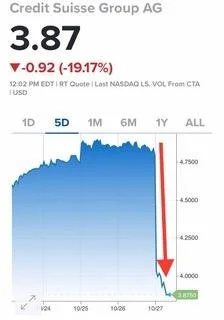
Credit Suisse shares fall off a cliff today, down 19%. CS announced a major restructuring and to lay off up to 9,000 employees.
This is what a (formally) global super bank failure looks like after years of financial mis-management and scandals. I expect more of these bank “restructures” in the coming months.
Courtesy of Dinar Guru
Sandy Ingram Big news and is one of the reasons we believe Iraq will come full circle and revalue their currency. Their actions say international connection. Article "Iraq is building the largest port in the Middle East and it will be one of the largest ports in the world when completed...rival the Suez Canal in Egypt...
Clare Article: "The House of Representatives grants confidence to the Sudanese cabinet" "Al-Sudani: Our cabinet has won the confidence of the House of Representatives"
************
(10/27) Very Close to the Finish Line!
Dinar Investor: 10-27-2022
(Alert!) Global Debt Market REMAINS UNSTABLE As Central Banks CONTINUE TO INFLATE!
Greg Mannarino: 10-27-2022
The Yen Is On Life Support: Japan’s Intervention Is FAILING!
Sean Foo: 10-27-2022
The Bank of Japan is intervening in the currency markets, trying to rescue the Yen from a crash. However, even though they have sold tens of billions of dollars to buy the Yen, it is not working.
Japan is trying to wrestle down inflation while trying to keep both its bond market and currency stable, but this won't work in the long run.
Japan is running out of time and this could force them to eventually pivot and hike rates or drain their reserves and still watch the Yen inflate away!
Who Owns the U.S. National Debt?
.Who Owns the U.S. National Debt?
Public debt and intragovernmental holdings
By Kimberly Amadeo Updated on October 4, 2022
The Social Security Trust Fund owns a significant portion of U.S. national debt, but how does that work and what does it mean? Below, we'll dive into who actually owns the U.S. national debt and how that impacts you.
Two Types of National Debt
The U.S. national debt crested $31.12 trillion in October 2022.1 The U.S. Treasury manages the U.S. national debt through its Bureau of Public Debt. The bureau classifies that amount into two broad types: intragovernmental holdings and debt held by the public.
Who Owns the U.S. National Debt?
Public debt and intragovernmental holdings
By Kimberly Amadeo Updated on October 4, 2022
The Social Security Trust Fund owns a significant portion of U.S. national debt, but how does that work and what does it mean? Below, we'll dive into who actually owns the U.S. national debt and how that impacts you.
Two Types of National Debt
The U.S. national debt crested $31.12 trillion in October 2022.1 The U.S. Treasury manages the U.S. national debt through its Bureau of Public Debt. The bureau classifies that amount into two broad types: intragovernmental holdings and debt held by the public.
Source: U.S. Department of the Treasury
Chart: The Balance Get the data Add this chart to your site
Intragovernmental Debt
The Treasury owes this part of the debt to other federal agencies. Intragovernmental holdings totaled more than $6.82 trillion in October 2022.1 Why would the government owe money to itself? Because some agencies, like the Social Security Trust Fund, take in more revenue from taxes than they need. These agencies then invest in U.S. Treasurys rather than stick this cash under a giant mattress,
This transfers the agencies' excess revenue to the general fund, where it's spent. They redeem their Treasury notes for funds as needed. The federal government then either raises taxes or issues more debt to raise the cash.
Source: Treasury
Chart: The Balance Get the data Add this chart to your site
Which agencies own the most Treasury notes, bills, and bonds? Social Security, by a long shot. The U.S. Treasury publishes this information in its monthly Treasury statement.
Social Security trusts, including the Federal Old-Age and Survivors Insurance and Federal Disability Insurance Trust Funds, held $2.75 trillion in Treasurys as of August 2022. The next largest agency was the Military Retirement Fund at $1.18 trillion. Other large holders of debt include the Office of Personnel Management Retirement, Medicare (which includes the Federal Supplementary Medical Insurance Trust Fund), then cash on hand to fund federal government operations.2
Public Debt
The public holds over $24.29 trillion of the national debt.1 Foreign governments hold a large portion of the public debt, while the rest is owned by U.S. banks and investors, the Federal Reserve, state and local governments, mutual funds, pensions funds, insurance companies, and holders of savings bonds.
The Treasury breaks down who holds how much of the public debt in a quarterly Treasury bulletin. Foreign and international investors held over $7.6 trillion, according to its September 2022 bulletin, which included data through March 2022. State and local governments held $1.45 trillion and mutual funds had $3.26 trillion.3
Other holders of the public debt include insurance companies, U.S. savings bonds, private pension funds, and other holders, including individuals, government-sponsored enterprises, brokers and dealers, banks, bank personal trusts and estates, corporate and non-corporate businesses, and other investors.4
Note
To continue reading, please go to the original article here:
https://www.thebalancemoney.com/who-owns-the-u-s-national-debt-3306124
Thoughts From Heresy Financial and Lynette Zang 10-27-2022
.The Fed is Hemorrhaging Billions of Dollars
Heresy Financial: 10-26-2022
The Federal Reserve is currently losing billions of dollars, whereas they used to have profits that they'd send back to the United States government.
This is causing many to be concerned about the solvency of the United States Central Bank, the Federal Reserve, and wondering whether the central bank that prints money might itself actually need a bailout.
The Fed is Hemorrhaging Billions of Dollars
Heresy Financial: 10-26-2022
The Federal Reserve is currently losing billions of dollars, whereas they used to have profits that they'd send back to the United States government.
This is causing many to be concerned about the solvency of the United States Central Bank, the Federal Reserve, and wondering whether the central bank that prints money might itself actually need a bailout.
Discussing Gold & CBDCs with Lynette Zang & Eric Griffin
10-26-2022
Viewer Questions:
Question 1: I have a loan with a variable interest rate. Will interest rates worldwide skyrocket eventually, therefore would it be wise to get fixed interest now when it is still low? How high do you think the interest will get?
Question 2: Given how the government has empowered itself to seize assets like Gold and silver in times of emergency, do you think it may prohibit the public selling of precious metals altogether in order to push everyone toward a CBDC?
Question 3: If gold is revalued at an extremely high price, how will dealers have enough fiat to buy the gold that people want to sell?
Question 4: In the future, if we moved to CBDC exclusively, would we be able to still buy gold and silver from dealers like ITM trading using the CBDC?
Question 5: You talk a lot about the IMF and BIS and reference their work in a lot of your videos. But I rarely hear you talk about the World Bank. What is World Bank? And do they play any part in this transition?
News, Rumors and Opinions Thursday Morning 10-27-2022
.RV Excerpts and Rumors from the Restored Republic via a GCR: Update as of Thurs. 27 Oct. 2022
Compiled Thurs. 27 Oct. 12:01 am EST by Judy Byington
Global Currency Reset:
The Quantum Financial System was live and Dubai 1 funding has been released. Historic, Golden Dragon, Yellow Dragon and German Bonds were all being paid out with a goal to finish by Thanksgiving.
By Thurs. 27 Oct Dubai 1 would be fully paid out and funding from Dubai 2 would be released.
Bond Holders expected to have access to their monies by Thurs. 27 Oct.
High up sources were saying we in Tier4B (the Internet Group) should be notified by email to set redemption/ exchange appointments of foreign currencies and Zim Bonds by sometime Thurs. 27 Oct., while MarkZ said notification could come after the Midterm Election (providing it is held) on Tues. 8 Nov.
RV Excerpts and Rumors from the Restored Republic via a GCR: Update as of Thurs. 27 Oct. 2022
Compiled Thurs. 27 Oct. 12:01 am EST by Judy Byington
Global Currency Reset:
The Quantum Financial System was live and Dubai 1 funding has been released. Historic, Golden Dragon, Yellow Dragon and German Bonds were all being paid out with a goal to finish by Thanksgiving.
By Thurs. 27 Oct Dubai 1 would be fully paid out and funding from Dubai 2 would be released.
Bond Holders expected to have access to their monies by Thurs. 27 Oct.
High up sources were saying we in Tier4B (the Internet Group) should be notified by email to set redemption/ exchange appointments of foreign currencies and Zim Bonds by sometime Thurs. 27 Oct., while MarkZ said notification could come after the Midterm Election (providing it is held) on Tues. 8 Nov.
For the special higher rates you must set an appointment to exchange foreign currencies at a Redemption Center and only during a limited amount of time.
At any time the General Public could exchange foreign currencies at a bank while being offered the lower Forex rates present on the bank screen at the time of exchange.
Global Financial Crisis:
Chinese Banks Dump Fiat US Dollar: https://www.zerohedge.com/markets/chinas-yuan-soars-most-record-after-beijing-orders-banks-dump-dollars
Read full post here: https://dinarchronicles.com/2022/10/27/restored-republic-via-a-gcr-update-as-of-october-27-2022/
************
Courtesy of Dinar Guru
Pimpy They've already made it clear as day they were going to change the rate. As a matter of fact even Sadr, one of his campaign promises was to change the rate at least back to the old rate. We more likely are going to see the rate change go back to 1190 dinars to start with and then over time slowly build back up.
Bruce [via WiserNow] ...we're getting from the sources that are very high up and very close...to the transaction itself, of our exchanges are saying that we in tier 4B...that's our internet group - should be notified...before noon tomorrow [Wednesday]...if it's late coming in tomorrow for some reason, we would set appointments and start Thursday... I'm excited about that. But the good news is we are hearing from Iraq...certain transactions...the rates are moving up - and we know that certain Iraqi citizens are being able to exchange through ATMs even here in the United States...I think that shows that we're very close ourselves.
***************
Tishwash: The World Bank: The crises of developing countries are exacerbated by the decline of their currencies
from Iraq's news
The World Bank has warned that currency depreciation in most developing economies may cause food and fuel prices to rise in a way that may exacerbate the food and energy crises that many of these countries are already witnessing.
The World Bank, in its latest issue of the "Commodity Market Outlook" report, indicated that "prices of most commodities measured in dollar terms have retreated from their peak levels due to fears of an imminent global recession."
He added that "since the Ukraine crisis in February 2022 until the end of last month, the price of Brent crude oil, denominated in US dollars, decreased by about 6 percent," but "due to the depreciation of currencies, nearly 60 percent of emerging market and developing economies that import oil witnessed an increase in oil prices in the local currency." During this period, about 90 percent of these economies also experienced a greater increase in wheat prices in local currencies than the increase in prices in US dollars.
He pointed out that "the rise in the prices of energy commodities, which is one of the requirements of agricultural production, leads to a rise in food prices."
During the first three quarters of 2022, the average food price inflation rate in South Asia was more than 20 percent, while the food price inflation rate in other regions, including Latin America and the Caribbean, the Middle East and North Africa, sub-Saharan Africa, Eastern Europe and Asia On average, it ranged between 12 and 15 percent.
He pointed out that East Asia and the Pacific "was the only region in which the rate of food price inflation decreased, partly due to the generally stable prices of rice, the staple food in the region."
Commenting on the report, Pablo Saavedra, World Bank Vice President for Equitable Growth, Finance and Institutions, said that "although many commodity prices have retreated from their peak levels, they are still high compared to their averages over the past five years."
He added, "If there is another jump in global food prices, it may prolong the challenges of food insecurity in various developing countries," stressing the need to "adopt a set of policies in order to enhance supply supplies, facilitate distribution and support real incomes."
He highlighted that "it is expected that oil prices will decline by 11 percent in 2023 after rising by about 60 percent in 2022," but that "despite this decline, energy prices next year will be 75 percent higher than their average in the past five years."
In this context, Ayhan Kosei, Chief Economist for Equitable Growth, Finance and Institutions and Director of the World Bank's Development Prospects Group, which publishes the "Commodity Market Outlook", said that "the combination of high commodity prices and the continued depreciation of currencies leads to an increase in inflation rates in many of countries".
He pointed out that "policy makers in emerging and developing economies have only limited scope to manage the most visible global inflation cycle in decades," stressing that "they must be slow and careful in defining their monetary and fiscal policies, clearly articulating their plans, and preparing for a period that may witness more inflation." Fluctuations in the global financial and commodity markets.
With regard to the prospects for commodity prices, the report said that higher energy product prices than the expected level may “prolong inflationary pressures” as it leads to higher prices for commodities other than energy products, especially foodstuffs, which exacerbates “challenges related to food insecurity.”
"If the slowdown in global growth rates intensifies, it may also entail significant risks, especially on crude oil and metal prices," he added.
He explained that concerns about a possible global recession next year "really contributed to a sharp decline in copper and aluminum prices," adding that "price volatility is likely to continue as the steps of the energy transition unfold and demand changes from fossil fuels to renewable energy sources, which is beneficial on some metal producers.
He pointed out that "minerals exporters may benefit the most from the opportunities for growth in the medium term," noting that at the same time "they can reduce the repercussions of price volatility by adopting well-designed frameworks for fiscal and monetary policies." link
Fed Folds With a Soft Pivot - Ep 850
Peter Schiff: 10-26-2022
· Interest rates are the Achilles’ heel of this bubble economy.
· Shelter costs are going up, even if housing prices are going down.
· Gold will be gaining value as the dollar loses value.
Don't Be SHOCKED If After The Midterm Elections ALL HELL BREAKS LOOSE.
Greg Mannarino: 10-26-2022
Are We Heading Into a Recession? How Bad Would It Be?
.Are We Heading Into a Recession? How Bad Would It Be?
Your Questions Answered: Timely personal finance inquiries, resolved
By Diccon Hyatt Updated on April 8, 2022
The Balance is here to help you navigate your financial life. To that end, we track the money-related questions you most search on Google so we know what’s on your mind. Here are the answers to some of your most recent inquiries.
Are We Heading Into A Recession?
It depends on whom you ask—some economists think a recession sometime in the next couple of years is pretty certain, while others think it’s much less likely.12 Many opinions are somewhere in between, putting the chances at around 30% in some cases. Here are their arguments.
Are We Heading Into a Recession? How Bad Would It Be?
Your Questions Answered: Timely personal finance inquiries, resolved
By Diccon Hyatt Updated on April 8, 2022
The Balance is here to help you navigate your financial life. To that end, we track the money-related questions you most search on Google so we know what’s on your mind. Here are the answers to some of your most recent inquiries.
Are We Heading Into A Recession?
It depends on whom you ask—some economists think a recession sometime in the next couple of years is pretty certain, while others think it’s much less likely.12 Many opinions are somewhere in between, putting the chances at around 30% in some cases. Here are their arguments.
In the first camp are those who think the Federal Reserve’s inflation-fighting campaign is what will send the economy into a recession. (That’s a period when economic activity declines significantly for more than a few months, according to a widely used definition by the National Bureau of Economic Research (NBER), the nonprofit research organization that officially calls the shots on U.S. recessions.)
The Fed has launched a series of increases to its benchmark interest rate in an effort to raise borrowing costs, slow down the economy, and bring today’s soaring inflation under control by rebalancing supply and demand. But pessimistic forecasts show the rate hikes dragging the economy down so much that it causes a recession.
Not only that, but there’s one indicator, which has proven to be a reliable predictor of recessions in the past, that’s flashed a warning sign. It’s the “inverted yield curve,” in which investors do something they don’t normally do: push the yields on shorter-term Treasury bonds higher than longer-term ones. Every time that’s happened in recent history, a recession has followed, and the yield curve did indeed invert for a couple days in early April.
Counterintuitively, some economists also see the plentiful jobs and rising wages of today’s labor market as a bad sign. Harvard economist Lawrence Summers, a former Treasury secretary, recently wrote a paper pointing out that every time since 1955 that the unemployment rate has been as low as it is now, and wages have been rising as fast as they are, a recession has followed.3
On the other hand, some point to that same robust job market as evidence that the economy is strong enough to withstand a few interest rate hikes, making a recession less likely, and argue that the unusual pandemic circumstances make the inverted yield curve a less predictable indicator this time around. Fed Chair Jerome Powell has acknowledged it will be a challenge to quell inflation without crushing the economy, but is optimistic that it can be done.4
How Bad Will The Next Recession Be?
To continue reading, please go to the original article here:
https://www.thebalancemoney.com/are-we-heading-into-a-recession-how-bad-would-it-be-5225360
Bill Holter, Robert Kiyosaki and George Gammon "Warnings" 10-26-2022
.This Is The End Of The System; You're On Your Own | Bill Holter
Liberty and Finance: 10-26-2022
Demand for physical metal has been extreme, almost completely wiping out wholesalers and depleting the major exchanges' reserves. "I would be surprised if there is metal available for fiat [currency] by the end of the year," says Bill Holter, contributor at JSMineSet.
He believes a major economic crisis is ahead.
The coming crisis is not a cyclical event, he notes. "This is the end of the system as we knew it."
This Is The End Of The System; You're On Your Own | Bill Holter
Liberty and Finance: 10-26-2022
Demand for physical metal has been extreme, almost completely wiping out wholesalers and depleting the major exchanges' reserves. "I would be surprised if there is metal available for fiat [currency] by the end of the year," says Bill Holter, contributor at JSMineSet.
He believes a major economic crisis is ahead.
The coming crisis is not a cyclical event, he notes. "This is the end of the system as we knew it."
"The Crash Will Be WORSE Than 1929..." - Robert Kiyosaki's Last WARNING
Reenvesting: 10-26-2022
Robert Kiyosaki warns about the biggest crash in world history, even more consequential than 1929.
The American Empire Will Collapse (This Is How It Ends)
The Rebel Capitalist: George Gammon: 10-26-2022
More News, Rumors and Opinions Wednesday PM 10-26-2022
.KTFA:
Samson: Founder of the world's largest hedge fund: The global economic system must be restructured
25th October, 2022
The founder and board member of the largest hedge fund in the world, Bridgewater Associates, Ray Dalio, stressed the importance of restructuring the global economic system and the existence of red lines in conflicts; To avoid world wars.
Dalio said, during the conference of the Future Investment Initiative, held in Riyadh today, Tuesday, over a period of 3 days, that global productivity will double, with the support of innovation, if this occurs in a peaceful environment.
"It is important to restructure the global economic system, and although I may be misunderstood at this point, the system is responsible for achieving and generating goals," Dalio added.
KTFA:
Samson: Founder of the world's largest hedge fund: The global economic system must be restructured
25th October, 2022
The founder and board member of the largest hedge fund in the world, Bridgewater Associates, Ray Dalio, stressed the importance of restructuring the global economic system and the existence of red lines in conflicts; To avoid world wars.
Dalio said, during the conference of the Future Investment Initiative, held in Riyadh today, Tuesday, over a period of 3 days, that global productivity will double, with the support of innovation, if this occurs in a peaceful environment.
"It is important to restructure the global economic system, and although I may be misunderstood at this point, the system is responsible for achieving and generating goals," Dalio added.
He pointed out that there are great risks of global wars, and when dealing with these risks there must be red lines, and if they exist, we will not reach wars.
And Dalio added: “There are many good things happening around the world, including innovation, where there is a huge amount of innovation happening right now, and if it happens in a safe and reassuring environment, productivity will double, so I agree on the importance of having empathy, understanding and agreement, I don’t know who will lead this but I hope that will happen soon."
The activities of the "Future Investment Initiative Conference", in its sixth edition, were launced today, Tuesday, October 25, 2022 under the slogan "Investing in Humanity", which will last for 3 days. LINK
****************
Samson: Russian-Iraqi Oil Ties "Only Getting Stronger"
25th October, 2022
More than 100 representatives of leading Iraqi and Russian businesses took part in the Russian-Iraqi Business Forum in Moscow last week.
According to a press release from The Chamber of Commerce and Industry of the Russian Federation, the Ambassador of Iraq in Moscow, Mr. Abdurakhman Al-Husseini, told delegates that Iraq is open to the development of business relations in all areas. This is not only the oil industry, but also various areas of industry, trade, and healthcare. The Iraqi ambassador also reminded that any Russian can apply for a visa at the airport upon arrival in Iraq.
The President of the Federation of Iraqi Chambers of Commerce and Industry, Abdurazzak Al-Zuheiri, speaking on behalf of the head of the Iraqi delegation, said there was a great desire to promote and strengthen Russian-Iraqi business relations, in particular, in the field of energy, construction, and food supplies.
Ali Warid, Director of the Technical Department of the Iraqi Oil Ministry, noted the long-standing Russian-Iraqi ties in the oil industry. According to him, they are only getting stronger, and most of the projects implemented by large Russian companies in Iraq are economically successful. Among the areas of development, Ali Varid outlined not only exploration, production, but also processing of oil and oil products.
Abbas Salim Hussein, Director of the Livestock Development Department of the Iraqi Ministry of Agriculture, spoke about the specifics of doing business in Iraq in his industry and called for developing cooperation in the poultry, meat, dairy and fish industries.
Aziz Nadim Al-Isa, director of the Industrial Development Department of the Iraqi Ministry of Industry, said that since 2003, the Iraqi economy has completely changed and has taken a course towards attracting investment in industry. The country is implementing 25 strategic technological development projects. He stressed that Iraq is interested in cooperation with Russia, primarily with high-tech companies.
Concluding the plenary part, Maksim Malyarchuk, Executive Director of the Russian-Iraqi Business Council at the Chamber of Commerce and Industry of the Russian Federation, spoke about the activities of the Council and assistance to Russian and Iraqi companies in the new conditions. In March, the Central Bank of Iraq banned settlements with the Russian Federation. But, despite this, according to Malyarchuk, today there are examples of direct deliveries from Russia to Iraq, and the issues of mutual settlements and logistics have been conceptually resolved.
Also, he noted the growth of requests from the Iraqi side and the interest in importing Russian products. LINK
************
Courtesy of Dinar Guru
MilitiaMan ...Look at the amounts of assets Iraq has. Not to mention the new electronic system in place is returning 100s of billions of dinars... All of this supports massive value for the exchange rate change success.. imo
Pimpy If I remember correctly they said they had no intentions on changing the exchange rate for 5 years. But that was back in February...What has changed since February? The government. Their intentions were to stay with the white papers, do the reform...Since then Maliki and the coordinating framework have taken control and they are building the government right now. That whole 'waiting 5 years' is out the door. We know this because we've seen articles within the past 2/3 weeks where they said they're going to change the exchange rate. We know they're going to do it. And it ain't going to be 5 years from now...
On The Brink Of Financial Collapse with Mario Innecco and Lynette Zang
10-25-2022
Ludwig von Mises said once you get into the inflationary route, eventually, people will realize that you won't be able to stop inflating, and then they will want to get rid of the currency. And I think we're very near that. At that stage, it's difficult to predict, but it could happen overnight
Chapters:
0:00 Introduction
5:41 Energy Crisis
10:00 Derivatives
19:50 A Need For Central Banks?
21:47 CBDC 27:04 Investing in Gold
36:14 Where is Store of Value
41:52 UK Real Estate
Japan Crisis Could Trigger Dollar Collapse (Here's How)
The Rebel Capitalist: George Gammon: 10-26-2022
Awake-In-3D Thoughts: "The Yen, The Euro, The USD and more.....10-26-2022
.Awake-in-3D: Japan Bond Market and the Yen Making a Last Stand
As I reported here, some months ago, that the Japanese Yen will be the first fiat currency to fall, we’re witnessing this unnecessary tragedy unfold on the world economic stage.
After spending over $50 Billion of her USD reserves, over the past 10 days, in a futile attempt to keep Japanese 10-year bond yields at a 2.5% limit, while also trying desperately to prevent the deepening free fall of the Yen against other major currencies, the stark and brutal reality of the debt-based fiat system is proving its predestined, unstoppable collapse.
The Yen will be first, then the Euro and/or the British Pound.
Awake-in-3D: Japan Bond Market and the Yen Making a Last Stand
As I reported here, some months ago, that the Japanese Yen will be the first fiat currency to fall, we’re witnessing this unnecessary tragedy unfold on the world economic stage.
After spending over $50 Billion of her USD reserves, over the past 10 days, in a futile attempt to keep Japanese 10-year bond yields at a 2.5% limit, while also trying desperately to prevent the deepening free fall of the Yen against other major currencies, the stark and brutal reality of the debt-based fiat system is proving its predestined, unstoppable collapse.
The Yen will be first, then the Euro and/or the British Pound.
@GCR_RealTimeNews
————————————
“Of course, with the entire Japanese financial experiment now counting down to extinction, at best Tokyo will buy itself a few months time, but as any terminal cancer patient will attest, those few last months are more valuable than anything.”
“While such a revolutionary reassessment may eventually happen, it won't be tonight because one day after the BOJ unleashed its biggest - and most futile - FX market intervention in history, selling some $50 billion in US reserve to buy worthless funny-money, it also offered to buy more bonds than planned at its regular market operation on Wednesday to continue the Kabuki theater that its YCC [Yield Curve Control] is still functioning.”
****************
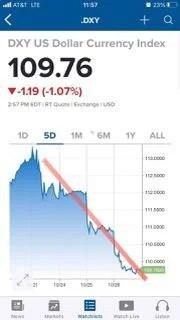
Awake-in-3D: Why has the US Dollar dropped 3.1% over the last 5 trading days?
Because Japan and China are selling US dollars (in slightly different ways) into the EuroDollar market in large quantities to raise save the value of the Yen and Yuan respectively.
Both Japan and China have tremendous dollar quantities (US Treasuries) to dump. Now, consider Iraq, they don’t have that many Dollars by comparison.
Therein lies the real reason Iraq cannot feasibly “raise the dollar exchange rate” (meaning strengthen the IQD) without the GCR General Redemptions being released.
@GCR_RealTimeNews
NEW RV/GCR FACT-BASED NEWS CHANNEL ON TELEGRAM
Awake-In-3D reports on “real world” financial events in the context of an emerging asset-backed Global Currency Reset as Central Banksters fight hard to preserve their collapsing Fiat Currency regime and dominance over humanity.
Providing unique commentary, backed by factual articles and reference links, the new "GCR Real-Time News" channel provides readers with a critical-thinking approach to world financial events documenting this historical financial Shift which is unfolding at this very moment.
Link to join: https://t.me/GCR_RealTimeNews
I don't sell products and this channel is not monetized. I'm not competing with other news sites. My only goal is providing Unique GCR commentary and analysis as a beneficial public service to GCR-Land.
Recession Dictionary: Your Guide to the Jargon
.Recession Dictionary: Your Guide to the Jargon
Here’s what terms like ‘soft landing’ and ‘inverted yield curve’ mean
By Diccon Hyatt Updated on April 12, 2022 Fact checked by Helen Reis
A few months ago, the fear of a U.S. recession seemed pretty far-fetched. Then inflation got even higher and Vladimir Putin ordered Russian troops into Ukraine, triggering talk of some pretty severe increases in benchmark interest rates, as well as sanctions and supply shortages that threaten to upend the global economy.
Now the word recession is being thrown around a lot, with some economists putting the odds in the 20% to 35% range within the next year or by the end of 2023.1
Recession Dictionary: Your Guide to the Jargon
Here’s what terms like ‘soft landing’ and ‘inverted yield curve’ mean
By Diccon Hyatt Updated on April 12, 2022 Fact checked by Helen Reis
A few months ago, the fear of a U.S. recession seemed pretty far-fetched. Then inflation got even higher and Vladimir Putin ordered Russian troops into Ukraine, triggering talk of some pretty severe increases in benchmark interest rates, as well as sanctions and supply shortages that threaten to upend the global economy.
Now the word recession is being thrown around a lot, with some economists putting the odds in the 20% to 35% range within the next year or by the end of 2023.1
So what exactly is a recession? And what do government officials, pundits and economists mean when they talk about a soft landing and the inverted yield curve? Here’s a guide for translating the jargon.
Recession
A recession is when activity declines significantly across broad parts of the economy for more than a few months, according to a widely used definition by the National Bureau of Economic Research (NBER), the nonprofit research organization that officially calls the shots on recessions.
In a recession, unemployment goes up, wages go down, and credit becomes harder to come by, damaging people’s lives both in the short and long terms. We had a brief recession when COVID-19 hit in the spring of 2020.2 Before that, there was the Great Recession from December 2007 through June 2009. It was the worst economic disaster since World War II, according to the government—sparked by a housing market collapse that decimated the financial system.3
You may have read that a recession is when real GDP (see definition below) shrinks two quarters in a row. Not necessarily. While recessions are often accompanied by that two-quarter downturn, the recession gurus at the NBER say that doesn’t always apply. Not only do they look at more than just GDP (for example, employment and industrial production statistics) when putting the “recession” label on an economic slowdown, but they look at the depth of the decline.4
So why is there an increased risk of recession now? Because the Federal Reserve has started to deliberately do things to slow down economic growth. It’s part of trying to bring inflation under control, and some people worry that too much of that too fast could actually lead to a decline in economic activity. (The Fed’s main tool is raising its benchmark interest rate to discourage borrowing, and in turn, spending.)
The war in Ukraine has made the Fed’s dilemma worse because sanctions against Russian exports have triggered a spike in oil, and in turn, gasoline prices, and threaten to disrupt the European economy and international trade with the U.S.
Inverted Yield Curve
There’s been a lot of talk lately among experts and pundits about the inverted yield curve flashing warning signs that a recession could be ahead. Here’s the jargon broken down piece by piece.
First, the “yield” part. In this case, the yield refers to yields on government debt, or Treasuries, meaning the expected return for investors factoring in the interest rate and how much they bought the bond for. Typically, the longer the term of the Treasury (how long the investor gets paid interest before their principal is returned,) the higher the yield. That’s because investors usually need to be compensated for the risk they’re taking by lending out their money for longer. In other words, it’s just plain harder to predict what the economy will be like 10 years out than two years out.5
To continue reading, please go to the original article here:
https://www.thebalancemoney.com/recession-dictionary-your-guide-to-the-jargon-5224220