“Tidbits From TNT” Saturday Morning 12-20-2025
TNT:
Tishwash: we already know this I'm not sure why they are telling us again but they are
An Iraqi bank switches to the global standard "SWIFT MX"
The National Bank of Iraq announced that it has successfully completed the transition to the new global standard " SWIFT MX " for financial messages, in a step that constituted a significant milestone in the bank's technological infrastructure modernization and enhanced readiness for digital transformation.
The bank said in a statement, “The implementation of this transformation comes as part of the bank’s transition from the old MT standard to the MX ISO 20022 model , which is the most advanced, structured and data-rich framework in the global financial messaging sector.
The transformation process was carried out across all operational channels with high efficiency and minimal downtime, reflecting the bank’s strong technical readiness, accurate planning, and commitment to providing its services without any significant interruption.”
He pointed out that "this transformation is an advanced step within the strategic roadmap of the National Bank of Iraq to modernize its systems, enhance its compatibility with global best practices, and provide an advanced digital banking experience for its individual and corporate clients."
For his part, the bank’s Chief Operating Officer and Deputy CEO, Aqeel Ezzedine, explained that “the smooth transition to the MX standard came as a result of a robust system of governance, teamwork and careful planning, and represents an important step in modernizing the payments infrastructure and enhancing the reliability and security of banking operations.”
Hani Khalil, head of the bank's transformation department, said that "achieving this transformation embodies the bank's commitment to keeping pace with the latest international standards in payment systems, and building a more transparent, integrated and high-quality financial data structure, which enhances the customer experience and strengthens the bank's position within the regional financial system."
The MX standard enables a more accurate and richer exchange of information in financial messages, with substantial improvements in transaction tracking and identification of parties, supporting global trends towards greater efficiency and transparency in payments. link
************
Tishwash: The torn currency: between the failure of paper circulation and the delay of digital transformation
The torn currency reveals a deeper flaw than the tearing of the paper, as it shows a cash management crisis, a delay in automation, and a weakness in replacement mechanisms, which makes the citizen the weakest link between banks that refuse, a market that punishes, and digital solutions that are not yet complete.
“No one will take it from me,” Zainab al-Khafaji, a government employee, whispered to herself, her voice thick with despair, as she strolled through the shops of Baghdad’s upscale Mansour district.
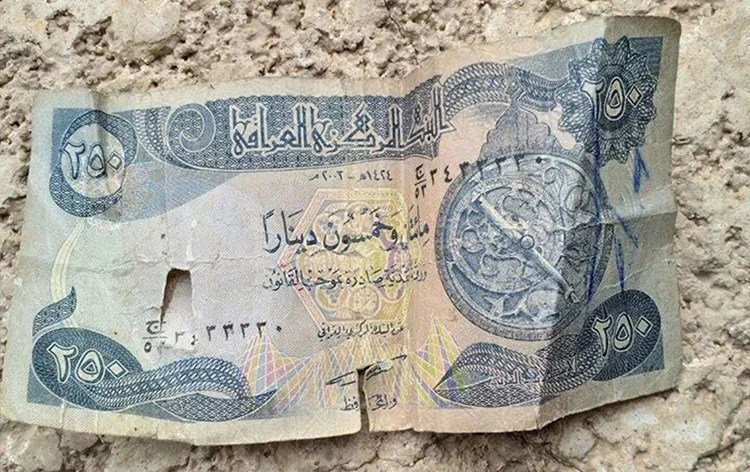
She clutched a five-thousand-dinar note that looked as if it had been through a war; it was tattered, its edges torn, and held together with a makeshift piece of tape.
Zainab says bitterly, “I don’t know who gave it to me while I was shopping in the crowded market, and when I tried to buy with it again, everyone refused it. Legally it is a national currency, but in the market’s view it is just a damaged piece of paper.”
Crisis of confidence in "small groups"
Zainab’s story is not an isolated case, but rather a reflection of the daily suffering experienced by millions of Iraqis, as worn-out paper currency, especially the small denominations (250, 500, 1000, 5000 dinars), has become a financial and psychological burden.
While worn-out currency is easy to trade in the Kurdistan Region or neighboring countries, citizens in central and southern Iraq face a popular and commercial “veto” on these papers.
Paper currency is subject to rapid deterioration, especially the smaller denominations, due to its frequent circulation and use by children in direct transactions between different shops and markets.
This is compounded by the lack of education from the Central Bank regarding the replacement of damaged currency at the bank, which has created an opening for unscrupulous individuals to take a percentage of the money in exchange for replacing damaged currency with new currency, sometimes reaching 50% of its value.
Black market for replacing damaged parts... commissions reaching 50%
This social “unacceptability” of the official currency opened the door for the emergence of a class of “weak-willed” people who exploited people’s needs and administrative complexities.
Due to poor education about central bank procedures, an illegal trade has emerged to exchange damaged currency for exorbitant commissions, sometimes reaching half the value of the amount.
Ali Al-Bahadli, a market owner, says: “Sometimes I have to leave my young son to manage the shop, and some people take advantage of his innocence and pass him quantities of small damaged denominations. At the end of the day, I find myself facing a financial loss for which I am not responsible. The only way out is for someone to come by from time to time and collect this (cash debris) in exchange for deducting a large percentage of its value, sometimes reaching 50%, so that he can later exchange it through his own means at the banks.”
As for Sobhi Hussein, a bus driver, he confirms that the banks themselves are contributing to the worsening of the crisis: “I have accumulated large amounts of 500 and 1000 denominations that are written on or torn. When I tried to deposit or exchange them in the banks, they were rejected outright, which forced me to sell them to exchange offices for a much lower value.”
Economic vision: The solution lies in "automation" and plastic currencies
Economic expert Dr. Hussein Al-Khaqani believes the crisis begins in the banks and ends in the streets. He says, “The central bank is the sole authority for issuing currency, but the refusal of some banks to accept damaged banknotes from merchants generates a defensive reaction from the public, causing them to stop using the currency for fear of losing its value.”
Al-Khaqani proposes a radical solution, which is to impose the use of electronic cards (Visa & MasterCard) on shops and gas stations, stressing that “the real application of automating transactions will reduce the amount of cash circulating manually, and protect the citizen from financial losses in small units.”
Other experts believe that solving this problem does not require additional resources, but rather a clear decision, strict implementation, and genuine coordination between the central bank, banks, and markets.
According to international reports, 15% of the money in circulation globally up to 2024 was printed using polymer material, which clearly contributed to reducing the percentage of torn money in the world.
Central Bank Guide: When to Accept Currency and When to Confiscate It?
Despite the public controversy, the Central Bank of Iraq has clear instructions aimed at protecting the value of the currency, which are as follows:
If the banknote is worn out or damaged even though it is not torn and no parts of it are missing, or if the banknote is made up of two parts (different numbers) and its area is close to the area of the original banknote and it is attached with adhesive tape, or if the banknote is attached with one or more transparent adhesive tapes along its length or width, or if the banknote has a cut in more than one corner.
Or if the banknote is defective in printing (in terms of design, size, color, or other security features that a genuine banknote has), or contains stamps or writings that do not affect its external appearance, or if the banknote has lost less than 50% of its area.
However, the Central Bank confirmed the confiscation of damaged banknotes that are not fit for circulation if changes have been made to the external appearance of the banknote as a result of writing, drawing, printing, stamps, or if it contains an adhesive substance, or if the banknote has lost 50% or more of its area, or if it is made up of two parts on one side.
If there is evidence that convinces the central bank that the missing parts of the papers have been completely destroyed, they will be partially or fully compensated. link
Tishwash: At Christmas Party, Trump Publicly Acknowledges U.S. Envoy to Iraq
Trump praised U.S. Envoy to Iraq Mark Savaya at a White House Christmas event, as the U.S. President praised sweeping first-year achievements.
A brief but pointed acknowledgment by U.S. President Donald Trump of America’s envoy to Iraq, Mark Savaya, during the White House’s 2025 Christmas party has drawn attention in diplomatic and political circles, symbolizing both personal rapport and the broader confidence projected by the administration as it declares sweeping domestic and international achievements.
In a post on X dated Dec. 19, 2025, Savaya publicly thanked President Trump for recognizing him during the White House Christmas gathering, writing: “President Trump, thank you for your kind acknowledgment at the 2025 White House Christmas party. You are truly the greatest president this country has ever had. Merry Christmas and may God bless you and the United States of America.”
The post was accompanied by a video capturing the moment in which President Trump acknowledged Savaya among a select group of invited guests, offering praise in front of the assembled audience.
The exchange occurred during what President Trump described as a particularly exclusive and tightly attended event.
Addressing the crowd, the president reflected on the significance of the gathering, noting that the Christmas party was “the toughest invitation,” emphasizing that attendance was limited and that those present held “special significance.”
Within that context, Trump called out Savaya by name, remarking, “Mark Savaya. Hey Mark! You’re looking good,” before continuing to recognize others in attendance and expressing pride in those gathered.
The moment, though brief, was emblematic of the administration’s broader messaging during the holiday season—an effort to project unity, loyalty, and confidence as the White House closed out its first year in office.
Savaya’s public response, effusive in its praise of the president, underscored the personal dimension of that acknowledgment and highlighted the envoy’s visibility within the administration at a time of heightened focus on U.S. foreign policy in the Middle East.
Mark Savaya @Mark_Savaya
President Trump, thank you for your kind acknowledgment at the 2025 White House Christmas party. You are truly the greatest president this country has ever had. Merry Christmas and may God bless you and the United States of America. link
Mot: To Save YOU Time!!!

Mot: Just as Mary is exhausted ~~~~