
What Is A Money Story And How Can It Affect Your Finances?
.What Is A Money Story And How Can It Affect Your Finances?
If I had more money, ____ wouldn’t be a problem. I work hard. I deserve that new _____.
I’ll never be able to pay off this debt. I can’t earn enough to get ahead.
I need X amount of money to have peace of mind. I’m a cheapskate.
Spending money on things for yourself is selfish.
Money can elicit a whole slew of feelings: shame, pride, guilt, stress, and more. And, more often than not, these feelings about money stem from your childhood.
Even if the adults in your life didn’t openly discuss money as you were growing up, you still picked up on how it was handled in your family.
What Is A Money Story And How Can It Affect Your Finances?
If I had more money, ____ wouldn’t be a problem. I work hard. I deserve that new _____.
I’ll never be able to pay off this debt. I can’t earn enough to get ahead.
I need X amount of money to have peace of mind. I’m a cheapskate.
Spending money on things for yourself is selfish.
Money can elicit a whole slew of feelings: shame, pride, guilt, stress, and more. And, more often than not, these feelings about money stem from your childhood.
Even if the adults in your life didn’t openly discuss money as you were growing up, you still picked up on how it was handled in your family.
Maybe there was a traumatic event, like a job loss, death, or divorce. Or perhaps it was things such as extreme frugality or spending, parents arguing about money, or a feeling of tension about paying the bills.
All these experiences combined to form your money story (or money scripts, as some call them).
Your money story was written, whether you realized it or not. And you carry your money story from the past into your adult life.
your life and money story in a book
![your-money-story-650x325[1].jpg](https://images.squarespace-cdn.com/content/v1/5d5222a44813620001d89582/1588810041029-UUIUWV1EVMLVVV1C0LB3/your-money-story-650x325%5B1%5D.jpg)
By better understanding your story, you can take steps to improve your financial future.
Below we’ll explain what a money story is and how it can affect your finances. We’ll also discuss how you can identify your money script and create a new one.
What is a “Money Story”?
A money story is a personal narrative about money. It makes up your beliefs, thoughts, and feelings about money – and affects your financial behaviors. Money stories are often generational and culturally based.
Your money story started forming in early childhood. It passed down to you from parents and other influences in your young life.
As a child, you observed the adults in your life – even when they didn’t know you were paying attention.
To continue reading, please go to the original article here:
What Worked (And Didn’t Work) During 1970s Stagflation
.What Worked (And Didn’t Work) During 1970s Stagflation
Notes From The Field By Simon Black May 5, 2020 Bahia Beach, Puerto Rico
When the New York Stock Exchange opened for trading on January 2, 1970, the Dow Jones Industrial Average was at 809 points. It was the start of a new decade, and expectations were high.
Consumer confidence was high, the economy was strong, and NASA had just put a man on the moon only a few months prior.
America was ready to move on from the tumultuous 1960s and was looking forward to a boom in the 1970s.
But that didn’t happen.
Over the next 10 years, the US economy would suffer its most painful episode since the Great Depression.
The 1970s were hit by a nasty bout of stagflation-- a period of high unemployment, high inflation, higher taxes, higher debt levels, and pitiful economic growth.
It’s one of the worst fates an economy can suffer. But it lingered in the US for years.
What Worked (And Didn’t Work) During 1970s Stagflation
Notes From The Field By Simon Black May 5, 2020 Bahia Beach, Puerto Rico
When the New York Stock Exchange opened for trading on January 2, 1970, the Dow Jones Industrial Average was at 809 points. It was the start of a new decade, and expectations were high.
Consumer confidence was high, the economy was strong, and NASA had just put a man on the moon only a few months prior. America was ready to move on from the tumultuous 1960s and was looking forward to a boom in the 1970s.
But that didn’t happen.
Over the next 10 years, the US economy would suffer its most painful episode since the Great Depression.
The 1970s were hit by a nasty bout of stagflation-- a period of high unemployment, high inflation, higher taxes, higher debt levels, and pitiful economic growth.
It’s one of the worst fates an economy can suffer. But it lingered in the US for years.
Inflation peaked above 10% in the 1970s. Unemployment was around 8%. ‘Underemployment’ was nearly 20%, i.e. people who wanted a full-time job but were only able to find part-time work.
And most traditional financial investments suffered too.
Bond investors were destroyed by inflation; anyone who purchased a US government 10-year Treasury in the early 1970s earned just 5.5%, well below the rate of inflation.
And the stock market produced dismal returns.
Remember-- the Dow Jones Industrial Average opened in 1970 at 809 points. At the close of the decade in December 1979, the Dow was worth just 839 points-- almost no gain.
And when adjusted for inflation, stock market investors LOST about 49% during the 1970s.
It was a brutal time to be an investor in mainstream assets.
But people who invested in REAL assets did quite well.
Consider farmland, for example: according to the US Department of Agriculture, the average price of US farmland in 1970 was $137 per acre.
In ten years, farmland had risen to $737 per acre-- a hefty return averaging more than 14% per year.
Investors who purchased farmland with a modest amount of leverage (i.e. a 30% down payment and a bank loan for the remaining 70%) earned a 24.7% average annualized return throughout the 1970s.
And that doesn’t include what they earned from their crops either.
Beef prices more than doubled in the 1970s. Corn prices nearly tripled. Wheat prices quadrupled.
Even after adjusting for inflation, agricultural commodities and real estate produced very strong returns and were among the best performing assets of the decade.
Residential real estate, however, was a mixed bag.
In some parts of the US, residential real estate as an asset class performed very well in the 1970s.
California real estate, for example, tripled in value during the decade as the state’s population exploded.
The population in counties like El Dorado (near the state capital of Sacramento) and Santa Cruz (south of San Francisco) grew at nearly 3x the national average, and home prices soared.
But in other parts of the country, residential real estate was a dismal investment as local governments imposed rent control, limiting how much a landlord could charge.
Reduced rents meant depressed property prices. So residential real estate was a very uneven asset class.
You won’t be surprised to learn that gold and silver also generated phenomenal returns during the 1970s.
Gold opened the decade at a price of $36.56-- the official US government price.
Back then the US dollar was still pegged to gold at that price. But by the end of the decade, the US dollar was officially a ‘fiat’ currency and no longer backed by gold.
By late 1979, the gold price had risen to more than $400, so gold investors made 10x their money during the decade.
And SILVER actually outperformed gold, rising from less than $2 in 1970, to more than $30 at the end of 1979-- a gain of more than 15x over the decade.
There are plenty of other examples, but the larger point is that real assets generally produced strong returns during one of the worst periods in US economic history.
Now, it would be ridiculous to say that the 2020s will be exactly like the 1970s.
As I’ve written multiple times before, it’s important to approach everything about this pandemic from a position of ignorance and uncertainty.
There are very few things we know for sure. One of them, however, is that they’re printing an enormous amount of money and going deeper into debt.
The US Treasury Department just announced yesterday that they plan on borrowing a record $3 TRILLION this quarter alone.
And who knows how much more they’ll borrow for the rest of the year.
Plus the Fed has already printed $2.5 trillion just in the last sixty days.
These are already incomprehensible sums of money, but it looks like they’re just getting warmed up. There’s likely a lot more debt and money printing to come.
So while we can’t say for certain what’s going to happen next-- stagflation, deflation, inflation, etc., it’s historically been a good idea to own real assets when the debt machine and printing presses are running like this.
PS- We think that silver has the potential to outperform gold by a large margin, though it's really difficult to purchase right now because investors are 'panic buying' silver and paying exorbitant prices for it.
But we recently sent a special report to members of our premium service Sovereign Man: Confidential explaining how to use the futures market to buy silver at an ENORMOUS discount to what everyone else is paying. Click here to learn more about this strategy and why silver is so compelling right now. LINK
To your freedom & prosperity, Simon Black, Founder, SovereignMan.com
https://www.sovereignman.com/trends/what-worked-and-didnt-work-during-1970s-stagflation-27738/
Good News And Bad News From Warren Buffett
.Good News And Bad News From Warren Buffett
Posted by TEBI on May 4, 2020
The world’s most famous investor Warren Buffett spoke at length at the weekend. Now aged 89, Buffett was addressing an online version of the annual meeting of his firm, Berkshire Hathaway. He talked about stocks, the economy and of course the coronavirus crisis.
Some commentators have suggested that Buffett was more downbeat than he has been in the past. He certainly had bad news as well as good. But, as Andrew Ross Sorkin commented in the New York Times, it’s more accurate to say he was neither pessimistic nor optimistic but realistic.
Particularly noticeable was how often Buffett repeated the words, “I don’t know”. That’s right, Warren Buffett, the most successful investor of the modern era, doesn’t know how this crisis will unfold. Yet there are plenty of experts in the media offering their opinions.
Good News And Bad News From Warren Buffett
Posted by TEBI on May 4, 2020
The world’s most famous investor Warren Buffett spoke at length at the weekend. Now aged 89, Buffett was addressing an online version of the annual meeting of his firm, Berkshire Hathaway. He talked about stocks, the economy and of course the coronavirus crisis.
Some commentators have suggested that Buffett was more downbeat than he has been in the past. He certainly had bad news as well as good. But, as Andrew Ross Sorkin commented in the New York Times, it’s more accurate to say he was neither pessimistic nor optimistic but realistic.
Particularly noticeable was how often Buffett repeated the words, “I don’t know”. That’s right, Warren Buffett, the most successful investor of the modern era, doesn’t know how this crisis will unfold. Yet there are plenty of experts in the media offering their opinions.
Ultimately, as Buffett’s friend, the late Jack Bogle, liked to say, “nobody knows nothing”. If there was ever a time for investors to stay humble, surely this is it.
Bad News
The current situation is unparalleled
In 2008 and 2009 our economic train went off the tracks. This time we just pulled the train of the tracks and put it on a siding. And I don’t really know of any parallel — in terms of the most important country in the world, most productive, huge population — in effect sidelining its economy and its workforce.
Nobody knows how the crisis will play out
We’re not getting a best case and we know we’re not getting a worst case. The range of possibilities is still extraordinarily wide. We do not know what exactly happens when you shut down a substantial portion of your society.
Anything can happen in the markets
Perhaps with a bias, I don’t believe anyone knows what the market is going to do tomorrow, next week, next month, next year. I know America’s going to move forward over time, but I don’t know for sure. Anything can happen in terms of markets. You’re going to have to be careful about how you bet.
… Good News
Nothing can stop America
To continue reading, please go to the original article here:
https://www.evidenceinvestor.com/good-news-and-bad-news-from-warren-buffett/
The Ones Most Responsive to Change
.The Ones Most Responsive to Change
By Muhammad Ali
IF YOU FAIL TO PLAN, YOU PLAN TO FAIL
Benjamin Franklin supposedly once said, “If you fail to plan, you are planning to fail.” Sir Winston Churchill is credited with another, oft repeated, saying: “Those who fail to learn from the past are doomed to repeat it.” And along that same vein there’s the phrase we hear often in the workplace, “learn from your mistakes.”
The questions that I have for you today are more about the odds. Alright let me elaborate on this. If you fail to plan, does that mean you will definitely fail? What are the odds of this happening?
And the other side, if you plan, does that mean you will not fail? What are the odds of this happening?
The Ones Most Responsive to Change
By Muhammad Ali
IF YOU FAIL TO PLAN, YOU PLAN TO FAIL
Benjamin Franklin supposedly once said, “If you fail to plan, you are planning to fail.” Sir Winston Churchill is credited with another, oft repeated, saying: “Those who fail to learn from the past are doomed to repeat it.” And along that same vein there’s the phrase we hear often in the workplace, “learn from your mistakes.”
The questions that I have for you today are more about the odds. Alright let me elaborate on this. If you fail to plan, does that mean you will definitely fail? What are the odds of this happening?
And the other side, if you plan, does that mean you will not fail? What are the odds of this happening?
I think it's pretty obvious to ascertain a conclusion on the above based on the several articles that I have written, about Sudden Wealth Syndrome and that statistically 70% of people lose their wealth within 2 years and we know that 85% of the millionaires created from the Kuwaiti rise in value were broke in 5 months. So let's refine our question and ask, did any of those people who planned yet they still failed?
Having a plan is one thing, but it is completely useless and a waste of time if you do not put it into action. Statistics say 90% of strategy fails because of poor execution. This I am sure that everyone is in agreement.
So what is clear is that we want to be among those who planned and succeeded. We don't want to plan and still fail, right? We've definitely waited long enough to think about all kinds of plans from A-Z. So how can we make sure that we find the right plan that will guarantee us long term success?
I for one don't want to be in the after RV enjoyment mood for only 2 years. Wouldn't you agree?
I have also written articles about forming a Team and I have even created an entire section dedicated to help you in forming your Team in my new Currency Exchange Planner Companion Edition. I said your Team should consist of a High Net worth Lawyer, Financial Planner/Advisor, Wealth Manager and a CPA just to name a few, but will having a Team of professionals increase our odds of success?
Yes, it most certainly will, but will it guarantee us that we will not fail long term? So again, we're playing the odds, we want to be sure that we are within that 15%-30% group category that will not only be successful, but we will be successful for 20, 30, 40, 50+ years. Now, we're getting into generational wealth. That is our goal.
As Charles Darwin famously said, “It’s not the strongest, who survive, nor the most intelligent, but the ones most responsive to change.”
Now, I don't like this guy, as he's got other theories that I am totally against, however, I think he has something in his statement above that we need to ponder over. As we begin our exchanges and new lives, it will be your responsiveness that makes or breaks you, in other words we need to be able to adapt to change.
Your plan will change as the environment changes around you, you may need to adapt to new circumstances as you will test different ideas or things, learn new things, find new technologies, and even meet new people. Breathe a little life into your plan, make it adaptable to any environment, any circumstances. So, let's keep our focus on the 'ones most responsive to change'.
God has told us to look out into His Creation to gain inspiration, so what if we take this to Nature, and the animal world?
When we think of the most adaptable species, what comes to mind? Camels are able to survive without food or water for months, cockroaches are said to have survived the atomic bombs on Hiroshima and Nagasaki in World War II, and Emperor Penguins are able to make journeys 60+ miles long with their last meal being four months earlier. All of these species are very well suited towards their particular environment, but if one were to put a camel in Antarctica, or an emperor penguin in the Gobi Desert, they would not survive for very long.
Adaptability is defined as the ability to adjust oneself readily to different conditions, so while these previously listed species may be able to survive in extreme conditions, they are poorly suited for other environments.
The only creature on earth that would come close to our adaptability would be the Tardigrade, also known as the water bear. These are very SMALL animals (0.05 mm – 1.2 mm long). Tardigrades are able to survive insane environments from close to absolute zero; to pressure that is far greater than the deepest parts of the ocean.
Take a look at this video for an understanding of them:
https://www.youtube.com/watch?v=IxndOd3kmSs
https://www.youtube.com/watch?time_continue=1&v=IxndOd3kmSs&feature=emb_logo
What Tardigrades lack, though, is intelligence this is the difference between us and them. Humans are able to form complex social structures and relationships with each other. Social structures are seen in many other primates and species which help them all to hunt better and defend themselves.
Humans could not have individually gotten to where we are today without the help from others. Just like the saying goes, team work makes the dream work!
So let's put this all together and formulate these concepts into our planning. We need to be responsive to change (adapt), do not let things change around you without you being aware of it. That's one. Two, there may be some wisdom in keeping things in a small controlled state. The Tardigrades have survived 500 million years and maybe one of those reasons was due to its size.
Now, I am not saying that after the RV, you can't move out of your 3 bedroom apartment to a new 10 bedroom bungalow, not at all, but what I am saying is that make sure you keep everything around you in a controlled state. You keep control, you maintain the control. Three, don't be afraid to get help from your Team.
However, do not rely on them to make your final decisions, they have knowledge and they have experiences, but rely on yourselves and that may require educating yourselves to better grasp the knowledge that they may impart onto you.
And last but not least, impart the same knowledge of your planning to your children and educate them so you all live under the same philosophy. And maybe write this saying on your computer screen wall paper or what the heck write it on your wall.
“It’s not the strongest, who survive, nor the most intelligent, but the ones most responsive to change.”
To play the odds, you must first have a solid plan and my Currency Exchange Planner can help you with that. It is designed to help you with your immediate RV exchange.
My Companion Edition is designed to help plan your wealth for 15 years and more. So together that helps to put you in the winning percentage, after that it depends upon how responsive to change are you?
I hope you have benefited from my article.
Thank you and I wish you all the success in your currency exchange.
Muhammad Ali www.CurrencyExchangePlanner.com
How Inflation Affects Growth Versus Value
.How Inflation Affects Growth Versus Value
By Ben Carlson Posted by TEBI on May 3, 2020
It seems bizarre to worry about inflation during the sharpest, more severe economic contraction of our lifetime.
But the sheer amount of government spending and monetary policy being instituted by the Federal Reserve means it’s something that’s on people’s mind as a potential risk in the not-too-distant future. The “worry” is once the virus is contained the economy could potentially overheat through a combination of pent up demand and government spending.
My initial read on this is if we do get inflation from all of this spending that’s a good thing — it means we beat the virus and things are back to normal (if there is such a thing).
The Fed would have a much easier time fighting inflation than the current predicament.
How Inflation Affects Growth Versus Value
By Ben Carlson Posted by TEBI on May 3, 2020
It seems bizarre to worry about inflation during the sharpest, more severe economic contraction of our lifetime.
But the sheer amount of government spending and monetary policy being instituted by the Federal Reserve means it’s something that’s on people’s mind as a potential risk in the not-too-distant future. The “worry” is once the virus is contained the economy could potentially overheat through a combination of pent up demand and government spending.
My initial read on this is if we do get inflation from all of this spending that’s a good thing — it means we beat the virus and things are back to normal (if there is such a thing).
The Fed would have a much easier time fighting inflation than the current predicament.
Here’s former Fed chair Janet Yellen in the Wall Street Journal discussing this idea:
Bigger federal borrowing needs will make it costly for the Treasury should interest rates eventually rise. “If the economy recovers and inflation is a problem, that will be the test,” says former Fed Chairwoman Janet Yellen. That isn’t a problem now. If it ever is, she says, “I think the Fed is going to win out on that.”
You have to be thinking 12 moves ahead to start planning for higher inflation at this point but there are likely some areas of the market that would benefit more from an inflationary spike than others.
Earlier this week I posited that low interest rates may be the simplest explanation for the stock market’s resilience. A few people pushed back with the fact that rates have been low in Japan and Europe as well and their markets haven’t been quite as strong.
Japan is on another planet when it comes to market relationships in general but there is an explanation for this. Because of the differences in the sector make-up of the underlying markets, U.S. stocks are more heavily weighted towards growth stocks while European and Japanese stocks are more in the value camp.
In a low rate, low inflation world, growth stocks tend to perform better while value stocks tend to do better when inflation is higher:
![Exhibit-1[1].png](https://images.squarespace-cdn.com/content/v1/5d5222a44813620001d89582/1588680435234-5M7JDG6578DA6Y6Q32PG/Exhibit-1%5B1%5D.png)
Think about growth stocks like they are a bond. The reason inflation is such a big risk for bondholders is because the purchasing power of your fixed rate income payments is eroded over time by inflation.
To continue reading, please go to the original article here:
https://www.evidenceinvestor.com/how-inflation-affects-growth-versus-value/
The Relationship Between Time, Money, And Happiness
.The Relationship Between Time, Money, And Happiness
Written by J.D. ROTH| Published: 15 May 2018 – Updated: 23 February 2020
The older I get, the more I'm convinced that time is money (and money is time). We're commonly taught that money is a “store of value”. But what does “store of value” actually mean? It's a repository of past effort that can be applied to future purchases. Really, money is a store of time. (Well, a store of productive time, anyhow.)
Now, having made this argument, I'll admit that time and money aren't exactly the same thing. Money is a store of time, sure, but the two concepts have some differences too.
For instance, time is linear. After one minute or one day has passed, it's irretrievable. You cannot reclaim it. If you waste an hour, it's gone forever. If you waste (or lose) a dollar, however, it's always possible to earn another dollar. Time marches forward but money has no “direction”.
The Relationship Between Time, Money, And Happiness
Written by J.D. ROTH| Published: 15 May 2018 – Updated: 23 February 2020
The older I get, the more I'm convinced that time is money (and money is time). We're commonly taught that money is a “store of value”. But what does “store of value” actually mean? It's a repository of past effort that can be applied to future purchases. Really, money is a store of time. (Well, a store of productive time, anyhow.)
Now, having made this argument, I'll admit that time and money aren't exactly the same thing. Money is a store of time, sure, but the two concepts have some differences too.
For instance, time is linear. After one minute or one day has passed, it's irretrievable. You cannot reclaim it. If you waste an hour, it's gone forever. If you waste (or lose) a dollar, however, it's always possible to earn another dollar. Time marches forward but money has no “direction”.
More importantly, time is finite. Money is not. Theoretically, your income and wealth have no upper bound. On the other hand, each of us has about seventy (maybe eighty) years on this earth. If you're lucky, you'll live for 1000 months. Only a very few of us will live 5000 weeks. Most of us will live between 25,000 and 30,000 days.
I've always loved this representation of a “life in weeks” of a typical American from the blog Wait But Why:
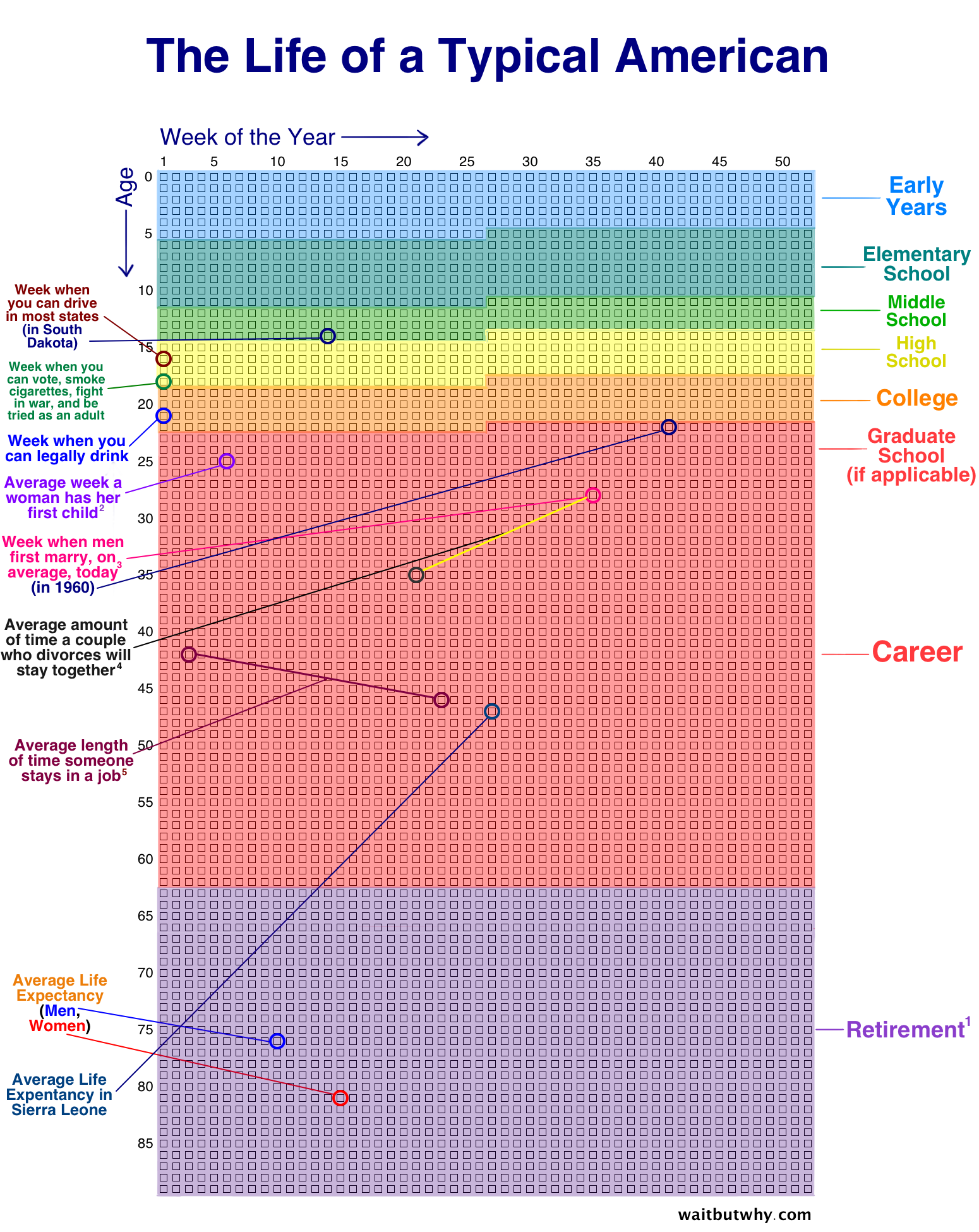
If you allow yourself to conduct a thought experiment in which time and money are interchangeable, you can reach some startling conclusions.
Wealth and Work
When I began to fully grasp the relationship between money and time, my first big insight was that wealth isn't necessarily an abundance of money — it's an abundance of time. Or potential time. When you accumulate a lot of money, you actually accumulate a large store of time to use however you please.
And, in fact, this seems to be one of the primary reasons the Financial Independence movement is gaining popularity. Financial Independence — having saved enough that you're no longer required to work for money — provides the promise that you can use your time in whichever way you choose. When I attend FI gatherings, I ask folks what motivates them. Almost everyone offers some variation on the theme: “I want to be able to do what I want, when I want.”
To me, one of the huge ironies of modern society is that so many people spend so much time to accumulate so much Stuff — yet never manage to set aside anything for the future. Why is this?
To continue reading, please go to the original article here:
I Hate My Job! Do I Have to Suck It Up Until the Economy Recovers?’
.I Hate My Job! Do I Have to Suck It Up Until the Economy Recovers?’
The Cut’s financial advice columnist Charlotte Cowles answers readers’ personal questions about personal finance.
I hated my job before the pandemic, and now I hate it even more. I’m a product manager at an apparel company, and the whole place is awful. The hours are never-ending, and there’s even less respect for personal time now that we’re all working from home. I also don’t approve of how the warehouse staff has been treated throughout this crisis.
I’m 29 and have had this job for two years; it was a significant step up from my previous job in terms of salary and title, but the company culture is bad and getting worse.
I was originally planning to quit in May (I’ve been saving up to do so since last fall) and take some time to reevaluate what I want to do next. But now I’m wondering if that’s completely insane.
I will have enough savings to cover my expenses and bills for at least six months (or longer if social-distancing measures keep up), but will I be able to find a new job by then? It seems pointless to look for jobs right now, and I’m not sure when that will change.
I Hate My Job! Do I Have to Suck It Up Until the Economy Recovers?’
The Cut’s financial advice columnist Charlotte Cowles answers readers’ personal questions about personal finance.
I hated my job before the pandemic, and now I hate it even more. I’m a product manager at an apparel company, and the whole place is awful. The hours are never-ending, and there’s even less respect for personal time now that we’re all working from home. I also don’t approve of how the warehouse staff has been treated throughout this crisis.
I’m 29 and have had this job for two years; it was a significant step up from my previous job in terms of salary and title, but the company culture is bad and getting worse.
I was originally planning to quit in May (I’ve been saving up to do so since last fall) and take some time to reevaluate what I want to do next. But now I’m wondering if that’s completely insane.
I will have enough savings to cover my expenses and bills for at least six months (or longer if social-distancing measures keep up), but will I be able to find a new job by then? It seems pointless to look for jobs right now, and I’m not sure when that will change.
I know I’m incredibly lucky to even have work right now, and part of me thinks I should just be grateful for my paycheck. But saving up to quit is the only thing that’s gotten me through these past few months, and honestly, I need a break. What’s the right move here?
Can I prioritize my mental health and put in my two weeks’ notice? Or do I need to save more before I leave? (If so, how much?) Or should I just suck it up until the economy recovers somewhat?
I can’t tell you when to quit your job, exactly. I don’t know what the economy will look like in six months, either. But I do believe that you shouldn’t have to torture yourself for a paycheck. I wish more people had the financial option to leave a workplace that’s bad for their health (mental and/or physical), and I’m glad that you’re in a position to do so, even if it’s tenuous.
On that note, you’ll want to consider your next steps very, very carefully. Most economic models predict that this mess will continue to get worse before it gets better, and the country’s recovery may take years. There’s a lot of pressure to hold on to whatever you’ve got, be hyper-protective, hunker down.
These are healthy instincts, and not to be ignored. The last thing you want is to be sitting around in a year feeling even more trapped than you do now because you’ve run out of savings and no one’s hiring.
Still, I relate to what you’re going through. I also hit an inflection point in my career around age 30, and for a while I felt like I’d really lost the plot. (When I did eventually quit my job later, I saved up a bunch of money first too. It wound up being less necessary than I anticipated, but it helped quell my anxiety.)
To continue reading, please go to the original article here:
https://www.thecut.com/2020/05/i-hate-my-job-is-it-a-bad-move-to-quit-right-now.html
All That Glitters: Why I’m Not Investing In Gold
.All That Glitters: Why I’m Not Investing In Gold
By J.D. ROTH| Published: 28 April 2020
Over the past month, I've read a lot of articles about the virtues of investing in gold. Especially in Facebook forums, there's a lot of talk about how gold makes a great long-term investment. (Fortunately, I haven't seen any comments like this in the GRS community on Facebook.)
Whenever the economy gets turbulent, the goldbugs come out in force. They shout from the hilltops that the world is doomed and that the only safe haven is gold. And I'll admit, their arguments can sound pretty convincing.
When I started this site in 2006, I felt unqualified to comment on gold. I hadn't read much about it, and I didn't feel educated enough to offer an opinion. That's changed.
Now, after fifteen years of reading and writing about money, I know enough about economic history and I know enough about gold as an investment to have what I believe is a (somewhat) educated response to this subject. And that response is this: Gold makes a lousy long-term investment.
All That Glitters: Why I’m Not Investing In Gold
By J.D. ROTH| Published: 28 April 2020
Over the past month, I've read a lot of articles about the virtues of investing in gold. Especially in Facebook forums, there's a lot of talk about how gold makes a great long-term investment. (Fortunately, I haven't seen any comments like this in the GRS community on Facebook.)
Whenever the economy gets turbulent, the goldbugs come out in force. They shout from the hilltops that the world is doomed and that the only safe haven is gold. And I'll admit, their arguments can sound pretty convincing.
When I started this site in 2006, I felt unqualified to comment on gold. I hadn't read much about it, and I didn't feel educated enough to offer an opinion. That's changed.
Now, after fifteen years of reading and writing about money, I know enough about economic history and I know enough about gold as an investment to have what I believe is a (somewhat) educated response to this subject. And that response is this: Gold makes a lousy long-term investment.
Today, let's have a discussion about the pros and cons of investing in gold while using my own opinion as a starting point. (And note that this article contains my opinion. It's backed up by some facts, but it's still my opinion. Don't take everything that follows as gospel.)
Put simply: I'm not a fan of precious metals. I have 0% of my investment dollars in gold and silver, and I expect that to hold true for the foreseeable future. It's my opinion that gold is a bad investment right now. Let me explain my reasoning.
Before we dive into the meat of this article, it's important to understand that I'm not an economist, and I'm not a gold expert. But for the past fifteen years, I've made a career out of personal finance, and gold is one tiny part of that subject. The core of this article was originally published here on 10 May 2011, the last time the goldbugs were out in force. This update contains substantial revisions. Also, please note that many of the comments on this article are from its original publication in 2011.
The Gold Standard
Many folks dislike our current monetary system because it's based on fiat currency. That is, a dollar is worth an arbitrary amount because the government says so. It's not based on anything concrete. Plus, the government can add and remove cash from the money supply at will, which affects the dollar's value.
U.S. dollars — and other world currencies — were once backed by gold. Under the Gold Standard, you could ask a bank to convert your paper money to gold at the legal rate (whatever that might be). In order for the government to print more money, they had to have the gold to back it.
Proponents of the “Gold Standard” argue that since the U.S. abandoned it in 1933, the dollar is more susceptible to inflation. That's true. But the Gold Standard didn't eliminate inflation, and it created other problems besides.
I am not an economist, and I struggle when it comes to economic theory, but my understanding is that much of the run-up to and aftermath of the Great Depression was thought to have been caused by the Gold Standard. Under the Gold Standard, currencies were much more susceptible to speculation and devaluation, which could lead to runs on the banks. That's why the U.S. abandoned it. And it wasn't only the United States that did so. Not a single country in the world uses the Gold Standard anymore. Until recently, most economists and politicians considered it a deserved relic.
Note: Though it's long, this 2004 speech from Ben Bernanke about money, gold, and the Great Depression is interesting, and explains why we're not likely to ever return to a Gold Standard in the U.S.
To continue reading, please go to the original article here:
Silver Hasn’t Been This Cheap In 5,000 Years of Human History
.Silver Hasn’t Been This Cheap In 5,000 Years of Human History
Notes From The Field By Simon Black April 30, 2020 Bahia Beach, Puerto Rico
More than 4,000 years ago, the city of Kanesh was quickly becoming an important commercial trading hub within the ancient Assyrian Empire.
Kanesh was located in the dead center of modern day Turkey, so it was perfectly situated on the route between the Mediterranean and the Black Sea, and between Europe and Asia Minor.
As a result, Kanesh became a popular trading post. And merchants, scribes, and moneylenders from all over the Assyrian Empire traveled there to profit from the boom in copper, tin, and textiles.
What’s extraordinary about this period of history is how many records remain from those day-to-day transactions.
Silver Hasn’t Been This Cheap In 5,000 Years of Human History
Notes From The Field By Simon Black April 30, 2020 Bahia Beach, Puerto Rico
More than 4,000 years ago, the city of Kanesh was quickly becoming an important commercial trading hub within the ancient Assyrian Empire.
Kanesh was located in the dead center of modern day Turkey, so it was perfectly situated on the route between the Mediterranean and the Black Sea, and between Europe and Asia Minor.
As a result, Kanesh became a popular trading post. And merchants, scribes, and moneylenders from all over the Assyrian Empire traveled there to profit from the boom in copper, tin, and textiles.
What’s extraordinary about this period of history is how many records remain from those day-to-day transactions.
The Assyrians borrowed the writing system from ancient Mesopotamia and routinely chiseled their commercial trades on clay ‘cuneiform’ tablets.
Tens of thousands of these tablets have been discovered by modern archaeologists, so we have an incredible amount of detail about ancient financial transactions.
For example, one tablet on display at the Met in New York City documents the terms of a loan that originated in Kanesh some time in the 19th century BC.
According to the table, an Assyrian merchant named Ashur-idi loaned 3kg of silver to two traders, with 1/3 of the amount to be repaid in one year’s time.
This was fairly common back then: gold and silver were both used as a medium of exchange in ancient times. But this was before coins existed, so transactions would be settled based on weight.
In ancient Babylonia, for instance (which rose to power after the Assyrian Empire faded), the cuneiform tablets from that era tell us that the price of barley averaged about 17 grams of silver per 100 quarts.
And merchants would use elaborate scales to weigh gold and silver when exchanging their goods.
Gold and silver were also exchangeable for each other. Another tablet from ancient Babylonia during the time of Nebuchadnezzer states that 5 shekels of silver were worth ½ shekel of gold.
(A shekel in ancient times was a unit of weight, equivalent to about 8.33 grams.)
This implies a 10:1 ratio between silver and gold.
We’ve discussed this ratio several times; the gold/silver ratio has existed for thousands of years, and up until the 20th century, it remained within that ancient range of between 10 to 20 units of silver per unit of gold.
In modern times, gold and silver are no longer used as a medium of exchange. But there’s still been a long-standing ratio that has persisted for decades.
One ounce of gold has typically been valued at 50 to 80 ounces of silver. Rarely does the ratio go higher (or lower). And when it has, prices have always corrected.
As of this morning the ratio is 112, meaning it now takes 112 ounces of silver to buy one ounce of gold; and today’s level is spitting distance from the ratio’s all-time high of 120, which it reached last month.
And when I say “all-time high,” I mean it. Ancient cuneiform tablets prove that silver has never been so cheap relative to gold in literally thousands of years of human history.
If history is any guide, this means that the ratio should eventually narrow, i.e. the price of silver should rise and/or the price of gold should fall, bringing the ratio back to its more normal range.
And there are plenty of ways to potentially make money from this.
The Chicago Mercantile Exchange, for example, offers a financially-settled futures contract for traders to speculate on the Gold/Silver ratio.
But the CME’s gold/silver ratio contract is very thinly traded and difficult to purchase, so it might not be the best approach.
In theory, one way to speculate that the gold/silver ratio will return to historic norms would be to ‘short’ gold contracts and go ‘long’ silver contracts, i.e. speculate that the price of gold will fall while the price of silver will rise.
But, personally, there’s no chance I would bet against gold right now.
I’ve written for the past several weeks that I approach this entire pandemic from a position of ignorance and uncertainty.
EVERY possible scenario is on the table, and no one can say for sure what’s going to happen next.
There are very few things that are clear. But in my view, one thing that has become clear is that western governments will print as much money as it takes to bail everyone out.
According to the Congressional Budget Office, the US federal government will post a $3.6 TRILLION deficit this Fiscal Year due to all the bailouts. Plus the Federal Reserve has already printed $2 trillion.
Frankly I think they’re just getting started.
With this incomprehensible tsunami of government debt and paper money flooding the system, real assets are a historically great bet.
We’ve talked about this before: real assets are things that cannot be engineered by politicians and central banks-- assets like productive land, well-managed businesses, and yes, precious metals.
And they all tend to do very well when central banks print tons of money.
Farmland, for example, was one of the best performing assets during the stagflation of the 1970s.
And financial data over the past several decades shows that whenever they print lots of money, the price of gold tends to increase.
Right now, in fact, the price of gold is relatively cheap compared to the current money supply.
And the price of silver is ridiculously cheap compared to gold. Again, silver has never been cheaper in 5,000 years.
This is why I’d rather just own physical silver. I’m not interested in betting against gold because I expect they’ll continue to print money. In fact I’m happy to buy more gold.
And while we cannot be certain about anything, there’s a strong case to be made that the price of silver could soar.
PS. Silver demand has gone through the roof because of Covid, and investors are now paying 20%, 50%, even 100% above the price to get their hands on physical silver.
We think that’s crazy.
To your freedom & prosperity, Simon Black, Founder, SovereignMan.com
The Ponzi Scheme That Will Bankrupt The World
.6 Central Banks & The Ponzi Scheme That Will Bankrupt The World
By Tyler Durden Wed, 04/29/2020 - 22:05
Authored by Egon von Greyerz via GoldSwitzerland.com,
The destiny of the world is now in the hands of 6 central banks, Fed, ECB, BoE (England), PBOC (China), BoJ (Japan), SNB (Swiss). This in itself bodes extremely badly for the global financial system. This is like putting the villains in charge of the judicial system. For decades these central banks have totally abused their power and taken control of the world monetary system for the benefit of their banker friends and in some cases their private shareholders.
The central banks have totally corrupted and destroyed the financial system, by printing money and extending credit that doesn’t exist. Everyone knows that creating money out of thin air makes the money totally worthless. These bankers know, that if you stand next to the printing press and get the money first, it does have some value before it circulates. And this is exactly what they have done. Once the money reaches the people, it devalues rapidly. As Mayer Amschel Rothschild said over 200 years ago:
“Permit me to issue and control the money of a nation, and I care not who makes its laws.”
6 Central Banks & The Ponzi Scheme That Will Bankrupt The World
By Tyler Durden Wed, 04/29/2020 - 22:05
Authored by Egon von Greyerz via GoldSwitzerland.com,
The destiny of the world is now in the hands of 6 central banks, Fed, ECB, BoE (England), PBOC (China), BoJ (Japan), SNB (Swiss). This in itself bodes extremely badly for the global financial system. This is like putting the villains in charge of the judicial system. For decades these central banks have totally abused their power and taken control of the world monetary system for the benefit of their banker friends and in some cases their private shareholders.
The central banks have totally corrupted and destroyed the financial system, by printing money and extending credit that doesn’t exist. Everyone knows that creating money out of thin air makes the money totally worthless. These bankers know, that if you stand next to the printing press and get the money first, it does have some value before it circulates. And this is exactly what they have done. Once the money reaches the people, it devalues rapidly. As Mayer Amschel Rothschild said over 200 years ago:
“Permit me to issue and control the money of a nation, and I care not who makes its laws.”
WORTHLESS MONEY PRINTING LEADS TO WORTHLESS ASSETS
But the bankers are not just in charge of the printing press, they are also in control of the cost of money in the form of interest rates. By manipulating rates, they are setting aside the natural laws of supply and demand. So they can print unlimited amounts of money and price it at 0%. The effect of this is a debt bubble that can never be repaid and an asset bubble that is so fake that not a single asset is worth a fraction of the value it is priced at.
The central banks are now panicking and are creating trillions of dollars, euros etc. Add to that additional bank lending and government debt and we are in the tens of trillions.
Just looking at the 6 biggest banks mentioned above, their balance sheets have gone up by $3 trillion from $21 trillion at the end of February 2020 to $24T today.
![download_36[1].png](https://images.squarespace-cdn.com/content/v1/5d5222a44813620001d89582/1588247474243-7YP65K4EXH98EDPQSJY4/download_36%5B1%5D.png)
But this is just the beginning. We must remember that it wasn’t the Coronavirus that started the money printing. It all began back in late July 2019 when the ECB warned the world that something was seriously wrong by saying, we will do whatever it takes. A few weeks later the Fed started daily Repos of $100s of billions. This was the time when serious problems in the financial system started.
$5 TRILLION CREATED WITH ZERO INTRINSIC VALUE
At the end of Sep 2019, the Fed balance sheet was $3.8T and today it is $6.6T, an increase of $2.8T most of which occurred since March 2020. During the same period (Sep 2019-April 2020) US debt grew by $2T from $22.7T to $24.7T.
To continue reading, please go to the original article here:
https://www.zerohedge.com/geopolitical/6-central-banks-ponzi-scheme-will-bankrupt-world
We’ll Get Through This
.We’ll Get Through This
Mar 9, 2020 by Morgan Housel
In the 1930s an Ohio lawyer named Benjamin Roth kept a detailed diary about what he saw during the Great Depression.
In the late 1930s, when the depression had mostly passed, he summarized a few points he had learned from the debacle. He wrote:
“Business will always come back. It will remain neither depressed nor exalted.”
“The stock market forecasts business in only a limited way. The beginning of a stock market movement usually is caused by the trend of business but in the end the movement is carried too high or too low—by the extreme optimism or despair of human nature.”
“Depression is time of greatest profit. The investor who has liquid funds and the courage to act can lay the basis for great profits.”
It’s silly to compare the last week to the Great Depression – unemployment is near a record low and the market is still up over the last 10 months. It’s also hard to think of a time when sentiment has changed so far, so fast, than the last week. And what’s really silly is to assume that abrupt shift won’t both feed on itself and lead to tangible economic problems.
We’ll Get Through This
Mar 9, 2020 by Morgan Housel
In the 1930s an Ohio lawyer named Benjamin Roth kept a detailed diary about what he saw during the Great Depression.
In the late 1930s, when the depression had mostly passed, he summarized a few points he had learned from the debacle. He wrote:
“Business will always come back. It will remain neither depressed nor exalted.”
“The stock market forecasts business in only a limited way. The beginning of a stock market movement usually is caused by the trend of business but in the end the movement is carried too high or too low—by the extreme optimism or despair of human nature.”
“Depression is time of greatest profit. The investor who has liquid funds and the courage to act can lay the basis for great profits.”
It’s silly to compare the last week to the Great Depression – unemployment is near a record low and the market is still up over the last 10 months. It’s also hard to think of a time when sentiment has changed so far, so fast, than the last week. And what’s really silly is to assume that abrupt shift won’t both feed on itself and lead to tangible economic problems.
But let me offer some advice, echoing Benjamin Roth’s lessons from 90 years ago: We’ll get through this.
It won’t be easy, and for some it will be agonizing. But no one should be surprised when a market economy that offers so many benefits occasionally asks something in return.
Keep a few things in mind.
1. Booms plant the seeds of busts. Busts do the same in the opposite direction.
There are no exceptions to Newton’s third law of physics. Every action has an equal and opposite reaction.
It’s tempting to fall for the siren song of booms because it’s so easy to extrapolate a positive trend without accounting for its offsetting factors. Booms make people complacent, assets expensive, and businesses fragile – all of which are easy to discount and hard to even measure when things are going well. It’s usually only in hindsight that we look back and realize how oblivious we were to the forces building up against us.
The same thing happens in reverse during busts. Relative to literally five hours ago, people are more aware of the risks they’re taking, businesses are looking for ways to get more productive, and assets are priced for better future returns – all of which are easy to discount and hard to even measure when things are falling apart.
It’s strange to think that we’re better positioned for future growth this week than last week. How can that be, given everything that’s happened? Well, it may get worse. But every step down plants the seeds for the next ride up.
2. Compounding is not about earning the highest returns. It’s about earning pretty good returns for the longest period of time possible.
Earning 20% a year and getting washed once a decade will leave you worse off than earning 8% a year and being able to hold your ground when times get rough. That’s so obvious. But it’s times like this that you realize financial “survival” is not just relevant to the broke and paranoid; it’s the single most important ingredient to long-term growth.
“Survival” means different things. It means having a strategy whose downsides you’re preemptively familiar with, so you’re prepared both psychologically and financially when they occur. It means being able to make decisions without being handcuffed by the timeline of debt repayment. It means having a huge gap between what could happen and what you need to have happen to do OK.
To continue reading, please go to the original article here:
https://www.collaborativefund.com/blog/well-get-through-this/