The Relationship Between Time, Money, And Happiness
The Relationship Between Time, Money, And Happiness
Written by J.D. ROTH| Published: 15 May 2018 – Updated: 23 February 2020
The older I get, the more I'm convinced that time is money (and money is time). We're commonly taught that money is a “store of value”. But what does “store of value” actually mean? It's a repository of past effort that can be applied to future purchases. Really, money is a store of time. (Well, a store of productive time, anyhow.)
Now, having made this argument, I'll admit that time and money aren't exactly the same thing. Money is a store of time, sure, but the two concepts have some differences too.
For instance, time is linear. After one minute or one day has passed, it's irretrievable. You cannot reclaim it. If you waste an hour, it's gone forever. If you waste (or lose) a dollar, however, it's always possible to earn another dollar. Time marches forward but money has no “direction”.
More importantly, time is finite. Money is not. Theoretically, your income and wealth have no upper bound. On the other hand, each of us has about seventy (maybe eighty) years on this earth. If you're lucky, you'll live for 1000 months. Only a very few of us will live 5000 weeks. Most of us will live between 25,000 and 30,000 days.
I've always loved this representation of a “life in weeks” of a typical American from the blog Wait But Why:
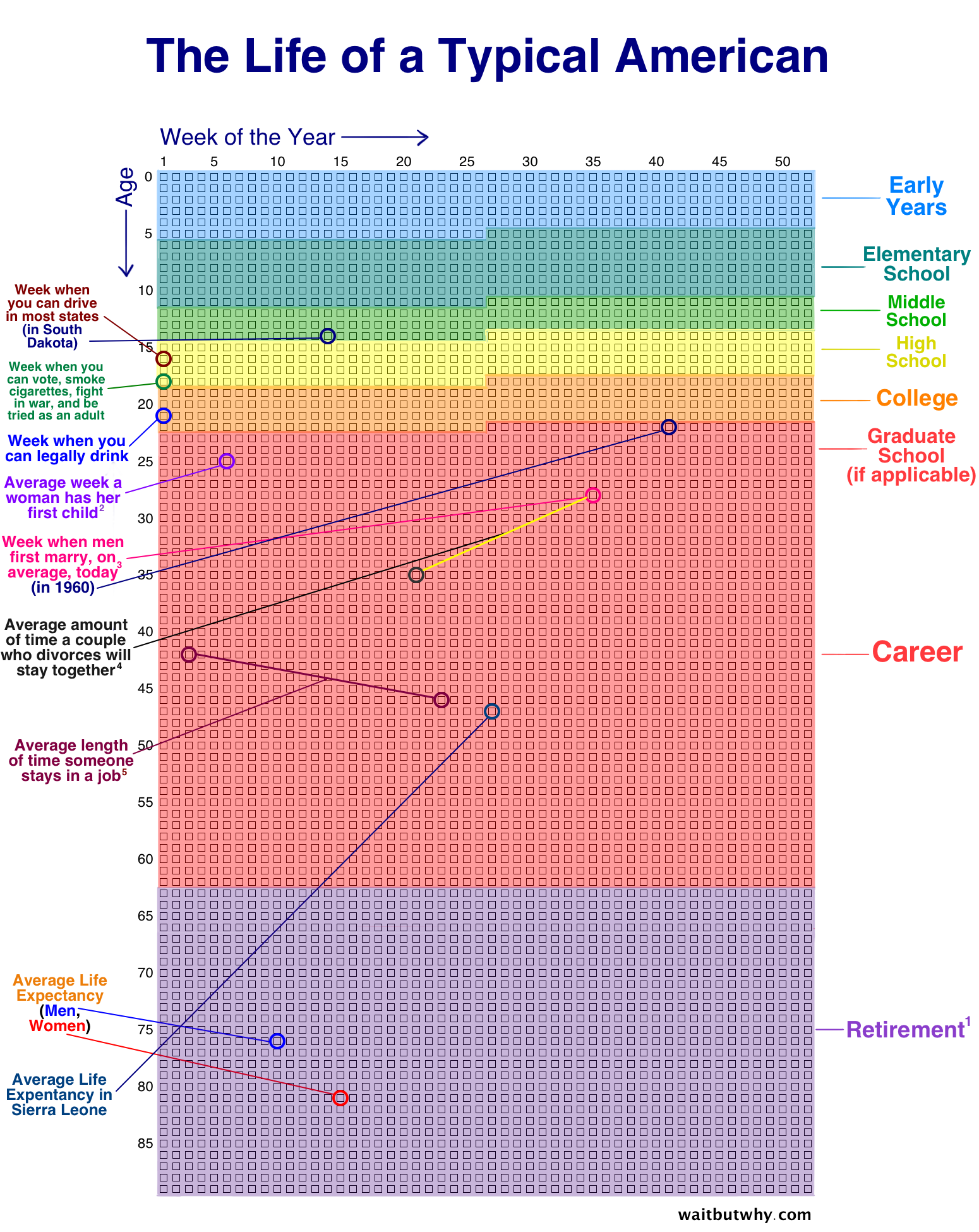
If you allow yourself to conduct a thought experiment in which time and money are interchangeable, you can reach some startling conclusions.
Wealth and Work
When I began to fully grasp the relationship between money and time, my first big insight was that wealth isn't necessarily an abundance of money — it's an abundance of time. Or potential time. When you accumulate a lot of money, you actually accumulate a large store of time to use however you please.
And, in fact, this seems to be one of the primary reasons the Financial Independence movement is gaining popularity. Financial Independence — having saved enough that you're no longer required to work for money — provides the promise that you can use your time in whichever way you choose. When I attend FI gatherings, I ask folks what motivates them. Almost everyone offers some variation on the theme: “I want to be able to do what I want, when I want.”
To me, one of the huge ironies of modern society is that so many people spend so much time to accumulate so much Stuff — yet never manage to set aside anything for the future. Why is this?
To continue reading, please go to the original article here:

6 Common Excuses for Not Saving Money By Tara Struyk
Have you ever settled on a new exercise program, only to get a bad cold a few days in and happily throw yourself on the couch, relieved to have a handy excuse? Excuses must be human nature; I know I usually make them when I'm facing something that’s new, that's hard, or that I just don’t enjoy. And I’ve certainly made excuses when it comes to money.
In the years that I’ve been writing about personal finance and investing, I’ve also heard my fair share of excuses, mostly from readers who don’t agree with my advice. The problem is, unlike good financial habits, excuses are easy to come by, even though most of them just don’t stand up to reason. Check out some of the ones I’ve heard most frequently so far.