
14 Surprising Facts About the British Royal Family’s Money
.14 Surprising Facts About the British Royal Family’s Money
Jami Farkas Sat, September 24, 2022
Even though the British royal family holds only symbolic power, King Charles III and his heirs still make millions.
The new king and sons Prince William and Prince Harry all make money from personal sources of wealth. As working members of the royal family, King Charles and Prince William also benefit from government money as well as from the income from estates that have been passed down through generations. Want to learn more about the British royal family? Click through to learn interesting facts about the royal family's wealth.
The King Receives a Sovereign Grant From Taxpayer Money.
14 Surprising Facts About the British Royal Family’s Money
Jami Farkas Sat, September 24, 2022
Even though the British royal family holds only symbolic power, King Charles III and his heirs still make millions.
The new king and sons Prince William and Prince Harry all make money from personal sources of wealth. As working members of the royal family, King Charles and Prince William also benefit from government money as well as from the income from estates that have been passed down through generations. Want to learn more about the British royal family? Click through to learn interesting facts about the royal family's wealth.
The King Receives a Sovereign Grant From Taxpayer Money.
The sitting monarch receives a Sovereign Grant from the HM Treasury to pay for the salaries of household staff, official travel expenses and the upkeep of the palaces.
The grant comes from profits from the Crown Estate. In the 2021-22 budget, the Sovereign Grant was £86.3, equivalent to £1.29 per person, the BBC reported. In U.S. dollars, those figures equal about $98.5 million and $1.50.
The Sovereign Grant Changes From Year to Year. The Sovereign Grant currently is equal to 25 percent of the Crown Estate's total profits, so when profits rise, so does the size of the grant.
The Crown Estate does not belong personally to the monarch or the royal family. It is managed by an independent group, and remaining 85% of profits go to the treasury to benefit all residents of the United Kingdom. The holdings of the Crown Estate are worth more than £7.3 billion -- $8.3 billion in U.S. money - and includes everything from beef farms to facilities for stone mining.
The King Gets Additional Income From the Duchy of Lancaster.
The Duchy of Lancaster refers to the portfolio of land, property and assets held in trust for the king or queen of England, and it provides the head of the royal family with an independent source of income outside of the Sovereign Grant.
For the year ending March 2022, the Duchy of Lancaster delivered a net income of £24.0 million ($27.4 million).
The King Also Has His Own Personal Wealth and Income.
Other sources of money for King Charles III are the personal investment portfolio and private estates, which include the Balmoral and Sandringham Estates that have been passed to him since the death of Queen Elizabeth II on Sept. 8. Forbes valued the inheritance at $500 million. The royal palaces and Crown Jewels are not part of his personal wealth, as they must be passed on to his successor and are not his to sell.
King Charles III has the highest British royal family net worth at $600 million and is by far the richest member of the royal family.
Prince William Gets His Money From the Duchy of Cornwall.
While the king gets income from the Duchy of Lancaster, the Prince of Wales, William, gets his income from the Duchy of Cornwall.
The estate, which is one of the oldest and largest in Britain, is spread throughout England and contains agricultural, commercial and residential property. The Duchy also includes a financial investment portfolio.
To continue reading, please go to the original article here:
https://news.yahoo.com/14-surprising-facts-british-royal-192418410.html
If King Charles III Stepped Down
.If King Charles III Stepped Down
Here's what would happen if King Charles III stepped down and handed the throne to Prince William
Maria Noyen Sat, September 24, 2022
King Charles III has not indicated that he ever plans to renounce the throne. Given his age and historically low popularity in the UK, however, it remains a possibility.
Insider spoke with a royal historian about what would happen if Charles stepped down as king.
The UK is mourning the loss of a queen that reigned for 70 years while also welcoming a king that spent the same amount of time preparing to replace her.
From the outside, the reign of King Charles III appears to have gotten off to a shockingly good start. In his first speech, he made his intention to follow in his mother's footsteps crystal clear.
"As the Queen herself did with such unswerving devotion, I too now solemnly pledge myself, throughout the remaining time God grants me, to uphold the constitutional principles at the heart of our nation," he said.
If King Charles III Stepped Down
Here's what would happen if King Charles III stepped down and handed the throne to Prince William
Maria Noyen Sat, September 24, 2022
King Charles III has not indicated that he ever plans to renounce the throne. Given his age and historically low popularity in the UK, however, it remains a possibility.
Insider spoke with a royal historian about what would happen if Charles stepped down as king.
The UK is mourning the loss of a queen that reigned for 70 years while also welcoming a king that spent the same amount of time preparing to replace her.
From the outside, the reign of King Charles III appears to have gotten off to a shockingly good start. In his first speech, he made his intention to follow in his mother's footsteps crystal clear.
"As the Queen herself did with such unswerving devotion, I too now solemnly pledge myself, throughout the remaining time God grants me, to uphold the constitutional principles at the heart of our nation," he said.
Charles, now aged 73, is the oldest person to become king in British history. In the years before Queen Elizabeth II died, speculation mounted that she may have been contemplating stepping down and handing the throne to Charles.
That said, the decades Charles spent as a prince saw his popularity among the public nearly decimated, especially following his divorce from Princess Diana in 1996. As recent as 2021, it led to a desire among the British public for Prince William to succeed Queen Elizabeth II instead of his father, according to a poll on behalf of Newsweek.
Insider spoke to royal experts about what would happen in the event Charles stepped down and what it would mean for the monarchy's future.
Charles couldn't simply step away from the throne
There are two scenarios in which Charles is alive but no longer king, royal historian Marlene Koenig told Insider.
The first comes under the Regency Act, Koenig said, which could be triggered if Charles was physically incapacitated, meaning he could no longer speak or move. Dr. Bob Morris, an honorary senior research associate at UCL's Constitution Unit, told Insider the monarch's inability to carry out their duties would also have to be certified by various people including their spouse.
If that occurred, the next in line – Prince William – would become regent. "He takes over and has all the powers of the king, except some matters, which are reserved," Morris said.
However, there is another, more controversial scenario — abdication. Koenig said it's highly unlikely to ever occur given Charles' intention to follow in his mother's footsteps.
In any case, abdication is a complex process. Charles couldn't simply decide to abdicate by himself. To make it official, he would first need UK Parliament to pass an Act of Abdication, Koenig said.
"He can't just say, 'OK, here it's yours, William.' Nope. The succession to the throne is legislated by parliament," she added.
To continue reading, please go to the original article here:
https://news.yahoo.com/heres-happen-king-charles-iii-100000649.html
Coins, Banknotes, and Stamps Featuring the Queen
.Coins, Banknotes, and Stamps Featuring the Queen
Here's What's Happening to All the Coins, Banknotes, and Stamps Featuring the Queen
Mehera Bonner Thu, September 22, 2022
The death of Queen Elizabeth II is ushering in a lot of changes around England (for one, Charles is King now, lol) and some of said changes are more complicated than others. Charles moving into Buckingham Palace? Easy. Figuring out what to do with the billions of coins, banknotes, and stamps with the Queen's face on them? Not so much.
Queen Elizabeth reigned for 70 years, and as a result her face is on pretty much everything. According to The Guardian, there are four and a half billion sterling bank notes featuring Her Majesty's famous profile (worth £80 billion). And on top of that, the Queen features on bank notes of other countries including Canada, New Zealand, and other parts of the Commonwealth.
Coins, Banknotes, and Stamps Featuring the Queen
Here's What's Happening to All the Coins, Banknotes, and Stamps Featuring the Queen
Mehera Bonner Thu, September 22, 2022
The death of Queen Elizabeth II is ushering in a lot of changes around England (for one, Charles is King now, lol) and some of said changes are more complicated than others. Charles moving into Buckingham Palace? Easy. Figuring out what to do with the billions of coins, banknotes, and stamps with the Queen's face on them? Not so much.
Queen Elizabeth reigned for 70 years, and as a result her face is on pretty much everything. According to The Guardian, there are four and a half billion sterling bank notes featuring Her Majesty's famous profile (worth £80 billion). And on top of that, the Queen features on bank notes of other countries including Canada, New Zealand, and other parts of the Commonwealth.
So...what's the plan?
All the Notes and Coins Will Be Replaced Over Time
Eventually, King Charles's face will be on British currency, a process that is expected to take two full years at the very least. Per The Guardian, back in the day when changes between monarchs happened more often, it was "common" to have coins featuring different monarch's faces in the rotation. Plus, the Queen herself had multiple coin portraits done over the years, so it's not as if this is a new concept! As royal expert Jonathan Sacerdoti tells E! News, "It's not like suddenly the cash in our pockets isn't going to be worth anything. Those things will be phased out gradually."
So yeah: coins with the Queen's face on them will still be usable—as confirmed by the Royal Mint (which makes British coins) on its website. As they put it, "Yes, all United Kingdom circulating coins bearing portraits of Queen Elizabeth II remain legal tender and in circulation. Further information will follow."
The Bank of England also released a statement saying, “Current banknotes featuring the image of Her Majesty The Queen will continue to be legal tender."
So what about other countries with the Queen's face on coins? The Bank of Canada reportedly says, “There is no legislative requirement to change the design within a prescribed period when the Monarch changes," while Bloomberg reports that The Reserve Bank of New Zealand will roll out its stock coins featuring the Queen and then eventually make new ones with Charles. According to them, “It will be several years before we need to introduce coins featuring King Charles the Third, and longer until stocks of $20 notes are exhausted."
To continue reading, please go to the original article here:
https://news.yahoo.com/heres-whats-happening-coins-banknotes-142000887.html
Incentives: The Most Powerful Force In The World
.Incentives: The Most Powerful Force In The World
SEP 20, 2022 by Morgan Housel Collab Fund
By age 35, Akinola Bolaji had already spent two decades scamming people online, posing as an American fisherman to con vulnerable widows into sending him money. The New York Times asked the Nigerian how he felt about causing so much harm to innocent people. He replied:
“Definitely there is always conscience. But poverty will not make you feel the pain.”
Scamming people is easier to justify in your head when you’re starving. It’s an extreme example of something everyone – you, me, everyone – is susceptible to and more influenced by than we want to admit: Incentives are the most powerful force in the world and can get people to justify or defend almost anything.
Incentives: The Most Powerful Force In The World
SEP 20, 2022 by Morgan Housel Collab Fund
By age 35, Akinola Bolaji had already spent two decades scamming people online, posing as an American fisherman to con vulnerable widows into sending him money. The New York Times asked the Nigerian how he felt about causing so much harm to innocent people. He replied:
“Definitely there is always conscience. But poverty will not make you feel the pain.”
Scamming people is easier to justify in your head when you’re starving. It’s an extreme example of something everyone – you, me, everyone – is susceptible to and more influenced by than we want to admit: Incentives are the most powerful force in the world and can get people to justify or defend almost anything.
When you understand how powerful incentives can be, you stop being surprised when the world lurches from one absurdity to the next. If I asked, “How many people in the world are truly crazy?” I might say, I don’t know, 3%-5%. But if I asked, “How many people in the world would be willing to do something crazy if their incentives were right?” I’d say, oh, easily 50% or more.
No matter how much information and context you have, nothing is more persuasive than what you desperately want or need to be true. And as Daniel Kahneman once wrote, “It is easier to recognize other people’s mistakes than our own.” What makes incentives powerful is now just how they influence other people’s decisions, but how blind we can be to how they impact our own.
A big thing here is recognizing that people are not calculators; they are storytellers. There’s too much information and too many blind spots for people to calculate exactly how the world works. Stories are the only realistic solution, simplifying complex problems into a few simple sentences.
And the best story always wins – not the best idea or the right idea, but just whatever sounds the best and gets people nodding their head the most. Ben Franklin once wrote, “If you are to persuade, appeal to interest and not to reason.” Incentives fuel stories that justify people’s actions and beliefs, offering comfort even when they’re doing things they know are wrong and believe things they know aren’t true.
True story about a guy I knew well: A pizza delivery man who became a subprime mortgage banker in 2005. Virtually overnight he could earn more per day than the earned per month delivering pizza. It completely changed his life.
Put yourself in his shoes. His job was to make loans. Feeding his family relied on making loans. And if he didn’t make those loans someone else would, so protesting or quitting felt pointless.
Everyone knew the subprime mortgage game was a joke in the mid-2000s. Everyone knew it would end one day. But the bar for someone like my friend to say, “This is unsustainable so I’m going to quit and deliver pizza again” is unbelievably high. It would be high for most of us. I didn’t blame him then, and I don’t blame him now.
A lot of people screwed up during the financial crisis. But too many of us underestimate how we ourselves would have acted if someone dangled enormous rewards in our face.
This goes up the food chain, from the broker to the CEO, the investors, the real estate appraiser, the realtor, the house flipper, the politician, the central banker – incentives lean heavily towards not rocking the boat. So everyone keeps paddling long after the market becomes unsustainable.
Sometimes the behaviors and outcomes are more extreme.
To continue reading, please go to the original article here:
The Rich Will Keep Getting Richer Even In The Face Of A Recession
.The Rich Will Keep Getting Richer Even In The Face Of A Recession, Especially In China, Credit Suisse Says
Chloe Taylor, Tristan Bove Tue, September 20, 2022
Even 2022’s eviscerated global stock markets and historic surge in interest rates worldwide won’t be enough to stop the millionaire mill from churning.
The number of millionaires in the world is set to hit 87 million by 2026, a 40% increase over the 62 million individuals with a net worth above $1 million in 2021, according to Credit Suisse’s annual Global Wealth Report, released on Tuesday, which found that global wealth growth is set to rebound despite a slowdown in 2022.
The Rich Will Keep Getting Richer Even In The Face Of A Recession, Especially In China, Credit Suisse Says
Chloe Taylor, Tristan Bove Tue, September 20, 2022
Even 2022’s eviscerated global stock markets and historic surge in interest rates worldwide won’t be enough to stop the millionaire mill from churning.
The number of millionaires in the world is set to hit 87 million by 2026, a 40% increase over the 62 million individuals with a net worth above $1 million in 2021, according to Credit Suisse’s annual Global Wealth Report, released on Tuesday, which found that global wealth growth is set to rebound despite a slowdown in 2022.
Emerging markets and middle-income countries will be the primary drivers of global growth over the next four years, the report found. Leading the pack in growth speed—despite years of COVID-related lockdowns and forecasts of a slowing economy—will be China, where the number of millionaires is set to double in the next four years.
The number of Chinese millionaires is set to grow from 6.2 million in 2021 to 12.2 million by 2026, the report said, a nearly 97% increase. While the U.S. is set to retain its throne as the country with the most millionaires in 2026—with 27.7 million—it will only be a 13% increase over 2021.
“We expect household wealth in China to continue to catch up with the United States, advancing the equivalent of 14 U.S. years between 2021 and 2026 to reach $119 trillion in real terms, similar to the United States level in 2019,” the report read.
In fact, the report said millionaires will be growing across the world, but it largely won't feel as good for them, thanks to inflation.
Inflation set to create millions of millionaires
In the Report, Credit Suisse predicted that the number of millionaires worldwide would exceed 87 million in 2026—up from 62.5 million in 2021.
However, analysts noted that millionaire status was becoming easier to achieve due to elevated inflation rates. “While some reversal of the exceptional wealth gains of 2021 is likely in 2022/2023 as several countries face slower growth or even recession, our five-year outlook is for wealth to continue growing,” Nannette Hechler-Fayd’herbe, global head of economics and research at Credit Suisse, said in the report.
The U.S. was still forecast to retain the world’s most millionaires in 2026, with Credit Suisse predicting 27,664 Americans would qualify as millionaires within the next five years.
View this interactive chart on Fortune.com
The number of millionaires calling the U.K., Canada and Japan home was also expected to increase substantially by the end of 2026.
To continue reading, please go to the original article here:
https://news.yahoo.com/rich-keep-getting-richer-even-163738655.html
King Charles III Leaves Note On Coffin Of His Mom, Queen Elizabeth II
.King Charles III Leaves Note On Coffin Of His Mom, Queen Elizabeth II
Katie Kindelan Mon, September 19, 2022
George VI King of the United Kingdom from 1936 to 1952, Emperor of India from 1936 to 1948 (1895-1952)
King Charles III paid tribute to his mother Queen Elizabeth II with a note on her coffin as she was laid to rest Monday. In a note that was tucked into a wreath of flowers and foliage chosen by Charles, the new king wrote, "In loving and devoted memory."
Charles signed the note with his first name, Charles, followed by the letter R, which stands for Rex, the Latin word for king. The king, the eldest of the queen's four children, has led members of the royal family and the public through more than one week of mourning for the queen, who died on Sept. 8 at age 96 while at Balmoral Castle in Scotland.
King Charles III Leaves Note On Coffin Of His Mom, Queen Elizabeth II
Katie Kindelan Mon, September 19, 2022
George VI King of the United Kingdom from 1936 to 1952, Emperor of India from 1936 to 1948 (1895-1952)
King Charles III paid tribute to his mother Queen Elizabeth II with a note on her coffin as she was laid to rest Monday. In a note that was tucked into a wreath of flowers and foliage chosen by Charles, the new king wrote, "In loving and devoted memory."
Charles signed the note with his first name, Charles, followed by the letter R, which stands for Rex, the Latin word for king. The king, the eldest of the queen's four children, has led members of the royal family and the public through more than one week of mourning for the queen, who died on Sept. 8 at age 96 while at Balmoral Castle in Scotland.
Charles was by his mother's side when she died and walked directly behind the queen's coffin as it was escorted into Westminster Abbey Monday for her funeral.
PHOTO: Britain's King Charles III walks beside The coffin of Queen Elizabeth II, draped in a Royal Standard and adorned with the Imperial State Crown and the Sovereign's orb and sceptre as it leaves Westminster Abbey in London, on Sept. 19, 2022.
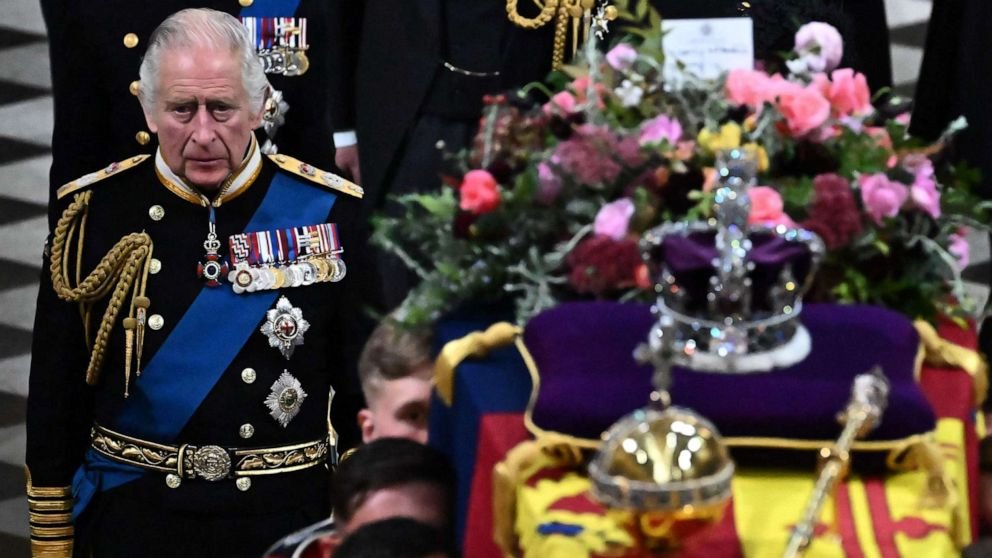
The floral wreath that held the note written by Charles was full of bright flowers cut from the gardens of the royal family's residences, as well as foliage of rosemary and English oak.
In a sentimental touch that came at the request of Charles, as did all the flowers chosen, the foliage in the wreath also included myrtle that was cut from a plant grown from myrtle that used in the queen’s wedding bouquet when she wed her beloved husband Prince Philip in 1947.
PHOTO: The coffin of Queen Elizabeth II with the Imperial State Crown, orb and sceptre resting on top is carried into Westminster Abbey on Sept. 19, 2022 in London.
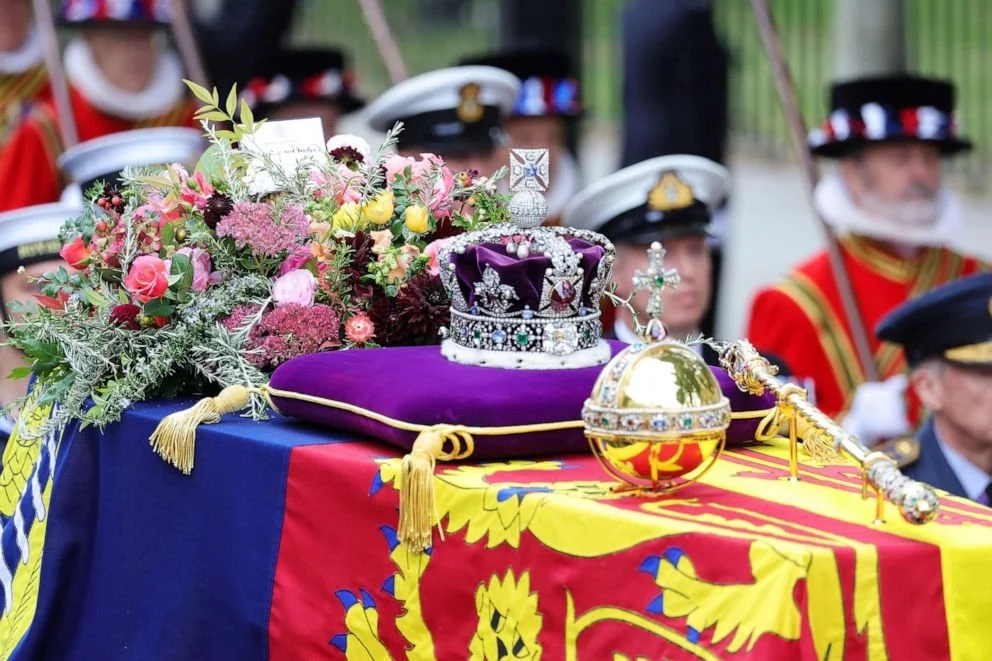
The queen will be buried next to Philip at the King George VI Memorial Chapel at St. George's Chapel on the grounds of Windsor Castle.
The burial service will be private, attended only by members of the royal family.
PHOTO: Britain's King Charles III, Britain's Princess Anne, Princess Royal, Britain's Prince Andrew, Duke of York and Britain's Prince Edward, Earl of Wessex arrive at Westminster Abbey in London, Sept. 19, 2022, for the funeral of Queen Elizabeth II.

Before the queen is buried, items on her coffin will be removed.
In addition to the wreath, the coffin is adorned with the Imperial State Crown, the crown that monarchs wear as they leave Westminster Abbey after the coronation.
The crown -- which contains 2,868 diamonds, 17 sapphires, 11 emeralds, 269 pearls, and four rubies -- was made in 1937 for the coronation of the queen's father, King George VI, according to Historic Royal Palaces, the organization that oversees the Tower of London, where the crown jewels are held.
The coffin of Queen Elizabeth II, who reigned for 70 years, is adorned with the Imperial State Crown. (ABC News Photo Illustration)
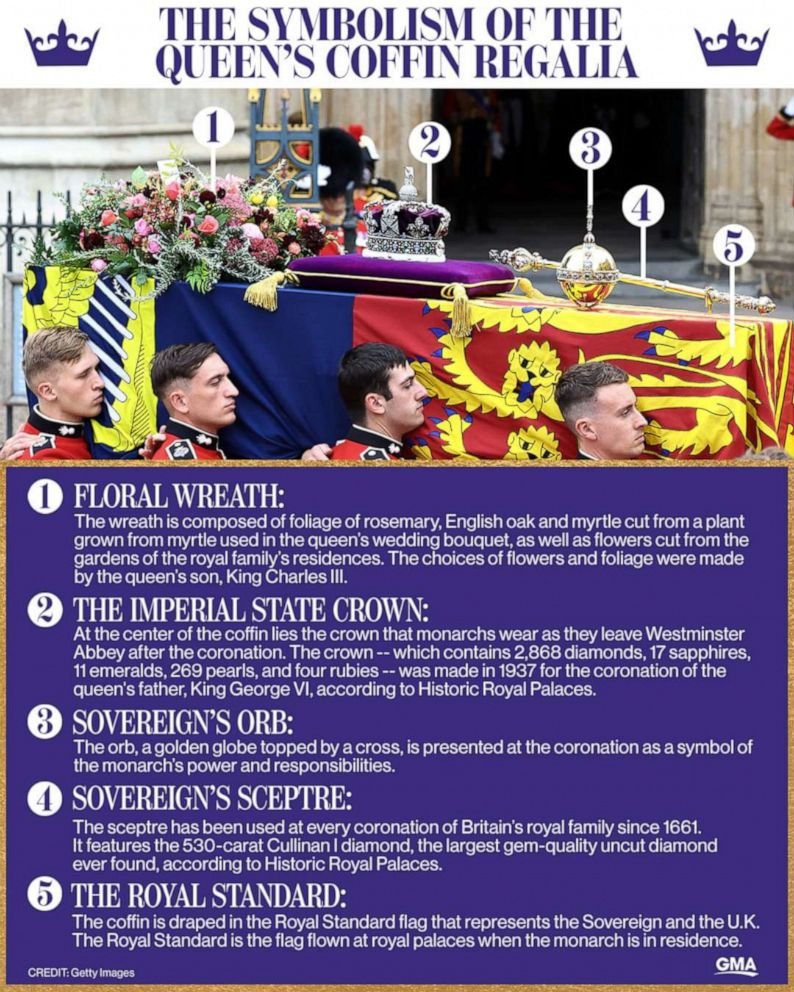
The queen's coffin is also adorned with the Sovereign's Sceptre with Cross and the Sovereign's Orb, both part of the coronation regalia.
The queen's coffin is draped with the Royal Standard, the flag representing the sovereign and the U.K. During her reign, the Royal Standard was flown on her car and aircraft on official journeys and at royal palaces when the queen was in residence.
King Charles III leaves note on coffin of his mom, Queen Elizabeth II originally appeared on goodmorningamerica.com
To continue reading, please go to the original article here:
https://news.yahoo.com/king-charles-iii-leaves-note-120013184.html
King Charles III leaves note on coffin of his mom, Queen Elizabeth II
The Queen’s Relationship With Each US President
.The Queen’s Relationship With Each US President
Oliver O'Connell Sun, September 18, 2022
Queen of the United Kingdom, Canada, Australia, and New Zealand - Over her 70 years as monarch, Queen Elizabeth II met every sitting US president, with the notable exception of President Lyndon Johnson.
Even before she ascended to the throne, she met President Harry Truman when she was heir and also met President Herbert Hoover when she was monarch, 20 years after he had left office.
Against the backdrop of the Cold War, the economic crises, societal changes, scientific breakthroughs, and military campaigns that have shaped the bond between the US and the UK, the Queen has been a constant and friendly soft power figure that was an important part of the special relationship.
The Queen’s Relationship With Each US President
Oliver O'Connell Sun, September 18, 2022
Queen of the United Kingdom, Canada, Australia, and New Zealand - Over her 70 years as monarch, Queen Elizabeth II met every sitting US president, with the notable exception of President Lyndon Johnson.
Even before she ascended to the throne, she met President Harry Truman when she was heir and also met President Herbert Hoover when she was monarch, 20 years after he had left office.
Against the backdrop of the Cold War, the economic crises, societal changes, scientific breakthroughs, and military campaigns that have shaped the bond between the US and the UK, the Queen has been a constant and friendly soft power figure that was an important part of the special relationship.
Here are some of the notable moments of her meetings with US presidents.
Harry Truman
In late 1951, while heir to the throne, Princess Elizabeth and Prince Philip visited Washington DC. The royal couple were on a tour of Canada at the time and took a side-trip to see President Truman, gifting him a candelabra, an oil painting, and an ornate mirror.
Mr Truman is said to have told the princess that he hoped “when you leave, you will like us even better than when you came”. The visit occurred as British and US troops were fighting communist insurgents in Korea at the dawn of the Cold War, just six years after the end of the Second World War.
Dwight D Eisenhower
The Queen made her first state visit to the US in 1957, attending a dinner at the White House on 20 October hosted by President Eisenhower and his wife, Mamie. Mr Eisenhower wore a British Order of Merit that was awarded to him by the Queen’s late father, King George VI, following the war.
At the time, relations between Britain and America were in a poor state following the Suez crisis in Egypt, during which the UK had kept the US in the dark about collusion with the French and Israelis.
Prime Minister Harold Macmillan asked the Queen to visit Washington to generate some goodwill between the two nations.
John F Kennedy
President John Kennedy (right) and his wife Jacqueline (second left) pictured with Queen Elizabeth II (second right) and the Duke of Edinburgh (left) at Buckingham Palace (PA)
The Kennedys attended a banquet in their honour at Buckingham Palace during a tour of Europe in the first year of his presidency, meeting the Queen on 5 June 1961.
It is said that the young monarch was intimidated by the glamorous Jackie Kennedy.
After returning to Washington, President Kennedy sent the Queen a birthday message, adding at the end of his letter: “May I also at the same time say how grateful my wife and I are for the cordial hospitality offered to us by your Majesty and Prince Philip during our visit to London last Monday. We shall always cherish the memory of that delightful evening.”
Mr Kennedy’s father had been US ambassador to the UK, and as something of an anglophile, the relationship between Britain and America was restored after the upset over Suez, with the Americans agreeing to share nuclear technology as the Cold War intensified.
Following President Kennedy’s assassination, the Queen sent a letter of condolence but did not attend the funeral as she was heavily pregnant, with Prince Philip, the Duke of Edinburgh representing the royal family.
The Queen did not meet President Kennedy’s successor President Lyndon Johnson.
Richard Nixon
President Nixon and first lady Pat Nixon came to Buckingham Palace in 1969 and returned to the UK again on 3 October 1970 when the monarch hosted them at Chequers, the country home of the British prime minister, then Edward Heath.
There was gossip that Mr Nixon had tried to set up his daughter Tricia with a then-bachelor Prince of Wales. The meetings between the Queen and the president came as the US was deeply mired in the war in Vietnam and successive prime ministers had refused to send British troops in support.
Gerald Ford
Following the resignation of President Nixon in 1974, President Ford took office as preparations were underway for the 1976 bicentennial, and a royal visit to Washington was on the cards.
Mr Ford threw a gala state dinner at the White House on 7 July to mark 200 years since the American Revolution. At the dinner, the Queen danced with Mr Ford to an unfortunately-timed rendition of “The Lady is a Tramp”, in an evening that was fondly recalled by first lady Betty Ford in her memoirs.
Jimmy Carter
The Queen hosted President Carter in May 1977 on his first overseas trip at a dinner for Nato leaders at Buckingham Palace. It was also the Queen’s silver jubilee year.
Reportedly, as Mr Carter stood with the Queen and other guests, he noticed the arrival of Queen Elizabeth, the queen mother, and ever the Southern gentleman, he broke away, took her by the hand, and escorted her to the assembled line of guests.
Famous for his informality, the president nevertheless ate chicken mousse off a gold plate and seemed excited by his dinner seating between the Queen and her sister, Princess Margaret, and across from Prince Charles, Prince Philip, and the queen mother.
Ronald Reagan
The Queen and President Reagan are said to have bonded over their mutual love of horseback riding when they met at Windsor Castle in June 1982, riding side by side on an eight-mile, hour long tour of the grounds. Mr Reagan was the first president to stay at the 11th-century castle.
Mr Reagan and his wife Nancy became the only presidential couple to host the Queen at their own home when they had the monarch and Prince Phillip stay at their ranch near Santa Barbara, California, in 1983. Poor weather meant there was no horse riding, but the Reagans served a lunch of regional staples, including enchiladas and tacos.
On the same trip, the royals were treated to a state dinner in San Francisco at the MH de Young Memorial Museum. The bad weather continued and during her remarks, the Queen joked: “I knew before we came that we had exported many of our traditions to the United States. But I had not realised before that weather was one of them.”
Over the president’s laughter, she added: “But, Mr President, if the climate has been cool, your welcome and that of the American people have been wonderfully warm.”
The Queen made Mr Reagan an honourary knight in recognition of America’s covert assistance to the UK during the Falklands War. Their meetings came at a time when the bond between Prime Minister Margaret Thatcher and Mr Reagan was one of the strongest of any transatlantic parings of the special relationship, and at the height of the Cold War.
To continue reading, please go to the original article here:
https://news.yahoo.com/queen-relationship-us-president-during-180755076.html
The Shrinking Realm: Queen Elizabeth’s Commonwealth And The Future Of Its Nations
.The Shrinking Realm: Queen Elizabeth’s Commonwealth And The Future Of Its Nations
Niamh Cavanagh·Producer Fri, September 16, 2022
Elizabeth II Queen of the United Kingdom, Canada, Australia, and New Zealand
LONDON — At its height, the British Empire’s rule oversaw 531 million people — over three continents spanning from North America to Oceania. It was once said that the sun never set on the British Empire, but as years passed, the monarchy’s global reach began to decline.
Six years after the devastation of World War I, Britain announced that each member of the Empire would be seen as equal. This meant that the monarchy and its Parliament had no power over the domestic and foreign policies of these “Dominions.
The Shrinking Realm: Queen Elizabeth’s Commonwealth And The Future Of Its Nations
Niamh Cavanagh·Producer Fri, September 16, 2022
Elizabeth II Queen of the United Kingdom, Canada, Australia, and New Zealand
LONDON — At its height, the British Empire’s rule oversaw 531 million people — over three continents spanning from North America to Oceania. It was once said that the sun never set on the British Empire, but as years passed, the monarchy’s global reach began to decline.
Six years after the devastation of World War I, Britain announced that each member of the Empire would be seen as equal. This meant that the monarchy and its Parliament had no power over the domestic and foreign policies of these “Dominions.
The officials in formal dress line up around the queen, who is wearing a crinoline and tiara, under a large chandelier.
Seven prime ministers posed in the Throne Room at Buckingham Palace in London at a dinner party given by Queen Elizabeth II on Dec. 3, 1952, for ministers attending the Commonwealth Conference and their wives. From left: Dudley Senanayake, premier of Ceylon; Sir Godfrey Hugging, premier of Southern Rhodesia; Sidney Holland, premier of New Zealand; Winston Churchill, premier of the United Kingdom; the queen; Robert Menzies, premier of Australia; Louis St. Laurent; premier of Canada; Nicholas Havenga, South African minister of finance; Khawaja Nazimuddin, premier of Pakistan, and Sir Chintaman Deshmukh, India's minister of finance. (AP Photo)
After World War II, the British Empire would continue to contract, as countries under its colonial rule fought for and gained their independence. In 1949, the British Commonwealth of Nations would no longer ask members to swear allegiance to the crown, and all nations under the umbrella of the association would simply be known as the Commonwealth of Nations.
Elizabethan Era
Upon Queen Elizabeth II’s ascension to the throne in 1952, the Commonwealth had already lost Ireland, in 1948. Eire gained its autonomy in 1921 after 800 years of British involvement, leaving only the six counties in Northern Ireland, of the 32 counties on the island, as part of the United Kingdom.
During her coronation speech in 1953, the new monarch acknowledged and praised Britain’s imperial past. “I have behind me not only the splendid traditions and the annals of more than a thousand years, but the living strength and majesty of the Commonwealth and Empire,” she said.
The Queen, accompanied by Gov. Gurmukh Nihal Singh, wearing a turban and a beard, shakes hands with a line of dignitaries and military officials.
The Queen and the Duke of Edinburgh arrive in Jaipur, India, on Jan. 22, 1961, met at the airport by Gov. Gurmukh Nihal Singh. (AP Photo)
Elizabeth, Britain’s longest-serving sovereign, was on the throne seven years longer than Queen Victoria, her great-great grandmother, who oversaw the expansion of Britain's colonial possessions.
“[The] Queen's reign is the kind of grand rebranding for the British Empire, which was originally kind of built on an ideology that dictated that white people and their settler descendants would be in charge,” Dr. Liam Liburd, assistant professor of Black British history at Durham University in England, told Yahoo News.
“The development of the Commonwealth after the Queen's coronation in 1953 can be seen as a kind of consolation prize for the British Empire.”
Decline of the Empire
Through the decades, the Commonwealth would see territories lost and countries depart, with some rejoining. By the 1960s, most of Britain’s colonies in Africa and Asia were independent, although some chose to remain as part of the Commonwealth, an option offered on a voluntary basis.
To continue reading, please go to the original article here:
https://news.yahoo.com/queen-elizabeth-commonwealth-realm-shrinking-nations-203450220.html
Queen Elizabeth II’s Best Feminist Moments
.Queen Elizabeth II’s Best Feminist Moments
Olivia Petter Fri, September 16, 2022
Queen Elizabeth II has died at the age of 96.
The monarch passed away “peacefully” in Balmoral Castle on Thursday 8 September. Her death comes almost a year and a half after the Duke of Edinburgh died on 9 April 2021. Over the course of her reign, the Queen was the most powerful person in Britain, but she was also one of the most inspiring women in the world.
She was the UK’s longest-serving monarch, recording 70 years on the throne, and despite hardly ever discussing women’s rights, she had a watershed impact on empowering women everywhere throughout her reign.
Queen Elizabeth II’s Best Feminist Moments
Olivia Petter Fri, September 16, 2022
Queen Elizabeth II has died at the age of 96.
The monarch passed away “peacefully” in Balmoral Castle on Thursday 8 September. Her death comes almost a year and a half after the Duke of Edinburgh died on 9 April 2021. Over the course of her reign, the Queen was the most powerful person in Britain, but she was also one of the most inspiring women in the world.
She was the UK’s longest-serving monarch, recording 70 years on the throne, and despite hardly ever discussing women’s rights, she had a watershed impact on empowering women everywhere throughout her reign.
The Queen was described by many as a feminist icon, including Olivia Colman, who played the monarch in the fourth season of The Crown.
The Oscar winner previously told Radio Times: “[The Queen is] the ultimate feminist. She’s the breadwinner. She’s the one on our coins and banknotes.”
In remembrance of the Queen, we’ve rounded up some of her best feminist moments.
When she took Saudi King Abdullah for a spin in her Land Rover
In 2003, the Queen famously took Abdullah, who died in 2015, for a drive in her Land Rover when he came to visit her in Balmoral, Scotland.
The story was told in a memoir by British diplomat Sir Sherard Cowper-Cowles, who was Ambassador to Saudi Arabia at the time.
“After lunch, the Queen had asked her royal guest whether he would like a tour of the estate,” wrote Cowper-Coles.
“Prompted by his foreign minister the urbane Prince Saud, an initially hesitant Abdullah had agreed. The royal Land Rovers were drawn up in front of the castle. As instructed, the Crown Prince climbed into the front seat of the front Land Rover, his interpreter in the seat behind.
“To his surprise, the Queen climbed into the driving seat, turned the ignition and drove off.”
The move was particularly significant considering women were not yet allowed to drive in Saudi Arabia, and, as Cowper-Coles writes, “Abdullah was not used to being driven by a woman, let alone a Queen”.
When she quietly oversaw the change in royal rules of succession to allow the eldest woman to accede to the throne
In 2011, the Queen oversaw a major change to succession laws as agreed by the leaders of the 16 Commonwealth countries that meant sons and daughters of any future British monarch would have equal rights to the throne.
Up until that point, the laws of succession dictated that the heir to the throne is always the first-born son of the monarch.
But according to the new rules, had the Duke and Duchess of Cambridge had a daughter first, she would have taken precedence to the throne over her younger brothers. As it so happens, the couple had a boy first, Prince George.
To continue reading, please go to the original article here:
https://news.yahoo.com/queen-elizabeth-ii-best-feminist-080007548.html
Three Big Things: The Most Important Forces Shaping the World
.Three Big Things: The Most Important Forces Shaping the World
by Morgan Housel
An irony of studying history is that we often know exactly how a story ends, but have no idea where it began. Here’s an example. What caused the financial crisis? Well, you have to understand the mortgage market.
What shaped the mortgage market? Well, you have to understand the 30-year decline in interest rates that preceded it. What caused falling interest rates? Well, you have to understand the inflation of the 1970s.
What caused that inflation? Well, you have to understand the monetary system of the 1970s and the hangover effects from the Vietnam War.
What caused the Vietnam War? Well, you have to understand the West’s fear of communism after World War II
And so on endlessly.
Three Big Things: The Most Important Forces Shaping the World
by Morgan Housel
An irony of studying history is that we often know exactly how a story ends, but have no idea where it began. Here’s an example. What caused the financial crisis? Well, you have to understand the mortgage market.
What shaped the mortgage market? Well, you have to understand the 30-year decline in interest rates that preceded it. What caused falling interest rates? Well, you have to understand the inflation of the 1970s.
What caused that inflation? Well, you have to understand the monetary system of the 1970s and the hangover effects from the Vietnam War.
What caused the Vietnam War? Well, you have to understand the West’s fear of communism after World War II
And so on endlessly.
Every current event – big or small – has parents, grandparents, great grandparents, siblings, and cousins. Ignoring that family tree can muddy your understanding of events, giving a false impression of why things happened, how long they might last, and under what circumstances they might happen again. Viewing events in isolation, without an appreciation for their long roots, helps explain everything from why forecasting is hard to why politics is nasty.
Those roots can snake back infinitely. But the deeper you dig, the closer you get to the Big Things: the handful of events that are so powerful they influence a range of seemingly unrelated topics.
The ultimate of those great-grandmother events was World War II.
It’s hard to overstate how much the world reset from 1939 to 1945, and how deeply the changes the war left behind went on to define virtually everything that’s happened since.
Penicillin owes its existence to the war. So do radar, jets, nuclear energy, rockets, and helicopters. Subsidizing consumption with consumer credit and tax-deductible interest were deliberate policies meant to keep the economy afloat after war-time production ended. The highways you drove on this morning were built to evacuate cities and mobilize the military in case of a nuclear bomb attack during the Cold War, and the Cold War was a WW2 cousin. Same for the internet.
The Civil Rights movement – perhaps the most important social and political event of our time – began in earnest with racial integration during the war.
The female laborforce grew by 6.5 million during the war because women were needed in factories. Most kept working after the war ended, beginning a trend that led to a doubling of the female laborforce participation rate by 1990. It’s probably the single most important economic event of our lifetime.
Find something that’s important to you in 2019 – social, political, economic, whatever – and with a little effort you can trace the roots of its importance back to World War II. There are so few exceptions to this rule it’s astounding.
But it’s not just astounding. It’s an example of something easy to overlook: If you don’t spend a little time understanding World War II’s causes and outcomes, you’re going to have a hard time understanding why the last 60 years have played out the way they have.
You’ll struggle to understand how the biggest technologies got off the ground, and how the most important innovations are born from panic-induced necessity more than cozy visions.
Or why household debt has risen the way it has.
Or why Europeans have different views on social safety nets than Americans. John Maynard Keynes predicted countries wrecked by war would go on to have a “craving for social and personal security,” and indeed they did. Historian Tony Judt writes of post-war Europe:
Only the state could offer hope or salvation to the mass of the population. And in the aftermath of depression, occupation and civil war, the state—as an agent of welfare, security and fairness—was a vital source of community and social cohesion.
There are so many things happening today that aren’t easy to grasp without a working knowledge of the 75-year-old wartime forces that got them going in the first place. To me, the war is fascinating to study not because of what happened, but what it went on to influence.
Which raises the question: What else is like World War II?
What are the other Big Things – the great-grandparents – of important topics today that we need to study if we want to understand what’s happening in the world?
Nothing is as influential as World War II has been. But there are a few other Big Things worth paying attention to, because they’re the root influencer of so many other topics.
The three big ones that stick out are demographics, inequality, and access to information.
There are hundreds of forces shaping the world not mentioned here. But I’d argue that many, even most, are derivatives of those three.
Each of these Big Things will have a profound impact on the coming decades because they’re both transformational and ubiquitous. They impact nearly everyone, albeit in different ways. With that comes the reality that we don’t know exactly how their influence will unfold. No one in 1945 knew exactly how World War II would go on to shape the world, only that it would in extreme ways. But we can guess some of the likeliest changes.
1. A demographic shift that reconfigures modern economies.
Here’s what’s happening:
To continue reading, please go to the original article here:
https://collabfund.com/blog/three-big-things-the-most-important-forces-shaping-the-world/
What Happens To The Late Queen's Assets And Who Gets What Title?
.What Happens To The Late Queen's Assets And Who Gets What Title?
Queen Elizabeth’s estimated $500 million is part of a bigger $28 billion empire.
This is how her wealth is going to be passed down
Dina Al-Shibeeb Sep. 09, 2022
Queen Elizabeth II, who died on Sept. 8, was the head of state of 14 Commonwealth realms, including Canada. Passing at the age of 96, Elizabeth left a long legacy after becoming the U.K.'s longest-serving monarch — reigning for 70 years. Not only was she the Queen of England, she was a wealthy woman in her own right. With British monarchs not required to reveal their assets, different media outlets have pitched in with their estimates.
What Happens To The Late Queen's Assets And Who Gets What Title?
Queen Elizabeth’s estimated $500 million is part of a bigger $28 billion empire.
This is how her wealth is going to be passed down
Dina Al-Shibeeb Sep. 09, 2022
Queen Elizabeth II, who died on Sept. 8, was the head of state of 14 Commonwealth realms, including Canada. Passing at the age of 96, Elizabeth left a long legacy after becoming the U.K.'s longest-serving monarch — reigning for 70 years. Not only was she the Queen of England, she was a wealthy woman in her own right. With British monarchs not required to reveal their assets, different media outlets have pitched in with their estimates.
The Queen’s personal wealth totals more than US$500 million in assets she accumulated over her decades on the throne, according to Forbes.
British media outlet, the Sun, estimates her net worth to be $3 billion, and the Sunday Times Rich List 2022 said the Queen’s net worth was around $420 million.
The Royal Family have accumulated wealth through centuries of rule and here's a look at what will happen to that wealth as the Queen is laid to rest and her son Charles assumes the throne.
How did the Queen accumulate wealth?
Elizabeth II inherited about $81 million from her mother, Queen Elizabeth, when the monarch died in 2002. The inheritance included assets like paintings, a valuable Faberge egg collection, china, jewelry and even horses.
Overall, the Queen didn’t receive a traditional annual salary. Like other Royal Family members she received income through a taxpayer fund called the Sovereign Grant, which amounted to more than 86 million pounds (almost $100 million) in 2021 and 2022.
The Sovereign Grant is geared to cover official travel, property maintenance plus the operating costs of the Queen’s London residence — Buckingham Palace.
The Sovereign Grant finds its roots in an agreement struck by King George III to surrender his income from Parliament in order to receive a fixed annual payment for himself and future generations of the royal family.
Following her death, King Charles is going to receive the yearly Sovereign Grant from the U.K. Treasury. He will be getting 15% of the profits from the Crown Estate.
The Queen’s wealth is in fact part of a larger empire worth approximately $28 billion, according to Forbes.
To continue reading, please go to the original article here:
https://moneywise.com/news/top-stories/queen-elizabeth-wealth-inheritance