
Why Poor People Can't Afford To Save Money
.Understanding the 'Boots Theory' of Socioeconomic Unfairness
This is why poor people can't afford to save money.
By Tom Huffman Dec. 01, 2021
We adhere to strict standards of editorial integrity to help you make decisions with confidence. Please be aware that some (or all) products and services linked in this article are from our sponsors.
Terry Pratchett was an English fantasy writer, best known for his Discworld series of 41 novels. If you’re familiar with Pratchett's novels, you may recognize the "boots theory." If not, you better write off the next few months of your life as you're about to undertake some serious binge-reading.
What is the 'boots theory'?
Understanding the 'Boots Theory' of Socioeconomic Unfairness
This is why poor people can't afford to save money.
By Tom Huffman Dec. 01, 2021
We adhere to strict standards of editorial integrity to help you make decisions with confidence. Please be aware that some (or all) products and services linked in this article are from our sponsors.
Terry Pratchett was an English fantasy writer, best known for his Discworld series of 41 novels. If you’re familiar with Pratchett's novels, you may recognize the "boots theory." If not, you better write off the next few months of your life as you're about to undertake some serious binge-reading.
What is the 'boots theory'?
The "boots theory" comes from a simple piece of dialogue in Pratchett’s 1993 novel Men at Arms. The book features a City Watch commander named Capt. Samuel Vimes. The captain is set to marry one of the richest women in the world, and he often opines about the differences between low-status and high-status spending habits.
At one point in the story, the captain ruminates:
The reason that the rich were so rich...was because they managed to spend less money.
In reference to the captain, the quote continues:
"Take boots, for example. He earned $38 a month plus allowances. A really good pair of leather boots cost $50. But an affordable pair of boots, which were sort of OK for a season or two and then leaked like hell when the cardboard gave out, cost about $10.
"Those were the kind of boots Vimes always bought, and wore until the soles were so thin that he could tell where he was in Ankh-Morpork on a foggy night by the feel of the cobbles.
"But the thing was that good boots lasted for years and years. A man who could afford $50 had a pair of boots that'd still be keeping his feet dry in 10 years' time, while the poor man who could only afford cheap boots would have spent a hundred dollars on boots in the same time and would still have wet feet."
This was Capt. Samuel Vimes' boots theory of socioeconomic unfairness.
The Boots Theory In Action
Pair of boots next to a desk on a carpeted floor.
The boots theory may seem obvious, but many people fall victim to its trap.
The wealthy, who have access to capital and disposable income, can make decisions with their money that leave them richer and better off.
To continue reading, please go to the original article here:
https://moneywise.com/managing-money/budgeting/boots-theory-of-socioeconomic-unfairness
5 Wise Money Moves Before The Fed Starts Raising Interest Rates Again
.5 Wise Money Moves Before The Fed Starts Raising Interest Rates Again
Time's almost up on ultralow rates, so don't be caught off guard. Federal Reserve Chairman Jerome Powell arrives for a Senate Banking Committee meeting in Washington, Sept. 28, 2021.
By Sigrid Forberg Jan. 27, 2022
Word just came down that you’ll soon pay more in interest for many loans. And your credit card balance with a variable interest rate? It’s about to cost you more too.
Federal Reserve Chairman Jerome Powell and the other policymakers at the central bank said this week that they’ll raise rates “soon,” likely at their next meeting in March, to try to slow inflation that’s rising faster than it has in almost 40 years.
5 Wise Money Moves Before The Fed Starts Raising Interest Rates Again
Time's almost up on ultralow rates, so don't be caught off guard.
Federal Reserve Chairman Jerome Powell arrives for a Senate Banking Committee meeting in Washington, Sept. 28, 2021.
By Sigrid Forberg Jan. 27, 2022
Word just came down that you’ll soon pay more in interest for many loans. And your credit card balance with a variable interest rate? It’s about to cost you more too.
Federal Reserve Chairman Jerome Powell and the other policymakers at the central bank said this week that they’ll raise rates “soon,” likely at their next meeting in March, to try to slow inflation that’s rising faster than it has in almost 40 years.
But regulators held a key interest rate near zero for now. You’ll need to act quickly to take advantage of today’s lower rates for a large purchase or for a loan for a necessity, like a new car to replace an old pile of junk that needs too many repairs.
Here are five money moves to jump on before rates rise.
1. Refinance Your Home Loan
Mortgage rates are going up from historically low levels in the pandemic, but they’re still a good deal for many people. The Fed’s expected rate increases this year will affect variable-rate loans, and its changing pandemic-related policies could create a climate for higher fixed-rate mortgages as well.
But take a look at your rates anyway because nearly 6 million homeowners could still save $1.6 billion monthly by refinancing now, the mortgage data and technology firm Black Knight tells MoneyWise.
The average interest rate on a 30-year fixed-rate mortgage hit 3.56% last week, up from 3.45%, government-sponsored mortgage buyer Freddie Mac reports. But remember that rates for shorter mortgages, while also trending upward, typically run lower than 30-year rates, so refinancing for a quicker payoff might still save you money in the end.
Plus, 3.56% is an average — lenders will offer you lower and higher rates. That’s one reason you shouldn’t skip the step of comparing rate quotes from multiple companies.
2. Consolidate Your Debt
The pandemic made it difficult for Americans to travel, eat in restaurants and shop at retailers, and many used the money they didn't spend on those activities to increase their savings and pay down debt.
To continue reading, please go to the original article here:
https://moneywise.com/managing-money/budgeting/money-moves-before-fed-raises-rates
Why Gold Matters: Everything You Need To Know
.Why Gold Matters: Everything You Need To Know
By Adam Hayes Updated March 09, 2022 Reviewed By Michael J Boyle Fact Checked By Diane Costagliola
Gold. It's shiny, metallic, and melts easily into bars, coins, or jewelry. It doesn't rust, corrode, or decay. Gold is...well, golden. But why is gold so valuable, both in our mind's eye and in reality as a global store of value and medium of exchange? Why is silver relegated to a distant second place, and what about poor old copper, which shares many of the same physical attributes as gold? Join us as we try to figure out the answers to these questions, and much more.
KEY TAKEAWAYS
In the articles that follow, we will take a look at gold's place in our economy and try to uncover just why it's valuable and what role gold can play today in investor's portfolios.
Why Gold Matters: Everything You Need To Know
By Adam Hayes Updated March 09, 2022 Reviewed By Michael J Boyle Fact Checked By Diane Costagliola
Gold. It's shiny, metallic, and melts easily into bars, coins, or jewelry. It doesn't rust, corrode, or decay. Gold is...well, golden. But why is gold so valuable, both in our mind's eye and in reality as a global store of value and medium of exchange? Why is silver relegated to a distant second place, and what about poor old copper, which shares many of the same physical attributes as gold? Join us as we try to figure out the answers to these questions, and much more.
KEY TAKEAWAYS
In the articles that follow, we will take a look at gold's place in our economy and try to uncover just why it's valuable and what role gold can play today in investor's portfolios.
In fact, by some accounts, gold has never been more fashionable as an alternative investment, able to weather financial crises and hedge against the inflationary pressures of fiat currency.
We will discuss the risks and opportunities of owning gold as an investment, how to try and make quick profits day trading it in the commodities market, what influences its price, and how to go about owning gold in your brokerage account.
Gold as an Investment
Before jumping on the gold bandwagon, let us first put a damper on the enthusiasm around gold and at the outset examine some reasons why investing in gold has some fundamental issues.
The main problem with gold is that, unlike other commodities such as oil or wheat, it does not get used up or consumed. Once gold is mined, it stays in the world. A barrel of oil, on the other hand, is turned into gas and other products that are expended in your car's gas tank or an airplane's jet engines. Grains are consumed in the food we and our animals eat. Gold, on the other hand, is turned into jewelry, used in art, stored in ingots locked away in vaults, and put to a variety of other uses. Regardless of gold's final destination, its chemical composition is such that the precious metal cannot be used up - it is permanent.
Because of this, the supply/demand argument that can be made for commodities like oil and grains, etc, doesn't hold so well for gold. In other words, the supply will only go up over time, even if demand for the metal dries up.
History Overcomes the Supply Problem
Like no other commodity, gold has held the fascination of human societies since the beginning of recorded time. Empires and kingdoms were built and destroyed over gold and mercantilism. As societies developed, gold was universally accepted as a satisfactory form of payment. In short, history has given gold a power surpassing that of any other commodity on the planet, and that power has never really disappeared. The U.S. monetary system was based on a gold standard until the 1970s.1 Proponents of this standard argue that such a monetary system effectively controls the expansion of credit and enforces discipline on lending standards, since the amount of credit created is linked to a physical supply of gold. It's hard to argue with that line of thinking after nearly three decades of a credit explosion in the U.S. led to the financial meltdown in the fall of 2008.
From a fundamental perspective, gold is generally viewed as a favorable hedge against inflation. Gold functions as a good store of value against a declining currency.
Investing in Gold
To continue reading, please go to the original article here:
https://www.investopedia.com/articles/economics/09/why-gold-matters.asp
What I Teach My Kids About Money
.What I Teach My Kids About Money
By Cameron Huddleston July 10, 2019
I’ve been a guest on a lot of podcasts lately talking about my new book, Mom and Dad, We Need to Talk: How to Have Essential Conversations With Your Parents About Their Finances.
As you can assume by the title, I’ve been sharing tips on how adult children can get their parents to open up about their finances so everyone can get on the same page if those children ever need to step in and help their parents.
Occasionally, though, the podcast hosts will turn the tables on me and ask what sort of money conversations I’ve had with my own children. I’ve been asked how I teach my kids about money, what sort of details I’ve given them about my finances, and what works and doesn’t work when it comes to teaching kids about personal finance.
What I Teach My Kids About Money
By Cameron Huddleston July 10, 2019
I’ve been a guest on a lot of podcasts lately talking about my new book, Mom and Dad, We Need to Talk: How to Have Essential Conversations With Your Parents About Their Finances.
As you can assume by the title, I’ve been sharing tips on how adult children can get their parents to open up about their finances so everyone can get on the same page if those children ever need to step in and help their parents.
Occasionally, though, the podcast hosts will turn the tables on me and ask what sort of money conversations I’ve had with my own children. I’ve been asked how I teach my kids about money, what sort of details I’ve given them about my finances, and what works and doesn’t work when it comes to teaching kids about personal finance.
I don’t claim to be an expert on kids and money. But as a mom of three kids ages 7 to 14, I’ve had plenty of experience teaching my own children money lessons. Here are five key things about money that I’ve tried to instill in my children.
Money Is Not a Taboo Topic
A couple of years ago, my middle child asked me out of the blue one day why people think it’s bad to talk about money. She couldn’t understand why the topic might be off limits because money is discussed so openly in our family.
Borrowing from the wisdom that my friend and financial psychologist Dr. Brad Klontz shared with me, I explained to my daughter that people avoid talking about money because they feel shame around it.
If the topic comes up in a conversation, they feel ashamed if they have less than the people they’re talking to – or if they have more money. They’re afraid they’ll be judged, I told her.
I remember my dad telling me when I was growing up that it wasn’t polite to talk about money. So he didn’t – which meant I didn’t have anyone teaching me about money. Once I got out into the real world, I had to figure out money matters on my own and made plenty of mistakes as a result.
I don’t want my kids to think that money is a taboo topic. That’s why I’ve been talking to them about it pretty much from the time they were able to talk. I want them to become financially responsible adults one day, so I consider it my job to teach them about being smart with their money.
After all, if I don’t teach them, who will? Only 17 states require high school students to take a course in personal finance, according to the Council for Economic Education. More importantly, I don’t want my kids to have negative associations with money. If I raise my children to believe that money is something you don’t talk about, they might develop an unhealthy relationship with it.
To continue reading, please go to the original article here:
https://cameronhuddleston.com/what-i-teach-my-kids-about-money/
How Gold Affects Currencies
.How Gold Affects Currencies 6
By Kalen Smith Updated January 26, 2022 Reviewed By Chip Stapleton
Ah, the enduring appeal—and influence—of gold. Even though it is no longer used as a primary form of currency in developed nations, the yellow metal continues to have a strong impact on the value of those currencies. Moreover, there is a strong correlation between its value and the strength of currencies trading on foreign exchanges.
To help illustrate this relationship between gold and foreign exchange trading, consider these five important features of the yellow stuff:
How Gold Affects Currencies
By Kalen Smith Updated January 26, 2022 Reviewed By Chip Stapleton
Ah, the enduring appeal—and influence—of gold. Even though it is no longer used as a primary form of currency in developed nations, the yellow metal continues to have a strong impact on the value of those currencies. Moreover, there is a strong correlation between its value and the strength of currencies trading on foreign exchanges.
To help illustrate this relationship between gold and foreign exchange trading, consider these five important features of the yellow stuff:
KEY TAKEAWAYS
*Throughout human history, gold has been used as a money form in one way or another.
*From gold coins to paper notes backed by the gold standard, only recently has money moved to a fiat system that is not backed by a physical commodity.
*Since then, inflation and a declining dollar have meant rising gold prices. By purchasing gold, people can also shelter themselves from times of global economic uncertainty.
*Gold levels may also influence national economies engaged in global trade and international finance.
Gold Was Once Used to Back up Currencies
As early as the Byzantine Empire, gold was used to support national currencies—that is, those considered legal tender in their nation of origin. Gold was also used as the world reserve currency up through most of the 20th century; the United States used the gold standard until 1971 when President Nixon discontinued it.
Until the gold standard was abandoned, countries couldn't simply print their fiat currencies ad nauseam. The paper money had to be backed up by an equal amount of gold in their reserves (then, as now, countries kept supplies of gold bullion on hand). Although the gold standard has long fallen out of in the developed world, some economists feel we should return to it due to the volatility of the U.S. dollar and other currencies; they like that it limited the amount of money nations were allowed to print.
Gold Used to Hedge Against Inflation
Investors typically buy large quantities of gold when their country is experiencing high levels of inflation. The demand for gold increases during inflationary times due to its inherent value and limited supply. As it cannot be diluted, gold is able to retain value much better than other forms of currency.
For example, in April 2011, investors feared declining values of fiat currency and drove the price of gold to a staggering $1,500 an ounce. This indicates there was little confidence in the currencies on the world market and that expectations of future economic stability were grim.
Note that economists are split over whether gold has proved to be as good of an inflation hedge as its promoters claim, since the data is inconsistent. Sometimes exceeding the inflation rate, and sometimes falling well short over periods of time. gold has been shown to be a much more effective hedge against economic downturns.1
The Price of Gold Affects Countries That Import and Export It
To continue reading, please go to the original article here:
https://www.investopedia.com/articles/forex/11/golds-effect-currencies.asp
Visualizing the Importance of Trust to the Banking Industry
.Visualizing the Importance of Trust to the Banking Industry
By Jeff Desjardins June 6, 2019
In the digital age, money is becoming less tangible.
Not only is carrying physical cash more of a rarity, but we are now able to even make contactless payments for many of the products and services we use on the fly.
Our financial transactions are starting to be analyzed and optimized by artificial intelligence. Meanwhile, investments and bills are paid online, and even checks can now be deposited through our phones. Who has the time to visit a physical bank these days, anyways?
Visualizing the Importance of Trust to the Banking Industry
By Jeff Desjardins June 6, 2019
In the digital age, money is becoming less tangible.
Not only is carrying physical cash more of a rarity, but we are now able to even make contactless payments for many of the products and services we use on the fly.
Our financial transactions are starting to be analyzed and optimized by artificial intelligence. Meanwhile, investments and bills are paid online, and even checks can now be deposited through our phones. Who has the time to visit a physical bank these days, anyways?
Trust in the Digital Age
The migration of financial services to the cloud is increasing access to banking solutions, while breaking down barriers of entry to the industry. It’s also creating opportunities for new service offerings that can leverage technology, data, and scale.
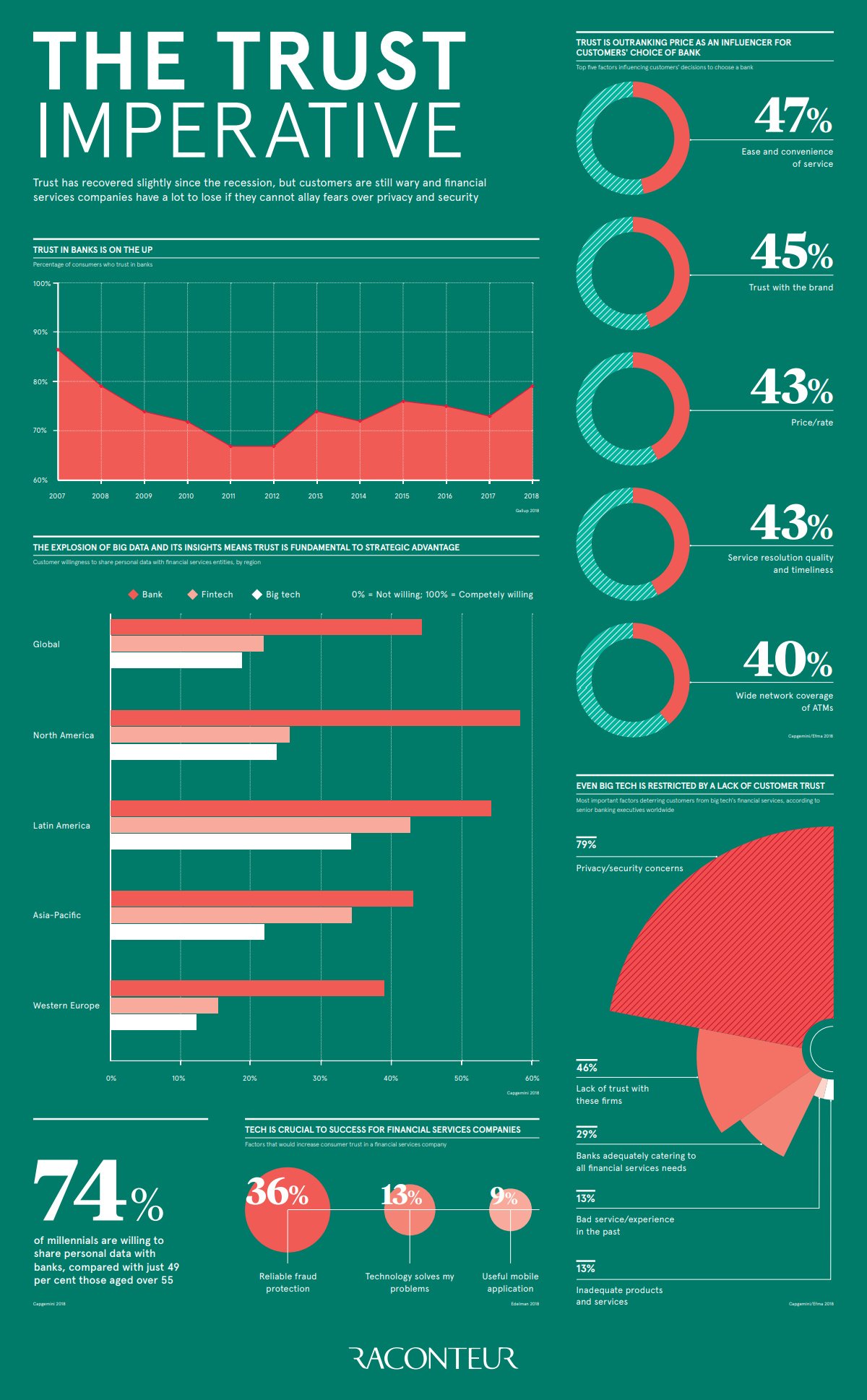
However, as today’s infographic from Raconteur shows, this digital migration has a crucial side effect: trust in financial services has emerged as a dominant driver of consumer activity.
This likely boils down to a couple major factors:
Tangibility
Financial services are becoming less grounded in physical experiences (using cash, visiting a branch, personal relationships, etc.)
Personal Data
Consumers are rightfully concerned about how personal data gets treated in the digital age
Further, the above factors are compounded by memories of the 2008 Financial Crisis. These events not only damaged institutional reputations, but they elevated trust to become a key concern and selling point for consumers.
Trust, by the Numbers
In general, trust in banks has been slowly on the rise since hitting a low point in 2011 and 2012.
At the same time, consumers are consistently ranking trust as a more important factor in their decision of where to bank. To the modern consumer, trust even outweighs price.
Top Five Factors for Choosing a Bank:
Ease and convenience of service (47%)
Trust with the brand (45%)
Price/rate (43%)
Service resolution quality and timeliness (43%)
Wide network coverage of ATMs (40%)
It’s important to recognize here that all five of the above factors rank quite closely in percentage terms. That said, while they are all crucial elements to a service offering, trust may be the most abstract one to try and tackle for companies in the space.
With this in mind, how can financial services leverage tech to increase the amount of trust that consumers have in them?
Tech Factors That Would Increase Consumer Trust:
Reliable fraud protection (36%)
Technology solves my problems (13%)
Useful mobile application (9%)
Better fraud protection capability stands out as one major trust-builder, while designing technology that is useful and effective is another key area to consider.
Do's & Don'ts When You Increase Your Income
.Do's & Don'ts When You Increase Your Income
7/11/2019 Team Member Blog, Consumerism to Frugalism
Most of you would like to increase your income. Whether you’re looking to make a career move, change companies, start a business, or simply move up in your current situation, making more money is likely one of the major factors in your job decisions.
Here at Money Saved is Money Earned, we know money isn’t everything and you shouldn’t live just for money. However, we also know that money plays a major factor in your ability to live the way you want.
While we should live within our means, most people would make very different choices if money wasn’t an option. Having said that, money should never be the end goal.
Do's & Don'ts When You Increase Your Income
7/11/2019 Team Member Blog, Consumerism to Frugalism
Most of you would like to increase your income. Whether you’re looking to make a career move, change companies, start a business, or simply move up in your current situation, making more money is likely one of the major factors in your job decisions.
Here at Money Saved is Money Earned, we know money isn’t everything and you shouldn’t live just for money. However, we also know that money plays a major factor in your ability to live the way you want.
While we should live within our means, most people would make very different choices if money wasn’t an option. Having said that, money should never be the end goal.
What’s really at the heart of the drive for more money is the desire for more freedom and power: over our life and the choices we make about it, as well as our ability to influence the world in the ways we care most about.
Money is nothing more than the means to an end.
Unfortunately, most of us will not win the big lottery, start a billion dollar company, or inherit millions. This means that while our incomes may increase over time that increase will likely be gradual, and may come in the form of step or merit-based raises, bonuses, or commissions.
However, most people find themselves spending money as fast as they make it, gradual increase or not.
With these points in mind, what SHOULD you do if you find your income increasing?
Luckily, we’re here to help.
Here are 2 things you should do when you increase your income and 1 you shouldn’t.
Things You SHOULD Do :
1. Pay off Debt
To continue reading, please go to the original article here:
9 Symptoms of an Unhealthy Relationship with Money
.9 Symptoms of an Unhealthy Relationship with Money
Do you have a love-hate relationship with money? Different people feel differently about money. Sometimes you feel confident about your financial situation. Other times you feel guilty about the money you spend. Some of us enjoy looking at our bank accounts, while some feel dreaded. Your relationship with money depends upon how you treat it. Whether you consider it your trusted friend or something that causes frustration, fear and guilt.
The good news is, no matter how unhealthy your relationship with money is, you can always take steps to improve it. However, to make that happen, you need to identify the habits which are causing you to overspend or preventing you from spending even on your basic comforts and necessities. In this article, we are going to discuss the symptoms that indicate you have an unhealthy relationship with money. But first, let’s discuss what is a healthy financial relationship.
9 Symptoms of an Unhealthy Relationship with Money
Do you have a love-hate relationship with money? Different people feel differently about money. Sometimes you feel confident about your financial situation. Other times you feel guilty about the money you spend. Some of us enjoy looking at our bank accounts, while some feel dreaded. Your relationship with money depends upon how you treat it. Whether you consider it your trusted friend or something that causes frustration, fear and guilt.
The good news is, no matter how unhealthy your relationship with money is, you can always take steps to improve it. However, to make that happen, you need to identify the habits which are causing you to overspend or preventing you from spending even on your basic comforts and necessities. In this article, we are going to discuss the symptoms that indicate you have an unhealthy relationship with money. But first, let’s discuss what is a healthy financial relationship.
What Is A Healthy Relationship With Money?
When we read the word “health”, nutrition, exercise and good sleep are what comes to our mind. We never consider money a part of our health. The truth is, to maintain a healthy lifestyle, you need to have a healthy relationship with money.
You need to consider your financial health as an important component of your overall wellbeing. If you want to develop a healthy relationship with money, you need to identify the problematic habits you have built around money over the years. Once you have identified these problems, it will get easier for you to manage your finances in a better way.
When you have a healthy relationship with money you are:
Intentional in your spending
Have reasonable or low debt
Saving to achieve your monetary goals
Investing in an emergency fund or insurance
Our spending habits stem from our childhood. The believes we learn about money as a child stick with us forever. Our beliefs regarding finances are what drive our financial behavior.
This makes it important for parents to cultivate healthy financial habits in their children. Doing so, they can prepare them to manage money in a better way as they enter adulthood.
How To Improve Your Relationship With Your Finances?
Now you must be wondering how to enhance your relationship with money. The answer is simple.
Just like any other relationship in your life, you can improve this relationship with love and compassion. If you want to build a healthy relationship with money, you need to love it no matter what the circumstances are.
To continue reading, please go to the original article here:
Frugal Living Tips from the Great Depression
.Frugal Living Tips from the Great Depression
January 16, 2022 by A Dime Saved
How frugal were people during the Great Depression? It was a time of hardship and uncertainty. Many families lost their homes or had to live with relatives that could afford to take them in, as they struggled to find work. Here are some frugal living tips from the great depression so you can save money now and avoid going broke!
First, let’s talk about some background about the Great Depression and why so many of our frugal living tips come from that era.
How the Great Depression Impacted America
Frugal Living Tips from the Great Depression
January 16, 2022 by A Dime Saved
How frugal were people during the Great Depression? It was a time of hardship and uncertainty. Many families lost their homes or had to live with relatives that could afford to take them in, as they struggled to find work. Here are some frugal living tips from the great depression so you can save money now and avoid going broke!
First, let’s talk about some background about the Great Depression and why so many of our frugal living tips come from that era.
How the Great Depression Impacted America
During the Great Depression, American families made due on much less than we do now! Families often lived out of their cars, as they moved from place to place in search of a job.
When frugality was necessary because there wasn’t much money around, it became ingrained into the culture of the American people. A lot of these frugal ways still exist today and you can use them to save money too.
What was life like during the Great Depression?
Life during the Great Depression was difficult. Families often didn’t have enough money to buy food, clothes, or shelter.
Many people were forced to live in poverty and unemployment was high. Some families even had to sell their possessions just to survive.
However, many Americans also found ways to be frugal and make due on less. They frugally reused and recycled their old items, grew their own food in gardens or fruit trees, bought used clothing and furniture instead of new ones they couldn’t afford anyway, and even found ways to entertain themselves without spending money.
Many frugal living tips from the Great Depression continue to be used today. They have been passed down through generations and are still in use because they work.
Just like during the great depression, frugality is necessary for people who can’t afford a lot of things or don’t get paid enough to make ends meet. Many families live frugally without realizing it, and there are many ways to do so.
How to Make Your Own Clothes and Save Money on Material Costs
To continue reading, please go to the original article here:
https://adimesaved.com/frugal-living-tips-from-the-great-depression
My Mama Always Told Me – You Better Have Your Own Money
.My Mama Always Told Me – You Better Have Your Own Money
MadMoney Monster
Warning: This post recounts a tale of hardcore MOM advice from yesteryear.
Moms, they’re funny creatures, aren’t they? They lecture us about not getting enough sleep, they threaten to not babysit when we ignore them for too long, they give us constant unsolicited advice on parenting, marriage, and cooking. And yet, no one in the world loves us more.
Recently, I’ve been thinking about all of the advice my mom gave me as I was growing up. Looking back on it, that advice certainly did shape my thoughts and the way in which I operate in this world. Today, I’m going to share a piece of pillar advice I heard from my mom over and over again – “Always have your own money!”
My Mama Always Told Me – You Better Have Your Own Money
MadMoney Monster
Warning: This post recounts a tale of hardcore MOM advice from yesteryear.
Moms, they’re funny creatures, aren’t they? They lecture us about not getting enough sleep, they threaten to not babysit when we ignore them for too long, they give us constant unsolicited advice on parenting, marriage, and cooking. And yet, no one in the world loves us more.
Recently, I’ve been thinking about all of the advice my mom gave me as I was growing up. Looking back on it, that advice certainly did shape my thoughts and the way in which I operate in this world. Today, I’m going to share a piece of pillar advice I heard from my mom over and over again – “Always have your own money!”
First, let me preface this by saying, I completely understand that not everyone lives this way. And that’s okay. The purpose of this post is to enlighten and entertain. I am in no way suggesting that EVERYONE should always have their own money because my mom said so. Now, with that said, let’s dig into why my mom told me that and how it has affected my life in a positive way. Here we go!
ALWAYS HAVE YOUR OWN MONEY
So just what did my mom mean by telling me to always have my own money? She meant exactly that – Always Have Your Own Money. In other words, I should strive to always be able to support myself, regardless of what circumstance life decides to throw my way. And regardless of what circumstances I get myself into.
Parents always have their children’s best interests at heart. They want their children to Do More and Be More. Their wish is for their children to always be happy, healthy, and never experience discomfort. And, they hope their children have plenty of money and enter into solid, well-suited relationships. But let’s face it, all these hopes and dreams and wishes don’t always take shape. And when they don’t, it’s nice to have, you guessed it…Money.
Money obviously isn’t a cure-all, but it sure does offer up some wonderful options when life throws you a curveball. With money, you can endure the emotional stresses of a difficult time without having to worry about how you’re going to pay the mortgage or buy groceries. With money, you have the luxury of taking a breather and contemplating your next move. This is something my mother never had.
REASONS FOR THIS ADVICE
To continue reading, please go to the original article here:
https://madmoneymonster.com/2017/10/11/my-mama-always-told-me-you-better-have-your-own-money/
The Mindset That Distinguishes the Successful from the Average
.The Mindset That Distinguishes the Successful from the Average
By Lars Beke
Being the best is not an easy task. That’s just the inconvenient truth. Ask Donald Trump, Anthony Joshua, Usain Bolt, Mark Zuckerberg and other successful people out there, all of them will tell you one thing: Success doesn’t come cheap on a platter of gold. You just have to work for it. That is, you need to do things differently if you want to stand out from the pack. You also need to have a different mindset to be more successful than others.
In fact, the difference between the best and rest is nothing but their mindset – the established behaviors and beliefs held by them. For instance, if you give two people the same time and the same amount of money to start a business, you will still find out that one person will still be more successful than the other.
The Mindset That Distinguishes the Successful from the Average
By Lars Beke
Being the best is not an easy task. That’s just the inconvenient truth. Ask Donald Trump, Anthony Joshua, Usain Bolt, Mark Zuckerberg and other successful people out there, all of them will tell you one thing: Success doesn’t come cheap on a platter of gold. You just have to work for it. That is, you need to do things differently if you want to stand out from the pack. You also need to have a different mindset to be more successful than others.
In fact, the difference between the best and rest is nothing but their mindset – the established behaviors and beliefs held by them. For instance, if you give two people the same time and the same amount of money to start a business, you will still find out that one person will still be more successful than the other.
The Mindset that Distinguishes the Successful from the Average
Why? It’s their mindset.
It is their mindset that influences the decisions they make, the way they react under pressure, and how they handle issues. Wondering what those mindsets are? Below are the mindsets that distinguish the successful from the average, the rich from the poor and the best from the rest.
1. They Never Give Up
The recent bout between Anthony Joshua and Wladimir Klitschko is a vivid example of how successful people don’t give up.
In the 6th round, Klitschko had the upper hand, giving Joshua some heavy jabs until the English man was knocked down in that round. However, despite this setback, Joshua did not give up.
He recovered in subsequent rounds and in the last round, he gave Klitschko an uppercut which sent the Ukrainian professional boxer down and the rest is history now.
Joshua won the bout not because he was more experienced than the former heavyweight champion Klitschko but because he had the mindset of not giving up.
2. They Are Self-Motivated
Self-motivation means the ability of a person to accept and complete any tasks without seeking any external inspiration from other people. It is a fact that people who are self-motivated are more successful than those who are not.
The best people in any field don’t need others to inspire them.
They can motivate themselves. This is because unlike the average people, the successful people have the passion, zeal, willingness, and enthusiasm to follow through their plans and overcome any challenges.
To continue reading, please go to the original article here:
https://wealthygorilla.com/mindset-distinguishes-successful-average/