
Living a Frugal Life and Enjoying It
.Living a Frugal Life and Enjoying It
August 28, 2020 by A Dime Saved
What does it mean to live a Frugal Life? I think there is an inherent positivity in choosing a Frugal Life, even if that decision is not based on money.
I live a frugal life. I talk about living frugally and how to save money because that is my life. That is how I live. Living a frugal life is more of a mindset than having to do with money. You can live a frugal life even if you have all the money in the world. Of course, there is a world of difference between choosing to live frugally and being forced to live frugally because of your circumstances.
Living a Frugal Life and Enjoying It
August 28, 2020 by A Dime Saved
What does it mean to live a Frugal Life? I think there is an inherent positivity in choosing a Frugal Life, even if that decision is not based on money.
I live a frugal life. I talk about living frugally and how to save money because that is my life. That is how I live. Living a frugal life is more of a mindset than having to do with money. You can live a frugal life even if you have all the money in the world. Of course, there is a world of difference between choosing to live frugally and being forced to live frugally because of your circumstances.
To be living a frugal life and enjoying it means you need to have the proper mindset in place. Living a frugal lifestyle is about more than cutting corners or making your own vegetable stock. To live a frugal lifestyle is to have a frugal mindset.
What does it mean to live a Frugal Life? I think there is a an inherent positivity in choosing a Frugal Life, even if that decision is not based on money.
Living frugally does not mean that you have to deprive yourself of every joy in the world, I think everyone is sick of all the articles and memes telling us to stop spending money and coffee. We get it. Coffee isn’t frugal. Starbucks is the devil blah blah. That’s not the point of frugality. Frugality also doesn’t mean never spending money or always buying the cheapest thing.
The Frugal Life isn’t The Cheap Life
I have an uncle who always buys the cheapest things. They can afford to spend more but he doesn’t want to. An appliance breaks- he goes to the store and buys the cheapest one. Unsurprisingly, they go through many, many appliances. Their appliances are always breaking. In fact, they have bought more microwaves in the past 2 years then I have bought in my adult life. (I only ever bought one).
That is not particularly frugal. Frugality would mean choosing the best option even if it means spending more money. Besides for probably saving money in the long run, the aggravation of constantly having broken appliances does not lead to a peaceful life.
Being frugal doesn’t mean picking the cheapest option always. It means choosing the frugal option always.
What does that mean?
Living a Mindfully Frugal Life
Living a frugal life and enjoying it means allowing yourself to spend money on what matters to you and you alone.
Living a frugal life means being mindful of where your money is going. It is choosing to spend your money in places where it matters and not spending your money in places where it doesn’t matter. Now, most people who live a frugal life tend to agree about what matters to them and what doesn’t. Designer handbags and fancy clothes are usually categorized under the “doesn’t matter” category.
To continue reading, please go to the original article here:
Stop! Don't Make These 6 Dumb Mistakes With Your Financial Windfall
.Stop! Don't Make These 6 Dumb Mistakes With Your Financial Windfall
By Kentin Waits
Maybe your lottery numbers finally came in. Maybe a favorite aunt remembered you in her will. Heck, maybe one day while you were shootin' at some food, up through the ground came bubblin' crude — oil that is! Texas tea! (See also: 50 Smart Things to Do With Your Tax Refund)
Whatever the source, you're the lucky beneficiary of a financial windfall. Revel in it and protect your new-found wealth by avoiding these six dumb moves.
1. Act Impulsively
Receiving money unexpectedly is exciting, and it can send even normally down-to-earth folks straight into the stratosphere. In those dizzying weeks and months following a financial windfall, we're really not ourselves, so making big decisions during that time is usually a terrible idea.
Stop! Don't Make These 6 Dumb Mistakes With Your Financial Windfall
By Kentin Waits
Maybe your lottery numbers finally came in. Maybe a favorite aunt remembered you in her will. Heck, maybe one day while you were shootin' at some food, up through the ground came bubblin' crude — oil that is! Texas tea! (See also: 50 Smart Things to Do With Your Tax Refund)
Whatever the source, you're the lucky beneficiary of a financial windfall. Revel in it and protect your new-found wealth by avoiding these six dumb moves.
1. Act Impulsively
Receiving money unexpectedly is exciting, and it can send even normally down-to-earth folks straight into the stratosphere. In those dizzying weeks and months following a financial windfall, we're really not ourselves, so making big decisions during that time is usually a terrible idea.

Instead of spending or investing immediately, take a time out. Collect yourself. Adjust to your new wealth for six months or a year and just let the cash sit in a money market account or CD. Remember, high emotion and sound decision-making usually don't mix.
2. Buy a New Car
Even if you're paying cash, there are many reasons to avoid buying a new car. Not only is it the most cliché thing you can do with a windfall, but it's also one of the quickest ways to lose roughly 25% on every dollar you spend.
The minute you sign the paperwork and drive off the lot, that new car becomes used. Depreciation takes a quick and silent bite out of your new ride. Let someone else absorb that financial hit; buy a pre-owned late-model car that's still under warranty.
3. Loan Money to Friends and Family
Making loans to friends and family is a sure way to take the wind out of your financial windfall. Loans have a curious way of never getting repaid, and once your bank balance dwindles, hard feelings can set in and slowly erode relationships.
To continue reading, please go to the original article here:
37 Life Hacks That Will Save You Money
37 Life Hacks That Will Save You Money
There are easy things you can do to reduce your monthly budget.
By Jeff Yeager Mar 15, 2022
Savvy shoppers might be the masters of coupon cutting and buying on a budget, but those aren’t the only ways to save money. If you don’t take advantage of all the life hacks available to you, you’re essentially leaving free cash on the table.
With a little effort and creativity, you can cut hundreds or even thousands of dollars a year from your budget. Plus, if you handle a few small items on your to-do list that you’ve been putting off, you can even find ways to earn more money without working more. Take these steps to gain control of your financial future.
37 Life Hacks That Will Save You Money
There are easy things you can do to reduce your monthly budget.
By Jeff Yeager Mar 15, 2022
Savvy shoppers might be the masters of coupon cutting and buying on a budget, but those aren’t the only ways to save money. If you don’t take advantage of all the life hacks available to you, you’re essentially leaving free cash on the table.
With a little effort and creativity, you can cut hundreds or even thousands of dollars a year from your budget. Plus, if you handle a few small items on your to-do list that you’ve been putting off, you can even find ways to earn more money without working more. Take these steps to gain control of your financial future.
1. Scan Grocery Receipts for Cash Back
You can save money on groceries by using smartphone apps like Ibotta and Checkout 51, which give you cash back on grocery store purchases. All you have to do is scan the receipts after you shop. You could easily earn $5 or more a week for just a couple minutes of your time.
2. Buy Prescription Drugs at Costco Without a Membership
Membership warehouse stores like Sam’s Club and Costco have good prices on prescription drugs — and you don’t have to be a member to buy them. So, take advantage of Costco’s low prices on doctor-prescribed meds without shelling out $60 or more a year to join the club.
3. Make Your Spending Work For You
If you’re spending anyway, why not profit from it? There are a ton of offers out there for cash back, rewards, etc. A great way to maximize your return is with the cashRewards Credit Card from Navy Federal Credit Union. You can earn a $200 cash back bonus when you spend $2,000 within 90 days of opening an account. If you’re spending anyway, why not profit from it?
You’ll also earn 1.75% cash back on purchases when you get a cashRewards Credit Card and enroll in direct deposit. If you don’t enroll in direct deposit, you’ll still earn 1.5% cash back. Plus, the cashRewards Credit Card also has no annual fee, no foreign transaction fee, and 0% intro APR on balance transfers for six months (offer ends July 5, 2022).
4. Get More Ink Out of Your Printer
If your printer is out of black ink or toner, change the text color to dark blue — you’ll be able to print a couple more times before purchasing a refill. Additionally, avoid thick, ink-wasting fonts in favor of slimmer ones like Arial and Courier New.
5. Ditch Your Low-Interest Savings Account
To continue reading, please go to the original article here:
https://www.gobankingrates.com/saving-money/savings-advice/life-hacks-save-money/
The Biggest Money Mistakes Women Make in Relationships
.The Biggest Money Mistakes Women Make in Relationships
By Gabrielle Olya
In today’s “Financially Savvy Female” column, we chat with Shelly-Ann Eweka, CFP, senior director of financial planning strategy at TIAA, about the three biggest money mistakes women make in relationships — plus, how to successfully talk about finances with your partner.
Mistake #1: Not Talking About Finances Soon Enough
You may not want to talk about money on a first date, but it’s a topic that should be discussed before you’re opening a joint bank account.
The Biggest Money Mistakes Women Make in Relationships
By Gabrielle Olya
In today’s “Financially Savvy Female” column, we chat with Shelly-Ann Eweka, CFP, senior director of financial planning strategy at TIAA, about the three biggest money mistakes women make in relationships — plus, how to successfully talk about finances with your partner.
Mistake #1: Not Talking About Finances Soon Enough
You may not want to talk about money on a first date, but it’s a topic that should be discussed before you’re opening a joint bank account.
“Discuss finances in a relationship as soon as you believe your finances will become intertwined,” Eweka said. “The person you are in a relationship with will impact how and when you reach your financial goals. In fact, your financial goals may change because of the relationship. The topics that should be discussed include credit scores, debt, estate wishes, goals and dreams. It is also important to understand your partner’s relationship with money.”
Mistake #2: Not Communicating Openly About Expenses
“When it comes to combining finances and dividing expenses in a relationship, mistakes happen because of a lack of communication between partners,” Eweka said. “It is critical to communicate and set expectations of how expenses will be handled.
Dividing expenses is a very personal decision — there is no right or wrong answer. If both partners are working, some couples split expenses evenly and others split expenses proportionally to earnings. The best way to handle this is for each partner to share their comfort level and come to an agreement about how to split the expenses. It is important to be aware that the agreement will probably shift over time — children, job loss or promotions may cause the agreement to change.”
These discussions will likely involve compromise — you can’t demand of your partner what you yourself are not willing to do.
“It won’t feel fair if you ask your partner to skip out on the season tickets if you don’t also show how you are contributing to maintaining the budget,” Eweka said. “Make a commitment to bring your lunch to work and pass on the expensive coffee each day.”
Mistake #3: Keeping Secrets About Your Financial Past
To continue reading, please go to the original article here:
10 Things You Can Do Right Now to Protect Against Inflation
.10 Things You Can Do Right Now to Protect Against Inflation
Looking for ways to put your money to work? Read on.
Adam McFadden | JANUARY 28, 2022 | Updated: March 16, 2022
There’s no doubt about it, inflation is here in a big way. So how can you put your money to work to stay ahead of it? The good news is there are some things you can do to protect and possibly grow your money in an inflationary economy. We cover some of these suggestions below for those who are looking to make the best use of their money during this time of high inflation.
10 Things You Can Do Right Now to Protect Against Inflation
Looking for ways to put your money to work? Read on.
Adam McFadden | JANUARY 28, 2022 | Updated: March 16, 2022
There’s no doubt about it, inflation is here in a big way. So how can you put your money to work to stay ahead of it? The good news is there are some things you can do to protect and possibly grow your money in an inflationary economy. We cover some of these suggestions below for those who are looking to make the best use of their money during this time of high inflation.
Key Takeaways
Inflation can be a challenge for everyone, especially those with little to no exposure in the stock market or a lot of extra cash sitting around.
Taking steps to lessen the impacts of inflation on your finances is key, whether it’s through investing or cutting costs.
The ultra-rich know that diversification across several different asset classes that outperform the market during inflationary times is key. These could include alternative investments like contemporary art, real estate, peer-to-peer lending, and more.
Diversify With One of the Most Inflation-Resilient Alternative Assets
Investing in art can provide a hedge against inflation, according to research from Bank of America. That’s because art correlation to other asset classes is extremely low. The firm’s Chief Investment Strategist expects inflation to surge and recommends investing in real assets, like art, as protection. The annual price appreciation of contemporary art has outpaced the S&P 500 by 164% over the last 25 years.
That’s why over two-thirds of ultra-high-net-worth collectors allocate at least 10% of their overall portfolios to art, on average, according to Deloitte. For the rest of us, there’s a new alternative investing platform called Masterworks. Now you can diversify your portfolio with multimillion-dollar paintings1 by artists like Banksy and Picasso without needing millions. With over 350,000 registered users it’s one of the most exclusive platforms to join.
Pay Down High-Interest Debt
Many credit cards have variable interest rates, meaning when the Feds raise the federal funds rate, your interest rate on your credit cards are likely to rise with it. The Feds have already stated they will most likely be raising the rate more than once in 2022 to combat inflation, so now is the time to start paying down any high-interest credit card debt.
To continue reading, please go to the original article here:
https://www.gobankingrates.com/what-to-do-with-your-money-during-high-inflation/?utm_source=yahoo&utm_medium=cpc&utm_campaign=native&costid=691
You Never Have Time, Only Intentions
.You Never Have Time, Only Intentions
by David Cain
In my new house the top floor is a single room with gabled walls and a single window that looks out over the street. I go up there twice daily to meditate for half an hour, so every time I’m in that room I can’t help but think, at least once, about how much time I have left in the day.
During those sessions I’m more aware of my thoughts, and the effect they have on me, than at any other time. And I’ve noticed that the amount of time I have left after my sitting—before I have to be somewhere, or before bedtime—makes a big difference psychologically.
You Never Have Time, Only Intentions
by David Cain
In my new house the top floor is a single room with gabled walls and a single window that looks out over the street. I go up there twice daily to meditate for half an hour, so every time I’m in that room I can’t help but think, at least once, about how much time I have left in the day.
During those sessions I’m more aware of my thoughts, and the effect they have on me, than at any other time. And I’ve noticed that the amount of time I have left after my sitting—before I have to be somewhere, or before bedtime—makes a big difference psychologically.
Given what I plan to do for the rest of the day, I always have one of two distinct feelings: I have enough time, or I don’t have enough time. I’m learning not to trust either of these feelings, because they’re based on an error in perception—when you think about it, and we never really have time. Time we talk about “having” is always in the future, where we can’t see it and don’t know what it will be like.
We can’t be confident it will be there when we need it, or that it will arrive without conditions or unexpected problems. We never possess time in the same way we possess the money in our wallets, although we talk like we do. We assume we have three hours or three days to do something, but it never actually comes into our possession.
The time we “have” is never where we are, and we can never see it, unlike everything else we have: our clothing, our furniture, our homes, our friends and family. We never know our time like we know those things, so we can’t depend on it like we depend on those things.
The un-ownability of time is a little more obvious when it comes to life expectancy. I have to occasionally remind myself I don’t have another 40 or 50 years to live. I often expect it, but I never have it. It’s not mine. I don’t even “have” one year. I do have this moment, but all the time stretching forward from it is just speculation. We can have intentions, but never time.
This all might sound like the shower-thoughts of a very bored person. What difference does it really make? “Having time” is just a way of speaking, isn’t it?
It’s not just semantics—there’s a tremendous difference between believing you own and control the upcoming three hours, and understanding that you have intentions for it but don’t own it.
Despite your expectations, something could interrupt you, or distract you, or the thing you thought you’d get done is bigger and more complex than you thought, all of which can instantly transmute the comforting feeling of “enough time” to the claustrophobic feeling of “not enough time”. Your time was never dependable, even if you didn’t realize it. Even if there turn out to be no complications, you can never know there won’t be until the time in question is gone.
Time we think we have is always going to be unreliable in this way, and since we’re constantly depending on this unreliable thing, it’s constantly generating a certain kind of stress, regardless of how any given stretch of time turns out.
To continue reading, please go to the original article here:
https://beforeitsnews.com/opinion-liberal/2017/05/you-never-have-time-only-intentions-2554118.html
The Reason Many Ultrarich People Aren’t Satisfied With Their Wealth
.The Reason Many Ultrarich People Aren’t Satisfied With Their Wealth
Joe Pinsker
At a certain point, another million dollars doesn’t make anything newly affordable. That’s when other motivations take over. As the number of millionaires and billionaires in the world climbs ever higher, there are a growing number of people who possess more money than they could ever reasonably spend on even the lushest goods. But at a certain level of wealth, the next million isn’t going to suddenly revolutionize their lifestyle. What drives people, once they’ve reached that point, to keep pursuing more?
There are some good explanations, I found, after talking to a few people who’ve spent significant amounts of time in the presence of and/or researching the really, really rich. Michael Norton, a Harvard Business School professor who has studied the connections between happiness and wealth, had a particularly elegant model for understanding this pattern of behavior.
The Reason Many Ultrarich People Aren’t Satisfied With Their Wealth
Joe Pinsker
At a certain point, another million dollars doesn’t make anything newly affordable. That’s when other motivations take over. As the number of millionaires and billionaires in the world climbs ever higher, there are a growing number of people who possess more money than they could ever reasonably spend on even the lushest goods. But at a certain level of wealth, the next million isn’t going to suddenly revolutionize their lifestyle. What drives people, once they’ve reached that point, to keep pursuing more?
There are some good explanations, I found, after talking to a few people who’ve spent significant amounts of time in the presence of and/or researching the really, really rich. Michael Norton, a Harvard Business School professor who has studied the connections between happiness and wealth, had a particularly elegant model for understanding this pattern of behavior.
Norton says that research regularly points to two central questions that people ask themselves when determining whether they’re satisfied with something in their life:
Am I doing better than I was before? And Am I doing better than other people?
This applies to wealth, but also to attractiveness, height, and other things that people fret about.
“But the problem is,” Norton says, “a lot of the things that really matter in life are hard to measure. So if you wanted to be a good parent, it’s a little hard to know if you’re being a better parent now than you were a year ago, and it’s also hard to know if you’re a better parent than the neighbors.”
So people turn to dimensions of comparison that can be quantified. “Money is a terrific one,” Norton says. “If I need to know if I’m doing better than I was, the easy thing to ask is, Am I making more money? or Does my house have more square feet? or Do I have more houses than I used to?”
This instinct to measure and compare doesn’t disappear once people have an obscene amount of money. “The problem is, Am I doing better than I was? is only [moving people in] one direction, which is up,” Norton says.
And if a family amasses, say, $50 million but upgrades to a neighborhood where everyone has that much money (or more), they feel a lot less rich than if they had stuck to the peer comparisons they were making tens of millions of dollars ago. Hence the ever-shifting goalposts of wealth and satisfaction.
The research Norton has conducted illustrating this phenomenon is dispiriting. In a paper published earlier this year, he and his collaborators asked more than 2,000 people who have a net worth of at least $1 million (including many whose wealth far exceeded that threshold) how happy they were on a scale of one to 10, and then how much more money they would need to get to 10.
To continue reading, please go to the original article here:
https://www.theatlantic.com/family/archive/2018/12/rich-people-happy-money/577231/
Oil Prices And Your Money
.Oil Prices And Your Money
By Dave @ Accidental Fire · Published March 15, 2022
Oil prices have soared in recent weeks putting gas prices at near record highs in the U.S. America is a very car-obsessed and car-dependent country so gas prices are what’s in the news. But don’t think that rising oil prices will only affect you at the gas pump. Tons of things we all use every day as this article details are literally either made of oil or depend heavily on oil for their manufacturing.
But it all comes back to gas for most. Despite the fact that over 40,000 Americans die by car every year – well over 100 people per day – cars are worshipped by a large portion of the population and permeate all aspects of our popular culture.
Oil Prices And Your Money
By Dave @ Accidental Fire · Published March 15, 2022
Oil prices have soared in recent weeks putting gas prices at near record highs in the U.S. America is a very car-obsessed and car-dependent country so gas prices are what’s in the news. But don’t think that rising oil prices will only affect you at the gas pump. Tons of things we all use every day as this article details are literally either made of oil or depend heavily on oil for their manufacturing.
But it all comes back to gas for most. Despite the fact that over 40,000 Americans die by car every year – well over 100 people per day – cars are worshipped by a large portion of the population and permeate all aspects of our popular culture.
The average American drives a jaw-dropping 14,000 miles per year, so gas prices are what’s on people’s mind because they burn a shit-ton of it everyday.
Being that I barely drive and don’t burn much gas myself I wouldn’t consider myself the best person to dish out advice about saving money on gas, aside from the obvious advice to drive less and walk or bike more. But I blog to help people with money and I’m here to contribute.
Some Tools
This AAA site with an interactive map does a good job of showing the general picture of gas prices across America including state averages and the national average.
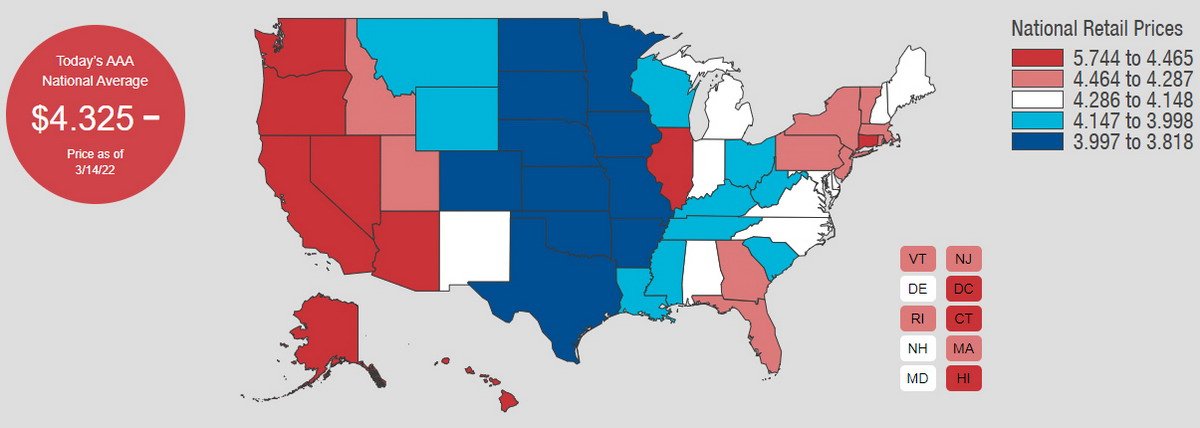
If you are taking any road trips or if you got on the RV bandwagon during covid like thousands of others, you need to be aware of price variances by geography. RV’s and sprinter vans get horrible gas mileage so filling up strategically in cheaper places can literally save you hundreds of dollars.
Another great tool if you drive a lot is the app Gasbuddy. The app searches for the cheapest prices near you and also has it’s own gas card and reward system. Full disclosure – I’ve never used it and am not affiliated with them in any way but online reviews seem mostly positive.
As you probably know most of the major oil companies have their own credit cards and reward systems. Again, being that I ride my bike way more than I drive I’m not the person to recommend any in particular but if you spend a lot on gas it’s probably in your best interest to check out sites like Nerdwallet who compare those sorts of things.
And if you happen to be in the market to buy a car, this list from Car & Driver of the most fuel efficient gas burners might be of help. Or you could get a hybrid or fully electric vehicle. Regardless of what you get, remember that savvy financial people buy used.
Third Order Effects
Now onto the more difficult truths. Most things are going to get more expensive. Inflation in America crested 7.5% recently and many “experts” had already predicted it to rise over 8% this year – before the war in Ukraine started and the oil price spike.
To continue reading, please go to the original article here:
https://accidentalfire.com/2022/03/15/oil-prices-and-your-money/
Five Critical Factors Why Prices Will Stay High For Years
.Five Critical Factors Why Prices Will Stay High For Years
Notes From the Field Simon Black March 14, 2022
At approximately 9am local time on February 21, 1972, a Boeing 707 airplane dubbed Spirit of ‘76 landed in Shanghai’s Hongqiao airport. The airplane’s main door opened, and out walked US President Richard Nixon.
The trip shocked the world. There had been no formal communication or diplomatic ties between the US and China for 25 years. And Nixon’s voyage not only normalized relations between the two countries, but it kickstarted decades of worldwide economic growth.
Back then, the US was the richest and most powerful economy in the world. But as a consequence of that prosperity, the US was also a very expensive place to produce.
Five Critical Factors Why Prices Will Stay High For Years
Notes From the Field Simon Black March 14, 2022
At approximately 9am local time on February 21, 1972, a Boeing 707 airplane dubbed Spirit of ‘76 landed in Shanghai’s Hongqiao airport. The airplane’s main door opened, and out walked US President Richard Nixon.
The trip shocked the world. There had been no formal communication or diplomatic ties between the US and China for 25 years. And Nixon’s voyage not only normalized relations between the two countries, but it kickstarted decades of worldwide economic growth.
Back then, the US was the richest and most powerful economy in the world. But as a consequence of that prosperity, the US was also a very expensive place to produce.
US companies were on the lookout for inexpensive, foreign manufacturing hubs where they could cheaply produce their products and sell them back to the US market.
China became that cheap manufacturing hub.
Eventually China was producing just about everything from T-shirts to antibiotics. And because the cost of production was so low in China, consumers around the world benefited.
Combined with cheap oil, a functioning global supply chain, and relative peace and stability, cheap Chinese production helped keep prices low and constrain inflation for decades.
But these trends are rapidly coming to an end.
For starters, China is now an economic superpower; many of its largest cities, in fact, have a per-capita GDP that exceeds the United States and Western Europe.
Wages have increased dramatically in China over the years because of this increase in prosperity, which means that it’s no longer cheap to manufacture most lower-end products there.
A lot of manufacturing has already shifted to cheaper places like Vietnam, Bangladesh, etc. But even those countries are quickly becoming more expensive places to produce. And they don’t have nearly enough capacity to keep up with global manufacturing demand.
Some large companies are starting to bring their manufacturing back home. This is becoming more popular now as global stability wanes.
Plus businesses learned during the COVID-19 lockdowns, and the resulting global supply chain dysfunction, that manufacturing at home is more reliable.
That may be true. But manufacturing in a ‘rich’ country is also a LOT more expensive.
So, regardless of whether a business chooses to manufacture at home or abroad, they’re almost guaranteed to suffer higher production costs. And that means consumers will be paying more.
This trend is a massive reversal from decades of cheap foreign production that kept prices low. But it only scratches the surface of why inflation will likely persist for years to come.
(British economist Charles Goodhart, a former central bank official, describes this phenomenon in his new book The Great Demographic Reversal. It’s definitely worth reading to understand this trend.)
Historic shifts in the labor market will also be a major contributor to inflation.
For example, there have never been more retirees in the history of the world than there are right now. And their numbers are growing.
According to Federal Reserve data, an additional 1.5 million people in the United States retired early during the first year of the pandemic. There will likely be more to come.
Plus US Labor Department statistics show that millions of other individuals, including young people, abandoned the idea of working altogether because of the pandemic.
Traditionally there’s a steady balance between the number of jobs in the economy, and the number of workers in the labor force. Sometimes there are shocks, like during the Great Recession in 2008, when millions of jobs vanished, practically overnight.
Now the converse has taken place: millions of workers have vanished, practically overnight.
The end result is that there are 11.3 million unfilled jobs in the United States-- a record high-- because so many people simply quit the labor force.
Of course, another key labor trend is that younger workers aren’t interested in most traditional jobs.
Countless teenagers aspire to be Instagram starlets, or to live-stream themselves playing video games for a living. They have little interest in construction, transportation, or manufacturing jobs.
So, in summary, we have former ‘low cost’ manufacturing hubs becoming a lot more expensive. Plus a constrained work force back home that limits production and pushes costs higher.
This is all highly inflationary.
And there’s absolutely nothing the government or central bank can do about it. Gen Z 20-somethings aren’t going to suddenly decide to start working traditional jobs just because the Federal Reserve raises interest rates by 0.25%.
Most likely the politicians will make it much worse-- which is another key factor in future inflation.
Nancy Pelosi stated on Friday that inflation was solely Vladimir Putin’s fault and insisted that their multi-trillion dollar deficit spending is “reducing the national debt” and “not adding to inflation.”
The President, meanwhile, has blamed inflation on “greed”, while the Federal Reserve insists that higher prices are a result of supply chain dysfunction.
Not one of these institutions-- Congress, the White House, or the Fed-- seems capable of looking at their own actions.
The Fed refuses to consider that inflation is due to their dizzying expansion of the US money supply-- the largest since 1943.
Congress refuses to consider that inflation is due to their insane deficit spending-- the largest ever in US history.
And the White House refuses to consider that inflation is due to its fetish for anti-competitive regulations and constant attacks on capitalism.
So, when the three key institutions charged with keeping inflation in check refuse to understand why there’s a problem, it’s hard to imagine they’re going to fix it.
There are plenty of other lingering inflation factors as well; geopolitical conflict is obviously inflationary. COVID-19 continues to be very inflationary. Environmental fanaticism is inflationary.
And just like the challenge of increased manufacturing costs, and labor market demographic trends, these issues cannot be magically fixed by politicians or central bankers.
In essence, policymakers are completely powerless to do anything about inflation.
There’s an irrational hope that inflation will quickly reverse, and prices will return to 2019 levels-- just as soon as Putin leaves Ukraine… and the global supply chain dysfunction works itself out.
But this is wishful thinking.
First, both of those resolutions could take a very long time.
But more importantly, the trends I outlined are much larger and could keep prices elevated for years to come.
So, if your “Plan A” is depending on the government for prosperity and price stability, it’s time to take a hard look at your Plan B.
To your freedom, Simon Black, Founder, SovereignMan.com
https://www.sovereignman.com/trends/five-critical-factors-why-prices-will-stay-high-for-years-34758/
32 Insider Tips for Buying and Selling a House
.32 Insider Tips for Buying and Selling a House
These insider tips can make buying or selling a home easier.
By Beth Rifkin Oct 1, 2021 Real Estate Investing 101
Whether you’re buying or selling a home, dealing in real estate can be a nerve-wracking experience, especially for a novice or first-timer. Fortunately, getting the right information can help make the process more manageable. Find out how you can buy and sell a house like a pro.
Tips for Buying a Home
When buying a home, whether to live in or as an investment property, it’s crucial to understand financing options, how to apply for a mortgage and the various expenses involved.
32 Insider Tips for Buying and Selling a House
These insider tips can make buying or selling a home easier.
By Beth Rifkin Oct 1, 2021 Real Estate Investing 101
Whether you’re buying or selling a home, dealing in real estate can be a nerve-wracking experience, especially for a novice or first-timer. Fortunately, getting the right information can help make the process more manageable. Find out how you can buy and sell a house like a pro.
Tips for Buying a Home
When buying a home, whether to live in or as an investment property, it’s crucial to understand financing options, how to apply for a mortgage and the various expenses involved.
It can be easy to get carried away when buying a home, so make sure the property is one that you will be able to afford, maintain and grow with over the years ahead.
1. Save For a Down Payment
The typical down payment is 20% of the sale price of the home. You might be able to get away with putting down less than that, but then your mortgage lender can require you to purchase private mortgage insurance. The insurance protects the lender in case you default on the loan.
That’s not a horrible thing, but it will increase your monthly payments by 0.5% to 1%. So it might make more sense to take some time and save more money for a down payment.
2. Check Your Credit
The better your credit score, the lower your mortgage interest rate will be. A score above 720 is ideal for purchasing a home.
Multiple factors are considered when calculating your score, such as if you pay your bills on time, the amount of your debt, length of credit history and types of credit; lenders prefer that you have a variety of credit sources. Check your credit quarterly and fix any mistakes that appear on your report.
3. Avoid Making Any Other Big Purchases
Every time you apply for a new form of credit, such as a credit card, a hard inquiry is run on your account, which can cause your credit score to take a slight dip. Therefore, avoid applying for or opening any new credit forms until after you have purchased your home.
4. Remember Closing Costs
Purchasing a home requires some mortgage-related expenses that might not be obvious at first — this includes closing costs.
Closing costs can include homeowners insurance, appraisals and home inspections, and cost about 2% to 5% of your mortgage. So, closing costs for a $300,000 mortgage, for example, can run anywhere from $6,000 to $15,000. Remember to plan for closing costs when calculating your budget.
To continue reading, please go to the original article here:
https://www.gobankingrates.com/investing/real-estate/insider-tips-buying-selling-house/
25 Tricks To Sell Your House for a Bigger Profit
.25 Tricks To Sell Your House for a Bigger Profit
Earn top dollar on your home with these simple tips.
By Alaina Tweddale Jan 28, 2022
It takes a savvy home seller to negotiate top dollar for their home. That’s why GOBankingRates talked to the experts and compiled the 25 best tips on how to add value to your home before you put it on the market so you can get the best price possible. What Adds More Value to Your Home: Indoor or Outdoor Upgrades?
Discover some of the best insider tips for selling a home.
Stage Your Property
Seventy-seven percent of realtors agree that it’s easier for a buyer to visualize a staged property as a future home, according to the National Association of Realtors 2017 Profile of Home Staging. The average cost to stage a home is between $2,000 and $2,400, according to data from Realtor.com. If you’re unsure how to stage a home, consider using a real estate agent.
25 Tricks To Sell Your House for a Bigger Profit
Earn top dollar on your home with these simple tips.
By Alaina Tweddale Jan 28, 2022
It takes a savvy home seller to negotiate top dollar for their home. That’s why GOBankingRates talked to the experts and compiled the 25 best tips on how to add value to your home before you put it on the market so you can get the best price possible. What Adds More Value to Your Home: Indoor or Outdoor Upgrades?
Discover some of the best insider tips for selling a home.
Stage Your Property
Seventy-seven percent of realtors agree that it’s easier for a buyer to visualize a staged property as a future home, according to the National Association of Realtors 2017 Profile of Home Staging. The average cost to stage a home is between $2,000 and $2,400, according to data from Realtor.com. If you’re unsure how to stage a home, consider using a real estate agent.
Staging the living room for buyers, followed by the master bedroom and the kitchen were found to be most important, according to the report.
Research Your Ideal Homebuyer
Different property types attract different types of buyers, each of whom has different homebuying wants and needs. Knowing your target buyer can make a substantial difference when selling your home.
For a single-family home in good condition, for example, the target buyer is likely looking for a move-in ready home. This type of buyer “does not want to do any repairs, and so spending time and money to make repairs makes sense,” said Lucas Machado, president of South Florida-based real estate investing firm House Heroes.
“If the property is in poor condition … it likely won’t qualify for a traditional bank mortgage,” Machado added. “This means the buyer is likely to be a real estate investor or cash-flush homeowner that intends to repair the property.”
These types of buyers prefer to do repairs and upgrades themselves. “The investor can likely do that work with more skill and less cost than the regular homeowner,” said Machado.
Create a Digital Home History
Buyers today seek homes that are move-in ready and well-maintained. Online services, like HomeZada, allow a seller to create an online digital footprint that details a home’s maintenance records, floor plans, warranty documents and more. If you have properly maintained your home, an online digital footprint can enable you to showcase your efforts while allowing potential buyers to fully appreciate the home’s maintenance history.
Boost Your Curb Appeal
How a home looks from the outside has a huge effect on how many potential buyers walk through the front door.
Than Merrill, CEO of FortuneBuilders, suggested investing in a new front door. If buying a replacement door is not within the budget, “consider repainting it for a fresh, clean look,” he said. It’s an affordable renovation you can make for less than $1,000. “Also, pressure washing the driveway and front walk — and trimming the hedges and trees — contribute to the overall look of the house.”
For people with a higher budget for renovations and repairs, Cannon Christian, president of Renovation Realty, suggested replacing worn vinyl siding. New vinyl siding can have an 80 percent or higher return on investment, according to Christian.
To continue reading, please go to the original article here: