
The Relationship Between Time, Money, And Happiness
.The Relationship Between Time, Money, And Happiness
Written by J.D. ROTH| Published: 15 May 2018 – Updated: 23 February 2020
The older I get, the more I'm convinced that time is money (and money is time). We're commonly taught that money is a “store of value”. But what does “store of value” actually mean? It's a repository of past effort that can be applied to future purchases. Really, money is a store of time. (Well, a store of productive time, anyhow.)
Now, having made this argument, I'll admit that time and money aren't exactly the same thing. Money is a store of time, sure, but the two concepts have some differences too.
For instance, time is linear. After one minute or one day has passed, it's irretrievable. You cannot reclaim it. If you waste an hour, it's gone forever. If you waste (or lose) a dollar, however, it's always possible to earn another dollar. Time marches forward but money has no “direction”.
The Relationship Between Time, Money, And Happiness
Written by J.D. ROTH| Published: 15 May 2018 – Updated: 23 February 2020
The older I get, the more I'm convinced that time is money (and money is time). We're commonly taught that money is a “store of value”. But what does “store of value” actually mean? It's a repository of past effort that can be applied to future purchases. Really, money is a store of time. (Well, a store of productive time, anyhow.)
Now, having made this argument, I'll admit that time and money aren't exactly the same thing. Money is a store of time, sure, but the two concepts have some differences too.
For instance, time is linear. After one minute or one day has passed, it's irretrievable. You cannot reclaim it. If you waste an hour, it's gone forever. If you waste (or lose) a dollar, however, it's always possible to earn another dollar. Time marches forward but money has no “direction”.
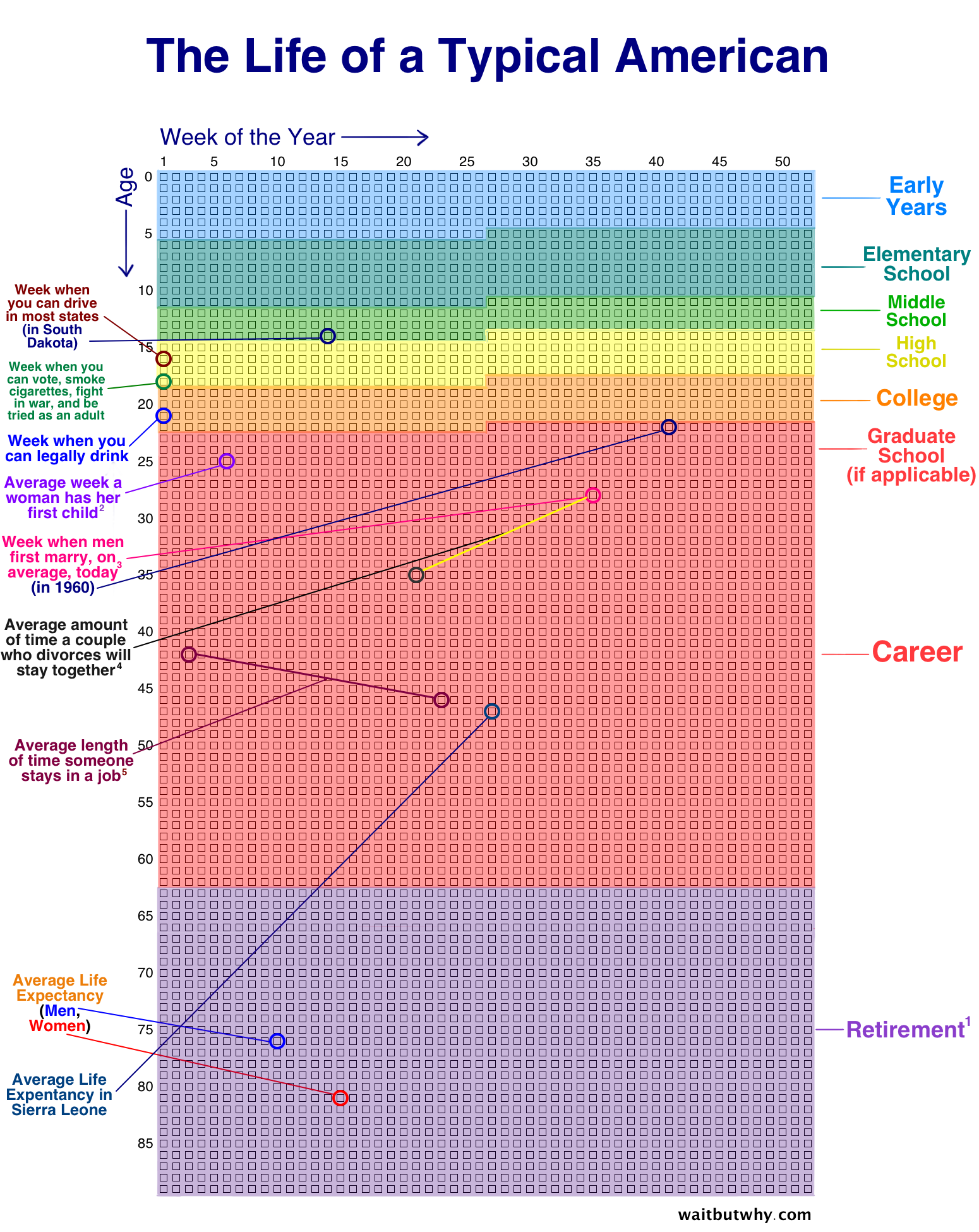
More importantly, time is finite. Money is not. Theoretically, your income and wealth have no upper bound. On the other hand, each of us has about seventy (maybe eighty) years on this earth. If you're lucky, you'll live for 1000 months. Only a very few of us will live 5000 weeks. Most of us will live between 25,000 and 30,000 days.
I've always loved this representation of a “life in weeks” of a typical American from the blog Wait But Why:
If you allow yourself to conduct a thought experiment in which time and money are interchangeable, you can reach some startling conclusions.
Wealth and Work
When I began to fully grasp the relationship between money and time, my first big insight was that wealth isn't necessarily an abundance of money — it's an abundance of time. Or potential time. When you accumulate a lot of money, you actually accumulate a large store of time to use however you please.
And, in fact, this seems to be one of the primary reasons the Financial Independence movement is gaining popularity. Financial Independence — having saved enough that you're no longer required to work for money — provides the promise that you can use your time in whichever way you choose. When I attend FI gatherings, I ask folks what motivates them. Almost everyone offers some variation on the theme: “I want to be able to do what I want, when I want.”
To me, one of the huge ironies of modern society is that so many people spend so much time to accumulate so much Stuff — yet never manage to set aside anything for the future. Why is this?
To continue reading, please go to the original article here:
"Q-isms and a Quick Review" by Kat - 5.2.20
."Q-isms and a Quick Review" by Kat - 5.2.20
5/02/2020 06:22:00 PM Emailed, Intel, Message, News, Thoughts
Entry Submitted by Kat at 4:45 PM EDT on May 2, 2020
Hi Dinarlandia,
I've given Q a hard time over the years. It's been out of my own frustration, of course, but I've softened up to old Q. I have a much clearer understanding of what this war of Light vs Evil has been about.
And all day today I've been feeling... this is OUR week. Even Q thinks so:
"Q-isms and a Quick Review" by Kat - 5.2.20
5/02/2020 06:22:00 PM Emailed, Intel, Message, News, Thoughts
Entry Submitted by Kat at 4:45 PM EDT on May 2, 2020
Hi Dinarlandia,
I've given Q a hard time over the years. It's been out of my own frustration, of course, but I've softened up to old Q. I have a much clearer understanding of what this war of Light vs Evil has been about.
And all day today I've been feeling... this is OUR week. Even Q thinks so:
![Boom+week+ahead[1].png](https://images.squarespace-cdn.com/content/v1/5d5222a44813620001d89582/1588486978485-JVNB08AA59V455CT6AA9/Boom%2Bweek%2Bahead%5B1%5D.png)
Now I know, I know, I've felt this way a lot over the last 8 years, and so has Q, but I REALLY feel it today.
![Nothing+can+stop+what%2527s+coming[1].png](https://images.squarespace-cdn.com/content/v1/5d5222a44813620001d89582/1588487044610-65T9ESJ498V6JJJZEBB2/Nothing%2Bcan%2Bstop%2Bwhat%252527s%2Bcoming%5B1%5D.png)
If you haven't seen this documentary, I highly recommend it. Not only for you, but for your family and friends. It sums up the history of the cabal/illuminati/deep state, brilliantly, and closes with such upliftment and optimism.
Cabal, Deep State, Q-Anon — 10-part Documentary by Janet Ossebaard 2 hours, 58 minutes
https://www.youtube.com/watch?v=GA5HcfVUYlo
https://www.youtube.com/watch?time_continue=11&v=GA5HcfVUYlo&feature=emb_logo
I must warn you, the chapters on the children are revolting, heart-crushing, vomitous and impossible to believe. But our brilliant Judy Byington has known about it all for years.
So let me take this moment to bow to you, Judy, for looking the most despicable crime on Earth clear in the face, and helping the children:
https://qanon.pub
![WWG1WGA+5-2-20[1].png](https://images.squarespace-cdn.com/content/v1/5d5222a44813620001d89582/1588487361343-XNXYT36Q03NQOKX4HUXJ/WWG1WGA%2B5-2-20%5B1%5D.png)
Keep in mind what David Wilcock said on April 1, 2020: "[Covid-19] is not killing very many people… Society’s going to come back on… the lights are going to come back on… and it’s very likely that we’re getting this amazing Global Economic Reset… arresting of deep state perpetrators… you look at how confident Q is…"
Regarding our exchanges:
I'm sure everyone is more-than-ready, but as a quick review of what we may or may not need, this is what I'm bringing:
-Several forms of ID, including one with photo (Passport, Driver's Lic.), and Utility Bill with street address.
- Currency and/or Bonds, neatly listed on a piece of paper; I'm bringing my receipts.
I've already made copies of my Currency and Bonds with their # clearly visible. Note the # on lower bottom Right hand side — just as a suggestion.
![vietnam-money-vietnam-tour-company[1].jpg](https://images.squarespace-cdn.com/content/v1/5d5222a44813620001d89582/1588487489817-NGPK4BSAZK52T7I1IYX9/vietnam-money-vietnam-tour-company%5B1%5D.jpg)
-If you have more than one Currency, it has been suggested to create a different bank account for each.
-Two copies of a written outline of your Humanitarian plans (you may not need this. We do not have to explain ourselves or justify asking for the Highest Rate—thank you Ron Giles!!)
-Ask for the Highest Rate you can get. If you don't know how you'll spend it now, it doesn't matter, it will come to you as we rebuild a beautiful New Earth.
For instance, how much will it cost to clean up the oceans? etc. That is what this money is for. Get as much as you can. That is how I'm thinking about it.
-Bring clear instructions on how to direct-deposit funds into your existing Bank account, if you want.
-IMPORTANT: Remember to GET COPIES of everything you sign, and every receipt, and the name, business cards or contact info. of everyone you dealt with.
Easy peasy.
BREATHE.
As a suggestion: Thank Source/God/All There Is (however you call your Higher Power,) the Alliance, President Trump, and yourself, for making this miraculous blessing possible.
The suggested action after the RV is this:
BREATHE and take at least 2-weeks to acclimatize, then: Take care of yourself - Take care of your family, friends, colleagues - Take care of your community - Take care of the world...
The coronavirus is what the illuminati had intended to wipe out Humanity with, but their plan failed.
Thanks to the covid-19 lockdown, the Alliance had the opportunity to free thousands of children held captive in cabal caves, move much of the cabal off-planet, and arrest the deep state that remain on Earth—all the while everyone is safe at home. It's miraculous, really.
Magenta Pixie put it so beautifully in a video I recently transcribed:
"Magenta: I’ve actually had people say that to me… oh my goodness I’ve been so thick all these years… I’ve been so blind… and I’ll reply, no you haven’t, it just hadn’t come to you yet… but now it has… and it doesn’t matter when it comes to you… when you find the truth… when you do find the truth then it’s your time to step forward…
And I was going to say… Social distancing is creating the telepathy… the more they [the cabal] separate us the stronger we reach out with that signal… everything they do is backfiring… they are creating the very thing they’re trying to prevent… which is the Great Awakening… the awareness of everyone on the planet knowing what they’re doing… and their downfall… they’re desperately trying to stop it… and by doing that, they’re creating it…"
May next week be OUR week. Victory to the Light! Victory to the Alliance! Peace, Light, Health and Abundance for all — Gaia, Kingdoms, Humanity — Goddess, Sovereign, Free. And so it is. xo, Kat
David Wilcock 4/22: Wikileaks Dumps ALL Files!
603,372 views https://www.youtube.com/watch?time_continue=98&v=P0ADvOEosFY&feature=emb_logo
https://inteldinarchronicles.blogspot.com/2020/05/q-isms-and-quick-review-by-kat-5220.html
I Hate My Job! Do I Have to Suck It Up Until the Economy Recovers?’
.I Hate My Job! Do I Have to Suck It Up Until the Economy Recovers?’
The Cut’s financial advice columnist Charlotte Cowles answers readers’ personal questions about personal finance.
I hated my job before the pandemic, and now I hate it even more. I’m a product manager at an apparel company, and the whole place is awful. The hours are never-ending, and there’s even less respect for personal time now that we’re all working from home. I also don’t approve of how the warehouse staff has been treated throughout this crisis.
I’m 29 and have had this job for two years; it was a significant step up from my previous job in terms of salary and title, but the company culture is bad and getting worse.
I was originally planning to quit in May (I’ve been saving up to do so since last fall) and take some time to reevaluate what I want to do next. But now I’m wondering if that’s completely insane.
I will have enough savings to cover my expenses and bills for at least six months (or longer if social-distancing measures keep up), but will I be able to find a new job by then? It seems pointless to look for jobs right now, and I’m not sure when that will change.
I Hate My Job! Do I Have to Suck It Up Until the Economy Recovers?’
The Cut’s financial advice columnist Charlotte Cowles answers readers’ personal questions about personal finance.
I hated my job before the pandemic, and now I hate it even more. I’m a product manager at an apparel company, and the whole place is awful. The hours are never-ending, and there’s even less respect for personal time now that we’re all working from home. I also don’t approve of how the warehouse staff has been treated throughout this crisis.
I’m 29 and have had this job for two years; it was a significant step up from my previous job in terms of salary and title, but the company culture is bad and getting worse.
I was originally planning to quit in May (I’ve been saving up to do so since last fall) and take some time to reevaluate what I want to do next. But now I’m wondering if that’s completely insane.
I will have enough savings to cover my expenses and bills for at least six months (or longer if social-distancing measures keep up), but will I be able to find a new job by then? It seems pointless to look for jobs right now, and I’m not sure when that will change.
I know I’m incredibly lucky to even have work right now, and part of me thinks I should just be grateful for my paycheck. But saving up to quit is the only thing that’s gotten me through these past few months, and honestly, I need a break. What’s the right move here?
Can I prioritize my mental health and put in my two weeks’ notice? Or do I need to save more before I leave? (If so, how much?) Or should I just suck it up until the economy recovers somewhat?
I can’t tell you when to quit your job, exactly. I don’t know what the economy will look like in six months, either. But I do believe that you shouldn’t have to torture yourself for a paycheck. I wish more people had the financial option to leave a workplace that’s bad for their health (mental and/or physical), and I’m glad that you’re in a position to do so, even if it’s tenuous.
On that note, you’ll want to consider your next steps very, very carefully. Most economic models predict that this mess will continue to get worse before it gets better, and the country’s recovery may take years. There’s a lot of pressure to hold on to whatever you’ve got, be hyper-protective, hunker down.
These are healthy instincts, and not to be ignored. The last thing you want is to be sitting around in a year feeling even more trapped than you do now because you’ve run out of savings and no one’s hiring.
Still, I relate to what you’re going through. I also hit an inflection point in my career around age 30, and for a while I felt like I’d really lost the plot. (When I did eventually quit my job later, I saved up a bunch of money first too. It wound up being less necessary than I anticipated, but it helped quell my anxiety.)
To continue reading, please go to the original article here:
https://www.thecut.com/2020/05/i-hate-my-job-is-it-a-bad-move-to-quit-right-now.html
Common Enemies
Common Enemies
Mar 19, 2020 by Morgan Housel
We are all of us children of earth; grant us that simple knowledge. If our brothers are oppressed, we are oppressed. If they hunger, we hunger. If their freedom is taken away our freedom is not secure. – FDR, 1942
Everyone wants a map. Just a simple guide to what’s going to happen next. In search of a map it’s become common to try to match our current situation to past crises. Is this like 2008? Similar to 9/11? Is this like the 1918 flu pandemic? Or maybe the Great Depression?
But none of those fit today’s ordeal. Today’s halt in economic activity is worse than 2008. The enemy is more invisible than 9/11. Our medical knowledge far exceeds that of 1918. Policy response is now faster and deeper than in the Great Depression.
None of those events offer a map of what might happen to us next. Few historic events ever do. Big events grow big because they’re complex, and complexity never repeats itself in its exact form.
But as Voltaire said, “History never repeats itself; man always does.”
Common Enemies
Mar 19, 2020 by Morgan Housel
We are all of us children of earth; grant us that simple knowledge. If our brothers are oppressed, we are oppressed. If they hunger, we hunger. If their freedom is taken away our freedom is not secure. – FDR, 1942
Everyone wants a map. Just a simple guide to what’s going to happen next. In search of a map it’s become common to try to match our current situation to past crises. Is this like 2008? Similar to 9/11? Is this like the 1918 flu pandemic? Or maybe the Great Depression?
But none of those fit today’s ordeal. Today’s halt in economic activity is worse than 2008. The enemy is more invisible than 9/11. Our medical knowledge far exceeds that of 1918. Policy response is now faster and deeper than in the Great Depression.
None of those events offer a map of what might happen to us next. Few historic events ever do. Big events grow big because they’re complex, and complexity never repeats itself in its exact form.
But as Voltaire said, “History never repeats itself; man always does.”
We can’t look at history to tell us what might happen next. We can, though, use history as a guide to predict the kind of behaviors people are susceptible to when faced with a similar event. And that’s where there is a historical map.
It’s World War II. Not the battle or the geopolitics. But World War II united most of the world against a common enemy in a way that’s incredibly rare. Cooperation within, and between, countries surged.
The fight against COVID-19 is nearly identical in that respect. This may be the first time since the 1940s that so much of the world is united so firmly against such a specific foe.
What unity did to people’s behaviors – their abilities, their outlooks, their incentives – surprised many during World War II. If history is any guide, we’re about to be surprised again.
The day after Pearl Harbor the nation gathered around their radios to hear Franklin Delano Roosevelt’s plan for the war.
He began: We are now in this war. We are all in it, all the way. Every single man, woman, and child is a partner in the most tremendous undertaking of our American history. We must share together the bad news and the good news, the defeats and the victories.
This was a new feeling for America because so much of the previous decade was devoted to fighting about the causes of and solutions to the Great Depression.
The depression affected people differently – some were crushed, some were unscathed, others profited. The war united Americans because an enemy attack would not discriminate by income or net worth. The risk was both catastrophic and equal among all Americans. Everyone had to chip in because everyone was at risk.
To win the war, four things needed to happen immediately that would completely upend American life.
To continue reading, please go to the original article here:
When To Follow The Rules — And When To Break Them
.When To Follow The Rules — And When To Break Them
By J.D. ROTH December 2019
Last night's recipe from HelloFresh was Bulgogi Pork Tenderloin. As always, the instructions were clear and easy to follow. As always, it took me about twice as long to prep things as the recipe card said they would.
I chopped the vegetables, boiled the rice, seared the meat, made the sauce. But when I reached the final step — “finish and serve” — I hit a wall of sorts.
“Ugh,” I said to Kim, who was playing with our three cats and one dog simultaneously. “The recipe calls for a tablespoon of butter in the rice. I hate adding butter to rice. It makes it gummy and gross. But HelloFresh always wants me to do it.”
“I like butter in my rice,” Kim said, throwing a bacon ball for the dog while kicking a catnip toy for the cats. “But if you don't like it, don't add it.”
I sighed. Of course, she was right: Just don't add the butter! Such an obvious solution, right? Yes — and no
When To Follow The Rules — And When To Break Them
By J.D. ROTH December 2019
Last night's recipe from HelloFresh was Bulgogi Pork Tenderloin. As always, the instructions were clear and easy to follow. As always, it took me about twice as long to prep things as the recipe card said they would.
I chopped the vegetables, boiled the rice, seared the meat, made the sauce. But when I reached the final step — “finish and serve” — I hit a wall of sorts.
“Ugh,” I said to Kim, who was playing with our three cats and one dog simultaneously. “The recipe calls for a tablespoon of butter in the rice. I hate adding butter to rice. It makes it gummy and gross. But HelloFresh always wants me to do it.”
“I like butter in my rice,” Kim said, throwing a bacon ball for the dog while kicking a catnip toy for the cats. “But if you don't like it, don't add it.”
I sighed. Of course, she was right: Just don't add the butter! Such an obvious solution, right? Yes — and no.
You see, I am fundamentally a Rule Follower. When I'm cooking, I follow the recipe exactly. When I'm building an IKEA desk for my new office, I follow the instructions exactly. On the road, I generally stick to the speed limit (which sometimes drives Kim nuts). I used to take pride that never once did I cheat on my homework or tests in high school and college — and I never helped anyone else cheat either.
As I said: I am, fundamentally, a Rule Follower.
This has been true when it comes to managing my money too. Since beginning my quest to become the CFO of my own life fifteen years ago, I've surrendered to wiser minds than mine. I tend to heed the time-tested “rules of money”, rules like:
When average people like me are wondering how to invest, the best answer is usually “set up automatic contributions to an index fund”.
When setting up a budget, it's more important to pay attention to the Big Picture than it is to fret over details. Follow the balanced money formula and you should do okay.
When you want to get out of debt, use the debt snowball method. If possible, pay high-interest debts first. Many folks (including me) have more success, though, if they pay off low-balance debts first. And still others use a debt snowball approach in which they start by tackling the debts with the greatest emotional weight.
If you're going to use them, know how to use credit cards wisely. If you're unable to use credit without digging yourself into debt, then throw away the “shovel”.And so on.
Following these rules has proved profitable. These “rules” are rules for a reason. Because they work. They allow folks to get out of debt and build wealth. Crazy, right?
Here's the thing, though. As effective as these financial rules have been for me, as much as I like strictly following a recipe, I've also come to realize that sometimes it makes sense to (gasp!) break the rules.
The challenge, then, is determining when to follow the rules — and when to break them.
To continue reading, please go to the original article here:
All That Glitters: Why I’m Not Investing In Gold
.All That Glitters: Why I’m Not Investing In Gold
By J.D. ROTH| Published: 28 April 2020
Over the past month, I've read a lot of articles about the virtues of investing in gold. Especially in Facebook forums, there's a lot of talk about how gold makes a great long-term investment. (Fortunately, I haven't seen any comments like this in the GRS community on Facebook.)
Whenever the economy gets turbulent, the goldbugs come out in force. They shout from the hilltops that the world is doomed and that the only safe haven is gold. And I'll admit, their arguments can sound pretty convincing.
When I started this site in 2006, I felt unqualified to comment on gold. I hadn't read much about it, and I didn't feel educated enough to offer an opinion. That's changed.
Now, after fifteen years of reading and writing about money, I know enough about economic history and I know enough about gold as an investment to have what I believe is a (somewhat) educated response to this subject. And that response is this: Gold makes a lousy long-term investment.
All That Glitters: Why I’m Not Investing In Gold
By J.D. ROTH| Published: 28 April 2020
Over the past month, I've read a lot of articles about the virtues of investing in gold. Especially in Facebook forums, there's a lot of talk about how gold makes a great long-term investment. (Fortunately, I haven't seen any comments like this in the GRS community on Facebook.)
Whenever the economy gets turbulent, the goldbugs come out in force. They shout from the hilltops that the world is doomed and that the only safe haven is gold. And I'll admit, their arguments can sound pretty convincing.
When I started this site in 2006, I felt unqualified to comment on gold. I hadn't read much about it, and I didn't feel educated enough to offer an opinion. That's changed.
Now, after fifteen years of reading and writing about money, I know enough about economic history and I know enough about gold as an investment to have what I believe is a (somewhat) educated response to this subject. And that response is this: Gold makes a lousy long-term investment.
Today, let's have a discussion about the pros and cons of investing in gold while using my own opinion as a starting point. (And note that this article contains my opinion. It's backed up by some facts, but it's still my opinion. Don't take everything that follows as gospel.)
Put simply: I'm not a fan of precious metals. I have 0% of my investment dollars in gold and silver, and I expect that to hold true for the foreseeable future. It's my opinion that gold is a bad investment right now. Let me explain my reasoning.
Before we dive into the meat of this article, it's important to understand that I'm not an economist, and I'm not a gold expert. But for the past fifteen years, I've made a career out of personal finance, and gold is one tiny part of that subject. The core of this article was originally published here on 10 May 2011, the last time the goldbugs were out in force. This update contains substantial revisions. Also, please note that many of the comments on this article are from its original publication in 2011.
The Gold Standard
Many folks dislike our current monetary system because it's based on fiat currency. That is, a dollar is worth an arbitrary amount because the government says so. It's not based on anything concrete. Plus, the government can add and remove cash from the money supply at will, which affects the dollar's value.
U.S. dollars — and other world currencies — were once backed by gold. Under the Gold Standard, you could ask a bank to convert your paper money to gold at the legal rate (whatever that might be). In order for the government to print more money, they had to have the gold to back it.
Proponents of the “Gold Standard” argue that since the U.S. abandoned it in 1933, the dollar is more susceptible to inflation. That's true. But the Gold Standard didn't eliminate inflation, and it created other problems besides.
I am not an economist, and I struggle when it comes to economic theory, but my understanding is that much of the run-up to and aftermath of the Great Depression was thought to have been caused by the Gold Standard. Under the Gold Standard, currencies were much more susceptible to speculation and devaluation, which could lead to runs on the banks. That's why the U.S. abandoned it. And it wasn't only the United States that did so. Not a single country in the world uses the Gold Standard anymore. Until recently, most economists and politicians considered it a deserved relic.
Note: Though it's long, this 2004 speech from Ben Bernanke about money, gold, and the Great Depression is interesting, and explains why we're not likely to ever return to a Gold Standard in the U.S.
To continue reading, please go to the original article here:
Silver Hasn’t Been This Cheap In 5,000 Years of Human History
.Silver Hasn’t Been This Cheap In 5,000 Years of Human History
Notes From The Field By Simon Black April 30, 2020 Bahia Beach, Puerto Rico
More than 4,000 years ago, the city of Kanesh was quickly becoming an important commercial trading hub within the ancient Assyrian Empire.
Kanesh was located in the dead center of modern day Turkey, so it was perfectly situated on the route between the Mediterranean and the Black Sea, and between Europe and Asia Minor.
As a result, Kanesh became a popular trading post. And merchants, scribes, and moneylenders from all over the Assyrian Empire traveled there to profit from the boom in copper, tin, and textiles.
What’s extraordinary about this period of history is how many records remain from those day-to-day transactions.
Silver Hasn’t Been This Cheap In 5,000 Years of Human History
Notes From The Field By Simon Black April 30, 2020 Bahia Beach, Puerto Rico
More than 4,000 years ago, the city of Kanesh was quickly becoming an important commercial trading hub within the ancient Assyrian Empire.
Kanesh was located in the dead center of modern day Turkey, so it was perfectly situated on the route between the Mediterranean and the Black Sea, and between Europe and Asia Minor.
As a result, Kanesh became a popular trading post. And merchants, scribes, and moneylenders from all over the Assyrian Empire traveled there to profit from the boom in copper, tin, and textiles.
What’s extraordinary about this period of history is how many records remain from those day-to-day transactions.
The Assyrians borrowed the writing system from ancient Mesopotamia and routinely chiseled their commercial trades on clay ‘cuneiform’ tablets.
Tens of thousands of these tablets have been discovered by modern archaeologists, so we have an incredible amount of detail about ancient financial transactions.
For example, one tablet on display at the Met in New York City documents the terms of a loan that originated in Kanesh some time in the 19th century BC.
According to the table, an Assyrian merchant named Ashur-idi loaned 3kg of silver to two traders, with 1/3 of the amount to be repaid in one year’s time.
This was fairly common back then: gold and silver were both used as a medium of exchange in ancient times. But this was before coins existed, so transactions would be settled based on weight.
In ancient Babylonia, for instance (which rose to power after the Assyrian Empire faded), the cuneiform tablets from that era tell us that the price of barley averaged about 17 grams of silver per 100 quarts.
And merchants would use elaborate scales to weigh gold and silver when exchanging their goods.
Gold and silver were also exchangeable for each other. Another tablet from ancient Babylonia during the time of Nebuchadnezzer states that 5 shekels of silver were worth ½ shekel of gold.
(A shekel in ancient times was a unit of weight, equivalent to about 8.33 grams.)
This implies a 10:1 ratio between silver and gold.
We’ve discussed this ratio several times; the gold/silver ratio has existed for thousands of years, and up until the 20th century, it remained within that ancient range of between 10 to 20 units of silver per unit of gold.
In modern times, gold and silver are no longer used as a medium of exchange. But there’s still been a long-standing ratio that has persisted for decades.
One ounce of gold has typically been valued at 50 to 80 ounces of silver. Rarely does the ratio go higher (or lower). And when it has, prices have always corrected.
As of this morning the ratio is 112, meaning it now takes 112 ounces of silver to buy one ounce of gold; and today’s level is spitting distance from the ratio’s all-time high of 120, which it reached last month.
And when I say “all-time high,” I mean it. Ancient cuneiform tablets prove that silver has never been so cheap relative to gold in literally thousands of years of human history.
If history is any guide, this means that the ratio should eventually narrow, i.e. the price of silver should rise and/or the price of gold should fall, bringing the ratio back to its more normal range.
And there are plenty of ways to potentially make money from this.
The Chicago Mercantile Exchange, for example, offers a financially-settled futures contract for traders to speculate on the Gold/Silver ratio.
But the CME’s gold/silver ratio contract is very thinly traded and difficult to purchase, so it might not be the best approach.
In theory, one way to speculate that the gold/silver ratio will return to historic norms would be to ‘short’ gold contracts and go ‘long’ silver contracts, i.e. speculate that the price of gold will fall while the price of silver will rise.
But, personally, there’s no chance I would bet against gold right now.
I’ve written for the past several weeks that I approach this entire pandemic from a position of ignorance and uncertainty.
EVERY possible scenario is on the table, and no one can say for sure what’s going to happen next.
There are very few things that are clear. But in my view, one thing that has become clear is that western governments will print as much money as it takes to bail everyone out.
According to the Congressional Budget Office, the US federal government will post a $3.6 TRILLION deficit this Fiscal Year due to all the bailouts. Plus the Federal Reserve has already printed $2 trillion.
Frankly I think they’re just getting started.
With this incomprehensible tsunami of government debt and paper money flooding the system, real assets are a historically great bet.
We’ve talked about this before: real assets are things that cannot be engineered by politicians and central banks-- assets like productive land, well-managed businesses, and yes, precious metals.
And they all tend to do very well when central banks print tons of money.
Farmland, for example, was one of the best performing assets during the stagflation of the 1970s.
And financial data over the past several decades shows that whenever they print lots of money, the price of gold tends to increase.
Right now, in fact, the price of gold is relatively cheap compared to the current money supply.
And the price of silver is ridiculously cheap compared to gold. Again, silver has never been cheaper in 5,000 years.
This is why I’d rather just own physical silver. I’m not interested in betting against gold because I expect they’ll continue to print money. In fact I’m happy to buy more gold.
And while we cannot be certain about anything, there’s a strong case to be made that the price of silver could soar.
PS. Silver demand has gone through the roof because of Covid, and investors are now paying 20%, 50%, even 100% above the price to get their hands on physical silver.
We think that’s crazy.
To your freedom & prosperity, Simon Black, Founder, SovereignMan.com
The Ponzi Scheme That Will Bankrupt The World
.6 Central Banks & The Ponzi Scheme That Will Bankrupt The World
By Tyler Durden Wed, 04/29/2020 - 22:05
Authored by Egon von Greyerz via GoldSwitzerland.com,
The destiny of the world is now in the hands of 6 central banks, Fed, ECB, BoE (England), PBOC (China), BoJ (Japan), SNB (Swiss). This in itself bodes extremely badly for the global financial system. This is like putting the villains in charge of the judicial system. For decades these central banks have totally abused their power and taken control of the world monetary system for the benefit of their banker friends and in some cases their private shareholders.
The central banks have totally corrupted and destroyed the financial system, by printing money and extending credit that doesn’t exist. Everyone knows that creating money out of thin air makes the money totally worthless. These bankers know, that if you stand next to the printing press and get the money first, it does have some value before it circulates. And this is exactly what they have done. Once the money reaches the people, it devalues rapidly. As Mayer Amschel Rothschild said over 200 years ago:
“Permit me to issue and control the money of a nation, and I care not who makes its laws.”
6 Central Banks & The Ponzi Scheme That Will Bankrupt The World
By Tyler Durden Wed, 04/29/2020 - 22:05
Authored by Egon von Greyerz via GoldSwitzerland.com,
The destiny of the world is now in the hands of 6 central banks, Fed, ECB, BoE (England), PBOC (China), BoJ (Japan), SNB (Swiss). This in itself bodes extremely badly for the global financial system. This is like putting the villains in charge of the judicial system. For decades these central banks have totally abused their power and taken control of the world monetary system for the benefit of their banker friends and in some cases their private shareholders.
The central banks have totally corrupted and destroyed the financial system, by printing money and extending credit that doesn’t exist. Everyone knows that creating money out of thin air makes the money totally worthless. These bankers know, that if you stand next to the printing press and get the money first, it does have some value before it circulates. And this is exactly what they have done. Once the money reaches the people, it devalues rapidly. As Mayer Amschel Rothschild said over 200 years ago:
“Permit me to issue and control the money of a nation, and I care not who makes its laws.”
WORTHLESS MONEY PRINTING LEADS TO WORTHLESS ASSETS
But the bankers are not just in charge of the printing press, they are also in control of the cost of money in the form of interest rates. By manipulating rates, they are setting aside the natural laws of supply and demand. So they can print unlimited amounts of money and price it at 0%. The effect of this is a debt bubble that can never be repaid and an asset bubble that is so fake that not a single asset is worth a fraction of the value it is priced at.
The central banks are now panicking and are creating trillions of dollars, euros etc. Add to that additional bank lending and government debt and we are in the tens of trillions.
Just looking at the 6 biggest banks mentioned above, their balance sheets have gone up by $3 trillion from $21 trillion at the end of February 2020 to $24T today.
![download_36[1].png](https://images.squarespace-cdn.com/content/v1/5d5222a44813620001d89582/1588247474243-7YP65K4EXH98EDPQSJY4/download_36%5B1%5D.png)
But this is just the beginning. We must remember that it wasn’t the Coronavirus that started the money printing. It all began back in late July 2019 when the ECB warned the world that something was seriously wrong by saying, we will do whatever it takes. A few weeks later the Fed started daily Repos of $100s of billions. This was the time when serious problems in the financial system started.
$5 TRILLION CREATED WITH ZERO INTRINSIC VALUE
At the end of Sep 2019, the Fed balance sheet was $3.8T and today it is $6.6T, an increase of $2.8T most of which occurred since March 2020. During the same period (Sep 2019-April 2020) US debt grew by $2T from $22.7T to $24.7T.
To continue reading, please go to the original article here:
https://www.zerohedge.com/geopolitical/6-central-banks-ponzi-scheme-will-bankrupt-world
The Next 45 Days May Be “The Most Critical Period In U.S. Financial History”
Why One Expert Says The Next 45 Days May Be “The Most Critical Period In U.S. Financial History”
April 23, 2020
The current market “is like no other” in U.S. history and it’s fate—and that of the U.S. economy—may depend on what happens in the next 45 days. Here’s why.
In just a month since the market hit a supposed bottom, the S&P 500 index is up roughly 25%, recouping a chunk of the loss racked up during the worst of the coronavirus market meltdown between mid-February and mid-March.
Still, money manager Alan B. Lancz says the market is now at an inflection point, and the next 45 days may be the most crucial in market history.
Why One Expert Says The Next 45 Days May Be “The Most Critical Period In U.S. Financial History”
April 23, 2020
The current market “is like no other” in U.S. history and it’s fate—and that of the U.S. economy—may depend on what happens in the next 45 days. Here’s why.
In just a month since the market hit a supposed bottom, the S&P 500 index is up roughly 25%, recouping a chunk of the loss racked up during the worst of the coronavirus market meltdown between mid-February and mid-March.
Still, money manager Alan B. Lancz says the market is now at an inflection point, and the next 45 days may be the most crucial in market history.
“The next 45 days may just become the most critical period in U.S. financial history,” Lancz wrote in a note this week. “While on average we may face a bear market every 10 years, this one is like no other.”
The coronavirus pandemic has sickened more than 869,000 Americans at the time of writing, and the outbreak has forced a near full-stop of all non-essential economic activity in order to help slow the spread of the virus.
While there are states in the U.S. that are already planning strategies for reopening their economies, Lancz said that the timing and execution of the reigniting of the U.S. economy could be one of the greatest factors in determining how the market recovers from the pandemic.
Lancz’s note came just days after the Trump administration issued guidelines for states to consider when working on plans to reopen their economies. While several state governors have begun relaxing social distancing guidelines and granting permission for some businesses to resume operations, President Donald Trump said Thursday that his administration may extend its national social distancing guidelines until early in the summer or later, marking a reversal from his prior eagerness to reopen the economy quickly.
To continue reading, please go to the original article here:
We’ll Get Through This
.We’ll Get Through This
Mar 9, 2020 by Morgan Housel
In the 1930s an Ohio lawyer named Benjamin Roth kept a detailed diary about what he saw during the Great Depression.
In the late 1930s, when the depression had mostly passed, he summarized a few points he had learned from the debacle. He wrote:
“Business will always come back. It will remain neither depressed nor exalted.”
“The stock market forecasts business in only a limited way. The beginning of a stock market movement usually is caused by the trend of business but in the end the movement is carried too high or too low—by the extreme optimism or despair of human nature.”
“Depression is time of greatest profit. The investor who has liquid funds and the courage to act can lay the basis for great profits.”
It’s silly to compare the last week to the Great Depression – unemployment is near a record low and the market is still up over the last 10 months. It’s also hard to think of a time when sentiment has changed so far, so fast, than the last week. And what’s really silly is to assume that abrupt shift won’t both feed on itself and lead to tangible economic problems.
We’ll Get Through This
Mar 9, 2020 by Morgan Housel
In the 1930s an Ohio lawyer named Benjamin Roth kept a detailed diary about what he saw during the Great Depression.
In the late 1930s, when the depression had mostly passed, he summarized a few points he had learned from the debacle. He wrote:
“Business will always come back. It will remain neither depressed nor exalted.”
“The stock market forecasts business in only a limited way. The beginning of a stock market movement usually is caused by the trend of business but in the end the movement is carried too high or too low—by the extreme optimism or despair of human nature.”
“Depression is time of greatest profit. The investor who has liquid funds and the courage to act can lay the basis for great profits.”
It’s silly to compare the last week to the Great Depression – unemployment is near a record low and the market is still up over the last 10 months. It’s also hard to think of a time when sentiment has changed so far, so fast, than the last week. And what’s really silly is to assume that abrupt shift won’t both feed on itself and lead to tangible economic problems.
But let me offer some advice, echoing Benjamin Roth’s lessons from 90 years ago: We’ll get through this.
It won’t be easy, and for some it will be agonizing. But no one should be surprised when a market economy that offers so many benefits occasionally asks something in return.
Keep a few things in mind.
1. Booms plant the seeds of busts. Busts do the same in the opposite direction.
There are no exceptions to Newton’s third law of physics. Every action has an equal and opposite reaction.
It’s tempting to fall for the siren song of booms because it’s so easy to extrapolate a positive trend without accounting for its offsetting factors. Booms make people complacent, assets expensive, and businesses fragile – all of which are easy to discount and hard to even measure when things are going well. It’s usually only in hindsight that we look back and realize how oblivious we were to the forces building up against us.
The same thing happens in reverse during busts. Relative to literally five hours ago, people are more aware of the risks they’re taking, businesses are looking for ways to get more productive, and assets are priced for better future returns – all of which are easy to discount and hard to even measure when things are falling apart.
It’s strange to think that we’re better positioned for future growth this week than last week. How can that be, given everything that’s happened? Well, it may get worse. But every step down plants the seeds for the next ride up.
2. Compounding is not about earning the highest returns. It’s about earning pretty good returns for the longest period of time possible.
Earning 20% a year and getting washed once a decade will leave you worse off than earning 8% a year and being able to hold your ground when times get rough. That’s so obvious. But it’s times like this that you realize financial “survival” is not just relevant to the broke and paranoid; it’s the single most important ingredient to long-term growth.
“Survival” means different things. It means having a strategy whose downsides you’re preemptively familiar with, so you’re prepared both psychologically and financially when they occur. It means being able to make decisions without being handcuffed by the timeline of debt repayment. It means having a huge gap between what could happen and what you need to have happen to do OK.
To continue reading, please go to the original article here:
https://www.collaborativefund.com/blog/well-get-through-this/
We Lost to Lifestyle Inflation. Here’s How We Fought Back.
We Lost to Lifestyle Inflation. Here’s How We Fought Back.
April 20, 2020 by Ed
Do you find yourself spending every penny you earn, no matter how much you make?
Lifestyle inflation (a.k.a lifestyle creep) was our biggest financial mistake. Sure, education isn’t a path to extreme wealth, but you can earn a decent living. Even as two brand new teachers, we earned above the median household income. Over time, with use of the education career ladder and teacher side hustles, we tripled that initial income. Then we spent every cent.
The result? After 15 years, we had a barely positive net worth. We’d gone from spending just over $3k a month to spending 3x that. A mountain of debt balanced out our assets – two car loans, a house that was too big, and a vacation home. We’d lost to lifestyle inflation. Badly. Here’s how we woke up and fought back. You can too.
What Is Lifestyle Inflation?
Lifestyle inflation means your living expenses grow as fast, or faster, than your income. If you’ve experienced this, you may feel weak or dumb. We certainly did when we became aware. Don’t.
We Lost to Lifestyle Inflation. Here’s How We Fought Back.
April 20, 2020 by Ed
Do you find yourself spending every penny you earn, no matter how much you make?
Lifestyle inflation (a.k.a lifestyle creep) was our biggest financial mistake. Sure, education isn’t a path to extreme wealth, but you can earn a decent living. Even as two brand new teachers, we earned above the median household income. Over time, with use of the education career ladder and teacher side hustles, we tripled that initial income. Then we spent every cent.
The result? After 15 years, we had a barely positive net worth. We’d gone from spending just over $3k a month to spending 3x that. A mountain of debt balanced out our assets – two car loans, a house that was too big, and a vacation home. We’d lost to lifestyle inflation. Badly. Here’s how we woke up and fought back. You can too.
What Is Lifestyle Inflation?
Lifestyle inflation means your living expenses grow as fast, or faster, than your income. If you’ve experienced this, you may feel weak or dumb. We certainly did when we became aware. Don’t.
The truth is – it’s a critical part of our society. The signals are embedded everywhere. You earn more so you can buy more. Career progress is rewarded with consumption. Bigger houses, luxury cars, more expensive vacations. It’s easy to fall for.
Our Lifestyle Inflation Milestones
The biggest moments of lifestyle inflation happen with jumps in income. It’s good practice to take at least half of any raise and save or invest it. Instead, most of us just buy more – a bigger car, nicer house, or luxury vacation. We did ‘em all.
College Graduation
Right after you graduate college or start your first career is the best opportunity to build a strong financial foundation. If you can fix your expenses at or near this level, and start slowly investing you’ll be in great shape. If only we’d done that, we’d be financially independent – and then some.
Unfortunately, we’d both felt restricted by our childhoods. When we started making actual money, we immediately started spending. For a time we even spent more than we earned – on nights out and vacations.
Debt Freedom
At some point, my feelings of financial insecurity kicked in and we decided to eliminate our debt. For almost two years we actually controlled our expenses and put any extra money we earned on our debt. It was smart!
Then – once the debt was gone, we inflated our lifestyle all the way to our income. We never outspent our income again, but we never started saving. It was dumb!
I became a school principal, with the increased duties and salary that come with it. TFI almost doubled her income through experience and extra duty. Our income grew pretty well. Did we save?
To continue reading, please go to the original article here: