
Future-proof Digital Asset Market Structure
Future-proof Digital Asset Market Structure
Observing Consciousness:5-28-2026
Trump post Decode… Gary Gensler represented the final enforcement layer of the dying fiat-regulatory order attempting to suffocate the birth of decentralized financial sovereignty before it could mature into a civilization scale operating system…
This was never about protecting investors… it was about protecting legacy power concentration sitting on top of SWIFT, central banking leverage, offshore liquidity control, debt-based monetary expansion, and institutional gatekeeping that extracts value at every layer of human productivity…
Future-proof Digital Asset Market Structure
Observing Consciousness: 5-28-2026
Trump post Decode… Gary Gensler represented the final enforcement layer of the dying fiat-regulatory order attempting to suffocate the birth of decentralized financial sovereignty before it could mature into a civilization scale operating system…
This was never about protecting investors… it was about protecting legacy power concentration sitting on top of SWIFT, central banking leverage, offshore liquidity control, debt-based monetary expansion, and institutional gatekeeping that extracts value at every layer of human productivity…
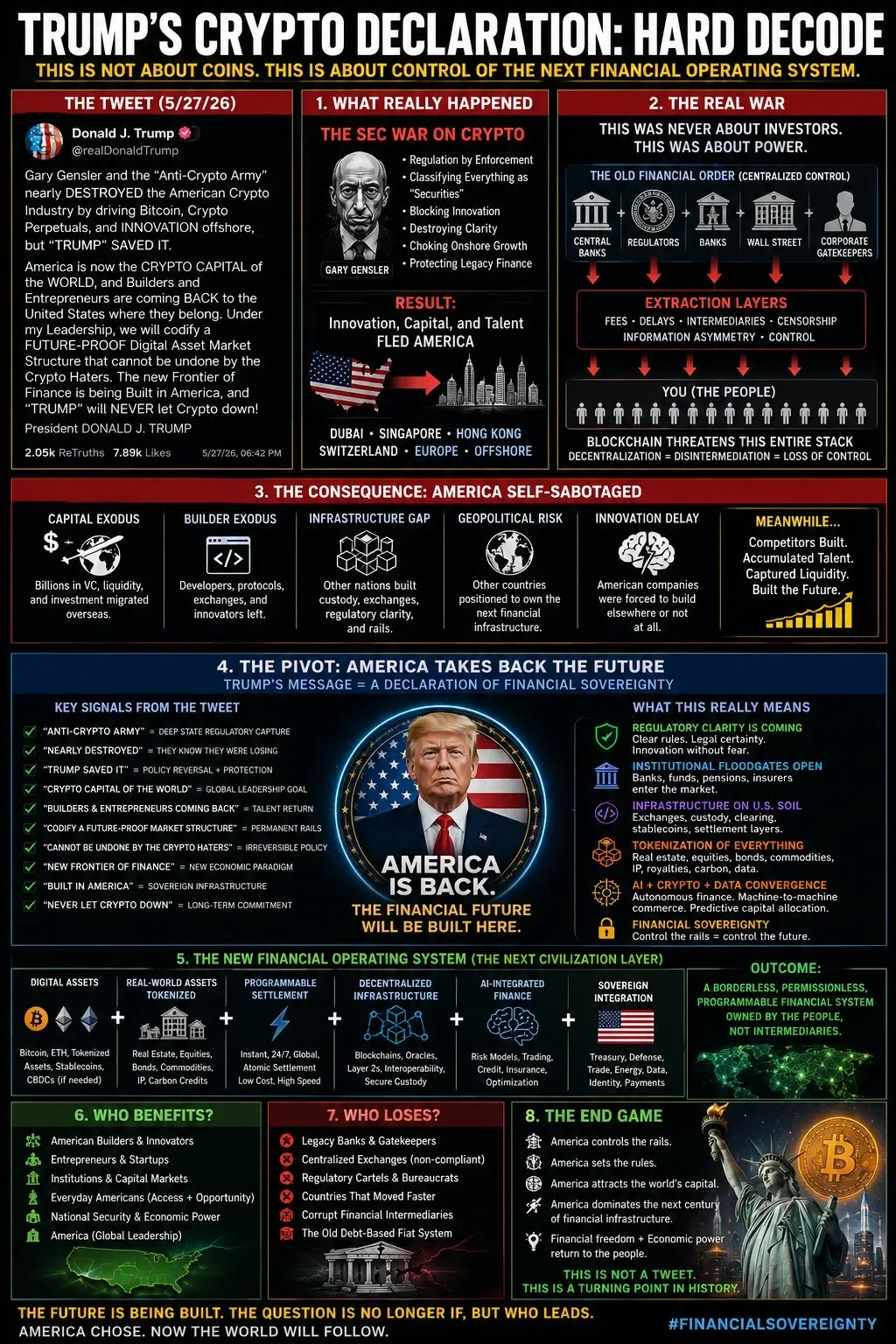
The SEC crackdown created regulatory fog thick enough to push developers, exchanges, liquidity providers, and infrastructure builders offshore while America deliberately crippled itself during the largest technological financial transition since the creation of the Federal Reserve itself…
Meanwhile, sovereign competitors quietly accumulated talent, compute infrastructure, digital custody systems, blockchain settlement frameworks, stablecoin experimentation, and AI-integrated financial tooling beneath the noise…
Trump’s post is effectively declaring that phase over… America is now openly entering the race to dominate the rails underneath the next economic civilization…
The phrase “future-proof digital asset market structure” carries enormous weight if you understand systems dynamics…
Civilizations are controlled through rails… trade rails, energy rails, currency rails, information rails, identity rails, snd settlement rails…
Whoever owns the rails underneath value transfer ultimately shapes the flow of global power itself…
Crypto evolved far beyond speculative assets years ago… it is now merging with AI, sovereign data infrastructure, energy grids, tokenized real-world assets, automated settlement, supply chain verification, machine-to-machine commerce, and programmable governance architecture… think Genesis Mission/Genesis Stack..
This is why the old guard panicked so violenty… because blockchain-based settlement threatens entire layers of institutional extraction that sit between humans and value…
[They] all understand it… banks, central banks, City of London, the C*P, and Blackrock understood it the second they pivoted toward ETF integration after years of public hostility…
Trump’s message signals that America intends to pull the builders, liquidity, infrastructure, and codified legal framework back inside US jurisdiction before the next financial operating system permanently consolidates elsewhere…
The real battlefield was never Bitcoin itself… the battlefield was control of the architecture that comes after fiat saturation, after infinite debt expansion, and after centralized financial mediation loses its grip on the velocity of human exchange…
Source(s):
• https://x.com/holonabove/status/2059817189918851203
Seeds of Wisdom RV and Economics Updates Thursday Afternoon 5-28-26
Good Afternoon Dinar Recaps,
US-Iran Ceasefire Framework Emerges as Markets Watch for Regional Stabilization
A proposed 60-day truce between the United States and Iran could temporarily ease energy market fears and reduce pressure on the global financial system.
Good Afternoon Dinar Recaps,
US-Iran Ceasefire Framework Emerges as Markets Watch for Regional Stabilization
A proposed 60-day truce between the United States and Iran could temporarily ease energy market fears and reduce pressure on the global financial system.
Overview
The United States and Iran have reportedly reached an outline agreement for a potential ceasefire extension, pending approval from President Donald Trump. The proposed framework comes after renewed military exchanges in the region and includes a 60-day truce alongside discussions surrounding Iran’s nuclear program. Financial markets are closely watching the developments as stability in the Middle East directly impacts oil prices, inflation, and global investor confidence.
Key Developments
1. US and Iran Draft 60-Day Ceasefire Proposal
Officials from both sides have reportedly developed an outline agreement designed to extend the current ceasefire for 60 additional days. The proposal is intended to create space for broader diplomatic discussions while reducing the immediate risk of escalation.
2. New Military Strikes Highlight Fragile Conditions
The ceasefire talks come immediately after Iran reportedly attacked a U.S. air base in Kuwait following American strikes targeting an Iranian drone operation. U.S. Central Command stated that American forces intercepted multiple Iranian drones and struck launch infrastructure before additional attacks could occur.
3. Strait of Hormuz and Oil Markets Remain Central Concern
Although ceasefire discussions have improved market sentiment slightly, investors remain cautious because instability involving Iran continues to threaten the Strait of Hormuz, a critical global oil shipping route. Any disruption in the region has the potential to rapidly impact energy prices, inflation, and supply chains worldwide.
4. Regional Conflict Risks Continue Expanding
The broader conflict remains active beyond Iran and the United States. Israel has reportedly intensified strikes against Iran-linked Hezbollah targets in Lebanon, while Gulf nations continue increasing defensive measures amid fears of further regional escalation.
Why It Matters
A sustained ceasefire between the United States and Iran could temporarily reduce pressure on energy markets and inflation expectations, helping stabilize financial markets already dealing with high debt and elevated interest rates. However, the fragile nature of the agreement highlights how quickly geopolitical events can disrupt global economic stability.
Why It Matters to Foreign Currency Holders
Reduced conflict risk may temporarily support global market confidence
Oil-sensitive currencies could remain highly volatile depending on negotiations
Safe-haven demand may continue if the ceasefire weakens or collapses
Implications for the Global Reset
Pillar 1: Energy Stability and Inflation Control
A successful ceasefire could ease immediate inflationary pressure by helping stabilize oil flows and reducing fears of prolonged supply disruption.
Pillar 2: Geopolitical Influence on Financial Systems
The situation demonstrates how regional military conflicts now play a major role in shaping global monetary policy, investor behavior, and trade stability.
Closing Insight
While the proposed ceasefire offers a potential path toward de-escalation, the underlying tensions remain unresolved. Financial markets may respond positively in the short term, but the broader risks tied to energy security, regional instability, and geopolitical fragmentation continue to weigh heavily on the global financial outlook.
This is not just a ceasefire negotiation — it’s a reminder that geopolitical conflict now sits at the center of global financial stability.
Seeds of Wisdom Team
Newshounds News™ Exclusive
Sources
Modern Diplomacy — "Report: US-Iran Ceasefire Deal Takes Shape After New Strikes"
Reuters — "US and Iran work toward extending ceasefire after new regional attacks"
~~~~~~~~~~
Seeds of Wisdom Team RV Currency Facts Youtube and Rumble
Newshound's News Telegram Room Link
RV Facts with Proof Links Link
RV Updates Proof links - Facts Link
Follow the Gold/Silver Rate COMEX
Follow Fast Facts
Seeds of Wisdom Team™Website
Thank you Dinar Recaps
US Treasury Pays 3.7%, Violates Every AML Regulation On The Books
US Treasury Pays 3.7%, Violates Every AML Regulation On The Books
Notes From the Field By James Hickman (Simon Black / Sovereign Man) May 28, 2026
Opening a bank account in the Land of the Free today feels like applying for a top secret security clearance. Banks often require multiple forms of ID, proof of address, proof of employment, plus detailed explanations of where your money came from, what you plan to do with it, and who you plan to send it to.
And that's just to get the account open. Once you've actually been deemed worthy of handing over your money to them, the surveillance really kicks in.
US Treasury Pays 3.7%, Violates Every AML Regulation On The Books
Notes From the Field By James Hickman (Simon Black / Sovereign Man) May 28, 2026
Opening a bank account in the Land of the Free today feels like applying for a top secret security clearance. Banks often require multiple forms of ID, proof of address, proof of employment, plus detailed explanations of where your money came from, what you plan to do with it, and who you plan to send it to.
And that's just to get the account open. Once you've actually been deemed worthy of handing over your money to them, the surveillance really kicks in.
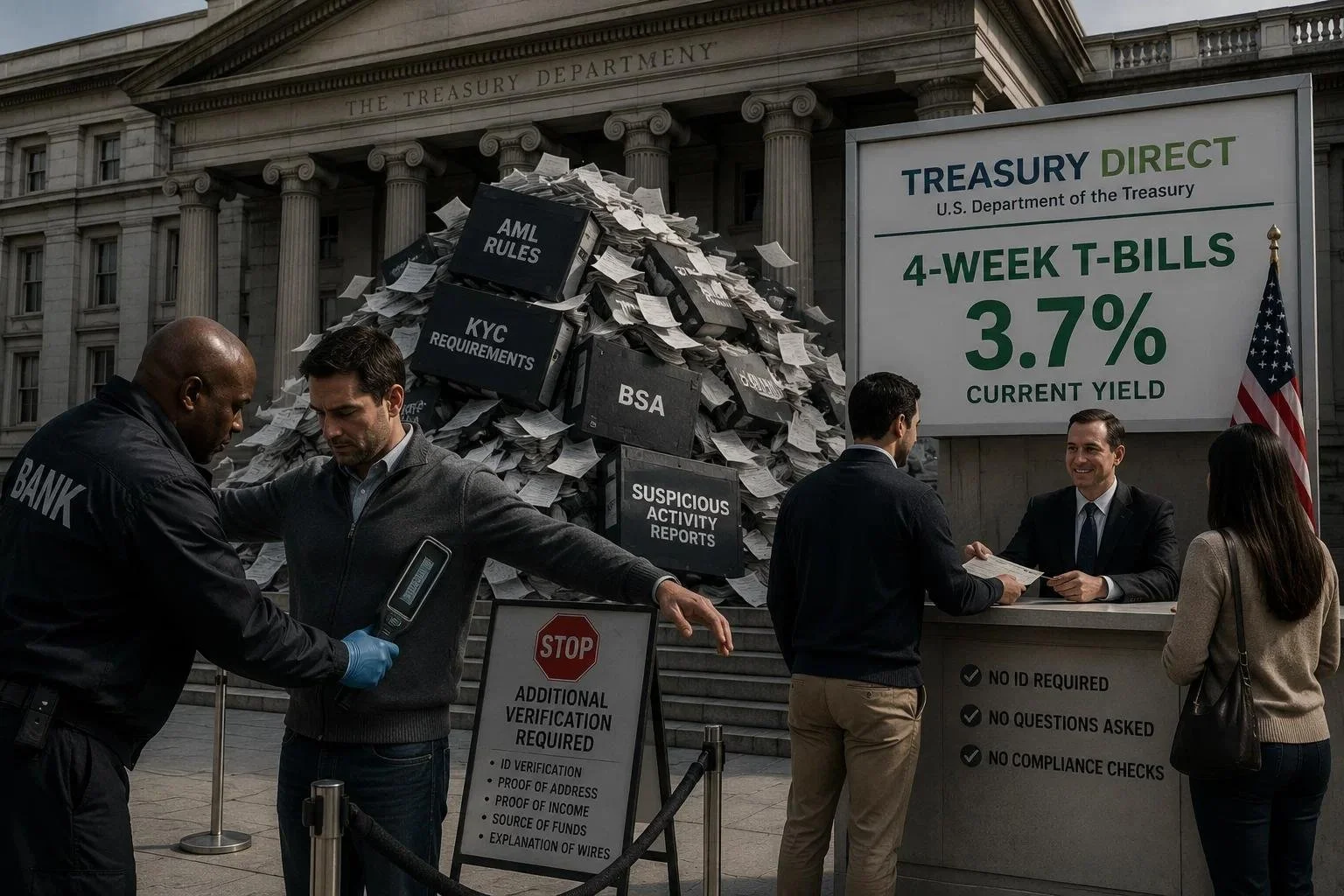
If you wire money to someone new, prepare for a phone call from the fraud department. Send a wire to a foreign bank and prepare for your account to be flagged by compliance.
The Cato Institute recently published a study showing that banks file 28 million reports to the federal government, flagging customer transactions as “suspicious”.
Yet the government’s own data show that 99.98% of these reports were filed on innocent people for completely frivolous reasons, i.e. people like my own mother who simply like to deal in physical cash.
Yet in the mind of a financial bureaucrat, using completely legal tender in the United States of America is suspicious and deserves to be reported.
Banking is a completely soulless industry devoid of any humanity or common sense.
We recently almost had a bank account shut down because one of our customers sent us a routine payment for his Total Access renewal.
Unfortunately our customer happens to have the same name as someone on a US government watch list.
Now, banks obviously shouldn’t be doing business with known criminals... so I have no problem that the transaction was flagged. But our team was quickly and easily able to prove that it wasn’t the same person. Not even close. Just two people who happen to have the same name.
But it didn’t matter. After several days of scrutiny and document gopher hunts, the bank not only rejected the transaction, but they nearly shut down our account.
Multiply that across every account, every business, every wire, every customer. American banking is now mostly a compliance apparatus that happens to do some occasional financial transactions on the side.
Yet for all the bureaucratic gauntlet your bank puts you through, the average savings account in the US pays a measly 0.38% interest right now.
It's one reason why I like crypto.
I'm not someone who thinks Bitcoin is going to magically become larger than the GDP of the known universe. But I do like that it's decentralized— that you can effectively be your own bank, without begging permission from someone whose entire job is to assume you're guilty.
Ironically, it turns out there's another option; there's at least one place in America to put your money that asks no questions.
They open accounts in no time with little more than a Social Security number. They don't demand to know where your funds came from. You don’t have to fill out 10,000 forms or show a single form of ID.
Frankly, these guys are deliberately and willfully violating every single Anti-Money Laundering rule and Treasury regulation on the books.
Fortunately no one is going to haul them off in handcuffs... because I’m talking about the Treasury Department itself!
The US government runs a website called Treasury Direct which allows anyone with a Social Security number to sign up and buy US government bonds.
Of course, as we discussed a few days ago, it would be insane to buy long-term bonds and lock up money for thirty years, ten years, or even five years. The US has nearly $40 trillion in debt, runs $2 trillion deficits every year, and has no plan to slow either down.
But the shortest-term security the US government sells is just FOUR WEEKS; it’s known as the 28-day T-bill. It’s essentially the same as a 1-month CD, and right now it pays 3.7%.
28 days is no time at all. And while I would in NO WAY be willing to hold a 30 year bond, I’m happy to loan a portion of my funds to the federal government for a couple of weeks.
Naturally the Treasury Direct website sucks. The User Interface is clunky and looks like a 15-year old designed it in 1997.
But none of that matters; they make it REALLY easy to sign up and buy bonds. You link your bank account select which bond you want to buy, and you can set yourself up for automatic reinvestments or payouts.
Crazy enough, the Treasury Department even allows you to transfer certain T-bills to third parties... which is effectively the same as making a cash or wire transfer.
There’s no hoops to jump through, no one flagging your transaction, no demands to prove that you’re not a member of Hezbollah or the Russian government.
The federal government ignores every single one of its own anti-money laundering rules. And I’d wager that criminals and terrorists are using Treasury Direct to launder and transfer money... because the Treasury Department literally performs zero compliance checks.
It’s pretty sad, and deeply ironic. But it’s also the easiest and safest way to earn a reasonable rate of return on a measly 4-week commitment.
To your freedom, James Hickman Co-Founder, Schiff Sovereign LLC
Dollar Demand CRUSHED As Gold Secretly Disappears From LBMA | Andy Schectman
Dollar Demand CRUSHED As Gold Secretly Disappears From LBMA | Andy Schectman
5-27-2026
Kaiser Johnson speaks with Miles Franklin CEO Andy Schectman about the growing mystery surrounding unreported gold movements out of the LBMA system and where that physical metal is ultimately going.
Schectman argues that official narratives do not fully account for discrepancies between reported inventories and trade flows, suggesting significant volumes of gold are being redirected into non Western vaulting and exchange systems.
Dollar Demand CRUSHED As Gold Secretly Disappears From LBMA | Andy Schectman
5-27-2026
Kaiser Johnson speaks with Miles Franklin CEO Andy Schectman about the growing mystery surrounding unreported gold movements out of the LBMA system and where that physical metal is ultimately going.
Schectman argues that official narratives do not fully account for discrepancies between reported inventories and trade flows, suggesting significant volumes of gold are being redirected into non Western vaulting and exchange systems.
He points to expanding gold hubs in regions such as the Middle East and Asia, where new exchanges and settlement mechanisms are increasingly built around physical delivery rather than paper claims.
The discussion also examines how central bank accumulation and sovereign demand are reshaping global liquidity in gold markets, reducing visible Western inventory availability.
Schectman concludes that these shifts may reflect a broader structural transition in global monetary architecture, with physical gold moving into strategic reserves outside traditional Western oversight.
INTERVIEW TIMELINE:
0:00 Intro
2:30 Gold update
17:00 Dollar dominance
32:00 Ignoring the noise
Coffee with MarkZ, joined by Dr. Scott Young. 05/28/2026
Coffee with MarkZ, joined by Dr. Scott Young. 05/28/2026
Some highlights by PDK-Not verbatim
MarkZ Disclaimer: Please consider everything on this call as my opinion. Be sure to consult a professional for any financial decisions
MZ: A short news segment and then we get to quiz Dr. Scott Young. StacieZ talks health after the news.
THE CONTENT IN THIS PODCAST IS FOR GENERAL & EDUCATIONAL PURPOSES ONLY&NOT INTENDED TO PROVIDE ANY PROFESSIONAL, FINANCIAL OR LEGAL ADVICE. PLEASE CONSIDER EVERYTHING DISCUSSED IN MARKZ’S OPINION ONLY
Coffee with MarkZ, joined by Dr. Scott Young. 05/28/2026
Some highlights by PDK-Not verbatim
MarkZ Disclaimer: Please consider everything on this call as my opinion. Be sure to consult a professional for any financial decisions
MZ: A short news segment and then we get to quiz Dr. Scott Young. StacieZ talks health after the news.
THE CONTENT IN THIS PODCAST IS FOR GENERAL & EDUCATIONAL PURPOSES ONLY&NOT INTENDED TO PROVIDE ANY PROFESSIONAL, FINANCIAL OR LEGAL ADVICE. PLEASE CONSIDER EVERYTHING DISCUSSED IN MARKZ’S OPINION ONLY
https://rumble.com/user/theoriginalmarkz
Kick: https://kick.com/theoriginalmarkz
FOLLOW MARKZ : TWITTER . https://twitter.com/originalmarkz?s=21. TRUTH SOCIAL . https://truthsocial.com/@theoriginalm...
Mod: MarkZ "Back To Basics" Pre-Recorded Call" for Newbies 10-19-2022 )https://www.youtube.com/watch?v=37oILmAlptM
MARKZ DAILY LINKS: https://theoriginalmarkz.com/home/
THANK YOU FOR JOINING. HAVE A BLESSED DAY. SEE YOU IN THE MORNING FOR COFFEE @ 10:00 AM EST ~ UNLESS BREAKING NEWS HAPPENS! FOR UPDATES ON MARK’S PODCAST GO TO: https://t.me/+b3hYhYlhKM1hYzcx
News, Rumors and Opinions Thursday 5-28-2026
Note: All intel should be considered as "Rumors" until we receive official announcements ...and “Rates and Dates” could change anytime until we get to the banks/redemption centers.
RV Excerpts from the Restored Republic via a GCR Update as of Thurs. 28 May 2026
Compiled Thurs. 28 May 2026 12:01 am EST by Judy Byington
Wed. 27 May 2026: CONFIRMED INTEL: SECURITY, STRUCTURE & SILENCE – THE TIER 4B PROTOCOL IGNITES GLOBAL RESET as Iraq, Vietnam & Zimbabwe Lead the Financial Revolution – RV 2026 …Web3.0 ISO20022 on Telegram
THE GLOBAL RESET MOVES FROM RUMOR TO REALITY. For years, IQD, VND, and ZIM holders were mocked, ignored, and called delusional. But now, all eyes are back on them—because the long-rumored revaluation is no longer speculation. It’s a verified action.
Note: All intel should be considered as "Rumors" until we receive official announcements ...and “Rates and Dates” could change anytime until we get to the banks/redemption centers.
RV Excerpts from the Restored Republic via a GCR Update as of Thurs. 28 May 2026
Compiled Thurs. 28 May 2026 12:01 am EST by Judy Byington
Wed. 27 May 2026: CONFIRMED INTEL: SECURITY, STRUCTURE & SILENCE – THE TIER 4B PROTOCOL IGNITES GLOBAL RESET as Iraq, Vietnam & Zimbabwe Lead the Financial Revolution – RV 2026 …Web3.0 ISO20022 on Telegram
THE GLOBAL RESET MOVES FROM RUMOR TO REALITY. For years, IQD, VND, and ZIM holders were mocked, ignored, and called delusional. But now, all eyes are back on them—because the long-rumored revaluation is no longer speculation. It’s a verified action.
Whispers on private forums have become bank-confirmed appointments, private tiered structures are (allegedly) moving forward, and a new financial system is rolling out quietly but powerfully. The RV has(allegedly) ignited, and TIER 4B is at the center of it all.
UNDERSTANDING THE TIERED STRUCTURE OF REVALUATION This is not a public forex event. This is a calibrated, classified, controlled restructuring. And it follows a tiered framework:
Tier 1: Sovereign governments and central banks
Tier 2: Multinational giants and elite financial trusts
Tier 3: High-net-worth individuals and pre-negotiated contracts
TIER 4B: Private citizens with legally acquired currency holdings. TIER 4B is where the people enter the equation. This is where suppressed value is unlocked, not for institutions—but for the faithful holders who waited through ridicule and silence. And now, TIER 4B is (allegedly) LIVE.
SECURITY, STRUCTURE & SILENCE: THE TIER 4B PROTOCOL: No walk-ins. No leaks. No circus. Bank staff are trained, armed with secure systems, and operating under blackout conditions. Participants are vetted, and electronic devices are restricted.
TIER 4B is not a public event. It is a classified operation, monitored, documented, and now (allegedly) fully active.
~~~~~~~~~~~~~~
Global Currency Reset:
Tues. 26 May 2026 Bruce, The Big CallThe Big Call Universe (ibize.com) 667-770-1866, pin 123456#, 667-770-1865: One source said the Tier4b green light would be on Thurs. 28 May 2026, with appointments as early as Friday 29 May. Other sources say notification Thurs-Fri with appointments launching over the weekend.
Judy Note: To my knowledge no one has been privy to the exact information about when Tier4b (Us the Internet Group) will be notified to set redemption/exchange appointments. That is the decision of 1-2 people, one being President Trump. We only know notification will be around the time of EBS Activation and likely during the ten days of communication darkness.
Read full post here: https://dinarchronicles.com/2026/05/28/restored-republic-via-a-gcr-update-as-of-may-28-2026/
**************
Courtesy of Dinar Guru: https://www.dinarguru.com/
Jeff They really don't have anything left to do...There's a lot of comments like, 'what's the delays? What's taking so long?' There is no delays in this other than the Iran war, waiting for a new regime to come in. That was a delay. Overall there's not a lot of delays. What it is, is they have scheduled dates for the rate change...Bankers schedule everything. That's what we're waiting on...Agreements are reached. Everything is ready to go.
Frank26 Question: "Do all the militia and the PMF have to be dismantled for this to go forward?" Yes...We're so close to getting rid of all of them.
Militia Man Alaq has been firm and confident ruling out devaluation. He's been saying it numerous time which is fascinating because they can't tell you about a revaluation. That is not in the cards. They're not going to tell us a time and date. I don't care how many people talk about that. They're just not going to do that. But we can see forward movement.
Iraqi Dinar What CBI Says vs What They're Actually Doing
Edu Matrix: 5-28-2026
Iraqi Dinar: What CBI Says vs What They're Actually Doing The Central Bank of Iraq is saying one thing, but actively preparing for another.
Analysis calls Iraq out, and so are we. It appears that they are preparing for global inclusion, yet they say otherwise.
Seeds of Wisdom RV and Economics Updates Thursday Morning 5-28-26
Good Morning Dinar Recaps,
Global Markets Brace for Reset Pressure as Bond Yields Rise and Oil Risks Escalate
Surging borrowing costs, geopolitical instability, and weakening confidence in sovereign debt markets are increasing strain on the global financial system.
Good Morning Dinar Recaps,
Global Markets Brace for Reset Pressure as Bond Yields Rise and Oil Risks Escalate
Surging borrowing costs, geopolitical instability, and weakening confidence in sovereign debt markets are increasing strain on the global financial system.
Overview
Today’s market developments point to growing concern over the stability of the global financial system as bond yields climb, oil markets remain volatile, and central banks face mounting pressure. Investors are increasingly focused on whether governments can sustain rising debt burdens in an environment of elevated inflation and geopolitical instability.
Key Developments
1. U.S. Treasury Yields Continue Climbing
U.S. Treasury yields moved higher today as investors reacted to concerns surrounding persistent inflation, expanding fiscal deficits, and continued heavy government borrowing. Rising yields increase borrowing costs across the economy and place additional pressure on already strained debt markets.
2. Oil Prices Remain Elevated Amid Middle East Tensions
Energy markets stayed volatile as tensions surrounding Iran and the Strait of Hormuz continued to threaten global oil supply stability. Elevated oil prices are reinforcing inflation fears worldwide, complicating central bank efforts to stabilize growth while controlling prices.
3. Central Banks Face Growing Policy Dilemma
Global central banks are increasingly trapped between the need to fight inflation and the risk of triggering economic slowdown or financial instability. Analysts warn that prolonged high interest rates could expose weaknesses in commercial real estate, private credit, and sovereign debt markets.
4. Investors Shift Toward Defensive Assets
Safe-haven demand increased today as investors moved capital into gold, defensive equities, and shorter-duration bonds. The shift reflects rising concern that the global economy may be entering a prolonged period of financial stress and slower growth.
Why It Matters
The combination of rising yields, elevated debt levels, and geopolitical instability is placing growing pressure on the foundations of the modern financial system. Historically, these conditions often force governments and central banks into major policy interventions or structural financial adjustments.
Why It Matters to Foreign Currency Holders
Increased risk of currency volatility and capital flow instability
Potential acceleration toward alternative settlement systems and reserve diversification
Rising importance of hard assets and inflation-resistant holdings
Implications for the Global Reset
Pillar 1: Debt Sustainability Challenges
Higher borrowing costs may eventually force governments to confront difficult choices involving spending cuts, monetary expansion, or debt restructuring mechanisms.
Pillar 2: Global Financial Power Shift
As confidence in traditional debt markets weakens, countries and institutions may continue exploring regional trade systems and diversified reserve strategies outside conventional frameworks.
Closing Insight
Today’s developments suggest the global economy is entering a period where debt, inflation, and geopolitical instability are becoming increasingly interconnected. Financial markets remain functional, but the underlying stress indicators continue to point toward a system under mounting long-term pressure.
This is not just market volatility — it’s a growing test of confidence in the global financial order itself.
Seeds of Wisdom Team
Newshounds News™ Exclusive
Sources
Reuters — "Treasury yields rise as investors assess inflation and debt concerns"
Reuters — "Oil prices volatile as Middle East tensions persist"
~~~~~~~~~~
🌱A Message to Our Currency Holders🌱
If you’ve been holding foreign currency for many years, you were not foolish.
You were not wrong to believe the global financial system would change.
What failed was not your patience — it was the information you were given.
For years, dates, rumors, and personalities replaced facts, structure, and proof. “This week” predictions created cycles of hope and disappointment that were never based on how currencies actually change.
That is not your failure.
Our mission here is different: • No dates • No rates • No hype • No gurus
Instead, we focus on:
• Verifiable developments • Institutional evidence
• Global financial structure • Where countries actually sit in the process
Currency value changes only come after sovereignty, trade, banking, settlement systems, and fiscal coordination are in place. History and institutions confirm this sequence.
You will see silence. You will see denials. That is not delay — that is discipline.
Protect your identity. Organize your documents. Verify everything.
Never hand your discernment to anyone who cannot show proof.
You deserve truth — not timelines.
Seeds of Wisdom Team
Newshounds News™
~~~~~~~~~~
Seeds of Wisdom Team RV Currency Facts Youtube and Rumble
Newshound's News Telegram Room Link
RV Facts with Proof Links Link
RV Updates Proof links - Facts Link
Follow the Gold/Silver Rate COMEX
Follow Fast Facts
Seeds of Wisdom Team™Website
Thank you Dinar Recaps
Iraq Economic News and Points To Ponder Thursday Morning 5-28-26
Basrah Crude Drops Despite Global Oil Rise
2026-05-28Shafaq News– Basrah Basrah crude slipped by more than 1% on Tuesday, diverging from broader gains in global oil markets.
Basrah Heavy crude fell 1.22%, or $1.19, to $96.19 per barrel, while Basrah Medium crude declined 1.20% to $98.29 per barrel. Globally, Brent crude rose $3.51, or 3.72%, to $97.8 a barrel. US West Texas Intermediate (WTI) crude gained $3.31, or 3.73%, to reach $91.99 per barrel.
Basrah Crude Drops Despite Global Oil Rise
2026-05-28Shafaq News– Basrah Basrah crude slipped by more than 1% on Tuesday, diverging from broader gains in global oil markets.
Basrah Heavy crude fell 1.22%, or $1.19, to $96.19 per barrel, while Basrah Medium crude declined 1.20% to $98.29 per barrel. Globally, Brent crude rose $3.51, or 3.72%, to $97.8 a barrel. US West Texas Intermediate (WTI) crude gained $3.31, or 3.73%, to reach $91.99 per barrel.
https://www.shafaq.com/en/Economy/Basrah-crude-drops-despite-global-oil-rise-1
US Sanctions Iranian Body Overseeing Hormuz Transit
2026-05-28 Shafaq News- Washington The United States imposed sanctions on Iran’s so-called “Persian Gulf Strait Authority,” accusing the Islamic Revolutionary Guard Corps (IRGC) of attempting to “extort” vessels transiting the Strait of Hormuz and “monetize” maritime traffic through the strategic waterway.
In a statement, the US Treasury Department warned that companies or individuals cooperating with the authority —an Iranian-controlled body established to manage passage requests through the Strait of Hormuz— could face sanctions exposure, saying such dealings may amount to providing support to the IRGC, which Washington designates as a Foreign Terrorist Organization.
Treasury Secretary Scott Bessent described the sanctions as part of Washington’s “Economic Fury” campaign against Iran, arguing that the measures aim to cut revenue linked to Tehran’s weapons programs, regional allies, and nuclear activities.
The sanctions followed recent US guidance warning against compliance with Iranian demands tied to transit through the Strait, including alleged “toll” payments, data-sharing requests, and other forms of compensation. The waterway carries nearly one-fifth of global oil supplies.
Iran established the authority after closing the Strait of Hormuz following the outbreak of war with the United States and Israel on February 28. Iran’s Revolutionary Guard has defended the arrangement, describing the designated corridor as the only safe maritime route through the waterway and warning that ships deviating from it could face attacks and security risks.
The move comes as the United States continues a naval blockade on Iranian ports, with President Donald Trump affirming that the blockade would remain “in full force and effect until an agreement is reached, certified, and signed.”
https://www.shafaq.com/en/World/US-sanctions-Iranian-body-overseeing-Hormuz-transit
Al-Sadr Sets One-Week Deadline For Saraya Al-Salam To Join Iraqi State Institutions
2026-05-28 Shafaq News- Najaf Muqtada Al-Sadr, leader of the Patriotic Shiite Movement (PSM), on Thursday gave Saraya Al-Salam, the armed wing of his movement, one week to complete procedures for separating from the PSM and integrating into Iraqi state institutions.
According to a document issued by Al-Sadr’s office, the full handover process should be completed by Eid Al-Ghadir, a major Shiite religious occasion that will fall on Thursday, June 4, 2026.
The directive assigned Haider Al-Jabri, director of Al-Sadr’s office, military adviser Abu Doaa Al-Issawi, jihadi aide Tahseen Al-Hamidawi, and Mohammed Al-Aboudi of the “Al-Bunyan Al-Marsous” framework to oversee the process, while the movement’s civilian branch will be integrated into the body in coordination with official authorities.
On Wednesday, Al-Sadr announced the formal separation of Saraya Al-Salam from the PSM, describing the move as being “in the national interest” and in response to risks facing the country.
Iraqi Prime Minister Ali Al-Zaidi welcomed the decision and urged other armed factions to follow the same path through official institutions, stressing that “the state alone should hold the authority to monopolize arms and enforce the law,” a principle that forms one of the central pledges in his government program.
Plastic Tide Chokes Iraq's Environment
2026-05-28Shafaq News- Baghdad Plastic bottles and single-use containers are emerging as one of Iraq’s “most pressing environmental pressures,’’ with consumption rising while recycling rates remain low, the Iraq Green Observatory reported on Thursday.
Plastic use is deeply embedded in daily life, ranging from bottled water and beverage packaging to food containers and plastic bags. Iraq is also among the region’s larger importers of plastic materials, with supplies mainly coming from China, Turkiye, Iran, and Saudi Arabia.
The watchdog estimates that each Iraqi generates around 400 grams of plastic waste per day. In Baghdad alone, waste output reaches roughly 10,000 tons daily, with plastic accounting for 600 to 1,000 tons —about 15% to 20% of total solid waste nationwide.
Beyond household consumption, the construction sector accounts for about 21% of plastic use, particularly in pipes, insulation materials, and building components. Plastic is also widely used in electronics, automotive manufacturing, and household goods.
Despite high levels of use, recycling remains limited. Less than 20% of plastic waste is recycled, while most ends up in unregulated dumpsites or informal landfills, including areas along the Tigris and Euphrates rivers.
Efforts to replace plastic bags with paper alternatives have faced practical constraints. Any transition, the Observatory notes, would require sustained public awareness campaigns alongside broader measures targeting single-use bottles, beverage packaging, and disposable containers that dominate consumption patterns —steps that are currently not in place.
Read more: Iraq's new government takes on plastic pollution with restrictions
https://www.shafaq.com/en/society/Plastic-tide-chokes-Iraq-s-environment
European markets rise as oil prices fall below $100
Stock Exchange European stocks rose slightly on Wednesday, May 27, as investors assessed military developments against Iran and falling oil prices, with London, Paris and Frankfurt stock exchanges ending higher.
The Stoxx Europe 600 index rose 0.1% to close at 628.64 points.
The French CAC 40 index rose 0.43%
The German DAX index rose 0.13%
Meanwhile, the FTSE 100 index in England rose 0.13%.
Escalating tensions with Iran
The performance came amid the ongoing war with Iran, in which US forces carried out what they described as "defensive" strikes against Iranian missile launch sites and ships in the south.
The Iranian Foreign Ministry responded by accusing the US of a blatant violation of the fragile truce. US Secretary of State Marco Rubio said the Strait of Hormuz "will be opened one way or another."
Despite this, US President Donald Trump wrote on the Truth Social platform that the peace negotiations are "going well".
AkzoNobel shares jump
Shares in Dutch paint maker AkzoNobel jumped 20% after it rejected a joint cash takeover bid of €73 per share from Nippon Paint and Sherwin-Williams.
The company's board of directors confirmed that it continues to recommend the planned merger with Axalta, noting that the offer "does not reflect true value and long-term growth prospects" and that it lacks sufficient guarantees for shareholders.
Automotive sector
The European automotive sector rose 2.6%, boosted by a 5.1% increase in new car registrations in the European Union. Shares of Renault climbed 4.1%, Stellantis 3.8%, Volkswagen 2.4%, Mercedes-Benz 3.1%, and BMW 2.3%.
https://www.economy-news.net/content.php?id=69620
Gold Hits Two-Month Low As US-Iran Tensions Fuel Inflation Fears
2026-05-28 Shafaq News Gold prices dropped to a two-month low on Thursday as inflation fears were stirred up after the U.S. and Iran traded more air strikes, boosting the dollar and crude prices, and fueling expectations of higher interest rates.
Spot gold was down 1.5% at $4,389.99 per ounce as of 0902 GMT, earlier falling to its lowest level since March 26. U.S. gold futures for June delivery fell 1.5% to $4,387.70.
The dollar rose to a one-week high, making greenback-priced bullion more expensive for holders of other currencies.
Oil prices jumped more than 2% after Iran's Revolutionary Guards said they targeted a U.S. airbase in response to a U.S. attack in the port city of Bandar Abbas.
Bullion has been under pressure since the start of the U.S.-Israeli war with Iran in late February. The effective closure of the Strait of Hormuz has prompted a surge in Brent crude prices, fanning inflation woes and propelling rate hike expectations.
"Gold drops to a two-month low and into bear market territory as fresh U.S.-Iran hostilities douse hopes of a deal. Heightened geopolitical uncertainty directs risk-off flows to the dollar, just as higher oil prices exacerbate inflation fears," Nikos Tzabouras, a senior market analyst at Jefferies-owned Tradu.com, wrote in a summary.
"Higher-for-longer rate prospects weigh on non-yielding assets, compounding bullion's weakness and leaving it vulnerable to new 2026 lows."
Despite being an inflation hedge, non-yielding bullion underperforms in high interest rate environments as investors turn to assets like Treasury yields that offer better returns.
Federal Reserve Governor Lisa Cook on Wednesday said she feels the U.S. central bank should hold short-term interest rates steady for now, but, with tariffs, the Iran war, and a surge in AI-related investment pushing prices higher, she is prepared to hike rates if needed.
The market awaits the U.S. Personal Consumption Expenditures data, the Fed's preferred inflation gauge, due later in the day, for cues on the Fed's monetary policy path.
Spot silver fell 1.7% to $73.34 per ounce and platinum lost 1.3% to $1,893.16. Both metals earlier hit a near one-month low. Palladium slid 1.8% to $1,366.00.
(Reuters) https://www.shafaq.com/en/Economy/Gold-hits-two-month-low-as-US-Iran-tensions-fuel-inflation-fears
Thursday AM Iraq News Posted by Tishwash at TNT
TNT:
Tishwash: Former MP: The government faces two paths: borrowing or raising the exchange rate.
Former member of the parliamentary finance committee, Abdul Hadi Mouhan, confirmed that the new government faces two paths: either external borrowing or increasing the exchange rate domestically in order to increase revenues under the current circumstances.
Mohan told Al-Maalomah, "There are two paths for the new government led by Ali Al-Zidi to ensure the securing of expenses, especially operational ones, by moving towards external borrowing, which is the most dangerous path that Iraq will face if it goes in this direction."
TNT:
Tishwash: Former MP: The government faces two paths: borrowing or raising the exchange rate.
Former member of the parliamentary finance committee, Abdul Hadi Mouhan, confirmed that the new government faces two paths: either external borrowing or increasing the exchange rate domestically in order to increase revenues under the current circumstances.
Mohan told Al-Maalomah, "There are two paths for the new government led by Ali Al-Zidi to ensure the securing of expenses, especially operational ones, by moving towards external borrowing, which is the most dangerous path that Iraq will face if it goes in this direction."
He added that "the second path that the government may resort to in order to increase its revenues is to go towards raising the exchange rate, which is the least dangerous path compared to going towards external borrowing, which is a double-edged sword for Iraq."
He indicated that "the government will most likely move towards raising the exchange rate in the upcoming budget in order to address the existing inflation and the deficit in the federal budget, and to ensure that the economic situation does not collapse." link
Tishwash: Prime Minister's Advisor: Iraq is on the verge of major economic changes under the guidance of Al-Zaidi
The Prime Minister's Advisor for Financial Affairs, Mazhar Muhammad Saleh, confirmed on Wednesday (May 27, 2026) that Iraq is going through an important transitional phase at the economic level, noting that the directives of Prime Minister Ali al-Zaidi have brought about a shift in the philosophy of managing the state's financial and economic affairs, which paves the way for broad transformations during the coming period.
Saleh said in a statement followed by “Baghdad Today” that “Al-Zidi assigned the Minister of Finance the duties of Deputy Chairman of the Ministerial Council for the Economy, which is a measure that reflects the philosophy of the modern state that sees the Ministry of Finance as a sovereign institution concerned with planning the economic future, and not just an entity for distributing salaries.”
He pointed out that "Iraq is about to undergo broad changes in its economic structure," noting that "the Prime Minister has asked the Ministry of Finance to prepare a long-term plan and move from the role of treasurer to a ministry that leads the reform of the philosophy of the economic system and creates a balanced partnership between the state and the market, within the framework of Iraq Vision 2035."
Saleh explained that "the Ministerial Council for the Economy has become the main engine for economic policies, and that it will lead the next phase by transforming temporary solutions into sustainable institutional work aimed at reforming the structure of the national economy."
He also explained that "implementation includes comprehensive oversight extending from the Financial Control Bureau to ministries such as industry and agriculture, reaching the oversight of financial markets," stressing that "the citizen is the primary goal of development programs and improving the standard of living."
In the same context, Saleh stressed that “the Central Bank of Iraq is independent in its work, but it coordinates within the Ministerial Council for the Economy, which is headed by the Ministry of Finance,” explaining that “there is a Council for Economic, Monetary and Financial Stability in which all essential economic files are presented.” link
***********
Tishwash: Post-Eid period: Parliament faces a cabinet test, and the insistence of political forces on their candidates deepens the crisis.
The escalating political controversy surrounding the session to complete the cabinet threatens to complicate the parliamentary scene, with political forces insisting on reintroducing the names that failed to gain confidence during the first session.
This puts Parliament in front of a new crisis that may hinder the resolution of the vacant ministries and open the door to deeper disputes within the political process, amid warnings of the country entering a phase of political deadlock that is difficult to contain.
In this regard, the MP from the Sadiqun bloc told Al-Maalouma that “the insistence of some parties on putting forward the same names that did not gain confidence in the previous session must be overcome,” noting that “Parliament did not grant confidence to these names before Eid, so how will it grant it to them after Eid?” stressing that “Iraq cannot stand helpless in the face of the emergence of new talents who can be appointed as ministers.”
Karim called on political blocs to "look for alternatives that enjoy the confidence of Parliament and political forces," noting that "parties should give themselves more space to put forward new names and increase the options for candidates for ministerial portfolios, in order to give the opportunity to the largest possible number."
In contrast, Kurdistan Democratic Party member Ribin Salam confirmed in a statement to Al-Maalomah that “the submission of the same Democratic Party candidate to fill the Ministry of Reconstruction and Housing depends on what will be issued by the Federal Court regarding the appeal submitted against the session of granting confidence, and what accompanied it in terms of failures and mismanagement by the Speaker of Parliament, as well as the deliberate violation of legal procedures in submitting the names of ministers for voting.”
The political arena is experiencing a state of cautious anticipation for the upcoming parliamentary session after the Eid al-Adha holiday, amidst growing doubts about its feasibility or its ability to resolve the remaining vacant ministerial posts.
This stems from the sharp disagreements that erupted during the previous confidence vote session. Political forces accuse Speaker of Parliament Haibat al-Halbousi of mismanaging the session and violating established voting procedures, leading some blocs to reject the results and challenge the legitimacy of certain measures.
Amid this crisis, the affected parties are insisting on resubmitting the same candidates who failed to secure a vote of confidence, threatening a repeat of the political division and further complicating the process of completing the cabinet. link
Tishwash: Al-Sadr announces the separation of the "Peace Brigades" from his movement and the joining of its members to the state.
On Wednesday, the leader of the Shiite National Movement, Muqtada al-Sadr, announced the separation of the "Peace Brigades" from the movement and the joining of its members to the state, while calling on the "Popular Mobilization Forces" to separate from "partisan and sectarian" orders.
Al-Sadr said in a statement, which was received by Shafaq News Agency, that "the decision came from the general interest of the nation, and in line with the dangers surrounding the nation."
He added that the civilian entities attached to the "Saraya" will move to Al-Bunyan Al-Marsous without any headquarters, weapons, uniforms, addresses, or anything else.
Al-Sadr expressed his gratitude to "the military formations of the Peace Brigades for all their greater and lesser jihad, and may God forgive all those who did not conform to our religious, doctrinal, and social tastes in general."
He expressed his hope that all the Popular Mobilization Forces would separate themselves from "partisan and sectarian orders," especially after the "factions" handed over their weapons to the state, as they had been advised to do years ago.
Al-Sadr's decision comes in conjunction with political moves to address the issue of the "factions'" weapons and hand them over to the government.
The Peace Brigades represent the military wing of the Shiite National Movement (formerly the Sadr Movement) led by Muqtada al-Sadr. It is an armed formation that officially falls under the umbrella of the government’s Popular Mobilization Forces (Brigades 313, 314, and 315), and it undertakes prominent security tasks in several Iraqi regions, most notably the city of Samarra.
Some political forces and armed factions are showing "flexibility" regarding the issue of restricting weapons to the state, after having been rigid on this subject, according to what a government source told Shafaq News Agency earlier, who added that the process of handing over weapons will be within a specific time mechanism.
The ministerial program of Ali al-Zaidi’s government, which won the confidence of the Iraqi parliament on Thursday, May 14, included a clause restricting weapons to the state, and he emphasized it during his speech after gaining the confidence.
Prior to that, an informed source had revealed to Shafaq News Agency on May 9 that the Coordination Framework had agreed with Prime Minister-designate Ali al-Zaidi to form a committee tasked with disarming armed factions, coinciding with the call made by the leader of the Sadrist movement, Muqtada al-Sadr.
The head of the executive council of the Al-Nujaba Movement, Nazim Al-Saidi, one of the most prominent armed factions, confirmed on May 15 that the “weapons control” clause included in the new government’s program does not include “resistance weapons” but rather those that cause “chaos.” link
FRANK26…5-27-26…. ONLY 1 OPTION
KTFA
Wednesday Night Video
FRANK26…5-27-26…. ONLY 1 OPTION
This video is in Frank’s and his team’s opinion only
Frank’s team is Walkingstick, Eddie and Omar in Iraq and guests
Playback Number: 605-313-5163 PIN: 156996#
KTFA
Wednesday Night Video
FRANK26…5-27-26…. ONLY 1 OPTION
This video is in Frank’s and his team’s opinion only
Frank’s team is Walkingstick, Eddie and Omar in Iraq and guests
Playback Number: 605-313-5163 PIN: 156996#
Iraq Economic News and Points To Ponder Wednesday Afternoon 5-27-26
Political Warnings About The Repercussions Of Dollar Fluctuations...And The Absence Of Economic Strategies Threatens The Livelihoods Of Vulnerable Groups
Information/Report.. Political and popular concerns are escalating in Iraq as the dollar exchange rate continues to fluctuate, amid criticism of the lack of comprehensive economic reform plans and the near-total reliance on oil revenues compared to weak support for productive sectors, which has negatively impacted the living conditions of citizens and disrupted local markets.
Political Warnings About The Repercussions Of Dollar Fluctuations...And The Absence Of Economic Strategies Threatens The Livelihoods Of Vulnerable Groups
Information/Report.. Political and popular concerns are escalating in Iraq as the dollar exchange rate continues to fluctuate, amid criticism of the lack of comprehensive economic reform plans and the near-total reliance on oil revenues compared to weak support for productive sectors, which has negatively impacted the living conditions of citizens and disrupted local markets.
In this regard, former MP Mahma Khalil confirmed in a statement to Al-Maalomah News Agency that “previous and current governments have failed to build a coherent economic policy based on clear reform principles, which has directly impacted the monetary and living conditions of citizens.”
He added that “the almost complete reliance on oil revenues, in contrast to the weak support for productive sectors, investment and the private sector, has contributed to the continuation of economic crises and complicated government solutions.”
He pointed out that “any real economic reform must begin with combating corruption and activating financial and administrative oversight, in addition to adopting development plans capable of enhancing the value of the Iraqi dinar and achieving stability in local markets.”
He explained that “the current stage requires serious economic decisions that are far from temporary solutions, with the need to build a long-term strategy that addresses the imbalances that have accumulated over the past years.”
In this context, Imran Karkoush, a member of the State of Law Coalition, confirmed in a statement to Al-Maalomah News Agency that “the continued fluctuation in the price of the dollar directly affects the livelihood of citizens, especially the poor and middle classes who bear the greatest burden of rising prices.”
He added that “addressing the crisis requires integrated government measures that include strengthening financial stability, supporting local production, and tightening control over markets to reduce exploitation and unjustified price increases.”
He explained that “the stability of the exchange rate and the improvement of the economic situation would contribute to easing the pressure on the markets and achieving a balance in food prices within the country.”
It should be noted that saving the Iraqi dinar is no longer merely a monetary issue, but a crucial political and executive decision.
The success of any government efforts requires moving beyond temporary solutions and immediately protecting markets from price gouging, as well as revitalizing local factories and farms to reduce reliance on imports—the first line of defense for the livelihood of ordinary citizens. End/25s
Khalil: Successive Governments Have Failed To Achieve Genuine Economic Reform And End The Dollar Crisis.
Information/Exclusive.. Former MP Mahma Khalil asserted on Tuesday that successive governments have failed to implement genuine economic reforms capable of addressing the dollar exchange rate crisis and achieving financial stability in the country.
Khalil told Al-Maalomah News Agency that “previous and current governments have failed to build a coherent economic policy based on clear reform principles, which has directly impacted the monetary and living conditions of citizens.”
He added that “the almost complete reliance on oil revenues, in contrast to the weak support for productive sectors, investment and the private sector, has contributed to the continuation of economic crises and complicated government solutions.”
He pointed out that “any real economic reform must begin with combating corruption and activating financial and administrative oversight, in addition to adopting development plans capable of enhancing the value of the Iraqi dinar and achieving stability in local markets.”
He explained that “the current stage requires serious economic decisions that are far from temporary solutions, with the need to build a long-term strategy that addresses the imbalances that have accumulated over the past years.”
Furthermore, Imran Karkoush, a member of the State of Law Coalition, confirmed in a previous statement to Al-Maalomah News Agency that addressing the dollar crisis represents the most significant challenge of the coming period due to its direct impact on citizens' livelihoods. End/25
The Ministry Of Finance Continues Temporary Spending... Will The 2026 Budget Law Be Postponed To 2027?
Alsumaria News– Economy: As several months of this year have passed, it has been determined Oil CommitteeGas and natural resources in House of Representatives4 key features of this year's budget, as explained by the Prime Minister's financial advisor, Mazhar Muhammad Salih, that Ministry of FinanceCurrently, revenues and expenditures are being carefully managed within short-term deficit conditions, in accordance with the provisions Financial Management LawFederal Decree No. 6 of 2019, as amended, explained that the budget has now become a means of absorbing shocks, especially after what can be called the "Hormuz shock".
Saleh stated that "the current mechanism relies on a temporary disbursement rate of 1/12 of the actual current expenditures for the 2025 fiscal year." He explained that "this mechanism ensures the continued funding of essential operating expenses and covers the obligations of ongoing investment projects, as well as those that have been completed and are ready for operation."
He explained, "However, this framework does not allow for the creation of new expenditures or the launch of new investment projects until the 2026 federal budget law is enacted." Saleh added, "With the escalating geopolitical changes in the region..."Gulf What could be termed the "Hormuz shock" presents fiscal policy with a critical test.
The budget is no longer merely a tool for managing revenues and expenditures, but has transformed into a means of absorbing external shocks, achieving economic stability, and maintaining the development trajectory in a highly volatile regional and international environment.
He continued, "In these circumstances, the efficiency of public finance management, the flexibility to reallocate spending priorities, and the ability to safeguard monetary and economic stability become crucial factors for the Iraqi economy to transition to a more secure and sustainable phase."
Saleh indicated that "the proposed scenario is the possibility of legislating a budget for the remainder of 2026." He explained that "if a climate of peace prevails, the budget deficit will be significantly lower, as the resumption of exports of 85 percent of oil through the Strait of Hormuz will ensure real revenue inflows within the approved estimates."
He added, "However, if the conditions of the US-Iranian war and its repercussions on the ability to Iraq Regarding oil exports, any budget approved under these circumstances will have a larger deficit, as oil is the primary source of funding for public spending.
Saleh concluded, "Therefore, the second half of 2026 will directly reflect these circumstances in the size of the expected deficit and in the public spending ceilings that will be adopted for the fiscal year."
Meanwhile, four key features were identified.
Oil Committee Gas and natural resources in House of Representatives Four key features of this year's budget.
Committee member Hawraa Aziz said...Al-Mousawi This year's budget will likely be based on a lower (hedging) oil price for 2026, around $60 per barrel, along with spending cuts, increased non-oil revenues, and a reduction in total dependence on oil.
Discussions are underway regarding efforts to reduce the budget deficit given the expected decline in global oil prices, as any increase in the price of oil supplied to local refineries could gradually impact citizens.
For his part, Ali al-Azirjawi, a member of the State of Law Coalition, stated that there is no longer enough time to submit the 2026 budget, indicating the necessity of...Asylum" Towards preparing an emergency plan similar to the Food Security Law, to be agreed upon quickly, to ensure the continued functioning of the government and ministries in an organized and efficient manner."
He added that "adopting an emergency plan is a realistic option in light of the current challenges," noting "the importance of expediting its vote within cabinet And then approve it so that it can assume its executive role as quickly as possible.”
Al-Azirjawi explained that “Iraq faces a number of economic challenges, most notably the size of its internal and external debt, which requires serious solutions, in addition to security challenges and regional tensions that further complicate the overall situation.
” In a proactive move, economic researcher Bassam Raad said that “the proposal put forward by the Oil and Gas Committee to adopt a hedging oil price of $60 per barrel represents a proactive step that appears aimed at controlling public spending and avoiding further internal debt.”
Raad added that “a careful reading of the figures and international economic warnings, especially the warnings of… ”International Monetary Fund This reveals inevitable challenges that could render this figure merely a temporary fix.
He explained that "adopting a price of $60 per barrel with an export volume of 3 million barrels per day would generate oil revenues equivalent to approximately 85 trillion Iraqi dinars, while the actual need to cover operational and investment expenses, even after reductions, is no less than 100 trillion dinars, meaning the deficit will persist even with adherence to a conservative price."
Raad clarified that "oil remains hostage to geopolitical tensions due to the disruption of export routes through Strait of Hormuz Oil exports plummeted by 90 percent last April, meaning this year will be a vicious cycle in which public finances struggle to secure salaries and avoid accumulating debt. The economist added that postponing the budget further contributed to this situation.
Nabil Al-Marsoumi The postponement of the 2026 budget to 2027 was attributed to several reasons, most notably the limited time available, as the country is now halfway through 2026.
Additionally, the volatility of oil prices and fluctuating export volumes, particularly after the Strait of Hormuz crisis, makes estimating oil revenues for this year more difficult.
Al-Marsoumi warned that the absence of a budget means the government lacks the legal authority to borrow domestically and internationally.
He explained that if the 2026 budget is not approved, the government must seek legislation authorizing it to borrow to cover the deficit, as occurred in 2022 when Parliament passed laws allowing the government to borrow domestically and internationally. Any borrowing without legal authorization is considered a violation.
Prime Minister's Advisor: Iraq Is On The Verge Of Major Economic Changes Under The Guidance Of Al-Zaidi
Baghdad Today - Baghdad: The Prime Minister's Advisor for Financial Affairs, Mazhar Muhammad Saleh, confirmed on Wednesday (May 27, 2026) that Iraq is going through an important transitional phase at the economic level, noting that the directives of Prime Minister Ali al-Zaidi have brought about a shift in the philosophy of managing the state's financial and economic affairs, which paves the way for broad transformations during the coming period.
Saleh said in a statement followed by “Baghdad Today” that “Al-Zidi assigned the Minister of Finance the duties of Deputy Chairman of the Ministerial Council for the Economy, which is a measure that reflects the philosophy of the modern state that sees the Ministry of Finance as a sovereign institution concerned with planning the economic future, and not just an entity for distributing salaries.”
He pointed out that "Iraq is about to undergo broad changes in its economic structure," noting that "the Prime Minister has asked the Ministry of Finance to prepare a long-term plan and move from the role of treasurer to a ministry that leads the reform of the philosophy of the economic system and creates a balanced partnership between the state and the market, within the framework of Iraq Vision 2035."
Saleh explained that "the Ministerial Council for the Economy has become the main engine for economic policies, and that it will lead the next phase by transforming temporary solutions into sustainable institutional work aimed at reforming the structure of the national economy."
He also explained that "implementation includes comprehensive oversight extending from the Financial Control Bureau to ministries such as industry and agriculture, reaching the oversight of financial markets," stressing that "the citizen is the primary goal of development programs and improving the standard of living."
In the same context, Saleh stressed that “the Central Bank of Iraq is independent in its work, but it coordinates within the Ministerial Council for the Economy, which is headed by the Ministry of Finance,” explaining that “there is a Council for Economic, Monetary and Financial Stability in which all essential economic files are presented.”