
4 Bad Habits That Could Affect Your Money More Than Tariffs and Inflation
4 Bad Habits That Could Affect Your Money More Than Tariffs and Inflation
Written by Chris Adam GoBankingRates
The Trump administration’s discussions about tariffs and inflation have led many consumers to question how well they’re prepared for the future regarding their finances. After all, some experts have raised concerns that tariffs could lead to higher prices on products and services people use each day.
But there may be a way to protect personal finances that has little to do with moves by the White House.
4 Bad Habits That Could Affect Your Money More Than Tariffs and Inflation
Written by Chris Adam GoBankingRates
The Trump administration’s discussions about tariffs and inflation have led many consumers to question how well they’re prepared for the future regarding their finances. After all, some experts have raised concerns that tariffs could lead to higher prices on products and services people use each day.
But there may be a way to protect personal finances that has little to do with moves by the White House.
GOBankingRates spoke with financial experts about some common bad habits that could affect your money more than tariffs or inflation.
Failing To Save and Invest Early
Bill Lyons, CEO of Griffin Funding, said one harmful habit is failing to save and invest early.
“Without a consistent savings plan, you’re missing out on the power of compound interest, which significantly grows wealth over time,” said Lyons. “Procrastinating on building an emergency fund or not setting aside money for retirement can also derail your financial security.”
Lyons said these habits are harmful because they limit your ability to cope with unexpected expenses and capitalize on long-term financial growth. To avoid this, develop a realistic budget that aligns with your income, prioritize savings and commit to setting aside money regularly, whether for emergencies, investments or retirement.
Increasing Spending as Income Grows
According to Brian Chasin, investing expert and chief financial officer at SOBA New Jersey, one of the most harmful habits is lifestyle inflation, increasing your spending as your income grows. While earning more should improve financial security, Chasin said, many people raise their standard of living instead of saving or investing the difference.
“This leads to missed wealth-building opportunities and greater vulnerability during economic downturns,” according to Chasin. “The fix is to establish a disciplined savings plan where a set percentage of any income increase is automatically directed toward long-term goals before adjusting discretionary spending.”
TO READ More: https://www.gobankingrates.com/money/economy/bad-habits-that-could-affect-your-money-more-than-tariffs-and-inflation/
MilitiaMan & CREW IRAQ DINAR UPDATE-Iraq Reforms: Strong Momentum & Global Integration-REER Readiness
MilitiaMan & CREW IRAQ DINAR UPDATE-Iraq Reforms: Strong Momentum & Global Integration-REER Readiness
5-27-2026
The Crew: Samson, PompeyPeter, Petra, Daytrader, Sunkissed, GIGI and Militia Man
No drama. No intrigue. No songs and dances. Just straight, factual news that I read and interpret to the best of my ability after being an avid Dinar investor and insanely obsessed Dinarian for over 15 years.
Follow MM on X == https://x.com/Slashn
MilitiaMan & CREW IRAQ DINAR UPDATE-Iraq Reforms: Strong Momentum & Global Integration-REER Readiness
5-27-2026
The Crew: Samson, PompeyPeter, Petra, Daytrader, Sunkissed, GIGI and Militia Man
No drama. No intrigue. No songs and dances. Just straight, factual news that I read and interpret to the best of my ability after being an avid Dinar investor and insanely obsessed Dinarian for over 15 years.
Follow MM on X == https://x.com/Slashn
Be sure to listen to full video for all the news……..
Treasury Yields are at 20-Year Highs and Almost Nobody wants them
Treasury Yields are at 20-Year Highs and Almost Nobody wants them
James Hickman: 5-27-2026
There are pools of capital in the world so large that they cannot be parked just anywhere.
Pension funds, foreign governments and central banks, giant commercial banks— they are collectively sitting on tens of trillions of dollars worth of capital that they have to invest in a safe, stable asset.
The stock market doesn’t really work— it’s far too volatile. Real estate doesn’t really work either— it’s not liquid.
Treasury Yields are at 20-Year Highs and Almost Nobody wants them
James Hickman: 5-27-2026
There are pools of capital in the world so large that they cannot be parked just anywhere.
Pension funds, foreign governments and central banks, giant commercial banks— they are collectively sitting on tens of trillions of dollars worth of capital that they have to invest in a safe, stable asset.
The stock market doesn’t really work— it’s far too volatile. Real estate doesn’t really work either— it’s not liquid.
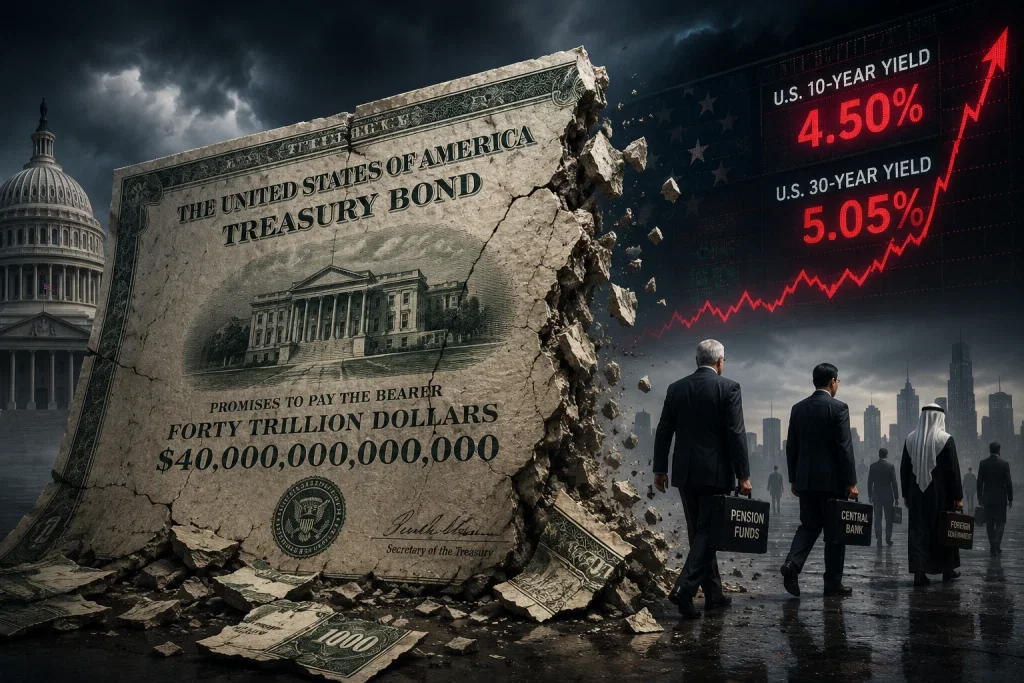
That is where the bond market comes in: it’s both massive (far larger than the stock market), so it can absorb enormous flows of capital. And it’s highly liquid. This allows large investors to quickly move huge sums of money in/out of the bond market.
That’s why, for the better part of a century, the single deepest and most trusted piece of that market has been US government bonds. With the US national debt of nearly $40 trillion, this makes America’s bond market REALLY big. And Congress keeps adding to it.
The federal government runs roughly $2 trillion annual deficits— which you could think of as the new ‘supply’ of Treasury securities added to the bond market each year.
In other words, when the government spends more, they have to borrow more money by issuing more Treasury bonds. So the supply of US Treasury securities in the bond market increases.
‘Demand’ for US government bonds, on the other hand, comes from everyone on the planet who buys them. Pension funds, foreign governments and central banks, big corporations, banks, money market funds, etc.
And as any high school economics student can tell you, the ‘price’ is where supply meets demand. In the bond market, we usually think of price as the bond yield, e.g. right now the US 10-year yield is 4.5%, and the 30-year Treasury is over 5%.
To put those yields in a historical context, they haven’t been this high in decades— and it’s a direct result of rising supply and waning demand.
On the supply side, the US government keeps borrowing money at an insane pace, i.e. the Treasury Department keeps flooding the market with more and more bonds, notes, and yields.
But on the demand side, investors are backing off— especially foreigners. Foreign ownership of US government bonds (as a percentage of total public debt) has fallen by roughly HALF since the early 2010s… with a significant drop recorded just over the past twelve months according to the Treasury Department’s own data.
Few people in Congress seem to mind; there is no serious discussion in Washington about slowing the growth of the deficit, i.e. the bond supply, let alone actually shrinking supply by paying off debt.
Ultimately this supply and demand imbalance means that bond yields will continue to rise— which affects just about everything else from auto loans to the 30-year mortgage rate.
And just take a look around the rest of the developed world:
Bond yields in Germany are far lower (by about 1.5%) than US yields. So are yields in Japan, France, Italy, Canada, Singapore, New Zealand, South Korea, and China.
Even GREECE, with its 3.6% 10-year government bond yield, has lower yields than the United States.
You’d think that such attractive yields in the United States compared to the rest of the world would entice a lot more capital into the US bond market. After all, investors generally chase the highest returns.
But buyers are signaling that they don’t think the return is worth the risk— that even a 4.5% yield on a 10-year Treasury note is not worth the risk of holding a US government IOU for an entire decade.
Think about how much has changed over the past decade… and how much more can change over the next decade. Inflation, government shutdowns, debt ceiling showdowns, political theater, war, Social Security’s looming insolvency, etc.
Foreign governments and central banks aren’t willing to lock themselves in for ten years, let alone thirty years, with so much chaos on the horizon.
And with less demand from foreigners in the bond market, it’s likely that bond yields will continue to rise, until the Treasury Department is paying 5, 6, and 7% to borrow money.
With a ~$40 trillion national debt, that’s almost $3 trillion per year just to pay interest— roughly 60% of last year’s tax revenue.
This is why it makes so much sense to have a Plan B… because the most likely ‘solution’ to this problem will be for the Federal Reserve to ‘print’ trillions of dollars of capital.
This approach may succeed in lowering yields. But it will lead to substantially higher inflation, for a lot longer.
Source: Schiff Sovereign
Bruce’s Big Call Dinar Intel Tuesday Night 5-26-26
Bruce’s Big Call Dinar Intel Tuesday Night 5-26-26
Transcribed By WiserNow Emailed To Recaps (INTEL ONLY)
Welcome everybody to the Big Call tonight -- it is Tuesday, May 26th and you’re listening to the big glad – Glad everybody can join us again. Thanks for tuning in all over the globe. Thank you, satellite team for getting us out - all over, and we're happy to be here. Hope everybody had a memorable Memorial Day yesterday, and hope that was good, and here we are. We had a three day weekend and we’re ready to start the big call.
Let's see what else. Let's talk about where we stand in our intel. I usually try to build a timeline for us, and I'm going to try to do that again tonight.
Bruce’s Big Call Dinar Intel Tuesday Night 5-26-26
Transcribed By WiserNow Emailed To Recaps (INTEL ONLY)
Welcome everybody to the Big Call tonight -- it is Tuesday, May 26th and you’re listening to the big glad – Glad everybody can join us again. Thanks for tuning in all over the globe. Thank you, satellite team for getting us out - all over, and we're happy to be here. Hope everybody had a memorable Memorial Day yesterday, and hope that was good, and here we are. We had a three day weekend and we’re ready to start the big call.
Let's see what else. Let's talk about where we stand in our intel. I usually try to build a timeline for us, and I'm going to try to do that again tonight.
What we get about Iraq, we have heard Sunday that we had new currencies that came up on the screens, and they're all flashing, but I think all of them that we're talking about are on the redemption center screen -- today, which is Tuesday, they were not on the bank screens, but they were on the redemption center screens.
That means they're still changing, they're changing, most of them are going up, and that's what we wanted to have happen, not only with Iran, but also with Iraq, and probably also the dong as well, and we did hear an approximate in country rate for Iraq on the Iraqi dinar. We haven't been able to confirm it in country, but we did hear in country Sunday Iraq was going to revalue their currency again, and it was going to be just a little over six, so we'll see.
Now Remember this , we don't typically do rates on the big call at all, because first of all, they're variable, they do change. We're assured to get a contract rate on the dinar if you go into the redemption center. It's not available in the banks, and they don't redeem Zim at the banks, so redemption center is the ticket for Zim holders and those that have dinar that want to get the highest available rate, which is what President Trump set up and contracted for Iraq.
We did hear that Dr. Senen Al Shabibi was the head of the Central Bank of Iraq years ago, I mean years ago. Well, he's been brought back in the picture over the CBI, which is cool. I remember him from 20 years ago, and he’s still hanging in there - they are bringing him in because they can trust him – and President Trump can trust him – so that is good news
LOST CONNECTION and a few minutes of script – sorry
They do have a new Prime Minister in Iraq - he has been seated - I think the counsel is all set up and no problems - and President of Iraq - there's also President of Kurdistan, which is a continuing presidency, I believe, of President Keldani.
Okay, so that's all good. We're all set from that perspective. What about Iran? What we're hearing about Iran, you guys probably thought some of the news about it, but it looks like we've extended the cease fire on Iran.
It looks like it's been extended for 60 more days by President Trump, and it looks like he does anticipate a real peace agreement to come out of that with 8 countries in the middle east - situation with these in the sort of all ascribing to the Abrahamic Accords, and with that agreement in place, hopefully they will eventually get Iran to participate and be part of that agreement.
Okay, so let's see where it goes – Now The Strait of Hormuz, obviously we want it completely open with no blockade, which we, our Navy, is the one doing the blockade watching keeping certain ships not going in or out of the Strait, but obviously this peace agreement, if agreed to, will allow that traffic to flow freely, like it used to. You should see your oil price starting to come down.
You should see your gas prices beginning to come down. We've seen some evidence of that here, and you know as well as I do, sometimes it goes up 10 - 20, 30 - 40, cents at a time, but tends to come down to sensitive time, it may not drop differently quite yet, but seen some good reductions in my market, and every market's a little bit different, some might still be going up or others could still be on their way down, so hopefully that's a good thing for us, and we'll get this on the way down,
All right, let's see, so that should take care of where we are on that. Also, have heard through a post was that this was pretty good stuff, actually described to President Trump, so I'm going to give him all the credit for this. I think it sounds great. It said something I'm very little bit something to the fact that a storm is upon us.
The mother of all bombs, M O A B, is what it said. M O A B. Now this is not a physical bomb that explodes. This is not that bomb. This is talking about intelligence, Intel -- MOAB is dropping. dropping, and let me think. How the rest of it went.
Something of restored public is back. The restored public is here, and the via via via or via via the global currency resets, and said something like, Thank you for your - thank you for your kind involvement President Donald J Trump.
So that I think is pointing to the fact that the global currency reset is taking place as a result of and the restored republic is part of that, literally. I think it was. And is upon us within a few days
I think that's really good. other people that we know that are good sources are talking about a couple of days, and I think that was including Tuesday, because information kept going on and it said we would have a green light for Tier 4b that's us, Internet Group, in conjunction with the ISO 200 20 22 on Thursday ???? made it sound like we could get notifications on Thursday exchanges as early as Friday
On our exchanges, which would be us now, could we go Thursday, Friday prior to the weekend -- Yeah, so you realize Sundays that they want this to go one of the month, and we're coming up Wednesday, Thursday, Friday, Saturday, Sunday, Friday.
Can you go by Thursday and start Exchange Friday, or get notified by the weekend, Saturday, and then power right through Sunday? It looks like it looks like a plan is for that to happen, for us to go.
I don't think Pres Trump that's going to cover anything out, you know. Looking like we are there now. I would like to see Iran wrapped up by the weekend .
This peace agreement is probably already done in principal. All I know is we need to pray that happens, or we can go ahead and have that agreement another part of the Abrahamic accord, - open up the strait - we can negotiate all the fine terms of this agreement and find out who in the world their government, who we can talk to, government that's not part of Islamic Republic
So hopefully we can get something very positive in the way of for Iran freedom and sovereignty since left was ousted 47 years ago.
Cuba needs to allow for change in their government structure, as well.
I believe that we need a very positive new workable government for the country, island country in Cuba.
It would be a free nation, you'd be amazed at that country after the fact - . Incredible, what they've done to survive, or what they can do to survive, would be amazing.
Let's see what else. So, you've got the rough timeline. We believe that we can get started here Thursday, Friday, notifications and exchanges Friday, Saturday. That's looking very good based on what I'm hearing, only tell you what I'm getting, Im going with that for right now –
The notifications that the zim holders and give zim holders a can't stay in and we need their dollars first
Okay, sure. And the other way we're kind of pictured, get the true 800 setting appointments posted on our website on Big Call universe.com and it will also Canada Post Canada, and you'll know which one is for the US and you know which one is for Canadian neighbors to the north. All right, that's that's the deal, which There's anything else that we have that is relevant right now. I think the main thing you guys would all look for is, you know, setting up it, getting it for exchanges, they don't know about it. The med bed desire, the next thing is we should be taking several appointments to go into that bed pretty quickly,
All right. So that's what I did today, as of today. So, thanks everybody for listening. I appreciate everybody. Want to thank Sue and Bob, my co-host, And thank you, Satellite Team, for getting the call out all over the globe Next call, last time we checked, it was around 23 million.
We'll see what happens to me on Thursdays. Call Thursday night
Everybody have a great night tonight, and we'll look forward to talking with you and see what we have by the time the big call rolls around Thursday night
Bruce’s Big Call Dinar Intel Tuesday Night 5-26-26 REPLAY LINK Intel Begins 1:15:30
https://www.freeconferencecallhd.com/wall/recorded_audio?audioRecordingUrl=https%3A%2F%2Frs0002.freeconferencecall.com%2Fstorage%2FsgetHD%2FHsCgW%2FOCbV
Bruce’s Big Call Dinar Intel Thursday Night 5-21-26 REPLAY LINK Intel Begins 1:15:30
Bruce’s Big Call Dinar Intel Tuesday Night 5-19-26 REPLAY LINK Intel Begins 1:05:45
Bruce’s Big Call Dinar Intel Thursday Night 5-14-26 REPLAY LINK Intel Begins 1:05:55
Bruce’s Big Call Dinar Intel Tuesday Night 5-12-26 REPLAY LINK Intel Begins 1:14:00
Bruce’s Big Call Dinar Intel Thursday Night 5-7-26 REPLAY LINK Intel Begins 1:18:00
https://www.freeconferencecallhd.com/wall/recorded_audio?audioRecordingUrl=https%3A%2F%2Frs0002.freeconferencecall.com%2Fstorage%2FsgetHD%2FHsCgW%2FO041
Bruce’s Big Call Dinar Intel Tuesday Night 5-5-26 REPLAY LINK Intel Begins 1:12:12
https://www.freeconferencecallhd.com/wall/recorded_audio?audioRecordingUrl=https%3A%2F%2Frs0002.freeconferencecall.com%2Fstorage%2FsgetHD%2FHsCgW%2FO0LQ
Bruce’s Big Call Dinar Intel Thursday Night 4-30--26 REPLAY LINK Intel Begins 1:29:50
Bruce’s Big Call Dinar Intel Tuesday Night 4-28-26 REPLAY LINK Intel Begins 1:14:50
Bruce’s Big Call Dinar Intel Thursday Night 4-23-26 REPLAY LINK Intel Begins 1:13:53
Seeds of Wisdom RV and Economics Updates Wednesday Afternoon 5-27-26
Good Afternoon Dinar Recaps,
Europe Enters Historic Rearmament Phase as NATO Dependence Weakens
Europe’s rapid military expansion signals a major geopolitical and financial shift as the continent prepares for a more independent security future.
Good Afternoon Dinar Recaps,
Europe Enters Historic Rearmament Phase as NATO Dependence Weakens
Europe’s rapid military expansion signals a major geopolitical and financial shift as the continent prepares for a more independent security future.
Overview
Europe is undergoing its largest military transformation since the Cold War, driven by rising tensions with Russia, uncertainty surrounding long-term U.S. support, and the broader fragmentation of the global order. The European Union is accelerating defense integration, military spending, and industrial expansion in what analysts view as a historic strategic realignment.
Key Developments
1. European Defense Spending Has Surged 150% Since 2020
European military expenditures have increased dramatically over the last five years as governments respond to the war in Ukraine and growing security concerns. The EU has launched major initiatives aimed at achieving “full defense readiness” by 2030, marking a fundamental shift in Europe’s strategic posture.
2. EU Launches Massive Defense Investment Programs
The European Union has committed:
€7.3 billion through the European Defence Fund
€1.5 billion in defense industry grants
€150 billion in military-related loans through the Security Action for Europe initiative
These programs are designed to strengthen munitions production, military mobility, joint procurement, and defense technology development across Europe.
3. Trump-Era NATO Tensions Accelerate European Independence
Concerns over future U.S. commitment to NATO — including repeated warnings from President Donald Trump regarding burden-sharing and alliance obligations — have intensified Europe’s push toward strategic autonomy. European leaders increasingly believe the continent can no longer rely entirely on American military guarantees.
4. Russia and Hybrid Warfare Continue Reshaping European Policy
Cyberattacks, infrastructure sabotage concerns, and the ongoing war in Ukraine have reinforced fears about long-term regional instability. Countries once resistant to deeper military integration, including Sweden and Finland, have shifted significantly toward stronger collective defense structures.
Why It Matters
Europe’s rearmament reflects more than military preparation — it represents a broader restructuring of geopolitical power and economic priorities. Increased defense spending on this scale may influence government debt levels, industrial policy, energy security, and financial markets for years to come.
Why It Matters to Foreign Currency Holders
Rising military expenditures could increase European sovereign debt issuance
Defense expansion may strengthen select sectors while pressuring public finances
A more independent Europe could reshape global reserve currency and trade dynamics
Implications for the Global Reset
Pillar 1: Fragmentation of the Post-Cold War Order
Europe’s growing military independence signals a shift away from the long-standing U.S.-led security structure that has dominated global affairs since World War II.
Pillar 2: Economic Realignment Through Defense Spending
Massive military investment programs may redirect capital flows, reshape industrial production, and increase the role of state-backed strategic sectors across Europe.
Closing Insight
Europe’s rearmament marks one of the most significant geopolitical transitions of the modern era. As global alliances evolve and security priorities intensify, the financial consequences of this transformation could extend far beyond defense policy.
This is not just military expansion — it’s a restructuring of Europe’s role within the future global order.
Seeds of Wisdom Team
Newshounds News™ Exclusive
Sources
Modern Diplomacy — "Europe’s Rearmament Era: The Biggest Military Shift Since the Cold War"
Reuters — "Europe ramps up defense spending amid security concerns"
~~~~~~~~~~
Seeds of Wisdom Team RV Currency Facts Youtube and Rumble
Newshound's News Telegram Room Link
RV Facts with Proof Links Link
RV Updates Proof links - Facts Link
Follow the Gold/Silver Rate COMEX
Follow Fast Facts
Seeds of Wisdom Team™Website
Thank you Dinar Recaps
The Reset, What to Expect: Larry Ballard
The Reset, What to Expect: Larry Ballard
Liberty Crusade Official : 5-27-2026
The global economic landscape is constantly evolving, shaped by a complex interplay of historical forces, geopolitical shifts, and financial dynamics.
An recent insightful presentation dives deep into what it describes as a “Great Reset,” a significant transformation currently underway that is poised to redefine the world order. This discussion highlights how various factors are converging to create a pivotal moment in economic history.
The Reset, What to Expect: Larry Ballard
Liberty Crusade Official : 5-27-2026
The global economic landscape is constantly evolving, shaped by a complex interplay of historical forces, geopolitical shifts, and financial dynamics.
An recent insightful presentation dives deep into what it describes as a “Great Reset,” a significant transformation currently underway that is poised to redefine the world order. This discussion highlights how various factors are converging to create a pivotal moment in economic history.
The presentation traces the trajectory of our financial system, starting from the gold-backed dollar era following World War II, through the shift to fiat currency in 1971 during the Nixon administration, and up to the Plaza Accord of 1985, which aimed to address international currency imbalances.
This historical context sets the stage for understanding current challenges, particularly the strain of unsustainable global debt and concerns about the valuation of currencies within existing global financial mechanisms. The speaker suggests that the current global economic model, characterized as a hybrid of capitalist efficiency and centralized control, is reaching a critical inflection point.
Geopolitical realignments are also a central theme. The video discusses how the U.S. is reportedly redefining its international relationships, exploring new dynamics with Europe and strengthening ties across the Western Hemisphere, the Middle East, Asia, and Africa.
A key aspect highlighted is the U.S.’s focus on reasserting influence over vital trade routes and oil supply lines, which are fundamental to international economic stability.
A core component of the proposed “reset” involves a potential transition from a fiat currency system to one that is commodity-backed.
The presentation explores the significant roles that gold and digital assets like Bitcoin could play in re-establishing financial reserves and currency stability. Furthermore, advanced technologies such as XRP are discussed as potential facilitators for global transactions, possibly offering alternatives to older international payment systems.
The video suggests a strategy of a managed transition for the current financial order, aiming to foster renewed manufacturing, economic growth, and enhanced global cooperation based on economic parity.
Looking ahead, the presentation envisions a multipolar world emerging from these changes, where major economies like the U.S. and China share influence alongside other nations such as Russia, India, Europe, and various African countries.
Domestically, the discussion touches upon significant efforts towards economic reconstruction within America, including substantial commitments to reinvigorating its industrial base, leveraging technological innovations, and establishing fair trade agreements.
For a comprehensive understanding of these intricate economic and geopolitical discussions, including deeper insights into the proposed transformations and their potential impacts, we encourage you to watch the full video from Liberty Crusade Official.
Coffee with MarkZ, joined by Andy Schectman and Zester. 05/27/2026
Coffee with MarkZ, joined by Andy Schectman and Zester. 05/27/2026
MarkZ Disclaimer: Please consider everything on this call as my opinion. Be sure to consult a professional for any financial decisions
MZ: Political deadlock is evaporating in Iraq, PMF changes, and Andy Schectman talks metals. Zester will join for a digital segment after the news.
THE CONTENT IN THIS PODCAST IS FOR GENERAL & EDUCATIONAL PURPOSES ONLY&NOT INTENDED TO PROVIDE ANY PROFESSIONAL, FINANCIAL OR LEGAL ADVICE. PLEASE CONSIDER EVERYTHING DISCUSSED IN MARKZ’S OPINION ONLY
Coffee with MarkZ, joined by Andy Schectman and Zester. 05/27/2026
MarkZ Disclaimer: Please consider everything on this call as my opinion. Be sure to consult a professional for any financial decisions
MZ: Political deadlock is evaporating in Iraq, PMF changes, and Andy Schectman talks metals. Zester will join for a digital segment after the news.
THE CONTENT IN THIS PODCAST IS FOR GENERAL & EDUCATIONAL PURPOSES ONLY&NOT INTENDED TO PROVIDE ANY PROFESSIONAL, FINANCIAL OR LEGAL ADVICE. PLEASE CONSIDER EVERYTHING DISCUSSED IN MARKZ’S OPINION ONLY
https://rumble.com/user/theoriginalmarkz
Kick: https://kick.com/theoriginalmarkz
FOLLOW MARKZ : TWITTER . https://twitter.com/originalmarkz?s=21. TRUTH SOCIAL . https://truthsocial.com/@theoriginalm...
Mod: MarkZ "Back To Basics" Pre-Recorded Call" for Newbies 10-19-2022 )https://www.youtube.com/watch?v=37oILmAlptM
MARKZ DAILY LINKS: https://theoriginalmarkz.com/home/
THANK YOU FOR JOINING. HAVE A BLESSED DAY. SEE YOU IN THE MORNING FOR COFFEE @ 10:00 AM EST ~ UNLESS BREAKING NEWS HAPPENS! FOR UPDATES ON MARK’S PODCAST GO TO: https://t.me/+b3hYhYlhKM1hYzcx
News, Rumors and Opinions Wednesday 5-27-2026
Ariel: The Deal of the Century
5-27-2026
Iran & The Deal Of The Century: The Operation To Restore Sovereignty
Currency Revaluation and the Gold Hammer:
“Gold shall destroy the Fed.” That drop wasn’t poetry. It’s operational doctrine. Kevin Warsh, the new Fed Chair, sits at the controls of the controlled demolition.
Ariel: The Deal of the Century
5-27-2026
Iran & The Deal Of The Century: The Operation To Restore Sovereignty
Currency Revaluation and the Gold Hammer:
“Gold shall destroy the Fed.” That drop wasn’t poetry. It’s operational doctrine. Kevin Warsh, the new Fed Chair, sits at the controls of the controlled demolition.
This isn’t some dove or hawk game Warsh’s track record screams surgical restructuring. He inherits the post-Powell mess of balance sheet bloat and credibility rot.
His mandate: restore integrity by shrinking the footprint, re-anchoring expectations, and preparing the ground for asset-backed recalibration.
Watch the mechanics. Middle East stability floods markets with reliable energy flows, crushing volatility premiums that propped up fiat derivatives casinos. Gold’s role surges not as speculative play but as the neutral settlement asset in new trade corridors.
Warsh’s quieter Fed, combined with revalued commodities from a pacified region, forces a soft landing into partial gold convertibility first through strategic reserves, then broader monetary reform.
The Federal Reserve doesn’t “end” with fireworks. It gets hollowed out, its infinite QE hammer replaced by discipline that starves the offshore dollar weaponization machine.
The Deepstate loses its two favorite toys: endless war financing and currency hegemony. Black budgets tied to Middle East chaos? Defunded. Offshore accounts and NGO fronts laundering influence?
Exposed under new scrutiny. The 13-lineage preservation networks that benefited from global instability scramble as real economic power shifts to productive alliances instead of managed decline.
Read Full Article:
https://www.patreon.com/posts/iran-deal-of-to-159333500
https://dinarchronicles.com/2026/05/27/prolotario-the-deal-of-the-century/
************
Courtesy of Dinar Guru: https://www.dinarguru.com/
Militia Man The CBI has strong reserves, a high coverage ratio, and is actively pushing banking reforms, digital transformation, and diversification. The new government is also coordinating fiscal and monetary policy more closely now. These are the exact tools needed to weather economic storms and protect the dinar’s value. The last three years is evidence of that!
Reset Intelligence The CBI has spent the last 18 months pulling notes from circulation...USD cash imports cut from $14 billion to $4 billion. 95% of the system on the electronic platform. 79 commercial banks queued for digital licenses. The project to delete three zeros contracts the IQD float from 93 trillion to 93 billion when the rate moves - and every three-zero note international investors are holding gets cleared in the same instant. Iraq has already laid the concrete on this foundation.
Jeff They're screaming at you from so many different angles that rate is about to change. It's not a secret. All of this information came forward since the new government has been in position. Remember they told us it'll be the new government that introduces Iraq to the next stage, next phase...That means when they've gone international.
Sandy Ingram I too want to get my hands on the Venezuelan currency. Experts are telling us investing in the VES, Venezuela's currency [the bolivar] is not a good idea. And we understand that. The currency keeps decreasing against the dollar. [We] will keep you updated on exactly what's going on in Venezuela and when we may should absolutely engage in getting our hands on the currency. Right now it's decreasing. We expect it's going to go up. We do not expect it's going to be another Iraqi situation where it's going to take years...
Steve Hanke: New Commodity SUPER CYCLE Has Begun - Why Everyone is Hoarding Gold & Oil
Lena Petrova: 5-27-2026
Iraq Economic News and Points To Ponder Wednesday Morning 5-27-26
Iranian President: The Main Battle Is Taking Place Today On The Economic War Front
Arabic and international Economy News - Follow-up Iranian President Masoud Pezeshkian asserted on Wednesday that the main battle is taking place today in the arena of economic warfare.
Pezeshkian said, "The main battle is taking place today in the arena of economic warfare."
He added that "after the enemy's failure in the military war, it is focusing on targeting our economic resilience and creating a disruption in the living conditions."
Iranian President: The Main Battle Is Taking Place Today On The Economic War Front
Arabic and international Economy News - Follow-up Iranian President Masoud Pezeshkian asserted on Wednesday that the main battle is taking place today in the arena of economic warfare.
Pezeshkian said, "The main battle is taking place today in the arena of economic warfare."
He added that "after the enemy's failure in the military war, it is focusing on targeting our economic resilience and creating a disruption in the living conditions." https://www.economy-news.net/content.php?id=69598
Tehran Is Negotiating Over Its Frozen Assets; Qatari Mediation Aims To Resolve The Final Obstacle With Washington
Money and Business Economy News - Follow-up Iran’s Tasnim news agency quoted a source close to the Iranian negotiating team on Tuesday as saying that the release of about $24 billion of frozen Iranian funds is one of the most prominent items on the agenda of the memorandum of understanding being negotiated between Tehran and Washington.
According to the source, Iranian Parliament Speaker Mohammad Baqer Qalibaf traveled to the Qatari capital, Doha, as part of efforts to reach an agreement on the mechanism for releasing these funds, amid intensive Qatari mediation between the two sides.
Tasnim News Agency confirmed that Qalibaf’s visit to Qatar made progress in indirect talks with the United States.
For its part, the Iranian news agency Fars indicated that Qatari mediation is currently working to resolve the issue of frozen Iranian funds, which is considered the "last sticking point" in the negotiations.
Fars reported that understandings between Washington and Tehran are nearing their final stages, after addressing most of the contentious issues, while the discussion is currently focused on the mechanisms for releasing Iranian funds and the conditions for implementing this within the framework of the proposed agreement.
Iran’s frozen funds abroad are estimated at $100 to $120 billion, representing oil sales revenues and Iranian assets held in international banks due to sanctions. These assets are currently at the heart of complex negotiations between Washington and Tehran, with Iran insisting on their release as a prerequisite for any agreements.
Estimates indicate that the most prominent countries holding Iranian financial revenues are China, which holds about $20 billion in oil revenues, in addition to $7 billion in India, $6 billion in Iraq related to electricity and gas revenues, as well as $6 billion transferred by South Korea to Qatar under previous understandings, in addition to other assets distributed in Japan, Luxembourg and the United States.
The roots of the Iranian funds seizure crisis go back to 1979 following the American hostage crisis in Tehran, when the first large batch of Iranian assets was frozen, and the issue later turned into an accumulated and complex file that the past decades have failed to resolve. https://www.economy-news.net/content.php?id=69559
Gold Rises As The Dollar Weakens And The World Awaits US-Iran Talks
Money and Business Economy News - Follow-up Gold rose on Wednesday, supported by a weaker dollar, as investors awaited any signs of progress in peace talks between the United States and Iran and assessed the outlook for monetary policy from the Federal Reserve.
Spot gold rose 0.2% to $4,516.76 an ounce by 00:51 GMT.
US gold futures for June delivery also rose 0.3% to $4,516.30.
The dollar weakened, making the precious metal priced in US dollars less expensive for holders of other currencies.
Iran said on Tuesday that the United States had violated the ceasefire by bombing targets near the Strait of Hormuz, potentially complicating efforts to end the war.
Meanwhile, U.S. Secretary of State Marco Rubio said that negotiating an agreement to end the conflict might "take a few days," after both sides had previously indicated progress regarding a memorandum of understanding that would halt hostilities and resume navigation through the Strait of Hormuz.
Markets are awaiting statements from Federal Reserve policymakers, including Vice Chairman Philip Jefferson and Council member Lisa Cook, to assess the impact of inflation on the future stance of monetary policy.
Investors are also awaiting the release of the US Personal Consumption Expenditures (PCE) data for April, due on Thursday, for any clues about the direction of US monetary policy.
As for other precious metals, silver rose 0.6% in spot trading to $77.40 an ounce, platinum was steady at $1,957.75, while palladium gained 0.9% to $1,391.68. https://www.economy-news.net/content.php?id=69590
Petroleum Products: Our Stations Are Supplying Citizens With Fuel Normally
Energy Economy News – Baghdad The Oil Products Company announced on Wednesday that fuel stations are operating normally in Baghdad and the provinces.
The company said in a statement received by "Al-Eqtisad News" that "fuel stations are operating normally in Baghdad and the provinces." She added, "We have directed that stations on external roads operate 24 hours a day."
https://www.economy-news.net/content.php?id=69596
Basra Crude Oil Prices Fall Amid Global Oil Decline
Energy Economy News – Baghdad Iraqi crude oil prices fell by more than 1.8% on Wednesday, coinciding with a drop in global oil prices.
U.S. West Texas Intermediate crude fell to $92.08 a barrel, down $1.81 or 1.93%, while Brent crude dropped to $98 a barrel, down $1.58 or 1.59%.
At the Iraqi level, Basra Heavy crude fell to $97.38 per barrel, a decrease of 1.83%, while Basra Medium crude fell to $99.48 per barrel, a decrease of 1.80%.
The OPEC basket also recorded a decline to $107.37 per barrel, down 4.46%, while the UAE's Murban crude rose 2.40% to $95.05 per barrel. https://www.economy-news.net/content.php?id=69594
Oil Prices Fell As Investors Awaited Progress In US-Iranian Talks
Energy Economy News - Follow-up Oil prices fell on Wednesday, giving up some of their earlier gains, as markets awaited developments in talks between the United States and Iran on ending tensions and reopening vital sea lanes.
Brent crude futures fell by $1.42, or 1.43%, to 98.16 a barrel, while U.S. West Texas Intermediate crude futures declined by $1.66, or 1.77%, to $92.23 a barrel.
The decline came after gains of more than 4% in the previous session, following new US strikes inside Iran that raised concerns about stalled efforts to end the conflict and reopen the Strait of Hormuz.
Markets are closely monitoring the course of US-Iranian negotiations amid escalating security tensions, while signs that some energy tankers have crossed the strait have boosted hopes for a wider resumption of global supplies.
https://www.economy-news.net/content.php?id=69593
An External Explosion Hits An Oil Tanker Off The Coast Of Oman, Causing A Fuel Leak
Energy Economy News - Follow-up The UK Maritime Trade Operations (UKMTO) reported an explosion on an oil tanker off the coast of Oman, resulting in a fuel spill into the sea. The crew and vessel are reported to be safe.
The authority stated that the incident occurred 60 nautical miles (approximately 111 kilometers) east of the Omani capital, Muscat. The tanker's captain reported an "external explosion" on the port side of the vessel at the stern, near the waterline.
As a result of the explosion, some bunker fuel leaked into the sea, but the crew and the ship are fine and no injuries have been reported.
According to a report by the Joint Maritime Information Centre (JMIC), the tanker was identified as "Olympic Life," a 318,676-ton Greek-owned crude oil tanker registered in the Marshall Islands, built in 2019.
This incident comes amid a major military escalation in the region, with US forces launching airstrikes early Tuesday targeting Iranian missile sites and boats that were laying sea mines in the Gulf. US officials confirmed that these strikes were carried out in "self-defense" to protect US forces.
For its part, Iran accused the United States of violating the ceasefire agreement, and the Iranian Revolutionary Guard vowed revenge. The Iranian Fars News Agency reported that Iranian forces shot down an American drone and forced American aircraft to leave Iranian airspace.
This incident is the latest in a series of attacks and explosions in the region since the war began three months ago, with Iran planting sea mines in the waters of the Strait of Hormuz as part of its campaign to disrupt navigation.
About one-fifth of the world’s oil production passes through the Strait of Hormuz, and its de facto closure has resulted in the detention of more than 1,550 commercial vessels and about 22,500 sailors in the Gulf.
Tim Hawkins, a spokesman for the U.S. Central Command, said that U.S. forces carried out "defensive strikes in southern Iran today to protect our forces from threats posed by Iranian forces."
This escalation comes despite ongoing negotiations between the United States and Iran, mediated by Pakistan, to reach an agreement to end the war. US Secretary of State Marco Rubio announced that the talks could continue for several more days to finalize a possible agreement. https://www.economy-news.net/content.php?id=69591
Seeds of Wisdom RV and Economics Updates Wednesday Morning 5-27-26
Good Morning Dinar Recaps,
India and Pakistan Compete for Influence as South Asia’s Strategic Importance Expands
The growing battle for narrative dominance between India and Pakistan reflects deeper shifts in global alliances, trade corridors, and multipolar geopolitics.
Good Morning Dinar Recaps,
India and Pakistan Compete for Influence as South Asia’s Strategic Importance Expands
The growing battle for narrative dominance between India and Pakistan reflects deeper shifts in global alliances, trade corridors, and multipolar geopolitics.
Overview
South Asia is increasingly becoming a focal point in the evolving multipolar global order, with both India and Pakistan working to shape perceptions of their geopolitical influence. Beyond military or economic strength, the region is now witnessing a broader struggle over diplomatic visibility, strategic partnerships, and narrative control.
Key Developments
1. India Expands Its Global Leadership Narrative
India continues positioning itself as a rising global power through initiatives emphasizing economic growth, diplomatic outreach, and Indo-Pacific cooperation. Its partnerships with the United States, Japan, and European allies have strengthened its role in major strategic frameworks such as the Quad.
2. Pakistan Reinforces Strategic Ties With China and Gulf States
Pakistan has responded by deepening relations with China, Gulf nations, and selected Western partners in an effort to maintain geopolitical relevance despite economic challenges. Its alignment with Beijing remains a key pillar of its regional strategy.
3. Narrative Competition Is Becoming a Foreign Policy Tool
Both nations are increasingly using strategic messaging and perception management to influence domestic and international audiences. Diplomatic successes are amplified publicly, while setbacks are often reframed, turning perception itself into a geopolitical battleground.
4. South Asia Sits at the Center of Multipolar Realignment
Broader global dynamics — including U.S.–China competition, energy corridor security, and shifting trade routes — are elevating South Asia’s strategic importance. Rather than a simple rise-or-decline scenario, the region reflects complex and overlapping alliances shaping the future balance of power.
Why It Matters
The geopolitical evolution of India and Pakistan matters because South Asia is increasingly tied to global supply chains, energy security, and strategic trade corridors. As the world moves toward a more fragmented and multipolar system, regional powers are becoming more influential in determining future financial and diplomatic alignments.
Why It Matters to Foreign Currency Holders
Growing geopolitical competition may increase regional currency volatility
Expanding trade partnerships could accelerate local currency settlement agreements
Strategic alliances may influence future energy pricing and trade flows
Implications for the Global Reset
Pillar 1: Multipolar Financial Realignment
The strengthening of regional alliances supports the gradual movement away from a fully centralized global system toward multi-regional economic influence and diversified trade networks.
Pillar 2: Strategic Corridor Competition
South Asia’s importance in energy transport, trade infrastructure, and global logistics places the region at the center of future economic and geopolitical restructuring.
Closing Insight
India and Pakistan are not simply competing for regional influence — they are competing to define their place in an emerging world order. As alliances evolve and global power becomes more distributed, South Asia’s role in shaping future financial and geopolitical systems will likely continue to grow.
This is not just a regional rivalry — it’s part of the larger struggle over influence in a rapidly changing global order.
Seeds of Wisdom Team
Newshounds News™ Exclusive
Sources
~~~~~~~~~~
🌱A Message to Our Currency Holders🌱
If you’ve been holding foreign currency for many years, you were not foolish.
You were not wrong to believe the global financial system would change.
What failed was not your patience — it was the information you were given.
For years, dates, rumors, and personalities replaced facts, structure, and proof. “This week” predictions created cycles of hope and disappointment that were never based on how currencies actually change.
That is not your failure.
Our mission here is different: • No dates • No rates • No hype • No gurus
Instead, we focus on:
• Verifiable developments • Institutional evidence
• Global financial structure • Where countries actually sit in the process
Currency value changes only come after sovereignty, trade, banking, settlement systems, and fiscal coordination are in place. History and institutions confirm this sequence.
You will see silence. You will see denials. That is not delay — that is discipline.
Protect your identity. Organize your documents. Verify everything.
Never hand your discernment to anyone who cannot show proof.
You deserve truth — not timelines.
Seeds of Wisdom Team
Newshounds News™
~~~~~~~~~~
Seeds of Wisdom Team RV Currency Facts Youtube and Rumble
Newshound's News Telegram Room Link
RV Facts with Proof Links Link
RV Updates Proof links - Facts Link
Follow the Gold/Silver Rate COMEX
Follow Fast Facts
Seeds of Wisdom Team™Website
Thank you Dinar Recaps
Wednesday Iraq News Posted by Tishwash at TNT 5-27-2026
TNT:
Tishwash: Rule of law: There is no longer enough time to send the 2026 budget
Ali Al-Azirjawi, a member of the State of Law Coalition, said that there is no longer enough time to send the 2026 budget.
Al-Azirjawi added that it is necessary to resort to preparing an "emergency plan similar to the Food Security Law that is quickly agreed upon to ensure the continued operation of the government and ministries in an organized and rational manner."
He added that "adopting an emergency plan is a realistic option in light of the current challenges," noting "the importance of expediting the vote on it within the Cabinet and then approving it so that it can take its executive role as quickly as possible."
TNT:
Tishwash: Rule of law: There is no longer enough time to send the 2026 budget
Ali Al-Azirjawi, a member of the State of Law Coalition, said that there is no longer enough time to send the 2026 budget.
Al-Azirjawi added that it is necessary to resort to preparing an "emergency plan similar to the Food Security Law that is quickly agreed upon to ensure the continued operation of the government and ministries in an organized and rational manner."
He added that "adopting an emergency plan is a realistic option in light of the current challenges," noting "the importance of expediting the vote on it within the Cabinet and then approving it so that it can take its executive role as quickly as possible."
Al-Azirjawi explained that "Iraq faces a number of economic challenges, most notably the size of its internal and external debt, which requires serious solutions, in addition to security challenges and regional tensions that further complicate the overall situation." link
Tishwash: Double salaries are straining the budget; an economist warns against printing money and calls for urgent austerity measures.
Economic expert Hashim al-Haboubi warned the government on Sunday of the dangers of continuing to print local currency, stressing that it will deplete the country's strategic reserves of gold and hard currency. He called for the implementation of an urgent package of financial reforms, spearheaded by strict government austerity measures.
Al-Haboubi told the Information Agency that "printing local currency will have dire consequences, primarily a decline in the purchasing power of the Iraqi dinar against foreign currencies, especially the dollar."
He added that "this step will deplete sovereign reserves, which currently stand at approximately 147 tons of gold and $114 billion, in addition to funds deposited with the US Federal Reserve." He urged the government to "implement a strict austerity policy, beginning with eliminating unnecessary expenditures."
He explained that "the state treasury spends 142 billion dinars monthly on the Presidency, in addition to the presence of more than 300 advisors in the Prime Minister's office – figures that strain the country's budget."
He emphasized that "the first steps toward genuine reform lie in unifying the salary system and preventing dual employment."
Al-Haboubi pointed out that "there are more than 20,000 people receiving multiple salaries per month, and some even receive up to nine salaries simultaneously." link
****************
Tishwash: Parliamentary Finance Committee: We await a decisive report on the financial situation following the decline in oil exports.
Member of the Parliamentary Finance Committee, Omar al-Karawi, confirmed on Sunday that his committee is awaiting a crucial report from the Ministry of Finance outlining the country's financial situation, given Baghdad's reduced capacity to export more than 90% of its crude oil.
Al-Karawi told Al-Maalouma that "the Parliamentary Finance Committee expects a highly important report from the Ministry of Finance, after the Eid al-Adha holiday, clarifying the overall financial situation, the extent of the existing challenges, and the currently proposed solutions to ensure the continued payment of salaries and other essential expenditures."
He explained that "treasury revenues have decreased by more than 90% with the cessation of the majority of crude oil exports, due to the current situation in the Arabian Gulf," indicating that "the Ministry of Finance's report will provide a comprehensive picture of the nature of the challenges and problems, and the possible solutions for addressing them."
He added that "the assessments will then be more realistic and objective in diagnosing the magnitude of the financial crisis in Iraq," noting that "the next phase requires the adoption of a clear strategy by Ali al-Zaidi's government to increase revenues, particularly non-oil revenues."
Al-Karawi stressed that “the recent crisis has underscored the necessity of creating a diversified economy capable of withstanding disruptions and crises, by boosting non-oil revenues and reducing reliance on oil as the sole source of funding.” link
Tishwash: Al-Zaydi's government: Opens the file on frozen funds to integrate factions; the decision restswith Washington.
May 26, 2026 - 11:43 PM
An informed source revealed on Tuesday that the government of Ali al-Zaidi intends to address Washington to release part of Iraq’s frozen funds in some international banks to cover the allocations for the elements of the factions that will be integrated into the directorates of the Popular Mobilization Forces and some security and military ministries.
According to the source, who spoke to Shafaq News Agency, integrating the members of the armed factions who agreed to hand over their weapons to the government and join the government institution requires large financial allocations compared to their numbers, which exceed 800,000 people.
The source explained that most factions agreed to hand over weapons, with the exception of the Al-Nujaba Movement and the Sayyid al-Shuhada Brigades.
According to the source, the issue of releasing frozen funds does not only include funds in Washington banks, but also in some European countries. If Washington agrees to Iraq’s request, the remaining banks in other countries will certainly agree to release the frozen Iraqi funds.
According to the source, significant changes will affect the Popular Mobilization Forces after the completion of the process of integrating the factions’ elements and sorting its directorates according to the approved structure of the institution, the most important of which is replacing the head of the body with an alternative candidate, “Ali Mayah Al-Zaydi”, in the event that “Abu Fadak” is not approved as a replacement for Al-Fayyad.
The source concluded that “meetings between the leaders of the coordination framework are continuing to resolve the issue of armed factions outside the official state framework.”
Recently, disagreements have escalated within the Coordination Framework forces regarding the American proposal to disarm the factions and dissolve or integrate the Popular Mobilization Forces.
An informed government source had previously revealed that some political forces and armed factions had shown “flexibility” regarding the issue of restricting weapons to the state, after having been rigid on this matter, indicating that the process of handing over weapons would be within a specific timeframe.
Prior to that, an informed source had revealed to Shafaq News Agency on May 9 that the Coordination Framework had agreed with Prime Minister-designate Ali al-Zaidi to form a committee tasked with disarming armed factions, coinciding with the call made by the leader of the Sadrist movement, Muqtada al-Sadr.
On May 15, Nazim al-Saidi, head of the executive council of the al-Nujaba Movement, one of the most prominent armed factions, confirmed that the “weapons control” clause included in the new government’s program does not include “resistance weapons” but rather those that cause “chaos.” ink