
FRANK26….7-31-25….ALOHA…..4TH
KTFA
Thursday Night Video
FRANK26….7-31-25….ALOHA…..4TH
This video is in Frank’s and his team’s opinion only
Frank’s team is Walkingstick, Eddie in Iraq and guests
Playback Number: 605-313-5163 PIN: 156996#
KTFA
Thursday Night Video
FRANK26….7-31-25….ALOHA…..4TH
This video is in Frank’s and his team’s opinion only
Frank’s team is Walkingstick, Eddie in Iraq and guests
Playback Number: 605-313-5163 PIN: 156996#
Iraq Economic News and Points To Ponder Thursday Evening 7-31-25
Among Them Is The Economic Contraction.. An Expert Reveals The Reasons Behind The Decline In The Exchange Rate.
July 31, 2025 Baghdad/Iraq Observer Economic expert Munar Al-Obaidi confirmed that the exchange rate of the US dollar against the Iraqi dinar has witnessed a significant decline recently.
This decline is due to a group of intertwined economic and procedural factors, which vary in their level of influence but have collectively contributed to strengthening the dinar.
Among Them Is The Economic Contraction.. An Expert Reveals The Reasons Behind The Decline In The Exchange Rate.
July 31, 2025 Baghdad/Iraq Observer Economic expert Munar Al-Obaidi confirmed that the exchange rate of the US dollar against the Iraqi dinar has witnessed a significant decline recently.
This decline is due to a group of intertwined economic and procedural factors, which vary in their level of influence but have collectively contributed to strengthening the dinar.
Al-Obaidi told the Iraq Observer that “the reasons for the dollar’s decline include the economic contraction and declining consumer confidence.
The state of uncertainty in the Iraqi market, as a result of the economic slowdown, has led to a decline in the confidence of individuals and institutions in spending, which has negatively impacted the volume of public demand, thus reducing the need for the dollar as a stimulus for trade.
In addition, the halt in government investment spending has led to the government focusing on operational spending rather than investment spending, leading to a decline in economic activity.”
He added that "the general budget is the primary driver of economic activity, and reducing investment spending has reduced aggregate demand, including demand for the dollar."
He noted that "other reasons include tightening controls at border crossings and government measures to curb smuggling and regulate relations with the Kurdistan Region, which have contributed to reducing the phenomenon of inflated invoices, which has reduced the unreal demand for dollars in the parallel market."
Regarding the shift of traders to the formal banking system, Al-Abidi explained that “the markets have witnessed the entry of a large segment of traders into the formal banking system, and their reliance on the official dollar exchange rate through approved platforms, which has reduced the volume of trading in the parallel market and reduced pressure on the dollar, in addition to a decline in re-export operations.
The decline in the re-export of goods to neighboring countries has led to a reduction in demand for imported goods, which has directly reflected in a decline in the need for dollars to finance these commercial operations.”
He emphasized that settling major companies' dues in oil products instead of cash also had an impact on depreciating the dollar, as the government settled a portion of foreign companies' dues in black oil and naphtha instead of cash, reducing reliance on dollars sold by the Central Bank and increasing their supply in the market."
He pointed out that “preparations for the electoral process also play a role.
With the start of the election season, the volume of spending related to the electoral campaigns increased, and this spending is often financed from cash reserves stored in dollars, which necessitated converting large amounts of them into dinars to cover campaign expenses, thus increasing the supply of dollars and increasing the number of foreign visitors and arrivals.
The increasing number of arrivals to Iraq contributed to the introduction of quantities of foreign currencies into the local market, which provided an additional source of hard currency outside the framework of central bank sales, and contributed to strengthening the availability of dollars.”
He continued, saying, "The halt to illicit trade as a result of the closure of the border with Syria played
a significant role in the decline of the dollar.
The closure of border crossings with Syria contributed to the reduction of smuggling and illegal trade, which had been heavily dependent on the dollar in the parallel market, leading to a further decline in demand for the dollar."
He concluded by saying, "The decline in the issued currency and the withdrawal of a portion of it from the market is another reason behind the decline in the dollar price.
The Central Bank of Iraq withdrew a portion of the dinar money supply from the market,
creating a double demand for the Iraqi dinar against the dollar.
This balance in demand levels between the two currencies helped boost the value of the dinar and raise its exchange rate against the dollar on the parallel market." https://observeriraq.net/بينها-الانكماش-الاقتصادي-خبير-يكشف-ال/
"They Wasted Two Years Between Transactions." This Is How An Iraqi Investor Left His Country.
Economy Yesterday, | Baghdad Today – Baghdad The Iraqi investor's decision to establish a modern water treatment plant in Jordan instead of Iraq was not a purely economic one, but rather a concrete embodiment of the idea of "escaping from a land of stagnant opportunities to a land of clear rules."
The factory, which is scheduled to begin production in March 2026, will produce glass products including probiotics, sparkling water, and vitamin-enriched water.
Most of the products will be destined for the Gulf and European markets,
while Iraq, the country of origin, remains an unfeasible prospect, according to the project owner.
Economist Nabil Al-Marsoumi, who reported this experience in a blog post followed by Baghdad Today, did not merely present a story, but pointed to a deeper structural flaw, saying:
“An Iraqi businessman has begun establishing a modern factory in Jordan to produce various types of healthy and mineral water, using glass containers.
These include probiotics, multivitamins, sparkling and still water, and fruit-flavored water.
Production is scheduled to begin in March 2026, and most of the production is reserved for export to the Gulf and Europe.”
According to what Al-Marsoumi quoted from the investor,
the decision not to implement the project in Iraq was due to what he described as an "investment-repelling environment."
He explained, "My decision not to implement the project in Iraq stems from industry constraints, licensing, and bureaucratic complications, in addition to the lack of confidence in Iraqi products in foreign markets, which I consider a decisive factor in making the decision."
The investor added, "I previously tried to add a production line to a water factory in Iraq,
and I've been working on the process for exactly two years.
They made me regret the day I thought of investing in Iraq."
Independent economic studies show that Iraq is one of the countries in the region richest in untapped investment opportunities: a large consumer market, a pivotal geographic location, vast natural esources, and a promising private sector.
However, these potentials rarely translate into actual projects,due to what is known as the "trust gap"—
the gap between investors and the system supposed to protect and empower them.
In an environment where the powers of the central government and the governorates overlap, where the authorities of official bodies intersect, and where regulatory bodies proliferate without clear legal basis, any productive project becomes a daily battle, one that has nothing to do with the product or its feasibility, but rather with the cumbersomeness of procedures.
Data from the Iraqi Ministry of Planning indicate that the
private sector's contribution to GDP rose from 32.4% in 2020 to approximately 39.5% in 2024.
However, this percentage, while encouraging on paper, does not reflect a real shift in the state's investment philosophy.
Rather, it demonstrates the pressures on the state itself, given recurring financial crises and the shrinking capacity of the public sector to absorb additional employment.
In contrast, neighboring countries—such as Jordan, Turkey, and the UAE— continue to attract Iraqi projects, not through exceptional financial privileges, but rather through clear procedures, consistent policies, and global market confidence in their legal and regulatory systems —something Iraq still lacks today.
This investor's experience, as reported by Al-Marsoumi, is not an exception. Rather, it embodies a recurring pattern, according to observers of Iraqi investment affairs, spanning sectors from agriculture to industry, from technology to services. Cumbersome procedures, a lack of transparency, the absence of commercial arbitration, and conflicting jurisdictions all constitute what can be termed a "soft repellent environment,"
one that doesn't expel investors by administrative order, but rather exhausts them until they withdraw voluntarily, burdened with disappointment and hesitation.
Some researchers argue that the question is not "Why did he choose Jordan?" but "Why did he not find in his country an incentive to stay?"
When neighboring countries become more attractive to Iraqi projects than Iraq itself, the fault lies not in the capital, but in the infrastructure that is supposed to accommodate it.
When an Iraqi-funded water plant is built in Amman, the irony lies not in the location, but in the deep gap in trust it reveals in the state, not the project. https://baghdadtoday.news/279861-.html
For current and reliable Iraqi news please visit: https://www.bondladyscorner.com
Seeds of Wisdom RV and Economic Updates Thursday Evening 7-31-25
Good Evening Dinar Recaps,
Trump’s Tariff Deadline Hits: Who Has a Deal—and Who’s on the Brink of Trade War?
With hours to go before the U.S. imposes sweeping new global tariffs, the world is holding its breath. On Friday, August 1, President Donald Trump’s long-threatened reciprocal tariffs will take effect, reshaping global trade with abrupt force.
Good Evening Dinar Recaps,
Trump’s Tariff Deadline Hits: Who Has a Deal—and Who’s on the Brink of Trade War?
With hours to go before the U.S. imposes sweeping new global tariffs, the world is holding its breath. On Friday, August 1, President Donald Trump’s long-threatened reciprocal tariffs will take effect, reshaping global trade with abrupt force.
A Trade Flashpoint Years in the Making
More than 120 days after declaring “Liberation Day” in April, Trump’s administration is now set to begin enforcing tariffs ranging from 15% to 50%, or more, on countries that failed to finalize new deals with Washington. Sectors like steel, copper, pharmaceuticals, and electronics will bear the brunt.
Trump remains unyielding:
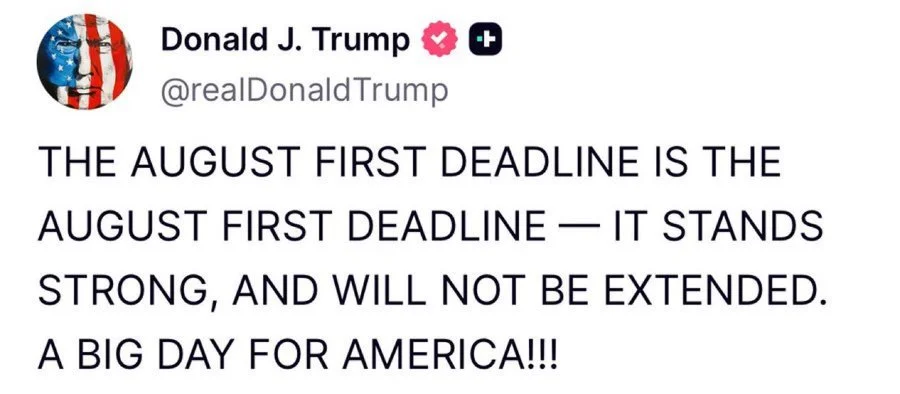
“THE AUGUST FIRST DEADLINE IS THE AUGUST FIRST DEADLINE – IT STANDS STRONG, AND WILL NOT BE EXTENDED,” he posted on Truth Social.
Winners: Countries That Secured Deals
A handful of U.S. partners have locked in agreements, accepting tariff increases in exchange for continued market access, U.S. investment, or exemptions on key goods:
European Union: Accepted 15% tariffs on most exports, including cars and pharmaceuticals, plus energy and investment pledges.
Japan: Secured 15% tariff (down from 25%) with a $550B investment pledge to the U.S.
United Kingdom: Agreed to a 10% general tariff, with a 25% sectoral tariff on metals.
South Korea: Accepted 15% tariff in exchange for U.S. export exemptions and $350B in pledged investments.
Indonesia: Negotiated a 19% rate by committing to Boeing aircraft purchases and trade liberalization.
Vietnam: Settled on a 20% base tariff and 40% for transshipped goods, in return for zero tariffs on U.S. cars.
Philippines: Accepted 19% tariffs, plus full U.S. export access and enhanced military cooperation.
Pakistan: Agreed to a joint oil development project; specific tariff terms remain undisclosed.
Still No Deal: Trump’s Top Three Trade Partners
Mexico: The largest U.S. trade partner ($840B/year) faces ongoing 25% tariffs. USMCA exemptions offer limited protection.
Canada: With $700B in bilateral trade, Canada risks a 35% tariff for goods not USMCA-compliant.
China: Trades over $530B with the U.S.; a 30% tariff is set to apply August 12 following a brief extension. Earlier rates had escalated to 145%.
On the Edge: India, Taiwan, Pakistan
India: Faces a 25% blanket tariff, plus penalties for energy ties with Russia. Trump criticized India’s high tariffs and minimal bilateral trade.
Taiwan: Facing a proposed 32% tariff (excluding semiconductors), final terms are still pending intense negotiations in Washington.
Little Hope: Brazil’s Breakdown
Brazil has drawn the harshest penalties: a 50% reciprocal tariff. Trump has directly linked the tariff to Brazil’s prosecution of former President Bolsonaro, calling it “economic blackmail.” Lula has called the move “an international disgrace.” Negotiations are stalled.
Wider Implications: Economic Blowback and Supply Disruptions
The Yale Budget Lab estimates that the tariffs could cost U.S. households an average of $2,400 in 2025, as prices rise across imported goods. Key industries such as electronics, clothing, and pharmaceuticals are expected to face disruptions as costs climb and supply chains reconfigure.
The IMF Weighs In
IMF Chief Economist Pierre-Olivier Gourinchas warned that the tariff war risks undermining global stability:
“Restoring stability in trade policy is essential. We urge all parties to agree on clear and predictable frameworks,” he said, in what was seen as a veiled criticism of Washington’s aggressive stance.
@ Newshounds News™
Source: Al Jazeera
~~~~~~~~~
Trump’s 25% Tariff on India Puts BRICS Unity to the Test
U.S. tariff escalation deepens BRICS economic tensions as India faces mounting pressure over stalled trade talks.
As the August 1 deadline approaches for sweeping new U.S. tariffs, the economic standoff between Washington and New Delhi has taken a dramatic turn. President Donald Trump confirmed Tuesday that a 25% tariff on Indian imports is imminent, sending shockwaves through both bilateral relations and the broader BRICS alliance.
Despite months of negotiation, the India-U.S. trade deal remains unresolved, threatening to ignite a full-scale trade war between the world’s largest and most populous democracies. And now, with India at the epicenter of escalating BRICS economic tensions, the bloc’s cohesion is facing one of its most significant tests to date.
Trump Escalates India Tariff Threats
Speaking at a press conference Tuesday, President Trump offered no ambiguity about his position:
“They are going to pay 25%.”
When asked directly whether Indian goods would face 20–25% tariffs, Trump reiterated:
“Yeah, I think so. India has been—they’re my friends.”
But the friendship appears strained. According to U.S. Trade Representative Jamieson Greer, the path to a trade agreement remains murky:
“They [India] have expressed strong interest in opening portions of their market. We, of course, are willing to continue talking to them. But I think we need some more negotiations with our Indian friends to see how ambitious they want to be.”
Trade Deficits and Discontent
The tariff threats stem in part from a widening trade imbalance. In 2024, the United States imported $87 billion worth of goods from India while exporting only $42 billion, a deficit that has more than doubled over the past decade.
Trump has long voiced frustration over India's tariff policies, calling them among the highest in the world:
“They charge more tariffs than any other country.”
During recent talks with Indian Prime Minister Narendra Modi, Trump reportedly said:
“You’re not treating us right.”
A Crucial Moment for BRICS Solidarity
India’s rising friction with the United States comes at a time when the BRICS alliance is under increased external pressure. Trump’s tariff campaign—part of a broader strategy that includes threats against China, Brazil, and others—has placed the bloc’s unity in the spotlight.
Earlier this year, Trump briefly imposed 26% tariffs on Indian goods before suspending them amid trade talks. Now, with new tariffs back on the table, India's response may shape the BRICS bloc’s credibility in resisting Western economic coercion.
India’s reaction has been reserved but pointed. Foreign Minister Subrahmanyam Jaishankar rejected any suggestion that a trade deal was near completion:
“The announcement was premature. Negotiations are complicated and intricate.”
High-Stakes Sectors at Risk
Key Indian exports to the U.S.—including pharmaceuticals, apparel, and telecommunications equipment—stand to be hit hard by the proposed tariffs. U.S. negotiators have also raised concerns over India's digital services tax and what they call “uniquely burdensome” testing standards for imports.
With time running out, the standoff poses a serious challenge not only to India-U.S. trade ties but also to BRICS’ long-term resilience. Other members of the bloc are closely watching how India navigates Washington’s pressure.What Comes Next?
The outcome of the U.S.-India tariff dispute could have lasting consequences for BRICS. Will India compromise to secure a bilateral deal? Or will it hold firm, testing the alliance’s resolve to stand up to U.S. economic dominance?
As Trump’s August 1 tariff deadline looms, BRICS unity may be redefined not by declarations, but by decisions—and India’s next move may determine the future of the alliance’s economic architecture.
@ Newshounds News™
Source: Watcher Guru
~~~~~~~~~
Seeds of Wisdom Team RV Currency Facts Youtube and Rumble
Newshound's News Telegram Room Link
Follow the Roadmap
Follow the Timeline
Seeds of Wisdom Team™ Website
Thank you Dinar Recaps
Iraq Good News Erases 87% of National +IQD RV Latest News
Iraq Good News Erases 87% of National +IQD RV Latest News
Edu Matrix: 7-31-2025
In a groundbreaking achievement for Iraq's economy, the state-owned Al-Rafidain Bank has announced the settlement of 87% of the country's foreign debt liabilities as of July 30, 2025.
This pivotal milestone, reached through strategic negotiations and successful legal actions, underscores Iraq's commitment to financial recovery and national sovereignty.
Iraq Good News Erases 87% of National +IQD RV Latest News
Edu Matrix: 7-31-2025
In a groundbreaking achievement for Iraq's economy, the state-owned Al-Rafidain Bank has announced the settlement of 87% of the country's foreign debt liabilities as of July 30, 2025.
This pivotal milestone, reached through strategic negotiations and successful legal actions, underscores Iraq's commitment to financial recovery and national sovereignty.
With significant concessions secured from creditors in France, the Netherlands, Turkey, and Lebanon, Iraq is enhancing its credit rating and building global trust in its financial governance.
The decline in foreign debt from $19.7 billion to $8.9 billion reflects Iraq’s focused policy reforms. Discover how this achievement paves the way for global integration and investor confidence in Iraq's fiscal stability!
Tokenized Gold Could Out-yield Treasuries - ‘Genius Act’ Ushers New Dollar Era | Sergey Nazarov
Tokenized Gold Could Out-yield Treasuries - ‘Genius Act’ Ushers New Dollar Era | Sergey Nazarov
Kitco News: 7-31-2025
Sergey Nazarov, Co-Founder of Chainlink and one of the most influential voices in digital-asset infrastructure, joins Jeremy Szafron for a high-impact discussion on the GENIUS Act, stablecoins, tokenized Treasuries, and whether gold on-chain can out-yield government bonds.
Nazarov says Washington’s new law is “the best trajectory the U.S. dollar has ever been on” and predicts the stable-coin market will jump from $200 billion to $2 trillion.
Tokenized Gold Could Out-yield Treasuries - ‘Genius Act’ Ushers New Dollar Era | Sergey Nazarov
Kitco News: 7-31-2025
Sergey Nazarov, Co-Founder of Chainlink and one of the most influential voices in digital-asset infrastructure, joins Jeremy Szafron for a high-impact discussion on the GENIUS Act, stablecoins, tokenized Treasuries, and whether gold on-chain can out-yield government bonds.
Nazarov says Washington’s new law is “the best trajectory the U.S. dollar has ever been on” and predicts the stable-coin market will jump from $200 billion to $2 trillion.
In this Kitco News interview, Nazarov explains why tokenized gold could generate yield, how Chainlink’s CCIP is already settling cross-border value between ANZ Bank and Fidelity International, and why retail CBDCs are off the table in America.
With Wall Street warming to stable-coins, sovereigns racing to adopt on-chain settlement, and gold buyers eyeing new yield mechanics, Nazarov lays out a roadmap that has hedge funds - and central banks - paying attention.
Key topics:
-$2 trillion stable-coin forecast -GENIUS Act and U.S. dollar dominance
-Tokenized gold: yield engine or store of value?
-Chainlink CCIP pilots with banks and funds
-Why the U.S. rejects a retail CBDC
-Oracles, proof-of-reserves, and systemic risk
-Asia vs. America: who leads tokenized finance? Follow Jeremy Szafron on Act
02:41 Impact of Stablecoins on the Financial System
12:40 Geopolitical Implications and Global Competition
23:17 Future of Tokenized Assets and Gold
28:16 Concerns About State Overreach and Surveillance
37:38 Chainlink's Role in the Future of Digital Finance
42:51 Conclusion
Iraq Economic News and Points To Ponder Thursday Afternoon 7-31-25
The Iraqi Stock Exchange Traded Shares Worth More Than 7 Billion Dinars In One Week.
Thursday, July 31, 2025| Economic Number of readings: 164 Baghdad / NINA / The Iraq Stock Exchange announced, on Thursday, that it traded shares worth more than 7 billion dinars during five trading sessions during the last week of July.
According to market statistics, the number of traded shares during this week amounted to more than 3 billion shares, with a financial value of more than 7 billion dinars.
The Iraqi Stock Exchange Traded Shares Worth More Than 7 Billion Dinars In One Week.
Thursday, July 31, 2025| Economic Number of readings: 164 Baghdad / NINA / The Iraq Stock Exchange announced, on Thursday, that it traded shares worth more than 7 billion dinars during five trading sessions during the last week of July.
According to market statistics, the number of traded shares during this week amounted to more than 3 billion shares, with a financial value of more than 7 billion dinars.
The ISX60 market trading index closed for the first session of the week at (977.25) points, while the index closed at the end of the week at (945.99) points, achieving a decrease of (3.30%) compared to its closing at the beginning of the session. The
ISX15 market trading index closed for the first session of the week at (1130.28) points, while the index closed at the end of the week at (1108.27) points, achieving a decrease of (1.99%) compared to its closing at the beginning of the session.
During the week, (4556) buy and sell contracts were executed on the shares of companies listed on the market. /End https://ninanews.com/Website/News/Details?key=1243925
Iraq To Increase Oil Production In August
Time: 2025/07/31 Reading: 660 times {Economic: Al Furat News} A government advisor revealed Iraq's intention to increase its crude oil export production over the next month.
The Prime Minister's financial advisor, Mohammed Salih, explained in a press statement that "the OPEC+ meeting held in June 2025 approved a plan to gradually ease the additional voluntary production cuts that eight countries have committed to since 2023," noting that "these countries will collectively begin gradually increasing their production by 548,000 barrels per day until September 2025."
Salih explained that Iraq had been committed to an additional voluntary cut of approximately 220,000 barrels per day since the beginning of 2024, and according to the new easing plan, it will be allowed to gradually increase its production starting next August.
The list of countries that will implement this increase includes Saudi Arabia, Iraq, the UAE, and Kuwait, in addition to Russia, Algeria, Oman, and Kazakhstan. The percentages of the increase will be distributed differently among these countries, based on an internal agreement within the alliance.
The Organization of the Petroleum Exporting Countries and its allies in the OPEC+ alliance decided to increase the production of eight member countries, as part of a plan to gradually ease the voluntary cuts, starting in August 2025 and continuing until September of the same year.
It is noteworthy that the federal government announced on July 17 that it had reached an agreement with the Kurdistan Regional Government to resume crude oil exports from the region, after a halt of more than two years, following drone attacks targeting the region's oil fields.
The agreement stipulates that "the regional government shall immediately begin delivering all oil produced from the region's fields to the State Oil Marketing Organization (SOMO) for export, provided that the current delivered quantity is not less than 230,000 barrels per day, to which any increase in production will be added."
Under the agreement, the federal Ministry of Finance is obligated to pay the regional government an advance of $16 for each barrel delivered, while 50,000 barrels per day are allocated for domestic consumption within the region.
Iraq is OPEC's second-largest oil producer, exporting approximately 3.5 million barrels of crude oil per day. LINK
Oil Prices Continue To Rise For The Fourth Consecutive Day.
Energy Economy News - Follow-up Oil prices rose for a fourth consecutive day on Thursday as investors fretted over supply amid US President Donald Trump's efforts to quickly resolve the war in Ukraine and his threats to impose tariffs on countries that buy Russian oil.
Brent crude futures for September delivery, which expire on Thursday, rose 27 cents, or 0.4%, to $73.51 a barrel by 00:28 GMT. US West Texas Intermediate crude for September delivery rose 37 cents, or 0.5%, to $70.37 a barrel. Both benchmarks settled 1% higher on Wednesday.
Brent crude for October delivery rose 29 cents, or 0.4%, to $72.76. "Buying interest continues to be supported by concerns that secondary tariffs on countries importing Russian crude will lead to supply cuts," said Toshitaka Tazawa, an analyst at Fujitomi Securities.
Trump threatened on Tuesday that he would begin imposing measures on Russia, including 100% secondary tariffs on its trading partners, if it did not make progress toward ending the war within 10 to 12 days, shortening a previous 50-day deadline. Trump said on Wednesday that the United States was still negotiating with India on trade, after announcing earlier in the day that the United States would impose a 25% tariff on goods imported from India starting Friday.
The United States also warned China, the largest buyer of Russian oil, that it could face hefty tariffs if it continues purchasing. The US Treasury Department announced new sanctions on Wednesday against more than 115 individuals, entities, and vessels linked to Iran, a sign that the Trump administration is intensifying its "maximum pressure" campaign against Iran after the bombing of key nuclear sites in June. China is the largest buyer of Iranian oil.
Meanwhile, U.S. crude oil inventories rose by 7.7 million barrels in the week ending July 25 to 426.7 million barrels, driven by lower exports, the Energy Information Administration reported Wednesday. Analysts had expected inventories to decline by 1.3 million barrels. https://economy-news.net/content.php?id=58145
After A Month Of Declines In Its Prices, Gold Is On The Rise Globally
Economy | 07/31/2025 Mawazine News - Follow-up Gold prices rose on Thursday from a monthly low recorded in the previous session, as uncertainty over new US tariffs increased the yellow metal's appeal.
Spot gold rose 0.8% to $3,301.49 per ounce by 06:12 GMT, after hitting its lowest level since June 30 at $3,267.79 on Wednesday. US gold futures were steady at $3,295.80 per ounce. https://www.mawazin.net/Details.aspx?jimare=264434
A New Rise In The Dollar Exchange Rate In Baghdad
Economy | 07/31/2025 Mawazine News - Baghdad - The dollar exchange rate witnessed a significant rise against the Iraqi dinar this Thursday morning in local markets in Baghdad.The selling price reached 140,750 dinars for $100, while the buying price reached 138,750 dinars for $100. https://www.mawazin.net/Details.aspx?jimare=264431
For current and reliable Iraqi news please visit: https://www.bondladyscorner.com
Seeds of Wisdom RV and Economic Updates Thursday Afternoon 7-31-25
Good Afternoon Dinar Recaps,
Trump White House Releases Long-Promised Crypto Framework — Stablecoins, Tax Clarity, and U.S. Dollar Hegemony Take Center Stage
The Trump administration has released its long-anticipated crypto policy report, outlining a sweeping regulatory blueprint that seeks to clarify digital asset oversight, promote stablecoins, and assert U.S. leadership in the evolving global financial system. The report marks a decisive step toward formalizing the United States’ stance on crypto market structure, stablecoin integration, tax treatment, and banking reforms.
Good Afternoon Dinar Recaps,
Trump White House Releases Long-Promised Crypto Framework — Stablecoins, Tax Clarity, and U.S. Dollar Hegemony Take Center Stage
The Trump administration has released its long-anticipated crypto policy report, outlining a sweeping regulatory blueprint that seeks to clarify digital asset oversight, promote stablecoins, and assert U.S. leadership in the evolving global financial system. The report marks a decisive step toward formalizing the United States’ stance on crypto market structure, stablecoin integration, tax treatment, and banking reforms.
A Formal Taxonomy of Digital Assets
The centerpiece of the report is a call to define a “taxonomy” of digital assets — clearly distinguishing which cryptocurrencies should be classified as commodities and which fall under the category of securities. The Commodity Futures Trading Commission (CFTC) would oversee spot markets for commodity tokens, while the Securities and Exchange Commission (SEC) would regulate crypto securities.
The report explicitly recommends joint oversight between the CFTC and SEC, which many in the industry see as a pragmatic division of responsibilities. SEC Chair Paul Atkins supported the proposal, stating:
“A rational regulatory framework for digital assets is the best way to catalyze American innovation, protect investors from fraud, and keep our capital markets the envy of the world.”
Banking Reform and Digital Custody Rights
The working group also called for streamlined bank charters and a transparent framework to allow banks to provide digital asset services. This includes holding custody of crypto assets and offering tokenized payment solutions — a critical step for integrating traditional financial institutions into the blockchain economy.
The proposal aims to ease regulatory barriers for banks entering the crypto space, aligning with broader efforts to modernize U.S. financial infrastructure without compromising on compliance.
Stablecoins as Instruments of Dollar Hegemony
Notably, the report reaffirmed the administration’s support for stablecoins pegged to the U.S. dollar, identifying them as key tools for protecting and extending the dollar’s global influence. While rejecting the development of a Federal Reserve–issued central bank digital currency (CBDC), the report endorsed stablecoin issuers who maintain reserves in U.S. financial instruments.
In a subtle yet important acknowledgment, the report noted that:
“Stablecoin issuers can coordinate with law enforcement to freeze and seize assets to counter illicit use.”
This mirrors a major feature typically associated with CBDCs, but implemented in the private sector — a potential compromise that merges financial control with free-market innovation.
Crypto Taxation: Tailored and Transparent
The final section of the report urged Congress to pass custom digital asset tax legislation — particularly for staking income and transaction-based activity. The authors propose that cryptocurrencies be recognized as a distinct class of assets, subject to modified tax rules that reflect their hybrid characteristics as both commodities and securities.
“Legislation should be enacted that treats digital assets as a new class of assets subject to modified versions of tax rules applicable to securities or commodities for federal income tax purposes.”
This would resolve longstanding ambiguities in crypto tax reporting and could pave the way for mainstream institutional adoption.
@ Newshounds News™
Source: Cointelegraph
~~~~~~~~~
Seeds of Wisdom Team RV Currency Facts Youtube and Rumble
Newshound's News Telegram Room Link
Follow the Roadmap
Follow the Timeline
Seeds of Wisdom Team™ Website
Thank you Dinar Recaps
Ariel: Big Moves are Being made Today
Ariel: Big Moves are Being made Today
Big Moves Are Being Made Today:
• Sec Dropped The Ripple Case
• Kurdish Region Ready To Export Oil
• President Demands Fed To Lower Interest Rates Now
Iraq has 30% Tariffs on them.
Ariel: Big Moves are Being made Today
Big Moves Are Being Made Today:
• Sec Dropped The Ripple Case
• Kurdish Region Ready To Export Oil
• President Demands Fed To Lower Interest Rates Now
Iraq has 30% Tariffs on them.
What was one of the main things Donald Trump said must cease regarding countries with financial undercuts?
Currency Manipulation.
Do I think Iraq will come out with a hard rate change on August 1st?
Can not say emphatically. But one thing I can say with 100% certainty.
Is that by default of their fraudulent monetary practice is that they will have to start on Friday a official procedure to end the program rate and allow a market float to determine their currency value.
National Bank of Iraq and Temenos have partnered together to transition the Iraqi Banks from Legacy Systems to a Unified Core Banking and Payments Platform.
What does this mean?
Temenos digital products are adaptable and scalable that will allow them to work inside an Open Banking System. This new upgrade will allow Iraq to trade with Global Financial Institutions around the world.
Do you all understand the importance of what is being done for your financial freedom?
All the tools will be available for you all to make a stable future for yourselves and family. Take full advantage of this opportunity.
This will never happen again.
Majeed: RV before the deadline, August 1
News, Rumors and Opinions Thursday 7-31-2025
Note: All intel should be considered as "Rumors" until we receive official announcements ...and “Rates and Dates” could change anytime until we get to the banks/redemption centers.
RV Excerpts from the Restored Republic via a GCR: Update as of Thurs. 31 July 2025
Compiled Thurs. 31 July 2025 12:01 am EST by Judy Byington
The Aug. 1 Deadline is the Aug. 1 Deadline
It Stands Strong and Will Not Be Extended.
A Big Day for America!
…President Trump on Telegram
Note: All intel should be considered as "Rumors" until we receive official announcements ...and “Rates and Dates” could change anytime until we get to the banks/redemption centers.
RV Excerpts from the Restored Republic via a GCR: Update as of Thurs. 31 July 2025
Compiled Thurs. 31 July 2025 12:01 am EST by Judy Byington
The Aug. 1 Deadline is the Aug. 1 Deadline
It Stands Strong and Will Not Be Extended.
A Big Day for America!
…President Trump on Telegram
Possible Timing:
Fri. 25 July 2025 Liberty Lounger Extraordinaire, Rebecca: Last Fri. 25 July I took a friend of mine to breakfast that’s on SSI disability. I wanted to tell her that money release was close. She was concerned her bank acct was overdrawn & called her bank. “Not overdrawn”, the banker said. “In fact, I see $5,000 sitting (pending), waiting to go into your account. I can’t tell where it’s coming from – but it’s there.” I thought it might be SSI; now I think DOGE.
Sat. 26 July 2025 Wolverine: The GCR Foundation has liquidity, all contracts signed, all tables closed.
Mon. 28 July 2025 Wolverine: All has begun. Sovereign Tables go. The owner of the Pentecostal group has sent an audio saying that all tables are closed for the Pentecostal group which means no one can sell any bonds and is ready to start the process and that payments will be released on Thurs. 31 July to all her leaders.
As of Tues 29 July 2025 Nesara Gesara, which was designed to liberate humanity, was (allegedly) activated. The military branch began carrying out 31 top-secret procedures intended to pay off debt, dismantle globalist organizations and return power to the people.
Tues. 29 July 2025 Wolverine: As most is confidential, I can only say certain things. All my sources are not talking as they might be under NDA. What we know is that payment will (allegedly) start this week. There were certain delays (not surprised) but nothing will stop this as any day we will be celebrating. Please have faith as this has been hidden all of us especially the people that are suffering economically and health wise. God bless. Wolverine
Wed. 30 July 2025 TNT Tony: The RV is (allegedly) complete. The lower denoms are out in Iraq. The banks have the rates. We’re waiting for our start time. In country Dinar Rate: $5.41 TNTRAYREN98 (@THE_TNT_TEAM) / X https://rayren98blogtalkradio.godaddysites.com
Thurs. 31 July 2025: Iraqi citizens were told that their new rate will(allegedly) go live Thursday morning 31 July 2025.
On Fri. 1 Aug. President Trump: “You’re gonna get a lot of payments. You’re gonna be very happy. If you’re a citizen of this country, you’re gonna be getting a lot of money in August.” NESARA/GESARA rollout. The Fri. 1 Aug. deadline is the Aug. 1 deadline – it stands strong, and will not be extended. A big day for America! …Donald J. Trump @theRealDonaldTrump https://x.com/majeed66224499/status/1950524454582599938?t=4oBCykFj0doBdViWbII3eA&s=09
Mon. 4 Aug. 2025 Wolverine: Tier4b Redemption starts. New rates could show up on the Forex.
Fri. 15 Aug. 2025 Wolverine: Deadline for GCR to (allegedly) go public and have new rates listed on the Forex.
~~~~~~~~~~~~~~
Global Financial Situation:
Wed. 30 July 2025 Epoch Times DOGE Saves nearly $200 Billion: https://www.theepochtimes.com/us/doge-says-it-has-helped-save-nearly-200-billion-5893027
Tues. 29 July 2025: IT’S REAL: TRUMP’S TARIFF REBATE CHECKS ARRIVE WHILE D*******S DROWN IN DEBT AND DONOR PANIC! [VIDEO] – amg-news.com – American Media Group
Read full post here: https://dinarchronicles.com/2025/07/31/restored-republic-via-a-gcr-update-as-of-july-31-2025/
************
Courtesy of Dinar Guru: https://www.dinarguru.com/
Walkingstick When [lower notes and exchange rate] come out together it's not going to be a big announcement. It's not going to be pomp and circumstance...fanfare. All of the education has been given to the citizens. They know what's coming. When they receive it, it'll be just like that, overnight. The next day when they wake up and they see a change in their accounts...cards, that's it. There won't be no explanation for it. No need. They already know what's coming.
Frank26 Trump it telling every country...if you want to do business with us you have to have a fair exchange rate against our currency because when their exchange rate is so low like Vietnam, China, Russia...and we want to trade products with them, that gap/separation, it's so low our profit margin is robbed from us...Donald Trump is telling every country to adjust their exchange rate of their currency...Is that not what Iraq is doing? ...It's happening with many countries now.
Did Fed Doom The Economy? What 'Policy Error' Means For Jobs, Home Prices | Danielle DiMartino Booth
David Lin: 7-30-2025
Danielle DiMartino Booth, former Fed insider and CEO of QI Research, criticizes the Federal Reserve's decision to keep interest rates unchanged amid signs of a weakening labor market, falling business investment, and disinflation, warning of a potential 'policy error' that could lead to recession while discussing risks to housing, jobs, and the broader economy.
0:00 - Intro.
0:56 - Powell’s opening statement
2:19 - Labor market
4:09 - Fed dissent
7:32 - Inflation
12:17 - What will happen to economy?
13:40 - GDP 15:23 - Consumer Confidence
17:09 - Outlook for markets and ‘real economy’
19:13 - Housing market
Thursday Coffee with MarkZ. 07/31/2025
Thursday Coffee with MarkZ. 07/31/2025
Some highlights by PDK-Not verbatim
MarkZ Disclaimer: Please consider everything on this call as my opinion. People who take notes do not catch everything and its best to watch the video so that you get everything in context. Be sure to consult a professional for any financial decisions
Member: Good Morning on this “August 1 eve”
Member: hope we are on the eve of the RV (announced by DJT tomorrow)?
Thursday Coffee with MarkZ. 07/31/2025
Some highlights by PDK-Not verbatim
MarkZ Disclaimer: Please consider everything on this call as my opinion. People who take notes do not catch everything and its best to watch the video so that you get everything in context. Be sure to consult a professional for any financial decisions
Member: Good Morning on this “August 1 eve”
Member: hope we are on the eve of the RV (announced by DJT tomorrow)?
Member: IMO -For Trump to say August 1 is a HUGE day for America, has to be something big because we’ve already been bringing in tariff income.
MZ: It might be another nothing burger…or it might be life changing…..we will see.
Member: Praying that good news arrives quickly - many are losing hope because the struggle to survive is overwhelming. Any RV news today Mark????
MZ: I do have a bond contact with a meeting tomorrow…..A couple more rumored to go today…but they are not my sources. I believe they are at the “tail end” which gives me a lot of positivity
Member: TNT is reporting the lower denoms are out and dinar rate is $5.41. Rumor?
MZ: Unfortunately I cannot verify that one,…my folks are saying it is not true..….but the rate would not surprise me. We have seen some older lower denominations in circulation…..but not the new ones yet.
Member: They need to audit the Fed, The Treasury and Ft. Knox….then reset.
Member: They need to get rid of Powell, bring in Judy Shelton to shut the Federal Reserve down, just like McMahon is doing with Dept of Education
MZ: They are an out of control entity right now….Clearly Trump has a plan to rein them in.
Member: I believe its all coming together…just not as quickly as we would like
MZ: I agree…..I really wanted it to happen way faster.
MZ: “Turkish minister : We have sent Iraq a draft of the new agreement on the oil pipeline” Iraq has indicated they can double or triple their oil output right away. This could be enormously profitable for Iraq. Its all coming together is we pay attention to the tapestry the world is weaving.
MZ: “State-owned bank announces the settlement of 87% of Iraq’s external debt file” that external debt file was huge between the end of Saadam Hussein and the Kuwait invasion up through today. Settling 87% is a huge number or debt repaid. They are in a great position for their currency and country internationally.
Member: Any new news on the dong ?
Member: I wonder if there is any chance that Vietnam goes tomorrow leading Iraq down that road based on their trade dependency?
Member: I wonder why the good guys have not allowed the RV take place already??
Member: Mark - My monthly PNC Checking Account Statement came yesterday and now says PNC Virtual Wallet Account.
Member: Chatter says Iran dropped zeros?
MZ: We talked about this last night and shared an article on it. The earliest they will start making decisions is this fall.
Member: I hope everyone has a great Thursday !!
Member: Thanks Mark for always being there for us even when news is quiet…..We appreciate you.
StacieZ joins the stream today. Please listen to the replay for here information.
THE CONTENT IN THIS PODCAST IS FOR GENERAL & EDUCATIONAL PURPOSES ONLY&NOT INTENDED TO PROVIDE ANY PROFESSIONAL, FINANCIAL OR LEGAL ADVICE. PLEASE CONSIDER EVERYTHING DISCUSSED IN MARKZ’S OPINION ONLY
FOLLOW MARKZ : TWITTER . https://twitter.com/originalmarkz?s=21. TRUTH SOCIAL . https://truthsocial.com/@theoriginalm...
Mod: MarkZ "Back To Basics" Pre-Recorded Call" for Newbies 10-19-2022 ) https://www.youtube.com/watch?v=37oILmAlptM
MARKZ DAILY LINKS: https://theoriginalmarkz.com/home/
Note from PDK: Please listen to the replay for all the details and entire stream….I do not transcribe political opinions, medical opinions or many guests on this stream……just RV/currency related topics.
ZESTER'S LINK TREE: https://linktr.ee/CrazyCryptonaut
THANKS FOR JOINING. HAVE A BLESSED DAY! SEE YOU ALL TUESDAY THROUGH THURSDAY EVENINGS FOR NEWS @ 7:00 PM EST ~ UNLESS BREAKING NEWS HAPPENS! FROM NOW ON NO MORE NIGHTLY PODCASTS ON MONDAYS AND FRIDAYS
“Tidbits From TNT” Thursday 7-31-2025
TNT:
Tishwash: Erbil agrees to send 120 billion dinars to Baghdad and deliver July payrolls.
An informed source revealed, today, Tuesday (July 29, 2025), that the Kurdistan Regional Government has agreed to send 120 billion dinars to Baghdad, during the regional council of ministers session scheduled for tomorrow, Wednesday.
The source told Baghdad Today, "The Council of Ministers will approve sending the amount to the federal government early next week, along with providing a copy of the quantities of oil the region can currently export."
He added that "the regional government will also send its employees' payrolls for July to Baghdad," noting that "the federal government, for its part, will disburse June salaries at the end of next week, amounting to 974 billion dinars."
TNT:
Tishwash: Erbil agrees to send 120 billion dinars to Baghdad and deliver July payrolls.
An informed source revealed, today, Tuesday (July 29, 2025), that the Kurdistan Regional Government has agreed to send 120 billion dinars to Baghdad, during the regional council of ministers session scheduled for tomorrow, Wednesday.
The source told Baghdad Today, "The Council of Ministers will approve sending the amount to the federal government early next week, along with providing a copy of the quantities of oil the region can currently export."
He added that "the regional government will also send its employees' payrolls for July to Baghdad," noting that "the federal government, for its part, will disburse June salaries at the end of next week, amounting to 974 billion dinars." link
Tishwash: Workshop on localizing the gold industry and strengthening craft workshops
The Central Agency for Standardization and Quality Control held a workshop at the agency's headquarters under the title "Localizing the Gold Industry and Strengthening Craft Workshops."
In his opening remarks at the workshop, the head of the Central Agency emphasized the role of the precious metals sector in strengthening the national economy, pointing to the need to enhance trust between local manufacturers and the public by ensuring the quality of jewelry and its freedom from commercial fraud.
He also commended the agency's role in protecting citizens from unfair practices, stressing its commitment to supporting local industries in accordance with international quality standards and in line with Iraq's vision for achieving sustainable economic development.
For his part, Kazem Attia Al-Shammari, a member of the Parliamentary Committee for Economy and Trade, emphasized the importance of strengthening national industries, particularly in the fields of gold and handicrafts. He noted that this would help attract investment by providing a business environment subject to quality and transparency standards.
Ghassan Sakban Kazim, Director of the Qirat Foundation for Economic Development, presented a video explaining the work of specialized gold-making workshops, with a detailed explanation of the foundation's goals of supporting national industry and facilitating procedures between the public and private sectors. He also addressed ways to overcome obstacles facing industrialists to ensure their compliance with technical and legal standards.
The workshop included a discussion session chaired by the Director General of the Standardization Department, Mohammed Latif Ahmed, with the participation of the Assistant Director General, Mustafa Saad Khazal, and the Director of the Qirat Foundation. Numerous proposals and questions were raised and answered, taking into account the workshop's concluding recommendations.
The workshop was attended by Prime Minister's Advisor Hussein Allawi Al-Najm, a representative of the Organized Crime Directorate, a number of general managers, and a number of Central Agency for Public Mobilization and Statistics (CAP) staff and goldsmith workshop owners, reflecting both official and popular interest in developing this vital sector. link
************
Tishwash: A state-owned bank announces the settlement of 87% of Iraq's external debt.
Rafidain Bank announced on Wednesday that it had achieved "substantial" progress on its foreign debt portfolio, settling approximately 87% of total international obligations through high-level financial and legal negotiations, resulting in a significant reduction in the volume of foreign debt.
The bank said in a statement today, "In the context of Iraq's commitment to the Paris Club Agreement, and with the direct approval of the Council of Ministers, the bank concluded major negotiated settlements with Dutch and French creditor companies, the most prominent of which was: Cabinet Resolution No. (403) of 2025: Settlement of three lawsuits filed by Dutch companies with a concession rate in favor of the bank exceeding 90% of the value of those claims.
The statement explained that "the bank has achieved significant legal successes abroad, most notably winning lawsuits in Turkey and Lebanon, enabling it to recover more than $2.8 million, reflecting the competence of its legal apparatus and its ability to defend the state's rights before international courts."
The bank affirmed in its statement that it "continues its efforts to close the remaining issues through final settlements, which will strengthen Iraq's sovereign rating and consolidate international confidence in its financial stability and commitment to sound financial governance." link
***********
Tishwash: The Iranian parliament approves removing four zeros from the currency.
MP Fathallah Tavasoli, a member of the Iranian parliament's economic committee, announced the committee's approval of a bill to remove four zeros from the national currency.
Tosoli explained that this project, submitted by the government, was approved after addressing the comments and in agreement with the governor of the Central Bank, the Ministry of Economy, and the relevant committee.
The Economic Committee stated that this step aims to facilitate transactions, and that the project's details are currently being amended to comply with other laws.
In May, the governor of the Central Bank of Iran, Mohammad Reza Farzin, stated that removing four zeros from the national currency "represents a priority in the country's monetary reform plan for the current year 2025."
Removing zeros from a currency is a financial procedure in which the circulating currency is replaced by a new one with a reduced nominal value, with specific zeros removed from its denominations (for example, when six zeros are removed, every million units of the old currency become equivalent to one unit of the modified currency).
This measure is usually taken to enhance financial credibility, restore monetary confidence, regulate exchange markets, and combat inflation. link
Mot: Mornings like this feed the soul.

Mot: What is it bout Dem Sheets!!! --- HUH!!!!