
Iraq Economic News and Points To Ponder Late Sunday Evening 8-25-24
Iraq's Oil Exports Decline
economy | 09:04 - 08/25/2024 Mawazine News - Follow-up The US Energy Information Administration announced on Sunday that Iraq's oil exports to America declined last week.
The administration stated in a table that "the average US imports of crude oil last week from 9 major countries amounted to 5.452 million barrels per day, down by 171 thousand barrels per day from the previous week, which amounted to 5.623 million barrels per day."
It added that "Iraq's oil exports to America amounted to 166 thousand barrels per day last week, down by 17 thousand barrels per day from the previous week, which amounted to 149 thousand barrels per day."
Iraq's Oil Exports Decline
economy | 09:04 - 08/25/2024 Mawazine News - Follow-up The US Energy Information Administration announced on Sunday that Iraq's oil exports to America declined last week.
The administration stated in a table that "the average US imports of crude oil last week from 9 major countries amounted to 5.452 million barrels per day, down by 171 thousand barrels per day from the previous week, which amounted to 5.623 million barrels per day."
It added that "Iraq's oil exports to America amounted to 166 thousand barrels per day last week, down by 17 thousand barrels per day from the previous week, which amounted to 149 thousand barrels per day."
The administration indicated that "the largest oil revenues to America last week came from Canada at a rate of 4.083 million barrels per day, followed by Colombia at an average of 213 thousand barrels per day, followed by Saudi Arabia at an average of 207 thousand barrels per day, from Nigeria at an average of 190 thousand barrels per day, and from Brazil at an average of 177 thousand barrels per day."
According to the table, "the amount of US imports of crude oil from Mexico was at a rate of 167 thousand barrels per day, from Ecuador at a rate of 163 thousand barrels per day, and from Libya at a rate of 86 thousand barrels per day. https://www.mawazin.net/Details.aspx?jimare=253891
Iraq's Oil Exports To America Decline During The Week
Energy Economy News – Baghdad The US Energy Information Administration announced today, Sunday, that Iraq's oil exports to America declined during the past week.
The administration stated in a table, which was reviewed by "Al-Eqtisad News", that "the average US imports of crude oil during the past week from 9 major countries amounted to 5.452 million barrels per day, a decrease of 171 thousand barrels per day from the previous week, which amounted to 5.623 million barrels per day."
She added that "Iraq's oil exports to America amounted to 166 thousand barrels per day last week, down by 17 thousand barrels per day from the previous week, which amounted to 149 thousand barrels per day."
The administration indicated that "the largest oil revenues for America during the past week came from Canada at a rate of 4.083 million barrels per day, followed by Colombia at an average of 213 thousand barrels per day, followed by Saudi Arabia at an average of 207 thousand barrels per day, from Nigeria at an average of 190 thousand barrels per day, and from Brazil at an average of 177 thousand barrels per day."
According to the table, "the amount of US imports of crude oil from Mexico was at a rate of 167 thousand barrels per day, from Ecuador at a rate of 163 thousand barrels per day, and from Libya at a rate of 86 thousand barrels per day.
135 views 08/25/2024 - 8:43 AM https://economy-news.net/content.php?id=46691
Recorded 41%.. Iraq Is The First Destination For Emirati Exports
2024/08/25 Read: 1,482 times {Economic: Al Furat News} Dubai ruler Mohammed bin Rashid announced an increase in UAE exports to Iraq Bin Rashid said in a press statement, "Our trade with Iraq increased by 41%, making it the first destination for Emirati exports”
He added, "Our foreign trade approached 1.4 trillion dirhams in six months, with a 25% growth in our non-oil exports, and our goal is to achieve 3 trillion dirhams in non-oil foreign trade."
Bin Rashid pointed out that "our economic relations have been strengthened with various countries, as our trade with India has increased by 10%, with Turkey by 15%, and with Iraq by 41%, making it the first destination for Emirati exports."
He continued, "The global growth rate of foreign trade reached about 1.5%, and the growth in our foreign trade reached 11.2% annually, as we move rapidly towards our targets." LINK
To resolve the issue of banks “deprived of the dollar.” Al-Alaq will return to Washington soon
Economy | Today, 14:00 | Baghdad today – Baghdad An official source in the Central Bank of Iraq revealed, today, Sunday (August 25, 2024), the imminent important visit of the bank’s governor, Ali Al-Alaq, to the United States of America to resolve the issue of Iraqi banks deprived of the dollar. The source told “Baghdad Today” that
“during the end of this month there will be an important visit by the Governor of the Central Bank of Iraq, Ali Al-Alaq, to New York City in the United States of America to hold several meetings with the US Federal Reserve and the US Treasury to discuss the file of Iraqi banks that are deprived of dealing in dollars, and the possibility of...
This deprivation was lifted, as this had a negative impact on the Iraqi banking and financial situation.” The source, who requested to remain anonymous, said,
“Those Iraqi banks are not being punished, but are only deprived of dealing in dollars, and
Al-Alaq’s visit comes in order to lift that deprivation, as well as discuss protecting the Iraqi banking system and supporting its stability.”
It is noteworthy that the Governor of the Central Bank of Iraq, Ali Al-Alaq, resolved on Wednesday (August 7, 2024) the controversy regarding reconsidering the dollar exchange rates.
Al-Alaq said, in press statements, followed by “Baghdad Today”:
“There is no intention to reconsider the dollar exchange rates,” pointing out,
“The Central Bank sells more than 250 million dollars daily at the official rate.” He noted,
“The bank covers the requirements of foreign trade, and some do not want fundamentalist methods,” noting,
“The view that the price of the dollar has risen or fallen is not a correct indicator.”
He stressed, "The central bank's success in controlling inflation compared to other countries," adding,
"We will reach 100 percent of foreign remittances without going through the US Federal Reserve at the end of this year." He stressed,
"The financial situation in Iraq is still proceeding within what is planned in the state's general budget," noting that
"for the first time, by virtue of the new budget and financial management law, the allocations of governorates and ministries are rotated." Al-Alaq said,
“The Central Bank is undergoing a major transformation process by reorganizing foreign trade, and
our procedures in foreign trade are taking place for the first time with the involvement of international institutions.” He continued,
"There are small traders outside the system that are putting pressure on the market, and
a mechanism to regulate their trade is about to be launched, and
we are focusing on getting everyone involved in sound fundamentalist channels." He revealed,
“The Central Bank has opened channels for the Chinese, Turkish, Indian, and UAE currencies,”
announcing, “The imminent launch of a new audit mechanism for trade via foreign currencies.” He stressed that
“all commercial foreign transfer operations are subject to review by the competent international company,” revealing
“meetings in New York at the end of August to discuss lifting sanctions on banks and reviewing transfer operations.” Al-Alaq explained,
“The dollar is not given to the traveler until after the departure stamp,” noting that
“the new mechanism guarantees the arrival of the dollar 100 percent to the traveler, and
we started with it in Baghdad, then Najaf, Basra, Erbil, Sulaymaniyah, and Kirkuk.”
He added, "There is a government move to increase capital support for the Real Estate Bank and the Housing Fund in the budget," noting,
"The bank's initiatives have an exceptional role in trying to fill the housing deficit." The Governor of the Central Bank announced,
“The capital increase paragraph for the Real Estate Bank and the Housing Fund in the budget has not been implemented yet, and
we do not want the bank’s financing to be a substitute for the investor’s obligations,” noting that
“the Real Estate Bank was directed to finance complexes with completion rates of 80 to 90 percent.”.
https://baghdadtoday.news/256475-لحسم-ملف-المصارف-المحرومة-من-الدولار.-العلاق-الى-واشنطن-قريباً.html
Central Bank Of Iraq Sales Amount To About $6 Billion In A Month
Posted On2024-08-25 By Sotaliraq The Central Bank of Iraq's sales from the hard currency auction for the US dollar during last July amounted to more than 5 billion dollars.
Our correspondent reported that the Central Bank sold during the month of July, during the days in which it opened its auction for buying and selling the US dollar, 5 billion, 746 million, 98 thousand, and 54 dollars, at a daily rate of 273 million, 623 thousand, and 716 dollars.
Our correspondent added that foreign remittance sales during the past month amounted to 5 billion, 428 million, 395 thousand, and 754 dollars, an increase of 94% compared to cash sales, which amounted to 317 million, 23 thousand dollars.
Our correspondent indicated that these sales were distributed between transfers abroad to finance foreign trade, and cash sales to banks, while the selling price of documentary credits and international settlements for electronic cards reached 1310 dinars per dollar, while the selling price of transfers abroad and the cash selling price reached 1305 dinars per dollar. LINK
For current and reliable Iraqi news please visit: https://www.bondladyscorner.com/
Does The World Bank Need To Rethink Its Policies?
Does The World Bank Need To Rethink Its Policies?
Banks Economy News - Follow-up For nearly eight decades, the World Bank—founded in 1944 to finance reconstruction and development after World War II—has been the largest international public agency ever. By 1973, as the need for reconstruction receded and many newly independent countries had joined the bank, President Robert McNamara outlined a revised mission.
The bank’s goal was “to accelerate economic growth and reduce absolute poverty.” At the bank’s headquarters in Washington, that goal was engraved on the lobby wall for all to see: “Our dream is a world free of poverty.”
The World Bank's initial approximation of the target was an annual estimate of the number of people living on less than $2.15 a day, the amount deemed necessary to avoid hunger, Paul Collier, a professor at Blavatnik College at the University of Oxford, wrote in an opinion piece for Foreign Policy.
Does The World Bank Need To Rethink Its Policies?
Banks Economy News - Follow-up For nearly eight decades, the World Bank—founded in 1944 to finance reconstruction and development after World War II—has been the largest international public agency ever. By 1973, as the need for reconstruction receded and many newly independent countries had joined the bank, President Robert McNamara outlined a revised mission.
The bank’s goal was “to accelerate economic growth and reduce absolute poverty.” At the bank’s headquarters in Washington, that goal was engraved on the lobby wall for all to see: “Our dream is a world free of poverty.”
The World Bank's initial approximation of the target was an annual estimate of the number of people living on less than $2.15 a day, the amount deemed necessary to avoid hunger, Paul Collier, a professor at Blavatnik College at the University of Oxford, wrote in an opinion piece for Foreign Policy.
This is a very conservative measure of the bank’s performance, Collier said—it could be achieved if the world’s poorest could reach the bare minimum necessary to survive even as the income gap with the rest of humanity widened. But even by this inadequate measure, the bank was a failure before 1990.
That is no longer in dispute: from 1960 to 1990, the incomes of the poorest countries diverged from those of the richest by standard statistical measures.
The number of people living in extreme poverty peaked in 1980 and then stabilized until the early 1990s, when China, India, and other emerging Asian markets took off.
Since 1990, China and India have largely lifted many millions out of poverty, but that was because of domestic reforms that opened their economies to trade. It was not because of the World Bank’s meager aid to these countries, which went disproportionately to Africa, along with policy advice.
But while the Bank cannot claim responsibility for China’s and India’s successes, it must accept responsibility for Africa’s failures. Yet the Bank and its leadership have been reluctant to confront or draw conclusions from their failures.
“When I first worked on the problem of global income inequality in 2003, I found that there was another problem within the problem that had not been noticed at the time,” said Professor of Economics and Public Policy at the Blavatnik School at the University of Oxford.
“A group of 60 poor countries, concentrated in Africa and Central Asia but with pockets elsewhere, had failed to spark economic growth and were gradually falling behind everyone else.”
“These countries had a population of about a billion people—I called them the bottom billion.” China and India were initially much poorer than most of these countries, but since the 1980s China has been growing rapidly, and since the 1990s India and Latin America have also been taking off.
In 1990, these three regions dominated global poverty statistics, but now they are favored by investors as emerging markets, and by 2035 their mass hunger problems will be a thing of the past, according to Collier.
The growth of these regions has helped global poverty begin to decline—both as a share of the world’s population and in absolute numbers, perhaps for the first time in human history. But this success has not extended to the bottom billion. As a group, their incomes have continued to diverge from those of the billions in emerging markets and the privileged billion in rich countries.
The divergence among the bottom billion continued until 2003, when global natural resource prices began a decade-long boom so extraordinary that it became known as a supercycle. Because economic growth never really caught on among the bottom billion, the exploitation and export of their natural resources became their dominant form of participation in the international economy, and the supercycle boosted their incomes.
This was their golden decade, and it lasted until 2014, when commodity prices collapsed; prices have been extremely volatile since then.
After 2014, the global economy entered a period known as the “new normal,” a term coined by economist Mohamed El-Erian. For the bottom billion, the new normal looked a lot like the old normal, the long period until the golden decade during which they were left behind.
Only during the golden decade did the bottom billion as a group briefly interrupt the tragedy of falling further and further behind the rest of humanity.
If the trend since 2014 continues, the global poverty headcount will soon return to its grim pre-1990 upward trajectory. Starting in 2035, after adjusting for inflation, the number of people living below the World Bank’s $2.15 poverty threshold – those so poor that they are starving – will increase relentlessly.
And they will be concentrated in very different places than in the past. Instead of China, India, and Latin America, the new poverty hotspots are Africa and Central Asia. Given the World Bank’s mission, the prospect of rising poverty rates in these long-focused regions should spur the Bank to action.
“Of course, there are many reasons to be skeptical of these forecasts. But we can supplement the projected trends with evidence of changes in national wealth per capita, including private assets such as homes and public assets such as infrastructure,” Collier said.
As imperfect as this measure may be, by looking at how assets have changed, we get some clues about how incomes will change in the future. In both the old normal and the new normal, the assets of the bottom billion remained virtually flat, while assets per capita in emerging markets grew rapidly, at 3% or more per year. The assets of the lucky billion living in the developed world grew comfortably, at about 2% per year.
People in the bottom billion are poorer than the rest of humanity. By 2020, the average fortune billion had $500,000 in assets per capita. The emerging market average had jumped to $85,000, and was on track to catch up with the fortune billion within a generation.
But people in the bottom billion have less than one-thirtieth of the fortune billion’s assets, and the fortune billion’s assets are growing only slowly.
Rather than prompting questions about why its approach was failing to achieve its stated purpose, in the early 2020s the Bank decided to change its stated purpose. The World Bank’s goal would no longer be a world free of global poverty – nor would it even be able to measure it.
Its goal would simply be to reduce the number of people living below a certain country-specific income threshold. If that number was falling, the Bank would declare victory: its programs in that country must be working.
This was not demanding enough that most programs would get a passing grade most years—even in Africa and Central Asia—so that everyone could relax. To avoid a troubled career, an employee assigned to one country that was not currently getting a passing grade would simply need to move to another country as quickly as possible.
Because everyone would be playing this game, the less experienced employees would end up working with the less capable in the more difficult countries.
Clearly, as the premier global institution, the World Bank must aim for global convergence: that is its core mission. The countries that have fallen behind to become the poorest must not merely avoid hunger or meet a low bureaucratic threshold—they must grow faster than other groups.
The failure of these programs, with the exception of one golden decade that had nothing to do with development projects, should be cause for serious soul-searching and sober reassessment at the Bank, reinforced by genuine concern about the prospects of the world’s poorest countries.
The World Bank might look to its sister institution, the International Monetary Fund, for an example of this kind of soul-searching. It happened in 2018 under then-IMF chief Christine Lagarde, now head of the European Central Bank. In an independent evaluation of its performance, the IMF found that in fragile states, only one in seven of its support and advice programs were successful.
This led to a major research study, published in 2021, that concluded that programs should last longer and be better tailored to the local context. The first fruits of this work were the agreement just reached with Ethiopia last month.
But in its policies toward persistently slow-growth countries in Africa and Central Asia, the IMF is hampered by a mandate that focuses solely on financial stability, not economic development. The development mandate falls to the World Bank—and that’s where it stops.
But instead of acknowledging a half-century of failure, discovering its causes, and launching a process of comprehensive institutional change, the World Bank made the sinister choice of redefining its purpose into something more easily achievable than economic development and income convergence.
It simply changed its poverty measures so that it would no longer have to report rising global poverty rates. Before the bank had finished this scandalous exercise, international outrage over its failure to respond to the multiple crises engulfing poor countries had reached its board of directors.
The board correctly judged the bank to have been slow to disburse funds that could have enabled the governments of the poorest countries to prevent their economies from collapsing. In February 2023, under humiliating circumstances, World Bank President David Malpass was forced to resign.
The move may finally prompt the bank to engage in the same soul-searching that the IMF has undergone. With its vast financial resources and highly skilled staff, the World Bank has a noble mission to fulfill.
Will its new president have the ambition to chart a bold new course—or will he retreat to the defensive amid a beleaguered bureaucracy? 08/25/2024 - https://economy-news.net/content.php?id=46711
“Humor While We Wait…and Wait…and Wait” Posted by Mot at TNT
TNT:
Mot: . in the past, we turned on a ‘night light’ and then
My husband and I were dressed and ready to go out for a lovely evening of dinner and theater. Having been burgled in the past, we turned on a ‘night light’ and then put the cat in the backyard.
When our Uber arrived, we walked out our front door and our rather tubby cat scooted between our legs inside, then ran up the stairs. Because our cat likes to chase our parakeet we didn’t want to leave them unchaperoned so my husband ran inside to retrieve her and put her in the back yard again.
Because I didn’t want the Uber driver to know our house was going to be empty all evening, I explained to him that my husband would be out momentarily as he was just bidding goodnight to my mother.
TNT:
Mot: . in the past, we turned on a ‘night light’ and then
My husband and I were dressed and ready to go out for a lovely evening of dinner and theater. Having been burgled in the past, we turned on a ‘night light’ and then put the cat in the backyard.
When our Uber arrived, we walked out our front door and our rather tubby cat scooted between our legs inside, then ran up the stairs. Because our cat likes to chase our parakeet we didn’t want to leave them unchaperoned so my husband ran inside to retrieve her and put her in the back yard again.
Because I didn’t want the Uber driver to know our house was going to be empty all evening, I explained to him that my husband would be out momentarily as he was just bidding goodnight to my mother.
A few minutes later he got into the Uber all hot and bothered, and said (to my growing horror and amusement) as the car pulled away, “Sorry it took so long but the stupid **** was hiding under the bed and I had to poke her ass with a coat hanger to get her to come out! She tried to take off so I grabbed her by the neck and wrapped her in a blanket so she wouldn’t scratch me like she did last time.
But it worked! I hauled her fat ass down the stairs and threw her into the backyard….she had better not shoot in the vegetable garden again.”
The silence in the Uber was deafening…..
************
Mot: ............ The Secret to a Happy Marriage
I asked my friend, “What is the secret behind your happy married life?” He replied, “You should share responsibilities with love and respect each other. Then, there will be no problems.”
Curious, I asked him to explain. He said, “In my house, I make decisions on bigger issues, while my wife decides on smaller ones. We do not interfere in each other’s decisions.”
Still unconvinced, I requested examples. He elaborated, “Smaller issues like which car to buy, how much to save, when to visit the supermarket, when and where to go on vacation, which sofa, air conditioner, or refrigerator to buy, and whether to keep a maid are all decided by my wife. I just agree to it.”
I then asked, “What is your role?” He smiled and said, “My decisions are for very big issues like whether America should attack Iran, whether Britain should lift sanctions over Zimbabwe, whether Bodoland should be formed, or whether Ronaldo should retire from football. My wife never objects to any of these decisions.”
************
Mot: 12 commandments fur Seniors

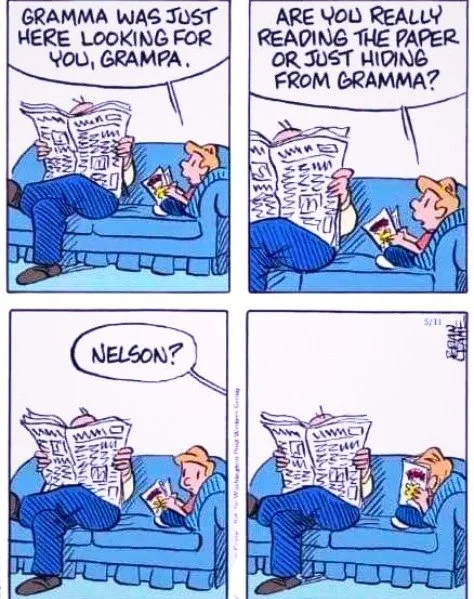
Mot: Hiding from Gramma
Mot ... Sign of the Time!!!

BRICS Launching New Stablecoin Pegged By Chinese Yuan & Gold-Backed Currency!
BRICS Launching New Stablecoin Pegged By Chinese Yuan & Gold-Backed Currency!
We Love Africa: 8-25-2024
What will the new Brics currency look like?
Until now, there have been speculations about whether Brics will launch a new currency in competition with the US dollar or not.
Even though there were official talks on launching a new payment system, like SWIFT, no official news came about Brics currency. But things have changed now.
BRICS Launching New Stablecoin Pegged By Chinese Yuan & Gold-Backed Currency!
We Love Africa: 8-25-2024
What will the new Brics currency look like?
Until now, there have been speculations about whether Brics will launch a new currency in competition with the US dollar or not.
Even though there were official talks on launching a new payment system, like SWIFT, no official news came about Brics currency. But things have changed now.
Brics is thinking of various options, considering what to use to peg the new currency. In this respect, Russia has increased its efforts and wants to launch the currency before its chairmanship ends this year.
As of now, Brics has proposed either launching a cryptocurrency pegged by the Chinese Yuan or a whole new currency pegged by gold.
More News, Rumors and Opinions Sunday Afternoon 8-25-2024
KTFA:
Clare: Baghdad Governorate announces a holiday for tomorrow, Monday, in its departments and sections
8/25/2024 Baghdad
Baghdad Governorate announced today, Sunday, a holiday for tomorrow, Monday, in its departments and divisions.
The governorate said in a statement received by "Al-Eqtisad News", "Based on the decision of the Baghdad Provincial Council and in view of the great efforts made by the governorate's staff in providing services during the Arbaeen visit of Imam Hussein (peace be upon him) and the continuation of reverse delegation services for visitors, the Governor of Baghdad, Abdul Muttalib Al-Alawi, directed the suspension of official work on Monday, August 26, 2024."
KTFA:
Clare: Baghdad Governorate announces a holiday for tomorrow, Monday, in its departments and sections
8/25/2024 Baghdad
Baghdad Governorate announced today, Sunday, a holiday for tomorrow, Monday, in its departments and divisions.
The governorate said in a statement received by "Al-Eqtisad News", "Based on the decision of the Baghdad Provincial Council and in view of the great efforts made by the governorate's staff in providing services during the Arbaeen visit of Imam Hussein (peace be upon him) and the continuation of reverse delegation services for visitors, the Governor of Baghdad, Abdul Muttalib Al-Alawi, directed the suspension of official work on Monday, August 26, 2024."
He added, "This includes all departments and sections associated with the governorate." LINK
Clare: Al-Sudani announces the success of the Arbaeen visit plan and reveals 37 service projects for the upcoming visit
8/25/2024
Prime Minister Mohammed Shia Al-Sudani announced the success of the security and service plans for the Arbaeen pilgrimage, during a press conference he held in Karbala Governorate, today, Sunday.
Al-Sudani appreciated the efforts of the Supreme Security Committee headed by the Minister of Interior, and all officers and members in ensuring the smooth flow of the visit, which extended over vast areas and thousands of kilometers of roads leading to the holy Karbala, as well as the efforts of the local service and administrative institutions in the governorates, and the formations of the various ministries, as more than 53 ministries and agencies participated, in addition to local governments, governors and governorate councils.
Al-Sudani expressed his thanks to the Governor of Karbala and the members of the provincial council for their continuous efforts that complemented the efforts of the ministries and provinces, extending his thanks to the visitors, the Husseini processions and the social activities for their cooperation and partnership with the security and service agencies. He also thanked the Husseini, Abbasi, Kadhimiya and military shrines for their important role, praising the role of the national media in this visit, which represents an opportunity to re-sharpen the spirit of all service teams and review the work and improve the provision of service to the citizen in the upcoming visits.
In order to establish an integrated infrastructure that facilitates the visit, the Prime Minister announced during the conference 37 diverse service projects that will be initiated by the Supreme Committee for Millions of Visits, and more than (3.5) trillion dinars have been allocated for them, distributed among the budgets of ministries and governorates, and include the construction and rehabilitation of ring roads, intersections, bridges, pedestrian bridges and squares, the construction of water complexes and cities for visitors, and service complexes, and they will be initiated in a few weeks.
He pointed out that since the end of the Arbaeen pilgrimage last year, work has begun on rehabilitating the border crossings in Zurbatiyah, Al-Mundhiriyah and Al-Shaib, establishing large exchange yards to facilitate the transportation of visitors, and projects related to rehabilitating the roads linking Karbala to other governorates. The government has also made progress in the Karbala-Najaf Metro project, while the Karbala International Airport project has reached advanced stages and will be opened next year.
He stressed that the government took the initiative to establish the Supreme Committee for Million-Pilgrim Visits, to be the permanent organizer and supervisor of this great effort, indicating that this occasion is no longer merely ideological, but rather a national epic that witnessed the presence of our people from all religions and sects in more than 50 processions providing services to the visitors. LINK
************
Courtesy of Dinar Guru: https://www.dinarguru.com/
Militia Man They're making nothing but money off their oil, but they're also making nothing but money off their non-oil revenue streams. Now it's a totally different ball game. Back in the old days Iraq's valuation of $3.22 was based off oil. It wasn't on phosphates...sulfur...liquid natural gas...tax revenues...tourism. None of those. Add all that in now into the exchange rate gives some support doesn't it. You start thinking about it, wait a second, so why would you come back out at $3.22 again? Good question. Will they? Don't know. Is it likely they will? I don't know. Why would it be any less than that?
Militia Man If you guys have the lop question, it's totally uneducated as far as I'm concerned. 100%...Iraq said they were going to bring value to their currency. Doing a lop doesn't bring value. It's a reverse split. Stays the same. It's total B.S., utter nonsense. It's unstudied, uneducated and frankly, quackery as far as I'm concerned.
"When the Crisis Hits, Buffett Will Buy Gold" Mike Maloney LIVE | Rebel Capitalist 3
Mike Maloney: 8-23-2024
this eye-opening video, Mike Maloney delves into the looming financial crisis, describing it as a "financial Supernova.
He explains the hyperbubble in asset classes, fueled by unprecedented levels of debt worldwide. Mike emphasizes the importance of owning precious metals like gold and silver as a safe haven during economic turbulence, backed by historical data showing their remarkable performance.
The video also challenges the notion of fiat currencies and their role in perpetuating economic instability.
“Tidbits From TNT” Sunday 8-25-2024
TNT:
Tishwash: Economist talks about the mechanism for reviving the Iraqi economy
Economic expert Mustafa Hantoush said today: "What the Central Bank of Iraq is doing by empowering foreign banks or foreign investors at the expense of the Iraqi banking system is a fatal blow to future opportunities to advance the Iraqi economy through the banking system."
According to his statement to Mawazine News Agency, the expert Hantoush described the experiences of foreign banks or foreign investors who own national banks as failed experiments, pointing out that they have caused financial disasters for many countries.
TNT:
Tishwash: Economist talks about the mechanism for reviving the Iraqi economy
Economic expert Mustafa Hantoush said today: "What the Central Bank of Iraq is doing by empowering foreign banks or foreign investors at the expense of the Iraqi banking system is a fatal blow to future opportunities to advance the Iraqi economy through the banking system."
According to his statement to Mawazine News Agency, the expert Hantoush described the experiences of foreign banks or foreign investors who own national banks as failed experiments, pointing out that they have caused financial disasters for many countries.
The economic expert explained: "Most countries in the world give a very specific percentage to foreign investors in the banking sector in order to preserve capital and profits as an economic cycle within the country." link
Tishwash: Mohammed bin Rashid: Iraq has become the first destination for UAE exports
Sheikh Mohammed bin Rashid Al Maktoum confirmed today, Sunday, that Iraq has become the first destination for Emirati exports by 41%.
Bin Rashid said, via the (X) platform: "Several years ago, we announced our national economic goals.. and announced that our foreign trade target for the year 2031 is 4 trillion dirhams annually, a goal that represented a major challenge at the time."
He added, "Today, our economic relations with various countries have been consolidated, as our trade with India has increased by 10%.. with Turkey by 15%.. and with Iraq by 41% to become the first destination for Emirati exports, followed by India, Turkey and others." link
************
Tishwash: To deter escalation and protect his country's forces.. A senior American general visits the Middle East
A senior US general is scheduled to tour the Middle East to emphasize the importance of deterring escalation and protecting US forces in the region. The
US Joint Chiefs of Staff said on Saturday that General CQ Brown will visit Egypt, Jordan and Israel in the coming days, where he will meet with his counterparts and a number of officials to discuss the situation and tensions in the region. The
Joint Chiefs of Staff statement indicated that Brown's visit demonstrates the long-term US commitment to the Middle East.
The statement stressed that General Brown will reaffirm the importance of deterring escalation and protecting US forces in the region, and Washington's support for Israel in defending itself and coordinating efforts to provide humanitarian assistance to civilians.
The statement also explained that the visit reflects the importance of reaching an agreement that returns the hostages, ends the violence and allows the entire region to focus on the next steps towards a more secure and stable Middle East. link
************
Tishwash: Rafidain warns of the risks of accessing customers' personal and financial information
Rafidain Bank warned, today, Saturday, of the risks of accessing customers’ personal and financial information through electronic and telephone fraud.
The bank stated in a statement received by {Euphrates News} a copy of it, that: "It is keen to educate its customers and the public about sound practices in using electronic services in general, and to direct the customer to take caution and care, to ward off the risks that may result from any attempts to access the customer's personal and financial information, through electronic fraud, telephone fraud, viruses and spyware, and identity theft."
Rafidain Bank advised its customers to: "Adhere to the following instructions:
- Avoid easy knowledge of the password, maintain its confidentiality, avoid using common and well-known passwords that are easy to predict, and change them periodically.
The bank advises its customers - for their security and safety - to refrain from using known information such as date of birth, phone number, or any part of the customer's name that is easily recognizable as a password.
- Avoid disclosing the password and personal data and maintain the confidentiality of the salary card number (Master or Visa Card), Internet banking, and the mobile banking application, and not to disclose them even to bank employees.
- Update the customer's information and data, whether his salary is domiciled or otherwise, whenever there is a change through the branches.
- Continuously verify your account movements (via account statement, movements in the mobile application), and if you doubt any of them, review your branch or the Banking Awareness and Public Protection Department in the General Administration of the Bank.
The bank noted "examples of fraudulent messages:
Phishing messages..
- These messages are sent to you by impersonating an employee at your bank, where he sends you messages asking you for information about your bank account or credit card under the pretext of verifying its numbers.
- Fraud through the trick of browsing your account
- Many users have been trapped on social networks through the trick of "Find out who browsed your account on Facebook" or any other social network.
Prize winning messages..
- Such messages claim that you have won valuable prizes or a trip to a certain country, and the sender of the message asks you to pay a certain amount to receive your prize, never do that.
- Fundraising fraud.
- Collecting money in a deceptive manner, as these scammers publish fake stories about a patient in need of treatment or a poor family or others and ask for donations from social media users.
Online job offers:
- If you apply for a job online, you will definitely be asked to fill out an application form. You can do so, but be careful not to write down your bank account number and credit card.
Tips to protect yourself from fraud attempts:
- Do not interact with people who ask you to pay a small amount of money to get a prize or gift or other offers.
- Do not agree to transfer a conversation with a specific person outside of social networks, such as communicating via WhatsApp or providing this person's email address.
- Verify the identity of people who message you due to an emergency while claiming to be your friends or relatives.
- Messages that include spelling and grammatical errors are always suspicious and you should be careful of them.
- If you want to provide help or assistance, do so through official and trusted sources.
- Do not trust pages that represent large companies or public figures that you have not verified.
- Do not trust any social pages that claim that they will make you a quick profit through the Internet or work from home.
- Do not click on links that you receive via WhatsApp or social networks or those that are published in comments.
Rafidain Bank called on its customers to "take precautions and be careful to avoid falling victim to criminal methods that aim to defraud citizens and steal their money by people impersonating employees working in financial institutions, international institutions or private companies, and then doing the following:
- Communicating with customers via social media (Facebook, Instagram, WhatsApp) under the pretext of providing financial assistance and prizes or monthly salaries for a specific period, in exchange for obtaining the personal information of the customer and the data and image of the bank card granted to him and the secret number and OTP verification code.
- Using the data and information necessary to create accounts in the name of customers or modify their account data or update their data or request the number that will be sent to you by SMS, and then carrying out electronic transfer operations for the purposes of paying bills and purchases and charging mobile phone balances or making electronic money transfers to other people.
Communicating with the beneficiaries of financial transfers under the pretext of executing them in their favor by mistake, and then asking them to reverse the amount by transferring to a specific account or charging a specific phone balance. link
Mot: Guys!! -- Beeeee sure and Take Notes!!!!


Economist’s “News and Views” Sunday 8-25-2024
CHINA To Leave World Bank: A New Financial System?
Fastepo: 8-25-2024
The World Bank has faced ongoing criticism from Global South nations regarding its lending practices and the conditions tied to financial support.
Developing countries have called for a fairer global financial system, pointing to the negative effects of the Structural Adjustment Programs (SAPs) of the 1980s and 1990s, which were intended to stabilize economies but often deepened poverty and inequality in regions like sub-Saharan Africa.
CHINA To Leave World Bank: A New Financial System?
Fastepo: 8-25-2024
The World Bank has faced ongoing criticism from Global South nations regarding its lending practices and the conditions tied to financial support.
Developing countries have called for a fairer global financial system, pointing to the negative effects of the Structural Adjustment Programs (SAPs) of the 1980s and 1990s, which were intended to stabilize economies but often deepened poverty and inequality in regions like sub-Saharan Africa.
A 2002 UNICEF report noted that 60% of countries implementing SAPs saw reduced access to essential services, contributing to long-term instability.
Another issue is the loss of sovereignty imposed by World Bank loans, with nations like Ghana and Zambia forced to adopt austerity measures that sparked unrest.
Environmental and social concerns have also arisen, as World Bank projects in Indonesia and Ethiopia have been linked to deforestation, displacement, and ecosystem damage.
Additionally, the bank's decision-making is seen as disproportionately influenced by powerful Global North shareholders like the U.S. and Japan, leading to accusations that the bank prioritizes wealthier nations' interests over those of developing countries.
Critics argue that the World Bank's efforts to address past mistakes have been inadequate. Despite creating an Independent Evaluation Group (IEG) to review projects, a 2020 report found that only 45% of recommendations had been fully implemented, raising doubts about the bank’s commitment to reform.
This criticism has intensified due to perceived inequalities in global financial aid, particularly during crises like the COVID-19 pandemic, where aid pledges to African and Latin American countries were seen as insufficient compared to the swift support for Ukraine during the 2022 Russian invasion.
In response to these challenges, China, alongside other BRICS nations, led the establishment of the Asian Infrastructure Investment Bank (AIIB) in 2016.
The AIIB aims to provide a more equitable alternative to the World Bank, focusing on the infrastructure needs of the Global South.
With a capital base of $100 billion and over 100 member states, the AIIB has emerged as a credible competitor to traditional Western-dominated financial institutions, signaling a shift in the global economic order.
ANOTHER Currency Is FAILING In Front Of Our Eyes...
Lynette Zang: 8-24-2024
Today's video is about Ethiopia's Birr and it's recent plummet. Could it be failing? And could this be a sign for what's ahead for the dollar?
PetroYuan Plans?| Saudi Arabia - China Ties Are Expected to Strengthen Crude Oil Trade in Yuan
Lena Petrova: 8-25-2024
News, Rumors and Opinions Sunday AM 8-25-2024
Note: All intel should be considered as "Rumors" until we receive official announcements ...and “Rates and Dates” could change anytime until we get to the banks/redemption centers.
RV Excerpts from the Restored Republic via a GCR: Update as of Sun. 25 Aug. 2024
Compiled Sun. 25 Aug. 2024 12:01 am EST by Judy Byington
Sat. 24 Aug. 2024 The Purpose of QFS: … (JFK Jr.)
The purpose of the QFS is to end corruption, usury and manipulation within the banking system. “Banks” will no longer need to make huge profits from money transfer transactions.
Note: All intel should be considered as "Rumors" until we receive official announcements ...and “Rates and Dates” could change anytime until we get to the banks/redemption centers.
RV Excerpts from the Restored Republic via a GCR: Update as of Sun. 25 Aug. 2024
Compiled Sun. 25 Aug. 2024 12:01 am EST by Judy Byington
Sat. 24 Aug. 2024 The Purpose of QFS: … (JFK Jr.)
The purpose of the QFS is to end corruption, usury and manipulation within the banking system. “Banks” will no longer need to make huge profits from money transfer transactions.
The QFS will be completely independent of any existing “centralized” system and all other transport systems will be obsolete.
QFS is not a cryptocurrency. After REVAL (revaluation), the currency of all nations will become obsolete, collateralizing assets and ensuring a stable value (this process is simply a bank of information in the computer’s memory).
Activation of the QFS ends the ‘central banking system’, perpetuating so-called ‘debt slavery’
Official site of the Quantum Financial System. Enter your personal information and find out how much money you have in your account. https://t.me/+9c_RzxhDf6E5ZDAx
~~~~~~~~~~~~~~
Global Financial Crisis:
Sat. 24 Aug. 2024 Australia NAB Outage: Chaos as thousands of Aussies are locked out of their bank accounts due to tech outage. https://www.dailymail.co.uk/news/article-13768213/NAB-outage-Chaos-thousands-Aussies-locked-bank-accounts-tech-outage.html
Sat. 24 Aug. 2024: I Guess This Is The End. The Fall of Baal: https://x.com/prolotario1/status/1758499176269201565?s=46
Info came out via Militia-Man & Crew that confirm what I shared with you all about Texas when redeeming currency for precious metals that once the Iraqi Dinar is on the Forex anyone will be able to convert into Gold & Silver.
Do you all know how monumental this is? Remember the 43 states that pass bills to make metals legal tender? This means your money will be 100% tax-free. This means that if you purchase property with gold mortgage, taxes, liens, etc, it will not be a factor in any capacity.
Why do you think bankers fear Basel 3? Remember what the MBA stated a few days ago? That the entire model of real estate will change because of B-3.
“The Mortgage Bankers Association (MBA) has voiced strong opposition to the Basel capital rule changes, pointing out seven key areas that could affect major banks and regional banks, lenders, servicers, and borrowers within the housing finance ecosystem. Here’s a closer look at these crucial concerns”. End quote.
Basel 3 empowers the citizens. Not the banking industry. This is why they are now trying to double down on the Dodd Frank Act. Which allows the bank to legally confiscate your money making them impervious to lawsuits. You all have to understand. In the 1970s boomers bought houses for 10k-20k.
Now do you all see why bankers were crying to Congress about Basel 3 on Capitol Hill a couple of months ago?
The days of writing up mortgages with interest rates that only exist on a computer screen with nothing in the bank vaults to support the contract written out home buyers that agree to honor that over decades on a monthly basis.
Not knowing they financially entrapped themselves by signing off on a document that allows the bank to seize or confiscate your property due to delinquency in payments for money they never physically possessed themselves to underwrite a contract based on nothing but a promise and not assets are over.
~~~~~~~~~~~~~
Sat. 24 Aug. 2024 A New Beginning: The Activation of GESARA NESARA
Amidst chaos and uncertainty, there is a glimmer of hope in the form of GESARA NESARA. This mysterious acronym represents a significant shift in global affairs.
It is said that the dismantling of old systems of government, education, finance, health, and commerce is underway, promising a new era for humanity. Could this be a ray of hope in these turbulent times?
Star-Link Satellite Awaiting the Green Light: One of the most surprising claims is that the Star-Link satellite is ready to send emergency alerts to all cell phones worldwide. These satellites are supposedly on standby, waiting to transmit signals. If true, this would be an unprecedented step in coordinating global events.
A Black Swan Lurking: A Global Stock Market Crash: Ominous predictions of an imminent Black Swan-like Stock Market crash are heightening the growing tensions. Such an event could send shockwaves around the world and lead to a global monetary transition affecting 209 countries. The impact of such a crisis is beyond imagination, and the world watches with bated breath.
~~~~~~~~~~~~~
Global Currency Reset: (Rumors/Opinions)
Sat. 24 Aug. 2024 MarkZ: “Farm Claim Payments: I am getting so many reports from you guys on this one. Payments are being made and I think it is just huge. I was told from day one this would be the first claim paid. I am excited to see it.
I do know real people with money in their pockets from Farm Claims payments.” We are hearing that they are off “stuck” and have moved past the initial round of bond stuff and they are starting to prepare (in mass) the folks with German bonds. I am 100% certain that is what they are going to start processing next. Hopefully also releasing the money that goes with it. I started getting this news last night.
We are hearing money is moving fairly quickly…but we have heard that before. I think we need to see more farm claims and settlements paid. And past Farm claims into CMKX and fines and Penalties.
This is some of the milestones we should be able to see in the coming days. Iraq is not the only monkey in the game….They are just the easiest to track….. . But we also track bonds and F&Ps…..also easy to track. Iraq is not the only cog in the wheel. But they just need to release that new rate.”
Sat. 24 Aug. 2024 TNT Tony: “Just got word that in Iraq the lower denoms are being released on the streets right now. Start poppin. It’s on it’s way.”
Read full post here: https://dinarchronicles.com/2024/08/25/restored-republic-via-a-gcr-update-as-of-august-25-2024/
Courtesy of Dinar Guru: https://www.dinarguru.com/
Militia Man Article Quote: "Alaq confirmed... there will be meetings held with the Federal bank and US Treasury at the end of this August" What's the date today? It's not far off. The last meeting he had was unannounced...I think him coming back to the Untied States, he's probably going to bring something he should have had done a long time ago.
Bruce [via WiserNow] ...it looks like our start for notification and exchanges could start over the weekend...It could defer to Monday, with exchanges starting either Monday or Tuesday. That's very possible.
************
Salah talk about brushes and power iqd dinar
Nader: 8-24-2024
Iraq Economic News and Points To Ponder Late Saturday Evening 8-24-24
The Dollar's Sudden Fall Against The Iraqi Dinar: What Are The Markets Hiding?
Last updated: August 18, 2024 Independent/- The exchange rates of the US dollar witnessed a noticeable decline against the Iraqi dinar in the markets of the capital, Baghdad and Erbil, on Sunday morning, which raised questions about the reasons for this decline and its possible repercussions on the local economy.
With the opening of the Al-Kifah and Al-Harithiya stock exchanges in Baghdad, dollar prices recorded a noticeable decline, as the exchange rate reached 149,500 dinars for every 100 dollars, compared to the price of 149,800 dinars for every 100 dollars the previous day.
The Dollar's Sudden Fall Against The Iraqi Dinar: What Are The Markets Hiding?
Last updated: August 18, 2024 Independent/- The exchange rates of the US dollar witnessed a noticeable decline against the Iraqi dinar in the markets of the capital, Baghdad and Erbil, on Sunday morning, which raised questions about the reasons for this decline and its possible repercussions on the local economy.
With the opening of the Al-Kifah and Al-Harithiya stock exchanges in Baghdad, dollar prices recorded a noticeable decline, as the exchange rate reached 149,500 dinars for every 100 dollars, compared to the price of 149,800 dinars for every 100 dollars the previous day.
his decline reflects a noticeable shift in the exchange market that may have long-term effects on the Iraqi economy.
In the local markets in Baghdad, exchange rates in banking shops also witnessed a decline, with the selling price reaching 150,500 dinars and the purchasing price 148,500 dinars for every 100 dollars.
This slight decrease may be an indication of market volatility or changes in supply and demand for the dollar.
In Erbil, the capital of the Kurdistan Region, money exchange shops recorded a slight decrease in the price of the dollar, as the selling price reached 149,500 dinars and the purchase price reached 149,400 dinars for every 100 dollars.
This decrease, although slight, reflects a similar movement in the region's markets and may have impacts on trade and local economic activity.
Possible Reasons For Decline:
Government or central intervention: This decline could be the result of intervention measures by the Central Bank of Iraq or the government to contain market fluctuations and enhance the stability of the dinar.
Global Economic Changes: There may be an impact from global changes in oil prices or US economic policies that may contribute to exchange rate fluctuations.
Adjustments in supply and demand: Changes in supply and demand for the dollar in local markets can play an important role in moving prices.
Possible Repercussions:
The decline in dollar prices may have positive and negative repercussions on the Iraqi economy.
On the one hand, the decline may contribute to supporting the purchasing power of the dinar and reduce inflationary pressures.
On the other hand, this change may raise concerns about market stability and potential impacts on trade and investment.
Future Prospects:
Although the current decline in dollar prices may be an indication of the beginning of a change in the market, the continuation of this trend depends on several factors, including local economic policies and global conditions.
The coming weeks will remain crucial in determining whether this decline will continue or if it is just a temporary fluctuation in the markets.
These transformations raise questions about the strategies of the Iraqi economy and the extent of their impact on the daily lives of citizens, which makes it necessary to follow economic developments closely to know their full repercussions. https://mustaqila.com/هبوط-الدولار-المفاجئ-أمام-الدينار-الع/
Iraq Is Among The Countries That Buy The Most Gold In 2024
Economy | Today, 09:22 | Baghdad today - follow-up Recent statistics revealed, today, Saturday (August 24, 2024), that Iraq ranked ninth globally among the 10 countries that bought the most gold this year, and what is meant by gold is the conversion of foreign cash reserves into gold.
According to statistics, Iraq bought 100 tons of gold this year,
coming ninth out of the 10 countries that bought the most gold this year, compared to 1,298 tons bought by Russia, as amid escalating geopolitical tensions and economic fluctuations, interest in buying gold is increasing.
Gold reached an all-time high of $2,531.75 per ounce after surpassing $2,500 for the first time this month amid growing expectations that the Federal Reserve is close to cutting interest rates.
https://baghdadtoday.news/256384-العراق-ضمن-أكثر-الدول-شراءً-للذهب-خلال-2024.html
More Than 100 Tons.. Iraq Is The Ninth Largest Buyer Of Gold In 2024
Economy 2024-08-24 | 2,315 views Alsumaria News-Economy Iraq ranked ninth globally among the 10 countries that bought the most gold this year.
What is meant by gold is the conversion of foreign monetary reserves into gold, not the gold of goldsmiths and citizens.
Iraq bought 100 tons of gold this year, coming ninth out of the 10 countries that bought the most gold this year, compared to 1,298 tons bought by Russia, as amid escalating geopolitical tensions and economic fluctuations, interest in buying gold is increasing.
This comes as the price of the precious metal reached an all-time high of $2,531.75 per ounce after surpassing $2,500 for the first time this month amid growing expectations that the Federal Reserve is close to cutting interest rates.
The price of bullion usually benefits from low interest rates, and central banks hold gold reserves because of its strong collateral, liquidity and yield characteristics.
https://www.alsumaria.tv/news/economy/497884/أكثر-من-100-طن-العراق-تاسع-أكبر-مشترٍ-للذهب-في-2024
Oil Prices Rise More Than 1 Percent As Dollar Falls
Saturday 24 August 2024 00:11 | Economic Number of readings: 321 Baghdad / NINA / Oil prices rose by more than one percent on Friday, with the decline of the dollar.
Brent crude futures rose 95 cents, or 1.23 percent, to $78.17 a barrel, while US West Texas Intermediate crude futures rose $1.06, or 1.45 percent, to $74.07 a barrel. "
Brent crude futures fell about two percent since the beginning of the week, while West Texas Intermediate crude lost more than three percent." https://ninanews.com/Website/News/Details?key=1149395
Economist Talks About The Mechanism For Reviving The Iraqi Economy
Economy | 08/24/2024 Mawazine News – Baghdad Economic expert Mustafa Hantoush said today: "What the Central Bank of Iraq is doing by empowering foreign banks or foreign investors at the expense of the Iraqi banking system is a fatal blow to future opportunities to advance the Iraqi economy through the banking system."
According to his statement to Mawazine News Agency, the expert Hantoush described the experiences of foreign banks or foreign investors who own national banks as failed experiments, pointing out that they have caused financial disasters for many countries.
The economic expert explained: "Most countries in the world give a very specific percentage to foreign investors in the banking sector in order to preserve capital and profits as an economic cycle within the country https://www.mawazin.net/Details.aspx?jimare=253831
Iraq And America To Resume Negotiations On The Banking Sector Next Monday
Banks Economy News – Baghdad A delegation from the Central Bank of Iraq is traveling to the United States of America to resume negotiations on the banking sector.
An informed source told Al-Eqtisad News that a delegation from the Central Bank of Iraq will begin negotiations with the American side on August 26 in America.
He added that the Central Bank has moved towards signing a contract with the international company Oliver Wyman to present a plan on reforming the private banking sector, within the next six months.
He pointed out that the proposed plan includes merging some banks or cancelling the licenses of some banks. 358 views 08/24/2024 - https://economy-news.net/content.php?id=46669
More than one billion dollars in sales of the Central Bank of Iraq during a week
Time: 2024/08/24 Read: 1,287 times {Economic: Al Furat News} The total sales of hard currency by the Central Bank of Iraq during the past week, which was opened in the auction last week, amounted to more than one billion dollars.
Sources reported that the Central Bank sold during the past week and for the 5 days in which the auction was opened, one billion, 135 million, 635 thousand, and 274 dollars, at a daily rate of 277 million, 127 million, and 456 dollars, lower sales than the previous week, which amounted to one billion, 384 million, 31 million, and 47 dollars .
The highest dollar sales were on Wednesday, when they reached 283 million, 616 thousand, and 416 dollars, while the lowest sales were on Tuesday, when sales reached 268 million, 304 thousand, and 25 dollars .
Foreign remittance sales during the past week amounted to 1 billion, 66 million, 985 thousand, and 274 dollars, an increase of 94% compared to cash sales, which amounted to 68 million, 650 thousand dollars .LINK
For current and reliable Iraqi news please visit: https://www.bondladyscorner.com/
Seeds of Wisdom RV and Economic Updates Sunday Morning 8-25-24
Good Morning Dinar Recaps,
DBS BANK PILOTS BLOCKCHAIN-BASED GOVERNMENT GRANTS
The blockchain-based solution builds on DBS Bank’s participation in Project Orchid, an effort by the Monetary Authority of Singapore to test the benefits of tokenization.
Singapore’s DBS Bank launched a solution that uses blockchain technology to streamline the disbursement of government grants.
DBS Bank announced that in the pilot, it collaborated with Enterprise Singapore (ESG), a statutory board under the Ministry of Trade and Industry of the Government of Singapore and the Singapore Fintech Association (SFA), which promotes financial technology in the country.
Good Morning Dinar Recaps,
DBS BANK PILOTS BLOCKCHAIN-BASED GOVERNMENT GRANTS
The blockchain-based solution builds on DBS Bank’s participation in Project Orchid, an effort by the Monetary Authority of Singapore to test the benefits of tokenization.
Singapore’s DBS Bank launched a solution that uses blockchain technology to streamline the disbursement of government grants.
DBS Bank announced that in the pilot, it collaborated with Enterprise Singapore (ESG), a statutory board under the Ministry of Trade and Industry of the Government of Singapore and the Singapore Fintech Association (SFA), which promotes financial technology in the country.
DBS Bank Uses Smart Contracts To Disburse Government Grants
During the pilot, the SFA disbursed government grants to 27 members. DBS said that its pilot showed how blockchain-based programmable grants can improve efficiency, enhance governance and allow businesses to have faster access to government grants.
With DBS’ permissioned blockchain, ESG and its intermediaries, like the SFA, can determine the conditions of the programs and govern grant disbursements. According to DBS, this includes disbursements to approved recipients upon fulfilling certain business conditions.
Once the conditions are fulfilled, smart contracts will verify that they are met. After this process, the grants will be disbursed automatically to the beneficiaries.
According to DBS, the solution enhances governance control and reduces the need for intermediaries to manually process cash handling. This allows businesses to receive their cash payouts from the government much faster.
Furthermore, the bank’s permissioned blockchain gives full visibility of the process, giving greater transparency to the organizations involved.
Permissioned blockchains are networks with an access control layer that allows participants only a pre-approved level of authority. Even though they use distributed ledger technology, these blockchains are only partially decentralized.
Results of MAS-led Project Orchid
DBS Bank also noted that the programmable grants pilot applies what the firm has learned from participating in Project Orchid, a digital currency initiative led by the Monetary Authority of Singapore (MAS). The initiative tests the benefits of tokenization with local stakeholders.
DBS Bank also previously collaborated with digital payment provider Ant International on a blockchain-based treasury and liquidity management solution. On Aug. 13, DBS launched its treasury tokens, which Ant will use for liquidity and treasury management. The tokens are within the bank’s Ethereum Virtual Machine (EVM) permissioned blockchain.
The solution was created using systems developed during the company’s participation in another MAS-led effort on digital currencies, Project Guardian.
@ Newshounds News™
Source: Coin Telegraph
~~~~~~~~~
DEBIT CARDS IN DIGITAL WALLETS Gaining Ground Across Sectors
August 2024
With a growing number of consumers adopting digital wallets, payment preferences have shifted. Debit cards are now the preferred method underpinning digital wallet payments.
Meanwhile, digital wallets have seen more significant adoption in the retail and grocery sectors. Apple Pay, in particular, has deepened its niche in travel-related transactions, possibly foretelling a broader acceptance of mobile-first, touchless payments. This report explores these trends, how different sectors are adapting to digital wallets and what this all means for businesses.
@ Newshounds News™
Source: PYMNTS
~~~~~~~~~
PROOF OF INK BY GAVIN WOOD: THE TATTOO THAT SECURES YOUR WEV3 PRIVACY
The Web3 individuality mechanism will require a unique, algorithmically generated tattoo to prove digital citizenship.
Parity Technologies is launching a Web3 individuality solution, which is a crucial missing element for mainstream Web3 adoption.
The new solution, “Proof-of-Ink,” will enable users to prove their digital individuality in a privacy-preserving manner through a unique tattoo serving as proof of digital citizenship.
Proof-of-Ink is set to launch in the fourth quarter of 2024, according to Gavin Wood, the co-founder of Ethereum, Polkadot and Kusama.
Wood announced during a keynote speech at the Web3 Summit in Berlin:
“We are able to deploy the baseline palette and launch the app at some point this year, hopefully in the final quarter […] We are aiming to launch the other two mechanisms next year.”
While Wood teased that one of the additional two digital identity solutions is further in development, he shared no details about their mechanics.
Mainstream adoption is crucial for any technological paradigm. Experts like Wood hope that Web3 adoption will create a more decentralized and user-centric internet, envisioned as a free public good to help humanity.
@ Newshounds News™
Read more: Coin Telegraph
~~~~~~~~~
WYOMING Aims to Launch US DOLLAR-BACKED STABLECOINS in 2025
Wyoming is reportedly developing its own U.S. dollar-backed stablecoin to be used for consumer payments.
The state plans to launch the Wyoming Stable Token in the first quarter of 2025, CNBC reported Friday.
“It is clear to me that digital assets are going to have a future,” Wyoming Governor Mark Gordon told CNBC at the Wyoming Blockchain Symposium in Jackson Hole. “The United States has to address this issue. Washington’s being a little bit stodgy, which is why Wyoming, being a nimble and entrepreneurial state, can make a difference.”
Advocates of the project the Wyoming stable token will provide a faster and cheaper way for individuals and businesses to transact, will create a new revenue stream for the state and may serve as a model for a stablecoin at the federal level, according to the report.
Gordon said the stablecoin will be transparent, fully backed by short-term Treasurys and dollar-dependent, per the report.
Wyoming has already been working to create a favorable regulatory environment for crypto, having passed more than 30 pieces of legislation related to that field since 2018, according to the report.
The state is currently vetting potential vendors and partners to provide an exchange, digital wallets and other technology needed for the stable token, per the report.
Wyoming aims to make the stablecoin a payment method for everyday use, Flavia Naves, a commissioner at the Wyoming Stable Token Commission, said in the report.
“When you walk into Cowboy Coffee in Jackson, Wyoming, and you want to buy your latte, there’s going to be their wallet there in Solana that you can use to buy your coffee with the Wyoming token,” Naves said, per the report.
Stablecoins are a type of currency designed to maintain a stable value by pegging their worth to a fiat currency, PYMNTS reported in April. Unlike traditional cryptocurrencies like bitcoin, which are notorious for their price fluctuations, stablecoins offer a level of stability that closely mirrors that of traditional currencies.
On the federal level, U.S. Sen. Kirsten Gillibrand, D-N.Y., and Sen. Cynthia Lummis, R-Wyo., introduced legislation to govern stablecoin use.
@ Newshounds News™
Source: PYMNTS
~~~~~~~~~
Newshound's Currency Facts Youtube and Rumble
Newshound's Podcast Link
Newshound's News Telegram Room Link
Q & A Classroom Link
Follow the Roadmap
Follow the Timeline
Seeds of Wisdom Team™ Website
Subscribe to Newsletter
Thank you Dinar Recaps
Iraq Is In The Grip Of Corruption: Who Bears Responsibility And Where Does The Solution Lie?
Iraq Is In The Grip Of Corruption: Who Bears Responsibility And Where Does The Solution Lie?
Last updated: August 22, 2024 The Independent / Investigative Report / - Today, Iraq lives in the grip of deep-rooted corruption, similar to a multi-headed ogre that does not stop growing and expanding, seizing the country’s resources and obstructing development and progress efforts.
Despite efforts to combat this scourge, corruption continues to worsen, raising urgent questions about who bears responsibility for the continuation of this situation and where real solutions can be found.
Iraq Is In The Grip Of Corruption: Who Bears Responsibility And Where Does The Solution Lie?
Last updated: August 22, 2024 The Independent / Investigative Report / - Today, Iraq lives in the grip of deep-rooted corruption, similar to a multi-headed ogre that does not stop growing and expanding, seizing the country’s resources and obstructing development and progress efforts.
Despite efforts to combat this scourge, corruption continues to worsen, raising urgent questions about who bears responsibility for the continuation of this situation and where real solutions can be found.
Sudanese Government Censorship: Efforts Of Questionable Effectiveness
Since Muhammad Shiaa Al-Sudani assumed the position of Prime Minister, fighting corruption has been his government's top priority.
The Sudanese came to carry the banner of change and promise to achieve what previous governments could not do, but Iraq, which suffers from deep-rooted corruption, requires more than just promises and slogans.
The new government issued many directives, including a call for an immediate response to corruption reports and the implementation of judicial decisions within 24 hours, but these efforts, despite their apparent seriousness, are still subject to doubt.
The question that arises is: Is launching these initiatives enough to bring about radical change in a country where corruption is part of the power structure?
Al-Sudani may be right in his enthusiasm to fight corruption, but can he withstand the challenges of political pressure and internal collusion?
Corruption in Iraq is not just an individual case here or there; It is a complex system that benefits influential parties capable of aborting any attempt at reform.
Although Sudanese has begun to move stagnant waters through bold decisions, his success remains dependent on his ability to confront the whales of corruption that have deep networks within state institutions.
In light of these complications, can the Sudanese government fulfill its promises, or will it join the list of governments that made big promises but failed to fulfill them?
House Oversight: Poor Performance And Limited Impact
is supposed to play The Iraqi Council of Representatives a central role in monitoring the government and holding those responsible for corruption accountable.
However, the reality reflects a clear weakness in the Council's performance, as it has often become part of the problem rather than part of the solution.
The political alliances that control the Council are often a stumbling block to activating its oversight role.
This manifests itself in delaying or disrupting parliamentary inquiries under partisan pressure or as a result of political bargaining.
This weakness in the supervisory role exacerbates the phenomenon of corruption and provides the corrupt with the opportunity to evade accountability.
The Council, which was supposed to be the guarantor of protecting the people’s rights and monitoring the performance of the executive authority, has become a tool in the hands of political alliances that prefer to preserve their own interests at the expense of the public interest.
In this context, the influence of narrow partisan interests that hinder the work of the Council cannot be ignored.
These interests prevent the activation of parliamentary oversight as required, and make it difficult to pass the necessary laws to combat corruption.
The result is that corruption files remain unresolved, without a radical solution, which weakens the people’s confidence in the House of Representatives and enhances the climate of impunity.
Judicial Oversight: Weakness In Resolving Major Cases
The judiciary in Iraq is considered the last stronghold that citizens must resort to in the face of corruption, but this fortress has also become breached.
The weakness of the judicial system in dealing with major corruption cases reflects a deeper problem of independence and political pressures affecting the administration of justice.
Many cases related to corruption remain stuck in the corridors of the judiciary, where trials are delayed and rulings are postponed due to political interference or pressure exerted by influential people.
This dynamic not only obstructs the course of justice, but also reinforces a culture of impunity.
Corrupt people in Iraq are well aware that the judiciary, which should be a strict watchdog, can be exploited by complicating legal procedures or using political connections to avoid accountability.
In this climate, corruption becomes an integral part of daily life, and citizens feel that the judicial system is powerless to protect them or preserve their rights.
Without real and comprehensive reform of the judicial system, corruption will continue to spread unchecked, and the Iraqi judiciary will continue to be seen as part of the problem rather than part of the solution.
The Role Of Media And Culture: Between Awareness And Misinformation
The media in any society is the watchdog and the voice of the oppressed,
but in Iraq, the media is often part of a network of interests that fuels corruption rather than exposes it.
The Iraqi media has the ability to expose corruption and shed light on illegal practices,
but this role is often undermined by political and economic ties that limit its independence.
The media, which is supposed to be a platform for transparency, often turns into tools of misinformation. Manipulation of information, bias in coverage, and reliance on suspicious sources of funding are all factors that make the media unable to fulfill its role in the fight against corruption.
Instead of being a means of educating the public and motivating them to hold them accountable, the media has become part of the system that protects the corrupt and closes the doors to any attempt at reform.
On the cultural side, Iraq faces great challenges in establishing the values of integrity and accountability. Public culture often tolerates corruption or considers it part of “realpolitik.”
The arts, education, and independent media are all tools that should be used to promote a culture that respects the law and promotes transparency.
Without a radical change in the cultural and media system, corruption will continue and the Iraqi people will remain hostage to a system that lacks integrity.
The American Role: Suspicious Influence And Intentional Disregard?
The issue of corruption in Iraq cannot be addressed without referring to the role that the United States has played since its occupation of the country in 2003.
American policies in Iraq, especially with regard to reconstruction and the distribution of contracts, have contributed greatly to creating a fertile environment for corruption.
Many US-financed reconstruction contracts were not well thought out and were implemented without adequate oversight, resulting in billions of dollars being wasted.
This financial chaos not only contributed to rampant corruption, but also helped build networks of corrupt people who still maintain their influence inside Iraq.
Although US forces have largely withdrawn, American influence remains strong in Iraq.
There are accusations that the United States turns a blind eye to some corruption files in order to preserve its strategic interests.
These policies, whether the result of negligence or design, have contributed to the deepening of the corruption crisis in Iraq, making it difficult for any Iraqi government to achieve real progress in combating this phenomenon.
The Role Of The United Nations: International Oversight And Its Limited Impact
The United Nations, which is supposed to be a neutral international body that contributes to enhancing transparency and supporting the rule of law, was not immune from criticism in Iraq.
Some UN-run aid programs have faced accusations of corruption or mismanagement, reducing Iraqis' confidence in the UN's oversight role.
Limited transparency in UN operations, and the absence of real accountability for those working in these programmes, have raised questions about the effectiveness of international oversight in combating corruption.
If international organizations are unable to provide a role model for transparency and integrity, how can corrupt Iraqi institutions be expected to achieve this?
Popular And Religious Censorship: A Latent Force That Needs To Be Activated
The Iraqi people have a latent power that can change the equation, but this power is often muzzled or not activated as required.
Popular oversight, which is practiced through protests, demonstrations, and civil society participation, is considered one of the most important means of putting pressure on the government and institutions to combat corruption.
At the same time, religious institutions play a major role in shaping public opinion in Iraq.
However, some of these institutions may provide moral or legal cover for the corrupt, whether intentionally or unintentionally.
If the religious role is properly activated, it can be a driving force towards reform and change.
Proposed solutions: Either reform the system or form an anti-corruption coalition
Combating corruption in Iraq requires taking radical and decisive steps, so the proposed solutions can be divided into two stages:
Fix The System From Within:
Current political leaders are required to adopt real reforms, far from rhetorical slogans and empty statements.
These reforms must include enhancing transparency and accountability in all state institutions, and ensuring the independence of the judiciary to be able to resolve major corruption-related cases without political interference.
Also, activating independent and effective parliamentary and judicial oversight is considered an imperative necessity to stop the flow of corruption.
The commitment of those in charge of the political process to reform is not an option, but rather a necessity for survival.
The continuation of corruption will ultimately lead to the collapse of the entire system, and
therefore the national interest requires taking radical measures to save what can be saved.
Forming An Anti-Corruption Political Coalition:
If the current leaders fail to reform the system from within, the alternative is to form an anti-corruption political coalition.
This coalition must include independent and honest political forces capable of presenting a new generation of politicians and administrators who are committed to the principles of transparency and integrity.
The new coalition must have a clear program aimed at restoring the people’s confidence in government institutions, and work closely with civil society organizations to educate citizens and motivate them to participate effectively in monitoring the government’s performance.
Supporting the coalition internationally is also a necessary step to strengthen its position and undertake the structural reforms required to eliminate corruption.
The international community, especially countries and organizations that have an interest in Iraq's stability, must realize that supporting the anti-corruption coalition is in everyone's interest, and enhances the chances of building a stable and transparent state.
Conclusion
Ultimately, the battle against corruption in Iraq remains an existential battle that requires the combined efforts of all components of society.
Real reform will not be achieved unless there is a strong political will supported by enlightened popular awareness.
Iraq needs a real renaissance that begins with breaking the cycle of corruption, to provide a better future for future generations. https://mustaqila.com/العراق-في-قبضة-الفساد/