
Is Peer Pressure Keeping You Poor?
Is Peer Pressure Keeping You Poor?
By Max Wong
Like every other Wise Bread writer, I hate debt. Although my debt doesn’t keep me awake at night, it is one of the things I think about while brushing my teeth every morning. “What will I do today (brush-brush) that will help me pay down (brush) my home mortgage ahead of (brush) schedule?”
The idea that “many people would rather struggle to pay off a large credit card bill than utter the phrase 'I can’t afford it,'” tests the limits of my financial imagination like a velociraptor tests an electric fence.
Is Peer Pressure Keeping You Poor?
By Max Wong
Like every other Wise Bread writer, I hate debt. Although my debt doesn’t keep me awake at night, it is one of the things I think about while brushing my teeth every morning. “What will I do today (brush-brush) that will help me pay down (brush) my home mortgage ahead of (brush) schedule?”
The idea that “many people would rather struggle to pay off a large credit card bill than utter the phrase 'I can’t afford it,'” tests the limits of my financial imagination like a velociraptor tests an electric fence.
It’s so painful, yet I can’t stop thinking about it. Spending money that you don’t have is a type of self-harm that often goes undetected and can have lifelong consequences. (See also: The Enemies of Frugality)
The Positive Power of "I Can't Afford That"
I am grateful that I figured out early on that people who judged me for saying “I can’t afford that” were the same people who were secretly living with crushing amounts of credit debt and didn’t own anything.
I think most emotionally mature people realize that friends and family who make you feel bad about how much money you have are not nice people, but even armed with that knowledge, there is still so much peer pressure to spend.
One of the hardest things about not having financial parity with the people around you is turning down invitations to events that are out of your budget range. Being in debt can be isolating.
In addition to missing out on weddings, nights on the town, or even schooling, friends who get turned down repeatedly might take your reluctance to spend money you don’t have as a personal rejection.
So, how do you talk about debt without losing all your friends? There must be at least a dozen ways that people manage their public spending vs. private debt, but I have four strategies that have worked for me personally.
Be Your Own Financial Cruise Director
Your debt is not your friends' problem to solve.
While your truly good friends will always listen to you complain about your financial woes, it’s not really up to them to make your life without money work. If you want to spend time with people you care about, suggest alternate, inexpensive ways of spending time with them:
If you can’t afford to go to a $10 gym class, suggest a morning hike or a run through the park to your sporty friends.
If you can’t afford dinner, ask to meet with your friends after dinner for a drink instead.
When I was really poor, I became the master social planner for everyone in my life because I would comb the weekly alternative newspaper for free concerts, book readings, art openings, and other events that I could invite my friends to.
Even if you live in a tiny town with no nightlife, there are plenty of free ways to spend time with your friends. For example, offer to go with them when they have to run all their boring errands. Or, hang out with them at school events for their kids. Do yourselves both a favor and schedule a cleaning day where you switch off helping each other clean your houses. Chores go faster when you have a friend to talk to.
Be Honest
To continue reading, please go to the original article here:
http://www.wisebread.com/is-peer-pressure-keeping-you-poor?ref=seealso
8 Money Lessons You Must Teach Your Children and Grandchildren
8 Money Lessons You Must Teach Your Children and Grandchildren
If you know and love a young person, pass on these life-changing lessons that can put anyone on the road to prosperity.
Kentin Waits • May 30, 2018
Around the nation, young people are graduating from high school and college and preparing to take charge of their financial lives.
If you listen closely, you can hear wallets groaning from coast to coast.
This is not another rant against millennials and other whippersnappers. Americans of all ages are hopelessly behind the curve when it comes to handling their money responsibly. Unless they have astute parents — or a natural interest in personal finance — young people are at a high risk of making financial mistakes that lead to chronic debt.
8 Money Lessons You Must Teach Your Children and Grandchildren
If you know and love a young person, pass on these life-changing lessons that can put anyone on the road to prosperity.
Kentin Waits • May 30, 2018
Around the nation, young people are graduating from high school and college and preparing to take charge of their financial lives.
If you listen closely, you can hear wallets groaning from coast to coast.
This is not another rant against millennials and other whippersnappers. Americans of all ages are hopelessly behind the curve when it comes to handling their money responsibly. Unless they have astute parents — or a natural interest in personal finance — young people are at a high risk of making financial mistakes that lead to chronic debt.
Money Talks News is all about providing the financial education lacking in too many schools and families. So, pass on the following 8 lessons to a young person in your life — or read these tips yourself if you’re fortunate enough to be a young adult just starting out on your own.
1. Debt is a form of slavery
In the first quarter of 2018, household debt reached a record $13.21 trillion, according to the Federal Reserve Bank of New York. Household debt is now 18 percent higher than it was in the second quarter of 2013.
Imagine how all that debt might impact the life of the average debtor. What will happen if there is a job loss or an illness that health insurance does not cover? How much stress would you feel in that situation?
Debt, especially unsecured consumer debt, is a form of slavery. The debtor is beholden to the creditor because each day that the debt remains unpaid, interest charges pile up. Over time, it’s easy to see how the unchecked use of credit can erode wealth and foreclose opportunities.
2. Financially successful people live below their means
Financial success is usually the result of years of self-control, and a big part of that discipline involves living within or below your means. If every dollar that comes into your life has to go out, there’s little hope for getting ahead.
Work to keep your overhead lower than your income, pocket the difference and don’t let every bump in income mean a boost in lifestyle.
3. Pay yourself first
Learning to pay yourself first is an important part of financial security. Direct a healthy portion of your income into an IRA, a 401(k) plan or a savings account before your paycheck even hits your account. Otherwise, you’ll have to constantly fight the temptation to spend every dollar.
When you automate your savings and make that an unwavering part of your routine, it puts the twin forces of time and compounding interest on your side.
4. Forget about impressing the Joneses
To continue reading, please go to the original article here:
Why Aren’t Rich People Happier?
Why Aren’t Rich People Happier?
Posted April 22, 2022 by Ben Carlson
William “Bud” Post lived a hard life.
His mother died when he was young and his father later dropped him off at an orphanage. Post was a drifter for most of his life, doing odd jobs to stay afloat. When he purchased a lottery ticket in 1988, he had just $2.46 in his bank account. Lo and behold, it was a winning ticket — Post walked away with $16.2 million. That’s a life-changing amount of money but it didn’t have the desired effect.
Just five years later Post proclaimed, “Everybody dreams of winning money, but nobody realizes the nightmares that come out of the woodwork, or the problems.”
Why Aren’t Rich People Happier?
Posted April 22, 2022 by Ben Carlson
William “Bud” Post lived a hard life.
His mother died when he was young and his father later dropped him off at an orphanage. Post was a drifter for most of his life, doing odd jobs to stay afloat. When he purchased a lottery ticket in 1988, he had just $2.46 in his bank account. Lo and behold, it was a winning ticket — Post walked away with $16.2 million. That’s a life-changing amount of money but it didn’t have the desired effect.
Just five years later Post proclaimed, “Everybody dreams of winning money, but nobody realizes the nightmares that come out of the woodwork, or the problems.”
Post blew through the money with some investments in a restaurant and a fleet of used cars. He also purchased a plane even though he didn’t know how to fly it. A handful of ex-wives sued him. His own brother even hired a hitman to kill him so he could inherit the winnings (he was unsuccessful).
In a matter of months he was forced to file for bankruptcy, surviving on Social Security and food stamps until he died broke in 2006.
When asked about hitting the jackpot after it all went up in smoke, Post later admitted, “I wish it never happened. It was totally a nightmare. I was much happier when I was broke.”
Studies show lottery winners have been shown to be more susceptible to drug and alcohol abuse, depression, divorce, suicide, or estrangement from their family.
I was reminded of Post’s story after reading a recent Conor Sen take on tech billionaires:
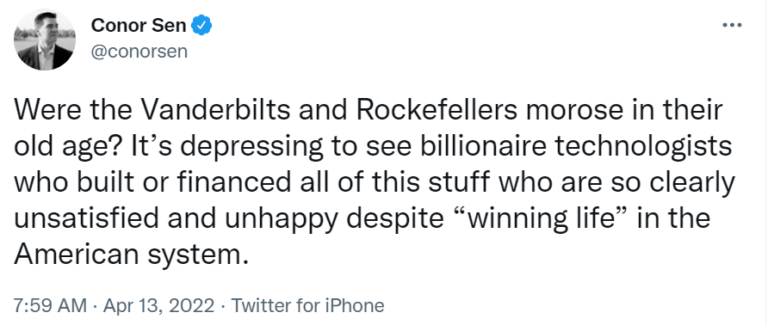
I’m not saying these people are all going to blow through their money but it does seem like many of the tech elite who have seemingly “won” the game are increasingly unhappy or unsatisfied.
They spend their time on social media getting into squabbles with one another, complaining about politics or offering cynical takes on the state of the world.
It’s possible I’m reading too much into the Twitter personas of these billionaires but it makes sense.
Having that much money can solve a lot of problems but it also creates a new set of complications, especially when it happens so young.
Buffett didn’t become a billionaire until he was 56 years old. Many of today’s tech titans strike it rich when they’re in their 20s.
To continue reading, please go to the original article here:
https://awealthofcommonsense.com/2022/04/why-arent-rich-people-happier/
Who Wants to Be a Billionaire?
Who Wants to Be a Billionaire?
November 18, 2022 by Ben Carlson
Scott Galloway once said, “It’s never been easier to become a billionaire, or harder to become a millionaire.” I’m not sure I agree but it does seem like more people want to become a billionaire these days. I honestly don’t think it’s worth it. More money in your life is obviously better than less money but only up to a certain point. Once you’re comfortable enough, more money these days seems to be more of a burden than a blessing. Just look at the list of the 10 richest people in the world right now:
Who Wants to Be a Billionaire?
November 18, 2022 by Ben Carlson
Scott Galloway once said, “It’s never been easier to become a billionaire, or harder to become a millionaire.” I’m not sure I agree but it does seem like more people want to become a billionaire these days. I honestly don’t think it’s worth it. More money in your life is obviously better than less money but only up to a certain point. Once you’re comfortable enough, more money these days seems to be more of a burden than a blessing. Just look at the list of the 10 richest people in the world right now:
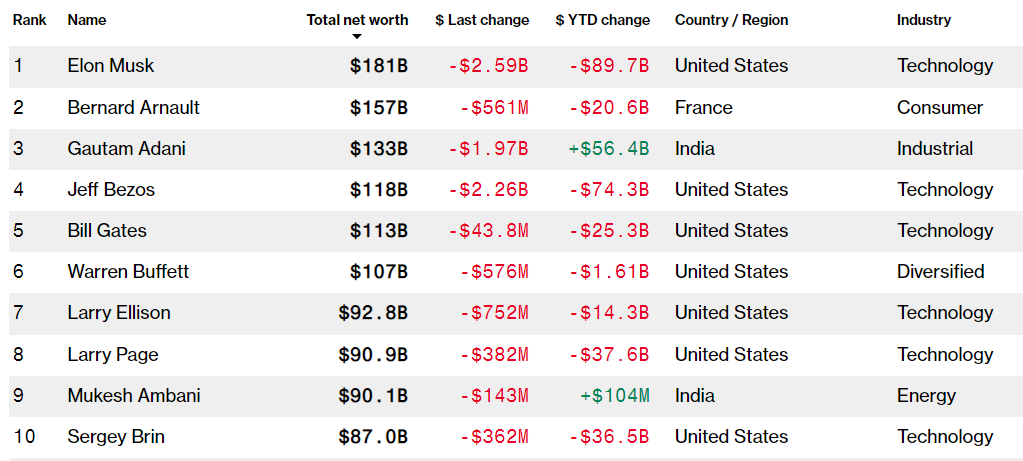
Elon Musk has been divorced three times. Jeff Bezos is divorced. So in Bernard Arnault. And Bill Gates. And Sergey Brin. Warren Buffett split from his wife in an unusual arrangement where she left him and he took on a new partner. Larry Ellison has been divorced four times.
The 10 richest men in the world have a combined 12 divorces between them.
Even billions of dollars can’t buy you more stable relationships.
In fact, the opposite is probably true. More money and success likely make it harder to have healthy relationships because there is always more work to do and wealth to build.
The richest man in the world has admitted as much on a number of different occasions.
This week Elon Musk talked about the fact that he works from morning until night 7 days a week.2 He shared that being the richest person on the planet isn’t all it’s cracked up to be:
I’d be careful what you wish for. I’m not sure how many people would actually like to be me. They would like to be what they imagine being me, which is not the same thing as actually being me. The amount that I torture myself is next level, frankly.
Sure, the money sounds great, but would you actually want the richest man on the planet’s life?
I wouldn’t.
In a profile from the New York Times a few years ago, Musk shared that his work nearly made him miss his own brother’s wedding (where he was the best man). Running multiple companies makes it difficult to spend time with his children or take any days off:
Two days later, he was scheduled to be the best man at the wedding of his brother, Kimbal, in Catalonia. Mr. Musk said he flew directly there from the factory, arriving just two hours before the ceremony. Immediately afterward, he got back on the plane and returned straight to Tesla headquarters, where work on the mass-market Model 3 has been all consuming.
He said he had been working up to 120 hours a week recently — echoing the reason he cited in a recent public apology to an analyst whom he had berated. In the interview, Mr. Musk said he had not taken more than a week off since 2001, when he was bedridden with malaria.
“There were times when I didn’t leave the factory for three or four days — days when I didn’t go outside,” he said. “This has really come at the expense of seeing my kids. And seeing friends.”
The billions he’s made from those companies sound great until you realize all of the baggage that comes with it.
Listen, I am glad people like Elon Musk exist — people who create potentially life-altering companies like Tesla and SpaceX. I just can’t imagine wrecking my personal life in the process.
Money, power and fame can amplify who you are but they can also change you as a person.
To continue reading, please go to the original article here:
https://awealthofcommonsense.com/2022/11/who-wants-to-be-a-billionaire/
10 Types of Neighbors That Are Costing You Money
10 Types of Neighbors That Are Costing You Money
By Tim Lemke
I really like my nextdoor neighbor, Dave. He's quiet, friendly, and always willing to lend me his leaf blower. He also keeps his property in good shape Not everyone is so fortunate to have great neighbors like him. And that's a shame, because bad neighbors can not only make your life uncomfortable, they can cost you money. For your sake, I hope that none of your neighbors fit these descriptions.
The Slob
The grass and weeds are up to your knees. The house hasn't been painted in decades. There are rusted out cars on the front yard and trash all over the place. These types of neighbors can make your house less valuable, potentially costing you tens of thousands of dollars when the time comes to sell your home.
10 Types of Neighbors That Are Costing You Money
By Tim Lemke
I really like my nextdoor neighbor, Dave. He's quiet, friendly, and always willing to lend me his leaf blower. He also keeps his property in good shape Not everyone is so fortunate to have great neighbors like him. And that's a shame, because bad neighbors can not only make your life uncomfortable, they can cost you money. For your sake, I hope that none of your neighbors fit these descriptions.
The Slob
The grass and weeds are up to your knees. The house hasn't been painted in decades. There are rusted out cars on the front yard and trash all over the place. These types of neighbors can make your house less valuable, potentially costing you tens of thousands of dollars when the time comes to sell your home.
The Bad Borrower
It's certainly neighborly to let a person borrow your casserole dish or a pair of hedge clippers from time to time. But it's important to not let the borrowing become too one-sided. It's tough living next door to the people who are always asking for stuff, but rarely offering. It's also problematic when a neighbor returns items in bad condition — or not at all.
The HOA Cop
Many neighborhoods have rules that govern everything from the color of your balcony railing to whether you can hang laundry on a clothesline. Often, these rules are enforced by a homeowner's association or zoning department that can levy fines.
You should always try your best to keep your house and yard up to code, but no one wants a neighbor that rats you out every time your grass gets a millimeter too high or some leaves fill up your gutters, costing you money in the form of fines and repairs.
Mr. and Mrs. Litigious
Everyone has a right to protect themselves if they believe their legal or civil rights have been violated by a neighbor. But no one wants to live next to the person who calls up a lawyer every time a tree branch falls from your yard to theirs.
Unless there's truly illegal activity going on, the best neighbors try to resolve disputes by talking things out first. Maybe your dog chewed up your neighbor's flower beds. Maybe their faulty downspout led to a stream of water flooding into your backyard. Stuff happens, and more often than not these issues can be resolved without much rancor or legal fees involved.
The Party Animal
To continue reading, please go to the original article here:
http://www.wisebread.com/10-types-of-neighbors-that-are-costing-you-money?ref=seealso
10 Types of Friends Who Are Costing You Money
10 Types of Friends Who Are Costing You Money
By Tim Lemke
Our friends are some of the most important people in our lives. But have you ever considered the impact they have on your finances?
Some friends can suck money from your wallet, even if they don't intend to. And because they're your friends, you may not even notice.
Consider whether yours fall into any of these categories of friends that cost you money.
10 Types of Friends Who Are Costing You Money
By Tim Lemke
Our friends are some of the most important people in our lives. But have you ever considered the impact they have on your finances?
Some friends can suck money from your wallet, even if they don't intend to. And because they're your friends, you may not even notice.
Consider whether yours fall into any of these categories of friends that cost you money.
1. The Leech
He's more than just cheap. He's a moocher. He's always asking to borrow money. He raids your fridge, and if you go out to eat, he always insists on paying just half the check — even if he ordered more. He wants you to spot him his share of the monthly rent and promises to pay you back — but you know he won't. He'll even "borrow" books and DVDs that you'll never see again. You need to draw a hard line on what you'll do for this friend. Otherwise, you'll both end up suffering financially.
2. The Big Spender
If you go to a baseball game together, they insist on getting tickets behind home plate instead of in the bleachers. When you suggest a weekend of camping, they push for a week of skiing in Aspen. Perhaps this friend is wealthy and has a good chunk of disposable income.
Or, perhaps they just love to spend and hate to save. Either way, keeping up with their lifestyle is making you go broke. You like this friend because you enjoy his or her company, but you must politely find a way to spend time with them on more frugal terms.
3. The Bad Association
He's always getting in trouble, and you're often dragged in his wake. He's the guy who shows up with weed at parties, or gets into fights at clubs. You can try your best to be on the straight and narrow, but just being around him can put you at risk for legal trouble.
And even if your criminal record stays clean, your social media profile might not. Think you're due for a raise at work? You better hope the boss doesn't see the drunken Instagram pic your friend tagged you in.
4. The Awful Entrepreneur
She always has a new idea for something that will change the world, and all she needs is some money to get it off the ground. Maybe it's a new mobile app to help you brush your teeth, or a new restaurant specializing in gourmet scrambled eggs.
You admire her entrepreneurial spirit, but the truth is that she has neither the business sense nor the dedication to get rich from any of these schemes. It may be tempting to lend money to friends for their business ventures, but don't let your friendship skew your assessment of whether the investment makes good financial sense.
To continue reading, please go to the original article here:
http://www.wisebread.com/10-types-of-friends-who-are-costing-you-money?ref=seealso
No Such Thing as Enough Money
No Such Thing as Enough Money
Jacob Schroeder Oct 27, 2021
How much money is enough?
It’s a philosophical money question that often arises out of discontent. We see someone of substantial means, like a celebrity, live a troubled life. Or, we ourselves experience great fortune yet feel unhappy.
It makes us wonder where the finish line is, the point when you can stop striving for more and settle into a life of satisfaction.
No Such Thing as Enough Money
Jacob Schroeder Oct 27, 2021
How much money is enough?
It’s a philosophical money question that often arises out of discontent. We see someone of substantial means, like a celebrity, live a troubled life. Or, we ourselves experience great fortune yet feel unhappy.
It makes us wonder where the finish line is, the point when you can stop striving for more and settle into a life of satisfaction.
There are some great financial blogs that provide good answers, such as here and here. And then there are a variety of books that tackle this question in their own ways: Ego Is the Enemy, The Last Lecture, the Bible, to name a few.
Another book that resonates with me, perhaps because of its instructive format, is How Will You Measure Your Life? by the late Clayton Christensen.
He comes to the startling realization:
“I had thought the destination was what was important, but it turned out it was the journey.”
That to me is the answer to the question. Though it is, in a way, a non-answer. As with many of life’s mysteries, there is no definitive conclusion.
There is never enough money.
Don’t get me wrong. I don’t mean that you can always use more money to achieve a perfect life. Rather, I mean the exact opposite.
No amount of money will insulate you from suffering.
This week Elon Musk’s wealth jumped by $36 billion in a single day, bringing his net worth close to $300 billion. Yet, even he has experienced some very public setbacks, including the tragedy of losing his first child.
“The race is not to the swift or the battle to the strong, nor does food come to the wise or wealth to the brilliant or favor to the learned; but time and chance happen to them all.” (Eccles. 9:11)
There is no such thing as enough money, as there is no destination of absolute happiness. It’s all about simply having the capacity to notice the truly joyful things along the journey.
To continue reading, please go to the original article here:
https://rootofall.substack.com/p/no-such-thing-as-enough-money
Four Things That Make Money Meaningful
Four Things That Make Money Meaningful
Jacob Schroeder Nov 13, 2020
Behind the long braids of barbed wire and tall machine-gun towers of Dachau came the unmistakable sound of laughter. A transport of prisoners from Auschwitz had just arrived, and they were joyful.
To me, this was the most affecting scene in Viktor Frankl’s book, Man’s Search for Meaning, about his physical and spiritual survival in Nazi death camps. He and his fellow captives became elated upon realizing they had been relocated to a camp without a chimney. As he writes: “We laughed and cracked jokes in spite of, and during, all we had to go through in the next few hours.”
Four Things That Make Money Meaningful
Jacob Schroeder Nov 13, 2020
Behind the long braids of barbed wire and tall machine-gun towers of Dachau came the unmistakable sound of laughter. A transport of prisoners from Auschwitz had just arrived, and they were joyful.
To me, this was the most affecting scene in Viktor Frankl’s book, Man’s Search for Meaning, about his physical and spiritual survival in Nazi death camps. He and his fellow captives became elated upon realizing they had been relocated to a camp without a chimney. As he writes: “We laughed and cracked jokes in spite of, and during, all we had to go through in the next few hours.”
Even in the darkest periods of mankind, fleeting moments of felicity could be found. Throughout the book, Frankl details what gave him a sense of meaning – art, humor, work, camaraderie – which helped him carry on over his several years in captivity.
As people tried to take away his humanity, he abided by the very thing he believed makes us human: “[A] human being is not one in pursuit of happiness but rather in search of a reason to become happy…through actualizing the potential meaning inherent and dormant in a given situation.”
Whether you believe it is the pattern recognition system in our brains or some deep ineffable cosmic conscious, it is hard to deny we hunger for meaning. And regardless of your circumstances, you need not go far to find it.
So, if there is meaning to be found in everything, what about money?
How we use money can be considered an expression of what we consider meaningful. Although it is easy to succumb to societal pressures and spend it on status symbols that provide no meaning at all.
It’s why any financial adviser worth a ***** will tell you to concentrate on your values, the things that truly give your life meaning. Those things help you use money not to build wealth for wealth’s sake but build life satisfaction. What good is money if you feel empty?
What is meaningful to you, may not be to me; and what is meaningful to me, may not be to you. However, there four things that often involve money and that various studies show are where most people tend to find meaning in their lives.
1. Family
When I look at my bank statement, I can separate expenses into categories like entertainment, food, transportation, etc. But underlying about 90% of them is one thing: family.
Perhaps, you can relate.
To continue reading, please go to the original article here:
https://rootofall.substack.com/p/four-things-that-make-money-meaningful
Sam Bankman-Fried vs. The Match King (Enigmatic Charlatans Are As Old As Time)
.Sam Bankman-Fried vs. The Match King (Enigmatic Charlatans Are As Old As Time)
Posted November 13, 2022 by Ben Carlson
“Everything in life is founded on confidence.” – Ivar Kreuger
On October 28, 1929, Swedish businessman Ivar Kreuger appeared on the cover of Time Magazine.
He was one of the most talked about people in the United States at the time because he was rich, powerful and mysterious. Kreuger controlled three-quarters of the production and sales of matches, owning more than 200 match factories in 35 different countries all around the globe.1
The Match King, as he was called, owned a private island in the North Sea and apartments all over the world. He was friends with actress Greta Garbo and an advisor to President Herbert Hoover. Kreuger played a prominent role in the Nobel Prize ceremonies and had business dealings with world leaders and prime ministers.
Sam Bankman-Fried vs. The Match King (Enigmatic Charlatans Are As Old As Time)
Posted November 13, 2022 by Ben Carlson
“Everything in life is founded on confidence.” – Ivar Kreuger
On October 28, 1929, Swedish businessman Ivar Kreuger appeared on the cover of Time Magazine.
He was one of the most talked about people in the United States at the time because he was rich, powerful and mysterious. Kreuger controlled three-quarters of the production and sales of matches, owning more than 200 match factories in 35 different countries all around the globe.1
The Match King, as he was called, owned a private island in the North Sea and apartments all over the world. He was friends with actress Greta Garbo and an advisor to President Herbert Hoover. Kreuger played a prominent role in the Nobel Prize ceremonies and had business dealings with world leaders and prime ministers.
The man was treated like a celebrity.
There were even plans to use his story to depict the American dream in a full feature-length film. That movie never saw the light of day because he shot and killed himself shortly thereafter as his empire of fraud came crumbling down in the Great Depression.
Before it all came to an end, he created one of the biggest business empires in the world.
Kreuger’s take-no-prisoners approach to business quickly allowed him to turn his match company, International Match Corporation, into a monopoly in the space.
Many countries were cash-strapped from their World War I debts. So Kreuger’s strategy for world domination of the match industry was to loan money to needy countries at favorable terms so government officials would allow him to buy up the match companies and factories within their borders.
The problem is International Match was only getting 6-8% in interest on those loans while Kreuger’s financial holding company was paying out double-digit dividends to investors, upwards of 15-30% in some cases.
It doesn’t take a genius to understand that spread does not make for a sustainable business model. But Kreuger was a master at deception when it came to the financials of his various holding companies.
He was the only one who knew what the actual profit and loss numbers looked like for International Match and all his various financial holding companies. In fact, Kreuger created some four hundred different off-the-book conduits to move money around and hide what was really going on.
He was so good at hiding what was really going on that his board and investors had no clue what was really going on. In fact, they had total faith in the Match King because he was so well-connected politically.
Percy Rockefeller, the nephew of John Rockefeller, was a member of the board of directors. Rockefeller gushed to other board members, “He [Kreuger] is on the most intimate terms with the heads of European Governments. Gentlemen, we are fortunate indeed to be associated with Ivar Kreuger.”
Little did Rockefeller know that Kreuger faked calls to prime ministers and presidents to prove how powerful he was.
He had some relationships but not nearly as many as his board thought.
Kreuger’s match business was on the way out as a profitable business once electricity became more ubiquitous but the stock market was on its way in as all sorts of new and exciting financial products were created during the roaring 20s.
To continue reading, please go to the original article here:
https://awealthofcommonsense.com/2022/11/sam-bankman-fried-vs-the-match-king/
How to Stop Carrying Too Much Financial Anxiety
How to Stop Carrying Too Much Financial Anxiety
Jacob Schroeder Mar 16, 2021
Your heart starts racing when a credit card rep calls about a payment you accidently missed, and then you turn on the news to see the stock market plummeting 10%, so you log into your 401(k) account in a panic as you berate yourself for not saving more and then wonder whether to sell your stocks to stop the bleeding, which reminds you of John from accounting who told you weeks ago to buy bitcoin, which is, of course, up 5,000%, and you just know he's going to gleefully boast about it at work tomorrow, and since his son plays with your son on the same soccer team, you suddenly remember that you need to spend another freaking $100 on new cleats, along with league registration fees, but you're tired of buying all this sports equipment because you don't even know where to store it, which is one of the reasons why your partner wants to move into a larger home in that one neighborhood everyone wants to live in, except you worry it's too expensive, but now you realize, after several tense arguments, you may have to surrender, though what you really would rather do is just run away and live in an apartment by yourself curled up under a warm, safe weighted blanket.
How to Stop Carrying Too Much Financial Anxiety
Jacob Schroeder Mar 16, 2021
Your heart starts racing when a credit card rep calls about a payment you accidently missed, and then you turn on the news to see the stock market plummeting 10%, so you log into your 401(k) account in a panic as you berate yourself for not saving more and then wonder whether to sell your stocks to stop the bleeding, which reminds you of John from accounting who told you weeks ago to buy bitcoin, which is, of course, up 5,000%, and you just know he's going to gleefully boast about it at work tomorrow, and since his son plays with your son on the same soccer team, you suddenly remember that you need to spend another freaking $100 on new cleats, along with league registration fees, but you're tired of buying all this sports equipment because you don't even know where to store it, which is one of the reasons why your partner wants to move into a larger home in that one neighborhood everyone wants to live in, except you worry it's too expensive, but now you realize, after several tense arguments, you may have to surrender, though what you really would rather do is just run away and live in an apartment by yourself curled up under a warm, safe weighted blanket.
Any of it sound familiar?
There are certain financial situations when feeling anxious is a rational response: loss of a job, stock market crash, high unexpected expense.
This article is not about those. In a time of elevated financial FOMO (fear of missing out), many people may suffer from self-induced financial anxiety.
We are anxious creatures. Some psychologists suggest anxiety is a by-product of our transition from hunter-gatherers to sedentary citizens. After the agricultural revolution, we started to spend much more time thinking and worrying about the future. The problem is that we often worry more than necessary, our thoughts high-jacked by innumerable possibilities that never come to pass or undesirable situations that are never as bad as we feared.
Seemingly, nothing makes us more anxious than money.
Money-related issues are the death knell of love. Heck, some of us fear running out of money more than death itself. And it doesn't matter if you're rich. According to a Northwestern Mutual study, 85% of Americans reported feeling financial anxiety, spanning all levels of income, race and gender -- and that's before the pandemic.
Financial anxiety is unavoidable. We suffer because we want. Anything you want to achieve in the future is going to cause some friction in the present. But that doesn't mean you should carry more than necessary.
"The heaviest burdens we carry are often the thoughts in our own head."
To continue reading, please go to the original article here:
https://rootofall.substack.com/p/how-to-stop-carrying-too-much-financial-anxiety
5 Friend Types That Can Hurt Your Finances
5 Friend Types That Can Hurt Your Finances
By Aja McClanahan
Your inner circle of friends can have a direct impact on many areas of your life, including your financial behavior. According to a 2014 study from the Journal of Consumer Research, peers can influence you to make certain decisions.
You can even bond with someone over decisions to abstain or indulge in certain activities. The study found, for instance, that friends bond over small shared indulgences like eating chocolate, but were more inclined to abstain as the stakes were raised.
5 Friend Types That Can Hurt Your Finances
By Aja McClanahan
Your inner circle of friends can have a direct impact on many areas of your life, including your financial behavior. According to a 2014 study from the Journal of Consumer Research, peers can influence you to make certain decisions.
You can even bond with someone over decisions to abstain or indulge in certain activities. The study found, for instance, that friends bond over small shared indulgences like eating chocolate, but were more inclined to abstain as the stakes were raised.
Because of this, you want to be especially aware of how your friends might be influencing your financial behaviors. You don't necessarily have to dump friends who negatively affect your spending, you just have to know how to handle your interactions so they don't cause you to make poor money decisions.
If you think it's time to take stock of your friend circle for the sake of your wallet, here are some personalities to watch out for.
1. The risk-taker friend
This person takes a lot of risks when it comes to their money. They aren't necessarily careless, they just tend to leap without looking. Sometimes they win and sometimes they lose. If you're not careful, these seasoned risk takers can take you along for a ride you're not ready for.
The excessive risk-taker tends to be impulsive, and seeing them win can influence you to make similar choices. This friend may encourage you to make major decisions without properly weighing all the risks involved.
How to handle them
Take their "bright ideas" with a grain of salt, but don't shun everything they conceive. They can be good business partners when tempered with caution. Sometimes, you won't be able to talk them out of anything, but you can definitely leverage their passion for risk taking if you find yourself being too conservative for your money goals.
2. The spendthrift friend
This friend spends every single penny that comes into their hands. They take expensive trips, show up at exclusive parties, and seem to be forever shopping and eating at fancy restaurants. In fact, whenever you two hang out it involves spending obscene amounts of money.
The spendthrift is not always broke. They may actually have the money to support this lifestyle; you, however, do not. One minute with the spendthrift and you could easily find yourself swept away by the sheer excitement of spending more money than you can afford.
How to handle them
To continue reading, please go to the original article here:
http://www.wisebread.com/5-friend-types-that-can-hurt-your-finances?ref=seealso