Start Thinking About Silver Before It Becomes Popular Again
Start Thinking About Silver Before It Becomes Popular Again
Notes From The Field By Simon Black
October 21, 2019 San Juan, Puerto Rico
In 663 BC, King Ashurbanipal of the Assyrian Empire invaded Egypt and sacked the city of Waset (located in modern day Luxor on the Nile River).
Ashurbanipal vanquished the city, purportedly seizing more than 75 metric tons of silver for his personal collection.
At the time in the ancient world, the prevailing ratio between gold and silver was 1:2. In other words, 75 metric tons (= 75,000 kilograms) of silver was worth 37,500 kilograms of gold, equal to $1.76 billion in today’s money.
That 1:2 gold/silver ratio had held for thousands of years across Persia, Mesopotamia, and Ancient Egypt, possibly since as early as 3,000 BC.
But over time it has changed periodically.
By the time of Alexander the Great in the 300s BC, the Gold/Silver ratio had shifted to 1:13. Mining techniques had advanced at that point, so the ancients were able to produce higher volumes of silver than ever before.
Under Julius Caesar in Ancient Rome, one ounce of gold was worth 12 ounces of silver. In the time of Mohammed and the early days of the Islamic Caliphate in the 600s, the ratio was 1:16.
Even in the early history of the United States, the Mint and Coinage Act of 1792 established a gold/silver ratio of 1:15.
(According to the law, one US dollar is defined as 1.604 grams of pure gold, or 24.1 grams of pure silver. So those pieces of paper in your wallet are not technically US dollars, but ‘Federal Reserve Notes’.)
In our modern times, the ratio average is around 55 ounces of silver per ounce of gold.
Much of this is due to continual improvements in mining techniques-- it’s a lot easier to mine than it was 5,000 years ago, so the ratio is more indicative of the natural abundance of these metals in the Earth’s crust.
But the gold/silver ratio also fluctuates from time to time based on market conditions.
To continue reading, please go to the original article here:
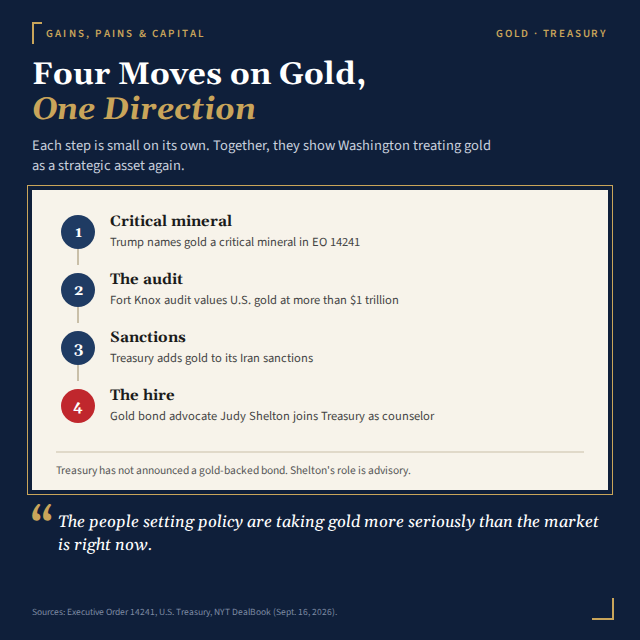

We’re in a “WARTIME ECONOMY” & GOLD Is a National Security Asset | Graham Summers & Michelle Makori
Miles Franklin Media: 10-9-2026
Michelle Makori, President & Editor-in-Chief of Miles Franklin Media, speaks with Graham Summers, President and Chief Market Strategist at Phoenix Capital Research and Macroeconomics Fellow at the Homeland Defense Institute, about why he believes the U.S. is already operating on a wartime economic footing as its economic competition with China reshapes national security, critical minerals, financial markets, and gold.