Money is Not a Four Letter Word
Money is Not a Four Letter Word
By JJ
This post is part of the #WomenRockMoney Movement, a large group of female personal finance bloggers who have come together to inspire more women to learn about money. ***
Money can elicit a multitude of emotions. Envy, shame, ignorance, superiority, dread and anxiety, to name a few.
For many, money is a source of confusion.
Cloaked in a combination of jargon and overly complex concepts, a basic understanding of personal finance seems insurmountable when first getting started.
This feeling is disproportionately true for women.
Studies have shown that women not only have lower rates of financial literacy then men but they are also less confident in their financial abilities. With more women becoming equal contributors in the household, or even the primary breadwinner, it’s important that we get a better grasp of the personal finance basics.
On a societal level the subject of money remans taboo. Although we deal with matters of personal finance on a daily basis, most of us don’t feel comfortable discussing money, even with our best friends or romantic partner.
In order to increase the financial knowledge and confidence of women we need to create an environment where we all feel comfortable talking about money.
Did you know that people would rather have a conversation about death then talk about their personal finances?
What?
Yes, it’s true. Kathleen Burns Kingsbury, author of “Breaking Money Silence,” found that nearly half of Americans would rather discuss death, religion or politics before having a conversation about their personal finances.
This is crazy!
While I have not found a comparable published statistic for Canadians, I am going to assume we share a similar sentiment with our Southern neighbours. (Side note: if you are aware of a similar study published about Canadians please let me know by leaving a comment below!)
To continue reading, please go to the original article here:
The Surprising Risk Of Having Too Much Cash
September 17, 2026 Fidelity
Investing in stocks and bonds may reduce some types of risk and enhance return potential.
There are many wonderful attributes of cash and short-term investments. Money held in a bank account or in a short-term investment like a money market fund is generally easy to access. The risk of volatility or loss is extremely low—or even nonexistent. Many short-term options, like money-market funds or short-term CDs or Treasurys, even pay interest.
6 Common Excuses for Not Saving Money By Tara Struyk
Have you ever settled on a new exercise program, only to get a bad cold a few days in and happily throw yourself on the couch, relieved to have a handy excuse? Excuses must be human nature; I know I usually make them when I'm facing something that’s new, that's hard, or that I just don’t enjoy. And I’ve certainly made excuses when it comes to money.
In the years that I’ve been writing about personal finance and investing, I’ve also heard my fair share of excuses, mostly from readers who don’t agree with my advice. The problem is, unlike good financial habits, excuses are easy to come by, even though most of them just don’t stand up to reason. Check out some of the ones I’ve heard most frequently so far.
How To Make Strategic Cash Bucketing Work For You
Last Edited Sep 16, 2026| Angelena Mascilli
Cash bucketing – or categorizing your funds based on specific expenses or goals – can help you organize your financial life.
Cash and other liquid assets may be the ideal place for buckets of money that you may need to access soon to cover expenses or capitalize on new investment opportunities.
3 Savings Moves To Make Post-Fed Rate Hike
By Matt Richardson September 17, 2026 CBS News MoneyWatch: Managing Your Money
With interest rates rising again, savers will want to take certain steps now to take advantage.
Savers on Thursday woke up to a new financial climate marked by the first interest rate hike from the Federal Reserve in more than three years. Now at a range between 3.75% and 4.00%, a new, higher federal funds rate is expected to lead to even higher rates for savers than they've already been accustomed to in recent years. And while that change will look different based on the account type and the bank in question, savers are undoubtedly now entering a more profitable period, especially if the Fed proceeds with another interest rate hike when it meets again in October.

Sometimes This Time Really Is Different
Notes From the Field By James Hickman (Simon Black / Sovereign Man) September 21, 2026
Some time in the middle of the second century AD, on the shores of the extremely picturesque Lake Iznik in modern-day Turkey at the site of the ancient city of Nicaea, a boy named Cassius Dio was born into a locally prominent family. His father was a Roman politician, his mother was Greek, and young Cassius Dio grew up in a bilingual household speaking Greek and Latin at a time when the Roman Empire was at its absolute peak.
5 Steps To Master Your Money
Simple strategies to help fund your future.
Fidelity Viewpoints
Key takeaways
Define clear goals and make a plan to help guide your financial decisions.
Set up automatic transfers to help boost your savings and keep you on track.
Build up your emergency savings to cover unexpected essential expenses
Debt management: How To Avoid Common, But Costly, Money Mistakes
May 27, 2026 Malena de la Fuente and Aaron Goodman
Americans are carrying more debt than ever before. Total household balances now approach $19 trillion, reflecting a steady increase over the past decade.1 In 2025, millennials in their mid-30s held roughly twice as much nonhousing debt—including student loans, auto loans, and credit card debt—as baby boomers did at a similar age.2
9 Ways Retirement Will Be Different in 2026
By Cameron Huddleston and Deirdre Shesgreen, AARP
How changes to Social Security, Medicare, 401(k) contributions and more will affect your finances
Retirement may seem like the most stable period of your life, with no work demands, no kids to cart around and lots of free time. But this dynamic new chapter comes with its own twists and turns. Your lifestyle, expectations and finances continue to change. And in 2026, big shifts are coming — from Social Security payments and Medicare expenses to how you save and spend.
12 Key Habits for Achieving Financial Freedom
Set yourself on the path to saving with these habits
By Matt Danielsson Updated March 06, 2026
Key Takeaways
Set financial goals and create a plan to achieve them.
Make and stick to a budget covering all financial needs.
Pay off credit cards monthly and minimize debt.
Automate savings with an emergency fund and retirement contributions.
U.S. consumers can request a free annual credit report from major agencies.
The Seven Deadly Sins Of Personal Finance
By J.D. Roth —03 June 2019
I've been reading and writing about personal finance for more than thirteen years. In that time, I've consumed a lot of books about money. Lately, I've found that it's fun to revisit old favorites.
Recently, for instance, I've been re-reading Brett Wilder's The Quiet Millionaire [my review]. It's different than most personal finance books. It's targeted at those who are farther along their financial journeys rather than at those just starting out. Still, there are bits and pieces in The Quiet Millionaire that are applicable to everyone.
5 Reasons Not to Use Debit Cards When You Shop Online
By Holly Johnson.
Many consumers use their debit cards for everything they buy. Using debit instead of paying with a credit card can help you avoid the potential for debt. The money is taken out of your bank account directly and immediately, so there’s little chance to spend more than you have, unlike using a credit card.
No Such Thing as Enough Money
Jacob Schroeder Oct 27, 2021
How much money is enough?
It’s a philosophical money question that often arises out of discontent. We see someone of substantial means, like a celebrity, live a troubled life. Or, we ourselves experience great fortune yet feel unhappy.
It makes us wonder where the finish line is, the point when you can stop striving for more and settle into a life of satisfaction.
The Relationship Between Money and Marriage
Jacob Schroeder Oct 12, 2021
I love scotch; she hates it.
There are many things my wife and I don't agree on, but money isn't one of them. We are intentional spenders, buying only what mutually aligns with our needs or values. For instance, disinterested in paying for the trappings of an ostentatious wedding, we tied the knot at New York's City Hall; our reception was watching our first son play at a public playground in the East Village on a warm fall afternoon.
We've been happily together for 16 years, which makes me wonder: Does love make the financial side of marriage work, or is it the other way around?
Experts Say This Is A Key Sign You Have An Unhealthy Relationship With Money
By Natalia Lusinski
When it comes to money and budgeting, it’s often easier said than done. You may have the best of intentions — you’ll eat out less this month and put the money into your savings account instead. But then life happens. Just like working through any other life, fitness, or wellness issue, a little introspection is often the ticket. If you want to get your finances back in order, a financial psychologist or money mindset coach can help. It all starts with getting your head in the right place.
4 Bad Habits That Could Affect Your Money More Than Tariffs and Inflation
Written by Chris Adam GoBankingRates
The Trump administration’s discussions about tariffs and inflation have led many consumers to question how well they’re prepared for the future regarding their finances. After all, some experts have raised concerns that tariffs could lead to higher prices on products and services people use each day.
But there may be a way to protect personal finances that has little to do with moves by the White House.
Expert Issues Warning Over US Bank Accounts Sitting Idle
Rudro Chakrabarti Mon, April 20, 2026
Money Can Now Be Turned Over To State. Secure your money ASAP
Katelyn Fugate thought she was doing something nice for her young son. A few years back, she opened a savings account for him — a small starter fund he could build on one day. Recently, she decided to check in on it.
The balance was zero. Fugate told Scripps News she went to check the balance hoping to start adding to it again. Instead, she found the account empty. (1) The bank had declared it dormant after five years of inactivity, closed it and shipped the money off to the state's unclaimed funds department. Worse, when Fugate went looking for it, she couldn't find the money at the bank or the state.
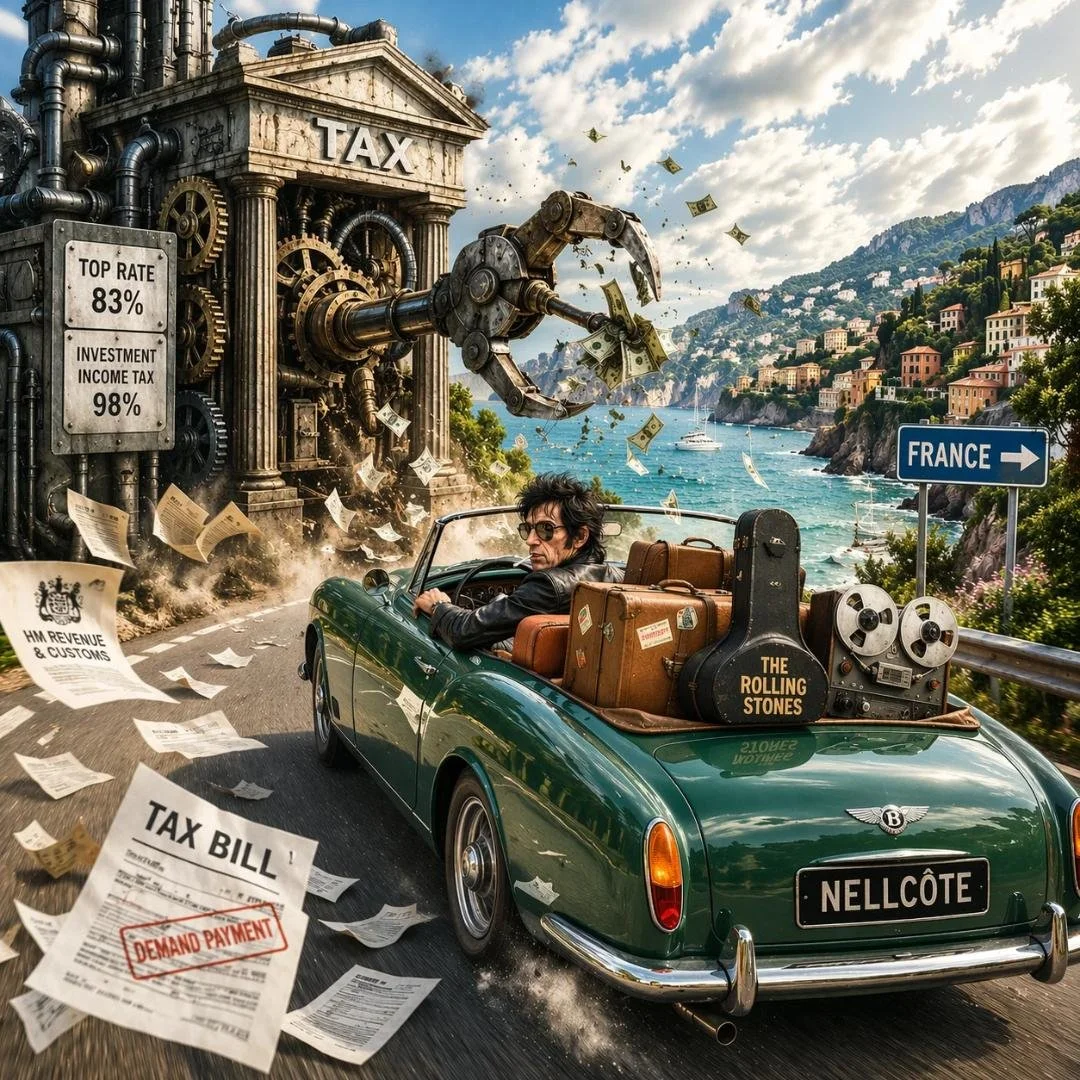
There Is No "Fair Share" — There Is Only “More”
Notes From the Field By James Hickman (Simon Black / Sovereign Man) April 16, 2026
In April 1971, Keith Richards loaded his family and his Bentley onto a cross-Channel ferry and drove south until he hit the Mediterranean. He rented a 19th-century villa called Nellcôte on a hillside above Villefranche-sur-Mer, and converted the basement into a recording studio.
The $13,000 Apartments the Government Won't Let You Buy
Notes From the Field By James Hickman (Simon Black/Sovereign Man) April 14, 2026
On May 20, 1862, Abraham Lincoln signed the Homestead Act into law, and it essentially said: here's 160 acres of land. It's yours. For free. All you have to do is live on it and improve it. And between 1862 and 1934, the federal government distributed 270 million acres under the program — roughly 10% of all the land in the United States.
Even as far back as the American Revolution, the Founding Fathers understood that property ownership made people more engaged, more productive citizens. Ownership meant that you had a vested financial interest in your community... and your country.
‘Let’s not be naive’: Ray Dalio says economic world order ‘is gone’ — warns of US ‘civil war.’ Preserve your wealth now
Jing Pan Sun, April 12, 2026 Moneywise
In the wake of the World Economic Forum in Davos, Switzerland, billionaire and founder of Bridgewater Associates, Ray Dalio, sounded a global fire alarm, and it’s starting to look like he was right.
The short version? The old economic world order is gone, and it’s likely not coming back any time soon.
“Let’s not be naive, ok, and say: Oh, we’re breaking the rule-based system,” Dalio said in an interview with Fortune at the WEF (1). “It’s gone. It’s going.” Dalio was referring to the current global balance of power between nations, which has hinged on relatively predictable U.S. foreign policy.
How Do I Manage This Much Money?
Moneywise Fri, April 3, 2026
My mom was much richer than I realized, and left me more than I could have imagined. How do I manage this much money? During the next 20 years or so, Americans will inherit an estimated $105 trillion as older Americans pass down their accumulated wealth to younger generations, in a phenomenon that has been dubbed the Great Wealth Transfer (1). That means there will be a lot of people who are surprised — even if pleasantly so — to be inheriting money and unsure about how best to manage it.
5 Subtly Genius Things All Wealthy People Do With Their Money — That You Should Do, Too
These moves don’t have to be reserved for the super rich.
t can feel like the super wealthy have access to some secret money playbook the rest of us never got. And in a way, that’s true. They have connections and access that most of us simply will never have.
But there’s good news: A lot of things the ultra wealthy do with their money are perfectly accessible to us — we just have to be smart enough to take advantage.
How to Make a Living Will for Free in 4 Easy Steps
Rachel Christian, CEPF® PennyHoarder
Drafting a living will might not be high on your to-do list — but maybe it should be.
A living will is a legal document that details which medical treatments you want — or don’t want — if you’re ever incapacitated or unable to make decisions for yourself.
Don’t get it confused with a last will and testament, a legal document that spells out who inherits your assets after you die. A living will applies only to your end-of-life medical care wishes.
4 Things To Consider Before Tapping Into Retirement Funds
Josephine Nesbit Sun, March 22, GoBankingRates
There’s a great deal of planning that goes into retirement, especially when it comes to deciding if, when and how to tap into your nest egg. Assessing your retirement fund is more than just covering your expenses. It can also affect your taxes, long-term income and investment growth.
3 Mistakes That Wipe Out Million-Dollar Nest Eggs, According to a CFP
Jake Safane Sat, March 21, 2026 GoBankingRates
For many people, reaching $1 million or more in retirement savings sounds like a surefire way to retire comfortably. But before you start dreaming of carefree golden years, it’s important to understand that million-dollar nest eggs can easily be wiped out by simple mistakes.
The problem usually isn’t blowing through your retirement savings by buying a yacht the day you leave your job, or seeing all your investments wiped out from a stock market crash. There are ways to prevent these types of mishaps, like through diversification, adjusting investment risk as you age and knowing what you can afford.
10 Frugal Lessons I Learned From Being Flat Out Broke
By Michelle Saving Money Invested Wallet
During the years I attended college, and shortly afterward, when I was about 21-22 years old, I was flat out broke. I was living in the middle of a big city all by myself and paying my bills on a server’s salary. I had zero savings and was living paycheck to paycheck just to get by; frugal living was a necessity.
To paint you a better picture of my situation, allow me to elaborate.
14 Bad Money Habits That Will Keep You Broke Forever
By Todd Kunsman Saving Money Invested Wallet
Being broke sucks. Worrying about bills and living paycheck to paycheck also sucks. And the thought of that being for a lifetime is demoralizing.
While all our financial situations are different, we all have the ability to change our “broke status.”
Will it be easy? Not at all, but your financial life can completely switch gears by identifying bad money habits that are keeping your pockets empty.
The trick is to really come to terms with these bad money habits and that yes, you probably are guilty of some or maybe even all of them.
6 Signs That You Are Too Obsessed With Making Money Now
By Todd Kunsman Make Money
Making money is something I’ve been working on quite a bit the last few years to better my financial health.
Yet, at times I also found myself becoming a bit too obsessed with making money now and the pursuit of wanting to get rich. I think it’s a natural feeling for many in our society.
However, I’ve been fortunate enough to catch myself and ensure I do not make it my entire life either.

Why I have doubts about the supposed “next Global Financial Crisis”
Notes From the Field By James Hickman (Simon Black) March 11, 2026
It was the early 2000s, and poor Monty was down on his luck.
An aging, out-of-work game hunter and security guard, Monty had been unemployed for quite some time. Fortunately, he was getting by, but living off the generosity of a family in southern California who had taken him in. Without them Monty would have almost certainly been living on the street.
But things started to change for Monty on a fateful day when his host family received a letter in the mail from a local bank-- addressed to Monty. They eagerly ripped open the letter to find that the bank had pre-approved old Monty for a substantial line of credit!
Should Paper Checks Be Abolished Like The Penny?
Good Partner Tue, September 8, 2026 Jay L. Zagorsky
While Americans are writing fewer checks, they haven't abandoned this means of payment.
Germany is getting rid of paper checks at the end of 2027. Australia is bidding them farewell by 2030. U.S. President Donald Trump followed up his order killing off the penny with an executive order stopping check writing by the federal government.
Should the U.S. follow these other countries and broadly eliminate the ability to write checks?