
A Generational Financial Reset Is Here : Felix Nikolas Prehn
A Generational Financial Reset Is Here : Felix Nikolas Prehn
10-9-2026
On this episode of the WTFinance podcast I had the pleasure of welcoming back Felix Nikolas Prehn. Felix Nikolas Prehn is an economist and former investment banker, trained in London and Hong Kong.
His reading of markets was shaped by mentors who spent careers inside the institutions: hedge fund managers, Wall Street professionals, and senior banking figures.
A Generational Financial Reset Is Here : Felix Nikolas Prehn
10-9-2026
On this episode of the WTFinance podcast I had the pleasure of welcoming back Felix Nikolas Prehn. Felix Nikolas Prehn is an economist and former investment banker, trained in London and Hong Kong.
His reading of markets was shaped by mentors who spent careers inside the institutions: hedge fund managers, Wall Street professionals, and senior banking figures.
During our conversation we spoke about the current situation in the economy, the most hated rally, money supply, CPI concern, concentration, the risk of a financial reset, what could happen to the dollar, the global monetary reset and more.
Ultimately, the conversation between Anthony Fatseas and Felix Nikolas Prehn serves as a reminder of the importance of maintaining a balanced and optimistic mindset in the face of persistent negative news.
While systemic economic risks are real and require careful navigation, historical data shows that technological progress and corporate adaptability consistently drive long-term value creation.
0:00 - Introduction
1:50 - Overview of the economy & markets?
3:51 - Most hated rallies
4:56 - Money supply
7:34 - CPI disconnect
10:09 - AI economic impact
14:16 - Concentration
17:59 - Debt crisis
21:09 - Japan option possible?
23:21 - Deficit unsustainable
24:51 - Monetary reset
28:16 - Central banks buying gold
31:41 - Geopolitical disconnect
34:59 - Undervalued sectors?
37:59 - AI impact
40:21 - One message to takeaway?
We’re in a “WARTIME ECONOMY” & GOLD Is a National Security Asset | Graham Summers & Michelle Makori
We’re in a “WARTIME ECONOMY” & GOLD Is a National Security Asset | Graham Summers & Michelle Makori
Miles Franklin Media: 10-9-2026
Michelle Makori, President & Editor-in-Chief of Miles Franklin Media, speaks with Graham Summers, President and Chief Market Strategist at Phoenix Capital Research and Macroeconomics Fellow at the Homeland Defense Institute, about why he believes the U.S. is already operating on a wartime economic footing as its economic competition with China reshapes national security, critical minerals, financial markets, and gold.
We’re in a “WARTIME ECONOMY” & GOLD Is a National Security Asset | Graham Summers & Michelle Makori
Miles Franklin Media: 10-9-2026
Michelle Makori, President & Editor-in-Chief of Miles Franklin Media, speaks with Graham Summers, President and Chief Market Strategist at Phoenix Capital Research and Macroeconomics Fellow at the Homeland Defense Institute, about why he believes the U.S. is already operating on a wartime economic footing as its economic competition with China reshapes national security, critical minerals, financial markets, and gold.
Summers explains why gold has moved to the forefront of U.S. national security, whether Washington could be quietly accumulating gold as China builds its reserves, and why policymakers may be reconsidering gold’s role in the monetary system.
He also examines the U.S. debt and Treasury market, the dollar’s purchasing power, central bank gold buying, and why government policy could drive a repricing across gold, Bitcoin, critical minerals, and other strategic assets.
Summers also explains why he believes the stock market itself has effectively become a matter of national security and what this shifting economic environment could mean for investors focused on hard assets, monetary stability, and wealth preservation.
In this episode of The Real Story:
Why gold is becoming a national security asset
Whether the U.S. could be quietly accumulating gold
How economic competition with China is reshaping U.S. policy
Why the dollar could be reassociated with gold
What could drive the next repricing in gold and Bitcoin
00:00 Coming Up
02:02 Introduction
03:32 Defining Wartime Economy
05:18 Executive Orders And Minerals
08:55 Inside National Security Briefings
11:40 Economic Defense Unit Explained
15:04 Deal Examples And Mining Push
18:10 Sponsor Break
19:10 Why The Urgency Now
24:37 Gold As Sanctions Weapon
30:05 Gold Backed Bonds Theory
35:24 Treasury Market Stress
44:22 China Gold And US Response
45:16 Trial Balloons Framework
46:04 Covert Gold Buying Tools
50:10 Fort Knox Audit Debate
51:00 Gold Revaluation Talk
53:12 Gold National Security Lens
55:32 Dollar Dominance Reality Check
58:48 China Gold Yuan Theory
01:01:30 Silver Critical Mineral Role
01:02:27 Venezuela Weapons Example
01:04:37 Silver Price Manipulation
01:07:23 Stocks As National Security
01:12:13 Everything Bubble Explained
01:15:10 Wartime Portfolio Strategy
01:20:12 Bipartisan Wartime Momentum
01:23:37 Homeland Defense Institute
Bruce’s Big Call Dinar Intel Thursday Night 10-8-26
Bruce’s Big Call Dinar Intel Thursday Night 10-8-26
Transcribed By WiserNow Emailed To Recaps (INTEL ONLY)
Welcome everybody to the Big Call tonight. It is Thursday, October eighth, and you're listening to the Big Doll. We do have a little echo in the background, and it may be affecting the recording. We don't know, but it's not going to deter us from continuing with the call.
I appreciate that, Bob. Thanks. Let's let's go ahead and talk about where we are on Intel today. This is not going to be a super long segment. I don't plan to to drag it out. you know. You guys know I try to come up with a reasonable timeline based on the intel that we get, so we can kind of get an idea of when everything is going to go.
Bruce’s Big Call Dinar Intel Thursday Night 10-8-26
Transcribed By WiserNow Emailed To Recaps (INTEL ONLY)
Welcome everybody to the Big Call tonight. It is Thursday, October eighth, and you're listening to the Big Doll. We do have a little echo in the background, and it may be affecting the recording. We don't know, but it's not going to deter us from continuing with the call.
I appreciate that, Bob. Thanks. Let's let's go ahead and talk about where we are on Intel today. This is not going to be a super long segment. I don't plan to to drag it out. you know. You guys know I try to come up with a reasonable timeline based on the intel that we get, so we can kind of get an idea of when everything is going to go.
When are we going to go? When are the numbers coming? When do we set our appointments, and so on? Well, this is going to be pretty simple because we know, for example, by people who are Redemption Center leaders that have gone in that we're told don't come in Friday or Saturday, but plan to come in at 1o'clock on Sunday, and I'm thinking, okay, Sunday 1p.m.
Really, I thought could they have a conference call planned? I think that's very possible. What about new rates on the forex? We're looking for the dinar, Rocky Dinar, to show up on the forex, along with some of the other currencies and rates, on Sunday on the forex,
it could be that's when they populate at 5o'clock in the afternoon Eastern. Is typically when that happens, but I'm not sure why 1o'clock, why four hours earlier, and then I find out this evening, not too long ago, before the big call started tonight, that something is supposed to happen on Sunday.
Well, we don't quite know what that is at all, other than the rates populating, we think. But beyond that, is there anything else that's supposed to happen? We don't know. Our redemption center leader did not give us an indication of that, except to say something is going to happen for us on Sunday. So we'll see. We'll see what that is.
If we find out, great. We are planning to do a call on Tuesday night. Hopefully, we have numbers by then, and it's a celebration call. But either way, we'll have a call on on Tuesday. The let's see, what would Tuesday's date be? That would be the 12th, wouldn't it? Yeah. Saturdays at 10.
The 11th is when we're looking for new forex rates to populate, and something is going to happen, whatever that is. And then, of course, we got a good shot, maybe after that, of getting notified and getting started.
Now, we did hear that one of our intel sources was saying this could go any time from let's call it tomorrow all the way through the 14th, and I'm thinking okay ninth through the 14th. We know Sunday could be important for us. New race showing up Sunday the 12th.
Okay, I mean Sunday the 11th rather, and then the 12th is Monday. All right. Then I thought, well, what about the 14th? What about the 14th and 15th, which is a week from today, on a Thursday, does this come into play where it lines up with the UN operational rates, which change on the first and 15th of the month?
15. would end up being Friday, a week from tomorrow, and so you know there's always that thing hanging out, possibly where we do this, see this thing as one intel source said, taking us all the way up to the 14th.
So we'll just have to see if that is the case, and I think I misspoke. The 15th is a week from tonight, Thursday, the 15th, and so maybe something occurs on that date, and in conjunction with UN operational Rates renewing; those are supposed to happen on the 15th as well.
So we'll see. We'll see. But I think for right now, we just have to see if we get anything else that shows us. What I find interesting is that Redemption Center staff is not to go in until 1o'clock Sunday. So, is there a conference call planned?
What is the thing that is supposed to be happening for us? What about what's happening outside of this in terms of world events?
We've heard yesterday and again today that the situation in Brazil has been handled, whatever that means. It's it's satisfied. Something is handled in Brazil. Good.
What about the student-led demonstrations and possible rioting in France, in Nantes, in Paris, and in I can't remember the other city right now. But wherever these are happening, generally France does a lot of student-led protests.
They'll protest an increase in in tote fares, they'll protest the train, you know, you know that kind of thing. The train stopping, busses, you know, they just have the way of flowing into the streets and doing a protest, but they typically don't last that long.
Now I don't know if there's more to this in France than that. I don't know. It it could be, even though I'm not hearing it yet. Our sources seem to think it could be more about taking their country back and not doing the kind of mass migration that's happened into Europe over the last number of years into the UK, Spain, France, you know certain countries.
So we'll see. I know Switzerland's not putting up on any of that, but so it could be it could be relative to that as well, but I know it was based on a student-led protest about lower funding for schools, public schools, and that kind of thing. I don't know if I'm buying that.
Maybe could be, but that is something that should be handled. And then, of course, the missiles that are being shot out of Lebanon by the Houthis or Houthis, you know, into Saudi Arabia and possibly on trying to get into Israel. I don't know how that's going, but I know that there are plenty of troops and cooperation between a couple of those countries to try to stem that and take care of that problem.
Other than that, I think we probably have clear sailing. Now, one thing about Nasara, we know that our new U.S.N. currency and our U.S.T.N. folding money needs to be announced at some point, probably by our Treasury Secretary Scott Besson and probably by the President, President Trump.
So we'll see, but I think that has to happen before we go in for our exchanges. I think because we're going to have that new money at the redemption centers available to us to take out some in cash, ideally not to exceed $2,500.
So a little packet of shrink wrap bills, maybe. But we'll see, we'll see. But that, I mean, I would think we would have that announced as our new currency, and there will only be so much time for the USD to be used internationally, and only in the United States for only so long.
My gut feeling is that probably it'll it'll be usable until the end of the year, but probably not beyond that. What money we have now, our fiat dollar, our USD holding currency, we have in our pockets now, or in our wallets and purses and money clips.
I think I think probably it won't be usable beyond the end of the year, and maybe internationally it won't be even usable that long because they're trying to get away from that. So we'll see how that unfolds.
So that's all I really have tonight. I think it's a short little segment, but I think we need to see new rates on the forex, and we need to see what's going to happen for us on Sunday, and maybe we get this early next week.
Let's call it yeah by Monday or Tuesday. I would hope so. We will see, and we'll look forward to having a good weekend, and then we'll regroup again on Tuesday for either a regular type big call or hopefully a celebration call.
Okay, so we'll look forward to getting together then. In the meantime, right now, everybody hang in there with your plan A, and try to get ready for what is about to come through. And you know this thing is fraught with delays and different things, as you guys know by now.
The intel is only seems good for the moment we get it, and then things change. But we're going to hope in this case that everything goes through and we get the numbers that we're looking for for setting up our appointments, and then we're able to set appointments and go.
So thanks everybody for tuning in. Thank you for being here, and let's go ahead and pray the call out. All right, everybody. Thank you for tuning in, and we look forward to talking with you on Tuesday night. God bless you all. Good night
Bruce’s Big Call Dinar Intel Thursday Night 10-8-26 REPLAY LINK Intel Begins 1:04:44
Bruce’s Big Call Dinar Intel Tuesday Night 10-6-26 REPLAY LINK Intel Begins 1:31:31
Bruce’s Big Call Dinar Intel Thursday Night 10-1-26 REPLAY LINK Intel Begins 1:09:19
Bruce’s Big Call Dinar Intel Tuesday Night 9-29-26 REPLAY LINK Intel Begins 59:00
Bruce’s Big Call Dinar Intel Thursday Night 9-24-26 REPLAY LINK Intel Begins 1:09:09
Bruce’s Big Call Dinar Intel Tuesday Night 9-22-26 REPLAY LINK Intel Begins 1:07:07
Bruce’s Big Call Dinar Intel Thursday Night 9-17-26 REPLAY LINK Intel Begins 1:04:00
Bruce’s Big Call Dinar Intel Tuesday Night 9-15-26 REPLAY LINK Intel Begins 1:22:40
Bruce’s Big Call Dinar Intel Thursday Night 9-10-26 REPLAY LINK Intel Begins 1:04:00
Bruce’s Big Call Dinar Intel Tuesday Night 9-8-26 REPLAY LINK Intel Begins 1:14:00
Bruce’s Big Call Dinar Intel Thursday Night 9-3-26 REPLAY LINK Intel Begins 1:19:19
Seeds of Wisdom RV and Economics Updates Friday Afternoon 10-9-26
Good Afternoon Dinar Recaps,
GLOBAL FINANCIAL INFRASTRUCTURE RESET: WALL STREET MOVES TOWARD TOKENIZED SECURITIES AS IMF WARNS OF NEW RISKS
Blockchain-based securities are moving closer to mainstream financial markets, while new warnings from the International Monetary Fund highlight why secure settlement, clear rules and investor protection will be essential to the next phase of digital finance.
Good Afternoon Dinar Recaps,
GLOBAL FINANCIAL INFRASTRUCTURE RESET: WALL STREET MOVES TOWARD TOKENIZED SECURITIES AS IMF WARNS OF NEW RISKS
Blockchain-based securities are moving closer to mainstream financial markets, while new warnings from the International Monetary Fund highlight why secure settlement, clear rules and investor protection will be essential to the next phase of digital finance.
OVERVIEW
Wall Street is advancing blockchain-based securities trading, with major financial institutions preparing systems that could make certain transactions faster and easier to transfer.
The IMF has warned that tokenization can introduce new risks, including liquidity pressures, operational failures and the possibility that automated trading could amplify market disruptions.
The global financial system is evolving through infrastructure changes, but adoption will depend on regulation, interoperability and confidence in the assets backing digital tokens.
KEY DEVELOPMENTS
1. Wall Street Pushes Blockchain Closer to Mainstream Markets
Financial firms are developing ways to represent traditional assets—including stocks, bonds and investment funds—as digital tokens recorded on blockchain networks.
A report published by Barron’s on October 9 describes efforts by major institutions to bring tokenization deeper into securities trading. The Depository Trust & Clearing Corporation (DTCC), a central part of U.S. securities-market infrastructure, is preparing a tokenization initiative, while firms including JPMorgan, Goldman Sachs and Nasdaq are participating in broader efforts to develop blockchain-based markets.
The potential benefits include faster transfers, more flexible trading hours and less capital tied up in separate settlement processes. However, the degree of improvement will depend on how the systems are implemented and connected to existing markets.
The important distinction: Tokenizing a stock does not automatically increase its value. It changes how the asset may be represented, transferred or settled—not the underlying company's financial performance.
2. The IMF Highlights Both Efficiency and Risk
The International Monetary Fund's October financial-stability analysis examines the opportunities and risks associated with tokenized financial assets.
Tokenization could reduce transaction costs and shorten settlement times. But the IMF has also highlighted vulnerabilities involving operational systems, smart contracts, liquidity, collateral and connections between different digital networks.
If automated transactions or liquidations occur rapidly during market stress, losses could spread more quickly. Unclear ownership rights, weak oversight or uncertainty about the asset backing a token could also undermine confidence.
The IMF's analysis does not suggest that tokenization must fail. Rather, it emphasizes that new technology does not eliminate traditional financial risks; it can change how those risks develop and spread.
3. The Settlement Question Becomes Central
One of the most important questions in digital finance is what money should be used to settle a tokenized transaction.
Some systems may use stablecoins—digital tokens designed to maintain a stable value, often by being linked to a national currency. Other approaches seek to settle transactions using central-bank money or tokenized commercial-bank deposits.
These are not interchangeable arrangements. Stablecoins depend on their issuers, reserves and redemption mechanisms, while central-bank money represents a direct claim on a central bank. Tokenized bank deposits remain claims on commercial banks.
The choice affects settlement confidence, liquidity and the way risks can move between financial institutions.
For global markets, interoperability and reliable settlement may matter as much as the blockchain technology itself.
WHY IT MATTERS
The modernization of financial infrastructure is an important development because the global economy depends on systems that move money, securities and collateral between institutions and countries.
If tokenization becomes widely adopted, it could reshape how securities are issued, transferred and settled. Transactions that once required several intermediaries and separate records could eventually be processed through more integrated digital systems.
But progress will not be measured simply by how many assets become tokens. Markets will also need enforceable ownership rights, reliable technology, clear regulatory standards and safeguards against fraud and instability.
The transition is likely to be gradual and uneven. Some applications may gain traction quickly, while others may remain limited by legal, technical or commercial barriers.
WHY IT MATTERS TO FOREIGN CURRENCY HOLDERS
For foreign currency holders following the Global Financial Reset, these developments are worth watching because the infrastructure supporting international finance is changing.
Tokenized assets, digital payments and new settlement systems could influence how institutions transfer funds and manage liquidity across borders. These changes may eventually affect access to financial services and the way different currencies are used in particular transactions.
However, blockchain adoption does not guarantee that any country's currency will appreciate or be revalued. A currency's value continues to depend on economic fundamentals, monetary policy, inflation, confidence, market liquidity and other factors.
The constructive takeaway is that real financial modernization can be tracked through implemented systems, published rules, completed transactions and measurable adoption—not through predictions of sudden currency windfalls.
IMPLICATIONS FOR THE GLOBAL RESET
Pillar 1: Payments
Digital infrastructure may make some transfers faster and more efficient. The key test will be whether new networks can connect safely with existing domestic and cross-border payment systems.
Pillar 2: Assets
Tokenization could change how securities and other financial assets are recorded and transferred. The underlying legal rights and economic value of those assets still matter.
Pillar 3: Technology
Blockchain and smart contracts may automate parts of financial processing, but reliable cybersecurity, governance and operational controls will be essential.
Pillar 4: Regulation and Trust
Common standards, enforceable rules and dependable settlement assets will help determine whether tokenized markets can expand without creating unacceptable risks.
THE BOTTOM LINE
The movement toward tokenized securities is evidence of a serious effort to modernize financial-market infrastructure, not proof of a predetermined global currency reset. The strongest signs of progress will be systems that work in real transactions, protect participants and connect securely across institutions and borders.
The next phase of global finance will be shaped not simply by new digital assets, but by the trusted infrastructure that makes them usable.
Seeds of Wisdom Team
Newshounds News
SOURCES
Barron’s — “The Biggest Change to Stock Trading in Decades Is Coming to Wall Street”
Seoul Economic Daily — “IMF Warns Asset Tokenization Breeds New Vulnerabilities”
~~~~~~~~~~
Seeds of Wisdom Team RV Currency Facts Youtube and Rumble
Newshound's News Telegram Room Link
RV Facts with Proof Links Link
RV Updates Proof links - Facts Link
Start Here room with Most Asked Questions Link
Follow the Gold/Silver Rate COMEX
Follow Fast Facts
Seeds of Wisdom Team™ Website
Thank you Dinar Recaps
MilitiaMan & Crew: Iraqi Dinar Update: Important Economic Shifts You Need to See
MilitiaMan & Crew: Iraqi Dinar Update: Important Economic Shifts You Need to See
10-8-2026
The Crew: Samson, PompeyPeter, Petra, Daytrader, Sunkissed, GIGI and Militia Man
Straight reporting on Iraq’s economy. CBI policy, the budget, oil, banking reform, and the exchange rate — read clean and interpreted without the noise. This channel started as daily phone calls to Mom with the latest dinar news. After she passed in 2022, I built a team so that same standard could keep going for everyone following the story.
Follow MM on X == https://x.com/Slashn
MilitiaMan & Crew: Iraqi Dinar Update: Important Economic Shifts You Need to See
10-8-2026
The Crew: Samson, PompeyPeter, Petra, Daytrader, Sunkissed, GIGI and Militia Man
Straight reporting on Iraq’s economy. CBI policy, the budget, oil, banking reform, and the exchange rate — read clean and interpreted without the noise. This channel started as daily phone calls to Mom with the latest dinar news. After she passed in 2022, I built a team so that same standard could keep going for everyone following the story.
Follow MM on X == https://x.com/Slashn
Be sure to listen to full video for all the news……..
News, Rumors and Opinions Friday 10-9-2026
“Still on Course” – RV/GCR Live Chat from Wolverine 7-8-26
We got some good news coming through. we are still on course to get this done and nothing has changed. The private contractor are waiting for notifications to get paid all contracts signed and waiting for banks to release the funds. We are talking about over quintillions of dollars, this amount of funds are not accomplished during regular banking hours, and people are waiting.
Tier4B I am not into that and Tony has given the intel for this.
I do have some good news regarding Dinar.
“Still on Course” – RV/GCR Live Chat from Wolverine 7-8-26
We got some good news coming through. we are still on course to get this done and nothing has changed. The private contractor are waiting for notifications to get paid all contracts signed and waiting for banks to release the funds. We are talking about over quintillions of dollars, this amount of funds are not accomplished during regular banking hours, and people are waiting.
Tier4B I am not into that and Tony has given the intel for this.
I do have some good news regarding Dinar.
Some people are traveling already. The Reno Airport is closed due to the fires, so if people say they are going to Reno for appts they are, but to a different airport. The naysayers try to play with your mind.
I am just waiting for a call today or tomorrow for me to travel. I was told to get my bags ready to travel this week. But I need that confirmation. I will be traveling with my wife and Nephew who will be “my ears” due to my hearing issues.
CARPATHIA READS SOME INFORMATION:
“Word has just come in regarding the start of the IQD. It is effective immediately. The official UN Statement confirms the same. It is immediate. The information is official and comes from multiple sources. These are not just WhatsApp messages. They are official documents.”
Wolverine: Things are really starting. IMO I think that any time we could get Tier 4B notifications.
The Admiral, people who have access to the Admiral, were told next week.
Banking days are Tues, Wed and Thursday. No Banking on Monday or Friday.
Platforms like Precatorious and Pentecostal are looking good. Brazilian platform looking good also.
In the overall aspect of things, I think we will have a beautiful October.
For the get together, I must get together with the people organizing this, we are running out of time, and I cannot just call the Hotel to get it organized, as we need to pay a deposit down for the reservation for the gathering. As soon as we get the Green Light, I will call the Hotel for a certain date in February, if it is booked out, and then we will have to do it in March, If that is not possible, we will have to wait till next year in our spring/summer months.
Mike Bara will have a get together in Las Vegas, but details are not firm yet.
A lot intel providers will be having a get together.
Q&A done on Audio. Shorty tells bank story. Cashed a check. Looked at the machine that dspenses currencies.
Asked if you are doing exchanges for foreign currency. I asked the teller, “Would you mind checking back screen to see what rates on are it.” She pulled up Kuwait Dinar at 3.50 and Jordan Dinar is 1.50 on her back screen.
I said, “so that is what you are exchanging that.” She said “yes.” I asked her about IQD but she said it is not on the screens, but only two on the screens at Wells Fargo were those two.
I asked the teller about Bolivar, ZIM, Dong, and they are not on the screens right now.
Wolverine: I am thinking that the rates for the IQD may be private for now, until after we RV. Therefore, would not yet be showing up on the bank screens for the public.
Peter Walker: We are noticing that the IQD has a exchange rate of 0 to the USD in the last few days, which means the exchange rate is deliberately being set to 0, so they may be preparing for a major exchange. We are hearing next week for things to get exciting, and we hope it does.
Wolverine: Lots of people are saying next week, received a call stating this from Europe.
Also private bondholders are stating they are waiting now to get their pay.
I was invited to go to Greece for Launch of Q Apple. A lot of people are anticipating to go there. The whole world is going to be tokenized. The XLM currency should be going extremely high and XRP is expected to go very high as it is being used for infrastructure.
Rest is in Audio.
https://dinarchronicles.com/2026/10/09/still-on-course-rv-gcr-live-chat-from-wolverine-7-8-26/
*************
Courtesy of Dinar Guru: https://www.dinarguru.com/
Jeff Devaluing the currency to 1500 doesn't raise the value of their currency to pay the US back for 23 years of services rendered... These are just games being played and optics to mislead and confuse. This is a massive game of Kuwait Syndrome...Stay relaxed. Stay grounded...
Walkingstick This [1510 devaluation] is very calculated...They're drawing in USDs off the streets...The biggest factor is those USDs are not flowing over the borders. That's a huge deal... The problem is they put this out there without explaining it to the citizens of Iraq. That's why there's a lot of confusion. This is not a bad thing by any means...
Mnt Goat ...what if Iraq could sell its oil for dinars? Would this not force the international market to demand dinars? Would the US ever allow this or do they maintain the dollar dependency as leverage with Iraq? When can they finally end this necessity to have this leverage over Iraq? Is Al-Zaidi going to be their savior? These are all questions closely related to see our RV. I am not saying that all these events must occur because remember Dr Shabibi was going to reinstate the dinar way back in 2013 and none of these banking reforms were in place nor any of these other measures done. So, anything can happen for these issues as long as SECRITY and STABILITY are achieved. We have been told over and over again these are the two main ingredients necessary for the reinstatement.
The U.S. Treasury Just Opened the Door to Gold
Taylor Kenny: 10-8-2026
Treasury yields are surging, central banks are buying gold, and Washington is openly discussing inflation as a way to manage the debt. Could a gold revaluation be closer than most people think?
CHAPTERS:
00:00 Bond Market Warning: Why Treasury Yields Matter
01:27 U.S. Treasury Yields Hit Highest Level Since 2002
02:26 America’s $40 Trillion Debt Problem
03:22 Why Central Banks Are Still Buying Gold
05:42 Why U.S. Gold Is Still Valued at $42.22 an Ounce
07:36 What Happened During the 1934 Gold Revaluation
09:31 Why Inflation May Be Part of the Debt Strategy
10:59 Central Banks Are Positioning for What Comes Next
12:23 How Physical Gold and Silver Fit Into a Wealth Protection Plan
Reset Intelligence: Iraq Goes First
Emailed to Recaps~Thank you David
Reset Intelligence: Iraq Goes First
By Reset Intelligence | @EXIT_FIAT
Iraq's Central Bank moved the IQD to 1,500 on Wednesday. Read that cut as the end of the story and you miss what Iraq is doing.
It is the first move in a sequence. Lower the rate. Replace the currency. Raise the rate.
Emailed to Recaps~Thank you David
Reset Intelligence: Iraq Goes First
By Reset Intelligence | @EXIT_FIAT
Iraq's Central Bank moved the IQD to 1,500 on Wednesday. Read that cut as the end of the story and you miss what Iraq is doing.
It is the first move in a sequence. Lower the rate. Replace the currency. Raise the rate.
Step one
On Thursday night Prime Minister Ali al-Zaidi sat down with the leaders of parliament in Baghdad and told them why. The oil could not get out, and the state has to find 10 trillion IQD every month. "We had three options," he said: mandatory savings, salaries every 45 days, or more borrowing. His government took none of them and backed the new rate instead. He called the closed strait "an undeclared siege."
What Iraq has already built
Most people have forgotten how much of the rest is already in place.
New notes - lawmakers disclosed in August that the Central Bank had finalized designs for a new series: 7.5 billion notes, with printers in France, Germany, Britain and Australia.
Smaller notes - a finance committee member said the bank intends to issue a note below 250 dinars.
Coins - the Prime Minister's financial adviser raised them himself on television in July.
Gold - the Central Bank holds 175.6 tonnes, third among Arab states.
The border - electronic customs is live at all 22 federal crossings.
Oil - the Oil Ministry puts October exports at 2.7 million barrels a day, against nearly 3.4 million before the war.
The street - Thursday closed at 165,700 IQD for $100 in Baghdad, the first lower close since the cut.
Washington - the yield on 10-year US government debt reached 5.34% on October 1, its highest since 2002. Washington's debt has passed $40 trillion.
The question
None of that is preparation for a dinar that stays at 1,500. So what is left, and how long is the wait?
That is the short version. Why Iraq is the linchpin, what is still on Baghdad's list, and why we would not expect a long wait - that is the daily read.
Read the full daily briefing free for 5 days. Sign up here: the daily Iraqi dinar briefing
Want it straight from the horse's mouth? The CBI Rate Alert pings you the moment the Central Bank of Iraq moves the official rate. The number itself, not a rumour about it. It comes with our free resource library and the daily breakdown of what is actually moving in Iraq. Sign up free: The CBI Rate Alert
Got a dinar question? Reset Intelligence runs an on-call research assistant: ask it anything they have published. It answers in seconds and will conduct deep research to find you the answer. Try it: the Iraqi dinar research assistant
Common questions, answered straight: When will the Iraqi dinar revalue? and Is the Iraqi dinar revaluation real?
The design behind all of it is mapped in Head of the Snake, and the free guides live in the Iraqi dinar resource library.
Follow the daily intel free: Telegram · Facebook · Spotify · Odysee
Iraq Economic News and Points To Ponder Late Thursday Evening 10-8-26
"A Hasty Decision That Harmed The Citizen," MP Walaa Al-Jizani Said: "Raising The Dollar Exchange Rate Has Had Negative Effects On The Street, And Parliament Is Moving To Discuss Its Repercussions"
Baghdad - One News - 10/07/2026 Deputy Walaa Al-Jizani, Vice President of the Badr parliamentary bloc, described the government’s decision to raise the dollar exchange rate as “hasty,” stressing that its repercussions have negatively affected the public and harmed citizens.
"A Hasty Decision That Harmed The Citizen," MP Walaa Al-Jizani Said: "Raising The Dollar Exchange Rate Has Had Negative Effects On The Street, And Parliament Is Moving To Discuss Its Repercussions"
Baghdad - One News - 10/07/2026 Deputy Walaa Al-Jizani, Vice President of the Badr parliamentary bloc, described the government’s decision to raise the dollar exchange rate as “hasty,” stressing that its repercussions have negatively affected the public and harmed citizens.
Al-Jizani said that the House of Representatives witnessed a parliamentary movement and stance regarding the decision to raise the exchange rate, indicating that the parliament works for all the people of Iraq and not for a specific political audience, in light of the reactions that the decision has caused in the street.
He added that the Speaker of Parliament was surprised by the decision to raise the dollar exchange rate, noting that there are several solutions that can be resorted to in order to address the repercussions of the decision, including proposals and solutions offered by financial experts.
Al-Jizani revealed that the Minister of Finance and the Governor of the Central Bank of Iraq will attend the House of Representatives tomorrow to discuss the details of the decision to raise the exchange rate and the reasons that led to taking it, stressing that the hosting will allow the representatives to see more clearly the background of the decision and its repercussions.
He indicated that the picture would become clearer after discussions with the Minister of Finance and the Governor of the Central Bank, stressing that Parliament would present its observations and recommendations regarding the decision during the discussions.
The deputy head of the Badr parliamentary bloc stressed that the House of Representatives has the right to make recommendations regarding the issue, considering that the Central Bank should deal with it in light of the repercussions of raising the exchange rate on citizens and markets.
Regarding the completion of the government formation, Al-Jizani revealed that the House of Representatives is expected to vote on completing Prime Minister Ali Falih Al-Zaidi's cabinet early next week. https://1news-iq.net/قرار-متسرع-أضر-بالمواطن-النائب-ولاء/
Al-Yassiri Rejects The Dollar Decision: It Is Not Economic Reform But Rather A Failure To Find Solutions
Baghdad - One News - 10/07/2026 MP Hayam Al-Yasiri announced her rejection of the decision to raise the dollar exchange rate, warning of its repercussions on the livelihood of citizens, especially the poor, employees and retirees.
Al-Yassiri said that raising the exchange rate does not represent economic reform, but rather reflects the inability to find successful economic solutions, considering that burdening the citizen with the consequences of the crisis represents the easiest way instead of addressing the causes of financial and economic imbalances.
She called for combating the big heads of corruption and revitalizing the economy through projects that contribute to maximizing state revenues, instead of seeking additional resources from the citizen's pocket.
Al-Yassiri warned that increasing economic burdens, coupled with rising prices, deteriorating services, and corruption cases, could lead to escalating public anger, stressing the need to find alternative solutions to address imbalances and increase state revenues. https://1news-iq.net/الياسري-ترفض-قرار-الدولار-ليس-إصلاحاً/
Iraqi Dinar Devaluation Sparks Backlash From Blocs Inside The Cabinet
2026-10-08 / Shafaq News- Baghdad Iraq's new official exchange rate of 1,520 dinars per US dollar took effect on Wednesday, the country's first devaluation since 2020 and a fiscal response to oil revenues squeezed by the resumption of the US war with Iran. Within hours, the dollar's street price jumped.
Two of Baghdad's main wholesale markets shut, and lawmakers began organizing to overturn a decision taken by a cabinet in which nearly every major political bloc holds a seat.
The Council of Ministers approved the move on Tuesday night on an emergency recommendation from the finance minister and the governor of the Central Bank of Iraq (CBI), Nizar Hussein. It gives the treasury more dinars for every dollar of oil sold.
It also raises the local cost of almost everything Iraq imports, in an economy where salaries, pensions and savings are held in dinars. The government calls the step a precaution. Critics see it as shifting the war's cost from the state's books to household budgets. The political backlash suggests the dispute is as much about Iraq's unfinished government as about its currency.
A New Rate, An Old Gap
Under the new structure, the CBI buys dollars from the Finance Ministry at 1,500 dinars, sells them to banks at 1,510 and to end users at 1,520, up from 1,320. Every $100 now costs 20,000 dinars more at the official window. The Finance Ministry paired the decision with a suspension of the advance collection of customs duties and tax deposits on imports.
Iraq runs two exchange rates: the official one, at which the CBI supplies dollars through banks for trade, travel and other approved uses, and a parallel street rate set by supply and demand. The parallel market responded first.
In Baghdad, the dollar climbed to around 168,500 dinars per $100 on Wednesday morning, from 159,800 the day before, then eased to about 167,000 by evening. In Erbil, capital of the Kurdistan Region, it traded near 166,700.
The disruption reached beyond the exchange counters. Shops and warehouses in Baghdad's Shorja market and the Alwat Jameela wholesale market closed temporarily, as did several exchange and money-transfer firms, because traders could not reprice goods and outstanding commitments.
Gold followed the dollar. A mithqal of 21-carat gold, the roughly five-gram unit Iraqi jewelers trade in, rose in Baghdad from 930,000 dinars on Tuesday to 978,000 on Wednesday morning.
Before the decision, the parallel market sat about 21% above the official rate. On Wednesday, the distance narrowed in percentage terms, but only because the official rate jumped. The street price rose as well.
A Revolt From Inside The Tent
The backlash in parliament came quickly. Lawmaker Uday al-Zamili of the Khadamat bloc told Shafaq News that parliament had decided to host the finance minister and the CBI governor on Thursday to examine the feasibility of the decision. He said it would hit citizens already facing a wave of price rises, and that MPs want to expose files linked to the exchange rate and corruption.
Lawmaker Suzan al-Saad of al-Nahj Al-Watani bloc said she had gathered more than 50 signatures for a dedicated session on the decision's consequences.
At a press conference in parliament, lawmaker Saba al-Saadi of the Reconstruction and Development bloc warned that raising the exchange rate to cover the deficit is a "red line."
The Kurdistan Democratic Party stopped short of demanding a reversal. Shakhawan Abdullah, head of the KDP bloc in the federal parliament, told local outlets that the government's aim in adjusting the rate was to recover the 20,000-dinar increase and turn it into revenue for the treasury. It should have taken concrete steps to control markets and contain rising prices first, he said, rather than leaving citizens to face "this economic spiral" alone.
The Iraqi Contractors Union asked Prime Minister Ali al-Zaidi to delay implementation. It warned that the costs of materials, transport and services would rise and erode companies' margins, and said dues linked to the 2020–21 adjustment rate had still not been fully paid.
After turning Wednesday's sitting into a general debate on the decision, parliament scheduled a special session for Thursday to question the finance minister and the CBI governor. The presidency then cancelled it, moving the hearing to the Finance Committee instead. KDP lawmaker Siban Shirwani said the committee would meet both officials at noon to discuss the reasons for the change, and might also take up the draft federal budget.
Former lawmaker Amir al-Maamouri challenged the outrage itself. He alleged that "most of the objectors knew the dollar would be raised and bought dollars from the market before the vote and the announcement of the 152 rate and made large gains." He asked why they were pretending not to know.
The cabinet, he noted, includes representatives of all political blocs, and they voted for the adjustment: "Did the representatives of the political blocs work in complete secrecy and hide the information?"
Al-Maamouri offered no evidence for the allegation of profiteering. The broader point, that the decision was no surprise inside the political class, finds support in the record.
The composition of the cabinet sharpens the contradiction. Al-Zaidi, a businessman with no party of his own, was sworn in in May as the nominee of the Coordination Framework, the alliance of Shia parties that won the most seats in the November 2025 election; since then, only 14 of 23 ministers have been approved.
Finance Minister Falih al-Sari, who carried the recommendation to cabinet, belongs to al-Hikma, the movement led by Ammar al-Hakim, and is a longtime senior figure on parliament's Finance Committee.
Other approved ministers come from the Islamic Dawa, Badr, Reconstruction and Development, and Sadiqoon, Taqadum, the Kurdistan Democratic Party (KDP), the Patriotic Union of Kurdistan (PUK), and the New Generation movement, among others.
The opposition to the devaluation appeared to have two strands: blocs inside the cabinet distancing themselves from a decision they share, and blocs outside it using the exchange rate as leverage in a government formation that remains incomplete, with nine portfolios still vacant.
Read more: Can Iraq’s economy weather a wider regional shock? Experts differ
The War Behind The Figures
Iraq's budget runs on oil, and the war has squeezed it. Exports through the Strait of Hormuz, the route for most of Iraq's crude before the conflict, have continued, but under disruption. Baghdad has added alternative routes, including overland shipments through Syria, which cost more and carry less. Those alternatives have not offset the shortfall.
The strain showed in the central bank's balance sheet well before Tuesday. CBI data show foreign reserves fell from $97.4 billion at the end of 2025 to $80.6 billion at the end of July 2026, a decline of about 17% in seven months. Finance Ministry figures showed a gap of more than 29 trillion dinars ($19.08 billion) between revenue and total spending during the first seven months of 2026.
Spending commitments made in Baghdad's political bargaining compounded the revenue shock. The Finance Ministry warned parliament that it could not fund the 2026 budget without an adjustment. That budget includes 100,000 new public-sector jobs demanded by political blocs during government formation. The draft 2027 budget is built around the new 1,500-dinar rate.
The draft sets spending at 217 trillion dinars ($142.76 billion) with a projected deficit of 50 trillion, assumes oil at $58 a barrel and exports of four million barrels a day, and fixes the exchange rate at 1,500 dinars per dollar, Finance Committee member Abbas Hayal told Shafaq News. The draft is due in parliament by October 15.
The Official Case
Mudhir Mohammed Saleh, the prime minister's financial adviser, framed the decision as insurance rather than rescue. He told the state-run Iraqi News Agency (INA) that the measures do not reflect an imbalance in the economy. “They are pre-emptive hedging against a war that threatens oil exports through Hormuz, and with them public revenue, the budget and foreign-currency inflows.”
Saleh presented the exchange rate, customs, taxes, spending and subsidies as one integrated protective system. He said monetary policy would keep foreign currency flowing so that trade finance continues on a regular, stable basis.
Fiscal policy would absorb part of the external shock. Customs and tax measures, in his account, are meant to regulate imports, strengthen revenue, and ration foreign currency, not to burden citizens or produce unjustified price rises, and to avoid passing their full cost to consumers.
Continued state spending on food, medicine, fuel and basic services, he said, would serve as the line of defense for living standards. "These measures do not aim at a sudden change in the exchange rate or at making society bear the cost of the crisis," he told INA, "but at hedging and building a financial and monetary safety margin."
The CBI called the move a strategic step to strengthen financial stability. It said its foreign reserves are sufficient to meet all requests to finance trade, settle bank-card payments and sell cash dollars to travelers.
It also described the change as a positive adjustment that would make Iraqi products more competitive against imports, encourage factories to expand, draw investment into non-oil sectors and create jobs for young Iraqis.
The state-owned Trade Bank of Iraq (TBI) began supplying foreign currency through official channels on Wednesday to support the market
Who Pays
Economists who spoke to Shafaq News accept the fiscal logic but dispute who carries the bill.
Economist Ahmed Abd Rabbo said the decision should be read as part of a broader economic package, estimating that the higher rate could bring the treasury between 17 and 20 trillion dinars a year, depending on oil revenues and how they are counted in the budget. That gain, he warned, would not be enough if import costs pass quickly into the prices of goods and services.
“A weaker dinar could give Iraqi industry and agriculture more room to compete with imports, but that does not happen automatically," he said, adding that it would require energy, financing, infrastructure, protection against dumping and simpler production procedures.
He proposed judging the decision against three indicators in the months ahead: the spread between the official and parallel rates, inflation and commodity prices, and whether productive sectors actually benefit from improved competitiveness.
Nawar al-Saadi, a professor of international economics, put the question more bluntly: who will bear the cost? By his estimate, the move cuts the dinar's value by about 14.5%. The government will collect more dinars for its oil, he said, but import costs will rise, pressing on purchasing power, especially for people on fixed incomes.
He identified inflation and a widening gap with the parallel market as the greatest risks, while cautioning that prices will not necessarily rise in step with the dollar.
The effect will vary with each product's dependence on imports, traders' margins, competition and monetary policy. Local industry may gain from a weaker dinar, he said, but Iraqi factories also depend on imported raw materials and equipment, which will push their own costs up.
Al-Saadi’s sharpest warning was against turning the exchange rate into a permanent tool for financing the budget deficit. Instead, he called for controlling current spending, limiting expansion of public hiring, raising non-oil revenue, and stimulating investment and production.
Manar al-Obaidi, head of the Iraq Future Foundation for economic studies and consultancy, said the state has already secured significant fiscal space.
Applying Iraq's high customs tariffs at the same time, he argued, hits imported goods twice, through a dearer dollar and steeper duties. The combined effect passes, to varying degrees, into the cost of food, medicine, factory inputs, machinery, spare parts and transport, and finally to the consumer.
Al-Obaidi called on the cabinet and parliament to freeze the 2010 Customs Tariff Law No. 22 for one year. In its place, he would revive the mechanism of Coalition Provisional Authority Order 38 of 2003, the occupation-era mechanism that imposed a 5% Reconstruction Levy on most covered imports.
The finance ministry and customs authority would issue unified instructions for all border crossings, and a review would follow after six months to measure the effect on inflation, prices, imports, revenue and industry. Protecting domestic producers, he said, does not require high tariffs on thousands of goods; the Iraqi Products Protection Law can target dumping and harmful import surges directly.
“The state should not use the exchange rate and customs tariffs at the same time as twin tools to raise revenue, loading the cost of both onto citizens and the market.”
Al-Obaidi describes the combination of exchange rate and customs as the problem, while Saleh describes the same combination as the protective design.
Third Reset In Six Years
Iraq has been here before, and each reset has followed fiscal need and political bargaining. In December 2020, as the COVID-19 oil crash opened a crippling deficit, the central bank moved the rate from 1,182 to 1,450 dinars per dollar.
The Fatah Alliance and State of Law, both aligned with Tehran, rejected that devaluation and delayed the national budget. In February 2023, al-Sudani's government reversed course and revalued the dinar to 1,300. Tighter US controls on dollar transfers through Iraq's banking system had pushed the street price toward 1,690.
The latest move also follows repeated official denials. In February, the then-governor Ali al-Alaq said there were no plans to change the rate. In June, the bank again denied reports of a planned increase. The parallel market did not believe them.
The Eco Iraq economic observatory counted six waves of increases in 2026, taking the street rate from about 150,400 dinars per $100 in January to a peak of 168,000 in October.
The Tests Ahead
The decision will be judged on terms its defenders and critics broadly share. The first is whether the parallel rate settles near 1,520 or keeps drifting away from it. The second is whether prices rise in step with the dollar or, as al-Saadi and Saleh both suggest, by less. The third is whether domestic producers capture any of the promised competitiveness.
The draft 2027 budget, due within a week, will show if the government treats 1,500 as a one-time adjustment or as the basis for a larger spending plan.
Hours before the decision, Jabar Goran, spokesman for al-Sulaymaniyah's currency market, warned that setting the rate at 1,500 would provoke a very negative reaction from citizens and the market. He did not expect the government to do it.
The government did it the next day.
This time, unlike in 2020 or 2023, the oil shock comes from a war Baghdad does not control and cannot end. The exchange rate has become the quickest tool the state has, and the blocs that share the cabinet now must decide whether to defend that tool or protest against it.
Read more: Why Iraq's dinar keeps sliding despite fresh US cash
1 USD = 1520 dinar Written and edited by Shafaq News staff.
Seeds of Wisdom RV and Economics Updates Friday Morning 10-9-26
Good Morning Dinar Recaps,
GLOBAL AI DEBT RESET WATCH: OPEN AI REVENUE GAP RAISES NEW QUESTIONS ABOUT THE AI BORROWING BOOM
New questions about how AI companies report revenue are emerging as technology giants pursue enormous financing deals, putting investor confidence and the sustainability of the AI investment boom under greater scrutiny.
Good Morning Dinar Recaps,
GLOBAL AI DEBT RESET WATCH: OPEN AI REVENUE GAP RAISES NEW QUESTIONS ABOUT THE AI BORROWING BOOM
New questions about how AI companies report revenue are emerging as technology giants pursue enormous financing deals, putting investor confidence and the sustainability of the AI investment boom under greater scrutiny.
OVERVIEW
OpenAI's September annualized revenue was reported at nearly $50 billion, below a previously indicated figure approaching $70 billion, largely because of differences in how revenue from cloud partners is counted.
Major companies are pursuing extraordinary financing for AI infrastructure, including reported plans involving more than $50 billion in financing for Broadcom's AI-chip work with OpenAI and a potential $40 billion SpaceX chip-financing package.
The developments raise a broader financial question: Can AI-generated revenue and future profits justify the enormous investments and borrowing now flowing into the sector?
KEY DEVELOPMENTS
1. OpenAI's Revenue Figure Raises New Questions
OpenAI's September annualized revenue was reported by Reuters at nearly $50 billion, compared with a figure approaching $70 billion that had previously been indicated to investors.
The difference does not necessarily mean that OpenAI suddenly lost $20 billion in sales.
Instead, the discrepancy largely reflects different accounting approaches to revenue earned through cloud partners. Anthropic includes the full value of certain partner sales in its reported revenue and records the partner's share as an expense. OpenAI generally records its own share of certain transactions.
Both companies can follow accepted accounting rules while reporting different top-line figures for comparable business activity.
This distinction matters because revenue figures are often used to evaluate a company's growth, market position and potential valuation.
Annualized revenue is also a run-rate estimate, typically calculated by projecting a recent period's sales over a full year. It is not the same as audited annual revenue or profit.
For investors, the important issue is not simply which company reports the larger number. It is understanding how much revenue the company actually retains, how quickly sales are growing and whether that growth can support its costs.
2. AI Companies Are Turning to Massive Financing Deals
The revenue discussion comes at a time when the cost of building AI infrastructure is rising dramatically.
According to reporting by The Wall Street Journal, Broadcom has been working to arrange more than $50 billion in financing connected to custom AI chips being developed with OpenAI.
Separately, SpaceX has reportedly discussed a financing package of approximately $40 billion to purchase Nvidia chips, including $30 billion in investment-grade debt and $10 billion in bank loans.
Oracle has also reportedly explored financing arrangements for major AI-chip purchases.
These remain reported financing plans and discussions, not proof that every proposed deal has been finalized.
Nevertheless, the scale is significant. AI companies and their partners need enormous amounts of money for computing equipment, data centers, electricity and supporting infrastructure.
As these projects expand, companies are increasingly turning to outside lenders and investors to fund their ambitions.
3. Investors Must Distinguish Growth From Financial Sustainability
AI is generating substantial demand, and its potential applications could transform productivity, healthcare, business operations and many other industries.
But rapid growth does not automatically guarantee long-term profitability.
Building AI infrastructure requires large upfront investments, while the revenue needed to recover those costs may take years to materialize.
Investors therefore need to examine several questions:
Are reported revenue figures comparable across companies?
How much cash is left after operating expenses and payments to cloud partners?
Can future revenue support the cost of financing, computing equipment and data centers?
What happens if AI demand grows more slowly than expected?
These are not reasons to assume that the AI sector is headed for a collapse. They are the questions investors must answer when a major technological boom becomes increasingly dependent on external financing.
WHY IT MATTERS
The AI story is becoming more than a technology race. It is also a story about debt, capital allocation, investor expectations and the future returns on enormous investments.
When companies seek tens of billions of dollars for infrastructure, they compete for capital alongside governments, established corporations and other borrowers.
If investors become less confident about expected returns, lenders may demand higher interest rates, financing may become more expensive and projects could be delayed or reduced.
If AI delivers strong productivity gains and sustainable profits, the investment could instead support long-term economic growth.
The central issue is the relationship between the amount of capital being committed today and the actual financial returns that emerge tomorrow.
WHY IT MATTERS TO FOREIGN CURRENCY HOLDERS
For foreign currency holders following the Global Financial Reset, the AI financing boom offers another way to understand how the international financial system is evolving.
Technology companies are becoming increasingly important participants in global capital markets. Their financing needs can influence corporate bond issuance, bank lending, investment flows and demand for major currencies.
For example, stronger U.S. technology investment may attract capital into American markets. But a deterioration in investor confidence could produce a different response, particularly if large financing commitments begin to look less sustainable.
The impact on any individual currency will depend on many factors, including interest rates, trade, economic growth, capital flows and investor confidence.
This is evidence of a changing financial landscape—not proof of an imminent currency revaluation or a guaranteed Global Reset event.
IMPLICATIONS FOR THE GLOBAL RESET
Pillar 1: Debt
AI infrastructure is creating substantial demand for external financing.
As corporate borrowing grows, investors will need to assess how much debt companies can reasonably support through future cash flows. If borrowing grows faster than earnings, the risks can spread beyond the companies themselves to lenders and investors.
Pillar 2: Technology
Artificial intelligence is becoming a capital-intensive industry requiring vast computing resources, electricity, data centers and specialized chips.
The next stage of AI development may depend as much on access to affordable financing and energy as on technological breakthroughs.
Pillar 3: Capital Flows
Large AI financing deals can redirect investment toward technology companies and away from other potential borrowers.
Governments already need capital to fund public services, infrastructure and debt obligations. As private-sector financing needs increase, competition for investor funds may become more intense.
Pillar 4: Transparency and Confidence
Comparable financial reporting becomes especially important when companies are valued on expectations of extraordinary future growth.
Investors need to distinguish between reported revenue, annualized revenue, cash flow and actual profit.
Greater transparency can strengthen confidence in legitimate growth. Unclear comparisons or unrealistic expectations can undermine it.
THE BOTTOM LINE
OpenAI's revenue discrepancy is not, by itself, evidence of financial failure. The difference largely reflects how partner sales are counted. But the story highlights a crucial question emerging across the AI industry: Are the revenues and profits being generated keeping pace with the enormous capital commitments being made?
As AI companies seek increasingly large financing packages, investors will be watching not only technological progress but also the quality of reported revenue, the cost of debt and the ability to produce lasting returns.
The global financial system is evolving as technology companies become major forces in the competition for capital, making transparency, sustainable debt and real economic value increasingly important to the next era of finance.
Seeds of Wisdom Team
Newshounds News
SOURCES
~~~~~~~~~~
🌱 A Message to Our Currency Holders🌱
If you’ve been holding foreign currency for many years, you were not foolish.
You were not wrong to believe the global financial system would change.
What failed was not your patience — it was the information you were given.
For years, dates, rumors, and personalities replaced facts, structure, and proof. “This week” predictions created cycles of hope and disappointment that were never based on how currencies actually change.
That is not your failure.
Our mission here is different: • No dates • No rates • No hype • No gurus
Instead, we focus on:
• Verifiable developments • Institutional evidence
• Global financial structure • Where countries actually sit in the process
Currency value changes only come after sovereignty, trade, banking, settlement systems, and fiscal coordination are in place. History and institutions confirm this sequence.
You will see silence. You will see denials. That is not delay — that is discipline.
Protect your identity. Organize your documents. Verify everything.
Never hand your discernment to anyone who cannot show proof.
You deserve truth — not timelines.
Seeds of Wisdom Team
Newshounds News
~~~~~~~~~~
Seeds of Wisdom Team RV Currency Facts Youtube and Rumble
Newshound's News Telegram Room Link
RV Facts with Proof Links Link
RV Updates Proof links - Facts Link
Start Here room with Most Asked Questions Link
Follow the Gold/Silver Rate COMEX
Follow Fast Facts
Seeds of Wisdom Team™ Website
Thank you Dinar Recaps
Rob Cunningham: Money is Getting a Makeover
Rob Cunningham: Money is Getting a Makeover
10-8-2026
MONEY IS GETTING A MAKEOVER
Forget crypto jargon. Forget politics. Forget financial terms.
Think about something everybody understands:
We buy a house. We want a deed.
We buy a car. We want a title.
Rob Cunningham: Money is Getting a Makeover
10-8-2026
MONEY IS GETTING A MAKEOVER
Forget crypto jargon. Forget politics. Forget financial terms.
Think about something everybody understands:
We buy a house. We want a deed.
We buy a car. We want a title.
We deposit money. We want a balance we can trust.
We pay somebody. We want proof they were paid.
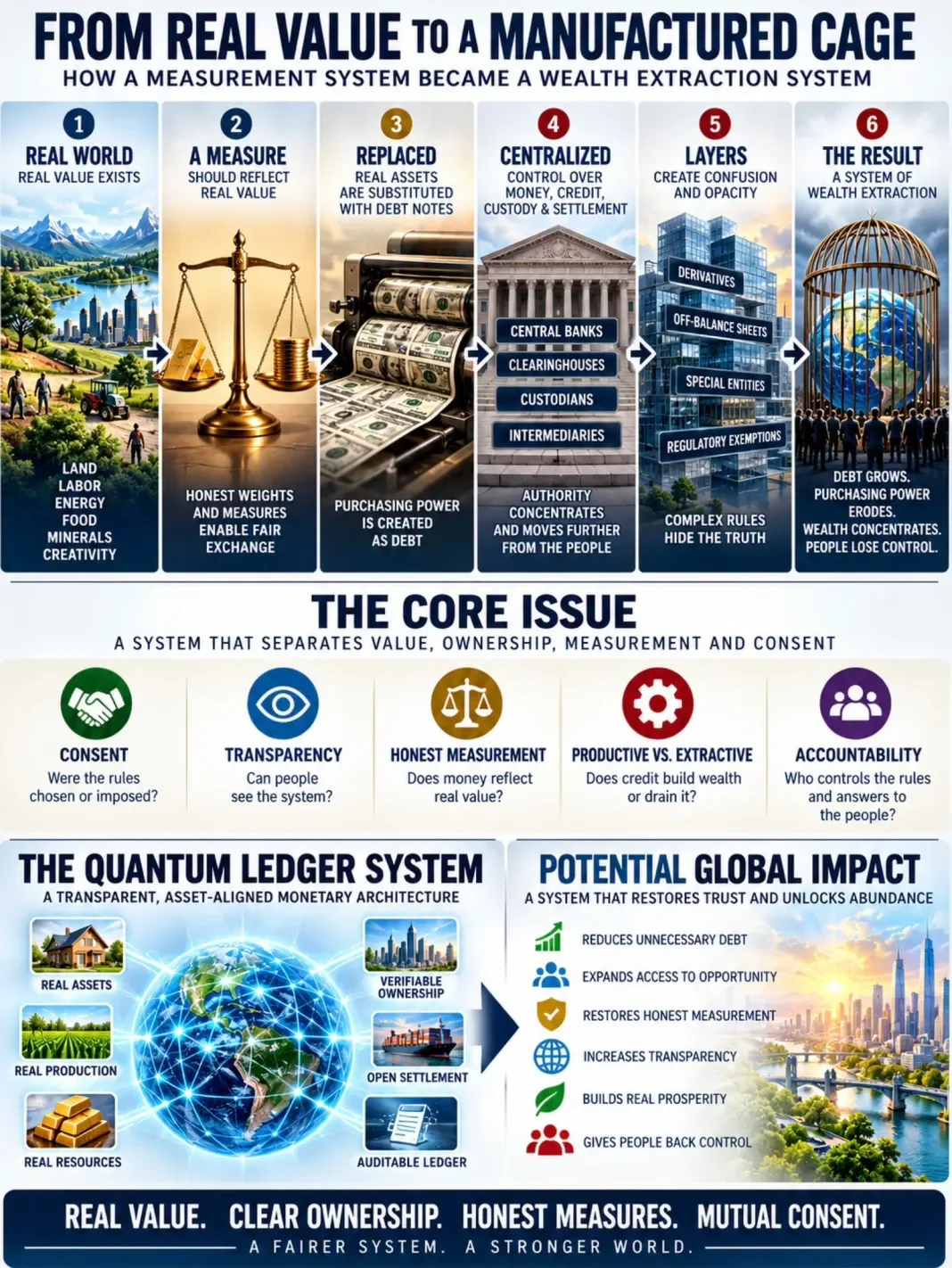
For generations, our financial system has accomplished extraordinary things – but it was built around enormous networks of banks, brokers, custodians, clearinghouses, databases and IOUs. The system works largely because we placed our trust institutions to keep their separate accounting ledgers straight.
When something goes wrong, figuring out who owns what, who owes what, and where “all the money” belongs can become remarkably complicated – at best.
Now imagine giving money and assets something closer to a perfect digital deed – in seconds.
That is the basic idea behind tokenization and distributed ledgers – clarity + honesty + title.
A stock, bond or other eligible asset can have a digital representation whose ownership and movement can be recorded on shared infrastructure. America’s enormous securities plumbing is already moving from experiments toward production: DTCC says its tokenization of $114 Trillion is planned for migration beginning October 15, 2026.
This isn’t simply “Bitcoin taking over the banks.”
The old financial system and new digital technology are beginning to connect. We are “bridging” from the old to the new.
Regulators are rewriting rules for this new environment. In October, the SEC and CFFC proposed a new framework addressing how investment advisers and regulated funds may custody certain crypto assets. Financial regulation itself is being adapted to digital ownership.
Why should anyone care?
Because the long-term promise isn’t “crypto.”
It is real wealth vs system “friction.”
Faster settlement. Better visibility. Assets that move more efficiently. Clearer records. Vastly fewer reconciliation problems. More competition. Lower costs.
Tokenization brings everyday people faster access to proceeds, greater transparency and more verifiable trust.
Technology is only part of the revolution. What we choose to require from technology and those who are elected to govern on our behalf, matters most.
We require real assets.
We require identifiable ownership.
We require understandable obligations.
We require auditable records.
We require honest measurement.
We require true accountability.
We require true mutual consent.
And then – something profound becomes possible:
For centuries we asked ordinary people to trust the books.
The emerging technology gives us an opportunity to build a world where ordinary people can increasingly say:
SHOW ME THE BOOKS.
And ultimately:
SHOW ME THE ASSET.
SHOW ME THE OWNER.
SHOW ME THE OBLIGATION.
SHOW ME THE PROOF.
That’s why there is legitimate reason for optimism.
We aren’t merely digitizing money.
We have an opportunity to make trust visible and wealth, common.
Let’s help others see what we see. Abundance belongs to us all.
Source(s):
• https://x.com/KuwlShow/status/2107792571430851053
https://dinarchronicles.com/2026/10/08/rob-cunningham-money-is-getting-a-makeover/
FRANK26……10-8-26….NICE TRY PARLIAMENT
KTFA
Thursday Night Video
FRANK26……10-8-26….NICE TRY PARLIAMENT
This video is in Frank’s and his team’s opinion only
Frank’s team is Walkingstick, Eddie and Omar in Iraq and guests
Playback Number: 605-313-5163 PIN: 156996#
KTFA
Thursday Night Video
FRANK26……10-8-26….NICE TRY PARLIAMENT
This video is in Frank’s and his team’s opinion only
Frank’s team is Walkingstick, Eddie and Omar in Iraq and guests
Playback Number: 605-313-5163 PIN: 156996#