
Diversification And Digitalization Are Reshaping Finance’s Future
Diversification And Digitalization Are Reshaping Finance’s Future
Strictly speaking, it is far from a divorce, or even a serious breakup. But Asia’s leading economies are edging away from their eight-decade relationship with the US dollar for international trade.
Two forces are driving this evolution of the international monetary system. Amid rising geopolitical and geoeconomic fragmentation, policymakers are weighing economic efficiency against national security and strategic resilience. And digital innovation is lowering the cost of conducting transactions directly across currencies and financial networks.
Diversification And Digitalization Are Reshaping Finance’s Future
Strictly speaking, it is far from a divorce, or even a serious breakup. But Asia’s leading economies are edging away from their eight-decade relationship with the US dollar for international trade.
Two forces are driving this evolution of the international monetary system. Amid rising geopolitical and geoeconomic fragmentation, policymakers are weighing economic efficiency against national security and strategic resilience. And digital innovation is lowering the cost of conducting transactions directly across currencies and financial networks.
Although the dollar still dominates trade in Asia, the region’s currency diversification promises to help shape the future of the world economy. The ASEAN+3 countries consist of 10 members of the Association of Southeast Asian Nations—Brunei Darussalam, Cambodia, Indonesia, Lao P.D.R., Malaysia, Myanmar, the Philippines, Singapore, Thailand, and Vietnam—plus China, Japan, and Korea. Together, they encompass more than a quarter of the world’s population and generate a quarter of global economic output.
Since World War II, the dollar has been Asia’s dominant international currency. It still accounts for more than 80 percent of trade invoicing and nearly 85 percent of foreign exchange settlement in the ASEAN+3 bloc. More than half of regional banks’ cross-border assets and liabilities are denominated in dollars, as are roughly two-thirds of official reserves.
Asia’s unfolding currency pivot is not an ideological campaign against the dollar. Policymakers are simply pursuing a pragmatic strategy of diversification. Their objective is to create alternative pathways of clearing and settlement for trade and finance that can operate alongside existing global systems. In doing so, they are building resilience.
What will emerge is a more layered financial architecture. The dollar is likely to remain the region’s dominant reserve asset and the ultimate liquidity backstop for financial markets. At the same time, local currency settlement arrangements and digital payment platforms will assume a larger role in trade and supply-chain integration.
The dollar’s advantage
The dollar’s historically dominant position in Asia is no accident. It is rooted in the postwar global order and reflects not only the weight of the US as the world’s largest economy but also the credibility of its institutions over time.
For central banks across the region, holding dollar reserves has ultimately been an expression of confidence in the Federal Reserve, the rule of law, and the transparency and predictability of the US monetary framework.
Yet this cannot be taken for granted. The dollar’s central role depends on continued confidence in the US as an open economy and in America’s ability to provide stable and predictable policy frameworks. To retain the dollar’s central role, the US must continue to offer the world’s largest and most dynamic economy, the deepest financial markets, and an independent central bank.
Recent strains in US institutions are testing that foundation. Market reactions over the past year—to events ranging from the tariffs imposed by the US administration to conflict in the Middle East—underscored a simple reality. When uncertainty originates elsewhere, investors seek safety in dollar-denominated assets. But when questions arise about the stability or predictability of US policies and institutions, concerns inevitably emerge about the dollar’s reliability as the anchor of the international monetary system.
Asia’s regional turn
Over the past two decades, Asia’s economic structure has changed dramatically. The region is no longer just the world’s factory, producing largely for Western consumption. Two decades ago, nearly a third of value-added exports from the ASEAN+3 group were destined for the US.
Today, that share is down to a fifth. Meanwhile, China and ASEAN are each now absorbing a tenth of the region’s production, up markedly from about 6 percent each two decades ago. Production networks across “Factory Asia” are now denser, more interconnected, and more firmly rooted within the region.
This structural transformation also changed the way economic shocks propagate. Analytical modeling by AMRO—the ASEAN+3 cooperation framework’s macroeconomic research office—suggests that shifts in regional domestic demand now affect neighboring economies more strongly than demand shocks originating in the US.
Asia has traditionally been highly sensitive to global financial cycles driven by American monetary policy. When the Fed tightened policy, financial conditions across the region tightened as well. Capital flowed out, local currencies came under pressure, and domestic borrowing costs rose.
As the region’s business cycles and production networks become more regionally anchored, monetary policy in Asia will respond more directly to domestic and regional conditions. While global factors remain important, there are early signs that financial conditions in ASEAN+3 economies are increasingly domestically driven.
To consolidate this growing financial autonomy, the region needs to expand the use of regional currencies in trade. Invoicing and settling intra-regional trade in those currencies will help loosen the link between domestic credit conditions and US monetary policy. Greater use of local currencies will gradually reduce structural currency mismatches and allow central banks to calibrate monetary policy more closely to domestic conditions rather than reacting defensively to dollar shocks.
As Asia aligns its financial architecture more closely with changing economic structures, the region will be better positioned to safeguard macroeconomic stability and strengthen its resilience to external shocks, such as the debt-driven 1997 Asian financial crisis. In that case, the IMF stepped in with a $40 billion program to stabilize the region’s collapsing currencies.
Rewiring international payments
In the aftermath of that crisis, some policymakers and academics advocated a European-style monetary union. Asia did not pursue that idea. The region is simply too diverse. Political systems, economic structures, income levels, and financial market development vary widely across the region, making a common currency impractical.
Instead, regional cooperation evolved in a more pragmatic direction, focusing on financial integration and stronger safety nets. Modernizing cross-border payment infrastructure became a central pillar of this strategy.
In the past decade, Asian central banks have pioneered local currency settlement frameworks. These are bilateral arrangements between two countries that use local currencies for cross-border settlement via financial institutions authorized by central banks. Although still modest in scale, such arrangements now operate between many ASEAN+3 economies.
TO READ MORE: https://www.imf.org/en/publications/fandd/issues/2026/09/asias-pragmatic-currency-pivot-dong-he
Sunday Iraq News Posted by Tishwash at TNT 9-20-2026
TNT:
Tishwash: Iraq to New York: Al-Zaidi addresses the United Nations and a meeting with Trump is anticipated.
Iraqi Prime Minister Ali Faleh al-Zaidi will head to New York in the coming hours at the head of a high-level government delegation to participate in the meetings of the 81st session of the United Nations General Assembly, whose high-level week begins on September 22.
According to the Director of the Prime Minister’s Media Office, Abdul Zahra al-Hindawi, al-Zaidi will deliver Iraq’s speech before the General Assembly, addressing Baghdad’s vision and positions regarding regional and international developments, in addition to the files of security, stability, development and international cooperation.
TNT:
Tishwash: Iraq to New York: Al-Zaidi addresses the United Nations and a meeting with Trump is anticipated.
Iraqi Prime Minister Ali Faleh al-Zaidi will head to New York in the coming hours at the head of a high-level government delegation to participate in the meetings of the 81st session of the United Nations General Assembly, whose high-level week begins on September 22.
According to the Director of the Prime Minister’s Media Office, Abdul Zahra al-Hindawi, al-Zaidi will deliver Iraq’s speech before the General Assembly, addressing Baghdad’s vision and positions regarding regional and international developments, in addition to the files of security, stability, development and international cooperation.
The visit is scheduled to include a series of bilateral meetings and talks with Arab and foreign leaders and heads of state, as part of the government’s efforts to strengthen political relations and expand areas of cooperation with regional and international partners.
The visit's agenda also has a prominent economic dimension, as the Prime Minister is scheduled to participate in events and meetings with representatives of major companies, businessmen and investors, in addition to a meeting with the American Chamber of Commerce, according to what the Iraqi government announced.
According to government statements, Baghdad aims to capitalize on the presence of the Iraqi delegation in New York to showcase investment opportunities and expand economic partnerships, in parallel with the transformations taking place in the Iraqi-American relationship and the increasing shift of a part of it towards economic, trade and investment issues.
On the political front, government spokesman Haider al-Aboudi announced that al-Zaidi's itinerary in the United States includes a meeting with US President Donald Trump, in addition to meetings with several other heads of state. Al-Zaidi and Trump previously met in Washington in July 2016 for talks that, according to reports at the time, focused on bilateral relations and economic issues.
The visit comes at a sensitive regional and international stage, amid multiple security and economic issues facing Iraq, including the repercussions of tensions in the region, the future of relations with the United States, and the promotion of foreign investments.
Baghdad is expected to present its vision on these issues during the meetings, focusing on consolidating Iraq's role in regional dialogue, attracting capital, and supporting development and reconstruction projects. link
************
Tishwash: Al-Zaydi orders that government officials be prevented from appearing in the media without prior approval.
On Saturday, Prime Minister Ali al-Zaidi directed that all advisors and government officials be prohibited from making press statements or appearing in the media without prior approval from his office.
The directive confirmed that the ban includes visual, audio and print media, noting that the measure comes within the framework of compliance with regulatory controls and keenness to unify the government discourse and ensure consistency in the official message.
Al-Zaydi stressed the need to adhere to this directive in order to avoid statements that may not accurately reflect the official position of the state, calling on everyone to strictly adhere to this directive. link
************
Tishwash: Iraq calls on American companies to expedite the implementation of their projects.
On Saturday, Iraqi Finance Minister Faleh Sari called on American companies operating in the oil and energy sectors to expedite the implementation of their projects in the country, thereby boosting foreign investment and supporting the development of vital sectors.
This came during his meeting with the US Chargé d'Affaires to Iraq, Steven Fagin, and his accompanying delegation, where relations between the two countries were reviewed, and ways to enhance economic and financial cooperation were discussed.
Sari confirmed in a statement received by Shafaq News Agency that Iraq’s actions in its relations with various countries are based on the country’s supreme interests, noting the Iraqi government’s keenness to ensure that its relationship with the United States is balanced and based on the common interests of the two countries.
For his part, the US Chargé d'Affaires described the visit of the Iraqi government delegation to Washington last July as very successful, stressing the importance of investing in and building upon the results of the visit, in order to strengthen the paths of cooperation between the two countries.
Iraqi Prime Minister Ali al-Zaidi visited the United States on July 13, and the five-day visit witnessed the signing of 48 agreements, memoranda of understanding, and partnership declarations between Iraqi and American institutions in the oil, energy, electricity, industry, technology, communications, finance, agriculture, education, and health sectors, with a declared value exceeding $60 billion. link
Tishwash: “Iraq Seeks Balanced Ties With US,” Finance Minister Says
At a Glance
Iraqi Finance Minister Faleh al-Sari met with U.S. Chargé d’Affaires Steven Fagin in Baghdad.
Talks covered bilateral relations and ways to strengthen economic and financial cooperation.
Sari urged U.S. oil and energy companies to accelerate projects in Iraq.
Fagin described the Iraqi government delegation’s July visit to Washington as “very successful.”
Iraqi Finance Minister Faleh al-Sari met with U.S. Chargé d’Affaires Steven Fagin to discuss strengthening economic and financial cooperation and accelerating American investment projects in Iraq.
Al-Sari said Iraq’s foreign relations are guided by its national interests, while calling for balanced ties with Washington based on shared interests.
Key Statements
“Iraq’s engagement in its relations with various countries is based on the country’s higher interests.”
— Iraqi Finance Minister Faleh al-Sari
“We are keen for Iraq’s relationship with the United States to be balanced and based on the shared interests of both countries.”
— Iraqi Finance Minister Faleh al-Sari
“We call on American companies operating in the oil and energy sectors to accelerate the implementation of their projects in Iraq.”
— Iraqi Finance Minister Faleh al-Sari
“The visit was very successful.”
— U.S. Chargé d’Affaires Steven Fagin, referring to the Iraqi government delegation’s July visit to Washington
Economic Cooperation
According to Iraq’s Finance Ministry, the meeting reviewed bilateral relations and ways to expand economic and financial cooperation between Baghdad and Washington.
Sari urged U.S. companies active in Iraq’s oil and energy sectors to move more quickly with their projects, saying greater investment would support foreign capital inflows and the development of vital sectors of the Iraqi economy.
The meeting also focused on building on the outcomes of the Iraqi government delegation’s visit to Washington in July.
Fagin described that visit as “very successful” and stressed the importance of using its results as a foundation for further cooperation between the two countries.
Iraq’s Foreign Relations
Sari emphasized that Baghdad’s engagement with different countries is based on Iraq’s national interests. He also said the government seeks a balanced relationship with the United States centered on mutual interests.
The comments come as Iraq continues to pursue foreign investment and economic partnerships while seeking to strengthen its energy sector, attract international companies and expand economic cooperation with major partners.
FYI
The meeting links Iraq’s broader economic priorities with its strategic relationship with Washington, particularly in the energy sector, where U.S. companies have a longstanding presence. Accelerating investment projects could carry significance for Iraq’s oil and energy development, while Baghdad’s emphasis on balanced relations reflects its stated approach of maintaining economic and diplomatic ties with multiple international partners. link
News, Rumors and Opinions Sunday 9-20-2026
GP Q: Banking Reset, the Fed Prepares for Major Overhaul
9-20-2026
BANKING RESET: FED PREPARES MAJOR OVERHAUL OF STRESS TESTS AND CAPITAL REQUIREMENTS
WHAT’S HAPPENING
The Federal Reserve is preparing major changes to how large U.S. banks are stress-tested, with more transparency around the models, assumptions and scenarios used.
GP Q: Banking Reset, the Fed Prepares for Major Overhaul
9-20-2026
BANKING RESET: FED PREPARES MAJOR OVERHAUL OF STRESS TESTS AND CAPITAL REQUIREMENTS
WHAT’S HAPPENING
The Federal Reserve is preparing major changes to how large U.S. banks are stress-tested, with more transparency around the models, assumptions and scenarios used.
The Fed plans to average two years of stress-test results when setting banks’ capital buffers, which could make capital requirements more predictable and less volatile.
Broader changes to bank capital rules and requirements for globally systemically important banks are also expected before the end of 2026.
GLOBAL RESET WATCH:
This is a change to the financial infrastructure beneath the banking system.
Banking Capital Credit Liquidity Financial Stability Global Finance
Stress testing and capital requirements determine how banks prepare for financial shocks and how much capital they maintain against potential losses.
WHY IT MATTERS TO CURRENCY HOLDERS
Foreign currency value is influenced by the broader financial system supporting each currency.
Changes in bank capital, liquidity, credit creation and financial regulation can affect that foundation over time.
This does not signal a currency revaluation or establish a Global Reset date.
PROOF LINKS:
Federal Reserve — “The Final Chapter on Modernizing Bank Regulatory Stress Testing”
https://federalreserve.gov/newsevents/speech/bowman20260918a.htm
Reuters — “Fed’s Bowman says overhaul of bank stress test will make process more transparent”
https://reuters.com/business/finance/feds-bowman-says-changes-bank-stress-test-coming-soon-2026-09-18/
REMEMBER:
The financial system does not change only through currencies.
Sometimes the biggest changes happen underneath the surface — in bank capital, regulation, liquidity and risk management.
Watch the infrastructure. The headlines often come later.
RUMOR SAFETY REMINDER:
The Fed’s banking reforms are not a currency reset announcement and do not provide a revaluation date.
Hope, not hype. Follow the documented changes.
Source(s):
• https://x.com/argosaki/status/2101458533682495911
https://dinarchronicles.com/2026/09/19/gp-q-banking-reset-the-fed-prepares-for-major-overhaul/
*************
Courtesy of Dinar Guru: https://www.dinarguru.com/
Frank26 There's a high possibility Iraq may be sanctioned again. But I don't think so because Zaidi is doing very good in following Trump's orders...But if this pressure does not move Zaidi in the right direction, then [Iraq] is going to be sanctioned. [Iraq] is going to be returned to the years of hell, which is the 1990s and all of your reforms will be halted. I don't see that happening because the involvement with the WB, IMF and the US Treasury...BIS, let alone the financing reform of Rothschild...
Stephen Al-Zaidi is planning on being in New York next week. He's going to be at the UN meeting and he's going to be meeting with Trump. This is already on the agenda. He's coming with his delegation. He's going to be meeting with the Treasury...I wish I could be a fly on the wall. I'm assuming they're going to be going over exactly what is getting ready to take place and making sure they have all the support they need to facilitate this new financial reform.
Ariel the Ministry of Finance’s declaration of financial sovereignty by September 30, 2026, formally ends the artificial program rate, decoupling the IQD from decades of suppression. This convergence is timed to precede Iraq’s October 15, 2026, 2027 budget release, which will formalize a new, market-reflective exchange rate backed by Iraq’s oil and gas reserves. Along with gold.
Bill Holter :"99% Of Silver Investors Are About To Be SHOCKED" | (Silver Prediction 2026)
The Silver Market: 9-17-2026
The U.S. national debt just crossed $40 trillion — over 124% of GDP. But according to this analyst, the real story isn't the debt itself. It's what's backing it.
In this conversation, we dig into the theory that a "gold revaluation" could be used to shore up the collateral behind U.S. Treasuries — and why some believe the math only works at prices as high as $180,000 an ounce.
We also cover the 2014 shift in banking law that turned deposits into loans, the controversial claims in David Rogers Webb's The Great Taking, and why some investors are moving to hold physical share certificates instead of leaving stock with a broker.
Seeds of Wisdom RV and Economics Updates Sunday Morning 9-20-26
Seeds of Wisdom RV and Economics Updates Sunday Morning 9-20-26
Good Morning Dinar Recaps,
U.S.-CHINA FINANCIAL RESET: AI, TRADE AND CRITICAL MINERALS MOVE TO CENTER STAGE
U.S. AND CHINESE ECONOMIC OFFICIALS ARE BRINGING AI, TRADE AND CRITICAL MINERALS TO THE CENTER OF HIGH-LEVEL TALKS, HIGHLIGHTING HOW TECHNOLOGY, SUPPLY CHAINS AND ECONOMIC RELATIONSHIPS ARE BECOMING INCREASINGLY INTERCONNECTED.
Seeds of Wisdom RV and Economics Updates Sunday Morning 9-20-26
Good Morning Dinar Recaps,
U.S.-CHINA FINANCIAL RESET: AI, TRADE AND CRITICAL MINERALS MOVE TO CENTER STAGE
U.S. AND CHINESE ECONOMIC OFFICIALS ARE BRINGING AI, TRADE AND CRITICAL MINERALS TO THE CENTER OF HIGH-LEVEL TALKS, HIGHLIGHTING HOW TECHNOLOGY, SUPPLY CHAINS AND ECONOMIC RELATIONSHIPS ARE BECOMING INCREASINGLY INTERCONNECTED.
OVERVIEW
U.S. Treasury Secretary Scott Bessent and Chinese Vice Premier He Lifeng are meeting in New York to discuss potential agreements involving AI, tariffs, critical minerals and other economic issues ahead of a planned Trump-Xi summit.
Critical minerals are moving deeper into the global financial and trade discussion. These materials are essential for semiconductors, batteries, advanced manufacturing, energy systems and other technologies, making reliable supply chains increasingly important to investment and economic planning.
The discussions come as the existing U.S.-China trade truce approaches its November 10 expiration date, adding pressure to address tariffs, rare-earth flows and other unresolved economic issues before the leaders meet.
KEY DEVELOPMENTS
1. AI Has Become Part of the U.S.-China Economic Relationship
Artificial intelligence is no longer simply a technology-sector issue.
The United States and China are both major participants in the development and deployment of advanced AI systems, and AI is increasingly connected to productivity, semiconductors, data centers, electricity demand, financial services and national economic competitiveness.
The upcoming discussions are expected to address AI-related security issues and technology competition, showing how AI has moved into the center of international economic policy.
That matters for the financial system because the countries that develop and deploy AI at scale will also be influencing future patterns of investment, manufacturing and global trade.
2. Critical Minerals Are Becoming Strategic Financial Assets
Critical minerals such as rare earth elements are essential inputs for many of the technologies driving the next phase of the global economy.
They are used in areas including advanced electronics, batteries, renewable-energy systems, semiconductors, defense technology and advanced manufacturing.
The U.S. Treasury has already emphasized the importance of transparent, market-based pricing for critical minerals, saying reliable reference prices can help attract private capital and support more resilient supply chains.
Treasury has also highlighted the concentration of critical-mineral supply chains as a vulnerability that can affect economic security and technological development.
The significance is broader than mining.
When a resource becomes essential to technology and industrial production, control over its supply, processing, pricing and financing can influence the movement of capital throughout the global economy.
3. Trade Is Being Connected to Supply-Chain Resilience
The U.S.-China discussions also include tariffs and the broader trade relationship.
The existing trade truce is scheduled to expire on November 10, making the coming negotiations important for businesses that depend on cross-border supply chains.
Potential agreements involving tariffs and critical-mineral flows could affect the cost and availability of goods and industrial inputs.
This demonstrates how trade policy increasingly overlaps with financial stability.
Supply chains affect production.
Production affects investment.
Investment affects economic growth.
And economic growth ultimately affects the financial strength and international use of currencies.
4. The Talks Come Before a Major Trump-Xi Meeting
The Bessent-He meeting is taking place ahead of a planned meeting between U.S. President Donald Trump and Chinese President Xi Jinping in Washington later this week.
Reuters reports that the economic officials' discussions are intended in part to prepare potential agreements for the leaders' meeting.
That makes the current negotiations important even before any final agreements are announced.
The key question is not whether every issue will be resolved immediately, but whether the two largest economies can establish arrangements that provide greater predictability for trade, technology and strategic supply chains.
5. A Broader Financial Realignment Is Taking Shape Around Strategic Resources
The U.S.-China discussions illustrate a larger shift in the way governments and markets view economic security.
For decades, global supply chains were often organized primarily around efficiency and cost.
Increasingly, governments are also considering resilience, diversification, strategic resources, domestic production and access to technology.
Treasury has described critical minerals, semiconductors, AI and advanced manufacturing as components of economic capacity and security.
This does not mean globalization is ending.
It does mean that the structure of global trade and investment is being reconsidered as governments place greater emphasis on the security of essential supply chains.
WHY IT MATTERS
The U.S.-China relationship reaches far beyond bilateral trade.
The two economies are deeply connected to global manufacturing, technology, commodities, investment and financial markets.
When discussions between them include AI, tariffs and critical minerals at the same time, it demonstrates how technology, trade and strategic resources are increasingly interconnected.
For the global financial system, the important issue is how these changes influence where capital is invested, where production occurs, how resources are priced and how international trade is conducted.
The financial system can be reshaped by changes in trade and supply chains long before those changes appear in currency markets.
WHY IT MATTERS TO FOREIGN CURRENCY HOLDERS
Readers hold foreign currency with the hope that it may increase in value if major changes occur in the global monetary system.
The U.S.-China discussions are relevant because trade flows, strategic resources, technology, investment and economic relationships all contribute to the underlying environment in which currencies operate.
However, negotiations over tariffs, AI and critical minerals do not establish a currency revaluation or guarantee a Global Reset.
The useful lesson is to watch the actual changes taking place in the financial and economic infrastructure.
Hope, not hype. Follow the evidence.
IMPLICATIONS FOR THE GLOBAL RESET
Pillar 1: Trade
The U.S.-China relationship remains one of the most important components of global trade. Changes to tariffs, trade agreements and supply chains can influence international capital and economic activity.
Pillar 2: Technology
AI is becoming an increasingly important source of productivity, investment and economic competitiveness. Control of advanced chips, computing capacity and AI infrastructure is therefore becoming part of the global economic equation.
Pillar 3: Critical minerals
Rare earths and other critical minerals are essential inputs for advanced technology and manufacturing. Their availability, pricing and supply-chain security are becoming increasingly important to global investment.
Pillar 4: Supply chains
The emphasis is shifting from supply chains based solely on efficiency toward systems that also consider diversification and resilience.
Pillar 5: Currencies
Trade balances, economic productivity, investment flows and confidence in financial systems can influence the long-term environment for currencies.
The U.S.-China talks do not announce a change in currency values, but they demonstrate how the underlying economic architecture supporting currencies continues to evolve.
RUMOR SAFETY REMINDER
The U.S.-China discussions are not an announcement of a currency revaluation, a new global currency or a specific Global Reset date.
The documented subjects are AI, tariffs, critical minerals, trade and broader economic issues.
Any future agreements should be evaluated based on what is actually announced—not on predictions about secret monetary events or predetermined currency values.
THE BOTTOM LINE
The meeting between U.S. and Chinese economic officials places three major components of the modern financial system in the same conversation:
AI → Trade → Critical Minerals
Each connects to investment, manufacturing, supply chains and economic competitiveness.
If agreements emerge from the negotiations, their significance will depend on how they affect the movement of goods, technology, resources and capital between the world's two largest economies.
For those watching the Global Reset, the most useful approach remains the same:
Watch the infrastructure. Watch the agreements. Watch the capital flows. Follow the evidence.
Seeds of Wisdom Team
Newshounds News™ Exclusive
SOURCES
~~~~~~~~~~
🌱 A Message to Our Currency Holders🌱
If you’ve been holding foreign currency for many years, you were not foolish.
You were not wrong to believe the global financial system would change.
What failed was not your patience — it was the information you were given.
For years, dates, rumors, and personalities replaced facts, structure, and proof. “This week” predictions created cycles of hope and disappointment that were never based on how currencies actually change.
That is not your failure.
Our mission here is different: • No dates • No rates • No hype • No gurus
Instead, we focus on:
• Verifiable developments • Institutional evidence
• Global financial structure • Where countries actually sit in the process
Currency value changes only come after sovereignty, trade, banking, settlement systems, and fiscal coordination are in place. History and institutions confirm this sequence.
You will see silence. You will see denials. That is not delay — that is discipline.
Protect your identity. Organize your documents. Verify everything.
Never hand your discernment to anyone who cannot show proof.
You deserve truth — not timelines.
Seeds of Wisdom Team
Newshounds News
~~~~~~~~~~
Seeds of Wisdom Team RV Currency Facts Youtube and Rumble
Newshound's News Telegram Room Link
RV Facts with Proof Links Link
RV Updates Proof links - Facts Link
Start Here room with Most Asked Questions Link
Follow the Gold/Silver Rate COMEX
Follow Fast Facts
Seeds of Wisdom Team™ Website
Thank you Dinar Recaps
Doing The Math: Interest Expense Is Going To $2 Trillion Annually
Doing The Math: Interest Expense Is Going To $2 Trillion Annually
Notes From the Field By James Hickman (Simon Black / Sovereign Man) September 17, 2026
It was January 2000. AOL had just announced it was buying Time Warner in what was then the biggest merger in history. Fourteen dot-com companies had bought Super Bowl ads, one of them starring a sock puppet that sold dog food. The US economy was growing at one of its fastest paces ever; GDP was up nearly 5% the year before— and that’s real growth, before adding inflation, which itself was just 1.4%.
Doing The Math: Interest Expense Is Going To $2 Trillion Annually
Notes From the Field By James Hickman (Simon Black / Sovereign Man) September 17, 2026
It was January 2000. AOL had just announced it was buying Time Warner in what was then the biggest merger in history. Fourteen dot-com companies had bought Super Bowl ads, one of them starring a sock puppet that sold dog food. The US economy was growing at one of its fastest paces ever; GDP was up nearly 5% the year before— and that’s real growth, before adding inflation, which itself was just 1.4%.
Unemployment was 4%, the lowest in thirty years. And there was no other country on the planet that could come close to rivaling America's dominance.
Best of all, the federal government was running a surplus… a real one. It was so strong that, even excluding the Social Security surplus, the government took in $86 billion more than it spent.
So the Treasury didn't need to borrow any money. Naturally it still held bond auctions, because when you issue the global reserve currency, you have to give investors a safe place to park their money. But Treasury was retiring more debt than it issued, and even started buying its own bonds back early.
And after wondering what “the meaning of the word is is”, Bill Clinton bragged that the country was "on track to pay down nearly $300 billion in debt” by the end of the year.
And in the middle of all that, the 10-year Treasury yield hit 6.79%.
In other words, investors wanted a 6.79% annual return to hold extremely safe US government bonds… at a moment when America was on top of the world and the government's finances were in their best shape in decades.
That interest rate was not a crisis. After all, the government didn’t have to borrow to keep the lights on or the military funded or Social Security solvent. So they didn’t really care.
The Treasury's interest bill was shrinking as a share of tax revenue every single year.
Imagine that.
Fast forward to earlier this week, and after a hot inflation report and with oil back above $100, the same 10-year yield briefly crossed 5%.
The reaction was instant panic.
Imagine being able to go back in time for a moment... back to January 2000. Imagine talking to an economist back then. You explain that you’re from the future, and that in 2026, the national debt is $40 trillion and growing faster than the economy. The foreign central banks that used to buy America's debt are dumping Treasuries and buying gold instead.
You explain that there are wars in Ukraine and Iran, socialism is creeping back into American politics, and Congress can barely function.
You then ask the economist from January 2000 to guess where they think the 10-year yield would be, given all of that bad news.
They'd probably guess 10%, maybe 12%, and they'd be amazed to hear it only just crossed 5%.
So why did it take so long?
Because after the 2008 financial crisis, the Fed cut rates to zero... and left them there for seven years. There were a few ceremonial hikes, but when COVID arrived, the Fed slashed rates right back to zero.
It was able to do this because the Fed conjured trillions of dollars out of thin air... and used that money to buy bonds and suppress yields.
The 10-year was so low, in fact, that the federal government could issue those notes at less than 0.5%.
For thirteen years money was essentially free, and an entire generation came to believe that was normal. It wasn't, and that era is clearly over.
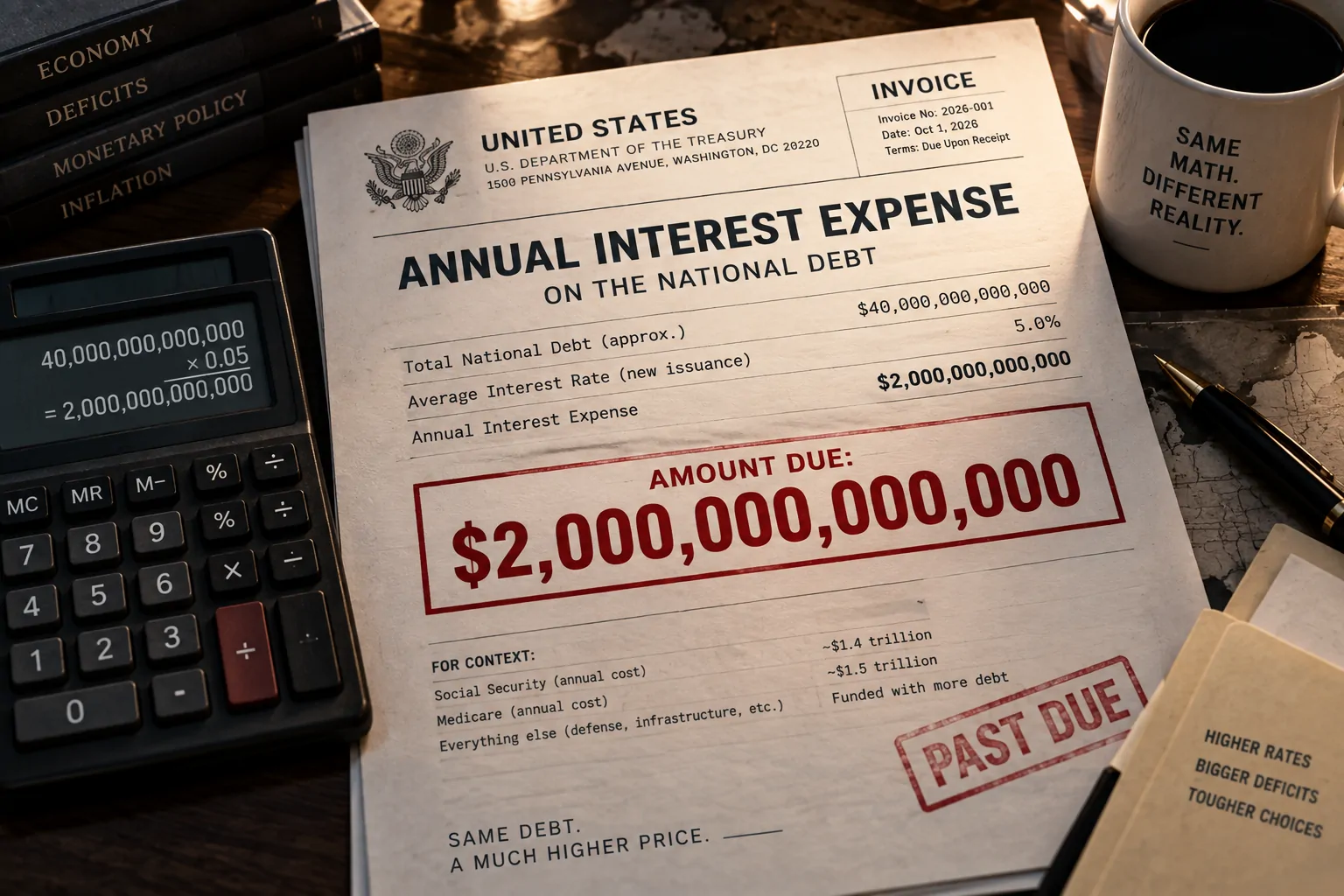
Think about what an opportunity that was: when you can borrow at 0.5%, $2 trillion in debt costs just $10 billion a year. Investing that money at even a measly 1% means the government would be making money on its debt.
A 1% hurdle rate is not particularly high. But Congress couldn’t manage even that much.
Despite racking up tens of trillions in debt, there's realistically nothing to show for all of that money: the national debt has quadrupled since the financial crisis, while the economy has only doubled.
Now, each year, much of the national debt matures, and the Treasury doesn't have the money to pay it back. So they have to issue new debt to repay the old debt.
Problem is, the new debt is issued at much higher rates. They were paying 0.5% on the old debt. The new yield of 5% is TEN times the interest on the same amount of debt.
And with an average maturity of about six years, most of the $40 trillion rolls over within just a few years... which means before long the annual interest bill will reach $2 trillion per year.
Add nearly $3 trillion for Social Security and Medicare, and that’s the vast majority of tax revenue.
Literally everything else, including the military, roads, and light bill at the White House, is funded with more debt.
In 2000, the government could shrug at a 6.79% yield because it was paying debt down. Today everyone's panicking at 5% because Congress borrows $2 trillion a year and can't stop.
So, is Congress going to suddenly find its inner fiscal discipline?
I'm not holding my breath.
That leaves exactly one way to get the 10-year back down, and it's the same way the Fed did it back in 2020: conjure more money out of thin air and make capital infinite.
And as the world discovered shortly after in 2021 and 2022, the consequence of that policy is inflation.
To your freedom, James Hickman Co-Founder, Schiff Sovereign LLC
P.S. In 2000, a 6.79% Treasury with 1.4% inflation was a fantastic deal. Today's 5% Treasury with the inflation that's coming is a losing one.
Real assets are where you come out ahead: gold, energy, and industrial metals rise when the dollar falls. The profitable, debt-free companies that produce them are what we research in Schiff Sovereign's Strategic Assets.
Iraq Economic News and Points To Ponder Late Saturday Evening 9-19-26
CBI Counters Fears Over Dollar Supply
2026-09-19 Shafaq News- Baghdad Iraq has enough foreign reserves to meet demand for dollars for imports, card payments and travelers at the official exchange rate, the country’s Central Bank (CBI) said on Saturday, as the Iraqi dinar weakened sharply against the US currency, hovering around 160,000 Iraqi dinars per $100.
CBI Counters Fears Over Dollar Supply
2026-09-19 Shafaq News- Baghdad Iraq has enough foreign reserves to meet demand for dollars for imports, card payments and travelers at the official exchange rate, the country’s Central Bank (CBI) said on Saturday, as the Iraqi dinar weakened sharply against the US currency, hovering around 160,000 Iraqi dinars per $100.
In a statement, the CBI attributed the rise to market speculation and expectations, as well as attempts by some beneficiaries to exploit geopolitical tensions in the region and unsettle economic and financial conditions.
The bank did not identify those it accused of benefiting from the situation.
Urging the public to rely on its official data and statements and avoid information circulated through unreliable sources, the CBI pledged to continue financing foreign trade through approved channels and for authorized purposes.
Earlier today, the CBI said that foreign reserves fell by nearly 17% in the first seven months of 2026 to $80.633 billion, with reserves declining by more than $5.5 billion in July alone
https://www.shafaq.com/en/Economy/CBI-counters-fears-over-dollar-supply
Iraqi Finance Minister Calls For Faster US Energy Projects
2026-09-19 Shafaq News- Baghdad Iraqi Finance Minister Faleh Sari on Saturday urged US companies operating in Iraq’s oil and energy sectors to accelerate project implementation, saying faster progress would “support foreign investment” and the development of key sectors.
During talks with US Chargé d’Affaires Steven Fagin, Sari said Iraq’s relations with other countries are guided by national interests and called for ties with Washington to remain balanced.
Fagin described the Iraqi government delegation’s July visit to Washington as “very successful” and urged both sides to build on its results to strengthen economic and financial cooperation.
Prime Minister Ali Al-Zaidi arrived in Washington on July 13 at the head of a government and business delegation. Shafaq News obtained an official list of 48 agreements and memoranda of understanding covering energy, infrastructure, technology, healthcare, finance, and other sectors.
Separately, the US Chamber of Commerce said more than 50 agreements, partnerships, and memoranda of understanding were signed or announced during the visit, with a combined value exceeding $60 billion.
https://www.shafaq.com/en/Economy/Iraqi-FM-calls-for-faster-US-energy-projects
CBI Foreign Reserves Drop Below $81B
2026-09-19 06:42 Shafaq News- Baghdad (Updated at 23:30) Iraq’s foreign reserves fell by about 17.2% during the first seven months of 2026, reaching $80.633 billion at the end of July, according to data from the Central Bank of Iraq (CBI).
The reserves stood at $86.175 billion at the end of June, compared with $97.432 billion at the end of 2025.
Measured in Iraqi dinars, foreign reserves fell to 104.823 trillion dinars ($80.633 billion) at the end of July, from 112.027 trillion dinars ($86.175 billion) at the end of June and 126.661 trillion dinars ($97.432 billion) at the end of 2025.
Gold holdings moved in the opposite direction in July, rising slightly to 29.665 trillion dinars ($22.819 billion) from 29.415 trillion dinars ($22.627 billion) in June. They remained below the 31.488 trillion dinars ($24.222 billion) recorded at the end of 2025.
CBI investments declined to 75.034 trillion dinars ($57.718 billion) at the end of July, compared with 81.998 trillion dinars ($63.075 billion) at the end of June and 93.266 trillion dinars ($71.743 billion) at the end of 2025.
Cash held in the central bank’s vaults also fell sharply, reaching 124 billion dinars ($95.385 million) at the end of July, compared with 614 billion dinars ($472.308 million) a month earlier and 1.907 trillion dinars ($1.467 billion) at the end of 2025.
https://www.shafaq.com/en/Economy/CBI-foreign-reserves-drop-below-81B
"Fighting Corruption Or Selective Enforcement?" Haider Al-Abadi: Why Are Some People Arrested While Others Are Left Alone? Not Applying The Law Equally To Everyone Is Itself Corruption
Baghdad - One News - 9/18/2026 Former Iraqi Prime Minister Haider al-Abadi criticized what he described as the failure to include everyone in anti-corruption measures, questioning the reasons for arresting certain individuals while not others, and warning that selectivity in applying the law could turn the fight against corruption itself into "corruption".
Al-Abadi said: “Why were certain people arrested and not others?” He considered that not applying anti-corruption measures to everyone means that it has become “corruption.”
He added that applying anti-corruption measures to everyone could, in his words, lead to “the collapse of the political process in Iraq,” referring to the extent to which corruption cases are intertwined with the political system. (Maliki & others)
In the government formation file, Al-Abadi described the positions of deputy prime ministers as “superfluous,” considering that creating them in light of the financial crisis would constitute an additional burden and could harm Prime Minister Ali Al-Zidi and his government.
Regarding the issue of weapons, the former Prime Minister criticized the shift from the principle of "monopolizing weapons" to "regulating weapons," describing this change as "a failure and detrimental to Iraq," and stressing the need to adhere to the principle of the state's monopoly on weapons. https://1news-iq.net/مكافحة-الفساد-أم-انتقائية؟-حيدر-الع/
"Corruption Has Gone Beyond Theft To The Plundering Of Public Funds," Al-Hakim Says, Calling For Automation And E-Government To Protect State Funds
Baghdad - One News - 9/19/2026 Ammar al-Hakim, head of the National State Forces Alliance and leader of the National Wisdom Movement, warned that the recently discovered cases of corruption have gone beyond the stage of “theft” and reached the stage of “plundering public funds,” calling for expanding reliance on automation and e-government to protect state funds.
During his meeting with a group of organizational leaders of the National Wisdom Movement in Karbala, Al-Hakim said that preserving public funds requires adopting automation systems, e-government, and dealing with greater transparency, which reduces human intervention in government procedures.
He considered that adopting this approach represents one of the best means to combat corruption, by enhancing transparency, protecting public funds, and reducing the spaces that can be exploited in illegal practices.
On the issue of weapons, Al-Hakim renewed his call to address the problem of weapons outside the framework of the state through dialogue and understanding, stressing the need to prioritize the public interest over private interests and to strengthen internal solidarity.
He called for containment, enduring the pain, and making the most of the current phase, along with communicating with political forces and establishing the best relations with them, while emphasizing the importance of institutional work and serving citizens with the available means.
On the organizational level, Al-Hakim stressed the importance of moving from the stage of dissemination to the stage of influence, noting that leadership means the ability to influence, and that being informed about political positions on internal and external issues contributes to enhancing awareness of developments and their outcomes.
He also called for pride in the historical identity and national heritage of the Wisdom Movement and recalling the stances of its leaders and symbols, stressing the importance of strengthening presence, influence, and institutional work.
FRANK26…9-19-26…..IT’S NOT WHAT THEY SAY…IT’S WHAT THEY DON’T SAY
KTFA
Saturday Night Video
FRANK26…9-19-26…..IT’S NOT WHAT THEY SAY…IT’S WHAT THEY DON’T SAY
This video is in Frank’s and his team’s opinion only
Frank’s team is Walkingstick, Eddie and Omar in Iraq and guests
Playback Number: 605-313-5163 PIN: 156996#
KTFA
Saturday Night Video
FRANK26…9-19-26…..IT’S NOT WHAT THEY SAY…IT’S WHAT THEY DON’T SAY
This video is in Frank’s and his team’s opinion only
Frank’s team is Walkingstick, Eddie and Omar in Iraq and guests
Playback Number: 605-313-5163 PIN: 156996#
Central Banks No Longer Trust Each Other: The Global Rush To Gold | Mark Thornton
Central Banks No Longer Trust Each Other: The Global Rush To Gold | Mark Thornton
Kitco News: 9-18-2026
Mark Thornton called the housing bubble in 2004. For four years, he was told he was wrong. He now says every paper-dollar asset you own is facing a very difficult future, and the AI buildout is the clearest warning sign he has seen since.
In this interview with Jeremy Szafron, the Mises Institute senior fellow and author of The Skyscraper Curse explains why AI data centers are this cycle's record-breaking tower, why the bonds financing them run decades longer than the hardware, who gets stuck with the cost when a tenant stops paying, and why central banks no longer trusting each other is the best sign he has seen for gold.
Central Banks No Longer Trust Each Other: The Global Rush To Gold | Mark Thornton
Kitco News: 9-18-2026
Mark Thornton called the housing bubble in 2004. For four years, he was told he was wrong. He now says every paper-dollar asset you own is facing a very difficult future, and the AI buildout is the clearest warning sign he has seen since.
In this interview with Jeremy Szafron, the Mises Institute senior fellow and author of The Skyscraper Curse explains why AI data centers are this cycle's record-breaking tower, why the bonds financing them run decades longer than the hardware, who gets stuck with the cost when a tenant stops paying, and why central banks no longer trusting each other is the best sign he has seen for gold.
Thornton also reacts to the Federal Reserve's report on Silicon Valley Bank published this week, Chairman Kevin Warsh's first rate hike in three years, and the drone attack on Saudi Arabia's East-West pipeline that cut Aramco supply to European buyers.
CHAPTERS
0:00 What the Fed's own report says about Silicon Valley Bank
3:29 The Fed isn't really tightening, he says
6:11 His case for abolishing the Fed entirely
8:24 The skyscraper curse, and why Jeddah just went quiet
13:38 How to tell if you're early or just wrong
15:41 AI data centers are the new bubble signal
17:37 The bonds that outlive the machines they fund
21:14 Factories are shrinking, power demand is soaring
23:30 Who pays when the tenant stops paying
25:59 Why the pipeline was defenceless, and can be hit again
29:55 The Challenger problem
33:44 Gold survives what paper money can't
37:13 Why no government gives up the printing press
39:32 What Poland and China see that the G7 doesn't
43:15 What survives honest money
RV Update, Could this Trigger the Next Big Payout? Holly Celiano
RV Update, Could this Trigger the Next Big Payout? Holly Celiano
9-18-2026
A recent video update dated September 18th, presented by Holly Celiano, brings several critical developments to the forefront. The discussion focuses heavily on Iraq’s impending sovereignty milestone, recent legislative maneuvers surrounding United States cryptocurrency regulations, and ongoing updates regarding currency valuation efforts tied to changing military dynamics in the Middle East.
RV Update, Could this Trigger the Next Big Payout? Holly Celiano
9-18-2026
A recent video update dated September 18th, presented by Holly Celiano, brings several critical developments to the forefront. The discussion focuses heavily on Iraq’s impending sovereignty milestone, recent legislative maneuvers surrounding United States cryptocurrency regulations, and ongoing updates regarding currency valuation efforts tied to changing military dynamics in the Middle East.
For anyone tracking global markets and financial sovereignty, this comprehensive analysis offers valuable perspectives on how international policy and digital assets intersect.
At the heart of the discussion is a major geopolitical turning point for the Middle East. Iraq will officially mark September 30th, 2026, as its Sovereignty Day.
This significant date coincides with the scheduled full withdrawal of United States-led coalition forces after more than two decades of military presence.
This transition represents much more than a mere shift in military control; it serves as a foundational step toward Iraq reclaiming full authority over its national territory and economic policy. Achieving this level of autonomy is viewed by analysts as critical for long-term regional stability, setting the stage for transformative political independence that carries deep implications well beyond Iraq’s borders.
Closely tied to this political milestone are crucial economic developments, particularly concerning Iraq’s financial independence. The country’s currency revaluation plans, which are closely linked to the upcoming budget framework, extend far beyond standard monetary policy.
For many observers, this initiative symbolizes Iraq finally stepping away from heavy external financial constraints and dollar dependency.
The potential revaluation carries massive economic implications, theoretically enabling the nation to stabilize its domestic economy and assert greater control over its national wealth.
Observers consider this financial realignment to be a pivotal factor in ensuring the country’s long-term economic health and prosperity.
Meanwhile, on the domestic front in the United States, the digital asset sector continues to experience significant regulatory turbulence. The video touches upon the recent defeat of the Clarity Act vote, a legislative measure aimed at establishing clearer rules for cryptocurrencies.
Rather than viewing this failure purely as a substantive policy defeat, analysts suggest it reflects a calculated political maneuver designed to navigate upcoming electoral landscapes. This highlights the complex interplay between emerging financial technologies and domestic political strategies, where legislative outcomes are frequently influenced by short-term campaign positioning rather than purely market-driven realities.
Despite these initial legislative roadblocks, the conversation highlights renewed bipartisan efforts to craft revised rules for the digital asset ecosystem. Lawmakers are actively attempting to design regulatory frameworks that can survive intense political scrutiny while effectively adapting to the fast-evolving crypto markets.
This iterative, ongoing approach demonstrates that digital asset oversight remains a top legislative priority. Many industry watchers anticipate that significant regulatory shifts could emerge following the upcoming midterm elections as politicians continue to negotiate terms that satisfy both innovation advocates and traditional financial gatekeepers.
Adding to this regulatory puzzle is the proactive stance taken by federal agencies. The Securities and Exchange Commission has signaled a willingness to move forward with market oversight without necessarily waiting for congressional consensus.
This assertive approach could potentially fast-track regulatory clarity and structure within the market, effectively bypassing traditional legislative gridlocks. By taking matters into their own hands, regulatory bodies are positioning themselves to act more decisively, shaping the future compliance landscape for digital currencies and blockchain technology in the United States.
Finally, the update addresses the broader financial picture, noting that progress regarding broader market and currency revaluation initiatives has been painstakingly slow. The necessity for meticulous tier-one and tier-two approvals before wider implementation can occur points to strong pushback from entrenched traditional power structures.
This systemic inertia illustrates how deeply invested parties often attempt to maintain control over legacy financial flows, thereby delaying comprehensive economic transformations.
However, despite these persistent hurdles, the overarching sentiment remains one of cautious optimism for gradual progress. Holly Celiano concludes her insightful overview with encouragement for viewers to stay persistent, remain vigilant, and closely monitor these rapidly evolving international and financial situations.
Iraq Economic News and Points To Ponder Saturday Afternoon 9-19-26
Observatory: Potential Sanctions And Speculation Shake The Dollar Market In Iraq
2026-09-19 04:45 Shafaq News - Baghdad The “Eco Iraq” economic observatory observed on Saturday a rapid rise in the exchange rate of the dollar in the parallel market against the Iraqi dinar, noting that the current rise is due to several factors, including fears of possible American sanctions against Iraq.
Observatory: Potential Sanctions And Speculation Shake The Dollar Market In Iraq
2026-09-19 04:45 Shafaq News - Baghdad The “Eco Iraq” economic observatory observed on Saturday a rapid rise in the exchange rate of the dollar in the parallel market against the Iraqi dinar, noting that the current rise is due to several factors, including fears of possible American sanctions against Iraq.
The observatory stated in a statement received by Shafaq News Agency that "the current rise is not related to one factor, but rather comes as a result of the overlap of several economic, financial and psychological factors," indicating that "among the most prominent of these are the speculations in the parallel market, which are active from time to time, taking advantage of the high demand for the dollar and the decline in its supply."
He added that "concerns and speculations related to the post-September 30th deadlines, and what is being discussed regarding the issue of restricting weapons to the state, along with talk of American sanctions or possible measures," explaining that "this increases the state of uncertainty in the market and pushes some traders to increase the demand for the dollar."
The Economic Observatory explained that "another reason is the decline in confidence in the banking sector from time to time, which represents an additional factor in increasing the demand for the dollar," pointing to the crisis of Al-Taif Bank and the imposition of guardianship over it by the Central Bank of Iraq on September 3.
In conclusion, the Eco Iraq Observatory called on the Central Bank of Iraq to "closely monitor developments in the exchange market and take appropriate measures to curb speculation and maintain market stability, thereby contributing to strengthening confidence in the Iraqi dinar and the banking sector
https://www.shafaq.com/ar/اقتصـاد/مرصد-العقوبات-المحتملة-والمضاربات-تهز-سوق-الدولار-في-العراق
The 2027 budget is facing comprehensive parliamentary review... Al-Shammari: No crises will hinder its approval
Information/Baghdad... Member of Parliament's Finance Committee, Mohammed Al-Shammari, confirmed on Saturday that the draft general budget law for 2027 will be subject to intensive technical study and detailed auditing as soon as it is officially sent by the Ministry of Finance and the government to the House of Representatives, noting that the existence of prior political understandings will contribute to its smooth passage without complex disputes.
Al-Shammari told Al-Maalouma News Agency that “the arrival of the budget to Parliament will begin with the Finance Committee’s work of reviewing all schedules, allocations, and expenditure items accurately to ensure their suitability to the economic reality and the needs of service projects,” indicating that “the auditing and study process represents an indispensable oversight and legislative duty before it is put to a vote.”
He added that "subjecting the draft to an in-depth study does not mean obstructing it, as the political climate is conducive and the parliamentary blocs are determined to finalize the necessary technical amendments through a swift consensus."
He predicted that "the reading and discussion procedures will proceed to approval without any crises or conflicts that might hinder its completion within the parliament." End/25h
Parliamentary Committee Clarifies Reasons For "Rise" In US Dollar Exchange Rate
Translated from Arabic
Pay attention to this statement carefully..... especially the last few seconds of the news......
Rate this translation:
https://x.com/AMrym93884/status/2101233753301430366
Abu Maryam @AMrym93884
1 News - One News @onenewsiq
·Translated from Arabic Parliamentary Committee Clarifies Reasons for "Rise" in US Dollar Exchange Rate | #wan_news
https://x.com/onenewsiq/status/2101218609716470171/video/1
Transcription of the video in the link:
This is a member of the Finance Committee in the Iraqi Parliament, Jamal Kujer.
The decline in the value of the dinar against the dollar to the fears stemming from the continuous American threats regarding the file of armed factions in Iraq and the fate of their weapons after September 30.
Kojer said that these threats raised fears among Iraqi citizens and pushed a greater number of them to buy dollars. He added that a segment of citizens fears the possibility of the United States, after September 30, reducing the sending of dollars to Iraq and their unavailability in the country, which prompted people who own dinars to daily buying dollars and gold, and pointed out that the increase in demand
On the dollar contributed to the continued rise in its price against the Iraqi dinar.
According to Kujer, another reason is related to the Iraqi government's attempt to amend the dinar exchange rate against the dollar in the draft budget law. https://x.com/AMrym93884/status/2101233753301430366 Abu Maryam @AMrym93884
The Dollar Is Caught Between Speculation And Rumors... A Financial Expert, Speaking To Iraq Observer, Predicts A Decline In The Exchange Rate After September 30th.
Baghdad/Iraq Observer Recently, local markets have witnessed a rise in the dollar exchange rate, amidst anticipation and speculation regarding expected developments at the end of the month. This has impacted market activity and raised concerns among citizens and traders about potential disruptions in the availability of foreign currency.
Financial and banking expert Dr. Mustafa Hantoush stated that part of the current increase may be linked to speculation and expectations circulating about September 30, 2026, explaining that talk of a possible dollar shortage or market instability has contributed to increased anxiety and speculation.
Hantoush told Iraq Observer that “delays in cash dollar shipments allocated for travelers are not new and have occurred on previous occasions,” noting that the Central Bank of Iraq possesses sufficient cash reserves to address such situations and meet domestic needs.
He added that “transfers for financing foreign trade differ from cash dollars allocated for travelers, as they are linked to trade, imports, and securing market needs,” emphasizing that their continuation is essential for Iraq’s food and economic security.
He pointed out that “fears of chaos or unrest are not, so far, based on clear indicators, especially given Iraq’s attainment of relative stability after years of challenges,” considering rumors and speculation to be among the factors influencing the exchange rate in the parallel market.
Hantoush indicated that “the decline in Central Bank sales over the past few months may be linked to the drop in oil revenues,” anticipating that the bank’s ability to meet market needs will improve with the current recovery in oil revenues.
He explained that “the stability of the situation after September 30th, and the absence of exceptional developments, may be reflected in the exchange rate and push it towards a decrease, as long as the official dollar rate remains fixed and no official decision is issued to change it.”
He emphasized that changing the official rate, should it be proposed in the future, would be a different matter requiring an official and publicly announced decision.
In the same context, the Central Bank of Iraq affirmed the adequacy of its foreign reserves to meet all demands for foreign currency, including financing foreign trade, settling bank cards, and fulfilling travelers' requests for cash dollars, at the approved official exchange rate.
The bank attributed the rise in the exchange rate in local markets to speculation
, speculation, and the exploitation of geopolitical circumstances.
Despite the Central Bank's confirmation of adequate reserves and the anticipation of improved oil revenues, the movement of the dollar in the local market remains largely dependent on the level of speculation and speculation, while any change in the official rate remains contingent upon an announced governmental and banking decision.
https://observeriraq.net/الدولار-بين-المضاربات-والشائعات-خبير/
Seeds of Wisdom RV and Economics Updates Saturday Afternoon 9-19-26
Good Afternoon Dinar Recaps,
BANKING RESET: FED PREPARES MAJOR OVERHAUL OF STRESS TESTS AND CAPITAL REQUIREMENTS
THE FEDERAL RESERVE IS PREPARING MAJOR CHANGES TO HOW LARGE U.S. BANKS ARE STRESS-TESTED AND HOW CAPITAL REQUIREMENTS ARE CALCULATED, POTENTIALLY CHANGING THE WAY BANKS PLAN FOR RISK, LENDING AND FINANCIAL STABILITY.
Good Afternoon Dinar Recaps,
BANKING RESET: FED PREPARES MAJOR OVERHAUL OF STRESS TESTS AND CAPITAL REQUIREMENTS
THE FEDERAL RESERVE IS PREPARING MAJOR CHANGES TO HOW LARGE U.S. BANKS ARE STRESS-TESTED AND HOW CAPITAL REQUIREMENTS ARE CALCULATED, POTENTIALLY CHANGING THE WAY BANKS PLAN FOR RISK, LENDING AND FINANCIAL STABILITY.
OVERVIEW
The Federal Reserve plans to finalize a revamped bank stress-test framework in the coming weeks, with greater transparency around the models, equations, assumptions and economic scenarios used to evaluate large banks.
The new framework would reduce volatility in banks' stress capital buffers by averaging the results of two consecutive annual stress tests. The Fed says this could reduce volatility by half without materially changing the overall level of required capital.
Broader capital-rule changes are also moving forward. Fed Vice Chair for Supervision Michelle Bowman said the Federal Reserve expects to finalize reforms to risk-based capital requirements and the surcharge applied to globally systemically important banks before the end of 2026.
KEY DEVELOPMENTS
1. The Fed Is Preparing to Finalize a New Stress-Test Framework
The Federal Reserve is preparing to vote on final revisions to its stress-testing framework for the nation's largest banks in the coming weeks.
Stress tests were introduced after the 2008 financial crisis to determine whether major banks have enough capital to absorb significant losses while continuing to operate and lend during severe economic conditions.
The Fed says the revised framework is designed to make the process more transparent, predictable and accountable.
The central bank plans to publish substantially more information about the models used in the tests, including equations, variables, coefficients, assumptions, limitations and the reasoning behind model decisions.
That would give banks, investors, regulators and the public a clearer view of how stress-test results are produced.
2. Capital Requirements Could Become Less Volatile
One of the most significant changes involves the way stress capital buffers are calculated.
Currently, changes in annual stress-test results can produce substantial year-to-year swings in the amount of additional capital banks are required to maintain.
Under the proposed approach, the Fed would average the results of a bank's two most recent annual stress tests.
According to Bowman, this approach could reduce stress-capital-buffer volatility by approximately half while not materially changing the aggregate amount of required capital.
The change is intended to give banks greater predictability when making capital and business decisions.
3. Broader Bank Capital Rules Are Also Being Reworked
The stress-test changes are part of a much larger restructuring of U.S. bank capital regulation.
Bowman said the Federal Reserve expects to finalize reforms to risk-based capital requirements for large and small banks, along with changes to the surcharge applied to globally systemically important banks.
These rules determine how much capital banks must maintain relative to the risks on their balance sheets.
The broader objective described by the Fed is to create capital requirements that are more closely aligned with actual risk while maintaining the ability of banks to absorb losses and continue lending during periods of financial stress.
4. Transparency Is Becoming a Bigger Part of Bank Regulation
The Fed's proposed changes represent a significant shift in how the stress-testing process is disclosed.
Under the revised framework, the public would receive more information about the models and scenarios used by the Federal Reserve.
The Fed also plans to seek public comment on changes to the framework governing hypothetical stress scenarios and, beginning with the 2026 stress test, on the scenarios themselves.
Greater disclosure could make it easier for investors, banks and other market participants to understand how regulatory capital requirements are established.
It also creates a more visible connection between bank regulation, risk assessment and market confidence.
5. The Banking System Is Being Rebuilt Around a New Risk Environment
The Federal Reserve's changes come as banks operate in an environment shaped by higher interest rates, changing credit conditions, geopolitical risks, technology-related risks and evolving financial markets.
Stress testing is designed to examine whether banks can withstand severe hypothetical conditions before those conditions actually occur.
The broader capital overhaul therefore matters beyond the individual banks being tested.
Large banks sit at the center of the financial system, providing credit, processing payments, financing businesses and participating in government and corporate debt markets.
Changes to their capital requirements can influence how much risk they can take, how much credit they can provide and how they allocate capital throughout the economy.
WHY IT MATTERS
Bank capital is one of the foundations of the global financial system.
When regulators change the way banks measure risk and determine required capital, the effects can extend into lending, investment, credit markets, liquidity and financial stability.
The Fed's reforms are therefore more than a technical change to a regulatory formula.
They represent an effort to modernize part of the financial infrastructure created after the 2008 financial crisis.
The financial system can change through its banking infrastructure long before those changes appear in currency headlines.
WHY IT MATTERS TO FOREIGN CURRENCY HOLDERS
Readers hold foreign currency with the hope that it may increase in value if major changes occur in the global monetary system.
Bank capital, liquidity, credit creation and financial stability are important parts of the infrastructure supporting any modern currency.
Changes in U.S. banking regulation do not automatically mean a currency revaluation or Global Reset event is coming.
But they are relevant to the broader financial picture because the banking system is one of the mechanisms through which money and credit move throughout the economy.
Hope, not hype. Watch the financial infrastructure and follow the evidence.
IMPLICATIONS FOR THE GLOBAL RESET
Pillar 1: Banking
Large banks are central components of the global financial system. Changes to capital requirements and stress testing can alter how banks manage risk and deploy capital.
Pillar 2: Regulation
The Fed is moving toward greater transparency and more predictable methods for calculating stress capital requirements.
Pillar 3: Liquidity
Capital requirements influence how much financial capacity banks maintain to absorb losses and continue operating during periods of stress.
Pillar 4: Credit
Banks are major providers of credit to households and businesses. Changes in capital requirements can affect how banks balance lending, investment and risk.
Pillar 5: Financial Stability
Stress testing is designed to identify vulnerabilities before they become systemic problems. A more transparent and risk-sensitive framework could become an important part of the evolving architecture of financial supervision.
RUMOR SAFETY REMINDER
The Federal Reserve's banking reforms are not an announcement of a currency revaluation, a new global currency or a specific Global Reset date.
The documented changes concern bank stress testing, capital requirements, regulatory transparency and financial stability.
As always, distinguish real changes to financial infrastructure from speculation about future currency events.
THE BOTTOM LINE
The Federal Reserve is preparing to change an important part of the U.S. banking framework.
The combination of more transparent stress tests, less volatile capital buffers and broader revisions to bank capital rules could influence how major banks measure risk, plan capital and support lending.
The larger connection is:
Banking → Capital → Credit → Liquidity → Financial Stability → Global Finance
These are the kinds of structural changes worth watching when following the evolution of the global financial system.
Seeds of Wisdom Team
Newshounds News™ Exclusive
SOURCES
Federal Reserve — "The Final Chapter on Modernizing Bank Regulatory Stress Testing"
Reuters — "Fed's Bowman says overhaul of bank stress test will make process more transparent"
~~~~~~~~~~
Seeds of Wisdom Team RV Currency Facts Youtube and Rumble
Newshound's News Telegram Room Link
RV Facts with Proof Links Link
RV Updates Proof links - Facts Link
Start Here room with Most Asked Questions Link
Follow the Gold/Silver Rate COMEX
Follow Fast Facts
Seeds of Wisdom Team™ Website
Thank you Dinar Recaps