
Government Regulations Now Add $132,000 to the Average New Home
Government Regulations Now Add $132,000 to the Average New Home
Notes From the Field By James Hockman (Simon Black / Sovereign Man) September 2, 2026
Somewhere in America there's a local ordinance that tells you which way your garage has to face. Another one dictates what your fence can be made of, and a third sets how many square feet of window your house needs. A few spell out the dimensions of particular features down to a quarter of an inch.
Government Regulations Now Add $132,000 to the Average New Home
Notes From the Field By James Hockman (Simon Black / Sovereign Man) September 2, 2026
Somewhere in America there's a local ordinance that tells you which way your garage has to face. Another one dictates what your fence can be made of, and a third sets how many square feet of window your house needs. A few spell out the dimensions of particular features down to a quarter of an inch.
The National Association of Home Builders, the trade group for the companies that build American homes, has been adding up what rules like these cost since 2011.
Its reasoning is simple: the country is short about 1.2 million homes, and rising regulatory costs are one of the things keeping builders from closing that gap. So anyone writing new rules ought to know what the existing ones already cost.
Government regulation now adds about $132,000 to the price of a new home.
That's just over a quarter of the roughly $500,000 the average new house sold for in January.
Builders said that ten years of changes to the building code added about $40,000 to the cost of a house. That’s the cost to buy the extra materials and labor each new edition of the code demands… whether or not the buyer wanted them.
Some of those rules are reasonable— hurricane-rated windows on a house within a mile of the shore, or shock-proof breakers on the circuits that run the stove and the dryer.
But those same code changes also decided that a hot-water pipe can't run more than 100 feet, that the outlet on a kitchen island has to pop up out of the countertop, and that an ordinary draft-vented furnace needs its own sealed, insulated room with an outside air vent.
None of those is a matter of life or death; even the furnace is an energy-efficiency rule, and the homeowner doesn't get to decide whether the upfront cost is worth the long term savings.
Codes get adopted locally, but the model codes that cities and counties copy are drafted with help from the Energy Department, FEMA, and the EPA.
The study notes, almost in passing, that "DOE also has a budget to persuade state and local governments to adopt more stringent codes."
In other words, a federal agency spends tax money persuading your county to make your house more expensive.
Just the energy part of the code adds between $9,600 and $21,400 to a home built to the 2021 version, and NAHB estimates it can take the buyer up to 90 years to recoup that money in lower utility bills. So maybe your grandkids will thank you, assuming the house is still standing.
This cost was made a federal requirement— a condition of every FHA and USDA loan on a new house— until a judge ruled in March that it violated the government's own affordable-housing law. But it still stands as the building code in roughly a dozen states.
Then come the fees. Permits, inspections, impact charges, and utility hookups add about $20,000 per house after the builder buys the lot.
Like any medieval lord, the local government also takes its tribute in land. More than 85% of developers have to hand part of their parcel to the town for a park or keep it as open space, at a cost of about $13,600 per home. Of course that cost is passed on to the buyer.
Regulation also costs time, and the study only quantifies about half that cost. More than 90% of developers report delays averaging about seven months, and more than a year passes between the zoning application and the first day of work on the site.
The study puts the delay itself at about $4,000 a house. It doesn't count the opportunity cost, or how delaying new housing supply raises the costs of everything else on the market.
And it's quickly getting worse. Five years ago the same study put the total regulatory cost per home at about $94,000. It's up more than 40% since then— and it has doubled since 2011.
Disposable income in the US rose 18% over the same five years. So the cost of obeying the rules is growing twice as fast as anyone's ability to pay it.
Notice that these costs have nothing to do with greedy builders or Wall Street landlords.
Many builders have been cutting prices every month for well over a year, and new homes still aren't selling. They're sitting unsold— in a country that's short 1.2 million homes— because a builder can only cut so far before he's selling at a loss.
Ironically, on top of the federal government pushing a rule that violated its own affordable-housing law, NAHB suspects some of the rules have less to do with safety or efficiency and more to do with "aesthetics, or possibly even, in some cases, a desire to price less affluent residents out of particular neighborhoods."
Yet the same city councils that pass them will tell you affordable housing is their top priority.
And homebuilding is just the one industry that bothered to add up the cost of insane government regulation.
The same thing happens anywhere the government writes the rule book.
Want to build a power line, a pipeline, or a mine? The White House's own environmental council found that the average federal environmental review takes four and a half years before anyone breaks ground.
The National Association of Manufacturers puts the cost of complying with federal rules at about $3 trillion a year, roughly 11% of GDP.
All of this strangling regulation is a big part of why the economy can't grow faster, and right now the US needs growth badly.
The national debt just crossed $40 trillion, and Congress refuses to cut a cent, even when the spending is obvious fraud.
That leaves two ways out. Either the economy grows faster than the debt, which means the country builds more, makes more, and starts more businesses than it does now… or the government prints the difference.
Without a regulation-destroying bonanza, it's obvious which one happens. If the government can't rein in the rules, it can't rein in the debt. And if it can't rein in the debt, it can't rein in inflation, because printing the money is the only option left.
To your freedom, James Hickman Co-Founder, Schiff Sovereign LLC
Rob Cunningham: Ripple Getting Two Valuable Gifts from Fedwire and SWIFT
Rob Cunningham: Ripple Getting Two Valuable Gifts from Fedwire and SWIFT
9-2-2026
What if Fedwire and SWIFT just gave Ripple two extraordinarily valuable early Christmas gifts?
What if those gifts were not contracts, endorsements or regulatory favors…
…but time?
Rob Cunningham: Ripple Getting Two Valuable Gifts from Fedwire and SWIFT
9-2-2026
What if Fedwire and SWIFT just gave Ripple two extraordinarily valuable early Christmas gifts?
What if those gifts were not contracts, endorsements or regulatory favors…
…but time?
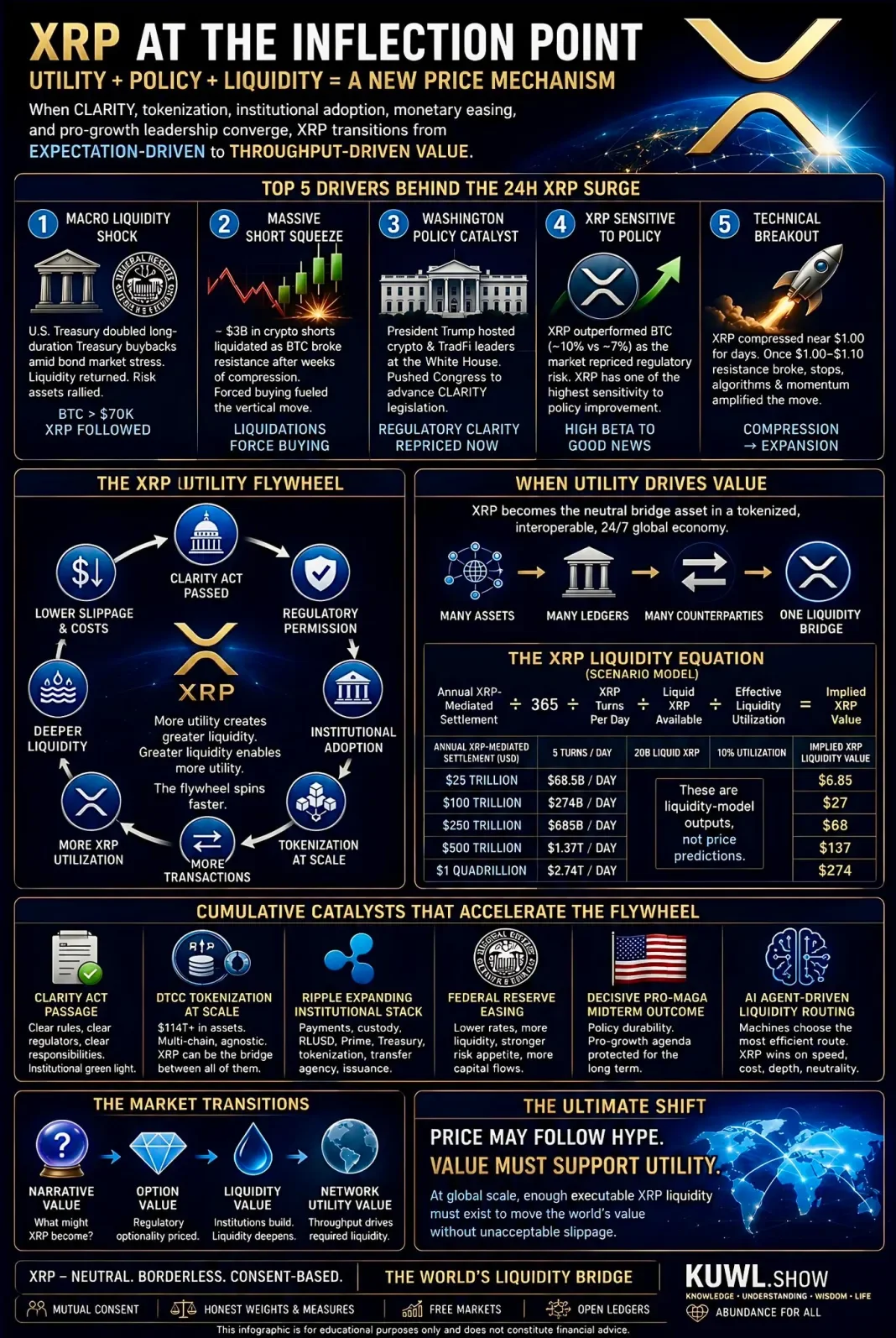
What is one additional year worth to the only ISO 20022-aligned enterprise global payments company purpose-built since 2012 to solve the very interoperability, liquidity, currency-exchange and real-time settlement problems legacy systems are still struggling to overcome?
How many institutions can Ripple integrate in twelve months?
How many payment corridors can it activate?
How much RLUSD liquidity can it establish?
How deeply can XRPL, ILP and XRP become embedded before November 2027 arrives?
And once institutions experience faster settlement, reduced prefunding and interoperable, 24/7 movement of value…
Why would they go backward?
Fedwire and SWIFT may believe they postponed releases.
Did they actually extend Ripple’s architectural head start?
Examine the super-special Christmas gifts they just placed beneath Ripple’s tree in my latest Substack: robcunningham.substack.com/p/the-ripple-wave-swells
Source(s):
• https://x.com/KuwlShow/status/2094817478442668161
More Wed. Iraq News Posted by Tishwash at TNT 9-2-2026
TNT:
Tishwash: Contractors in the liberated areas are demanding payment of their dues and warning of project stoppages.
The Iraqi Contractors Union called on the Prime Minister, Parliament, and Minister of Finance on Tuesday to intervene urgently to disburse the outstanding financial dues owed to companies and contractors contracted with the Reconstruction Fund for Liberated Areas, noting that the delay of some of these dues for more than two years has caused financial damage to contractors and threatened their ability to continue implementing projects.
TNT:
Tishwash: Contractors in the liberated areas are demanding payment of their dues and warning of project stoppages.
The Iraqi Contractors Union called on the Prime Minister, Parliament, and Minister of Finance on Tuesday to intervene urgently to disburse the outstanding financial dues owed to companies and contractors contracted with the Reconstruction Fund for Liberated Areas, noting that the delay of some of these dues for more than two years has caused financial damage to contractors and threatened their ability to continue implementing projects.
This came during a conference held in Anbar province, attended by a correspondent from Shafaq News Agency, with the participation of a number of contractors from the liberated provinces to raise their concerns and demand their rights and outstanding financial dues from the Reconstruction Fund for Liberated Areas.
The head of the Iraqi and Arab Contractors Union, Ali Fakher Sanafi, confirmed in a statement during the conference that the Reconstruction Fund for Liberated Areas has played a role in supporting the stability of the liberated governorates over the past years by implementing projects, rebuilding infrastructure, and supporting the people of these governorates who were subjected to damage and destruction as a result of military operations against groups of evil and terrorism.
He pointed out that contractors who contributed to the reconstruction of their cities and bore the burdens of implementation, financing and financial obligations cannot be left to face this crisis without real solutions.
According to Sanafi, the contractors called on the government, the House of Representatives, and the Ministry of Finance to intervene urgently and disburse the dues of companies and contractors contracted with the Reconstruction Fund for Liberated Areas, just like the rest of the contracting parties, and to do justice to this segment that had a fundamental role in the reconstruction of those areas.
In an exclusive interview with Shafaq News Agency, Snafi said that the issue of entitlements is "complex and cannot be resolved so easily."
He added that the state is suffering from a financial crisis and a deficit in paying employee salaries, which is repeated at the beginning of each month, considering that the private sector treats him as if he were "second class".
Snafi said the country is facing a "real crisis" after the war and the closure of the Strait of Hormuz, noting that Iraq is known for its dependence on oil.
He explained that the Prime Minister granted contractors 600 billion Iraqi dinars, of which amounts ranging between 300 and 350 billion dinars were distributed, while some ministries have not yet received their share of the amount.
He explained that the agreement stipulates allocating at least one trillion Iraqi dinars per month during the current phase, with the possibility of increasing the amount, stressing that the contractors "are optimistic," but the first 600 billion has not yet been completed.
Snafi stressed that the crisis is not limited to the fund for the reconstruction of liberated areas, but is a "general crisis in all regions of Iraq".
He pointed out that there is communication between the Contractors Union and the sub-unions, warning that stopping projects leads to their demise and harms the citizen, the government and the contractor, expressing that the union does not wish to reach this stage.
Snafi said that contractors "are the children of the state," and that the relationship with it is similar, as he described it, to "father and son," adding that disagreements may occur between the two sides, but they do not mean hatred.
He added that the contractors "did their part," and reached a point where they wanted "only a portion of what they had provided" returned to them.
He pointed out that all projects throughout Iraq have reached completion rates of no less than 30 percent, considering this an achievement for the Iraqi contractor, but he indicated that there is no specific percentage for the stalled projects, although their number is large, and that many projects are now threatened with being stopped due to the financial deficit. link
************
Tishwash: Maliki's coalition withdraws its appeal to the Federal Court regarding the ministers of interior and education, leaving the decision to parliament.
On Tuesday, Jassim Mohammed Jaafar, a leader in the State of Law Coalition, revealed that his coalition had withdrawn its appeal to the Federal Court regarding doubts about the vote counting process for candidates for the Ministries of Interior and Defense.
Jaafar told Al-Maalomah News Agency that "it was agreed to refer the authority to re-nominate Qasim Atta and Amer Al-Khazai to the House of Representatives, to decide through a voting process on the option of re-nomination or not."
He added that "if an absolute majority is not obtained to re-nominate the previous candidates, the names of the reserve candidates will be put forward immediately," while ruling out "the completion of the cabinet in next Monday's session, due to the lack of clarity regarding the candidates of the political blocs and the continuation of unresolved disputes."
It is worth noting that the statement issued after yesterday's coordination meeting set Monday as the date for finalizing the government formation and voting on the nominated ministers.link
Tishwash: Parliamentary Security Committee: We seriously doubt the withdrawal of the international coalition from Iraq.
On Wednesday, Jawad al-Saadi, a member of the Parliamentary Security and Defense Committee, called on the government to include the Parliament in the committees tasked with monitoring the withdrawal of international coalition forces from Iraq, expressing doubts about the seriousness of the withdrawal's implementation.
Al-Saadi told the Information Agency, "The government is required to include Parliament in the committees concerned with the withdrawal of international coalition forces to ensure clear monitoring of the procedures," indicating that "there are doubts about the seriousness of the withdrawal and the extent of commitment to its implementation."
He added, "The continued presence of international coalition forces in Iraq is not in the country's interest, especially since Iraq possesses security forces capable of maintaining security and defending its territory," stressing the need for the withdrawal process to be clear and specific, in a way that preserves Iraq's sovereignty and its security decisions.
Al-Saadi affirmed that "Parliament is concerned with monitoring this issue, and its inclusion in the withdrawal committees contributes to strengthening oversight and ensuring the implementation of what is agreed upon." link
************
Tishwash: Shahid: Political disagreements over the creation of deputy prime minister positions
Member of Parliament, Ahmed Shaheed, confirmed on Tuesday that the issue of appointing deputies to the Prime Minister has not yet been resolved, suggesting that political forces will begin discussions on this issue after the vote to complete Al-Zidi’s cabinet.
Shahid told Al-Maalomah News Agency, "There is a political trend emerging towards appointing deputies for Prime Minister Ali Falih al-Zaidi, but the idea is still under discussion and has not yet taken an official stance."
He added that "this proposal faces mixed acceptance within political circles, as some reject this approach based on financial and administrative considerations, because it will constitute an additional financial burden on the budget and an extra routine link in the structure of state administration."
It is worth noting that the statement issued after yesterday's coordination meeting set Monday as the date for finalizing the cabinet formation and voting on the nominated ministers. link
Bruce’s Big Call Dinar Intel Tuesday Night 9-1-26
Bruce’s Big Call Dinar Intel Tuesday Night 9-1-26
Transcribed By WiserNow Emailed To Recaps (INTEL ONLY)
Welcome everybody to the Big Call tonight. It's Tuesday, September 1, and you're listening to the Big Call. Thanks for tuning in again, everybody. Look forward to having another good call tonight, and hopefully we'll be imparting some really good information to you. Looking forward to it.
All right, let's do a little reset of our own. Here we are, the first of September. Let's see where we are with respect to the timing that we're looking for, we always try to create some kind of a timeline. So let's do that. I think the first thing we can look at is what we're hearing about this week. We had heard that we could get notified about middle of the week.
Bruce’s Big Call Dinar Intel Tuesday Night 9-1-26
Transcribed By WiserNow Emailed To Recaps (INTEL ONLY)
Welcome everybody to the Big Call tonight. It's Tuesday, September 1, and you're listening to the Big Call. Thanks for tuning in again, everybody. Look forward to having another good call tonight, and hopefully we'll be imparting some really good information to you. Looking forward to it.
All right, let's do a little reset of our own. Here we are, the first of September. Let's see where we are with respect to the timing that we're looking for, we always try to create some kind of a timeline. So let's do that. I think the first thing we can look at is what we're hearing about this week. We had heard that we could get notified about middle of the week.
Now, the middle of the week is theoretically Wednesday, in terms of you know Monday through Friday, midweek. In fact, in German, the word Medvak means Wednesday. It means middle of the week, so I'm thinking okay maybe Wednesday could be the day we get notified.
Well, that's tomorrow, but what I've heard since then today points to the idea of sovereign bondholders, which that would be the whales, the big guys in tier two, being taken care of today, and then the so-called regular bondholders in tier three are supposed to be taken care of tomorrow, Wednesday, and we are supposed to hear about notifications, 800 numbers somewhere between Thursday, Friday, and Saturday.
Now I'm hoping it's Thursday. I think it very well could be. We're getting this primarily from Redemption Center leaders directly from Wells Fargo. Now, it doesn't mean that's the end-all, be-all, because we also know the military is actually in charge of the release of this.
Okay, and military information is a little tough to get right now. In fact, most of it has been cut off over the last. I'm going to say week, week and a half.
We haven't really had military input. Maybe a little word here or a word there, but overall, I like the timing of this, and the reason I like the idea of Thursday, or Thursday, Friday, Saturday, is because of something called the Sovereign Wealth Liberation.
Okay, our sovereign wealth liberation, and that is the concept for Tier 4B for us to be liberated with this wealth, and it also probably would extend to no more taxation as well, and that's something that's part of NESARA, and that's something I think we're looking forward to getting. So, what? When was that supposed to start? We heard about it yesterday, and it's supposed to start in three days.
So the theory would be, if we take that 72 hours at three days, extend it to Tuesday, Wednesday, Thursday, it makes Thursday Doable for our ability to receive this wealth liberation, and I think that that is a real thing. It's an expression that we've heard. I hadn't heard it before today, but I do believe it's a real thing, and something we are really waiting for.
So, bottom line is, I think we're in the week we're supposed to receive this. It appears that that's the case. We do know something in. Iraq that took place, which was the Iraqi dinar.
I told you guys, I think last week we understood that we had transport planes of new lower denominations that we print here in the U.S. for Iraq, and we've done it since the beginning of their new Iraqi dinar in 2003, by the way.
So what what's amazing about that is I think that those transports, if I remember right, landed last Monday and Tuesday a week ago in Iraq with new lower denominations that would be used in the ATMs, also in the merchant shops, restaurants, etc. and those were to be disseminated and brought out.
But to make the lower denoms really work, Iraq has to have a new revalued dinar rate in country, and what I don't know right now, and I hoped I would get it for tonight's call, is has that occurred? Has that occurred in country?
We've heard of evaluations of the Iraqi dinar at least two or three times in country, and maybe once or twice about an international, a new international rate for the dinar for regional trading between countries, and so on.
Maybe it wasn't brought out to everybody, but it might have been kept into the Middle East.
So we don't really know exactly right now tonight whether we have a newly revalued dinar, but we do know that the prime minister of Iraq has stated that he wants all American troops be removed by the end of September.
We were under the impression that almost all had already been removed in August, but obviously, for Iraq to feel that they have their full sovereignty, they do not want the United States there with troops in country.
So he's expecting he, the Prime Minister is expecting to make some announcement around or on the 30th of September, which is the last day, about the sovereignty of Iraq.
I'm sure the revaluation of the currency, but we know that we're going to have that sooner than 29 days from now, so that's something that's out there.
It may be a very real thing that he'll announce, but all indication we have is that everything is going on now, meaning the funds are moving in place for all of this to take place now,
Now we don't know everything, obviously, and some of the information we get morphs and changes into something and God knows we've been pushed from week to weekend to week to weekend for months now.
To be fair, question is: Have we moved far enough yet to where we can see the completion of the RV, the exchanges, the completion by the end of September?
Now, that's what I'm hearing. That means all exchanges done, redemption centers open and closed, everything good to go by the end of September.
All right. Now, what about the Iraqi dinar, which the notes that we have are what they call the three zero notes, meaning the 25k, meaning 25,000, 10,000, 5,000, 1,000. I don't think many of you have 1,000, but I do.
I got them for a different reason. But those 25k, 10k, 5k, 1k nodes with the three zeros removed would be worth 25 dinar, 10 dinar, 5 dinar, 1 dinar.
Now, are those notes have they been lopped off effectively in country?
By the way, this does not affect the notes that we have. The notes that we have, the three zero dinar nodes are fully valued at 25,000, 10,000, 5000, 1000. So, and of course, I don't deal in that we deal in millions of dinars, or billions of dinars. 10s of millions of it, whatever.
So the good news is that those have full value for us because President Trump, in his first term, negotiated a contract rate with Dr. Sinoen Al Shabibi, who was at the time the head of the Central Bank of Iraq, and we have a contract rate which is extremely high. I've talked to you guys about it before, and it's still there. We still have it.
This is part of the reason it was negotiated was because of what we did to liberate Iraq from Saddam Hussein, and also because of the sacrifice that was made with the lives of our soldiers that went in, and also obviously the expense of it as well.
So this is sort of a a way to pay the United States back for the loss and everything that we sacrificed-we, meaning our military, sacrificed in Iraq. So that's all good.
Now, speaking of Iraq, I heard something today I don't have proof of, but there's a possibility that Iran could use the new Iraqi dinar because their current Iranian rial is virtually worthless. It has been crushed all the way down.
Now, what about what President Trump is doing right now? Is tomorrow could tomorrow be a significant day in the Middle East? Maybe so.
What am I hearing? I'm hearing that there's any country that is helping Iran is looking at an increase of 25% tariffs on any business that we're doing with that country.
Now remember, United Kingdom was helping, China was helping, I believe India was helping, and who knows what other countries were trying to help Iran when we have actually tried to stabilize the the process over there so that we could have a change in government, so that we could make a make a change and the people could could have something that they could be proud of in the future.
I know that we've got those tariffs will go into effect if any of those countries that I mentioned-China, Canada-I don't think is. I hope not. UK, India, Pakistan, whoever's helping helping Iran will pay the price in tariff increases.
Now, what else? What else is happening? I believe that things are happening to the point where this conflict is either about to be resolved or. or in the sense that Iran will surrender and give up and basically come to the party.
Now, the other thing I wanted to mention is we have taken over the Strait of Hormuz, and we've also taken over Karg Island, which is where the oil comes out of Iran to go into the tanker vessels, and yes, we did bomb Karg Island and took care of the people that were trying Iranian forces that were trying to guard it and keep it and all that, but we have control of Karg Island as well as the Strait of Hormuz.
Now we're going to be there to allow the oil to flow freely under our supervision, the United States, to these other countries that were dependent on Iranian oil.
I think it's going to be different because we're the ones overseeing it and watching it and making sure it's all done properly. Well, that's about what I have in terms of the overview for this.
Are we looking at a start of Thursday or Friday or Saturday this week? We know that redemption centers had conference calls on both Saturday and Sunday this past weekend, two days in a row. I think Saturdays was an hour and five minutes, and I don't know how long Sundays was.
But and what came out of those calls, I think it's preparation. I think it's further preparation for all the Redemption Center staff and leaders to be fully up to speed on what's about to take place.
I feel like we are obviously we're closer than we've ever been, obviously, but I do feel that they do want to keep this quiet, and even NESARA will probably not be announced.
Now, maybe we get some of it brought out in the EBS broadcast, emergency broadcasts. We're supposed to get EBS on television, on internet, and also on phone.
So I don't know what that's going to look like yet. Nobody really can tell us what to fully expect, but I'm looking for that to take place.
And I personally think when we start doing our exchanges, we'll have some form of EBS emergency broadcast type disclosure going on because that provides cover for us going in for exchanges.
But I really think their goal now is to get us our numbers, our 800 numbers, set our appointments, go in, then get our MedBed appointments set up, and I think we're supposed to get our exchanges done at both banks and obviously redemption centers, which is where I'm going to send you redemption centers that are overseen by Wells Fargo and U.S. Treasury.
That's where we get the contract rate on the dinar. That's where the ZIM is to be redeemed. That's why we call them redemption centers. Okay. So I want everybody to be aware of that.
Now there are some people that are still putting out ridiculous rates on the on the dong at 47 cents. No, that's far too low, and the dinar at 322 far too low.
Don't even when you see that, you realize that's just regurgitated from 20 years ago. It's just not true. We know the rates have been higher and will be higher on the screens by a long shot than those.
So I'm going to say that is what I have for tonight's call. We'll see what happens on Thursday. We'll have a call Thursday night, and we'll see what what transpires between now and then. So let me thank everybody for listening. Big Call Universe, thanks for coming in. 15 years straight listening to the Big Call, some of you, and thank you for that.
And Bob's had his company for over 15 years now, and thank you for Bob for consistency on the big call, and same thing with Sue consistency year after year for like 11 years now. It's crazy. Where did the time go? But you know when we when all this is over, we'll be able to look back on some of these calls and say, "Man, that was really, that was really fun.
And so I think it's great that you guys are tuning in and getting something from the big call. And so let's do this. Let's go ahead and pray the call out, and then we'll look forward to seeing what happens between now and Thursday. All right, Thursday night for the big call.
Let's go ahead and turn off the recording, and then we will say good night.
Bruce’s Big Call Dinar Intel Tuesday Night 8-18-26 REPLAY LINK Intel Begins 1:13:33
Bruce’s Big Call Dinar Intel Thursday Night 8-27-26 REPLAY LINK Intel Begins 1:03:33
https://www.freeconferencecallhd.com/wall/recorded_audio?audioRecordingUrl=https%3A%2F%2Frs0002.freeconferencecall.com%2Fstorage%2FsgetHD%2FHsCgW%2FOGMR
Bruce’s Big Call Dinar Intel Tuesday Night 8-18-26 REPLAY LINK Intel Begins 1:06:20
Bruce’s Big Call Dinar Intel Thursday Night 8-20-26 REPLAY LINK Intel Begins 1:09:20
Bruce’s Big Call Dinar Intel Tuesday Night 8-18-26 REPLAY LINK Intel Begins 1:14:40
https://www.freeconferencecallhd.com/wall/recorded_audio?audioRecordingUrl=https%3A%2F%2Frs0002.freeconferencecall.com%2Fstorage%2FsgetHD%2FHsCgW%2FOGvf
Bruce’s Big Call Dinar Intel Thursday Night 8-13-26 REPLAY LINK Intel Begins 1:04:54
Bruce’s Big Call Dinar Intel Tuesday Night 8-11-26 REPLAY LINK Intel Begins 1:02:00
Bruce’s Big Call Dinar Intel Thursday Night 8-6-26 REPLAY LINK Intel Begins 1:22:22
Bruce’s Big Call Dinar Intel Tuesday Night 8-4-26 REPLAY LINK Intel Begins 1:19:00
https://www.freeconferencecallhd.com/wall/recorded_audio?audioRecordingUrl=https%3A%2F%2Frs0002.freeconferencecall.com%2Fstorage%2FsgetHD%2FHsCgW%2FOG0D
Bruce’s Big Call Dinar Intel Thursday Night 7-23-26 REPLAY LINK Intel Begins 1:08:45
Bruce’s Big Call Dinar Intel Tuesday Night 7-28-26 REPLAY LINK Intel Begins 1:34:24
Bruce’s Big Call Dinar Intel Thursday Night 7-23-26 REPLAY LINK Intel Begins 1:27:10
Bruce’s Big Call Dinar Intel Tuesday Night 7-21-26 REPLAY LINK Intel Begins 1:30:35
Bruce’s Big Call Dinar Intel Thursday Night 7-16-26 REPLAY LINK Intel Begins 1:14:00
Bruce’s Big Call Dinar Intel Tuesday Night 7-7-26 REPLAY LINK Intel Begins 1:03:15
https://www.freeconferencecallhd.com/wall/recorded_audio?audioRecordingUrl=https%3A%2F%2Frs0002.freeconferencecall.com%2Fstorage%2FsgetHD%2FHsCgW%2FO7eM
Seeds of Wisdom RV and Economics Updates Wednesday Afternoon 9-2-26
Good Afternoon Dinar Recaps,
JAPAN'S RISING YIELDS BEGIN REVERSING GLOBAL CAPITAL FLOWS
Higher Japanese bond yields are making domestic assets more attractive and beginning to challenge a decades-old flow of Japanese capital into overseas markets.
Good Afternoon Dinar Recaps,
JAPAN'S RISING YIELDS BEGIN REVERSING GLOBAL CAPITAL FLOWS
Higher Japanese bond yields are making domestic assets more attractive and beginning to challenge a decades-old flow of Japanese capital into overseas markets.
OVERVIEW
Capital is shifting: Japanese investors have sold a net ¥3 trillion ($18.7 billion) of foreign bonds in 2026, as higher domestic yields improve the appeal of Japanese fixed-income assets.
Japan's role is changing: Japan has historically been a major buyer of U.S.Treasuries and other foreign sovereign debt. A reduction in that demand could affect global bond markets.
Global repricing: Higher Japanese yields are occurring as borrowing costs are already rising elsewhere, increasing competition for global investment capital.
KEY DEVELOPMENTS
1. Higher Japanese Yields Are Changing the Investment Equation
Japan's 10-year government bond yield has moved above 3% for the first time since 1996.
After decades of exceptionally low domestic interest rates, Japanese investors now have a stronger incentive to consider keeping more capital at home.
The change is important because Japan's low-yield environment historically encouraged investors to seek higher returns in U.S., European and other overseas bond markets.
2. Japanese Investors Are Already Pulling Back From Foreign Bonds
Japanese investors have sold a net ¥3 trillion of foreign bonds so far in 2026, according to data cited by Reuters.
This does not represent a sudden liquidation of Japan's enormous overseas holdings. Instead, the more important development is a gradual reduction in new demand for foreign debt.
That distinction matters because Japan does not need to sell its existing holdings aggressively to affect global markets. Simply becoming a less active buyer can reduce an important source of incremental demand.
3. Pension Funds Are Showing Greater Interest in Domestic Bonds
A J.P. Morgan Asset Management survey of 82 Japanese corporate pension funds found that the net share planning to increase domestic bond holdings was the highest since the survey began in 2008.
Higher Japanese yields combined with elevated currency-hedging costs are making overseas bonds less attractive relative to domestic alternatives.
This suggests the change may involve more than short-term trading. Institutional investors are reassessing where their long-term capital should be allocated.
4. The U.S. Treasury Market Could Feel the Difference
Japan has historically been one of the world's largest holders of U.S. Treasury securities and an important source of international bond demand.
If Japanese investors increasingly prefer domestic bonds, the United States and other major borrowers may need to attract capital from other investors by offering higher yields or greater compensation for risk.
That does not mean Japan is abandoning U.S. Treasuries. The more immediate issue is that Japan may gradually stop being the marginal buyer of foreign bonds.
5. A Global Competition for Capital Is Emerging
Japan's changing investment behavior is occurring at the same time that governments and corporations worldwide are seeking large amounts of financing.
Higher government borrowing, increased corporate debt issuance, defense spending and investment in areas such as artificial intelligence are all competing for available capital.
As Japan becomes more attractive to its own investors, the world's major borrowers may have to compete more aggressively for the remaining pool of global savings.
WHY IT MATTERS
For decades, Japan's extremely low interest rates helped create an environment in which capital flowed outward into higher-yielding foreign markets.
That relationship is now changing.
The significance is not that Japan will suddenly bring all of its overseas money home. The more measurable change is that higher Japanese yields are reducing the incentive for some investors to send additional money abroad.
That creates a potential ripple effect across Treasuries, European bonds, currencies and other global assets.
The broader financial system is moving toward a world in which governments are increasingly competing with one another for a finite supply of investment capital.
WHY IT MATTERS TO FOREIGN CURRENCY HOLDERS
Japanese Yen: Higher domestic yields can strengthen the investment case for the yen, although exchange-rate movements also depend on Bank of Japan policy and global risk conditions.
Capital Flows: If Japanese investors reduce overseas purchases, money can move differently between yen, dollars, euros and other currencies.
Global Bonds: Reduced Japanese demand could place additional upward pressure on yields in foreign bond markets.
Purchasing Power: Changes in interest rates, currencies and energy costs can influence the purchasing power of currencies around the world.
Investment Risk: Currency holders should watch whether Japan's changing capital allocation becomes a sustained trend rather than a temporary market adjustment.
IMPLICATIONS FOR THE GLOBAL RESET
Pillar 1: Assets
Japan's changing investment behavior demonstrates how higher interest rates can alter global asset allocation.
If domestic Japanese bonds become sufficiently attractive, investors may gradually reduce exposure to foreign bonds and other overseas assets. That can change demand, valuations and yields across international markets.
Pillar 2: Debt
The global debt system depends on governments being able to attract enough capital to finance their borrowing.
If one of the world's largest pools of savings becomes less willing to purchase foreign debt, other governments may have to offer higher yields to attract replacement capital.
That could increase borrowing costs and place additional pressure on already heavily indebted economies.
CONCLUSION
Japan's rising bond yields are beginning to produce an effect that extends beyond the Japanese financial system: they are changing the relative attractiveness of domestic versus foreign assets.
The evidence so far points to a gradual shift rather than a sudden repatriation of Japan's overseas wealth. But even a gradual reduction in Japanese demand can matter because Japan has been one of the world's most important sources of international bond investment.
As major governments compete for capital while borrowing needs remain elevated, Japan's changing behavior could become an increasingly important part of the global financial equation.
The critical question is no longer simply how high Japanese yields can rise—it is how much global capital remains available when Japan no longer needs to look overseas for returns.
Seeds of Wisdom Team
Newshounds News™ Exclusive
SOURCES
Reuters — “How Japan's bond rout is turning the tide of global capital” — September 2, 2026
Vanguard — “Japan's higher rates raise stakes for global markets” — September 1, 2026
~~~~~~~~~~
Seeds of Wisdom Team RV Currency Facts Youtube and Rumble
Newshound's News Telegram Room Link
RV Facts with Proof Links Link
RV Updates Proof links - Facts Link
Start Here room with Most Asked Questions Link
Follow the Gold/Silver Rate COMEX
Follow Fast Facts
Seeds of Wisdom Team™Website
Thank you Dinar Recaps
Ariel: What Iraq has for their Transition (and more)
Ariel: What Iraq has for their Transition
9-2-2026
The Bottom Line Is Reserves
The Clarity Act still sitting in committee establishes the legal framework for the US Treasury to back digital and revalued currencies against hard assets. Gold. Not promises. Not petrodollar leverage. Physical bullion on US soil. Every sovereign currency that reenters the system under a revaluation protocol needs collateral backing. Iraq’s dinar can’t RV into a vacuum. It RVs into a system. That system needs reserves.
Ariel: What Iraq has for their Transition
9-2-2026
The Bottom Line Is Reserves
The Clarity Act still sitting in committee establishes the legal framework for the US Treasury to back digital and revalued currencies against hard assets. Gold. Not promises. Not petrodollar leverage. Physical bullion on US soil. Every sovereign currency that reenters the system under a revaluation protocol needs collateral backing. Iraq’s dinar can’t RV into a vacuum. It RVs into a system. That system needs reserves.
There Is No Other Way But Up
Venezuela’s bolívar went through three redenominations between 2008 and 2021. The Petro CBDC was scrapped in early 2024. What’s left is a currency so destroyed by hyperinflation that the only viable path forward is a complete reset delete the zeros, peg to a basket, and back it with the gold Venezuela still holds domestically (roughly 161 tonnes in Caracas vaults, separate from what was in London).
What Iraq Has For Their Transition
Iraq holds approximately 132.7 tonnes of gold reserves as of the latest World Gold Council reporting. But the real number including what’s in the Central Bank of Iraq’s vaults in Baghdad, what’s been quietly accumulated through Chinese gold swaps over the past 18 months, and what’s held in proxy accounts is substantially higher. The CBI has been methodically acquiring. Quietly. Consistently. During periods when gold pulled back, the CBI bought. This isn’t speculation; it’s import data through Swiss refineries that traces back to Baghdad.
The Bottom Line
The Venezuelan gold seizure wasn’t about Venezuela. It was about demonstrating the mechanism. You take the gold, you consolidate it, you put it in the vault that backs the new system, and you let every other central bank watch it happen. Then you let the legislation catch up. Then you let the troops leave. Then you let the numbers change.
Source(s):
• https://x.com/Prolotario1/status/2094903806207119524
https://dinarchronicles.com/2026/09/02/prolotario-what-iraq-has-for-their-transition/
Ariel: The 2027 Delay Rumor
9-2-2026
THE 2027 DELAY RUMOR — COUNTERPROPAGINA OR REAL OBSTACLE?
The rumor circulating that Iraq intends to delay the three-zero deletion until 2027 is coming from two distinct pipelines:
Pipeline A: Gulf-state financial media, specifically outlets with editorial ties to Qatari and UAE banking interests. These outlets benefit from the IQD remaining depressed because their sovereign wealth funds hold short positions on the IQD through derivative structures. Every month of delay is millions in carry-trade profits for Doha and Abu Dhabi.
Pipeline B: Actual internal Iraqi resistance. A faction within the Central Bank of Iraq’s senior advisory board tied to the previous Al-Maliki government’s corruption networks is pushing for delay because redenomination eliminates the last mechanism they have for siphoning oil revenue through currency arbitrage. Delete three zeros, and their black-market exchange operations collapse overnight.
The US position is unambiguous. The September 30, 2026 troop withdrawal deadline is not a goodwill gesture it is leverage. The message delivered through backchannel diplomatic channels is direct: redenominate by the withdrawal deadline, or the security umbrella lifts. Iraq’s military cannot independently secure its borders against Iranian Quds Force incursion. The Defense Ministry in Baghdad knows this. The US Treasury knows this. The White Hat planners know this.
The 2027 date is aspirational paranoia designed to create fatigue among currency speculators who will then sell their positions at a loss before the actual event occurs.
Read Full Article:
https://www.patreon.com/Prolotario1/posts/soft-removal-vs-168344768
https://dinarchronicles.com/2026/09/02/prolotario-the-2027-delay-rumor/
Coffee with MarkZ, joined by Andy Schectman and Zester. 09/02/2026
Coffee with MarkZ, joined by Andy Schectman and Zester. 09/02/2026
MarkZ Disclaimer: Please consider everything on this call as my opinion. Be sure to consult a professional for any financial decisions
MZ: Andy joins us early this morning around 15 minutes in. I will give a quick news update first thing to be prepared. Iraq seems to be doing what it takes to increase their value.
THE CONTENT IN THIS PODCAST IS FOR GENERAL & EDUCATIONAL PURPOSES ONLY&NOT INTENDED TO PROVIDE ANY PROFESSIONAL, FINANCIAL OR LEGAL ADVICE. PLEASE CONSIDER EVERYTHING DISCUSSED IN MARKZ’S OPINION ONLY
Coffee with MarkZ, joined by Andy Schectman and Zester. 09/02/2026
MarkZ Disclaimer: Please consider everything on this call as my opinion. Be sure to consult a professional for any financial decisions
MZ: Andy joins us early this morning around 15 minutes in. I will give a quick news update first thing to be prepared. Iraq seems to be doing what it takes to increase their value.
THE CONTENT IN THIS PODCAST IS FOR GENERAL & EDUCATIONAL PURPOSES ONLY&NOT INTENDED TO PROVIDE ANY PROFESSIONAL, FINANCIAL OR LEGAL ADVICE. PLEASE CONSIDER EVERYTHING DISCUSSED IN MARKZ’S OPINION ONLY
https://rumble.com/user/theoriginalmarkz
Kick: https://kick.com/theoriginalmarkz
Markz's linktree https://linktr.ee/theMarkZshow
FOLLOW MARKZ : TWITTER . https://twitter.com/originalmarkz?s=21. TRUTH SOCIAL . https://truthsocial.com/@theoriginalm...
Mod: MarkZ "Back To Basics" Pre-Recorded Call" for Newbies 10-19-2022 )https://www.youtube.com/watch?v=37oILmAlptM
MARKZ DAILY LINKS: https://theoriginalmarkz.com/home/
THANK YOU FOR JOINING. HAVE A BLESSED DAY. SEE YOU IN THE MORNING FOR COFFEE @ 10:00 AM EST ~ UNLESS BREAKING NEWS HAPPENS! FOR UPDATES ON MARK’S PODCAST GO TO: https://t.me/+b3hYhYlhKM1hYzcx
News, Rumors and Opinions Wednesday 9-2-2026
Note: All intel should be considered as "Rumors" until we receive official announcements ...and “Rates and Dates” could change anytime until we get to the banks/redemption centers.
Reset Intelligence: September First
9-1-2026
September First
By Reset Intelligence | @EXIT_FIAT
Iraq’s bypass export contracts took effect this morning, on the exact date the cabinet set.
Note: All intel should be considered as "Rumors" until we receive official announcements ...and “Rates and Dates” could change anytime until we get to the banks/redemption centers.
Reset Intelligence: September First
9-1-2026
September First
By Reset Intelligence | @EXIT_FIAT
Iraq’s bypass export contracts took effect this morning, on the exact date the cabinet set.
The same week, the central bank froze the accounts of 12 senior officials while still denying any new currency exists.
The routes opened
The 3-month arrangement to export crude through local and international firms carries September 1 as its start date, and the flow is already visible. Basra’s exports have climbed to their highest level since the war with Iran began. India is set to take its first Iraqi cargo in 5 months. The Ceyhan line is ramping toward its contracted 750,000 barrels a day. Revenue that spent the summer trapped behind a mined strait is coming back on stream on routes Tehran cannot reach.
The audit reached back to 2003
While the routes opened, Baghdad turned the lights on over 23 years of paperwork:
• Integrity Commission – every government contract and final account since 2003 called in for review, no exceptions
• Dawn campaign – 1.359 trillion dinars recovered so far, on the government spokesman’s own numbers
• Asset freeze – 12 current and former political figures locked out of their accounts at every bank in Iraq, on a court order
• The street price – the dollar closed Sunday at 153,750 per $100 in Baghdad, the dinar firmer across the weekend
The calendar filled
The Prime Minister says government-formation talks conclude this week, with parliament voting next week on the 9 remaining cabinet posts. The 2027 budget, the first full budget in 2 years, is due at parliament by mid-September. The militia weapons deadline closes September 30. And on the water, CENTCOM struck IRGC launchers that were staging sea mines to re-close the lanes the Navy spent August clearing – cleared is not the same as open, and the insurers know it.
Washington moved too
Fed chair Warsh went hawkish at Jackson Hole and gold slipped back under $4,500. Treasury Secretary Bessent opened the G20 in Asheville with “America first does not mean America alone.” And the White House published the terms of a 65 billion barrel oil deal one border from Caracas. The system on the receiving end of all this is being cleared lane by lane, in public.
That is the short version – the what. The why, the 150-year-old American precedent that maps onto this exact week, and what it all means for the dinar’s next number, is in today’s full briefing
The announcement is always the last thing a state issues. The equipment comes first, and the equipment is everywhere now.
https://dinarchronicles.com/2026/09/01/reset-intelligence-september-first/
************
Courtesy of Dinar Guru: https://www.dinarguru.com/
Militia Man A redenomination, deleting the zeros, is a unit change. It simplifies the currency, forces a note exchange and can help pull cash into formal channels...It does not by itself change the real purchasing power...If they were going to redenominate, they could have done this years and years ago... A REER, real effective exchange rate, style adjustment is different. It is a coordinated managed realignment of the exchange rate by the CBI...It is a monetary policy decision...A coordinated rate adjustment is a deliberate structural move...Public discussion is correctly starting to separate them...the clarity is progress...
Frank26 IMO September is for the next two steps in the process of Monetary Reform which is first redenomination with the introduction of lower denomination notes and the other is the reinstatement, leading to anytime after January 1st, the revaluation through an international float basket based on supply and demand of the international market. IMO the first part will be about $1.30 inside of Iraq. Then outside, we investors that invested in purchasing Iraqi currency will take the $1.30 to the real effective exchanges rate (REER) of $3.22 to about $4.25...We are getting close and closer...
Jeff Question: "Before the troops leave Iraq will we see a completed government and new rate or will we see it in October?" Jeff: I think there's a very good chance everything is going to transpire before the troops leave by September 30th - rate, cabinet, all of that...Whether the troops are out by the 15th or the 30th doesn't matter, the rate change date is already scheduled.
Mark Z & Zester: Signs That We Are Close To The Global Currency Reset with Nicholas Veniamin
9-1-2026
Iraq Economic News and Points To Ponder Wednesday Morning 9-2-26
Between External Borrowing And Removing Zeros... The Government Faces Difficult Choices To Address The Financial Crisis
31 Aug 13:51 Information/Report... As pressure mounts on Iraq's public finances, a range of options for addressing the liquidity crisis are resurfacing. These include resorting to external borrowing and restructuring the local currency.
Parliamentary sources confirm that the project to remove zeros from the currency has not yet entered the implementation phase, while economists discuss the possibility of securing a substantial external loan to provide liquidity and bolster reserves.
Between External Borrowing And Removing Zeros... The Government Faces Difficult Choices To Address The Financial Crisis
31 Aug 13:51 Information/Report... As pressure mounts on Iraq's public finances, a range of options for addressing the liquidity crisis are resurfacing. These include resorting to external borrowing and restructuring the local currency.
Parliamentary sources confirm that the project to remove zeros from the currency has not yet entered the implementation phase, while economists discuss the possibility of securing a substantial external loan to provide liquidity and bolster reserves.
This comes amidst ongoing challenges related to public spending and the heavy reliance on oil revenues, meaning any decline in oil prices or revenues quickly impacts the state's ability to finance its expenditures and obligations.
External borrowing: The fastest solution?
Economic expert Abdul Rahman Al-Mashhadani believes that the government's move towards external borrowing from international banks represents one of the quickest available solutions to address the liquidity shortage and overcome current financial pressures.
Al-Mashhadani told Al-Maalouma that external loans offer Iraq grace periods of several years before repayments of installments and interest begin. This provides the government with time to secure repayment resources without creating immediate pressure on public spending.
He also believes that resorting to borrowing can contribute to replenishing the central bank's reserves, especially given the depletion of some of them due to market financing requirements and government spending.
Al-Mashhadani suggests that Iraq could request a loan of up to $20 billion, arguing that the current debt level, compared to the size of the economy and oil revenues, gives the country room to maneuver in international borrowing markets.
But does borrowing address the root of the problem?
While borrowing may provide a quick fix for the liquidity problem, resorting to it does not represent a final solution to the structural imbalances in the Iraqi economy, as loans remain financial obligations that the state will need to repay in the future.
This means that the success of borrowing in alleviating the crisis depends on how the funds are used and whether they are directed towards supporting financial stability, financing productive projects, and reducing imbalances, rather than being used to cover recurring expenses without addressing the sources of the deficit.
Furthermore, continued reliance on oil as the primary source of revenue leaves Iraqi finances vulnerable to the fluctuations of global markets, making fiscal reform and diversification of income sources essential alongside any temporary financing solutions.
Removing zeros... an old project resurfaces
. The project to remove zeros from the Iraqi dinar has resurfaced following reports about the possibility of issuing a new currency in early 2027.
However, MP Murtadha Afwin confirmed to Al-Maalomah that the project has not yet moved to the implementation phase, stressing that removing zeros does not in itself represent a solution to the economic crises plaguing Iraq.
This stance highlights the need to distinguish between restructuring currency denominations and raising the real value of the currency. Removing zeros, if implemented, primarily aims to simplify monetary transactions and reduce the volume of circulating currency.
It does not automatically increase the purchasing power of the dinar or address inflation and the budget deficit.
The project to remove zeros has been under discussion in Iraq for years, and the Central Bank has previously addressed it as part of plans to restructure the currency and facilitate monetary transactions.
Official positions vary, and an important point emerges here: discussing the removal of zeros or external borrowing does not necessarily imply a final government decision on these matters. The Iraqi government has recently confirmed that there are no official plans to change the currency or remove three zeros, and it has denied any intention to borrow externally.
It described the financial situation as a temporary liquidity crisis, not a structural financial crisis.
Conversely, political and economic statements continue to raise the issues of borrowing and removing zeros within the public debate on how to address financial pressures, reflecting the extent of the debate surrounding the options the state might adopt in the coming period.
The liquidity crisis requires broader solutions.
Between the option of external borrowing and the project to remove zeros from the currency, a genuine solution to the financial crisis seems linked to reforms that go beyond monetary measures alone. These reforms include controlling public spending, boosting non-oil revenues, revitalizing the private sector, reviewing government expenditures, and addressing areas of waste and corruption. End/25m
Living Costs Squeeze Savings For Iraqi Households
2026-09-01 Shafaq News- Baghdad For many salaried Iraqis and retirees, a month's pay is largely spent the moment it arrives, leaving little room for savings or investment as rent, utilities, food and transportation take a growing share of household income.
Abu Ahmed, a Baghdad resident, said his salary is "gone as soon as I receive it," with rent, bills, food and transportation taking priority before any money can be set aside. What remains, he said, is too little to save in any meaningful way.
The timing of salary payments adds to the strain. Hassan Hadi, another Baghdad resident, said household expenses continue regardless of whether salaries arrive on schedule, with school fees, clothing, private generators, food and transportation consuming much of his income.
What The Essentials Cost
The pressure is reflected in the cost of basic goods and services. Regular gasoline is priced nationally at 450 dinars per liter, about $0.35, under decisions issued by the Council of Ministers.
Many Baghdad households also rely on neighborhood generators during outages in the national grid. The Baghdad Provincial Council sets monthly generator rates; in June 2026, it priced an ampere at 12,000 dinars ($9) for round-the-clock service, 8,000 dinars ($6) for night-only supply and 6,000 dinars ($4.60) in privatized areas linked to the national grid.
Against those costs, Iraq's statutory minimum wage has remained at 350,000 dinars a month, about $269, since a 2017 cabinet decision. That is about 30% below the roughly 500,000 dinars ($385) that labor unions cite as an estimated monthly poverty line.
Education can add substantially to household expenses. Annual fees at Iraq's private colleges range from about 1.2 million to 8 million dinars ($920 to $6,150), rising above 10 million dinars ($7,690) for some medical and dental programs, according to government figures.
A Low Rate Of Saving
Mudhhir Mohammed Salih, financial adviser to the prime minister, told Shafaq News that Iraq's gross national savings average 12% to 15% of GDP, with the rate fluctuating according to oil prices, income, consumption and investment.
Using a measure focused on individuals rather than national savings, economist Hilal al-Taan said about 9.7% of Iraqis saved money in 2024, well below the global average. He attributed the low rate to limited incomes, high spending on food and housing, weak confidence in banks and rising living costs.
Inflation And The Shrinking Dinar
Najm Abdul-Tarish, an academic at the University of Dhi Qar, said much of a household's income goes toward housing, education and healthcare, while inflation erodes the dinar's purchasing power. In practical terms, the money in a worker's pocket buys less even when its face value remains unchanged.
"Higher inflation can therefore erode savings while raising household expenses, putting additional pressure on both saving and investment," Abdul-Tarish told Shafaq News.
Exchange-rate pressures add another dimension. While the Central Bank of Iraq sets the official rate at 1,300 dinars to the dollar, the currency has traded weaker on the parallel market. In May 2026, $100 sold for about 153,750 dinars in Baghdad, equivalent to roughly 1,538 dinars to the dollar, according to exchange-shop data.
Cash Outside The Banks
Salih said a large amount of cash circulates outside Iraq's banking system, although he cautioned that money held outside banks should not be treated entirely as savings because much of it is used for everyday purchases, trade and other transactions.
Moving a larger share through banks could strengthen their capacity to finance economic activity, he said.
"A larger share of savings moving through banks would strengthen their ability to mobilize domestic resources for lending and investment," Salih said, pointing to the need for better banking services, greater public confidence in financial institutions and wider use of electronic payments.
Central Bank figures illustrate the challenge. Total deposits at operating banks fell from 133.50 trillion dinars ($102.7 billion) in 2023 to 122.88 trillion dinars ($94.5 billion) in 2024. Over the same period, bank credit increased from 95.66 trillion dinars ($73.6 billion) to 102.24 trillion dinars ($78.6 billion), increasing the importance of attracting deposits to support lending.
Economist Dhergham Mohammed Ali linked weak savings to the limited use of banks, calling for wider adoption of electronic payments and more point-of-sale terminals and cash facilities across retail businesses and transportation.
By the CBI's latest reading, currency in circulation totaled 111.189 trillion dinars ($85.5 billion), of which 101.966 trillion dinars ($78.4 billion) circulated outside the banking system — about 91.7% of the total.
That does not mean the money represents untapped household savings; much of it finances everyday transactions. But the scale highlights the challenge facing Iraq's banking sector: drawing more economic activity into formal financial channels while many households have increasingly little income left to save.
https://www.shafaq.com/en/Economy/Living-costs-squeeze-savings-for-Iraqi-households
Seeds of Wisdom RV and Economics Updates Wednesday Morning 9-2-26
Good Morning Dinar Recaps,
U.S. DEBT TOPS $40 TRILLION: RISING TREASURY YIELDS EXPOSE A NEW FISCAL PRESSURE POINT
America's debt has crossed $40 trillion as rising long-term Treasury yields increase the cost of government borrowing and force markets to reassess the country's fiscal flexibility.
Good Morning Dinar Recaps,
U.S. DEBT TOPS $40 TRILLION: RISING TREASURY YIELDS EXPOSE A NEW FISCAL PRESSURE POINT
America's debt has crossed $40 trillion as rising long-term Treasury yields increase the cost of government borrowing and force markets to reassess the country's fiscal flexibility.
OVERVIEW
U.S. Debt: Total U.S. government debt has surpassed $40 trillion, underscoring the scale of America's long-term fiscal challenge.
Treasury Yields: Long-dated Treasury yields have climbed to their highest levels since 2007, increasing the cost of financing and refinancing federal debt.
Financial System: The combination of massive debt, heavy Treasury issuance and higher required yields is creating a new pressure point for the dollar-centered global financial system.
KEY DEVELOPMENTS
1. U.S. Debt Has Crossed the $40 Trillion Threshold
The United States has now moved beyond $40 trillion in total federal debt, a milestone that highlights how rapidly the government's borrowing burden has expanded.
The significance is not simply the size of the number. The larger issue is the relationship between the amount of debt outstanding and the cost of financing that debt.
As more debt must be refinanced, changes in interest rates can have an increasingly significant effect on federal interest expenses.
2. Long-Term Treasury Yields Are Reaching New Highs
Long-dated Treasury yields have risen to their highest levels since 2007, reflecting investor concerns about inflation, government borrowing requirements and the future path of interest rates.
The 10-year Treasury yield has moved above 4.8%, approaching levels not seen since the early 2020s.
Higher yields mean investors are demanding greater compensation to hold longer-term government debt.
3. Treasury Supply Is Adding to the Pressure
The Treasury market is facing a combination of large borrowing needs and changing demand.
The federal government must continue issuing debt to finance deficits and refinance maturing obligations. At the same time, investors are reassessing how much compensation they require to hold long-duration government bonds.
Reuters reports that intertwined supply-and-demand pressures could keep long-term Treasury yields elevated rather than allowing them to quickly return to previous lows.
4. Higher Yields Increase the Cost of America's Debt
The impact of higher yields does not occur all at once because much of the existing federal debt was issued at earlier interest rates.
However, as Treasury securities mature and are refinanced, new borrowing increasingly reflects today's higher market rates.
That creates a potentially difficult feedback mechanism:
Higher yields → higher refinancing costs → larger interest expenses → greater fiscal pressure → increased borrowing needs.
The longer elevated yields persist, the more important this cycle becomes.
5. Treasury Stress Has Global Consequences
U.S. Treasuries are not simply another bond market. They serve as a benchmark for global borrowing costs and a core reserve asset for the international financial system.
When Treasury yields rise, borrowing costs can also increase for corporations, households and governments around the world.
The current move is occurring alongside elevated borrowing costs in Japan, the United Kingdom and Europe, suggesting that the issue is becoming part of a broader reassessment of sovereign debt and the global cost of capital.
WHY IT MATTERS
The $40 trillion debt milestone becomes more significant when viewed alongside rising interest rates and higher Treasury yields.
For years, the U.S. financial system benefited from relatively low borrowing costs. That environment allowed enormous amounts of government debt to be financed at comparatively inexpensive rates.
That equation is changing.
If long-term yields remain elevated, the United States could face increasing interest costs and less fiscal flexibility, particularly as large amounts of existing debt mature and require refinancing.
The broader concern is that the world's largest economy is entering a period in which the cost of capital itself is becoming a financial constraint.
WHY IT MATTERS TO FOREIGN CURRENCY HOLDERS
Dollar: Higher Treasury yields can support demand for dollar-denominated assets, although the longer-term fiscal implications create competing pressures.
Capital Flows: Global investors must continually compare U.S. Treasury returns with opportunities in Japan, Europe and other markets.
Exchange Rates: Changes in interest-rate expectations can produce significant movements in the dollar and other major currencies.
Purchasing Power: Higher government borrowing costs can contribute to broader financial and economic pressures that ultimately affect the purchasing power of currencies.
Global Debt: Because Treasury yields influence borrowing costs worldwide, sustained U.S. yield increases can affect currencies and financial markets far beyond the United States.
IMPLICATIONS FOR THE GLOBAL RESET
Pillar 1: Debt
The $40 trillion milestone demonstrates the growing importance of sovereign debt sustainability.
The critical issue is not simply how much debt exists, but how much it costs to maintain and refinance. If interest rates remain structurally higher, governments may have less room to respond to future economic or financial shocks.
Pillar 2: Assets
Treasury securities sit at the foundation of global asset pricing.
When Treasury yields rise, investors can demand higher returns from stocks, corporate bonds, real estate and other risk assets. Capital may also shift between countries as investors reassess relative yields and risk.
This makes the Treasury market a key transmission point for a broader global repricing of financial assets.
CONCLUSION
The United States crossing $40 trillion in debt is significant on its own, but the more important development is occurring at the same time: the market is demanding higher yields to finance America's long-term borrowing.
That creates a new fiscal pressure point. The longer Treasury yields remain elevated, the more the cost of refinancing America's enormous debt stock becomes part of the government's financial equation.
And because Treasuries serve as a benchmark for the global financial system, the consequences extend beyond Washington.
The emerging question is no longer simply how much debt the United States can issue—it is how much the global financial system will require the United States to pay to keep financing it.
Seeds of Wisdom Team
Newshounds News™ Exclusive
SOURCES
~~~~~~~~~~
🌱 A Message to Our Currency Holders🌱
If you’ve been holding foreign currency for many years, you were not foolish.
You were not wrong to believe the global financial system would change.
What failed was not your patience — it was the information you were given.
For years, dates, rumors, and personalities replaced facts, structure, and proof. “This week” predictions created cycles of hope and disappointment that were never based on how currencies actually change.
That is not your failure.
Our mission here is different: • No dates • No rates • No hype • No gurus
Instead, we focus on:
• Verifiable developments • Institutional evidence
• Global financial structure • Where countries actually sit in the process
Currency value changes only come after sovereignty, trade, banking, settlement systems, and fiscal coordination are in place. History and institutions confirm this sequence.
You will see silence. You will see denials. That is not delay — that is discipline.
Protect your identity. Organize your documents. Verify everything.
Never hand your discernment to anyone who cannot show proof.
You deserve truth — not timelines.
Seeds of Wisdom Team
Newshounds News
~~~~~~~~~~
Seeds of Wisdom Team RV Currency Facts Youtube and Rumble
Newshound's News Telegram Room Link
RV Facts with Proof Links Link
RV Updates Proof links - Facts Link
Start Here room with Most Asked Questions Link
Follow the Gold/Silver Rate COMEX
Follow Fast Facts
Seeds of Wisdom Team™Website
Thank you Dinar Recaps
Monetary RESET Has Begun, But “Performance Gold” Could Be the Biggest Opportunity | Ronald Stöeferle
Monetary RESET Has Begun, But “Performance Gold” Could Be the Biggest Opportunity | Ronald Stöeferle
Miles Franklin Media: 9-1-2026
Michelle Makori, President & Editor-in-Chief of Miles Franklin Media, interviews Ronald-Peter Stöferle, Managing Partner and Fund Manager at Incrementum and co-author of the annual In Gold We Trust report.
Stöferle explains why gold is undergoing a “creeping remonetization,” driven by central-bank accumulation, geopolitical fragmentation and growing concerns over the global monetary system. He argues that gold’s bull market is not yet in a bubble and reveals why $8,900 gold is now his new base case after his previous $4,800 target was reached ahead of schedule.
Monetary RESET Has Begun, But “Performance Gold” Could Be the Biggest Opportunity | Ronald Stöeferle
Miles Franklin Media: 9-1-2026
Michelle Makori, President & Editor-in-Chief of Miles Franklin Media, interviews Ronald-Peter Stöferle, Managing Partner and Fund Manager at Incrementum and co-author of the annual In Gold We Trust report.
Stöferle explains why gold is undergoing a “creeping remonetization,” driven by central-bank accumulation, geopolitical fragmentation and growing concerns over the global monetary system. He argues that gold’s bull market is not yet in a bubble and reveals why $8,900 gold is now his new base case after his previous $4,800 target was reached ahead of schedule.
The conversation also examines sovereign debt, inflation, de-dollarization and the changing role of gold as a neutral global reserve asset. Stöferle explains why Western institutional investors remain significantly underallocated to gold and why a shift in institutional capital could become an important driver of the next phase of the bull market.
He also discusses silver and mining equities as higher-beta opportunities, the potential role of Bitcoin and commodities in a diversified portfolio, and why the global monetary system could undergo a major reorganization in the years ahead. In this episode of The Real Story:
Why $8,900 gold is now Stöferle’s base case
Gold’s “creeping remonetization”
Central banks and the new gold-buying cycle
Sovereign debt, inflation and de-dollarization
Why institutions remain underallocated to gold
Silver and miners as higher-beta gold plays
Gold, Bitcoin and commodities in a changing portfolio
00:00 Coming Up
01:38 Introduction
03:34 Why Gold Remonetizes
05:59 History Rhymes Again
08:18 Six Vectors Overview
09:04 Central Banks Shift 2022
16:02 Sanctions and Dollar Weaponization
23:21 Bessent Soundbite Breakdown
28:30 Reanchoring With Gold Bonds
33:51 Sponsor Break and Return
38:03 Institutional Demand Gap
43:45 How Allocations Could Rise
48:58 Gold Allocation Framework
50:54 Gold and Bitcoin Allocation
51:14 New 60/40 Outperformance
52:34 Dow Theory Bull Phases
56:14 Why This Bull Isn’t Over
59:16 Gold Targets Reset Higher
01:03:29 Revaluation and Remonetization
01:07:18 Tokenized Gold Reality Check
01:11:07 Miners Catching Up
01:15:07 Why Own Physical Gold
01:17:31 Corporate Gold Standard Idea
01:21:12 What Brings Generalists Back
01:24:29 What Could Break the Thesis
01:28:48 Long View on Gold’s Future
01:33:03 Where to Follow and Closing