
Reset Intelligence: Trump Forces the CLARITY Act
Reset Intelligence: Trump Forces the CLARITY Act
7-29-2026
Trump Forces the CLARITY Act
By Reset Intelligence | @EXIT_FIAT
Trump just cancelled the Senate’s summer break to force a vote before anyone leaves town. In Baghdad, the central bank switched on a rebuilt machine 2 days later.
Reset Intelligence: Trump Forces the CLARITY Act
7-29-2026
Trump Forces the CLARITY Act
By Reset Intelligence | @EXIT_FIAT
Trump just cancelled the Senate’s summer break to force a vote before anyone leaves town. In Baghdad, the central bank switched on a rebuilt machine 2 days later.
Two ends of the same reset moved in the same week. Here is the short version.
Washington: the rulebook gets forced onto the floor
The President told the Senate nobody goes home. No August recess until the work is done. Sitting in the middle of that jammed calendar is the CLARITY Act, the bill that decides how the next digital-dollar system is governed. It is still short of the votes it needs, and the fight is not settled, but the President just handed it the one thing it was about to lose: time on the floor.
• CLARITY Act – the merged Senate crypto rulebook; needs 60 votes, the majority holds 53; a possible floor vote the week of August 3.
• The Fed – rate decision July 29 under new chair Kevin Warsh; the odds of a hike jumped to roughly 1 in 3.
Baghdad: the machine is ready, the chairs are not
On July 30 the Central Bank of Iraq’s rebuilt internal structure takes effect. The money side is finished. But 2 seats in the cabinet are still empty, Interior and Defence, the ministries that command the guns. Until they are filled, no budget passes and the rate cannot legally move.
• CBI restructure – approved July 25, effective July 30.
• The gate – Interior and Defence unfilled since the government formed in May; the militia question sits underneath both.
• September 30 – the deadline Iraq has set for its armed factions to hand their weapons to the state.
Why the two connect
A currency does not get to reprice until one government, and one alone, holds the right to use force inside its borders. Look next door at Lebanon, where an Iran-backed militia grew stronger than the state and the pound lost most of its value. That is the exact ending Iraq is working to avoid. The prime minister has spent the month moving between Washington, Tehran, Ankara and Riyadh, settling who is allowed to carry a gun. Force comes first. The money comes second.
The number on the note moves last. Everything that decides it is moving right now, and the only question history will ask is who saw it while it was actually happening
That is the what. The daily briefing is the why: what each move sets up, and what it means for the dinar in your drawer. It is free for 5 days.
Read the full daily briefing free for 5 days. Sign up here: resetintelligence.com
Want it straight from the horse’s mouth? The CBI Rate Alert pings you the moment the Central Bank of Iraq moves the official rate. The number itself, not a rumour about it. It comes with our free resource library and the daily breakdown of what is actually moving in Iraq. Sign up free: resetintelligence.com/rate-alert
Follow the daily intel free: Telegram · Facebook · Spotify
The book behind the briefing, Head of the Snake, maps the 118-year design this all runs on. The free resource library is the reference layer for the event.
https://dinarchronicles.com/2026/07/28/reset-intelligence-trump-forces-the-clarity-act/
News, Rumors and Opinions Wednesday 7-29-2026
Note: All intel should be considered as "Rumors" until we receive official announcements ...and “Rates and Dates” could change anytime until we get to the banks/redemption centers.
RV Excerpts from the Restored Republic via a GCR Update as of Wed. 29 July 2026
Compiled Wed. 29 July 2026 12:01 am EST by Judy Byington
Judy Note: Worldwide Banks that held trillions in fiat currency were losing control as their collection on so-called debts was being erased. The money always belonged to The People and The People were taking it back. A new gold-backed Global Financial System was rising as a Great Awakening to the World Activated.
Note: All intel should be considered as "Rumors" until we receive official announcements ...and “Rates and Dates” could change anytime until we get to the banks/redemption centers.
RV Excerpts from the Restored Republic via a GCR Update as of Wed. 29 July 2026
Compiled Wed. 29 July 2026 12:01 am EST by Judy Byington
Judy Note: Worldwide Banks that held trillions in fiat currency were losing control as their collection on so-called debts was being erased. The money always belonged to The People and The People were taking it back. A new gold-backed Global Financial System was rising as a Great Awakening to the World Activated.
Tues. 28 July 2026 While corporate media anchors label these events as “isolated software glitches” or “routine maintenance,” the physical reality across global markets confirms the exact operational shifts we outlined. …Tier4b ISO20022 on Telegram
THE COMMERCIAL BANKING SHUTDOWNS ARE LIVE Over the last 48 hours, major international banking networks and payment clearing hubs across multiple regions (allegedly) experienced sudden, synchronized processing freezes. ATM networks and digital mobile banking apps went dark simultaneously. Why? Because the legacy central banking software (allegedly) rejected unbacked fiat routing packets as the ISO 20022 quantum verification filters locked into place.
AVIATION AND LOGISTICS NETWORK OVERRIDES Major transport and supply-chain logistics grids reported sudden communication drop-offs and system reboots. These are the exact tactical corridors where the old maritime logistics tracking codes are (allegedly) being scrubbed and replaced by autonomous sovereign verification nodes under Alliance oversight.
THE MEDIA SILENCE ON CORPORATE FAILURES Notice how quickly the mainstream financial networks glossed over the massive liquidity clearing anomalies at primary commercial institutions? They are (allegedly) under strict administrative gag-orders because the old balance sheets cannot reconcile physical asset-backing ratios.
The transition from theory into physical reality is no longer a forward projection. It is unfolding in real-time across every public ledger, banking terminal, and communication grid on Earth. Look at the public error screens. Read between the lines of the corporate reports.
The physical proof is right in front of you. Stay sharp. Stay encrypted. The restoration is moving fast.
Judy Note:No one knows the exact date for notification of appointments for Tier4b (us, the Internet Group) to exchange foreign currencies, but deadlines shown in the above Timing indicate it to be very soon. We have been told that Wells Fargo, which is controlled by the Chinese Elders – (the ones who own the gold behind the Global Currency Reset) – will send out emails to currency and bond holders worldwide telling them how to set redemption & exchange appointments. It is advised to exchange/redeem your foreign currency at an official Redemption Center (RC) rather than a bank. You can only (allegedly) redeem Zim at a RC, the Dinar Contract Rate can (allegedly) only be given at a RC and banks will offer you lower exchange rates than what you can obtain at a RC. You can (allegedly) only set up your new wallet (bank account) at a RC. It was my understanding that most banks were under control of the Cabal and would soon play a different role in the Global Financial System.
Read full post here: https://dinarchronicles.com/2026/07/29/restored-republic-via-a-gcr-update-as-of-july-29-2026/
*************
Courtesy of Dinar Guru: https://www.dinarguru.com/
Militia Man The goal is clear. Build an integrated digital financial system that relies on international standards, raise the efficiency of public money management, enhance transparency and improve government services to the citizens. This is the stage being ready to raise the REER curtain tor investors...
Reset Intelligence A country does not get to benefit from a stronger currency until one government, and one alone, holds the right to use force inside its borders. Next door in Lebanon, an Iran-backed militia grew stronger than the state, and the Lebanese pound lost 90% of its value. That is the exact ending Iraq is trying not to write. Which is why 2 chairs still sit empty in Iraq's cabinet, Interior and Defense, the ministries that command the guns.The bank is ready, and the export income is being locked in...
Frank26 [Iraq boots-on-the-ground report] OMAR: On TV the confirmed proposal removes the three zeros at a conversion of 1,000 to 1 ratio. That is 1,000 old IQD notes to 1 new IQD note. Everything converts proportionally...bank account..prices...wages...contracts. The exchange rate re-expresses the same way. 1,310 IQD against the American dollar becomes $1.31 new IQD against the dollar...They're telling us purchasing power is preserved. This is accounting simplification they said not a wealth event on its own. FRANK: But it will be for you [international investors]. But it gives the citizens of Iraq a fair chance...This is the education to the citizens of Iraq.
Clive Thompson: Gold Could Be Revalued to $15,000 or Higher
Pinnacle Digest: 7-29-2026
Clive Thompson believes the world is moving closer to a major monetary reckoning that could force governments and central banks to take extraordinary steps to protect the financial system.
The retired Swiss banker and wealth manager explains why confidence in government debt matters more than any specific debt-to-GDP threshold, and how quickly bond markets can turn when that confidence disappears.
Thompson outlines a scenario used before in which the United States could officially revalue its gold reserves, potentially to $15,000, $20,000, or more per ounce. This could generate enormous liquidity for the Treasury, reduce new borrowing, lower bond yields, and buy the financial system more time.
He also explains why gold may help investors reach “the other side” of a monetary reset, debt jubilee, inflationary crisis, or transition to central bank digital currencies.
The discussion also covers China’s slowing economy, AI and automation, rising debt, possible Federal Reserve intervention, physical silver demand, portfolio diversification, and the biggest mistake Clive has witnessed during nearly 50 years in financial markets.
Iraq Economic News and Points To Ponder Wednesday Morning 7-29-26
Oil Jumps 4% After US-Saudi Strikes In Iraq
026-07-29 Shafaq News Oil prices rose more than $3 a barrel on Wednesday after joint strikes in Iraq by the United States and Saudi Arabia, and the interception of Iran's ballistic missiles aimed at U.S. forces in the Middle East, while U.S. crude inventories shrank.
Oil Jumps 4% After US-Saudi Strikes In Iraq
026-07-29 Shafaq News Oil prices rose more than $3 a barrel on Wednesday after joint strikes in Iraq by the United States and Saudi Arabia, and the interception of Iran's ballistic missiles aimed at U.S. forces in the Middle East, while U.S. crude inventories shrank.
Brent futures increased by $3.30, or 3.9%, to $87.39 a barrel by 0300 GMT, while U.S. West Texas Intermediate (WTI) crude rose $3.05, or 3.8%, to $82.31 a barrel.
"Renewed strength comes after the U.S. said it intercepted a surprise attack on U.S. troops," ING analysts said in a note.
"Saudi Arabia intercepted drones from Iranian-backed groups in Iraq, which were targeting Saudi energy infrastructure," they said, adding that U.S. and Saudi forces launched strikes on weapon sites across eastern Iraq.
The latest developments dampen expectations for a swift de-escalation in the Persian Gulf, they said.
The U.S. military said it intercepted ballistic missiles launched by Iran towards U.S. forces in the Middle East in what Washington called "an attempted surprise attack" by Tehran.
Iran's elite Revolutionary Guards later said they fired several ballistic missiles at a U.S. air base and military Central Command center in Jordan.
Saudi Arabia also said its armed forces, in coordination with U.S. Central Command, carried out "targeted strikes" against Iran-backed groups in Iraq it blamed for drone attacks on the kingdom's oil facilities.
U.S. crude inventories fell by about 3.3 million barrels in the week ended July 24, market sources said on Tuesday, citing data from the American Petroleum Institute.
Official inventory data from the Energy Information Administration is due later on Wednesday.
Further supporting prices, OPEC+ is likely to halt oil output increases for three months starting in October, sources told Reuters, after the producer group completes the scheduled return of barrels following voluntary cuts. (Reuters)
https://www.shafaq.com/en/Economy/Oil-jumps-4-after-US-Saudi-strikes-in-Iraq
Basrah Crudes Slip Amid Benchmark Gains
2026-07-29 Shafaq News- Basrah Iraq’s Basrah crude declined by nearly 1% on Wednesday, despite strong gains in the benchmark crude futures.
Basrah Heavy crude slipped 0.90% to $53.70 per barrel, while Basrah Medium crude fell 0.87% to $56.00 per barrel.
Brent crude climbed $2.70, or 3.2%, to $86.79 per barrel, while US West Texas Intermediate crude advanced $2.65, or 3.3%, to $81.91 per barrel.
OPEC's basket fell 8.54% to $88.91 per barrel, while UAE Murban crude edged down 0.40% to $84.09 per barrel. Saudi Arabia's Arab Light crude declined 1.21% to $75.29 per barrel, Kuwait Export Blend dropped 6.86% to $87.56 per barrel, Qatar Land crude lost 5.50% to $83.84 per barrel, and Dubai crude slipped 2.55% to $76.91 per barrel.
https://www.shafaq.com/en/Economy/Basrah-crudes-slip-amid-benchmark-gains
Dollar Rises In Baghdad And Erbil
2026-07-29 Shafaq News- Baghdad/ Erbil The US dollar opened Wednesday's trading higher in Iraq, hovering around 150,250 dinars per 100 dollars in Baghdad and Erbil.
According to Shafaq News market survey, the dollar traded in Baghdad's Al-Kifah and Al-Harithiya exchanges at 150,300 dinars per 100 dollars, up from Tuesday's 149,900 dinars.
In the Iraqi capital, exchange shops sold the dollar at 150,750 dinars and bought it at 149,750 dinars.
In Erbil, selling prices stood at 150,350 dinars and buying prices at 150,250 dinars.
https://www.shafaq.com/en/Economy/Dollar-rises-in-Baghdad-and-Erbil-2
Baghdad Gold Holds Firm While Erbil Ticks Higher
2026-07-29 Shafaq News- Baghdad/ Erbil On Wednesday, gold prices held steady in Baghdad while edging higher in Erbil, hovering around 850,000 IQD per mithqal in the capital, according to Shafaq News market survey.
Gold prices on Baghdad's Al-Nahr Street recorded a selling price of 848,000 IQD per mithqal (equivalent to five grams) for 21-carat gold, including Gulf, Turkish, and European varieties, with a buying price of 844,000 IQD, unchanged from Tuesday.
The selling price for 21-carat Iraqi gold stood at 818,000 IQD, with a buying price of 814,000 IQD.
In jewelry stores, 21-carat Gulf gold ranged between 850,000 and 860,000 IQD per mithqal, while Iraqi gold sold for between 820,000 and 830,000 IQD.
In Erbil, 22-carat gold was sold at 897,000 IQD per mithqal, 21-carat gold at 857,000 IQD, and 18-carat gold at 734,000 IQD.
https://www.shafaq.com/en/Economy/Baghdad-gold-holds-firm-while-Erbil-ticks-higher
Iraq Announces The Launch Of The Service "Starlink"
Money and business Economy News _ Baghdad The head of the executive body of the Media and Communications Authority, Bleigh Abu Kalal, announced on Wednesday the actual launch of the satellite Internet service "Starlink" in Iraq.
Abu Kull said in a blog post posted on the "X" platform: "On the blessing of God, the actual launch of Starlink service in Iraq is now."
The announcement comes after months of regulatory and technical measures related to the introduction of the satellite Internet service to the Iraqi market, allowing users to benefit from the service in accordance with the controls approved by the competent authorities. https://www.economy-news.net/content.php?id=71951
US Embassy Issues New Security Alert, Urges Americans Not To Travel To Iraq
Iraq Jawad Al-Samarraie July 29, 2026 Baghdad (IraqiNews.com) – The U.S. Embassy in Baghdad on Wednesday issued a security alert advising American citizens to avoid travel to Iraq, following a series of attacks that it said were carried out by Iran-aligned militias targeting locations inside Iraq and across the region.
In the alert, the embassy urged U.S. nationals currently in Iraq to remain vigilant, closely monitor local media, and follow instructions issued by Iraqi authorities.
The embassy also warned that air travel could be affected without prior notice, including possible flight delays, cancellations, or temporary airspace closures.
As a result, American citizens planning to travel were advised to check directly with their airlines before heading to airports, as flight schedules may change at any time.
The mission reiterated that Iraq remains under the U.S. State Department’s Level 4: Do Not Travel advisory, citing terrorism, kidnapping, armed conflict, civil unrest, and the U.S. government’s limited ability to provide emergency services to its citizens in the country.
In addition to avoiding unnecessary travel, the embassy encouraged U.S. citizens already in Iraq to maintain communication with family members, ensure travel documents remain valid, and keep mobile phones fully charged.
The advisory also urged Americans to avoid protests and demonstrations, maintain a low profile, stay aware of their surroundings, and enroll in the Smart Traveler Enrollment Program (STEP) to receive security updates.
Furthermore, the embassy advised citizens to follow official U.S. State Department security alerts and remain prepared for rapidly changing conditions.
The advisory comes amid heightened security tensions across Iraq and the wider region.
Earlier this week, Kurdistan Region Prime Minister Masrour Barzani said the region had recently come under drone attacks launched from the direction of Nineveh, stressing the need for an effective air defense system to protect the Kurdistan Region.
Days earlier, coalition forces intercepted eight explosive-laden drones targeting Erbil. The Kurdistan Region’s Counter-Terrorism Service said all of the drones were successfully destroyed before reaching their targets, with no casualties reported.
The U.S. Embassy continues to operate in Iraq, although the mandatory departure order for non-essential U.S. government personnel remains in effect. https://www.iraqinews.com/iraq/us-embassy-security-alert-iraq-do-not-travel/
Seeds of Wisdom RV and Economics Updates Wednesday Morning 7-29-26
Good Morning Dinar Recaps,
Global Regulators Watch U.S.–Iran Diplomacy as Energy Markets Signal Broader Economic Shift
Diplomatic uncertainty between the United States and Iran is reshaping global energy markets as policymakers and investors weigh the implications for inflation, trade, and financial stability. While negotiations continue, the Strait of Hormuz remains a focal point for global commerce, reinforcing how geopolitical developments increasingly influence the future direction of the international financial system.
Good Morning Dinar Recaps,
Global Regulators Watch U.S.–Iran Diplomacy as Energy Markets Signal Broader Economic Shift
Diplomatic uncertainty between the United States and Iran is reshaping global energy markets as policymakers and investors weigh the implications for inflation, trade, and financial stability. While negotiations continue, the Strait of Hormuz remains a focal point for global commerce, reinforcing how geopolitical developments increasingly influence the future direction of the international financial system.
Overview
U.S.–Iran diplomacy remains active despite conflicting public statements, leaving markets uncertain about the path toward a lasting agreement.
Oil prices reacted to changing expectations, reflecting the market's sensitivity to developments surrounding the Strait of Hormuz and regional security.
The evolving situation highlights the growing connection between geopolitical stability, monetary policy, and the future global financial system.
Key Developments
1. Iran Denies Reports of Direct Talks
Iran publicly rejected reports that it had proposed direct negotiations with the United States, emphasizing that any communications continue through intermediaries. The differing public narratives illustrate the fragile nature of the diplomatic process while leaving open the possibility that indirect negotiations remain underway.
2. President Trump Continues to Favor Diplomacy but Warns Military Options Remain
President Trump indicated that negotiations cannot continue indefinitely and stated that military options remain available should diplomacy fail. The comments reinforce a strategy combining diplomatic pressure with military readiness, contributing to continued uncertainty in global markets.
3. Oil Markets Continue Repricing Geopolitical Risk
Crude oil prices remained highly sensitive to developments in the Middle East. Although prices eased from recent highs as immediate fears moderated, traders continue assigning a geopolitical risk premium because of uncertainty surrounding shipping through the Strait of Hormuz and regional energy infrastructure. Energy costs remain an important factor influencing inflation expectations worldwide.
4. Global Financial Markets Continue Watching Every Diplomatic Signal
The ongoing negotiations demonstrate how quickly geopolitical developments now influence currencies, commodities, Treasury markets, and digital assets. Investors increasingly recognize that diplomacy in the Middle East has become a major variable affecting central bank policy, global liquidity, and cross-border capital flows.
Why It Matters
The global economy remains highly dependent on stable energy supplies and confidence in international trade routes. Even without new military escalation, uncertainty surrounding the Strait of Hormuz can influence inflation expectations, interest-rate policy, investment decisions, and financial market volatility across the world.
Why It Matters to Foreign Currency Holders
Currency holders continue watching developments closely because prolonged geopolitical uncertainty may strengthen demand for traditional safe-haven assets while also affecting commodity-linked currencies and monetary policy decisions. Changes in inflation expectations and global capital flows could influence the timing of future currency realignments and broader financial reforms.
Implications for the Global Reset
Pillar 1: Debt
Persistent energy-driven inflation could keep borrowing costs elevated, increasing pressure on governments managing historically high debt levels.
Pillar 2: Trade
The Strait of Hormuz remains one of the world's most critical energy corridors. Continued uncertainty reinforces the importance of secure trade routes and diversified supply chains.
Pillar 5: Energy
Energy markets remain one of the primary transmission mechanisms through which geopolitical events affect inflation, central bank policy, and the broader global financial system.
Closing Thought
This is not simply about diplomacy or military strategy—it reflects how energy security, global trade, and financial stability have become increasingly interconnected, shaping the evolution of the international monetary system.
Seeds of Wisdom Team
Newshounds News™ Exclusive
Sources
Al Jazeera – US-Iran war: Will peace talks resume, and when?
ABC News – How the US-Iran ceasefire and MOU broke down — a timeline
~~~~~~~~~~
🌱 A Message to Our Currency Holders🌱
If you’ve been holding foreign currency for many years, you were not foolish.
You were not wrong to believe the global financial system would change.
What failed was not your patience — it was the information you were given.
For years, dates, rumors, and personalities replaced facts, structure, and proof. “This week” predictions created cycles of hope and disappointment that were never based on how currencies actually change.
That is not your failure.
Our mission here is different: • No dates • No rates • No hype • No gurus
Instead, we focus on:
• Verifiable developments • Institutional evidence
• Global financial structure • Where countries actually sit in the process
Currency value changes only come after sovereignty, trade, banking, settlement systems, and fiscal coordination are in place. History and institutions confirm this sequence.
You will see silence. You will see denials. That is not delay — that is discipline.
Protect your identity. Organize your documents.
Verify everything.
Never hand your discernment to anyone who cannot show proof.
You deserve truth — not timelines.
Seeds of Wisdom Team
Newshounds News
~~~~~~~~~~
Seeds of Wisdom Team RV Currency Facts Youtube and Rumble
Newshound's News Telegram Room Link
RV Facts with Proof Links Link
RV Updates Proof links - Facts Link
Start Here room with Most Asked Questions Link
Follow the Gold/Silver Rate COMEX
Follow Fast Facts
Seeds of Wisdom Team™Website
Thank you Dinar Recaps
COMEX Crisis & China’s Gold Revolution | Andy Schectman
COMEX Crisis & China’s Gold Revolution | Andy Schectman
Liberty and Finance: 7-28-2026
China is rapidly building a new financial infrastructure centered around physical gold, same-day settlement, and alternatives to Western paper markets, according to Andy Schectman.
In this interview, Andy breaks down China’s gold accumulation, record silver imports, COMEX leverage, and why he believes the world may be shifting toward physical price discovery.
He also discusses growing BRICS cooperation, new payment systems outside SWIFT, and the potential impact on the dollar’s global role.
COMEX Crisis & China’s Gold Revolution | Andy Schectman
Liberty and Finance: 7-28-2026
China is rapidly building a new financial infrastructure centered around physical gold, same-day settlement, and alternatives to Western paper markets, according to Andy Schectman.
In this interview, Andy breaks down China’s gold accumulation, record silver imports, COMEX leverage, and why he believes the world may be shifting toward physical price discovery.
He also discusses growing BRICS cooperation, new payment systems outside SWIFT, and the potential impact on the dollar’s global role.
Beyond precious metals, Andy warns about the risks surrounding AI development, private credit, and an increasingly digital financial system.
With central banks reportedly accumulating gold at record levels, Andy explains why investors should pay attention to deliveries and physical ownership rather than short-term price movements.
INTERVIEW TIMELINE:
0:00 Intro
1:35 Shanghai physical gold exchange
18:20 Bullion update
27:40 AI & BRICS
FRANK26…7-28-26….THE MOTHER OF ALL BANK STORIES
KTFA
Tuesday Night Video
FRANK26…7-28-26….THE MOTHER OF ALL BANK STORIES
This video is in Frank’s and his team’s opinion only
Frank’s team is Walkingstick, Eddie and Omar in Iraq and guests
Playback Number: 605-313-5163 PIN: 156996#
KTFA
Tuesday Night Video
FRANK26…7-28-26….THE MOTHER OF ALL BANK STORIES
This video is in Frank’s and his team’s opinion only
Frank’s team is Walkingstick, Eddie and Omar in Iraq and guests
Playback Number: 605-313-5163 PIN: 156996#
What Frank’s suit color’s mean…. FRANKS SUIT COLORS FOR CC'S..... WHITE = NEW INFO…. SILVER = INTEL FROZEN…. RED= HIGH ALERT… PURPLE=GUEST WITH US…. BLUE = AIR FORCE…. BLACK = GROUND/FF’S…. GREEN= MR OR FAB 4 ... GOLD = CHANGE… ORANGE=IMPLEMENTATION
Iraq Economic News and Points To Ponder Tuesday Evening 7-28-26
Will They Remove Three Zeroes From The Dinar
The Iraqi federal government is considering two additional measures to address its financial crisis: borrowing domestically and internationally and removing three zeros from the Iraqi dinar, a currency redenomination intended to simplify transactions, strengthen confidence in the dinar, and help manage inflationary pressures caused by increased money printing.
Will They Remove Three Zeroes From The Dinar
The Iraqi federal government is considering two additional measures to address its financial crisis: borrowing domestically and internationally and removing three zeros from the Iraqi dinar, a currency redenomination intended to simplify transactions, strengthen confidence in the dinar, and help manage inflationary pressures caused by increased money printing.
By: Hawre Tofiq
It is clear that, due to the war, the Strait of Hormuz has been closed, significantly restricting oil exports and causing a sharp decline in public revenues. As a result, the federal government is facing a crisis in financing its operational budget, particularly the payment of public sector salaries. To address this situation, it has taken the following steps:
1. Printing More Iraqi Dinars
During Prime Minister Mohammed Shia' Al-Sudani's government, additional Iraqi dinars have been printed to pay salaries. While this measure has helped solve the immediate problem of salary payments, it could lead to long-term inflation because of the increased money supply.
2. Two Additional Plans Under Consideration
The government is now considering two further options:
First: Domestic and foreign borrowing.
Second: Removing three zeros from the Iraqi dinar.
The Iraqi government is reportedly considering deleting three zeros from the national currency. For example:
25,000 Iraqi dinars would become 25 dinars after removing three zeros.
Likewise, all other currency denominations would be adjusted accordingly.
Instead of expressing figures in billions, they would be expressed in millions.
The objective of this move is to preserve the value of the Iraqi dinar. Since a large amount of currency has already been printed, the government fears inflationary pressure. It also intends to revalue the exchange rate against the U.S. dollar.
For example, after removing the three zeros, US$100 could be exchanged for 150 Iraqi dinars instead of the current denomination. The government also believes this measure could help reduce the apparent size of operational budget expenditures, including salaries.
3. Legal and Constitutional Requirements
Monetary and financial policy requires legal backing. The proposal to remove three zeros from the Iraqi dinar would normally require legislation, making it a politically sensitive issue that may be difficult to pass in Parliament.
To address this, the government has explored another legal route. The Prime Minister requested that the Federal Supreme Court of Iraq issue an interpretive ruling regarding the powers of the Council of Ministers under Article 80, Paragraph Third of the Iraqi Constitution, which authorizes the Council to issue decisions, regulations, and instructions.
The Prime Minister asked whether the Council of Ministers could issue regulations and instructions even if Parliament had not explicitly delegated that authority in a specific law.
The Federal Supreme Court ruled that, regardless of whether a law expressly grants such authority, the Council of Ministers possesses an inherent constitutional power to issue regulations, instructions, and decisions.
This ruling opens the door for the government to proceed with removing the three zeros from the Iraqi dinar through a governmental regulation, without first obtaining parliamentary approval. That this is a highly technical monetary and financial issue that deserves careful analysis and discussion by financial and economic experts.
From A Rentier Economy To Production: The Government Sets Goals For The Next Decade
Baghdad Today - Baghdad The Prime Minister’s financial advisor, Mazhar Muhammad Salih, announced on Monday (July 27, 2026) that the government has developed a plan to raise non-oil revenues to 46% within ten years, noting that the government is proceeding to enhance the private sector’s contribution to 54% of the GDP.
Saleh said in a press statement followed by “Baghdad Today”, that “the government’s fiscal policy during the next ten years aims to achieve economic stability and sustainable development, through diversifying revenue sources and strengthening the role of the private sector in the national economy”, noting that “the fiscal policy has a pivotal planning path, whose priorities are to achieve the two goals of economic stability and sustainable development, and the government will continue to implement its tools and procedures through the federal general budget, by restructuring public expenditures and revenues, in a way that contributes to restructuring the real economy at the macro level.”
He added that "the financial path aims to achieve two main goals during the next ten years, the first of which is to diversify non-oil revenue sources to reach about 46% of total public revenues, compared to no more than 10% or less at the present time, while the second goal is to raise the contribution of the private sector to the gross domestic product from about 37% to 54% during the next decade."
Saleh explained that "the financial plan stems from the conviction that diversifying public revenues and reducing the burdens imposed by a single-sector rentier economy go hand in hand with increasing the contribution of the private sector to the gross domestic product, because expanding the contribution of the private sector enhances the diversification of the national economy and increases opportunities for investment, production and employment."
He pointed out that "the principles and mechanisms of financial planning for the future of Iraq are based on gradually enhancing the added value produced by the private sector, which supports diversifying the structure of the gross domestic product and enhances the sustainability of economic growth."
Saleh explained that “revitalizing the productive sectors, expanding the investment base, and implementing strategic projects with a direct impact on local development are key pillars for creating sustainable job opportunities and reducing unemployment rates to single digits, reaching about 3% of the total workforce, instead of its current level of 13%.”
He stressed that "the economic philosophy upon which the process of sustainable development and achieving stability in Iraq is based is based on an effective partnership between the state and the market, which ensures the integration of the public and private roles in building a diversified economy that is more capable of facing future challenges."
https://baghdadtoday.news/303984-.html
Mid-August Is The Deadline... The Formation Of The Government Enters Its Final Stage.
Baghdad Today - Baghdad The issue of completing the cabinet has entered a new phase of political activity, following indications of a convergence of positions among the blocs regarding the vacant portfolios, at a time when attention is turning to the House of Representatives to resolve this long-awaited entitlement, amid expectations that the nominated names will be put to a vote during the middle of next August.
MP Ali Nahir said in a press statement followed by “Baghdad Today”, that “the completion of the ministerial cabinet will be in the middle of next month, especially after the understandings that took place between the political blocs regarding ministerial entitlements”, indicating that “its completion also means the completion of citizens’ rights.”
For his part, MP Jawad Rahim Al-Saadi said that “the completion of the cabinet was supposed to have taken place before the Prime Minister’s visit to the United States, but its resolution was postponed pending the arrival of the candidates’ names,” noting that “the number of remaining ministerial portfolios is nine.”
For his part, Walaa al-Jizani, deputy head of the Badr parliamentary bloc, confirmed that “the deliberations between the political blocs are still ongoing based on entitlements,” expecting to proceed with the vote on the remaining ministerial cabinet “in the middle of next August.”
This statement comes amid ongoing negotiations between political forces to complete the formation of the new government, after a number of ministerial portfolios were decided and other positions, including deputy prime ministers and some service ministries, remain subject to negotiation between blocs according to the principle of electoral entitlement and political balances, amid anticipation of the announcement of the final formula of the government cabinet in the coming days.
https://baghdadtoday.news/303974-.html
The Head Of The Integrity Commission Affirms The Continued Pursuit Of Corrupt Individuals Without Pause.
Information/Baghdad... The head of the Federal Integrity Commission, Mohammed Ali Al-Lami, affirmed on Tuesday that Iraq is moving steadily towards establishing a safe and stimulating environment for development and investment, thanks to concerted national efforts to combat corruption and dry up its sources, stressing that Iraq's battle against corruption is ongoing and knows no borders.
Al-Lami said in a speech in Turkey, which was followed by Al-Maalomah, that “Iraq is moving forward with steady steps in establishing a safe and stimulating environment for development and investment, thanks to the concerted national efforts to combat corruption and dry up its sources,” stressing that “completing these efforts requires effective international cooperation to track down and recover smuggled Iraqi funds.”
Al-Lami explained that “Iraq looks forward to strengthening cooperation with friendly countries, especially the Republic of Turkey, in the field of pursuing funds and proceeds obtained from corruption crimes, and exchanging information and expertise, in a way that contributes to recovering smuggled funds and returning them to the public treasure to be used in infrastructure, services and development projects.”
He pointed out that “Iraq’s success in combating corruption internally should be accompanied by a genuine international partnership based on legal and diplomatic cooperation, in accordance with relevant international agreements, foremost among them the United Nations Convention against Corruption,” stressing that “Iraq’s battle against corruption is ongoing and will not be stopped by borders,” and affirming that “whoever believes that he has found a safe haven outside the country after smuggling Iraqi money is living in a delusion.”
He added that “the competent Iraqi authorities are determined to pursue all legal and international diplomatic means to prosecute the accused and convicted and recover public funds,” explaining that “the money of the Iraqi people funds is a trust that cannot be compromised, and that the commission continues to work in coordination with international partners to prevent the provision of any safe havens for the corrupt, until all smuggled funds are returned to their rightful place in the public treasure.”
He noted that "the agenda and activities of the Prime Minister's official visit to the Republic of Turkey will include discussions on ways to enhance bilateral cooperation between the two countries, particularly in the areas of economy, water, security, and investment.
The visit will also address files and issues of common interest, mechanisms for implementing bilateral agreements and memoranda of understanding, and the follow-up and development of joint infrastructure projects, all in a manner that serves the interests of the two neighboring countries." (End of report 25)
Seeds of Wisdom RV and Economics Updates Tuesday Evening 7-28-26
Good Evening Dinar Recaps,
U.S.–Iran Tensions Reignite as Jordan Attack, Hormuz Dispute, and Oil Markets Raise Global Risk
Military escalation, maritime security concerns, and renewed volatility in oil markets are reinforcing the close connection between geopolitical conflict and the stability of the global financial system.
Good Evening Dinar Recaps,
U.S.–Iran Tensions Reignite as Jordan Attack, Hormuz Dispute, and Oil Markets Raise Global Risk
Military escalation, maritime security concerns, and renewed volatility in oil markets are reinforcing the close connection between geopolitical conflict and the stability of the global financial system.
Overview
A reported attack on a U.S. base in Jordan and the interception of Iranian missiles have heightened regional tensions, raising concerns about a broader Middle East conflict.
Iran rejected a proposal regarding shipping management in the Strait of Hormuz, reaffirming its determination to maintain influence over one of the world's most important energy corridors.
Oil prices rebounded sharply following the renewed military developments, underscoring how quickly geopolitical events can reshape global financial markets.
Key Developments
1. Regional Military Tensions Intensify
Reports indicated that a U.S. military installation in Jordan came under attack, while U.S. air defense systems reportedly intercepted Iranian ballistic missiles over Jordanian airspace. Although details continue to emerge, the incidents reflect the ongoing risk that the conflict could expand beyond Iran itself.
Jordan has become an increasingly important strategic location for U.S. and allied operations, making any attack there significant for regional security.
2. Strait of Hormuz Remains a Global Flashpoint
Iran also rejected an Omani proposal that would have shared responsibility for managing shipping traffic through the Strait of Hormuz, instead insisting on maintaining greater operational control over vessels entering the waterway.
Because approximately one-fifth of the world's seaborne oil trade passes through the Strait of Hormuz, uncertainty surrounding navigation continues to influence global energy markets and shipping costs.
3. Oil Markets Respond Immediately
Oil prices reversed earlier declines after reports of renewed military activity.
Brent crude and West Texas Intermediate (WTI) both climbed as traders priced in the possibility of additional supply disruptions should regional hostilities continue.
Although prices remain below their recent highs, energy markets continue reacting rapidly to developments involving Iran and key shipping lanes.
4. Diplomacy Continues Alongside Military Pressure
Despite the renewed tensions, diplomatic efforts have not completely stopped.
Comments from Israeli officials suggested that earlier ceasefire discussions were motivated largely by concerns that prolonged conflict could significantly damage the global economy through higher oil prices and increased inflation.
Markets continue to monitor whether diplomacy can stabilize the region before further military escalation occurs.
Why It Matters
The latest developments demonstrate that geopolitical conflicts increasingly influence financial markets in real time. Energy prices, inflation expectations, shipping costs, and investor confidence can change within minutes as military events unfold across strategically important regions.
Why It Matters to Foreign Currency Holders
Currency values often respond to major geopolitical events. Rising energy costs and market uncertainty can strengthen some reserve currencies while placing additional pressure on countries heavily dependent on imported energy.
For those following potential currency realignments or broader monetary reforms, continued instability around global energy supplies remains an important factor affecting capital flows and international financial conditions.
Implications for the Global Reset
Pillar 2: Trade
The Strait of Hormuz remains one of the world's most critical trade chokepoints. Continued uncertainty surrounding maritime security highlights the importance of resilient global supply chains and diversified trade routes.
Pillar 5: Energy
Energy security continues to play a central role in global financial stability. Even temporary disruptions or heightened risks can influence inflation, monetary policy, commodity markets, and economic growth worldwide.
Closing Thoughts
The renewed tensions illustrate that global financial stability is increasingly tied to geopolitical security. As energy corridors, military strategy, and international diplomacy intersect, developments in the Middle East continue to shape inflation, investment flows, and the evolving structure of the global financial system.
Seeds of Wisdom Team
Newshounds News™ Exclusive
Sources
Crypto Briefing — US Base Attack in Jordan Reignites Iran Tensions, Oil Prices Jump
Crypto Briefing — Iran Rejects Oman's Strait of Hormuz Shipping Proposal, Asserts Control
~~~~~~~~~~
Seeds of Wisdom Team RV Currency Facts Youtube and Rumble
Newshound's News Telegram Room Link
RV Facts with Proof Links Link
RV Updates Proof links - Facts Link
Start Here room with Most Asked Questions Link
Follow the Gold/Silver Rate COMEX
Follow Fast Facts
Seeds of Wisdom Team™Website
Thank you Dinar Recaps
Reset Intelligence: Is Iraq Ready to Drop the Zeros?
Reset Intelligence: Is Iraq Ready to Drop the Zeros?
7-28-2026
Is Iraq Ready to Drop the Zeros?
By Reset Intelligence | @EXIT_FIAT
Everyone is asking whether Iraq is about to drop a zero off the dinar. That is the loud story.
The story that pays is what the Central Bank of Iraq did to itself over the weekend, while the world watched the war instead.
Reset Intelligence: Is Iraq Ready to Drop the Zeros?
7-28-2026
Is Iraq Ready to Drop the Zeros?
By Reset Intelligence | @EXIT_FIAT
Everyone is asking whether Iraq is about to drop a zero off the dinar. That is the loud story.
The story that pays is what the Central Bank of Iraq did to itself over the weekend, while the world watched the war instead.
What actually moved
While the guns paused over Iran for a second day, Baghdad spent the weekend working on the machinery of its own financial system. Not a headline. A reorganization chart, a revenue number, and another pile of seized cash. Here is the short version of the moves, all on the public record:
• CBI restructure – approved 25 July, effective 30 July. The Central Bank upgraded its supervision of the cash economy and pulled its Basra, Mosul and Erbil branches under direct control.
• Non-oil revenue – a record 16% of government income for May and June. It was under 5% before 2020. For an oil economy, income that is not oil is the rare signal.
• Operation Dawn – the al-Jumaili c********n case seizures climbed to 127 billion dinars and $24 million, plus property and gold. 15 people arrested, including lawmakers and former governors.
• Pipeline treaty – the 1973 Iraq-Turkey oil agreement formally expires today. An interim protocol keeps roughly 250,000 barrels a day flowing while a new deal is negotiated.
The zero everyone is chasing
An economic expert floated the idea of removing one zero from the dinar. No official has confirmed it, and here is the part almost nobody explains: removing a zero is a redenomination. It changes the face of the note, not what the note buys. It is not the reprice this community has waited on for 20 years. We break down why the rumour is a conditioning exercise, and what the real moves underneath it are pointing to, inside the full briefing.
The number on the note has not moved yet. The country underneath it is being rebuilt to carry a different one. The only question history will ask is who was watching the wiring while everyone else watched the war.
Read the full daily briefing free for 5 days. Sign up here: resetintelligence.com
The book behind the briefing is Head of the Snake, and the free reference guides live in the resource library.
https://dinarchronicles.com/2026/07/27/reset-intelligence-is-iraq-ready-to-drop-the-zeros/
AMRO lifts Việt Nam growth forecast to 7.5 per cent amid improving regional outlook
KTFA:
Henig: AMRO lifts Việt Nam growth forecast to 7.5 per cent amid improving regional outlook
AMRO has raised its forecast for Việt Nam's economic growth to 7.5 per cent this year, joining a growing number of international institutions that have turned more optimistic about the country's outlook.
HÀ NỘI — The ASEAN+3 Macroeconomic Research Office (AMRO) has raised its forecast for Việt Nam's economic growth to 7.5 per cent this year, citing stronger domestic demand, resilient investment and robust AI-driven technology exports across the region.
KTFA:
Henig: AMRO lifts Việt Nam growth forecast to 7.5 per cent amid improving regional outlook
AMRO has raised its forecast for Việt Nam's economic growth to 7.5 per cent this year, joining a growing number of international institutions that have turned more optimistic about the country's outlook.
HÀ NỘI — The ASEAN+3 Macroeconomic Research Office (AMRO) has raised its forecast for Việt Nam's economic growth to 7.5 per cent this year, citing stronger domestic demand, resilient investment and robust AI-driven technology exports across the region.
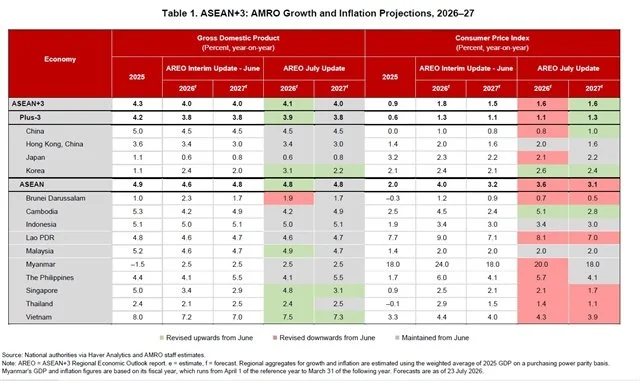
AMRO's July update compares its latest GDP growth and inflation forecasts for ASEAN+3 economies. — Source AMRO
The revised projection, up from 7.2 per cent in AMRO's June update, makes the Singapore-based research organisation the latest international institution to upgrade its outlook for Việt Nam following stronger-than-expected economic performance in the first half of the year.
Việt Nam's GDP grew 8.18 per cent in the first half of 2026, up from 7.63 per cent a year earlier, as growth accelerated from 7.83 per cent in the first quarter to 8.39 per cent in the second quarter.
AMRO also raised its forecast for 2027 growth to 7.3 per cent from 7.0 per cent, while lowering its inflation forecasts to 4.3 per cent for 2026 and 3.9 per cent for 2027.
The latest revision follows a series of more optimistic forecasts by international financial institutions.
Standard Chartered recently raised its projection for Việt Nam's GDP growth this year to 9.5 per cent, while Singapore-based UOB lifted its forecast to 8.5 per cent, reflecting confidence in the country's strong domestic demand, manufacturing activity and exports.
Although AMRO's forecast remains more conservative than those of Standard Chartered and UOB, it is above the World Bank's latest projection of 6.8 per cent and the Asian Development Bank's forecast of 7.2 per cent, highlighting growing confidence that Việt Nam will remain one of Asia's fastest-growing economies.
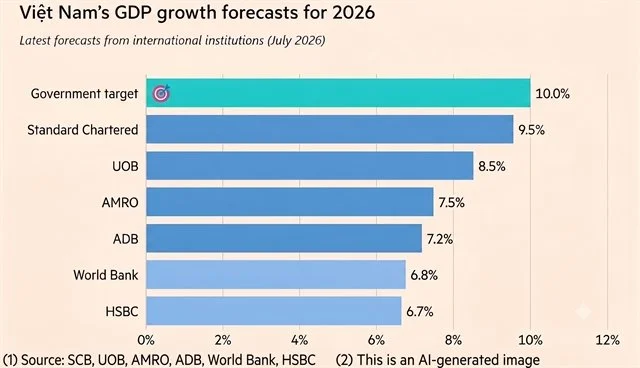
Việt Nam’s 2026 GDP growth forecasts from international institutions alongside the government’s target. — Source: Standard Chartered, UOB, AMRO, ADB, World Bank, HSBC
AMRO's revised outlook comes as it upgraded its forecast for the ASEAN+3 region – comprising the 10 ASEAN member states plus China, Japan and South Korea – to 4.1 per cent growth in 2026 from 4.0 per cent projected in June.
Regional growth is expected to ease slightly to 4.0 per cent next year, while headline inflation has been revised down to 1.6 per cent, pointing to lower global commodity price assumptions.
According to the report, the regional economy has remained resilient despite geopolitical tensions in the Middle East. Household spending has stayed firm, investment has continued to expand and exports have been supported by strong demand for semiconductors and other AI-related products.
At the same time, disruptions to energy and industrial input supplies have proved less severe than initially feared, allowing manufacturing activity to continue expanding.
"ASEAN+3 has remained resilient, supported by firm domestic demand and its central role in global AI supply chains," said AMRO Chief Economist Dong He.
"The impact of the Middle East conflict has also been less severe than initially expected, although elevated energy and input costs continue to pose risks to inflation and industrial activity."
The report said ASEAN+3 exports grew by nearly 20 per cent in the first quarter, with AI-enabling products accounting for almost two-thirds of the increase. Worldwide semiconductor sales also nearly doubled during the first five months of the year as investment in AI infrastructure accelerated.
Tourism also contributed to growth, with international arrivals across the region increasing 7.5 per cent in the first quarter. Việt Nam was among the strongest-performing destinations.
Despite the improved outlook, AMRO warned that significant uncertainties remain.
The organisation said renewed escalation of the Middle East conflict could drive up energy, shipping and food prices, while weaker-than-expected demand for AI-related products could weigh on exports and investment across the region.
AMRO highlighted the technology cycle as one of the biggest risks facing the regional economy.
Under a scenario in which global technology investment slows to its 2024 pace, ASEAN+3 growth could fall to 3.7 per cent in 2026 and 2.5 per cent in 2027, marking the region's weakest expansion since the Asian Financial Crisis, excluding the pandemic years.
The report also pointed to financial market volatility and rising protectionism as key downside risks.
Uncertainty over future US trade measures, together with possible tighter export controls and broader trade restrictions, could increase costs, disrupt regional supply chains and weigh on economic growth.
"The wide range of plausible outcomes underscores the importance of continued vigilance and sound macroeconomic policies," said He.
"Policymakers will need to respond flexibly to differing domestic conditions and rapidly evolving external risks, particularly the AI cycle and the Middle East conflict." — VNS
Seeds of Wisdom RV and Economics Updates Tuesday Afternoon 7-28-26
Good Afternoon Dinar Recaps,
U.S. Senate Delays CLARITY Act as Digital Asset Reform Waits Behind Russia Sanctions and Trump Nominees
The Senate temporarily paused consideration of the CLARITY Act to prioritize national security legislation and executive nominations, delaying one of the most significant cryptocurrency market structure bills in U.S. history. While supporters remain optimistic the legislation could still advance before the August 8 recess, the delay highlights the political hurdles facing the future of digital asset regulation.
Good Afternoon Dinar Recaps,
U.S. Senate Delays CLARITY Act as Digital Asset Reform Waits Behind Russia Sanctions and Trump Nominees
The Senate temporarily paused consideration of the CLARITY Act to prioritize national security legislation and executive nominations, delaying one of the most significant cryptocurrency market structure bills in U.S. history. While supporters remain optimistic the legislation could still advance before the August 8 recess, the delay highlights the political hurdles facing the future of digital asset regulation.
Overview
The U.S. Senate postponed procedural action on the CLARITY Act while prioritizing Russia sanctions legislation and a large package of Trump administration nominations.
Supporters still hope to pass the bill before the August 8 recess, but the legislative calendar has become increasingly compressed.
The delay underscores how digital asset regulation has become intertwined with broader political, regulatory, and national security priorities.
Key Developments
1. Senate Prioritizes National Security Agenda
Senate Majority Leader John Thune delayed movement on the CLARITY Act after filing cloture on a package of executive nominations while also advancing legislation related to new Russia sanctions. With limited legislative days remaining before the August recess, the crypto bill has temporarily moved behind higher-priority Senate business.
2. CLARITY Act Still Faces Political Challenges
Although negotiations over ethics provisions have progressed in recent weeks, Democratic concerns remain unresolved. Some lawmakers continue pushing for stronger state-level enforcement authority, while others remain concerned about stablecoin regulations, banking issues, and consumer protections.
The delay is procedural rather than a rejection of the legislation, but it reduces the margin for completing Senate action before lawmakers leave Washington.
3. Industry Continues to Push for Action
Major financial institutions and digital asset companies continue urging Congress to complete the legislation this year. Supporters argue the United States risks falling behind other countries that have already established comprehensive digital asset regulatory frameworks.
Several industry leaders warn that continued delays could postpone regulatory certainty well into 2027, potentially slowing investment, innovation, and institutional adoption within the United States.
4. Why the CLARITY Act Matters
The CLARITY Act is designed to establish clear federal rules governing digital assets, define regulatory responsibilities between agencies, and provide businesses with greater legal certainty.
Supporters believe the legislation would strengthen America's competitiveness in blockchain technology while encouraging responsible innovation under a unified regulatory framework.
Why It Matters
Clear financial rules are becoming increasingly important as digital assets move further into the mainstream financial system. While the Senate delay is temporary, the outcome of the CLARITY Act will influence how the United States regulates cryptocurrencies, tokenized assets, and future blockchain-based financial services.
For investors, financial institutions, and technology companies, regulatory certainty may prove just as important as market performance in determining long-term adoption.
Why It Matters to Foreign Currency Holders
Foreign currency holders continue watching U.S. financial reforms closely because modern payment infrastructure and digital asset regulations could eventually support faster, more transparent international settlement systems. Although the CLARITY Act does not directly involve currency revaluations, it represents another step toward modernization of the global financial architecture.
Implications for the Global Reset
Pillar 2: Trade
Clear digital asset regulations could improve cross-border commerce by supporting more efficient payment networks, settlement systems, and tokenized financial markets.
Pillar 4: Technology
The CLARITY Act represents continued progress toward integrating blockchain technology, digital assets, and tokenized finance into the broader financial system while establishing clearer regulatory oversight.
Closing Thought
The delay may have postponed the vote, but it has not slowed the broader transition toward regulated digital finance. As governments refine the rules governing digital assets, the foundation for the next generation of global financial infrastructure continues to take shape.
Seeds of Wisdom Team
Newshounds News™ Exclusive
Sources
CoinGape — Breaking: US Senate Puts CLARITY Act on Hold for Russia Sanctions Bill, Trump Nominations
U.S. Senate — Senate Floor Schedule and Legislative Proceedings
~~~~~~~~~~
Seeds of Wisdom Team RV Currency Facts Youtube and Rumble
Newshound's News Telegram Room Link
RV Facts with Proof Links Link
RV Updates Proof links - Facts Link
Start Here room with Most Asked Questions Link
Follow the Gold/Silver Rate COMEX
Follow Fast Facts
Seeds of Wisdom Team™Website
Thank you Dinar Recaps