
Iraq Economic News and Points To Ponder Tuesday Afternoon 7-28-26
Oil Drops Over $1 On US-Iran Peace Hopes
2026-07-28 Shafaq News Oil prices extended declines on Tuesday, down by over $1 per barrel amid hopes for a resolution in the U.S.-Iran war which significantly disrupted global energy flows.
Brent crude futures were down $1.47, or 1.66%, at $86.89 by 0326 GMT, their lowest since July 20. U.S. West Texas Intermediate crude was at $81.16 a barrel, down $1.45, or 1.76%, also the lowest level since July 20.
Oil Drops Over $1 On US-Iran Peace Hopes
2026-07-28 Shafaq News Oil prices extended declines on Tuesday, down by over $1 per barrel amid hopes for a resolution in the U.S.-Iran war which significantly disrupted global energy flows.
Brent crude futures were down $1.47, or 1.66%, at $86.89 by 0326 GMT, their lowest since July 20. U.S. West Texas Intermediate crude was at $81.16 a barrel, down $1.45, or 1.76%, also the lowest level since July 20.
Both contracts slid around 8% in the prior session after the U.S. abruptly suspended a campaign of air strikes against Iran over the weekend.
U.S. President Donald Trump said on Monday the United States was having "good talks" with Iran and that there was a chance of a resolution.
However, he said U.S. strikes would resume if negotiations failed while Iran issued similar comments about retaliation.
"For now, the relief that an off-ramp has been found has taken the heat out of prices and eased concerns around Houthi attacks on Saudi infrastructure.
However, the situation remains highly fluid," IG analyst Tony Sycamore said in a client note.
Afrah al-Zouba, the foreign minister-designate of Yemen's internationally recognised Saudi-backed government, said Yemen-based Houthi fighters aimed to replicate Iran's control of shipping through the Strait of Hormuz at Bab el-Mandeb.
"Whether the Houthis have the military capacity to enforce a comprehensive blockade is questionable, especially given that the Saudis will attack them relentlessly.
Still, there is no doubt that traffic has dropped off significantly in the Red Sea and the Strait of Hormuz," Marex analyst Edward Meir said.
"A key reason prices are not even higher than they are right now is the demand destruction that is taking place, especially in Asia," Meir said.
Also weighing down oil prices was news that the Caspian Pipeline Consortium's Black Sea terminal on the Russian coast has resumed oil loadings, after a one-week stoppage following Ukrainian drone attacks.
Still, analysts warned that the risks to supply disruptions spreading to the Red Sea remain elevated after Saudi Arabia said it shot down drones aimed at petroleum targets, including in Riyadh. It said they had been launched from Iraq by Iran-backed armed groups, and it reserved the right to respond.
Separately, Iran's Houthi allies in Yemen said they had targeted the East-West Pipeline carrying oil to Saudi Arabia's main Red Sea port of Yanbu in retaliation for Saudi drone incursions.
Barclays analysts said in a note on Monday "flows through the strait remain subdued".
They said, in the week ended July 24, crude oil and refined product net exports through the strait averaged 2.9 million barrels a day compared with 5.9 million in the previous week.
Elsewhere, U.S. crude oil stockpiles likely fell last week alongside gasoline, while distillate stocks likely rose, a preliminary Reuters poll showed on Monday. (REUTERS)
https://www.shafaq.com/en/Economy/Oil-drops-over-1-on-US-Iran-peace-hopes
Basrah Crudes Plunge Amid Global Oil Losses
2026-07-28 Shafaq News- Basrah Iraq’s Basrah crude tumbled more than 17% on Tuesday, while major global benchmarks declined.
Basrah Heavy crude dropped by $11.63, or 17.67%, to $54.19 per barrel, while Basrah Medium crude fell by $11.63, or 17.07%, to settle at $56.49 per barrel.
Brent crude futures declined by $1.47, or 1.66%, to $86.89 per barrel, while US West Texas Intermediate crude lost $1.45, or 1.76%, to $81.16 per barrel, with both benchmarks hitting their lowest levels since July 20.
https://www.shafaq.com/en/Economy/Basrah-crudes-plunge-amid-global-oil-losses
Gold Slips Ahead Of Fed Rate Decision
2026-07-28 02:41 Shafaq News Gold prices fell on Tuesday, pressured by a stronger dollar, while markets looked to the Federal Reserve's upcoming policy decision for clues on the interest rate outlook.
Spot gold fell 0.7% to $4,045.89 per ounce by 0448 GMT after rising as much as 1% on Monday. U.S. gold futures for August delivery lost 0.8% to $4,046.20.
The dollar held near a one-month high, making greenback-priced bullion more expensive for holders of other currencies.
"We're oscillating in this narrow range between $3,950 and $4,200, and I think the market is just waiting for Fed signals," said Ilya Spivak, head of global macro at finance content network Tastylive.
The U.S. Federal Reserve will conclude its two-day policy meeting on Wednesday. Expectations that the Fed will hold interest rates steady stand at 62%, while 38% of market participants expect at least a 25-basis-point rate hike, according to CME FedWatch, that is up from 16% a week earlier.
Markets are pricing in an 81% chance for a hike at the central bank's September meeting.
President Donald Trump on Monday called on the Fed to lower interest rates, saying the U.S. should have the lowest interest rate in the world.
Trump also said on Monday that the United States was having "good talks" with Iran and there was a chance of a deal to resolve their conflict, but warned that strikes would resume if negotiations failed to deliver.
Tehran appeared to quickly test the pause in the U.S. military campaign, with Saudi Arabia, Jordan and Iraq reporting drone attacks on Monday.
Spivak added that if the Fed meeting generates language that's not setting the groundwork for a rate hike in September, gold is likely to rally above $4,200 per ounce.
Spot silver fell 2% to $57.23 per ounce, platinum lost 0.9% to $1,605.93 and palladium slid 1.6% to $1,270.97. (REUTERS)
https://www.shafaq.com/en/Economy/Gold-slips-ahead-of-Fed-rate-decision
Diesel Shortage Worsens In Baghdad As Queues Lengthen
2026-07-28 Shafaq News- Baghdad (Updated) A Diesel shortage in Baghdad worsened on Tuesday as lines of vehicles outside fuel stations grew longer, part of a supply crisis affecting most of Iraq in recent days.
The shortage, which extends to Baghdad and several provinces, stems from higher domestic demand as private neighborhood generators consume more fuel during the summer, alongside reduced output at several oil refineries, energy specialist Asem Jihad told Shafaq News, adding that the government supplies Diesel free of charge to private generators under a program to support power provision for citizens, while also meeting the needs of other sectors that depend on the fuel.
“That has raised demand markedly at a time when domestic refineries cannot meet the full requirement, owing to limited production capacity and maintenance at some refining units.”
Read more: Fuel shortages paralyze Erbil gasoline stations
To cover the shortfall, the Ministry of Oil has turned to importing Diesel to sustain supply to private generators and local markets, Jihad said, considering this step a temporary measure until domestic refinery output increases and projects to develop the refining sector are completed.
Poor-quality Fuel Strains Iraq Generators
Owners of private electricity generators said the fuel used to run their machines has deteriorated in quality and become harder to obtain, causing repeated technical faults.
One owner, who runs three private generators, told Shafaq News that some of his machines had begun to run erratically because of the fuel, with sensors malfunctioning during operation and dragging down performance. "If the situation continues like this, we will be forced to stop the generators, because there is not enough fuel to run them."
Read more: Iraq’s energy emergency: Kerosene shortages disrupt power and daily life
https://www.shafaq.com/en/Economy/Kerosene-shortage-worsens-in-Baghdad-as-queues-lengthen
USD/IQD Exchange Rates Drop In Baghdad, Erbil
2026-07-28 04:13 Shafaq News- Baghdad/ Erbil The US dollar weakened against the Iraqi dinar on Tuesday morning, hovering around 150,000 dinars per $100 in Baghdad and Erbil, according to a Shafaq News market survey.
In Baghdad, the dollar traded at 149,900 IQD per $100 at the Al-Kifah and Al-Harithiya central exchanges, down from 150,050 IQD on Monday.
Exchange shops in the capital offered the dollar at 150,500 IQD per $100, with a buying price of 149,500 IQD.
In Erbil, the capital of the Kurdistan Region, the dollar was selling at 150,150 IQD per $100 and buying at 150,050 IQD per $100. https://www.shafaq.com/en/Economy/USD-IQD-exchange-rates-drop-in-Baghdad-Erbil-8-0
Ariel: The Operational Framework Unfolding
Ariel: The Operational Framework Unfolding
7-28-2026
The Operational Framework Unfolding: Implementation Phase Has Started
Operation Global Realignment
This moment stands as one of the most decisive inflection points in modern financial history. The impending Senate floor vote on the Crypto Clarity Act will codify regulatory certainty for digital assets in the United States, effectively dismantling the final legal barriers that have kept decentralized finance chained to the legacy fiat architecture.
Ariel: The Operational Framework Unfolding
7-28-2026
The Operational Framework Unfolding: Implementation Phase Has Started
Operation Global Realignment
This moment stands as one of the most decisive inflection points in modern financial history. The impending Senate floor vote on the Crypto Clarity Act will codify regulatory certainty for digital assets in the United States, effectively dismantling the final legal barriers that have kept decentralized finance chained to the legacy fiat architecture.
By removing regulatory ambiguity, the Act accelerates the migration of capital away from the parasitic Rothschild-controlled debt-based monetary system that has dominated global finance for over a century.
This shift will starve the old central-bank debt engine of its endless liquidity and force a painful but necessary reconfiguration of value storage worldwide.
The Japanese reverse carry trade, now entering its terminal phase, serves as the critical detonator. With the Bank of Japan openly committing to more frequent rate hikes beyond the previous six-month cadence, the yen carry trade that fueled cheap global borrowing for decades is being deliberately unwound. BoJ insider warnings from figures such as Yuto have proven accurate.
This constitutes an orchestrated collapse designed to trigger the broader Great Financial Reset. The dominoes are falling in sequence. Let’s get into it.
Impact on the Iraqi Dinar and Parallel Digital Transformation
– TheCrypto Clarity Act will create a parallel, regulated on-ramp for sovereign digital currencies and tokenized assets, directly benefiting Iraq’s dual-track strategy of currency redenomination and full digital migration.
– Iraq’s Deletion of 3 Zeros Project, which physically removes three zeros from the dinar while simultaneously launching a digital dinar on a blockchain-compliant ledger, gains immediate legitimacy and interoperability once U.S. regulatory clarity is established. This removes previous skepticism around sovereign digital currencies being treated as unregistered securities.
– The ASYCUDA Agreement (Automated System for Customs Data) signed with the World Trade Organization streamlines Iraq’s customs, taxation, and cross-border settlement processes. When layered atop the Clarity Act’s framework, it enables real-time, transparent dinar-denominated trade settlements that bypass traditional SWIFT bottlenecks still tied to legacy debt structures.
– Once the Senate vote passes, institutional capital currently sidelined by regulatory fear will flow into compliant crypto infrastructure. This capital will seek yield in undervalued, resource-backed digital sovereigns such as the new Iraqi dinar, whose oil reserves, reconstruction contracts, and WTO accession provide tangible collateral absent in most fiat experiments.
Read Full Article:
https://www.patreon.com/Prolotario1/posts/operational-has-165018168
https://dinarchronicles.com/2026/07/28/prolotario-the-operational-framework-unfolding/
Tuesday Iraq News Posted by Tishwash at TNT 7-28-2026
TNT:
Tishwash: The Foreign Minister and the US Chargé d'Affaires discuss ways to implement the memoranda of understanding signed between Baghdad and Washington.
Foreign Minister Fuad Hussein met with the Chargé d'Affaires of the US Embassy in Iraq, Joshua Harris, in Baghdad on Monday to discuss ways to implement the memoranda of understanding signed between Baghdad and Washington.
A statement from the Ministry of Foreign Affairs, reported by Al-Mirbad, indicated that "Foreign Minister Fuad Hussein received the Chargé d'Affaires of the US Embassy in Iraq, Joshua Harris, in Baghdad."
TNT:
Tishwash: The Foreign Minister and the US Chargé d'Affaires discuss ways to implement the memoranda of understanding signed between Baghdad and Washington.
Foreign Minister Fuad Hussein met with the Chargé d'Affaires of the US Embassy in Iraq, Joshua Harris, in Baghdad on Monday to discuss ways to implement the memoranda of understanding signed between Baghdad and Washington.
A statement from the Ministry of Foreign Affairs, reported by Al-Mirbad, indicated that "Foreign Minister Fuad Hussein received the Chargé d'Affaires of the US Embassy in Iraq, Joshua Harris, in Baghdad."
The statement added that "the meeting reviewed the results of the Iraqi delegation's visit, headed by the Prime Minister, to Washington, D.C., and assessed its outcomes, particularly the memoranda of understanding signed between the two sides, and ways to follow up on their implementation to enhance bilateral cooperation in various fields."
The statement continued, "The meeting also addressed the results of the Prime Minister's visit and the accompanying delegation to the Islamic Republic of Iran."
The statement concluded by noting that "the two sides discussed the course of Iraqi relations with both the Republic of Turkey and the Kingdom of Saudi Arabia, and the ongoing preparations for upcoming official visits, which will contribute to strengthening regional cooperation and developing bilateral partnerships."
The statement affirmed that "the two sides exchanged views on developments in the region, particularly those related to maritime security in the Strait of Hormuz, emphasizing the importance of avoiding escalation and maintaining regional security and stability."
The statement concluded by noting that "the meeting addressed the economic repercussions of regional developments and their potential impact on oil markets and the financial situation in Iraq."link
Tishwash: The US Treasury removes 84 names and entities, including some linked to Iraq, from sanctions list.
Announced Department of the Treasury The United States removed 84 individuals and entities, including some linked to Iraq, from its sanctions lists, which contain more than 17,000 names, as part of efforts to streamline sanctions programs and make things easier for banks.
And it was Minister of the Treasury Scott Bisent began a comprehensive review of the Department’s sanctions programs and lists last May, with the aim of removing outdated inputs and easing compliance burdens on financial institutions, and later announced the removal of 76 targets in the first phase of the review.
An official said Department of the Treasury The goal is "to ensure that the Department's sanctions remain effective, precise, and focused, and to eliminate unnecessary excesses left over from previous administrations," he said, noting that the number of names on the sanctions lists in 2024 exceeded 3,000, compared to only 880 in 2017. He added, "Sanctions are not meant to be an indefinite tool."
Bisent repeatedly emphasized the readiness President Donald Trump's administration To impose sanctions on the two largest oil companies in Russia Rosneft and Lukoil, a move they avoided Presidential Administration the previous Joe Biden Fearing a further rise in oil prices, the second batch of delistings from the "Specially Designated Nationals and Blocked Persons List" includes 36 deceased individuals and their associated listings, 33 Iraq-linked entities that were first listed in 1991 or 1992, and seven obsolete targets related to smuggling. drugs in Colombia The Treasury Department also added eight names of drug kingpins whose activities have been neutralized.
The Treasury’s Office of Foreign Assets Control (OFAC) updated the data of 22 individuals and entities to add or clarify key identifying information.
The Treasury Department stated that each removal from the list is subject to a review by other agencies to ensure it does not harm U.S. foreign policy or interests. National security She noted that names could be reinstated if necessary. link
************
Tishwash: Following security guarantees, Dana Gas restarts the Kormor gas field.
Dana Gas announced on Monday the gradual resumption of operations at the Kormor gas field in the Kurdistan Region, following an assessment of the security situation and receipt of official guarantees from the regional and federal governments.
The company said in a statement received by Al-Sa’a Network that “it was decided, after assessing the security situation and receiving official and clear guarantees from the highest levels in the Kurdistan Regional Government and the Iraqi Federal Government, to raise the level of production in the Kormor gas field cautiously and gradually.”
In mid-July, the UAE-based Dana Gas announced the temporary suspension of its operations at the main production facilities in the Kormor gas field in Sulaymaniyah Governorate, after receiving security threats, before deciding to gradually resume operations after obtaining security guarantees from the relevant authorities. link
**********
Tishwash: "Al-Maalomah" reveals the name of the candidate for the position of Minister of Defense in Al-Zaidi's government
Ahmed Abdul Sattar, a member of the United Anbar Alliance, revealed on Sunday the name of the Sunni forces' nominee for the Ministry of Defense in Prime Minister Ali al-Zaidi's government.
Abdul Sattar told Al-Maalomah News Agency that "the Sunni National Council held a meeting with Sunni leaders to reach a unified position on selecting a consensus candidate for the Ministry of Defense," explaining that "the consensus settled on nominating former Minister of Industry Khalid Battal al-Jughaifi for the ministerial post."
He added that "the vote on al-Jughaifi is scheduled to take place during the upcoming parliamentary session on the 15th of next month," noting that "Mohammed al-Halbousi, head of the Progress Alliance, received a delegation from the Badr parliamentary bloc and informed them of the selection of al-Jughaifi as the nominee for the Ministry of Defense."
He clarified that "the Sunni forces intend to inform the Coordination Framework forces and the Kurdish parties of the nominee in the coming period, with the name to be officially announced during the session to vote on the vacant ministerial portfolios in al-Zaidi's government."
He noted that "the forces within the Coordination Framework had demanded that their Sunni counterparts nominate their candidate for the position of Minister of Defense." link
Tishwash: Why is the "Asycuda" system controversial in Iraq? An advisor reveals the reasons.
Nabil Al-Khafaji, advisor to the head of the Baghdad Chamber of Commerce, revealed the reasons for the controversy surrounding the "ASYCUDA" system adopted in customs procedures, considering that the main problem lies in the difficulty of modifying data after it has been entered, despite the possibility of developing a more efficient local system.
Al-Khafaji said during a televised interview followed by Al-Sa’a Network that Iraq possesses the competencies and technical capabilities that qualify it to establish a better customs system, indicating that the ASYCUDA system is old and it is difficult to make modifications to it after the data has been recorded.
He added that "many developed countries do not adopt this system," noting that "Iraq was able to develop a local system that links all financial benefits and procedures more efficiently."
He explained that "the problem does not lie in entering the data, but in the mechanism for modifying it after it has been recorded," noting that "any error in the shipment information or the goods code (HS Code) becomes complicated to correct within the system."
Al-Khafaji explained that “errors are often caused by the data submitted by the source or exporting company, but the ASYCUDA mechanism makes dealing with these errors more difficult, which is reflected in the speed of completing customs transactions.” link
News, Rumors and Opinions Tuesday 7-28-2026
KTFA:
Clare: Channel 8 English:
Economic expert Haidar al-Sheikh predicted a "qualitative leap" for the Iraqi dinar, emphasizing that upcoming currency reforms and government efforts to absorb hoarded liquidity will fundamentally strengthen the national currency's purchasing power and market stability.
KTFA:
Clare: Channel 8 English:
Economic expert Haidar al-Sheikh predicted a "qualitative leap" for the Iraqi dinar, emphasizing that upcoming currency reforms and government efforts to absorb hoarded liquidity will fundamentally strengthen the national currency's purchasing power and market stability.
Tishwash: Mid-August is the deadline... the formation of the government enters its final stage.
7/27/2026
The issue of completing the cabinet has entered a new phase of political activity, following indications of a convergence of positions among the blocs regarding the vacant portfolios, at a time when attention is turning to the House of Representatives to resolve this long-awaited entitlement, amid expectations that the nominated names will be put to a vote during the middle of next August.
MP Ali Nahir said in a press statement followed by “Baghdad Today”, that “the completion of the ministerial cabinet will be in the middle of next month, especially after the understandings that took place between the political blocs regarding ministerial entitlements”, indicating that “its completion also means the completion of citizens’ rights.”
For his part, MP Jawad Rahim Al-Saadi said that “the completion of the cabinet was supposed to have taken place before the Prime Minister’s visit to the United States, but its resolution was postponed pending the arrival of the candidates’ names,” noting that “the number of remaining ministerial portfolios is nine.”
For his part, Walaa al-Jizani, deputy head of the Badr parliamentary bloc, confirmed that “the deliberations between the political blocs are still ongoing based on entitlements,” expecting to proceed with the vote on the remaining ministerial cabinet “in the middle of next August.”
This statement comes amid ongoing negotiations between political forces to complete the formation of the new government, after a number of ministerial portfolios were decided and other positions, including deputy prime ministers and some service ministries, remain subject to negotiation between blocs according to the principle of electoral entitlement and political balances, amid anticipation of the announcement of the final formula of the government cabinet in the coming days. LINK
*************
Courtesy of Dinar Guru: https://www.dinarguru.com/
Reset Intelligence An economic expert floated removing one zero from the dinar. No official has confirmed it...Removing a zero is a redenomination. It changes the face of the note, not what the note buys. It is not the reprice this community has waited on for 20 years. The rumor is the noise. The machinery is the story. The number on the note has not moved yet. The country underneath it is being rebuilt to carry a different one.
Boot-On-The-Ground Guru OmarThe CBI deputy governor said today...redenomination and revaluation...They gave us two big steps...Step #1: Redenomination...they gave us four categories for this. 1. The redenomination phase removes the three zeros from circulation from currency. 2. Technical and administrative cleanup. 3. New notes issued, old notes retired. 4. Zero change in the USD purchasing power. It labels change but value does not change. Step #2: Revaluation. 1. The CBI raises the official exchange rate. 2. This produces a real gain in the United States dollar terms. 3. This is the event holders are positioned for.
Mnt Goat Article: "...IRAQ AND THE UNITED STATES WILL SIGN THE LARGEST ECONOMIC AGREEMENT IN HISTORY" Quote: "...It will be the largest package of agreements and memoranda of understanding since the establishment of relations between the two countries...The package will also include the announcement of major American companies entering the Iraqi market, and the launch of broad investment opportunities in various sectors, which will contribute to revitalizing the economy..." Can you say RV, can you say WTO? WOW!
Final Silver CRASH Coming! $39/oz Likely | Chris Vermeulen
Liberty and Finance: 7-27-2026
Gold and silver may not have reached their final lows, according to technical analyst Chris Vermeulen, who warns that both metals could see another major leg down before the next long-term bull market begins.
Using Fibonacci analysis, he explains why silver could fall toward $40-$39 and gold toward $3,600-$3,300 despite growing bullish sentiment among investors.
Vermeulen also points to a weakening stock market, a strengthening U.S. dollar, and rising oil prices as potential catalysts for a broad market washout.
He discusses why panic selling could create one of the best long-term buying opportunities in years for precious metals.
Finally, Chris shares what indicators he's watching to determine when the next sustained bull market in gold and silver is ready to begin.
INTERVIEW TIMELINE:
0:00 Intro
1:10 Silver to $39?
8:00 Gold to $3300?
15:30 Stock market breakdown
19:30 Holding cash vs shorting stocks
21:18 The Technical Traders
Seeds of Wisdom RV and Economics Updates Tuesday Morning 7-28-26
Good Morning Dinar Recaps,
Federal Reserve Faces Critical Rate Decision as Markets Brace for Possible Surprise Hike
Global investors are entering one of the most closely watched Federal Reserve meetings in recent years as uncertainty grows over whether policymakers will hold interest rates steady or deliver an unexpected rate increase. While most economists still expect no immediate change, rising inflation risks and mixed market signals have fueled speculation that the Fed could take a more hawkish stance than many investors anticipate.
Good Morning Dinar Recaps,
Federal Reserve Faces Critical Rate Decision as Markets Brace for Possible Surprise Hike
Global investors are entering one of the most closely watched Federal Reserve meetings in recent years as uncertainty grows over whether policymakers will hold interest rates steady or deliver an unexpected rate increase. While most economists still expect no immediate change, rising inflation risks and mixed market signals have fueled speculation that the Fed could take a more hawkish stance than many investors anticipate.
Overview
Markets are increasingly divided over this week's Federal Open Market Committee (FOMC) meeting, with some analysts warning that a surprise rate hike remains possible.
Citadel Securities has suggested Federal Reserve Chair Kevin Warsh could strengthen the Fed's anti-inflation credibility with a 0.25% rate increase, despite expectations that rates will remain unchanged.
The outcome could influence borrowing costs, the U.S. dollar, Treasury yields, global capital flows, and financial markets worldwide.
Key Developments
1. Markets Prepare for One of the Most Uncertain Fed Meetings in Years
Investors are closely watching this week's Federal Reserve meeting as policymakers weigh whether inflation has cooled enough to justify keeping rates unchanged or whether additional tightening may still be necessary.
Although the consensus expectation remains for the Fed to leave rates unchanged, financial markets continue pricing a meaningful possibility that policymakers could deliver a surprise increase or signal that future rate hikes remain firmly on the table.
The uncertainty itself has become a major market driver, increasing volatility across bonds, equities, currencies, and digital assets.
2. Surprise Rate Hike Would Reinforce Inflation Fight
Citadel Securities argues that Chair Kevin Warsh could strengthen the Federal Reserve's inflation-fighting credibility by approving a 0.25% rate increase, demonstrating the central bank's commitment to restoring price stability.
Supporters of this view believe acting sooner rather than later could prevent inflation expectations from becoming embedded in the economy, particularly after recent geopolitical events temporarily pushed energy prices higher.
Other economists continue expecting rates to remain unchanged this week but acknowledge that another increase later this year remains possible if inflation proves more persistent than expected.
3. Several Economic Indicators Continue Pressuring the Fed
Federal Reserve officials continue monitoring several key indicators before making their decision.
Inflation remains above the Fed's long-term 2% target, while the labor market has remained relatively resilient despite higher borrowing costs. Earlier increases in energy prices resulting from Middle East tensions also contributed to renewed inflation concerns.
Additional factors—including tariffs, continued business investment in artificial intelligence infrastructure, and resilient consumer spending—have led some analysts to conclude that inflation risks remain elevated.
4. Global Financial Markets Await the Fed's Signal
The Federal Reserve's decision extends far beyond the United States.
Interest-rate policy influences Treasury yields, mortgage rates, automobile financing, business lending, credit-card borrowing, foreign exchange markets, precious metals, cryptocurrencies, and global investment flows.
Even if rates remain unchanged, investors will carefully analyze the Fed's statement and Chair Warsh's comments for clues regarding future policy decisions during the remainder of the year.
Why It Matters
The Federal Reserve effectively determines the global cost of money. Changes in U.S. interest-rate policy influence borrowing costs, investment decisions, inflation expectations, currency values, and capital flows throughout the world economy.
Because many international financial markets remain closely tied to the U.S. dollar, even modest policy changes can ripple through governments, corporations, financial institutions, and households worldwide.
Why It Matters to Foreign Currency Holders
Interest-rate decisions often influence the strength of the U.S. dollar relative to other currencies.
Higher rates can attract global capital into dollar-denominated assets, while lower rates may encourage investors to seek opportunities elsewhere. These shifts can affect currency valuations, precious metals, digital assets, and broader expectations surrounding future monetary policy.
Implications for the Global Reset
Pillar 1: Debt
Interest-rate decisions directly affect government borrowing costs, corporate financing, consumer debt, and the sustainability of historically high global debt levels.
Pillar 3: Assets
Federal Reserve policy influences investor demand for stocks, bonds, gold, cryptocurrencies, and other financial assets as markets continually adjust to changing expectations for inflation and economic growth.
Future Outlook
Markets will now focus on the Federal Reserve's policy announcement, Chair Warsh's press conference, and any revisions to the central bank's economic outlook. Investors will also continue monitoring inflation data, employment reports, and energy prices for clues about whether additional policy tightening may still lie ahead.
This is not simply about whether interest rates move by one-quarter of one percent—it reflects how the world's most influential central bank shapes global liquidity, borrowing costs, capital flows, and confidence across the international financial system.
Seeds of Wisdom Team
Newshounds News™ Exclusive
Sources
Business Insider — Why a Surprise Rate Hike Could Be Coming at Next Week's Fed Meeting
Yahoo Finance – Citadel Securities Sees Warsh Delivering Surprise Fed Rate Hike
~~~~~~~~~~
🌱 A Message to Our Currency Holders🌱
If you’ve been holding foreign currency for many years, you were not foolish.
You were not wrong to believe the global financial system would change.
What failed was not your patience — it was the information you were given.
For years, dates, rumors, and personalities replaced facts, structure, and proof. “This week” predictions created cycles of hope and disappointment that were never based on how currencies actually change.
That is not your failure.
Our mission here is different: • No dates • No rates • No hype • No gurus
Instead, we focus on:
• Verifiable developments • Institutional evidence
• Global financial structure • Where countries actually sit in the process
Currency value changes only come after sovereignty, trade, banking, settlement systems, and fiscal coordination are in place. History and institutions confirm this sequence.
You will see silence. You will see denials. That is not delay — that is discipline.
Protect your identity. Organize your documents. Verify everything.
Never hand your discernment to anyone who cannot show proof.
You deserve truth — not timelines.
Seeds of Wisdom Team
Newshounds News
~~~~~~~~~~
Seeds of Wisdom Team RV Currency Facts Youtube and Rumble
Newshound's News Telegram Room Link
RV Facts with Proof Links Link
RV Updates Proof links - Facts Link
Start Here room with Most Asked Questions Link
Follow the Gold/Silver Rate COMEX
Follow Fast Facts
Seeds of Wisdom Team™Website
Thank you Dinar Recaps
Why They Won't Even Fix the Easy Stuff
Why They Won't Even Fix the Easy Stuff
Notes From the Fied By (Simon Black / Sovereign Man) July 27, 2026
The Department of Transportation's headquarters campus in Washington spans two complexes covering 1.8 million square feet across 11-acre of prime DC real estate. In the private sector, such a trophy office property would fetch north of $1 billion per year in rental income.
Yet for the federal government, two-thirds of the space sits empty according to the Government Accountability Office (GAO), the federal government's own internal watchdog. This is based on real data; the GAO toured the department's buildings last fall and counted the empty desks.
Why They Won't Even Fix the Easy Stuff
Notes From the Fied By (Simon Black / Sovereign Man) July 27, 2026
The Department of Transportation's headquarters campus in Washington spans two complexes covering 1.8 million square feet across 11-acre of prime DC real estate. In the private sector, such a trophy office property would fetch north of $1 billion per year in rental income.
Yet for the federal government, two-thirds of the space sits empty according to the Government Accountability Office (GAO), the federal government's own internal watchdog. This is based on real data; the GAO toured the department's buildings last fall and counted the empty desks.
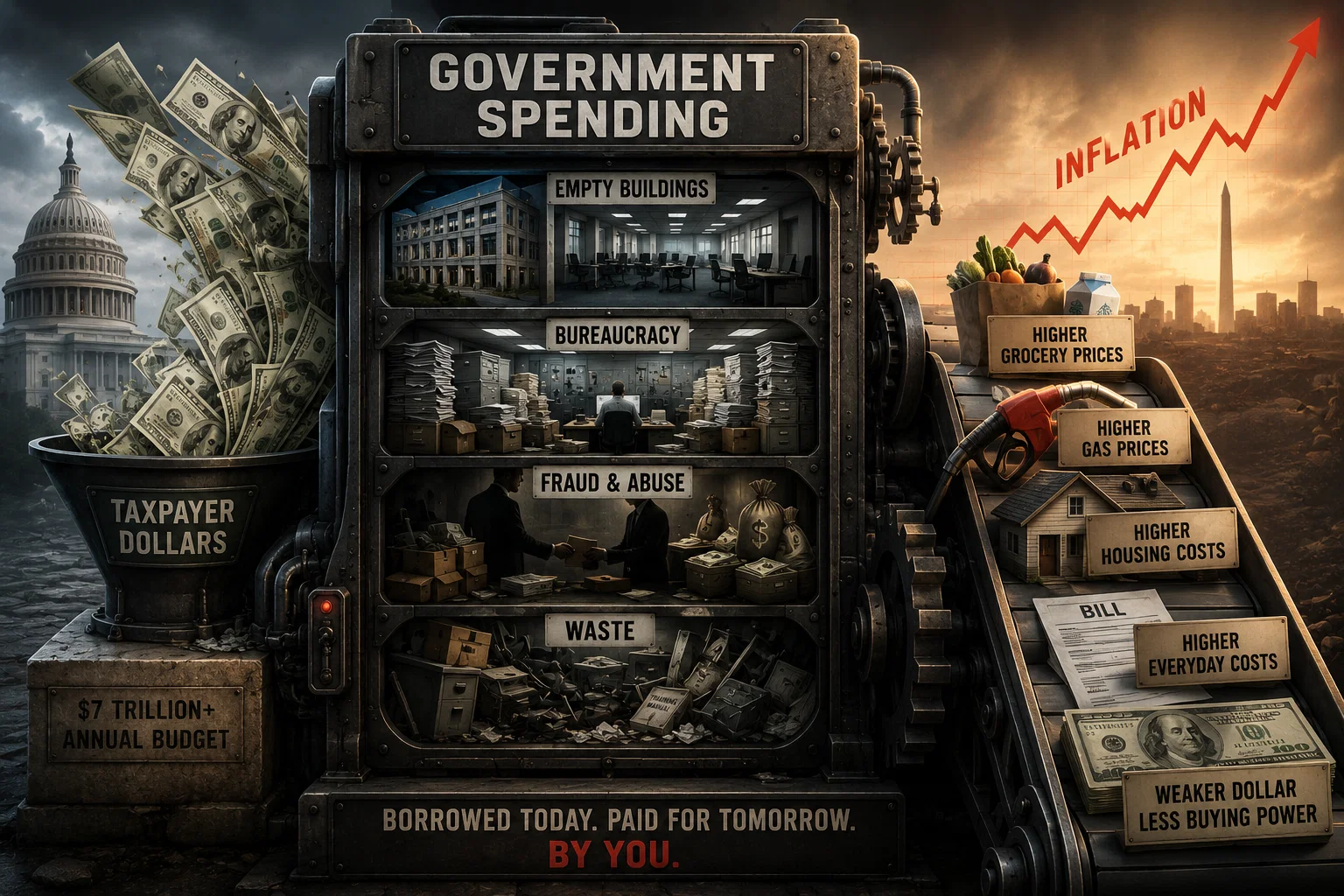
And this is far from an isolated case. Of the 189 government buildings around the country that were analyzed by the GAO, 168 were underutilized— with occupancy averaging just 37%.
One of the worst offenders is One Aviation Plaza in Queens, which sits at 13% occupancy.
Ironically, Congress actually set a MINIMUM standard for all government buildings to be at least 60% occupied. This is the law of the land in the United States, set by the 2023 USE IT Act.
So, Congress was surprisingly trying to make things more efficient and save taxpayer money— potentially billions each year. They passed a law. But the government doesn't follow it.
The big consequence for the government violating its own law so far has been this GAO report. Nobody was fined, nobody was fired, and nothing was sold. Basically we got a PDF.
And all of that is just one category of waste at just one department. The bigger losses are to outright fraud.
In June, the Justice Department announced a record-setting healthcare fraud takedown: 455 defendants, the most ever charged in a single healthcare fraud operation, including 90 doctors and licensed medical professionals, all accused in schemes involving $6.5 billion in fraudulent claims.
Yet federal agents only managed to seize $182 million in cash and assets. No word on what happened to the other $6.3 billion.
By the government's own accounting, federal agencies made close to $200 billion in improper payments in fiscal year 2025 alone... $24 billion more than the year before.
That's money which should never have gone out the door, went out in the wrong amount, or can't be documented. And that was only across 64 programs at 15 agencies... a small fraction of the government's total footprint.
This keeps happening for a simple reason: the federal government's ~$7 trillion annual budget is too vast for anyone to keep track of... and no one is ever held accountable.
Bureaucrats who waste the money never get fired; in fact it is damn near impossible to fire a federal employee. And voters continue electing the same incompetent, crooked politicians to public office.
Even when there's public outcry over obvious fraud, the legacy media closes ranks around their party and insists that voters are racist for criticizing "Learning Centers".
None of this is free. The empty buildings, the stolen billions, the money nobody can track: it all gets paid for with borrowed money. And that deficit spending is what fuels inflation.
June's Consumer Price Index came in at 3.5%. By the Fed's own admission, inflation has now missed its 2% target for five years running.
And after all that failure, few in Washington will name the cause.
A lot of people blame oil, especially after the war with Iran sent crude above $126 a barrel. But oil has been all over the board for the last five years; it was under $60 a barrel just last fall. So why wasn't inflation falling when oil was cheap?
Because, through all of it, there has been exactly one constant: insane levels of government spending. Deficits keep rising, and the more money the government wastes, the more stubborn inflation becomes.
The central bank can't fix that; the Fed doesn't pass spending bills, Congress does. And as long as the spending stays out of control, inflation is not coming down.
And Washington has shown no appetite to bring it under control. They refuse to cut even the easiest, most obvious waste and fraud.
Nothing about this changes on its own. A government that can't bring itself to sell an empty building is not going to take on the spending that actually matters, and inflation is how they'll pay for the difference.
Which is exactly why it makes so much sense to own the real assets that hold their value when the dollar doesn't: gold, silver, and well-managed, productive businesses.
It's definitely time to be thinking about a Plan B.
To your freedom, James Hickman Co-Founder, Schiff Sovereign LLC
P.S. Our flagship service, Plan B Confidential, is built for exactly this: real asset strategies to protect your savings from Washington's spending, and residency options in countries where your money buys far more. It's backed by boots-on-the-ground research from all over the world—
The Gold Reset Already Happened and Almost Nobody Noticed | Willem Middelkoop
The Gold Reset Already Happened and Almost Nobody Noticed | Willem Middelkoop
Kitco News: 7-27-2026
Willem Middelkoop says the monetary reset isn't coming. It's already underway, quietly, in the accounting. He also argues China is now the dominant force in the gold market, buying on every dip while the West still trades paper.
Kitco's Jeremy Szafron sits down with Willem Middelkoop, author of "The Big Reset" and founder of the Commodity Discovery Fund, for a wide-ranging hour on why both Washington and Beijing may want a cheaper gold price, the state gold buyers that don't show up in official numbers, gold overtaking US Treasuries as the world's top reserve asset, the move of price discovery to Shanghai, China's shift from paper to physical, silver's path to a possible $500, and where the gold miners go from here.
The Gold Reset Already Happened and Almost Nobody Noticed | Willem Middelkoop
Kitco News: 7-27-2026
Willem Middelkoop says the monetary reset isn't coming. It's already underway, quietly, in the accounting. He also argues China is now the dominant force in the gold market, buying on every dip while the West still trades paper.
Kitco's Jeremy Szafron sits down with Willem Middelkoop, author of "The Big Reset" and founder of the Commodity Discovery Fund, for a wide-ranging hour on why both Washington and Beijing may want a cheaper gold price, the state gold buyers that don't show up in official numbers, gold overtaking US Treasuries as the world's top reserve asset, the move of price discovery to Shanghai, China's shift from paper to physical, silver's path to a possible $500, and where the gold miners go from here.
CHAPTERS
0:00 Gold's Wild Year
0:50 Meet Willem Middelkoop
1:46 Big Reset Thesis
3:56 Central Banks Drive Gold
6:57 Hidden China Gold Hoard
9:34 Reset Through Accounting
13:21 US Gold Politics
17:13 Custody and Sanctions Risk
19:03 BRICS Parallel Rails
22:57 China Shifts to Physical
28:27 Hong Kong Clearing and mBridge
30:23 Gold for Trade Settlement
32:56 Debt Crisis Warning
33:39 Gold Bonds Speculation
34:56 Gold Replaces Treasuries
36:22 Peak Supply Metals
37:05 Silver Shortage Signals
39:48 Paper Market Breakdown
42:29 Perfect Storm Thesis
45:29 Miners Leverage Valuations
47:38 Mergers Discovery Arbitrage
54:00 China Buys in Ground
56:40 China Russia Calculus
1:00:47 Investor Takeaways
1:03:40 Closing
FRANK26….7-27-26……WHAT DO YOU THINK?
KTFA
Monday Night Video
FRANK26….7-27-26……WHAT DO YOU THINK?
Intel Starts about minute 16:00
This video is in Frank’s and his team’s opinion only
Frank’s team is Walkingstick, Eddie and Omar in Iraq and guests
KTFA
Monday Night Video
FRANK26….7-27-26……WHAT DO YOU THINK?
Intel Starts about minute 16:00
This video is in Frank’s and his team’s opinion only
Frank’s team is Walkingstick, Eddie and Omar in Iraq and guests
Playback Number: 605-313-5163 PIN: 156996#
Iraq Economic News and Points To Ponder Monday Evening 7-27-26
Masrour Barzani renews his support for the Zaidi government in combating corruption, and demands that Baghdad assume its responsibility in protecting the Kurdistan Region from the threat of drones - 7/27/2026
Latest News Monday, July 27, 2026 Erbil - One News - The Prime Minister of the Kurdistan Region, Masrour Barzani, announced his government’s support for the steps taken by Prime Minister Ali Zaidi’s government in combating corruption, stressing the region’s readiness to provide assistance and cooperation with the federal government to address outstanding problems in a final and radical manner.
Masrour Barzani renews his support for the Zaidi government in combating corruption, and demands that Baghdad assume its responsibility in protecting the Kurdistan Region from the threat of drones - 7/27/2026
Latest News Monday, July 27, 2026 Erbil - One News - The Prime Minister of the Kurdistan Region, Masrour Barzani, announced his government’s support for the steps taken by Prime Minister Ali Zaidi’s government in combating corruption, stressing the region’s readiness to provide assistance and cooperation with the federal government to address outstanding problems in a final and radical manner.
Barzani said that the Kurdistan Region supports the federal government and seeks to strengthen cooperation with it, stressing that the region calls for resolving the crises that the region is going through peaceful means, away from escalation and wars.
On the security front, Barzani held the federal government responsible for averting the threat of drones targeting the region, stressing that Kurdistan is not a party to the war, and that his government has demanded respect for the region’s sovereignty and the prevention of the use of Iraqi territory or airspace to target it.
He added that the continued drone attacks require Baghdad to take practical measures to protect the security of the region and its citizens, reiterating the call to adopt dialogue and peaceful solutions to address the region's crises.
On the economic front, Barzani pointed out that the fuel quota allocated to the region by the federal government is not sufficient to cover local consumption, noting that the regional government has requested an increase in the quantities sent.
The regional government chief attributed the rise in fuel prices to the crises and tensions in the region, and the resulting pressure on supplies and markets.
Barzani affirmed that the regional government is committed to supporting and cooperating with the al-Zaidi government, both in combating corruption and in addressing financial and security disputes, in order to contribute to maintaining stability and reaching lasting solutions to the outstanding issues between Baghdad and Erbil.
https://1news-iq.net/مسرور-بارزاني-يجدد-دعمه-لحكومة-الزيدي/
PM Barzani: Erbil-Bound Drones Sent From Nineveh
2026-07-27 / 04:30 Shafaq News- Erbil Kurdistan Region Prime Minister Masrour Barzani on Monday said some drones targeting Erbil were launched from Nineveh province, urging the federal government to stop armed IRI groups from using Iraqi territory to “threaten” the Region.
Speaking at a press conference, Barzani stated that the Kurdistan Regional Government (KRG) had sought an air-defense system through Baghdad and several foreign governments but was not permitted to acquire one, although defensive systems alone “will not end the threat.”
On July 24, Global Coalition air defenses shot down five explosive drones over Erbil, according to the Kurdistan Region’s Counter-Terrorism Directorate, which reported that the aircraft approached from west of the province and caused no casualties, although falling debris ignited dry vegetation.
Around 20 drone and missile attacks have targeted the Kurdistan Region since July 17, including US-linked sites around Erbil and Iranian-Kurdish opposition bases in Erbil and Al-Sulaymaniyah. The strikes killed at least nine people and wounded six, all members of Iranian-Kurdish opposition groups.
Iran’s army has taken responsibility for attacks on US infrastructure and Iranian-Kurdish opposition groups, but no Iraqi IRI armed faction has claimed the strikes. (so they can't be blamed and give the GOI leverage to remove their arms) Kataib Sayyid Al-Shuhada denied (they lie outright) on July 17 that any operation had been launched from Iraqi territory, while Saraya Awliya Al-Dam rejected reports linking it to the attacks on July 25 as false and unsupported by evidence.
Read more: Two weeks of attacks on Iraqi Kurdistan, Iran claims US damage
https://www.shafaq.com/en/Kurdistan/PM-Barzani-Erbil-bound-drones-sent-from-Nineveh
Salaries Await Liquidity... Funding Crisis Delays Employee Payments
Baghdad Today - Baghdad An informed source revealed today, Monday (July 27, 2026), that the salaries of most state employees for this month have been delayed, despite the month having ended, attributing this to a lack of financial liquidity and a decline in public revenues.
The source told Baghdad Today that the delay in paying salaries is due to the repercussions of the war between the United States and Iran, and the accompanying closure of the Strait of Hormuz, which affected oil exports and contributed to a decline in financial revenues, making it difficult to provide the necessary liquidity to release employee salaries.
He added that the Ministry of Finance had announced on the 22nd of this month the release of funding for the salaries of state employees, but a large number of institutions have not yet been able to disburse the dues of their employees, due to the continued financial liquidity crisis. https://baghdadtoday.news/303975-.html
MP Miqdad Al-Khafaji Demands The Ministry Of Finance Explain The Reasons For The Delay In Salary Payments.
House of Representatives, Office of the Minister
Dr. Miqdad Al-Khafaji, Surgeon House of Representatives Najomeh Ne Nushtiran
Republic of Iraq Council of Representatives ۸۰۹ Number: Date: 26/7/2026
Greetings... To: Ministry of Finance / Minister's Office
Subject: Clarification and Follow-up on the Reasons for the Delay in Salary Disbursement
Based on the provisions of Article (61/Second) of the Constitution of the Republic of Iraq of 2005 and the provisions of Articles (15) and (27) of the Law of the House of Representatives and its Formations No. (13) of 2018, and based on the numerous appeals and complaints received by our office from employees, retirees, and social welfare beneficiaries,
We kindly request your review and explanation of the reasons for the monthly delay in releasing and distributing the salaries of employees, retirees, and beneficiaries, which has negatively and directly impacted the daily lives of citizens and their ability to meet their basic financial obligations
We also request the swift establishment of a specific and urgent regulatory mechanism, obligating all ministries, non-ministerial entities, and governorates to adhere to the specified annual and monthly deadlines for submitting payroll lists and receiving notifications, with a fixed and specific date designated each month for disbursing entitlements without any delay. as required by law.
We kindly request your response, along with detailed reasons for the delay, within the legally specified period, so that we may inform the public and take With utmost respect and appreciation
Deputy Dr. Al-Kharaj Miqdad Al-Khafaji Please be advised... With appreciation. Speaker of the House of Representatives and his deputies - O Administration - For filing
Due To A Lack Of Liquidity, The Ministry Of Finance Postpones Salary Payments, And Parliament Moves To Summon The Minister.
Today 12:35 Information / Baghdad... An informed source reported on Monday that the Ministry of Finance and the Accounting Department have decided to postpone the disbursement of salaries for employees of ministries and government departments for three days due to a temporary shortage of cash liquidity.
The source told Al-Maalomah that "this measure prompted the Parliamentary Finance Committee to take urgent action, as it intends to summon the Minister of Finance and the Directors General of the Accounting and Budget Departments in the coming hours."
The source added that "the summons will be held within the committee or in the Parliament building to provide an urgent briefing to the public and the legislative authority regarding the current cash liquidity situation and the reasons that led to this emergency halt in the salary funding process." End/25
Salary Phobia: Citizens Are Apprehensive, But The Government Reassures: It Has Been Thoroughly Reviewed Before Distribution.
Information / Special.. The financial advisor to the Prime Minister, Mazhar Muhammad Saleh, revealed today, Monday, the reasons for the delay in disbursing employee salaries during the current month and previous months, while reassuring citizens that the disbursement of salaries cannot be delayed for more than a month.
Saleh told Al-Maalomah that “the delay in salaries is due to regulatory financial procedures related to auditing and preparing the salaries of each ministry and institution government within what is known as the (trial balance), which includes each ministry’s share of salaries and disbursement units.”
He added that "there are about 1,000 disbursement units in Iraq, all of which are included in the trial balance, and then submitted to the General Accounts Department for detailed auditing in accordance with the highest standards of financial governance."
Saleh explained that "the trial balance includes the number of employees, their salary costs, promotions, bonuses, and all details related to the monthly salary," noting that "the audit process may be repeated once or twice to verify the funds before they are disbursed monthly after the procedures are completed."
He pointed out that "the state provides financial allocations to employees of companies that have been shut down since 2003, as a result of the declining economic and investment policies in the country, which have not provided solutions for these companies to return to production and benefit from them locally or through export."
Saleh pointed out that “the total amount allocated to the salaries of state employees in its various formations, in addition to the salaries of retirees, beneficiaries of the social protection network, wages, and grants, amounts to about 8 trillion Iraqi dinars.”
The Prime Minister's financial advisor emphasized that "salaries must remain a red line for the government, as they represent a source of livelihood for approximately 40 million Iraqi citizens," explaining that "the state's fiscal policy is concerned with addressing any liquidity shortfalls and securing the necessary funds through various means, whether through domestic or external borrowing." (End of page 25)
From Oil Dominance To A Diversified Economy: Al-Zidi's Government Aims To Raise Non-Oil Revenues To 46% And Expand Private Sector Contribution Over The Next Decade
latest newsMonday,July 27, 2026Baghdad - One News - The Prime Minister’s Advisor for Financial and Economic Affairs, Mazhar Muhammad Salih, revealed a long-term governmental plan to restructure public finances and the Iraqi economy over the next ten years, by diversifying revenue sources and reducing dependence on oil, in parallel with expanding the role of the private sector and increasing its contribution to the gross domestic product.
Saleh said that the government’s fiscal policy aims, during the next decade, to achieve economic stability and sustainable development, through restructuring public expenditures and revenues, and adopting the federal budget as a tool to reorganize the real economy and revitalize the productive sectors.
He explained that the financial track includes two main objectives; the first is to raise the share of non-oil revenues to about 46% of total public revenues, compared to a percentage that does not exceed 10% or less currently, in order to limit the impact of oil price fluctuations and the volatility of its revenues on public finances.
The second objective is to raise the private sector’s contribution to GDP from about 37% currently to 54% over the next ten years, by expanding the investment and production environment and promoting economic activity outside the government sector.
Saleh pointed out that revitalizing the productive sectors would provide sustainable job opportunities and reduce the unemployment rate to about 3% of the total workforce, instead of its current level of about 13%.
According to the government's proposal, these goals reflect an effort to reshape the structure of the Iraqi economy and gradually move from a model heavily reliant on oil revenues and public spending to a more diversified economy driven by broader productive and investment sectors. https://1news-iq.net/من-هيمنة-النفط-إلى-اقتصاد-متنوع-حكومة/
Seeds of Wisdom RV and Economics Updates Monday Evening 7-27-26
Good Evening Dinar Recaps,
Global Regulators Accelerate Digital Money Framework as Stablecoins Reshape Financial System
Governments and financial regulators are moving rapidly to establish common rules for digital money as stablecoins become an increasingly important part of the global financial system. New U.S. legislation, combined with guidance from international institutions, signals that digital assets are transitioning from an emerging technology into regulated financial infrastructure.
Good Evening Dinar Recaps,
Global Regulators Accelerate Digital Money Framework as Stablecoins Reshape Financial System
Governments and financial regulators are moving rapidly to establish common rules for digital money as stablecoins become an increasingly important part of the global financial system. New U.S. legislation, combined with guidance from international institutions, signals that digital assets are transitioning from an emerging technology into regulated financial infrastructure.
Overview
The United States has established its first federal framework for payment stablecoins through the GENIUS Act, while lawmakers continue advancing the CLARITY Act to define broader digital asset regulation.
The Bank for International Settlements (BIS) and the International Monetary Fund (IMF) are encouraging countries to modernize payment systems while maintaining public confidence, financial stability, and effective oversight.
Together, these developments represent another major step toward a more digital, interconnected global financial system.
Key Developments
1. GENIUS Act Creates America's First Stablecoin Framework
The GENIUS (Guiding and Establishing National Innovation for U.S. Stablecoins) Act establishes the first comprehensive federal framework governing payment stablecoins in the United States.
The legislation requires qualifying stablecoins to maintain one-to-one backing with high-quality liquid assets, such as U.S. dollars and short-term U.S. Treasury securities. Issuers must also provide regular reserve disclosures and comply with anti-money laundering and financial reporting requirements.
Supporters believe the law provides long-awaited regulatory certainty that could encourage broader adoption of compliant digital payment systems by banks, businesses, and financial institutions.
2. CLARITY Act Would Define the Digital Asset Marketplace
While the GENIUS Act focuses specifically on payment stablecoins, the CLARITY Act seeks to establish a comprehensive regulatory framework for digital assets.
The proposed legislation would define whether digital assets fall under the jurisdiction of the Securities and Exchange Commission (SEC) or the Commodity Futures Trading Commission (CFTC), reducing years of regulatory uncertainty.
Lawmakers continue negotiating ethics provisions and other amendments as bipartisan discussions move forward in the Senate. Although additional legislative steps remain, the bill represents one of the most significant efforts to modernize U.S. digital asset regulation.
3. BIS Calls for Trust as the Foundation of Digital Money
The Bank for International Settlements (BIS) has emphasized that the future of digital money depends not only on technological innovation but also on maintaining public trust, legal certainty, and financial stability.
Rather than replacing existing monetary systems, the BIS envisions digital payment innovations operating within a unified financial framework where commercial banks, central banks, and regulated private institutions remain interconnected.
The BIS has also highlighted the importance of interoperability, secure settlement systems, and internationally coordinated standards as digital finance expands across borders.
4. IMF Sees Stablecoins Transforming Cross-Border Payments
The International Monetary Fund (IMF) has continued studying how stablecoins could improve cross-border payments by reducing settlement times and lowering transaction costs.
At the same time, IMF researchers caution that rapid growth without appropriate regulation could create new risks involving monetary policy transmission, capital flows, consumer protection, and financial stability.
The IMF encourages countries to develop balanced regulatory frameworks that support innovation while preserving confidence in national monetary systems.
Why It Matters
Digital money is steadily moving from experimentation into mainstream finance. Governments are increasingly choosing regulation over prohibition, recognizing that digital payment technologies are likely to become permanent components of the international financial system.
As national frameworks become more consistent, financial institutions may gain greater confidence to expand tokenized payments, programmable finance, and regulated digital asset services.
Why It Matters to Foreign Currency Holders
For those following international monetary developments, these reforms represent foundational infrastructure rather than immediate currency revaluations.
Clearer regulatory standards, stronger payment networks, and improved cross-border settlement systems could gradually reshape how currencies move through the global economy while supporting broader financial modernization over time.
Implications for the Global Reset
Pillar 2: Trade
More efficient cross-border payment systems could reduce transaction costs, improve settlement speed, and strengthen international commerce.
Pillar 4: Technology
Digital ledgers, tokenization, regulated stablecoins, and programmable settlement are becoming increasingly important components of the next generation of global financial infrastructure.
Future Outlook
Attention now turns to continued Senate consideration of the CLARITY Act, implementation of the GENIUS Act, and ongoing international coordination among regulators, central banks, and financial institutions. As regulatory clarity expands, adoption of compliant digital payment systems is expected to accelerate across both domestic and international markets.
This is not simply about cryptocurrency—it reflects the broader modernization of the global financial system as governments, regulators, and financial institutions work to build the trusted digital infrastructure that may support the next generation of international commerce and payments.
Seeds of Wisdom Team
Newshounds News™ Exclusive
Sources
~~~~~~~~~~
Seeds of Wisdom Team RV Currency Facts Youtube and Rumble
Newshound's News Telegram Room Link
RV Facts with Proof Links Link
RV Updates Proof links - Facts Link
Start Here room with Most Asked Questions Link
Follow the Gold/Silver Rate COMEX
Follow Fast Facts
Seeds of Wisdom Team™Website
Thank you Dinar Recaps
Major Market Repricing Alert, Global Economy Changed Forever-The Reset Begins.
Major Market Repricing Alert, Global Economy Changed Forever-The Reset Begins.
David Lin: 7-27-2027
In a highly insightful interview on the David Lin Report, financial expert John Butler sat down to discuss the complex web of geopolitical risks, macroeconomic policy, and market valuations currently shaping the global economy.
As investors navigate increasingly volatile market conditions, Butler provides a sobering look at how underlying systemic issues—ranging from trade disruptions to unsustainable global debt—are building toward a major paradigm shift. This discussion serves as a crucial guide for those looking to protect their wealth in an unpredictable economic landscape
Major Market Repricing Alert, Global Economy Changed Forever-The Reset Begins.
David Lin: 7-27-2027
In a highly insightful interview on the David Lin Report, financial expert John Butler sat down to discuss the complex web of geopolitical risks, macroeconomic policy, and market valuations currently shaping the global economy.
As investors navigate increasingly volatile market conditions, Butler provides a sobering look at how underlying systemic issues—ranging from trade disruptions to unsustainable global debt—are building toward a major paradigm shift. This discussion serves as a crucial guide for those looking to protect their wealth in an unpredictable economic landscape
One of the most pressing concerns highlighted by Butler is the vulnerability of critical global trade routes. Asymmetric control over key maritime choke points, such as the Strait of Hormuz and the Bab al-Mandab, has introduced unprecedented friction into global supply chains.
By restricting the flow of vital commodities—including crude oil, fertilizers, and petrochemical products—these geopolitical tensions are actively fueling stagflationary pressures worldwide. Unlike routine market corrections, shipping disruptions of this magnitude create structural supply deficits that keep consumer prices elevated, proving that geopolitical risk is no longer just a hypothetical concern but an active driver of global inflation.
Despite these clear systemic threats, Butler argues that global markets have yet to accurately price in these risks. Equity valuations remain stubbornly elevated, buoyed largely by waves of speculative enthusiasm. Butler specifically points to the current artificial intelligence (AI) boom, characterizing much of the market excitement as an overblown hype bubble.
While AI technology holds genuine long-term promise, the extreme premium currently placed on speculative tech stocks ignores the immediate reality of rising operational costs, supply chain vulnerabilities, and tightening liquidity, leaving portfolios heavily exposed to sudden downward corrections.
Beneath the surface of market optimism lies a deeper, structural threat: the unsustainable rise of sovereign government debt across major Western economies, including the United States, the United Kingdom, and the European Union.
Butler warns of impending debt spirals and fiscal crises as governments continue to issue massive amounts of debt to fund persistent structural deficits. This fiscal strain is occurring alongside a historic shift in global power dynamics.
The world is rapidly transitioning from a unipolar system dominated by Western financial institutions to a multipolar order, forcing a recalibration of international trade alliances and foreign policies while introducing further friction into the global financial architecture.
In this environment of fiscal instability and shifting power, Butler maintains a strongly bullish outlook on precious metals over the long term. While near-term interest rate hikes by central banks may temporarily suppress the price of gold and silver, the fundamental drivers remain historically strong.
Decades of neo-Keynesian inflationary policies—characterized by persistent deficit spending and central bank intervention—have eroded the purchasing power of fiat currencies. Because these inflationary monetary policies are unlikely to be reversed by governments anytime soon, precious metals remain a vital, non-dilutable hedge against currency devaluation.
Ultimately, Butler advocates for a strategic pivot in investment philosophy. Rather than chasing momentum in overvalued and speculative sectors, he advises investors to focus on real assets that possess inherent pricing power.
This includes physical precious metals, energy resources, and basic commodities that are absolutely essential for maintaining daily societal functions. In an era marked by lower average valuations and heightened macroeconomic volatility, wealth preservation requires a historically informed approach focused on tangible utility and supply-demand fundamentals.