Rob Cunningham: Changing the World’s Broken Money System
Rob Cunningham: Changing the World’s Broken Money System
6-29-2026
Changing the world’s broken money system is not like changing software.
It is more like changing the operating system of civilization while the airplane is still flying.
A debt-based fiat system depends on (con)fidence, credit expansion, centralized liquidity, sovereign bond markets, banking collateral, FX pricing, payment rails, legal definitions, and institutional trust.
Rob Cunningham: Changing the World’s Broken Money System
6-29-2026
Changing the world’s broken money system is not like changing software.
It is more like changing the operating system of civilization while the airplane is still flying.
A debt-based fiat system depends on (con)fidence, credit expansion, centralized liquidity, sovereign bond markets, banking collateral, FX pricing, payment rails, legal definitions, and institutional trust.
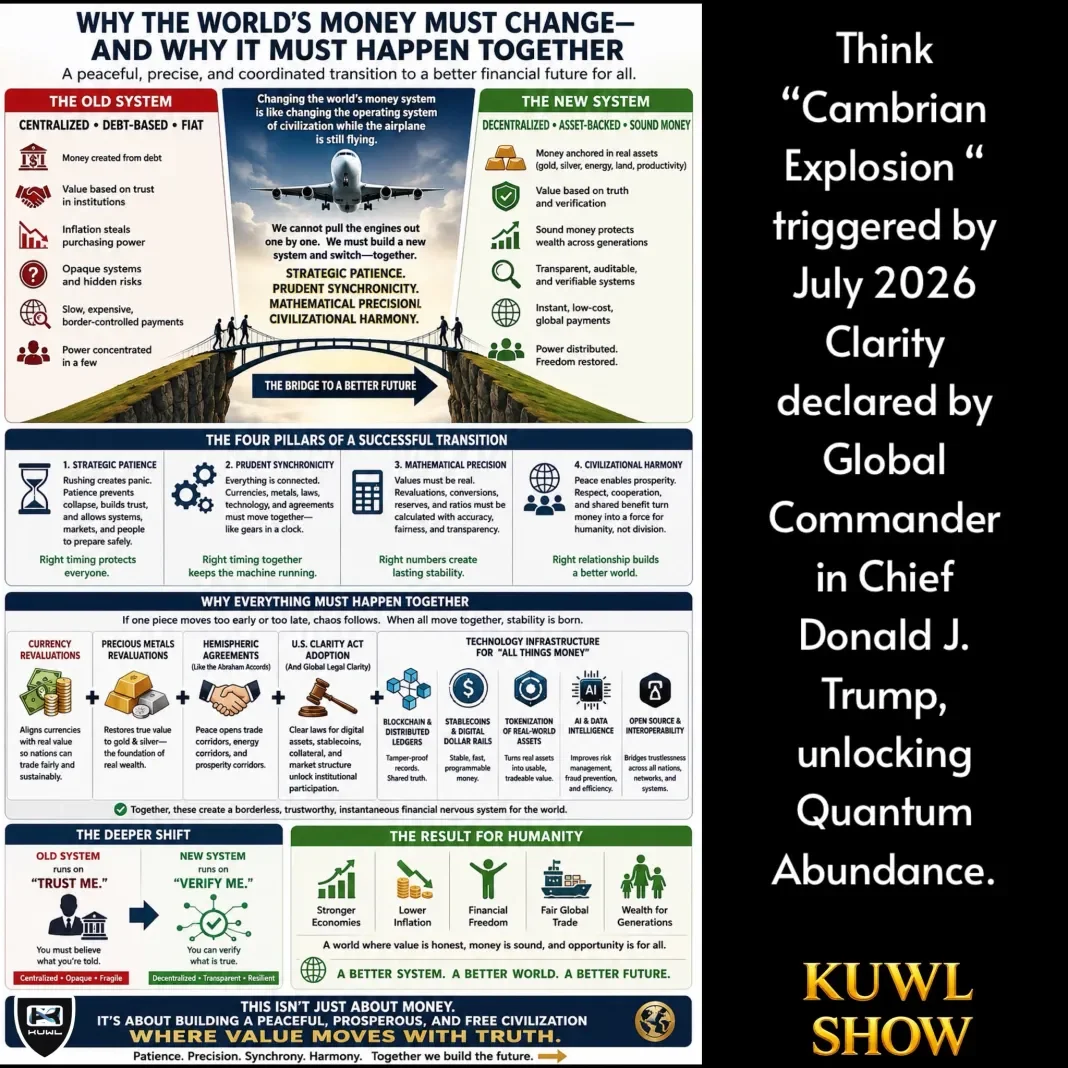
An asset-backed sound money system depends on valuation discipline, verified collateral, transparent settlement, lawful custody, interoperable ledgers, sovereign consent, and mathematical finality.
This kind of transition cannot happen randomly. It requires strategic patience because premature moves could trigger panic, capital flight, bank runs, geopolitical retaliation, or disorderly repricing. It requires prudent synchronicity because currencies, metals, bonds, commodities, payment rails, and digital settlement systems are all connected. Move one gear too early, and the whole machine can seize.
It requires mathematical precision because an asset-backed system must answer hard questions:
What is the real value of gold, silver, oil, land, energy, productive capacity, digital assets, sovereign reserves, and tokenized collateral?
How are currencies revalued without destroying trade?
How are debt obligations converted without social collapse?
How does liquidity keep flowing while trust is transferred from institutions to verifiable systems?
This is why key changes must occur nearly together.
• Currency revaluations without payment modernization create chaos.
• Precious metals revaluation without legal clarity creates speculation.
• Blockchain rails without stablecoins and tokenized collateral create disconnected plumbing.
• AI without lawful monetary guardrails accelerates disorder.
• Stablecoins without sovereign and regulatory clarity become private money empires.
• Tokenization without interoperability creates thousands of new silos.
• Open-source public infrastructure without governance discipline becomes fragile.
The Abraham Accords-type framework matters because money is downstream from peace.
Trade corridors, energy corridors, settlement corridors, and capital corridors all require geopolitical alignment.
Sound money cannot fully function in a world organized around perpetual conflict, sanctions warfare, opaque ledgers, and weaponized dependency.
The U.S. Clarity Act framework matters because law must bless the rails before capital can safely migrate. Institutions need to know what is a security, commodity, payment token, stablecoin, custody asset, collateral instrument, and settlement mechanism. Without legal clarity, trillion-dollar balance sheets wait on the sidelines.
DLT, tokenization, stablecoins, AI, interoperability, and open-source ledgers matter because the new system cannot merely be “gold with better branding.” It needs real-time proof, instant settlement, auditable collateral, programmable compliance, sovereign interoperability, and neutral bridges between nations.
The deeper necessity is this:
A centralized fiat system runs on “trust me.”
A decentralized sound money system runs on “verify me.”
And civilization cannot jump from one to the other in pieces. It must cross the bridge in formation.
This is the case for patience, precision, synchronicity, and harmony. The goal is not just a new money system. The goal is a lawful, peaceful, interoperable, asset-anchored civilization where value moves with truth instead of manipulation.
Our “Cambrian Explosion” moment arrives soon.
Source(s):
• https://x.com/KuwlShow/status/2071240589077512609
https://dinarchronicles.com/2026/06/29/rob-cunningham-changing-the-worlds-broken-money-system/
Gold, Stablecoins & the Coming Financial Reset | Robert Kientz & Andy Schectman
Gold, Stablecoins & the Coming Financial Reset | Robert Kientz & Andy Schectman
Miles Franklin Media: 6-28-2026
Andy Schectman, President & CEO of Miles Franklin Precious Metals, speaks with Robert Kientz, Founder of The Freedom Report, about why he believes the global financial system is moving toward a major reset and why gold, silver, stablecoins, and digital money are all central to what comes next.
Kientz warns that physical demand for gold and silver is far stronger than the paper price reflects, with sovereigns and major players increasingly standing for delivery on COMEX.
Gold, Stablecoins & the Coming Financial Reset | Robert Kientz & Andy Schectman
Miles Franklin Media: 6-28-2026
Andy Schectman, President & CEO of Miles Franklin Precious Metals, speaks with Robert Kientz, Founder of The Freedom Report, about why he believes the global financial system is moving toward a major reset and why gold, silver, stablecoins, and digital money are all central to what comes next.
Kientz warns that physical demand for gold and silver is far stronger than the paper price reflects, with sovereigns and major players increasingly standing for delivery on COMEX.
He explains why China’s push to internationalize the renminbi could be tied to gold, why central banks continue to accumulate the one asset they cannot print, and why the U.S. may be using stablecoins as a bridge into a new digital monetary system.
Kientz also breaks down the risks of programmable money, the difference between stablecoins and CBDCs, and why financial liberty may become one of the defining issues of the next several years.
In this episode of Little by Little with Andy Schectman:
*Why Kientz sees a currency reset and financial reset ahead
*Who may be standing for delivery of massive amounts of gold and silver
*Why China, BRICS, and Asia are building new gold and commodity infrastructure
*How stablecoins could become a backdoor path to a digital dollar system
*Why sound money, trust, and freedom are becoming inseparable
00:00 Coming Up
01:42 Introduction
03:50 Sound Money Mission
08:12 Why Miners Stay Quiet
11:40 Comex Delivery Shock
13:36 Sovereigns Drive Demand
17:25 Central Banks Know
24:34 Paper Markets Explained
30:23 Delivery Breaks Systems
31:58 Genius Act And Tether
35:31 Stablecoins To Cbdc
42:40 Trust Versus Inflation
45:15 How To Follow And Help
48:01 Final Thanks And Signoff
More Iraq News Posted by Clare at KTFA 6-29-2026
KTFA:
Clare: Special forces deployed inside the Green Zone and reports of senior officials being arrested
6/27/2026
A security source reported on Sunday that special security forces were deployed inside the Green Zone in central Baghdad, coinciding with news of arrests targeting senior political officials and security personnel involved in corruption cases.
The source told Shafaq News Agency that special forces were deployed around a number of sensitive headquarters inside the Green Zone, with security measures being tightened at some entrances and roads leading to them.
KTFA:
Clare: Special forces deployed inside the Green Zone and reports of senior officials being arrested
6/27/2026
A security source reported on Sunday that special security forces were deployed inside the Green Zone in central Baghdad, coinciding with news of arrests targeting senior political officials and security personnel involved in corruption cases.
The source told Shafaq News Agency that special forces were deployed around a number of sensitive headquarters inside the Green Zone, with security measures being tightened at some entrances and roads leading to them.
He added that the security deployment coincided with information about arrests carried out according to judicial orders, targeting figures, officials and security personnel whose names appeared in files related to corruption and abuse of power. LINK
Most of them are MPs (Ministers of Parliament) ... State media reveals the names of those arrested on corruption charges
6/28/2026
The Iraqi News Agency revealed on Sunday the names of the politicians and officials arrested on corruption charges as part of the campaign that began at dawn today.
The official Iraqi news agency reported that "the number of detainees on corruption charges has reached 47, including officials and members of parliament."
The names of the detainees were presented, and they are: the head of the Azm Alliance, Member of Parliament Muthanna al-Samarrai, Member of Parliament Ziyad al-Janabi, Member of Parliament Bahaa al-Nouri, Member of Parliament Muhammad al-Karbouli, Member of Parliament Alia Nassif, Member of Parliament Muhammad Jamil al-Mayahi, Member of Parliament Hassan al-Khafaji, Member of Parliament Abdul Rahman al-Luwaizi.
Also: Member of Parliament Mudhar Al-Karawi, Member of Parliament Hind Al-Abbasi, Member of Parliament Muhammad Farman Al-Jubouri, Member of Parliament Bushra Al-Qaisi, former Member of Parliament Muhammad Al-Sayhoud, Undersecretary of the Ministry of Oil for Distribution Affairs Ali Ma’araj and Ibrahim Al-Sumaida’i.
The Federal Integrity Commission announced a short while ago that it has begun taking decisive measures to implement the judicial arrest warrants issued against a number of those accused of misappropriating public funds .
The commission confirmed in a statement received by Shafaq News Agency that this achievement was the result of the combined and integrated efforts of the three authorities – the judicial, executive, and legislative branches – with the commission’s efforts, which led directly to the implementation of those orders, as a result of diligent and continuous follow-up, auditing, and monitoring operations by the aforementioned entities .
The commission stressed that all its actions are carried out strictly in accordance with the provisions of the law and under its umbrella, noting that it derives its strength and determination from the absolute popular support and the authority of the law, and the unlimited support and continuous backing from the President of the Supreme Judicial Council, the Prime Minister and the Speaker of Parliament .
An informed source revealed to Shafaq News Agency earlier on Sunday the details of the largest anti-corruption operation in the country, which has so far resulted in the arrest of 43 officials and politicians, and will be completed in a second phase targeting "first-class " figures.
According to the source, the operation that was launched is considered the first part, and the total number of detainees in it reached 43 people, some of whom were released .
It is reported that security forces in the Iraqi capital, Baghdad, began on Sunday morning to close the entrances to the fortified Green Zone (which includes the parliament building, government headquarters and diplomatic missions), coinciding with a large-scale raid and search campaign that targeted the homes of MPs, politicians and businessmen .
These unprecedented and stringent measures come in conjunction with frequent reports of an expanded list of prosecutions targeting senior officials, security personnel, and businessmen on charges of illicit enrichment and squandering of public funds. LINK
*************
Clare: (WAA) exclusively publishes the names of the arrested MPs and officials following Al-Jumaili's confessions
6/28/2026
The Iraqi News Agency (INA) exclusively published today, Sunday, the names of those accused in corruption cases who were arrested, including members of parliament and officials, based on the confessions of the Deputy Minister of Oil, Adnan al-Jumaili.
High-ranking sources told the Iraqi News Agency (INA) that "those arrested are:
- Muthanna al-Samarrai, head of the Azm Alliance and member of parliament, is accused of corruption.
Member of Parliament Ziad al-Janabi accused of corruption
Member of Parliament Bahaa al-Nouri on corruption charges
Member of Parliament Mohammed al-Karbouli on corruption charges
Member of Parliament Alia Nassif faces corruption charges
Member of Parliament Mohammed Jamil Al-Mayahi accused of corruption
Member of Parliament Hassan al-Khafaji accused of corruption
Member of Parliament Abdul Rahman Al-Luwaizi on corruption charges
Member of Parliament Mudhar Al-Karawi on corruption charges
Member of Parliament Hind Al-Abbasi accused of corruption
Member of Parliament Mohammed Farman al-Jubouri on corruption charges
Member of Parliament Bushra al-Qaisi accused of corruption
Former Member of Parliament Mohammed Al-Sayhoud on corruption charges
-Ali Ma'araj, Undersecretary of the Ministry of Oil for Distribution Affairs, is accused of corruption.
Ibrahim Al-Sumaidaie on corruption charges
Clare: With the participation of a delegation from the Kurdistan Regional Government, the Ministerial Council for Economy held a meeting in Baghdad.
6/28/2026 Erbil (Kurdistan 24) -
The Federal Ministerial Council for Economy will hold a high-level meeting in Baghdad on Monday, June 29, 2026, with the participation of an official delegation from the Kurdistan Regional Government, to resolve joint economic and customs issues.
Kurdistan 24 quoted an informed source as saying that the meeting will focus mainly on putting the final touches on the agreement concluded between Erbil and Baghdad regarding the implementation of the ASYCUDA global system for automating and modernizing customs.
The source explained that the talks will resolve four outstanding technical points that still require final agreement between the two governments. These points include the mechanism for collecting and distributing customs duties and revenues, the controls for granting customs exemptions, the strategy for protecting local products from imported goods, as well as agreeing on the formation of a joint field committee to inspect and evaluate unofficial border crossings.
This anticipated meeting comes as a complementary step to the recent understandings between the Federal Ministry of Finance and the Kurdistan Region delegation present in Baghdad, to unify financial and customs policy and ensure the smooth flow of mutual dues. LINK
************
Clare: Erbil, Baghdad Near Final ASYCUDA Customs Accord
6/28/2026 ERBIL (Kurdistan24) -
In a critical bid to modernize Iraq's fractured border management and streamline billions of dollars in cross-border commerce, a senior delegation from the Kurdistan Regional Government (KRG) has arrived in Baghdad. The officials are scheduled to participate in a pivotal meeting of the Iraqi Ministerial Council for Economy on Monday, aiming to finalize the implementation of the ASYCUDA automated customs platform.
Developed by the United Nations and utilized globally, the Automated System for Customs Data (ASYCUDA) represents one of the most sophisticated institutional reforms in international customs administration.
By digitizing tariffs, standardizing logistical procedures, and eliminating vast swaths of bureaucratic paperwork, the platform is designed to increase transparency, curb border corruption, and maximize state revenue collection.
The political weight of the KRG delegation arriving Sunday evening underscores the strategic importance of the impending talks.
Led by Minister of Finance and Economy Awat Janab Noori, the negotiating team features top regional executives, including Omed Sabah, President of the Diwan of the Council of Ministers, and Dr. Amanj Rahim, Secretary of the Council of Ministers.
They are accompanied by senior administrative and security figures: Dr. Abdulhakim Khusraw, Head of the Department of Coordination and Follow-up; Ministry of Interior Advisor Dr. Sami Jalal; Director General of Customs Kamal Raouf; and Assistant Director General Jawhar Mahmoud.
According to an informed source who spoke to Kurdistan24, Erbil and Baghdad have already signed a foundational memorandum of understanding regarding the ASYCUDA rollout.
Yet, the transition from paper agreement to functional digital reality hinges on resolving four lingering policy disputes during Monday's session.
First, negotiators must reach a consensus on the distribution of customs and tax revenues generated at the borders.
Second, they must agree on a unified, transparent framework for commercial customs exemptions.
Third, the governments must establish firm, mutual mechanisms to protect domestic agricultural and industrial products from unregulated foreign dumping.
Finally, the council is tasked with approving the creation of a joint federal-regional committee explicitly mandated to inspect unofficial border crossings, a long-standing source of revenue leakage for both capitals.
For years, fragmented customs policies have complicated fiscal relations between Erbil and Baghdad, creating administrative bottlenecks and fostering mutual distrust over revenue sharing.
A fully implemented ASYCUDA system would effectively bridge this divide by providing a single, real-time digital window into the nation's trade flows, ensuring equitable financial oversight.
Reaching an agreement on these final four hurdles would mark a watershed moment in economic integration between the federal government and the Kurdistan Region.
According to Kurdistan24 sources, should Monday's negotiations succeed, the ASYCUDA accord will be fully ratified and move immediately into its active implementation phase.
For regional businesses, international investors, and public finances, the modernization of these procedures promises a newly predictable, transparent, and seamlessly coordinated Iraqi market. LINK
Monday Coffee with MarkZ. 06/29/2026
Monday Coffee with MarkZ. 06/29/2026
MarkZ Disclaimer: Please consider everything on this call as my opinion. Be sure to consult a professional for any financial decisions
MZ: The great corruption roundup in Iraq's Green Zone, ASYCUDA, and Iranian conflict fallout. This should make for an interesting week!
THE CONTENT IN THIS PODCAST IS FOR GENERAL & EDUCATIONAL PURPOSES ONLY&NOT INTENDED TO PROVIDE ANY PROFESSIONAL, FINANCIAL OR LEGAL ADVICE. PLEASE CONSIDER EVERYTHING DISCUSSED IN MARKZ’S OPINION ONLY
Monday Coffee with MarkZ. 06/29/2026
MarkZ Disclaimer: Please consider everything on this call as my opinion. Be sure to consult a professional for any financial decisions
MZ: The great corruption roundup in Iraq's Green Zone, ASYCUDA, and Iranian conflict fallout. This should make for an interesting week!
THE CONTENT IN THIS PODCAST IS FOR GENERAL & EDUCATIONAL PURPOSES ONLY&NOT INTENDED TO PROVIDE ANY PROFESSIONAL, FINANCIAL OR LEGAL ADVICE. PLEASE CONSIDER EVERYTHING DISCUSSED IN MARKZ’S OPINION ONLY
https://rumble.com/user/theoriginalmarkz
Kick: https://kick.com/theoriginalmarkz
Markz's linktree https://linktr.ee/theMarkZshow
FOLLOW MARKZ : TWITTER . https://twitter.com/originalmarkz?s=21. TRUTH SOCIAL . https://truthsocial.com/@theoriginalm...
Mod: MarkZ "Back To Basics" Pre-Recorded Call" for Newbies 10-19-2022 )https://www.youtube.com/watch?v=37oILmAlptM
MARKZ DAILY LINKS: https://theoriginalmarkz.com/home/
THANK YOU FOR JOINING. HAVE A BLESSED DAY. SEE YOU IN THE MORNING FOR COFFEE @ 10:00 AM EST ~ UNLESS BREAKING NEWS HAPPENS! FOR UPDATES ON MARK’S PODCAST GO TO: https://t.me/+b3hYhYlhKM1hYzcx
Seeds of Wisdom RV and Economics Updates Monday Afternoon 6-29-26
Housing Affordability Bill Heads to Trump as Congress Clears Major Bipartisan Reform
House Speaker Mike Johnson confirmed the bipartisan housing affordability bill will be delivered to President Donald Trump on Monday, reviving momentum for one of the most significant U.S. housing reform packages in decades.
Overview
House Speaker Mike Johnson announced the housing bill will be sent to President Trump on Monday after a brief delay.
The legislation passed both the House and Senate with overwhelming bipartisan support and aims to expand housing supply while lowering costs.
The bill reflects growing efforts to address America's housing affordability crisis through regulatory reform, increased construction, and limits on institutional home purchases.
Housing Affordability Bill Heads to Trump as Congress Clears Major Bipartisan Reform
House Speaker Mike Johnson confirmed the bipartisan housing affordability bill will be delivered to President Donald Trump on Monday, reviving momentum for one of the most significant U.S. housing reform packages in decades.
Overview
House Speaker Mike Johnson announced the housing bill will be sent to President Trump on Monday after a brief delay.
The legislation passed both the House and Senate with overwhelming bipartisan support and aims to expand housing supply while lowering costs.
The bill reflects growing efforts to address America's housing affordability crisis through regulatory reform, increased construction, and limits on institutional home purchases.
Key Developments
1. Johnson Confirms Bill Will Be Delivered
Speaker Mike Johnson said the House will formally transmit the bipartisan housing affordability legislation to President Donald Trump on Monday.
The bill's delivery follows several days of uncertainty after President Trump postponed a planned signing ceremony while encouraging Congress to advance separate election-related legislation. Despite the delay, Johnson emphasized that the housing package remains a top legislative priority.
2. What the Housing Bill Does
Known as the 21st Century ROAD to Housing Act, the legislation seeks to improve housing affordability through several reforms, including:
Expanding the nation's housing supply.
Reducing regulatory barriers that slow residential construction.
Encouraging affordable housing development.
Limiting large institutional investors from acquiring additional single-family homes.
Modernizing federal housing and community development programs.
3. Why Housing Remains a National Priority
Housing affordability has become one of the nation's largest economic concerns as elevated mortgage rates, limited inventory, and rising construction costs continue to pressure homebuyers.
Lawmakers from both parties have argued that increasing supply while reducing unnecessary regulations could help improve affordability over the long term, although many economists caution that meaningful improvements will likely take time.
4. What Happens Next
Once delivered to the White House, President Trump can sign the legislation into law, allow it to become law without a signature under constitutional procedures, or veto it.
Because the measure received overwhelming bipartisan support in both chambers, it represents one of the most broadly supported pieces of domestic legislation passed during the current Congress.
Why It Matters
Housing affordability affects economic growth, household wealth, inflation, and consumer confidence. Expanding housing supply could improve access to homeownership while supporting construction activity and long-term economic stability.
Why It Matters to Foreign Currency Holders
A healthier U.S. housing market supports broader economic stability, influencing interest rates, capital flows, and confidence in the U.S. dollar. Improvements in housing supply and affordability may also reduce inflationary pressures that affect global monetary policy.
Implications for the Global Reset
Pillar 1 – Debt
Greater housing affordability may ease financial pressure on households while improving long-term economic resilience and reducing borrowing stress.
Pillar 2 – Trade
Expanded residential construction increases demand across manufacturing, building materials, transportation, and supply chains, supporting broader economic activity.
Closing Thoughts
The bipartisan housing legislation represents one of the most significant federal housing initiatives in years and reflects growing recognition that expanding supply is essential to improving affordability. While the bill alone is unlikely to solve America's housing shortage, it establishes a framework for reducing regulatory barriers and encouraging new development.
This is not just about housing—it reflects broader efforts to strengthen the U.S. economy by improving affordability, expanding investment, and modernizing critical domestic infrastructure.
Seeds of Wisdom Team
Newshounds News™ Exclusive
Sources
Reuters — Housing bill will be sent to Trump on Monday, U.S. House speaker says
Reuters — House speaker to send housing bill to White House following meeting with Trump
~~~~~~~~~~
Seeds of Wisdom Team RV Currency Facts Youtube and Rumble
Newshound's News Telegram Room Link
RV Facts with Proof Links Link
RV Updates Proof links - Facts Link
Start Here room with Most Asked Questions Link
Follow the Gold/Silver Rate COMEX
Follow Fast Facts
Seeds of Wisdom Team™ Website
Thank you Dinar Recaps
Monday AM Iraq News Posted by Tishwash at TNT 6-29-2026
TNT:
Tishwash:A high-ranking source: Several individuals accused in corruption cases were arrested based on Al-Jumaili's confessions.
A high-level source reported on Sunday that a number of suspects in corruption cases have been arrested, based on confessions made by the Undersecretary of the Ministry of Oil, Adnan al-Jumaili.
The source told the Iraqi News Agency (INA) that “a number of individuals accused in corruption cases were arrested based on confessions made by the Deputy Minister of Oil, Adnan al-Jumaili,” noting that “the arrests included members of parliament whose immunity had been lifted and officials whose names appeared in those confessions.”
TNT:
Tishwash:A high-ranking source: Several individuals accused in corruption cases were arrested based on Al-Jumaili's confessions.
A high-level source reported on Sunday that a number of suspects in corruption cases have been arrested, based on confessions made by the Undersecretary of the Ministry of Oil, Adnan al-Jumaili.
The source told the Iraqi News Agency (INA) that “a number of individuals accused in corruption cases were arrested based on confessions made by the Deputy Minister of Oil, Adnan al-Jumaili,” noting that “the arrests included members of parliament whose immunity had been lifted and officials whose names appeared in those confessions.”
The source added that “Prime Minister Ali Falih al-Zubaidi will not hesitate to pursue those involved in corruption and the misappropriation of state funds.” link
Tishwash: From Baghdad to Ankara: Money laundering networks for corrupt officials in Iraq exposed
A Syrian source revealed on Sunday the existence of money smuggling networks operating between Iraq, Syria, and Turkey.
The source told the Information Agency: "There is a money smuggling network managed by Syrian figures. Smuggled funds are transferred to certain Iraqi political figures accused of corruption, including individuals close to Sarmad al-Khanjar, son of the head of the Sovereignty Alliance, and Mohammed al-Halbousi, head of the Progress Party, as well as other figures associated with Muthanna al-Samarrai."
The source added that "Syrian figures close to Turkish-backed factions, such as the former Hamza Division (which was later integrated into the 76th Division, a unit of the de facto government's Ministry of Defense), are also involved." The source explained that "this division oversees the smuggling of funds from Iraq to Syria, and then their transfer to Turkey."
He confirmed that "the mastermind behind this network is a Syrian man residing in the Aleppo countryside and close to Turkey, named Abdul Rahman al-Mawali," explaining that "this network works to smuggle millions of dollars for corrupt figures linked to corruption cases in Iraq, depositing them in Turkish banks under the names of Syrians." link
************
Tishwash: Government advisor: Recovering looted funds enhances the climate of trust and transparency.
The financial advisor to the Prime Minister, Mazhar Muhammad Salih, confirmed on Sunday that recovering public funds looted due to corruption enhances the climate of trust and transparency.
Saleh said in a press statement that “recovering public funds that have left the economic cycle due to corruption or misappropriation of public funds is not only important in terms of its direct financial value, but also reflects a clear governmental will to combat corruption and restore the rights of the state, which enhances the confidence of citizens and investors in national institutions.”
Recovering stolen funds
He added that “the recovered funds contribute to easing the pressures on the general budget and reducing the need for borrowing, as well as providing additional resources that can be directed towards developing infrastructure and the health, education, housing and basic services sectors.”
He pointed out that “returning these funds to the official cycle of the national economy stimulates economic activity and supports government investment spending, especially if they are employed in productive and developmental projects capable of creating job opportunities and stimulating sustainable growth.”
Saleh explained that “the state’s success in pursuing and recovering looted funds sends reassuring messages to the local and international business community, enhances the climate of trust and transparency, and encourages attracting more investments.”
He explained that “integrating these funds into national development plans and Iraq’s Vision 2050 makes them an effective tool to support economic reform and achieve sustainable development goals.” link
Tishwash: Calls for a mutually beneficial economic partnership with Washington
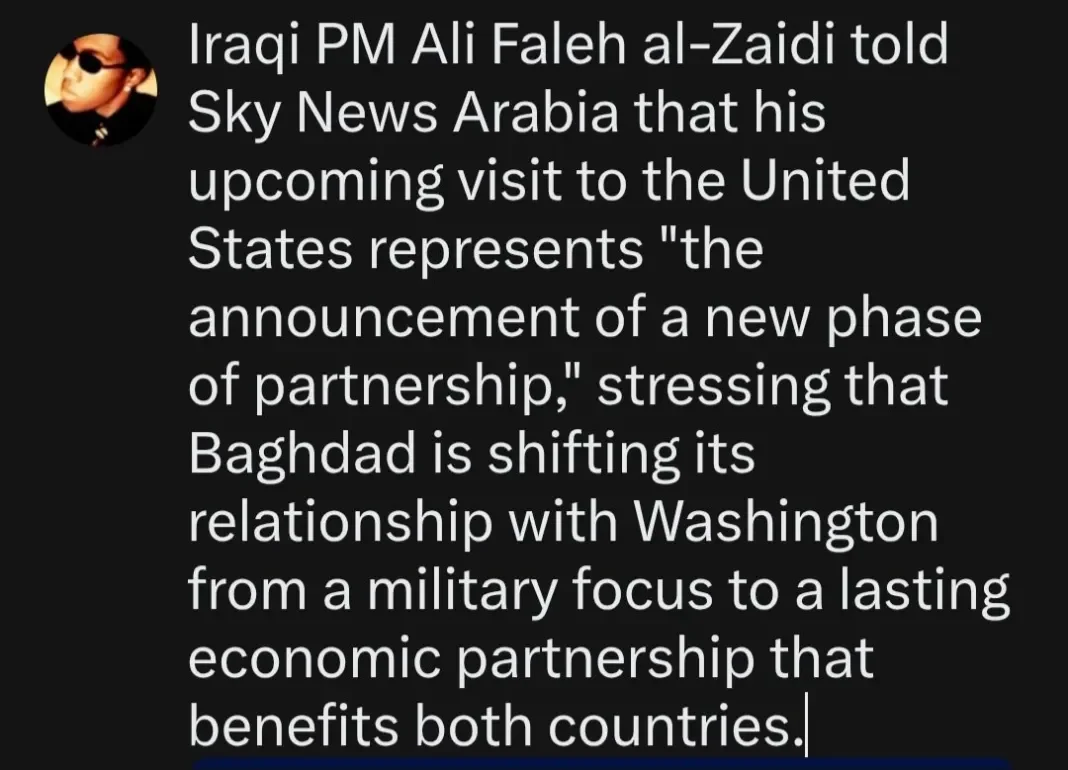
In light of what the Prime Minister has put forward regarding moving towards economic cooperation with the United States of America, economic experts explained that Iraq seeks to invest in the Strategic Framework Agreement with the United States to reduce total dependence on oil revenues, as the visit of the Prime Minister, Ali al-Zaidi, to Washington falls within the efforts to strengthen economic relations and transform them “from military to economic partnership.”
The necessity of partnership
In this regard, international economic expert Dr. Nabil Al-Abadi explained that the economic partnership with America must be economically viable and stem from genuine integration between the two countries, as Iraq possesses the resources and the United States possesses the technology.
Capital and expertise.
Al-Abadi added, in an interview with Al-Sabah, that Iraq, which suffers from a fragile rentier economy and structural inflation, therefore partnership is not a strategic option but a necessity for restructuring it, provided that we read it with the logic of mutual gain and not dependency, pointing out that the benefits are not in loans, but in technology transfer, as America has an energy revolution (associated and shale gas) and water management and smart agriculture technologies, and Iraq needs a technical partnership, not a financial one, that moves it from importing technology to localizing it. Likewise, restructuring the Iraqi banking sector according to FATF standards should not be seen as guardianship, but as a gateway to integration into the global financial system, which will attract non-oil investments.
Partnership pillars
He believed that the partnership should be based on three pillars. The first is that there should be no contract without a binding timetable for completion, and no project without an Iraqi employment rate of no less than 60%. The second pillar is oil for expertise, not oil for debt, meaning we do not accept loans that drain liquidity, but rather partnerships in the field of renewable energy and infrastructure in exchange for facilities for American companies, to balance the trade balance. He added that the third and final pillar is that there should be no signing of comprehensive agreements in haste, but rather the partnership should be sectoral (energy, health, education) and decomposable, so that we are not held hostage to a single file.
The international economist warned against treating this partnership as a "political project," explaining that if the "Deal of the Century" remains merely a declaration of intent, we will lose a golden opportunity. The American market is the largest in the world, but it is unforgiving. We must raise our ambitions from simply being oil suppliers to becoming partners in supply chains (especially for rare earth minerals found in the mountains of Iraq).
Al-Abadi concluded that partnership with America is possible and beneficial, but it has inevitable conditions, and the opportunity exists, but it needs the mindset of a tough negotiator, noting that Iraq has human capital and land, and America has technology and access to markets.
He explained that when the scales are balanced, we can say: we are making a partnership, not an economic surrender treaty, calling for our deal to be a win-win deal, otherwise let the deal be suspended, because a loss in timing is worse than a loss in the deal itself.
Development paths
In a related context, Jassim Al-Aradi, a member of the Baghdad Economic Forum, considered the economic partnership between Iraq and the United States an important opportunity to redirect bilateral relations towards development paths that achieve the highest levels of benefit based on investment, technology transfer and capacity building, instead of being limited to traditional trade relations. He indicated that Iraq possesses great potential that qualifies it to attract major American companies in the energy, industry, infrastructure, digital economy, agriculture and financial services sectors, which contributes to diversifying national income sources and reducing dependence on oil revenues.
Al-Aradi told Al-Sabah that the partnership should be based on the principle of mutual interests, by attracting quality investments that provide job opportunities for Iraqis, support the transfer of knowledge and modern technologies, and enhance local industries and production chains, while giving priority to projects that achieve added value for the national economy and contribute to increasing non-oil exports.
He added that the success of the partnership requires creating a stable investment environment by developing economic legislation, simplifying administrative procedures, enhancing transparency and protecting the investor, in addition to activating the role of the Iraqi private sector as a key partner in implementing projects, in order to ensure that the local economy benefits from foreign investments and that they are not limited to the implementation of contracts only.
Expanding areas of cooperation
For his part, expert and economist Hassan Ali Al-Daghari called for expanding the areas of cooperation to include technical education, vocational training, digital transformation, and energy.
He emphasized the importance of renewable energy and developing the banking sector, noting that these sectors are fundamental pillars for building a more competitive and sustainable economy. He added that the more partnerships are linked to programs for transferring expertise and building national capabilities, the greater their positive impact on development. Economic.
Al-Daghari pointed out, in an interview with Al-Sabah, that the success of the economic partnership with the United States is not measured by the size of the agreements signed, but rather by its ability to achieve tangible results represented in increasing investment, creating job opportunities, developing industry and production, and strengthening Iraq's position as an economic center. And my investment in the region. link
MilitiaMan & CREW IRAQ DINAR UPDATE-72 Hour Iraq Reform Surge: Arrests, CBI Aligned $30B Deal Before US Visit
MilitiaMan & CREW IRAQ DINAR UPDATE-72 Hour Iraq Reform Surge: Arrests, CBI Aligned $30B Deal Before US Visit
6-28-2026
The Crew: Samson, PompeyPeter, Petra, Daytrader, Sunkissed, GIGI and Militia Man
No drama. No intrigue. No songs and dances. Just straight, factual news that I read and interpret to the best of my ability after being an avid Dinar investor and insanely obsessed Dinarian for over 15 years.
Follow MM on X == https://x.com/Slashn
MilitiaMan & CREW IRAQ DINAR UPDATE-72 Hour Iraq Reform Surge: Arrests, CBI Aligned $30B Deal Before US Visit
6-28-2026
The Crew: Samson, PompeyPeter, Petra, Daytrader, Sunkissed, GIGI and Militia Man
No drama. No intrigue. No songs and dances. Just straight, factual news that I read and interpret to the best of my ability after being an avid Dinar investor and insanely obsessed Dinarian for over 15 years.
Follow MM on X == https://x.com/Slashn
Be sure to listen to full video for all the news……..
FRANK26…6-28-26…..T-10
KTFA
Sunday Night Video
FRANK26…6-28-26…..T-10
This video is in Frank’s and his team’s opinion only
Frank’s team is Walkingstick, Eddie and Omar in Iraq and guests
Playback Number: 605-313-5163 PIN: 156996#
KTFA
Sunday Night Video
FRANK26…6-28-26…..T-10
This video is in Frank’s and his team’s opinion only
Frank’s team is Walkingstick, Eddie and Omar in Iraq and guests
Playback Number: 605-313-5163 PIN: 156996#
Seeds of Wisdom RV and Economics Updates Sunday Night 6-28-26
Global Trade Enters a New Era as Tariffs Reshape the World Economy
The resurgence of tariffs is transforming international trade, signaling a shift away from decades of globalization toward a more protectionist and strategically competitive global economy.
Overview
Global tariff barriers continue rising as major economies prioritize national security and domestic industries over free trade.
The United States has expanded tariffs beyond geopolitical rivals, affecting many long-standing allies and major trading partners.
The shift is accelerating changes to supply chains, investment decisions, and the future structure of global commerce.
Global Trade Enters a New Era as Tariffs Reshape the World Economy
The resurgence of tariffs is transforming international trade, signaling a shift away from decades of globalization toward a more protectionist and strategically competitive global economy.
Overview
Global tariff barriers continue rising as major economies prioritize national security and domestic industries over free trade.
The United States has expanded tariffs beyond geopolitical rivals, affecting many long-standing allies and major trading partners.
The shift is accelerating changes to supply chains, investment decisions, and the future structure of global commerce.
Key Developments
1. A Turning Point for Global Trade
For decades, the World Trade Organization (WTO) helped reduce tariffs and encouraged expanding global commerce through multilateral trade agreements and dispute resolution mechanisms.
That trend has reversed dramatically. Since 2025, governments have increasingly relied on tariffs and industrial policy to protect strategic industries, marking one of the most significant shifts in global trade policy since the end of World War II.
2. Tariffs Expand Beyond Traditional Rivals
While trade tensions between the United States and China remain central, recent tariff actions have extended well beyond geopolitical competitors.
The United States has imposed or threatened tariffs affecting several long-standing allies, including:
European Union
Japan
Mexico
Canada
United Kingdom
These actions demonstrate that economic policy is increasingly being used as a strategic tool rather than solely a trade instrument.
3. Global Supply Chains Continue to Adjust
Higher tariffs are encouraging companies to diversify manufacturing locations, relocate production, and reduce dependence on individual countries for critical goods.
Businesses are increasingly evaluating supply chain resilience alongside production costs, leading to greater investment in regional manufacturing hubs and "friend-shoring" strategies.
4. Markets Face a New Trading Environment
Financial markets are adjusting to an environment where trade policy can change rapidly in response to geopolitical events.
Investors are closely monitoring tariff negotiations, bilateral agreements, and industrial policy as governments seek to strengthen domestic manufacturing while protecting strategic technologies and critical supply chains.
Why It Matters
The return of tariffs represents a fundamental shift in the global economic landscape. Trade policy is becoming an increasingly important instrument of national security, economic competitiveness, and geopolitical influence, with long-term implications for inflation, investment, and global growth.
Why It Matters to Foreign Currency Holders
Changes in global trade directly affect currency values, capital flows, and economic growth. As nations restructure supply chains and expand regional trade partnerships, currency investors are closely watching how these developments influence reserve currencies, cross-border payments, and international monetary cooperation.
Implications for the Global Reset
Pillar 1 – Trade
The continued rise in tariffs is accelerating the restructuring of global trade relationships, encouraging regional supply chains and reducing dependence on traditional globalization models.
Pillar 2 – Assets
Trade fragmentation is influencing global capital allocation as businesses and investors redirect investments toward domestic manufacturing, strategic industries, and critical infrastructure.
Closing Thoughts
The recent resurgence of tariffs suggests that globalization is entering a new phase, where economic security increasingly outweighs the pursuit of maximum trade efficiency. Governments are placing greater emphasis on resilient supply chains, domestic production, and strategic independence as geopolitical competition intensifies.
This is not just about tariffs—it reflects the ongoing restructuring of global trade, supply chains, and economic power as nations prepare for a more multipolar financial and geopolitical future.
Seeds of Wisdom Team
Newshounds News™ Exclusive
Sources
Modern Diplomacy — Making Tariffs Trendy Again: The New Global Trade Battlefield
World Trade Organization — Trade Monitoring Reports and Global Trade Developments
~~~~~~~~~~
Seeds of Wisdom Team RV Currency Facts Youtube and Rumble
Newshound's News Telegram Room Link
RV Facts with Proof Links Link
RV Updates Proof links - Facts Link
Start Here room with Most Asked Questions Link
Follow the Gold/Silver Rate COMEX
Follow Fast Facts
Seeds of Wisdom Team™ Website
Thank you Dinar Recaps
Ariel: How Long have you been Waiting to Hear this from Iraq?
Ariel: How Long have you been Waiting to Hear this from Iraq?
6-28-2026
If you ever doubted this investment.
If you denounced the investors of IQD.
If you denied that any progress was being made.
If you proclaimed that this would never happen.
Ariel: How Long have you been Waiting to Hear this from Iraq?
6-28-2026
If you ever doubted this investment.
If you denounced the investors of IQD.
If you denied that any progress was being made.
If you proclaimed that this would never happen.
If you wrote the entire thing off as hopium.
If you sold your IQD because of some skeptical rumor.
If you mocked the people stacking dinar like it was toilet paper.
If you trusted the old guard analysts still parroting the static 1,300 rate forever.
Now is the time to double back reconfigure your assessment and ask yourself did you succumb to narratives designed to ensure you remain broke into perpetuity?
~The Window Is Closing But The Blinds Are Opening
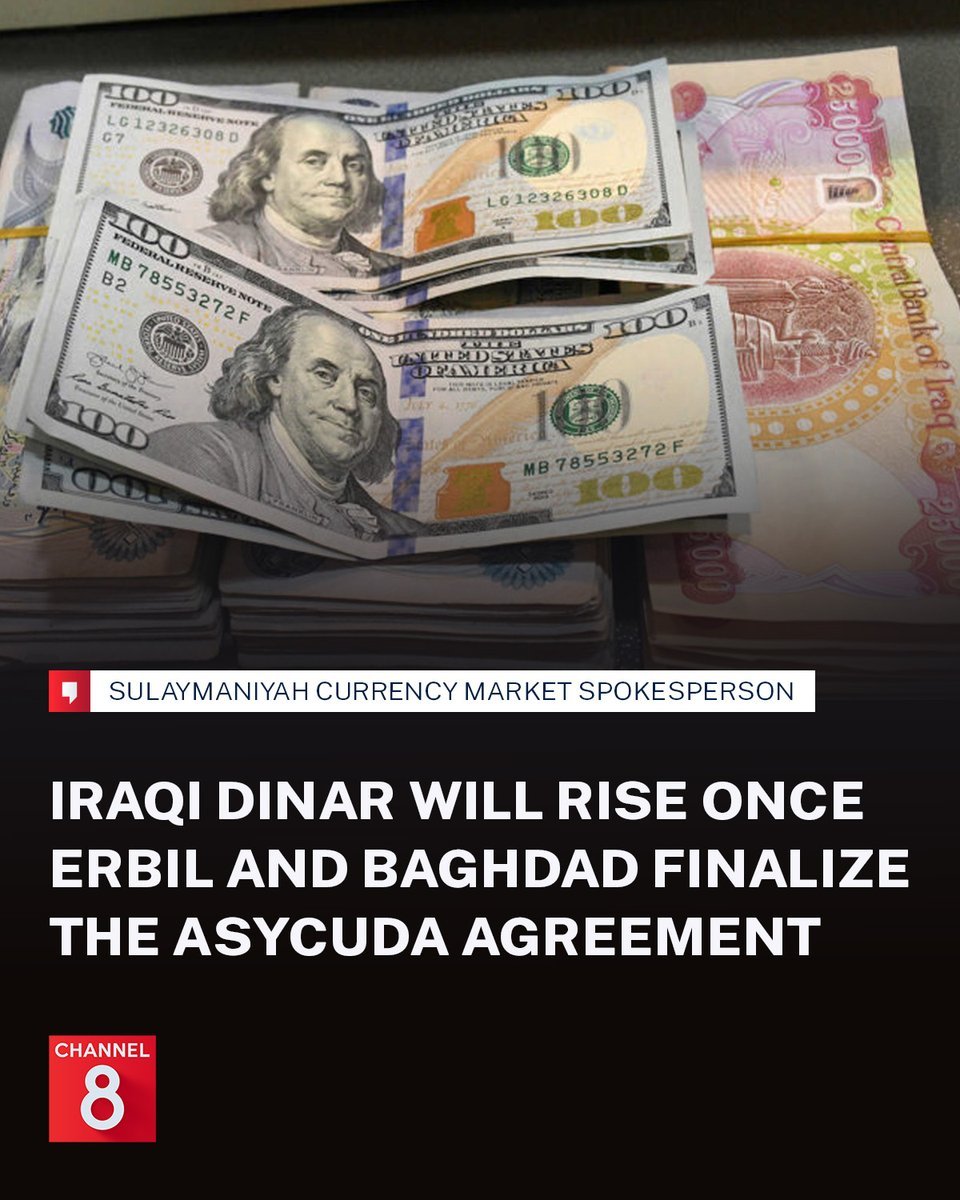
Channel 8 English: A spokesperson for the Sulaymaniyah Currency Exchange Market told Channel8 that the reason for the dinar strengthening—if the deal is finalized—is "because 85% of the dollar demand in the market comes from traders, while the remaining 15% comes from everyday citizens." He added that Iraqi PM al-Zaidi's mid-July Washington visit will bolster the dinar through U.S. economic backing. Read more: https://channel8.com/english/news/60604
You Can Not Do This On A Program Rate
Currency Revaluation Will Start The Process
First Squawk: SCOTT BESSENT: WALL STREET CAN THRIVE, BUT IT’S TIME FOR MAIN STREET TO PROSPER
Source(s):
• https://x.com/Prolotario1/status/2071015197272154391
• https://x.com/Prolotario1/status/2071079872827433083
The US Is Doing Exactly What The British Empire Did In 1921. The Final Economic Reset
The US Is Doing Exactly What The British Empire Did In 1921. The Final Economic Reset
Unfolded finance: 6-28-2026
In February 1921, Chancellor Robert Horne inherited a 7% Bank Rate, two million unemployed, and £4.7 billion in war debt owed to the United States.
Britain had three choices: default, devalue, or defend the pound through deflation and accept whatever pain that defense produced. The Treasury chose deflation.
The US Is Doing Exactly What The British Empire Did In 1921. The Final Economic Reset
Unfolded finance: 6-28-2026
In February 1921, Chancellor Robert Horne inherited a 7% Bank Rate, two million unemployed, and £4.7 billion in war debt owed to the United States.
Britain had three choices: default, devalue, or defend the pound through deflation and accept whatever pain that defense produced. The Treasury chose deflation.
The Geddes Committee was formed to slash government spending department by department, treating the cuts as discipline rather than decline. Nobody in that room believed they were choosing a multi-decade trajectory. They were wrong.
The 1925 gold standard return everyone remembers wasn't the mistake — it was just the formal confirmation of a path Britain had already locked in four years earlier.
America in 2025 carries $36 trillion in debt and just spent two years defending dollar credibility through rates held above 5%. The same three paths sit on the table: restructuring entitlement promises, accepting a managed dollar decline, or fiscal contraction defended as discipline.
A federal spending efficiency review launched in 2025 functions as a direct structural echo of the Geddes Axe — cutting across government department after government department to prove fiscal seriousness to markets asking the same uncomfortable questions Britain faced in 1921. The difference is scale.
Britain's 1921 mistake cost Britain a decade of unemployment. America's version, made from the center of the global financial system instead of its edge, doesn't stay contained to one country.
What You'll Learn:
▸ Why 1921, not 1925, was the actual turning point in Britain's postwar economic decline
▸ What the three real choices were — default, devaluation, or deflation — and why Britain's Treasury ruled out two of them before serious debate even began
▸ How the Geddes Axe became the formal expression of a decision that had already been made months earlier
▸ Why Britain's eventual 1925, 1931, 1949, and 1967 devaluations were all delayed consequences of the 1921 choice, not separate mistakes
▸ How America's 2025 federal spending review structurally mirrors the Geddes Committee's mandate and justification
▸ Why the same three-path decision tree — default, devalue, or defend through deflation — is currently running inside U.S. fiscal policy
▸ Why America's version of this decision carries global consequences Britain's 1921 choice never had to reckon with The Timeline:
1919 — Britain suspends the gold standard; pound begins floating freely for the first time in decades 1920
— Bank Rate raised to 7% to defend sterling's international value February 1921
— Unemployment crosses two million; Robert Horne becomes Chancellor of the Exchequer 1921
— Geddes Committee formed to identify deep cuts across government departments 1922
— Geddes Axe report delivered; education, police, and military spending slashed 1925
— Churchill returns the pound to gold at the prewar parity, confirming the path chosen in 1921 1931
— Britain abandons gold entirely; first devaluation the 1921 policy was meant to avoid 1949, 1967
— Further sterling devaluations; each one a delayed continuation of the same unresolved choice 2022-2024
— Federal Reserve holds rates above 5% to defend dollar credibility against inflation 2025
— Federal spending efficiency review launched; structural echo of the Geddes Axe begins Horne never believed he was choosing decline. He believed he was choosing discipline.
History stopped distinguishing between the two.