
Ariel: The Best Thing IQD Holders Can Read Right Now
Ariel: The Best Thing IQD Holders Can Read Right Now
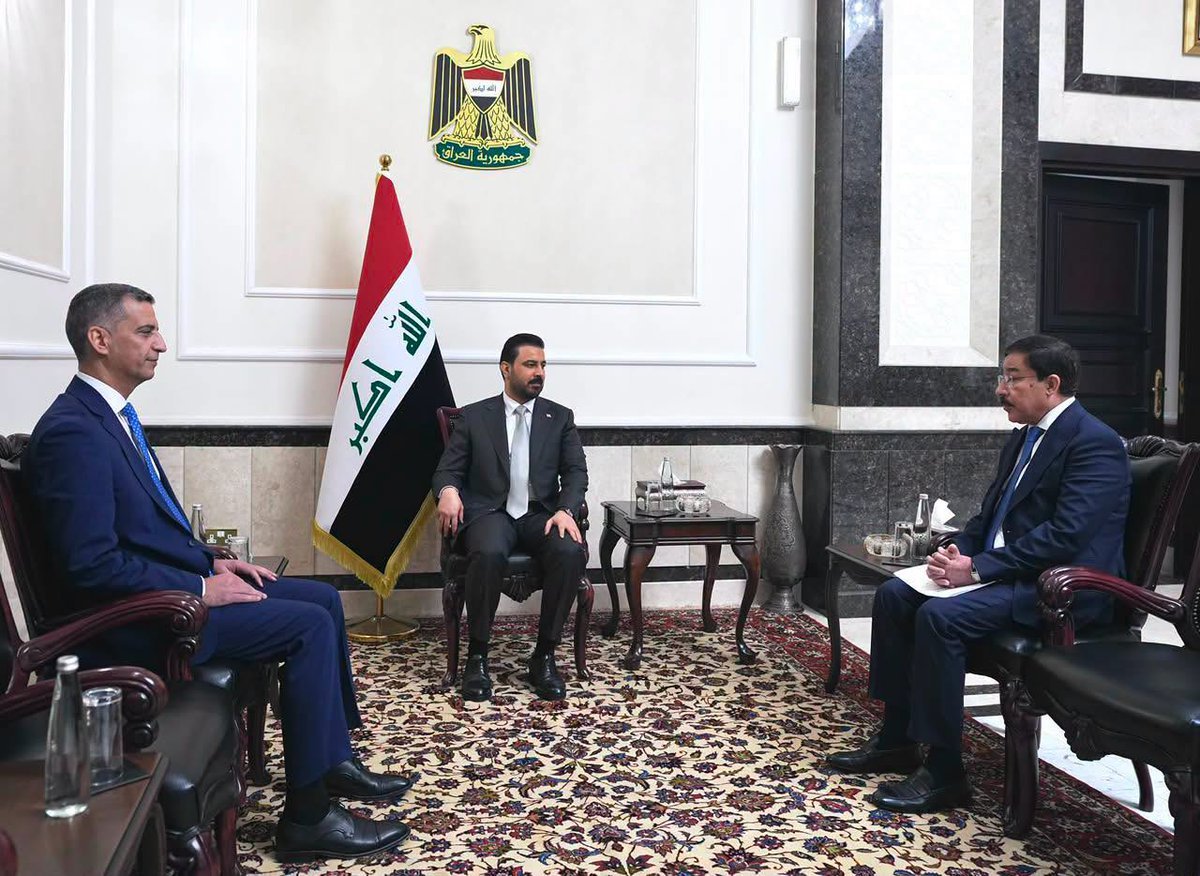
“Prime Minister Ali Faleh al-Zaidi oversaw the handover ceremony for incoming Central Bank of Iraq (CBI) Governor Nizar Nasser Hussein. He stressed the urgency of advancing banking reforms to foster economic stability and investment, emphasizing that adopting international standards is vital to keeping pace with global digital transformation.”
Yes! You read that correctly and coherently.
Yes! You are seeing what you think you are seeing.
Yes! This means what you think means.
Ariel: The Best Thing IQD Holders Can Read Right Now
“Prime Minister Ali Faleh al-Zaidi oversaw the handover ceremony for incoming Central Bank of Iraq (CBI) Governor Nizar Nasser Hussein. He stressed the urgency of advancing banking reforms to foster economic stability and investment, emphasizing that adopting international standards is vital to keeping pace with global digital transformation.”
Yes! You read that correctly and coherently.
Yes! You are seeing what you think you are seeing.
Yes! This means what you think means.
No! You are not misinterpreting anything.
No! You are not coping & hoping things are not what they seem.
No! You are not making baseless assumptions that don’t exist.
Everything is working itself out as you sit and patiently anticipate an inevitable conclusion you thought you would never live to experience.
Channel 8 English: Prime Minister Ali Faleh al-Zaidi oversaw the handover ceremony for incoming Central Bank of Iraq (CBI) Governor Nizar Nasser Hussein. He stressed the urgency of advancing banking reforms to foster economic stability and investment, emphasizing that adopting international standards is vital to keeping pace with global digital transformation.
FIVE QUESTIONS THAT COULD CHANGE EVERYTHING: MarkZ
FIVE QUESTIONS THAT COULD CHANGE EVERYTHING: MarkZ
Latest RV News, Iraq and Zim Breakthrough, Big Changes with MarkZ, June 2026
Jon Dowling and Chris Real World: 6-22-2026
In an ever-evolving global financial landscape, staying informed about geopolitical developments and currency reform is essential for those tracking potential shifts in the international market.
A recent episode of the Jon Dowling podcast offers a deep dive into these complex topics, featuring MarkZ, a veteran analyst of financial resets and currency revaluations.
FIVE QUESTIONS THAT COULD CHANGE EVERYTHING: MarkZ
Latest RV News, Iraq and Zim Breakthrough, Big Changes with MarkZ, June 2026
Jon Dowling and Chris Real World: 6-22-2026
In an ever-evolving global financial landscape, staying informed about geopolitical developments and currency reform is essential for those tracking potential shifts in the international market.
A recent episode of the Jon Dowling podcast offers a deep dive into these complex topics, featuring MarkZ, a veteran analyst of financial resets and currency revaluations.
The discussion provides a comprehensive look at the structural changes currently unfolding in Iraq and Zimbabwe, offering a nuanced perspective on what these reforms could mean for the future of global finance.
A primary focus of the conversation revolves around the systematic overhaul of the Iraqi Dinar. MarkZ clarifies that the current movement in Iraq involves more than a simple currency “lopping.” Instead, the country is pursuing a structural reform that includes the deletion of three zeros from the currency, backed by new legislative frameworks, updated tax codes, and rigorous financial regulations.
This process is positioned as a deliberate, legal path aimed at restoring the Iraqi Dinar’s international standing. While the podcast notes conflicting reports coming out of the Iraqi Central Bank and parliament, the consensus points to a genuine, ongoing effort to restructure the nation’s monetary system.
The discussion expands beyond economics into the volatile realm of geopolitics. The podcast touches on the internal political struggles in Iraq, particularly the tension between various factions and the efforts to diminish factional influence.
Furthermore, the episode analyzes the broader international picture, looking at the shifting dynamics between the U.S. and Israel, as well as the potential for strategic regional shifts. By connecting these historical and political threads, the analysts provide a backdrop for why these currency reforms are not happening in a vacuum, but are instead part of a much larger puzzle involving international security and economic peace processes.
Turning to the African continent, the episode explores the economic trajectory of Zimbabwe. MarkZ addresses common misconceptions surrounding Zimbabwean bonds, or “Zim bonds,” emphasizing that they are backed by gold and intended for humanitarian utility rather than being the worthless instruments some skeptics suggest.
The conversation also highlights reports of rising precious metal prices, citing data that suggests a significant increase in the valuation of gold and silver. This, coupled with political developments regarding the opposition leadership, paints a picture of a nation attempting to align its financial future with tangible, hard assets.
Throughout the episode, there is a recurring theme of patience and discernment. In an age of rapid information spread, the speakers urge listeners to remain grounded. They advise against getting caught up in the speculation of “imminent” payouts, emphasizing that the timing of such large-scale global events is often dictated by complex factors beyond any single person’s control.
By focusing on fundamental economic shifts rather than rumors, listeners are encouraged to adopt a more resilient and long-term view of their financial interests.
For those interested in following these developments as they unfold, the podcast serves as a valuable resource for tracking the intersection of diplomacy, precious metals, and currency policy. Whether you are a student of global economics or simply curious about the potential for a financial reset, this episode provides a wealth of information to help you navigate the complexities of today’s market.
Iraq Economic News and Points To Ponder Monday Evening 6-22-26
Oil Declines After US-Iran Talks Conclude
2026-06-22 Shafaq News Brent crude prices slid on Monday after U.S.-Iran talks concluded in Switzerland with Tehran saying it had secured waivers for oil and petrochemical exports, easing worries about a supply shortage in global markets.
Brent crude fell $1.19, or 1.48%, to $79.38 a barrel by 0416 GMT. Prices had climbed to $82.30 at the start of trading, fuelled by a bumpy start to the talks with threats from U.S. President Donald Trump to restart the war on Iran and Tehran's announcement it had again closed the Strait of Hormuz.
Oil Declines After US-Iran Talks Conclude
2026-06-22 Shafaq News Brent crude prices slid on Monday after U.S.-Iran talks concluded in Switzerland with Tehran saying it had secured waivers for oil and petrochemical exports, easing worries about a supply shortage in global markets.
Brent crude fell $1.19, or 1.48%, to $79.38 a barrel by 0416 GMT. Prices had climbed to $82.30 at the start of trading, fuelled by a bumpy start to the talks with threats from U.S. President Donald Trump to restart the war on Iran and Tehran's announcement it had again closed the Strait of Hormuz.
U.S. West Texas Intermediate crude futures were at $76.73 a barrel, up 13 cents, ahead of the contract's expiry later on Monday. The more active August contract fell 21 cents to $75.64 a barrel. There was no settlement in the U.S. market on Friday due to a holiday.
"The decline has been driven primarily by improving prospects for a diplomatic breakthrough between the United States and Iran ... reviving hopes that sanctions on Iran could eventually be eased," said Sugandha Sachdeva, founder of SS WealthStreet, a New Delhi-based research firm.
High-ranking U.S. and Iranian officials wrapped up their first round of talks in Switzerland on Monday, mediators said. The talks began on Sunday under the terms of a memorandum of understanding reached last week to extend a tenuous ceasefire from April for at least another 60 days.
Iranian Foreign Minister Abbas Araqchi said his country had secured waivers for oil and petrochemical exports, the release of some frozen assets and the launch of a reconstruction and development plan for Iran.
"Such a development would allow nearly 1.5 million barrels per day of Iranian crude to return to international markets, significantly improving global supply availability at a time when demand growth remains moderate," Sachdeva said.
'VERY REAL RISKS'
Before the talks, the number of ships that passed the Strait of Hormuz fell sharply on Sunday, shipping data showed, after Iran announced it had again closed the waterway, citing Israeli and U.S. violations of the interim peace deal.
Israeli strikes in Lebanon killed at least 20 people on Saturday, Lebanon's state news agency NNA said, one day after a ceasefire with Hezbollah took effect, aimed at halting months of escalating violence.
"Recent developments show that moving towards a more permanent deal will be challenging, with very real risks of a flare-up in hostilities during the 60-day ceasefire," ING analysts said in a note ahead of the announcement of the conclusion of the talks in Switzerland.
Still, oil prices fell more than 8% last week on hopes of more supply from the release of cargoes stranded in the Gulf and the potential lifting of U.S. sanctions on Iranian oil as part of the U.S.-Iran deal.
Over 25 million barrels of Iranian oil have passed through the virtual blockade line since Monday, the head of the National Iranian Oil Company, Hamid Bovard, told state TV on Sunday.
The United Arab Emirates, Kuwait and Iraq have offered more oil to customers in the past week.
Iraq plans to restore crude production gradually to between 4.2 million and 4.3 million barrels per day, Iraq's deputy oil minister for upstream affairs said in a statement on Sunday.
(Reuters) https://www.shafaq.com/en/Economy/Oil-declines-after-US-Iran-talks-conclude
Dollar Nears 157,000 Dinars In Baghdad And Erbil
2026-06-22 Shafaq News- Baghdad/ Erbil The US dollar opened Monday’s trading higher in Iraq, hovering around 157,000 dinars per 100 dollars.
According to Shafaq News market survey, the dollar traded in Baghdad's Al-Kifah and Al-Harithiya exchanges at 156,700 dinars per 100 dollars, up from the previous session’s 155,900 dinars.
In the Iraqi capital, exchange shops sold the dollar at 157,250 dinars and bought it at 156,250 dinars, while in Erbil, selling prices stood at 156,600 dinars and buying prices at 156,700 dinars.
Speaking to Shafaq News, financial expert Walid Eidi attributed the recent rise primarily to market speculation and uncertainty surrounding changes in the Central Bank of Iraq's leadership, despite the continued stability of the official exchange rate. The increase, he noted, lacks strong economic fundamentals, predicting that pressures on the currency market could ease as regional tensions subside and confidence gradually returns.
https://www.shafaq.com/en/Economy/Dollar-nears-157-000-dinars-in-Baghdad-and-Erbil
Gold Prices Rise In Baghdad And Erbil
2026-06-22Shafaq News- Baghdad/ Erbil Gold prices rose in Baghdad and Erbil on Monday, hovering around 925,000 IQD per mithqal, according to Shafaq News market survey.
Wholesale prices on Baghdad's Al-Nahr Street recorded a selling price of 922,000 IQD per mithqal (equivalent to five grams) for 21-carat gold, including Gulf, Turkish, and European varieties, with a buying price of 918,000 IQD, up from Sunday's 908,000 IQD.
The selling price for 21-carat Iraqi gold stood at 892,000 IQD, with a buying price of 888,000 IQD.
In jewelry stores, the selling price per mithqal of 21-carat Gulf gold ranged between 925,000 and 935,000 IQD, while Iraqi gold sold for between 895,000 and 905,000 IQD.
In Erbil, 22-carat gold was sold at 978,000 IQD per mithqal, 21-carat gold at 933,000 IQD, and 18-carat gold at 799,000 IQD. https://www.shafaq.com/en/Economy/Gold-prices-rise-in-Baghdad-and-Erbil-2-9
Iraq Transport Minister Names Acting Ports Chief
2026-06-22 Shafaq News- Baghdad Iraq's Transport Minister Wahab Salman al-Hassani on Monday formally appointed Alaa Abd al-Hassan Ali Obeid as acting director general of the General Company for Ports of Iraq for a three-month term, according to a document reviewed by Shafaq News.
The company oversees the Grand Al-Faw Port project, a centerpiece of Iraq's $17 billion Development Road initiative, an infrastructure corridor to link the Gulf to Europe through Iraqi territory.
The appointment takes effect from the date Obeid assumes duties and remains in force until a permanent replacement is named through the legally prescribed process.
The move formalizes an arrangement already in place since May 31, when al-Hassani relieved then-director general Farhan al-Fartousi and designated Obeid to manage the state-owned company on a caretaker basis pending the outcome of that suspension.
Al-Hassani also dismissed four department heads at the General Company for Maritime Transport, including the directors of insurance and contracts, replacing each with an acting appointee. The minister cited "requirements of work interest" as the basis for the removals.
Read more: PM Al-Zaidi targets major overhaul of Iraqi institutions
https://www.shafaq.com/en/Economy/Iraq-Transport-Minister-names-acting-ports-chief
Iraq Purchases $17M In Kuwaiti Non-Oil Goods
2026-06-22 Shafaq News- Baghdad Iraq ranked fifth among the largest importers of Kuwaiti non-oil goods in March 2026, with imports valued at 5.24 million Kuwaiti dinars (about $17.1M), according to data released by Kuwait's Central Statistical Bureau.
The figures showed that Saudi Arabia topped the list of importers of Kuwaiti non-oil products, with imports worth 26.52 million Kuwaiti dinars (about $86.6M). It was followed by United Arab Emirates at 17.14 million dinars (about $56.0M), Jordan at 7.51 million dinars (about $24.5M), and India at 7.47 million dinars (about $24.4M).
Kuwait recorded a trade surplus of 1.768 billion Kuwaiti dinars (about $5.77B) during the first quarter of 2026, a 30.6% decline compared with the same period in 2025, amid decreases in exports, imports, and overall trade volume.
https://www.shafaq.com/en/Economy/Iraq-purchases-17M-in-Kuwaiti-non-oil-goods
Seeds of Wisdom RV and Economics Updates Monday Evening 6-22-26
Good Evening Dinar Recaps,
How Trump’s AI Proposal Could Reshape Wealth Creation in America
The White House is exploring whether Americans should directly benefit from the explosive growth of artificial intelligence, raising new questions about public ownership, investment, and the future of digital finance.]
Good Evening Dinar Recaps,
How Trump’s AI Proposal Could Reshape Wealth Creation in America
The White House is exploring whether Americans should directly benefit from the explosive growth of artificial intelligence, raising new questions about public ownership, investment, and the future of digital finance.]
Overview
President Donald Trump is exploring ways for Americans to share in the wealth generated by the rapidly expanding artificial intelligence industry.
Several proposals under discussion include government equity stakes in AI companies, public wealth funds, and citizen dividend programs.
The debate extends beyond technology, touching on the future structure of wealth creation, national competitiveness, and financial infrastructure.
Key Developments
1. Government Equity Stakes Under Consideration
The administration is reportedly examining whether the federal government could acquire ownership stakes in leading AI companies such as OpenAI and Anthropic. Supporters argue that because AI has benefited from public research, infrastructure, and taxpayer-funded innovation, Americans should participate in the industry's long-term financial gains.
One proposal would allow companies to satisfy part of their tax obligations by issuing shares instead of cash, enabling the government to gradually build equity positions without directly investing taxpayer dollars.
2. Public Investment Could Accompany AI Expansion
Another proposal would provide government funding or incentives for AI infrastructure projects in exchange for equity ownership.
With AI companies investing hundreds of billions of dollars into data centers, semiconductor manufacturing, and advanced computing systems, supporters believe taxpayers should receive a financial return when public assistance helps build these strategic industries.
Critics, however, caution that government ownership could blur the line between regulator and investor, potentially creating conflicts of interest.
3. Public Wealth Funds and Citizen Dividends
A third concept would direct revenues generated through AI-related taxes or government investments into a national public wealth fund.
Similar to Alaska's Permanent Fund, the earnings could eventually be distributed directly to American citizens through annual dividend payments, allowing the benefits of AI-driven economic growth to be shared more broadly.
Why It Matters
Artificial intelligence is expected to become one of the largest wealth-creating technologies in modern history. As leading AI companies move toward multi-trillion-dollar valuations, policymakers are increasingly debating who should benefit from that growth.
The discussion reflects a broader shift toward ensuring that technological innovation produces shared national prosperity, rather than concentrating wealth among a relatively small number of investors and technology firms.
Why It Matters to Foreign Currency Holders
Although this proposal is centered on artificial intelligence, it also reflects the broader modernization of America's financial architecture.
As governments increasingly integrate AI, digital assets, tokenization, and advanced financial technologies into economic policy, investors following potential currency realignments and financial system reforms may view these developments as part of the continuing evolution toward a more digitally integrated global economy.
Implications for the Global Reset
Pillar 1 : Technology
Artificial intelligence is becoming a foundational component of future economic competitiveness. Government participation in AI wealth creation signals a growing recognition that strategic technologies may become national financial assets.
Pillar 2 : Assets
The discussion introduces new ideas about public ownership, sovereign investment, and wealth distribution, suggesting governments may increasingly seek ways to ensure citizens participate in the appreciation of critical digital industries.
Closing Thoughts
No formal proposal has yet been introduced, and significant legal, political, and economic hurdles remain before any government ownership model could be implemented.
However, the conversation itself marks an important shift. Rather than asking whether AI will create enormous wealth, policymakers are increasingly asking who should ultimately benefit from it.
This is not just about artificial intelligence—it reflects the growing debate over who will own, benefit from, and help shape the next generation of the global digital economy.
Seeds of Wisdom Team
Newshounds News™ Exclusive
Sources
~~~~~~~~~~
Seeds of Wisdom Team RV Currency Facts Youtube and Rumble
Newshound's News Telegram Room Link
RV Facts with Proof Links Link
RV Updates Proof links - Facts Link
Start Here room with Most Asked Questions Link
Follow the Gold/Silver Rate COMEX
Follow Fast Facts
Seeds of Wisdom Team™Website
Thank you Dinar Recaps
Alan Greenspan, Longtime Chairman of the Federal Reserve, Dies at 100
Alan Greenspan, Longtime Chairman of the Federal Reserve, Dies at 100
PATRICIO CHILE Mon, June 22, 2026 at 7:15 AM EDT
Alan Greenspan, the longtime chairman of the Federal Reserve, has died, his wife confirmed. He was 100 years old.
"Alan passed away at our home this morning at the age of 100 from complications of Parkinson's Disease," Andrea Mitchell, his wife and a chief correspondent at NBC News, said in a statement published by the network on Monday.
The economist is remembered for leading the American central bank amid periods of historic U.S. economic expansion, while critics have also said his policies contributed to and exacerbated the mortgage crisis and financial crash of 2008.
Alan Greenspan, Longtime Chairman of the Federal Reserve, Dies at 100
PATRICIO CHILE Mon, June 22, 2026 at 7:15 AM EDT
Alan Greenspan, the longtime chairman of the Federal Reserve, has died, his wife confirmed. He was 100 years old.
"Alan passed away at our home this morning at the age of 100 from complications of Parkinson's Disease," Andrea Mitchell, his wife and a chief correspondent at NBC News, said in a statement published by the network on Monday.
The economist is remembered for leading the American central bank amid periods of historic U.S. economic expansion, while critics have also said his policies contributed to and exacerbated the mortgage crisis and financial crash of 2008.
Greenspan, a libertarian Republican, became the 13th chairman of the Board of Governors of the Federal Reserve System two months before the stock market crash on Oct. 19,1987, known as Black Monday. He was credited with moving quickly to alleviate investors' fears after the crash and was instrumental in ensuring the Federal Reserve made plenty of money available to alleviate the impact on financial markets. Stocks quickly rebounded.
He was appointed Fed chair by four different presidents during his career, first by Ronald Reagan in 1987. Greenspan continued to serve as Fed chairman under presidents George H. W. Bush, Bill Clinton and George W. Bush. He steered the U.S. economy through the economic boom in the 1990s, the dotcom bubble, and the Sept. 11, 2001, terrorist attacks. His final term as chair ended on Jan. 31, 2006.
Under his leadership, the Fed fostered a distaste for regulation and promoted very low interest rates in the early 2000s -- two phenomena critics say encouraged a bubble in housing prices that eventually burst with disastrous effects on the global economy.
During his tenure, and before the financial crisis began, the nation experienced one of the longest periods of economic growth in its history.
A decorated economist, first inspired by music
Greenspan was born on March 6, 1926, in New York City, the only child of Herbert Greenspan, a stockbroker, and Rose Goldsmith Greenspan, a retail worker. His parents divorced when he was 4 years old, and he was raised mainly by his mother and his grandparents.
An aspiring musician, Greenspan attended Juilliard for a year and played saxophone and clarinet before dropping out and enrolling at New York University. He went on to gain his bachelor's, master's and doctoral degrees in economics from New York University. He also engaged in some advanced graduate work at Columbia University in New York, where he studied under the influential economist Arthur Burns.
Though short-lived, his music career was an influential portion of Greenspan's life, and he considered the move into economics a logical progression. He saw the organization of economic data into sound fiscal modeling as analogous to the organization of musical notes into tunes, according to Greenspan biographer Justin Martin in his book, "Greenspan: The Man Behind Money."
"I get the same kind of joy from solving a hard mathematical problem as I do from hearing a Haydn quartet," Greenspan once told The New York Times Magazine.
Greenspan taught economics at NYU between 1953 and 1955 and then founded the economic consulting firm Townsend & Greenspan, where he served as chairman and president from 1954 to 1974. He returned to the firm in 1977 and stayed until 1987.
President Richard Nixon nominated Greenspan to chair the President's Council of Economic Advisers in 1974, the first of many government economic positions he would hold. Nixon resigned as president hours after Greenspan was nominated, but he continued to serve under President Gerald Ford. Greenspan also served as a member of President Ronald Reagan's Economic Policy Advisory Board and was a consultant to the Congressional Budget Office.
In the private sector, Greenspan served as corporate director for many companies, including Alcoa, General Foods and J.P. Morgan & Co. He also served as a member of Time magazine's Board of Economists and a senior adviser to the Brookings Panel on Economic Activity.
In 2002, Greenspan received an honorary knighthood from Queen Elizabeth II in recognition of his contribution to global economic stability. In 2005, President George W. Bush presented Greenspan with the Presidential Medal of Freedom.
He held the position of Fed chairman from the time Reagan appointed him in 1987 until 2006, serving an unprecedented five terms under four presidents before being succeeded by Ben Bernanke.
Greenspan is credited by many with facilitating the longest economic expansion in U.S. history. One day after the Black Monday stock crash, Greenspan affirmed the Fed's "readiness to serve as a source of liquidity to support the economic and financial system" and the central bank moved to encourage banks to lend on their normal terms. Unlike prior financial crises, the events of Black Monday notably were not followed by an economic recession or a banking crisis and less than two years later, the U.S. stock market surpassed its pre-crash highs.
During his tenure, Greenspan developed a reputation for being a consensus-builder and for his strong anti-inflation stance, focusing more on controlling prices than on promoting full employment. He led the Federal Reserve through several events with major economic consequences, including two U.S. recessions, the 1997 Asian financial crisis and the Sept. 11, 2001, terrorist attacks.
'How could we have possibly got it so wrong?'
Starting in June 2003, the Federal Reserve set the federal funds rate, the rate at which banks typically borrow from each other, to one percent for a year. Though its intention was to lower the cost of borrowing and stimulate the economy, critics said the rate was too low and encouraged investments in risky subprime mortgage-backed securities, which they say contributed to the financial crisis in 2008.
The National Bureau of Economic Research, a research organization seen as an authority on measuring economic performance, later said that the recession officially began in December 2007.
In September 2007, Greenspan published a book that was both a memoir and economic commentary, "The Age of Turbulence: Adventures in a New World," in which he criticized the George W. Bush administration for overspending and admitted that he supported the administration's tax cuts without stressing the need for spending cuts.
In an interview with Bloomberg Businessweek in August 2012, Greenspan said, "one day before Lehman Brothers crashes, conventional wisdom was not even certain that we would fall into a recession."
"In fact, we learned many months later that the downward trend had actually started," Greenspan said. "How could we have possibly got it so wrong? I mean, I actually was saying, 'Yes, recession is coming, not that we're here yet.' We didn't know that it had already hit."
In October 2008, Greenspan acknowledged to a congressional committee discussing financial regulation that, "I made a mistake in presuming that the self-interests of organizations, specifically banks and others, were such as that they were best capable of protecting their own shareholders and their equity in the firms."
To Continue Reading LINK
A source reveals to Al-Mustaqilla: The government is moving towards removing three zeros from the Iraqi dinar and issuing a new currency.
KTFA:
Clare: A source reveals to Al-Mustaqilla: The government is moving towards removing three zeros from the Iraqi dinar and issuing a new currency.
June 21, 2026 3:44 pm
Al-Mustaqilla - A source told Al-Mustaqilla that the Iraqi government, headed by Ali al-Zaidi, is moving towards studying and implementing a major economic project related to removing three zeros from the Iraqi currency, as part of a package of monetary reforms aimed at restructuring the financial system and facilitating daily transactions.
KTFA:
Clare: A source reveals to Al-Mustaqilla: The government is moving towards removing three zeros from the Iraqi dinar and issuing a new currency.
June 21, 2026 3:44 pm
Al-Mustaqilla - A source told Al-Mustaqilla that the Iraqi government, headed by Ali al-Zaidi, is moving towards studying and implementing a major economic project related to removing three zeros from the Iraqi currency, as part of a package of monetary reforms aimed at restructuring the financial system and facilitating daily transactions.
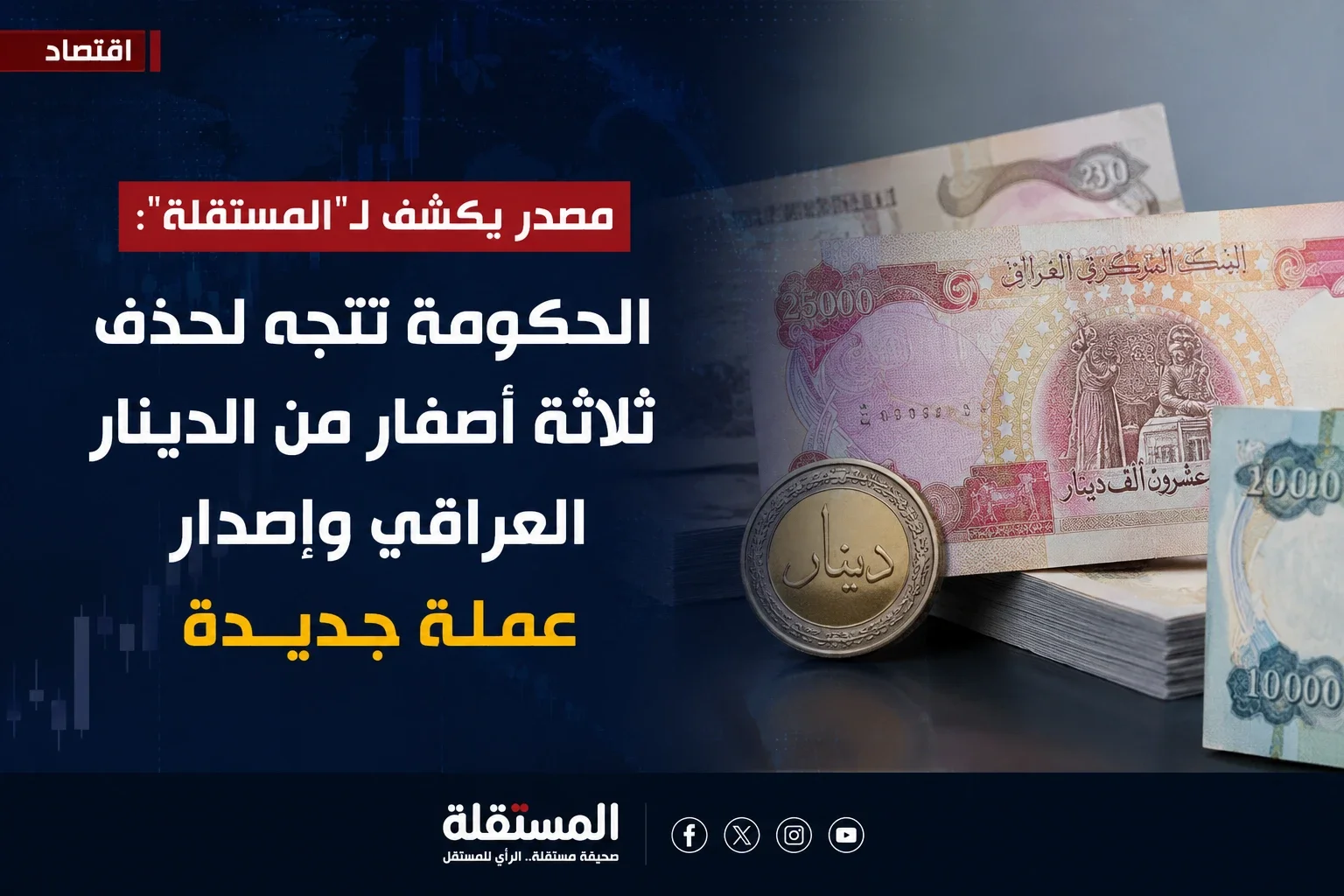
PiAccording to the source, the project also includes a move towards gradually issuing a new Iraqi currency, while maintaining the real value of the dinar without any change in purchasing power, if the plan is officially implemented by the Central Bank of Iraq.
Is it a reformist step or a cosmetic change?
This proposal comes at a time when the Iraqi economy is facing multiple challenges, most notably:
Continued heavy reliance on oil revenues
Exchange rate fluctuations against the dollar
Inflation of the money supply and expansion of the circulating money supply
Weak confidence in the banking system
Experts believe that the “removing zeros” project is usually classified as currency redomination but rather aims to simplify the numbers and facilitate daily financial transactions.
International experiences and local concerns
The experiences of other countries indicate that such steps may technically succeed in simplifying the monetary system, but they require economic stability and high confidence in the banking sector to ensure that there is no market disruption.
Conversely, experts warn that any ill-conceived application could lead to:
Price confusion during the transition period
Citizens fear a loss of value
Difficulties in temporarily controlling the money market
Iraq's economy: between reform and pressures
This debate comes at a time when Iraq is trying to balance financial reforms with the pressure of economic challenges, making the currency issue one of the most sensitive issues in the next stage, especially if the transition to a new currency actually takes place.
Between supporters who consider the move a “necessary update” and opponents who see it as “more cosmetic than a radical reform,” the final decision remains linked to the readiness of financial institutions and their ability to manage the transition without economic shocks.
Is this the beginning of an actual change in the form of the Iraqi dinar? Or just a new debate within monetary policy circles?
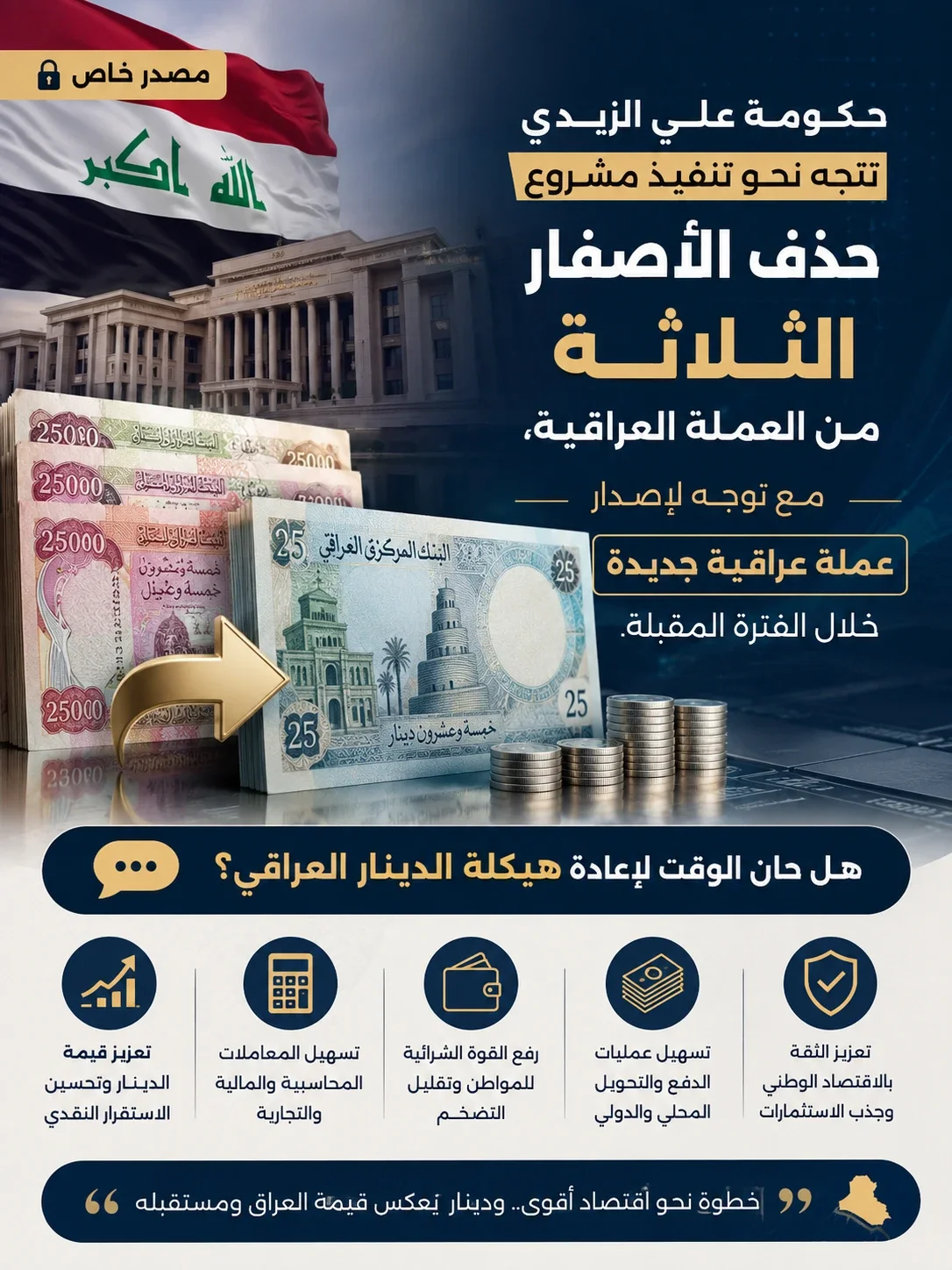
GOOGLE TRANSLATION OF THE BOTTOM PICTURE WITH THE 25 NOTE IN IT:
A private source. God is great. Ali al-Zaidi's government is moving towards implementing a project to remove three zeros from the Iraqi currency, with a plan to issue a new Iraqi currency in the coming period. 25,000 Saturday Al-Alwan Stan 25,000
Pure bitterness Financial 25,000 To the colors of the garden 25,000 Five and you feel five and eyelids 25,000 23,000 25
The Central Bank of Iraq 25 Twenty-five dinars 25 Is it time to restructure the Iraqi dinar?
Strengthening confidence in the national economy and attracting investments Facilitating local and international payment and transfer operations Raising the purchasing power of citizens and reducing inflation Facilitating accounting, financial, and commercial transactions Strengthening the value of the dinar and improving monetary stability and a step towards a stronger economy... and a dinar that reflects the value of Iraq and its future LINK
FRANK26….6-22-26….IS THIS THE ANNOUNCEMENT? (3 Videos)
KTFA
Monday Night Video Part 1
FRANK26….6-22-26….IS THIS THE ANNOUNCEMENT?
This video is in Frank’s and his team’s opinion only
Frank’s team is Walkingstick, Eddie and Omar in Iraq and guests
Playback Number: 605-313-5163 PIN: 156996#
KTFA
Monday Night Video Part 1
FRANK26….6-22-26….IS THIS THE ANNOUNCEMENT?
This video is in Frank’s and his team’s opinion only
Frank’s team is Walkingstick, Eddie and Omar in Iraq and guests
Playback Number: 605-313-5163 PIN: 156996#
Frank26: Monday Part 2
Frank26: Monday Part 3
Iraq Economic News and Points To Ponder Monday Afternoon 6-22-26
Judge Zeidan Discusses Strengthening Financial Stability With Central Bank Governor Nizar Nasser
Money and Business Economy News — Baghdad The head of the Supreme Judicial Council, Judge Faiq Zaidan, discussed on Monday with the new governor of the Central Bank, Nizar Nasser, ways to enhance financial stability and support legal procedures.
A statement from the Supreme Judicial Council, received by "Al-Eqtisad News," stated that "the President of the Supreme Judicial Council received the new Governor of the Central Bank, Nizar Nasser, and congratulated him on assuming his position, wishing him success in his duties."
Judge Zeidan Discusses Strengthening Financial Stability With Central Bank Governor Nizar Nasser
Money and Business Economy News — Baghdad The head of the Supreme Judicial Council, Judge Faiq Zaidan, discussed on Monday with the new governor of the Central Bank, Nizar Nasser, ways to enhance financial stability and support legal procedures.
A statement from the Supreme Judicial Council, received by "Al-Eqtisad News," stated that "the President of the Supreme Judicial Council received the new Governor of the Central Bank, Nizar Nasser, and congratulated him on assuming his position, wishing him success in his duties."
The statement indicated that "Judge Zeidan discussed with the Governor of the Central Bank a number of files of common interest related to strengthening financial stability and supporting the legal procedures of the Central Bank."
https://www.economy-news.net/content.php?id=70544
Gold Rises After Progress In Talks Between Washington And Tehran
Money and Business Economy News — Follow-up Gold prices rose on Monday from their lowest level in more than a week, reached in the previous session, as oil prices fell after Iran indicated progress in peace talks with the United States, although expectations of an interest rate hike following hawkish signals from the US Federal Reserve weighed on the precious metal's performance outlook.
Gold rose 0.9% in spot trading to $4,197.41 per ounce by 02:38 GMT, after falling on Friday to its lowest level since June 11. U.S. gold futures for August delivery fell 0.7% to $4,215.90.
The first round of talks between senior US and Iranian officials in Switzerland ended on Monday, and Iran's Press TV quoted the Iranian Foreign Ministry spokesman as saying that good progress had been made.
A joint statement issued by the two mediating countries, Qatar and Pakistan, said that the United States and Iran had agreed on a roadmap to reach a final agreement within 60 days.
Edward Meir, an analyst at Marex, said, "The current situation in Switzerland is very different from what it was a few hours ago when the two sides were fighting, but now it seems that they are making some progress."
He added, "We will continue to trade in line with geopolitical trends for a little longer, but the situation is fluid, so it is probably best to observe developments from the sidelines for the time being."
Meanwhile, Federal Reserve Chairman Kevin Warsh's focus on inflation at last week's press conference, without any more nuanced comments about what might open the door to an interest rate hike, led investors to conclude that a rate increase was imminent.
According to the CME Group's Fidwatch tool, traders see an 89% chance of an interest rate hike in December, compared with 61% before the US Federal Reserve meeting.
As for other precious metals, silver rose 1.8% in spot trading to $66.10 an ounce, platinum gained 0.2% to $1,667.97 and palladium climbed 1% to $1,270.41. https://www.economy-news.net/content.php?id=70543
Iran Cuts Oil Prices To Attract Buyers After Resuming Exports Through The Strait Of Hormuz
energy Iran has significantly reduced the prices of its crude oil offered for sale to China, in an attempt to accelerate the disposal of supplies after resuming oil exports through the Strait of Hormuz following the interim agreement with the United States.
According to Bloomberg data, July delivery shipments of Iranian light crude are being offered at discounts of between $2.50 and $5 per barrel compared to the price of Brent crude, compared to discounts that were around $1 before the agreement.
Shipping data shows that 11 oil tankers left Iran’s Chabahar port in recent days, carrying about 20 million barrels.
China accounts for about 90% of Iranian oil exports, often through indirect trade channels or under alternative shipping names.
Meanwhile, estimates indicate that there are approximately 121 million barrels of Iranian oil stored on tankers in the Gulf and other areas, a 5% increase from the week prior to the agreement. https://www.economy-news.net/content.php?id=70590
Iraq, Jordan And Egypt Affirm Their Commitment To Implementing The Outcomes Of The "Tripartite Cooperation"
Localities Iraq, Jordan, and Egypt affirmed on Monday their commitment to implementing the outcomes of the tripartite cooperation mechanism and strengthening economic integration.
The Iraqi Ministry of Foreign Affairs stated in a press release, "Foreign Minister Fuad Hussein held extensive talks today, Monday, with Jordanian Deputy Prime Minister and Minister of Foreign Affairs and Expatriates Ayman Safadi and Egyptian Minister of Foreign Affairs, Immigration, and Egyptian Expatriates Badr Abdel-Aty, on the sidelines of the Arab Consultative Meeting and the resumed 165th regular session of the Council of the League of Arab States at the ministerial level, held in the Jordanian capital, Amman."
According to the statement, the talks included "reviewing the paths of joint cooperation among the three countries within the framework of the tripartite cooperation mechanism, and discussing ways to enhance the strategic partnership and expand areas of economic, trade, and investment cooperation, in a manner that contributes to achieving the common interests of the peoples of the three countries."
The ministers emphasized "the importance of continuing coordination and consultation among Iraq, Jordan, and Egypt, activating the outcomes of previous tripartite meetings, and accelerating the implementation of joint projects, in order to strengthen economic integration and support sustainable development efforts in the region."
The ministers exchanged views on the most prominent regional and international developments, stressing the importance of strengthening joint Arab action, supporting efforts aimed at consolidating security and stability, and addressing the challenges facing the region through dialogue, cooperation and continuous coordination.
Seeds of Wisdom RV and Economics Updates Monday Afternoon 6-22-26
Good Afternoon Dinar Recaps,
China Targets Strategic U.S. Defense and Technology Sectors as Trade Tensions Escalate
Beijing has ended its recent trade truce with Washington by imposing sweeping sanctions on dozens of U.S. defense and technology companies, intensifying competition over rare earth minerals, advanced manufacturing, and global supply chains.
Good Afternoon Dinar Recaps,
China Targets Strategic U.S. Defense and Technology Sectors as Trade Tensions Escalate
Beijing has ended its recent trade truce with Washington by imposing sweeping sanctions on dozens of U.S. defense and technology companies, intensifying competition over rare earth minerals, advanced manufacturing, and global supply chains.
Overview
China has officially ended its trade truce with the United States, imposing new sanctions on American defense, aerospace, robotics, and rare earth companies.
The measures include export restrictions on critical dual-use technologies and procurement bans affecting dozens of U.S. firms.
The escalation highlights growing geopolitical competition over strategic resources that support artificial intelligence, semiconductors, defense systems, and advanced manufacturing.
Key Developments
1. China Restricts Critical Exports to U.S. Companies
Beijing announced that ten American companies involved in defense, robotics, and rare earth development will no longer receive exports of Chinese dual-use products—materials and technologies that have both civilian and military applications.
Among those reportedly affected are USA Rare Earth, Red Cat, and AVEOX, companies involved in domestic rare earth processing, tactical drone development, and advanced electromechanical systems.
China also ordered that all existing export activities to these entities cease immediately, signaling a more aggressive use of supply chains as a geopolitical tool.
2. Procurement Ban Expands Economic Pressure
In addition to export restrictions, China's Ministry of Finance issued new directives prohibiting government agencies and public institutions from purchasing products from 46 American companies operating in aerospace, defense, and advanced technologies.
The reported list includes divisions or subsidiaries associated with Lockheed Martin, RTX (formerly Raytheon Technologies), Boeing Defense, General Dynamics, and Sierra Nevada Corporation.
The action significantly broadens China's response beyond trade by targeting future commercial opportunities within China's public sector.
3. Rare Earths Become a Strategic Battleground
The latest measures follow U.S. actions earlier this month that expanded restrictions on several Chinese technology firms.
China currently accounts for approximately 60% of global rare earth production and nearly 90% of global refining capacity, giving Beijing considerable leverage over industries dependent on these materials.
Rare earth elements are essential for manufacturing:
Semiconductors
Artificial intelligence hardware
Electric vehicles
Defense systems
Advanced electronics
Renewable energy technologies
The dispute underscores how control of critical minerals has become an increasingly important element of national security and industrial policy.
Why It Matters
The conflict extends far beyond tariffs. It reflects an intensifying competition over technological leadership, manufacturing independence, and strategic resource control.
As governments increasingly treat supply chains as national security assets, businesses and investors face growing uncertainty surrounding access to essential materials, production costs, and long-term investment planning.
Why It Matters to Foreign Currency Holders
For those following potential global monetary restructuring, the dispute highlights the continued fragmentation of international trade and finance.
As nations pursue greater resource security, industrial independence, and alternative supply networks, these developments reinforce broader trends toward regional economic blocs, strategic reserve accumulation, and diversification away from highly concentrated global supply chains.
Implications for the Global Reset
Pillar 1 – Trade
The sanctions demonstrate how trade is increasingly being shaped by geopolitical strategy rather than traditional market economics, accelerating the restructuring of global supply chains.
Pillar 2 – Assets
Control of critical minerals and advanced manufacturing capabilities is becoming a strategic national asset, reinforcing the importance of commodities, industrial infrastructure, and resource security in the evolving global financial system.
Closing Thoughts
China's latest sanctions mark another significant escalation in the ongoing strategic competition between the world's two largest economies.
While the immediate effects will likely be felt across defense and technology industries, the longer-term consequences could reshape global manufacturing, investment flows, and access to critical raw materials for years to come.
This is not just about trade—it reflects the accelerating race for control of the technologies, resources, and industrial capacity that will shape the next era of global economic power.
Seeds of Wisdom Team
Newshounds News™ Exclusive
Sources
~~~~~~~~~~
Seeds of Wisdom Team RV Currency Facts Youtube and Rumble
Newshound's News Telegram Room Link
RV Facts with Proof Links Link
RV Updates Proof links - Facts Link
Start Here room with Most Asked Questions Link
Follow the Gold/Silver Rate COMEX
Follow Fast Facts
Seeds of Wisdom Team™Website
Thank you Dinar Recaps
Monday Iraq News posted by Tishwash at TNT 6-22-2026
TNT:
Tishwash: The Central Bank Governor assumes his duties and reviews the bank's operations.
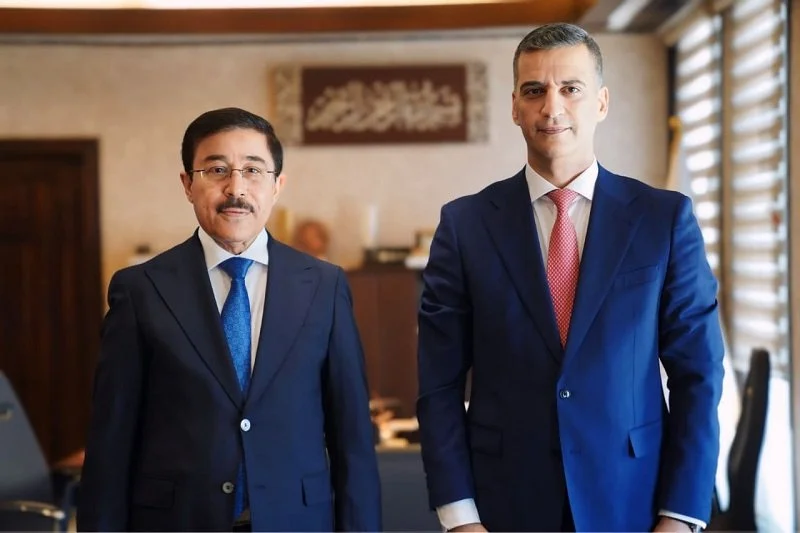
The newly appointed Governor of the Central Bank of Iraq, Mr. Nizar Nasser, officially assumed his duties, accompanied by his predecessor, Mr. Ali Mohsen Al-Alaq.
They conducted a field visit to various offices and departments within the Central Bank to observe operations and understand the nature of the tasks and responsibilities carried out by the different divisions and directorates.
During his tour, Mr. Nasser emphasized the importance of continuing institutional work and enhancing performance efficiency to achieve the Central Bank of Iraq's objectives and consolidate financial and monetary stability.
TNT:
Tishwash: The Central Bank Governor assumes his duties and reviews the bank's operations.
The newly appointed Governor of the Central Bank of Iraq, Mr. Nizar Nasser, officially assumed his duties, accompanied by his predecessor, Mr. Ali Mohsen Al-Alaq.
They conducted a field visit to various offices and departments within the Central Bank to observe operations and understand the nature of the tasks and responsibilities carried out by the different divisions and directorates.
During his tour, Mr. Nasser emphasized the importance of continuing institutional work and enhancing performance efficiency to achieve the Central Bank of Iraq's objectives and consolidate financial and monetary stability.
He also commended the efforts made during the previous term under the leadership of his predecessor, Mr. Ali Mohsen Al-Alaq, and the achievements that contributed to developing the banking sector and strengthening the national economy.
Baghdad - Media Office,
Central Bank of Iraq,
June 22, 2026 link
Tishwash: Al-Zaydi intends to complete the formation of the Iraqi government before visiting Washington.
from Kurdish news
Federal Prime Minister Ali al-Zaidi intends to complete the formation of the government in the first half of July before his anticipated visit to Washington to meet with US President Donald Trump, an official spokesman announced on Sunday, June 21, 2026.
The full cabinet was expected to include 23 ministers, but in mid-May, al-Zaydi presented a list of 14 names, which won parliamentary approval and began its work. Since then, negotiations have been ongoing, hampered by political disagreements over the remaining portfolios, most notably the Interior and Defense ministries.
Government spokesman Haider al-Aboudi said in his weekly press conference that "the cabinet will be completed in the first half of July, before the Washington visit."
Al-Zaidi is expected to visit the White House after that period at the invitation of Trump, in his first visit abroad since taking office and pledging to restrict the weapons of armed groups, which is what Washington is pressuring Baghdad to achieve.
A security official said that al-Zaydi's government is working on "implementing a specific roadmap before the Washington visit" that includes making progress in forming the government and appointing new occupants to senior positions.
Washington had suspended, in response to attacks by Iraqi armed groups on American interests during the Middle East war, cash payments of Iraqi oil revenues that it receives under an agreement concluded after the American invasion, in addition to security assistance.
A US official said last month that Washington was looking for "concrete steps" from al-Zaydi to remove factions from state institutions before aid could be resumed.
Two weeks ago, the Asaib Ahl al-Haq and Kataib al-Imam Ali factions announced that they had handed over the administration of their armed brigades within the Popular Mobilization Forces to the Iraqi government, while other factions, most notably Kataib Hezbollah, Kataib Sayyid al-Shuhada and Harakat al-Nujaba, are holding onto their weapons as long as the international coalition led by Washington to fight the Islamic State remains in northern Iraq until September.
The Popular Mobilization Forces (PMF) were formed in 2014 from Iraqi armed groups to fight jihadists and later became part of the military establishment. However, they also include brigades affiliated with factions allied with Tehran that operate independently and have launched attacks on American interests, prompting deadly retaliatory strikes from Washington.
Baghdad confirms that one of the most prominent issues that al-Zaidi intends to discuss in Washington is the economic file, at a time when Iraq, which is recovering from conflicts that destroyed its infrastructure, is seeking to attract huge investments, especially in the oil sector. link
************
Tishwash: An economic expert warns via Nina against removing zeros... Iraq needs to eliminate the causes of deficit, waste, and corruption.
Former MP and economic expert Hussein al-Falluji warned against rushing the implementation of the project to remove three zeros from the Iraqi dinar and replace the currency, stressing that "this measure will not raise the real value of the dinar, increase the purchasing power of citizens, or address the deep imbalances plaguing the Iraqi economy."
In a statement to the National Iraqi News Agency , al-Falluji said , "Removing zeros is merely a nominal and accounting change to the monetary unit, whereby 1,000 dinars become one new dinar, while prices, salaries, deposits, and debts are changed proportionally, without any real increase in wealth or income." He added,
"The danger lies in presenting this measure to the public as an economic reform or a means to strengthen the dinar, while the strength of a currency is not determined by the numbers printed on it, but rather by the strength of production, the stability of public finances, the volume of exports and foreign reserves, confidence in the banking system, and the ability to control inflation and the deficit."
The economic expert pointed out that "replacing the currency under the current circumstances could lead to market instability, exploitation of the currency conversion process to artificially inflate prices, and increased speculation on the dollar and gold, in addition to the significant costs of printing the new currency, withdrawing the old, and upgrading banking and accounting systems and ATMs."
He explained that "Iraq does not suffer from a crisis regarding the form of the dinar or the number of zeros, but rather from a structural economic and financial crisis, characterized by excessive reliance on oil revenues, inflated current expenditures and the public sector wage bill, weak non-oil revenues, poor collection of taxes, fees, and services, declining domestic production, and a weak private sector and banking system." He emphasized that "removing zeros will not change this equation. If the state is spending 100 trillion dinars and collecting limited local revenues, after removing the zeros it will spend an additional 100 billion dinars, while the deficit and financial imbalance will remain the same."
Al-Falluji called on the government and the Central Bank to refrain from seeking "emotional or propagandistic" measures that give the public a temporary impression of currency strength. Instead, he urged them to focus on a serious economic reform program that begins with reforming public finances, controlling spending, developing local revenues, reforming the dinar income cycle, developing the banking sector, stimulating industry and agriculture, and reducing dependence on imports.
He added, "Removing zeros should be a result of actual economic and monetary stability, not a superficial means of creating this stability. Iraq needs to eliminate the causes of deficits, waste, corruption, and weak production before removing zeros from its currency." It is worth noting that government spokesman Haider al-Aboudi confirmed in a statement to the official newspaper that the government and the Central Bank of Iraq are adopting a flexible economic approach regarding the exchange rate policy of the US dollar against the Iraqi dinar, which currently stands at 1,557 dinars.
Al- Aboudi explained in a press statement that "this policy is based on achieving the national interest and enhancing economic stability, and can be described as an exchange rate policy consistent with the requirements of economic growth."
He pointed out that this approach seeks to achieve a carefully considered balance between the exchange rate and GDP, reflecting the true strength of the national economy and its structural characteristics, and ensuring the stability of macroeconomic indicators.
He explained that the monetary policy authorized by the Central Bank of Iraq under its law is consistent with the government's general directions, which are based on strengthening economic solutions and activating the tools for sustainable growth. link
Tishwash: Economic expert: The risk of a blacklist remains if Iraq's commitments are delayed.
Economic expert Manar Al-Obaidi confirmed on Saturday (June 20, 2026) that the risk of being blacklisted still exists if Iraq's commitments are delayed.
Al-Obaidi said in an analysis seen by “Baghdad Today” that “Iraq is on the right track in the fight against money laundering and terrorist financing, following the recent statement issued by the Financial Action Task Force (FATF), while warning at the same time of the risks of laxity in implementing the agreed obligations.”
He added that "Iraq's continued participation in the cooperative process with the Financial Action Task Force through an agreed joint action plan reflects its continued integration into the international financial system and the preservation of its banking relationships, without imposing any countermeasures against it."
He explained that "this development is a positive indicator, but it does not mean the end of the challenges," stressing that "the next stage requires serious work to implement anti-money laundering laws in all their forms in all governorates and regions without exception."
He added that "the responsibility for accomplishing this task lies with various parties, starting with the executive bodies concerned with enforcing the law and implementing procedures, passing through the legislative bodies that are responsible for completing the necessary legal frameworks, and reaching the community and the private sector through promoting awareness, commitment and reporting of violations."
Al-Obeidi warned that “failure to implement the agreed-upon procedures within the specified timeframes could expose Iraq to significant losses and increase the likelihood of its being placed on the blacklist, which would have negative repercussions on the financial sector and the national economy in general.”
He pointed out that "the opportunity is still available for Iraq to complete the requirements of financial reform, stressing that neglecting it will have a high cost to the state and citizens."
Al-Obaidi praised "the efforts of the official bodies that contributed to strengthening cooperation with international institutions, foremost among them the Anti-Money Laundering and Counter-Terrorism Financing Office and its professional staff," noting that "the role played by the office in the recent negotiations was a key factor in avoiding Iraq being included on the blacklist." link
Monday Coffee with MarkZ. 06/22/2026
Monday Coffee with MarkZ. 06/22/2026
Some highlights by PDK-Not verbatim
MarkZ Disclaimer: Please consider everything on this call as my opinion. People who take notes do not catch everything and its best to watch the video so that you get everything in context. Be sure to consult a professional for any financial decisions
Member: Good morning Mark and admin team. Good morning RV friends.
MZ: Progress in Iraq, Iran and a sovereign update. The Mushroom ladies join us after the news today
Monday Coffee with MarkZ. 06/22/2026
Some highlights by PDK-Not verbatim
MarkZ Disclaimer: Please consider everything on this call as my opinion. People who take notes do not catch everything and its best to watch the video so that you get everything in context. Be sure to consult a professional for any financial decisions
Member: Good morning Mark and admin team. Good morning RV friends.
MZ: Progress in Iraq, Iran and a sovereign update. The Mushroom ladies join us after the news today
MZ: On the rumor front the consensus is it could happen anywhere between now and the 4th….the extreme outliers think it will be by September. I believe it will be closer to the 4th.
MZ: There is a lot that happened this weekend.
MZ: Some of the Groups and Sovereigns are expecting the Indian Nations to be funded and released today or tomorrow. …I hear the money is positioned and they will be allowed to distribute and spend it this week. ….and even some of the bond contacts are telling me similar things.
MZ: I have a contact in one of the largest currency groups that was told on Sunday they will be traveling on Tuesday to get into place for this week. This is very hopeful but is it premature to say that the value has been changed yet……Maybe…but maybe not premature at all.
MZ: I am expecting a lot of movement this week based on what we heard over the weekend. I am getting a lot of chatter from sovereigns (Tier 3) and that is awesome. We have always been told soveriegns were among the very first to go
MZ: Should be sovereigns then full release of all the bond money and then CMKX, settlements, Prosperity packages…then us……It appears things may be moving. I am pretty upbeat about it
Member: How long for things to trickle down to us in 4b?
MZ: I was told maybe a week…which the timing would line up to early July 1st through 4th almost perfectly.
MZ: Cross your fingers and stay calm.
Member: This is old but possibly still valid……There are 5 Tiers of folks Exchanging. Tier 1-governments and royalty Tier 2-whales-elite with platforms of currency, corporations, etc. Tier 3-Admirals Group, American Indians, CMKX, large church groups (like the Mormons), etc. Tier 4-all the hundreds of thousands paying attention to intel - internet groups(all of us). Tier 5- those who never paid attn - the general public.
Member: per Frank26, he believe that between July 1st to July 5th we will see government formed, budget, HCL and the new rate.
MZ: Not sure if they will seat the government that quickly…but, its possible. I kinda think rate before then though. I still think before the 4th is the goal.
Member: Have you heard from your redemption center folks?
MZ: They did not work last weekend…but were told they would possibly work next weekend.
Member: Major happenings in Iraq over the weekend
MZ: “Priorities of the new Central Bank Governor : Implementing Oliver Wyman’s criteria is of utmost importance” An integrated banking system and no dollar restrictions. They also want us to know they will be managing the “Exchange Rate”
MZ: There is a lot of back and forth on this one. Similar to what we saw in Kuwait and China days before their last revaluations.
MZ: “Al-Aboudi: the government and the Central Bank adopt a flexible approach to the exchange rate” they are letting us know they can change it based on needs
MZ: Then the Iraqi government says “There are no plans to change the national currency or remove three zeros from the Iraqi dinar” at this time. We also heard this the morning Kuwait revalued.
MZ: We have the Iraqi government telling us one thing and the Central banks telling us another. We were told the RV is now in the hands of the Central Bank of Iraq and they do not need the government at all.
Member: Alan Greenspan, former U.S. Fed chair under 4 presidents dead at the age of 100.
Member: Will there be more than one 800 number?
MZ: There will be many…..probably one for each bank. There will be separate numbers for Europe, Indonesia….ect…….Banks will be competing for your business.
Member: Thanks so much Mark and mods….Everyone have a Marvelous Monday
THE CONTENT IN THIS PODCAST IS FOR GENERAL & EDUCATIONAL PURPOSES ONLY&NOT INTENDED TO PROVIDE ANY PROFESSIONAL, FINANCIAL OR LEGAL ADVICE. PLEASE CONSIDER EVERYTHING DISCUSSED IN MARKZ’S OPINION ONLY
https://rumble.com/user/theoriginalmarkz
Kick: https://kick.com/theoriginalmarkz
Markz's linktree https://linktr.ee/theMarkZshow
FOLLOW MARKZ : TWITTER . https://twitter.com/originalmarkz?s=21. TRUTH SOCIAL . https://truthsocial.com/@theoriginalm...
Mod: MarkZ "Back To Basics" Pre-Recorded Call" for Newbies 10-19-2022 )https://www.youtube.com/watch?v=37oILmAlptM
MARKZ DAILY LINKS: https://theoriginalmarkz.com/home/
Note from PDK: Please listen to the replay for all the details and entire stream….I do not transcribe political opinions, medical opinions or many guests on this stream……just RV/currency related topics.
THANK YOU FOR JOINING. HAVE A BLESSED DAY. SEE YOU IN THE MORNING FOR COFFEE @ 10:00 AM EST ~ UNLESS BREAKING NEWS HAPPENS! FOR UPDATES ON MARK’S PODCAST GO TO: https://t.me/+b3hYhYlhKM1hYzcx