TNT:
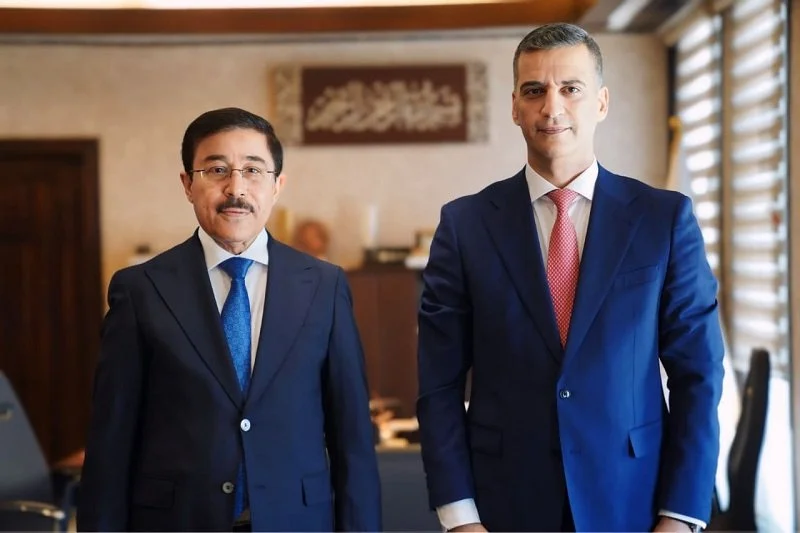
Tishwash: The Central Bank Governor assumes his duties and reviews the bank's operations.
The newly appointed Governor of the Central Bank of Iraq, Mr. Nizar Nasser, officially assumed his duties, accompanied by his predecessor, Mr. Ali Mohsen Al-Alaq.
They conducted a field visit to various offices and departments within the Central Bank to observe operations and understand the nature of the tasks and responsibilities carried out by the different divisions and directorates.
During his tour, Mr. Nasser emphasized the importance of continuing institutional work and enhancing performance efficiency to achieve the Central Bank of Iraq's objectives and consolidate financial and monetary stability.
He also commended the efforts made during the previous term under the leadership of his predecessor, Mr. Ali Mohsen Al-Alaq, and the achievements that contributed to developing the banking sector and strengthening the national economy.
Baghdad - Media Office,
Central Bank of Iraq,
June 22, 2026 link
Tishwash: Al-Zaydi intends to complete the formation of the Iraqi government before visiting Washington.
from Kurdish news
Federal Prime Minister Ali al-Zaidi intends to complete the formation of the government in the first half of July before his anticipated visit to Washington to meet with US President Donald Trump, an official spokesman announced on Sunday, June 21, 2026.
The full cabinet was expected to include 23 ministers, but in mid-May, al-Zaydi presented a list of 14 names, which won parliamentary approval and began its work. Since then, negotiations have been ongoing, hampered by political disagreements over the remaining portfolios, most notably the Interior and Defense ministries.
Government spokesman Haider al-Aboudi said in his weekly press conference that "the cabinet will be completed in the first half of July, before the Washington visit."
Al-Zaidi is expected to visit the White House after that period at the invitation of Trump, in his first visit abroad since taking office and pledging to restrict the weapons of armed groups, which is what Washington is pressuring Baghdad to achieve.
A security official said that al-Zaydi's government is working on "implementing a specific roadmap before the Washington visit" that includes making progress in forming the government and appointing new occupants to senior positions.
Washington had suspended, in response to attacks by Iraqi armed groups on American interests during the Middle East war, cash payments of Iraqi oil revenues that it receives under an agreement concluded after the American invasion, in addition to security assistance.
A US official said last month that Washington was looking for "concrete steps" from al-Zaydi to remove factions from state institutions before aid could be resumed.
Two weeks ago, the Asaib Ahl al-Haq and Kataib al-Imam Ali factions announced that they had handed over the administration of their armed brigades within the Popular Mobilization Forces to the Iraqi government, while other factions, most notably Kataib Hezbollah, Kataib Sayyid al-Shuhada and Harakat al-Nujaba, are holding onto their weapons as long as the international coalition led by Washington to fight the Islamic State remains in northern Iraq until September.
The Popular Mobilization Forces (PMF) were formed in 2014 from Iraqi armed groups to fight jihadists and later became part of the military establishment. However, they also include brigades affiliated with factions allied with Tehran that operate independently and have launched attacks on American interests, prompting deadly retaliatory strikes from Washington.
Baghdad confirms that one of the most prominent issues that al-Zaidi intends to discuss in Washington is the economic file, at a time when Iraq, which is recovering from conflicts that destroyed its infrastructure, is seeking to attract huge investments, especially in the oil sector. link
************
Tishwash: An economic expert warns via Nina against removing zeros... Iraq needs to eliminate the causes of deficit, waste, and corruption.
Former MP and economic expert Hussein al-Falluji warned against rushing the implementation of the project to remove three zeros from the Iraqi dinar and replace the currency, stressing that "this measure will not raise the real value of the dinar, increase the purchasing power of citizens, or address the deep imbalances plaguing the Iraqi economy."
In a statement to the National Iraqi News Agency , al-Falluji said , "Removing zeros is merely a nominal and accounting change to the monetary unit, whereby 1,000 dinars become one new dinar, while prices, salaries, deposits, and debts are changed proportionally, without any real increase in wealth or income." He added,
"The danger lies in presenting this measure to the public as an economic reform or a means to strengthen the dinar, while the strength of a currency is not determined by the numbers printed on it, but rather by the strength of production, the stability of public finances, the volume of exports and foreign reserves, confidence in the banking system, and the ability to control inflation and the deficit."
The economic expert pointed out that "replacing the currency under the current circumstances could lead to market instability, exploitation of the currency conversion process to artificially inflate prices, and increased speculation on the dollar and gold, in addition to the significant costs of printing the new currency, withdrawing the old, and upgrading banking and accounting systems and ATMs."
He explained that "Iraq does not suffer from a crisis regarding the form of the dinar or the number of zeros, but rather from a structural economic and financial crisis, characterized by excessive reliance on oil revenues, inflated current expenditures and the public sector wage bill, weak non-oil revenues, poor collection of taxes, fees, and services, declining domestic production, and a weak private sector and banking system." He emphasized that "removing zeros will not change this equation. If the state is spending 100 trillion dinars and collecting limited local revenues, after removing the zeros it will spend an additional 100 billion dinars, while the deficit and financial imbalance will remain the same."
Al-Falluji called on the government and the Central Bank to refrain from seeking "emotional or propagandistic" measures that give the public a temporary impression of currency strength. Instead, he urged them to focus on a serious economic reform program that begins with reforming public finances, controlling spending, developing local revenues, reforming the dinar income cycle, developing the banking sector, stimulating industry and agriculture, and reducing dependence on imports.
He added, "Removing zeros should be a result of actual economic and monetary stability, not a superficial means of creating this stability. Iraq needs to eliminate the causes of deficits, waste, corruption, and weak production before removing zeros from its currency." It is worth noting that government spokesman Haider al-Aboudi confirmed in a statement to the official newspaper that the government and the Central Bank of Iraq are adopting a flexible economic approach regarding the exchange rate policy of the US dollar against the Iraqi dinar, which currently stands at 1,557 dinars.
Al- Aboudi explained in a press statement that "this policy is based on achieving the national interest and enhancing economic stability, and can be described as an exchange rate policy consistent with the requirements of economic growth."
He pointed out that this approach seeks to achieve a carefully considered balance between the exchange rate and GDP, reflecting the true strength of the national economy and its structural characteristics, and ensuring the stability of macroeconomic indicators.
He explained that the monetary policy authorized by the Central Bank of Iraq under its law is consistent with the government's general directions, which are based on strengthening economic solutions and activating the tools for sustainable growth. link
Tishwash: Economic expert: The risk of a blacklist remains if Iraq's commitments are delayed.
Economic expert Manar Al-Obaidi confirmed on Saturday (June 20, 2026) that the risk of being blacklisted still exists if Iraq's commitments are delayed.
Al-Obaidi said in an analysis seen by “Baghdad Today” that “Iraq is on the right track in the fight against money laundering and terrorist financing, following the recent statement issued by the Financial Action Task Force (FATF), while warning at the same time of the risks of laxity in implementing the agreed obligations.”
He added that "Iraq's continued participation in the cooperative process with the Financial Action Task Force through an agreed joint action plan reflects its continued integration into the international financial system and the preservation of its banking relationships, without imposing any countermeasures against it."
He explained that "this development is a positive indicator, but it does not mean the end of the challenges," stressing that "the next stage requires serious work to implement anti-money laundering laws in all their forms in all governorates and regions without exception."
He added that "the responsibility for accomplishing this task lies with various parties, starting with the executive bodies concerned with enforcing the law and implementing procedures, passing through the legislative bodies that are responsible for completing the necessary legal frameworks, and reaching the community and the private sector through promoting awareness, commitment and reporting of violations."
Al-Obeidi warned that “failure to implement the agreed-upon procedures within the specified timeframes could expose Iraq to significant losses and increase the likelihood of its being placed on the blacklist, which would have negative repercussions on the financial sector and the national economy in general.”
He pointed out that "the opportunity is still available for Iraq to complete the requirements of financial reform, stressing that neglecting it will have a high cost to the state and citizens."
Al-Obaidi praised "the efforts of the official bodies that contributed to strengthening cooperation with international institutions, foremost among them the Anti-Money Laundering and Counter-Terrorism Financing Office and its professional staff," noting that "the role played by the office in the recent negotiations was a key factor in avoiding Iraq being included on the blacklist." link