Jon Dowling: Fed Meeting, Currencies, Metals, Cryptos, and Iraq Updates with Rob Cunningham, June 2026
Jon Dowling: Fed Meeting, Currencies, Metals, Cryptos, and Iraq Updates with Rob Cunningham, June 2026
6-16-2026
In a recent episode of the Jon Dowling podcast, economic commentator and military veteran Rob Cunningham provided a comprehensive look at what he describes as a pivotal turning point in the global financial system.
Cunningham, who brings a unique perspective as a former commercial pilot and patriot, joined Dowling to discuss the intersection of U.S. monetary policy, geopolitical stabilization, and the technological evolution of money.
Jon Dowling: Fed Meeting, Currencies, Metals, Cryptos, and Iraq Updates with Rob Cunningham, June 2026
6-16-2026
In a recent episode of the Jon Dowling podcast, economic commentator and military veteran Rob Cunningham provided a comprehensive look at what he describes as a pivotal turning point in the global financial system.
Cunningham, who brings a unique perspective as a former commercial pilot and patriot, joined Dowling to discuss the intersection of U.S. monetary policy, geopolitical stabilization, and the technological evolution of money.
The conversation centered largely on the anticipated evolution of the Federal Reserve’s strategy.
Cunningham highlighted the potential influence of Fed insider Kevin Warsh, suggesting a move toward resolving the current “dysfunctional flatness” of the yield curve. By addressing these artificial constraints, Cunningham predicts a radical paradigm shift: a period where short-term interest rates are lowered to unlock liquidity and stimulate economic growth.
Contrary to traditional economic theories that suggest growth inevitably leads to inflation, Cunningham argues that we are entering an era where growth—facilitated by lower energy prices and peace in the Middle East—can occur alongside price stability.
This shift would allow for the refinancing of trillions in U.S. debt at more sustainable rates, while simultaneously opening the floodgates for private capital to flow into emerging sectors like technology and digital assets.
A significant portion of the discussion focused on the international stage, specifically the reintegration of nations like Iraq and Vietnam into the global financial fold.
Cunningham emphasized the importance of the “Clarity Act,” a move toward national sovereignty and transparency that signals a country’s readiness to participate in a modern, technology-driven economy.
With Iraq’s stabilization and the potential for new peace deals in the region, Cunningham suggests that the world is moving away from centralized control toward a system that values natural resource abundance and economic reform.
He identifies the Iraqi dinar and the Vietnamese dong as currencies to watch as these nations undergo internal renewals and embrace decentralized financial structures.
At the heart of this transition is a move toward Distributed Ledger Technology (DLT) and stablecoins. Cunningham envisions a “bottom-up” global financial architecture that replaces elite-dominated monetary control with a system based on voluntary compliance and transparency protocols. This shift isn’t just about efficiency; it’s about establishing a foundation of “sound money.”
Cunningham also expressed strong support for Judy Shelton, a prominent advocate for asset-backed monetary systems. Her inclusion in the conversation underscores a broader movement toward ensuring that currency holds intrinsic value, further shielding the global economy from the volatility of unbacked fiat systems.
As for when these changes will manifest, Cunningham offered a cautious but optimistic timeline. He anticipates that the economic momentum generated by these policy shifts will become powerfully evident by the third quarter of 2024.
Symbolically, he looks toward the July 4th holiday as a potential window for the signing of the Clarity Act, aligning a moment of financial renewal with America’s heritage of freedom.
The insights shared by Rob Cunningham on the Jon Dowling podcast serve as a roadmap for understanding a complex and rapidly changing world. By focusing on liquidity, technological innovation, and geopolitical stability, Cunningham provides a framework for how the global economy might transition into a more transparent and growth-oriented future.
To hear the full discussion and gain deeper insights into these economic forecasts, be sure to watch the full video from Jon Dowling.
Coffee with MarkZ, joined by Zester. 06/17/2026
Coffee with MarkZ, joined by Zester. 06/17/2026
MarkZ Disclaimer: Please consider everything on this call as my opinion. Be sure to consult a professional for any financial decisions
MZ: Details dominate the news today in both Iraq and Iran, focusing on a peace deal. Zester takes a deeper dive into the troubled private equity market.
THE CONTENT IN THIS PODCAST IS FOR GENERAL & EDUCATIONAL PURPOSES ONLY&NOT INTENDED TO PROVIDE ANY PROFESSIONAL, FINANCIAL OR LEGAL ADVICE. PLEASE CONSIDER EVERYTHING DISCUSSED IN MARKZ’S OPINION ONLY
Coffee with MarkZ, joined by Zester. 06/17/2026
MarkZ Disclaimer: Please consider everything on this call as my opinion. Be sure to consult a professional for any financial decisions
MZ: Details dominate the news today in both Iraq and Iran, focusing on a peace deal. Zester takes a deeper dive into the troubled private equity market.
THE CONTENT IN THIS PODCAST IS FOR GENERAL & EDUCATIONAL PURPOSES ONLY&NOT INTENDED TO PROVIDE ANY PROFESSIONAL, FINANCIAL OR LEGAL ADVICE. PLEASE CONSIDER EVERYTHING DISCUSSED IN MARKZ’S OPINION ONLY
https://rumble.com/user/theoriginalmarkz
Kick: https://kick.com/theoriginalmarkz
Markz's linktree https://linktr.ee/theMarkZshow
FOLLOW MARKZ : TWITTER . https://twitter.com/originalmarkz?s=21. TRUTH SOCIAL . https://truthsocial.com/@theoriginalm...
Mod: MarkZ "Back To Basics" Pre-Recorded Call" for Newbies 10-19-2022 )https://www.youtube.com/watch?v=37oILmAlptM
MARKZ DAILY LINKS: https://theoriginalmarkz.com/home/
THANK YOU FOR JOINING. HAVE A BLESSED DAY. SEE YOU IN THE MORNING FOR COFFEE @ 10:00 AM EST ~ UNLESS BREAKING NEWS HAPPENS! FOR UPDATES ON MARK’S PODCAST GO TO: https://t.me/+b3hYhYlhKM1hYzcx
Wed. Iraq News Posted by Tishwash at TNT 6-17-2026
TNT:
Tishwash: The government announces the purpose of al-Zaidi's visit to Washington
Government spokesman Haider Al-Aboudi confirmed on Tuesday that Prime Minister Ali Faleh Al-Zaidi's visit to Washington aims to strengthen the Iraqi-American partnership, noting that economic, trade and investment issues will be at the forefront of the visit's agenda.
Al-Aboudi said in a press statement: “The Prime Minister, Ali Faleh Al-Zaidi, will pay an official visit to Washington in mid-July with the aim of establishing the necessary momentum to strengthen the Iraqi-American partnership and elevate it to an effective level within the framework of the strategic relationship between the two countries, in accordance with the principle of common interests of the two friendly peoples.”
TNT:
Tishwash: The government announces the purpose of al-Zaidi's visit to Washington
Government spokesman Haider Al-Aboudi confirmed on Tuesday that Prime Minister Ali Faleh Al-Zaidi's visit to Washington aims to strengthen the Iraqi-American partnership, noting that economic, trade and investment issues will be at the forefront of the visit's agenda.
Al-Aboudi said in a press statement: “The Prime Minister, Ali Faleh Al-Zaidi, will pay an official visit to Washington in mid-July with the aim of establishing the necessary momentum to strengthen the Iraqi-American partnership and elevate it to an effective level within the framework of the strategic relationship between the two countries, in accordance with the principle of common interests of the two friendly peoples.”
He added, “Based on the priorities of the Iraqi government and its ministerial program, which has gained the confidence of the House of Representatives, economic, trade and investment files will be at the forefront of the axes of the anticipated visit as the cornerstone of the path of bilateral cooperation,” noting that “the government seeks to expand the horizons of strategic partnership with international companies and stimulate the investment environment in a way that contributes to achieving direct benefits for the Iraqi economy and enhances internal stability.”
Al-Aboudi continued, “Within the framework of this stability, which is based on economic foundations and flexible management of the variables of the current stage, the Iraqi government is proceeding with addressing the issue of unregulated weapons and working to restrict their possession and use to the state and its competent institutions, as they are constitutionally authorized to make the sovereign decision in this field.”
Prime Minister Ali Faleh al-Zaidi received in his office the US President’s Special Envoy, Tom Barrack, and discussed with him the Iraqi government’s shared commitment to establishing a strong and mutually beneficial US-Iraqi partnership capable of fulfilling the aspirations of Iraqis for a future of sovereignty, security and prosperity, and providing tangible benefits to both the Iraqi and American peoples. link
************
Tishwash: Ending the "militias" and the relationship between Erbil and Baghdad are on the table for Masoud Barzani and Tom Barrack
Kurdish leader Masoud Barzani discussed with US President’s Special Envoy for Iraq and Syria, Tom Barak, on Tuesday, ways to enhance stability in Iraq and the Kurdistan Region. While Barak stressed the need for Baghdad to restrict weapons to the state and end the influence of “militias,” Barzani pointed to the importance of the federal government’s commitment to the principles of partnership, balance, and consensus within the framework of the constitution.
A statement from Barzani’s headquarters, received by Shafaq News Agency, stated that Masoud Barzani received Ambassador Tom Barrack at the Salahaddin resort. During the meeting, Barrack emphasized that Iraq and the region need stability, and that the Kurdistan Region plays an important and essential role in the present and future, while expressing his admiration for the development and progress witnessed in the Kurdistan Region, describing it as exemplary.
For his part, Barzani stressed that the Kurdistan Region has always been a stabilizing factor, and that it supports dialogue and diplomatic solutions to all of Iraq’s and the region’s problems, noting that the Kurdistan Region has never been part of the problems, but has always been unfairly harmed by the consequences of wars and conflicts in the region.
Barzani also stressed the need for the Middle East to move towards a stable situation that brings prosperity to the region's inhabitants.
In another part of the meeting, the importance of joint work and coordination between the Kurdistan Region and the new Iraqi government was highlighted.
The US envoy spoke about the need for stability in the Iraqi political system and the protection of the state’s role in controlling unofficial armed forces, reiterating his country’s support for the Iraqi federal prime minister in the process of restricting weapons to the state and ending the influence of militias, as stated in the statement.
Regarding the new Iraqi government, Barzani affirmed his support for Prime Minister Ali al-Zubaidi, stressing the need for everyone to learn from the mistakes of the past and to work on the basis of the principles of partnership, balance, and consensus, and within the framework of the constitution.
In another part of the meeting, views were exchanged on the situation in the region and its equations, and the two sides agreed to work together according to common priorities to enhance the stability of Iraq and the Kurdistan Region, and to build a long-term strategic friendship in economic aspects and to encourage investment. link
*************
Tishwash: The fluctuation in the dollar's exchange rate is linked to the mechanisms of the central bank and has no relation to political agreements.
A currency exchanger in Erbil markets revealed that the main reason behind the recent rise in the dollar exchange rate is due to the scarcity of hard currency offered in the markets, denying that the matter has any connection to political understandings or agreements.
Money exchanger Mam Sayed explained in an exclusive statement to Kurdistan 24 on Tuesday, June 16, 2026, that the decline in the amount of dollars offered by the Central Bank of Iraq has directly impacted prices. He pointed out that the scarcity of foreign currency in the markets is linked to the Central Bank's sales mechanism in Baghdad. He also noted the existence of unconfirmed rumors about the Central Bank's intention to adjust the official exchange rate to 142,000 dinars per 100 dollars, which has contributed to increased volatility and instability in the parallel market.
Regarding the role of Erbil markets in price movements, Mam Sayed stressed that "this situation is not related to Erbil markets, but rather the procedures followed in Baghdad are the main cause of the current state of confusion."
Regarding price levels, Al-Sarraf explained that the trading of the past 24 hours witnessed sharp fluctuations; as the exchange rate yesterday morning reached 154,000 dinars per 100 dollars, while the price currently ranges between 155,700 and 156,000 dinars.
He also revealed that commercial activity and market demand are currently concentrated almost entirely on the Iranian Toman, while trading in other currencies such as the Euro, the British Pound, and the Chinese Yuan has witnessed a significant decline and near-total stagnation.
The money changer pointed out the difficulty of predicting the course of exchange rates in the coming days, given the continued scarcity of dollars and the uncertainty regarding the duration of this situation.
For his part, Mazhar Muhammad Salih, the Iraqi Prime Minister's economic advisor, had previously told Kurdistan 24 that the current financial difficulties are directly linked to regional tensions and the closure of the Strait of Hormuz. He explained that approximately 85% of Iraq's oil was exported daily through this strait, meaning that the disruption of this vital waterway has severely limited the government's financial capabilities.
Ali al-Zidi’s advisor denied rumors that spoke of a government intention to reduce the value of the local currency, stressing: “The Iraqi government has no plans at the moment to raise the exchange rate of the dollar, but rather all efforts are focused on finding alternative mechanisms and overcoming the current financial crisis.”
The clarifications from Mazhar Muhammad Salih come in response to what local media outlets have been reporting in recent days regarding the federal government's intention to raise the exchange rate of the dollar against the dinar to confront the current economic and financial challenges. link
Tishwash: Speculation and Scarcity Drive Iraqi Dinar Lower as Baghdad Rejects Devaluation Fears
While the closure of the Strait of Hormuz chokes oil revenue, currency markets in Erbil and Baghdad grapple with a dollar shortage and a wave of disruptive rumors.
In the bustling corridors of Erbil's currency bazaar, the rhythmic exchange of notes has taken on a frantic pace as the U.S. dollar climbs sharply against the Iraqi dinar. On Tuesday, the local market was defined by a volatile mix of genuine scarcity and a feverish wave of speculation, leaving traders and citizens alike struggling to find firm footing in an increasingly unstable financial landscape.
The immediate source of the tremor appears to be a sudden tightening of dollar liquidity originating in Baghdad. Mam Sayid, a prominent currency exchanger in Erbil's bazaar, told Kurdistan24 on Tuesday that the primary driver behind the dollar's surge is a physical shortage of the currency.
While the Central Bank of Iraq (CBI) continues to sell dollars, Sayid noted that the pace is depleting national reserves at a concerning rate.
The resulting anxiety is manifesting in sharp price fluctuations.
According to Sayid's 24-hour market update, the exchange rate moved from approximately 154,000 IQD per $100 on Monday morning to as high as 156,000 IQD by Tuesday.
This rapid depreciation has been further fueled by a persistent rumor that the Central Bank intends to raise the official exchange rate to 142,000 IQD, a move that would effectively codify a devaluation of the national currency.
Sayid was emphatic that the disruption is a product of policy uncertainty in the capital rather than local conditions in the Kurdistan Region.
The fiscal squeeze is undeniable, and its roots are deeply anchored in the region's geopolitical volatility. Iraq's financial health is inextricably tied to its oil exports, and the recent conflict has dealt a staggering blow to the state's revenue streams.
Mazhar Mohammed Salih, a senior economic advisor to Iraqi Prime Minister Ali al-Zaidi, recently provided Kurdistan24 with a stark assessment of the crisis.
He explained that the ongoing closure of the Strait of Hormuz, the maritime chokepoint through which 85 percent of Iraq's oil once flowed daily, has severely restricted the government's financial capacity.
However, Salih moved decisively to quell the market's worst fears. In an interview with Kurdistan24, he categorically denied reports that the government plans to officially devalue the dinar to offset the revenue shortfall.
"At this stage, the Iraqi government has no plans to raise the value of the dollar," Salih stated, characterizing reports of an impending hike as baseless.
He noted that the administration is instead aggressively pursuing alternative economic mechanisms to navigate the current fiscal crunch without resorting to a policy-led increase in exchange rates.
Despite these official reassurances, the psychology of the bazaar often moves faster than the directives from the Prime Minister's office.
In a highly dollarized economy like Iraq's, rumors of a pending rate change often become self-fulfilling prophecies.
Traders, anticipating a more expensive dollar tomorrow, hoard their current holdings today, thereby strangling supply and driving prices up in a classic speculative loop.
The shift in market demand also reflects broader regional alignments. Mam Sayid revealed that while the dollar dominates the conversation, demand among traders has become concentrated on the Iranian toman.
Meanwhile, traditional trading in other major international currencies, such as the euro, the British pound, and the Chinese yuan, has effectively stalled. This stagnation in non-dollar trading highlights the unique, almost singular importance of the U.S. currency to Iraq's domestic stability and its ability to pay for essential imports.
The implications for the average Iraqi are significant.
A rising dollar translates directly into higher costs for imported goods, from basic foodstuffs to electronics and medicine, eroding the purchasing power of families already strained by the wider regional conflict.
For the al-Zaidi government, the challenge is twofold: they must manage a genuine liquidity crisis born of suppressed oil exports while simultaneously conducting a war of words against the rumors that threaten to unanchor the currency.
As the markets wait for a definitive sign of stability, predicting the dinar's trajectory remains a difficult task for even the most seasoned observers.
For Mam Sayid and his fellow traders in Erbil, the immediate future is a waiting game. Until the underlying scarcity is resolved and the "142,000" rumor is fully exorcised from the public consciousness, the Iraqi dinar will likely remain at the mercy of the prevailing winds blowing from Baghdad and the volatile waters of the Gulf. link
News, Rumors and Opinions Wednesday 6-17-2026
Reset Intelligence: Washington Sends its Closer to Baghdad
6-16-2026
Washington Sends the Closer
By Reset Intelligence | @EXIT_FIAT
One day after the United States and Iran put their names to a deal, Washington put its closer on a plane to Baghdad.
You do not send your closer to walk the file the day after the signature unless the deal underneath it is real.
Reset Intelligence: Washington Sends its Closer to Baghdad
6-16-2026
Washington Sends the Closer
By Reset Intelligence | @EXIT_FIAT
One day after the United States and Iran put their names to a deal, Washington put its closer on a plane to Baghdad.
You do not send your closer to walk the file the day after the signature unless the deal underneath it is real.
The envoy walks the file
Tom Barrack, the US Special Presidential Envoy for Iraq and Syria, landed in Baghdad on Monday, met Prime Minister Ali al-Zaidi and the head of the Supreme Judicial Council, then flew to Erbil to sit with the Barzanis. Oil is 84 percent of what Iraq earns. Friday’s signing in Geneva lifts the blockade that cut that income to a trickle. He is not in Iraq to observe.
The moves on the table
• The Erbil deadlock – the KDP and PUK still have no regional cabinet more than a year and a half after the vote, and a senior Kurdish figure says only an outside power can broker between them. Barrack is that power.
• The gate that opened – S&P pulled Iraq off CreditWatch negative, and the central bank is grading its banks back into the euro, the dirham, the yuan.
• The July clock – the treaty carrying Iraq’s northern oil through Turkey lapses on July 27, days before al-Zaidi flies to Washington.
• The Washington trip – al-Zaidi heads to the US in July with a 500,000 barrel-a-day offer in his folder.
Why Washington cares this much
That is the short version, and those moves are public. The daily briefing is where they connect: why the United States is already wired into Iraq’s money, what a new financial system needs from this last piece, and what it means for the rate that still sits at 1,300 to the dollar. That is the read behind the free sign-up.
Read the full daily briefing free for 5 days. Sign up here: resetintelligence.com
The book that mapped this two years before Treasury named the architecture verbatim: Head of the Snake (25% off with code 25XOFF). Free guides and the scenario research reports are here: Resources.
The only question history will ask is who saw it while it was actually happening.
Read full post here: https://dinarchronicles.com/2026/06/16/reset-intelligence-washington-sends-its-closer-to-baghdad/
*************
Courtesy of Dinar Guru: https://www.dinarguru.com/
Reset Intelligence One day after the US and Iran put their names to a deal, Washington flies its closer into Baghdad. Special Presidential Envoy Tom Barrack walks the oil, the cabinet, and the revenue file toward a close. The real question is why Washington cares this much about one country in particular...Washington does not move this hard on a country it holds no stake in...Washington is there for the monetary result...A new financial system needs this last piece fixed, and whoever is holding the dinar when the rate flips gets paid.
Stephen The current central bank governor is butting heads with the new prime minister because the new prime minister Kaidi is wanting to increase the purchasing power of the Iraqi dinar and the current central bank governor was threatening to resign...It seems like they are at odds. I personally believe we're going to see a replacement of the central bank governor most likely in the next 30 to 60 days. Maybe sooner.
Militia Man The United States-Iran agreement is a significant positive tailwind for the country of Iraq. It supports my outside the box thinking that things could move faster than most conservative timelines even suggest...We see all kinds of wonderful things taking place ...All of this taking place creates an environment t that makes a managed REER in the coming weeks, months, even more feasible and well timed...
Jeff Banking reform...is waiting for the rate to change...Attracting investment is waiting for the rate to change...The private sector must play a larger role, again, need the rate to change for that. Everything in Iraq right now is waiting for the rate to change. That's why it looks like absolutely nothing in Iraq has happened in this month of June or since the new PM has come in. The new PM cannot do anything till the rate changes.
As Trust In Governments & Institutions Collapses, We Rebuild It In Our Families | Andy Schectman
Liberty and Finance: 6-16-2026
Andy Schectman more up close and personal than you’ve ever seen him… In a time when confidence in governments and major institutions continues to erode, many are turning their attention back to what remains stable and within their control. This conversation explores how trust is rebuilt not through systems, but through people, families, and long-term relationships.
Andy Schectman reflects on decades of experience building a family-run business grounded in integrity, consistency, and personal accountability.
The discussion highlights how small, disciplined actions and strong relationships can create resilience even amid financial and social uncertainty. Ultimately, the message centers on strengthening the foundations closest to us when larger structures feel increasingly uncertain.
INTERVIEW TIMELINE:
0:00 Intro
2:00 Making family a priority
11:46 The laws of compounding
20:00 Financial system's trust eroding
23:50 Optimism
Iraq Economic News and Points To Ponder Late Tuesday Evening 6-16-26
Oil Prices Fall On Uncertainty Over Hormuz Reopening
2026-06-16 Shafaq News Oil prices extended losses on Tuesday, as markets weighed prospects for resumption of supply through the key Strait of Hormuz against shaky physical market drivers and a lack of details from a preliminary deal to end the Iran war.
By 0436 GMT, Brent crude futures fell 25 cents, or 0.3%, to $82.92 a barrel and U.S. West Texas Intermediate inched down 9 cents, or 0.1%, to $80.66 a barrel.
Oil Prices Fall On Uncertainty Over Hormuz Reopening
2026-06-16 Shafaq News Oil prices extended losses on Tuesday, as markets weighed prospects for resumption of supply through the key Strait of Hormuz against shaky physical market drivers and a lack of details from a preliminary deal to end the Iran war.
By 0436 GMT, Brent crude futures fell 25 cents, or 0.3%, to $82.92 a barrel and U.S. West Texas Intermediate inched down 9 cents, or 0.1%, to $80.66 a barrel.
On Monday, oil prices fell nearly 5% to their lowest close since March 4, after U.S. President Donald Trump said a memorandum of understanding was signed to end the U.S.-Israeli war with Iran, though full details have not been made public.
The hostilities led to the closure of the Strait of Hormuz that typically carried one-fifth of the world's oil supply before the conflict.
Some analysts expect a resumption of supply soon via the Strait, with other factors weighing down physical market prices.
"From here, it likely takes several weeks for tanker flow to be restored," Morgan Stanley analysts said in a client note.
"We see 50% of production back by September, and 80% by December, slightly faster than before."
A broad range of indicators had signaled weakness in physical oil markets in recent weeks, they added.
"High U.S. exports and low China imports are the key drivers (and) in the short term (i.e. next weeks) they do not seem to come to an end just yet."
China's crude imports slumped 29% in May to their lowest in eight years, extending a dramatic decline for the world's importer, with its liftings of Saudi Arabia crude expected to also fall in July.
Early indications are that the U.S.-Iran deal would reopen the blockaded Strait of Hormuz and extend a ceasefire for 60 days, allowing negotiators to tackle difficult issues such as the future of Iran's nuclear programme.
On Monday, Iranian President Masoud Pezeshkian called the U.S.-Iran pact an "important step" toward stopping the fighting but cautioned a final agreement for a lasting truce "has yet to take shape".
But with full details yet to emerge and a permanent truce still to be reached, overall price weakness is limited.
Suvro Sarkar, the head of DBS Bank's energy research, said the deal's first phase, encompassing the Geneva signing of an extension of the 60-day ceasefire, was easy, would buy time and kick the "nuclear can" down the road.
But the second phase, to be watched most closely by markets for its physical impact, is the phased reopening of the Strait of Hormuz and the wind-down of the US naval blockade on Iranian ports and vessels, he added.
"Anything other than a clean simultaneous unlock will mean renewed volatility in oil prices," Sarkar said. "Given the trust deficit so far, it will be interesting to see how this plays out over the next couple of weeks."
On Monday, a senior Iranian official said Iran would freeze its nuclear activity until a final agreement, and refrain from further uranium enrichment or expansion of nuclear facilities.
Reuters https://www.shafaq.com/en/Economy/Oil-prices-fall-on-uncertainty-over-Hormuz-reopening
Iraq's Petroleum Product Exports Fall 16% In Q1 2026
2026-06-16 Shafaq News- Baghdad Iraq's petroleum product exports totaled 2.35 million tonnes in the first quarter of 2026, down nearly 16% from 2.80 million tonnes during the same period last year, according to data released on Tuesday by the State Oil Marketing Organization (SOMO).
The exports consisted of 2.12 million tonnes of fuel oil and 234,503 tonnes of naphtha, while no sulfur exports were recorded during the January-March period.
Iraq, OPEC's second-largest oil producer, relies on crude oil exports for about 90% of federal revenue. According to government accounts through April, oil revenues reached 26.121 trillion Iraqi dinars (about $17B), accounting for 84% of the country's total income of 31.163 trillion dinars (about $20B) during the first four months of 2026.
https://www.shafaq.com/en/Economy/Iraq-s-petroleum-product-exports-fall-16-in-Q1-2026
Iraqi Crude Among Top Losers On US-Iran Deal Hopes
2026-06-16 Shafaq News- Basrah Iraq's Basrah crude posted sharp losses on Tuesday, ranking among the steepest decliners in global oil markets as optimism over a preliminary US-Iran agreement pressured prices.
Basrah Heavy dropped $4.64, or 7.98%, to $53.50 per barrel, while Basrah Medium fell by the same amount, losing 7.70% to settle at $55.60 per barrel.
Globally, Brent crude eased 0.31% to $82.92 per barrel, and US West Texas Intermediate (WTI) slipped 0.11% to $80.66 per barrel.
The Organization of the Petroleum Exporting Countries (OPEC) basket declined 6.52% to $91.68 per barrel. Omani crude on the Dubai Energy Exchange also fell 7% to $81.91 per barrel, as wait-and-see sentiment spread across regional markets. https://www.shafaq.com/en/Economy/Iraqi-crude-among-top-losers-on-US-Iran-deal-hopes
Two Tankers Receive 4M Barrels Of Iraqi Crude At Basra Ports
2026-06-16 Shafaq News- Basra Two oil tankers, a Greek and an Emirati tanker, are currently being loaded with a combined four million barrels of Iraqi crude at southern ports in Basra as part of the resumption of crude oil exports, an Iraqi ports source told Shafaq News on Tuesday.
This development follows the preliminary understanding between Iran and the United States announced on Sunday, which led to the reopening of the Strait of Hormuz to maritime traffic after intermittent disruptions linked to the conflict involving Iran, the United States, and Israel.
Hormuz, the strategic maritime corridor, has been largely shut since February 28 following the US–Israel war on Iran, disrupting energy flows and prompting Gulf producers, including Iraq, which routes roughly 95% of its oil exports through the waterway, to scale back shipments.
Turkiye Rejects Extending Kirkuk-Ceyhan Oil Pipeline Agreement
2026-06-16 Shafaq News- Ankara Ankara refuses to extend the existing Kirkuk-Ceyhan oil pipeline agreement under current conditions, Reuters reported on Tuesday, citing a senior Turkish official.
Iraq requested at least a one-year extension to allow more time for negotiations on a replacement deal.
Ali Nizar, head of Iraq’s State Organization for Marketing of Oil (SOMO), said Iraq has exported about 12 million barrels of crude oil through its southern ports since the beginning of June.
The current Kirkuk-Ceyhan pipeline agreement is due to expire on July 27, ending a framework that has regulated oil exports between Iraq and Turkiye for decades. Both sides continue to discuss a draft agreement that would govern export operations through the route in the coming period.
https://www.shafaq.com/en/Economy/Turkiye-rejects-extending-Kirkuk-Ceyhan-oil-pipeline-agreement
Seeds of Wisdom RV and Economics Updates Wednesday Morning 6-17-26
Good Morning Dinar Recaps,
Europe's Gas Market Survives Hormuz Shock, but Long-Term Demand Decline Looms
The recent Strait of Hormuz disruption tested Europe's energy resilience, but the greater challenge may be adapting to a future of declining natural gas demand.
Good Morning Dinar Recaps,
Europe's Gas Market Survives Hormuz Shock, but Long-Term Demand Decline Looms
The recent Strait of Hormuz disruption tested Europe's energy resilience, but the greater challenge may be adapting to a future of declining natural gas demand.
Overview
Europe successfully weathered the Strait of Hormuz disruption by diversifying liquefied natural gas (LNG) imports and relying on expanded energy infrastructure.
Although the U.S.-Iran peace framework is expected to restore shipping, lingering production losses in Qatar and global LNG competition could affect supply for years.
Analysts now believe Europe's biggest energy challenge is no longer supply security—but steadily declining demand driven by electrification and decarbonization.
Key Developments
1. Europe Withstood a Major Global LNG Supply Shock
The temporary closure of the Strait of Hormuz disrupted nearly 20% of global LNG trade, causing European natural gas prices to surge by approximately 31% and increasing the European Union's collective gas bill by nearly 48%. Despite these pressures, Europe avoided widespread shortages by increasing LNG imports from the United States, Algeria, and Nigeria while relying on expanded storage and pipeline networks.
2. Diversified Energy Infrastructure Prevented a Crisis
Years of investment in LNG import terminals, cross-border pipelines, storage facilities, and interconnectors allowed natural gas supplies to move efficiently throughout Europe. New regasification terminals across the Baltic, Adriatic, and Aegean regions further strengthened Europe's ability to respond to supply disruptions.
3. Long-Term Demand Decline May Become the Bigger Story
While supply security has improved, researchers project that European natural gas demand could decline between 30% and nearly 50% by 2040, depending on energy prices and climate policies. Electrification, renewable energy expansion, improved efficiency, and decarbonization efforts are expected to steadily reduce gas consumption across power generation, industry, and residential heating.
Why It Matters
The Hormuz crisis demonstrated that Europe's energy system is significantly more resilient than during previous supply shocks, including the aftermath of Russia's invasion of Ukraine. Diversified supply sources and stronger infrastructure have reduced the risk of widespread shortages during geopolitical disruptions.
However, Europe's energy debate is evolving. Instead of asking whether enough gas is available, policymakers are increasingly focused on whether natural gas will remain economically competitive as renewable energy, battery storage, nuclear power, and electrification continue expanding.
Why It Matters to Foreign Currency Holders
Energy remains one of the largest drivers of global inflation, monetary policy, and economic growth. Greater stability in Europe's gas market could ease inflationary pressures and influence future interest-rate decisions by major central banks.
For those following the Global Financial Reset, this transition reflects the ongoing restructuring of global energy systems. As nations diversify supply chains and modernize infrastructure, energy security continues to play a central role in shaping currencies, trade, and long-term investment flows.
Implications for the Global Reset
Pillar 1: Energy
The Hormuz crisis confirmed that energy diversification and resilient infrastructure are becoming essential pillars of national and economic security. Countries continue investing in multiple supply sources to reduce dependence on any single region.
Pillar 2: Trade
Europe's increasing reliance on U.S. LNG while gradually reducing Russian energy imports illustrates the continued realignment of global trade relationships and strategic energy partnerships.
Looking Ahead
Several developments will determine Europe's long-term energy outlook:
Normalization of LNG shipments through the Strait of Hormuz
Recovery of Qatar's LNG production capacity
Growth in U.S. LNG exports to Europe
Future competition from Asian LNG buyers
Continued expansion of renewable energy and electrification
European policies aimed at reducing fossil fuel consumption
While Europe's ability to withstand supply disruptions has improved dramatically, the next major challenge may be managing a gradual decline in natural gas demand rather than responding to future shortages.
This is not just an energy story—it's global finance restructuring before our eyes.
Seeds of Wisdom Team
Newshounds News™ Exclusive
Sources
Modern Diplomacy — "Europe Gas Market Survives Hormuz Shock but Long-Term Demand Decline Looms"
Reuters — Coverage of European energy markets, LNG trade, and the Strait of Hormuz disruption.
~~~~~~~~~~
🌱 A Message to Our Currency Holders🌱
If you’ve been holding foreign currency for many years, you were not foolish.
You were not wrong to believe the global financial system would change.
What failed was not your patience — it was the information you were given.
For years, dates, rumors, and personalities replaced facts, structure, and proof. “This week” predictions created cycles of hope and disappointment that were never based on how currencies actually change.
That is not your failure.
Our mission here is different: • No dates • No rates • No hype • No gurus
Instead, we focus on:
• Verifiable developments • Institutional evidence
• Global financial structure • Where countries actually sit in the process
Currency value changes only come after sovereignty, trade, banking, settlement systems, and fiscal coordination are in place. History and institutions confirm this sequence.
You will see silence. You will see denials. That is not delay — that is discipline.
Protect your identity. Organize your documents. Verify everything.
Never hand your discernment to anyone who cannot show proof.
You deserve truth — not timelines.
Seeds of Wisdom Team
Newshounds News
~~~~~~~~~~
Seeds of Wisdom Team RV Currency Facts Youtube and Rumble
Newshound's News Telegram Room Link
RV Facts with Proof Links Link
RV Updates Proof links - Facts Link
Follow the Gold/Silver Rate COMEX
Follow Fast Facts
Seeds of Wisdom Team™Website
Thank you Dinar Recaps
MilitiaMan & CREW IRAQ DINAR UPDATE-"Hush-Major Convergences-Cabinet, ASYCUDA, Iran Deal & Iraqi Skies Reopen"
MilitiaMan & CREW IRAQ DINAR UPDATE-"Hush-Major Convergences-Cabinet, ASYCUDA, Iran Deal & Iraqi Skies Reopen"
6-16-2026
The Crew: Samson, PompeyPeter, Petra, Daytrader, Sunkissed, GIGI and Militia Man
No drama. No intrigue. No songs and dances. Just straight, factual news that I read and interpret to the best of my ability after being an avid Dinar investor and insanely obsessed Dinarian for over 15 years.
Follow MM on X == https://x.com/Slashn
MilitiaMan & CREW IRAQ DINAR UPDATE-"Hush-Major Convergences-Cabinet, ASYCUDA, Iran Deal & Iraqi Skies Reopen"
6-16-2026
The Crew: Samson, PompeyPeter, Petra, Daytrader, Sunkissed, GIGI and Militia Man
No drama. No intrigue. No songs and dances. Just straight, factual news that I read and interpret to the best of my ability after being an avid Dinar investor and insanely obsessed Dinarian for over 15 years.
Follow MM on X == https://x.com/Slashn
Be sure to listen to full video for all the news……..
FRANK26…6-16-26….“MADE IN IRAQ"
KTFA
Tuesday Night Video
FRANK26…6-16-26….“MADE IN IRAQ"
This video is in Frank’s and his team’s opinion only
Frank’s team is Walkingstick, Eddie and Omar in Iraq and guests
Playback Number: 605-313-5163 PIN: 156996#
KTFA
Tuesday Night Video
FRANK26…6-16-26….“MADE IN IRAQ"
This video is in Frank’s and his team’s opinion only
Frank’s team is Walkingstick, Eddie and Omar in Iraq and guests
Playback Number: 605-313-5163 PIN: 156996#
What Frank’s suit color’s mean…. FRANKS SUIT COLORS FOR CC'S..... WHITE = NEW INFO…. SILVER = INTEL FROZEN…. RED= HIGH ALERT… PURPLE=GUEST WITH US…. BLUE = AIR FORCE…. BLACK = GROUND/FF’S…. GREEN= MR OR FAB 4 ... GOLD = CHANGE… ORANGE=IMPLEMENTATION
Iraq Economic News and Points To Ponder Tuesday Evening 6-16-26
Al-Zaydi's Advisor Told Kurdistan 24: There Are No Plans To Raise The Dollar Exchange Rate.
Erbil (Kurdistan24) – An advisor to the Iraqi Prime Minister denied all reports circulating about the government's intention to raise the exchange rate of the dollar against the dinar to address the current financial crisis. He indicated that although the closure of the Strait of Hormuz has significantly harmed the country's revenues, the government will not resort to increasing the dollar's value.
Al-Zaydi's Advisor Told Kurdistan 24: There Are No Plans To Raise The Dollar Exchange Rate.
Erbil (Kurdistan24) – An advisor to the Iraqi Prime Minister denied all reports circulating about the government's intention to raise the exchange rate of the dollar against the dinar to address the current financial crisis. He indicated that although the closure of the Strait of Hormuz has significantly harmed the country's revenues, the government will not resort to increasing the dollar's value.
The Iraqi Prime Minister's economic advisor, Mazhar Muhammad Salih, told Kurdistan 24 that Iraq's current financial challenges are directly linked to regional conflicts and tensions, as well as the closure of the Strait of Hormuz. He explained that approximately 85% of Iraq's oil was exported daily through this strait to global markets, and therefore, the disruption of this vital waterway has significantly reduced the government's financial capabilities.
Ali al-Zidi’s advisor denied rumors that the government wanted to adjust the exchange rate, saying: “At this stage, the Iraqi government has no plans to raise the dollar exchange rate. Rather, all efforts and discussions are focused on finding alternative mechanisms to overcome this current situation.”
These statements by Mazhar Muhammad Salih come after reports circulated by some Iraqi media outlets in the past few days, indicating the federal government’s intention to raise the exchange rate of the dollar against the dinar again as a step to confront the current challenges and financial crisis.
Speculation And Scarcity Drive Iraqi Dinar Lower As Baghdad Rejects Devaluation Fears
While the closure of the Strait of Hormuz chokes oil revenue, currency markets in Erbil and Baghdad grapple with a dollar shortage and a wave of disruptive rumors
ERBIL (Kurdistan24) - In the bustling corridors of Erbil's currency bazaar, the rhythmic exchange of notes has taken on a frantic pace as the U.S. dollar climbs sharply against the Iraqi dinar. On Tuesday, the local market was defined by a volatile mix of genuine scarcity and a feverish wave of speculation, leaving traders and citizens alike struggling to find firm footing in an increasingly unstable financial landscape.
The immediate source of the tremor appears to be a sudden tightening of dollar liquidity originating in Baghdad. Mam Sayid, a prominent currency exchanger in Erbil's bazaar, told Kurdistan24 on Tuesday that the primary driver behind the dollar's surge is a physical shortage of the currency.
While the Central Bank of Iraq (CBI) continues to sell dollars, Sayid noted that the pace is depleting national reserves at a concerning rate.
The resulting anxiety is manifesting in sharp price fluctuations.
According to Sayid's 24-hour market update, the exchange rate moved from approximately 154,000 IQD per $100 on Monday morning to as high as 156,000 IQD by Tuesday.
This rapid depreciation has been further fueled by a persistent rumor that the Central Bank intends to raise the official exchange rate to 142,000 IQD, a move that would effectively codify a devaluation of the national currency.
Sayid was emphatic that the disruption is a product of policy uncertainty in the capital rather than local conditions in the Kurdistan Region.
The fiscal squeeze is undeniable, and its roots are deeply anchored in the region's geopolitical volatility. Iraq's financial health is inextricably tied to its oil exports, and the recent conflict has dealt a staggering blow to the state's revenue streams.
Mazhar Mohammed Salih, a senior economic advisor to Iraqi Prime Minister Ali al-Zaidi, recently provided Kurdistan24 with a stark assessment of the crisis.
He explained that the ongoing closure of the Strait of Hormuz, the maritime chokepoint through which 85 percent of Iraq's oil once flowed daily, has severely restricted the government's financial capacity.
However, Salih moved decisively to quell the market's worst fears. In an interview with Kurdistan24, he categorically denied reports that the government plans to officially devalue the dinar to offset the revenue shortfall.
"At this stage, the Iraqi government has no plans to raise the value of the dollar," Salih stated, characterizing reports of an impending hike as baseless.
He noted that the administration is instead aggressively pursuing alternative economic mechanisms to navigate the current fiscal crunch without resorting to a policy-led increase in exchange rates.
Despite these official reassurances, the psychology of the bazaar often moves faster than the directives from the Prime Minister's office.
In a highly dollarized economy like Iraq's, rumors of a pending rate change often become self-fulfilling prophecies.
Traders, anticipating a more expensive dollar tomorrow, hoard their current holdings today, thereby strangling supply and driving prices up in a classic speculative loop.
The shift in market demand also reflects broader regional alignments. Mam Sayid revealed that while the dollar dominates the conversation, demand among traders has become concentrated on the Iranian toman.
Meanwhile, traditional trading in other major international currencies, such as the euro, the British pound, and the Chinese yuan, has effectively stalled. This stagnation in non-dollar trading highlights the unique, almost singular importance of the U.S. currency to Iraq's domestic stability and its ability to pay for essential imports.
The implications for the average Iraqi are significant.
A rising dollar translates directly into higher costs for imported goods, from basic foodstuffs to electronics and medicine, eroding the purchasing power of families already strained by the wider regional conflict.
For the al-Zaidi government, the challenge is twofold: they must manage a genuine liquidity crisis born of suppressed oil exports while simultaneously conducting a war of words against the rumors that threaten to unanchor the currency.
As the markets wait for a definitive sign of stability, predicting the dinar's trajectory remains a difficult task for even the most seasoned observers.
For Mam Sayid and his fellow traders in Erbil, the immediate future is a waiting game. Until the underlying scarcity is resolved and the "142,000" rumor is fully exorcised from the public consciousness, the Iraqi dinar will likely remain at the mercy of the prevailing winds blowing from Baghdad and the volatile waters of the Gulf.
Summary
Iraq’s dinar has slipped as a dollar shortage and rumors of a rate hike hit markets. While Prime Minister Ali al-Zaidi's advisor denied devaluation plans, citing the Strait of Hormuz closure as the root fiscal cause, speculation has driven exchange rates toward 156,000 IQD per $100.
Finance Minister: We Are Proceeding With The Implementation Of A Package Of Reforms Aimed At Maximizing Non-Oil Revenues.
Time: 2026/06/16 15:23:39 {Economic: Al-Furat News} Finance Minister, Faleh Sari, confirmed on Tuesday the continuation of implementing a package of reforms aimed at maximizing non-oil revenues.
The media office of the Minister of Finance stated in a statement received by Al-Furat News that “the Minister of Finance, Falih Sari, received today, Tuesday, the Assistant Secretary-General of the United Nations Development Programme (UNDP), and the Regional Director for Arab States, Abdullah Al-Dardari.”
He added that "during the meeting, the government's priorities for the next stage were reviewed in light of the current economic challenges."
According to the statement, the minister affirmed that "the ministry is proceeding with the implementation of a package of reforms and measures aimed at maximizing non-oil revenues, developing financial management, and advancing automation projects and the shift towards program and performance budgeting, in order to enhance spending efficiency and raise the level of financial performance."
He pointed to "the importance of partnership with international institutions in supporting development programs, and benefiting from technical expertise in implementing the government's economic and financial priorities."
For its part, the United Nations Development Programme delegation welcomed the “establishment of the Financial Stability Board,” expressing “the Programme’s readiness to support the Iraqi Development Fund and contribute to supporting development projects through local funds in the southern governorates and liberated areas, in a way that contributes to improving the service situation and supporting development opportunities in those areas.”
https://alforatnews.iq/news/وزير-المالية-ماضون-بتنفيذ-حزمة-إصلاحات-تهدف-لتعظيم-الإيرادات-غير-النفطية
Easy Money Or Postponed Reform? An Expert Warns Against Treasury Transfers Becoming A Permanent Cover For The Government's Deficit.
Baghdad Today – Baghdad Economic expert Ziad Al-Hashemi warned on Monday (June 16, 2026) against continuing to rely on the treasury transfer discount mechanism as a means of financing the government's financial deficit, considering that it has turned from a temporary financial tool to address crises into a means that contributes to postponing economic reforms and perpetuating waste and financial corruption.
Al-Hashemi said in a statement followed by “Baghdad Today”, that discounted treasury transfers are originally a financial procedure used in many countries around the world to provide liquidity when needed, but their use in Iraq has become so frequent that it raises concerns about its repercussions on financial stability and economic reform.
He explained that the Ministry of Finance resorts to issuing treasury bills to obtain the necessary liquidity to finance salaries and public expenditures when revenues decline, especially oil revenues, as some banks purchase these bills before their ownership is transferred to the Central Bank, which undertakes to pay their value.
He added that Iraqi governments, during periods of high oil prices and increased revenues, have become accustomed to expanding public spending and appointments without building sustainable solutions to financial imbalances, noting that the decline in revenues later pushes them to look for quick sources of funding instead of adopting reform measures to address the causes of the deficit.
He believed that the central bank’s continued provision of financing to the government through discounting treasury bills gives it a wide margin to overcome its financial crises without having to implement real reforms related to controlling spending, combating corruption, and reducing financial waste.
Al-Hashemi stressed that one of the keys to financial reform is strengthening the independence of the central bank and enabling it to make its monetary decisions away from government financial pressures, allowing it to refuse to finance the deficit repeatedly and pushing governments to look for more sustainable economic solutions.
He pointed out that closing the door to "easy financing" will force governments to reconsider spending priorities, maximize non-oil revenues, and improve the efficiency of public finance management, instead of continuing to rely on temporary financing tools.
He warned that continuing the current approach could lead to the entrenchment of problems of corruption, administrative inefficiency and financial waste, noting that financial resources and reserves should be managed in a way that achieves economic stability and preserves the rights of future generations, rather than being turned into a means of addressing recurring financial imbalances without radical reform. https://baghdadtoday.news/301419-.html
Gold Prices Rise In Baghdad And Erbil
2026-06-16 Shafaq News- Baghdad/ Erbil Gold edged higher in Baghdad and Erbil on Tuesday, hovering around 940,000 IQD per mithqal, according to Shafaq News market survey.
Wholesale prices on Baghdad's Al-Nahr Street recorded a selling price of 943,000 IQD per mithqal (equivalent to five grams) for 21-carat gold, including Gulf, Turkish, and European varieties, with a buying price of 939,000 IQD, up from Monday's 935,000 IQD.
The selling price for 21-carat Iraqi gold stood at 913,000 IQD, with a buying price of 909,000 IQD.
In jewelry stores, the selling price per mithqal of 21-carat Gulf gold ranged between 945,000 and 955,000 IQD, while Iraqi gold sold for between 915,000 and 925,000 IQD.
In Erbil, 22-carat gold was sold at 995,000 IQD per mithqal, 21-carat gold at 950,000 IQD, and 18-carat gold at 814,000 IQD. https://www.shafaq.com/en/Economy/Gold-prices-rise-in-Baghdad-and-Erbil-0
Dollar Rises In Baghdad, Stabilizes In Erbil
2026-06-16 Shafaq News- Baghdad/ Erbil The US dollar opened Tuesday’s trading mixed in Iraq, hovering around 155,000 dinars per 100 dollars.
According to Shafaq News market survey, the dollar traded in Baghdad's Al-Kifah and Al-Harithiya exchanges at 154,900 dinars per 100 dollars, up from the previous session’s 154,200 dinars.
In the Iraqi capital, exchange shops sold the dollar at 155,500 dinars and bought it at 154,500 dinars, while in Erbil, selling prices stood at 153,850 dinars and buying prices at 153,750 dinars.
https://www.shafaq.com/en/Economy/Dollar-rises-in-Baghdad-stabilizes-in-Erbil-4
Who Owns the Federal Reserve?
Who Owns the Federal Reserve?
How the Fed Remains Independent
By Kimberly Amadeo Updated on October 2, 2024
The Federal Reserve is the central bank of the United States. Its decisions affect the U.S. economy and, therefore, the world. This position makes it the most powerful actor in the global economy. It is not a company or a government agency. Its leader is not an elected official, which makes it seem highly suspicious to many people, because it is not subject to either voters or shareholders.1
Learn how the Federal Reserve works, who actually owns it, and how they are held accountable.
Who Owns the Federal Reserve?
How the Fed Remains Independent
By Kimberly Amadeo Updated on October 2, 2024
The Federal Reserve is the central bank of the United States. Its decisions affect the U.S. economy and, therefore, the world. This position makes it the most powerful actor in the global economy. It is not a company or a government agency. Its leader is not an elected official, which makes it seem highly suspicious to many people, because it is not subject to either voters or shareholders.1
Learn how the Federal Reserve works, who actually owns it, and how they are held accountable.
Who Owns the Federal Reserve?
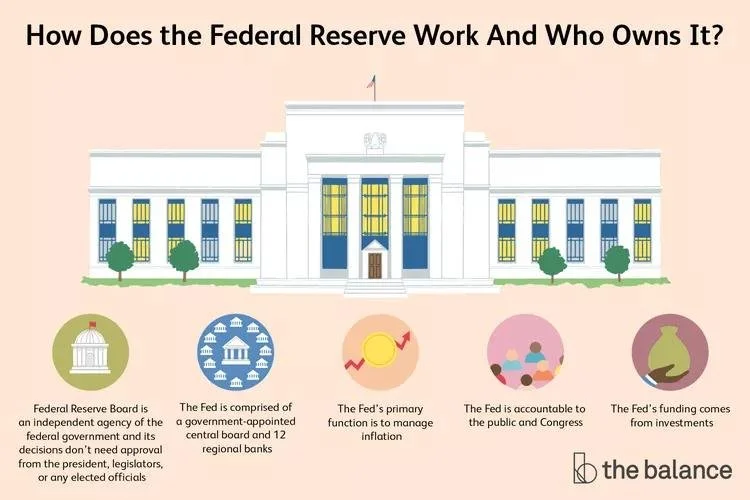
The Federal Reserve is an independent entity established by the Federal Reserve Act of 1913. At that time, President Woodrow Wilson wanted a government-appointed central board, but Congress wanted the Fed to have 12 regional banks to represent America's diverse regions. The compromise meant that the Fed has both.2
Congress and the Fed
The president and Congress must approve all members of the Federal Reserve Board of Governors, but the board members' terms deliberately don't coincide with those of elected officials. The president appoints the Federal Reserve chair, currently Jerome Powell.3 Congress must approve the president's appointment. The chair must report on the Fed's actions to Congress.4
Congress can alter the statutes governing the Fed. For example, the Dodd-Frank Wall Street Reform and Consumer Protection Act limited the Fed's powers. It required the Government Accountability Office (GAO) to audit the emergency loans the Fed made during the 2008 financial crisis. It also required the Fed to make public the names of banks that received any emergency loans or TARP funds. The Fed must get Treasury Department approval before making emergency loans, as it did with Bear Stearns and AIG.5
Note
The Fed's Board is an independent agency of the federal government, but its decisions don't have to be approved by the president, legislators, or any elected official.
Funding
Equally as important, the Fed does not receive its funding from Congress. Instead, its funds come from its investments. It receives interest from U.S. Treasury notes it acquired as part of open market operations. It receives interest on its foreign currency investments. Its banks receive fees for services provided to commercial banks. These include check clearing, funds transfers, and automated clearinghouse operations.
The Fed also receives interest on loans it makes to its member banks. It uses these funds to pay its bills, then turns any "profit" over to the U.S. Treasury Department.6
Bank Members
The 12 regional Federal Reserve banks are set up similarly to private banks. They store currency, process checks, and make loans to the private banks within the area that they regulate. These banks are also members of the Federal Reserve banking system. As such, they must maintain reserve requirements. In return, they can borrow from each other at the fed funds rate when needed. As a last resort, they can also borrow from the Fed's discount window at the discount rate.7
To be a member of the Federal Reserve system, commercial banks must own shares of stock in the 12 regional Federal Reserve banks. But owning Federal Reserve bank stock is nothing like owning stock in a private company. It can't be traded and doesn't give the member banks voting rights. These pay out dividends, mandated by law to be 6%.8 But the banks must return all profits, after paying expenses, to the U.S. Treasury.6
Why the Fed Must Remain Independent
Note
The Fed's monetary policy can do its job better when it is shielded from short-term political influence. It must be free to set expectations, especially about inflation. It cannot do that when its leaders are worried about being fired by an elected official.
Fed chairs are predominantly well-respected academic economists.9 Their expertise is in public policy, finance, and central banking. They are valued for that expertise, not for charisma, a large fan base, or public speaking skills. They are accustomed to an environment where ideas are rationally discussed, debated, and evaluated.
How the Fed Is Held Accountable
Although it is independent, the Fed is still accountable to the public and to Congress. The Fed can best guide expectations if it is transparent about its actions. It must also clearly communicate its reasons for its actions.
The Fed communicates through frequent and detailed reports. First, the Fed chair and other board members testify frequently before Congress. Second, the Fed submits to Congress a detailed Monetary Policy Report twice per year. Third, the Federal Open Market Committee (FOMC) publishes a statement after each meeting. It also provides detailed meeting minutes three weeks later. Verbatim transcripts are available five years later.10
How the Fed Works
The Fed's primary function has been to manage inflation. It has a variety of tools to accomplish that.
To Continue To Read More: https://www.thebalancemoney.com/who-owns-the-federal-reserve-3305974
Why a Gold Backed System is the Only Option
Why a Gold Backed System is the Only Option
VRIC Media: 6-15-2026
The recent dialogue between Darrell Thomas and economic analyst Melody Wright at the Vancouver Resource Investment Conference (VRIC) offers a sobering look at the current macroeconomic climate.
As the global economy faces a complex web of challenges, Wright provides a detailed examination of why current market behavior seems disconnected from the realities faced by many households and industries.
Why a Gold Backed System is the Only Option
VRIC Media: 6-15-2026
The recent dialogue between Darrell Thomas and economic analyst Melody Wright at the Vancouver Resource Investment Conference (VRIC) offers a sobering look at the current macroeconomic climate.
As the global economy faces a complex web of challenges, Wright provides a detailed examination of why current market behavior seems disconnected from the realities faced by many households and industries.
While major stock indices remain near record levels, sectors such as mining and precious metals have faced significant headwinds, painting a picture of an economy that is struggling under the weight of uneven pressures.
A central theme of the discussion is the precarious state of the bond market and its direct impact on housing. Wright highlights how climbing 10-year Treasury yields are driving mortgage rates to levels that effectively freeze the real estate market.
This stagnation is not merely a product of high interest rates; it is fueled by a combination of overbuilding, speculative investment, and a growing skepticism regarding Federal Reserve policy. Wright argues that the market is beginning to price in the possibility of structural shifts or debt restructuring, as the burden of national debt interest costs continues to mount.
The conversation further draws uncomfortable parallels between today’s environment and the 2008 Global Financial Crisis. While current government interventions differ from the market-driven dynamics of the past, the underlying stress in credit markets and rising mortgage delinquency rates remain clear warning signs.
Wright points out that the housing market is currently sustained by a thin sliver of activity, with total sales volumes plummeting even as prices remain stubbornly high. Compounding these issues are deeper demographic shifts—the “silver tsunami” of an aging population, declining birth rates, and changing household formations—which add long-term strain to the labor supply and social safety nets.
Beyond residential real estate, Wright identifies commercial property as another potential epicenter for financial instability. With a “hard maturity wall” of loans coming due, the combination of high vacancies and default risks creates a scenario that could trigger widespread urban economic distress.
The shadow lending system, which often obscure the true level of risk in these sectors, only adds to the potential volatility of the situation.
Given these converging threats, Wright advocates for a defensive approach to personal finance. Her advice centers on the importance of debt reduction, maintaining financial resilience, and preparing for possible supply chain disruptions through increased self-sufficiency.
For those looking to protect their assets, she underscores the value of prudent investments, including precious metals like gold, as a hedge against systemic uncertainty.
To hear the full analysis and gain a deeper understanding of these critical economic indicators, we encourage you to watch the complete interview with Melody Wright on the official VRIC Media YouTube channel.
https://www.youtube.com/watch?v=lN99PekzEw8
https://dinarchronicles.com/2026/06/15/vric-media-why-a-gold-backed-system-is-the-only-option/