
FRANK26…6-16-26….“MADE IN IRAQ"
KTFA
Tuesday Night Video
FRANK26…6-16-26….“MADE IN IRAQ"
This video is in Frank’s and his team’s opinion only
Frank’s team is Walkingstick, Eddie and Omar in Iraq and guests
Playback Number: 605-313-5163 PIN: 156996#
KTFA
Tuesday Night Video
FRANK26…6-16-26….“MADE IN IRAQ"
This video is in Frank’s and his team’s opinion only
Frank’s team is Walkingstick, Eddie and Omar in Iraq and guests
Playback Number: 605-313-5163 PIN: 156996#
What Frank’s suit color’s mean…. FRANKS SUIT COLORS FOR CC'S..... WHITE = NEW INFO…. SILVER = INTEL FROZEN…. RED= HIGH ALERT… PURPLE=GUEST WITH US…. BLUE = AIR FORCE…. BLACK = GROUND/FF’S…. GREEN= MR OR FAB 4 ... GOLD = CHANGE… ORANGE=IMPLEMENTATION
Iraq Economic News and Points To Ponder Tuesday Evening 6-16-26
Al-Zaydi's Advisor Told Kurdistan 24: There Are No Plans To Raise The Dollar Exchange Rate.
Erbil (Kurdistan24) – An advisor to the Iraqi Prime Minister denied all reports circulating about the government's intention to raise the exchange rate of the dollar against the dinar to address the current financial crisis. He indicated that although the closure of the Strait of Hormuz has significantly harmed the country's revenues, the government will not resort to increasing the dollar's value.
Al-Zaydi's Advisor Told Kurdistan 24: There Are No Plans To Raise The Dollar Exchange Rate.
Erbil (Kurdistan24) – An advisor to the Iraqi Prime Minister denied all reports circulating about the government's intention to raise the exchange rate of the dollar against the dinar to address the current financial crisis. He indicated that although the closure of the Strait of Hormuz has significantly harmed the country's revenues, the government will not resort to increasing the dollar's value.
The Iraqi Prime Minister's economic advisor, Mazhar Muhammad Salih, told Kurdistan 24 that Iraq's current financial challenges are directly linked to regional conflicts and tensions, as well as the closure of the Strait of Hormuz. He explained that approximately 85% of Iraq's oil was exported daily through this strait to global markets, and therefore, the disruption of this vital waterway has significantly reduced the government's financial capabilities.
Ali al-Zidi’s advisor denied rumors that the government wanted to adjust the exchange rate, saying: “At this stage, the Iraqi government has no plans to raise the dollar exchange rate. Rather, all efforts and discussions are focused on finding alternative mechanisms to overcome this current situation.”
These statements by Mazhar Muhammad Salih come after reports circulated by some Iraqi media outlets in the past few days, indicating the federal government’s intention to raise the exchange rate of the dollar against the dinar again as a step to confront the current challenges and financial crisis.
Speculation And Scarcity Drive Iraqi Dinar Lower As Baghdad Rejects Devaluation Fears
While the closure of the Strait of Hormuz chokes oil revenue, currency markets in Erbil and Baghdad grapple with a dollar shortage and a wave of disruptive rumors
ERBIL (Kurdistan24) - In the bustling corridors of Erbil's currency bazaar, the rhythmic exchange of notes has taken on a frantic pace as the U.S. dollar climbs sharply against the Iraqi dinar. On Tuesday, the local market was defined by a volatile mix of genuine scarcity and a feverish wave of speculation, leaving traders and citizens alike struggling to find firm footing in an increasingly unstable financial landscape.
The immediate source of the tremor appears to be a sudden tightening of dollar liquidity originating in Baghdad. Mam Sayid, a prominent currency exchanger in Erbil's bazaar, told Kurdistan24 on Tuesday that the primary driver behind the dollar's surge is a physical shortage of the currency.
While the Central Bank of Iraq (CBI) continues to sell dollars, Sayid noted that the pace is depleting national reserves at a concerning rate.
The resulting anxiety is manifesting in sharp price fluctuations.
According to Sayid's 24-hour market update, the exchange rate moved from approximately 154,000 IQD per $100 on Monday morning to as high as 156,000 IQD by Tuesday.
This rapid depreciation has been further fueled by a persistent rumor that the Central Bank intends to raise the official exchange rate to 142,000 IQD, a move that would effectively codify a devaluation of the national currency.
Sayid was emphatic that the disruption is a product of policy uncertainty in the capital rather than local conditions in the Kurdistan Region.
The fiscal squeeze is undeniable, and its roots are deeply anchored in the region's geopolitical volatility. Iraq's financial health is inextricably tied to its oil exports, and the recent conflict has dealt a staggering blow to the state's revenue streams.
Mazhar Mohammed Salih, a senior economic advisor to Iraqi Prime Minister Ali al-Zaidi, recently provided Kurdistan24 with a stark assessment of the crisis.
He explained that the ongoing closure of the Strait of Hormuz, the maritime chokepoint through which 85 percent of Iraq's oil once flowed daily, has severely restricted the government's financial capacity.
However, Salih moved decisively to quell the market's worst fears. In an interview with Kurdistan24, he categorically denied reports that the government plans to officially devalue the dinar to offset the revenue shortfall.
"At this stage, the Iraqi government has no plans to raise the value of the dollar," Salih stated, characterizing reports of an impending hike as baseless.
He noted that the administration is instead aggressively pursuing alternative economic mechanisms to navigate the current fiscal crunch without resorting to a policy-led increase in exchange rates.
Despite these official reassurances, the psychology of the bazaar often moves faster than the directives from the Prime Minister's office.
In a highly dollarized economy like Iraq's, rumors of a pending rate change often become self-fulfilling prophecies.
Traders, anticipating a more expensive dollar tomorrow, hoard their current holdings today, thereby strangling supply and driving prices up in a classic speculative loop.
The shift in market demand also reflects broader regional alignments. Mam Sayid revealed that while the dollar dominates the conversation, demand among traders has become concentrated on the Iranian toman.
Meanwhile, traditional trading in other major international currencies, such as the euro, the British pound, and the Chinese yuan, has effectively stalled. This stagnation in non-dollar trading highlights the unique, almost singular importance of the U.S. currency to Iraq's domestic stability and its ability to pay for essential imports.
The implications for the average Iraqi are significant.
A rising dollar translates directly into higher costs for imported goods, from basic foodstuffs to electronics and medicine, eroding the purchasing power of families already strained by the wider regional conflict.
For the al-Zaidi government, the challenge is twofold: they must manage a genuine liquidity crisis born of suppressed oil exports while simultaneously conducting a war of words against the rumors that threaten to unanchor the currency.
As the markets wait for a definitive sign of stability, predicting the dinar's trajectory remains a difficult task for even the most seasoned observers.
For Mam Sayid and his fellow traders in Erbil, the immediate future is a waiting game. Until the underlying scarcity is resolved and the "142,000" rumor is fully exorcised from the public consciousness, the Iraqi dinar will likely remain at the mercy of the prevailing winds blowing from Baghdad and the volatile waters of the Gulf.
Summary
Iraq’s dinar has slipped as a dollar shortage and rumors of a rate hike hit markets. While Prime Minister Ali al-Zaidi's advisor denied devaluation plans, citing the Strait of Hormuz closure as the root fiscal cause, speculation has driven exchange rates toward 156,000 IQD per $100.
Finance Minister: We Are Proceeding With The Implementation Of A Package Of Reforms Aimed At Maximizing Non-Oil Revenues.
Time: 2026/06/16 15:23:39 {Economic: Al-Furat News} Finance Minister, Faleh Sari, confirmed on Tuesday the continuation of implementing a package of reforms aimed at maximizing non-oil revenues.
The media office of the Minister of Finance stated in a statement received by Al-Furat News that “the Minister of Finance, Falih Sari, received today, Tuesday, the Assistant Secretary-General of the United Nations Development Programme (UNDP), and the Regional Director for Arab States, Abdullah Al-Dardari.”
He added that "during the meeting, the government's priorities for the next stage were reviewed in light of the current economic challenges."
According to the statement, the minister affirmed that "the ministry is proceeding with the implementation of a package of reforms and measures aimed at maximizing non-oil revenues, developing financial management, and advancing automation projects and the shift towards program and performance budgeting, in order to enhance spending efficiency and raise the level of financial performance."
He pointed to "the importance of partnership with international institutions in supporting development programs, and benefiting from technical expertise in implementing the government's economic and financial priorities."
For its part, the United Nations Development Programme delegation welcomed the “establishment of the Financial Stability Board,” expressing “the Programme’s readiness to support the Iraqi Development Fund and contribute to supporting development projects through local funds in the southern governorates and liberated areas, in a way that contributes to improving the service situation and supporting development opportunities in those areas.”
https://alforatnews.iq/news/وزير-المالية-ماضون-بتنفيذ-حزمة-إصلاحات-تهدف-لتعظيم-الإيرادات-غير-النفطية
Easy Money Or Postponed Reform? An Expert Warns Against Treasury Transfers Becoming A Permanent Cover For The Government's Deficit.
Baghdad Today – Baghdad Economic expert Ziad Al-Hashemi warned on Monday (June 16, 2026) against continuing to rely on the treasury transfer discount mechanism as a means of financing the government's financial deficit, considering that it has turned from a temporary financial tool to address crises into a means that contributes to postponing economic reforms and perpetuating waste and financial corruption.
Al-Hashemi said in a statement followed by “Baghdad Today”, that discounted treasury transfers are originally a financial procedure used in many countries around the world to provide liquidity when needed, but their use in Iraq has become so frequent that it raises concerns about its repercussions on financial stability and economic reform.
He explained that the Ministry of Finance resorts to issuing treasury bills to obtain the necessary liquidity to finance salaries and public expenditures when revenues decline, especially oil revenues, as some banks purchase these bills before their ownership is transferred to the Central Bank, which undertakes to pay their value.
He added that Iraqi governments, during periods of high oil prices and increased revenues, have become accustomed to expanding public spending and appointments without building sustainable solutions to financial imbalances, noting that the decline in revenues later pushes them to look for quick sources of funding instead of adopting reform measures to address the causes of the deficit.
He believed that the central bank’s continued provision of financing to the government through discounting treasury bills gives it a wide margin to overcome its financial crises without having to implement real reforms related to controlling spending, combating corruption, and reducing financial waste.
Al-Hashemi stressed that one of the keys to financial reform is strengthening the independence of the central bank and enabling it to make its monetary decisions away from government financial pressures, allowing it to refuse to finance the deficit repeatedly and pushing governments to look for more sustainable economic solutions.
He pointed out that closing the door to "easy financing" will force governments to reconsider spending priorities, maximize non-oil revenues, and improve the efficiency of public finance management, instead of continuing to rely on temporary financing tools.
He warned that continuing the current approach could lead to the entrenchment of problems of corruption, administrative inefficiency and financial waste, noting that financial resources and reserves should be managed in a way that achieves economic stability and preserves the rights of future generations, rather than being turned into a means of addressing recurring financial imbalances without radical reform. https://baghdadtoday.news/301419-.html
Gold Prices Rise In Baghdad And Erbil
2026-06-16 Shafaq News- Baghdad/ Erbil Gold edged higher in Baghdad and Erbil on Tuesday, hovering around 940,000 IQD per mithqal, according to Shafaq News market survey.
Wholesale prices on Baghdad's Al-Nahr Street recorded a selling price of 943,000 IQD per mithqal (equivalent to five grams) for 21-carat gold, including Gulf, Turkish, and European varieties, with a buying price of 939,000 IQD, up from Monday's 935,000 IQD.
The selling price for 21-carat Iraqi gold stood at 913,000 IQD, with a buying price of 909,000 IQD.
In jewelry stores, the selling price per mithqal of 21-carat Gulf gold ranged between 945,000 and 955,000 IQD, while Iraqi gold sold for between 915,000 and 925,000 IQD.
In Erbil, 22-carat gold was sold at 995,000 IQD per mithqal, 21-carat gold at 950,000 IQD, and 18-carat gold at 814,000 IQD. https://www.shafaq.com/en/Economy/Gold-prices-rise-in-Baghdad-and-Erbil-0
Dollar Rises In Baghdad, Stabilizes In Erbil
2026-06-16 Shafaq News- Baghdad/ Erbil The US dollar opened Tuesday’s trading mixed in Iraq, hovering around 155,000 dinars per 100 dollars.
According to Shafaq News market survey, the dollar traded in Baghdad's Al-Kifah and Al-Harithiya exchanges at 154,900 dinars per 100 dollars, up from the previous session’s 154,200 dinars.
In the Iraqi capital, exchange shops sold the dollar at 155,500 dinars and bought it at 154,500 dinars, while in Erbil, selling prices stood at 153,850 dinars and buying prices at 153,750 dinars.
https://www.shafaq.com/en/Economy/Dollar-rises-in-Baghdad-stabilizes-in-Erbil-4
Who Owns the Federal Reserve?
Who Owns the Federal Reserve?
How the Fed Remains Independent
By Kimberly Amadeo Updated on October 2, 2024
The Federal Reserve is the central bank of the United States. Its decisions affect the U.S. economy and, therefore, the world. This position makes it the most powerful actor in the global economy. It is not a company or a government agency. Its leader is not an elected official, which makes it seem highly suspicious to many people, because it is not subject to either voters or shareholders.1
Learn how the Federal Reserve works, who actually owns it, and how they are held accountable.
Who Owns the Federal Reserve?
How the Fed Remains Independent
By Kimberly Amadeo Updated on October 2, 2024
The Federal Reserve is the central bank of the United States. Its decisions affect the U.S. economy and, therefore, the world. This position makes it the most powerful actor in the global economy. It is not a company or a government agency. Its leader is not an elected official, which makes it seem highly suspicious to many people, because it is not subject to either voters or shareholders.1
Learn how the Federal Reserve works, who actually owns it, and how they are held accountable.
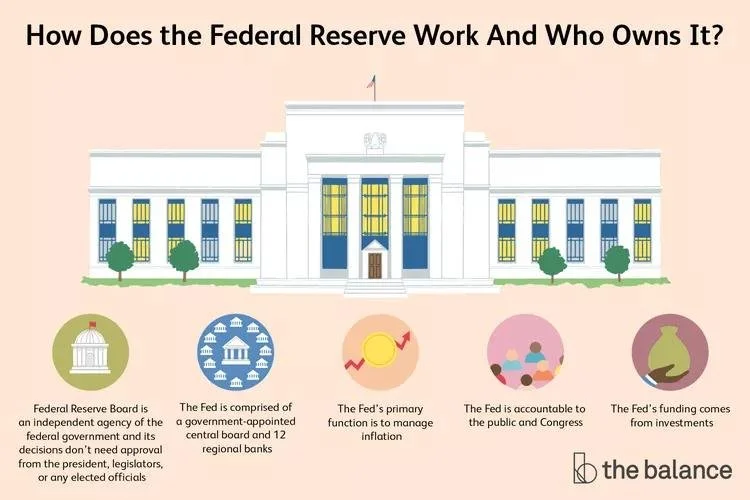
Who Owns the Federal Reserve?
The Federal Reserve is an independent entity established by the Federal Reserve Act of 1913. At that time, President Woodrow Wilson wanted a government-appointed central board, but Congress wanted the Fed to have 12 regional banks to represent America's diverse regions. The compromise meant that the Fed has both.2
Congress and the Fed
The president and Congress must approve all members of the Federal Reserve Board of Governors, but the board members' terms deliberately don't coincide with those of elected officials. The president appoints the Federal Reserve chair, currently Jerome Powell.3 Congress must approve the president's appointment. The chair must report on the Fed's actions to Congress.4
Congress can alter the statutes governing the Fed. For example, the Dodd-Frank Wall Street Reform and Consumer Protection Act limited the Fed's powers. It required the Government Accountability Office (GAO) to audit the emergency loans the Fed made during the 2008 financial crisis. It also required the Fed to make public the names of banks that received any emergency loans or TARP funds. The Fed must get Treasury Department approval before making emergency loans, as it did with Bear Stearns and AIG.5
Note
The Fed's Board is an independent agency of the federal government, but its decisions don't have to be approved by the president, legislators, or any elected official.
Funding
Equally as important, the Fed does not receive its funding from Congress. Instead, its funds come from its investments. It receives interest from U.S. Treasury notes it acquired as part of open market operations. It receives interest on its foreign currency investments. Its banks receive fees for services provided to commercial banks. These include check clearing, funds transfers, and automated clearinghouse operations.
The Fed also receives interest on loans it makes to its member banks. It uses these funds to pay its bills, then turns any "profit" over to the U.S. Treasury Department.6
Bank Members
The 12 regional Federal Reserve banks are set up similarly to private banks. They store currency, process checks, and make loans to the private banks within the area that they regulate. These banks are also members of the Federal Reserve banking system. As such, they must maintain reserve requirements. In return, they can borrow from each other at the fed funds rate when needed. As a last resort, they can also borrow from the Fed's discount window at the discount rate.7
To be a member of the Federal Reserve system, commercial banks must own shares of stock in the 12 regional Federal Reserve banks. But owning Federal Reserve bank stock is nothing like owning stock in a private company. It can't be traded and doesn't give the member banks voting rights. These pay out dividends, mandated by law to be 6%.8 But the banks must return all profits, after paying expenses, to the U.S. Treasury.6
Why the Fed Must Remain Independent
Note
The Fed's monetary policy can do its job better when it is shielded from short-term political influence. It must be free to set expectations, especially about inflation. It cannot do that when its leaders are worried about being fired by an elected official.
Fed chairs are predominantly well-respected academic economists.9 Their expertise is in public policy, finance, and central banking. They are valued for that expertise, not for charisma, a large fan base, or public speaking skills. They are accustomed to an environment where ideas are rationally discussed, debated, and evaluated.
How the Fed Is Held Accountable
Although it is independent, the Fed is still accountable to the public and to Congress. The Fed can best guide expectations if it is transparent about its actions. It must also clearly communicate its reasons for its actions.
The Fed communicates through frequent and detailed reports. First, the Fed chair and other board members testify frequently before Congress. Second, the Fed submits to Congress a detailed Monetary Policy Report twice per year. Third, the Federal Open Market Committee (FOMC) publishes a statement after each meeting. It also provides detailed meeting minutes three weeks later. Verbatim transcripts are available five years later.10
How the Fed Works
The Fed's primary function has been to manage inflation. It has a variety of tools to accomplish that.
To Continue To Read More: https://www.thebalancemoney.com/who-owns-the-federal-reserve-3305974
Why a Gold Backed System is the Only Option
Why a Gold Backed System is the Only Option
VRIC Media: 6-15-2026
The recent dialogue between Darrell Thomas and economic analyst Melody Wright at the Vancouver Resource Investment Conference (VRIC) offers a sobering look at the current macroeconomic climate.
As the global economy faces a complex web of challenges, Wright provides a detailed examination of why current market behavior seems disconnected from the realities faced by many households and industries.
Why a Gold Backed System is the Only Option
VRIC Media: 6-15-2026
The recent dialogue between Darrell Thomas and economic analyst Melody Wright at the Vancouver Resource Investment Conference (VRIC) offers a sobering look at the current macroeconomic climate.
As the global economy faces a complex web of challenges, Wright provides a detailed examination of why current market behavior seems disconnected from the realities faced by many households and industries.
While major stock indices remain near record levels, sectors such as mining and precious metals have faced significant headwinds, painting a picture of an economy that is struggling under the weight of uneven pressures.
A central theme of the discussion is the precarious state of the bond market and its direct impact on housing. Wright highlights how climbing 10-year Treasury yields are driving mortgage rates to levels that effectively freeze the real estate market.
This stagnation is not merely a product of high interest rates; it is fueled by a combination of overbuilding, speculative investment, and a growing skepticism regarding Federal Reserve policy. Wright argues that the market is beginning to price in the possibility of structural shifts or debt restructuring, as the burden of national debt interest costs continues to mount.
The conversation further draws uncomfortable parallels between today’s environment and the 2008 Global Financial Crisis. While current government interventions differ from the market-driven dynamics of the past, the underlying stress in credit markets and rising mortgage delinquency rates remain clear warning signs.
Wright points out that the housing market is currently sustained by a thin sliver of activity, with total sales volumes plummeting even as prices remain stubbornly high. Compounding these issues are deeper demographic shifts—the “silver tsunami” of an aging population, declining birth rates, and changing household formations—which add long-term strain to the labor supply and social safety nets.
Beyond residential real estate, Wright identifies commercial property as another potential epicenter for financial instability. With a “hard maturity wall” of loans coming due, the combination of high vacancies and default risks creates a scenario that could trigger widespread urban economic distress.
The shadow lending system, which often obscure the true level of risk in these sectors, only adds to the potential volatility of the situation.
Given these converging threats, Wright advocates for a defensive approach to personal finance. Her advice centers on the importance of debt reduction, maintaining financial resilience, and preparing for possible supply chain disruptions through increased self-sufficiency.
For those looking to protect their assets, she underscores the value of prudent investments, including precious metals like gold, as a hedge against systemic uncertainty.
To hear the full analysis and gain a deeper understanding of these critical economic indicators, we encourage you to watch the complete interview with Melody Wright on the official VRIC Media YouTube channel.
https://www.youtube.com/watch?v=lN99PekzEw8
https://dinarchronicles.com/2026/06/15/vric-media-why-a-gold-backed-system-is-the-only-option/
ALERT: Debt Collapse In High Gear | Craig Hemke
ALERT: Debt Collapse In High Gear | Craig Hemke
Liberty and Finance: 6-15-2026
Craig Hemke breaks down the debt numbers driving gold and silver higher despite recent market frustration.
He explains why a $293 billion monthly deficit and soaring interest costs point toward continued currency debasement and mounting pressure on policymakers.
Hemke argues that Washington lacks a realistic path to reverse the debt trajectory, forcing monetary authorities toward lower rates, intervention, and potentially yield curve control.
ALERT: Debt Collapse In High Gear | Craig Hemke
Liberty and Finance: 6-15-2026
Craig Hemke breaks down the debt numbers driving gold and silver higher despite recent market frustration.
He explains why a $293 billion monthly deficit and soaring interest costs point toward continued currency debasement and mounting pressure on policymakers.
Hemke argues that Washington lacks a realistic path to reverse the debt trajectory, forcing monetary authorities toward lower rates, intervention, and potentially yield curve control.
He also shares why investor sentiment recently reached extreme pessimism and why those moments often create opportunity in precious metals.
Watch as Craig connects the debt crisis, Federal Reserve policy, and the long term outlook for gold and silver through what he calls "the biggest picture."
INTERVIEW TIMELINE:
0:00 Intro
2:00 Dollar devaluation
9:00 Iran deal & new Fed chair
29:36 TF Metals Report
Iraq Economic News and Points To Ponder Tuesday Afternoon 6-16-26
G7 Leaders Pledge To Boost Efforts To Tackle The Global Debt Crisis
Arabic and international At their summit in Evian-les-Bains, France, the leaders of the G7 pledged to strengthen international efforts to address the growing risks of global debt that threaten economic stability and limit countries' ability to finance public services.
In a joint statement, the leaders called for increased support for heavily indebted countries, particularly those implementing economic reform programs but struggling to attract investment, while urging international financial institutions to expand their risk-sharing tools.
G7 Leaders Pledge To Boost Efforts To Tackle The Global Debt Crisis
Arabic and international At their summit in Evian-les-Bains, France, the leaders of the G7 pledged to strengthen international efforts to address the growing risks of global debt that threaten economic stability and limit countries' ability to finance public services.
In a joint statement, the leaders called for increased support for heavily indebted countries, particularly those implementing economic reform programs but struggling to attract investment, while urging international financial institutions to expand their risk-sharing tools.
The statement stressed the need to develop the international financing system to be more efficient and transparent, noting the importance of cooperation with the G20 to ensure an orderly and transparent restructuring of the debts of fragile and middle-income countries.
The G7 leaders also stressed the importance of promoting private investment and blended finance to support long-term development projects, as well as strengthening infrastructure and supply chains, in order to achieve sustainable economic growth. https://www.economy-news.net/content.php?id=70338
From "Spending For The Sake Of Spending" To "Spending For Results": Iraq Opens The Door To Financial Reform Through Program And Performance Budgeting.
Reports Economy News – Baghdad The Iraqi government is moving towards a fundamental shift in public finance management by adopting a program and performance budget, a step that is considered one of the most prominent paths of financial and administrative reform, and aims to link government spending to actual results and achievement indicators, instead of being limited to allocating funds and monitoring their disbursement according to the traditional categories adopted for decades.
This trend comes at a time when public finances are facing increasing challenges related to the need to raise spending efficiency, maximize non-oil revenues, and ensure that resources are directed towards priority projects and services, in order to achieve a tangible developmental and economic impact.
In this context, Finance Minister Faleh Al-Sari stressed that the shift towards a program and performance budget is a key priority in the next phase, noting that the ministry is proceeding with the implementation of a reform path based on clear priorities, foremost among them the automation of financial, tax and customs systems.
Al-Sari explained that these measures represent fundamental pillars for simplifying procedures, enhancing non-oil revenues, reducing financial waste, and strengthening oversight, which contributes to building a more efficient and transparent financial management.
He stressed that program and performance budgeting is a strategic step that links government spending to goals and results, and contributes to directing resources towards projects and services that have a direct impact on the lives of citizens, especially in light of the current financial challenges and changes related to energy markets and public revenues.
This approach representsa shift in the philosophy of preparing public budgets, as the program and performance budget differs from the traditional budgets known as "item budgets," which focus on the amount that ministries and government agencies spend on salaries, supplies and projects, while the new budget focuses on the results achieved and the expected returns from public spending.
In this context, the Prime Minister’s Advisor for Economic and Financial Affairs, Mazhar Muhammad Saleh, explained that the government is moving towards adopting a program and performance budget as one of the most prominent paths of financial and administrative reform, with the aim of raising the efficiency of public spending and linking it to the goals and results achieved on the ground.
Saleh told Al-Eqtisad News that this type of budget is based on allocating financial resources according to specific programs and objectives and measurable performance indicators, which allows for evaluating the efficiency of government spending and its contribution to achieving developmental and service goals, as well as enhancing transparency and accountability by measuring achievement levels and monitoring the implementation of government plans.
He added that the selection of projects and programs that receive funding will be based on the government’s priorities and strategic plans, the feasibility of the projects, and their ability to achieve tangible results that reflect on services and economic development, with the adoption of clear performance indicators to monitor implementation and measure completion rates periodically.
Saleh pointed out that adopting a program and performance budget represents a gradual shift from the concept of "spending for the sake of spending" to the concept of "spending for the sake of results," as it assumes that the continuation of funding or the release of financial payments is linked to actual completion rates and project outputs, instead of being satisfied with fixed annual allocations.
He explained that the application of this system in Iraq will not be immediate, but will be done gradually due to its need to build specialized technical capabilities and benefit from international expertise in cooperation with the World Bank and relevant United Nations agencies, noting that the mechanisms for annual financial allocation currently in place will continue during the transitional phase in parallel with the introduction of modern tools for measuring performance, monitoring implementation and linking funding to achievement indicators.
Experts believe that the success of the experiment is not only linked to changing the form of the budget, but also to the ability of government institutions to build monitoring and administrative systems capable of tracking implementation and accurately measuring results, as well as the availability of modern databases and advanced digital systems that support the decision-making process.
In this regard, financial expert Mustafa Akram Hantoush said that adopting a program and performance budget is a necessary shift after decades of working with line-item budgeting, which saw the allocation and spending of huge sums on projects, many of which were not completed.
He explained that the essence of the new budget lies in linking government spending to specific goals and measurable results, by focusing on a limited number of priority projects and sectors and ensuring their completion within clear timeframes, which contributes to reducing financial waste and increasing the efficiency of public resource utilization.
Hantoush added that this approach could provide a more effective basis for implementing major strategic projects, especially in the infrastructure, energy and transportation sectors, such as electricity projects, the Grand Faw Port and the Development Road, which would enhance economic growth opportunities and support efforts to diversify national income sources.
While the government affirms that program and performance budgeting represents a strategic option for reforming public finance management, the success of this transformation will remain contingent on the ability of institutions to move from a culture of traditional spending to a culture of results management, and to link funding to the level of actual achievement, in order to ensure that public resources are directed towards achieving development, improving services, and enhancing the state’s efficiency in managing its financial resources in the coming years. https://www.economy-news.net/content.php?id=70223
Erbil And Baghdad Are Nearing The Activation Of The ASYCUDA Customs System.
Money and Business Economy News – Baghdad Sami Jalal, the legal advisor to the Ministry of Interior in the Kurdistan Region, revealed on Tuesday that a high-level delegation will soon head to Baghdad to finalize the procedures for the agreement to implement the ASYCUDA customs system, in preparation for presenting it to the Iraqi Ministerial Council for Economy for ratification.
Jalal told Al-Ahd News that “a government delegation will visit the capital, Baghdad, tomorrow, Wednesday, on a mission dedicated to the ASYCUDA system,” explaining that the visit includes signing an agreement with the federal government regarding the application of the customs system, before referring it to the Ministerial Council for Economy to complete the procedures for ratification and implementation.
In the same context, a high-level delegation from the regional government is scheduled to arrive in the capital, Baghdad, to discuss a number of important financial and oil-related issues.
According to information obtained by “Al-Ahd News”, the delegation includes the Ministers of Finance and Economy, the Minister of Natural Resources, the Head of the Cabinet Office, the Secretary of the Cabinet, in addition to a representative from the Ministry of Interior, with official negotiations with the relevant authorities in the federal government scheduled to begin on Wednesday.
The talks will focus on three main issues: the implementation of the ASYCUDA system, non-oil revenues and the federal treasury’s share of them, as well as the issue of exporting the region’s oil and the demands of oil companies.
https://www.economy-news.net/content.php?id=70316
Brent Crude Price Falls Below $79 A Barrel
energy Trading data indicated that oil prices fell by 5-6% in the global market, with Brent crude dropping below $79 a barrel for the first time since early March.
August futures for Brent crude fell 5.04% compared to the previous close, reaching $78.97 a barrel.
This marks the first time the benchmark has fallen below $79 since March 3. July futures for West Texas Intermediate (WTI) crude also declined, by 5.78%, to $76.08.
The sharp drop in oil prices (Brent below $79 and WTI below $77) is attributed to the major political breakthrough in the Middle East and expectations of a return to normal oil supplies.
Prices fell by about 5% on Monday, reaching their lowest settlement level since March 4, 2016, after US President Donald Trump announced the signing of a memorandum of understanding to end the war with Iran, although the full details of the memorandum have not yet been disclosed. https://www.economy-news.net/content.php?id=70342
Dhi Qar: Inauguration Of The Al-Rifai Treatment Plant Project With A Capacity Of 60,000 Cubic Meters Per Day
Localities The Ministry of Construction, Housing and Municipalities announced on Tuesday the opening of a wastewater treatment plant in Al-Rifai district in Dhi Qar Governorate with a production capacity of 60,000 cubic meters per day, confirming that the project has been handed over to the local government to begin actual operation and serve more than 250,000 people, while revealing the completion rates in other pollution treatment projects in the governorate.
The Director General of the General Directorate of Sewers, Engineer Imad Tawfiq, said: “This project is one of the major strategic projects that has faced several difficulties and challenges since 2012,” indicating that “since 2019 the Directorate has been able to actually begin and address all the technical and legal problems that the project faced throughout the past years, so that it can be completed perfectly and according to the highest technical specifications prepared for it.”
Tawfiq added, "The project, designed to treat heavy sewage, serves vast areas of the district and will officially become operational today." He pointed out that "the responsibility now lies with the local government in Dhi Qar to fully operate and manage the project, as the Ministry of Construction's role is limited to constructing these vital projects, while local governments are responsible for their operation to ensure environmental protection and prevent river pollution.
" He called on the local administration to "provide the necessary technical staff and financial allocations to ensure the station's continued operation after its official handover." https://www.economy-news.net/content.php?id=70343
After A Two-Year Delay, An Additional 400 Megawatts Will Be Supplied To Karbala Next Month.
Localities Karbala Provincial Council member Israa al-Nasrawi announced on Tuesday that a number of "important agreements" had been reached with the Ministry of Electricity regarding strengthening the energy situation in the province and the reasons for the decline in supply there.
Al-Nasrawi stated that "a meeting was held with the Minister of Electricity, Ali Saadi Wahib, in the presence of the Governor of Karbala, Nassif Al-Khattabi, and a number of general managers in the production, transmission and distribution sectors, which addressed files related to the production and transmission sectors."
She indicated that one of the most prominent outcomes of the meeting was "the imminent entry of the Al-Dhafaaf station into service during the coming month of July, after its implementation was delayed for more than two years, which will provide about 400 additional megawatts to the electricity system in Karbala."
She added that "the meeting discussed ways to enhance the electricity system and increase the province's share of energy, especially with the approach of the month of Muharram and the influx of large numbers of visitors to the city."
Seeds of Wisdom RV and Economics Updates Tuesday Afternoon 6-16-26
Good Afternoon Dinar Recaps,
Who Is Still Outside MiCA? Tether, Binance Among Leading Crypto Firms
Europe's landmark crypto regulations are entering a critical phase as major digital asset companies race to comply—or risk losing access to one of the world's largest cryptocurrency markets.
Good Afternoon Dinar Recaps,
Who Is Still Outside MiCA? Tether, Binance Among Leading Crypto Firms
Europe's landmark crypto regulations are entering a critical phase as major digital asset companies race to comply—or risk losing access to one of the world's largest cryptocurrency markets.
Overview
The European Union's July 1 MiCA transition deadline is rapidly approaching, placing pressure on thousands of crypto firms to secure regulatory authorization.
Several major industry leaders, including Tether and Binance, remain outside the MiCA framework, creating uncertainty for their future operations in Europe.
MiCA is expected to reshape the European crypto industry, separating fully regulated firms from those operating outside the new legal framework.
Key Developments
1. Most Crypto Firms Still Lack MiCA Authorization
Although Markets in Crypto-Assets (MiCA) regulations are nearing full implementation, only 194 firms had received authorization by May 2026, out of nearly 3,000 registered crypto companies operating across the European Union. This means approximately 75% of firms remain unlicensed as the compliance deadline approaches.
2. Tether Continues to Resist MiCA Requirements
Tether, issuer of the world's largest stablecoin (USDT), remains the most prominent company choosing not to pursue MiCA authorization. CEO Paolo Ardoino has criticized portions of the regulation, particularly reserve management and banking requirements.
As a result, several major exchanges have already restricted or delisted USDT trading for European Economic Area users, while MiCA-compliant alternatives such as USDC continue gaining market share.
3. Binance and Other Major Firms Still Await Approval
While many leading exchanges—including Coinbase, Kraken, Crypto.com, Gemini, OKX, Bybit, and Bitstamp—have secured or established MiCA-compliant operations, Binance's authorization remains pending. Other international platforms, including HTX and BitMEX, have also yet to announce full MiCA approval.
Without authorization, these firms may lose the ability to offer services, onboard new customers, or market products throughout the European Union.
Why It Matters
MiCA represents one of the most significant regulatory frameworks ever introduced for digital assets. Rather than regulating individual countries separately, it creates a single licensing system allowing approved firms to operate across all EU member states.
For crypto companies, compliance means continued access to one of the world's largest financial markets. For those choosing not to comply, Europe could effectively become unavailable, shifting business activity toward other jurisdictions.
Why It Matters to Foreign Currency Holders
The growth of regulated stablecoins and digital payment infrastructure is another step toward the modernization of global financial systems. As governments increasingly regulate blockchain-based assets, digital currencies are becoming more integrated into mainstream banking and international payments.
For those following the Global Financial Reset, MiCA demonstrates how governments are building regulated digital asset ecosystems that could eventually complement future cross-border settlement networks and tokenized financial markets.
Implications for the Global Reset
Pillar 1: Technology
MiCA establishes one of the world's first comprehensive regulatory frameworks for digital assets, providing legal certainty for blockchain innovation while encouraging institutional participation.
Pillar 2: Assets
As regulated stablecoins replace unregulated alternatives in key jurisdictions, digital assets are becoming increasingly integrated into the global financial system, strengthening the foundation for tokenized payments and cross-border settlements.
Looking Ahead
The July 1 implementation deadline will mark a major turning point for Europe's cryptocurrency industry.
Key developments to watch include:
Final MiCA approvals for remaining exchanges and stablecoin issuers
Potential expansion of MiCA-compliant stablecoins across Europe
Whether Binance secures full authorization
The future availability of USDT within European markets
How other global regulators may model future crypto legislation after MiCA
Europe's regulatory framework could become the blueprint for digital asset regulation worldwide, influencing how governments balance innovation with financial oversight.
This is not just cryptocurrency regulation—it’s global finance restructuring before our eyes.
Seeds of Wisdom Team
Newshounds News™ Exclusive
Sources
~~~~~~~~~~
Seeds of Wisdom Team RV Currency Facts Youtube and Rumble
Newshound's News Telegram Room Link
RV Facts with Proof Links Link
RV Updates Proof links - Facts Link
Follow the Gold/Silver Rate COMEX
Follow Fast Facts
Seeds of Wisdom Team™Website
Thank you Dinar Recaps
Coffee with MarkZ, joined by Dr. Jay Caprietta. 06/16/2026
Coffee with MarkZ, joined by Dr. Jay Caprietta. 06/16/2026
MarkZ Disclaimer: Please consider everything on this call as my opinion. Be sure to consult a professional for any financial decisions
MZ: Iranian deal virtually signed, what to expect next, HCL, Iraq US Tour, and more. Dr. Jay Caprietta joins us after the news for a word.
THE CONTENT IN THIS PODCAST IS FOR GENERAL & EDUCATIONAL PURPOSES ONLY&NOT INTENDED TO PROVIDE ANY PROFESSIONAL, FINANCIAL OR LEGAL ADVICE. PLEASE CONSIDER EVERYTHING DISCUSSED IN MARKZ’S OPINION ONLY
Coffee with MarkZ, joined by Dr. Jay Caprietta. 06/16/2026
MarkZ Disclaimer: Please consider everything on this call as my opinion. Be sure to consult a professional for any financial decisions
MZ: Iranian deal virtually signed, what to expect next, HCL, Iraq US Tour, and more. Dr. Jay Caprietta joins us after the news for a word.
THE CONTENT IN THIS PODCAST IS FOR GENERAL & EDUCATIONAL PURPOSES ONLY&NOT INTENDED TO PROVIDE ANY PROFESSIONAL, FINANCIAL OR LEGAL ADVICE. PLEASE CONSIDER EVERYTHING DISCUSSED IN MARKZ’S OPINION ONLY
https://rumble.com/user/theoriginalmarkz
Kick: https://kick.com/theoriginalmarkz
Markz's linktree https://linktr.ee/theMarkZshow
FOLLOW MARKZ : TWITTER . https://twitter.com/originalmarkz?s=21. TRUTH SOCIAL . https://truthsocial.com/@theoriginalm...
Mod: MarkZ "Back To Basics" Pre-Recorded Call" for Newbies 10-19-2022 )https://www.youtube.com/watch?v=37oILmAlptM
MARKZ DAILY LINKS: https://theoriginalmarkz.com/home/
THANK YOU FOR JOINING. HAVE A BLESSED DAY. SEE YOU IN THE MORNING FOR COFFEE @ 10:00 AM EST ~ UNLESS BREAKING NEWS HAPPENS! FOR UPDATES ON MARK’S PODCAST GO TO: https://t.me/+b3hYhYlhKM1hYzcx
Iraqi Dinar Update: Why the IQD Has Not Revalued
Iraqi Dinar Update: Why the IQD Has Not Revalued
Edu Matrix: 6-15-2026
Iraqi Dinar Update: Why the IQD Has Not Revalued - Special Report on Iraq and Iraq's Neighbors and 7 to 10 reasons why the Iraqi Dinar has not adjusted.
Investing in foreign currency can often feel like a gamble, but for some, the decision is rooted in a sense of duty or historical optimism.
Iraqi Dinar Update: Why the IQD Has Not Revalued
Edu Matrix: 6-15-2026
Iraqi Dinar Update: Why the IQD Has Not Revalued - Special Report on Iraq and Iraq's Neighbors and 7 to 10 reasons why the Iraqi Dinar has not adjusted.
Investing in foreign currency can often feel like a gamble, but for some, the decision is rooted in a sense of duty or historical optimism.
A recent video from Edu Matrix on YouTube features a compelling personal narrative from a retired tax professional who, two decades ago, made a significant investment in the Iraqi dinar. Driven by a letter from then-Secretary of State Condoleezza Rice encouraging military members to support the reconstruction of Iraq, the investor hoped to see both personal growth and the stabilization of a nation. However, the reality of the past twenty years has proven to be much more complex than anticipated.
The narrative highlights the stark contrast between the initial vision for Iraq and the current economic reality.
Rather than the appreciation many investors had hoped for, the dinar has experienced significant devaluation, leaving long-term holders feeling frustrated and disillusioned. The speaker dives deep into why this stagnation has persisted, pointing toward a web of geopolitical, economic, and spiritual challenges. A primary concern raised in the discussion is the influence of neighboring nations, particularly Iran, on Iraq’s domestic policy and economic decision-making.
According to the speaker, this external pressure has historically hindered Iraq’s ability to assert full economic sovereignty.
Beyond the financials, the video explores the structural hurdles Iraq faces in integrating into the global banking system.
The legacy of the 2003 invasion, coupled with ongoing struggles regarding the management of oil revenue and foreign intervention, provides a sobering look at how difficult it is for a nation to rebuild its financial foundation after years of conflict.
The speaker also touches upon the broader regional tensions currently shifting across the Middle East, suggesting that recent developments may signal a pivot point for Iraq’s future on the world stage.
Despite the personal disappointment surrounding the stagnant investment, the speaker maintains a hopeful outlook for the people of Iraq. There is a palpable desire to see the nation emerge as a stable, independent, and prosperous player in the global market—a shift that would naturally strengthen the dinar against the U.S. dollar.
The discussion concludes by bridging the gap between numbers and culture, as the speaker reflects on the ethnic and historical tensions that define the region. Through personal anecdotes from traveling and engaging with local communities, the narrative emphasizes that the road to economic stability is inextricably linked to the complex, deeply human identity of the Iraqi people.
For those interested in a deeper dive into the intersection of geopolitical history and currency investment, this video offers a candid, firsthand perspective on the realities of long-term international holding. You can watch the full discussion on the Edu Matrix YouTube channel.
News, Rumors and Opinions Tuesday 6-16-2026
Reset Intelligence: Closing in on World Peace
6-15-2026
Closing in on World Peace
By Reset Intelligence | @EXIT_FIAT
On June 14, Donald Trump declared the war with Iran complete and ordered the United States naval blockade lifted, with the signing set for Friday, June 19, in Switzerland.
The same day, with almost no one reporting it, Iraq secured both of its oil export routes at once. That is the move that matters for anyone holding the dinar.
Reset Intelligence: Closing in on World Peace
6-15-2026
Closing in on World Peace
By Reset Intelligence | @EXIT_FIAT
On June 14, Donald Trump declared the war with Iran complete and ordered the United States naval blockade lifted, with the signing set for Friday, June 19, in Switzerland.
The same day, with almost no one reporting it, Iraq secured both of its oil export routes at once. That is the move that matters for anyone holding the dinar.
Two routes, one day
Trump posted that the deal is done, opened the Strait of Hormuz toll-free, and lifted the naval blockade. The same morning, Iraq’s Army Chief of Staff flew to Erbil and signed a security agreement protecting Kurdistan’s oil fields. The southern Gulf passage and the northern pipeline up through Turkey came back online together, after months reduced to a trickle through one.
The money that holds the rate
Before the war, Iraq’s oil sales brought in around 7 billion dollars a month. The blockade cut that to under a billion. The signature turns the income back on, and that income fills the budget that holds the dinar’s exchange rate. Iraq’s 2026 budget is written at the central bank’s rate of 1,300 to the dollar. The cabinet still has 9 seats to fill, and parliament returns July 1.
The wider read
• Europe – Britain, France, Germany and Italy signaled they are ready to lift their Iran sanctions, which starts pulling down the wall that kept Iraq’s banks out of the global payment system. The Central Bank of Iraq confirmed its reform reached its second phase, with compliant banks cleared to move foreign currency again.
• The dates – the G7 opens in Evian this week, the Fed closes Wednesday, the signing lands Friday, and the calendar stacks toward July 4.
• The pattern – a spring of declassified files keeps proving the people who were called conspiracy theorists right. The full briefing connects that to the rest.
This is the short version. The full daily briefing connects the moves, names the players, walks the history, and tells you what it actually means for anyone holding currency, with every source verified and full audio narration.
Read full post here: https://dinarchronicles.com/2026/06/15/reset-intelligence-closing-in-on-world-peace/
*************
Courtesy of Dinar Guru: https://www.dinarguru.com/
Guy The Vietnam dong is going to be right on the heels of the Iraqi dinar. My intel says that Vietnam has actually contacted the Americans a year ago and said, 'we're ready go now. Why would we we have to wait for Iraq to get their act together? We're ready.' The US just said, 'Calm down. Everything is going by a plan.' I think Vietnam is going to go right after them...
Frank26 All the pieces are falling into place for [Iraq's] monetary reform. Trust me, Z is not coming to Washington DC simply to talk about investors. Mark my word. With the Strait of Hormuz now open, [Iraq's] oil is going to flow and the HCL is going to explode with the new exchange rate. People can say this is quite a coincidence. No, this was supreme timing...
Militia Man President Trump announced the US and Iran had reached an agreement...The Strait of Hormuz will be reopened immediately to all commercial traffic toll-free...A formal ceremony is expected to be in Switzerland on Friday...I think that's really big news because Iraq and Iran are heavy trading partners. It's going to have an influence... probably a lot bigger than many ever realize...The momentum we're seeing is for real...
Reset Intelligence Trump declares the Iran war complete. The blockade lifts. Baghdad secures Kurdistan's oil fields. Both routes reconnect. The rate waits inside the budget.
The Most Important Iraqi Dinar Video You'll Ever Watch
The Dinar Den: 6-15-2026
Iraq Economic News and Points To Ponder Tuesday Morning 6-16-26
United Nations: Iraq's Four Presidencies Agree On Ensuring A Decent Life For All Citizens
Iraqi News Agency (INA) Baghdad INA - June 15th, 2026 The UN Assistant Secretary-General and Regional Director of the United Nations Development Programme (UNDP) for Arab States, Abdullah Al-Dardari, affirmed on Monday that Iraq's four presidencies are in agreement on combating corruption and adopting a competitive economy to ensure a decent life for all citizens.
United Nations: Iraq's Four Presidencies Agree On Ensuring A Decent Life For All Citizens
Iraqi News Agency (INA) Baghdad INA - June 15th, 2026 The UN Assistant Secretary-General and Regional Director of the United Nations Development Programme (UNDP) for Arab States, Abdullah Al-Dardari, affirmed on Monday that Iraq's four presidencies are in agreement on combating corruption and adopting a competitive economy to ensure a decent life for all citizens.
During a roundtable discussion with several media, including the Iraqi News Agency (INA), Al-Dardari stated, "During my visit to Iraq, I had the honor of meeting with the four presidencies and a number of ministers," indicating that "this demonstrates their interest in what the United Nations program can offer Iraq."
He added, "I heard comprehensive and aligned visions among the four presidencies regarding the necessity of transitioning to a strong, competitive Iraq that guarantees a decent life for all citizens and public services, with an economy based not solely on rent-seeking but on competitiveness, combating corruption, reforming and developing the social protection system, and reforming the subsidy system, as it does not satisfy the citizen and public finances in its current form.”
Al-Dardari emphasized, "I was surprised by the depth and breadth of the vision, and most importantly, the strong political consensus among the four presidencies regarding this vision and the boldness in confronting it," noting that "any government that confronts corruption, subsidies, arms control, social protection management, and economic diversification simultaneously is a testament to the boldness of its approach, and we cannot remain as we are."
Standard & Poor's Affirms Iraq's Sovereign Rating And Removes It From Negative Watch.
Economy - 13/06/2026 Mawazin News - Economy Standard & Poor's Global Ratings affirmed Iraq's sovereign rating at 'B-/B' and removed its long-term rating from negative watch. The agency assigned a negative outlook, citing risks of conflict in the Middle East over the next six to twelve months, including continued disruptions to export trade routes through the Strait of Hormuz and potential damage to infrastructure. Iraq's economy remains heavily reliant on the oil sector, making it particularly vulnerable to the decline in crude exports through the strategic waterway, according to Reuters.
The agency forecasts full-year oil production to average 2.9 million barrels per day in 2026, down approximately 28% from the pre-war average of 4 million barrels per day recorded in 2025, attributing its forecast to current production levels and the fragile recovery expected in the second half of the year.
The agency stated that, given that oil revenues constitute more than 90% of budget revenues and merchandise exports, Iraq's fiscal and balance of payments positions are likely to remain under pressure this year, projecting a 15% contraction in real GDP.
A rise in average oil prices during the period Standard & Poor's said that 2026 could provide some support for fiscal and external revenues, assuming a gradual recovery in oil exports in the second half, which remains its baseline scenario.
The agency had placed Iraq's long-term sovereign rating of "B-" on negative watch in March, citing the risk of a downgrade after a sharp drop in oil production linked to escalating conflict in the region.
https://www.mawazin.net/Details.aspx?jimare=283571
Source To Al-Sharq: Anticipation For The Arrival Of The US Envoy To Discuss The Completion Of The Cabinet Formation And Arrangements For The Meeting Between Al-Zaidi And Trump
Baghdad - One News - 6/15/2026An Iraqi government source revealed that the US Special Envoy to Iraq, Tom Barrack, will visit Baghdad in the coming hours to hold talks with Iraqi officials on a number of political and security issues.
The source explained that the visit will address the completion of Prime Minister Ali al-Zaidi's cabinet, in addition to discussing the issue of restricting weapons to the state and the factions that have agreed to hand over their weapons.
He added that Barak will discuss preparations for al-Zaidi's upcoming visit to the United States, and will also head to the Kurdistan Region to discuss outstanding issues between Baghdad and Erbil.
The visit comes at a time when al-Zaidi's anticipated visit to Washington represents an important step towards reorganizing the paths of political, security and economic cooperation between the two countries.
https://1news-iq.net/مصدر-للشرق-ترقب-لوصول-المبعوث-الأميرك/
US’s Barrack Arrives To Shape ‘New Direction’ In Iraq Ties
2026-06-15 / Shafaq News- Baghdad US Special Envoy to Iraq and Syria Tom Barrack arrived in Baghdad on Monday for meetings with Prime Minister Ali Al-Zaidi and senior Iraqi officials, focusing on shaping “a new direction for a strong and mutually beneficial US-Iraq relationship.”
Barrack said, shortly after his arrival, that he would convey US President Donald Trump's support for the Iraqi government during his meeting with Al-Zaidi.
Ambassador Tom Barrack @USAMBTurkiye Happy and honored to be back in Baghdad, meeting with our great U.S. Embassy team led by Chargé d’Affaires Joshua Harris. Today I will meet with Prime Minister Al-Zaidi to convey President Trump’s support for his government, and discuss our partnership on a new direction for a strong and mutually beneficial US-Iraq relationship.
A government source previously told Shafaq News that the visit will cover Baghdad's position on armed factions seeking to dismantle their military wings and join the Popular Mobilization Forces (PMF), Iraq's state-sanctioned security umbrella.
Discussions are also expected to pave the way for Al-Zaidi's planned trip to the United States and explore proposals to ease political tensions while preserving the country’s power-sharing framework.
Read more: Trump's new Iraq-Syria envoy faces an Iran test Syria never posed
https://shafaq.com/en/Iraq/US-s-Barrack-arrives-to-shape-new-direction-in-Iraq-ties
The Parliamentary Finance Committee Rules Out Approving The Budget And Calls For Exploring Financial Alternatives.
Information / Baghdad... Member of the Parliamentary Finance Committee, Hussein al-Daraji, ruled out the possibility of approving the general budget this year, indicating that the Finance Committee will hold a series of meetings during the upcoming legislative session to discuss available options and alternatives.
Al-Daraji told the Information Agency, "Current data does not suggest the possibility of approving the general budget this year given the existing financial and economic challenges."
He added, "The Parliamentary Finance Committee will begin holding intensive meetings during the upcoming legislative session to study suitable alternatives that can ensure the continued funding of state institutions and cover necessary expenditures."
He pointed out that "the next phase requires developing financial and economic solutions that are appropriate to the current reality and ensure the continued fulfillment of governmental and service obligations."
He affirmed that "the Finance Committee will work in coordination with relevant authorities to reach realistic solutions that contribute to overcoming the existing financial challenges." End/25
Supporting Iraq With Electricity: The Most Prominent Topic Discussed In The Meeting Between Al-Zaidi And Trump's Envoy
Money and Business Economy News — Baghdad Prime Minister Ali Faleh al-Zaidi and US President Donald Trump’s special envoy Tom Barrack renewed on Tuesday their shared commitment to establishing a strong and mutually beneficial Iraqi-American partnership.
A statement from the Prime Minister's office, received by "Al-Eqtisad News," stated that "Al-Zaidi and President Trump's Special Envoy Tom Barrack reaffirmed the shared commitment of the Iraqi government, led by Prime Minister Ali Al-Zaidi, and the United States government, led by President Trump, to establish a strong and mutually beneficial US-Iraqi partnership capable of fulfilling the aspirations of Iraqis for a future of sovereignty, security, and prosperity, and providing tangible benefits to both the Iraqi and American peoples."
The statement added that "Barak conveyed Trump's desire to receive Prime Minister Ali al-Zaidi at the White House in mid-July to discuss the future of this important relationship."
According to the statement, the two sides discussed "the shared and ambitious vision of the Iraqi government to build a brighter future free from terrorism, and to implement Iraqi plans aimed at the complete disarmament and disbanding of all armed groups and formations operating outside the authority and control of the Iraqi state, and to confine weapons to the hands of the state, and to impose full sovereignty, in a way that ensures that Iraq is kept away from conflicts and that its territory is not used by any party to threaten regional peace," noting that "al-Zaidi and Barak stressed the urgent need to fully accomplish these efforts."
Al-Zaidi reiterated Iraq's commitment to deepening trade and investment relations between the two countries, which Barak welcomed as a shared approach.
According to the statement, both sides also praised “Iraq’s decision to complete the granting of the operating license to Starlink, to provide world-class internet services to Iraqi consumers, and to launch negotiations with Chevron to develop the West Qurna-2 and Nasiriyah oil fields, in a way that achieves mutual benefit for both sides, and to enable the American companies HKN, Western Zagros and Hunt to resume their operations with the provision of full security guarantees, and to move forward with the memorandum of understanding with TI Capital to rehabilitate the Kirkuk-Banias pipeline as a vital route for oil exports.”
The Prime Minister and the Special Presidential Envoy also reaffirmed "the shared commitment to expanding trade cooperation between the United States and Iraq to support Iraq's electricity needs, including Excelerate Energy's project to develop a floating liquefied natural gas (LNG) import terminal in Khor Al-Zubair."
Both sides also emphasized "the importance of supporting a strong, united, sovereign, federal, democratic Iraq based on well-established constitutional institutions, and ensuring full equality for all citizens, thereby enhancing Iraq's unity, stability, and prosperity." https://www.economy-news.net/content.php?id=70299