Iraq Economic News and Points To Ponder Monday Evening 6-15-26
Oil Accounts For 84% Of Iraq's Revenues In Early 2026
2026-06-15 Shafaq News- Baghdad Oil revenues totaled 26.121 trillion Iraqi dinars ($17B), accounting for 84% of Iraq's total income of 31.163 trillion dinars ($20B) during the first four months of 2026, according to federal government state accounts through April.
Actual spending reached 37.835 trillion dinars ($25B) during the January-April period, leaving a budget deficit of 6.672 trillion dinars ($5B). Non-oil income stood at 5.041 trillion dinars ($4B), representing the remaining 16% of total revenues.
Oil Accounts For 84% Of Iraq's Revenues In Early 2026
2026-06-15 Shafaq News- Baghdad Oil revenues totaled 26.121 trillion Iraqi dinars ($17B), accounting for 84% of Iraq's total income of 31.163 trillion dinars ($20B) during the first four months of 2026, according to federal government state accounts through April.
Actual spending reached 37.835 trillion dinars ($25B) during the January-April period, leaving a budget deficit of 6.672 trillion dinars ($5B). Non-oil income stood at 5.041 trillion dinars ($4B), representing the remaining 16% of total revenues.
Current expenditures amounted to 36.444 trillion dinars ($24B), while investment spending reached 1.391 trillion dinars ($902M).
Iraq, OPEC's second-largest oil producer, relies on crude exports for about 90% of federal income, a dependence that has come under pressure after the war in Iran disrupted shipping through the Strait of Hormuz, which carries around 20% of global oil supplies. In late March, economic expert Nabil Al-Marsoumi estimated that Iraq had reduced production by around 2.9 million barrels per day, the steepest cut among OPEC members.
Read more: Iraq’s oil bottleneck: Abundance trapped by dependency
https://www.shafaq.com/en/Economy/Oil-accounts-for-84-of-Iraq-s-revenues-in-early-2026
Financial Crisis And A Missing Budget... The Economy Is On The Brink Of Collapse
Information/Report.. The financial situation in Iraq is witnessing escalating challenges in light of the continued pressure on the general budget and the delay in its approval, which raises concerns about the repercussions on the financing of service projects and basic government obligations, at a time when calls are increasing to adopt economic reforms and diversify sources of income to reduce dependence on oil.
In this regard, economic analyst Muayad Al-Ali confirmed in a statement to Al-Maalouma Agency that “the current government is facing increasing financial pressures with regard to financing service and investment projects, in addition to its basic obligations such as employee salaries,” indicating that “this reality poses real challenges to its ability to implement its development programs without affecting financial stability.”
He added that “continuing to rely on oil as the sole source of income makes the Iraqi economy vulnerable to global fluctuations, which necessitates a serious move towards diversifying revenue sources and activating other productive sectors.”
Al-Ali pointed out that “combating corruption and recovering looted funds are a fundamental pillar for improving the financial situation, along with the need to set clear priorities in government spending and focus on service projects that have a direct impact on the lives of citizens.”
He warned that “any expansion of internal or external borrowing without careful study could put pressure on the country’s economic and political decision-making,” stressing that “maintaining financial reserves is an important priority at the present stage.”
He concluded by saying that “the government’s success in the financial file depends on its ability to achieve a balance between securing salaries and financing projects, while adopting a more diversified and sustainable economic policy.”
In the same context, Hussein Al-Daraji, a member of the parliamentary finance committee, stated to Al-Maalouma News Agency that "the current data does not indicate the possibility of approving the general budget during the current year in light of the existing financial and economic challenges."
He added that "the parliamentary finance committee will begin holding intensive meetings during the next legislative session to study suitable alternatives through which the continued funding of state institutions and the covering of necessary expenses can be ensured."
He noted that "the next phase requires developing financial and economic solutions that are appropriate to the current reality and ensure the continued fulfillment of government and service obligations."
He affirmed that "the Finance Committee will work in coordination with relevant authorities to arrive at realistic solutions that contribute to overcoming the existing financial challenges."
It should be noted that the next phase requires more realistic financial and economic measures to ensure the continued funding of state institutions and the coverage of necessary expenditures, along with the need to proceed with structural reforms that contribute to strengthening financial stability and reducing dependence on oil resources as the sole source of revenue. End/25s
https://almaalomah.me/news/135647/report/أزمة-مالية-وموازنة-غائبة-الاقتصاد-على-حافة-الهاوية
Iraq: Between Oil Abundance And Financial Deficit... Calls For Economic Reform
Information/Report... The Iraqi economy faces a stark paradox that raises many questions in political and public circles. Despite the massive financial inflows resulting from oil sales, official indicators still point to a budget deficit and difficulties in securing public funds. This reality has placed the country's fiscal policy under intense scrutiny, amid escalating warnings about the lack of oversight and the squandering of revenues. Simultaneously, the door has been closed to easy and dangerous solutions such as printing money, leaving the government with only one option: comprehensive structural reform.
In this regard, former MP Abdul Qadir Muhammad confirmed in a statement to Al-Maalouma Agency that “Iraq witnessed large financial inflows from oil sales that were supposed to be reflected in the service and economic reality, but the weakness of financial management and the absence of oversight contributed to the failure to achieve the desired results.”
He added that “the continued talk about financial difficulties in securing public expenditures reveals the existence of financial waste and weakness in coordination mechanisms between state institutions, which has led to the continuation of the deficit gap despite the available resources.”
He pointed out that “addressing the financial crisis requires tightening control procedures, rearranging public spending priorities, and reducing financial waste, in order to ensure optimal utilization of oil revenues.”
Mohammed concluded by saying that “excessive reliance on oil without genuine economic reforms will keep the economy vulnerable to fluctuations and hinder the government’s ability to achieve sustainable financial stability.”
In the same context, economic expert Rashid Al-Saadi confirmed in a statement to Al-Maalouma Agency that “the Central Bank cannot print new paper currency to address the financial deficit that the country is experiencing, and its role, according to the prevailing law, is limited to printing replacement currency for torn and worn banknotes, as well as compensating for internal commissions.”
He added that “the Central Bank of Iraq did not resort to printing new paper currency, as this step is considered a violation of Law No. 56 of 2004,” explaining that “the bank relies on a global economic plan to raise the country’s economy according to the prevailing perspective, without the need to resort to printing new currency for fear of experiencing a financial setback.”
Al-Saadi explained that “the country’s economy will recover in the coming period and regain its economic standing without the need for external borrowing.”
Experts believe that escaping the cycle of recurring financial crises lies not in temporary fixes or measures that violate banking laws, but rather in an administrative revolution that controls public spending and curbs waste.
The recovery of the Iraqi economy and avoiding the trap of external borrowing remain contingent on the seriousness of institutions in reducing their dependence on oil and transforming financial surpluses into tangible development projects that improve the quality of services provided to citizens. End/25
Standard & Poor's: The Iraqi Economy Is Moving Steadily Towards Strengthening Financial Sustainability Despite Regional Challenges
Baghdad/ NINA / Standard & Poor's (S&P) credit rating agency issued its June 2026 report, confirming Iraq's rating at (B-/B) and removing the previously assigned credit watch.
The agency stated in its report that "the Iraqi economy is steadily progressing towards strengthening fiscal sustainability despite regional challenges."
It also predicted that "increased oil production during 2026 will be a crucial support for Iraq in the face of global price volatility and surrounding geopolitical tensions." The agency
commended the Iraqi authorities' efforts to redirect some oil export channels following recent events and diversify export routes after Cabinet approval, as part of plans aimed at increasing oil exports and diversifying the country's electricity and gas sources. This has led to investments in power plants and liquefied natural gas during 2025.
The agency also predicted a gradual and sustained recovery in oil production and exports in the second half of the year, with Iraq's real GDP expected to rise by about 13% in 2027.
According to the report, large international reserves, in addition to liquid assets directly available to the government (estimated at about 11% of GDP, including foreign deposits), will provide Iraq with some flexibility, including the ability to meet its debt obligations in both local and foreign currencies on time and in full.
Seeds of Wisdom RV and Economics Updates Monday Evening 6-15-26
Good Evening Dinar Recaps,
CLARITY Act Nears Senate Vote as Crypto Industry Pushes for Regulatory Breakthrough
Lawmakers, regulators, and industry leaders prepare for a pivotal Chicago summit that could shape the future of U.S. digital asset regulation.
Good Evening Dinar Recaps,
CLARITY Act Nears Senate Vote as Crypto Industry Pushes for Regulatory Breakthrough
Lawmakers, regulators, and industry leaders prepare for a pivotal Chicago summit that could shape the future of U.S. digital asset regulation.
Overview
Momentum is building for the CLARITY Act as lawmakers and crypto industry leaders signal that the legislation may soon reach the U.S. Senate floor for a vote.
A high-level summit in Chicago will bring together policymakers, regulators, investors, and blockchain leaders to discuss the future of digital asset regulation and possible revisions to the bill.
Industry advocates are urging Congress to preserve key protections for blockchain developers, warning that weakening the legislation could drive innovation and investment overseas.
Key Developments
1.The CLARITY Act is moving closer to a Senate floor vote, with growing optimism among lawmakers and the digital asset industry despite remaining negotiations.
2.The Blockchain Regulatory Certainty Act (BRCA) remains one of the bill's most important provisions, protecting non-custodial developers, validators, and node operators from being classified as money transmitters.
3.Representative Dusty Johnson is expected to address the Chicago summit and discuss how House lawmakers view potential Senate amendments before final legislation advances.
Why It Matters
The CLARITY Act represents one of the most significant attempts to establish a clear regulatory framework for digital assets in the United States. By defining regulatory responsibilities and clarifying legal protections for blockchain participants, the legislation seeks to provide greater certainty for businesses, investors, and developers.
Supporters argue that regulatory clarity would encourage investment, innovation, and job creation, while helping the United States remain competitive in the rapidly evolving global digital asset economy.
Why It Matters to Foreign Currency Holders
Many observers view blockchain technology, tokenized assets, and regulated digital currencies as important components of the future financial system. Although the CLARITY Act does not involve foreign currency revaluations, it could strengthen the legal foundation for digital financial infrastructure that may eventually support faster cross-border payments, tokenized markets, and evolving international settlement systems.
For those following broader monetary changes, the legislation represents another step toward the modernization of global finance.
Implications for the Global Reset
Pillar 1: Technology
The CLARITY Act supports the development of regulated blockchain infrastructure, helping establish legal certainty for digital assets and encouraging innovation within the U.S. financial system.
Pillar 2: Financial Infrastructure
Clear digital asset regulations could accelerate the adoption of tokenized financial markets, blockchain-based settlement systems, and next-generation payment networks, all of which are important building blocks in the ongoing modernization of global finance.
Looking Ahead
Attention now turns to the upcoming Chicago summit and subsequent Senate negotiations. Lawmakers must still resolve outstanding issues involving the BRCA, ethics provisions, and crypto crime enforcement before scheduling a final Senate vote.
If the legislation advances, it could become one of the most consequential U.S. financial regulatory reforms affecting digital assets, blockchain innovation, and the future competitiveness of the American financial system.
This is not just politics — it's global finance restructuring before our eyes.
Seeds of Wisdom Team
Newshounds News™ Exclusive
Sources
CoinGape — "CLARITY Act Nears Senate Floor Vote As Lawmakers & Industry Set To Meet In Chicago"
Reuters — Coverage of U.S. cryptocurrency regulation and digital asset policy developments
~~~~~~~~~~
Seeds of Wisdom Team RV Currency Facts Youtube and Rumble
Newshound's News Telegram Room Link
RV Facts with Proof Links Link
RV Updates Proof links - Facts Link
Follow the Gold/Silver Rate COMEX
Follow Fast Facts
Seeds of Wisdom Team™Website
Thank you Dinar Recaps
Gold Telegraph: Things Always Fall into Place
Gold Telegraph: Things Always Fall into Place
6-15-2026
One of the great ironies of modern history.
President Richard Nixon told Judy Shelton: “I know very little about monetary policy.”
Think about that. The same president who closed the gold window in 1971 made one of the most consequential monetary decisions in human history. A decision that ended Bretton Woods, severed the dollar’s link to gold, and reshaped the global financial system. More than 50 years later, the world is still living with the consequences.
Gold Telegraph: Things Always Fall into Place
6-15-2026
One of the great ironies of modern history.
President Richard Nixon told Judy Shelton: “I know very little about monetary policy.”
Think about that. The same president who closed the gold window in 1971 made one of the most consequential monetary decisions in human history. A decision that ended Bretton Woods, severed the dollar’s link to gold, and reshaped the global financial system. More than 50 years later, the world is still living with the consequences.
Watch the full film: https://youtube.com/watch?v=USGjSU5yXh8&t=113s
Nothing has changed. Gold is moving back into the centre of the monetary system. The majority follow the day-to-day price, which is fine. This global debt problem is a slow-moving train that needs to be addressed, and I bet that it will largely be dealt with through debasement…
The United States now carries over $39 trillion in debt, faces trillions in long-term liabilities, and depends on a monetary system that requires ever-growing debt and liquidity to function. And many are worried about gold? But what do I know… Numbers on numbers.
BREAKING NEWS: SINGAPORE BANK DBS TO OFFER TOKENIZED GOLD TO RETAIL CUSTOMERS
Starting to add up…
“Each token is backed by one gram of physical gold held by DBS in a dedicated vault in Singapore…”
Goldman has increased its forecast for the copper deficit outside the United States from 60,000 tonnes to 640,000 tonnes. Ten times larger. In a market already struggling to find enough metal. The copper crunch is no longer a future problem. Not many are watching this…
Things always fall into place when you study the patterns of history. You just have to look.
BREAKING NEWS: SINGAPORE PLANS TO LAUNCH A GOLD-CLEARING SYSTEM THIS YEAR WITH BANKS INCLUDING JPMORGAN
The gold world continues to change…
“The Singapore Exchange will establish the over-the-counter clearing mechanism…”
Source(s):
• https://x.com/GoldTelegraph_/status/2064380840809738357
https://dinarchronicles.com/2026/06/15/gold-telegraph-things-always-fall-into-place/
News, Rumors and Opinions Monday 6-15-2026
KTFA:
Henig: IMO: New industrial clusters equals more industrial output, meaning more money coming into Vietnam. Interesting.
Phú Thọ establishes first three industrial clusters after provincial merger
June 15, 2026 - 17:07
New clusters will create fresh momentum for industrial development while marking the start of infrastructure investment projects aimed at improving the province’s investment climate and promoting modern, synchronised and sustainable industrial growth.
KTFA:
Henig: IMO: New industrial clusters equals more industrial output, meaning more money coming into Vietnam. Interesting.
Phú Thọ establishes first three industrial clusters after provincial merger
June 15, 2026 - 17:07
New clusters will create fresh momentum for industrial development while marking the start of infrastructure investment projects aimed at improving the province’s investment climate and promoting modern, synchronised and sustainable industrial growth.
HÀ NỘI — The People's Committee of Phú Thọ Province on Monday announced the establishment of three industrial clusters: Đầm Đuống Industrial Cluster in Đại Đồng Commune, Yên Phương Craft Village Industrial Cluster in Tam Hồng Commune and Sơn Lôi Industrial Cluster in Bình Nguyên and Bình Tuyền communes.
Speaking at the ceremony, Trần Quang Tuấn, director of the provincial Department of Industry and Trade, said these were the first industrial clusters established since the formation of the new Phú Thọ Province through the merger of Hòa Bình, Vĩnh Phúc and Phú Thọ provinces.
Tuấn said the new clusters would create fresh momentum for industrial development while marking the start of infrastructure investment projects aimed at improving the province’s investment climate and promoting modern, synchronised and sustainable industrial growth.
Under the province’s Industrial Cluster Development Plan for 2026–2030, with a vision to 2050, Phú Thọ is expected to develop 133 industrial clusters. So far, the provincial authorities have approved 66 clusters, gradually building a comprehensive infrastructure network to support socio-economic development.
“The establishment of these clusters is particularly significant as Phú Thọ enters a new development phase following the merger,” Tuấn said, adding that they are expected to attract investment, support the growth of key industries, manufacturing and processing sectors, and help relocate scattered production facilities with potential environmental risks into concentrated industrial zones.
At the event, the Department of Industry and Trade also announced the investors responsible for developing the clusters’ technical infrastructure. HSC Đại Đồng High-Tech Paper Joint Stock Company will develop Đầm Đuống Industrial Cluster, 18.9 Investment and Industrial Development Co., Ltd. will develop Yên Phương Craft Village Industrial Cluster, while Trí Đức Investment Group JSC will invest in Sơn Lôi Industrial Cluster.
Tuấn noted that the participation of these investors reflects confidence in the province’s business environment and will encourage continued administrative reforms and stronger support for enterprises. — VNS
************
Clare: KRG Delegation to Visit Baghdad for Talks on ASYCUDA, Non-Oil Revenues, and Oil Exports
6/14/2026
A high-level delegation from the Kurdistan Regional Government (KRG) is set to visit Baghdad on Tuesday to discuss a number of financial and energy-related issues.
According to sources, negotiations are scheduled to begin on Wednesday, with discussions centered on the implementation of the ASYCUDA system, declining non-oil revenues, and security guarantees for foreign oil companies.
Composition of the Delegation
Channel8 has learned from an informed source that the delegation will include the Minister of Finance and Economy, the Minister of Natural Resources, the President of the Diwan of the Council of Ministers, the Secretary of the Council of Ministers, and a representative from the Ministry of Interior.
Key Issues on the Negotiation Agenda
According to the available information, negotiations will officially begin on Wednesday and will focus on three main files: implementation of the ASYCUDA automated customs system, non-oil revenues and the federal treasury’s share, and the resumption of Kurdistan Region oil exports alongside meeting the requirements of international oil companies.
Previous Understandings on the ASYCUDA System
During previous rounds of talks between the KRG and the federal government, both sides reached an understanding regarding the ASYCUDA system, agreeing that the Kurdistan Region’s local regulations at border crossings concerning customs duties on goods and supplies should be taken into consideration.
The latest Council of Ministers meeting strongly reaffirmed the commitment to this understanding.
Dispute Over Non-Oil Revenues and Federal Demands
On non-oil revenues, the federal government continues to insist that the KRG transfer 120 billion Iraqi Dinars (IQD) each month.
The Kurdistan Regional Government, however, is seeking to reduce the fixed amount, arguing that local revenues have dropped by 70% due to wartime conditions in the region and the administrative transition to the ASYCUDA system.
Oil Output and Security Demands from Foreign Companies
Oil production and exports in the Kurdistan Region have declined sharply to approximately 75,000 barrels per day, with around 55,000 barrels allocated for domestic use and the remainder exported.
International oil companies have suspended most of their operations and are demanding stronger security guarantees from both Erbil and Baghdad before resuming full-scale production. LINK
Courtesy of Dinar Guru: https://www.dinarguru.com/
Sandy IngramThe Central Bank of Iraq is being accused of printing new dinars. The CBI says this is not true. They say they are not printing new dinars to cover government spending. Instead they say recent operations were part of normal financial management involving Treasury instruments, not reckless money creation...Iraq is facing serious spending pressure. Whenever people...print money, they fear inflation, currency weakness and change to the Iraqi dinar value...The CBI is trying to calm the market before the rumors become panic. What this report shows us is the people of Iraq have a clear understanding of what printing extra or more IQD banknotes is all about...Iraq has a law against printing new money.
Jeff Question: "With Iraq's 2026 budget being considered a 'program budget' and the World Bank assisting, is this an international reflection?" Yes, but indirectly. I would not say that the '26 program budget itself means Iraq is going international in the sense of revaluing the dinar or suddenly entering global markets overnight. However it does fit the pattern of reforms that countries implement when they are trying to become more integrated into the international financial system...The '26 budget is probably not the event itself, but it may be one of the prerequisites for becoming more integrated into the international financial investment system...This is part of that transitional transformational step as Iraq is going international...
***********
The Last Exit Before a Currency Reset? | GOLD RUSH HOUR
Taylor Kenny: 6-14-2026
Inflation is back in the headlines—but are the official numbers telling the full story? In this episode, we explore the disconnect between official inflation data and real-world price increases, the growing threat of CBDCs, and the historical role of gold and silver during periods of currency instability.
Iraq Economic News and Points To Ponder Monday Afternoon 6-15-26
Crude Prices Fall To March Lows On US-Iran Accord
2026-06-15 Shafaq News Oil prices slipped to their lowest since March on Monday after U.S. President Donald Trump and Iran's deputy foreign minister said they had reached an initial deal to end the war and to resume traffic through the Strait of Hormuz.
Brent crude futures fell $4.08, or 4.7%, to $83.25 a barrel by 0415 GMT and U.S. West Texas Intermediate was at $80.53, down $4.35, or 5.1%. Both contracts fell to their lowest levels since March 10 on Monday after tumbling more than 3% on Friday.
Crude Prices Fall To March Lows On US-Iran Accord
2026-06-15 Shafaq News Oil prices slipped to their lowest since March on Monday after U.S. President Donald Trump and Iran's deputy foreign minister said they had reached an initial deal to end the war and to resume traffic through the Strait of Hormuz.
Brent crude futures fell $4.08, or 4.7%, to $83.25 a barrel by 0415 GMT and U.S. West Texas Intermediate was at $80.53, down $4.35, or 5.1%. Both contracts fell to their lowest levels since March 10 on Monday after tumbling more than 3% on Friday.
The U.S. and Iran will sign a memorandum of understanding in Switzerland on Friday, said the prime minister of Pakistan, whose country has served as a mediator. Trump said on Sunday that the Strait of Hormuz would be open "toll free" and that a U.S. naval blockade of Iranian ports would also end.
Iran's semi-official Mehr news agency said the draftdeal called for reopening the Strait of Hormuz within 30 days under Iranian arrangements.
"The geopolitical risk premium that had been built into crude is now being unwound quite aggressively as traders price in the prospect of restored oil flows," said Tim Waterer, chief market analyst at KCM Trade.
The world has lost millions of barrels of oil and gas supply since the war closed the Strait of Hormuz, a chokepoint for a fifth of the world's oil and liquefied natural gas supplies, for more than three months.
Investors are also watching cautiously how quickly Middle Eastern producers can resume oil production and exports following damage from the war and whether more ships will enter the region.
"While these uncertainties suggest upside risks to our forecast for Brent oil futures to reach $80/bbl by the end of the year, it's worth noting that oil flows through the Strait of Hormuz just needs to reach 60-70% of pre-war levels to return oil markets to pre-war oversupplyexpectations," Vivek Dhar, a commodities strategist at Commonwealth Bank of Australia, said in a note.
Iran's deputy foreign minister, Kazem Gharibabadi, said a more expansive agreement would be negotiated during a 60-day ceasefire period.
E4 nations, which include the UK, France, Germany and Italy, said on Sunday the countries were prepared to lift sanctions on Iran in response to steps on its nuclear programme.
"Beyond the immediate price reaction, attention will now shift toward the pace of actual supply normalization and compliance with the agreement," said Priyanka Sachdeva, senior market analyst at Phillip Nova.
"While the conflict may have come to an end and oil flows through the Strait of Hormuz may gradually return to normal, the damage already done cannot be reversed overnight. This includes not only any physical damage to oil infrastructure but also the economic strain endured byoil importing economies that have faced elevated energy costs for months."
(Reuters) https://www.shafaq.com/en/Economy/Crude-prices-fall-to-March-lows-on-US-Iran-accord
https://www.shafaq.com/en/Economy/Crude-prices-fall-to-March-lows-on-US-Iran-accord
Baghdad Requests Extension Of Kirkuk-Ceyhan Oil Deal
2026-06-15 Shafaq News- Baghdad Iraq has formally asked Turkiye to extend the agreement covering the oil pipeline linking Kirkuk to the Turkish port of Ceyhan for at least one year, seeking additional time to negotiate a new arrangement for crude exports through the route.
Ali Nizar, Iraq's State Oil Marketing Organization (SOMO) chief, also told Reuters that the country exported around 12 million barrels of crude through its southern ports since the beginning of June.
The Kirkuk-Ceyhan accord is set to expire on July 27, ending decades of cooperation on oil shipments between Iraq and Turkiye. https://www.shafaq.com/en/Economy/Baghdad-requests-extension-of-Kirkuk-Ceyhan-oil-deal
US Dollar Edges Lower In Baghdad And Erbil
2026-06-15 Shafaq News- Baghdad/ Erbil The US dollar opened Monday’s trading lower in Iraq, hovering around 154,500 dinars per 100 dollars in Baghdad and Erbil.
According to Shafaq News market survey, the dollar traded in Baghdad's Al-Kifah and Al-Harithiya central exchanges at 154,200 dinars per 100 dollars, down from 154,600 dinars recorded on Sunday.
In the Iraqi capital, exchange shops sold the dollar at 154,750 dinars per 100 dollars and bought it at 153,750 dinars.
In Erbil, the dollar was selling at 153,850 dinars per 100 dollars and buying at 153,800 dinars.
https://www.shafaq.com/en/Economy/US-Dollar-edges-lower-in-Baghdad-and-Erbil
Iraq-Jordan Power Link Expected To Finish In Three Months
2026-06-15 Shafaq News- Al-Anbar The Iraq-Jordan electricity interconnection project has entered its final stages, with the transmission line linking Al-Rutba and Al-Qaim districts in western Al-Anbar province expected to be completed within the next three months, a senior local official told Shafaq News on Monday.
Al-Rutba District Commissioner (Qaimaqam) Imad Al-Dulaimi said the district has received uninterrupted electricity from Jordan for nearly three years through a 132-kilovolt line. The expansion will increase transmission to 400 kilovolts and extend coverage to Al-Qaim.
The first stage is expected to add around 200 megawatts to Iraq's grid through the National Control Center of the Electricity Ministry, Al-Dulaimi noted, while stressing that broader reforms remain necessary. Those efforts include linking Iraq to the Gulf power network and expanding domestic production, including the planned Al-Anbar thermal power station.
Official figures show Al-Anbar currently receives between 600 and 650 megawatts, compared with demand estimated at 2,700 to 3,000 megawatts, limiting service to six to eight hours a day.
Former Electricity Minister Ziad Ali Fadhil inaugurated the initial phase in Al-Rutba in March 2024.
Iraq remains heavily reliant on electricity and gas imports from Iran, particularly during the summer. The challenge has intensified since Washington revoked a sanctions waiver that allowed Baghdad to continue purchasing Iranian energy. Electricity Minister Ali Saad Waheeb this month ordered the creation of a central emergency operations room after ministry officials warned that lower domestic gas output and a 50% drop in imports from Iran could strain the system during the summer of 2026.
Read more: Iraq power 2026: war on Iran collapses the grid's last defenses
https://www.shafaq.com/en/Economy/Iraq-Jordan-power-link-expected-to-finish-in-three-months
Gold Prices Rise In Baghdad And Erbil
2026-06-15 Shafaq News- Baghdad/ Erbil Gold edged higher in Baghdad and Erbil on Monday, hovering around 930,000 IQD per mithqal, according to Shafaq News market survey.
Wholesale prices on Baghdad's Al-Nahr Street recorded a selling price of 935,000 IQD per mithqal (equivalent to five grams) for 21-carat gold, including Gulf, Turkish, and European varieties, with a buying price of 931,000 IQD, up from Sunday’s 917,000 IQD.
The selling price for 21-carat Iraqi gold stood at 905,000 IQD, with a buying price of 901,000 IQD.
In jewelry stores, the selling price per mithqal of 21-carat Gulf gold ranged between 935,000 and 945,000 IQD, while Iraqi gold sold for between 905,000 and 915,000 IQD.
In Erbil, 22-carat gold was sold at 988,000 IQD per mithqal, 21-carat gold at 943,000 IQD, and 18-carat gold at 808,000 IQD. https://www.shafaq.com/en/Economy/Gold-prices-rise-in-Baghdad-and-Erbil-5-7
Weekly Trading Value On Iraq Bourse Plunges 94%
2026-06-15 Shafaq News- Baghdad The Iraq Stock Exchange (ISX) recorded more than four billion Iraqi dinars (roughly $3M) in trading value last week, marking a 94% decrease compared with the previous week.
According to market data, 2.699 billion shares were traded worth 4.390 billion dinars, down 96% in volume from last week, through 6,278 transactions.
The ISX60 index closed at 954.14 points, reflecting a 0.37% decrease from the previous session.
Investors traded shares of 57 companies, while 35 others saw no activity due to unmatched buy and sell orders. Eleven companies remained suspended for failing to submit required disclosures.
Non-Iraqi investors purchased 456 thousand shares worth one million dinars through five transactions, while selling 15 million shares valued at 60 million dinars through 44 transactions.
The Iraq Stock Exchange holds five trading sessions per week, from Sunday to Thursday, and includes 104 listed Iraqi joint-stock companies representing the banking, telecommunications, industry, agriculture, insurance, financial investment, tourism, hotel, and service sectors. https://www.shafaq.com/en/Economy/Weekly-trading-value-on-Iraq-bourse-plunges-94
Seeds of Wisdom RV and Economics Updates Monday Afternoon 6-15-26
Good Afternoon Dinar Recaps,
Trump, Trade and Iran: G7 Summit Tests Western Unity Amid Global Economic Shifts
Leaders gather in France facing trade disputes, Middle East diplomacy, Ukraine, and China's growing influence over critical supply chains.
Good Afternoon Dinar Recaps,
Trump, Trade and Iran: G7 Summit Tests Western Unity Amid Global Economic Shifts
Leaders gather in France facing trade disputes, Middle East diplomacy, Ukraine, and China's growing influence over critical supply chains.
Overview
The 2026 G7 Summit opens amid overlapping geopolitical and economic challenges, including trade disputes, the aftermath of the U.S.-Iran conflict, the war in Ukraine, and strategic competition with China.
President Donald Trump's renewed tariff threats against France have heightened tensions among Western allies, raising questions about the unity of the G7.
The recent U.S.-Iran framework agreement has shifted global attention toward energy security, sanctions, and the next phase of nuclear negotiations.
Key Developments
1.Trump renewed trade pressure by threatening tariffs on French exports unless France drops its digital tax on major U.S. technology companies.
2.The U.S.-Iran framework agreement changed the summit's agenda, with leaders expected to focus on implementation, the reopening of the Strait of Hormuz, sanctions relief, and future nuclear negotiations.
3.Critical minerals, supply-chain security, and reducing dependence on China remain central topics as G7 nations seek stronger economic resilience and strategic coordination.
Why It Matters
The G7 represents many of the world's largest advanced economies, making its decisions highly influential for global trade, financial markets, energy security, inflation, and investment flows. Although the U.S.-Iran agreement has eased immediate concerns over oil supplies, growing disagreements over tariffs, industrial policy, and China's expanding influence continue to challenge Western unity.
The summit's outcomes could shape future cooperation on trade, sanctions, monetary policy, critical minerals, and global economic stability.
Why It Matters to Foreign Currency Holders
Foreign currency holders continue watching developments that may reshape the international monetary system. Trade realignment, sanctions policy, energy security, and diversification away from traditional supply chains all contribute to ongoing discussions surrounding reserve currencies, cross-border payment systems, and future monetary reforms.
Any agreements reached on trade, energy, or strategic cooperation could influence currency values, capital flows, and the evolution of the global financial system.
Implications for the Global Reset
Pillar 1: Trade
The G7's focus on critical minerals, supply-chain resilience, and reducing dependence on China reflects the accelerating shift toward a more diversified and multipolar global trading system.
Pillar 2: Energy
The U.S.-Iran diplomatic breakthrough and the potential reopening of the Strait of Hormuz could stabilize global energy markets, reduce inflationary pressures, and improve confidence across financial markets.
Looking Ahead
Markets will closely watch the summit's final communique for signs of unity on trade policy, Ukraine, Iran, China, and critical minerals. Investors will also monitor progress on implementing the U.S.-Iran agreement and whether trade tensions between Washington and Europe intensify.
The decisions made at this summit could influence global growth, inflation, energy prices, supply chains, and financial cooperation throughout the remainder of 2026.
This is not just politics — it's global finance restructuring before our eyes.
Seeds of Wisdom Team
Newshounds News™ Exclusive
Sources
Reuters — Coverage of the 2026 G7 Summit, U.S.-Iran diplomacy, and global trade discussions
Modern Diplomacy — "Trump, Trade and Iran: Key Challenges Facing G7 Leaders in France"
~~~~~~~~~~
Seeds of Wisdom Team RV Currency Facts Youtube and Rumble
Newshound's News Telegram Room Link
RV Facts with Proof Links Link
RV Updates Proof links - Facts Link
Follow the Gold/Silver Rate COMEX
Follow Fast Facts
Seeds of Wisdom Team™Website
Thank you Dinar Recaps
Congress Passed 133 Broadband Programs. Its Big Idea Is A 134th
Congress Passed 133 Broadband Programs. Its Big Idea Is A 134th
Notes from the Field By James Hickman (Simon Black / Sovereign Man) June 15, 2026
There are things that a free market will never do, and it’s usually for very good reasons. Running fiber-optic cable down a twelve-mile dirt road costs a fortune, and the handful of households scattered along that road will never pay enough in monthly bills to justify the cost of laying the cable.
That’s why private companies don't bother laying fiber in rural areas: the math doesn't work.
Congress Passed 133 Broadband Programs. Its Big Idea Is A 134th
Notes from the Field By James Hickman (Simon Black / Sovereign Man) June 15, 2026
There are things that a free market will never do, and it’s usually for very good reasons. Running fiber-optic cable down a twelve-mile dirt road costs a fortune, and the handful of households scattered along that road will never pay enough in monthly bills to justify the cost of laying the cable.
That’s why private companies don't bother laying fiber in rural areas: the math doesn't work.
But living out in the country is a choice— one that plenty of people gladly make. Some people value the space, the quiet, and the empty horizon far more than same-day Amazon delivery or 1 gigabit Internet.
And most people typically know about these trade-offs before they move out to the country. Urban and suburban conveniences are just that— conveniences. They are not inalienable “rights”. No one is entitled to fast internet.
Yet Congress has decided at least 133 times that fast Internet, is, in fact, a right. And one that they have decided to provide with your money.
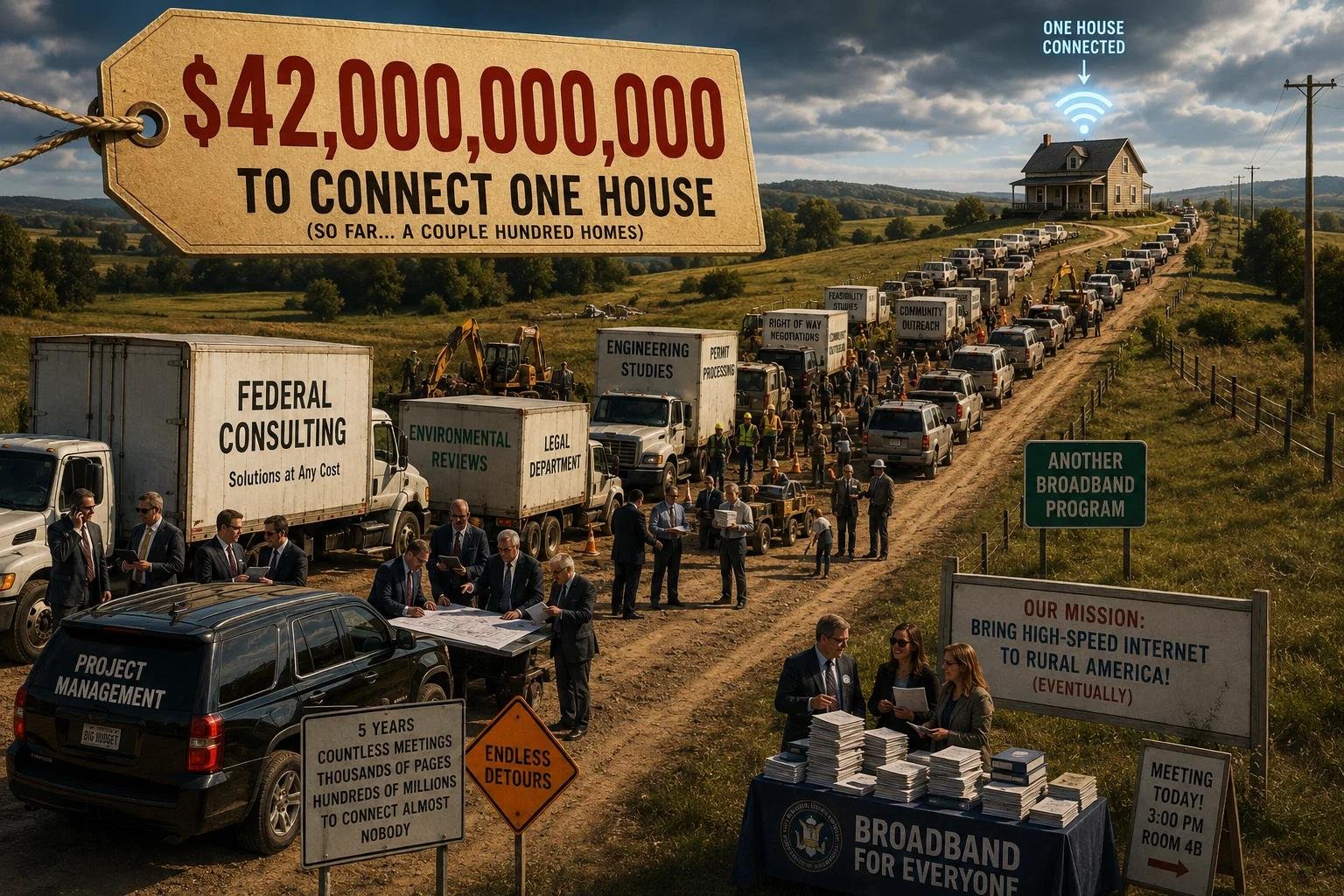
Its biggest program is the Broadband Equity, Access, and Deployment program, known as BEAD. It was created in 2021 as part of Joe Biden’s staggering infrastructure bill, and over $42 billion was allocated to wire up rural America.
Five years later it has connected almost nobody. The first BEAD-funded household in the entire country came online only this spring— a single home near Ogallala, Nebraska, hooked up in May 2026. About a hundred more followed in rural Louisiana. That was the triumphant achievement of five years and ridiculous money spent: a couple hundred connected homes.
BEAD is far from alone. In 2023, the Government Accountability Office— Congress's own watchdog— set out to count the federal government's broadband programs and found more than 133 of them, scattered across 15 separate agencies.
These programs are largely similar yet have no coordinated plan to prevent overlap, or wiring the same stretch of dirt twice.
The GAO told them to sort it out. When it checked back in 2025, most of the work hadn't been touched.
So what do you do about 133 overlapping programs and a flagship that spent billions to connect a couple hundred homes?
If you’re the United States Congress, you add a 134th broadband program!
On June 3, the House Rules Committee advanced next year's Agriculture spending bill with fresh loans and grants for the US Department of Agriculture's ReConnect program— the 134th rural broadband fund, stacked on the $42 billion one that barely works and the 133 others nobody can keep track of.
A private company that spends so much money to connect a couple hundred homes would be bankrupt, and its executives likely facing criminal charges. A federal agency that does it gets a sequel.
What makes it worse is that the problem was already solved by the free market.
Anyone at the end of a dirt road can order a Starlink dish online and have high-speed internet running within about a week— no federal fiber, no years-long wait, no act of Congress.
For that $42 billion price tag, the US taxpayer could have bought a Starlink dish for every one of the top-end estimate of 12 million unserved households in America AND prepaid their internet service for the next five years.
So where did that money go?
It is egregious. The government borrows $2 trillion a year to do this sort of garbage, and acts like a single dollar cut from the budget would throw single mothers out on the streets. They literally wail that “people will die”.
And half the country thinks the answer is to collect more in taxes!
Keep in mind, this $42 billion is part of the legitimate spending — not the $600 billion a year the Treasury Secretary estimates is lost to outright fraud, the $186 billion in improper payments the government admits to, or the hundreds of billions in legal graft on top.
All that borrowing and waste gets paid for one way or another— a weaker dollar, higher taxes, more inflation.
You can’t change any of that. But just like those people without internet on a dead-end road, you do have a choice.
That choice is a Plan B.
The tools to route around Congress already exist.
Owning real assets— gold, silver, energy, productive technology, and the well-managed businesses that produce them— protects your purchasing power when the government reaches for the printing press.
Moving some savings into stronger jurisdictions, establishing a second residency, and taking every legal step to cut your tax bill all mean that no single government's incompetence has total claim over your life.
None of it requires predicting the next crisis. It benefits you, and gives you options, no matter what happens next.
To your freedom, James Hickman Co-Founder, Schiff Sovereign LLC
Congress passed 133 broadband programs. Its Big Idea Is a 134th. | Schiff Sovereign
Monday Iraq News Posted by Tishwash at TNT 6-15-2026
TNT:
Tishwash: Ambassador Tom Barrack arrives in Baghdad to convey President Trump's support for the Iraqi government.
US envoy and ambassador, Tom Barrack, announced his arrival in the Iraqi capital, Baghdad, on an official visit, with the aim of strengthening joint cooperation and discussing prospects for partnership between the two countries.
Barak explained, in a post published on his official X platform account, that he began his visit by meeting with the staff of the US Embassy in Baghdad, headed by Chargé d'Affaires Joshua Harris.
TNT:
Tishwash: Ambassador Tom Barrack arrives in Baghdad to convey President Trump's support for the Iraqi government.
US envoy and ambassador, Tom Barrack, announced his arrival in the Iraqi capital, Baghdad, on an official visit, with the aim of strengthening joint cooperation and discussing prospects for partnership between the two countries.
Barak explained, in a post published on his official X platform account, that he began his visit by meeting with the staff of the US Embassy in Baghdad, headed by Chargé d'Affaires Joshua Harris.
The US envoy indicated that he would meet today with Prime Minister (al-Zaidi) to convey a message of support from President Donald Trump for the Iraqi government, in addition to discussing the bilateral partnership and exploring new directions for building strong and mutually beneficial relations between the United States and Iraq. link
Tishwash: The President of the Kurdistan Region welcomes the US-Iran agreement and affirms: Tom Barrack's visit will address important issues.
Kurdistan Region President Nechirvan Barzani announced on Monday, June 15, 2026, in a special statement to Kurdistan24 correspondent Hoshmand Sadiq, the region’s full support for the agreement reached between the United States of America and the Islamic Republic of Iran.
The United States and Iran reached a comprehensive agreement early Monday morning, June 15, 2026, to end tensions. The agreement includes a ceasefire in Lebanon and the reopening of the strategic Strait of Hormuz, and is scheduled to be officially signed in Switzerland next Friday, June 19.
Nechirvan Barzani expressed his hope that this agreement would be implemented quickly so that peace and stability could return to the region, stressing that the main goal is to avoid wars and establish peace, thus paving the way for greater stability for the people.
Tom Barrack, the US President’s Special Envoy to Iraq and Syria, is scheduled to visit Baghdad and Erbil on Tuesday, June 16, 2026.
Regarding this visit, the President of the Kurdistan Region explained that this is the first time that Tom Barrack has officially visited the region in his capacity as an envoy of the US President, stressing that issues related to the Kurdistan Region and Iraq in general will be discussed in order to strengthen joint coordination between all parties.
Regarding the internal situation in the Kurdistan Region, Nechirvan Barzani indicated that President Masoud Barzani’s initiative came at the right time, stressing the continuation of communication and work with all political parties. link
************
Tishwash: Uncertainty surrounds Washington: How will al-Zaidi's visit reshape Iraqi-American relations?
Professor of Political Science Dr. Khalifa Al-Tamimi revealed on Sunday (June 14, 2026) that any future visit by Iraqi Prime Minister Ali Al-Zaidi to the White House will focus on four main and direct issues with the American administration, foremost among them the financial file and the future of energy.
Al-Tamimi told Baghdad Today that the Prime Minister's upcoming visit to the United States will put four key issues on the table for discussion, most notably the financial situation and exploring mechanisms for developing investment, particularly in the oil and gas sectors. He added that the talks will also include the security aspect, in accordance with the terms of the Strategic Framework Agreement.
He added that "among the main issues is outlining the nature of the relationship between Baghdad and Washington for the next stage, especially since the United States has extensive vital interests in Iraq, at a time when the country is going through a sensitive and complex phase that requires the government to define its strategy in a way that preserves the supreme national interests and regulates the form of partnership with the American side."
Al-Tamimi pointed out that "the visit will consciously address how to support Baghdad in light of the financial crisis that has begun to take on critical dimensions, especially with the continuation of the Strait of Hormuz crisis, which has complicated the marketing of about 90% of Iraqi oil exports, which constitute the main nerve of the general budget."
The political expert pointed out that "the current US administration differs in its orientations from previous administrations, and the features of its policies towards Baghdad are still not entirely clear," suggesting that "this visit will provide decisive and important answers regarding how Washington will deal with the Iraqi file in all its complexities."
Al-Tamimi concluded by saying: “The Prime Minister’s visit to the United States may constitute a turning point in the course of the Iraqi financial crisis, through discussing the possibility of obtaining emergency exemptions related to energy or exports, and redrawing Iraq’s financial policies in a way that positively impacts internal economic stability.”
It is worth noting that Iraq and the United States share deep-rooted political, security, and economic ties based on the Strategic Framework Agreement signed in 2008, which governs cooperation between the two countries.
These moves come at a time when Baghdad faces mounting financial challenges due to the volatility of the global energy market and the logistical pressures associated with oil exports, amidst concerted government efforts to attract foreign investment and expand international partnerships to diversify national income sources. link
************
Tishwash: Parliamentary warnings about the economic exhaustion of the Iraqi street... Are lean years looming on the horizon?
MP Duha Laibi, from the Coordination Framework, sounded the alarm regarding the deteriorating living and service conditions in the country, stressing that the Iraqi street has become “completely exhausted” from the burden of the recent economic measures and reforms that have negatively affected its daily strength and future livelihood, at a time when large segments of citizens lack the most basic necessities of life and essential services.
Laibi told Al-Maalomah that “the ongoing waves of demonstrations and protests in various governorates are nothing but a natural reflection of the deep-rooted unemployment crisis,” explaining that “thousands of graduates continue to flock to the streets to demand their legitimate rights to appointment and job opportunities, coinciding with a state of overwhelming public discontent fueled by the continuation of corruption files and the waste of public money without decisive solutions.”
She added that “the successive wars and conflicts in the region have cast a heavy shadow on the joints of the national economy and levels of national income, leading to a direct erosion of the purchasing power of citizens and exacerbating the harshness of living conditions.”
Laibi revealed “an anticipated parliamentary movement that includes proposals and legislative actions aimed at curbing inflation and ensuring the stability of the Iraqi dinar exchange rate to protect the purchasing power of the citizen,” while stressing the need for the government to adopt flexible economic policies that take into account the human and livelihood dimension, and avoid burdening vulnerable classes with additional burdens that they cannot bear.”
The MP explained that “despite the House of Representatives being in its current legislative recess, this temporary stagnation will not disrupt oversight mechanisms,” emphasizing that “the relevant parliamentary committees and MPs concerned with oversight are closely and continuously monitoring all new government decisions and measures, especially those related to the pressing economic situation and exchange rate policies, to ensure that the situation does not deteriorate further.” link
Tishwash: The Investment Authority details the procedures for "Mall of Iraq" and responds to the statements of its owner.
On Sunday, the National Investment Commission issued a statement clarifying the legal procedures related to the "Iraq Mall" project, in response to what was circulated in the media and statements by the project's owner, Hassan Nasser, regarding exemption requests and power outages.
Hassan Nasser, the owner of "Iraq Mall," announced during a press conference that the mall is threatened with closure within 48 hours due to power outages, and financial losses estimated at about one and a half billion per month.
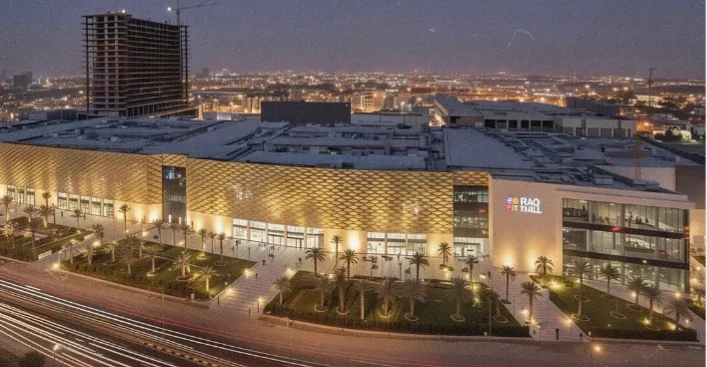
Nasser also said that the mall is facing major operational difficulties as a result of fluctuating electricity supply, which may lead to its complete closure during the aforementioned period.
The statement issued by the commission, and received by Shafaq News Agency, said that the first official communication from “Jewel of Baghdad for Investment and Real Estate Development” company, the owner and implementer of the project, was dated 5/24/2026, and was received from the Baghdad Investment Commission to the National Investment Commission, in which it requested that the mobile power station for the project with a capacity of 132.33 MVA be included in the customs exemptions.
She added that the Authority contacted the Ministry of Electricity on 2/6/2026 after the request was studied by the technical department to obtain the necessary approvals from the relevant sectoral authorities. The Ministry of Industry and Minerals was also contacted on 1/6/2026 via the electronic platform to determine the possibility of manufacturing the station locally or not, in accordance with the law protecting local products.
The authority explained that the investor submitted a pledge on 6/8/2026 to pay the customs duties if the station could be manufactured locally by the Ministry of Industry, noting that the General Authority of Customs was contacted to include the station in the exemptions in order to speed up the procedures.
She explained that the General Authority of Customs responded on 6/10/2026 with a rejection due to the lack of a legal basis, while emphasizing the need for the approval of the Ministry of Industry and Minerals as an effective legal basis. The approval of the Ministry of Industry was received on 6/14/2026 stating that it is not possible to manufacture these stations locally, which gives the Authority the legal powers to follow up on the procedures for bringing in the electrical station.
The statement added that the Authority, while welcoming criticism and media follow-up, expresses its regret for the issuance of statements that included personal characterization and targeting of some of its employees, stressing that its staff perform their duties in accordance with applicable laws and instructions.
The commission affirmed that its doors are open to receive complaints and objections through official channels, calling on investors to adhere to the approved legal procedures, and stressing its continued support for investment projects that contribute to the development of the Iraqi economy. lin
Monday Coffee with MarkZ, joined 06/15/2026
Monday Coffee with MarkZ, joined 06/15/2026
MarkZ Disclaimer: Please consider everything on this call as my opinion. Be sure to consult a professional for any financial decisions
MZ: HCL, cabinet and US visit
Fernando with ATB Joins the stream today. Please listen to the replay for his information and opinions
THE CONTENT IN THIS PODCAST IS FOR GENERAL & EDUCATIONAL PURPOSES ONLY&NOT INTENDED TO PROVIDE ANY PROFESSIONAL, FINANCIAL OR LEGAL ADVICE. PLEASE CONSIDER EVERYTHING DISCUSSED IN MARKZ’S OPINION ONLY
Monday Coffee with MarkZ, joined 06/15/2026
MarkZ Disclaimer: Please consider everything on this call as my opinion. Be sure to consult a professional for any financial decisions
MZ: HCL, cabinet and US visit
Fernando with ATB Joins the stream today. Please listen to the replay for his information and opinions
THE CONTENT IN THIS PODCAST IS FOR GENERAL & EDUCATIONAL PURPOSES ONLY&NOT INTENDED TO PROVIDE ANY PROFESSIONAL, FINANCIAL OR LEGAL ADVICE. PLEASE CONSIDER EVERYTHING DISCUSSED IN MARKZ’S OPINION ONLY
https://rumble.com/user/theoriginalmarkz
Kick: https://kick.com/theoriginalmarkz
Markz's linktree https://linktr.ee/theMarkZshow
FOLLOW MARKZ : TWITTER . https://twitter.com/originalmarkz?s=21. TRUTH SOCIAL . https://truthsocial.com/@theoriginalm...
Mod: MarkZ "Back To Basics" Pre-Recorded Call" for Newbies 10-19-2022 )https://www.youtube.com/watch?v=37oILmAlptM
MARKZ DAILY LINKS: https://theoriginalmarkz.com/home/
THANK YOU FOR JOINING. HAVE A BLESSED DAY. SEE YOU IN THE MORNING FOR COFFEE @ 10:00 AM EST ~ UNLESS BREAKING NEWS HAPPENS! FOR UPDATES ON MARK’S PODCAST GO TO: https://t.me/+b3hYhYlhKM1hYzcx
MilitiaMan & CREW IRAQ DINAR UPDATE-"The Final Phase Is Accelerating: Iraq’s Convergences Are Tightening Fast"
MilitiaMan & CREW IRAQ DINAR UPDATE-"The Final Phase Is Accelerating: Iraq’s Convergences Are Tightening Fast"
6-14-2026
The Crew: Samson, PompeyPeter, Petra, Daytrader, Sunkissed, GIGI and Militia Man
No drama. No intrigue. No songs and dances. Just straight, factual news that I read and interpret to the best of my ability after being an avid Dinar investor and insanely obsessed Dinarian for over 15 years.
Follow MM on X == https://x.com/Slashn
MilitiaMan & CREW IRAQ DINAR UPDATE-"The Final Phase Is Accelerating: Iraq’s Convergences Are Tightening Fast"
6-14-2026
The Crew: Samson, PompeyPeter, Petra, Daytrader, Sunkissed, GIGI and Militia Man
No drama. No intrigue. No songs and dances. Just straight, factual news that I read and interpret to the best of my ability after being an avid Dinar investor and insanely obsessed Dinarian for over 15 years.
Follow MM on X == https://x.com/Slashn
Be sure to listen to full video for all the news……..
Iraq Economic News and Points To Ponder Late Sunday Evening 6-14-26
Iraq Economic News and Points To Ponder Late Sunday Evening 6-14-26
Economic Observatory: Financial Revenues For Iraqi Railways Are Unprofitable
Money and Business Economy News – Baghdad The Echo Iraq Observatory announced on Sunday that the financial revenues of Iraq Railways are not profitable, while pointing to a legal problem in delivering a train to the governorates of the Kurdistan Region.
The observatory stated in a statement that the railway network in Iraq currently has two main lines for night transport, linking Baghdad to Basra and back, passing through a number of governorates, indicating that the capacity of each trip reaches about 360 seats, including tourist seats and others designated for sleeping.
Iraq Economic News and Points To Ponder Late Sunday Evening 6-14-26
Economic Observatory: Financial Revenues For Iraqi Railways Are Unprofitable
Money and Business Economy News – Baghdad The Echo Iraq Observatory announced on Sunday that the financial revenues of Iraq Railways are not profitable, while pointing to a legal problem in delivering a train to the governorates of the Kurdistan Region.
The observatory stated in a statement that the railway network in Iraq currently has two main lines for night transport, linking Baghdad to Basra and back, passing through a number of governorates, indicating that the capacity of each trip reaches about 360 seats, including tourist seats and others designated for sleeping.
He explained that "the operation of these lines is done within a service-oriented framework aimed at covering operational expenses only, without generating direct revenues for the state," adding that revenues are generated when transporting goods such as oil and its derivatives, grains, and commercial goods.
He pointed out that "there are other lines within the country, but they are not operating regularly, including the Baghdad-Karbala line, which is used seasonally during religious visits, in addition to the Baghdad-Ramadi and Baghdad-Samarra lines, which do not operate daily."
He explained that "the Baghdad-Mosul line is still not operational due to the security situation that the country has witnessed in recent years, in addition to other lines such as Baghdad-Kirkuk."
The Eco Iraq Observatory called on the government to "develop the railway sector and expand the network linking the provinces and neighboring countries," adding that "rehabilitating the inefficient lines will enhance transportation, support the national economy, and boost non-oil revenues."
Regarding linking Baghdad with the Kurdistan Region governorates such as Erbil and Sulaymaniyah, the Observatory explained that there is a legal obstacle related to the ownership of the railway routes, as the laws stipulate that the lands through which the lines pass must be under the management of the General Company for Railways exclusively, which is facing objection from the region. https://www.economy-news.net/content.php?id=70225
Financial Times: Easing Sanctions On Iran Depends On Progress In Nuclear Negotiations
Arabic and international Economy News - Follow-up The Financial Times reported that easing sanctions on Iran, including releasing frozen assets abroad, will depend on the progress of negotiations on Iran's nuclear program.
The newspaper quoted sources familiar with the negotiations as saying that any easing of sanctions on Iran, including the release of its frozen assets abroad, would be gradual and contingent on progress in the nuclear negotiations, which would begin after the signing of the memorandum of understanding.
The sources added that the United States would grant Iran permission to sell oil during the 60-day extension of the ceasefire regime.
The Iranian news agency Mehr had previously reported, based on a draft memorandum of understanding, that the United States had pledged to release $24 billion of Iranian assets held abroad, with half of this amount to be returned to Iran before the memorandum of understanding between the two countries was signed.
US President Donald Trump and Iranian Deputy Foreign Minister Kazem Gharibabadi had earlier confirmed the completion of the memorandum of understanding, which is scheduled to be signed in Switzerland on June 19.
Iranian television officially announced early Monday that a peace agreement had been reached with the United States, indicating that Washington had been forced to accept ending the war.
Earlier, US President Donald Trump announced that the United Statesand Iran had reached a peace agreement, writing in a post on the Truth Social platform: "The agreement with the Islamic Republic of Iran has been finalized... Congratulations to all!"
The Pakistani Prime Minister also thanked the United States and Iran for their commitment to finding a diplomatic solution to the conflict, and thanked the leadership of the State of Qatar for its support in reaching an agreement between Washington and Tehran, and Saudi Arabia and Turkey for their contributions to reaching an agreement between Washington and Tehran.
https://www.economy-news.net/content.php?id=70267
Trump Threatens Macron: Either Cancel The Tech Tax Or Face 100% Tariffs
Arabic and international Economy News - Follow-up In a new escalation between Washington and Paris, US President Donald Trump threatened to impose 100% tariffs on all types of French wine and champagne.
In an interview with the New York Post, Trump said he had asked French President Emmanuel Macron to scrap the 3% tax on technology companies, warning that France could face devastating tariffs in the US market if it did not comply.
Trump explained, "I asked him (Macron) not to impose tariffs on American companies, and if they do, I will have no choice but to impose a 100% tariff on all Champagne and all wines produced in France."
The US president added that what Macron simply needs is to "cancel the sales tax, and then he will not be under this pressure."
US President Donald Trump is scheduled to arrive in Evian-les-Bains, France on Monday for the G7 summit meetings at a time when world leaders are increasingly wary of the United States.
Many experts have also pointed out that a large number of G7 leaders were directly affected by Trump’s erratic moves on the world stage, which caused turmoil in the Middle East, trade, and diplomacy.
https://www.economy-news.net/content.php?id=70268
The European Stoxx 600 Index Hits A Record High After The US-Iran Agreement.
Stock Exchange Economy News - Follow-up The pan-European STOXX 600 index opened at a record high on Monday, with most sectors rising after the United States and Iran reached a preliminary agreement to reopen the Strait of Hormuz and end the more than three-month-long conflict in the Middle East.
Global risk appetite improved, and Brent crude fell 4% after US and Iranian officials announced they had reached a framework agreement that is scheduled to be signed on Friday.
The pan-European STOXX 600 index rose 1.2% to 640.94 points by 07:11 GMT, surpassing its previous record high set on February 27. With Monday's gains, the benchmark index has recovered all of its conflict-related losses, according to Reuters.
Most sectors posted gains, led by automakers whose shares rose 3.5%, while shares of energy-sensitive airlines such as Lufthansa and Air France jumped more than 5% each. The travel and leisure sector also hit a new high.
European stocks have generally underperformed compared to their US and Asian counterparts since March, mainly due to Europe's reliance on the Strait of Hormuz for oil supplies.
Concerns about inflation caused by rising energy prices prompted the European Central Bank to raise interest rates by 25 basis points last week.
Traders expect the European Central Bank to raise interest rates by another 25 basis points before the end of this year, according to data from the London Stock Exchange Group.
Shares of Schneider Electric, which specializes in artificial intelligence equipment, rose 3.3% after it entered into a strategic partnership with Taiwan's Foxconn to develop and expand its next-generation AI data center infrastructure. In contrast, energy stocks fell 2.7%, affected by the decline in crude oil prices. https://www.economy-news.net/content.php?id=70262
Jefferies International: A Federal Reserve interest rate hike is currently unlikely.
banks Economy News - Follow-up Jefferies International's chief economist, Alia Mbayed, said that recent declines in oil prices have led investors to reduce their expectations regarding an interest rate hike by the US Federal Reserve before the end of this year, noting that any potential move may be postponed until the beginning of next year.
Mbayed added that the scenario of the Federal Reserve raising interest rates in the near term seems unlikely at the moment.