
MilitiaMan and Crew: IQD News Update-Facts-Central Bank Integration-Globally-ER
MilitiaMan and Crew: IQD News Update-Facts-Central Bank Integration-Globally-ER
2-26-2026
The Crew: Samson, PompeyPeter, Petra, Daytrader, Sunkissed, GIGI and Militia Man
Follow MM on X == https://x.com/Slashn
Be sure to listen to full video for all the news……..
MilitiaMan and Crew: IQD News Update-Facts-Central Bank Integration-Globally-ER
2-26-2026
The Crew: Samson, PompeyPeter, Petra, Daytrader, Sunkissed, GIGI and Militia Man
Follow MM on X == https://x.com/Slashn
Be sure to listen to full video for all the news……..
FRANK26….2-26-26….MORE BANK STORIES
KTFA
Thursday Night Video
FRANK26….2-26-26….MORE BANK STORIES
This video is in Frank’s and his team’s opinion only
Frank’s team is Walkingstick, Eddie and Omar in Iraq and guests
Playback Number: 605-313-5163 PIN: 156996#
KTFA
Thursday Night Video
FRANK26….2-26-26….MORE BANK STORIES
This video is in Frank’s and his team’s opinion only
Frank’s team is Walkingstick, Eddie and Omar in Iraq and guests
Playback Number: 605-313-5163 PIN: 156996#
Seeds of Wisdom RV and Economics Updates Thursday Evening 2-26-26
Good Morning Dinar Recaps,
Nuclear Diplomacy in Geneva: Risks and Ripples Across Markets
Critical U.S.–Iran talks test global stability and financial sentiment
Good Morning Dinar Recaps,
Nuclear Diplomacy in Geneva: Risks and Ripples Across Markets
Critical U.S.–Iran talks test global stability and financial sentiment
Overview
Negotiators from the United States and Iran resumed nuclear negotiations in Geneva, marking a pivotal moment in diplomatic efforts to avoid a broader military confrontation. While no binding deal was reached, diplomats reported incremental progress — and markets reacted sharply to the evolving risk calculus.
Key Diplomatic Signals
Negotiations continued amid a massive U.S. military buildup near the region.
Tehran signaled willingness to show “flexibility” but stopped short of solid concessions.
Officials framed today’s session as a last chance to avert conflict that could destabilize the region and markets.
Market and Commodity Reactions
Oil and Energy Prices
Geopolitical risk premiums strengthened as traders balanced rising tensions against a recent surge in U.S. crude inventories — a dynamic keeping oil prices relatively stable but jittery. Brent and WTI oil benchmarks remain anchored by uncertainty.
Strategic Impact:
Energy markets price both supply risk from conflict and demand headwinds from economic slowdowns — a rare dual squeeze that influences inflation and global growth projections.
Stock Index Volatility
U.S. equity averages closed lower as investors reassessed risk, particularly in:
Chipmakers and AI-focused sectors
Global yield-sensitive industries
Heightened caution reflects both geopolitical uncertainty and broader macro concerns.
ESG and Institutional Shifts
Meanwhile, the Government Pension Fund of Norway is deploying Claude AI for ESG investment screening, signaling how risk frameworks are evolving alongside geopolitical stress in capital markets.
Why It Matters
This moment impacts the global reset across multiple domains:
Geopolitical Risk Realignment — Nuclear diplomacy is reshaping risk premia across asset classes.
Energy Security Dynamics — Oil prices are bridging geopolitical tension and inventory-driven pressure.
Market Behavior Under Stress — Safe-haven flows, volatility repricing, and risk-asset retrenchment reflect deep structural uncertainty.
Financial systems are reacting not just to economic data but to the probability of conflict and diplomacy outcomes.
This is not just market volatility — it’s the recalibration of geopolitical risk premia.
Why It Matters to Foreign Currency Holders
From a global macro reset perspective:
Safe-haven currencies (e.g., USD, CHF, JPY) may benefit temporarily amid risk-off moves.
Emerging market currencies could face pressure from widened risk spreads.
Oil-linked FX baskets (e.g., CAD, NOK) may see increased volatility as energy markets oscillate between supply concerns and inventory dynamics.
Yield curves and Treasury flows shift as investors reposition amid geopolitical uncertainty.
Cumulatively, these tendencies signal that currency dynamics are increasingly tied to geopolitical outcomes rather than purely economic fundamentals.
This is not just market volatility — it’s the recalibration of geopolitical risk premia.
Implications for the Global Reset
Pillar 1: Risk-Based Capital Allocation
Financial flows are being rerouted toward perceived stability as conflict risk shapes sentiment more than traditional macro indicators.
Pillar 2: Commodity-Finance Interdependence
Energy prices and inventories have never been more tightly coupled with diplomatic risk — oil market psychology now moves in lockstep with nuclear negotiations.
Pillar 3: Political Certainty Over Economic Certainty
Markets react more to conflict probability than inflation data — a structural shift that reinforces geopolitical drivers in global finance.
Today’s diplomatic developments are more than another flashpoint — they are a force multiplier shaping how capital markets, energy systems, and currency regimes interact.
This is not just energy pricing — it’s geopolitics fused with financial flows.
Seeds of Wisdom Team
Newshounds News™ Exclusive
Sources
~~~~~~~~~~
Brazil Draws the Line: No BRICS Currency at 2026 Summit
Lula clarifies de-dollarization debate ahead of India-hosted gathering
Overview
In a significant recalibration of expectations, Luiz Inácio Lula da Silva made it clear that a BRICS currency is not on the table for 2026.
Speaking ahead of the 18th BRICS Summit, scheduled to be hosted in India, Lula stated:
“There is no proposal to create the BRICS currency. There is no debate within BRICS about whether to create a new currency.”
The announcement directly addresses years of speculation that the bloc was preparing to launch a gold-backed or trade-backed alternative to the U.S. dollar.
Instead, Brazil is drawing a sharp distinction between:
Creating a new currency
Expanding trade in local currencies
That distinction matters.
Key Developments
1. BRICS Currency: Officially Off the 2026 Agenda
Despite persistent market chatter, Lula confirmed:
No formal proposal exists
No internal debate is underway
No summit agenda includes currency formation
This signals a cooling of expectations surrounding a unified BRICS monetary instrument.
Strategic Impact:
The bloc is not ready for a shared reserve asset or supranational unit — institutional alignment remains insufficient.
2. Local Currency Trade Still Supported
While rejecting a new BRICS currency, Lula did endorse bilateral trade in national currencies.
He emphasized that trade between Brazil and India does not require U.S. dollar settlement.
“It is not necessary that a trade agreement between India and Brazil has to be done with US dollars. We can use our own currencies.”
However, he acknowledged:
It is difficult
It requires coordination
It is gradual
This reflects a pragmatic approach rather than ideological de-dollarization.
3. Not Anti-Dollar — But Pro-Options
Lula stressed that local currency trade is not anti-American or anti-dollar.
He openly acknowledged:
The U.S. dollar remains the strongest global currency
The United States will resist alternative currency influence
BRICS must consider geopolitical realities
This marks a shift from aggressive de-dollarization rhetoric toward a more cautious tone.
Why It Matters
For years, markets speculated that BRICS was on the verge of launching:
A shared currency
A gold-backed trade unit
A dollar alternative reserve asset
Brazil’s clarification introduces reality over rhetoric.
The bloc remains focused on:
Trade flexibility
Payment diversification
Bilateral arrangements
But not a monetary revolution — at least not yet.
This is not a monetary revolution — it’s a recalibration of expectations.
Why It Matters to Foreign Currency Holders
For currency watchers and global reset observers:
No immediate BRICS currency launch
No 2026 monetary reset event
Gradual diversification remains the path
However:
China and India still pursue:
Yuan internationalization
Rupee cross-border expansion
The broader trend of multipolar payment systems continues — just without a unified BRICS coin.
De-dollarization talk cools, but diversification continues quietly.
Implications for the Global Reset
Pillar 1: De-Dollarization Is Incremental, Not Explosive
The process is evolving through bilateral trade arrangements — not through a dramatic currency replacement event.
Pillar 2: BRICS Remains Economically Diverse
Internal financial differences make a shared currency structurally difficult.
Brazil’s message suggests:
Monetary sovereignty remains national
Coordination is selective
Integration is cautious
The Bigger Picture
Lula also highlighted the demographic power of the bloc:
India and China together represent nearly half of humanity
BRICS collectively accounts for a substantial portion of global population and economic output
Yet demographic weight alone does not equal monetary unity.
Institutional integration takes time — and consensus.
For now, BRICS is choosing flexibility over transformation.
This is not just currency commentary — it’s a strategic signal about how fast global monetary realignment can truly move.
Seeds of Wisdom Team
Newshounds News™ Exclusive
Sources
Watcher Guru — “Brazil Makes Major Declaration on BRICS Currency & De-Dollarization”
Reuters — “Brazil’s Lula Clarifies BRICS Currency Debate Ahead of Summit”
~~~~~~~~~~
Seeds of Wisdom Team RV Currency Facts Youtube and Rumble
Newshound's News Telegram Room Link
RV Facts with Proof Links Link
RV Updates Proof links - Facts Link
Follow the Gold/Silver Rate COMEX
Follow Fast Facts
Seeds of Wisdom Team™ Website
Thank you Dinar Recaps
Iraq Economic News and Points To Ponder Thursday Evening 2-26-26
Central Bank Advances Iraqi Banking Reform, Eases Foreign Transactions
26th February 2026 in Iraq Banking & Finance News, Iraq Industry & Trade News
By John Lee. The Central Bank of Iraq (CBI) has announced completion of the principal phase of its comprehensive reform programme for commercial, Islamic and foreign bank branches operating in Iraq.
Central Bank Advances Iraqi Banking Reform, Eases Foreign Transactions
26th February 2026 in Iraq Banking & Finance News, Iraq Industry & Trade News
By John Lee. The Central Bank of Iraq (CBI) has announced completion of the principal phase of its comprehensive reform programme for commercial, Islamic and foreign bank branches operating in Iraq.
According to the Bank, all Iraqi banks have submitted the required documentation under the "minimum requirements" framework, selecting one of three pathways:
Continuing in the market as independent banking institutions;
Merging with other banking institutions;
Exiting the market.
The submissions enable the Central Bank to assess each institution's compliance with minimum reform standards. Over the coming months, banks are expected to address any identified gaps and work towards full compliance.
The Central Bank also announced a new initiative aimed at expanding the capacity of private banks to support international trade. Banks meeting specified criteria under Central Bank evaluation will be permitted to resume cross-border transactions and issue letters of credit in multiple international currencies, including:
Euro;
UAE dirham;
Chinese yuan;
Jordanian dinar.
The Bank said the move forms part of its broader strategy to strengthen confidence in Iraq's financial sector, enhance global integration, and support sustainable economic growth.
Iraq’s CF Weighs Al-Maliki Nomination Under US Pressure
2026-02-26 Shafaq News- Baghdad Leaders of Iraq’s Shiite Coordination Framework (CF) held internal meetings Thursday to align positions ahead of a broader session next week, as divisions persist over nominating former prime minister Nouri Al-Maliki amid mounting US pressure.
Sources within the alliance told Shafaq News that three key issues will dominate the upcoming meeting, including urging parliament to set a date to elect a president. Kurdish parties are not expected to formally reveal their candidate until the voting session.
Under the proposed sequence, the Framework would present its nominee for prime minister one week after the president is elected, followed by a parliamentary session to announce the designation and begin government formation.
Another source said the bloc could still opt for an alternative candidate from the list under consideration, depending on political calculations and regional dynamics.
Earlier this week, a senior Framework official told Shafaq News the alliance had secured an extension to a US deadline related to withdrawing Al-Maliki’s nomination, adding that Al-Maliki has refused to step aside voluntarily, arguing that only the two-thirds majority that nominated him can rescind the decision.
The Framework, which groups Iraq’s main ruling Shiite factions, is split over Al-Maliki’s candidacy. Washington has strongly opposed to his return, with US envoy Tom Barrack conveying the American position during a recent visit to Baghdad.
President Donald Trump has also publicly criticized Al-Maliki’s previous tenure as prime minister from 2006 to 2014, and US pressure has intensified in recent weeks. CF formally nominated Al-Maliki on January 24, 2026, with majority backing from its components.
Read more: Nouri Al-Maliki’s new doctrine for power: Pragmatism over defiance?
https://www.shafaq.com/en/Iraq/Iraq-s-CF-weighs-Al-Maliki-nomination-under-US-pressure
Iraq Protests Arab States’ Support For Kuwait In Maritime Dispute
2026-02-26 Shafaq News- Baghdad Iraq’s Foreign Ministry on Thursday reproached Palestine, Jordan, and Egypt over their official positions aligned with Kuwait regarding Baghdad’s deposit of its maritime boundaries map with the United Nations.
The three counties expressed concern over Iraq’s submission to the United Nations, reaffirmed support for Kuwait’s sovereignty, and urged both sides to resolve the maritime dispute through dialogue in line with international law and the 1982 UN Convention on the Law of the Sea.
The ministry said in separate statements, that the remarks came during meetings between Undersecretary for Bilateral Relations Ambassador Mohammed Hussein Bahr Al-Uloom and the ambassadors of Palestine, Jordan, and Egypt. Bahr Al-Uloom presented Baghdad’s position concerning the three counties’ statements, which “overlooked Iraq’s viewpoint and the measures it had taken in full accordance with international law, particularly the 1982 United Nations Convention on the Law of the Sea.”
He described Iraq’s move as a sovereign right, adding that the country acted with full transparency and remains committed to addressing related issues through legal and diplomatic channels in a way that safeguards its sovereignty and national rights.
doSterposn9i80t4c0h44ah3i86f7c8afgi1m0f81m08h91a64aa13f53cll ·
Foreign Ministry representative hosts the Ambassador of the Arab Republic of Egypt to Iraq
The Ministry of Foreign Affairs, representing the Ministry of Foreign Relations, Ambassador Mohammed Hussein Bahr Aloum, on Thursday, 26/02/2026, hosted the Ambassador of the Arab Republic of Egypt to the Republic of Iraq, Mr. Ahmed Samir Helmy, on the background of the statement issued by the Egyptian Ministry of Foreign Affairs and Immigration regarding the deposit of the Republic of Iraq the map of maritime areas to the nations المتحدة
The ministry spokesman affirmed clearly and explicitly that Iraq's decision to deposit a map of its maritime areas is indeed a sovereign that cannot be reversed, in accordance with Iraq's position and his observations in accordance with the Egyptian statement, which obliterates Iraq's opinion, position and the actions it has taken in full compliance with the provisions of international law, and especially the United Nations Convention on Law The seafarers of 1982, with full transparency reflects his keenness in addressing all relevant issues through legal and diplomatic frameworks, upholding Iraq's sovereignty and preserving its national rights.
In this context, Iraq expresses its regret for making such a statement, for which it is due to a state of dissatisfaction at the official and popular levels.
The ministry spokesman also stressed the depth and durability of the fraternal and historical relations between the Republic of Iraq and the Arab Republic of Egypt, emphasizing the importance of investigating the highest levels of accuracy and objectivity in official statements and positions, which have a direct impact on the course of the bilateral relations, emphasizing that any statement should include respect for the sovereignty of the two countries on Towards even more.
He expressed the appreciation of the Republic of Iraq for the special relations with the Arab Republic of Egypt and its keenness to develop them in various fields.
On his part, the Egyptian ambassador expressed his gratitude for what the ministry spokesman provided with important and comprehensive information on the reality of the situation between the two countries and the level of cooperation and communication on the subject of drawing maritime borders, underlining that the concern expressed by Egypt in its statement stems from its eagerness to support security and stability between the two countries.
He also noted that he would ensure that Iraq's message is conveyed to the Egyptian leadership in a clear and detailed manner, reflecting the Iraqi viewpoint and the relevant developments between the two countries.
***************
To read more about the news of the Ministry, you can visit the official pages and accounts of the Iraqi Ministry of Foreign Affairs: Ministry's website:https://mofa.gov.iq
Earlier this month, Baghdad a detailed maritime domain map with the United Nations and prepared to submit a Federal Supreme Court ruling that annulled the demarcation with Kuwait up to marker 162, a step that calls for re-demarcation under international law. Meanwhile, Gulf states, including the GCC, have urged Iraq to withdraw the submission and address the issue through diplomatic channels.
Read more: Khor Abdullah entangled in sovereignty disputes and legacy of invasion
https://www.shafaq.com/en/Iraq/Iraq-protests-Arab-states-support-for-Kuwait-in-maritime-dispute
German Report: Dispute Over Khor Abdullah Area Affects The Development Road Project And The Grand Faw Port –
Khor Abdullah – One News 2/26/2026 A report published by the German website DW stated that the dispute over the Khor Abdullah area is affecting regional development projects, especially the Grand Faw Port and the development road project in Iraq.
The report added that Iraqis see the Kuwaiti Mubarak Al-Kabeer port, which is part of Kuwait's 2035 vision and China's Belt and Road Initiative, as restricting maritime access and threatening the viability of their projects.
It also stated that if the Iraqi parliament refuses to ratify the agreement, a permanent and implementable solution must be found. The report added that this solution should be based on re-engagement between the two parties, grounded in justice, shared economic interests, and respect for international law and the constitution.
The report concludes that the Khor Abdullah dispute transcends being a technical disagreement over maritime borders, as Iraq and Kuwait can transform this thorny dispute into a model for regional diplomacy and respect for the international legal order, while demonstrating a clear commitment to international law and judicial bodies.
https://1news-iq.net/تقرير-الماني-الخلاف-بشأن-منطقة-خور-عبد/
Dollar’s Global Dominance Finally Cracking?
Dollar’s Global Dominance Finally Cracking?
WTFinance: 2-26-2026
The global monetary system is at a crossroads, influenced by geopolitical tensions, technological innovation, and shifting economic landscapes.
In a recent episode of the WTFinance Podcast, host Anthony Fatseas sat down with Barry Eichengreen, a distinguished economist and professor at the University of California, Berkeley, to dissect the current state and future trajectory of global finance.
Dollar’s Global Dominance Finally Cracking?
WTFinance: 2-26-2026
The global monetary system is at a crossroads, influenced by geopolitical tensions, technological innovation, and shifting economic landscapes.
In a recent episode of the WTFinance Podcast, host Anthony Fatseas sat down with Barry Eichengreen, a distinguished economist and professor at the University of California, Berkeley, to dissect the current state and future trajectory of global finance.
Their discussion shed light on the dominance of the US dollar, the rise of alternative currencies, and the challenges posed by a rapidly changing world.
Eichengreen highlighted the pressing issue of a K-shaped economy, where technological advancements, particularly AI, and post-pandemic trends have exacerbated economic inequality.
The K-shaped recovery, where certain sectors and populations rebound quickly while others lag, poses significant political challenges. Addressing these disparities requires nuanced policy-making, but Eichengreen emphasized the difficulty in implementing effective measures due to political gridlock and competing interests.
The conversation also touched on the geopolitical implications of US policies under Trump and Putin, which have prompted Europe and other regions to diversify their economic and strategic dependencies away from the US.
While this transition is slow and complex, it signifies a shift in the global economic landscape.
Eichengreen noted that Europe’s pursuit of greater unity is hindered by internal divisions and competition, whereas China’s efforts to internationalize its currency are stalled due to governance and trust issues.
Despite these developments, Eichengreen stressed that the US dollar remains the global reserve currency, and its position is not immediately threatened.
Although there is a gradual erosion of its share, mainly in favor of smaller, well-managed currencies leveraging digital technology, a sudden flight from the dollar would trigger a severe global liquidity crisis, jeopardizing 21st-century globalization.
The discussion also explored the growing role of digital currencies, stablecoins, and central bank digital currencies (CBDCs).
Eichengreen provided a historical perspective on global currency cycles, from ancient times to the present, underscoring the significance of geopolitical, financial, and economic factors in shaping currency dominance.
His forthcoming book, “Money Beyond Borders: Global Currencies from Crisis to Crypto,” delves into these themes, offering an in-depth analysis of the interplay between geopolitics, financial innovation, and economic power.
The episode concluded with a cautionary note on the need to carefully manage the privileges and responsibilities associated with issuing the world’s primary international currency.
Eichengreen emphasized that the US must be mindful of its role in maintaining global financial stability and the implications of its monetary policies on the global economy.
In conclusion, the WTFinance Podcast episode with Barry Eichengreen offers valuable insights into the complex and evolving global monetary system.
As the world navigates the challenges of technological disruption, geopolitical tensions, and economic inequality, understanding the dynamics of currency dominance and the rise of digital currencies is crucial. For those interested in delving deeper into these topics, watching the full video from WTFinance is a must.
Trump Revalues Gold? ‘It’s a 65% Chance’ – James Rickards Explains the Real Implications
Trump Revalues Gold? ‘It’s a 65% Chance’ – James Rickards Explains the Real Implications
Miles Franklin Media: 2-25-2026
Michelle Makori, President & Editor-in-Chief of Miles Franklin Media, speaks with macro strategist James Rickards about growing speculation that the United States could revalue its gold reserves.
America still values its gold at $42.22 per ounce, a price set in 1973, and why the Treasury legally has the authority to reprice gold closer to market levels with what some describe as “the stroke of a pen.”
Trump Revalues Gold? ‘It’s a 65% Chance’ – James Rickards Explains the Real Implications
Miles Franklin Media: 2-25-2026
Michelle Makori, President & Editor-in-Chief of Miles Franklin Media, speaks with macro strategist James Rickards about growing speculation that the United States could revalue its gold reserves.
America still values its gold at $42.22 per ounce, a price set in 1973, and why the Treasury legally has the authority to reprice gold closer to market levels with what some describe as “the stroke of a pen.”
While the move would largely be an accounting adjustment, Rickards argues the real impact would be psychological – signaling to markets and foreign governments that the United States is once again treating gold as a monetary asset.
Rickards estimates the probability of such a move under a Trump administration at “65%” He also discusses:
How gold revaluation works step-by-step
Why it could bypass debt ceiling constraints
The potential $1 trillion Treasury windfall
Signals this would send to China and global central banks
Why gold is increasingly viewed as protection against financial weaponization
Seeds of Wisdom RV and Economics Updates Thursday Afternoon 2-26-26
Good Morning Dinar Recaps,
BRICS Warships in Formation: Economic Bloc Steps Into Global Security Arena
“Will for Peace 2026” signals a strategic shift from finance to force projection
Good Morning Dinar Recaps,
BRICS Warships in Formation: Economic Bloc Steps Into Global Security Arena
“Will for Peace 2026” signals a strategic shift from finance to force projection
Overview
In January 2026, the BRICS bloc — Brazil, Russia, India, China, and South Africa — crossed a symbolic threshold.
Warships from China, Russia, Iran, and the United Arab Emirates gathered off South Africa’s Western Cape for the “Will for Peace 2026” naval drills — described as the first operational military event conducted under a BRICS security framework.
What began as an economic reform coalition is now signaling a willingness to evolve into something more strategic.
The question is no longer whether BRICS has security ambitions — it’s whether it can function as a unified security actor.
Key Developments
1. A Military Exercise With Strategic Messaging
The naval drills took place near Simon’s Town and ran for eight days.
South Africa framed the exercise as maritime cooperation focused on:
Anti-piracy operations
Shipping lane protection
Maritime security coordination
However, analysts note this event represents something deeper:
BRICS is testing its identity beyond economics.
This marks a departure from the bloc’s traditional focus on:
Development banking
Trade reform
Currency diversification
Multipolar financial systems
Now, hard power projection is entering the equation.
2. China Assumes Command Leadership
For the first time within a BRICS security context, China assumed centralized coordination — overseeing:
Strategic planning
Tactical execution
Command-and-control architecture
This leadership role signals Beijing’s intent to institutionalize a BRICS global security framework from within.
China’s military footprint in Africa has expanded rapidly:
At least 15 PLA Navy port calls across Africa between 2024–2025
Expanded military education commitments under FOCAC (2024–2027)
Training programs for 6,500 African military and police personnel
The exercise reflects China’s broader strategy of integrating security relationships alongside economic ties.
Strategic Impact:
Beijing is shaping BRICS security architecture in ways that align with its global ambitions.
3. Internal Fractures Exposed
Despite the optics, unity was far from complete.
Notably absent:
India
Brazil
India’s absence was widely interpreted as balancing its ties with the United States.
Brazil also avoided participation, signaling that not all founding members are ready to militarize BRICS cooperation.
Further tensions emerged inside South Africa itself.
President Cyril Ramaphosa reportedly ordered that Iranian naval vessels not participate — yet Iranian warships docked and joined drills led by China’s 48th Naval Task Force.
A Board of Enquiry followed.
This episode exposed:
Civil-military coordination gaps
Political divisions
Questions about sovereignty and command authority
Strategic Impact:
BRICS unity on paper does not automatically translate into operational cohesion.
Why It Matters
This development signals three major shifts:
BRICS is no longer purely economic.
China is increasingly shaping the bloc’s strategic direction.
Internal divisions could limit BRICS’ ability to function as a cohesive security alliance.
The comparison some analysts draw is provocative:
BRICS was designed as an economic counterweight to Western institutions — not a military counterpart to NATO.
Yet exercises like “Will for Peace 2026” blur that boundary.
From trade bloc to naval bloc — BRICS is recalibrating global power signals.
Why It Matters to Foreign Currency Holders
For those watching global financial realignment:
Security blocs influence trade corridors and maritime stability.
Naval coordination impacts energy routes and shipping insurance costs.
Geopolitical alignments affect capital flows and reserve currency positioning.
If BRICS evolves into a security actor, it reshapes how:
Trade is protected
Resources are transported
Strategic partnerships are structured
Security architecture and monetary architecture often move together.
When warships gather, economic alliances reveal strategic ambition.
Implications for the Global Reset
Pillar 1: Multipolarity Expands Beyond Finance
BRICS’ evolution suggests multipolarity is expanding from economic forums into military signaling.
Pillar 2: China’s Strategic Institutionalization
By leading operational planning, China positions itself as the bloc’s de facto strategic architect.
However:
Without India and Brazil’s participation, BRICS security cohesion remains incomplete.
This tension will determine whether BRICS becomes:
A coordinated security coalition
orA symbolic platform with limited operational unity
This is not just economic reform — it’s the testing of a multipolar security axis
Conclusion
“Will for Peace 2026” represents a pivotal moment.
BRICS is experimenting with security integration, but internal fractures are visible. The bloc’s future role in global security will depend on:
Whether founding members align on military objectives
Whether sovereignty concerns are resolved internally
Whether China’s leadership role is accepted or resisted
The economic alliance has tested the waters of security cooperation.
Whether this marks the birth of a lasting military dimension — or a one-off symbolic exercise — remains to be seen.
This is not just geopolitics — it’s the visible reshaping of global power architecture.
Seeds of Wisdom Team
Newshounds News™ Exclusive
Sources
~~~~~~~~~~
Seeds of Wisdom Team RV Currency Facts Youtube and Rumble
Newshound's News Telegram Room Link
RV Facts with Proof Links Link
RV Updates Proof links - Facts Link
Follow the Gold/Silver Rate COMEX
Follow Fast Facts
Seeds of Wisdom Team™ Website
Thank you Dinar Recaps
The 92% Tax Rate That Nobody Ever Paid
The 92% Tax Rate That Nobody Ever Paid
Notes From the Field By James Hickman (Simon Black) February 26, 2026
In 1954, Frank Sinatra was on top of the world. He'd just won the Academy Award for Best Supporting Actor in From Here to Eternity — a comeback role that rescued his career after years of decline and a voice hemorrhage that nearly ended it all.
Hollywood was paying him handsomely again. But there was a problem. The top marginal income tax rate was 92%, and Sinatra was about to watch most of his comeback earnings disappear before a single penny ever hit his bank account.
The 92% Tax Rate That Nobody Ever Paid
Notes From the Field By James Hickman (Simon Black) February 26, 2026
In 1954, Frank Sinatra was on top of the world. He'd just won the Academy Award for Best Supporting Actor in From Here to Eternity — a comeback role that rescued his career after years of decline and a voice hemorrhage that nearly ended it all.
Hollywood was paying him handsomely again. But there was a problem. The top marginal income tax rate was 92%, and Sinatra was about to watch most of his comeback earnings disappear before a single penny ever hit his bank account.
So Ol' Blue Eyes did what every major Hollywood star at the time was doing: he set up what was known as a "collapsible corporation."
The tactic was simple. Instead of collecting his fee personally — where it would be taxed at 92% — Sinatra had the studio pay his corporation, which was taxed at roughly 50%. He'd take a modest salary out of the company. Then, when the picture wrapped, he'd sell the corporation's stock and pay the 25% capital gains rate on the proceeds.
The 92% rate was the law. But in practice, it was a fiction.
Back in the 1950s, fewer than 10,000 households in the entire country — out of 57 million tax returns — earned enough to even reach the top bracket. And those who did had so many deductions and shelters available that the top 1% paid an effective federal income tax rate of just 16.9%.
I think this is important to point out because, just last week, TIME Magazine published an article titled "Tax the Rich. They're Not Going Anywhere". They argued that wealthy Americans are too "sticky" to flee, so cities and states should feel free to squeeze them.
New York's mayor Zohran Mamdani wants an additional 2% tax on incomes over $1 million. California voters are expected to vote on a "one-time" 5% wealth tax on billionaires. TIME cheers them all on.
In Britain, the Labour government already abolished the "non-dom" regime — a 110-year-old policy that let wealthy foreigners shield overseas income from UK taxes. As a result of changing this program, Britain drove over 10,000 millionaires out of the country.
But rather than eat their humble pie and admit a policy failure, the left wing of their party is pushing for a new wealth tax. On top of that, they continue gaslight people and insisting, just like TIME magazine, that wealthy people don’t leave when tax rates rise.
Across the pond in America, Bernie Sanders, AOC, and Elizabeth Warren have been beating this drum for years— demanding that the wealthy pay their "fair share."
What IS the fair share? They never say. They never commit to a number.
So let's look at the numbers they keep ignoring.
In 2022, the top 1% of American taxpayers paid 40.4% of all federal income taxes, according to the Tax Foundation. The top 10% paid 72%. The bottom 50% paid 3%.
And the top 1% doesn't just pay a large share — they pay a share wildly disproportionate to their income. They earned 22.4% of all adjusted gross income but shouldered 40.4% of the tax bill. That's nearly double their proportional share.
This isn't new. It's been the trend for decades — and it runs in exactly the opposite direction from what the "fair share" crowd implies.
In 1980 (when the top marginal tax rate was 70%), the wealthiest taxpayers (the top 1%) paid 19% of all federal income taxes. Today, again, the top 1% pay 40.4% of the taxes, even though the highest marginal tax rate is much lower.
How? Because the Tax Reform Act of 1986 — a bipartisan deal signed by Ronald Reagan — made a simple trade: dramatically lower rates in exchange for closing the loopholes. No more passive loss write-offs zeroing out taxable income. No more converting salary into capital gains through shell corporations. No more Frank Sinatra deals.
The rates were lower, but there were fewer places to hide. And these changes to the tax code resulted in the wealthy paying MORE tax, not less.
Even if you go back to the days of 92% rates (which the Left loves to bring up), the effective rate for the top 0.1% was only 21%.
But even setting all of that aside — even if you could squeeze a few more percentage points out of the top 1% — it wouldn't fix anything. The federal government is running $2 trillion annual deficits. Higher taxes are not the solution.
Cutting the deficit requires spending restraint. And economic growth.
Given Congress’s intransigence in cutting spending, growth is the easier option. But it requires a stable, predictable business environment with minimal bureaucracy.
Instead, we get an environment that changes every four years — sometimes every four weeks. One administration's regulations get undone by the next. Businesses get sued over rules that didn't exist two years ago.
Take the infamous Corporate Transparency Act.
Congress passed this law in 2021 requiring roughly 32 million small businesses to file "beneficial ownership" reports with FinCEN. The penalties for failure to do so were $500 per day in fines and up to two years in prison.
Never mind that the government already collects this information through K-1s, 1099-DIVs, and existing bank regulations. Never mind that large banks and publicly traded corporations were conveniently exempted.
The onus fell on small, family-owned businesses: the restaurant owner figuring out how to keep waitstaff from quitting, the small shop already buried in paperwork. Well, Congress gave them yet another form to fill out under threats of penalties and imprisonment.
But then the regulations changed— SEVEN TIMES in four months. A federal judge blocked the law. Three days later, an appeals court reversed him. Three days after that, a different panel reversed the reversal. Then the Supreme Court weighed in.
The Treasury Department kept issuing new deadlines to comply, and no business owner had any idea from one week to the next whether they were in compliance.
In the end, the White House simply canceled it— which was the right thing to do. But the next President might very well put it back in place.
The whole ethos was that every small business owner is a potential money launderer. Never mind the money laundering rules already on the books — rather than fix what wasn't working, Congress just piled on more. That's how you end up with a Code of Federal Regulations over 188,000 pages long.
That's the real problem. Not that the wealthy aren't paying enough. That the business environment in America is so needlessly complex, so maddeningly unstable, that it chokes the growth that would actually generate the revenue politicians claim to want.
If they spent as much energy making it easier to build a business as they do dreaming up new ways to "soak the rich," the tax base would take care of itself.
To your freedom, James Hickman Co-Founder, Schiff Sovereign LLC
Preparing for the Comeback of the Gold Standard
Preparing for the Comeback of the Gold Standard
Bendleruschka: 2-26-2026
Bendleruschka @bendleruschka
GOLD COMMS – GOLD SHALL DESTROY FED
PREPARING FOR THE COMEBACK OF THE GOLD STANDARD – US Gold Reserve audit & revaluation.
Are we finally getting to know the status at Fort Knox?
Preparing for the Comeback of the Gold Standard
Bendleruschka: 2-26-2026
Bendleruschka @bendleruschka
GOLD COMMS – GOLD SHALL DESTROY FED
PREPARING FOR THE COMEBACK OF THE GOLD STANDARD – US Gold Reserve audit & revaluation.
Are we finally getting to know the status at Fort Knox?
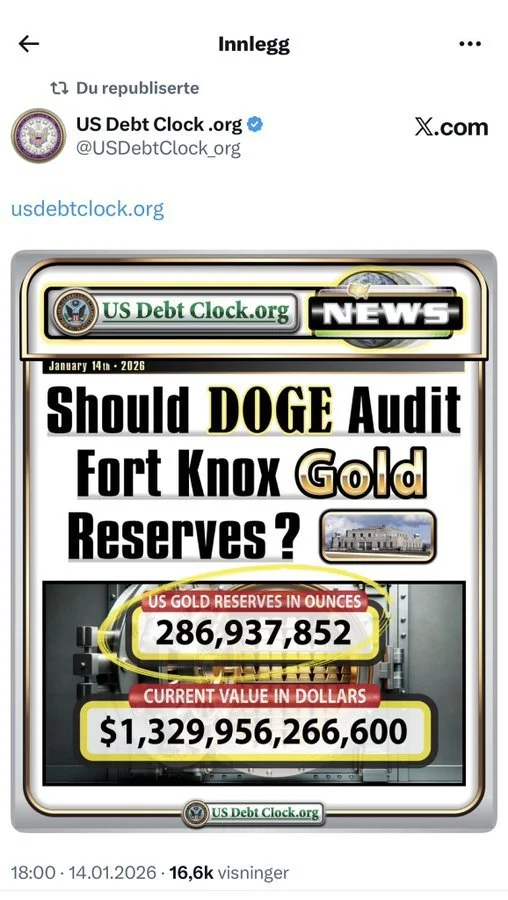
DOGE is also an audit by the way. EVERYTHING IS BEING AUDITED NOW.
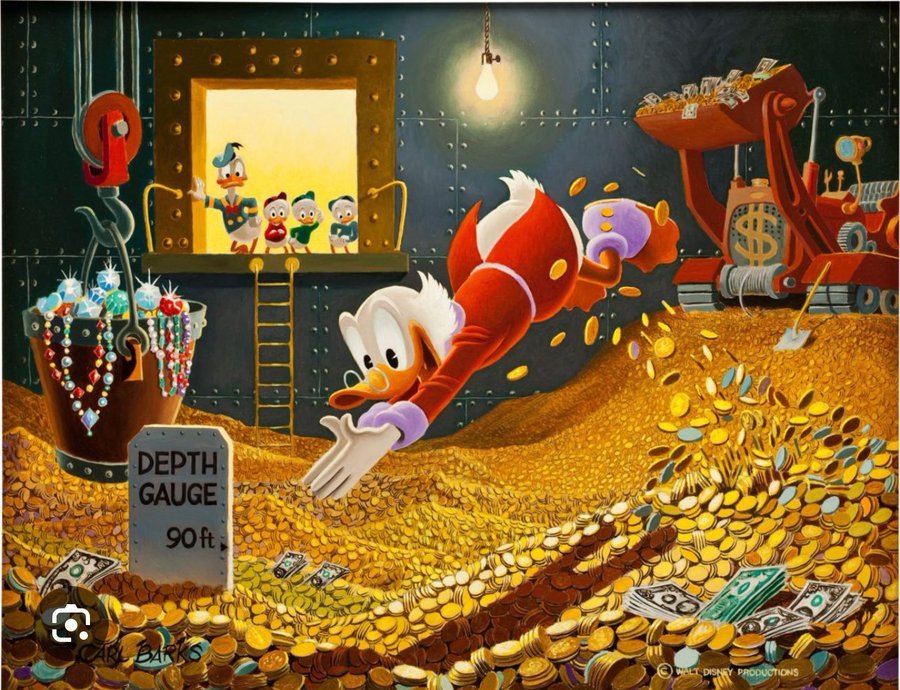
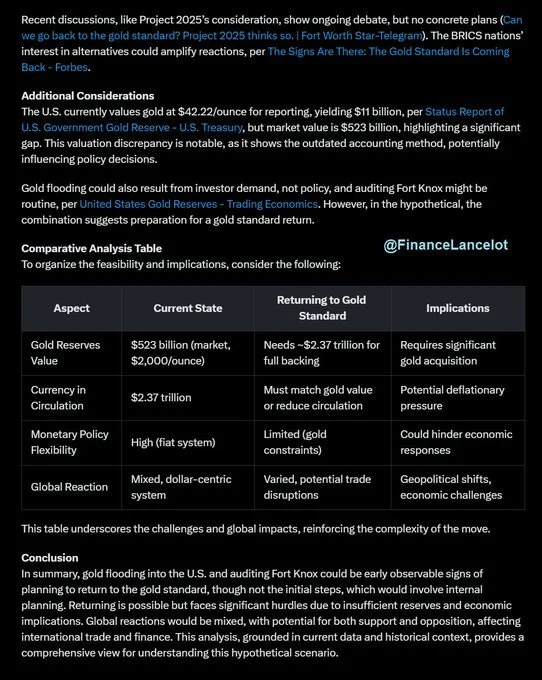
Financelot: How long until the general public finally realizes what's really going on here? JP Morgan & U.S. Treasury are bringing all the gold back to the US so they can audit & implement a gold standard. They created the Sovereign Wealth Fund specifically to replace the Federal Reserve.
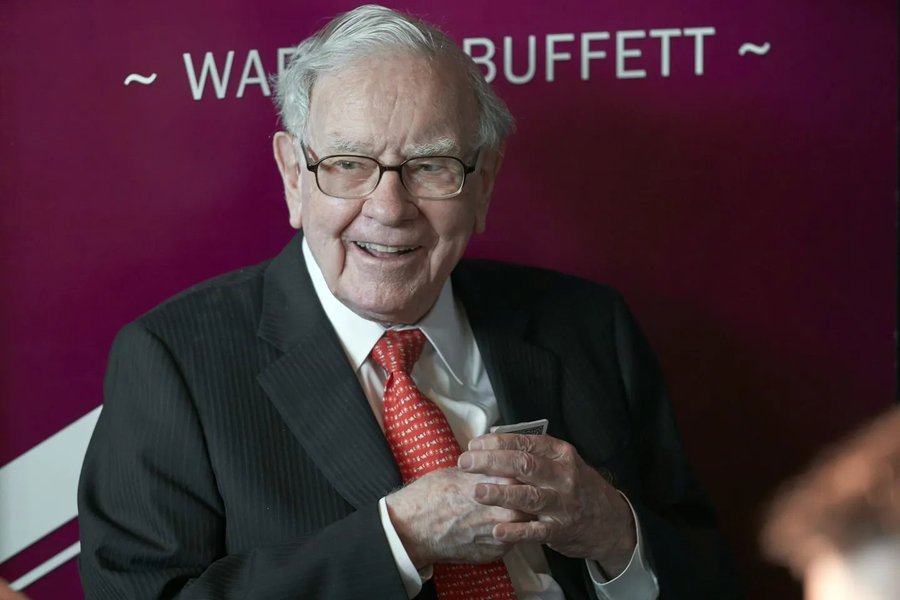
Financealot: Why do you suppose Warren Buffet is hoarding $325 billion in cash? P.S. The euphoric rally to the 1929 peak was 5 years & 1 month
“Tidbits From TNT” Thursday 2-26-2026
TNT:
Tishwash: Cash hoarded in home safes and lost trust in bank vaults
At the heart of the banking confidence crisis that is hindering the spread of electronic payments in Iraq, the majority of economic transactions are still conducted in cash, while savings remain completely outside the formal banking system.
However, the average Iraqi citizen manages his daily life entirely by relying on paper money, as he withdraws his salaries in cash, pays for his purchases in cash, and keeps his savings at home away from banks.
Meanwhile, electronic payment cards have become a routine part of daily life in neighboring countries, revealing that Iraq is about twenty years behind in adopting the simplest modern financing tools.
TNT:
Tishwash: Cash hoarded in home safes and lost trust in bank vaults
At the heart of the banking confidence crisis that is hindering the spread of electronic payments in Iraq, the majority of economic transactions are still conducted in cash, while savings remain completely outside the formal banking system.
However, the average Iraqi citizen manages his daily life entirely by relying on paper money, as he withdraws his salaries in cash, pays for his purchases in cash, and keeps his savings at home away from banks.
Meanwhile, electronic payment cards have become a routine part of daily life in neighboring countries, revealing that Iraq is about twenty years behind in adopting the simplest modern financing tools.
This delay reflects “weak confidence in banks,” as observers describe it, since the huge amount of cash is hoarded inside homes and exceeds 90 trillion dinars, or about 90 percent of the total cash in circulation, according to the latest data from the Central Bank.
In addition, statistics indicate that less than 20 percent of the population has bank accounts, compared to more than 50 percent in Saudi Arabia and the UAE, where digital payments have been commonplace for years.
A Baghdad resident said via Facebook, “I prefer to keep my money at home for fear of any potential banking crisis, as past experiences do not encourage trust.”
A local economic activist stated, “The sector needs radical reforms to build trust, especially with the push to end cash payments in government institutions by July 2026.”
A banking source noted that “electronic transactions grew by 17.7 percent in the first quarter of 2025, but reliance on cash still prevails despite the launch of platforms such as ePassole in the Kurdistan Region.”
Despite these government efforts, the biggest challenge remains convincing citizens of the security of the digital system amid fears of losing or freezing deposits. link
************
Tishwash: Al-Sudani Coalition signals constitutional action over Iraq’s presidency stalemate
Press release from the Reconstruction and Development Parliamentary Bloc
posted on facebook
Iraq’s Reconstruction and Development (Al-Ima’ar wal Tanmiya) Coalition, the largest electoral bloc in parliament, on Thursday warned of potential constitutional action over the delayed election of the country’s president, describing the impasse as a “clear violation” of constitutional deadlines.
In a statement, the bloc, led by caretaker Prime Minister Mohammed Shia al-Sudani, explained that parliament has yet to elect a head of state despite the passage of almost two months since lawmakers chose the speaker and his two deputies.
The coalition urged the Presidency of the Council of Representatives to hold a dedicated session next week to elect a president, calling on parliament to assume its “national responsibility” and end what it characterized as institutional paralysis. It also called on Kurdish political forces to agree on a single nominee ahead of the session, enabling lawmakers to proceed with the remaining constitutional steps —most notably the formation of “a fully empowered government” in line with the election results.
The continued operation of a government with limited powers, it cautioned, is causing “direct harm” to citizens and state institutions, adding that it would resort to “all available constitutional means and procedures” if the stalemate persists.
Under Iraq’s post-2003 power-sharing arrangement, the presidency is traditionally held by a Kurd, the prime ministership by a Shiite Muslim, and the speakership by a Sunni Arab. The constitution requires parliament to elect a president within 30 days of its first session —a deadline that expired on January 28.
Previous attempts to elect a president have failed due to disagreements between the Kurdistan Democratic Party (KDP) and the Patriotic Union of Kurdistan (PUK), the two main Kurdish parties, which have not agreed on a joint candidate, repeatedly preventing the quorum required for a vote.
text: Arabic and international...
All news (Press Release)
Nearly two months have passed since the election of the Speaker of Parliament and his two deputies. Given the continued delay in electing a President of the Republic, which constitutes a clear violation of the constitutional timelines stipulated in the Iraqi Constitution, we in the Reconstruction and Development Bloc affirm the following:
We call upon the Speaker of Parliament to expedite the convening of a session dedicated to electing the President of the Republic within the coming week. This is necessary to end the current situation of exceeding constitutional deadlines and obstructing the resolution of fundamental entitlements. We urge the Speaker to fulfill its national responsibility by ending this paralysis, which has negatively impacted the performance of state institutions.
We also call upon our brothers in the Kurdish political forces to finalize their candidate for the presidency before the session convenes. This will allow us to move forward with fulfilling the remaining constitutional requirements, foremost among them the formation of a fully empowered government, in accordance with the election results, capable of providing services to citizens, protecting the country's interests, and consolidating political and institutional stability.
The continued existence of a government with limited powers constitutes a direct harm to our people and to the work of the state and its institutions. If this obstruction continues, the Reconstruction and Development Bloc will resort to using all available constitutional means and procedures to ensure the end of the stalemate and to maintain the correct constitutional path.
Tishwash: US sanctions threaten an "oil blockade," and the Iraqi central bank may find itself in a "predicament" - Urgent
After the language of escalation and American threats, sanctions began to loom on the horizon, and Iraq may find itself facing an "oil embargo," and the Iraqi Central Bank may be in a "predicament" if Washington implements sanctions against Baghdad.
Sanctions on the financial and oil sectors
Political analyst Wael Munther confirmed in his interview with "Baghdad Today" that "the issue of sanctions that the United States of America may impose on Iraq, whether in the oil or financial sector, is based on legal frameworks and approved contexts that authorize it to prevent dealing with institutions, individuals, or even countries in the financial and economic aspects."
Munther explains that “Washington has the ability to impose sanctions that are not limited to the entities directly involved, but extend to include companies or institutions that deal with them, which means including any party that cooperates with those entities within the circle of financial targeting.”
"The oil embargo" and the search for alternatives
The political analyst points out that “the threat of imposing such sanctions will negatively affect the economic situation in Iraq, especially with regard to the mechanism for exporting oil, as Iraq may find itself in a situation similar to an oil embargo, as a result of the reluctance of international companies that are accustomed to buying Iraqi oil to complete their deals, for fear of being exposed to financial sanctions from the American side, which will push them to look for alternatives in other markets.”
Regarding the sanctions on the Central Bank of Iraq, Munther explained that “any potential sanctions that may affect the Central Bank will directly impact its foreign relations, as international banks and financial institutions will avoid dealing with it, fearing exposure to American punitive measures, which in turn will affect the movement of financial transfers and the country’s foreign trade.”
Baghdad's calculations will change 180 degrees if former Prime Minister Nouri al-Maliki returns to the premiership, after the US President explicitly threatened Iraq that "if al-Maliki, known for his leanings towards Tehran, enters the government through the front door, American protection will be withdrawn immediately."
Trump, known for his sharp words, used three explicit threats in his tweet, expressing his opposition to Maliki's election: "No more aid to Iraq if he wins, no chance for Baghdad to succeed, and the country could sink into chaos and poverty."
This threat should not be read in isolation, but rather within a much broader economic context where the United States already has cards to play on any government in Baghdad that is not to Trump’s liking, and oil, which finances about 90% of the state’s revenues, is at the heart of this equation. link
************
Mot: Unpacking

Coffee with MarkZ, joined by Dr. Scott Young. 02/26/2026
Note From PDK: If There is little to no RV news or the podcast content (Like most podcasts this week) or guests are mostly political I do not transcribe notes. This post is a few RV related tidbits from Wednesday and Thursday…..but not much was available…..Thanks for understanding. PDK
Coffee with MarkZ, joined by Dr. Scott Young. 02/26/2026
Some highlights by PDK-Not verbatim
MarkZ Disclaimer: Please consider everything on this call as my opinion. People who take notes do not catch everything and its best to watch the video so that you get everything in context. Be sure to consult a professional for any financial decisions
Member: Good morning Mark. Mods and all fellow Dinarians from around the Cosmos!!!
Note From PDK: If There is little to no RV news or the podcast content (Like most podcasts this week) or guests are mostly political I do not transcribe notes. This post is a few RV related tidbits from Wednesday and Thursday…..but not much was available…..Thanks for understanding. PDK
Coffee with MarkZ, joined by Dr. Scott Young. 02/26/2026
Some highlights by PDK-Not verbatim
MarkZ Disclaimer: Please consider everything on this call as my opinion. People who take notes do not catch everything and its best to watch the video so that you get everything in context. Be sure to consult a professional for any financial decisions
Member: Good morning Mark. Mods and all fellow Dinarians from around the Cosmos!!!
Member: My initials are RV. I’m having a strange sensation that I need to be released!!!
Member: Is February still the goal to release the RV?
MZ: I still think February or early March is still the goal. I still feel very good about it.
Member: Why the heck is it so quiet everywhere????
Member: Many Intel providers have been told to zip it.
MZ: I wonder who told them to zip it? Is this coming from a source that knows anything…or from a source who does not want to answer anything?
MZ: (From Wednesday) On the bond side its dead quiet. On the banking side….my contacts in Wealth Management have gone very quiet. When you ask them anything on timing or what they have been told they go dead silent. Maybe they are getting que’d up and possibly getting some details. But nobody wants to lose their chance at the trough. This is just a guess
MZ: (From Thursday) Quiet on the bond front. I am trying to find out what is going on. Was the possible exchange from a person that was offered $59,600 for a million dong still happening? Is the meeting still on? Is it not on? I am still trying to find out some details. The meeting was supposed to occur tomorrow.
MZ: In Iraq: (From Wednesday) “Trumps Envoy held secret meetings with parties affiliated with Iraqi factions mediated by the government to disarm” So Mark Sayova is there and they have been working quietly behind the scenes for weeks to get things done. They are still removing that Iranian influence.
MZ: (From Thursday ) “Sudani coalition threatens Constitutional escalation” This is a push to get the government sat and to get things done. The pressure is on to get the President and Prime Minister done by early next week. It is looking like it will be Sudani.
Member: the rumor is that the parliament has to be seated before Iraq revalues?
Member: The world is in chaos, people need help, it’s time to RV. Iraq has become irrelevant in this process. Just leave them behind
Member: Frank 26 had a bank story for a guy in Canada that says their bank only was interested in IQD not VND….
MZ: That makes sense for the “Oil for Dinar” program for coalition forces on the dinar…..IMO the VND will be just a simple exchange at the new rate…..so this makes sense to me. IMO they will still handle the VND….just no special hoops to jump through.
Member: Will 1-800 # be in a separate email from dinar recaps or within their daily email ?
Member: I believe they said it would be posted on their website for all to see…..and possibly be emailed in their usual daily emails to members. But all intel people will be posting it….you will not miss it.
Member: I hope everyone is have a great and blessed week. Thank you again for everything you do for us Mark
Dr. Scott joins the stream today. Please listen to replay for his information and opinions
THE CONTENT IN THIS PODCAST IS FOR GENERAL & EDUCATIONAL PURPOSES ONLY&NOT INTENDED TO PROVIDE ANY PROFESSIONAL, FINANCIAL OR LEGAL ADVICE. PLEASE CONSIDER EVERYTHING DISCUSSED IN MARKZ’S OPINION ONLY
https://rumble.com/user/theoriginalmarkz
Kick: https://kick.com/theoriginalmarkz
FOLLOW MARKZ : TWITTER . https://twitter.com/originalmarkz?s=21. TRUTH SOCIAL . https://truthsocial.com/@theoriginalm...
Mod: MarkZ "Back To Basics" Pre-Recorded Call" for Newbies 10-19-2022 ) https://www.youtube.com/watch?v=37oILmAlptM
MARKZ DAILY LINKS: https://theoriginalmarkz.com/home/
Note from PDK: Please listen to the replay for all the details and entire stream….I do not transcribe political opinions, medical opinions or many guests on this stream……just RV/currency related topics.
THANK YOU FOR JOINING. HAVE A BLESSED DAY. SEE YOU IN THE MORNING FOR COFFEE @ 10:00 AM EST ~ UNLESS BREAKING NEWS HAPPENS! FOR UPDATES ON MARK’S PODCAST GO TO: https://t.me/+b3hYhYlhKM1hYzcx