
“Tidbits From TNT” Wednesday 1-7-2025
TNT:
Tishwash: The Iraqi Trade Bank announces that all its branches will be open during official holidays.
The Iraqi Trade Bank announced on Tuesday that all its branches will be open during official holidays, based on the directives of the Central Bank.
The bank's media office stated in a statement received by the Iraqi News Agency (INA) that, "Based on the directives of the Central Bank of Iraq, it has been decided to open all branches of the Iraqi Trade Bank to receive customers during official holidays from ten o'clock in the morning until one o'clock in the afternoon.
TNT:
Tishwash: The Iraqi Trade Bank announces that all its branches will be open during official holidays.
The Iraqi Trade Bank announced on Tuesday that all its branches will be open during official holidays, based on the directives of the Central Bank.
The bank's media office stated in a statement received by the Iraqi News Agency (INA) that, "Based on the directives of the Central Bank of Iraq, it has been decided to open all branches of the Iraqi Trade Bank to receive customers during official holidays from ten o'clock in the morning until one o'clock in the afternoon.
Working hours during this period will be limited to receiving and processing foreign transfers and the pre-customs declaration only, and no other banking operations will be carried out other than those mentioned above."
He added that "work will continue at the bank during official holidays until 31/1/2026". link
Tishwash: Al-Rasheed Bank announces the launch of Reconstruction Bonds (Third Issue)
Al-Rasheed Bank announced today, Tuesday, the launch of its third issuance of reconstruction bonds. The bank's media office stated in a press release that "the third issuance of reconstruction bonds will be issued in denominations of 500,000 Iraqi dinars only, with the disbursement of the fourth and final semi-annual interest payments."
The statement further clarified that "the fourth and final semi-annual interest payments will also be disbursed to reconstruction bonds in denominations of 1,000,000 Iraqi dinars only."
The bank called on the citizens included to "visit the relevant branches to complete the receipt procedures," stressing "its full commitment to fulfilling all government bond obligations, within the framework of its national role in supporting reconstruction plans and enhancing confidence in the Iraqi banking sector." link
************
Tishwash: The 2025 budget tables: Who bears the responsibility for the trillions of dinars lost?
The 2025 budget tables raise a pivotal question: Who will answer for managing the funds of an entire year away from parliamentary oversight?
Between continuous postponement and parliamentary statements, the citizen remains facing the hypothesis of non-transparent spending, while the government and parliament prepare for the 2026 budget in less favorable financial circumstances, making transparency the first real test.
Between a simple question on paper: “Where are the 2025 budget tables?” and a more complex question about the shape of the 2026 budget in light of cheaper oil and a heavier deficit, the financial scene in Iraq is moving on shaky political ground that makes every numerical entitlement a file for contention and postponement.
MP Mudar Al-Karawi summarizes one aspect of the picture when he says that “the 2025 budget schedules were expected to reach the Finance Committee in the House of Representatives during February or March of last year, but they have not been sent yet.”
But behind this statement is a whole fiscal year in which public money was spent without the detailed distribution of its expenditure passing through the House of Representatives as the constitution requires, as if trillions of dinars were managed in “dark rooms” outside the oversight light.
The tripartite law, which included the budgets for 2023, 2024, and 2025, was presented to the public as a reform step that would end the annual delay in approving the budget and provide a basis for planning for three consecutive years.
But the end of 2025 revealed a harsh paradox: the state has an effective budget law, but its third year is almost a “year without schedules”; spending continues, contracts are signed, and obligations are postponed, while the document that is supposed to explain to Iraqis how and where their money was spent has not been completed or has not yet been presented on a clear legislative path.
A full year's schedules without a clear legislative path
Al-Karawi links the completion of the parliamentary leadership and the formation of committees, particularly the Finance Committee, to the reopening of this stalled issue. With the resumption of sessions, the committee will face two overlapping tasks simultaneously: first, demanding that the government submit the 2025 budget schedules with detailed section by section; and second, developing a clear mechanism for finalizing the 2026 budget by proposing ideas that align with Iraq's current financial realities, rather than simply repeating the approaches of past years.
The crux of the problem is that Iraq entered the “tripartite budget” experiment based on a single law covering the years 2023, 2024 and 2025, with huge spending figures, a clear deficit, and a hypothetical oil price that was more optimistic than what the market later proved.
The law stipulated sending annual schedules that clarify where the money goes each year, from provincial projects to sectoral allocations, but what happened in practice is that the third year turned into a gray area; spending is ongoing, and obligations are continuing, while the schedules that give Parliament the right to examine and amend have not arrived at all, or have remained locked away in the executive drawers.
With this transformation, the “2025 schedules” become more than a financial document; they become a test of the limits of real oversight of public finances, and a mirror reflecting how trillions of dinars can be managed away from public parliamentary debate, at a time when the citizen is asked to bear the consequences of those decisions without being informed of their details.
Who is held accountable for a lost fiscal year?
The question of “Who is accountable?” oscillates between politics, oversight, and the judiciary, and has yet to find a definitive answer.
Theoretically, the House of Representatives possesses broad oversight tools; the Finance Committee can request a detailed report from the new government on its spending plans for 2025, summon relevant ministers and officials to explain the reasons for the delays, and even proceed with questioning if it is proven that the delay was not a mere administrative oversight but a deliberate political decision to avoid public debate on the figures.
In contrast, the Financial Control Bureau can present to the representatives and the public a report that answers the direct question of the street: On what basis were hundreds of trillions spent in a year whose schedules were not approved?
What is the extent of the commitments that were postponed to 2026 without a clear legislative cover? And how did these commitments overlap with the contracts and projects that were extended or referred in light of this vacuum? Opening the “books of 2025” in this manner is not a supervisory luxury, but rather a prerequisite to convince people that talk of “financial reform” is not just a slogan for political consumption.
However, the deeper dilemma lies in the conflict of interests; the forces that participated in managing the 2025 budget within the executive branch are almost the same ones that have the upper hand within parliament.
Here, accountability becomes a test for the entire political system: Does it have the courage to subject a full fiscal year to a genuine review, or will the file be moved from shelf to shelf until it is forgotten under other headings?
2026... A new year born from cheaper oil and heavier spending
The biggest challenge, as Al-Karawi points out, is looming from the gateway of 2026. The new year does not start from a zero point, but rather on top of accumulated layers of public spending; inflated salaries that have come to swallow the largest part of the budget, long-term contracts in the electricity and infrastructure sectors, obligations towards the region and governorates, in addition to internal and external debts whose interest accumulates year after year.
In contrast, the oil prices on which the three-year budget assumptions were based have declined significantly; this means that each barrel is now being sold at a price lower than the price at which the spending was designed.
This difference does not remain confined to tables and calculations, but is directly reflected in the state’s ability to finance salaries and services, and in its margin for investment spending.
Therefore, Al-Kroui warns that the financial situation in 2026 “will not be easy”, and that the matter “requires taking decisions that would provide a degree of flexibility and smoothness in financial dealings, secure funding for state departments and ensure the continuity of the salary file.”
Politically, the 2026 budget appears to be an early test for both the incoming government and the new parliament; it will reveal the extent to which political forces can move from the logic of postponing the problem to the logic of acknowledging the numbers as they are, and bear the cost of moving from the discourse of “oil abundance” to the discourse of managing scarcity with greater transparency before the public. link
Mot: . They Say - its Not What Ya Says.. but How Ya Says it!!!

Mot: Getting it Right is Important!! -- Right!!!!????

Seeds of Wisdom RV and Economics Updates Wednesday Morning 1-7-26
Good Morning Dinar Recaps,
Trump Administration Says Military ‘Always an Option’ to Acquire Greenland
White House renews push to secure strategic Arctic territory amid rising geopolitical tension
Good Morning Dinar Recaps,
Trump Administration Says Military ‘Always an Option’ to Acquire Greenland
White House renews push to secure strategic Arctic territory amid rising geopolitical tension
Overview
The Trump administration confirmed it is actively exploring ways to acquire Greenland, calling the effort a national security priority and stating that U.S. military force remains an option. The comments have triggered strong pushback from European allies and reignited concerns over sovereignty, alliance stability, and Arctic security.
The renewed focus comes amid heightened geopolitical tension following recent U.S. military actions abroad, raising alarms among NATO partners that the administration may be signaling a more assertive approach toward territorial and strategic control.
Key Developments
The White House stated that acquiring Greenland is vital to U.S. national security, particularly to counter perceived threats from China and Russia in the Arctic.
Officials indicated that multiple options are under consideration, including purchasing the territory or establishing a compact of free association, while explicitly declining to rule out military action.
European leaders, including those from Denmark, France, Germany, Italy, Spain, and the United Kingdom, issued a joint statement reaffirming Greenland’s sovereignty and rejecting any U.S. takeover.
Canada publicly supported Denmark’s position, underscoring the risk such rhetoric poses to NATO unity.
U.S. lawmakers raised concerns that threatening action against a fellow NATO ally could undermine the alliance’s foundational principles.
Why It Matters
This episode represents a significant escalation in U.S. rhetoric toward a NATO partner and challenges long-standing norms around sovereignty and collective security. It also highlights how strategic geography is increasingly central to global power competition, particularly in regions tied to defense, trade routes, and resource access.
Energy & Strategic Resources
Greenland holds vast untapped reserves of rare earth elements, critical minerals, uranium, and hydrocarbons, many of which are essential to advanced manufacturing, defense systems, and the global energy transition. As Western nations seek to reduce reliance on China-dominated supply chains, Greenland’s resource potential has become increasingly strategic.
Control or preferential access to these materials could influence future trade flows, industrial policy, and reserve asset strategies, making Greenland a focal point in the broader realignment of global supply chains. The Arctic’s melting ice is also opening new shipping lanes, further elevating Greenland’s importance in global commerce and energy logistics.
Why It Matters to Foreign Currency Holders
Strategic resource competition can reshape trade balances and strengthen currencies tied to critical minerals and energy production.
Heightened NATO tensions may increase volatility in reserve currencies and drive diversification into hard assets and alternative stores of value.
Arctic shipping and resource access could alter global trade routes, impacting currency flows and long-term economic positioning.
Policy uncertainty tied to territorial ambitions can raise sovereign risk premiums, affecting capital allocation and FX stability.
Resource-backed economic leverage may accelerate shifts away from purely fiat-based valuation frameworks.
Implications for the Global Reset
Pillar: Strategic Resource Realignment
Control of critical minerals and energy inputs is becoming central to economic power, reserve strategy, and industrial sovereignty.Pillar: Alliance and Monetary Stability Stress
Challenges to NATO cohesion and sovereignty norms increase systemic risk and encourage hedging against traditional financial structures.
This is not just politics — it’s global finance restructuring before our eyes.
Seeds of Wisdom Team
Newshounds News™ Exclusive
Sources
~~~~~~~~~~
Trump Says 50 Million Barrels of Venezuelan Oil Will Be Sold to the United States at Market Prices
Administration signals direct control over oil flows following Maduro’s removal
Overview
President Donald Trump said Tuesday that Venezuela’s interim authorities will sell between 30 million and 50 million barrels of oil to the United States at market prices, with proceeds overseen by his administration. The announcement follows the U.S. operation that captured Venezuelan President Nicolás Maduro and his wife, Cilia Flores, and signals a sharp escalation in Washington’s involvement in Venezuela’s energy sector.
Trump said the oil would be transported directly to U.S. ports and that he had instructed the Secretary of Energy to execute the plan immediately.
Key Developments
Trump stated that the oil would be sold, not gifted, at prevailing market prices, with revenues controlled by the U.S. administration.
The president said the proceeds would be used to benefit both Venezuela and the United States, framing the arrangement as partial reimbursement for damages he claims Venezuela caused the U.S.
The announcement follows the capture of Maduro and his wife on narco-terrorism charges after a large-scale U.S. military operation in Caracas.
Trump said his administration intends to “run” Venezuela’s recovery and pressure interim leaders to open the country’s oil reserves to American companies.
The White House is reportedly planning meetings with major U.S. oil executives, including firms with historical exposure to Venezuelan production.
Why It Matters
Venezuela holds the largest proven oil reserves in the world, yet years of sanctions, mismanagement, and underinvestment have crippled production. The U.S. move signals an attempt to directly influence the future structure of Venezuela’s energy sector, raising questions about sovereignty, international law, and the precedent of resource control following regime change.
The announcement also underscores how energy assets are being positioned as strategic spoils rather than neutral market goods, particularly in geopolitically unstable regions.
Energy & Strategic Resources
Venezuelan oil represents a critical lever in global energy markets, especially as supply constraints, geopolitical fragmentation, and energy security concerns intensify. Directing oil sales toward the United States could reshape regional trade flows and weaken alternative energy partnerships Venezuela previously maintained with countries such as China, Russia, and Iran.
Beyond pricing impacts, control over production, shipping, and settlement terms carries implications for currency flows, sanctions enforcement, and reserve strategy, reinforcing the role of energy as a foundational pillar in the broader global financial realignment.
Why It Matters to Foreign Currency Holders
Oil-linked currencies and trade balances may shift as Venezuelan supply is redirected toward U.S. markets.
Dollar demand could rise if oil transactions are settled under U.S. oversight, reinforcing short-term dollar strength while accelerating long-term hedging behavior.
Energy-backed influence may prompt other producing nations to reassess pricing and settlement frameworks outside traditional Western systems.
Emerging market risk premiums could increase as investors reassess the security of resource sovereignty.
Reserve diversification trends may accelerate as energy becomes more explicitly tied to geopolitical power.
Implications for the Global Reset
Pillar: Resource Control and Monetary Leverage
Energy assets are increasingly intertwined with financial authority, sanctions power, and currency influence.Pillar: Post-Crisis Asset Reallocation
Direct intervention in resource-rich states signals a shift toward hard-asset-centered geopolitical strategy.
This is not just energy policy — it’s global finance restructuring before our eyes.
Seeds of Wisdom Team
Newshounds News™ Exclusive
Sources
Newsweek – “Trump Says Venezuelan Oil Will Be Sold to U.S. at Market Prices After Maduro Capture”
Reuters – “Trump orders U.S. officials to secure Venezuelan oil sales following Maduro arrest”
~~~~~~~~~~
China Bans Dual-Use Exports to Japan After Taiwan Remarks, Raising Rare Earths Concerns
Beijing restricts exports of dual-use goods to Japan amid escalating Sino-Japanese tensions
Overview
China announced a ban on exports of dual-use goods to Japan that could contribute to its military capabilities, citing national security concerns. The measure comes after remarks by Japanese Prime Minister Sanae Takaichi that suggested a Chinese attack on Taiwan could pose an existential threat to Japan, a comment Beijing called “provocative.” Dual-use items include goods, software, and technologies with both civilian and military applications, notably certain rare earth elements used in drones, semiconductors, and advanced manufacturing.
Japan’s foreign ministry strongly protested the restrictions, calling the ban “absolutely unacceptable and deeply regrettable” and saying it deviates from international norms.
Key Developments
China’s commerce ministry said the export ban takes effect immediately for any items that could enhance Japan’s military capabilities, but has not yet released a specific list of restricted goods.
Dual-use goods encompass a wide range of technologies, including rare earth elements crucial for electronics, aerospace, and defense manufacturing.
Japanese officials have demanded the measures be revoked, warning that they could disrupt supply chains for critical industries.
Analysts note that China previously used rare earth export controls as leverage during diplomatic disputes, including a high-profile case in 2010 that disrupted Japanese manufacturing.
The ban follows a broader pattern of diplomatic and trade tensions between Beijing and Tokyo, with both nations increasing defense postures and economic tools in strategic competition.
Why It Matters
The move marks a significant escalation in trade policy being used as a tool of geopolitical pressure between two of Asia’s largest economies. Rare earths and other dual-use technologies are essential inputs for high-performance manufacturing, renewable technologies, and military systems. Restricting their flow to Japan — even if targeted at military use — has wide implications for industrial production, innovation capacity, and regional supply chains.
Energy & Strategic Resources
Rare earth elements and other dual-use materials are strategic resources central to modern technology, including electric vehicles, robotics, defense systems, and renewable energy infrastructure. China controls a substantial share of global rare earth processing and export capacity, giving it leverage in disputes where these materials can be wielded as geopolitical assets.
Disruptions to Japan’s access could trigger shifts in industrial investments, accelerate supply-chain diversification, and prompt other nations to secure alternative sources or accelerate domestic production. These dynamics are increasingly a key part of the broader global realignment of strategic resources and currency flows in an era of heightened geopolitical tension.
Why It Matters to Foreign Currency Holders
Supply-chain risk affects currency volatility as nations adjust trade exposures to resource chokepoints.
Dependence on Chinese materials may drive reshoring and diversification, influencing long-term trade balances.
Price shocks in rare earths and related critical minerals can transmit inflationary pressures globally.
Resource control amplifies geopolitical risk premiums, impacting foreign exchange valuations.
Reserve and investment strategies may shift toward hard assets as nations hedge against strategic supply disruptions.
Implications for the Global Reset
Pillar: Strategic Resource Leverage
Control over rare earths and dual-use technologies is now an explicit tool of diplomatic and economic power.Pillar: Supply-Chain Decoupling
Growing tensions encourage diversification away from dominant suppliers, reshaping global trade networks and reserve asset planning.
This is not just trade policy — it’s global finance restructuring before our eyes.
Seeds of Wisdom Team
Newshounds News™ Exclusive
Sources
Reuters – “China bans exports of dual-use items for military purposes to Japan”
Reuters – “Japan condemns China’s dual-use export ban as rare earths risks loom”
~~~~~~~~~~
🌱 A Message to Our Currency Holders🌱
If you’ve been holding foreign currency for many years, you were not foolish.
You were not wrong to believe the global financial system would change.
What failed was not your patience — it was the information you were given.
For years, dates, rumors, and personalities replaced facts, structure, and proof. “This week” predictions created cycles of hope and disappointment that were never based on how currencies actually change.
That is not your failure.
Our mission here is different: • No dates • No rates • No hype • No gurus
Instead, we focus on:
• Verifiable developments • Institutional evidence
• Global financial structure • Where countries actually sit in the process
Currency value changes only come after sovereignty, trade, banking, settlement systems, and fiscal coordination are in place. History and institutions confirm this sequence.
You will see silence. You will see denials. That is not delay — that is discipline.
Protect your identity. Organize your documents. Verify everything.
Never hand your discernment to anyone who cannot show proof.
You deserve truth — not timelines.
Seeds of Wisdom Team Newshounds News
Seeds of Wisdom Team RV Currency Facts Youtube and Rumble
Newshound's News Telegram Room Link
RV Facts with Proof Links Link
RV Updates Proof links - Facts Link
Follow the Gold/Silver Rate COMEX
Follow Fast Facts
Seeds of Wisdom Team™ Website
Thank you Dinar Recaps
Iraq Economic News and Points To Ponder Wednesday Morning 1-7-26
Iraq's Gold Reserves Remain Stable At 170 Tons.
Economy News – Baghdad The World Gold Council announced on Wednesday that Iraq maintained its global ranking with reserves exceeding 170 tons of gold, without any change.
The council stated in its latest statistics for January, which were reviewed by "Economy News", that Iraq maintained its 29th position globally out of 100 countries that possess the largest reserves of the precious metal.
Iraq's Gold Reserves Remain Stable At 170 Tons.
Economy News – Baghdad The World Gold Council announced on Wednesday that Iraq maintained its global ranking with reserves exceeding 170 tons of gold, without any change.
The council stated in its latest statistics for January, which were reviewed by "Economy News", that Iraq maintained its 29th position globally out of 100 countries that possess the largest reserves of the precious metal.
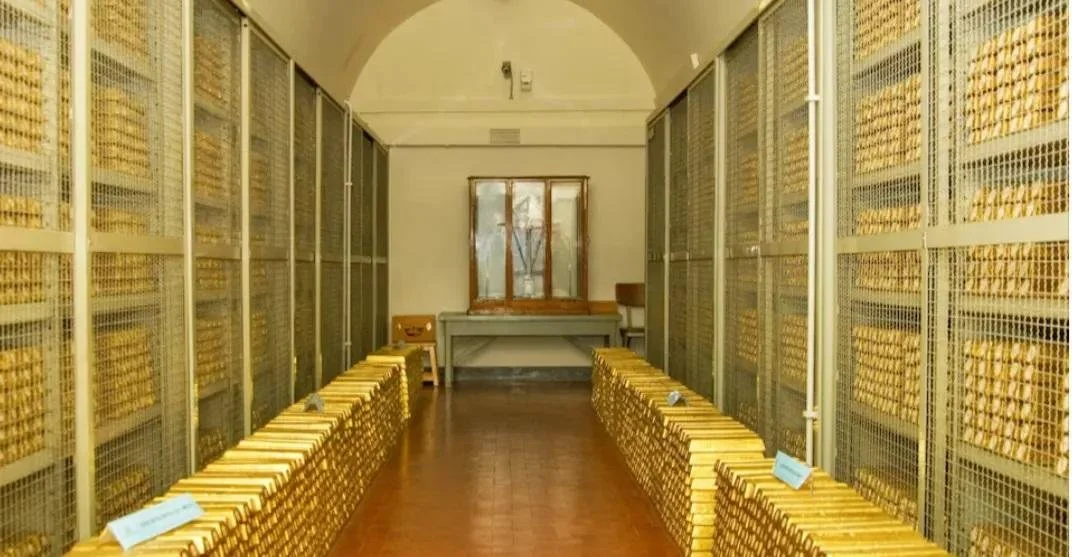
He explained that Iraq’s gold reserves amounted to 170.9 tons, equivalent to 22.1% of its total other hard currency reserves, ranking fourth at the Arab level after Saudi Arabia, Lebanon and Algeria.
It is worth noting that the World Gold Council, which is based in the United Kingdom, includes the world’s largest gold mining companies and has extensive experience in analyzing market trends and factors affecting the price of the precious metal. https://economy-news.net/content.php?id=64277
Central Bank: The Dollar Is Stable At 1320 Dinars, And The Rise In The Parallel Market Is Due To Demand Outside
Banks. Economy News – Baghdad Haider Ghazi, the media officer of the Central Bank of Iraq, confirmed that there has been no change in the exchange rate of the dollar against the dinar, and it remains fixed at 1320 dinars per dollar, explaining that what is being circulated as an exchange rate is only the demand of the unofficial market for dollars outside the system of banks licensed to work in foreign transfers through correspondent banks.
Ghazi, in a statement according to the official newspaper, attributed the main reason for the rise in the parallel market to the customs duty due to demand outside the banking system, noting that the application of the prior customs duty for transfer purposes may have put significant pressure on those seeking cash dollars, and was behind the rise in demand for the dollar against the dinar in the local markets.
He explained that traders are required to bring the customs declaration (customs statement) from the ASYCUDA system before the bank transfer is made to them, adding that on many occasions the Central Bank of Iraq stated that the ways to obtain dollars are through:
First, external transfers through banks in a systematic and documented manner with all parties, and second, through the traveler's dollar after depositing an amount in Iraqi dinars with companies of categories A and B, and it is received through outlets inside Iraqi airports, as the bank set the traveler's share per month at $3,000. https://economy-news.net/content.php?id=64273
Gold Prices In Baghdad Have Decreased.
Economy News – Baghdad Gold prices, both foreign and Iraqi, fell on Wednesday in local markets in the capital, Baghdad. Gold prices in the wholesale markets of Al-Nahr Street in Baghdad this morning recorded a selling price of 914,000 dinars per mithqal of 21-karat gold from the Gulf, Turkey, and Europe, while the buying price was 910,000 dinars, after the prices were at 924,000 dinars yesterday, Tuesday.
The selling price of one mithqal of 21-karat Iraqi gold reached 884,000 dinars, while the buying price reached 880,000 dinars. He pointed out that gold prices in jewelry stores varied, as the selling price of a mithqal of 21-karat Gulf gold ranged between 915,000 and 925,000 dinars, while the selling price of a mithqal of Iraqi gold ranged between 885,000 and 895,000 dinars. https://economy-news.net/content.php?id=64275
Basra Crude Oil Prices Decline
Time: 2026/01/07 10:04:49 Reading: 45 times {Economic: Al-Furat News} Basra Heavy and Basra Medium crude oil prices fell by more than 2% on Wednesday, as oil prices declined in global markets.
Basra Heavy crude prices fell by $1.38, or 2.35%, to $57.27, and Basra Medium crude prices fell by $1.38, or 2.26%, to $59.82.
Oil prices fell globally after US President Donald Trump said Venezuela would return between 30 and 50 million barrels of sanctioned oil to the United States, increasing concerns about a supply glut in the global market.
Oil products explain the reason for the disruption to gas transport.
Time: 2026/01/07 13:14:37 Reading: 180 times {Economic: Al-Furat News} The Undersecretary of the Ministry of Oil for Gas Affairs, Izzat Saber Ismail, explained that there was a problem in the gas transportation process, as a result of a technical malfunction that affected the pipeline from Basra to Baghdad, while praising the high level of coordination between the two companies and the speed with which solutions were found to the emergency problems.
The media office of the Oil Products Distribution Company stated in a statement received by Al-Furat News that “the company’s Director General, Hussein Talib Aboud, and the senior staff received the Undersecretary of the Ministry of Oil for Gas Affairs, Izzat Saber Ismail, accompanied by the Director General of the Gas Filling and Services Company, Anmar Ali Hussein, where the meeting witnessed a discussion of the reality of cooking gas and the problems that accompanied it in the supply during the past two days.”
The statement added that "the Undersecretary chaired, on the sidelines of the meeting, a joint meeting of senior owners in the oil products distribution and gas filling and services companies, stressing that gas production exceeds the level of consumption, as the concerned parties produce more than (9) thousand tons per day, while the daily consumption rate is (7) thousand tons."
The agent explained that "the problem in transporting the gas is due to a technical malfunction in the pipeline transporting from Basra to Baghdad, praising the high level of coordination between the two companies and the speed with which they addressed the emergency problems." LINK https://alforatnews.iq/news/
In A New Clarification, The Ministry Of Oil Identifies The Reasons For The Cooking Gas Shortage And Reassures Citizens.
Time: 2026/01/07 11:52:4 {Local: Al-Furat News} The Ministry of Oil clarified today, Wednesday, the reasons for the recent shortage of cooking gas, while indicating that a plan has been put in place to expand the pipelines and increase reserves.
The Undersecretary of the Ministry of Oil for Gas Affairs, Izzat Saber, said in a press statement that "the recent shortage of cooking gas is due to a leak in one of the gas pipelines heading to the capital, Baghdad," stressing that "technical and engineering teams are currently working to repair it in order to bring it back into service."
Saber added that "the ministry resorted to using tankers to transport gas production as an alternative measure to ensure the continuity of supplies," noting that "some tried to exploit this emergency situation to raise prices for citizens."
He added that "100 tankers transport gas daily to factories and direct sales outlets for citizens to meet the need," revealing that "there is a plan to further expand the pipeline in order to increase the strategic gas reserves in equipped factories and avoid any shortages in the future."
The Ministry of Oil announced yesterday, Tuesday, that what is being circulated regarding the existence of a cooking gas crisis is inaccurate, indicating that the crisis is fabricated, while announcing the dispatch of additional shipments to processing stations to meet the demand.
The ministry said, "There is no real crisis in cooking gas cylinders, and what is happening now is deliberate disruption by some transporters," stressing that "the ministry will take deterrent measures against those responsible for this."
She added that "cooking gas is available at all processing stations in large quantities," noting that the ministry will send additional shipments of gas to stations and any area experiencing an increase in demand LINK
The UAE Will Have The Highest Cost Of Living In The Arab World, While Iraq Will Have The Lowest, In 2026.
Economy News - Follow-up The 2026 cost of living index for Arab countries showed that Iraq was among the countries with a low cost of living, according to data issued by Numbeo, a website specializing in comparing price levels between countries.
The United Arab Emirates topped the list of countries with the highest cost of living in the Arab world, after recording 55.2 points, followed by Yemen with an index of 53.1 points, then Qatar with 50.4 points, Palestine with 48.1 points, and Bahrain with 47.6 points, amid high price levels compared to the rest of the countries in the region.
The following countries came in the next positions with an index of 43.9 points, Oman with 43.6 points, Kuwait with 42.5 points, Lebanon with 41.7 points, then Jordan with 39.4 points, while Morocco recorded 31.4 points, and Tunisia with 29.1 points.
At the bottom of the list, Iraq ranked among the Arab countries with the lowest cost of living, scoring 28.4 points, ahead of Algeria, which scored 28.0 points, Syria, 25.0 points, and Egypt, 21.6 points, while Libya came at the bottom of the list with an index of 18.3 points.
It should be emphasized that the index measures price levels only in comparison to New York City, and does not reflect income levels or quality of life. https://economy-news.net/content.php?id=64231
Mr. Al-Hakim Outlines 11 Paths To Ensure The Iraqi Army's Performance In Protecting The Homeland And The Democratic System.
Time: 2026/01/07 13:52:14 Reading: 45 times {Political: Al-Furat News} The head of the National State Forces Alliance, Mr. Ammar Al-Hakim, outlined 11 paths today, Wednesday, to ensure the performance of the Iraqi army in protecting the homeland and the democratic system.
In a speech on the occasion of the 105th anniversary of the founding of the Iraqi Army, Mr. Al-Hakim said: “The Iraqi Army, with its long history, is not just an armed formation, but rather the memory of a state and the experience of a nation; a journey that went through stages of establishment and building, and a journey that was exposed to the upheavals of politics, wars and challenges, but it remained in its essence linked to the soil of Iraq and the identity of the Iraqis.”
He added: “Our army, in the battles against terrorism, has set an example of patience, cohesion, and capacity building, moving from the stage of challenge to the stage of initiative, until the victories that we are all proud of were achieved, and they would not have been achieved without the blood of the martyrs, the sacrifices of the wounded, the vigilance of the fighters, and the support and assistance of their families.”
He continued: “One of the most important things that distinguishes the military institution is that it pays a heavy price and makes great sacrifices so that we can live a normal life. Therefore, talking about the army should not remain in the realm of slogans, but should turn into a moral, political and legislative commitment to the rights of the fighters and their families.”
He added that the main paths to strengthening the army's position and ensuring its constitutional role in protecting the homeland, preserving the democratic system, and maintaining sovereignty are:
Establishing a national constitutional military doctrine.
Building a sovereign armament decision through diversifying sources of power.
Upgrading the air defense and airspace protection system.
Investing in quality training and continuous development.
Strengthening command, control, and communications.
Developing cyber capabilities and electronic warfare.
Combating corruption and administrative mismanagement within the military establishment.
Supporting military manufacturing, local maintenance, and building a national supply chain.
Deepening the integration between the army and the rest of the security system.
Updating the military intelligence and early warning system.
Caring for combatants, their families, the wounded, and disabled veterans. LINK
MilitiaMan and Crew: IQD News Update-"REER Adjustment: Global Integration 2026
MilitiaMan and Crew: IQD News Update-"REER Adjustment: Global Integration 2026
1-6-2026
The Crew: Samson, PompeyPeter, Petra, Daytrader, Sunkissed, GIGI and Militia Man
Follow MM on X == https://x.com/Slashn
Be sure to listen to full video for all the news……..
MilitiaMan and Crew: IQD News Update-"REER Adjustment: Global Integration 2026
1-6-2026
The Crew: Samson, PompeyPeter, Petra, Daytrader, Sunkissed, GIGI and Militia Man
Follow MM on X == https://x.com/Slashn
Be sure to listen to full video for all the news……..
FRANK26…1-6-26…..LUCY…YOU GOT SOME EXPLAINING TO DO !
KTFA
Tuesday Night Video
FRANK26…1-6-26…..LUCY…YOU GOT SOME EXPLAINING TO DO !
This video is in Frank’s and his team’s opinion only
Frank’s team is Walkingstick, Eddie in Iraq and guests
Playback Number: 605-313-5163 PIN: 156996#
KTFA
Tuesday Night Video
FRANK26…1-6-26…..LUCY…YOU GOT SOME EXPLAINING TO DO !
This video is in Frank’s and his team’s opinion only
Frank’s team is Walkingstick, Eddie in Iraq and guests
Playback Number: 605-313-5163 PIN: 156996#
What Frank’s suit color’s mean…. FRANKS SUIT COLORS FOR CC'S..... WHITE = NEW INFO…. SILVER = INTEL FROZEN…. RED= HIGH ALERT… PURPLE=GUEST WITH US…. BLUE = AIR FORCE…. BLACK = GROUND/FF’S…. GREEN= MR OR FAB 4 ... GOLD = CHANGE… ORANGE=IMPLEMENTATION
Seeds Of Wisdom RV And Economics Updates Tuesday Evening 1-6-26
Good Evening Dinar Recaps,
Hezbollah Denies Presence in Venezuela Amid U.S. Claims After Maduro Capture
Group rejects U.S. assertions as geopolitical tensions escalate in the Western Hemisphere
Good Evening Dinar Recaps,
Hezbollah Denies Presence in Venezuela Amid U.S. Claims After Maduro Capture
Group rejects U.S. assertions as geopolitical tensions escalate in the Western Hemisphere
Overview
Hezbollah publicly denied any operational presence in Venezuela, responding directly to U.S. claims that the group was active there following the U.S. seizure of Venezuelan President Nicolás Maduro.
U.S. officials, particularly Secretary of State Marco Rubio, have argued that Iran and Hezbollah pose security concerns in the region, saying the United States will not allow such influence to persist.
The Lebanese movement characterized U.S. policy as an imposition of force, stressing sovereignty and freedoms.
This exchange unfolds amid broader geopolitical fallout from the U.S. operation in Venezuela, involving international law debates and global reactions.
Key Developments
Hezbollah spokesman denied any group presence in Venezuela or elsewhere in the Western Hemisphere, framing U.S. assertions as false and rooted in interventionist policy.
Marco Rubio stated the U.S. would prevent Venezuela from becoming a base for Hezbollah, Iran, or other adversarial forces, framing part of the U.S. mission in Venezuela as pushing back against foreign influence.
Declaring that Venezuela must cut ties with Iran and Hezbollah, U.S. officials emphasized stopping drug trafficking and adversarial influence, placing diplomatic pressure on Caracas.
Hezbollah’s denial comes amid longstanding allegations and historical claims about its alleged presence in Latin America, though evidence has been disputed and politically contested by multiple parties.
International reactions to the U.S. operation include strong condemnations from various states and movements, including Iran, Russia, and allied organizations expressing solidarity with Venezuela.
Why It Matters
This exchange highlights how geopolitical narratives and proxy accusations shape international crises, especially in contested regions like Latin America. The U.S. framing of Hezbollah and Iranian influence as justification for broader intervention risks destabilizing diplomatic norms and intensifying regional tensions. The push and pull between denial and accusation will influence how allies and adversaries alike interpret sovereignty, intervention, and security priorities in the Western Hemisphere.
Why It Matters to Foreign Currency Holders
Geopolitical risk premiums rise when major powers accuse non-state actors of regional influence, impacting currency valuations in affected markets.
Uncertainty about Venezuela’s future political alignment affects investor confidence in regional currencies and risk assets.
Allegations involving Hezbollah and Iran highlight how geopolitical risk can ripple into trade, sanctions, and capital flows, influencing foreign exchange markets.
Central banks and sovereign reserve managers price in political conflict, potentially shifting allocations toward safer assets and away from volatile emerging market exposures.
Narrative disputes over security and intervention can contribute to volatility spikes in FX pairs tied to commodity-exporting countries, including Venezuela’s links to energy markets.
Implications for the Global Reset
Pillar: Geopolitical Narrative Risk – The framing of foreign influence abroad can become a catalyst for policy shifts that reshape currency and asset allocation strategies.
Pillar: FX Volatility from Interventionist Politics – Escalating rhetoric and cross-regional disputes increase volatility in emerging markets, prompting reserve diversification.
This is not just politics — it’s global finance restructuring before our eyes.
Seeds of Wisdom Team
Newshounds News™ Exclusive
Sources
Newsweek – “Hezbollah Responds to Trump Admin Saying Group Active in Venezuela”
Naharnet – “Rubio vows no Hezbollah/Iran activities in Venezuela after Maduro capture”
~~~~~~~~~~
Commodity & Energy Shockwaves: Metals, Oil, and Global Trade React to Geopolitics
Markets respond to Venezuela crisis and supply concerns, highlighting systemic risk to global finance
Overview
Copper hit record highs amid supply disruptions and rising global demand, signaling stress in industrial metals markets.
Gold and silver surged as investors sought safe havens following geopolitical developments, including the U.S. seizure of Venezuelan President Nicolás Maduro.
Oil and energy stocks rallied, with markets pricing in potential production shifts and strategic realignments in Venezuela.
These moves highlight how commodity markets are now tightly interlinked with geopolitical events, impacting global trade, energy flows, and currency stability.
Key Developments
Copper Breaks Record Highs
Global copper prices surpassed $13,000 per ton on the London Metal Exchange. Factors driving this include strong industrial demand, supply constraints, and tariff risks affecting trade flows. U.S. copper stockpiles have increased as investors hedge against potential disruptions.Gold & Silver Surge as Safe Havens
Precious metals rallied sharply amid geopolitical uncertainty, with gold climbing and silver gaining even more in percentage terms. Investors are using these assets to hedge against systemic and geopolitical risks.Energy Markets React
Crude prices and energy stocks rose following U.S. operations in Venezuela. Market sentiment reflects potential changes in oil production access, geopolitical risk premiums, and the possibility of U.S. firms influencing Venezuelan energy markets.
Why It Matters
Commodity and energy market reactions reveal the interdependence between geopolitical events and financial markets. Price surges in copper, gold, silver, and oil indicate stress on industrial and financial systems, foreshadowing potential currency fluctuations and trade disruptions.
Why It Matters to Foreign Currency Holders
Currency Volatility: Rising commodity prices and geopolitical risks feed into volatility in commodity-linked currencies, such as the Brazilian real, Canadian dollar, and Venezuelan bolívar.
Inflation & Monetary Policy: Sharp commodity moves can trigger inflation expectations, influencing central bank decisions and FX risk premiums.
Reserve Asset Strategy: Safe-haven metals rally signals a potential shift in how central banks and sovereign investors allocate reserves, especially in emerging market exposures.
Trade Flow Uncertainty: Supply constraints and geopolitical risks in critical commodities like copper and oil affect trade balances and capital flows, influencing currency valuations and financial stability globally.
Implications for the Global Reset
Pillar: Strategic Resource Repricing – Surging metals and energy prices signal a potential recalibration of asset and reserve valuations.
Pillar: Geopolitical Risk Transmission – Energy and metals markets internalize security events quickly, reshaping trade, currency, and financial system expectations.
This is not just markets — it’s global finance restructuring before our eyes.
Seeds of Wisdom Team
Newshounds News™ Exclusive
Sources
~~~~~~~~~~
Seeds of Wisdom Team RV Currency Facts Youtube and Rumble
Newshound's News Telegram Room Link
RV Facts with Proof Links Link
RV Updates Proof links - Facts Link
Follow the Gold/Silver Rate COMEX
Follow Fast Facts
Seeds of Wisdom Team™ Website
Thank you Dinar Recaps
Iraq Economic News and Points To Ponder Tuesday Evening 1-6-26
An Expert Links The Rise Of The Dollar To Increased Demand From Traders And Customs Automation.
The iraqi trading corporation decides to open its branches to customers during the holiday.
Baghdad – Nada Shawkat An economic expert linked the rise in the dollar exchange rate against the local dinar to increased demand from traders and the implementation of the customs automation system, which has directly altered import and clearance procedures.
Expert Nasser al-Kinani stated yesterday that "the current rise in the dollar against the dinar is a natural consequence of a confluence of factors, primarily increased demand from traders, coinciding with the implementation of the customs automation system, which has imposed a new reality on import and clearance operations."
An Expert Links The Rise Of The Dollar To Increased Demand From Traders And Customs Automation.
The iraqi trading corporation decides to open its branches to customers during the holiday.
Baghdad – Nada Shawkat An economic expert linked the rise in the dollar exchange rate against the local dinar to increased demand from traders and the implementation of the customs automation system, which has directly altered import and clearance procedures.
Expert Nasser al-Kinani stated yesterday that "the current rise in the dollar against the dinar is a natural consequence of a confluence of factors, primarily increased demand from traders, coinciding with the implementation of the customs automation system, which has imposed a new reality on import and clearance operations."
He added that "Iraq employs a traditional currency peg system, where the Central Bank sets the official rate at 1,320 dinars per dollar, supported by substantial foreign reserves and relatively low annual inflation of between 2 and 3 percent.
However, the parallel market sees fluctuating prices on paper, reflecting a gap between the economic reality and the reform measures." The dollar exchange rate has risen in both the Baghdad and Erbil stock exchanges.
Currency exchange operators reported yesterday that the dollar exchange rate had risen in Baghdad's Al-Kifah and Al-Harithiya markets, reaching 147,700 Iraqi dinars per 100 dollars, compared to 146,500 dinars the day before.
They also noted that selling prices at local exchange bureaus in Baghdad's markets had increased, reaching 148,250 dinars per 100 dollars, while the buying price was 147,250 dinars.
They confirmed that selling prices had also risen in Erbil, reaching 146,600 dinars per 100 dollars, with a buying price of 146,500 dinars. Meanwhile, the Trade Bank of Iraq announced that all its branches would remain open during the official holidays.
The bank stated in a press release received by Al-Zaman yesterday that, “Based on directives from the Central Bank of Iraq, all bank branches will be open to customers during official holidays from 10:00 AM to 1:00 PM. During this period, services will be limited to receiving and processing foreign remittances and pre-customs declarations only.
No other banking transactions will be conducted.” The statement continued, “The bank will remain open during official holidays until the end of this month.”
Separately, the Ministry of Industry revealed the size of Iraq’s reserves of important minerals, particularly sulfur, phosphate, and limestone.Ministry spokesperson Duha al-Jubouri stated yesterday that Iraq holds the world's largest reserves of free sedimentary sulfur, estimated at approximately 600 million tons. She added that these reserves are primarily located in Nineveh Governorate, where the sulfur is utilized in the production of fertilizers and various chemical industries.
Al-Jubouri also noted that Iraq ranks second globally in phosphate rock reserves, estimated at around 10 billion tons, located in Anbar Governorate. She emphasized that phosphate rock is the primary raw material in the production of phosphate fertilizers.
Furthermore, she explained that Iraq is rich in high-purity silica sand, with reserves exceeding 350 million tons, found in Anbar and Najaf Governorates. She stressed that this sand is a fundamental material in the manufacture of glass, ceramics, and various refractory materials.
Regarding limestone, al-Jubouri stated that Iraq possesses abundant reserves of this essential material, used in cement production and other industries. She added that Iraq has over 8 billion tons of this vital resource, which is used in the production of various types of cement. It is used in the glass, ceramics, dyes, building stone and other industries), and she went on to say that “providing this raw material has enabled Iraq to be self-sufficient in cement for about 10 years, with production reaching 37 million tons last year .LINK
Gold And Dollar Prices Rise In Baghdad And Erbil
Economy News – Baghdad On Tuesday, gold prices in local markets in Baghdad and Erbil witnessed a significant increase, coinciding with the rise in the dollar exchange rate against the Iraqi dinar.
The wholesale markets in Al-Nahr Street in Baghdad recorded this morning a selling price of 924,000 dinars for one mithqal of 21-karat gold from Gulf, Turkish and European origins, while the buying price was 920,000 dinars, compared to 908,000 dinars for selling the mithqal yesterday.
As for Iraqi gold, 21 karat, it recorded a selling price of 894,000 dinars and a buying price of 890,000 dinars.
In goldsmith shops, the selling price of a mithqal of foreign 21-karat gold ranged between 925,000 and 935,000 dinars, while the selling price of a mithqal of Iraqi gold ranged between 895,000 and 905,000 dinars.
In Erbil, gold prices also rose, with the selling price of 22-karat gold reaching about 981,000 dinars, 21-karat gold about 935,000 dinars, while the selling price of 18-karat gold reached 801,000 dinars.
In the same context, the exchange rate of the dollar rose in the markets of Baghdad and Erbil, where it reached 147,700 dinars per 100 dollars in the Al-Kifah and Al-Harithiya exchanges, after it was at 146,500 dinars yesterday. https://economy-news.net/content.php?id=64225
Israel: Security Talks With Syria With US Support
A statement from the US State Department on Tuesday said that the new Syrian government and Israel will form a joint group under US supervision to share intelligence and seek to contain military escalation on the ground.
The statement, issued after talks in Paris, said that Syria and Israel committed to "making arrangements that guarantee lasting security and stability for both countries."
Israel confirmed on Tuesday that it held security talks in Paris with Syria under the auspices of the United States, with the aim of promoting regional stability and economic cooperation.
A statement from Prime Minister Benjamin Netanyahu's office said that "the dialogue took place within the framework of President (Donald) Trump's vision for advancing peace in the Middle East," explaining that Israel emphasized during the talks "the importance of ensuring the security of its citizens and avoiding threats along its borders.
" The statement added that "Israel reiterated its commitment to strengthening regional stability and security, in addition to the need to make progress in economic cooperation for the benefit of both countries."
Meanwhile, at least seven people, including six civilians, were killed on Tuesday in the northern Syrian city of Aleppo as a result of ongoing clashes between government forces and the Syrian Democratic Forces (SDF), who traded accusations regarding responsibility for the outbreak of violence, amid stalled negotiations between the two sides for months.
Meanwhile, hospitals and government offices were targeted by Kurdish militants.
Despite signing an agreement in March stipulating the integration of Kurdish self-administration institutions within the framework of the Syrian state, the two sides occasionally engage in bloody clashes, particularly in the city of Aleppo, which includes two predominantly Kurdish neighborhoods.
On Tuesday morning, the Syrian Democratic Forces accused "armed factions affiliated with the Ministry of Defense" of "targeting the Sheikh Maqsoud neighborhood" in Aleppo with a reconnaissance plane, resulting in "the martyrdom of a citizen from the neighborhood and the injury of two others."
Later, it reported that the death toll had risen to "three martyrs, including two women," as a result of "indiscriminate artillery and rocket shelling by Damascus government factions on the Sheikh Maqsoud and Ashrafieh neighborhoods."
In another statement, Kurdish forces accused factions within the Syrian army of shelling the city of Deir Hafer, located about 50 kilometers east of Aleppo, and the area surrounding the strategic Tishrin Dam northeast of Aleppo, using mortars and heavy weapons. The US-backed forces asserted their "legitimate right to respond to these attacks in defense of our people and to preserve the security and stability of our regions."
For its part, the authorities accused the Syrian Democratic Forces of “a new violation of the agreements signed with the government,” referring to the March agreement.
The Syrian Defense Ministry's media office, as reported by the official news agency SANA, stated that the Syrian Democratic Forces (SDF) targeted "several neighborhoods in Aleppo adjacent to those they control," resulting in "three martyrs and more than 12 injuries among civilians." It also accused the SDF of targeting "an army position in the vicinity of the Sheikh Maqsoud neighborhood, resulting in one martyr and five wounded."
She said that "the army targeted the sources of fire of the SDF and the sources from which its drones were launched."
The Ministry of Agriculture announced that two female employees at its scientific research center were among the dead.
The Syrian state news agency SANA reported that the Syrian Democratic Forces (SDF) "targeted a hospital in the Bustan al-Basha neighborhood with artillery shells," while the Aleppo governorate, via its Telegram channel, reported that a shell landed at the hospital's main gate.
This is not the first time the two sides have engaged in deadly clashes. Similar clashes erupted on December 22, hours after Turkish Foreign Minister Hakan Fidan visited Damascus, during which he urged Kurdish forces "not to become an obstacle to the unity and long-term stability of Syrian territory."
The Ministry of Health at the time counted the killing of four civilians as a result of the shelling by the Syrian Democratic Forces, which in turn reported the killing of a woman in the government shelling.
The renewed clashes on Tuesday came two days after a new round of negotiations held on Sunday in Damascus. According to the Kurds, the talks discussed the integration of their forces into the army, but failed to achieve "tangible results," according to state media. LINK
Has Washington Ushered In An Era Of Silent Wars?
Baghdad – Al-Zaman On the dawn of January 3, 2026, the world did not awaken to the dramatic news of the arrest of Venezuelan President Nicolás Maduro in his bedroom at the Miraflores Palace. Rather, the military in Moscow, strategic planners in Beijing, and politicians in Tehran awoke to a nightmare that threatened to forever alter the rules of international engagement.
Operation Southern Spear was not a special forces raid, nor a counter-narcotics campaign as official Pentagon statements claimed; it was a complex earthquake that killed two birds with one stone: technically undermining the prestige of the "Eastern weapon" and geopolitically reclaiming control of "energy keys."
In this in-depth reading, we reconstruct the scene from the charred remains of radars to the barrels of oil awaiting a new owner.
The New Doctrine
Perhaps the most dangerous lesson of the Caracas night was the radical shift in American military doctrine. If the 2003 invasion of Baghdad inaugurated the “Shock and Awe” doctrine based on overwhelming firepower, then Operation 2026 inaugurated the “Shock and Silence” doctrine.
The objective was no longer to destroy the enemy army, but to “extinguish” it. Washington did not bomb the Venezuelan army to annihilate it, but rather to sever its “brain” from its “body” in a complex surgical operation that began weeks before the zero hour.
The question now troubling the Kremlin is not “Where is Maduro?” but “Why did the S-300s fall silent?” Venezuela, once considered the most heavily fortified stronghold in Latin America thanks to its sophisticated Russian air defense network (S-300VM Antey-2500), fell without firing a single missile. This collapse was not merely an act of betrayal, but a crushing technological defeat that exposed the tactics of sixth-generation warfare.
Burn-through jamming: The American EA-18G Growler electronic warfare aircraft did not employ traditional jamming, but rather used a technique called "energy flooding," emitting massive electromagnetic energy that completely saturated the Russian radar screens, turning them white. Venezuelan defenses were rendered completely blind and unable to lock onto the aircraft flying overhead.
Cyber overload: The attacks that struck the national electricity grid last December were not random. They were a “rehearsal” to cut power to early warning centers and isolate the command in the capital from missile batteries on the outskirts.
Decapitation Strike: The surgical strike against the command and control (C2) centers at La Carlota Air Base and the Ministry of Defense rendered the Venezuelan military—a centralized, hierarchical force—a lifeless entity. Field officers, isolated and without orders, chose silence over suicide.
If technology is the “tool,” then energy is the “drive.” No reasonable person could believe that Washington mobilized its fleets to arrest a drug trafficker. Venezuela is the reservoir that sits atop the world’s largest proven oil reserves (more than 300 billion barrels).
Timing is crucial here. With the rise of the “Eastern Alliance” and China and Russia’s efforts to decouple from the petrodollar, Venezuela has transformed from a “rogue state” into an “existential threat.”
Reports of Chinese acquisitions of energy infrastructure and the transformation of Caribbean ports into safe havens for Iranian tankers have made the “southern spear” an absolute necessity for US national security.
Washington has gone so far as to nationalize the “oil tap” and prevent it from flowing into the engines of the Eastern axis’s economic war machine, delivering a blow to the principle of “multipolarity.”
Bloody messages
The operation is a brutal revival of the “Monroe Doctrine” (the backyard is a red line), but it carried loaded messages for Caracas’s allies:
To Moscow: Your defense systems, the pride of Russian industry, have failed their first real test against hybrid warfare. This is a blow to the reputation of Russian weaponry that could have serious political and economic costs.
To Tehran: The long arm you extended across the Atlantic (drone factories and defense agreements) was severed in one night. The Caribbean is not the Strait of Hormuz.
After the fall
But did the battle end with Maduro's deportation to Florida? Here begins the most dangerous chapter. Washington succeeded brilliantly in "demolition," but history tells us that it often fails in "construction."
The Venezuelan state is now in a terrifying vacuum; the army is demoralized and lacks legitimacy, and the institutions are paralyzed. The void left by the regime will not be filled immediately by liberals returning from exile, but rather by the only organized and ideologically armed force: the colectivos.
We are facing a scenario in which Venezuela transforms from a “dictatorial state” (with relative security) into a “failed state” (ravaged by militias). If security collapses and Caracas becomes a battleground for street warfare, the “southern spear” could backfire on its launchers in the form of waves of mass displacement and uncontrollable regional chaos.
The operation of January 3, 2026 will be taught in military academies as a model of stunning tactical success.
It will be studied in policy institutes as a model of grand strategic gamble. Washington has reclaimed the key to its backyard.
It has proven its overwhelming technological superiority, but it may have unwittingly opened a Pandora's box in Latin America. In a world of interests, the victor is not the one who wins the dawn battle, but the one who survives the midday mud. LINK
Gold and Silver Swings Signals a Physical Market Takeover
Gold and Silver Swings Signals a Physical Market Takeover
Lynette Zang: 1-5-2026
Most people see gold and silver volatility as instability. In reality, these wild price swings signal that paper markets are losing control as physical demand takes over price discovery.
Watch to understand why this transition is happening and what it means for how you interpret gold and silver prices going forward.
Gold and Silver Swings Signals a Physical Market Takeover
Lynette Zang: 1-5-2026
Most people see gold and silver volatility as instability. In reality, these wild price swings signal that paper markets are losing control as physical demand takes over price discovery.
Watch to understand why this transition is happening and what it means for how you interpret gold and silver prices going forward.
Chapters:
00:00 Extreme Volatility in Gold and Silver
02:22 CME Margin Hikes, Profit Taking, and Paper Market Control
03:27 Why This Time Is Different: Physical Markets Taking Over
05:04 Paper Market Swings vs Physical Metal Reality
07:09 Silver’s Massive Trading Range & Why Volatility Doesn’t Matter
09:16 2008 Comparison: Spot Prices, Stocks, and Physical Gold
11:40 Higher Lows, Long-Term Trends, and Ignoring Wall Street Noise
12:31 If You Don’t Hold It, You Don’t Own It: Accumulation Strategy
13:34 Pre-1933 Territorial & Fractional Gold — Monetary vs Collectible Classification
14:33 Silver-to-Gold Ratio at 56:1 — Convert Silver to Gold Now or Wait?
15:23 Why Asian Markets Push Gold & Silver Prices Up While the U.S. Pushes Them Down
17:54 Does Tarnish (Toning) Matter on Silver Coins? Should You Clean Them?
18:02 What Is Glint and How Does It Work With Physical Gold?
18:22 What Is Arbitrage and How Does It Apply to Markets?
19:35 Call for Viewers Who Have Lived Through Currency Resets & Hyperinflation
The ‘Hidden Hand’ Buying Gold & Silver: Why Governments Are Using Banks to Accumulate | Josh Phair
The ‘Hidden Hand’ Buying Gold & Silver: Why Governments Are Using Banks to Accumulate | Josh Phair
Kitco News: 1-6-2026
Josh Phair, CEO of Scottsdale Mint, joins Jeremy Szafron on Kitco News to warn that the world has entered a "Metals War" where nations are scrambling to secure resources for future conflicts.
Phair argues that a "Hidden Hand"—governments employing banks to conduct mercantile banking—is quietly accumulating gold and silver, fundamentally decoupling the physical market from the Fed’s interest rate policies.
The ‘Hidden Hand’ Buying Gold & Silver: Why Governments Are Using Banks to Accumulate | Josh Phair
Kitco News: 1-6-2026
Josh Phair, CEO of Scottsdale Mint, joins Jeremy Szafron on Kitco News to warn that the world has entered a "Metals War" where nations are scrambling to secure resources for future conflicts.
Phair argues that a "Hidden Hand"—governments employing banks to conduct mercantile banking—is quietly accumulating gold and silver, fundamentally decoupling the physical market from the Fed’s interest rate policies.
He details why US banks flipped from net short to net long after Thanksgiving, the "desperate" arbitrage that saw jets flying silver across the Atlantic, and the reality of China’s new export licensing system.
Phair also breaks down his "Axis vs. Allies" thesis for resource control and updates the "Phair-Sinclair Ratio," predicting a path to $35,000 gold as the West faces a critical shortage of strategic minerals.
00:00 - The Fed is Broken & Silver Explodes
01:16 - The "Metals War" Has Begun
02:34 - The "Hidden Hand": Governments Buying Secretly
04:01 - US Banks Flip Net Long (Insider Intel)
07:17 - Axis vs. Allies: The Battle for Critical Resources
14:32 - China Locks Exports: The Supply Chain Break
20:02 - Strategic Metals: The New Oil of 2026
22:45 - The US-China Decoupling Reality
24:23 - Fact Check: Are Wholesale Lines Freezing?
29:05 - Physical Shortages & Retail Panic
33:24 - AI Slop & Fake Market Signals
37:02 - $35,000 Gold Forecast (Phair-Sinclair Ratio)
Seeds of Wisdom RV and Economics Updates Tuesday Afternoon 1-6-26
Good Afternoon Dinar Recaps,
Markets Defy Geopolitics as Central Banks, AI, and Crypto Reshape 2026
Global assets surge despite rising geopolitical, monetary, and fiscal fault lines
Good Afternoon Dinar Recaps,
Markets Defy Geopolitics as Central Banks, AI, and Crypto Reshape 2026
Global assets surge despite rising geopolitical, monetary, and fiscal fault lines
Overview
Global markets pushed to new highs, largely brushing off geopolitical shocks.
Central banks signaled tightening paths, led by Japan’s historic policy pivot.
AI-driven inflation risks emerged as a major 2026 concern among investors.
Crypto, eurozone expansion, and shifting trade diplomacy highlighted monetary fragmentation.
Key Developments
Asian equities surged to record levels, following Wall Street highs, despite oil volatility tied to Venezuela’s leadership seizure.
The Bank of Japan reaffirmed continued interest rate hikes, marking a decisive break from decades of ultra-loose policy.
Japan’s government declared the end of its deflationary era, even as fiscal stimulus continues.
Investors warned that AI investment and global stimulus could reignite inflation, challenging current easing assumptions.
Bulgaria officially adopted the euro, retiring its national currency and joining ECB governance.
Trump Media announced plans to issue crypto tokens to shareholders, accelerating political entanglement with digital assets.
Ireland pursued deeper trade engagement with China, diverging from broader EU trade posture.
Markets displayed notable complacency, prioritizing liquidity and momentum over geopolitical risk.
Why It Matters
This snapshot of global finance reveals a disconnect between asset prices and underlying risk. While markets celebrate liquidity and technological optimism, monetary tightening, geopolitical escalation, and fiscal expansion are quietly colliding. The balance between policy control and market confidence is becoming increasingly fragile.
Why It Matters to Foreign Currency Holders
Diverging central bank paths increase currency volatility, complicating long-term valuation assumptions.
AI-driven inflation pressures threaten fiat purchasing power, especially where stimulus remains aggressive.
Eurozone expansion adds structural strain to ECB policy coherence, impacting euro stability.
Crypto integration into corporate and political spheres signals parallel value systems gaining legitimacy.
Geopolitical complacency masks latent currency risk, reinforcing the need for diversification across assets and jurisdictions.
Implications for the Global Reset
Pillar: Monetary Fragmentation
Divergent policy paths and new digital instruments are eroding synchronized global monetary control.Pillar: Liquidity vs. Reality Reckoning
Markets are betting liquidity can overpower geopolitics — a wager that will define 2026.
This is not just politics — it’s global finance restructuring before our eyes.
Seeds of Wisdom Team
Newshounds News™ Exclusive
Sources
Modern Diplomacy – “Financial Brief: A Weekly Roundup on the Geopolitics of Money | Jan 06”
Reuters – “Trump’s Venezuela gambit tests investor appetite for geopolitical risk”
~~~~~~~~~~
U.S. Seizure of Maduro Challenges China’s Non-Intervention Diplomacy
Beijing condemns U.S. action as “world judge” moment exposes limits of China’s global security vision
Overview
China sharply criticized the U.S. capture of Venezuelan President Nicolas Maduro, accusing Washington of violating international law.
Beijing backed a UN Security Council debate, supported by Russia and requested by Colombia.
The incident pressures China’s long-standing non-intervention doctrine, particularly among developing nations.
Venezuela’s role as China’s closest Latin American ally heightens the strategic stakes.
Key Developments
China condemned the U.S. operation as dangerous and destabilizing, warning it sets a precedent for unilateral intervention.
Beijing framed the issue at the United Nations as a sovereignty violation, positioning itself as a defender of international norms.
Images of Maduro’s arrest and transfer to New York circulated globally, amplifying diplomatic fallout.
China limited its response to rhetoric and multilateral pressure, offering no material or security backing.
Venezuela’s capture represents a symbolic setback for China’s influence in Latin America, where it has made steady diplomatic gains.
Analysts note China lacks practical tools to counter direct U.S. military actions, despite deep economic ties.
Why It Matters
The episode tests China’s credibility as an alternative global power offering diplomacy over force. While Beijing promotes a rules-based, non-interventionist security vision, its inability to shield a close ally from U.S. action exposes the limits of that model. This moment may reshape how developing nations assess China’s capacity to balance American power.
Why It Matters to Foreign Currency Holders
Security guarantees increasingly influence currency trust, especially for nations aligned with major powers.
China’s limited response highlights the gap between economic influence and hard-power backing, affecting confidence in yuan-centric trade systems.
Events like this accelerate hedging behavior among emerging markets, diversifying away from reliance on any single geopolitical sponsor.
Sovereign risk tied to intervention reshapes reserve allocation decisions, strengthening demand for neutral, asset-anchored value stores.
The incident reinforces global fragmentation, increasing volatility across fiat currencies tied to geopolitical leverage.
Implications for the Global Reset
Pillar: Power Asymmetry Exposure
Economic influence alone is proving insufficient without credible security backing.Pillar: Currency Hedging Acceleration
Nations are reassessing reserve strategies amid rising intervention risk.
This is not just politics — it’s global finance restructuring before our eyes.
Seeds of Wisdom Team
Newshounds News™ Exclusive
Sources
Modern Diplomacy – “U.S. Seizure of Maduro Challenges China’s Non-Intervention Diplomacy”
Reuters – “China says it cannot accept countries acting as ‘world judge’ after U.S. captures Maduro”
~~~~~~~~~~
China Is Building Out Another Artificial Island
Satellite imagery reveals fresh land reclamation at Antelope Reef in the contested South China Sea
Overview
New satellite imagery shows China expanding an artificial outpost at Antelope Reef in the Paracel Islands, a highly disputed area of the South China Sea.
The activity suggests a renewed phase of land reclamation, part of Beijing’s long‑running strategy to cement control over vital maritime corridors.
Antelope Reef remains contested by Vietnam and Taiwan, intensifying regional tensions over sovereignty and maritime rights.
Key Developments
European Space Agency satellite data shows sand dredging at Antelope Reef began after mid‑October, expanding the reef’s perimeter and infrastructure footprint.
Antelope Reef lies about 250 miles southeast of China’s Sanya naval base on Hainan Island and roughly 250 miles east of Vietnam’s Hue coast — a strategic position for influence over sea lanes.
China has engaged in extensive land reclamation across the Paracel and Spratly Islands since 2013, building multiple bases and militarized outposts.
Satellite analysis notes dredging now concentrated along multiple sites around Antelope’s lagoon, hinting at further expansion or infrastructure deployment.
Vietnam, which also claims the feature, has increased its own reclamation efforts elsewhere in the Spratlys, prompting diplomatic pushback from Beijing.
Why It Matters
China’s expanded land reclamation at Antelope Reef underscores Beijing’s determination to solidify territorial control over the South China Sea — a strategic waterway through which about one‑third of global maritime trade passes. Disputes over jurisdiction and sovereignty, particularly with Vietnam and Taiwan, make any new construction a flashpoint for regional friction.
Why It Matters to Foreign Currency Holders
Heightened geopolitical tensions in the South China Sea raise risk premiums on currencies tied to export‑oriented and commodity‑linked economies.
Trade routes through the South China Sea are crucial to global supply chains, so instability increases volatility in exchange rates and trade finance.
China’s assertive infrastructure expansion reflects broader strategic priorities that influence investor confidence, particularly in Asian currencies.
Dominance over maritime corridors can reshape regional investment flows, affecting currency stability and capital allocation.
Foreign exchange markets price in sovereign and territorial risk, so prolonged disputes can shift central bank policy considerations and reserve management strategies.
Implications for the Global Reset
Pillar: Strategic Trade Chokepoint Control
Securing major sea lanes enhances geopolitical leverage and can affect currency flows tied to trade balances.Pillar: Risk and Reserve Reassessment
Regional volatility will prompt investors and central banks to diversify exposures and rethink reserve allocations.
This is not just politics — it’s global finance restructuring before our eyes.
Seeds of Wisdom Team
Newshounds News™ Exclusive
Sources
~~~~~~~~~~
India Assumes BRICS Chairmanship as the Bloc Eyes Multipolar Cooperation
New Delhi leads BRICS in 2026, balancing expansion, diplomacy, and global finance initiatives
Overview
India officially assumed the BRICS chairmanship on January 1, 2026, marking the first time it leads the bloc since expansion to 10 members.
The 2026 chairmanship priorities focus on technology, sustainability, and intra-BRICS growth, signaling a strategic push toward multipolar economic cooperation.
India calibrated its stance on Venezuela, expressing deep concern and calling for dialogue, reflecting careful diplomacy amid U.S. and Latin American developments.
BRICS continues to attract global interest, with discussions on BRICS+ expansion and alternative currency mechanisms ongoing.
Key Developments
India sets agenda for 2026 BRICS leadership, emphasizing innovation, economic integration, and sustainable development initiatives.
Venezuela crisis prompts India to advocate dialogue, balancing non-alignment with global economic engagement.
Expansion of BRICS+ remains on the horizon, with multiple countries showing interest in joining the bloc.
Preparations for enhanced intra-BRICS trade settlements and currency cooperation continue, though no unified currency system has yet been implemented.
The bloc’s coordination underscores a broader multipolar vision, aiming to reduce reliance on single-reserve currencies and encourage cooperative economic growth.
Why It Matters
India’s chairmanship represents a strategic inflection point for BRICS, as the bloc navigates global leadership, expansion, and multipolar economic coordination. India’s approach signals that BRICS intends to assert its relevance in global finance and development, while carefully managing diplomatic relations with major powers, including the United States.
Why It Matters to Foreign Currency Holders
BRICS+ expansion and trade settlement initiatives could alter currency flows in global markets.
Alternative settlement mechanisms may reduce dependence on the U.S. dollar, introducing new risk and hedging considerations.
India’s leadership could influence intra-BRICS credit and investment patterns, affecting FX exposure for emerging-market investors.
Global confidence in multipolar financial systems may create volatility in currencies tied to trade with BRICS members.
Portfolio diversification strategies may need adjustment, as the bloc strengthens regional economic integration and increases cross-border capital flows.
Implications for the Global Reset
Pillar: Multipolar Economic Influence
BRICS chairmanship under India accelerates initiatives that challenge single-currency dominance and promote multipolar financial coordination.Pillar: Strategic Risk Hedging
Investors may increasingly consider BRICS currency and trade exposure in sovereign risk assessments.
This is not just politics — it’s global finance restructuring before our eyes.
Seeds of Wisdom Team
Newshounds News™ Exclusive
Sources
~~~~~~~~~~
Seeds of Wisdom Team RV Currency Facts Youtube and Rumble
Newshound's News Telegram Room Link
RV Facts with Proof Links Link
RV Updates Proof links - Facts Link
Follow the Gold/Silver Rate COMEX
Follow Fast Facts
Seeds of Wisdom Team™ Website
Thank you Dinar Recaps
Millionaires In America: How Common Is It To Have A 7-Figure Net Worth?
Millionaires In America: How Common Is It To Have A 7-Figure Net Worth?
Emily Batdorf December 2, 2025 Yahoo Personal Finance
If you’ve dreamed of becoming a millionaire, you’re not alone. To many, hitting this financial milestone signals you’ve “made it.” With assets valued at seven figures, you can wave goodbye to many of the financial stressors that nagged at you when you had less. However, with inflation eroding the value of the dollar with each passing year, being a millionaire doesn’t mean what it used to. As a result, there are more millionaires today than there used to be, and becoming one might be more within your reach.
Read on to learn more about how many millionaires there are in the U.S. today and ways you can grow your net worth to become a millionaire too.
Millionaires In America: How Common Is It To Have A 7-Figure Net Worth?
Emily Batdorf December 2, 2025 Yahoo Personal Finance
If you’ve dreamed of becoming a millionaire, you’re not alone. To many, hitting this financial milestone signals you’ve “made it.” With assets valued at seven figures, you can wave goodbye to many of the financial stressors that nagged at you when you had less. However, with inflation eroding the value of the dollar with each passing year, being a millionaire doesn’t mean what it used to. As a result, there are more millionaires today than there used to be, and becoming one might be more within your reach.
Read on to learn more about how many millionaires there are in the U.S. today and ways you can grow your net worth to become a millionaire too.
What does it mean to be a millionaire today?
The term “millionaire” can have a range of different meanings depending on who you ask. Some people may define a millionaire as someone who earns a seven-figure income each year. But the most widely accepted definition is someone with a net worth of at least $1 million.
That said, within the world of millionaires, there’s an incredibly broad range of wealth. For instance, having a net worth of $1 million may not even be enough to retire, depending on how much you spend each year. But having a net worth of $10 million or $100 million affords you a completely different lifestyle — one in which you largely don’t need to worry about financial security.
How many millionaires are there in America?
According to Swiss bank USB’s 2025 Global Wealth Report, there were 23,831,000 millionaires in the United States in 2024. Compared to other countries, this is by far the largest number of millionaires, comprising nearly 40% of millionaires worldwide.
The number of millionaires is also growing in many parts of the world, including the United States. Though the number of millionaires is growing at a much faster rate in countries such as India and China, the U.S. still had 1.5% more millionaires compared to the previous year’s Global Wealth Report. In other words, the U.S. gained roughly 379,000 millionaires in a single year, which translates to over a thousand new millionaires each day.
However, it’s important to note that wealth isn't equally distributed among different races in America. According to U.S. Census Bureau data, 1 in 5 households with a white householder had a net worth of at least $1 million. For households with a Black householder, that ratio falls to 1 in 20.
Millionaire money habits to adopt
TO READ MORE: https://finance.yahoo.com/news/wealthy-just-rich-heres-real-150337374.html