Ariel: Iraqi Dinar Update, We are on the Edge of Life Changing Events
Ariel: Iraqi Dinar Update, We are on the Edge of Life Changing Events
Iraqi Dinar Update: We Are On The Edge Of Life Changing Events
I Love Where We Are Right Now
The statement from the Director of the Iraqi Observatory for Rights and Freedoms Adil Alkuzay urging rapid conversion of dinar savings to dollars or gold ahead of a potential “float” or sanctions, projecting devaluation to 170,000 IQD per $100 and then 200,000 carries the weight of a calculated warning, rooted in fears of uncontrolled devaluation rather than the planned redenomination, but it underscores the urgency swirling around Iraq’s monetary pivot.
Ariel: Iraqi Dinar Update, We are on the Edge of Life Changing Events
Iraqi Dinar Update: We Are On The Edge Of Life Changing Events
I Love Where We Are Right Now
The statement from the Director of the Iraqi Observatory for Rights and Freedoms Adil Alkuzay urging rapid conversion of dinar savings to dollars or gold ahead of a potential “float” or sanctions, projecting devaluation to 170,000 IQD per $100 and then 200,000 carries the weight of a calculated warning, rooted in fears of uncontrolled devaluation rather than the planned redenomination, but it underscores the urgency swirling around Iraq’s monetary pivot.
This isn’t the official CBI line; it’s a rights group’s alarm bell, reflecting grassroots anxiety over parallel market pressures and Iranian proxy influences that could exploit any delay pierced economic forums show similar whispers in Baghdad cafes since late December 2025, with black-market rates already edging toward 1,450 IQD/USD amid speculation.
Historical precedents abound where similar “dump the currency” warnings surfaced right before major upward shifts or stabilizations, often misinterpreted as collapse signals but actually preceding government interventions that rewarded holders.
In Kuwait’s 1990-1991 post-invasion period, black-market rumors of total dinar worthlessness (with calls to swap for dollars at pennies) peaked in early 1991, just months before the March 1991 revaluation and new note issuance that restored parity and punished panic sellers parallel to Iraq’s setup, where warnings flush hoarded dinars into banks for traceability.
Turkey’s 2005 six-zero lop saw 2004 warnings from economists urging dollar conversions amid inflation fears, yet the redenomination stabilized the lira and boosted confidence, with late exiters losing on exchange fees while holders benefited from simplified transactions.
Zimbabwe’s multiple redenominations (2006-2009) featured pre-event panics urging gold/dollar swaps, but each lop aimed to curb hyperinflation without full collapse holders who stayed positioned for post-reform growth, a nuance lost on panic narratives.
Venezuela’s own 2018 and 2021 zero-lops had similar pre-warnings of “float to zero,” driving dollar flights that governments used to recapture liquidity before stabilizations Maduro’s fall now reverses this for Iraq’s allies, compressing timelines.
These patterns repeat in emerging markets: alarmism peaks to create behavioral compliance, rewarding patient holders with the “new” rate’s advantages while punishing speculators Alkuzay’s post fits this mold, adding fuel to acceleration as public conversions bolster CBI reserves for an earlier launch.
Source(s): https://www.patreon.com/posts/iraqi-dinar-we-147510155
Can Trump Fix the US Debt Crisis with Crypto and Gold?
Can Trump Fix the US Debt Crisis with Crypto and Gold?
Karlton Dennis: 1-6-2025
The United States is grappling with a daunting national debt of $39 trillion, a figure that continues to grow as government spending outpaces revenue.
As the nation hurtles towards its 250th anniversary in 2026, finding innovative solutions to this fiscal crisis has become imperative.
A recent video by Karlton Dennis explores the intriguing relationship between the national debt and potential strategies involving cryptocurrency and gold
Can Trump Fix the US Debt Crisis with Crypto and Gold?
Karlton Dennis: 1-6-2025
The United States is grappling with a daunting national debt of $39 trillion, a figure that continues to grow as government spending outpaces revenue.
As the nation hurtles towards its 250th anniversary in 2026, finding innovative solutions to this fiscal crisis has become imperative.
A recent video by Karlton Dennis explores the intriguing relationship between the national debt and potential strategies involving cryptocurrency and gold, possibly backed by President Donald Trump.
Initially, Trump’s approach to tackling the debt focused on creating the Department of Government Efficiency (DOGE), led by Elon Musk, which aimed to cut wasteful federal spending and improve budgeting efficiency.
While DOGE managed to save around $215 billion, this amount was merely a drop in the ocean compared to the overall national debt. It became clear that spending cuts alone were insufficient to resolve the debt crisis.
The national debt continues to balloon because the government spends more than it earns, necessitating the issuance of Treasury securities to borrow money. This borrowing is sustainable only as long as investors demand these securities at reasonable interest rates.
However, even a slight increase in interest rates could cause the government’s annual interest payments to skyrocket, having a devastating impact on the broader economy.
In response to these challenges, Trump’s administration explored new strategies involving emerging financial technologies, particularly cryptocurrencies.
The Genius Act, passed in July 2025, mandates that stablecoins – digital currencies pegged to the US dollar – must be backed by either actual US dollars or short-term Treasury bills. This linkage creates a direct demand mechanism for government debt, as growth in stablecoin circulation translates into increased demand for Treasury securities, helping to keep interest rates low and borrowing costs manageable.
Another innovative tool proposed is gold-backed Treasury bonds.
These bonds would allow investors to lend money to the government and receive physical gold upon maturity, without interest payments in the interim.
This method, supported by Judy Shelton, Trump’s economic adviser, leverages the government’s enormous gold reserves, which, if revalued closer to current market prices, could unlock trillions in liquidity. This liquidity could then be used to reduce debt or stabilize the economy.
While these financial innovations may offer temporary relief and stability, they do not address the root problem of federal overspending. Rising interest rates could slow economic growth by increasing the cost of capital for businesses and government projects. Thus, long-term solutions require fiscal discipline, smarter investments, and policies that promote sustainable economic expansion.
As the United States navigates its fiscal challenges, it is clear that a combination of short-term fixes and comprehensive fiscal reform is necessary to control the ever-growing national debt. The approaches discussed in Karlton Dennis’s video may provide critical short-term support to the nation’s finances, but the real challenge remains balancing quick fixes with long-term fiscal responsibility.
Watch the full video by Karlton Dennis to gain further insights into the potential solutions to the US national debt crisis.
News, Rumors and Opinions Tuesday 1-6-2026
Note: All intel should be considered as "Rumors" until we receive official announcements ...and “Rates and Dates” could change anytime until we get to the banks/redemption centers.
RV Excerpts from the Restored Republic via a GCR Update as of Tues. 6 Jan. 2026
Compiled Tues. 6 Jan. 2026 12:01 am EST by Judy Byington
Global Currency Reset Update (Rumors)
Mon. 5 Jan. 2025 QFS GLOBAL ALERT Tier 4B Activation Surge …Quantum Financial System on Telegram
The Global ISO-20022 rainbow currency rollout now (allegedly) stands at 93.8% live integration across all compliant networks—pushing full parity within hours.
Note: All intel should be considered as "Rumors" until we receive official announcements ...and “Rates and Dates” could change anytime until we get to the banks/redemption centers.
RV Excerpts from the Restored Republic via a GCR Update as of Tues. 6 Jan. 2026
Compiled Tues. 6 Jan. 2026 12:01 am EST by Judy Byington
Global Currency Reset Update (Rumors)
Mon. 5 Jan. 2025 QFS GLOBAL ALERT Tier 4B Activation Surge …Quantum Financial System on Telegram
The Global ISO-20022 rainbow currency rollout now (allegedly) stands at 93.8% live integration across all compliant networks—pushing full parity within hours.
On Sun. 4 Jan. 2026 the GCR/RV shotgun start(allegedly) locked into mathematical irreversibility at precisely 02:17 UTC, with quantum entanglement security locks fully engaged and no turning back.
Direct from the Reno/Zurich/Hong Kong QFS master control: In the last 18 hours:
Wells Fargo has (allegedly) synchronized over 12,500 military-protected Redemption Centers nationwide, prepping for immediate 800# release sequences.
Trump’s GENIUS Act has (allegedly) triggered Stablecoin approvals tied to gold-backed digital certificates, blocking CBDC surveillance traps.
8,400+ private humanitarian project wallets (allegedly) activated in real-time feeds from Zimbabwe/Hong Kong/Moscow liquidity pools
NDA 72–96 hour windows now (allegedly) auto-deploying for Tier 4A adjudicated settlements
Sovereign rate vs street rate screens (allegedly) flashing 1:1 asset-backed parity on mirrored accounts
Med-bed allocation trusts (allegedly) funded via Saint Germain World Trust tranches
Dragon Family yellow/gold dragon bonds (allegedly) redeemed in bulk transfers.
Off-ledger mirrored accounts (allegedly) fully on-ledger and NESARA debt jubilee packets (allegedly) uploaded for mass distribution—all confirmed from White Dragon and Space Force secure briefings, with zero delays.
The old fiat chains are (allegedly) shattering—freedom’s quantum pulse is here. The greatest wealth transfer in human history(allegedly) is now in motion.
~~~~~~~~~~~
Mon. 5 Jan. 2025 The New Quantum Financial System…
The new QFS (allegedly) operates completely independently from the existing “centralized” banking and ends the “Central Banking System” that perpetuates “Debt Slavery” around the world.
Even though it is the ultimate in design, reliability, security and safety, the roll-out process will occur over time.
QFS operates on a Distributed Ledger Technology. It is NOT crypto currency or Blockchain technology.
Quantum Qubits “interact” with every financial transaction anywhere in the world of finance to ensure that each transaction is legal, owner-intended and transparent.
Since Central Banks do not have the ability to “reconcile” old FIAT (paper) money into the new QFS system, all fractional reserve banking and central banking activities will (allegedly) cease.
Every sovereign currency and every bank represents a separate Ledger in QFS.
Data on all account holders, at all banks, in all 209 participating countries was (allegedly) downloaded into QFS in March 2017 and serves as a “Distributed Ledger”.
QFS is designed for and ready to (allegedly) convert ALL bank accounts denominated in any Fiat currency anywhere in the world into a local asset-backed currency.
QFS pings the originating Fiat currency bank account to ensure it is still valid, active, and operational at the time the exchange of fiat currency for asset-backed currency takes effect.
After the successful ping of a local bank account, the fiat currency holdings are converted into the new local asset-backed currency on a 1:1 basis.
Read Full Post Here: https://dinarchronicles.com/2026/01/06/restored-republic-via-a-gcr-update-as-of-january-6-2026/
Courtesy of Dinar Guru: https://www.dinarguru.com/
Walkingstick All that is waiting for the new exchange rate has already been agreed upon by the right people. The monetary reform is done. It is a done deal. Ain't no stopping it now.
Frank26 [Iraq boots-on-the-ground report] OMAR: Many Iraqis feel reforms are too slow and patience is wearing thin especially among the youth and the unemployed population. FRANK: They know purchasing power is coming and been promised them. They know who says to them it's coming all the time. And they know the one that pulls the trigger doesn't open his damn mouth except to say, 'I got no plans in doing anything.' OMAR: Television showing foreign contractors, some of them Americans, being attacked at hotels by protesters. Citizens are very upset. They voted on November 11th for Sudani to be the prime minister and he's still not named. And the citizens are upset at the reforms and the lies. This is going sideways fast... FRANK: ...When the smoke clears...everything will be fine.
************
Silver Update: US Commits To $7.4 Billion Metal Refinery
Arcadia Economics: 1-5-2026
The gold and silver prices are soaring again to start the first full week of 2026, and in the midst of the rally, Donald Trump and the U.S. just committed $7.4 billion to build a critical minerals refinery in Tennessee.
It's the latest indication that the government realizes that it has work to do in securing our metals infrastructure, especially here in the U.S., where there are only two LBMA-approved refineries that process silver, and one of them is currently not taking any new silver.
So to find out more about this latest development, and the pricing in the precious metals world, click to watch this video now!
Seeds of Wisdom RV and Economics Updates Tuesday Morning 1-6-26
Good Morning Dinar Recaps,
Greenland Flashpoint: NATO Allies Rebuke Trump as Arctic Tensions Rise
European leaders issue rare unified pushback after renewed U.S. rhetoric on Greenland’s future
Good Morning Dinar Recaps,
Greenland Flashpoint: NATO Allies Rebuke Trump as Arctic Tensions Rise
European leaders issue rare unified pushback after renewed U.S. rhetoric on Greenland’s future
Overview
President Donald Trump renewed U.S. claims of strategic “need” for Greenland, citing national security concerns.
Key NATO allies — including the UK, Germany, France, and Denmark — issued firm public rebukes, affirming Greenland’s sovereignty.
A rare joint NATO-aligned statement declared Greenland’s future belongs solely to Greenland and Denmark.
The dispute unfolds amid heightened global tensions, including U.S. military action in Venezuela and ongoing conflicts involving Russia and Ukraine.
Key Developments
UK Foreign Secretary Yvette Cooper stated unequivocally that Greenland is part of the Kingdom of Denmark, stressing that its future is not subject to outside pressure.
Germany’s foreign minister reinforced that Greenland falls under NATO protection through Denmark, dismissing unilateral claims.
President Trump reiterated that the U.S. “needs Greenland” for national security, asserting Denmark cannot adequately defend it.
Denmark’s government demanded the U.S. stop its rhetoric, calling annexation language unacceptable.
Greenland’s Prime Minister Jens-Frederik Nielsen condemned the comments as disrespectful, rejecting any suggestion of U.S. control.
A joint statement signed by leading European NATO heads reaffirmed sovereignty, territorial integrity, and border inviolability.
NATO leaders confirmed expanded Arctic defense investments, emphasizing collective security rather than unilateral dominance.
The dispute follows U.S. military actions in Venezuela, intensifying global scrutiny of Washington’s approach to sovereignty.
Why It Matters to Foreign Currency Holders
Rising geopolitical friction in the Arctic accelerates de-dollarization pressures, as nations seek insulation from U.S. political risk.
Sovereignty disputes tied to strategic resources undermine confidence in reserve currency stability, especially when military force is implied.
Greenland’s critical minerals and Arctic positioning reinforce the shift toward asset-backed value systems, favoring currencies linked to commodities.
Public resistance from NATO allies signals limits to U.S. monetary and geopolitical leverage, a key signal for currency diversification strategies.
Escalating global power fragmentation increases volatility in fiat systems, reinforcing demand for alternative settlement mechanisms.
Why It Matters
Greenland sits at the intersection of Arctic defense, missile detection, rare earth access, and future trade routes. As the Arctic opens and competition intensifies, control over geography increasingly translates into control over monetary influence. The unified response from U.S. allies reflects growing resistance to unilateral power, even within traditional alliances.
Implications for the Global Reset
Pillar: Sovereignty Enforcement
Nations are reinforcing territorial boundaries as a foundation for monetary independence and trade security.Pillar: Hard-Asset Repricing
Strategic minerals and geography are becoming anchors of value as fiat credibility weakens.
This is not just politics — it’s global finance restructuring before our eyes.
Seeds of Wisdom Team
Newshounds News™ Exclusive
Sources
Newsweek – “Greenland Warnings Issued by Top US Allies After Trump Remarks”
Newsweek – “NATO Leaders Issue Defiant New Greenland Message to Trump’s US”
~~~~~~~~~~
UN Warns of Venezuela Instability as Legal Storm Builds Over U.S. Maduro Seizure
Security Council debates sovereignty, precedent, and global fallout following U.S. operation
Overview
The United Nations warned of escalating instability in Venezuela following the U.S. capture of President Nicolas Maduro.
The UN Security Council convened an emergency debate on the legality and consequences of the operation.
The United States defended the action as a law-enforcement seizure, not a military intervention.
Major global powers condemned the move, raising alarms over sovereignty and international law.
Key Developments
UN Secretary-General Antonio Guterres cautioned that the operation could destabilize Venezuela and the wider region, urging inclusive political dialogue.
Maduro was transferred to the United States to face federal drug-related charges, which he has denied.
The U.S. argued the action was necessary to prevent hostile actors from controlling Venezuela’s vast energy reserves.
Washington insisted it has no plans to occupy Venezuela, framing the seizure as limited and targeted.
Venezuela’s UN ambassador condemned the operation as an illegal armed attack, asserting the country’s constitutional order remains intact.
Russia, China, and Colombia denounced the move as a violation of sovereignty, while others emphasized respect for international law.
The United States invoked Article 51 of the UN Charter, claiming self-defense justification.
The Security Council is unlikely to take formal action, given U.S. veto power.
Why It Matters
The seizure of a sitting head of state represents a significant escalation in how power is exercised in the international system. If left unchallenged, it could reshape norms around sovereignty, intervention, and the limits of international law, particularly when energy resources and geopolitical rivals are involved.
Why It Matters to Foreign Currency Holders
Precedents of forced regime disruption increase geopolitical risk premiums, weakening confidence in fiat currencies tied to interventionist policy.
Energy-producing nations may accelerate settlement outside the U.S. dollar to reduce exposure to legal and military leverage.
Rising sovereign risk pushes central banks toward diversification, including gold, commodities, and non-Western currency blocs.
Legal uncertainty around state sovereignty undermines trust in global financial governance, reinforcing the shift toward parallel systems.
Episodes like this strengthen the case for asset-backed and regional settlement frameworks, insulating value from political shock.
Implications for the Global Reset
Pillar: Sovereignty Repricing
Nations are reassessing political risk exposure embedded in reserve currencies and legal systems.Pillar: Energy and Power Realignment
Control over energy resources increasingly dictates currency alliances and settlement choices.
This is not just politics — it’s global finance restructuring before our eyes.
Seeds of Wisdom Team
Newshounds News™ Exclusive
Sources
Modern Diplomacy – “UN Warns of Venezuela Instability, Questions Legality of U.S. Maduro Seizure”
Reuters – UN chief raises concerns about instability in Venezuela, legality of U.S. operation
~~~~~~~~~~
Seeds of Wisdom Team RV Currency Facts Youtube and Rumble
Newshound's News Telegram Room Link
RV Facts with Proof Links Link
RV Updates Proof links - Facts Link
Follow the Gold/Silver Rate COMEX
Follow Fast Facts
Seeds of Wisdom Team™ Website
Thank you Dinar Recaps
Iraq Economic News and Points To Ponder Tuesday Morning 1-6-26
FX Treat: OPEC Producers Maintain Current Production Plans Until Next March
Today 16:15 The Information Agency/Translation: A report by the economic news website FixTreat, published Tuesday, confirmed that OPEC+ producers have reaffirmed their plans to maintain current oil production levels until March, with minor deviations from Kazakhstan, Iraq, and Russia.
FX Treat: OPEC Producers Maintain Current Production Plans Until Next March
Today 16:15 The Information Agency/Translation: A report by the economic news website FixTreat, published Tuesday, confirmed that OPEC+ producers have reaffirmed their plans to maintain current oil production levels until March, with minor deviations from Kazakhstan, Iraq, and Russia.
The report, translated by the Information Agency, quoted Commerzbank commodities analyst Barbara Lambrecht, who noted that "Saudi Arabia has cut its official selling prices for the third consecutive month, indicating limited room for production increases and keeping premiums at their lowest levels in five years."
The report added that "after brief discussions over the weekend, the eight OPEC+ producers who voluntarily reduced their output confirmed their intention to keep production steady until the end of March. This is not surprising, and this course is likely to be reaffirmed at the next meeting in early February."
He added, "There have been individual deviations from the plans. Kazakhstan and Iraq produced excess quantities in November, while Russia, in particular, is experiencing a production shortfall. However, overall, the deviation was limited to 140,000 barrels per day, according to figures from the International Energy Agency."
The further decline in Saudi Arabia's official selling prices for February confirms that there is no room for increased production. These prices have fallen for the third consecutive month, and the premium for Arab Light crude compared to the Oman/Dubai benchmark reached only 30 US cents in Asia, down from 60 US cents in January – its lowest level in five years. [End/25] LINK https://almaalomah.me/news/
The President Of The Republic Affirms The Importance Of Strengthening The Iraqi-British Partnership In A Way That Serves The Higher Interests.
{Politics: Al-Furat News} The President of the Republic, Abdul Latif Jamal Rashid, stressed the importance of strengthening the partnership relations between Iraq and the United Kingdom in a way that serves the higher interests of the two countries.
The Media Department of the Presidency of the Republic stated in a statement, a copy of which was received by Al-Furat News, that: “This came during the reception of the President of the Republic, the Ambassador of the United Kingdom to Iraq, Irfan Siddiq, and the Chief Executive of the Commonwealth and Development Office - British Foreign Office, Helena Vecca Lazano, in the presence of the former, Shanaz Ibrahim Ahmed.”
He added that "during the meeting, bilateral relations between the two countries were discussed and ways to develop them in various fields, as well as an exchange of views on a number of regional and international issues of common interest."
Rashid stressed "the importance of strengthening partnership relations between Iraq and the United Kingdom in a way that serves the higher interests of the two friendly countries."
For his part, Irfan Siddiq expressed the United Kingdom’s appreciation for the existing level of bilateral cooperation, praising the role played by political forces in supporting stability and promoting dialogue and understanding. LINK https://alforatnews.iq/news/
The US Embassy On Army Day: Committed To Working With And Supporting Iraqi Forces
Time: 2026/01/06 09:28:55 Reading: 15 times {Political: Al-Furat News} The US Embassy in Baghdad praised the service and sacrifices of the Iraqi security forces on Tuesday, on the occasion of the 105th anniversary of the founding of the Iraqi army.
The embassy stated in a statement, a copy of which was received by Al-Furat News, that it praised "the service and sacrifices of the Iraqi security forces, including the Peshmerga forces, in defending Iraq and protecting its sovereignty."
She added that "the United States recognizes the vital role of those forces in achieving the hard-won battlefield victory over ISIS, and in supporting a stable Iraq," stressing "the commitment to working with Iraqi security forces as Iraq continues to build a safer and more prosperous future for its people."
Today, January 6th, Iraq celebrates the 105th anniversary of the founding of the Iraqi Army, which is an official holiday in the country. LINK https://alforatnews.iq/news/
Iraq Is Among The Arab Countries With The Lowest Cost Of Living
Information/Follow-up...
The 2026 Cost of Living Index for Arab Countries showed that Iraq was among the countries with a low cost of living, according to data issued by Numbeo, a website specializing in comparing price levels between countries.
The UAE topped the list of countries with the highest cost of living in the Arab world, recording 55.2 points, followed by Yemen with an index of 53.1 points, then Qatar with 50.4 points, Palestine with 48.1 points, and Bahrain with 47.6 points, amid high price levels compared to the rest of the region.
Saudi Arabia came in next with an index of 43.9 points, Oman with 43.6 points, Kuwait with 42.5 points, Lebanon with 41.7 points, then Jordan with 39.4 points, while Morocco recorded 31.4 points, and Tunisia 29.1 points.
At the bottom of the list, Iraq ranked among the least expensive Arab countries to live in, scoring 28.4 points, ahead of Algeria (28.0 points), Syria (25.0 points), and Egypt (21.6 points). Libya came in last with an index of 18.3 points.
It's important to note that the index measures price levels only in comparison to New York City and does not reflect income levels or quality of life. LINK https://almaalomah.me/news/
Saddam Hussein Is Among Them, And Maduro In Venezuela Is The Most Recent... Prominent Presidents And Leaders Arrested By America Throughout History
January Washington/Iraq Observer Historically, US forces have arrested numerous heads of state and government leaders, both during direct military operations and after the end of major conflicts. These arrests are part of US strategies to effect regime change or to prosecute officials involved in acts of hostility or war crimes.
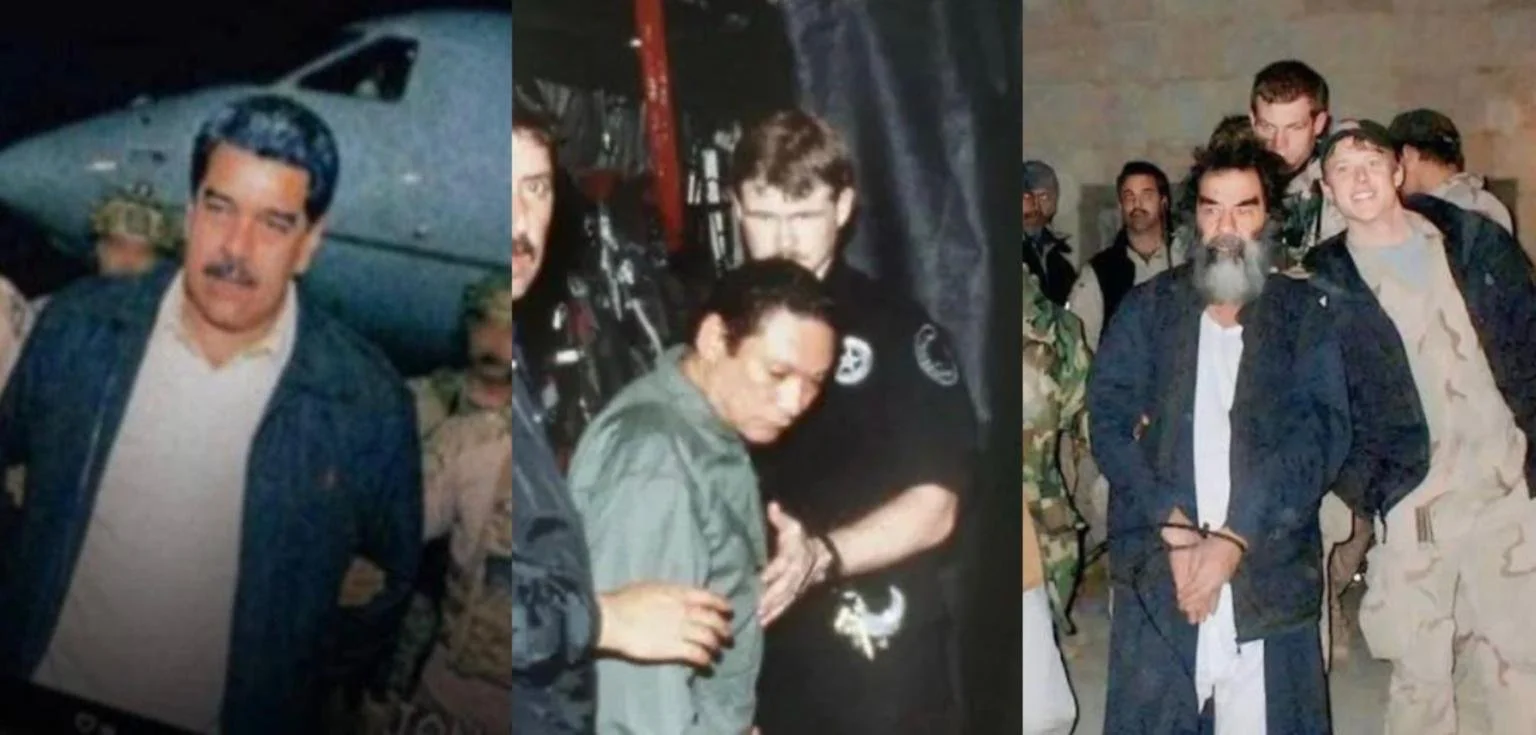
Among the most prominent leaders captured were:
Emilio Aguinaldo (Philippines): The first president of the Philippines, captured by the Americans during the Philippine-American War following an infiltration operation by General Frederick Funston's forces.
Hideki Tojo (Japan): Prime Minister of Japan for most of World War II. He attempted suicide when American military police arrived to arrest him for war crimes, but survived, was tried, and executed.
Manuel Noriega (Panama): The de facto ruler of Panama, captured by the Americans after the 1989 invasion of Panama (Operation Just Cause), surrendering after a ten-day siege.
Saddam Hussein (Iraq): The former Iraqi president, captured during Operation Red Dawn in December 2003 following the invasion of Iraq.
Hudson Austin (Grenada): The head of the military junta that seized power in Grenada, captured by the U.S. military during Operation Urgent Fury in 1983.
Nicolás Maduro (Venezuela): According to recent media reports, he was arrested by US Delta Force on January 3, 2026, following military strikes on Venezuela. LINK
“Tidbits From TNT” Tuesday Morning 1-6-2026
TNT:
Tishwash: Iraq's accession to the World Trade Organization: The United Nations confirms tangible progress.
Joining the World Trade Organization is witnessing clear progress, according to the United Nations International Trade Centre, with the completion of key technical and regulatory stages at both the local and international levels.
The International Trade Centre, a United Nations agency, confirmed that Iraq has made clear progress in its steps towards joining the organization.
TNT:
Tishwash: Iraq's accession to the World Trade Organization: The United Nations confirms tangible progress.
Joining the World Trade Organization is witnessing clear progress, according to the United Nations International Trade Centre, with the completion of key technical and regulatory stages at both the local and international levels.
The International Trade Centre, a United Nations agency, confirmed that Iraq has made clear progress in its steps towards joining the organization.
Eric Bochot, the director of the International Trade Centre’s programs in Iraq, affiliated with the United Nations, said : “The process of Iraq’s accession to the World Trade Organization is still ongoing, and has seen progress in several important stages at both the national and international levels.”
Bushot added that this progress includes the establishment and reactivation of the Iraq Working Group at the World Trade Organization, the revival of national coordination mechanisms, technical reviews of trade-related legislation, communication with member states of the organization, as well as preparatory work related to market access and regulatory harmonization.
The UN official stressed that what has been accomplished so far reflects a continued commitment to aligning the Iraqi trade system with multilateral rules, although additional steps are still required.
For his part, economist Nabil Al-Tamimi said that the government and the Ministry of Trade are working hard to join the World Trade Organization.
Al-Tamimi added that “joining requires several procedures, including legislative and legal amendments, in order for Iraq to meet the conditions for joining this organization, noting that the legislative process in Iraq may be slow for several reasons.”
Al-Tamimi explained that these steps were accompanied by procedural obligations that are part of the conditions for joining the organization. link
Tishwash: Parliament will host officials from the Central Bank and the Integrity Commission next week.
"Within the framework of activating the oversight role"
The Parliament Presidency set next week, Monday (January 5, 2026), as the date for hosting a number of officials from the Financial Control Bureau, the Integrity Commission, the Central Bank and other federal institutions within the framework of activating the oversight role.
The media department of the House of Representatives stated in a statement received by Network 964 that the parliament “held its second session of the sixth electoral term of the first legislative year, the first legislative chapter, today, Monday, under the chairmanship of Hebat Al-Halbousi, Speaker of the Council, and in the presence of 229 deputies.”
He added that “the Speaker of the Council emphasized at the beginning of the session the need to adhere to the provisions of the House of Representatives’ internal regulations, as they are in effect and were voted on in the previous session.”
He pointed out that “President Hebat Al-Halbousi stressed the importance of expediting the formation of parliamentary committees, and giving a deadline of 7 days for parliamentary blocs to submit their proposals to the Presidency of the Council regarding the development of a plan to distribute members among the parliamentary committees according to the internal regulations of the Council, stressing the importance of activating the Parliamentary Conduct Committee to preserve the status of Iraq and the House of Representatives in terms of oversight and legislation.”
He added that “the Speaker of the Council noted that the time for holding the Council sessions has been permanently fixed at 11 am, in agreement with the heads of the parliamentary blocs, in addition to proceeding with other controls and instructions that enhance the management of the legislative institution in the best way.”
He explained that “the session emphasized the discussion by the members of the council of the organizational matters that the council follows in managing its sessions and parliamentary committees in order to address some of the previous obstacles to enhance the role of the House of Representatives in oversight and legislation, in addition to stressing the need to prioritize the enactment of important laws.”
Regarding candidacy for the presidency, he explained that “the Speaker of the Council noted that 44 applications for candidacy have been received so far, and the extension of time was due to the New Year holiday, indicating that the nomination period closes today, Monday, at the end of official working hours.”
He concluded by saying that “Al-Halbousi mentioned that the House of Representatives will host next week officials from the Financial Control Bureau, the Integrity Commission, the Federal Service Council, the provincial councils, the Central Bank, the head of the Martyrs Foundation, and the head of the Retirement Authority.” link
************
Tishwash: Sources: Measures and solutions to reduce the dollar exchange rate against the dinar in local markets
Economically,the exchange rate of the US dollar continues to rise against the Iraqi dinar in local markets, with trading indicators approaching the 150,000 dinar mark for every 100 dollars in many governorates, in a development that has raised concerns among economic circles and citizens alike.
Banking reports indicated that the exchange rate reached levels close to this threshold, with prices ranging around 147,000-150,000 dinars per 100 dollars recorded in exchange bureaus and shops in Baghdad, Erbil and other cities, after a relative stability of the dinar earlier this year.governmentBaghdadGovernment sources confirmed to Iraqi media outlets that a series of governmental and monetary measures are being implemented or planned to contain the surge in the dollar's value and attempt to lower its price against the dinar in the parallel market.
These measures include: strengthening oversight of the exchange market and curbing speculation.
Sources indicated that relevant authorities are focusing on monitoring buying and selling activity in unofficial markets and attempting to limit speculation, which is considered a driving factor behind the rise in the price of foreign currency.
This step comes within the framework of efforts to control prices and reduce the gap between official and parallel exchange rates.Encouraging official transactions through banks and official platforms is also being pursued.
Central Bank of IraqGovernment agencies are encouraging transactions in US dollars through official banking channels and facilitating access to the currency for citizens and merchants from the official market at fixed rates, in an effort to alleviate pressure on the parallel market.
This includes utilizing reserves.
Iraq-Regarding hard currency,economic sources stated that the country's hard currency reserves play a role in calming the market, as they contribute to meeting the real demand for dollars and reducingAsylumThe parallel market, along with efforts to finance foreign trade to support legitimate demand, has prompted economic and public reactions .
A number of merchants and citizens have expressed concern about the impact of the rising exchange rate on import costs and consumer goods prices, especially given the economy's reliance on imports.
Some economic entities have called on the Baghdad government to intervene swiftly to address the dinar's decline and ensure price stability. In contrast, experts believe that current government measures may take time to produce tangible results in the markets, and that the issue is not simply about reducing the exchange rate, but requires a comprehensive package of financial and monetary reforms to improve investor confidence and reduce dependence on the parallel market.
With the dollar approaching unprecedented levels in the Iraqi market, monetary and governmental authorities in Baghdad face a challenge that necessitates coordination between fiscal, monetary, and regulatory policies to curb currency volatility, while simultaneously working to calm markets and restore public confidence in the Iraqi dinar, in an attempt to push the exchange rate toward more stable levels in the coming weeks. link
I Asked My Trainer~~~~

Gunna Treat Her Right I Am!!!!

FRANK26….1-5-26……PARLIAMENT WANTS ALAK
KTFA
Monday Night Video
FRANK26….1-5-26……PARLIAMENT WANTS ALAK
This video is in Frank’s and his team’s opinion only
Frank’s team is Walkingstick, Eddie in Iraq and guests
Playback Number: 605-313-5163 PIN: 156996#
KTFA
Monday Night Video
FRANK26….1-5-26……PARLIAMENT WANTS ALAK
This video is in Frank’s and his team’s opinion only
Frank’s team is Walkingstick, Eddie in Iraq and guests
Playback Number: 605-313-5163 PIN: 156996#
Are You Wealthy Or Just Rich? Here's the Real Difference — And Exactly What It Takes To Be Both
Are You Wealthy Or Just Rich? Here's the Real Difference — And Exactly What It Takes To Be Both
Ivy Grace December 18, 2025 Benzinga
There's a difference between looking rich and actually being wealthy. One is loud. The other doesn't need to explain anything.
Rich means you earn a lot. You might drive a luxury SUV, own a $10,000 couch, and take three vacations a year — all while living paycheck to paycheck. Wealthy means you own assets that generate income whether you're working or not. Wealth buys freedom. Rich buys bills.
Are You Wealthy Or Just Rich? Here's the Real Difference — And Exactly What It Takes To Be Both
Ivy Grace December 18, 2025 Benzinga
There's a difference between looking rich and actually being wealthy. One is loud. The other doesn't need to explain anything.
Rich means you earn a lot. You might drive a luxury SUV, own a $10,000 couch, and take three vacations a year — all while living paycheck to paycheck. Wealthy means you own assets that generate income whether you're working or not. Wealth buys freedom. Rich buys bills.
What It Takes To Be Considered Wealthy
According to the 2025 Charles Schwab Modern Wealth Survey, Americans now say you need $2.3 million in net worth to feel wealthy. To feel just financially comfortable, the average response is $839,000 — up from $778,000 the year before.
The survey, conducted among more than 2,000 U.S. adults, also revealed generational breakdowns:
Gen Z: $329,000 for comfort, $1.7 million for wealth
Millennials: $847,000 for comfort, $2.1 million for wealth
Gen X: $783,000 for comfort, $2.1 million for wealth
Boomers: $943,000 for comfort, $2.8 million for wealth
But these are perceptions, not actual thresholds. What people feel is enough often doesn't reflect what they actually have — or what they truly need to build lasting wealth.
What the Data Actually Shows
The Federal Reserve's Survey of Consumer Finances puts the median net worth of U.S. households at $192,700. That's the 50th percentile — half the country is below it.
To reach the top tiers:
75th percentile: around $659,000
90th percentile: $1.87 million
95th percentile: over $3 million
Top 1%: typically starts around $11–16 million
Based on recent asset growth, especially in real estate and the stock market, the current top 10% threshold is estimated to have climbed closer to $2.5 million–$3 million. That lines up almost exactly with where the Schwab survey says people start feeling wealthy.
Rich Is Income. Wealthy Is Ownership
TO READ MORE: https://finance.yahoo.com/news/wealthy-just-rich-heres-real-150337374.html
Some Clear Thinking About This Weekend’s Strike In Venezuela
Some Clear Thinking About This Weekend’s Strike In Venezuela
Notes From the Field By James Hickman (Simon Black) January 5, 2026
It’s hard to imagine America being intimidated by a guy named “Little Turtle”. And yet, in the year 1790, he was about as terrifying as it could get.
Little Turtle was the war chief of the Miami nation, one of the Algonquian-speaking tribes in the Great Lakes region, and he had made a name for himself fighting against the United States during the Revolutionary War.
Some Clear Thinking About This Weekend’s Strike In Venezuela
Notes From the Field By James Hickman (Simon Black) January 5, 2026
It’s hard to imagine America being intimidated by a guy named “Little Turtle”. And yet, in the year 1790, he was about as terrifying as it could get.
Little Turtle was the war chief of the Miami nation, one of the Algonquian-speaking tribes in the Great Lakes region, and he had made a name for himself fighting against the United States during the Revolutionary War.
(At one point he literally butchered his captives after a lopsided battle.)
More than a century before, Little Turtle’s people had waged a long war against the Iroquois over control of the land in what is today Indiana and western Ohio. So, when the American Revolution was over, he continued fighting against settlers that he felt were encroaching on his tribe’s territory.
Roughly 1500 American settlers were killed between 1784 and 1789. And when it finally became clear to the US government in 1790 that the violence would not stop, they sent an expedition under the command of General Josiah Harmar to fight the Miami.
Little Turtle was ready. And on October 21 at the Battle of Kekionga in northeastern Indiana, Little Turtle vanquished American forces.
In terms of casualty percentages, it was one of the worst defeats in US history. More importantly, given how small America’s military was at the time, the defeat became a national security nightmare. The US essentially didn’t have an Army after the battle.
In response, Congress passed a series of laws known as the “Militia Acts”, which, among other things, federalized state militias for use by the federal government.
But the new laws also gave the President sweeping authority to take command of these forces under certain circumstances, including invasion or threat of invasion “from any foreign nation or Indian tribe”.
Fast forward more than two centuries, and these Militia Acts are among the foundational legal arguments in favor of the Trump administration’s actions in Venezuela over the weekend.
Now, tremendous amounts of ink have already been spilled over Venezuela in the past 48-hours.
What I found so interesting, however, is that most of the legacy media articles, not to mention social media commentary, devolved into typical ignorant tribalism, i.e. people are frequently for/against something based on whether or not they’re for/against the person doing it.
In this case, the Left is predictably howling that the President’s use of the military was illegal and unconstitutional-- an assertion that is being repeated and reposted by millions of people.
TO CONTINUE AND TO READ MORE:
“Apocalypse is Unfolding”: Gold Soars as Tensions Escalate, Faith in Money Dies
“Apocalypse is Unfolding”: Gold Soars as Tensions Escalate, Faith in Money Dies
Daniela Cambone: 1-5-2026
Gold is hovering around $4,450—not just a bull market, but a symptom of a dawning realization that decades of money printing have hollowed out the dollar’s value.
People are waking up, stacking “junk silver” (pre-1965 coins) and physical metal as a form of preparation. “My number one concern about 2026 is a second wave of inflation,” says Jeffrey Tucker, Founder, Author, and President of the Brownstone Institute.
“Apocalypse is Unfolding”: Gold Soars as Tensions Escalate, Faith in Money Dies
Daniela Cambone: 1-5-2026
Gold is hovering around $4,450—not just a bull market, but a symptom of a dawning realization that decades of money printing have hollowed out the dollar’s value.
People are waking up, stacking “junk silver” (pre-1965 coins) and physical metal as a form of preparation. “My number one concern about 2026 is a second wave of inflation,” says Jeffrey Tucker, Founder, Author, and President of the Brownstone Institute.
In a conversation with Daniela Cambone, Tucker warns that inflation could intensify as the U.S. approaches the 2026 midterm elections, adding pressure to the housing market and increasing economic uncertainty.
“I would not be at all surprised to see inflation of 3% or higher,” he says. Tucker also criticizes the idea of cutting interest rates at this stage, calling it “the worst possible time” and “a disastrous idea.”
He cautions that current policies risk repeating past mistakes: “My concern has been that we’re going to repeat the experience of the 1970s.”
He concludes that the deeper issue is a loss of trust in the system: “This would not be happening if people had confidence in the fiat money system — and they just don’t.”
Chapters:
00:00 Is U.S. economic growth sustainable?
04:42 How much blame belongs to the Fed?
06:07 A return to sound money
08:08 Gold and silver outlook
09:28 Inflation and the loss of confidence in government
14:43 A new Fed chair — what comes next?
21:04 Housing: what’s ahead?
24:07 Silver coin bags make a comeback
Some “Iraq News” Posted by Clare at KTFA 1-5-2026
KTFA:
Clare: Banking reforms
1/5/2025 Mitham Adham Al-Zubaidi
The Iraqi banking sector is currently witnessing a remarkable transformation led by the Iraqi government through the Central Bank, within the framework of structural and regulatory reforms aimed at rebuilding the financial system on more efficient and transparent foundations.
These reforms, which came after years of concentration and weak governance and banking infrastructure, seek to create a banking environment based on fair competition and the prevention of monopolies, instead of relying on privileges or currency auction interventions.
KTFA:
Clare: Banking reforms
1/5/2025 Mitham Adham Al-Zubaidi
The Iraqi banking sector is currently witnessing a remarkable transformation led by the Iraqi government through the Central Bank, within the framework of structural and regulatory reforms aimed at rebuilding the financial system on more efficient and transparent foundations.
These reforms, which came after years of concentration and weak governance and banking infrastructure, seek to create a banking environment based on fair competition and the prevention of monopolies, instead of relying on privileges or currency auction interventions.
The Central Bank of Iraq has enlisted the help of specialized international consulting firms, most notably Oliver Wyman, to develop modern frameworks for governance, risk management, and bank restructuring, in order to ensure the standardization of criteria, raise the efficiency of boards of directors, and enhance compliance with international regulations.
This collaboration is seen as a key step towards breaking traditional business patterns and opening the way for more competitive banks to provide quality services.
The impact of these reforms is not limited to the banking sector alone, but extends directly to the Iraq Stock Exchange, where the banking sector constitutes the largest part of the number of listed companies and the market value of the trading volume.
With the implementation of new governance standards and the restructuring of some banks, investors, using brokerage and financial trading firms, are reassessing bank shares based on transparency and management strength, rather than size or connections. This is reflected in tangible changes in the number of shareholders, trading volumes, and daily trading values, as liquidity gradually shifts towards the most compliant and adaptable banks.
While these transformations may lead to short-term market volatility, in the medium term they are shaping a more mature financial market, one where monopolies diminish, stocks are priced according to actual performance, and the base of informed shareholders expands to attract investment from ordinary citizens.
Ultimately, the current banking reforms represent an opportunity to rebalance stability and competition, and to build a financial sector that supports both the national economy and the capital market. LINK
************
Clare: The Iraqi parliament's leadership gives blocs 10 days to distribute their members among the committees.
1/5/2026
MP Mohammed Al-Baldawi, from the “Sadiqun” parliamentary bloc, stated on Monday that the meeting held by the Speaker of Parliament with the heads of political blocs, and the second session of Parliament, resulted in an agreement to grant ten days to the heads of blocs to distribute their members among the parliamentary committees.
Al-Baldawi told Shafaq News Agency that the number of parliamentary committees currently stands at 25, and some committees are expected to be split to bring the total to 27. These committees will be finalized after the distribution of representatives and their official adoption within Parliament.
He pointed out that the process of appointing the heads of the permanent parliamentary committees needs time until the new government is formed, taking into account parliamentary entitlement, indicating that the management of the committees will currently be based on the oldest members.
In a statement issued by the office of the First Deputy Speaker of Parliament, Adnan Faihan, the latter stressed the importance of expediting the submission of the names of candidates for the temporary committees, taking into account experience, competence and specialization, achieving a legal quorum during meetings, and giving priority to proposals and draft laws that touch the lives of citizens.
During the meeting, it was agreed to form a committee headed by the First Deputy and a number of heads of blocs to study the names of the candidates and decide on their distribution among the committees, in addition to an understanding to prepare a monthly agenda for the sessions of the House of Representatives, with the aim of developing the role of the legislative institution and enhancing its oversight work in the sixth parliamentary session.
On Monday morning, January 5, 2026, the Speaker of the House of Representatives, Hebat Al-Halbousi, opened the proceedings of session number (2) within the first legislative term of the first legislative year of the sixth electoral cycle. LINK
Clare: Victorious parliamentary bloc: More than 141 laws awaiting legislation
1/5/2026 Baghdad – Wissam Al-Mulla –
The head of the Victorious parliamentary bloc, Faleh Al-Khazali, confirmed on Monday that more than 141 laws are awaiting legislation.
He also indicated that the parliament's leadership has set a 10-day deadline for submitting the names of MPs to the committees.
Al-Khazali told the Iraqi News Agency (INA) that "the Speaker of Parliament held a meeting with the heads of the parliamentary blocs, where an agreement was reached on forming the parliamentary committees and distributing MPs according to their electoral weight, their preferences, and their areas of expertise." He explained that "the work of Parliament is legislative and oversight-oriented, and the stability of the committees will lead to efficient work."
He added that "there are more than 141 laws awaiting legislation, based on Article 60, Paragraph 2 of the Constitution, which stipulates that legislation can be submitted by 10 MPs or through parliamentary committees." He clarified that "Parliament cannot function without functioning parliamentary committees."
He stated that "the Parliament Presidency has set a period of 7-10 days to submit the names of the deputies to the committees," noting that "the deputies will be distributed among the parliamentary committees, but the chairmanship of the committees will be with the oldest, and after the formation of the government, a vote will be held on the chairman of the committee, the deputy, and the rapporteur." LINK
************
Clare: Government advisor: Fluctuations in the parallel dollar market are temporary and do not affect the stability of living standards.
1/5/2026
The economic advisor to the Prime Minister, Mazhar Muhammad Saleh, confirmed on Monday that the fluctuation in global oil prices is not directly related to the volatility of the parallel exchange market in Iraq, explaining that the monetary policy based on a fixed exchange rate supported by reserves exceeding $100 billion provides a strong stability umbrella for foreign currency.
Saleh told Al-Furat News Agency that “the limited fluctuations in the parallel market represent temporary and ineffective reactions that came in response to the launch of the latest fiscal discipline package, which included decisions to re-examine the paths of public spending and enhance the efficiency of revenues, especially through expanding and controlling tax and customs bases.”
He added that "these movements are a natural behavior for markets when they receive new signals from fiscal policy, as supply and demand forces tend to test these signals and adapt to them in stages, before returning to more stable paths that are in harmony with economic and financial fundamentals."
He pointed out that "the current fluctuations in the parallel market do not reflect a structural imbalance in the exchange market, but rather a temporary adaptation phase with regulatory tools aimed at enhancing financial and monetary stability in the medium term."
Saleh pointed out that "the limited movements observed in the parallel market do not affect the stability of the general price range, which has maintained a low inflation rate of about 2.5% annually, which reflects the effectiveness of the macroeconomic policy mix."
He explained that stability is due to the convergence of three main policies:
Monetary policy: A fixed official exchange rate for the Iraqi dinar at 1320 dinars to the dollar.
Fiscal policy: Broad support amounting to about 13% of GDP, limits the transmission of price shocks to living standards.
Trade policy: Price defense through the subsidized food basket and the modern market system (hypermarkets), which absorbs the noise generated by the parallel market and turns it into stable white noise.
Saleh concluded by saying that "the parallel market no longer has a significant impact on daily life, after its effect became detached from income and consumption levels and its impact shifted mainly to the asset sector, which is not directly related to the stability of living or social peace."
From... Ragheed LINK