
Iraq Economic News and Points To Ponder Friday Morning 10-24-25
A British Report Reveals The Need To Modernize The Banking System In Iraq
Economy | 10/23/2025 Mawazine News – Baghdad The English-language magazine "Global Finance" revealed that economic diversification in Iraq is limited, considering that modernizing the "backward" banking system is a priority for the country.
The magazine stated in a report on the performance of central banks in the Middle East that "Iraq's GDP growth is expected to recover in 2025 after two consecutive years of recession, driven primarily by a recovery in oil production," noting that "the economy remains heavily dependent on hydrocarbons, which constitute 95% of government revenues, making it vulnerable to fluctuations in global oil prices."
A British Report Reveals The Need To Modernize The Banking System In Iraq
Economy | 10/23/2025 Mawazine News – Baghdad The English-language magazine "Global Finance" revealed that economic diversification in Iraq is limited, considering that modernizing the "backward" banking system is a priority for the country.
The magazine stated in a report on the performance of central banks in the Middle East that "Iraq's GDP growth is expected to recover in 2025 after two consecutive years of recession, driven primarily by a recovery in oil production," noting that "the economy remains heavily dependent on hydrocarbons, which constitute 95% of government revenues, making it vulnerable to fluctuations in global oil prices."
It added that "although economic diversification has been on the agenda for a long time, real progress has been limited. In response, the Central Bank of Iraq is promoting what it describes as "developmental central banking," focusing on directing credit toward strategic sectors, such as agriculture and industry, to expand the country's economic base."
The report explained that "modernizing Iraq's backward banking system is another priority. Reforms are underway in state-owned banks, alongside initiatives aimed at reducing the use of cash."
In May 2024, new regulations were issued for digital banks and electronic payment companies, prompting several new players to enter the market.
According to the report, "Despite efforts to combat money laundering and terrorist financing, the Central Bank still faces severe compliance challenges, and many Iraqi banks remain restricted to dollar transactions due to concerns about illicit financial flows to sanctioned entities."
The magazine noted in its report that "in early 2025, authorities uncovered a new scheme involving Visa and Mastercard prepaid products used to transfer funds to Iranian-backed militias. In response, the Central Bank of Iraq set a monthly cross-border transfer cap of $300 million and capped individual cardholder transactions at $5,000."
https://www.mawazin.net/Details.aspx?jimare=268978
Government Advisor: Iraq's Foreign Exchange Reserves Exceed $100 Billion
Economy | 04:48 - 10/23/2025 Mawazine News - Baghdad - The Prime Minister's financial advisor, Mazhar Mohammed Salih, confirmed that Iraq's external debt is at its lowest levels compared to many neighboring countries.
Salih said in a statement to the official agency that "the general indicators of the Iraqi economy have witnessed improvement over the past two years, thanks to a number of interconnected factors, the most important of which is the relative stability in oil revenues at acceptable levels, which provided a stable funding base for the general budget, and improved management of public spending by re-prioritizing reconstruction and infrastructure projects, and focusing on the service and production sectors within the government program."
He added, "This came in addition to activating the financial and administrative reform tools launched by the Central Bank and the Ministry of Finance, whether through electronic payment systems, expanding the network of non-oil revenues, or controlling border crossings and customs through automation, in addition to stabilizing the exchange rate and controlling inflation within globally acceptable limits, which strengthened monetary and financial confidence in the national economy."
He continued, "The Prime Minister's assertion that the financial and economic situation is at its best reflects a significant improvement in the management of the financial cycle, and is a solid prelude to comprehensive structural improvement.
" He explained that "the national economy has demonstrated its ability to efficiently and transparently utilize its resources, and looks forward to establishing a sustainable development economy on solid foundations, particularly within the framework of the Development Road project."
He pointed out that, with regard to the decline in the fiscal deficit to 34 trillion dinars, this decline represents a noticeable shift from the annual deficit levels that were estimated between (60-64) trillion dinars annually.
He pointed out that “the current government’s total government debt did not exceed (34) trillion dinars during the past three years, as a result of gradual fiscal policies that can be summarized in three main mechanisms, the most important of which are:
increasing non-oil revenues by improving tax and customs collection through automation and preventing financial evasion, enhancing the capacity to collect fees for government and municipal services, controlling waste in public institutions, improving collection efficiency, rationalizing public spending by rationing unnecessary operating spending, setting priorities for initiating investment projects of productive and service importance, adopting the principle of “daily cash management” in spending, to reduce short-term debts, and enhancing internal liquidity by increasing reliance on internal borrowing when needed through local debt instruments (bonds, treasury transfers) instead of external financing.”
He explained that “this was accompanied by an increase in the Central Bank’s foreign currency reserves, which provided space Greater government finances through the dinar window, in addition to increased coordination between fiscal and monetary policy, ensuring sustainable financing without inflationary pressures.”
He stressed that “the reduction in the estimated deficit rates in General Budget Law No. (13) of 2023 (the three-year budget) was not only due to a significant increase in oil revenues, but also as a result of gradual reform in public finance management and improving cash flows between institutions.”
He continued, "The reading of the external debt in the Prime Minister's speech was technical and analytical, as the external debt did not exceed $13 billion, which is a very low level compared to many countries, including neighboring countries. This reflects that the external debt burden on Iraqi finances is limited, and that the structure of public debt is more inward-looking (in dinars) than outward-looking (in dollars)."
Saleh concluded by saying, "The frequent talk about the risk of external debt is often used in political or electoral contexts and does not reflect the true financial situation, especially since Iraq possesses foreign exchange reserves exceeding $100 billion at the Central Bank of Iraq, which cover the external debt many times over in terms of the internationally recognized foreign exchange reserve efficiency indicators." https://www.mawazin.net/Details.aspx?jimare=268983
For current and reliable Iraqi news please visit: https://www.bondladyscorner.com
50 Things To Do Right Now To Save Money
50 Things To Do Right Now To Save Money
J. Arky Thu, October 23, 2025 GOBankingRates
If there is one thing that is always on our minds, it is how to save money. In the last quarter of 2025, that question looms larger than ever, as inflation threatens to wreak havoc on the average person’s finances and prices continue to skyrocket on everyday purchases.
There are plenty of ways to make sure that you are saving money as the year wraps up and they are pretty simple too. Following just a few could help you roll into the new year with a savings account in the black.
50 Things To Do Right Now To Save Money
J. Arky Thu, October 23, 2025 GOBankingRates
If there is one thing that is always on our minds, it is how to save money. In the last quarter of 2025, that question looms larger than ever, as inflation threatens to wreak havoc on the average person’s finances and prices continue to skyrocket on everyday purchases.
There are plenty of ways to make sure that you are saving money as the year wraps up and they are pretty simple too. Following just a few could help you roll into the new year with a savings account in the black.
Here Are Top Things To Do To Save Money In Late 2025.
Set up an automatic savings plan for your paychecks so a portion of your income goes directly into your savings account.
Plan a staycation rather than a vacation, that way you get to rest and relax without having to spend money on travel, lodging and restaurants.
Cancel at least one “fun subscription” that you hardly ever use or have only used once before, making it one less expense you have to worry about.
Write up a meal plan for each week from now and until New Years Day, then go back and see how much you ended up spending compared to the first three-quarters of the year.
If there is a minor maintenance job on your car, like an oil change, figure out how to do it yourself and skip paying a mechanic to charge you for the service.
Check your wardrobe for items that might have holes and learn how to stitch them, giving your clothes a second round of life and avoiding a costly shopping trip.
Sign up for a library card for access to free books, music, movies and more.
Try shopping for groceries at a discount store where you can get the same products you would at a name brand supermarket for much less.
Instead of holiday shopping, try a DIY approach and make simple, festive gifts for everyone on your list.
Buy a water filter that fits your budget, as well as a reusable water bottle and ditch plastic water bottles for 2025 and beyond.
For any fun winter outdoor activities like skiing or snowboarding, try renting instead of buying, especially if you only hit the slopes once a year.
Set up a “blotto” account or in other words, an account that you can put money into and use for whatever you want without having to dip into checking, savings or other accounts.
Instead of cranking up the thermostat and blasting the heat, wear a heavy sweater or snuggle up under a blanket during cold weather.
TO READ MORE: https://www.yahoo.com/lifestyle/articles/50-things-now-save-money-160018034.html
“Tidbits From TNT” Friday Morning 10-24-2025
TNT:
Tishwash: Government: Iraq has foreign exchange reserves exceeding $100 billion, covering its external debt many times over.
The Prime Minister's financial advisor, Mazhar Mohammed Salih, confirmed on Thursday that Iraq's external debt is at its lowest level compared to many neighboring countries.
Saleh said in a statement to the official agency, followed by (Al-Rabia): “The general indicators of the Iraqi economy have witnessed an improvement during the past two years, thanks to a number of intertwined factors
TNT:
Tishwash: Government: Iraq has foreign exchange reserves exceeding $100 billion, covering its external debt many times over.
The Prime Minister's financial advisor, Mazhar Mohammed Salih, confirmed on Thursday that Iraq's external debt is at its lowest level compared to many neighboring countries.
Saleh said in a statement to the official agency, followed by (Al-Rabia): “The general indicators of the Iraqi economy have witnessed an improvement during the past two years, thanks to a number of intertwined factors
The most important of which is the relative stability of oil revenues at acceptable levels, which provided a stable funding base for the general budget, and improved management of public spending by re-prioritizing reconstruction and infrastructure projects, and focusing on the service and production sectors within the government program.”
He added, "This came alongside the activation of financial and administrative reform tools launched by the Central Bank and the Ministry of Finance, whether through electronic payment systems, expanding the non-oil revenue network, or controlling border crossings and customs through automation, in addition to stabilizing the exchange rate and controlling inflation within globally acceptable limits, which has strengthened monetary and financial confidence in the national economy." link
Tishwash: Iraq is preparing to launch an international conference to market investment opportunities on the path to development
The Iraq Fund for Development revealed its expectations that the volume of investments in the Development Road project will reach about (150) billion dollars, subject to increase in the coming years, stressing that the project constitutes a qualitative economic shift that will redraw the map of investment in Iraq and the region, and open new horizons of cooperation with international partners.
The head of the fund, Mohammed Al-Najjar, said, "Major changes are looming on the horizon for the Iraqi economy, with investments in the project expected to reach about (150) billion dollars, most of which are partnerships between Iraq and international companies within a safe and attractive investment environment."
He added, "The Fund is planning to launch an international investment conference to market the project, which may be held at Al-Faw Port or in the form of a global tour to present investment opportunities to governments, sovereign funds and major companies."
Al-Najjar pointed out that "the development road project includes an integrated economic system that includes transportation, industry, energy, agriculture, housing and logistics services, on an area of about (24) thousand square kilometers, which is equivalent to the area of Belgium, which allows the establishment of industrial and residential cities and modern production projects."
The head of the fund confirmed "the exclusion of any financial or financing obstacles, noting that the government has established an independent legal framework to manage the project, ensure transparency and protect investors' rights, while closely monitoring all specialized opportunities within the various sectors, including oil and gas, industry and agriculture." link
************
Tishwash: The Swiss Embassy reopens in Baghdad after 30 years of closure: a step towards strengthening bilateral relations.
The Swiss embassy in Baghdad was officially reopened on Thursday, in the presence of Iraqi Deputy Prime Minister and Minister of Foreign Affairs Fuad Hussein and Swiss Foreign Minister Ignazio Cassis. The event was described as a turning point in relations between Iraq and Switzerland, after a three-decade hiatus.
The opening ceremony was attended by a number of senior Iraqi officials and members of the Swiss delegation. In his speech, Minister Fuad Hussein emphasized that this step reflects the international community's confidence in the stability Iraq is experiencing. It also paves the way for expanding political and economic cooperation and opening the doors to investment for Swiss companies in the Iraqi market.
For his part, Swiss Minister Ignazio Cassis welcomed the return of Swiss diplomatic representation to Iraq, stressing that his country views Iraq as an important partner in the region and that the opening of the embassy reflects Switzerland's commitment to supporting stability and development efforts in the Middle East.
This opening marks the culmination of a process of diplomatic rapprochement between the two countries and a step toward a more cooperative and partnership-based future. link
************
Tishwash: Al-Sudani: The government has achieved an economic transformation, with international accolades, in less than three years.
Prime Minister Mohammed Shia al-Sudani affirmed on Thursday that the Iraqi government has achieved a real economic transformation in less than three years, as attested by international institutions. He noted that the results of the reforms adopted will become clear in the coming years.
During his reception of sheikhs and dignitaries of the Al-Izirj clan in Baghdad, according to a statement from his media office, Al-Sudani said, “The results of the sixth parliamentary elections will either establish stability that preserves what has been achieved during this period, or lead to regression and squandering of the achievements.” He pointed out that “there are those who practice lying, deception, and distortion in an attempt to influence the achievements made and confuse the scene.”
He continued, "Our government came into office during difficult circumstances, and from the first day of its term, it began addressing citizens' needs and priorities." He noted that "the government took an important step in appointing graduates and securing permanent contracts and lecturers."
He pointed out that "the services file was a priority in our work through service efforts, completing stalled and suspended projects, and launching new projects in Baghdad and the governorates."
He added, "The ballot boxes will determine how the country will be run for the next four years, and voters must carefully choose who will represent them in the House of Representatives."
He pointed out that "we have preserved Iraq's security and stability, avoiding any emotional stances, while maintaining our principled position in support of the Palestinian cause." link
Mot: Happened Again!!! – siigghhhhh

Mot: Halloween in Yellowstone Park

FRANK26…10-23-25….THE 10 LD
KTFA
Thursday Night Video
FRANK26…10-23-25….THE 10 LD
This video is in Frank’s and his team’s opinion only
Frank’s team is Walkingstick, Eddie in Iraq and guests
Playback Number: 605-313-5163 PIN: 156996#
KTFA
Thursday Night Video
FRANK26…10-23-25….THE 10 LD
This video is in Frank’s and his team’s opinion only
Frank’s team is Walkingstick, Eddie in Iraq and guests
Playback Number: 605-313-5163 PIN: 156996#
Seeds of Wisdom RV and Economics Updates Thursday Evening 10-23-25
Good Evening Dinar Recaps,
Peace as Policy: Diplomacy and the Economics of a Global Reset
Cease-fires and summits are not just geopolitical optics — they are economic infrastructure for a new monetary order.
A series of diplomatic signals this week underscore how geopolitical stabilization is aligning with the financial restructuring now underway.
Good Evening Dinar Recaps,
Peace as Policy: Diplomacy and the Economics of a Global Reset
Cease-fires and summits are not just geopolitical optics — they are economic infrastructure for a new monetary order.
A series of diplomatic signals this week underscore how geopolitical stabilization is aligning with the financial restructuring now underway.
U.S. and BRICS nations are quietly building peace corridors — diplomatic frameworks that reduce risk and unlock capital flows for the next global financial phase.
Trump’s Budapest Summit Initiative—now slated for early November—will include envoys from Russia, Turkey, and Saudi Arabia, focusing on energy coordination and trade stabilization.
Turkey’s mediation in Gaza and India’s proposal for a neutral BRICS peace commission both aim to normalize regional trade channels.
At the same time, the IMF and BIS are promoting “cross-border liquidity frameworks” that could operate seamlessly once geopolitical tensions ease — suggesting policy synchronization between peace and finance.
Each diplomatic thaw creates the stability required for interoperable digital currencies, tokenized reserves, and commodity-backed settlement networks to function globally.
Peace, in this context, becomes a precondition for the financial reset — not its byproduct.
Implications:
The world’s emerging alliances appear less ideological and more infrastructural — geoeconomic partnerships designed to enable a new trade and currency architecture beyond the old dollarized order.
Diplomacy has become the operating system upgrade for global finance.
This is not just politics — it’s global finance restructuring before our eyes.
Seeds of Wisdom Team
Newshounds News™ Exclusive
Sources:
~~~~~~~~~
India at the Crossroads: BRICS, Quad, and the Architecture of a Dual Financial Order
As global alliances fracture and converge, India’s decision may determine which system defines the next world economy.
India stands today at the geopolitical and financial crossroads of the emerging global order.
At this week’s ASEAN Summit in Kuala Lumpur (October 26–28), Prime Minister Narendra Modi faces the delicate task of navigating between two rival economic frameworks — BRICS and the Quad.
Each represents a competing vision for the future of finance:
BRICS is advancing a gold- and commodity-backed digital payments network aimed at reducing dependence on the dollar.
The Quad, led by the U.S., Japan, and Australia, is reinforcing a tokenized, dollar-based architecture aligned with IMF and BIS digital standards.
Reports from Watcher.Guru and Reuters suggest that India’s participation in both systems is increasingly difficult as U.S. trade tariffs, BRICS currency plans, and Iran’s inclusion test New Delhi’s neutrality. If India tilts toward BRICS, it could accelerate the formation of a parallel financial network centered on resource-backed trade. If it sides with the Quad, it strengthens the digitally centralized Western framework built around tokenized dollars and allied liquidity corridors.
Implications:
India’s balancing act is more than diplomatic — it’s structural. The outcome could determine whether the next global reset takes form as a divided multipolar system or an interoperable hybrid order linking East and West through digital and asset-backed mechanisms.
This is not just politics — it’s global finance restructuring before our eyes.
Seeds of Wisdom Team
Newshounds News™ Exclusive
Sources:
~~~~~~~~~
Seeds of Wisdom Team RV Currency Facts Youtube and Rumble
Newshound's News Telegram Room Link
Follow the Gold/Silver Rate COMEX
Follow Fast Facts
Seeds of Wisdom Team™ Website
Thank you Dinar Recaps
Let’s Take a Quick Pause and Look Back at History
Let’s Take a Quick Pause and Look Back at History
Notes From the Field By James Hickman (Simon Black) October 23, 2025
In light of this week’s roller-coaster gold ride, I thought it would be useful to turn once again back to the lessons of history and revisit what we discussed recently about the 1970s.
Foreign governments and central banks around the world had been becoming increasingly concerned about the US government’s outrageous fiscal deficits as early as the mid-1960s.
Let’s Take a Quick Pause and Look Back at History
Notes From the Field By James Hickman (Simon Black) October 23, 2025
In light of this week’s roller-coaster gold ride, I thought it would be useful to turn once again back to the lessons of history and revisit what we discussed recently about the 1970s.
Foreign governments and central banks around the world had been becoming increasingly concerned about the US government’s outrageous fiscal deficits as early as the mid-1960s.
French President Charles de Gaulle sounded the alarm about America’s costly war in Vietnam, combined with historic welfare spending, and he began demanding that the Treasury Department redeem a portion of France’s US dollar holdings for gold.
Decades ago, that was his right because under the post–World War II Bretton Woods system, the US dollar was convertible into gold at a rate of $35 per ounce.
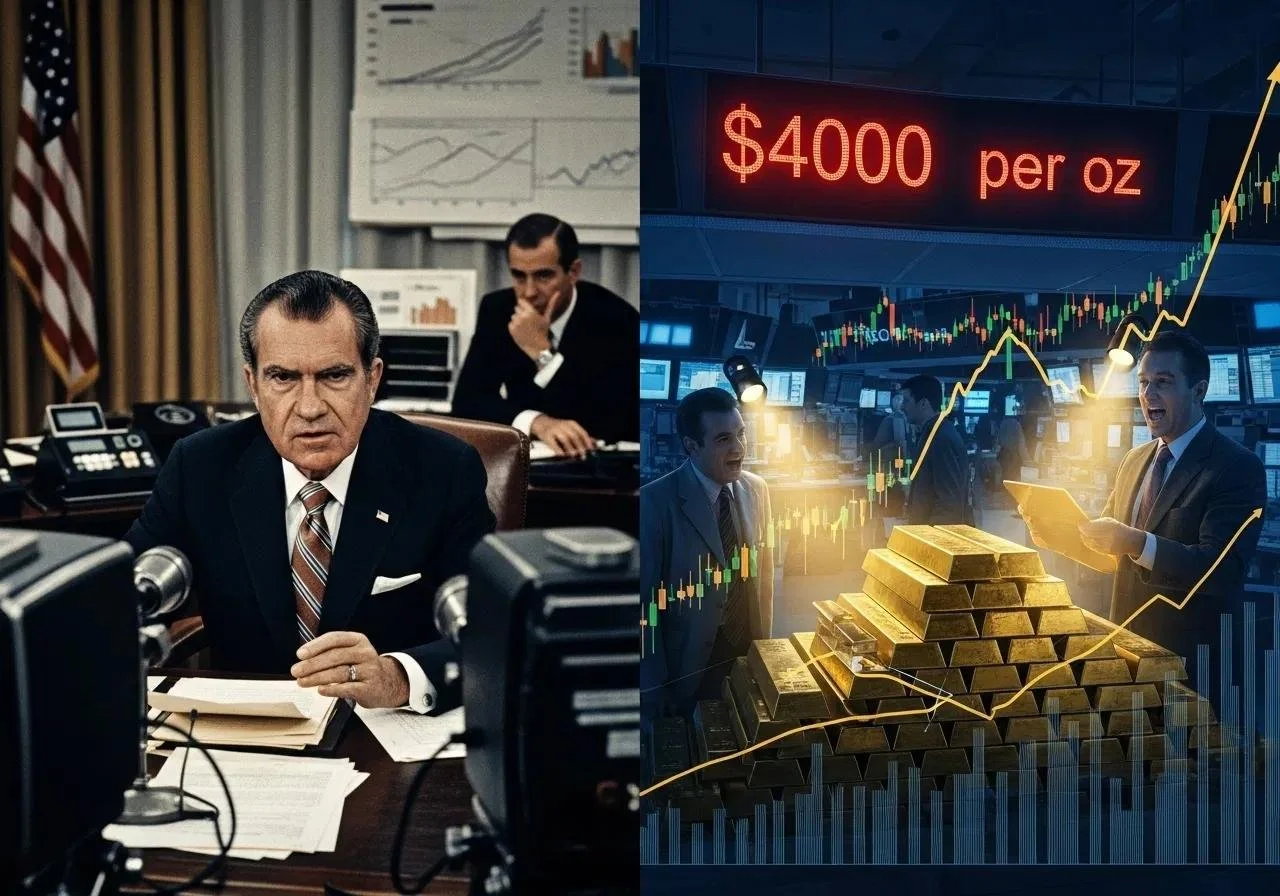
By 1971, foreigners’ demands to exchange their dollars for gold had become so great that Richard Nixon formally ended the convertibility once and for all.
Nixon downplayed any impact, telling Americans on August 15, 1971, “your dollar will be worth just as much tomorrow as it is today.”
The reality is the dollar went on to lose 75% of its value throughout the course of the decade. And if anything, Nixon’s move only encouraged foreigners to dump their dollars at an even more rapid pace.
As a result, the price of gold skyrocketed fivefold as governments and central banks around the world diversified out of the dollar and into gold.
We’ve been seeing this same move over the past couple of years—insatiable foreign and central bank appetite has driven gold prices from $1,800 a couple of years ago to over $4,000 today.
Obviously, over the past few months, there has been a lot of individual investor capital flowing into ETFs, hedge fund speculation, and similar vehicles. But in the long run, gold’s rise has been—and will continue to be—driven by foreign government and central bank diversification out of the dollar.
In 1975, gold hit a temporary peak at around $185 per ounce. After a period of consolidation, in which there was a significant price correction, gold then resumed its ascent, rising all the way to $850.
The point is that regardless of any short-term price correction, the fundamental driver—foreign governments and central banks diversifying out of the US dollar—hadn’t changed.
It took the election of Ronald Reagan in 1980 to finally restore credibility in the US government’s finances. Reagan, of course, campaigned on cutting the deficit, sparking a long-term trend which culminated in multiple budget surpluses in the late 1990s.
This renewed confidence in US government finances is what ultimately reversed the trend on gold prices, causing the price to collapse below $300 by the end of the 90s.
I believe we’re in a similar situation today as in 1975.
Gold had a significant correction earlier this week, but the price remained above $4,000.
Perhaps this is the start of a lull period, or even a correction phase as in 1975, but it doesn’t fundamentally change the story right now: foreign governments and central banks are aggressively trying to diversify their US dollar strategic reserves, and gold is one of the only assets that makes sense.
I’m not here to say “buy gold” at $4,000. But based on the trajectory of the US government’s finances, the price of gold should go much higher over the next few years.
I don’t say this because I’m a “gold bug.” I don’t have any irrational fascination with a piece of metal. Rather, my outlook is based on a clear understanding of global central banking and strategic reserve assets, coupled with the obvious deterioration in the US government’s fiscal condition.
But I also understand that after an almost uninterrupted and astonishing rise to nearly $4,400, gold may be due for a correction—similar to what happened in 1975.
The reality is, no one knows for sure. Gold could just as easily rise to $5,000 as drop to $3,500.
I’d point out, however, that there are still a number of high-quality gold, platinum, and silver businesses that are wildly undervalued and extremely profitable—and they will continue to be extremely profitable even if there is a steep decline in gold prices.
For example, one of the companies we featured in our premium investment research service is producing gold at a price of just $1,000 per ounce. This means the price of gold could fall below $3,000, and this company would still be making money hand over fist—and trading at just 5x earnings based on today’s stock price.
Did I mention they pay a handsome dividend?
To me, the long-term case for gold is crystal clear—foreign governments and central banks will continue to by gold unless there is a fundamental change in Congress’s attitude toward the US budget deficit. And I don’t see that happening anytime soon.
The short-term case for gold over the next couple of months is anyone’s guess. It could go higher, it could go lower. And that’s why I think some of these ultra-cheap, highly profitable, well-managed, largely debt-free gold companies are really worth considering.
When the long-term case for gold is so obvious, it’s a sensible strategy to own a business that has so much gold exposure, pays a dividend, and can continue to be extremely profitable—even if there’s a short-term gold correction.
To your freedom, James Hickman Co-Founder, Schiff Sovereign LLC
Evening News with MarkZ, joined by Dr. Scott Young. 10/23/2025
Evening News with MarkZ, joined by Dr. Scott Young. 10/23/2025
MarkZ Disclaimer: Please consider everything on this call as my opinion. Be sure to consult a professional for any financial decisions
THE CONTENT IN THIS PODCAST IS FOR GENERAL & EDUCATIONAL PURPOSES ONLY&NOT INTENDED TO PROVIDE ANY PROFESSIONAL, FINANCIAL OR LEGAL ADVICE. PLEASE CONSIDER EVERYTHING DISCUSSED IN MARKZ’S OPINION ONLY
Evening News with MarkZ, joined by Dr. Scott Young. 10/23/2025
MarkZ Disclaimer: Please consider everything on this call as my opinion. Be sure to consult a professional for any financial decisions
THE CONTENT IN THIS PODCAST IS FOR GENERAL & EDUCATIONAL PURPOSES ONLY&NOT INTENDED TO PROVIDE ANY PROFESSIONAL, FINANCIAL OR LEGAL ADVICE. PLEASE CONSIDER EVERYTHING DISCUSSED IN MARKZ’S OPINION ONLY
https://rumble.com/user/theoriginalmarkz
Kick: https://kick.com/theoriginalmarkz
FOLLOW MARKZ : TWITTER . https://twitter.com/originalmarkz?s=21. TRUTH SOCIAL . https://truthsocial.com/@theoriginalm...
Mod: MarkZ "Back To Basics" Pre-Recorded Call" for Newbies 10-19-2022 ) https://www.youtube.com/watch?v=37oILmAlptM
MARKZ DAILY LINKS: https://theoriginalmarkz.com/home/
THANK YOU ALL FOR JOINING. HAVE A BLESSED NIGHT! SEE YOU ALL IN THE MORNING FOR COFFEE @ 10:00 AM EST ~ UNLESS BREAKING NEWS HAPPENS!
FROM NOW ON NO MORE NIGHTLY PODCASTS ON MONDAYS AND FRIDAYS
What’s Really Driving Gold & Silver Volatility? It’s Classic ‘Price Misdirection’ | Andy Schectman
What’s Really Driving Gold & Silver Volatility? It’s Classic ‘Price Misdirection’ | Andy Schectman
Miles Franklin Media: Michelle Makori, President & Editor-in-Chief of Miles Franklin Media, breaks down the shocking overnight sell-off that sent gold and silver prices tumbling before bouncing back.
Andy Schectman, Founder & CEO of Miles Franklin Precious Metals, reveals what really happened and who dumped gold in the middle of the night and why?
Was it technical selling, profit-taking, or a coordinated paper-market attack?
What’s Really Driving Gold & Silver Volatility? It’s Classic ‘Price Misdirection’ | Andy Schectman
Miles Franklin Media: Michelle Makori, President & Editor-in-Chief of Miles Franklin Media, breaks down the shocking overnight sell-off that sent gold and silver prices tumbling before bouncing back.
Andy Schectman, Founder & CEO of Miles Franklin Precious Metals, reveals what really happened and who dumped gold in the middle of the night and why?
Was it technical selling, profit-taking, or a coordinated paper-market attack?
Schectman exposes what really happened during the “drive-by” selloff, which banks quietly bought the dip, and how this wild volatility could be a flashing warning signal of something much bigger – a reset in the global monetary order.
In this interview:
Record highs followed by the sharpest gold drop in 12 years
Massive futures dump at the thinnest trading hour – why it matters
Evidence of major banks buying physical metal right after the crash
Paper vs. Physical: the widening gap and what it reveals
Is this volatility engineered misdirection before a monetary reset?
Why gold’s “crash” may actually confirm its long-term bull trend
00:00 Introduction: Gold & Silver Market Volatility
02:55 Analyzing the Gold Market Correction
04:44 Market Manipulation & Paper Contracts
13:43 Global Financial Implications
31:52 Mainstream Media Narratives
38:46 Future of Gold & Silver
44:19 Systemic Contagion & Coordinated Attacks
46:22 Global South & East's Role in Commodities
50:26 The Erosion of the Dollar's Attraction
59:00 U.S. Government's Secret Gold Accumulation
01:11:09 The Federal Reserve's Dilemma
01:21:06 Practical Investment Advice in a Volatile Market
01:27:37 Conclusion & Viewer Engagement
Iraq Economic News and Points To Ponder Thursday Afternoon 10-23-25
Iraq Economic News and Points To Ponder Thursday Afternoon 10-23-25
The Dollar Price Stabilized In Local Markets With The Closing Of The Stock Exchange.
Thursday, October 23, 2025, 5:01 PM | Economics Number of readings: 138 Baghdad / NINA / The exchange rates of the dollar stabilized against the dinar, Thursday afternoon, in Baghdad markets, with the closing of the stock exchange.
The dollar prices witnessed stability in the Al-Kifah and Al-Harithiya stock exchanges, recording 141,400 dinars for $100, the same prices recorded this morning.
Iraq Economic News and Points To Ponder Thursday Afternoon 10-23-25
The Dollar Price Stabilized In Local Markets With The Closing Of The Stock Exchange.
Thursday, October 23, 2025, 5:01 PM | Economics Number of readings: 138 Baghdad / NINA / The exchange rates of the dollar stabilized against the dinar, Thursday afternoon, in Baghdad markets, with the closing of the stock exchange.
The dollar prices witnessed stability in the Al-Kifah and Al-Harithiya stock exchanges, recording 141,400 dinars for $100, the same prices recorded this morning.
The selling prices in exchange shops and local markets stabilized in Baghdad, where the selling price reached 142,500 dinars for $100, while the purchase price reached 140,500 dinars for $100.
In Erbil, the dollar also stabilized, where the selling price reached 141,200 dinars for every $100, and the purchase price reached 141,075 dinars for $100. /End https://ninanews.com/Website/News/Details?key=1258437
Al-Nusairi: Strengthening And Continuing The Implementation Of The Economic Reform Methodology Is A Central Goal After The Elections.
Banks Economy News – Baghdad Economic and banking advisor Samir Al-Nusairi explained on Thursday that in light of the current circumstances, amid the democratic movement, preparations for the upcoming elections, and the economic challenges facing our beloved country, it is necessary to develop a methodology for post-election economic reform that reinforces and continues the economic reform process initiated by successive previous governments, particularly what the current government has undertaken since 2023 in all economic sectors, with a focus on financial and banking reform in cooperation with the Central Bank and international consulting firms.
Al-Nusairi said in an interview with Al-Eqtisad News that the Iraqi economy, through study, analysis, capabilities, and available factors, can overcome imbalances and deviations in the economic structure and achieve balanced and diversified economic and structural reforms for the economy, while insisting on overcoming the objective and subjective economic conditions that the country is experiencing after the elections. Al-Nusairi promised to stimulate, encourage, and support the private sector in accordance with the vision of the Private Sector Development Strategy (2014-2030), which is based on Article 25 of the Constitution, which stipulates (the development of a vital and prosperous national private sector that is locally proactive, regionally competitive, and globally integrated) with the aim of achieving economic diversification, sustainable development, and job creation with the necessary and appropriate steps.
He pointed out the necessity of abandoning the rentier economy, which relies on 93% of oil revenues and constitutes 60% of the gross domestic product, and developing and revolutionizing other vital economic sectors, including agriculture, industry, and tourism, through restructuring state-owned industries, a gradual shift towards the private sector, and encouraging partnerships with local and foreign investors, in addition to reviewing the legislative environment for industrial operations and providing the infrastructure to secure the requirements of the work environment, and expanding the establishment of industrial zones.
He added that improving agricultural production and livestock, providing effective supplies and treatments for fields and farms, maintaining irrigation and drainage projects, supporting agricultural products for export, improving seed quality, and ensuring state prices, as well as supporting entrepreneurship, providing support for small and medium-sized enterprises, and granting soft loans, are all essential components for economic resilience and recovery.
He stressed the need to address the ongoing delay in preparing the general budget and commit to submitting it to the House of Representatives by the date specified in the Financial Management Law, approving it, and issuing its law by early 2026, while emphasizing the completion of the final accounts for previous years and submitting them to the new House of Representatives.
He explained that the country possesses the elements of resilience and economic progress, represented by its possession of the fourth-largest oil reserves in the world, exceeding 150 billion barrels, vast arable agricultural areas, young human resources capable of working, and experts in economics and finance with academic and executive experience, which can lead Iraq to recovery by providing a suitable work environment and securing an investment climate that encourages private capital and contributes to economic development, and stimulating and encouraging the real sector.
Al-Nusairi concluded his speech by pointing to the shortcomings of the legislative environment for managing the economy and the laws regulating economic activity, which were issued in 2004, which calls for reconsideration and making fundamental amendments to them in line with the new situation of managing the economy, international economic changes and their negative impact on the economic reality.
https://economy-news.net/content.php?id=61487
Oil Prices Rose 3% After US Sanctions On Russian Companies.
economy | 08:20 - 10/23/2025 Mawazine News – Economy Oil prices jumped about 2.5% on Thursday, extending gains from the previous session amid renewed supply concerns after the United States imposed sanctions on major Russian oil companies Rosneft and Lukoil over the conflict in Ukraine.
Brent crude futures rose $1.56, or 2.49%, to $64.15 by 03:03 GMT. U.S. West Texas Intermediate (WTI) crude futures rose $1.53, or 2.62%, to $60.03.
The United States expressed its readiness to take further action and urged Moscow to immediately agree to a ceasefire in the Russian war in Ukraine. U.S. President Donald Trump has resisted pressure from members of Congress to impose energy sanctions for months, hoping Russia would agree to end the fighting in Ukraine.
But with no end in sight, he said he felt the time had come. Britain imposed sanctions on Rosneft and Lukoil last week. Separately, European Union countries agreed on the 19th package of sanctions against Russia over the war, which includes a ban on imports of Russian liquefied natural gas.
“President Trump’s new sanctions on Russia’s largest oil companies are aimed at choking off the revenues the Kremlin is funding the war, a move that could lead to a reduction in the actual flow of Russian barrels,” said Priyanka Sachdeva, market analyst at Philip Nova.
Immediately after the US sanctions were announced, Brent and WTI crude futures rose by more than $2 a barrel, also supported by a surprise drop in US inventories. But market skepticism about whether the US sanctions would actually lead to a fundamental shift in supply limited oil’s gains. https://www.mawazin.net/Details.aspx?jimare=268954
Gold Prices Rebound Amid Rising Geopolitical Tensions And Anticipation Of US Inflation Data.
Thursday, October 23, 2025, | Economics Number of reads: 183 Baghdad/ NINA / Gold prices rebounded after declining in the previous session, driven by rising geopolitical risks amid US sanctions on Russia and the possibility of additional restrictions on Chinese exports, while investors are awaiting US inflation data for fresh clues on the path of interest rates.
Spot gold rose 0.7 percent to $4,123.39 per ounce.
US gold futures for December delivery rose 1.8 percent to $4,138.10 per ounce.
Gold prices have risen about 57 percent so far this year, reaching an all-time high of $4,381.21 last Monday, benefiting from geopolitical and economic uncertainty, bets on interest rate cuts, and continued buying by central banks.
As for other precious metals, spot silver rose 1.2 percent to $49.10 an ounce, platinum fell 1.1 percent to $1,603.70, and palladium fell 0.9 percent to $1,445.43. /End https://ninanews.com/Website/News/Details?key=1258424
For current and reliable Iraqi news please visit: https://www.bondladyscorner.com.
Seeds of Wisdom RV and Economics Updates Thursday Afternoon 10-23-25
Good Afternoon Dinar Recaps,
Central Banks Turn to Gold as Trust in Paper Fades
Soaring bullion demand reveals growing unease with dollar liquidity and debt saturation.
Global markets are witnessing a decisive flight toward tangible value. The World Gold Council’s Q3 report shows an 18% surge in central bank gold purchases, led by China, Turkey, and India—nations central to the shifting axis of monetary power.
Good Afternoon Dinar Recaps,
Central Banks Turn to Gold as Trust in Paper Fades
Soaring bullion demand reveals growing unease with dollar liquidity and debt saturation.
Global markets are witnessing a decisive flight toward tangible value. The World Gold Council’s Q3 report shows an 18% surge in central bank gold purchases, led by China, Turkey, and India—nations central to the shifting axis of monetary power.
China’s official holdings now exceed 2,280 tonnes, while several BRICS-aligned states are quietly accumulating through sovereign funds and strategic reserves.
Silver and copper prices have also spiked amid supply disruptions and war-driven risk premiums, signaling stress across key industrial metals.
Analysts view this as more than hedging—it’s a confidence migration away from paper-based debt instruments toward hard collateral systems.
The pattern mirrors historic monetary transitions where nations move to anchor currencies in real assets ahead of systemic change. As liquidity pressures deepen, metal accumulation becomes both insurance and infrastructure—preparing for potential asset-backed settlements under new monetary frameworks.
Implications:
Gold’s re-emergence as a central monetary asset highlights waning trust in fiat solvency and the return of commodity-based credibility in international finance. This accumulation phase may serve as the bridge to a hybrid financial order, where digital systems meet physical anchors—the defining feature of a modernized gold-linked reset.
This is not just politics — it’s global finance restructuring before our eyes.
Seeds of Wisdom Team
Newshounds News™ Exclusive
Sources:
~~~~~~~~~
IMF, BIS, and the Return of Real Value: Gold as the Digital Anchor
New reports hint that the foundations of the next monetary system may be tangible once again.
A quiet but significant policy pivot is underway at the International Monetary Fund (IMF) and the Bank for International Settlements (BIS).
Recent internal discussions and BIS briefings indicate growing support for “multi-asset reserve models” — systems that blend digital currency frameworks with physical asset collateral, particularly gold.
The IMF’s 2025 Digital Reserve Study highlights that a gold-linked digital settlement unit could “enhance confidence and liquidity during global restructuring phases.”
Meanwhile, the BIS Innovation Hub’s Project Aurum has begun simulations using tokenized gold as a reserve instrument for cross-border payments.
Several BRICS and G20 nations are reportedly exploring hybrid frameworks where tokenized fiat is partially backed by sovereign gold reserves, a model that merges old-world security with digital speed.
These initiatives suggest that the next monetary architecture may not abandon hard assets but re-anchor global liquidity in verifiable value.
Such a system would reduce fiat dependency and create a bridge between Western CBDCs and Eastern gold-backed payment rails — the foundation of a new, interoperable financial order.
Implications:
If successful, this shift could mark the first asset-based digital standard since 1971, restoring trust to global money and formalizing the structure of the post-dollar financial reset.
This is not just politics — it’s global finance restructuring before our eyes.
Seeds of Wisdom Team
Newshounds News™ Exclusive
Sources:
~~~~~~~~~
Seeds of Wisdom Team RV Currency Facts Youtube and Rumble
Newshound's News Telegram Room Link
Follow the Gold/Silver Rate COMEX
Follow Fast Facts
Seeds of Wisdom Team™ Website
Thank you Dinar Recaps
Jon Dowling & Mark Z & Zester - NESARA GESARA, GREAT WEALTH TRANSFER, CURRENCIES & THE NEW SYSTEM
Jon Dowling & Mark Z & Zester - NESARA GESARA, GREAT WEALTH TRANSFER, CURRENCIES & THE NEW SYSTEM
10-22-2025
Are we on the cusp of a financial revolution? Recent global events certainly suggest something monumental is brewing beneath the surface of our economic landscape.
A compelling podcast episode recently delved deep into the intricate mechanics of this global financial reset, featuring a wide-ranging discussion on currency revaluations, the indispensable role of blockchain technology, and the timeless significance of precious metals.
Jon Dowling & Mark Z & Zester - NESARA GESARA, GREAT WEALTH TRANSFER, CURRENCIES & THE NEW SYSTEM
10-22-2025
Are we on the cusp of a financial revolution? Recent global events certainly suggest something monumental is brewing beneath the surface of our economic landscape.
A compelling podcast episode recently delved deep into the intricate mechanics of this global financial reset, featuring a wide-ranging discussion on currency revaluations, the indispensable role of blockchain technology, and the timeless significance of precious metals.
Joining the hosts were two formidable voices: Mark Z, a seasoned financial analyst and commentator, and his son Zester, a blockchain and crypto expert who has been hands-on in the industry since 2016.
Together, they painted a vivid picture of an evolving economic future that demands our attention.
Mark Z kicked off the conversation by providing crucial context for the impending reset. He highlighted a series of geopolitical and financial developments – from Iraq’s pivotal oil shipment moves and the ravenous gold accumulation by central banks, to legislative efforts concerning sanctions on Zimbabwe.
All these events, he argued, are not isolated incidents but interconnected signals of an inevitable shift. He emphasized the crucial need to “clean up” existing corrupt financial systems in nations like Vietnam and Venezuela as a prerequisite for any meaningful revaluation of currencies and assets.
The message was clear: the old system is being meticulously dismantled.
Building on his father’s insights, Zester articulated how blockchain technology is not merely a buzzword, but the very backbone of this new financial system. He explained how traditional assets, especially precious metals like gold and silver, will become incredibly liquid and tradeable at spot prices through tokenization.
But Zester stressed a critical point: blockchain’s impact extends far beyond just cryptocurrencies. It represents a fundamental shift towards an immutable, transparent system for ownership, legal processes, and every conceivable financial transaction.
Imagine a world where asset ownership is verifiable instantly, legal agreements are executed without dispute, and financial transactions are beyond reproach. This is the promise of blockchain in the context of the reset.
The discussion then moved to the practical architecture of this transition.
The upcoming ISO 20022 messaging standard, designed to modernize global banking communication, is central to this. While many blockchain projects are only now integrating this standard, projects like Ripple (XRP) have been at the forefront for years, positioning them as key players in the new financial paradigm.
The hosts and guests highlighted the projected impact of XRP ETFs launching soon, with potential inflows of a staggering $10 billion. This influx, they predict, could push XRP’s price into double digits, fueling a broader crypto bull run perfectly aligned with the global reset.
Legislative efforts are also paving the way. They touched on initiatives like the Bitcoin Act of 2024/2025, which aims to create a decentralized crypto strategic reserve in the U.S., notably funded by a revaluation of gold – directly connecting precious metals back to the digital future.
While the outlook is transformative, the hosts also stressed the inevitability of a market correction or “crash” as the old fiat system makes way for the new asset-backed model.
Their advice was pragmatic: prepare and stay grounded amidst the anticipated volatility.
For a glimpse into a successful transition, they pointed to El Salvador’s pioneering adoption of blockchain in its judicial system. This real-world example demonstrates how the technology can significantly reduce crime and stabilize economies, proving its potential beyond just financial transactions.
In closing, Mark and Zester delivered a powerful message: we are standing before an unprecedented opportunity. This is a monumental shift from a debt-based fiat system to an asset-backed, blockchain-enabled future.
But with this blessing, they warned, comes profound responsibility. Complacency is not an option. Active participation and vigilance are crucial to prevent the new system from succumbing to the same human flaws of corruption and inequality that plagued the old.
The podcast concluded with practical resources for those looking to acquire precious metals and understand the currencies pivotal to this global reset.
Ready to dive deeper into how gold, blockchain, and astute financial analysis are reshaping our world?
Watch the full video from Jon Dowling for further insights and information – because the future isn’t just coming; it’s being built right now.