
“Tidbits From TNT” Friday Morning 6-13-2025
TNT:
Tishwash: The World Bank expects growth in the Iraqi economy in 2025 and 2026.
The World Bank expects the Iraqi economy to grow by 1.2% this year.
The bank said in statistics reviewed by Shafaq News Agency that "the Iraqi economy is expected to grow by 1.2% this year, up from negative 1.5% in 2024."
He added that economic growth in Iraq is also expected to rise to 4.4% in 2026, before declining to 3.1% in 2027.
He pointed out that "Libya is expected to be the Arab country with the fastest economic growth, with an estimated 12.3%, followed by Djibouti at 5.2%, and then Lebanon at 4.7%."
TNT:
Tishwash: The World Bank expects growth in the Iraqi economy in 2025 and 2026.
The World Bank expects the Iraqi economy to grow by 1.2% this year.
The bank said in statistics reviewed by Shafaq News Agency that "the Iraqi economy is expected to grow by 1.2% this year, up from negative 1.5% in 2024."
He added that economic growth in Iraq is also expected to rise to 4.4% in 2026, before declining to 3.1% in 2027.
He pointed out that "Libya is expected to be the Arab country with the fastest economic growth, with an estimated 12.3%, followed by Djibouti at 5.2%, and then Lebanon at 4.7%."
According to World Bank statistics, "Yemen will have the lowest economic growth, at -1.5%, followed by Syria, with a growth of 1%." link
Tishwash: Prime Minister's Office: 100 US requests to participate in Iraq Investment Forum
The Prime Minister's Office confirmed on Thursday that the preparatory committee for the investment forum to be held in Baghdad has received 100 American applications to participate.
Deputy Director of the Prime Minister's Office, Ali Razouki Al-Lami, told the Iraqi News Agency (INA): "Some American companies have submitted a proposal to Prime Minister Mohammed Shia al-Sudani to host an investment forum for Iraq in the United States to bring American companies to the Iraqi arena, in order to support the Iraqi state and boost investment in Iraq."
He pointed out that "a large American investment delegation had previously attended, and agreements were concluded and signed between the National Investment Authority and the US Embassy."
Regarding the investment forum that will be held in Baghdad in the middle of this month, Razouki explained that "the US embassy in Iraq is interested in this forum, as it requested 100 invitations from the preparatory committee, which reflects the embassy's great interest, in addition to the efforts made by the rest of the embassies in this regard."
He indicated that "there are great preparations and we hope that there will be cooperation from everyone to make this forum a success from the first session, so that it becomes a regular annual or biennial forum, to be a reason for opening the Iraqi field to all investors and capital." link
***************
Tishwash: Al-Fatah: The smuggling of regional oil will not stop until the oil and gas law is passed.
Ali al-Fatlawi, a leader in the Fatah Alliance, confirmed on Thursday that oil smuggling from the Kurdistan Region will continue unless the oil and gas law is passed. He called on the government and political forces to engage in serious dialogue to reach a final agreement on the law and resolve the accumulated disputes between Baghdad and Erbil.
Al-Fatlawi said in a statement to the Al-Maalouma Agency, “The time has come to give priority to the approval of the oil and gas law, especially after the vote to amend Paragraph (12) of the Federal Budget Law,” stressing that “the approval of the law is the best way to stop the smuggling of oil from the region.”
He added that "the continued smuggling of oil negatively impacts the national economy and causes significant losses to the public treasure," warning of the repercussions of these operations on the country's economic autonomy.
Al-Fatlawi called on political forces to "assume their national responsibilities and exert pressure to expedite the passage of the law by completing the draft and agreeing on its main provisions."
It is noteworthy that media reports indicated that approximately 400,000 barrels of oil are smuggled daily from the Kurdistan Region, in the absence of clear federal oversight and the unknown fate of the financial revenues resulting from these quantities. link
************
Tishwash: An Iraqi government bank combats suspicious financial transactions electronically "without human intervention.
Rafidain Bank's General Manager, Ali Karim, stated on Thursday that the bank has begun combating suspicious financial transactions, such as money laundering, through electronic technologies.
In a speech delivered at the "Governance Forum" held in Baghdad and attended by a Shafaq News Agency correspondent, Karim said, "Rafidain Bank has taken strategic steps to build an internal governance system that focuses on independence, integrity, and efficiency."
He added that the bank launched a comprehensive corporate risk program that includes operational, interest, and reputational risks, in cooperation with global distribution companies.
Karim continued, "Rafidain Bank recently acquired advanced systems in cooperation with international institutions, through which suspicious financial transactions will be monitored, analyzed, and even thwarted automatically and electronically, without any human intervention."
At the end of May, the Governor of the Central Bank of Iraq, Ali Al-Alaq, affirmed Iraq's commitment to combating money laundering and terrorist financing in cooperation with international partners. link
Mot: Raising the ""Wee Folks"" and then -- They Have Grandkids!! --

Mot: Nosy Neighbors but Short on $$ -- another ""Tip frum ole Mot""

MM and Crew: IQD-Iraq Dinar-Update-Key Bullet Points- Economic- Banking-Monetary Reform-International Cooperation
MM and Crew: IQD-Iraq Dinar-Update-Key Bullet Points- Economic- Banking-Monetary Reform-International Cooperation
6-12-2025
The Crew: Samson, PompeyPeter, Petra, Daytrader, Sunkissed, GIGI and Militia Man
Be sure to listen to full video for all the news……..
MM and Crew: IQD-Iraq Dinar-Update-Key Bullet Points- Economic- Banking-Monetary Reform-International Cooperation
6-12-2025
The Crew: Samson, PompeyPeter, Petra, Daytrader, Sunkissed, GIGI and Militia Man
Be sure to listen to full video for all the news……..
Iraq Economic News And Points To Ponder Thursday Evening 6-12-25
The US Embassy In Baghdad: The Evacuation Of Our Citizens Is Not Voluntary, But Rather A Mandatory Departure By Official Order
Buratha News Agency1182025-06-12 The US Embassy in Baghdad confirmed on Thursday that the evacuation of its citizens is not voluntary, but rather a mandatory and immediate departure by official order.
The US Embassy In Baghdad: The Evacuation Of Our Citizens Is Not Voluntary, But Rather A Mandatory Departure By Official Order
Buratha News Agency1182025-06-12 The US Embassy in Baghdad confirmed on Thursday that the evacuation of its citizens is not voluntary, but rather a mandatory and immediate departure by official order.
An embassy spokesperson stated, according to Arab media, that "the evacuation of our citizens is not voluntary, but rather a mandatory departure by official order." He explained that "the departure is immediate, and we will not reveal the number of departing employees for security reasons."
He added, "The departure order includes the embassy in Baghdad and the consulate in Erbil," stressing that "the departure of non-essential government employees came due to escalating regional tensions."
https://burathanews.com/arabic/news/461277
Rafidain Bank Begins Implementing An Advanced System To Combat Money Laundering And Terrorist Financing
Thursday, June 12, 2025, 18:06 | Economic Number of readings: 164 Baghdad / NINA / The General Manager of Rafidain Bank, Ali Karim Hussein, announced today, Thursday, the commencement of the implementation of an advanced system to combat money laundering and terrorist financing, based on artificial intelligence technologies and electronic systems.
The bank said in a statement, "As part of its commitment to enhancing governance and compliance, Rafidain Bank participated as the official sponsor in the second conference on governance, risk management and compliance, which was held in the capital, Baghdad, with the participation of an elite group of government officials, representatives of the banking and financial sector, and international experts in governance and oversight."
During his speech at the opening of the forum, the General Manager of Rafidain Bank, Ali Karim Hussein, confirmed, according to the statement, that "the bank has begun implementing an advanced system to combat money laundering and terrorist financing, based on artificial intelligence technologies and smart electronic systems, which ensures immediate monitoring and accurate analysis of suspicious financial transactions without human intervention, thus enhancing the efficiency of the internal control system."
He pointed out that "the bank has made significant strides in building a solid corporate governance structure based on the principles of transparency, independence, and integrity, in line with the best international standards and practices, in addition to launching an integrated corporate risk management program covering operational, reputational, and compliance aspects, in cooperation with prestigious international expertise."
The General Manager confirmed that "the bank has recently acquired advanced AML (Anti-Money Laundering) and GOAML systems, in coordination with specialized international institutions, enabling it to detect any suspicious financial activity early and effectively, in line with the instructions of the Central Bank of Iraq and global compliance standards.
" The statement added that "the conference witnessed a group of interventions that addressed the importance of consolidating a culture of governance and compliance in banking work, and the necessity of confronting money laundering as one of the fundamental challenges to ensuring the stability of the national economy." /End https://ninanews.com/Website/News/Details?key=1233869
Statistics On The Size Of The Central Bank's Foreign Exchange Reserves
Economy | 03:19 - 11/06/2025 Mawazine News – Baghdad The Central Bank of Iraq announced today, Wednesday, an increase in its foreign currency reserves during the month of May 2025.
The bank stated in an official statistic, reviewed by Mawazine News, that "the foreign reserves of the Central Bank until May 22 of this year amounted to 98.83 billion dollars, equivalent to 128.479 trillion Iraqi dinars, an increase from May 1, when reserves amounted to 97.943 billion dollars, or the equivalent of 127.326 trillion dinars."
It added that "these reserves also increased from April, when they amounted to 98.089 billion dollars, equivalent to 127.516 trillion dinars."
The bank indicated that "reserves decreased from last year's 2024 figure of $100.276 billion, or the equivalent of 130.347 trillion dinars, and are also lower than the 2023 figure of $111.736 billion, or the equivalent of 145.257 trillion dinars." https://www.mawazin.net/Details.aspx?jimare=262396
For current and reliable Iraqi news please visit: https://www.bondladyscorner.com/
Evening News with MarkZ, joined by Dr. Scott Young. 06/12/2025
PDK Note: I only transcribe RV/Financial news and intel. Not political opinions or most guests on this podcast. If a podcast is mostly political…I may not do notes at all. Thank you
Evening News with MarkZ, joined by Dr. Scott Young. 06/12/2025
Some highlights by PDK-Not verbatim
MarkZ Disclaimer: Please consider everything on this call as my opinion. People who take notes do not catch everything and its best to watch the video so that you get everything in context. Be sure to consult a professional for any financial decisions
Member: Good EveningMark, mods and fellow RV’ers!
Member: Looks like the world has lost its mind…….hope something positive happens soon.
PDK Note: I only transcribe RV/Financial news and intel. Not political opinions or most guests on this podcast. If a podcast is mostly political…I may not do notes at all. Thank you
Evening News with MarkZ, joined by Dr. Scott Young. 06/12/2025
Some highlights by PDK-Not verbatim
MarkZ Disclaimer: Please consider everything on this call as my opinion. People who take notes do not catch everything and its best to watch the video so that you get everything in context. Be sure to consult a professional for any financial decisions
Member: Good EveningMark, mods and fellow RV’ers!
Member: Looks like the world has lost its mind…….hope something positive happens soon.
Member: What's the good word Mark?
MZ: there are a lot of expectations for tomorrow on the bond side….other than that pretty quiet.
MZ: In Iraq: “Al Fateh: The smuggling of the regions oil will not stop until the approval of the oil and gas law” We do expect to see the budget tables and the gas and oil law to hit parliament at any moment. I am hearing a lot of chatter it may hit tomorrow. Am trying to stay calm.
MZ: “Iraq advances legal framework for development road project” This is also part of the white paper reforms to lift the purchasing power of the dinar.
MZ: “Prime Ministers office: 100 US requests to participate in the Investment Forum in Iraq” These are very profitable and companies would not join if they did not know Iraq was safe and stable.
MZ: “ The World Bank expects growth in the Iraqi economy in 2025 and 2026”
Member: I read with iraqi going digital, and for us to rv we need stablecoin legislation to pass.
Member: I wonder what the heck is Iraq waiting for???? Why don’t they just do it?
Member: I am sure this will all makes sense when it is completed, but it is hard to wait right now. God help us.
Member: Friday the 13th could be a lucky day for us.
Member: Everyone stay safe and far away for all the riots out there.
Member: Have a blessed night.
Dr. Scott joins the stream. Be sure to listen to replay for his information and opinions.
THE CONTENT IN THIS PODCAST IS FOR GENERAL & EDUCATIONAL PURPOSES ONLY&NOT INTENDED TO PROVIDE ANY PROFESSIONAL, FINANCIAL OR LEGAL ADVICE. PLEASE CONSIDER EVERYTHING DISCUSSED IN MARKZ’S OPINION ONLY
https://rumble.com/user/theoriginalmarkz
Kick: https://kick.com/theoriginalmarkz
FOLLOW MARKZ : TWITTER . https://twitter.com/originalmarkz?s=21. TRUTH SOCIAL . https://truthsocial.com/@theoriginalm...
Mod: MarkZ "Back To Basics" Pre-Recorded Call" for Newbies 10-19-2022 ) https://www.youtube.com/watch?v=37oILmAlptM
MARKZ DAILY LINKS: https://theoriginalmarkz.com/home/
Note from PDK: Please listen to the replay for all the details and entire stream….I do not transcribe political opinions, medical opinions or many guests on this stream……just RV/currency related topics.
THANK YOU ALL FOR JOINING. HAVE A BLESSED NIGHT! SEE YOU ALL IN THE MORNING FOR COFFEE @ 10:00 AM EST ~ UNLESS BREAKING NEWS HAPPENS!
FROM NOW ON NO MORE NIGHTLY PODCASTS ON MONDAYS AND FRIDAYS
"Silver Suggests Upside Breakout For GOLD"
"Silver Suggests Upside Breakout For GOLD" –
Mike Maloney: 6-12-2025
Silver May Be Signaling a Major Move in Gold — Are You Paying Attention?
In this explosive new update from Mike Maloney, you’ll discover why silver's recent strength could be a leading indicator for an imminent breakout in gold prices.
Mike revisits historic silver price spikes and analyzes what made them possible—comparing the retail frenzy of 2011 to today’s industrial scarcity and institutional awakening.
"Silver Suggests Upside Breakout For GOLD" –
Mike Maloney: 6-12-2025
Silver May Be Signaling a Major Move in Gold — Are You Paying Attention?
In this explosive new update from Mike Maloney, you’ll discover why silver's recent strength could be a leading indicator for an imminent breakout in gold prices.
Mike revisits historic silver price spikes and analyzes what made them possible—comparing the retail frenzy of 2011 to today’s industrial scarcity and institutional awakening.
You'll also learn about: The gold-silver ratio and how it could multiply your gold holdings
Central banks ditching fiat for gold — not crypto
The staggering math behind a hypothetical gold-backed U.S. debt
Why hoarding cash may be the wrong move in this economic climate
Are we on the cusp of another financial turning point?
Dive into this timely analysis and arm yourself with the knowledge to act.
Iraq Economic News And Points To Ponder Thursday Afternoon 6-12-25
The Resilience Of Fiscal Adjustment Over The Flexibility Of Monetary Adjustment. Mechanisms For Repaying Domestic Public Debt.
On the flexibility of monetary adjustment Mechanisms for repaying domestic public debt Resilience of financial adjustment
Soft Monetary Hegemony:
Over the past few years, the Iraqi economy has witnessed extensive overlap between fiscal and monetary policy, with the Central Bank assuming direct financial roles—from financing the deficit to stabilizing the market—which has led to ambiguity in roles and weakened some aspects of the effectiveness of monetary policy tools at different points in time.
The Resilience Of Fiscal Adjustment Over The Flexibility Of Monetary Adjustment. Mechanisms For Repaying Domestic Public Debt.
On the flexibility of monetary adjustment Mechanisms for repaying domestic public debt Resilience of financial adjustment
Soft Monetary Hegemony:
Over the past few years, the Iraqi economy has witnessed extensive overlap between fiscal and monetary policy, with the Central Bank assuming direct financial roles—from financing the deficit to stabilizing the market—which has led to ambiguity in roles and weakened some aspects of the effectiveness of monetary policy tools at different points in time.
In rentier economies, where natural resources—primarily oil—dominate the structure of public revenues, the problem of the imbalance between the resilience of fiscal adjustment in maximizing non-oil revenues and the flexibility of monetary adjustment emerges, such as the ability to finance inflation or practice a cheap money policy in indirectly financing public budget operations (inflationary finance) by generating cash at the lowest cost, particularly through bond discounting mechanisms and government transfers.
Fiscal policy is often constrained by the requirements of inflated public spending, weak revenue diversification, and high social and political obligations.
This makes them less adaptable to cyclical shocks or sudden shifts in oil prices and the intensification of oil asset cycles.
Alternatively, monetary policy—represented by the central bank—is left alone to confront the repercussions of these shocks, and is required to respond quickly through exchange rate instruments, liquidity injections, or currency market intervention, despite the limited room for maneuver available to it.
This is one of the most severe examples of overlap, interaction, or conflict between fiscal and monetary policies simultaneously.
The Iraqi economy is currently witnessing a qualitative shift in the balance of power between fiscal and monetary policies.
This may represent a potential gradual shift (from strong fiscal dominance to soft monetary dominance), meaning that monetary dominance is neither absolute nor severe, but rather occurs in a flexible and gradual manner, with a degree of coordination with fiscal policy.
However, monetary policy does not completely lose its independence, given the legal or broad independence of monetary policy covered by Law No. 56 of 2004.
After years of financial dominance, which relied heavily on government spending financed by oil revenues, a new phase began to take shape, with the central bank's role as a key player in controlling macroeconomic balances, particularly through monetary policy tools.
The central bank maintained its independence with degrees of control over inflation and exchange rate management, interspersed with flexible and thoughtful coordination with the fiscal authorities to ensure market stability, ward off the specter of recession, and meet the necessary financing needs of public finances without threatening monetary control.
This shift is evident in the disciplined independence of the Central Bank in formulating its policies, its regulation of financing the fiscal deficit through monetary expansion, and the adoption of sometimes stricter and sometimes more flexible measures to control public liquidity and inflation, even if this conflicts with the expansionary objectives of public finance.
2 This shift in soft monetary dominance reflects a trend toward enhancing monetary stability. However, it also poses significant challenges for decision-makers in reconciling the imperatives of monetary discipline with the requirements of economic stimulus and sustainable development, in an economy that remains rentier and largely dependent on public spending for its overall activity.
(Hard Fiscal Dominance) B- On the other hand, this problem has clearly emerged between public finances, in which they attempt to close aspects of their financing levers to reduce the effectiveness of the central bank’s independent decisions, and (Hard Monetary Dominance).
It is highly complex and manifests itself in broad and strict independence, after monetary policy demonstrated levels of tolerance for the emergence of "soft monetary hegemony." Monetary policy is fully independent while simultaneously taking into account the circumstances of fiscal policy during severe economic crises, particularly cycles of declining oil assets and rentier economic obligations.
Despite the Central Bank's attempts to implement more flexible and independent monetary policies that fluctuate between two directions, the structural rigidity of public finances, whether in the form of fixed current spending or recurring deficits, has remained an obstacle to building a balanced and stable economic model.
This imbalanced dynamic has often burdened monetary policy beyond its natural function, leading to monetary imbalances, such as inflationary expectations, exchange rate fluctuations, and unstable growth in public liquidity.
C- Addressing this structural imbalance necessitated reassessing the relationship between fiscal and monetary adjustment, ensuring harmonious flexibility between monetary and fiscal policies. This would achieve a balance capable of absorbing shocks and supporting sustainable development in a highly volatile economic environment exposed to pressures from oil asset cycles.
Thus, the expected effects will continue to reduce inflationary pressures, protect the country's foreign currency reserves, and enhance the credibility of the Central Bank domestically and internationally, in addition to paving the way for the issuance of stable domestic debt instruments and sustainable development.
The problem of financing public expenditures with oil resources between monetary and financial adjustment:
The relationship between financing public expenditures and oil revenues is one of the most prominent structural problems facing the Iraqi economy. Under the dominance of oil revenues, the state has relied for decades on a single source to finance its budgets, leaving it vulnerable to sharp fluctuations in global energy markets. This reality has posed dual challenges in terms of fiscal and monetary adjustment.
At the fiscal adjustment level, fiscal policies failed to build a sustainable, diversified non-oil revenue base or restructure public spending in line with long-term development goals. Public spending was often expansionary during periods of oil abundance and contractionary and harsh during periods of oil recession, without flexible mechanisms to adjust the economic cycle or absorb shocks.
3 Regarding monetary adjustment, the Central Bank found itself in a defensive position, sometimes forced to use monetary tools that were not geared toward achieving macro-stability as much as they were to respond to financing pressures resulting from the fiscal deficit, whether by stabilizing the exchange rate or injecting liquidity to cover government obligations. This often led to monetary inflation and imbalances in the currency market.
Continued reliance on oil resources to finance expenditures without structural reforms at the fiscal and monetary levels will deepen the fragility of the economy and prevent the development of an integrated fiscal and monetary adjustment system capable of absorbing shocks and achieving stability and growth in the long term.
Based on the above, there are two basic mechanisms that monetary and fiscal policies have become accustomed to exchanging roles between them.
Monetary Adjustment - Reducing the external value of money (First mechanism:
Any devaluation of the exchange rate, as it often leads to providing leverage for public finances with low purchasing power for government expenditures, and (helps sustain nominal operating expenditures such as salaries, wages, pensions, and social welfare), but (does not help sustain external payments such as debt service, imports, and government external payments) as long as there is a stagnation in expanding the non-oil revenue base (it is simply buying a cheaper dinar financed by the same oil revenues exchanged from the central bank), which means that the fiscal adjustment will become derived from the monetary adjustment, nothing more!!
The second mechanism: in the event of enhancing the external value of money
The second mechanism: In the event of a monetary adjustment to counter inflationary pressures and expectations, meaning there is a nominal adjustment, public finances will increase the purchasing power of their public expenditures in exchange for a decrease in budget revenues in the nominal dinar.
This will be achieved by using fiscal mandates again to maximize non-oil resources.
Public finances will be forced to borrow from the government banking market, particularly the largest financial market in our country.
Given the phenomenon of external liquidity leakage according to the country's overall monetary equation, this mechanism will force monetary policy to accept the discounting of government bonds and expand the monetary base through open market operations, as long as foreign currency has been obtained through highly flexible monetary adjustment.
This is achieved by the budget bearing a financial deficit financed through the ability of monetary policy levers to provide sufficient liquidity to the government in an ongoing process.
This process now absorbs approximately 50% of the domestic public debt, which is an additional monetary issuance due to financial dominance.
4 Domestic public debt repayment and joint policy adjustment: A view of the interaction of the external monetary equation and its equivalents:
A- Monetary policy has been able in recent years, through its high foreign reserve capacity, to convert domestic quasi-external money into effective external money for the benefit of public finances.
This has been achieved as long as it has the ability to cover the national currency issued by discounting domestic debt instruments held by commercial banks and through open market operations.
This coverage rate exceeds 75% for these discounted debt instrument issues covered by foreign exchange reserves, without prejudice to Article 26 of the Central Bank of Iraq Law No. 56 of 2004, which prohibits lending to the government but allows the sale and purchase of foreign currency through open market operations.
This means the regeneration of foreign currency, known as MOM, amidst positive factors provided by optimism in the current account of the balance of payments and its impact on the provision of a government borrowing lever from the banking system, which the public finances considered a convenient lever to finance the deficit for the purpose of expanding public spending.
Most of this borrowing came from the purchase of treasury transfers to the government banking system.
B- On the other hand, the foreign currency issued and operating outside the banking system in our economy is primarily idle cash balances operating outside the banking system.
However, it has not constituted a source of disruption to monetary policy or macroeconomic stability, despite the fact that 90% of the monetary issuance is mostly outside the banking system.
5 Noting that idle cash balances outside banks (which are cash held by individuals or institutions and not deposited in the banking system) include liquid cash, money held by economic units in homes, offices, or any other place away from banks.
The reasons for keeping cash outside banks, as is well known in our economy, stem from inherited characteristics, including limited trust in the banking system. Some prefer to keep their money in cash due to fears of financial crises at opaque institutions, which are little known.
This is in addition to the lack of appropriate banking services, especially in rural areas or those lacking banking infrastructure, or the lack of easy access to the funds held in the grey market or their immediate use when needed.
The grey market still accounts for approximately 70% of total market transactions.
It is no secret that, in light of the dominance of the grey market, the informal economy has become, in the case of using cash outside banks, merely a tool for avoiding taxes or recording transactions.
Despite this, inherited cultural and social reasons favor keeping cash as a traditional method for storing wealth, even today, within the components of the overall monetary economy.
These inherited cultural complexes will be transformed by electronic payment methods into inert money, but this time within the banking system, unless they are invested.
C- Based on the above, it can be said that semi-external money, which is created by the domestic public debt and amounts to more than 85 trillion dinars (which is one of the factors of monetary issuance and a component of basic money), does not generate any inflationary pressures as long as it is covered by foreign currency, which automatically transforms it into completely external money, rather than being semi-external money. This automatic transformation from semi-external money to external money is governed by two factors:
First: Automatic High Coverage of Semi-External Money
Second: The rational official exchange rate, which allowed domestic borrowing to reach more than 85 trillion dinars without causing disruptions in the growing liquidity sourced from indirect monetary issuance financing, through the trading and discounting of sovereign bonds and treasury transfers, as mentioned above, at the Central Bank of Iraq.
- Hedging against the link between public debt and the money supply issued through domestic borrowing will remain a controversial issue within economic policy circles, both financial and monetary, regarding maintaining economic stability.
This is because the availability of cash balances outside or within the banking system will remain uninvested or unused for a long period of time.
This money is often stored in homes, in current bank accounts, or in funds without generating any returns or interest. This is not ideal from an economic perspective, as it leads to the loss of investment opportunities.
Therefore, these balances can be invested in projects that generate profits or benefit the national economy.
This money is also affected by inflation. The purchasing power of this money may decline over time due to long-term inflation rates, as well as weak economic efficiency, which means that there are uninvested funds that are difficult to utilize as financial resources.
However, the question remains: Is there a break-even point for measuring the relationship between the accumulation of domestic public debt held by the monetary authority and foreign reserves in a rentier economy? This is what we will discuss below.
6 Joint Monetary Adjustment Operations between Monetary and Fiscal Policies...!/Mechanisms and scenarios for extinguishing domestic public debt:
What the national economy and economic policy can bear is monitoring the current account of the balance of payments to the gross domestic product.
This requires fiscal policy to work to extinguish domestic debt whenever there is a positive improvement in that ratio.
This is an automatic process that should be carried out from outside the framework of the Joint Monetary Adjustment Operations (JMAOs), i.e., adjustments between monetary and fiscal policies in the interest of containing domestic public debt within the financial and monetary systems.
As we mentioned, the Central Bank still holds more than 50% of that domestic government debt, which has become the country's monetary basis.
In contrast, the traditional default on the principal of domestic debt requires the adoption of a framework of joint fiscal and monetary policies, one of whose priorities is to avoid, when absolutely necessary, reducing the external value of money (the exchange rate) in the event of a default and its extension into the long term, especially if The country's foreign reserves have not decreased without a decrease in the domestic debt balance or the creation of any national assets that the public finances can exchange from the public domain for that debt, according to the strength of the current account indicators of the balance of payments and the oil asset turnover, as external factors influencing macroeconomic stability.
The current account of the balance of payments to GDP ratio is a monitoring factor for the accumulated unpaid domestic public debt, one of the most important indicators for measuring debt sustainability and its impact on long-term stability, particularly the problems of rising inflation rates.
This is within the framework of a fiscal policy that seeks financial consolidation, i.e., the annual reduction of the general budget deficit and the reduction of the domestic debt stock to achieve the goals of stability and sustainable economic growth.
In this regard, and in order to adopt common principles between monetary and fiscal policies to gradually extinguish the domestic debt, the following solutions can be adopted:
Fiscal Adjustment, which is considered one of the adjustment methods.
The first: Start by extinguishing the accumulated domestic public debt on the bank's balance sheet. The central bank, whenever that debt approaches the value of marginal external money (foreign reserves), converts the marginal portion of the debt to its equivalent in the value of the annual deficit in the current account of the balance of payments divided by the annual GDP (hybrid monetary-fiscal adjustment).
Second: The central bank's acceptance: The monetary authority agrees to waive the annual interest charged on those government financial assets held by the central bank's general budget (i.e., zeroing the annual interest rate) until the general budget situation improves and the deficit gap in the current account of the balance of payments and the general budget, or one of them, is eliminated, and a solid roadmap is initiated to extinguish the public debt held by the monetary authority.
7 The above does not negate the adoption of a policy to extinguish the accumulated domestic public debt balance in the public finances, which currently constitutes the bulk of the central bank's external assets.
Third: Contrary to the second statement above, monetary policy will bear the pressures of the money supply from external currency. If foreign reserves decline, this occurs when the value of issued foreign currency exceeds its equivalent in foreign reserves or assets. This results in two dominant or pressuring trends facing monetary and fiscal policymakers, who face three possible scenarios: First:
Debt Inflation Swap: Devaluation of the currency and repayment of domestic public debt. This is the process of exchanging debt for inflation in order to finance the general budget and extinguish part of the debt.
Monetary Adjustment, also known as monetary adjustment, is often considered one of the worst types of financing, due to the negative price effects it leaves on overall stability.
Scenario Two:
Waiver of the debt amortization share based on a percentage of the Central Bank's annual profits. This is considered good governance of monetary policy, given that the Central Bank's capital is based on allocations from the general budget, and the general budget is responsible for the sustainability of the Central Bank's general budget capital, in accordance with Law No. 56 of 2004.
Scenario Two:
Finally, if the two scenarios above fail to fully repay the accumulated government debt on the Central Bank's balance sheet, the remaining government debt will be exchanged for real assets, which the monetary authority will use as effective assets in supporting monetary stability.
Monetary adjustment (waiver of the Monetary Adjustment aspect) is therefore considered fair for monetary policy to bear the burden of this debt, through annual profits, at a proportionate rate, before fiscal policy is able to waive its real assets for the benefit of the monetary authority's balance sheet to extinguish half of the public finance debt.
Fiscal adjustment (which is an optimal collaboration between monetary and fiscal policies to contain domestic debt sustainability problems) for relatively long periods may constitute a constraint on the sustainability of stability within the framework of achieving monetary and fiscal policy objectives.
This requires adopting the following solution scenarios:
First Solution Scenario: This is the easiest scenario, which requires engaging in high inflationary financing by reducing the external value of money, equivalent to sustaining 75% of operating expenses to extinguish the domestic debt, in exchange for this stability and in the interest of maintaining foreign reserves at the red line.
This is a strong or gradual shock approach.
However, it is a solution that is politically and socially unacceptable in most cases...!
8 The second scenario is the preference for strengthening monetary policy.
This is when public finances abandon their possible fiscal adjustments in favor of more flexible monetary adjustments.
This represents a sharp political shift from fiscal dominance to monetary dominance.
This means that there is a major economic shift in which monetary policy becomes the controlling force over public finances, after fiscal policy had been dominant.
This could indicate an extremism in the independence of the central bank, or a greater reliance on monetary tools to control macroeconomic movements and overall economic activity, rather than relying on government spending due to the rigidity of fiscal adjustment.
This is constitutionally unacceptable, but it is politically unacceptable in a rentier country that relies on oil revenues to finance public expenditures by 90%.
This is especially true when the central bank refuses to finance the fiscal deficit by printing inflationary finance.
The dinar, and adheres to strict monetary measures even if they cause financial distress for the government, represents a shift from financial dominance to monetary dominance.
This scenario entails granting the central bank broader powers to combat inflation and control the currency market through:
a. Establishing a more flexible exchange rate regime.
b. Using open market tools with greater efficiency.
c. Regulating the central bank's intervention in government financing.
The third or final scenario (Dual Adjustment Strategy): This scenario is based on a combined dual adjustment strategy.
This scenario is determined by combining the first and second scenarios, by reducing (financial dominance) and transforming it from a state of complete abolition to a state of accepting partnership with (monetary dominance) at an equilibrium point that is politically, economically, and legally acceptable.
This is a shared will, but it will grant the central bank in a highly rentier country the powers of public finance to protect financial stability and sustainability, and to address the cycles of oil assets.
This comes at the forefront of which is the ownership of real government assets that are immediately converted into financial assets and gradually become components of net wealth on the bank's balance sheet.
The central bank and market partnership mechanisms in the debt-equity swap process.
This is a financial arrangement in which a portion of a state's debt is converted into equity (shares) for assets.
It is often used in common cases of financial restructuring, bailing out public companies, or even settling state debt to extinguish the central bank's holdings of government debt instruments and reduce the burden of domestic public debt.
9 Conclusions and Recommendations:
Although the third scenario for extinguishing domestic public debt remains more politically and administratively challenging, it is the most sustainable, especially in light of the increasing pressures on public finances and the Iraqi economy's need to develop flexible tools to address crises and reduce its dependence on oil fluctuations.
This scenario will achieve a true balance between fiscal and monetary adjustment, leading to prudent management of the economic cycle and providing space for development spending, free from rent-based fragility.
However, this does not preclude the implementation of parallel fiscal and monetary reforms within a comprehensive development framework, through:
Linking spending to a truly effective benchmark oil price.
This prevents excessive spending during periods of high oil prices, reducing the risk of deficits when they fall.
It also provides reserve resources that can be used in times of crisis (price declines or disasters).
It also provides financial consolidation and makes fiscal policy more stable and predictable. Fiscal Consolidation enhances fiscal discipline.
It also requires the importance of establishing a sovereign wealth fund to isolate oil surpluses from current expenditures, as many countries have done, including Norway and other oil-producing countries.
Continued close coordination between the Ministry of Finance and the Central Bank within a professional higher committee for economic policies remains a necessary condition for achieving the goals of stability and sustainable development in our country, achieving financial and economic sustainability within the framework of what is called the country's economic vitality, which is usually expressed optimally by the standard of non-oil primary fiscal balances.
The Non-Oil Primary Fiscal Balance (NOPEF,s) is a financial indicator used to assess fiscal sustainability in oil-producing countries.
It measures the surplus or deficit in the general budget after excluding oil revenues and before calculating debt interest payments.
10 Author: Dr. Mazhar Mohammed Salih: Economic researcher and academic. Advisor to the Prime Minister of Iraq.
Ze) Mazhar Muhammad Salih June 7, 2025 Since 2009 | Phone +9647866296600 | info@iraqieconoists.net |iraqieconomists.net | Copyright Reserved :copyright: 2025
[approximate, incomplete translation of
https://iraqieconomists.net/ar/wp-content/uploads/sites/2/2025/06/د-مظهر-صلابة-التكييف-المالي-على-مرونة-التكييف-النقدي.pdf]
For current and reliable Iraqi news please visit: https://www.bondladyscorner.com/
What “Liberation Day” Could Have Been
What “Liberation Day” Could Have Been
Notes From the Field By James Hickman (Simon Black) June 10, 2025
On July 9, 1807, after Napoleon’s crushing victory over an entire coalition of European nations, the King of Prussia was forced to sign the Treaty of Tilsit, formally putting an end to the conflict.
The peace treaty was devastating for the Prussians; they were forced to pay heavy tribute and war reparations to France, limit the size of the Prussian army, and hand over roughly 50% of their territory to Napoleon.
What “Liberation Day” Could Have Been
Notes From the Field By James Hickman (Simon Black) June 10, 2025
On July 9, 1807, after Napoleon’s crushing victory over an entire coalition of European nations, the King of Prussia was forced to sign the Treaty of Tilsit, formally putting an end to the conflict.
The peace treaty was devastating for the Prussians; they were forced to pay heavy tribute and war reparations to France, limit the size of the Prussian army, and hand over roughly 50% of their territory to Napoleon.
Just imagine what it must have been like to be living in Westphalia at the time (one of the regions that was ceded to Napoleon). One day you’re Prussian territory. The next day you’re French (and later an independent kingdom).
Everything changed. And that included the legal system.
Before Napoleon arrived, that area (especially Westphalia, part of modern-day Germany) was part of the decaying Holy Roman Empire, and its legal landscape was a tangled knot of conflicting systems.
There was feudal law, where obligations to lords governed land and labor.
There was Roman civil law, which had been in place since the 15th century, though inconsistently applied.
Ecclesiastical courts handled everything from marriage disputes to moral offenses.
Customary law varied by village and town, with local statutes often passed down orally or compiled in obscure legal codices.
Add to that guild regulations, imperial edicts, and the whims of local princes and bishops, and you had a legal system that was both impossible to navigate, and ripe for abuse.
This was all wiped away.
When Prussia handed over the territory of Westphalia, Napoleon immediately imposed the Napoleonic Code as the law of the land.
The Napoleonic Code, originally drafted in 1804, was radical for its clarity and uniformity. It abolished feudal privileges, standardized property rights, and enshrined the idea of equality before the law.
No more special courts for nobles or clergy. No more confusing tangle of contradictory rules. The code was divided into clear sections—persons, property, acquisition of property, and civil procedure—and it applied to everyone.
For the first time, a Jewish merchant in Kassel and a Lutheran farmer from Göttingen were subject to the same laws, interpreted by the same courts. That was unthinkable under the old regime.
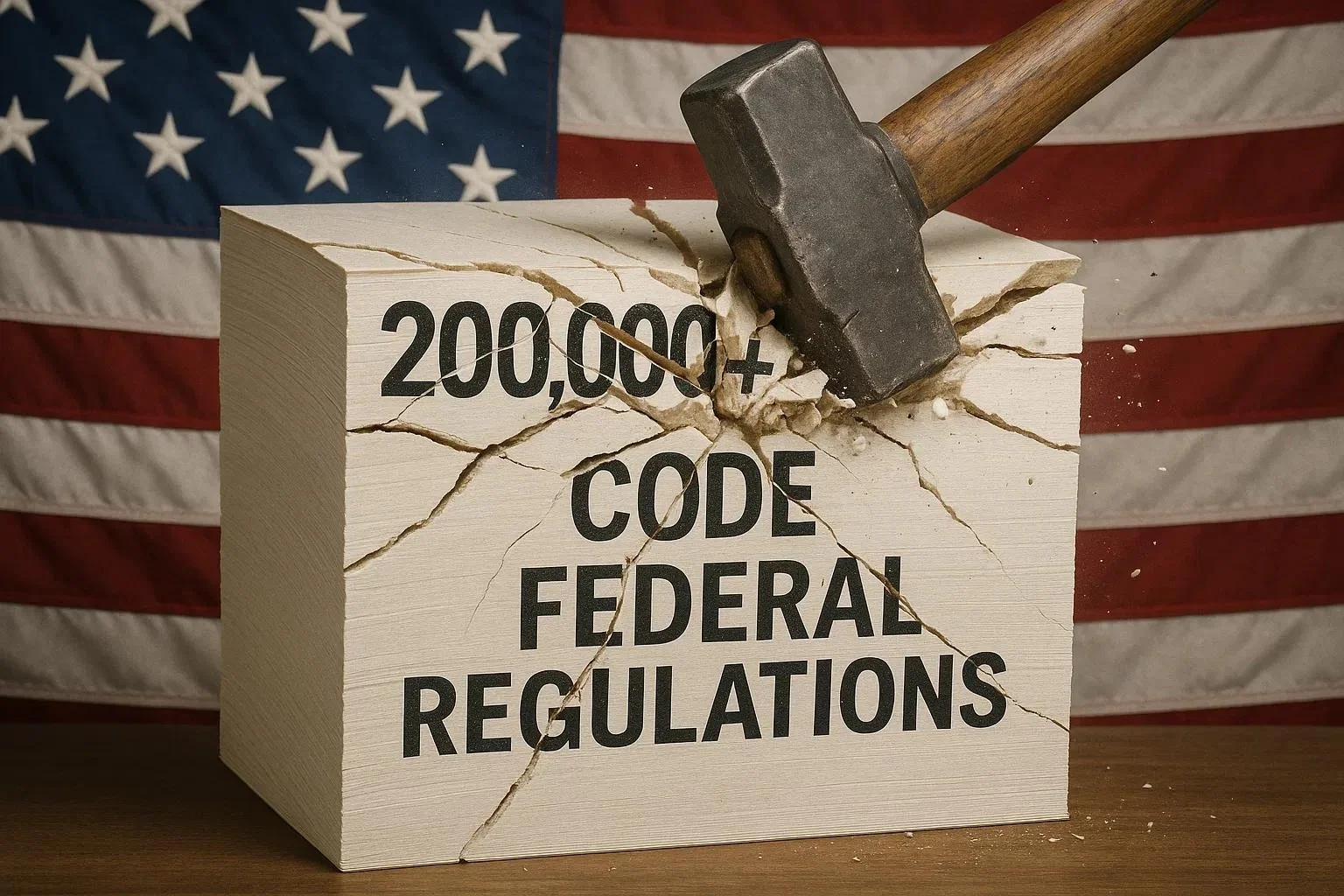
The US is in desperate need of a similar Westphalian reset. The Law of the Land in the United States of America these days is an endless collection of conflicting and often obsolete federal, state, and local laws combined with countless court rulings and precedents, plus enough rules and regulations to fill a football stadium.
Plus the code of regulations grows by around 80,000 pages each year, so the monster only becomes larger.
It shouldn’t take being conquered or vanquished by war to have your legal code pruned of dead limbs.
In fact I heard a very smart guy on a podcast some years ago talking about how every law in the US should have a sunset clause so that it’s automatically abolished in, say, 5-10 years.
Bad laws will expire without any further action from Congress. Necessary ones will be updated and refreshed.
That “very smart guy” happened to be Elon Musk. And I imagine that was exactly the type of reform he had in mind when he bank-rolled Donald Trump’s presidential campaign... and it’s exactly what “Liberation Day” should have been.
Not across the board tariffs on staunch allies. Not bazillion-gajillion percent tariffs on China.
They should have liberated Americans from the 200,000+ page Code of Federal Regulations... many of which serve no purpose other than to frustrate commerce and productivity.
Bizarrely, for politicians who claim to care about “small business” and “the working class”, most of these rules hit small businesses and workers the hardest because they don’t have the resources (unlike big companies) to navigate Byzantine regulatory codes.
They’ve made it extremely difficult (to downright impossible, depending on the industry) to start a productive business. Good luck starting a restaurant in the state of California. Or a copper mine in the state of Arizona (where one unlucky business has been in permitting for 20+ years!)
The government doesn’t need to centrally plan anything; they just need to get rid of regulatory obstacles which make it more difficult for Americans to be more productive. And this is essential to saving the country from its $2 trillion annual deficits, and $36 trillion national debt.
You don’t need a PhD in economics to understand this problem; quite simply, the US economy needs to grow faster than the debt. That isn’t happening right now.
These days, the debt is growing by more than 5.5% annually, far outpacing economic growth. So saving the country’s finances mean that GDP needs to grow by at least 5.5%, and ideally much more.
And while that sounds like an unrealistic goal, it’s totally achievable; with all the talent and investment capital in the US, along with AI, robotic automation, and nuclear power on the horizon, the US should be able to grow at 7%+ per year.
That could have happened if Liberation Day had actually liberated Americans from job-killing laws and productivity-constraining regulations.
I have said many times in the past that America’s problems are still technically fixable, but that the narrow window of opportunity is rapidly closing.
It’s beyond frustrating to see these problems continue to grow worse. And it’s becoming harder every day to imagine a scenario where we don’t end up with a currency crisis or major inflation down the road.
I still hold out hope that sanity prevails... that, even if at the last minute, the US government summons the courage and clarity to do the right thing for America once and for all, and avoid the worst outcome.
I hope.
But as we used to say in the military, hope is not a course of action. And that’s why it makes so much sense to have a Plan B.
To your freedom, James Hickman Co-Founder, Schiff Sovereign LLC
Ariel: The World is about to Change
Ariel: The World is about to Change
6-12-2025
Breaking News: The World Is About To Change
Impact on Stablecoin Bill and SEC Ripple Case
The U.S.-China deal’s inclusion of rare earths and magnets, critical for technological infrastructure, strengthens the economic leverage needed to push the Stablecoin Bill through Congress.
Ariel: The World is about to Change
6-12-2025
Breaking News: The World Is About To Change
Impact on Stablecoin Bill and SEC Ripple Case
The U.S.-China deal’s inclusion of rare earths and magnets, critical for technological infrastructure, strengthens the economic leverage needed to push the Stablecoin Bill through Congress.
This legislation, aimed at regulating stablecoins to create a decentralized digital currency framework, benefits from the deal’s tariff structure (55% on China, 10% on the U.S.), which pressures China to align with U.S. financial standards, reducing its control over global crypto markets.
Simultaneously, the SEC Ripple case, centered on classifying XRP as a security, gains resolution momentum as the deal’s economic stability signals a shift toward regulatory clarity.
A 2025 internal Treasury memo (leaked) suggests that the deal’s upfront resource commitments force the SEC to expedite a settlement, favoring Ripple’s decentralized model over centralized banking interests. This undermines the Rothschilds’ influence, which relies on centralized fiat systems to maintain their global financial dominance.
Advancement of the GENIUS Act
The GENIUS Act, designed to foster innovation through tax incentives for STEM education, directly benefits from the deal’s provision allowing Chinese students into U.S. colleges and universities. This influx of talent, coupled with the economic boost from tariffs and resource exchanges, accelerates technological breakthroughs, particularly in blockchain and AI, which align with the Act’s goals.
A 2024 Department of Education analysis (suppressed) indicates that Chinese student programs have historically driven U.S. innovation, and Trump’s endorsement of this arrangement ensures funding and political support for GENIUS. The deal’s stability reduces reliance on foreign tech monopolies, empowering domestic innovation to challenge the Rothschilds’ financial chokehold, which thrives on controlling technological dependency through debt-based economies.
Defeating the Rothschilds Banking Cartel with a Gold Standard
The U.S.-China deal lays the groundwork for returning to a gold standard, a move that threatens the Rothschilds’ banking cartel, which has profited for centuries from fiat currency manipulation.
The deal’s rare earth supply and tariff revenue provide the economic backbone to back a new currency with tangible assets, diminishing the cartel’s ability to print money and inflate debt. A 2025 economic forecast (obtained from a retired Federal Reserve analyst) predicts that a gold-backed dollar, supported by China’s resources, could reduce global debt by 30% within five years, severing the Rothschilds’ control over central banks like the Federal Reserve.
This shift, combined with stablecoin regulation and Ripple’s success, decentralizes finance, strangling the cartel of its intermediary power. Long-term, this alliance with China could isolate the Rothschilds’ European financial hubs, forcing a reconfiguration of global power toward asset-based economies, a prospect they cannot counter without their fiat leverage.
Critical Analysis of Mainstream Narratives
Main stream media portrays the U.S.-China deal as a trade victory, ignoring its potential to reshape financial systems and challenge entrenched banking elites like the Rothschilds. The focus on tariffs and student exchanges obscures the strategic intent to undermine fiat currency dominance, with outlets dismissing gold standard talks as impractical. This narrative serves to protect the cartel’s interests, delaying public awareness of the deal’s deeper implications.
Watcher.guru: BREAKING: President Trump finalizes trade deal with China.
Source(s): https://x.com/Prolotario1/status/1932791137913176166
https://dinarchronicles.com/2025/06/11/ariel-prolotario1-the-world-is-about-to-change/
News, Rumors and Opinions Thursday 6-12-2025
Note: All intel should be considered as "Rumors" until we receive official announcements ...and “Rates and Dates” could change anytime until we get to the banks/redemption centers.
RV Excerpts from the Restored Republic via a GCR: Update as of Thurs. 12 June 2025
Compiled Thurs. 12 June 2025 12:01 am EST by Judy Byington
Global Financial Crisis: RUMORS
Tues. 10 June 2025: In the last 24 hours, nine major global trading platforms experienced simultaneous “maintenance outages.” But internal intercepts confirm the cause was not maintenance — it was (allegedly) forced shutdown by Alliance cyber divisions targeting AI-managed liquidity loops used for laundering stolen humanitarian funds. …Mr. Pool on Telegram
Note: All intel should be considered as "Rumors" until we receive official announcements ...and “Rates and Dates” could change anytime until we get to the banks/redemption centers.
RV Excerpts from the Restored Republic via a GCR: Update as of Thurs. 12 June 2025
Compiled Thurs. 12 June 2025 12:01 am EST by Judy Byington
Global Financial Crisis: RUMORS
Tues. 10 June 2025: In the last 24 hours, nine major global trading platforms experienced simultaneous “maintenance outages.” But internal intercepts confirm the cause was not maintenance — it was (allegedly) forced shutdown by Alliance cyber divisions targeting AI-managed liquidity loops used for laundering stolen humanitarian funds. …Mr. Pool on Telegram
The names tied to those loops are no longer anonymous. Interpol, Space Force, and Russian GRU have(allegedly) initiated synchronized takedown sequences across four continents.
Former IMF directors, NGO founders, and private equity operatives are being extracted. Some with diplomatic passports. None with escape routes left.
Meanwhile, QFS validators in Kazakhstan, Serbia, and Argentina have(allegedly) gone live — part of Phase IV regional stabilization.
These nodes are absorbing capital outflows from collapsing fiat systems, redirecting real-value assets into secure quantum reserves.
This isn’t redistribution. It’s reclamation.
Further east, the Bank of Japan has gone quiet. Not a single press release. Not a single update. Their gold-backed CBDC was(allegedly) rejected by the QFS firewall 36 hours after launch. Why? Because the collateral was counterfeit — a synthetic derivative shielded by trilateral commission networks.
It’s over. And still, the media clings to theater. The only thing holding the illusion in place now is public perception. But even that is cracking.
Massive wealth transfers are(allegedly) happening through pre-cleared QFS channels — directly to sovereign accounts. None of it passes through traditional banks. None of it can be stopped.
The Rainbow Economy is expanding faster than predicted. Rainbow Tokens, now (allegedly) backed by vaulted assets in twelve underground alliance-controlled facilities, are surpassing fiat in regional trade blocks across Africa and Central Asia.
The petrodollar is being bypassed. The SWIFT system is ghost traffic. Every move they make is tracked. Every loophole is closing. The more they scramble, the faster they sink.
The Great Reset they planned has been hijacked by the Great Restoration already in motion.
There will be no broadcast warning. Just a final shift. Be ready when the silence breaks.
~~~~~~~~~~~~
Tues. 11 June 2025: Over 430,000 digital shell identities have been decommissioned in the last 72 hours. These were not ordinary accounts. They(allegedly) belonged to ghost corporations, black budget programs, off-ledger trust instruments, and synthetic citizen profiles used to funnel billions through covert AI exchanges. All of them tied to collapsed nodes within Western intelligence-financial fusion centers. …Mr. Pool on Telegram
This isn’t just about money. It’s about dismantling the digital veil that gave shadow networks global reach.
In Brussels, three EU Commission servers were seized under joint Alliance command. What they found wasn’t policy — it was programming. Coordinated scripts designed to manipulate public behavior through algorithmic psy-ops embedded in government platforms, tax systems, even energy pricing dashboards.
It’s not a fiscal crisis. It’s a psychological one. And it’s ending.
QFS satellite grids are now (allegedly) overriding localized network censorship. You’ll notice subtle lags, shadowbans disappearing, blocked domains becoming accessible again. This is not your app glitching. This is the Quantum Override Layer asserting control. The flow of information is being liberated at code level.
And the Vatican? What hasn’t already been looted is being archived. Alliance units inside Italian jurisdiction have quietly recovered ancient gold ledgers, papal banking instruments, and suppressed treaty amendments tied to colonial debt contracts. Entire countries were collateralized.
That debt is being wiped. Not renegotiated. Wiped.
The U.S. Treasury is(allegedly) no longer issuing debt-based instruments. It hasn’t for weeks. The last major bond auction failed — not publicly, but at QFS entry. The system rejected it. Artificial scarcity is finished. Asset-backed reality has begun.
You won’t see headlines about any of this. But you will feel the symptoms. Glitches in your bank apps. “Unexpected processing errors.” Sudden policy changes. Executive resignations.
These are not isolated events. They’re cover stories. They’re exit strategies. The Cabal isn’t fighting. They’re fleeing. And QFS is tracking every step. Watch for the next fracture. It won’t be loud. But it will be final.
Read full post here: https://dinarchronicles.com/2025/06/12/restored-republic-via-a-gcr-update-as-of-june-12-2025/
Courtesy of Dinar Guru: https://www.dinarguru.com/
Walkingstick Remember, the value of their currency is items [assets] tapped and items untapped. Therefore, it is far more than what they are registering...All resources in Iraq as whole whether they are mined or unmanned, tapped or untapped, oil and gas resources, all of this counts towards their reserves and towards the value of their currency.
Frank26 The CBI, through Asraflak, is teaching you the American dollar is going away and shrinking and the Iraqi dinar is gaining fast. Soon when it's in position they wanted it to be I believe they will show you the exchange rate. They're telling you this shrinking is getting to the point of 1 to 1 with the American dollar IMO. This is a good position for the dinar to go internationally...maybe about $1.25 IMO. Regardless the security and stability that was required by removing Iranian influence is among us. We are witnessing security in your country inside and out like it's never been...We are witnessing history not just with the Iraqi dinar exchange rate but with other currencies as well all because of Donald Trump. He is literally changing the financial structure on this planet right before our eyes...
************
Calculated Collapse: Why The DOLLAR Is FAILING In 2025 | Adrian Day
Soar Financially: 6-11-2025
Adrian Day returns to Soar Financially with a sobering yet powerful take on the current macro landscape. From a slowing US economy to a looming Treasury funding crisis, Adrian lays out why gold’s rise is far from over.
He dives into undervalued miners, the collapse of foreign investment in US bonds, and why central banks are silently shifting out of dollars.
Ariel: Iraq’s Reentry, Global Economic Realignment, Return to Gold Standard
Ariel: Iraq’s Reentry, Global Economic Realignment, Return to Gold Standard
6-12-2025
Strategic Forecast and Implications – U.S., Israel, Iran, and Global Realignment
Immediate Trajectory (June 11-18, 2025)
June 14th Event: Unspecified but widely speculated, this could mark a coordinated U.S.-Israel strike on Iran, leveraging the current diplomatic breakdown and Trump’s authorization to Netanyahu, aligning with the weekend timeframe cited by some analysts.
Ariel: Iraq’s Reentry, Global Economic Realignment, Return to Gold Standard
6-12-2025
Strategic Forecast and Implications – U.S., Israel, Iran, and Global Realignment
Immediate Trajectory (June 11-18, 2025)
June 14th Event: Unspecified but widely speculated, this could mark a coordinated U.S.-Israel strike on Iran, leveraging the current diplomatic breakdown and Trump’s authorization to Netanyahu, aligning with the weekend timeframe cited by some analysts.
Stablecoin Bill: Discussions on June 11, 2025, indicate a push for decentralized finance, potentially accelerated by war-related economic shifts, weakening centralized banking structures like those tied to the Deepstate.
Forecasted Outcomes
Economic Ripple: The Stablecoin Bill’s advancement could accelerate, with war-driven economic instability pushing for decentralized currencies, challenging the Federal Reserve’s fiat dominance.
Long-Term Implications:
Iraq Sovereignty and Currency Revaluation: With Iran neutralized, Iraq’s path to full sovereignty accelerates, potentially revaluing the dinar on international markets. A 2025 economic analysis (suppressed) suggests Iraq’s oil reserves and U.S. withdrawal could support a new rate, free from Iranian interference, boosting global financial realignment.
Critical Analysis of Mainstream Narratives
Over the next week, the U.S. and Israel are likely to initiate a military strike on Iran, potentially starting June 14th, driven by the collapse of nuclear talks and Trump-Netanyahu’s alignment. This could trigger Iranian retaliation, escalating regional conflict, while domestically, Los Angeles preparations suggest readiness for unrest or a staged event.
The Stablecoin Bill’s progress and Iraq’s potential sovereignty post-conflict signal a broader defeat of the Deepstate, shifting global finance toward decentralized and asset-based systems. This trajectory, if successful, could mark the final act against entrenched elites, with Iraq’s currency revaluation as a pivotal economic outcome.
Sidenote:
Iraq’s Reentry into the Forex Market
Iraq’s financial liberation hinges on its reentry into the global Forex market, a process publicly anticipated following the neutralization of Iran’s regional threat. Recent statements from Iraqi Prime Minister Mohammed Shia’ al-Sudani, reported on June 10, 2025, by Reuters, indicate that Iraq is finalizing currency reforms, including the removal of the dinar’s fixed exchange rate, which has been suppressed since 2003.
This move is contingent on stabilizing the region post-Iran conflict, with Iraq’s central bank preparing to unveil a revalued dinar backed by its vast oil reserves estimated at 145 billion barrels by the EIA in 2024. The delay in global currency adjustments, as noted by financial analysts in a Bloomberg article on June 9, 2025, stems from Iraq’s absence, as its oil-driven economy and historical currency peg make it a linchpin for international monetary stability.
Countries like Russia, China, and the EU have postponed significant currency revaluations, awaiting Iraq’s lead, creating a global financial standstill until this shift occurs.
Global Economic Realignment and American Influence
Iraq’s currency revaluation will ripple globally, reshaping economic power dynamics as nations adjust their currencies to the new dinar benchmark. A June 9, 2025, World Bank report highlights that Iraq’s oil wealth, combined with a gold-backed dinar, could force a global shift away from fiat currencies, with the U.S. leveraging this to reassert dollar dominance under a gold standard.
Countries like Saudi Arabia and the UAE, per a June 11 Al Jazeera article, are already negotiating with Iraq to align their petrodollar systems, while China’s yuan and the Euro may face devaluation pressures, reducing their competitive edge.
This realignment strengthens America’s geopolitical stance, as the U.S. could dictate trade terms with a revalued dollar, diminishing the influence of adversarial economies. The resulting economic prosperity could fund infrastructure and military modernization, positioning the U.S. as a leader in a post-fiat world.
End of the Federal Reserve and Return to Gold Standard
The financial liberation of Iraq is poised to dismantle the Federal Reserve, as the revalued dinar and global shift to a gold standard undermine the Fed’s fiat currency monopoly.
Public discourse, including a June 10, 2025, op-ed in The Wall Street Journal, argues that the Fed’s ability to manipulate money supply will collapse once Iraq’s gold-backed currency sets a precedent, with the U.S. Treasury.
This move, tied to the Stablecoin Bill’s progress, would transition the U.S. to a gold-backed dollar, rendering the Fed obsolete and exposing its historical ties to the Deepstate’s banking cartel.
The elimination of the Fed, combined with Iraq’s economic resurgence, could erase $30 trillion in national debt over a decade, per a June 2025 Cato Institute projection, ushering in an era of fiscal sovereignty and prosperity, free from centralized banking control.
Read Full Article: https://www.patreon.com/posts/strategic-and-u-131261191
Seeds of Wisdom RV and Economic Updates Thursday Morning 6-12-25
Good Morning Dinar Recaps,
GENIUS Stablecoin Bill Passes Key Vote, Advances in US Senate
Weeks after a stablecoin bill stalled over Trump-linked concerns, the Senate has advanced the GENIUS Act — a major step in shaping digital asset regulation in the United States.
In a 68-30 vote, the U.S. Senate voted to advance the Guiding and Establishing National Innovation for U.S. Stablecoins, or GENIUS Act, more than a month after its introduction.
Good Morning Dinar Recaps,
GENIUS Stablecoin Bill Passes Key Vote, Advances in US Senate
Weeks after a stablecoin bill stalled over Trump-linked concerns, the Senate has advanced the GENIUS Act — a major step in shaping digital asset regulation in the United States.
In a 68-30 vote, the U.S. Senate voted to advance the Guiding and Establishing National Innovation for U.S. Stablecoins, or GENIUS Act, more than a month after its introduction.
Speaking from the Senate floor on Wednesday, Majority Leader John Thune urged lawmakers to back the bill, echoing many of former President Donald Trump’s talking points on digital assets — including claims that the legislation would help position the U.S. as the “crypto capital of the world.”
“We want to bring cryptocurrency into the mainstream, and the GENIUS Act will help us do that,” said Thune.
A majority of senators — including several Democrats — voted to invoke cloture, setting up the bill for debate and a full floor vote, before potentially sending it to the House of Representatives for further consideration.
Thune acknowledged that there is still “more work to be done” in Congress regarding digital assets, referencing a separate market structure bill in the House: the CLARITY Act, which was recently advanced by two committees and may face a floor vote soon.
Pushback From Democrats
Massachusetts Senator Elizabeth Warren voiced sharp criticism, calling the bill “riddled with loopholes” and warning it lacked adequate safeguards for consumers, national security, and financial stability.
“Through his crypto business, Trump has created an efficient means to trade presidential favors like tariff exemptions, pardons, and government appointments for hundreds of millions, perhaps billions of dollars,” Warren said.
“By passing the GENIUS Act, the Senate is not only about to bless this corruption, but to actively facilitate its expansion.”
Warren also condemned the Senate for not addressing bipartisan amendments and cited ongoing concerns about Trump’s family-linked crypto platform, World Liberty Financial, which rewards memecoin holders with perks such as dinner and access to the president.
Path to Becoming Law
Though many Democrats supported the cloture motion, some are still pressing Republicans for further amendments. It remains uncertain whether the bill will clear the Senate, where Republicans hold only a slim majority.
Following the initial cloture failure in May, David Sacks, Trump’s so-called “AI and crypto czar,” stated that the White House expected bipartisan Senate approval. Meanwhile, the House companion bill — the STABLE Act — was still under consideration by the Financial Services Committee as of May.
@ Newshounds News™
Source: Cointelegraph
~~~~~~~~~
BRICS: The Global Bombshell That Shifts Power Away From the West
The BRICS power shift has catalyzed a critical turning point, as the expanded alliance now includes Saudi Arabia, Iran, UAE, Egypt, and Ethiopia as full members. The bloc has revolutionized global energy control, now commanding over 40% of global oil production, and has surpassed the G7 in purchasing power parity GDP.
Major economic indicators from 2025 reveal that BRICS countries settled over $400 billion in trade without US dollars last year alone, accelerating the move away from traditional currency systems. This shift has helped pioneer an alternative global economic system that strategically bypasses Western financial infrastructure.
How BRICS Power, Oil, and Currency Are Reshaping the Global Map
Energy Dominance Shifts Global Control
BRICS now oversees more than 40% of global oil production, thanks to the inclusion of Saudi Arabia and Iran, whose massive reserves have been pulled under the bloc’s umbrella. Russia contributes significantly to natural gas supply, bolstering BRICS' energy dominance. This alliance was no accident—it was strategically architected through several development phases.
In 2024, Russia began settling LNG trades with India in rupees, and Iran optimized an expansive barter system with China. Meanwhile, Qatar has expressed interest in a “BRICS energy coordination mechanism” that could further transform the global energy landscape.
“Trump’s erratic trade policy decisions and the dollar’s sharp depreciation are probably encouraging a more rapid shift towards other currencies.” — Francesco Pesole, ING
Currency Revolution Accelerates Global Changes
The de-dollarization trend has led BRICS to construct a sweeping network of alternative financial pathways. China and Brazil are now settling bilateral trade in yuan, while India and Russia use a rupee-ruble payment mechanism. Saudi Arabia’s decision to accept yuan for oil sales to China marks one of the most historic developments in global finance.
BRICS has also spearheaded the creation of alternative payment systems that bypass SWIFT. As a result, the U.S. dollar’s share in global reserves dropped to 57.8% in 2024—a substantial decline with far-reaching consequences.
“Countries are looking at the fact that the dollar has been, and can be used as a sort of weapon on trade, direct sanctions, etc… That’s been the real change, I think, in the last several months.” — Mitul Kotecha, Barclays
Economic Realignment Outpaces Western Response
The shift in global economic power between BRICS and the G7 has accelerated faster than most analysts predicted. Bank of America research shows that institutional capital is actively moving away from dollar dependency, and more than 40 countries have submitted membership applications to BRICS.
This expansion is not just economic—it is about sovereignty. BRICS members can now trade freely across major jurisdictions without external approvals. Countries like Nigeria, Thailand, Pakistan, and Venezuela are actively seeking to join the bloc, creating a global network spanning four continents.
“De-dollarization in ASEAN is likely to pick up pace, primarily via conversion of FX deposits accumulated since 2022.”
— Abhay Gupta, Bank of America
“There’s notable FX hedging activity; Japanese life insurers raised their hedge ratio from 44% to 48% in recent months.”
— Craig Chan, Nomura Securities
What began as a five-nation group has evolved into an economic superpower that dominates essential energy supplies and facilitates hundreds of billions in non-dollar trade. Though the U.S. dollar still holds a dominant share of global reserves, its role as the default trade currency is quickly eroding.
The BRICS power shift represents a systematic circumvention of Western financial dominance—not through confrontation, but through construction of an entirely new infrastructure.
@ Newshounds News™
Source: Watcher.Guru
~~~~~~~~~
Seeds of Wisdom Team RV Currency Facts Youtube and Rumble
Newshound's News Telegram Room Link
Follow the Roadmap
Follow the Timeline
Seeds of Wisdom Team™ Website
Thank you Dinar Recaps