
“Tidbits From TNT” Friday Morning 12-19-2025
TNT:
Tishwash: A parliamentarian reveals the difficulty of meeting the demands of the protesting engineers due to the budget.
MP Haider Al-Salami stated on Thursday that the demands of the protesting engineers have not been met for more than four months, despite his addressing the Prime Minister to include their rights to appointment within the budget amendments .
Al-Salami explained in a statement received by Al-Sa’a Network that “the Ministry of Finance was unable to implement the request due to the budget law before the amendment,” noting that “this reflects the difficult financial situation the country is going through as a result of previous wrong financial policies.”
TNT:
Tishwash: A parliamentarian reveals the difficulty of meeting the demands of the protesting engineers due to the budget.
MP Haider Al-Salami stated on Thursday that the demands of the protesting engineers have not been met for more than four months, despite his addressing the Prime Minister to include their rights to appointment within the budget amendments .
Al-Salami explained in a statement received by Al-Sa’a Network that “the Ministry of Finance was unable to implement the request due to the budget law before the amendment,” noting that “this reflects the difficult financial situation the country is going through as a result of previous wrong financial policies.” link
Tishwash: Prime Minister Mohammed Shia' al-Sudani chairs a special meeting on the oil and gas sectors.
Prime Minister Mohammed Shia Al-Sudani chaired a special meeting on Wednesday concerning the oil and gas sectors, in the presence of the Ministers of Oil and Finance, a number of advisors, and senior staff from the Ministry of Oil and SOMO.
His Excellency affirmed the government's intention to review the financial and economic aspects and raise the efficiency of the Ministry of Oil's sectors, as they are the main source of revenue for the state's general budget.
The meeting discussed plans to develop crude oil production and exports, as well as efforts to achieve self-sufficiency and export petroleum products, and to determine the rates of local consumption.
The meeting addressed the localization of industries necessary for the oil sector, and the development of national capabilities in the public and private sectors in the fields of drilling, extraction, mechanical engineering, and others, in order to rely on national personnel in these aspects. link
************
Tishwash: Nasiriyah goes digital... FTTH fiber optic internet has reached Al-Jubayish
The IT manager is optimistic
Nasiriyah is nearing a complete digital transformation, a goal pursued by a department called the "Digital Transformation Center," as confirmed by Hussein Muhi Hariz, Director of Communications and Information Technology in Dhi Qar.
He tells 964 Network that the FTTH (Fiber to the Home) internet has reached all areas of Dhi Qar, even Al-Jubayish in the south and Al-Fajr in the north. Nasiriyah has reached 98% completion, making Dhi Qar the second most successful governorate after Baghdad.
With the arrival of this service, experts and officials expect the era of poor internet in Iraq to end, eliminating the need for wireless internet and its many problems. However, tower owners have a different opinion, and 964 Network has previously documented their repeated protests
Hussein Muhi Hariz - Director of Communications and Information Technology in Dhi Qar, for 964 Network :
The number of subscribers to the fiber optic cable service has reached 85,000 in Dhi Qar, after the service was non-existent or at a low level, and most of the districts and sub-districts have been covered, and it is in a state of continuous development.
There are projects between Dhi Qar and neighboring governorates such as Muthanna, Basra, Maysan, Wasit and Diwaniyah, which are related to international projects and capacity transfer and are currently under implementation. There are also other projects to provide protection routes to ensure that communication service in the governorate is not interrupted.
Previously, only one company was responsible for the (FTTH) project, and now there are two companies. The completion rate in Nasiriyah has reached 98%, and it has been almost completely completed in one of the districts.
Most government departments have been equipped with internet services through e-government, and we have maintenance teams in three districts, North, South and the governorate center, to ensure that the internet service is not interrupted.
We have a committee specializing in promoting citizens’ subscription to (FTTH) services, which offer services that are much better than “wireless” services, as they are secure and of high quality, and most of our staff are trained to respond quickly in case of any damage.
The terrain of Dhi Qar is different from others due to the presence of marshes and agricultural lands, and this is the biggest challenge.
Interaction is ongoing between government departments, and we do not start any project until we have obtained approvals from the relevant departments to prevent conflicts.
The Minister of Communications took it upon herself to equip schools with free internet, and Dhi Qar was in second place after the capital, Baghdad, with 300 schools and the number is increasing.
We have completed 98 communication booths in Nasiriyah Central Prison and the Correctional Prison to provide a secure communication service, under the supervision of the competent security agencies to ensure that inmates can contact their families.
Dhi Qar Governorate is distinguished by the presence of e-government. It is the first governorate in Iraq to work on the subject of e-government, and the Digital Transformation Center has been activated and opened in the governorate. God willing, the future will be better for activating e-government and the official government email.
Even districts far from Nasiriyah, such as Al-Jubayish district (90 km south) and Al-Fajr district (120 km north), were included in the (FTTH) services and the service reached them. link
Mot: a Motisum!! -- How to Get Rid of Junk

Mot: I Finded Him I Dids!!!!

Stephanie Starr: Connect the Dots, this is Getting Interesting
Stephanie Starr: Connect the Dots, this is Getting Interesting
12-17-2025
Stephanie Starr @StephanieStarrC
CONNECT THE DOTS… THIS IS GETTING INTERESTING
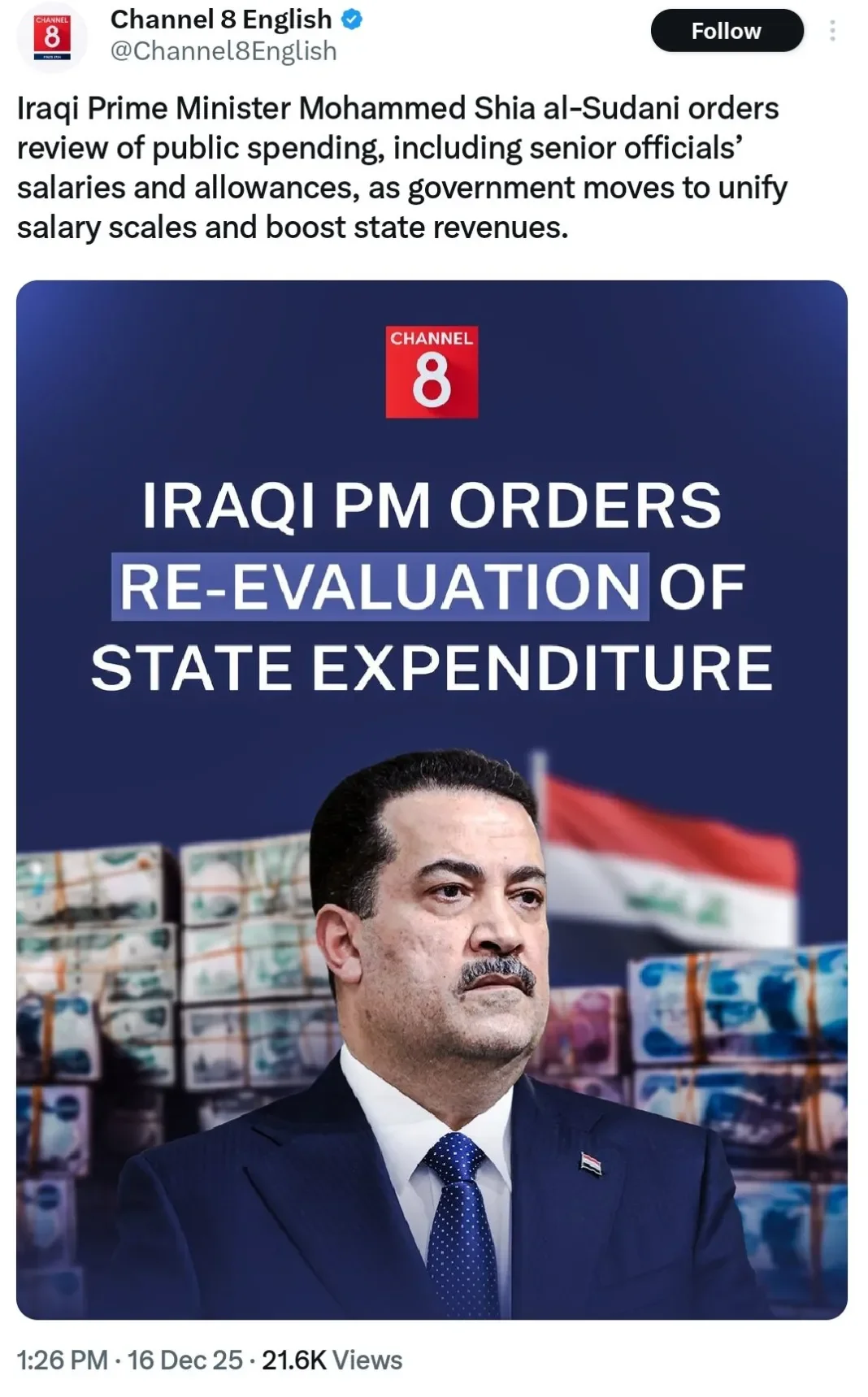
Iraq’s PM just ordered a re-evaluation of state spending — senior salaries, allowances, and unified pay scales — while officials admit oil alone can’t cover salaries and expenses anymore.
Stephanie Starr: Connect the Dots, this is Getting Interesting
12-17-2025
Stephanie Starr @StephanieStarrC
CONNECT THE DOTS… THIS IS GETTING INTERESTING
Iraq’s PM just ordered a re-evaluation of state spending — senior salaries, allowances, and unified pay scales — while officials admit oil alone can’t cover salaries and expenses anymore.
That’s not panic…
That’s pre-reform behavior.
When a country:
Reviews salaries
Tightens budgets
Talks about “other alternatives”
Refuses devaluation
And pushes banking & fiscal reform
…it’s usually preparing for a NEW financial framework, not collapse.
Media says “currency crisis” — but insiders know this looks more like:
Structural pressure
Fiscal stress-testing
Justification for BIG moves
And let’s not forget:
Banking reform is underway
Digital systems are rolling out
Budget laws & emergency mechanisms are in place
International eyes are watching closely
This feels less like IF and more like WHEN Pressure + Preparation = Change
The pieces are moving… stay sharp.
Look below for more information that came out today.
THIS IS NOT SMALL. THIS IS HISTORIC.
The U.S. just voted to repeal the 1991 & 2002 war authorizations against Iraq — officially ending the legal framework of war.
Let that sink in.
No war status
No sovereign-risk excuse
No more “post-conflict” label
AND ON THE SAME DAY
U.S. lawmakers meet with the Special Envoy for Iraq to discuss Iraq’s future — not war, but rebuilding, sovereignty, and independence.
Meanwhile:
Iraq is tightening budgets
Reviewing spending
Reforming banks
Refusing devaluation
Ending decades-old restrictions
This is what chapter-closing looks like.
This is what pre-normalization looks like.
This is what systems reset before value changes look like.
Watch actions, not hype. The legal, political, and economic doors are opening — fast.
Seeds of Wisdom RV and Economics Updates Thursday Afternoon 12-18-25
Good Afternoon Dinar Recaps,
🌱 A Message to Our Currency Holders🌱
If you’ve been holding foreign currency for many years, you were not foolish.
You were not wrong to believe the global financial system would change.
What failed was not your patience — it was the information you were given.
For years, dates, rumors, and personalities replaced facts, structure, and proof. “This week” predictions created cycles of hope and disappointment that were never based on how currencies actually change.
That is not your failure.
Good Afternoon Dinar Recaps,
🌱 A Message to Our Currency Holders🌱
If you’ve been holding foreign currency for many years, you were not foolish.
You were not wrong to believe the global financial system would change.
What failed was not your patience — it was the information you were given.
For years, dates, rumors, and personalities replaced facts, structure, and proof. “This week” predictions created cycles of hope and disappointment that were never based on how currencies actually change.
That is not your failure.
Our mission here is different:
• No dates • No rates • No hype • No gurus
Instead, we focus on:
• Verifiable developments • Institutional evidence
• Global financial structure • Where countries actually sit in the process
Currency value changes only come after sovereignty, trade, banking, settlement systems, and fiscal coordination are in place. History and institutions confirm this sequence.
You will see silence. You will see denials. That is not delay — that is discipline.
Protect your identity. Organize your documents.
Verify everything.
Never hand your discernment to anyone who cannot show proof.
You deserve truth — not timelines.
Seeds of Wisdom Team
Newshounds News
~~~~~~~~~~
Trump Backs Gas Deal in Middle East Peace Plan
U.S.-backed Israel–Egypt energy agreement strengthens regional power balance
Overview
The Trump administration backed a landmark natural gas export deal between Israel and Egypt, positioning energy cooperation as a diplomatic bridge.
The agreement is valued at approximately $35 billion, making it Israel’s largest gas export deal to date.
Gas will be supplied from Israel’s Leviathan field to Egypt through 2040, supporting Egypt’s ambition to become a regional LNG hub.
Washington views the deal as a step toward broader Middle East normalization, including renewed momentum behind the Abraham Accords.
Key Developments
Israel will export approximately 130 billion cubic meters of natural gas to Egypt, with Chevron, NewMed Energy, and Ratio Petroleum as partners.
U.S. diplomatic pressure helped finalize the agreement, after pricing concerns initially delayed approval.
Egypt currently imports roughly 20% of its natural gas from Israel, highlighting Cairo’s growing reliance on cross-border energy flows.
The deal is seen as a precursor to a possible Trump-Netanyahu-Sisi summit, expanding cooperation beyond security into economic integration.
Why It Matters
This gas agreement serves as a strategic economic anchor at a time of strained regional relations following the Gaza conflict. By tying Israel and Egypt together through long-term energy dependency, the U.S. is advancing a pragmatic peace framework that relies on economic incentives rather than political guarantees alone, reshaping regional power dynamics while countering Iranian influence.
Why It Matters to Foreign Currency Holders
Large-scale energy contracts drive sustained foreign-exchange flows, reinforcing demand for settlement currencies used in gas trade.
Israel’s export revenues may support currency stability, strengthening fiscal inflows tied to long-term contracts.
Egypt’s need to finance energy imports affects reserve management, influencing demand for hard currencies and FX liquidity.
Regional energy integration can reduce volatility, making Middle Eastern currencies more attractive to foreign holders over time.
Implications for the Global Reset
Pillar: Energy as Financial Leverage — Energy supply agreements increasingly replace military alliances as tools of influence.
Pillar: Regional Currency Realignment — Long-term trade flows reshape FX demand and reserve strategies beyond Western markets.
This is not just politics — it’s global finance restructuring before our eyes.
Seeds of Wisdom Team
Newshounds News™ Exclusive
Sources
~~~~~~~~~~
BRICS Enters Second Stage of Expansion
Alliance signals deeper integration, partner-state pathway, and sustained global realignment
Overview
BRICS has officially entered a second stage of expansion, confirmed by Russia’s BRICS Sherpa Sergey Ryabkov.
No fixed timeline or list of incoming countries was provided, underscoring strategic flexibility.
A new “partner state” category has emerged, enabling cooperation with a broader set of states without full membership rights.
Russia’s 2023 Chairmanship oversaw the first major expansion, integrating new members smoothly.
Key Developments
Partner-state status allows staged entry and influence without full accession, broadening BRICS reach.
Indonesia joined as a full member in January 2025, bringing the bloc to ten members.
Expanded membership and partners now represent a significant share of global population and economic activity, enhancing geopolitical weight.
BRICS declarations from recent summits highlight longer-term cooperative agendas, including finance, trade, and political coordination.
Why It Matters
BRICS’ evolution from an informal dialogue forum to a structured, multi-tiered bloc marks a shift in the architecture of global governance. Expansion strengthens the bloc’s bargaining position in international forums, amplifies non-Western economic influence, and promotes alternatives to existing global norms dominated by Western institutions.
Why It Matters to Foreign Currency Holders
Reduced reliance on the U.S. dollar: BRICS members and partners have increasingly emphasized local-currency trade and settlement systems, expanding cross-border transactions outside the dollar’s dominance.
Alternative payment systems: Developments like interconnected BRICS payment mechanisms aim to facilitate settlements in national currencies, which can reduce exchange risk for holders of BRICS-linked currencies.
Diversification of FX exposure: As BRICS countries and partners deepen financial cooperation, foreign investors and reserve managers may find incentives to diversify portfolios toward BRICS currencies and instruments, potentially altering global FX demand dynamics.
Long-term de-dollarization trends: Though a unified BRICS currency is not imminent, the collective push toward local-currency usage and alternative systems could reduce dollar dominance over time, reshaping foreign exchange landscapes for holders globally.
Implications for the Global Reset
Pillar: Multipolar Governance — BRICS’ structured expansion supports a redistribution of global power away from unipolar Western systems.
Pillar: Financial System Diversification — Sustained local-currency use and alternative settlement mechanisms lay groundwork for a more pluralistic international monetary system.
This is not just politics — it’s global finance restructuring before our eyes.
Seeds of Wisdom Team
Newshounds News™ Exclusive
Sources
~~~~~~~~~~
Seeds of Wisdom Team RV Currency Facts Youtube and Rumble
Newshound's News Telegram Room Link
RV Facts with Proof Links Link
RV Updates Proof links - Facts Link
Follow the Gold/Silver Rate COMEX
Follow Fast Facts
Seeds of Wisdom Team™ Website
Thank you Dinar Recaps
“Tidbits From TNT” Thursday 12-18-2025
TNT:
Tishwash: Al-Alaq: We succeeded in increasing the size of foreign reserves and curbing inflation.
The Governor of the Central Bank of Iraq, Dr. Ali Al-Alaq, affirmed that maintaining financial and banking stability, public financial sustainability, and curbing inflation are among the most difficult challenges facing countries, and cannot be achieved without operating the various economic sectors, especially in light of global economic and financial complexities.
Al-Alaq explained, during a lecture on development financing in light of the global debt crisis, held on the sidelines of the Fifth Regional Conference of the Al-Baraka Forum for Islamic Economics, which is being held in Cairo in partnership with the General Secretariat of the League of Arab States
TNT:
Tishwash: Al-Alaq: We succeeded in increasing the size of foreign reserves and curbing inflation.
The Governor of the Central Bank of Iraq, Dr. Ali Al-Alaq, affirmed that maintaining financial and banking stability, public financial sustainability, and curbing inflation are among the most difficult challenges facing countries, and cannot be achieved without operating the various economic sectors, especially in light of global economic and financial complexities.
Al-Alaq explained, during a lecture on development financing in light of the global debt crisis, held on the sidelines of the Fifth Regional Conference of the Al-Baraka Forum for Islamic Economics, which is being held in Cairo in partnership with the General Secretariat of the League of Arab States
And which was attended by Al-Sabah newspaper, that “the Iraqi scene is facing intertwined pressures and accumulated infrastructure and development challenges, which require diversifying the economy and maximizing public revenues,”
Noting that “public finances in Iraq depend on oil exports by more than 90%, which is an unconventional source subject to fluctuations in global prices, which leads to fluctuations in revenues and weak financial stability, which necessitates finding structural solutions.”
He explained that “the limited economic diversification and weak productive sectors have made Iraq a country that is primarily an importer, which puts continuous pressure on the dollar and the exchange rate, especially with the rise in purchasing power and the increase in daily demand for foreign currency, which directly affects monetary policy, which has achieved great success in balancing the maintenance of price levels, managing liquidity, and stimulating the economy.”
He pointed out that "public spending pressures, particularly on salaries, subsidies and basic services, pose an additional challenge," stressing "the difficulty of reducing these expenditures due to the potential social repercussions, at a time when the central bank is striving to avoid inflation and maintain monetary stability to protect the social structure of the country."
Al-Alaq pointed out that “Iraq has been able in recent years to finance part of the financial deficit through the development of non-oil revenues, while continuing to coordinate with the Prime Minister with the aim of maximizing these resources and reducing dependence on oil,” in an effort to break what he described as the “financial dominance” of oil revenues over the general budget.
The governor of the Central Bank affirmed that "the stability of the exchange rate is a pivotal goal, as it provides a safe cover for investors and citizens," noting that "Iraq has succeeded in raising the size of foreign reserves and linking them to a package of integrated monetary policies, which have contributed to reducing the inflation rate to about 1%, which is among the lowest levels recorded."
He added that "Iraq is in the process of governing the banking sector," revealing that "an update is underway in cooperation between the Central Bank and an international company for a comprehensive reform plan, which includes reviewing bank licenses according to new conditions and standards, in order to strengthen the banking system and raise its efficiency."
Regarding Islamic bonds, Al-Alaq explained that "there are no Islamic bond instruments in Iraq yet," noting that "there is an integrated project submitted by the Central Bank to the Iraqi Parliament for voting, which opens new horizons for financing and investment."
On the issue of debt, Al-Alaq stressed "the need to find an organized and continuous international dialogue between creditors and debtors," calling for "the establishment of a regional platform to organize this dialogue and reduce the gap between the two parties, in order to ensure negotiations without significant losses, and to contribute to the implementation of reforms and the strengthening of the economic base with the support of the participating countries."
He pointed to “international studies showing that losses in the debt file may range between 20% and 25% as a result of poorly considered financing conditions or delays,” stressing that “negotiating platforms contribute to reducing these losses and enhancing international cooperation by improving debt conditions, bridging the information gap, and exchanging experiences in economic reform processes.” link
************
TishWash: ATM machine arrived in Hajiawa district for the first time
The first ATM was installed in Hajiawa district of Raperin Autonomous Administration on Thursday, December 18,
This device is dedicated to serving salaried employees, while those who have “my account”, can now withdraw their salaries in their district without having to go outside Hajiawa.
This step will provide great convenience to the citizens of the region and reduce the pressure on the banks of the central administration of Raperin.
It is worth mentioning that the “My Account” project is a strategic project of the Kurdistan Regional Government to digitize the salary payment system and switch from cash to banking.
Currently, several banks are participating in the “My Account” project and salaried employees can open bank accounts through them, namely:
Cihan Bank: One of the private banks active in this project.
RT Bank: Involved in providing banking services to employees.
Iraqi Islamic Bank: Provides services to salaried employees.
BBAC Bank: It is one of the Lebanese banks operating in the region and participating in the project.
NBI (National Bank of Iraq): One of the banks with the most branches in the provinces. link
Tishwash: Iraq seeks coordination with the International Trade Centre to enhance trade exchange
Border crossings statement
The head of the Border Ports Authority, Omar Al-Waeli, discussed on Thursday ways to enhance cooperation and facilitate international trade during his reception of an official delegation from the United Nations International Trade Centre, coming from Switzerland, headed by Pierre Bonthonno, Director of the Trade and Investment Facilitation Department, and Director of Trade Facilitation and Digital Transformation Programs and Trade Policy Advisor.
Network Statement from the Border Ports Authority
The Chairman of the Border Ports Authority, Lieutenant General Dr. Omar Adnan Al-Waili, received an official delegation from the United Nations International Trade Centre, coming from Switzerland, headed by Ms. Pierre Bonthonno, Director of the Trade and Investment Facilitation Department, the Director of Trade Facilitation and Digital Transformation Programs, and a Trade Policy Advisor, with the aim of strengthening cooperation and facilitating international trade.
The Chairman of the Authority provided a detailed explanation of the Authority’s work and efforts in maximizing non-oil revenues and combating smuggling in all its forms, stressing that the Authority is witnessing a broad digital transformation through the introduction of modern technologies, data exchange between the relevant working parties, networking of sonars at all border crossings, and activating cross-border trade according to the TIR system, with direct follow-up and supervision from the Prime Minister.
Al-Waeli stressed the continued hard work to enhance security and stability at border crossings, which will positively impact the increase in trade exchange in Iraq and facilitate international trade.
For their part, the members of the delegation praised the measures taken by the Authority in the field of governance and electronic oversight, and expressed their admiration for the efforts it is making in the field of combating smuggling and rebuilding border crossings, stressing their readiness to provide technical and training support to improve the Authority’s technical capabilities.
This visit reflects the International Trade Centre’s interest in strengthening cooperation with the Border Ports Authority with the aim of improving work efficiency and promoting stability and economic development. link
************
Mot: ole ""Motisums"" Facts bout - ""Christmas is in the air""

Seeds of Wisdom RV and Economics Updates Thursday Morning 12-18-25
Good Morning Dinar Recaps,
European Bank and Commodity Stocks Lead Markets as Metals Signal Hedging Shift
Rising bank shares and surging metals reflect parallel confidence and caution across global markets.
Good Morning Dinar Recaps,
European Bank and Commodity Stocks Lead Markets as Metals Signal Hedging Shift
Rising bank shares and surging metals reflect parallel confidence and caution across global markets.
Overview
European equities moved higher, led by banking and commodity-linked stocks.
Gold and silver prices remained elevated, signaling persistent hedging demand.
Oil prices firmed amid geopolitical risk, tightening energy market sentiment.
Markets show dual behavior, combining risk appetite with defensive positioning.
Key Developments
Banking stocks drive European gains
European bank shares led market advances as investors responded to resilient earnings expectations and the prospect of prolonged higher interest margins, despite slowing growth in parts of the region.Commodity and mining firms strengthen
Resource-linked stocks rose alongside firmer prices for industrial metals, reflecting both infrastructure demand expectations and investor hedging against currency and inflation risk.Precious metals maintain elevated levels
Gold and silver prices remained near recent highs, underscoring continued demand for hard-asset protection amid geopolitical tensions, currency volatility, and shifting monetary policy expectations.Oil prices react to geopolitical developments
Energy markets advanced as traders priced in supply risk tied to rising global tensions, reinforcing the link between geopolitics and asset pricing.
Why It Matters
The simultaneous rise in bank equities and precious metals highlights a fractured market psychology — confidence in financial institutions coexists with growing demand for hard-asset protection. This duality reflects uncertainty surrounding monetary stability, geopolitical risk, and long-term currency credibility.
Why It Matters to Foreign Currency Holders
For foreign currency holders, elevated precious metal prices signal diminishing trust in fiat stability, even as financial markets rally. When metals rise alongside equities, it often precedes currency volatility, reinforcing the case for diversification into real assets during monetary transition periods.
Implications for the Global Reset
Pillar 1: Hard Assets Regain Strategic Importance
Gold, silver, and commodities are increasingly viewed as monetary hedges, not just investment assets.
Pillar 2: Banking Strength Masks Systemic Risk
Strong bank performance may reflect margin dynamics rather than systemic stability, suggesting underlying vulnerabilities remain unresolved.
This is not just politics — it’s global finance restructuring before our eyes.
Seeds of Wisdom Team
Newshounds News™ Exclusive
Sources
Reuters – European shares rise as banking, commodity stocks lead gains
Reuters – Gold steadies near highs as investors hedge geopolitical and currency risk
~~~~~~~~~~
Wild Currency Swings Spotlight Emerging Markets as Dollar Volatility Intensifies
Sharp FX moves reveal stress fractures in the global monetary system and rising de-dollarization pressure.
Overview
Emerging market currencies experienced sharp swings, outperforming and underperforming in rapid succession.
U.S. dollar volatility amplified FX moves, increasing stress on global trade and capital flows.
Investors selectively rotated into higher-yielding currencies, while avoiding structurally weak markets.
Currency fragmentation accelerated, reflecting a multipolar monetary transition.
Key Developments
Emerging market FX volatility surges
Currency markets across Latin America, Asia, and Eastern Europe experienced heightened volatility as shifting U.S. rate expectations and geopolitical risk drove erratic capital flows.Selective strength replaces broad EM rallies
Rather than a unified emerging-market upswing, investors favored countries with strong reserves, credible policy frameworks, and commodity backing, while penalizing high-debt and politically unstable economies.Dollar swings disrupt trade dynamics
Sudden dollar moves complicated trade settlement and hedging strategies, particularly for import-dependent nations, reinforcing demand for local-currency trade arrangements.De-dollarization narratives gain momentum
Volatility reinforced interest in alternative settlement systems, regional payment frameworks, and reserve diversification — even as the dollar remains dominant.
Why It Matters
Currency volatility is no longer an anomaly — it is becoming structural. The growing dispersion among emerging market currencies highlights a transition from a dollar-centric system toward a fragmented, multi-currency environment, where stability is increasingly determined by national balance sheets and policy credibility.
Why It Matters to Foreign Currency Holders
For foreign currency holders, rising FX volatility means currency values can shift rapidly due to policy intervention, capital controls, or geopolitical shocks. Holding currency exposure now carries higher policy risk, making diversification across currencies, assets, and jurisdictions more critical during the global reset.
Implications for the Global Reset
Pillar 1: Fragmented Monetary Order Emerges
Currency performance is increasingly country-specific, signaling the erosion of a one-size-fits-all global monetary framework.
Pillar 2: Dollar Dominance Faces Structural Friction
While the dollar remains central, volatility and politicization are driving nations to seek alternatives for trade and reserves.
This is not just politics — it’s global finance restructuring before our eyes.
Seeds of Wisdom Team
Newshounds News™ Exclusive
Sources
Reuters – Wild currency swings put emerging markets in the spotlight
Reuters – Dollar volatility fuels pressure on global FX markets
~~~~~~~~~~
Seeds of Wisdom Team RV Currency Facts Youtube and Rumble
Newshound's News Telegram Room Link
RV Facts with Proof Links Link
RV Updates Proof links - Facts Link
Follow the Gold/Silver Rate COMEX
Follow Fast Facts
Seeds of Wisdom Team™ Website
Thank you Dinar Recaps
Seeds of Wisdom RV and Economics Updates Wednesday Evening 12-17-25
Good Evening Dinar Recaps,
Nigeria’s Central Bank Signals Stability as Global Volatility Tests Emerging Markets
Policy reassurance aims to anchor investor confidence amid currency pressure and global financial fragmentation.
Good Evening Dinar Recaps,
Nigeria’s Central Bank Signals Stability as Global Volatility Tests Emerging Markets
Policy reassurance aims to anchor investor confidence amid currency pressure and global financial fragmentation.
Overview
Nigeria’s central bank reaffirmed its reform commitment, emphasizing financial and currency stability.
Officials sought to reassure foreign investors, amid rising global market volatility.
Exchange rate management remains a priority, following recent naira fluctuations.
Emerging markets face mounting pressure, as capital flows grow more selective.
Key Developments
CBN reinforces reform trajectory
The Central Bank of Nigeria (CBN) publicly signaled that it remains committed to structural reforms, disciplined monetary policy, and transparent market mechanisms despite external shocks and global uncertainty.Investor confidence placed front and center
Nigerian officials emphasized consistency in policy direction to prevent capital flight and encourage sustained foreign portfolio and direct investment, particularly as emerging markets compete for scarce global liquidity.Currency stability highlighted as a strategic objective
The CBN acknowledged pressures on the naira but framed recent volatility as part of a broader global trend, not a domestic policy failure. Measures remain focused on reducing distortions and improving FX market functionality.Emerging markets under global strain
Nigeria’s messaging comes as many developing economies struggle with stronger capital controls, dollar volatility, and tightening global financial conditions, underscoring the fragility of emerging-market currencies.
Why It Matters
Nigeria is Africa’s largest economy and a key energy and commodities player. How its central bank manages reform credibility amid global volatility offers insight into whether emerging markets can maintain financial sovereignty without triggering destabilizing capital outflows. The outcome influences regional confidence far beyond Nigeria’s borders.
Why It Matters to Foreign Currency Holders
For foreign currency holders, Nigeria’s stance highlights a growing reality: central banks in emerging markets are prioritizing controlled stability over free-market volatility. Currency values may be increasingly managed, not purely market-driven, reinforcing the importance of diversification and awareness of policy risk during the global monetary reset.
Implications for the Global Reset
Pillar 1: Monetary Sovereignty Over Market Orthodoxy
Emerging markets are asserting tighter control over currency outcomes as global volatility rises, signaling a shift away from hands-off monetary frameworks.
Pillar 2: Capital Becomes Conditional
Foreign capital is no longer assumed — it must be earned through policy credibility, signaling a rebalancing of power between investors and sovereign states.
This is not just politics — it’s global finance restructuring before our eyes.
Seeds of Wisdom Team
Newshounds News™ Exclusive
Sources
~~~~~~~~~~
India’s Central Bank Steps In as Rupee Volatility Triggers Currency Defense
RBI intervention signals rising global FX stress and a shift toward active currency management.
Overview
India’s central bank intervened aggressively to halt a sharp decline in the rupee.
U.S. dollar selling by the RBI stabilized markets, reversing one-way currency pressure.
Global dollar volatility continues to strain emerging markets.
Currency defense highlights a broader shift toward hands-on monetary control.
Key Developments
RBI halts rupee’s downward slide
The Reserve Bank of India (RBI) entered foreign exchange markets decisively, selling U.S. dollars to counter a rapid depreciation of the rupee. The move marked a clear break from tolerance of market-driven declines.One-way trade triggers central bank response
Traders reported heavy speculative pressure pushing the rupee lower, prompting authorities to act in order to prevent disorderly market conditions and preserve confidence.Dollar strength pressures emerging markets
The intervention reflects mounting strain across emerging-market currencies as shifting U.S. rate expectations and geopolitical risks drive erratic dollar flows.FX reserves deployed as strategic buffer
India’s sizable foreign exchange reserves provided the RBI with room to intervene forcefully, underscoring the importance of reserve accumulation in a volatile global system.
Why It Matters
India’s move reinforces a global pattern: central banks are no longer relying solely on interest rates to manage stability. Direct currency intervention is returning as a core policy tool, signaling rising stress within the international monetary system and increasing fragmentation of currency regimes.
Why It Matters to Foreign Currency Holders
For foreign currency holders, India’s intervention highlights a critical reality — currency markets are increasingly policy-managed. Sudden central bank action can rapidly reverse FX trends, increasing volatility and policy risk while reducing predictability in currency valuations during the global reset.
Implications for the Global Reset
Pillar 1: Return of Active Currency Defense
Central banks are reclaiming control over exchange rates, signaling a move away from fully free-floating currency systems.
Pillar 2: Reserves as Power
Foreign exchange reserves are becoming a strategic weapon, reinforcing the divide between nations that can defend their currencies and those that cannot.
This is not just politics — it’s global finance restructuring before our eyes.
Seeds of Wisdom Team
Newshounds News™ Exclusive
Sources
Reuters – India’s RBI returns with decisive hand to halt rupee’s one-way slide
Reuters – Dollar volatility pressures emerging market currencies
~~~~~~~~~~
Seeds of Wisdom Team RV Currency Facts Youtube and Rumble
Newshound's News Telegram Room Link
RV Facts with Proof Links Link
RV Updates Proof links - Facts Link
Follow the Gold/Silver Rate COMEX
Follow Fast Facts
Seeds of Wisdom Team™ Website
Thank you Dinar Recaps
Market Panic Ahead When this System Blows
Market Panic Ahead When this System Blows
Liberty and Finance: 12-17-2025
A shocking exposé has brought to light a pervasive and systemic real estate tax fraud that has been quietly ravaging the financial stability of millions of American households.
Expert Mitch Vexler has revealed the alarming details of this widespread scheme, which has been orchestrated by local school districts and central appraisal districts across the United States and Canada.
Market Panic Ahead When this System Blows
Liberty and Finance: 12-17-2025
A shocking exposé has brought to light a pervasive and systemic real estate tax fraud that has been quietly ravaging the financial stability of millions of American households.
Expert Mitch Vexler has revealed the alarming details of this widespread scheme, which has been orchestrated by local school districts and central appraisal districts across the United States and Canada.
The consequences are dire, with over 42 million households – approximately 36.7% of U.S. households – facing the very real threat of losing their homes due to inflated property taxes.
At the heart of this is the fraudulent overvaluation of property taxes, which violates both federal constitutional law (specifically the 16th Amendment) and state laws. Local school districts and central appraisal districts have been manipulating property assessments to service massive bond debts, resulting in overt taxation that burdens homeowners – particularly retirees and middle-income families.
This has led to widespread financial distress, bankruptcy risk, and loss of homes, equity from homeowners and undermining the very fabric of the American dream of homeownership.
The scheme is perpetuated by compounded interest on bonds and the continuous issuance of new bonds, with bond debt now estimated at a staggering $5 trillion nationally. Central appraisal districts are ignoring uniform appraisal standards, instead manipulating valuations to meet budgetary targets for school districts. This not only strips equity from homeowners but also creates a deflationary spiral that jeopardizes local economies and the broader financial system.
The real-world impacts of these fraudulent practices are far-reaching, contributing to a housing affordability crisis that is pricing out first-time homebuyers and forcing many to relocate or downsize.
Local examples, such as a failed hotel project in Conroe, Texas, financed with bonds that now burden taxpayers despite no real economic return, illustrate the devastating consequences of this scheme.
While solutions exist, including legal challenges currently pending in courts, systemic resistance persists due to claims of sovereign immunity and “ultravirus” protections by government entities.
Mitch Vexler is calling for grassroots advocacy, encouraging homeowners to unite in pushing local school boards and appraisal districts to adhere to the law and stop the fraud. His organization provides extensive documentation, legal filings, and resources online to empower citizens to fight back and hold responsible parties accountable.
The situation is dire, with the potential for a catastrophic market collapse worse than the 2008 financial crisis if left unchecked. It is imperative that homeowners, policymakers, and the broader public become aware of this issue and take action to prevent further damage.
Gold Warning Issued as New Monetary System Takes Hold
Gold Warning Issued as New Monetary System Takes Hold
Taylor Kenny: 12-17-2025
The global monetary system is undergoing a profound transformation, and it’s happening beneath the surface.
The rising significance of gold is at the forefront of this change, driven by ongoing global political and economic disruptions.
As the world becomes increasingly uncertain, gold is emerging as the ultimate safe-haven asset, poised to replace the US dollar’s historical role as the global reserve currency.
Gold Warning Issued as New Monetary System Takes Hold
Taylor Kenny: 12-17-2025
The global monetary system is undergoing a profound transformation, and it’s happening beneath the surface.
The rising significance of gold is at the forefront of this change, driven by ongoing global political and economic disruptions.
As the world becomes increasingly uncertain, gold is emerging as the ultimate safe-haven asset, poised to replace the US dollar’s historical role as the global reserve currency.
The current fiat monetary system is designed to create inflation, effectively transferring wealth from the masses to the currency issuers.
By printing currencies endlessly, governments can maintain a semblance of economic growth, but at the cost of eroding the purchasing power of their citizens.
In contrast, gold has served as a reliable store of value for thousands of years, its value rooted in its scarcity and tangible worth.
Central banks worldwide are aggressively purchasing physical gold, not just as a diversification strategy, but as a deliberate move to position themselves for a new monetary paradigm.
This shift is driven by the erosion of confidence in the US dollar, fueled by unsustainable debt and inflationary policies.
As foreign nations and central banks reduce their reliance on the dollar, a parallel gold-backed monetary system is emerging. This signals the approaching end of the dollar’s dominance and the inevitable rise in gold’s value.
The 1933 gold confiscation by President Roosevelt and the 1971 Nixon shock, which ended the gold standard, are stark reminders of government attempts to control wealth and enable unrestricted money printing.
These events demonstrate the inherent tension between the desire for monetary freedom and the need for government control.
As the global monetary system undergoes this transformation, individuals must prepare for the consequences. Acquiring physical gold and silver is a prudent step in protecting wealth against the rapid devaluation of fiat assets like dollars, bonds, retirement accounts, and even stocks or real estate.
The speed and inevitability of a currency reset mean that the time to act is now, before a crisis unfolds.
In the face of this monumental shift, it’s essential to educate yourself and develop a personalized wealth protection strategy centered on physical precious metals. By doing so, you can safeguard your financial future and thrive in a world where the rules of the monetary system are being rewritten.
For further insights and information on this critical topic, watch the full video from ITM Trading. Their expert analysis and guidance can help you navigate the complexities of the emerging gold-backed monetary system and make informed decisions about your financial future.
In conclusion, the rise of gold as a safe-haven asset is a clarion call for individuals to reassess their financial strategies and prepare for a new monetary paradigm.
By understanding the transformation underway and taking proactive steps to protect your wealth, you can ensure a secure financial future in a rapidly changing world.
Seeds of Wisdom RV and Economics Updates Wednesday Afternoon 12-17-25
Good Afternoon Dinar Recaps,
U.S. Begins Venezuela Blockade as Trump Assembles “Largest Armada”: Escalation in Oil and Military Pressure
Naval blockade of Venezuelan oil tankers intensifies U.S.–Caracas conflict, with rising geopolitical and economic fallout.
Good Afternoon Dinar Recaps,
U.S. Begins Venezuela Blockade as Trump Assembles “Largest Armada”: Escalation in Oil and Military Pressure
Naval blockade of Venezuelan oil tankers intensifies U.S.–Caracas conflict, with rising geopolitical and economic fallout.
Overview
President Trump orders a total naval blockade of all U.S.-sanctioned oil tankers going into and out of Venezuela.
U.S. military presence in the Caribbean surges, described as the largest armada in South American history.
Venezuela condemns the blockade as unlawful and vows to pursue action at the United Nations.
Oil markets react, with prices rising on geopolitical risk, while enforcement and legal questions persist.
Key Developments
Blockade officially announced
President Donald Trump declared a “total and complete blockade” of all U.S.-sanctioned oil tankers servicing Venezuela, citing allegations that the Maduro regime uses oil revenues to fund terrorism, drug trafficking, and human trafficking. He framed the directive as necessary to reclaim U.S. “stolen” oil, land, and assets and labelled the Venezuelan government a “foreign terrorist organization.”Largest armada deployed near Venezuela
Trump’s announcement emphasized that Venezuela was “completely surrounded by the largest Armada ever assembled in the history of South America,” with ongoing build-up of U.S. naval forces in the Caribbean.Venezuela condemns the action
Caracas, led by President Nicolás Maduro, denounced the blockade as a “grotesque threat” and violation of international law, characterizing it as an effort to seize national wealth. The Venezuelan government intends to raise the issue at the United Nations and appeal to the global community.Oil prices respond to disruption fears
Oil markets saw a rebound from multi-year lows following the blockade announcement, with Brent and WTI crude rising as energy stocks gained. Analysts caution that fundamentals may limit sustained price escalation absent broader supply shocks.
Why It Matters
The blockade marks a significant escalation in U.S.–Venezuelan tensions and reflects a broader Trump administration strategy of blending economic sanctions with military pressure. By targeting Venezuela’s critical oil exports, the policy places severe strain on the country’s already fragile economy and raises the specter of deeper conflict. Global markets and geopolitical alignments could shift as countries react to enforcement actions and diplomatic fallout.
Why It Matters to Global Energy Markets
Venezuela holds the world’s largest proven oil reserves. Disruptions to its crude exports under blockade pressure may reverberate through global oil supply chains, affecting prices, trade flows, and energy security strategies—particularly among major consumers and producers.
Implications for the Global Reset
Pillar 1: Militarized Economic Warfare
The Venezuela blockade illustrates a fusion of military force and economic policy to exert pressure on a sovereign state’s resource sector—redefining how sanctions and security strategies intertwine.
Pillar 2: Geopolitical Polarization and Legal Contention
Global institutions and foreign governments may be drawn into disputes over international law, freedom of navigation, and the legitimacy of naval blockades, potentially reshaping diplomatic alliances and norms.
This is not just geopolitics — it’s a reordering of power, resources, and legal frameworks in global affairs.
Seeds of Wisdom Team
Newshounds News™ Exclusive
Sources
Newsweek – “Venezuela Blockade Begins as Trump Assembles ‘Largest Armada’: Live Update”
ABC News – “Trump announces 'TOTAL AND COMPLETE BLOCKADE' of sanctioned Venezuelan oil tankers”
Al Jazeera – “Trump orders naval blockade of sanctioned Venezuelan oil tankers”
Barron’s – “Oil Prices Jump Off Multi-Year Lows as Trump Orders Venezuela Blockade”
~~~~~~~~~~
Asian Markets Rebound as Tech Leads Risk-On Shift Across the Region
Technology shares lift Asian equities as investors rotate toward growth amid global monetary recalibration.
Overview
Asian equity markets advanced broadly, led by gains in technology and semiconductor stocks.
Investor sentiment turned risk-on, signaling confidence despite global macro uncertainty.
Regional divergence remains, with some markets lagging due to domestic pressures.
Capital flows reflect global asset rotation, not economic normalization.
Key Developments
Tech stocks drive regional gains
Major Asian indices, including Japan’s Nikkei and Hong Kong’s Hang Seng, moved higher as technology and AI-linked shares rebounded. Semiconductor and chip-equipment firms led the advance, benefiting from renewed global demand expectations.China and Hong Kong stabilize cautiously
Chinese and Hong Kong markets showed modest improvement as investors weighed stimulus expectations against lingering structural concerns in property and debt markets. Gains were selective rather than broad-based.Mixed performance across Asia-Pacific
While Japan, South Korea, and China saw gains, markets such as Australia and parts of Southeast Asia underperformed due to commodity price sensitivity and domestic growth concerns.Global liquidity expectations influence flows
The rebound reflects anticipation that major central banks are nearing policy inflection points, encouraging investors to reposition into growth-oriented assets ahead of broader monetary shifts.
Why It Matters
Asian equity movements often act as an early signal of global capital reallocation trends. The renewed appetite for technology and growth assets suggests investors are positioning for structural changes in liquidity, productivity, and digital infrastructure rather than short-term economic relief. This behavior aligns with a world transitioning toward multipolar capital markets.
Why It Matters to Foreign Currency Holders
Currency holders should note that risk-on equity flows often weaken safe-haven currencies while strengthening regional and emerging-market currencies. As capital rotates into Asian assets, demand for local currencies can rise temporarily — but volatility increases if expectations reverse. This underscores the importance of diversification during global monetary transition phases.
Implications for the Global Reset
Pillar 1: Capital Rotation Over Economic Recovery
Markets are reallocating capital in anticipation of system change, not cyclical recovery — a hallmark of late-stage monetary restructuring.
Pillar 2: Asia’s Role in the Next Financial Order
Asia’s tech and manufacturing base continues to attract global liquidity, reinforcing its role as a cornerstone of the emerging multipolar financial system.
This is not just politics — it’s global finance restructuring before our eyes.
Seeds of Wisdom Team
Newshounds News™ Exclusive
Sources
Reuters – “Asian stocks rise as tech shares rebound, risk appetite improves”
Reuters – “Global investors rotate toward growth as policy outlook shifts”
~~~~~~~~~~
Seeds of Wisdom Team RV Currency Facts Youtube and Rumble
Newshound's News Telegram Room Link
RV Facts with Proof Links Link
RV Updates Proof links - Facts Link
Follow the Gold/Silver Rate COMEX
Follow Fast Facts
Seeds of Wisdom Team™ Website
Thank you Dinar Recaps
Flashback: $2,000 Gold Is Just The Beginning Here’s What Might Happen Next–
Flashback: $2,000 Gold Is Just The Beginning Here’s What Might Happen Next–
Notes From the Field By James Hickman (Simon Black) December 17, 2025
Today we’ll continue to look back at past articles that have become especially relevant, as many of the trends we warned about are now playing out in real time.
Yesterday we talked about how, back in 2022, we encouraged readers to move into real assets at a time when the dollar was irrationally strong. Gold was cheap, interest rates were near zero, and most people were still drinking the Kool-Aid.
It was one of those rare moments when the writing was on the wall, but the price tags hadn’t caught up yet.
Then in November 2023, gold crossed $2,000 for the first time. And we said: this is just the beginning.
Flashback: $2,000 Gold Is Just The Beginning Here’s What Might Happen Next–
Notes From the Field By James Hickman (Simon Black) December 17, 2025
Today we’ll continue to look back at past articles that have become especially relevant, as many of the trends we warned about are now playing out in real time.
Yesterday we talked about how, back in 2022, we encouraged readers to move into real assets at a time when the dollar was irrationally strong. Gold was cheap, interest rates were near zero, and most people were still drinking the Kool-Aid.
It was one of those rare moments when the writing was on the wall, but the price tags hadn’t caught up yet.
Then in November 2023, gold crossed $2,000 for the first time. And we said: this is just the beginning.
Not because we’re gold bugs or speculators—but because we saw the early signs of the US dollar's 80 year reign of global dominance starting to shift. We were pointing to the long-term, systemic forces driving it. Out-of-control debt, eroding trust in institutions, and the creeping de-dollarization of global finance.
We said, “we could easily see central banks around the world ditching their US dollars and loading up on gold as part of a new, de-dollarized global financial system.”
“This could potentially trigger trillions of dollars worth of capital inflows into the gold market, causing a surge in gold prices.”
We said $2,000 was the beginning. Now with gold trading over $4,300, we’re not going to say this is the beginning. But it’s certainly not the end.
Public Law 93-373 was supposed to be so boring that Congress didn’t even bother to give it a name.
You know how most laws passed by Congress have some fancy name-- like the “Inflation Reduction Act” or the “USA PATRIOT Act” or some such nonsense?
Well, on November 7, 1973, US Senator James Fulbright introduced a very short bill-- it was only ONE page-- that didn’t even have a name. But Fulbright’s unnamed bill ended up being one of the most important pieces of legislation in US history.
By the time Fulbright introduced his bill, it had been two years since the legendary “Nixon Shock” of 1971. That was when US President Richard Nixon implemented wage and price controls, and canceled the US dollar’s convertibility into gold.
Nixon famously promised the American public that there wouldn’t be any negative consequences from his actions. Yet inflation hit 3% the following year, in 1972. Then 4.7% in 1973. Then 11.2% in 1974.
Simultaneously, gold prices around the world were surging… from $35/ounce before the Nixon Shock, to more than $170 in 1974.
But individual Americans weren’t allowed to benefit from those gains thanks to a forty year old executive order that had been signed in 1933 by then President Franklin Roosevelt.
Roosevelt’s Executive Order 6102 criminalized the private ownership of more than $100 worth of gold in the United States. Roosevelt also gave Americans just 25 days to turn over their gold to the Federal Reserve… or else face up to ten years in prison.
Naturally, plenty of Americans were outraged, and a number of lawsuits were filed claiming that Roosevelt’s order was unconstitutional.
Roosevelt was rightfully worried that the Supreme Court would overturn his order. And at a certain point he considered packing the court, i.e. appointing several sympathetic judges to the Supreme Court to ensure his victory. He also considered issuing another order which would make it illegal to sue the federal government.
Fortunately for Roosevelt, however, he didn’t have to implement any of those actions; the Supreme Court very narrowly ruled in his favor, and his Executive Order stood as law of the land for four decades… until Senator Fulbright’s no-name law was finally passed on August 14, 1974.
It went into effect the following year, and Americans were suddenly free once again to exchange their rapidly-depreciating US dollars for gold.
Unsurprisingly, gold prices started rising dramatically in the second half of the decade... from about $180 in 1975, to a whopping $850 in January 1980.
And the declining dollar was just one reason for gold’s popularity; remember, the United States suffered a deluge of troubles during the 1970s and early 1980s.
The world found out that the US President was a criminal during the Watergate scandal of 1974. Then there was the humiliating US withdrawal from Vietnam in 1975, complete with a helicopter evacuation of the American embassy in Saigon.
Iran seized 52 US citizens in 1979 and held them hostage for more than a year.
Inflation raged, peaking at 13.6%. The economy stagnated and fell into recession. Troubles in the Middle East (including conflict with Israel) led to energy shortages and rising fuel prices.
Civil unrest and ‘mostly peaceful’ protests were a constant problem in the 70s and 80s. Meanwhile, criminals rampaged across American cities, and the murder rate soared. Major cities like New York, LA, and Chicago became synonymous with violent crime.
The world stopped making sense. And gold became a safe haven from that chaos.
There’s an old saying (originally a Danish proverb) suggesting that if history doesn’t repeat, it certainly rhymes. And I think it’s obvious that we’re facing many of the same challenges today.
There are major problems in the Middle East. Energy is becoming scarce (especially in Europe). The US military suffered a humiliating withdrawal from Afghanistan. Civil unrest and crime rates are totally unacceptable. Inflation continues to rage. And the President, a.k.a. “the Big Guy” appears suspicious A.F.
Just like in the 1970s, gold represents a safe haven from this chaos. And even though it’s hovering at a near-record around $2,000, I think that there is still a long way for gold to rise.
The US national debt is now $33.7 trillion; that’s up more than HALF A TRILLION just in the month of October.
The people in charge have absolutely zero fiscal restraint. Zero responsibility.
Zero sense of how destructive their actions are. They spend money and go deeper into debt as if there will never be any consequences, ever, until the end of time. They’re disgustingly ignorant, and dangerous.
The truth is that there are serious consequences to all of this debt. And we don’t have to guess what they are.
The Congressional Budget Office is already projecting that, by 2031, the US government will spend 100% of its tax revenue just on mandatory entitlements (like Social Security) and interest on the debt.
This means that, after 2031, the funding for literally everything else in government-- from the US military to the light bill at the White House-- will have to be funded by more debt.
That’s only 7 years away.
Then, two years later in 2033, Social Security’s primary trust fund will run out of money; this will cost the government an additional $1 trillion in additional spending each year to keep the program running. Naturally they’ll have to borrow that money too.
Eventually the national debt will become so large that simply paying interest each year will consume more than 100% of tax revenue.
The Federal Reserve will most likely attempt to bail out government by creating trillions upon trillions of dollars. But just as we saw over the past few years, such actions will most likely result in much higher inflation.
Disgusted with their financial circumstance, voters across America will likely turn to Socialist politicians who blame all the problems on the evils of capitalism, rather than their own incompetence. And with a majority of leftists running the country, they’ll only make things worse.
I also anticipate more conflict in the world, thanks in large part to the continued decline of America’s stature and reputation for strength.
It’s also quite likely that the US dollar could lose its royal status as the world’s dominant reserve currency by the end of the decade.
I don’t necessarily believe that the dollar will simply vanish from global trade.
But it won’t be “King” dollar anymore. Perhaps more like “Earl” or “Viscount” dollar, alongside other currencies and exchange mechanisms-- including gold.
In fact we could easily see central banks around the world ditching their US dollars and loading up on gold as part of a new, de-dollarized global financial system.
This could potentially trigger trillions of dollars worth of capital inflows into the gold market, causing a surge in gold prices.
And these are just some of the reasons why gold could still have a long, long way to rise from here.
Bear in mind that I’m not thinking about the gold price next month, or even next year. I think long-term, and my views on gold are based on trends that will likely continue to unfold over the next decade.
I’m not a ‘gold bug’. I don’t have a fanatical view about anything other than my own children. I’m not a gold speculator either.
But it’s obvious to me that in an upside down world where there are such obvious long-term threats to the US dollar, it makes sense to look for real stores of value.
And that’s why $2,000 gold could just be the beginning of a much bigger story.
To your freedom, James Hickman Co-Founder, Schiff Sovereign LLC
TO READ MORE: LINK
News, Rumors and Opinions Wednesday 12-17-2025
Note: All intel should be considered as "Rumors" until we receive official announcements ...and “Rates and Dates” could change anytime until we get to the banks/redemption centers.
RV Excerpts from the Restored Republic via a GCR Update as of Wed. 17 Dec. 2025
Compiled Wed. 17 Dec. 2025 12:01 am EST by Judy Byington
The long-awaited Revaluation (RV) has (allegedly) reached its final launch phase, with notifications and payouts expected to begin as early as this week under the secure Quantum Financial System (QFS).
Note: All intel should be considered as "Rumors" until we receive official announcements ...and “Rates and Dates” could change anytime until we get to the banks/redemption centers.
RV Excerpts from the Restored Republic via a GCR Update as of Wed. 17 Dec. 2025
Compiled Wed. 17 Dec. 2025 12:01 am EST by Judy Byington
The long-awaited Revaluation (RV) has (allegedly) reached its final launch phase, with notifications and payouts expected to begin as early as this week under the secure Quantum Financial System (QFS).
Sovereign gold-backed currencies across 209 nations are (allegedly) fully activated, triggering the greatest wealth transfer in human history. Trillions reclaimed from Cabal vaults are flowing to the people, fulfilling the promises of abundance for all who have endured under the old fiat oppression.
NESARA/GESARA protocols are now(allegedly) in full effect, initiating widespread debt forgiveness—including mortgages, loans, credit cards, and taxes—as the IRS (allegedly) dissolves and common law restores true freedom.
Redemption centers (allegedly) stand prepared for Tier 4B appointments, where humanitarian projects will receive unprecedented funding to rebuild communities and heal the planet.
~~~~~~~~~~~~~
Global Currency Reset:
Tier 4B notifications were expected imminently, ushering in historic payouts and complete debt forgiveness under NESARA/GESARA protocols. All personal, mortgage, and credit card debts were (allegedly) being wiped clean as the old fiat system collapsed, making way for abundance and prosperity for all. …The Debt Clock on Telegram
Tues. 16 Dec. 2025 Valid Source Reports RV info from the UK: “From my very close friend and site member in the UK just now. (this is for her bonds and T4B follows on the heels of bonds). Peter, our canary is singing!!! He received a notification after 9pm here from the lawyers that the Ministry of Defense are paying out. This is fines and penalties!!!! We are there my friend!!! I won’t be able to notify you of my funds as my NDA is in place. We are there!!!! So exciting!!!!!”
~~~~~~~~~~~~~
Mon. 15 Dec. 2025 GCR
The Global Currency Reset activates fully, with 209 nations transitioning to gold-backed currencies under the Quantum Financial System, bankrupting the Federal Reserve, IRS, and central banking c***l.
NESARA/GESARA rolls out imminently, delivering widespread debt forgiveness that erases mortgages, credit cards, and student loans for billions worldwide.
The Quantum Financial System operates at full capacity, securing the greatest wealth transfer in history through gold-backed prosperity and unbreakable Stellar Blockchain ledgers.
Quantum infrastructure replaces the old system, liberating suppressed technologies and ushering in an era of financial sovereignty for the awakened.
Read full post here: https://dinarchronicles.com/2025/12/17/restored-republic-via-a-gcr-update-as-of-december-17-2025/
Courtesy of Dinar Guru: https://www.dinarguru.com/
Frank26 15, 16, 17 days we've been riding a wave... Surfs up...We've been riding a wonderful experience...It has been unbelievable the stuff we share with you...You have Sudani yesterday bragging all day. You got Alaq two, three days in a row. Saleh came out bragged. You got the United States Treasury, BIS, WTO and IMF all sitting there in the 8th floor of the CBI bank watching everything they're about to do... monitoring everything.
Mnt Goat Article: "TRUMP’S ENVOY: THE DECISION OF IRAQI LEADERS WILL DETERMINE WHETHER THE COUNTRY MOVES TOWARDS SOVEREIGNTY OR SLIDES INTO DISINTEGRATION" WOW! Now we all get the clear message of Savaya from the Trump administration on the two possible futures of Iraq...
Militia Man The CBI governor Alaq confirmed in December 2025 the three zero project is active, tied to the digital dinar, now in full implementation. Those are words that he said. I didn't just say it. That's what he's talking about. Paper notes to be phased out by 2026 making way for programmable tokenized IQD backed oil and gold...This is the big picture. It's been very complex...I think Iraq has gone beyond the edge...in free fall getting ready to splash, making a big one.
**************
HOLY SH*T! The Bank of Japan is about to DUMP ¥83 TRILLION of Stocks–Global MELTDOWN Imminent!
Steven Van Metre: 12-16-2025
The Bank of Japan is gearing up to dump over $500 billion in ETFs that could ignite a yen surge, blow up the massive Yen carry trade, and send global stocks crashing.