
The Reason Many Ultrarich People Aren’t Satisfied With Their Wealth
.The Reason Many Ultrarich People Aren’t Satisfied With Their Wealth
Joe Pinsker
At a certain point, another million dollars doesn’t make anything newly affordable. That’s when other motivations take over. As the number of millionaires and billionaires in the world climbs ever higher, there are a growing number of people who possess more money than they could ever reasonably spend on even the lushest goods. But at a certain level of wealth, the next million isn’t going to suddenly revolutionize their lifestyle. What drives people, once they’ve reached that point, to keep pursuing more?
There are some good explanations, I found, after talking to a few people who’ve spent significant amounts of time in the presence of and/or researching the really, really rich. Michael Norton, a Harvard Business School professor who has studied the connections between happiness and wealth, had a particularly elegant model for understanding this pattern of behavior.
The Reason Many Ultrarich People Aren’t Satisfied With Their Wealth
Joe Pinsker
At a certain point, another million dollars doesn’t make anything newly affordable. That’s when other motivations take over. As the number of millionaires and billionaires in the world climbs ever higher, there are a growing number of people who possess more money than they could ever reasonably spend on even the lushest goods. But at a certain level of wealth, the next million isn’t going to suddenly revolutionize their lifestyle. What drives people, once they’ve reached that point, to keep pursuing more?
There are some good explanations, I found, after talking to a few people who’ve spent significant amounts of time in the presence of and/or researching the really, really rich. Michael Norton, a Harvard Business School professor who has studied the connections between happiness and wealth, had a particularly elegant model for understanding this pattern of behavior.
Norton says that research regularly points to two central questions that people ask themselves when determining whether they’re satisfied with something in their life:
Am I doing better than I was before? And Am I doing better than other people?
This applies to wealth, but also to attractiveness, height, and other things that people fret about.
“But the problem is,” Norton says, “a lot of the things that really matter in life are hard to measure. So if you wanted to be a good parent, it’s a little hard to know if you’re being a better parent now than you were a year ago, and it’s also hard to know if you’re a better parent than the neighbors.”
So people turn to dimensions of comparison that can be quantified. “Money is a terrific one,” Norton says. “If I need to know if I’m doing better than I was, the easy thing to ask is, Am I making more money? or Does my house have more square feet? or Do I have more houses than I used to?”
This instinct to measure and compare doesn’t disappear once people have an obscene amount of money. “The problem is, Am I doing better than I was? is only [moving people in] one direction, which is up,” Norton says.
And if a family amasses, say, $50 million but upgrades to a neighborhood where everyone has that much money (or more), they feel a lot less rich than if they had stuck to the peer comparisons they were making tens of millions of dollars ago. Hence the ever-shifting goalposts of wealth and satisfaction.
The research Norton has conducted illustrating this phenomenon is dispiriting. In a paper published earlier this year, he and his collaborators asked more than 2,000 people who have a net worth of at least $1 million (including many whose wealth far exceeded that threshold) how happy they were on a scale of one to 10, and then how much more money they would need to get to 10.
To continue reading, please go to the original article here:
https://www.theatlantic.com/family/archive/2018/12/rich-people-happy-money/577231/
Oil Prices And Your Money
.Oil Prices And Your Money
By Dave @ Accidental Fire · Published March 15, 2022
Oil prices have soared in recent weeks putting gas prices at near record highs in the U.S. America is a very car-obsessed and car-dependent country so gas prices are what’s in the news. But don’t think that rising oil prices will only affect you at the gas pump. Tons of things we all use every day as this article details are literally either made of oil or depend heavily on oil for their manufacturing.
But it all comes back to gas for most. Despite the fact that over 40,000 Americans die by car every year – well over 100 people per day – cars are worshipped by a large portion of the population and permeate all aspects of our popular culture.
Oil Prices And Your Money
By Dave @ Accidental Fire · Published March 15, 2022
Oil prices have soared in recent weeks putting gas prices at near record highs in the U.S. America is a very car-obsessed and car-dependent country so gas prices are what’s in the news. But don’t think that rising oil prices will only affect you at the gas pump. Tons of things we all use every day as this article details are literally either made of oil or depend heavily on oil for their manufacturing.
But it all comes back to gas for most. Despite the fact that over 40,000 Americans die by car every year – well over 100 people per day – cars are worshipped by a large portion of the population and permeate all aspects of our popular culture.
The average American drives a jaw-dropping 14,000 miles per year, so gas prices are what’s on people’s mind because they burn a shit-ton of it everyday.
Being that I barely drive and don’t burn much gas myself I wouldn’t consider myself the best person to dish out advice about saving money on gas, aside from the obvious advice to drive less and walk or bike more. But I blog to help people with money and I’m here to contribute.
Some Tools
This AAA site with an interactive map does a good job of showing the general picture of gas prices across America including state averages and the national average.
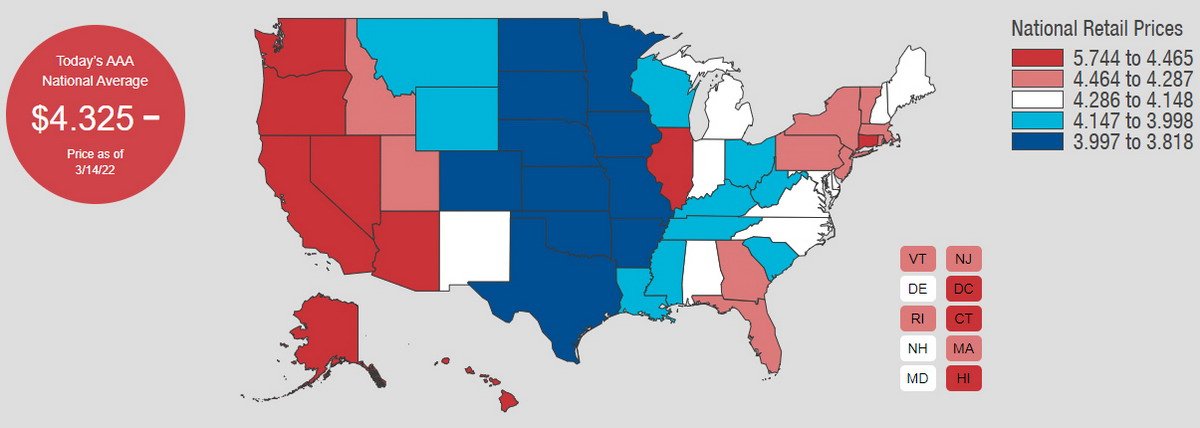
If you are taking any road trips or if you got on the RV bandwagon during covid like thousands of others, you need to be aware of price variances by geography. RV’s and sprinter vans get horrible gas mileage so filling up strategically in cheaper places can literally save you hundreds of dollars.
Another great tool if you drive a lot is the app Gasbuddy. The app searches for the cheapest prices near you and also has it’s own gas card and reward system. Full disclosure – I’ve never used it and am not affiliated with them in any way but online reviews seem mostly positive.
As you probably know most of the major oil companies have their own credit cards and reward systems. Again, being that I ride my bike way more than I drive I’m not the person to recommend any in particular but if you spend a lot on gas it’s probably in your best interest to check out sites like Nerdwallet who compare those sorts of things.
And if you happen to be in the market to buy a car, this list from Car & Driver of the most fuel efficient gas burners might be of help. Or you could get a hybrid or fully electric vehicle. Regardless of what you get, remember that savvy financial people buy used.
Third Order Effects
Now onto the more difficult truths. Most things are going to get more expensive. Inflation in America crested 7.5% recently and many “experts” had already predicted it to rise over 8% this year – before the war in Ukraine started and the oil price spike.
To continue reading, please go to the original article here:
https://accidentalfire.com/2022/03/15/oil-prices-and-your-money/
Five Critical Factors Why Prices Will Stay High For Years
.Five Critical Factors Why Prices Will Stay High For Years
Notes From the Field Simon Black March 14, 2022
At approximately 9am local time on February 21, 1972, a Boeing 707 airplane dubbed Spirit of ‘76 landed in Shanghai’s Hongqiao airport. The airplane’s main door opened, and out walked US President Richard Nixon.
The trip shocked the world. There had been no formal communication or diplomatic ties between the US and China for 25 years. And Nixon’s voyage not only normalized relations between the two countries, but it kickstarted decades of worldwide economic growth.
Back then, the US was the richest and most powerful economy in the world. But as a consequence of that prosperity, the US was also a very expensive place to produce.
Five Critical Factors Why Prices Will Stay High For Years
Notes From the Field Simon Black March 14, 2022
At approximately 9am local time on February 21, 1972, a Boeing 707 airplane dubbed Spirit of ‘76 landed in Shanghai’s Hongqiao airport. The airplane’s main door opened, and out walked US President Richard Nixon.
The trip shocked the world. There had been no formal communication or diplomatic ties between the US and China for 25 years. And Nixon’s voyage not only normalized relations between the two countries, but it kickstarted decades of worldwide economic growth.
Back then, the US was the richest and most powerful economy in the world. But as a consequence of that prosperity, the US was also a very expensive place to produce.
US companies were on the lookout for inexpensive, foreign manufacturing hubs where they could cheaply produce their products and sell them back to the US market.
China became that cheap manufacturing hub.
Eventually China was producing just about everything from T-shirts to antibiotics. And because the cost of production was so low in China, consumers around the world benefited.
Combined with cheap oil, a functioning global supply chain, and relative peace and stability, cheap Chinese production helped keep prices low and constrain inflation for decades.
But these trends are rapidly coming to an end.
For starters, China is now an economic superpower; many of its largest cities, in fact, have a per-capita GDP that exceeds the United States and Western Europe.
Wages have increased dramatically in China over the years because of this increase in prosperity, which means that it’s no longer cheap to manufacture most lower-end products there.
A lot of manufacturing has already shifted to cheaper places like Vietnam, Bangladesh, etc. But even those countries are quickly becoming more expensive places to produce. And they don’t have nearly enough capacity to keep up with global manufacturing demand.
Some large companies are starting to bring their manufacturing back home. This is becoming more popular now as global stability wanes.
Plus businesses learned during the COVID-19 lockdowns, and the resulting global supply chain dysfunction, that manufacturing at home is more reliable.
That may be true. But manufacturing in a ‘rich’ country is also a LOT more expensive.
So, regardless of whether a business chooses to manufacture at home or abroad, they’re almost guaranteed to suffer higher production costs. And that means consumers will be paying more.
This trend is a massive reversal from decades of cheap foreign production that kept prices low. But it only scratches the surface of why inflation will likely persist for years to come.
(British economist Charles Goodhart, a former central bank official, describes this phenomenon in his new book The Great Demographic Reversal. It’s definitely worth reading to understand this trend.)
Historic shifts in the labor market will also be a major contributor to inflation.
For example, there have never been more retirees in the history of the world than there are right now. And their numbers are growing.
According to Federal Reserve data, an additional 1.5 million people in the United States retired early during the first year of the pandemic. There will likely be more to come.
Plus US Labor Department statistics show that millions of other individuals, including young people, abandoned the idea of working altogether because of the pandemic.
Traditionally there’s a steady balance between the number of jobs in the economy, and the number of workers in the labor force. Sometimes there are shocks, like during the Great Recession in 2008, when millions of jobs vanished, practically overnight.
Now the converse has taken place: millions of workers have vanished, practically overnight.
The end result is that there are 11.3 million unfilled jobs in the United States-- a record high-- because so many people simply quit the labor force.
Of course, another key labor trend is that younger workers aren’t interested in most traditional jobs.
Countless teenagers aspire to be Instagram starlets, or to live-stream themselves playing video games for a living. They have little interest in construction, transportation, or manufacturing jobs.
So, in summary, we have former ‘low cost’ manufacturing hubs becoming a lot more expensive. Plus a constrained work force back home that limits production and pushes costs higher.
This is all highly inflationary.
And there’s absolutely nothing the government or central bank can do about it. Gen Z 20-somethings aren’t going to suddenly decide to start working traditional jobs just because the Federal Reserve raises interest rates by 0.25%.
Most likely the politicians will make it much worse-- which is another key factor in future inflation.
Nancy Pelosi stated on Friday that inflation was solely Vladimir Putin’s fault and insisted that their multi-trillion dollar deficit spending is “reducing the national debt” and “not adding to inflation.”
The President, meanwhile, has blamed inflation on “greed”, while the Federal Reserve insists that higher prices are a result of supply chain dysfunction.
Not one of these institutions-- Congress, the White House, or the Fed-- seems capable of looking at their own actions.
The Fed refuses to consider that inflation is due to their dizzying expansion of the US money supply-- the largest since 1943.
Congress refuses to consider that inflation is due to their insane deficit spending-- the largest ever in US history.
And the White House refuses to consider that inflation is due to its fetish for anti-competitive regulations and constant attacks on capitalism.
So, when the three key institutions charged with keeping inflation in check refuse to understand why there’s a problem, it’s hard to imagine they’re going to fix it.
There are plenty of other lingering inflation factors as well; geopolitical conflict is obviously inflationary. COVID-19 continues to be very inflationary. Environmental fanaticism is inflationary.
And just like the challenge of increased manufacturing costs, and labor market demographic trends, these issues cannot be magically fixed by politicians or central bankers.
In essence, policymakers are completely powerless to do anything about inflation.
There’s an irrational hope that inflation will quickly reverse, and prices will return to 2019 levels-- just as soon as Putin leaves Ukraine… and the global supply chain dysfunction works itself out.
But this is wishful thinking.
First, both of those resolutions could take a very long time.
But more importantly, the trends I outlined are much larger and could keep prices elevated for years to come.
So, if your “Plan A” is depending on the government for prosperity and price stability, it’s time to take a hard look at your Plan B.
To your freedom, Simon Black, Founder, SovereignMan.com
https://www.sovereignman.com/trends/five-critical-factors-why-prices-will-stay-high-for-years-34758/
32 Insider Tips for Buying and Selling a House
.32 Insider Tips for Buying and Selling a House
These insider tips can make buying or selling a home easier.
By Beth Rifkin Oct 1, 2021 Real Estate Investing 101
Whether you’re buying or selling a home, dealing in real estate can be a nerve-wracking experience, especially for a novice or first-timer. Fortunately, getting the right information can help make the process more manageable. Find out how you can buy and sell a house like a pro.
Tips for Buying a Home
When buying a home, whether to live in or as an investment property, it’s crucial to understand financing options, how to apply for a mortgage and the various expenses involved.
32 Insider Tips for Buying and Selling a House
These insider tips can make buying or selling a home easier.
By Beth Rifkin Oct 1, 2021 Real Estate Investing 101
Whether you’re buying or selling a home, dealing in real estate can be a nerve-wracking experience, especially for a novice or first-timer. Fortunately, getting the right information can help make the process more manageable. Find out how you can buy and sell a house like a pro.
Tips for Buying a Home
When buying a home, whether to live in or as an investment property, it’s crucial to understand financing options, how to apply for a mortgage and the various expenses involved.
It can be easy to get carried away when buying a home, so make sure the property is one that you will be able to afford, maintain and grow with over the years ahead.
1. Save For a Down Payment
The typical down payment is 20% of the sale price of the home. You might be able to get away with putting down less than that, but then your mortgage lender can require you to purchase private mortgage insurance. The insurance protects the lender in case you default on the loan.
That’s not a horrible thing, but it will increase your monthly payments by 0.5% to 1%. So it might make more sense to take some time and save more money for a down payment.
2. Check Your Credit
The better your credit score, the lower your mortgage interest rate will be. A score above 720 is ideal for purchasing a home.
Multiple factors are considered when calculating your score, such as if you pay your bills on time, the amount of your debt, length of credit history and types of credit; lenders prefer that you have a variety of credit sources. Check your credit quarterly and fix any mistakes that appear on your report.
3. Avoid Making Any Other Big Purchases
Every time you apply for a new form of credit, such as a credit card, a hard inquiry is run on your account, which can cause your credit score to take a slight dip. Therefore, avoid applying for or opening any new credit forms until after you have purchased your home.
4. Remember Closing Costs
Purchasing a home requires some mortgage-related expenses that might not be obvious at first — this includes closing costs.
Closing costs can include homeowners insurance, appraisals and home inspections, and cost about 2% to 5% of your mortgage. So, closing costs for a $300,000 mortgage, for example, can run anywhere from $6,000 to $15,000. Remember to plan for closing costs when calculating your budget.
To continue reading, please go to the original article here:
https://www.gobankingrates.com/investing/real-estate/insider-tips-buying-selling-house/
25 Tricks To Sell Your House for a Bigger Profit
.25 Tricks To Sell Your House for a Bigger Profit
Earn top dollar on your home with these simple tips.
By Alaina Tweddale Jan 28, 2022
It takes a savvy home seller to negotiate top dollar for their home. That’s why GOBankingRates talked to the experts and compiled the 25 best tips on how to add value to your home before you put it on the market so you can get the best price possible. What Adds More Value to Your Home: Indoor or Outdoor Upgrades?
Discover some of the best insider tips for selling a home.
Stage Your Property
Seventy-seven percent of realtors agree that it’s easier for a buyer to visualize a staged property as a future home, according to the National Association of Realtors 2017 Profile of Home Staging. The average cost to stage a home is between $2,000 and $2,400, according to data from Realtor.com. If you’re unsure how to stage a home, consider using a real estate agent.
25 Tricks To Sell Your House for a Bigger Profit
Earn top dollar on your home with these simple tips.
By Alaina Tweddale Jan 28, 2022
It takes a savvy home seller to negotiate top dollar for their home. That’s why GOBankingRates talked to the experts and compiled the 25 best tips on how to add value to your home before you put it on the market so you can get the best price possible. What Adds More Value to Your Home: Indoor or Outdoor Upgrades?
Discover some of the best insider tips for selling a home.
Stage Your Property
Seventy-seven percent of realtors agree that it’s easier for a buyer to visualize a staged property as a future home, according to the National Association of Realtors 2017 Profile of Home Staging. The average cost to stage a home is between $2,000 and $2,400, according to data from Realtor.com. If you’re unsure how to stage a home, consider using a real estate agent.
Staging the living room for buyers, followed by the master bedroom and the kitchen were found to be most important, according to the report.
Research Your Ideal Homebuyer
Different property types attract different types of buyers, each of whom has different homebuying wants and needs. Knowing your target buyer can make a substantial difference when selling your home.
For a single-family home in good condition, for example, the target buyer is likely looking for a move-in ready home. This type of buyer “does not want to do any repairs, and so spending time and money to make repairs makes sense,” said Lucas Machado, president of South Florida-based real estate investing firm House Heroes.
“If the property is in poor condition … it likely won’t qualify for a traditional bank mortgage,” Machado added. “This means the buyer is likely to be a real estate investor or cash-flush homeowner that intends to repair the property.”
These types of buyers prefer to do repairs and upgrades themselves. “The investor can likely do that work with more skill and less cost than the regular homeowner,” said Machado.
Create a Digital Home History
Buyers today seek homes that are move-in ready and well-maintained. Online services, like HomeZada, allow a seller to create an online digital footprint that details a home’s maintenance records, floor plans, warranty documents and more. If you have properly maintained your home, an online digital footprint can enable you to showcase your efforts while allowing potential buyers to fully appreciate the home’s maintenance history.
Boost Your Curb Appeal
How a home looks from the outside has a huge effect on how many potential buyers walk through the front door.
Than Merrill, CEO of FortuneBuilders, suggested investing in a new front door. If buying a replacement door is not within the budget, “consider repainting it for a fresh, clean look,” he said. It’s an affordable renovation you can make for less than $1,000. “Also, pressure washing the driveway and front walk — and trimming the hedges and trees — contribute to the overall look of the house.”
For people with a higher budget for renovations and repairs, Cannon Christian, president of Renovation Realty, suggested replacing worn vinyl siding. New vinyl siding can have an 80 percent or higher return on investment, according to Christian.
To continue reading, please go to the original article here:
The Craziest Things That Kill Your Home’s Value
.The Craziest Things That Kill Your Home’s Value
Gabrielle Olya Sat, March 12, 2022, 8
Preparing your home for sale is no easy feat. Even if you've kept it in relatively good condition over the years, you have to ask yourself, will buyers, real estate agents and appraisers be wowed?
First impressions can impact your property's value and potentially make it harder to sell your home. So that you don't waste time and money, here is a list of things that could negatively affect your home. Consider these issues before putting your property on the market.
The Craziest Things That Kill Your Home’s Value
Gabrielle Olya Sat, March 12, 2022, 8
Preparing your home for sale is no easy feat. Even if you've kept it in relatively good condition over the years, you have to ask yourself, will buyers, real estate agents and appraisers be wowed?
First impressions can impact your property's value and potentially make it harder to sell your home. So that you don't waste time and money, here is a list of things that could negatively affect your home. Consider these issues before putting your property on the market.
Not Keeping Up With the Joneses
Whether you skimped on an upgrade to save money early on or just haven't had time to update certain features of your home, not keeping up with the neighbors could hurt your home's value. Adrian Muller, president of Hudson View Appraisal Services, said homes without features that are common in the area, such as a patio or pool in Florida, will have an overall lower value.
Zombie Houses
Sometimes, the factors that affect your home's value have nothing to do with your property at all. One such example is a "zombie house" in your neighborhood. Zombie houses are abandoned, neglected or dilapidated homes with overgrown yards, said Mary Case Friedner, a real estate broker serving the Hudson River towns of Westchester County, New York.
"They can really hurt the value of neighboring homes," she said.
Fracking
Homeowners near shale gas wells can take a major hit to property values, according to a study by economists from Duke University and Resources for the Future, a nonprofit research institution. The researchers found that Pennsylvania homeowners who used groundwater for consumption lost up to 24% of their property's value if they lived within 1 1/4 miles of a shale gas well.
Cracks in the Pavement
You might not pay much attention to wear and tear on your driveway, but appraisers will. They look for signs of physical depreciation, so consider resealing the surface of your driveway before you put your house on the market. "Large cracks and potholes on the driveway surface raise a red flag in the appraisal process," Muller said.
Curb Unappeal
To continue reading, please go to the original article here:
https://news.yahoo.com/craziest-things-kill-home-value-130010985.html
There's A Way To Bring Down Gas Prices, But You Won't Like It
.There's A Way To Bring Down Gas Prices, But You Won't Like It
Joel Mathis, Contributing Writer Fri, March 11, 2022
A modest suggestion to deal with rising gas prices: Let's bring back the 55-mph speed limit.
Prices were already on the upswing before Vladimir Putin's invasion of Ukraine, thanks largely to a slow ramp-up in oil production following the pandemic-driven collapse in demand. Now the cost is going to go up even more, driven higher by sanctions on Russia's oil and gas industries. We're getting a real-time lesson in the laws of supply and demand.
For the most part, the solutions on offer are supply-driven. The Biden Administration has approached the oil-rich nations of Saudi Arabia and Venezuela — falteringly — about loosening their production spigots. The White House has also ordered that 60 million barrels be released from the Strategic Petroleum Reserve.
There's A Way To Bring Down Gas Prices, But You Won't Like It
Joel Mathis, Contributing Writer Fri, March 11, 2022
A modest suggestion to deal with rising gas prices: Let's bring back the 55-mph speed limit.
Prices were already on the upswing before Vladimir Putin's invasion of Ukraine, thanks largely to a slow ramp-up in oil production following the pandemic-driven collapse in demand. Now the cost is going to go up even more, driven higher by sanctions on Russia's oil and gas industries. We're getting a real-time lesson in the laws of supply and demand.
For the most part, the solutions on offer are supply-driven. The Biden Administration has approached the oil-rich nations of Saudi Arabia and Venezuela — falteringly — about loosening their production spigots. The White House has also ordered that 60 million barrels be released from the Strategic Petroleum Reserve.
Republicans, meanwhile, want the United States to ramp up domestic oil production. It's "drill, baby, drill" all over again, but it's not clear that any of these moves will do much to meaningfully bring down prices.
Meanwhile, nobody in government is really talking about how to use less gasoline.
One quick-and-obvious way we can do that is to make everybody drive slower. We've done it before. Congress passed the national maximum speed limit in 1973, not as a way to save lives in traffic accidents, but to reduce gasoline use during the Arab oil embargo.
The limit lasted 22 years, and during that time the country reduced its consumption by 167,000 barrels a day, and as much as an overall savings of 3 percent of annual fuel consumption. (It also inspired Sammy Hagar's best song.) Yes, it made long car trips interminable — I say this as a child of the era who spent way too many hours trapped in a crowded backseat with my sisters — but it also saved a lot of gas. We could do it again.
Of course, the big problem with this proposal is that most Americans will despise it. We love our speed. One 2020 survey suggested that nearly half of us have driven 15 mph over the existing speed limits, which range from 65 mph and up in most states.
To continue reading, please go to the original article here:
https://www.yahoo.com/news/theres-way-bring-down-gas-183643325.html
If You Have This Much Money, You Should Have a Financial Advisor
.If You Have This Much Money, You Should Have a Financial Advisor
Patrick Villanova Thu, March 10, 2022
Money can’t buy happiness directly, but it seems like paying a financial advisor sure can help.
A new survey found people with more than $1.2 million in household assets report higher levels of happiness when working with a financial advisor compared to those who don’t have an advisor. The finding is part of Herbers & Company’s inaugural Consumer Financial Behaviors Study, which polled 1,000 consumers across the U.S. A financial advisor can help you manage assets and plan for retirement
If You Have This Much Money, You Should Have a Financial Advisor
Patrick Villanova Thu, March 10, 2022
Money can’t buy happiness directly, but it seems like paying a financial advisor sure can help.
A new survey found people with more than $1.2 million in household assets report higher levels of happiness when working with a financial advisor compared to those who don’t have an advisor. The finding is part of Herbers & Company’s inaugural Consumer Financial Behaviors Study, which polled 1,000 consumers across the U.S. A financial advisor can help you manage assets and plan for retirement
As individuals move past $1.2 million of assets, those who work with financial advisors rapidly increase in happiness, while those without advisors rapidly become less happy,” wrote Sonya Lutter, the certified financial planner (CFP) and licensed therapist who authored the study.
Herbers & Company is a consultancy firm that specializes in helping independent financial advisory firms grow their businesses.
How Happiness is Measured
To quantify a respondent’s level of happiness, the survey presented each consumer with a list of 43 questions concerning his or her daily behaviors and interactions. The survey also pinpointed four core principles of happiness – fulfillment, intention, impact and gratefulness – and gauged how much respondents identify with each. All participants in the survey have at least $250,000 in household assets.
The survey found that 66% of respondents who work with a financial advisor reported heightened levels of all four core factors of happiness. Only 34% of people without an advisor identified with those four principles in the same way.
The results of the study also suggest that those with financial advisors experience greater satisfaction outside of their relationship with money.
“People who have financial advisors are not only happier with their finances, but they are also far happier about their personal relationships and their communication with their partners,” wrote Lutter, a former administrator of applied human sciences at Kansas State University. “While it’s possible that happy couples might be more likely to hire financial advisors, it’s also possible that working with a financial advisor gives couples an opportunity to talk about financial goals, and thereby gives them a happiness boost.”
Which High-Net Worth Individuals Are Happiest?
To continue reading, please go to the original article here:
Check out the reader comments – they are very insightful
https://finance.yahoo.com/news/much-money-financial-advisor-180121345.html
When This Lucky Man Won Millions On The Lottery, He Dropped A Major Bombshell On His Best Friend
.When This Lucky Man Won Millions On The Lottery, He Dropped A Major Bombshell On His Best Friend
By Andrea Marchiano
What would you do with $22 million? Buy a yacht, perhaps? Move into a mansion? It’s something that probably crosses your mind when you see a Powerball billboard on the highway. But not everyone has to daydream about bringing home a ton of cash. One man knows exactly what that’s like. Only his unexpected move after the millions hit his bank account left everyone stunned, and what's more, it completely changed the relationship with his closest friend.
That guy is Thomas Cook, and he had wondered for years what he’d do if he ever won the Powerball jackpot. Then, to his great surprise, he finally got to put that long-imagined plan into motion. First off, the Wisconsinite had to call his friend Joseph Feeney – and drop a rather large bombshell on him.
When This Lucky Man Won Millions On The Lottery, He Dropped A Major Bombshell On His Best Friend
By Andrea Marchiano
What would you do with $22 million? Buy a yacht, perhaps? Move into a mansion? It’s something that probably crosses your mind when you see a Powerball billboard on the highway. But not everyone has to daydream about bringing home a ton of cash. One man knows exactly what that’s like. Only his unexpected move after the millions hit his bank account left everyone stunned, and what's more, it completely changed the relationship with his closest friend.
That guy is Thomas Cook, and he had wondered for years what he’d do if he ever won the Powerball jackpot. Then, to his great surprise, he finally got to put that long-imagined plan into motion. First off, the Wisconsinite had to call his friend Joseph Feeney – and drop a rather large bombshell on him.
It’s not hard to think of yourself in Cook’s place. You may even have played Powerball yourself since it began in 1992! Back then, hopefuls each picked five numbers out of a range from 1 to 45. They also chose a separate Powerball number – also from between 1 and 45. Simple enough? We think so. And that’s all it took for Cook to become a multi-millionaire.
Not everyone has scooped as much money as Cook has, though. The Powerball jackpots in the early days were relatively small. The first-ever winner took home a $5.9 million prize – which, let’s face it, is still nothing to sniff at. But as time has gone on, the game has changed slightly – and the cash rewards have gotten even bigger.
That's all great news, but in reality, you have a very slim chance of winning the Powerball. The likelihood is approximately 1 in 292 million, which means all most of us will do is dream. But the chance to bring home millions – or billions – has kept many of us in the game. And this included Cook.
Wisconsin — Cook's home state — was actually one of the first states to take part in the Powerball, and it’s had 18 winners since that very first draw back in 1992. Back in 2019 West Allis resident Manuel Franco became a multi-millionaire. Not only that, but he clinched the third-biggest cash sum ever given out in a U.S. lottery. It’s an amount that totally dwarfs Cook’s impressive win.
How much did Franco get? A truly incredible $768 million. He also opted to receive his winnings in a lump sum. And even though Franco had to pay state and federal taxes on the money, he still netted a world-changing amount of cash: $326 million, according to the folks in the know.
You can also forget about staying anonymous if you’re lucky enough to scoop the Powerball in Wisconsin. State law doesn’t allow you to. That’s not great if you’d like to keep greedy family members at bay... So, Franco had to go through the process of a press conference. And while speaking to the media, he described how he had felt when he had bought his Powerball tickets for a mere $10.
To continue reading, please go to the original article here: LINK
7 Timely Warren Buffett Quotes to Help You In 2022's Manic Market
7 Timely Warren Buffett Quotes to Help You In 2022's Manic Market
Let the Oracle of Omaha be your guide in today's tough market.
By Sigrid Forberg Jan. 29, 2022
Warren Buffett is a remarkable investor. He’s grown his business, Berkshire Hathaway, from a failing textile company into a multinational conglomerate with stakes in Geico, Apple and Coca-Cola.
Buffett has dropped countless gems of wisdom over the years, but the following seven quotes offer investors particularly timely advice on how to invest in stocks today — maybe even with your spare change.
7 Timely Warren Buffett Quotes to Help You In 2022's Manic Market
Let the Oracle of Omaha be your guide in today's tough market.
By Sigrid Forberg Jan. 29, 2022
Warren Buffett is a remarkable investor. He’s grown his business, Berkshire Hathaway, from a failing textile company into a multinational conglomerate with stakes in Geico, Apple and Coca-Cola.
Buffett has dropped countless gems of wisdom over the years, but the following seven quotes offer investors particularly timely advice on how to invest in stocks today — maybe even with your spare change.
1. Fight against the ravages of inflation
“Inflation acts as a gigantic corporate tapeworm. That tapeworm preemptively consumes its requisite daily diet of investment dollars regardless of the health of the host organism. Regardless of a company's profits, it has to spend more on receivables, inventory, and fixed assets to simply equal the unit volume of the previous year.”
Buffett offered this colorful image back in his 1981 annual letter to shareholders. The billionaire investor described high inflation as a “tax on capital” that dissuades corporate investment.
With inflation at a worrisome 7%, a level not seen in close to 40 years, investors might want to think about assets that are immune (or at least not as vulnerable) to the ravages of rising costs.
One example other billionaires like Bill Gates have taken to recently is investing in farmland. Agriculture offers steady, reliable returns — whatever the state of the economy, people still need to eat.
Other assets that have historically done well during periods of high inflation include gold and real estate.
2. Don’t follow the herd
“Most people get interested in stocks when everyone else is. The time to get interested is when no one else is. You can't buy what is popular and do well.”
According to Bank of America, equity funds took in more than $1 trillion in cash in 2021, exceeding the combined total from the past two decades.
Whether you’re new to investing or you’ve been at it for ages, going against the grain is often the prudent thing to do.
To continue reading, please go to the original article here:
https://moneywise.com/u/investing/investing-basics/buffett-quotes-january
A Year of Essential Home Maintenance Projects
.A Year of Essential Home Maintenance Projects
January 31, 2022 D. Guerra
Caring for your home and everything in it will help you preserve its value. However, it can be overwhelming to tackle all your home maintenance projects in a short period of time. It’s much easier to maintain your home when you perform some upkeep each month. In a year’s time, you can tackle all the most crucial aspects of maintaining your house and everything in it. Use this guide to refer to all year long as you tackle your home’s most pressing home maintenance projects.
January
Carpets, Couches, and Chairs
After the holidays, your carpeting and furniture upholstery can become seriously soiled. While you can hire professional cleaners to visit your home and clean these features, you can also tackle them yourself relatively inexpensively.
A Year of Essential Home Maintenance Projects
January 31, 2022 D. Guerra
Caring for your home and everything in it will help you preserve its value. However, it can be overwhelming to tackle all your home maintenance projects in a short period of time. It’s much easier to maintain your home when you perform some upkeep each month. In a year’s time, you can tackle all the most crucial aspects of maintaining your house and everything in it. Use this guide to refer to all year long as you tackle your home’s most pressing home maintenance projects.
January
Carpets, Couches, and Chairs
After the holidays, your carpeting and furniture upholstery can become seriously soiled. While you can hire professional cleaners to visit your home and clean these features, you can also tackle them yourself relatively inexpensively.
To clean your carpeting, you can rent a rug-cleaning machine from a home improvement center, or you can clean the carpet by hand using a solution of baking soda, water, carpet shampoo, and towels.
Bathrooms
Your bathrooms get heavy use on an ordinary basis, in particular during the holidays when you have visitors and they are in operation 24/7. January is the perfect month to give them a good clean and make sure everything is working properly, bathroom maintenance is something that is regularly neglected by homeowners.
Your shower heads are commonly overseen, however, they too need a deep clean every now and then. It will help remove any debris and stain and make them look new, there are great online guides on how to clean a showerhead properly.
Toilets are certainly a crucial aspect of your home’s plumbing system. Take time this month to ensure that each is working properly. Be sure that water isn’t running and there are no leaks. Toilet kits are inexpensive, so if you need to swap out old or worn parts, this is a good time to do that.
Kitchen
Set aside time this month to deep clean and organize your kitchen. Be sure to tackle such tasks as:
Clean refrigerator coils
Clean the garbage disposal
Reorganize the pantry (remove expired items)
Clean pipes beneath the sink
Clean the oven
Check the kitchen smoke alarm (and update the fire extinguisher)
This is an essential home maintenance project that needs to be properly carried out every year.
To continue reading, please go to the original article here:
https://porch.com/advice/year-essential-home-maintenance-projects