
20 Insider Tips To Save Money on Every Part of Your Home
.20 Insider Tips To Save Money on Every Part of Your Home
Cut costs on your mortgage, renovations and decorating.
By Gabrielle Olya July 12, 2021 Save Money at Home
The expenses that come with buying, renovating and decorating a home can add up, but fortunately, there are ways to save money every step of the way.
GOBankingRates asked real estate insiders for their best tips on how to save money on every part of your home, and their advice can help cut costs for anyone looking to buy a new home or renovate the one they currently have.
Here's how to save money in every nook and cranny of your house.
20 Insider Tips To Save Money on Every Part of Your Home
Cut costs on your mortgage, renovations and decorating.
By Gabrielle Olya July 12, 2021 Save Money at Home
The expenses that come with buying, renovating and decorating a home can add up, but fortunately, there are ways to save money every step of the way.
GOBankingRates asked real estate insiders for their best tips on how to save money on every part of your home, and their advice can help cut costs for anyone looking to buy a new home or renovate the one they currently have.
Here's how to save money in every nook and cranny of your house.
1. Get a Mortgage With No Down Payment
Find out if you qualify for a government home loan, as there are options that require no down payment at all. U.S. Department of Agriculture loans are available for borrowers in need who want to purchase a home in rural or suburban areas. Veteran’s Administration loans are available to active-duty or prior-duty service members and, in certain cases, their spouses and widows or widowers. VA loans are available through private lenders, such as NBKC Bank. VA home loans and USDA loans do not require a down payment.
“The greatest features of a VA home loan are that there is no down payment required if you stay within the county loan limits, and there is no PMI insurance ever,” said Jim Schneider, former army officer and a loan specialist at NBKC Bank. “On any other type of loan, if you put down less than 20% of the purchase price you are required to pay PMI insurance on the loan. This can be hundreds of dollars per month, which can be totally avoided by doing a VA loan. On top of those benefits, the VA loan will also have the lowest rate available among all loan types because it is the least risky loan a bank can do.”
2. Take Advantage of Down Payment Assistance Programs
If you can’t afford a down payment and don’t qualify for a mortgage with no down payment, that doesn’t mean you can’t buy a home.
“There are so many down payment assistance programs out there for buyers, so educate yourself,” said Dawn Houlf, realtor and owner of EXIT Realty Number One.
One option is a 203k loan, which can also help cover renovation costs.
“First-time homeowners who want to renovate their homes on a budget, or homeowners who opted to buy a distressed property for a good deal, should strongly consider the 203k loan,” said Than Merrill, founder of real estate investment company CT Homes. “A 203k loan is a type of home renovation loan that is backed by the Federal Housing Administration.
The loan includes both the cost of purchasing a property, plus the estimated costs for renovating it. Homebuyers that wish to rehabilitate an older or damaged home can get approved. Not only will this loan cover home upgrades, it also allows borrowers to put down 3.5% on their homes as opposed to the standard 20%.”
To continue reading, please go to the original article here:
https://www.gobankingrates.com/saving-money/home/tips-to-save-money-on-home/
Buying a House in 2021
.Buying a House in 2021
Published June 30, 2021 by J.D. Roth
I feel as if, right now in 2021, I am swinging along on a comfortable trapeze bar and that I need to swing to the next one. And…I’m a little scared. One source of this trepidation is my current housing situation. Kim and I sold our home last month and are looking for another. As you might have heard, it’s a crazy time to buy. Our stories today reflect that. It’s the parable of the trapeze by Danaan Parry.
Buying a House in 2021 June 23, 2021 by One Frugal Girl
Last June we had a wild idea. After nearly twenty years of living in the same house, we decided it was time to move. Despite limited inventory and wildly escalating prices, we vowed to find a new place. With flexible work options, we can finally move out to the countryside. How hard could it be to find a new place to live? It didn’t seem that difficult at first. We planned to drive through a few neighborhoods, make an offer, and move in.
Buying a House in 2021
Published June 30, 2021 by J.D. Roth
I feel as if, right now in 2021, I am swinging along on a comfortable trapeze bar and that I need to swing to the next one. And…I’m a little scared. One source of this trepidation is my current housing situation. Kim and I sold our home last month and are looking for another. As you might have heard, it’s a crazy time to buy. Our stories today reflect that. It’s the parable of the trapeze by Danaan Parry.
Buying a House in 2021 June 23, 2021 by One Frugal Girl
Last June we had a wild idea. After nearly twenty years of living in the same house, we decided it was time to move. Despite limited inventory and wildly escalating prices, we vowed to find a new place. With flexible work options, we can finally move out to the countryside. How hard could it be to find a new place to live? It didn’t seem that difficult at first. We planned to drive through a few neighborhoods, make an offer, and move in.
If only it were that easy! Instead of finding a new house, we spent countless hours stalking new home listings and setting alerts for neighborhoods in our desired price range. Once a week, we drove north and west in search of the perfect spot, only to come home tired and disappointed.
After nine months, we grew restless and eventually settled on a house we didn’t love. Thankfully, an undisclosed conservation easement allowed us to back out of the deal. If it hadn’t been for that glitch, we would’ve bought the wrong house and been miserable.
Must-Haves When Searching for a Home
To further complicate matters, our list of must-haves grew and shrank throughout our home buying journey. What seemed important one day didn’t seem significant the next. Each time we stepped into a house, we changed our minds.
But nearly buying the wrong house changed everything for me. The house we almost bought was dark and dismal, with small windows and a shady backyard. After recognizing our error, we only considered houses with large windows and lots of natural sunlight.
To continue reading, please go to the original article here:
https://www.onefrugalgirl.com/buying-a-house-in-2021/
15 Things to do if you Get Rich All of a Sudden
.From Recaps Archives
15 Things To Do If You Get Rich All of a Sudden
In this Alux.com video we'll try to answer the following questions:
What should you do if you get rich all of a sudden?
What do to if you inherit money?
How to manage a large sum of money?
What should you do if you get rich?
What do to if you win the lotto?
From Recaps Archives
15 Things To Do If You Get Rich All of a Sudden
In this Alux.com video we'll try to answer the following questions:
What should you do if you get rich all of a sudden?
What do to if you inherit money?
How to manage a large sum of money?
What should you do if you get rich?
What do to if you win the lotto?
How to manage wealth? How to get wealthy?
How to maintain being rich?
How to keep your wealth?
How not to lose money?
Why do people go broke after they went rich?
How do people lose money?
What if you inherit a fortune?
I just inherited a million dollars, what do I do? How to you being investing money?
What you should know about money?
If You’re Still Worried, You Aren’t Wealthy
.If You’re Still Worried, You Aren’t Wealthy
Posted June 1, 2021 by Ben Carlson
Wealth means different things to different people.
Some people assume wealth is the amount of money you have in the bank or your investment portfolio. Others judge wealth based on the number of material possessions you’re able to buy. Then there are those people who figure only those with a high enough income can be considered rich.
What constitutes a rich life really depends on your relationship with money and what matters most to you in life. There are many ways to become wealthy that don’t involve money. Being content with what you have is a sure sign you’re living a rich life.
If You’re Still Worried, You Aren’t Wealthy
Posted June 1, 2021 by Ben Carlson
Wealth means different things to different people.
Some people assume wealth is the amount of money you have in the bank or your investment portfolio. Others judge wealth based on the number of material possessions you’re able to buy. Then there are those people who figure only those with a high enough income can be considered rich.
What constitutes a rich life really depends on your relationship with money and what matters most to you in life. There are many ways to become wealthy that don’t involve money. Being content with what you have is a sure sign you’re living a rich life.
When you’re content, a number doesn’t matter as much as your mindset.
Take this headline from this weekend’s Wall Street Journal:

Millennials haven’t always had it easy. Many had student loans, stagnating wages and a difficult job market to deal with following the 2008 financial crisis. So I get why some people are gunshy:
Many of these workers may have struggled with stagnating wages and huge student loan debts earlier in their careers. Some worry they’ll mismanage this boon and forever ruin their chance at financial stability.
“These individuals completely feel and understand and recognize the pain of the last year, but now they’re being given an opportunity to come out of that,” Mr. Vakil said. “They’re saying, ‘This is my one chance.’ They’re taking it with both hands. They don’t want to mess it up.”
Sure, you don’t want to make unnecessary mistakes but the whole point of wealth is that it’s supposed to make your life less stressful. For many it seems building wealth only intensifies their worries.
Look at this headline from MarketWatch:
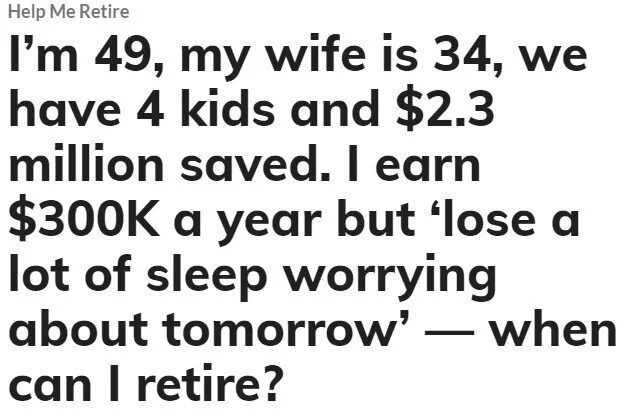
This person has a net worth that puts them in the top 5% of all Americans and yet they still have trouble sleeping at night because of financial worries. Here’s the kicker:
To continue reading, please go to the original article here:
https://awealthofcommonsense.com/2021/06/if-youre-still-worried-you-arent-wealthy/
13 Financial Moves to Make After Losing a Spouse
.13 Financial Moves to Make After Losing a Spouse
Nothing upends your world like the death of a spouse, leaving you at a loss for what to do next.
by: Janet Kidd Stewart April 29, 2020
Nothing upends your world like the death of a spouse, leaving you at a loss for what to do next. When death comes before you realize your retirement plans, it can be particularly devastating.
Triage Your Tasks
Of the roughly 15 million widows and widowers in the United States, about 2.8 million women and 800,000 men are younger than age 65, according to Census Bureau data. But whether you are of retirement age or not, making the right financial moves early can set you up for greater financial stability later on.
The oft-quoted mantra of telling grieving spouses not to make any financial decisions for a year is misguided at best and disastrous at worst. Many decisions simply can’t be postponed for a year, and others shouldn’t be rushed into. “We advocate a much more nuanced timeline,” says Susan Bradley, founder of the Sudden Money Institute, which trains financial advisers to work with clients in transition.
13 Financial Moves to Make After Losing a Spouse
Nothing upends your world like the death of a spouse, leaving you at a loss for what to do next.
by: Janet Kidd Stewart April 29, 2020
Nothing upends your world like the death of a spouse, leaving you at a loss for what to do next. When death comes before you realize your retirement plans, it can be particularly devastating.
Triage Your Tasks
Of the roughly 15 million widows and widowers in the United States, about 2.8 million women and 800,000 men are younger than age 65, according to Census Bureau data. But whether you are of retirement age or not, making the right financial moves early can set you up for greater financial stability later on.
The oft-quoted mantra of telling grieving spouses not to make any financial decisions for a year is misguided at best and disastrous at worst. Many decisions simply can’t be postponed for a year, and others shouldn’t be rushed into. “We advocate a much more nuanced timeline,” says Susan Bradley, founder of the Sudden Money Institute, which trains financial advisers to work with clients in transition.
She recommends breaking tasks down into three piles — urgent, soon and later — with those in the last pile being perhaps two years or more down the road, depending on individual circumstances.
A surviving stay-at-home spouse with school-age kids may have the resources to keep the family home until the youngest graduates, for example, but then may need (or want) to downsize and head back to work. An empty nester who had been counting on a few more years of a spouse’s income before retirement — and at least a few years of dual Social Security checks — may need to adjust more quickly.
Gather Documents
Now, for the practical matters. If it’s still early days, begin by making sure the funeral director you’re working with has notified the Social Security Administration of the death and ordered 15 to 20 certified copies of the death certificate for tasks such as retitling the mortgage and changing owner names on financial accounts.
You’ll need one or more of these documents to apply for Social Security benefits, work with your spouse’s employer to distribute life insurance and other benefits such as final pay and retirement plan savings, collect private life insurance proceeds and create a cash flow statement and household budget.
Keep Good Records
Get a notebook for logging conversations with your spouse’s employer, Social Security clerks and others. Advisers and survivors say this is essential in the foggy, early days of grief.
“I kept notes on everything,” says Sue Knight Deutsch, who lost her husband Michael to colon cancer in 2009. He was 55; she was 53. “I had a notebook and every time I made a call I wrote down a date and case number for the call so when I would call again and get a new person I could tell them the number.”
Also, keep an expandable file near the notebook. The file should hold the death certificates and other important papers, correspondence related to the spouse’s death and current bills due and paid.
Organize the Bills
If your spouse handled the bills and you need a new system, create one box or tray for unopened mail and make sure every piece goes into that box. Look through the checkbook or online banking account for past or recurring payments. If you have access to your spouse’s email account, look for electronic notifications of bills due.
To continue reading, please go to the original article here:
The Financial Effects of Losing a Spouse
.The Financial Effects of Losing a Spouse
Rocky Mengle, Tax Editor Fri, July 16, 2021
The death of a spouse is one of the most difficult things imaginable. Besides the emotional toll, surviving spouses typically confront financial issues, which often trigger tax-related questions and consequences. Some of them are fairly straightforward, while others can be tricky. That's why Letha McDowell, president of the National Academy of Elder Law Attorneys, advises surviving spouses not to make major financial changes immediately. Instead, she tells them to reassess their finances from a tax perspective.
The loss of income after a spouse dies certainly has tax implications. For instance, if a drop in income means the surviving spouse needs to tap into a retirement account, McDowell points out that "the taxes may be less than initially anticipated because, if you have lower income, you may be in a lower bracket."
The Financial Effects of Losing a Spouse
Rocky Mengle, Tax Editor Fri, July 16, 2021
The death of a spouse is one of the most difficult things imaginable. Besides the emotional toll, surviving spouses typically confront financial issues, which often trigger tax-related questions and consequences. Some of them are fairly straightforward, while others can be tricky. That's why Letha McDowell, president of the National Academy of Elder Law Attorneys, advises surviving spouses not to make major financial changes immediately. Instead, she tells them to reassess their finances from a tax perspective.
The loss of income after a spouse dies certainly has tax implications. For instance, if a drop in income means the surviving spouse needs to tap into a retirement account, McDowell points out that "the taxes may be less than initially anticipated because, if you have lower income, you may be in a lower bracket."
Less income could also mean that the surviving spouse now qualifies for certain tax deductions or credits that have income caps or phase-out rules. Local jurisdictions often have income-based property tax breaks that may suddenly become available, too.
Eventually, every surviving spouse has a new filing status. A joint federal tax return is allowed for the year the deceased spouse dies if the surviving spouse didn't remarry. The qualifying widow(er) status may be an option for two more years if there's a dependent child. After that, a surviving spouse who doesn't remarry must file as a single taxpayer, which usually means less favorable tax rates and a lower standard deduction.
Inheriting a traditional IRA can also affect the surviving spouse's taxes, but first, there's a decision to make. An inheriting spouse can be designated as the account owner, roll the funds into their own retirement account, or be treated as a beneficiary. That decision will affect required minimum distributions and ultimately the surviving spouse's taxable income.
As either the designated owner of the original account or the owner of the account with rolled-over funds, the surviving spouse can take RMDs based on their own life expectancy. If the third option -- staying as the IRA's beneficiary -- is chosen, RMDs are based on the life expectancy of the deceased spouse. "Almost everyone either rolls [an inherited IRA] into their own IRA or at least they transfer it into an account in their name," McDowell notes.
To continue reading, please go to the original article here:
https://finance.yahoo.com/news/financial-effects-losing-spouse-125927518.html
What You Need To Know Before You Invest In Anything
.What You Need To Know Before You Invest In Anything
Thomas Kopelman / June 1, 2021
As a financial advisor, I get asked almost daily what I am investing in.
It mostly sounds like this “are you invested in Bitcoin? Ethereum, Apple, Tesla, AMC, etc.” The list could go on forever. I always have a hard time answering this question because what I invest in doesn’t really matter. Just because I invest in certain things does not mean you should and vise versa. The real question is “why do I invest in those things?” The why is so much more important than the what.
And for me, I have a deep why for my investing strategy.
I believe in low cost, diversified investing for most of my portfolio. About 80% of my current portfolio is in low cost index funds that have the exposure I want (the same as our RLS Wealth clients). Some to large cap, some to mid cap, some to small cap, some to international, some to value, and some to growth.
What You Need To Know Before You Invest In Anything
Thomas Kopelman / June 1, 2021
As a financial advisor, I get asked almost daily what I am investing in.
It mostly sounds like this “are you invested in Bitcoin? Ethereum, Apple, Tesla, AMC, etc.” The list could go on forever. I always have a hard time answering this question because what I invest in doesn’t really matter. Just because I invest in certain things does not mean you should and vise versa. The real question is “why do I invest in those things?” The why is so much more important than the what.
And for me, I have a deep why for my investing strategy.
I believe in low cost, diversified investing for most of my portfolio. About 80% of my current portfolio is in low cost index funds that have the exposure I want (the same as our RLS Wealth clients). Some to large cap, some to mid cap, some to small cap, some to international, some to value, and some to growth.
My main focus here is to get what the market offers. To hold on long term and to not touch this money till I need it in the distant future — and to keep the fees as low as possible, but also to keep the gains sheltered inside as much as possible by using ETFs.
Then, with the last 20% I take more risk. I invest in some cryptocurrencies I really believe in as well as some individual stocks. The key here is that I truly believe in them. I did my research. I found what I think will make an impact in the future — and with these investments, I still have a long term view. This belief system is so crucial when you invest, because without it, how do you continue to stick with it when times get tough?
These last few weeks, so many people I know sold their positions in Bitcoin, Ethereum, and other cryptocurrencies, and if that is you, it’s probably because you never believed in the investment in the first place. You probably just invested because others were doing it and you were hoping to make lots of money off of it. I am here to tell you that investing that way rarely works.
Every time things get tough, you are going to sit there and fight yourself on whether you should sell or not simply because you have no true belief around it. This is why it is so important to invest in what you truly believe in because that long term belief enables you to hold on through short term downturns. Sure, it still won’t be easy, but it will be possible when you truly believe in the investment.
I also want to note that chasing investment returns as a millennial is not where your energy is best spent. Your energy is best spent continually investing, increasing your income, increasing your investment percentage, investing in the right accounts based on taxes, etc.
Here are some pieces of investment advice to help you out:
https://thomaskopelman.com/2021/06/what-you-need-to-know-before-you-invest-in-anything/
What You Need to Know About Inflation
.What You Need to Know About Inflation
June 21, 2021 MST Category: General Investing
The rate of inflation went up this Spring and that has caused some significant fluctuations in the market as well as a lot of talk about inflation. Given the fact that inflation has been low for so long, novice and young investors may not know a lot about inflation, so today we're going to take an in-depth look at it.
What Is Inflation?
Inflation is a general increase in prices and thus a fall in the purchasing value of money. In essence, your money is worth less than it used to be. It buys a smaller quantity of goods and services.
How to Calculate Inflation
The most common measurement of inflation in the United States is the government's measurement, known as the Consumer Price Index (CPI). There are actually multiple CPIs. The most common is the CPI-U, the consumer price index for all urban consumers. However, there is also a CPI-W, the consumer price index for urban wage earners and clerical workers, and a CPI-E, the consumer price index for the elderly.
What You Need to Know About Inflation
June 21, 2021 MST Category: General Investing
The rate of inflation went up this Spring and that has caused some significant fluctuations in the market as well as a lot of talk about inflation. Given the fact that inflation has been low for so long, novice and young investors may not know a lot about inflation, so today we're going to take an in-depth look at it.
What Is Inflation?
Inflation is a general increase in prices and thus a fall in the purchasing value of money. In essence, your money is worth less than it used to be. It buys a smaller quantity of goods and services.
How to Calculate Inflation
The most common measurement of inflation in the United States is the government's measurement, known as the Consumer Price Index (CPI). There are actually multiple CPIs. The most common is the CPI-U, the consumer price index for all urban consumers. However, there is also a CPI-W, the consumer price index for urban wage earners and clerical workers, and a CPI-E, the consumer price index for the elderly.
You may also hear about “chained CPI” or C-CPI-U. As a general rule, C-CPI-U is lower than CPI-U is lower than CPI-E and CPI-W varies. The government also measures inflation using the Personal Consumption Expenditures Price Index (PCEPI). The Federal Reserve uses this and considers it a bit more accurate than CPI. It generally runs lower than CPI-U by about 0.5% a year over the last 50 or 60 years.
For the most part, when people talk about the rate of inflation they are talking about the CPI-U. However, the inflation measurement used for Social Security inflation adjustments and federal pension inflation adjustments is actually CPI-W. CPI-U is used in many private collective bargaining agreements, however. The price of school lunches is also indexed against CPI-U. CPI-U is the one used to determine the rate paid by TIPS and I Bonds.
Core CPI (officially called “Consumer Price Index for All Urban Consumers: All Items Less Food & Energy”) is used by many economists and thought to be more useful than CPI-U. It is basically CPI minus some relatively volatile items such as food and fuel. It is much less volatile than CPI, although less broad.
“Chained” or “chain-weighted” simply takes into account product substitutions as discussed below.
Criticisms of CPI-U
There are many criticisms of the CPI process. Some are quite valid and reasonable while others are promoted by conspiracy theorists and can be nonsensical. Academics have criticized CPI-U for having an upward bias. Their argument is that CPI overstates inflation because:
It omits consumer substitution
It doesn't account fully for quality change and
It doesn't reflect the addition of new goods.
Consumer substitution is the effect that when the price of one thing goes up, people buy something else. So if the price of beef goes up, people buy less beef and more chicken. Quality change refers to the fact that when you buy a computer or a car these days, it is a far better product than what you could have bought 10 or 20 years ago. Essentially the thought is that it SHOULD cost more because it is better. It's not the same thing.
The same argument might be applied to housing, education, and health care as well. The “addition of new goods” argument is that when a new product or service is introduced to the market, it makes a dollar more valuable, since it can buy more. But that new item isn't in the CPI and so the CPI doesn't affect that additional value.
The financial community, particularly people with inflation-indexed salaries, pensions, or other financial benefits, often criticizes CPI-U for having a downward bias. This view is quite prevalent in the general public. There are a number of reasons for this view. Part of it is distrust of the government.
To continue reading, please go to the original article here:
Are You Rich? How the Wealthy Are Defined
.Are You Rich? How the Wealthy Are Defined
Emma Kerr Tue, July 13, 2021
The vast majority of Americans do not meet commonly held definitions of what it means to be rich in the U.S.
Respondents to Schwab's 2021 Modern Wealth Survey said a net worth of $1.9 million qualifies a person as wealthy. The average net worth of U.S. households, however, is less than half of that.
But wealth is in the eye of the beholder -- a person's location, career, community, background and so many other factors can influence his or her perception of wealth. Those perceptions may be evolving as new generations enter adulthood and redefine success.
Are You Rich? How the Wealthy Are Defined
Emma Kerr Tue, July 13, 2021
The vast majority of Americans do not meet commonly held definitions of what it means to be rich in the U.S. Respondents to Schwab's 2021 Modern Wealth Survey said a net worth of $1.9 million qualifies a person as wealthy. The average net worth of U.S. households, however, is less than half of that.
But wealth is in the eye of the beholder -- a person's location, career, community, background and so many other factors can influence his or her perception of wealth. Those perceptions may be evolving as new generations enter adulthood and redefine success.
"The generations of today, Gen Y and Gen Z, they don't think about wealth and success the way boomers did, especially as it relates to finances," says Penny Phillips, president and co-founder of Journey Strategic Wealth in New Jersey and California. "It was, save my money, make some investments and when I'm 65, I'll try to take my first big vacation. Today, success is defined so much more by life experiences and impact and living for today."
Indeed, the annual Schwab survey found that respondents are lowering the bar for what they consider wealthy. Compared to 2021 standards, respondents to the 2020 survey described the threshold for wealth as being a net worth of $2.6 million.
The recent coronavirus pandemic may also have affected how consumers perceive wealth and shed new light on individual priorities amid the year's financial uncertainty and stress.
"With what's happened in the world in the pandemic, it's reframed priorities and brought about different emotions and behaviors," says Amy Richardson, a certified financial planner at Schwab, on the company's Intelligent Portfolios Premium team. "There might have been a shift in how people perceive what makes them happy and how much it takes to achieve financial independence."
Net Worth vs. Income
Net worth is the sum of an individual's assets, less liabilities. But individuals with high incomes don't necessarily have a net worth to match, and the reverse is true as well.
To continue reading, please go to the original article here:
12 Steps to Achieve Financial Freedom
.12 Steps to Achieve Financial Freedom
This guide lays out everything you need to finally master your money.
By Maryalene LaPonsie | April 26, 2021
What is financial freedom?
Ask a room of people to define financial freedom, and you’re likely to get a dozen different answers. For some, financial freedom means being able to pay the bills with money left over each month or having a fully funded emergency account. Others may want to retire early and travel extensively.
Regardless of how you define financial freedom, everyone can benefit from taking a comprehensive approach to money management. “It’s important to think about your finances holistically,” says Elisabeth Kozack, co-head of consumer lending at Marcus by Goldman Sachs.
12 Steps to Achieve Financial Freedom
This guide lays out everything you need to finally master your money.
By Maryalene LaPonsie | April 26, 2021
What is financial freedom?
Ask a room of people to define financial freedom, and you’re likely to get a dozen different answers. For some, financial freedom means being able to pay the bills with money left over each month or having a fully funded emergency account. Others may want to retire early and travel extensively.
Regardless of how you define financial freedom, everyone can benefit from taking a comprehensive approach to money management. “It’s important to think about your finances holistically,” says Elisabeth Kozack, co-head of consumer lending at Marcus by Goldman Sachs.
The following 12 steps will help you achieve your vision for the future.
Commit To Living Within Your Means.
The path to financial freedom begins with a step many people overlook. It starts by developing a mindset in which you prioritize building a strong financial foundation of savings before you move on to spending and investing. “You’ll never get ahead if you’re always putting the cart before the horse,” says Charles Czajka, CEO of Macro Money Concepts in Stuart, Florida.
People need to analyze their beliefs about money and examine their relationship with it. Rather than assuming wealth is something attainable only by those with high incomes, recognize that even middle-class families can move from living paycheck to paycheck to a financially comfortable lifestyle so long as they spend less than they earn.
Know Your Current Financial Situation.
Regardless of whether you are just out of college or getting ready to retire, its essential to understand where you stand financially right now. “Completing an honest assessment of your personal financial situation is a critical first step on the journey to establishing financial well-being,” says Dave Kilby, CEO and president of FinFit, a financial wellness employee benefits platform.
That means adding up debt, calculating expected income and identifying holes in your financial picture, such as a lack of insurance or emergency savings. Consulting with a professional may be helpful in this process, particularly if you have complex finances or are approaching retirement.
“I think everyone should have a financial advisor,” says Wilson Coffman, president of Coffman Retirement Group in Huntsville, Alabama. These professionals have experience and expertise that other individuals may not. What’s more, they aren’t emotionally invested in your money, which means their advice should be neutral and objective.
Open The Right Accounts.
To continue reading, please go to the original article here:
How to Spot Counterfeit Money
.How to Spot Counterfeit Money
How can you tell if money is fake? Check the bills in your wallet with these methods.
By Geoff Williams | July 21, 2021 U.S. News & World Report
Checking counterfeit money light. 100 dollars against the window in his hand. Check for watermark on new hundred dollar bill. translucence of the American currency.
If you hold the bill toward the light and there's no watermark or if you can see the watermark even without holding it up toward the light, then the bill you're holding is probably a counterfeit.(GETTY IMAGES)
It would be easy to assume that it's rare to encounter counterfeit money. After all, plenty of people rely on credit and debit cards and even cryptocurrency, and go long stretches of time without touching a dollar bill or quarter. But cash isn’t exactly dead yet. Every week, it seems, counterfeiters make news throughout the country.
How to Spot Counterfeit Money
How can you tell if money is fake? Check the bills in your wallet with these methods.
By Geoff Williams | July 21, 2021 U.S. News & World Report
Checking counterfeit money light. 100 dollars against the window in his hand. Check for watermark on new hundred dollar bill. translucence of the American currency.
If you hold the bill toward the light and there's no watermark or if you can see the watermark even without holding it up toward the light, then the bill you're holding is probably a counterfeit.(GETTY IMAGES)
It would be easy to assume that it's rare to encounter counterfeit money. After all, plenty of people rely on credit and debit cards and even cryptocurrency, and go long stretches of time without touching a dollar bill or quarter. But cash isn’t exactly dead yet. Every week, it seems, counterfeiters make news throughout the country.
In Casper, Wyoming, the police are investigating phony $100 bills circulating. Counterfeit money recently turned up in Hartville, Ohio. Counterfeit cash was also passed at businesses in Lubbock, Texas. A local band in Richland, Washington, received four fake $100 bills in their tip jar.
So, yes, counterfeit crime is still very much a thing, and if you use cash in your day-to-day life, or even just occasionally, it may pay off to know the signs of counterfeit bills. If you want to know if your U.S. dollars are real or fake, use these methods.
Evaluate the Feel of the Paper
This observation is based on gut instinct.
“Most counterfeits are identified by the feel of the paper,” says L. Burke Files, president of Financial Examinations & Evaluations, a firm that does investigations, risk management and other types of consulting in Tempe, Arizona.
Generally, fake money, he says, “does not have the crisp money feel and the raised feeling of the black ink on the front of the bills."
Files, who has been a financial investigator for 30 years, says that counterfeit money – in all countries throughout the world – is a problem. He also says that quite a few business owners unfortunately appear to accept – and pass on – counterfeit dollars knowing they’re fake.
“As one person told me, it only becomes bad when someone fails to take it,” Files says.
It's easy to imagine why a business owner might knowingly pass on a counterfeit bill. Often, when a business owner or consumer turns in counterfeit money to the authorities, they aren't reimbursed for that bill.
Check for Color-Shifting Ink
The paper money you’re holding should change color.
To continue reading, please go to the original article here:
https://money.usnews.com/money/personal-finance/articles/2013/04/25/how-to-spot-counterfeit-money