
Thank you to all the subscribers to our Early Access program…we thank you for your continued support.
We are excited to offer this new service to keep you informed and up-to-date on the latest Dinar and currency news.
Thursday Coffee with MarkZ. 10/02/2025
Thursday Coffee with MarkZ. 10/02/2025
Some highlights by PDK-Not verbatim
MarkZ Disclaimer: Please consider everything on this call as my opinion. People who take notes do not catch everything and its best to watch the video so that you get everything in context. Be sure to consult a professional for any financial decisions
Member: Good Morning Mark Mods and fellow hopium addicts.
Member: Mark, is there some way to get notifications from you when you get the 1-800 numbers?
Thursday Coffee with MarkZ. 10/02/2025
Some highlights by PDK-Not verbatim
MarkZ Disclaimer: Please consider everything on this call as my opinion. People who take notes do not catch everything and its best to watch the video so that you get everything in context. Be sure to consult a professional for any financial decisions
Member: Good Morning Mark Mods and fellow hopium addicts.
Member: Mark, is there some way to get notifications from you when you get the 1-800 numbers?
MZ: Supposedly they are going to tell me…then I will do a podcast and plaster it all over the internet. It will be recorded and super easy.
MZ: No fresh bond news……
MZ: In Iraq: “Parliament is in an undeclared recess. Laws are on hold and MP’s (Members of Parliament) are in a race for election campaigns” They are not getting anything done as they worry about elections.
Member: (From dinar Guru) Mnt Goat Article: “OIL: AGREEMENT TO DELIVER KURDISTAN’S OIL TO SOMO AND EXPORT IT VIA CEYHAN IN ACCORDANCE WITH THE CONSTITUTION AND BUDGET.” ...we know the IMF kept telling Iraq from the results of their consultation sessions that they had to deliver oil on a steady basis and pay salaries on a steady basis. No more delays due to disputes with Baghdad. That these disputes between Baghdad and Kurdistan must end. Now with this new agreement it gives them the opportunity to do just what the IMF needs them to do – be a “united” Iraq...This will change the entire dynamics of Iraq. This will finally get the Oil and Gas Law that is required by the constitution. Through UNITY not DIVISION and Iraq finally picked unity...All I can say now is Woo Hoo!
Member: Goldilocks breaking news. Iraq and Vietnam complete currency exchange training for international.
Member: Frank26 said last night it’s gonna be soon for us to see an rv
Member: Anyone see majeed’s post about 18 hours ago? CBI governor saying at the closing of the forum meeting“ banking reform is done… it’s time to implement based on the SET timeline”
Member: Well Fargo rolled out the red carpet for me, treated me like royalty. Set up accounts verified some of my currency. Great relationship stated. Now I wait.
Member: Isn’t this weekend a three day weekend for Iraq and didn’t doctor Shabibi said it would happen on a three day weekend?
Member: I believe Oct 3rd is the Iraqi Independence day.
Member: October 3rd is also a special day in Germany. its German Reunification day
Member: Tomorrow is the equivalent of our July 4th in Iraq, isn’t it? So could the 3-Day weekend be referring to Iraq and not us?
MZ: Yes its “National Day” “ National Day is a eternal station for the renewal of the pledge of sovereignty and unity” It is similar to our July 4th. A lot of people are pointing towards it and a great day to celebrate. I stopped looking at specific dates for the RV to stay off of the roller coaster….but it would be a great day to do it.
Member: I heard that the dinar was originally introduced on oct 3rd 1930 something …not sure if true
Member: I remember past reading in my research that Iraq wanted 3 days before we RV. Also Walking Stick reference that they appear to be running 2 sets of books to run the rates but we brought that up earlier
Member: The campaign season in Iraq starts October 3rd through November the 8th and the election is November the 11th so my opinion maybe will go by the latest November 11th
Member: Thanks Mark for all the time and encouragement you give us all. We appreciate you.
Member: For those celebrating Yom Kippur ……. Have a meaningful and peaceful renewal.
Member: Everyone have a wonderful day
THE CONTENT IN THIS PODCAST IS FOR GENERAL & EDUCATIONAL PURPOSES ONLY&NOT INTENDED TO PROVIDE ANY PROFESSIONAL, FINANCIAL OR LEGAL ADVICE. PLEASE CONSIDER EVERYTHING DISCUSSED IN MARKZ’S OPINION ONLY
FOLLOW MARKZ : TWITTER . https://twitter.com/originalmarkz?s=21. TRUTH SOCIAL . https://truthsocial.com/@theoriginalm...
Mod: MarkZ "Back To Basics" Pre-Recorded Call" for Newbies 10-19-2022 ) https://www.youtube.com/watch?v=37oILmAlptM
MARKZ DAILY LINKS: https://theoriginalmarkz.com/home/
Note from PDK: Please listen to the replay for all the details and entire stream….I do not transcribe political opinions, medical opinions or many guests on this stream……just RV/currency related topics.
ZESTER'S LINK TREE: https://linktr.ee/CrazyCryptonaut
THANKS FOR JOINING. HAVE A BLESSED DAY! SEE YOU ALL TUESDAY THROUGH THURSDAY EVENINGS FOR NEWS @ 7:00 PM EST ~ UNLESS BREAKING NEWS HAPPENS! FROM NOW ON NO MORE NIGHTLY PODCASTS ON MONDAYS AND FRIDAYS
The Government Shutdown, What’s the Big Deal?
The Government Shutdown, What’s the Big Deal?
Heresy Financial: 10-2-2025
The phrase “government shutdown” is back in the news, often accompanied by panic and dire predictions. It’s easy to feel overwhelmed by the political noise, but the truth is, not all shutdowns are created equal.
In fact, distinguishing the current turmoil from potentially catastrophic economic events is crucial for anyone trying to understand the actual risk level.
The Government Shutdown, What’s the Big Deal?
Heresy Financial: 10-2-2025
The phrase “government shutdown” is back in the news, often accompanied by panic and dire predictions. It’s easy to feel overwhelmed by the political noise, but the truth is, not all shutdowns are created equal.
In fact, distinguishing the current turmoil from potentially catastrophic economic events is crucial for anyone trying to understand the actual risk level.
Drawing insights from detailed financial analysis, we can cut through the complexity. A government shutdown is essentially the cessation of some or all non-essential government services because Congress has failed to authorize funds to pay employees.
But to truly grasp the stakes, we must recognize that there are three fundamentally different types of shutdowns—each carrying a vastly different economic consequence.
This is the type of shutdown the U.S. currently faces most frequently. It stems from Congress’s failure to pass the necessary appropriations bills to fund the government’s operations for the upcoming fiscal year.
A budget shutdown is essentially a disagreement over how to allocate the remaining, smaller pot of discretionary funds. When this spending authority lapses, non-essential services tied to those funds cease.
As seen in the 2018-2019 shutdown, while frustrating and disruptive, these shutdowns are generally minimal in long-term economic impact. They cause temporary disruptions, short-term market volatility, and delays in government services (like processing permits or reporting economic data), but they do not lead to a default.
While often confused with budget fights, a debt ceiling crisis is fundamentally different and potentially far more dangerous.
The debt ceiling is the statutory limit on how much money the U.S. Treasury can borrow to fulfill existing legal obligations—bills that Congress has already authorized. Think of the debt ceiling as the limit on your credit card, whereas the budget is the argument over how much you spend this month.
When the government hits the debt ceiling, it can no longer borrow money to pay its bills (including payments to bondholders). While Congress almost always raises or suspends this limit to avoid catastrophe, the risks associated with a true debt ceiling shutdown (a technical default) are immense.
In short, a budget shutdown is a skirmish over future spending; a debt ceiling shutdown is a massive crisis concerning the government’s ability to pay past debts.
The third type of shutdown is thankfully rare, historical, and catastrophic: the currency failure shutdown.
This occurs when a government becomes unable to pay its bills because its currency is no longer accepted. This goes far beyond budget gridlock; it signifies a fundamental loss of confidence in the nation’s monetary system, often triggered by hyperinflation or severe political instability.
This scenario typically leads to regime change, a complete monetary reset, or the adoption of a different currency structure.
While fascinating to consider in a historical context, it bears no resemblance to the current political disagreements.
It is undeniably frustrating to watch Congress repeatedly stumble toward these fiscal deadlines. However, the video analysis offers a crucial philosophical takeaway: the gridlock is intentional.
The U.S. system of checks and balances was specifically designed to make decision-making difficult. By dividing power and requiring broad consensus, the founders sought to prevent the concentration of authority and safeguard against tyranny or rapid, unwise government action.
While this structure often results in inefficiencies and frustrating delays, it is a feature designed to prevent catastrophic outcomes. We may lament the temporary closure of national parks, but the difficulty in passing legislation acts as a permanent brake on runaway power.
When you hear warnings about an impending government shutdown, remember to ask which type is being discussed.
Currently, we endure budget shutdowns—a painful but temporary disruption resulting from necessary political negotiations over discretionary funds. The high-stakes drama involves temporary salary freezes and service halts, but it is a relatively stable part of the American political process.
The true fiscal calamity remains the debt ceiling shutdown, an event that carries the potential for global economic devastation, but which has historically been averted at the last minute.
For further detailed analysis on government shutdowns and financial markets, we recommend checking out the insights provided by Heresy Financial.
https://dinarchronicles.com/2025/10/02/heresy-financial-the-government-shutdown-whats-the-big-deal/
Seeds of Wisdom RV and Economics Updates Thursday Morning 10-2-25
Good Morning Dinar Recaps,
US Shutdown Day 2: What’s Happening, Who’s Affected & Why It Matters
Services falter, economic losses mount, and continuity of governance looms as a central test of American institutional strength.
Good Morning Dinar Recaps,
US Shutdown Day 2: What’s Happening, Who’s Affected & Why It Matters
Services falter, economic losses mount, and continuity of governance looms as a central test of American institutional strength.
What Operations Continue — and What Doesn’t
• Essential services such as Social Security payments, Medicare, Medicaid, and the U.S. Postal Service (which is funded outside annual appropriations) remain operational.
• The federal courts announced they can sustain operations through October 17, 2025 under existing resources.
• Public health & research agencies face deep cuts: ~41% of Health & Human Services staff will be furloughed, and institutions like NIH and CDC are heavily affected.
• Cybersecurity functions are compromised — CISA has furloughed most of its workforce, weakening defense of critical infrastructure.
• Hospitals, particularly in rural or underserved areas, risk losing federal funding via Medicaid and other support programs.
• Air traffic and aviation impacts include the halting of new air traffic controller training, potential delays in safety inspections, and strain on travel infrastructure.
Economic Fallout & Ripple Effects
• A White House memo projects up to $15 billion in GDP lost per week during the shutdown, with potential unemployment rises.
• The CBO previously estimated that extended shutdowns suppress private-sector demand, as furloughed workers lose income and cut spending.
• Historic precedent: The 2018–19 shutdown cost the economy ~$11 billion and shaved growth.
Could Continuity of Government Be Tested?
Government continuity mechanisms are designed to maintain essential functions despite funding gaps. But the 2025 shutdown is testing those lines:
• Federal law (the Government Employee Fair Treatment Act of 2019) ensures retroactive pay for furloughed employees once funding is restored.
• But many federal contractors do not get back pay and may suffer permanent layoffs.
• The ability of agencies to suspend non-essential operations, redirect funds, or invoke emergency powers will strain interagency cooperation—and may empower the executive branch.
Tie-In With Deeper Structural Shifts
• The shutdown undermines the United States’ reputation for institutional stability. As the world watches, it bolsters arguments for alternative power centers—nations and blocs that claim they can deliver governance without such breakdowns.
• In times of uncertainty, capital and trust migrate. Investors may question dollar-based assets and U.S. debt, accelerating interest in non-USD reserves, alternative financial systems, or gold-anchored institutions.
• As agencies pause, new opportunities emerge for states, private actors, and foreign powers to fill gaps—shaping parallel systems of influence, trade, and financial alignment.
Why This Matters / Key Takeaway
On Day 2, the U.S. shutdown is no longer just a political showdown. It is a stress test of governance, credibility, and global authority. The resulting economic scars, institutional paralysis, and capital uncertainty create openings for shifts in financial order—just the kind of restructuring many talk about, but few expect to see so clearly.
This is not just politics — it’s global finance restructuring before our eyes.
@ Newshounds News™ Exclusive
Sources:
The Guardian – What does the US government shutdown mean for everyday people The Guardian
Modern Diplomacy (via your link)
Reuters – Courts can sustain operations through October 17 Reuters
Reuters – Health agency furloughs Reuters
Washington Post – CISA and cybersecurity furloughs The Washington Post
Axios – Hospital funding in jeopardy Axios
Reuters – Air traffic controller training halted Reuters
Politico – White House memo on GDP loss Politico
CBO – Potential effects of a federal government shutdown Congressional Budget Office
The Guardian / historic shutdown cost The Guardian+1
Wikipedia – 2025 U.S. federal government shutdown Wikipedia
Wikipedia – Government Employee Fair Treatment Act Wikipedia
House.gov / impact summary tonko.house.gov
~~~~~~~~~
US Upgrades Air Power on Korean Peninsula
Strategic modernization in East Asia exposes deeper shifts in power, alliances, and global defense finances.
Modernization Amid Rising Tensions
• The U.S. is retiring aging A-10 aircraft in South Korea and upgrading F-16 jets with new avionics to improve survivability and mission precision.
• Drone operations are expanding: a drone squadron in South Korea has been established, and U.S. Air Force, Navy, and Marine drones are now deployed in Japan for intelligence and deterrence roles.
• The move occurs in tandem with rebalancing in Japan, where F-35A and F-15EX jets are being phased into Japan’s combat fleet.
Why It Matters
• The U.S. is signaling its continuing commitment to deterrence in Northeast Asia, reinforcing alliances as North Korea advances missile and nuclear capabilities.
• Upgrading capabilities in an allied theater extends U.S. logistical, strategic, and financial burden—yet it also projects influence and anchors security partnerships in a contested region.
• The modernization supports U.S. goals of maintaining forward-deployed dominance, which has downstream effects on trade routes, supply chains, and regional stability.
Global & Financial Implications in a Restructuring Era
🔹 Military Spending & Fiscal Strain
• Funding modernization is expensive. As defense budgets swell, opportunity cost appears in social programs, infrastructure, and domestic priorities.
• In the context of government shutdowns, volatile debt, and financial stress, the willingness to sustain heavy defense outlays may be tested.
🔹 Realignment of Defense Influence
• Nations in Southeast and Northeast Asia witness these upgrades as both reassurance and pressure. Some may shift procurement or alignments (Russia, China, India) in response.
• Competitors may respond: China could accelerate naval or air development in disputed areas (South China Sea, Taiwan Strait) to counterbalance U.S. presence.
🔹 Infrastructure, Bases & Local Economies
• Bases in South Korea, Japan, and allied outposts see upgrades, spurring contracts, defense manufacturing, and local economic activity tied to U.S. defense industrial complex.
• Those infrastructure investments carry long-term financial commitments and create dependencies.
Key Takeaway
U.S. upgrades in air power aren’t just about military deterrence. They are nodes in a larger architecture of global influence, financial marking, and infrastructure dependence. As the world edges toward a multipolar order, control of the skies becomes central to who controls the future.
This is not just politics — global finance restructuring before our eyes.
@ Newshounds News™ Exclusive
Source: Newsweek – US Upgrades Air Power on Korean Peninsula Newsweek
~~~~~~~~~
China Uses UN to Advance Biggest Territorial Claim
China leverages the United Nations to bolster its sovereignty narrative over Taiwan — a move with deep geopolitical and financial implications.
China’s Legal Play at the U.N.
● The Chinese government issued a white paper at the U.N. General Assembly, asserting that UN Resolution 2758 “once and for all” settled China’s representation, and implicitly extended its sovereignty claim over Taiwan.
● Beijing claims that the resolution, passed in 1971, supports the idea that Taiwan is a province of China, and that “two Chinas” or “one China, one Taiwan” are illegitimate.
● Taiwan’s government and its de facto diplomatic representatives (AIT) reject that interpretation, emphasizing that 2758 did not expressly address Taiwan’s political status.
Responses & Regional Ripple Effects
● Taiwan condemned the white paper, accusing China of deliberate distortion of treaties and documents to justify coercive claims.
● Recent reporting indicates Taiwan views China’s reinterpretation of 2758 as an attempt to manufacture a legal basis for future aggression.
● Observers note that the U.N. General Assembly’s decision did not adjudicate the status of Taiwan as a state; it resolved which government represents “China” at the U.N.
● In parallel, China continues to apply pressure via grey-zone tools — military drills, diplomatic isolation, media influence, and legal arguments — to shift the status quo.
Larger Stakes: Power, Influence & Financial Leverage
🔹 Weaponizing International Institutions
China’s use of the UN as a venue for sovereignty claims illustrates how great powers can co-opt multilateral institutions to validate expansionist agendas. This undermines the credibility of neutrality in global systems.
🔹 Erosion of Norms & Precedents
If states succeed in stretching legal interpretations to justify territorial claims, international law becomes malleable. That could embolden other powers to challenge borders under nominal legal cover.
🔹 Financial & Strategic Impacts
Countries aligned with China may begin to mirror its use of legal and institutional pressure. Capital flows, trade agreements, and investment patterns may increasingly favor states that accept such interpretations or stay silent.
🔹 Questioning U.S. Authority & Rule Enforcement
As China asserts dominance in key institutions, American leverage through institutions like the U.N. wanes. Its ability to uphold rules, impose sanctions, or shape UN bodies may diminish over time.
Why This Matters / Key Takeaway
China’s push to reframe Taiwan’s status at the U.N. is more than a legal argument — it is a structural move in the reshaping of global power. By bending institutions to its will, Beijing challenges the mechanisms through which rules, norms, and legitimacy are maintained. In doing so, it accelerates shifts in financial, diplomatic, and institutional architecture — exactly the kind of transformation that signals we are witnessing global finance restructuring.
This is not just politics — it’s global finance restructuring before our eyes.
@ Newshounds News™ Exclusive
Sources & Further Reading:
Newsweek – China Uses UN to Advance Biggest Territorial Claim Newsweek
Reuters – Taiwan says China trying to create legal basis for attack via misinterpretation of UN Resolution 2758 Reuters
U.S.–Asia Law Institute – Analysis: UN General Assembly Resolution 2758 Does Not Establish Beijing’s “One China” as Fact U.S.-Asia Law Institute
Taiwan Ministry of Foreign Affairs – Rebuttal to PRC claims on Taiwan Taiwan MOFA
RUSI / policy papers – Taiwan’s response to China’s grey zone tactics RUSI
Academia (arXiv) – Cross-strait information influence networks arXiv
~~~~~~~~~
Seeds of Wisdom Team RV Currency Facts Youtube and Rumble
Newshound's News Telegram Room Link
Follow the Gold/Silver Rate COMEX
Follow Fast Facts
Seeds of Wisdom Team™ Website
Thank you Dinar Recaps
Iraq Economic News and Points To Ponder Thursday Morning 10-2-25
Financial Stability Dilemma
Catastrophic Figures: Iraq Is Drowning In Debt. Dangerous Indicators Portend A Bleak Future For The Economy.
Baghdad Today – Baghdad Iraq's public finances are experiencing a critical phase, with government policies intersecting with accumulating obligations and increasing economic pressures.
This situation is no longer simply a matter of numbers; it has become a test of economic governance and the state's ability to balance operational spending with sustainable financing.
Financial Stability Dilemma
Catastrophic Figures: Iraq Is Drowning In Debt. Dangerous Indicators Portend A Bleak Future For The Economy.
Baghdad Today – Baghdad Iraq's public finances are experiencing a critical phase, with government policies intersecting with accumulating obligations and increasing economic pressures.
This situation is no longer simply a matter of numbers; it has become a test of economic governance and the state's ability to balance operational spending with sustainable financing.
Official data indicates that domestic debt reached approximately 87 trillion dinars by mid-2025, while a proposal to issue new bonds worth 5 trillion dinars to pay contractors' dues is looming, potentially raising the figure to approximately 97 trillion dinars.
According to legal readings, any unforeseen expansion of domestic debt requires strict controls and legislation to prevent it from becoming a long-term burden.
Economist Nabil Al-Marsoumi warned in a statement on his Facebook page, followed by Baghdad Today, of the alarming rise in domestic debt. He noted that "the Ministerial Council for the Economy recommended issuing bonds worth 5 trillion dinars to pay contractors' dues, which some sources indicate amount to 7 trillion dinars.
If the government approves this recommendation, it will raise the domestic debt to more than 97 trillion dinars." This warning reflects genuine concern about excessive reliance on domestic debt instruments to finance operational obligations rather than productive projects.
In-depth legal analyses confirm that the continuation of this financing pattern will weaken the monetary authority, raise inflation, reduce private sector financing, and increase the burden of debt service, which reached 9.3 trillion dinars in 2024.
In parallel, economist Manar Al-Obaidi previously offered a critical assessment of other economic policies, which he believes have contributed to deepening the deficit despite massive oil revenues of nearly $300 billion between 2022 and 2024.
Al-Obaidi notes that "the decision to devalue the dinar from 1,450 to 1,310 to the dollar increased state expenditures by about 40 trillion dinars and exacerbated the fiscal deficit," in addition to the jump in current expenditures from 104 to 125 trillion dinars and the increase in the wage bill from 43 to 60 trillion dinars over two years.
According to him, the domestic debt rose from 69 to more than 85 trillion dinars by mid-2025, relying primarily on the liquidity of public and private banks, which depleted their resources and impacted economic activity. Comparative legal research shows that such policies in similar countries lead to inflated debt without achieving real growth.
The Prime Minister's financial advisor, Mazhar Mohammed Salih, offers a more reassuring official reading in previous press statements.
Salih asserts that "the ratio of external and domestic public debt does not exceed 33% of GDP, an indicator that places Iraq within a comfortable and low-risk global credit rating.
" He adds that "domestic debt amounts to 85 trillion dinars, half of which is invested in the Central Bank of Iraq's investment portfolio, and the remainder is held by government banks and the public in bonds and transfers."
He explains that "external debt does not exceed 8% of GDP, most of which are long-term loans for the reconstruction of liberated areas." He also points out that Iraq has written off approximately $100 billion of its external debt under the Paris Club agreement, and that the remainder will be paid off by 2028 with the final foreign private sector debt of $2.7 billion.
According to independent research estimates, this ratio makes Iraq less vulnerable to risks compared to similar countries, but it does not mean that uncontrolled domestic borrowing will be safe.
The result is that Iraq faces three clear paths:
the first is represented by Al-Marsoumi's warnings of domestic debt ballooning to approximately 97 trillion dinars if new bonds are issued;
the second is expressed by Al-Obaidi through a critical assessment of fiscal policies that have undermined stability despite the oil abundance; and
the third is Saleh's official reading, which confirms that overall debt ratios remain within globally safe standards. Comparative analyses suggest that the challenge lies not in the size of the debt alone, but in how to manage it and link it to sustainable development plans that ensure that borrowing funds are transformed into productive investments rather than a renewable burden.
Ultimately, issuing new bonds to pay contractors' dues is not a simple financial choice, but rather a decision that requires a balance between meeting urgent obligations and maintaining long-term financial stability.
The logical conclusion is that the government needs a clear public debt strategy that combines fiscal discipline with development planning, to prevent financing tools from becoming shackles that shackle a fragile economy rather than saving it.
Source: Baghdad Today Monitoring and Follow-up Department https://baghdadtoday.news/284215-.html
An Oil Expert Explains The Importance Of The Baghdad-Kurdistan Agreement And Its Impact On The Global Market.
Economic: Al Furat News} Oil expert Furat al-Moussawi considered the oil agreement between Baghdad and the Kurdistan Region a strategic and important agreement that paves the way for future legislation of a new oil and gas law. He noted that the next three months will be a litmus test of the extent of all parties' commitment to its provisions.
The useful summary... You can find important news on the Euphrates News channel on Telegram
During his appearance on the "Free Talk" program on Al Furat TV, Al-Moussawi said, "Iraq has suffered for more than twenty years from financial and economic problems that have affected the salaries of the region's employees," noting that "there are clear clauses in the agreement and others that remain ambiguous."
He pointed out that "Iraq has been restricted in expanding industrial and development projects due to a production quota described as unfair, as its production ceiling has been set at 4.6 million barrels per day since 2018."
Al-Moussawi explained that "Iraq attempted to negotiate with OPEC to increase its oil quota, but the negotiations did not achieve the desired results due to the quantities produced in the region outside SOMO's quota.
These quantities were deducted from Iraq's OPEC quota and set at 1.4 million barrels from October 2024 until the end of October 2025, which harmed Iraq's financial revenues and reputation within the organization."
The expert discussed the demands of oil companies operating in the region, stating that "one of these demands was addressed by setting $16 as an approximate average figure, with an international company to determine the transportation and cost costs to pay those companies' dues, amounting to approximately $1 billion, which was transferred to the federal government."
He added, "The previous contract between the region and foreign companies was based on production-sharing, but a compromise formula was reached that allowed for the writing of a new law.
Eight companies also requested to sign new contracts with the Baghdad government to guarantee their rights, with the federal government paying the companies $16 in kind through deducting oil quantities, not in cash. This was considered an achievement for those companies, with the agreement to postpone payment of the $1 billion."
Despite the agreement's importance, Al-Moussawi described it as "cautious due to its potential financial and legal risks," noting that "Turkey seeks to cancel the Ceyhan pipeline and conclude a new agreement by the end of 2026, while Iraq has rushed to pump the region's oil through the existing pipeline to increase its negotiating leverage with Ankara."
He added, "The region's oil companies are looking to sign formal international agreements with the federal government," stressing that "Iraq will participate in the upcoming OPEC meeting on October 5, where it was agreed to raise its quota to 4 million and 220 thousand barrels per day, including between 800 and 900 thousand barrels for domestic consumption, with full commitment to the quota to strengthen its position in subsequent negotiations to increase it."
Al-Moussawi explained that "Iraq views the Ceyhan pipeline as a strategic option for diversifying export outlets and preventing any smuggling attempts," noting that "the region's oil quantities will be counted toward Iraq's OPEC quota," noting that "oil derivative prices in the region are very high due to the reliance on private refineries."
He concluded his remarks by stressing that "setting the 50% share for the region is not the end of the road, as Baghdad will work to raise it to 70% and also supply the region with kerosene and gasoline to ease the burden on citizens." LINK
For current and reliable Iraqi news please visit: https://www.bondladyscorner.com
Who Do We Hold Accountable?
Who Do We Hold Accountable?
The loss and squandering of non-oil revenues in numbers: Billions And Abundant Resources Are Being Swallowed Up By Corruption Networks.
Baghdad Today – Baghdad The issue of non-oil revenues in Iraq is one of the most important issues, revealing the depth of the structural dependence on oil.
The state treasury remains almost entirely tied to oil revenues, while other resources are supposed to be the primary tributary to ensuring financial stability.
Who Do We Hold Accountable?
The loss and squandering of non-oil revenues in numbers: Billions And Abundant Resources Are Being Swallowed Up By Corruption Networks.
Baghdad Today – Baghdad The issue of non-oil revenues in Iraq is one of the most important issues, revealing the depth of the structural dependence on oil.
The state treasury remains almost entirely tied to oil revenues, while other resources are supposed to be the primary tributary to ensuring financial stability.
Constitutional deliberations indicate that excessive reliance on a single resource weakens the principle of economic justice and disrupts the mechanisms for equitable wealth distribution.
According to Ministry of Finance data, the percentage of non-oil revenues rose from 7 percent in 2023 to 9 percent in 2024, and then to 10 percent by July 2025.
These are official figures, which economist Nabil al-Marsoumi asserts on his Facebook page, monitored by Baghdad Today, are the most accurate and reliable. However, they remain modest when compared to the potential in sectors such as tourism, ports, and border crossings.
Monitoring data indicates that this gap does not reflect a shortage of resources, but rather a crisis in collection mechanisms.
In the religious tourism sector, one of the most prominent potential sources of income, millions of visitors enter Iraq annually, with the Arbaeen pilgrimage exceeding four million foreign visitors. According to preliminary research data, average spending ranges between one and two billion dollars annually, while reports indicate direct and indirect revenues exceeding nine billion dollars in 2023.
However, the treasury's share of these funds is extremely limited due to the vast informal economy and weak tax collection. Constitutional law experts argue that the absence of strict tax legislation on tourism services deprives the state of legitimate entitlements and leaves it hostage to the informal market.
This limits direct revenues to a few tens of millions of dollars, while possible collection through smart mechanisms could reach hundreds of millions.
Field studies indicate that this shortcoming is not related to weak demand, but rather to the absence of institutional tools capable of fair collection.
Border crossings and customs represent a stark example of the discrepancy between reality and potential.
According to various legal estimates, border crossings should constitute the state's second-largest source of revenue after oil, but corruption and fraud consume a significant portion of the revenue.
Official customs revenues in 2025 amounted to approximately 2.7 trillion dinars, with expectations of reaching 3 trillion by the end of the year, equivalent to approximately $2.3 billion.
However, international oversight reports indicate that customs losses could reach as much as 30 percent of revenues. If this loss were eliminated through comprehensive automation and the integration of collection with electronic payment, the proceeds could easily rise to $2.9 billion annually.
Comparative analyses indicate that Iraq is the only regional exception, losing a third of its customs revenues despite its extensive network of border crossings.
Iraqi ports, in turn, present a similar picture. According to critical readings of constitutional jurisprudence, port revenues fall within sovereign resources that are supposed to be centrally managed in accordance with the principle of transparency.
In the first quarter of 2025, ports generated revenues exceeding 314 billion dinars, equivalent to approximately $240 million over three months, meaning annual revenues approach $1 billion.
However, this figure remains below actual potential, as improving handling management, increasing operational efficiency, and linking electronic invoicing with customs could increase revenues to $1.15 billion annually.
Institutional estimates indicate that Iraq is losing a portion of its resources due to the lack of a unified port collection system, which further widens the gap between reality and potential.
When compared to the Gulf states, the magnitude of the difference becomes clear. Research studies indicate that Saudi Arabia, through Vision 2030, has succeeded in increasing the contribution of non-oil revenues to more than 40 percent of the budget by developing tourism, imposing a value-added tax, and developing non-oil industries.
The UAE has transformed its economy into a global hub for aviation, tourism, real estate, and financial services, until the oil contribution declined to less than 30 percent of GDP.
Qatar, on the other hand, has harnessed liquefied natural gas revenues while simultaneously building service and investment sectors that have boosted sustainable revenues.
According to contemporary intellectual approaches, these experiences would not have been possible without stable institutions and accumulated experience in managing public resources.
Iraq, by contrast, has remained stagnant despite possessing similar, and perhaps even broader, assets, such as massive religious tourism, extensive border crossings, and strategic seaports. In-depth legal analyses confirm that structural obstacles have prevented the exploitation of these resources, most notably administrative and financial corruption, which causes significant revenue leakage; the absence of a long-term strategic vision, which renders short-term policies hostage to political consensus; weak infrastructure, a widespread informal economy; and political and security instability, which undermines investor confidence and prevents stable economic policies.
Comparative experience demonstrates that these obstacles are not inevitable, as other countries in the region have overcome them through gradual and cumulative reforms.
********************************
In conclusion, Iraq does not lack resources, but rather the institutional will to transform them into actual revenues for the state treasury. While the official share of non-oil revenues has risen to 10 percent, it remains modest compared to the 40 percent achieved by Saudi Arabia or the 30 percent achieved by the UAE.
If Iraq succeeds in overcoming the obstacles of corruption and red tape and adopts a genuine strategic plan, it could double its non-oil resources to nearly $5 billion annually in the short term, and raise their share to more than 20 percent of total revenues within a few years.
According to intersecting political-economic estimates, this path is contingent on radical reforms that redefine the relationship between the state and the economy and free public finances from the grip of oil rents.
Source: Baghdad Today Monitoring and Follow-up Department https://baghdadtoday.news/284288-.html
For current and reliable Iraqi news please visit: https://www.bondladyscorner.com
“Tidbits From TNT” Thursday Morning 10-2-2025
TNT:
Tishwash: $6.1B boost: Iraq signs 64 partnership contracts for industry
Iraq’s Industrial Week kicked off Wednesday at Baghdad International Fair, bringing together local and foreign companies from both the public and private sectors.
At the opening ceremony, Industry and Minerals Minister Khaled Battal highlighted that the government has completed more than 86% of its industrial program, and laid the groundwork for 27 new factories.
TNT:
Tishwash: $6.1B boost: Iraq signs 64 partnership contracts for industry
Iraq’s Industrial Week kicked off Wednesday at Baghdad International Fair, bringing together local and foreign companies from both the public and private sectors.
At the opening ceremony, Industry and Minerals Minister Khaled Battal highlighted that the government has completed more than 86% of its industrial program, and laid the groundwork for 27 new factories.
He also pointed out that the ministry signed 64 partnership contracts worth 9 trillion dinars ($6.1 billion) with local and foreign investors in strategic industries, including fertilizers, phosphates, iron, and steel. Talks are ongoing for an additional 33 contracts.
Noting that the week-long fair will continue through October 7, Battal described it as an economic and social platform that connects industrialists with policymakers, ''helping obstacles removal to industrial projects.”
“Key challenges facing national industry include shortages of electricity and gas, border crossing issues, and aging factories,” the minister underlined, adding that Iraq has achieved self-sufficiency in cement, producing over 37 million tons in 2024.
Production has also increased for chlorine used in water treatment, electrical transformers, and other industrial goods.
Meanwhile, the General Company for Iron and Steel displayed its products at the fair. Marketing Director Mohammad Subih emphasized that Iraqi rebar production matches European standards, highlighting that the ISO-certified plant produces up to 600,000 tons annually, with plans to export to neighboring countries. link
************
Tishwash: Iraqi banks between the "dollar transfers complex" and the "dream of a regional financial center": A new vision for the changing Middle East economy
In a region experiencing major transformations, from economic corridor projects to reconstruction plans, from geopolitical shifts to the so-called "New Middle East" plans, Iraq finds itself facing both a historic opportunity and fateful challenges.
A bold banking and economic vision is needed here, seeking to transform Iraqi banks from marginal players to key players in economic decision-making and building an attractive investment environment.
A rapidly changing Middle East
Economic expert Saif al-Halfi told Iraq Observer that the Middle East is currently undergoing profound transformations, including mega-projects and new economic corridors. Baghdad stands at a historic gateway that requires a fundamental shift in the way the financial sector is managed. What is required is not just an injection of capital or the introduction of modern payment systems, but rather the establishment of an integrated legal and institutional vision that protects financing and opens the way for development initiatives.
Only then can Iraq capitalize on its strategic geographic location, the Faw Port, the Development Road project, and its oil, gas, and human resources to become a financial and commercial hub at the heart of the region.
The first challenge: Capital and institutional reform.
The first step Al-Halfi refers to is raising the capital of Iraqi banks and strengthening their resilience to risks. This is a plan the government has implemented in cooperation with the Central Bank and with the assistance of the global consulting firm Oliver Wyman. The decision was made to raise the capital of banks to 400 billion dinars. Although this decision appears to be an accounting measure, it lays a new foundation for building a stronger banking sector that is more integrated with the regional and international economies.
He adds that institutional reform, the dismantling of large shareholdings, and the introduction of automation and modern systems are not sufficient on their own, but they are an indispensable condition for transitioning from the stage of survival to the stage of competition and expansion.
The Second Challenge: From Dollar Captivity to Diversified Financing
Al-Halfi acknowledges that banking activity in Iraq still relies almost entirely on foreign remittances in dollars. This reality makes banks more like large exchange houses than true financial institutions. International experience confirms that banks only flourish when they transform into "real financiers" of the national economy through lending and adopting diverse strategies.
The economic expert suggests that expansion should be based on five main paths: "The first is personal and housing loans to meet citizens' needs. The second is financing small and medium-sized enterprises, as they are the largest engine of employment and growth.
This is in addition to loans to large companies, especially those listed on the Iraq Stock Exchange or seeking to be listed. Syndicated loans to finance oil, electricity, refinery, and residential projects, provided the Central Bank is flexible in granting licenses.
Fifth, financing international trade, including letters of credit and participation in foreign projects such as oil refining in more active markets." These mechanisms, if implemented boldly, will open the door to a qualitative transformation in the Iraqi economy, away from the "dollar complex."
Challenge 3: The Electronic Payment Revolution
In parallel with financing and lending, electronic payment is emerging as a fundamental pillar of the new financial world. Al-Halfi believes that Iraqi banks must accelerate the provision of modern and diverse banking products, such as credit cards, debit cards, prepaid cards, charge cards, and even secured credit cards. Diversifying these products will not only contribute to enhancing financial inclusion and reducing reliance on cash, but will also enhance the financial system's ability to combat money laundering and boost investor and customer confidence alike.
What is required of the Iraqi government
however, is that banks alone cannot fight this battle. What is required, according to the economic expert, is to expedite the enactment of modern laws to protect loans and electronic transactions, in addition to establishing specialized banking courts to quickly resolve disputes, and establishing an expedited judiciary to ensure the stability of transactions.
He stresses the importance of establishing a credit guarantee scheme for small and medium-sized loans, in which the state participates in guaranteeing loans to reduce financing risks, thus encouraging banks to lend instead of relying on external transfers.
The historic opportunity
presents a mix of challenges and opportunities. On the one hand, Iraqi banks face the accumulation of overreliance on the dollar, weak capital, and delayed legislation. On the other hand, Iraq possesses a unique geographical location and massive strategic projects, as well as natural and human resources that could transform it into a regional financial center if exploited wisely.
Al-Halfi poses a pivotal question: Will Iraqi banks remain captive to remittances, or will they transform into genuine financial institutions that contribute to building a diversified and robust economy?
The answer, it seems, cannot be delayed. Today's Middle East does not wait for the hesitant, and if Iraq does not race against time to reform its banking sector, it may find itself excluded from the map of the new Middle East. link
************
Tishwash: Jordan-Iraq Bank branch opened in Erbil
Jordan-Iraq Bank is expanding its branch network with the opening of a new branch in Erbil.
In a strategic move that reflects Jordan Bank Group's vision to strengthen its regional presence and consolidate its position as a leading financial institution, the bank announced the opening of its new branch in Erbil, the capital of the Iraqi Kurdistan Region.
Saleh Hamad said the opening is part of a well-designed expansion plan aimed at establishing the bank's presence in the Iraqi market and expanding its banking services to meet customer needs according to the highest international standards.
The Erbil branch provides a qualitative addition to the Bank of Jordan's regional corridor as it provides a comprehensive financial system that supports economic activity and opens up new opportunities for sustainable growth.
The Group is also committed to contributing to the development of the banking environment in Iraq and financial development through advanced digital solutions that improve the quality of service and support the development of the business environment in Iraq.
Erbil is gaining strategic importance as an active economic center and a major gateway for trade and investment, making it a key stage in the bank's plans to expand its presence in Iraq.
This expansion will allow for wider coverage of key markets and provide comprehensive banking services, strengthening Jordan Bank's position as a leading banking institution in the region that can empower various economic sectors to access advanced financial solutions, increase investment opportunities and revitalize the business environment.
Jordan Bank's expansion plans are based on a rich banking heritage and strong experience spanning more than 65 years, which has contributed to and will continue to build a comprehensive financial group with an extensive network of branches in Jordan, Palestine, Syria, Bahrain and Iraq.
The Bank continues to invest in the development of advanced digital systems, positioning itself as a leading regional financial institution capable of managing banking transformation, strengthening economic integration and establishing itself as a driver of development and stimulation of growth locally and regionally link
*************
Mot: I Used to Worry bout it!!! --- Now ~~~

Mot: Yeppers - My Peoples!!!!

Gold Back in the Game: Why More Than 30 States Are Moving Now | JP Cortez
Gold Back in the Game: Why More Than 30 States Are Moving Now | JP Cortez
Miles Franklin Media: 10-12025
Andy Schectman, CEO of Miles Franklin Precious Metals, speaks with Jp Cortez, Executive Director of the Sound Money Defense League, about the growing state-level revolt against the U.S. dollar and the push to restore gold and silver as real money.
Jp explains why nearly 70% of U.S. states are advancing pro-gold and silver legislation, and how Wyoming and Utah are building state gold reserves.
Gold Back in the Game: Why More Than 30 States Are Moving Now | JP Cortez
Miles Franklin Media: 10-12025
Andy Schectman, CEO of Miles Franklin Precious Metals, speaks with Jp Cortez, Executive Director of the Sound Money Defense League, about the growing state-level revolt against the U.S. dollar and the push to restore gold and silver as real money.
Jp explains why nearly 70% of U.S. states are advancing pro-gold and silver legislation, and how Wyoming and Utah are building state gold reserves.
He also breaks down federal efforts to audit America’s gold reserves, the new Silver Act, and the risks of financial surveillance in so-called “sound money” bills. This conversation dives into the future of money, the role of sound money in protecting wealth, and whether states are quietly leading a monetary rebellion against fiat money.
In this episode of Little by Little:
70% of U.S. states now considering pro-gold and silver legislation
Wyoming passes $10M gold reserve; Utah invests $180M
Why some states are reimposing taxes on precious metals
The push to audit America’s gold and refine coin-melt bars
The Silver Act and why silver shortages matter now
Florida’s “sound money” law
Risk of surveillance
Are states leading a quiet rebellion against the dollar?
00:00 Coming Up
01:19 Introduction Jp Cortez and the Sound Money Defense League
04:20 The Historical Context of America's Monetary System
05:13 State Legislation & the Push for Sound Money
08:35 Challenges & Controversies in Sound Money Legislation
18:17 The Role of Gold in the US Government's Balance Sheet
21:01 Florida's Controversial Sound Money Bill
24:35 Tax Implications on Precious Metals
24:43 Legislative Bills & Digital Systems
24:58 Privacy Concerns with Digital Transactions
25:49 Government Involvement in Monetary Systems
29:55 Generational Divide: Gold vs. Crypto
34:04 Federal Legislation & the Silver Act
38:30 Best Case Scenario for Gold & Silver
44:10 Legal Tender & the Future of Fiat Currencies
47:32 Gold Reserve Transparency Act
49:31 Conclusion & Final Thoughts
Bruce’s Big Call Dinar Intel Tuesday Night 9 -30 -25
Bruce’s Big Call Dinar Intel Tuesday Night 9 -30 -25
Transcribed By WiserNow Emailed To Recaps (INTEL ONLY)
Welcome everybody to the big call tonight. it is Tuesday, September 30th and you’re listening to the big call. thank you, everybody, wherever you're tuned in from all around the globe. Good to have you in tonight. Let's go ahead and pray the call in and then we'll take it from there
So thank you, Bob, appreciate that. Okay, let's get into the Intel tonight. First of all, I want to address a situation I learned about yesterday, about a med bed update. Now this is regarding the number of med beds that we already have in the United States, approximately 29,000
Bruce’s Big Call Dinar Intel Tuesday Night 9 -30 -25
Transcribed By WiserNow Emailed To Recaps (INTEL ONLY)
Welcome everybody to the big call tonight. it is Tuesday, September 30th and you’re listening to the big call. thank you, everybody, wherever you're tuned in from all around the globe. Good to have you in tonight. Let's go ahead and pray the call in and then we'll take it from there
So thank you, Bob, appreciate that. Okay, let's get into the Intel tonight. First of all, I want to address a situation I learned about yesterday, about a med bed update. Now this is regarding the number of med beds that we already have in the United States, approximately 29,000
I believe it was 629,600 med bed centers throughout the United States, and each med bed Center has two med beds in each one. Okay, so that's a lot of med beds right there already across this country.
Now this is something that I found very interesting. There are 23,500 hospitals. That are being retrofitted for med beds across the United States. I'm talking the US - 23,500 hospitals will have med beds for use by the public, starting around January 1,
They are retrofitting these hospitals to have med bed centers in them, and each hospital will have either two or four med beds in each hospital, half of the hospitals will have two med beds. The other half of the 23,500 hospitals will have four med beds in each one.
So they're going to be set up. This is to take place between now and the end of the year, with the public being able to get started around the first of January 2026 the ones that are there now, already in med bed centers, are there for us.
They're there for us, especially those who are Zim holders and those that are in dire need get first access, and then remember, each of you will be able to refer six people that you know that should be in dire need. Whether they're Zim holders or not, doesn't matter, but it'd be nice if they were, and if they're not, that's okay too.
You can refer those and you tell them that, or you have it typed out already on a list printed out that you can hand them when you go in to the med bed center for your appointment, because that's when they want to know who you would refer.
And so that way they vet these people a little bit by knowing you first and then your that you want to have them in. They can be family members. They can be other people that you know, from work or from your neighborhood or whatever.
This doesn't matter. Contact these people to let them know. We can set up an appointment for you to come in for the bed.
My understanding is we will be under an NDA for a certain period of time when we come out of the med Beds - might even have to sign that before we do before we even go in there. I'm sure we would. If we can see the write it might let me sign mine after see, but that's a nice, nice little bit of information that we just like get it. Okay. What else is going on?
All right, we did get some confirmation that Doge money, the R and R money and the tariff dividends have been placed in our, what I'm calling our quantum accounts, and that's already been processed for us, and that was to have been done Saturday, Sunday and yesterday, actually, to get those in the proper hoppers. The military uses the term hoppers, putting those funds in the hopper. That's what we got. Confirmed today,
President Trump had meeting with Netanyahu in again, the White House today or yesterday, I guess it was talking about getting a peace deal going between Israel and Hamas.
And everybody in that middle eastern region has signed off on the 20 point peace deal, and Hamas needs to come to the party and capitulate and agree to it, or else there'll be some serious consequences that they'll face from Israel, and that'll be it won't be pleasant.
So it's kind of like Netanyahu said yesterday. He said, We can do this the easy way, or we can do it the hard way. He said, I'd rather do it the easy way, which means sign and for once in your life, be a person of your word.
Let, let your the fact that you signed a peace agreement, make it count for something.
Make it, make it real. Okay, because everybody else in the Middle East is in favor of this.
All right, so that we got that point made, I believe we're going to have peace between Israel and Hamas and also Russia and Ukraine. I know they're going to work that out. I don't know if it's done, done done, or if it's getting done, but I believe it's something that is happening, really now, and I hope it is now.
Now. The timing for this. We heard was that we would get started, we get our notifications when they had a peace accord between Russia, Ukraine and Israel and Hamas.
And I think there's probably truth to that. Now there is a group called GMA - global military alliance.
GMA -military alliance of 184 generals from around the world, 18 of which are US generals.
And Pete had said, and I'm not sure who the other one is in charge this alliance, this global military alliance, okay, so that group is determining when we get the green light to get to get started, to Go
Now I don't know if all 184 have to agree, but I know our 18 generals probably have to have a consensus and agree before we get the green light to go.
Now, let's talk about where we're hearing we are in this process.
We have heard from several sources, including redemption center leaders, including people that are over seven or eight redemption centers that we have in their opinion that we're going to receive our 800 numbers either Wednesday or Thursday of this week. Tomorrow is Wednesday, the first of October.
Thursday is the second. And we're hearing that because the government is to shut down without a continuing resolution. If that is the status at this hour, at midnight tonight, our government Eastern Daylight Time would shut down.
And we're also hearing that at 1am in the morning tomorrow, an hour later, that the Restored Republic of the United States of America would come back up online.
That means, with restored the public, we get the new aspect of our government. We get so much tied into that through NESARA, we get a new currency the USN, we got a lot of things that are moving forward. We could get an EBS Emergency Broadcast System Programming that might come up. I'm hearing dates of somewhere around the third through the sixth, which would be Friday through Sunday or Monday. I think it will be Friday through Monday this weekend. So we'll have to see if that happens.
If that happens, guess what that could be?
That could be covered for us, going for our exchanges, having set our appointments and going to the redemption centers to exchange currency, to activate our quantum account, quantum card, to redeem our Zim and to make our three to five minute presentation On our humanitarian projects and then take it from there.
So we have possibility of tomorrow or Thursday? My gut is going to be Thursday. That's when we would get notified tomorrow. I'm going to say Thursday is looking good to get notified and then set appointments and get started, maybe over the weekend.
And it seems like that would make sense if the EBS is kicking off now, a lot of the cities, as you guys know, across the country, are getting held in cleanup, and the cleanup is ongoing, and probably still be ongoing, but they're in a position where they have a lot that they have done, and we don't usually hear about specific cities until they're complete, until they've been completely cleaned up.
Like President Trump said, it took 14 days, probably a little bit less, but 14 days total for Washington, DC to be cleaned up, about 1400 1500 people removed.
I'm sure there's a lot to that. I think I'm always looking for help. I believe New York is, I think, almost done. I think Chicago has been at least, if not completely done, mostly done. And Detroit is good. There are a lot of cities.
So you've heard about Portland. They're in there. I don't know where we stand on Seattle, but there's they're making, they're making their ones all the way through the country. Gonna get this done until it's completely done. And I think that's wonderful.
So I'm excited about where we stand,
All right, so I think, or a good place, I think the fact that our fiscal and it's not physical, it's fiscal, f, i, s, c, a, l, fiscal year starts October one, tomorrow, Wednesday
I think it's perfect timing that the government under the USA, Inc, if you will, will run out of money, theoretically, tonight, at midnight, and then they'll continue to pay, you know, other services in Social Security and Medicare and Medicaid and all that stuff.
But this is good timing to transition from the old to the new Restored Republic, and so I'm excited about that. I think it's great, and I'm ready for a start.
And I think we can say that we'll see what happens tomorrow, and we'll see what happens Thursday, and with any success, we'll have a celebration call Thursday night at the regular time. All right, so I'm looking forward to getting started on projects. We've got some things to do beforehand, but don't worry about it. You're all entitled to take a vacation. You're all entitled to get your house in order and all of that stuff.
But we'll be getting some basics put together. Main thing is get our websites built out and prepare, prepare for it. And I think we're, we're excited to do that, so let's do this. Let's go ahead and pray the call out, and then we'll look forward to seeing what happens tomorrow, and also, obviously, Thursday.
We were looking for notifications. We're hearing Wednesday or Thursday. My gut is it'll be on Thursday,
Let's pray the call out. Thanks everybody. So let's go ahead and pray the call out, and then we'll keep an eye on what happens in the next two days.
And everybody have a wonderful time. Hopefully we'll get together with the celebration of all hopefully it would be on Thursday night. All right, everybody take care and have a great blessing.
Bruce’s Big Call Dinar Intel Tuesday Night 9-30-25 REPLAY LINK Intel Begins 1:11:44
Bruce’s Big Call Dinar Intel Thursday Night 9-25-25 REPLAY LINK Intel Begins 1:22:12
Bruce’s Big Call Dinar Intel Tuesday Night 9-23-25 REPLAY LINK Intel Begins 1:30:50
Bruce’s Big Call Dinar Intel Thursday Night 9-18-25 REPLAY LINK Intel Begins 1:00:15
Bruce’s Big Call Dinar Intel Tuesday Night 9-16-25 REPLAY LINK Intel Begins 1:11:44
Bruce’s Big Call Dinar Intel Thursday Night 9-11-25 REPLAY LINK Intel Begins 1:14:50
Bruce’s Big Call Dinar Intel Tuesday Night 9-9-25 REPLAY LINK Intel Begins 1:14:00
Bruce’s Big Call Dinar Intel Thursday Night 9-4-25 REPLAY LINK Intel Begins 1:16:30
Bruce’s Big Call Dinar Intel Tuesday Night 9-2-25 REPLAY LINK Intel Begins 1:10:10
Iraq Economic News and Points To Ponder Wednesday Evening 10-1-25
The Exchange Rate Declined In Local Markets In Baghdad.
Economy | 11:42 - 01/10/2025 Mawazine News – Baghdad The exchange rate of the dollar against the dinar decreased this Wednesday morning in Baghdad markets.
The dollar price witnessed a decrease with the opening of the Al-Kifah and Al-Harithiya stock exchanges to 141,500 dinars for every $100, while yesterday morning it recorded 141,600 dinars for every $100.
The Exchange Rate Declined In Local Markets In Baghdad.
Economy | 11:42 - 01/10/2025 Mawazine News – Baghdad The exchange rate of the dollar against the dinar decreased this Wednesday morning in Baghdad markets.
The dollar price witnessed a decrease with the opening of the Al-Kifah and Al-Harithiya stock exchanges to 141,500 dinars for every $100, while yesterday morning it recorded 141,600 dinars for every $100.
In exchange shops in local markets in Baghdad, the selling price of the dollar decreased to 142,500 dinars for every $100, and the buying price to 140,500 dinars for every $100. https://www.mawazin.net/Details.aspx?jimare=267659
Gold Hits New Record High
Stock Exchange Gold prices rose to a record high on Wednesday, supported by a weaker dollar and safe-haven demand following the U.S. government shutdown, while weak jobs data reinforced expectations of an interest rate cut by the Federal Reserve this month.
As of 10:55 GMT, spot gold was up 0.2% at $3,866 per ounce, after hitting an all-time high of $3,895 earlier in the session. U.S. gold futures for December delivery rose 0.5% to $3,893.
The dollar weakened, opening up new opportunities for a basket of other major currencies, making dollar-denominated gold more accessible to foreign buyers. https://economy-news.net/content.php?id=60607
Oil Prices Rise Slightly After Sharp Declines Over The Past Two Days.
Time: 2025/10/01 Reading: 90 times {Economic: Al Furat News} Oil prices stabilized in early trading on Wednesday, following two consecutive days of losses, as investors assessed potential OPEC+ plans to increase production next month amid expectations of shrinking US crude oil inventories.
Brent crude futures for December delivery rose 12 cents to $66.15 a barrel, while U.S. West Texas Intermediate crude rose 12 cents to $62.49 a barrel.
Oil prices fell more than 3% on Monday, the largest daily drop since August 1, and fell at least 1.5% on Tuesday. LINK
Opening Of A New Branch Of The Bank Of Jordan In Basra
Wednesday, October 1, 2025, | Economics Number of reads: 284 Basra / NINA / A new branch of the Bank of Jordan was opened in Basra Governorate, in the presence of the Chairman of the Financial and Administrative Committee, Dr. Shukr Mahmoud Al-Amri, and the General Manager of the Bank Group, Saleh Rajab Hammad, at the Grand Millennium Hotel - Al-Farahidi Hall.
Al-Amri stressed: "The opening of the branch represents a qualitative addition to the infrastructure in the field of modern banking services, and opens broad horizons to attract investments and support the private sector, which contributes to the development of the local economy.
He added: "Basra, with its economic potential and attractive environment, is a promising destination for investors at the local, regional and international levels, indicating that this step comes in support of the banking sector and the enhancement of economic activity in the governorate. / End https://ninanews.com/Website/News/Details?key=1254669
The Prime Minister's Advisor Sets Six Criteria For Selecting Iraq Development Fund Projects.
Money and Business Economy News – Baghdad Mohammed Al-Najjar, Advisor to the Prime Minister for Investment Affairs and Executive Director of the Iraq Development Fund, explained on Wednesday the criteria for selecting Iraq Development Fund projects, stressing that education, water, and the environment are priorities among the Fund's projects.
Al-Najjar said, in an interview with the Iraqi News Agency, followed by "Al-Iqtisad News," that "there are a set of criteria for selecting projects. The first is the amount of human capital that will be created through the project, including operators, engineers, and experts.
The second criterion is to engage in solving any of the crises that Iraq is going through, so that it can be resolved. We do not enter projects simply because they are profitable."
He added, "Another criterion is the possibility of involving the private sector in the project, as it must contribute no less than 80%, in order to optimally utilize capital, spread it across a large number of projects, and create investment outlets, as the private sector has significant funds outside the banking system and the economy."
He continued, "The fourth criterion is environmental impact, the fifth is economic impact, and the sixth is the ability of the company we partner with to finance and obtain international funding."
He explained that "most projects, if they are from a foreign party, we try to pair them with an Iraqi investor, to give the Iraqi investor the opportunity to learn the administrative capabilities possessed by the foreign investor."
He pointed out that "the Fund is not a legal entity that grants exemptions or incentives. Iraqi law does not grant these powers to the Fund; rather, they fall under the Parliament's purview.
With the approaching elections and the legislative process stalled pending the formation of a new government, we will seek in the next session to grant incentive powers to relevant institutions, such as the Investment Authority, to develop the Iraqi economy."
He explained, "The Fund sees the project and its importance, as there are no divisions similar to those of the state. However, our priority programs are education, water, and the environment, and the projects we excel at are those that require state support but can generate profits."
He pointed out that "a large part of the fund's purpose is to establish a social stratum whose goal is to find ways to engage young people, who constitute the largest percentage. However, so far, implementation will be slow, despite the presence of major initiatives from the current government. Therefore, we need to launch projects that include young people as a key component."
https://economy-news.net/content.php?id=60595
For current and reliable Iraqi news please visit: https://www.bondladyscorner.com
FRANK26….10-1-25……..DATE
KTFA
Wednesday Night Video
FRANK26….10-1-25……..DATE
This video is in Frank’s and his team’s opinion only
Frank’s team is Walkingstick, Eddie in Iraq and guests
Playback Number: 605-313-5163 PIN: 156996#
KTFA
Wednesday Night Video
FRANK26….10-1-25……..DATE
This video is in Frank’s and his team’s opinion only
Frank’s team is Walkingstick, Eddie in Iraq and guests
Playback Number: 605-313-5163 PIN: 156996#
Countries are Canceling Treasuries for Gold as US Revaluation Panic Grows
Countries are Canceling Treasuries for Gold as US Revaluation Panic Grows
Sean Foo: 9-20-2025
For decades, the US dollar has stood as the undisputed monarch of global finance, its status as the world’s primary reserve currency underpinning stability and shaping international trade. But what if this reign is quietly approaching its twilight?
A compelling video from Sean Foo offers a deep dive into the accelerating “de-dollarization” trend, painting a picture of a world on the cusp of a profound economic shift.
Countries are Canceling Treasuries for Gold as US Revaluation Panic Grows
Sean Foo: 9-20-2025
For decades, the US dollar has stood as the undisputed monarch of global finance, its status as the world’s primary reserve currency underpinning stability and shaping international trade. But what if this reign is quietly approaching its twilight?
A compelling video from Sean Foo offers a deep dive into the accelerating “de-dollarization” trend, painting a picture of a world on the cusp of a profound economic shift.
Sean Foo highlights that the erosion of the dollar’s dominance isn’t a sudden event, but rather the cumulative effect of several powerful forces. Geopolitical tensions, particularly the rising friction between major powers, have incentivized nations to seek alternatives to the dollar-centric system.
Add to this the disruptive force of trade wars – vividly exemplified by the Trump Administration’s tariffs – which have fractured established supply chains and cooled international demand for the dollar.
Simultaneously, persistent fiscal mismanagement within the US, leading to ballooning deficits, has further undermined confidence. When a nation’s financial house isn’t in order, the stability of its currency comes under scrutiny on the global stage.
This isn’t just theoretical; it’s playing out in real-time. China, for instance, is actively spearheading the shift by increasingly conducting its trade and financial transactions in its own currency, the renminbi (RMB), rather than the US dollar.
This move, accelerated by the very trade wars intended to pressure China, demonstrates a strategic pivot away from dollar dependency.
The impact is palpable. The US economy itself is showing signs of instability – think payroll declines, delayed economic data, and increasingly erratic government behavior – all of which erode investor confidence.
The numbers don’t lie: the dollar index plummeted nearly 11% in the first half of 2025, marking its worst performance since the historic collapse of the Bretton Woods system in 1973. This is not merely a dip; it’s a tremor.
Amidst this weakening dollar and a landscape of rising tariffs and projected $2 trillion fiscal deficits in 2025, central banks worldwide are doing something significant. They are actively reducing their holdings of US Treasuries – long considered the world’s safest asset – and conspicuously increasing their gold reserves.
Gold, the ancient store of value, is re-emerging as the preferred safe haven, signaling a historic shift in global financial strategy.
Interestingly, Sean Foo also explores a drastic measure the US government could take: a gold revaluation. Given the vast disparity between the book value and market value of US gold reserves, such a move could unlock nearly $1 trillion in liquidity. This “easy money” could provide short-term relief for US fiscal and monetary policy, fueling inflation-driven GDP growth.
However, this path is fraught with peril. A gold revaluation would be an implicit admission of the dollar’s fragile condition, potentially accelerating its decline.
Furthermore, it could unintentionally strengthen China’s financial position, as China is rumored to hold vast, potentially underreported, gold reserves. The US faces a challenging dilemma: embrace this short-term liquidity and risk undermining the dollar’s long-term status, or avoid it and battle escalating fiscal crises head-on.
The implications of these shifts are profound. We are witnessing a historic recalibration of global reserves, a re-evaluation of dollar holdings, and a resurgence of gold’s role in the new economic landscape. For investors, policymakers, and anyone concerned about the future of money, understanding these dynamics is crucial.
The world is moving on from a singular reliance on the US dollar. The question is no longer if things are changing, but how fast, and what the ultimate destination will be.
Shutdown Or Not, Government Dysfunction = Higher Gold Prices
Shutdown Or Not, Government Dysfunction = Higher Gold Prices
Notes From the Field By James Hickman (Simon Black) September 30, 2025
All eyes are on Washington to see if the government shuts down when the clock strikes midnight tonight.
Funny thing is, most people aren’t really going to care—because all of the “essential” services will keep running. (Which makes you wonder: why do non-essential government services exist on the taxpayer’s dime in the first place?)
But today is also the end of the fiscal year. And based on the data, we can see that the US will end the fiscal year with around $37.5 trillion in debt. That means, for Fiscal Year 2025, the debt will have increased by another $1.8 trillion.
Shutdown Or Not, Government Dysfunction = Higher Gold Prices
Notes From the Field By James Hickman (Simon Black) September 30, 2025
All eyes are on Washington to see if the government shuts down when the clock strikes midnight tonight.
Funny thing is, most people aren’t really going to care—because all of the “essential” services will keep running. (Which makes you wonder: why do non-essential government services exist on the taxpayer’s dime in the first place?)
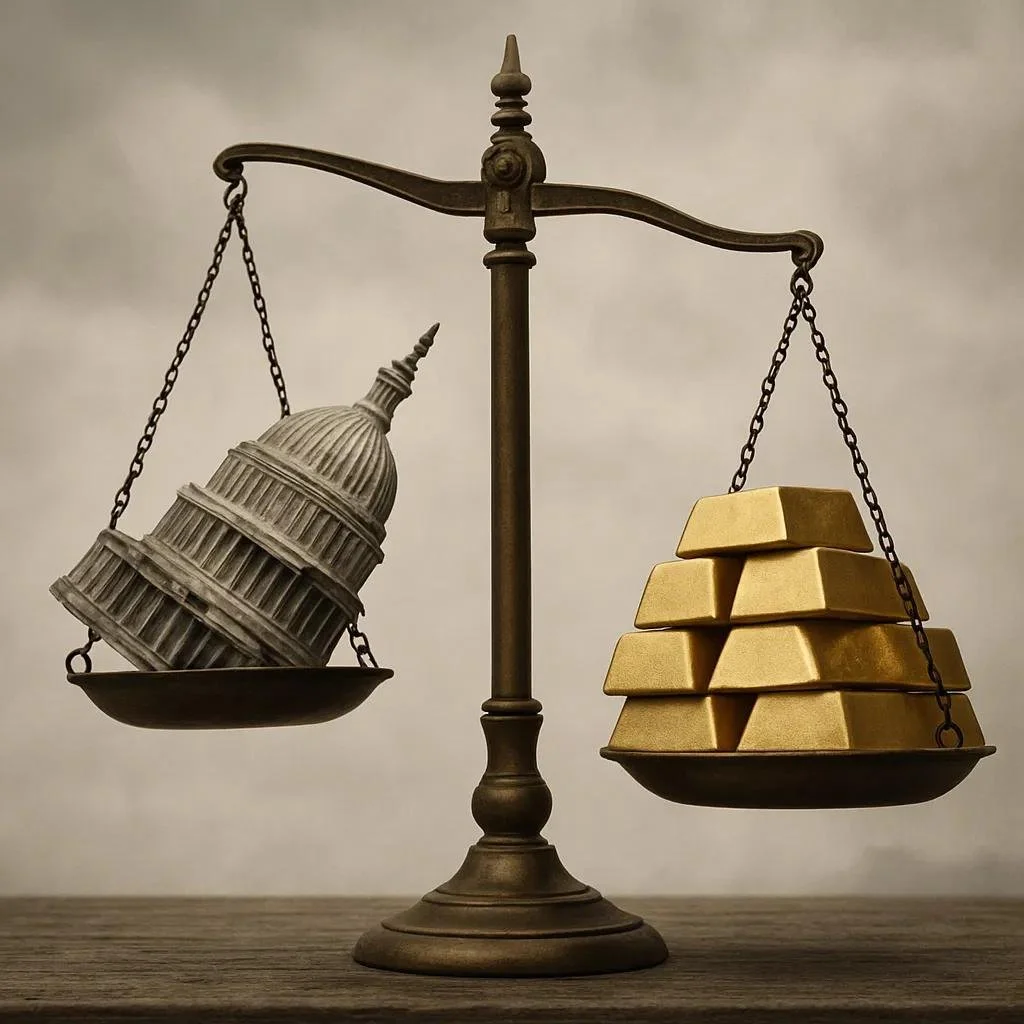
But today is also the end of the fiscal year. And based on the data, we can see that the US will end the fiscal year with around $37.5 trillion in debt. That means, for Fiscal Year 2025, the debt will have increased by another $1.8 trillion.
Taken as a whole, this is an obvious testament to why foreign governments and central banks are rapidly losing confidence in the US government.
It doesn’t even matter whether the government shuts down tonight— it is the fact that it always comes so close. That Congress can’t even manage to pass a basic budget.
And the “solution” on the table is just another short-term patch— a continuing resolution that keeps the government funded for less than two months, until November 21st.
America looks like exactly what it is: a dysfunctional government that can’t even pass a budget.
Frankly, it’s embarrassing.
On top of that, you’ve got this $37.5 trillion debt growing by leaps and bounds—faster than the US economy and faster than tax revenue.
At a certain point, these foreign governments and central banks, who collectively own trillions upon trillions of dollars worth of US government bonds, start wondering: why should I continue to own these securities? Why continue to lend money to the US government?
They can’t even pass a routine budget, let alone the kind of budget that would actually reassure foreign governments and central banks—a truly controversial one that makes deep, necessary cuts to runaway spending.
Then there’s another problem—one that isn’t new. It started under the Bush administration, Obama elevated it, and Biden perfected it: the weaponization of the US dollar, the financial system, and US Treasury bonds.
This gives foreign governments and central banks obvious concern: if they do something the US doesn’t like, they’re going to be frozen out of the dollar system—out of their Treasury holdings, and out of dollar-denominated assets altogether.
And these are all reasons why we believe, over the long run, gold will continue to march higher: central banks will continue to buy gold as an alternative to US dollars.
Why gold?
It’s an independent asset. It’s not controlled by any government. No country is worried that America will freeze its gold holdings. Millions of troy ounces of bars and bullion stored around the world can’t be frozen with the click of a button.
Gold is universally accepted by every other country and central bank. There’s a global market for it. And it’s an asset class large enough to absorb billions of dollars— or even tens, or hundreds of billions—over time.
You can’t say that about most other asset classes.
Gold has already had an astonishing run—especially this year. But we think that, over the long run, as more foreign central banks allocate an increasing percentage of their strategic reserves into gold instead of dollars, that excess demand will continue to push the gold price much higher.
Gold is like anything else—subject to the laws of supply and demand. Demand for physical gold by governments and central banks around the world has been very strong.
And based on the data we’re seeing, that continues to be the case.
The Chinese central bank has bought another 21 tons of gold this year, marking ten consecutive months of purchases.
And it’s not just China. It’s all over the world— Poland, Turkey, Czech Republic, Kazakhstan and many other countries are buying literal tons of gold.
In fact, 95% of central bank reserve managers said they expect global official gold holdings to increase over the next 12 months, according to the 2025 World Gold Council Central Bank Gold Reserves Survey.
There are, however, short-term price risks. For example, the gold price is also impacted by demand for jewelry, as well as industrial use.
Given current record-high prices, jewelry demand is much weaker.
And that can have an adverse impact on gold prices.
Another factor to consider is supply. At a certain point, mining companies are going to take advantage of these high prices and ratchet up production, eventually resulting in oversupply in the market. That, too, could weigh on gold prices.
But we think these are shorter-term factors that don’t change anything about the long-term driver of gold prices—and that is central bank demand.
What we are seeing literally today— government shutdowns and $1.8 trillion deficits—just underscores how widespread that central bank demand is—and why it simply isn’t going away.
To your freedom, James Hickman Co-Founder, Schiff Sovereign LLC
PS: While gold has hit all time highs, the share prices of many top quality gold producers has lagged far behind. That is starting to change, but there is still opportunity before the gap closes.
Seeds of Wisdom RV and Economics Updates Wednesday Afternoon 10-1-25
Good Afternoon Dinar Recaps,
BRICS Dollar Devaluation Path Strengthens With New Payment Systems
As BRICS builds alternative payment rails and leans on gold reserves, the move toward a multipolar financial order accelerates — with profound geopolitical and economic consequences.
Good Afternoon Dinar Recaps,
BRICS Dollar Devaluation Path Strengthens With New Payment Systems
As BRICS builds alternative payment rails and leans on gold reserves, the move toward a multipolar financial order accelerates — with profound geopolitical and economic consequences.
Payment Infrastructure Advances: Beyond Talk to Action
BRICS is pushing forward with BRICS Pay, a decentralized cross-border payment messaging system designed to bypass Western-controlled networks like SWIFT, allowing member nations to transact in local currencies.
During the Rio de Janeiro deliberations, the bloc proposed a guarantee fund to support local payments and integrate them into BRICS Pay.
These systems aren’t theoretical — they are intended to make dollar-free trade routable, reliable, and scalable across BRICS and select partner states.
De-Dollarization Backed by Gold & Local Currency Trade
🔹 Gold as a Pillar
BRICS nations now hold over 6,000 tons of gold — nearly 20–21% of global central bank reserves. Russia and China lead, owning ~74% of the bloc’s gold reserves.
The gold buffer acts as a shield against sanctions, dollar volatility, and external pressure while anchoring confidence in new payment systems.
🔹 Local Currency Settlement
Trade between BRICS nations increasingly uses national currencies instead of the U.S. dollar, reducing the need for dollar liquidity or FX hedging.
The New Development Bank (NDB) now plans to issue its first Indian rupee-denominated bond, aiming to raise ~$400–$500 million in India, as part of a strategy to internationalize BRICS member currencies.
Challenges & Friction in the Shift
🔹 Institutional & Network Effects
The U.S. dollar remains deeply entrenched in global trade: used in nearly 90% of FX trades and ~48% of SWIFT payments.
De-dollarization faces headwinds: liquidity fragmentation, exchange risk, and the higher cost of managing multiple currency rails.
🔹 Uneven Commitment Among Members
India has publicly stated de-dollarization is “not part of India’s financial agenda”, emphasizing bilateral local-currency trade instead.
Some BRICS members remain wary of overextending—too rapid a shift could destabilize economies, especially those with debt pegged to USD or who still rely heavily on U.S. trade and investment.
How This Fits Into Broader Global Restructuring
🔹 Redistribution of Financial Power
By operating an independent payment network and backing it with gold, BRICS is carving out financial sovereignty zones less subject to U.S. pressure or SWIFT control.
🔹 Erosion of Dollar Leverage
As BRICS transactions move off dollar rails, demand for USD as a settlement, reserve, and liquidity asset may decline — weakening the mechanisms by which the U.S. exerts financial influence.
🔹 Multipolar Payment Networks
Instead of one monolithic financial system, we may see overlapping networks (BRICS Pay, CIPS, mBridge, regional CBDC links), each with their own control nodes, rules, and dominant currencies. The world becomes less unified and more plural in financial architecture.
🔹 Gold & Currency Strategy as Influence Tools
Holding gold gives BRICS credibility; issuing debt in local currencies gives them leverage. These instruments become tools of diplomacy and alignment, not just balance sheet items.
Key Takeaway
BRICS is not just talking about breaking dollar dominance — it is constructing the alternatives. Payment systems, gold reserves, and currency internationalization converge in a push to remake global finance. What once seemed speculative is now engineering realignment of power.
This is not just politics — global finance restructuring before our eyes.
@ Newshounds News™ Exclusive
Sources:
Watcher.Guru – BRICS Dollar Devaluation Path Strengthens With New Payment Systems Watcher Guru
InvestingNews – How Would a New BRICS Currency Affect the US Dollar? Investing News Network (INN)
Nestmann – The BRICS De-Dollarization & What It Means for Gold The Nestmann Group
Brasil de Fato – BRICS leaders propose alternative payment system to SWIFT Brasil de Fato
Reuters / News – BRICS-backed NDB plans first rupee-denominated bond Reuters
Wikipedia – BRICS Pay Wikipedia
Carnegie / Policy analyses – Challenges to de-dollarization and structural headwinds CIRSD
Additional academic insight – Geopolitical Tensions & Financial Networks: Strategic Shifts Toward Alternatives arXiv
~~~~~~~~~
Seeds of Wisdom Team RV Currency Facts Youtube and Rumble
Newshound's News Telegram Room Link
Follow the Gold/Silver Rate COMEX
Follow Fast Facts
Seeds of Wisdom Team™ Website
Thank you Dinar Recaps