
Thank you to all the subscribers to our Early Access program…we thank you for your continued support.
We are excited to offer this new service to keep you informed and up-to-date on the latest Dinar and currency news.
Dollar Dominance Is Fading. Gold and Silver Are Paying Attention
Dollar Dominance Is Fading. Gold and Silver Are Paying Attention
The U.S. dollar and gold have a well-documented inverse relationship — and right now, with gold at $4,690 and silver at historically unprecedented price levels, that relationship is doing exactly what it’s supposed to do. The dollar is weakening structurally. Precious metals are the direct beneficiary.
Dollar Dominance Is Fading. Gold and Silver Are Paying Attention
The U.S. dollar and gold have a well-documented inverse relationship — and right now, with gold at $4,690 and silver at historically unprecedented price levels, that relationship is doing exactly what it’s supposed to do. The dollar is weakening structurally. Precious metals are the direct beneficiary.
Most investors tracking gold and silver watch inflation, interest rates, and geopolitical headlines. All of those matter. But they all route through the same upstream variable: the dollar. Understanding why is the difference between reacting to price moves and anticipating them.
Key Takeaways
The U.S. dollar’s share of global foreign exchange reserves has fallen from ~71% in 2000 to ~57% today — a structural decline that directly benefits gold and silver.
When the DXY dropped roughly 10–11% in the first half of 2025, gold broke to successive all-time highs and silver gained approximately 147% for the year.
Central banks bought gold at a 70-year high across 2022, 2023, and 2024 — the clearest institutional signal that dollar dominance is in long-term decline.
What Is Dollar Dominance — and How Does It Affect Gold and Silver Prices?
Dollar dominance is the U.S. dollar’s outsized role in the global financial system. Since the Bretton Woods agreement in 1944, the dollar has been the world’s primary reserve currency. Most international trade, debt, and commodity pricing — including gold and silver — is denominated in USD.
When the dollar is strong, it takes fewer dollars to buy an ounce of gold — that suppresses price. When the dollar weakens, the reverse happens. It’s a relationship that has held through every major market cycle for the past half-century.
What’s changed is the dollar’s grip itself. Its share of global foreign exchange reserves has fallen from approximately 71% at the turn of the century to roughly 57% today — its lowest level in decades [IMF Currency Composition of Official Foreign Exchange Reserves (COFER), Q4 2025]. That structural decline is the backdrop against which every gold and silver price move should be read.
How Does Dollar Strength Drive Gold and Silver Prices?
The mechanics are direct. Gold is priced in U.S. dollars globally. When the dollar rises, gold becomes more expensive for foreign buyers — demand falls, price follows. The reverse is equally true, and the data bears it out consistently.
Most gold analysts track the U.S. Dollar Index (DXY), which measures the dollar against a basket of six major currencies. In the first half of 2025, the DXY dropped roughly 10–11% — its steepest first-half decline in over 50 years. Gold surged through its previous all-time high and kept climbing into 2026 [RBC Wealth Management, U.S. Dollar in Transition, 2025].
This isn’t coincidental. Gold doesn’t pay interest, doesn’t carry counterparty risk, and can’t be printed. When the currency it’s priced in loses purchasing power, gold’s real value stays the same — only the number of dollars required to buy it changes. That’s not speculation. That’s arithmetic.
Silver responds to the same dynamic, but more violently. Its smaller market and industrial demand component mean bigger moves in both directions.
Why Is the Dollar the #1 Signal — and Not Just One Factor Among Many?
Precious metals investors track inflation, interest rates, geopolitical instability, central bank policy. But the dollar sits above the rest because nearly every other variable routes through it first.
Take inflation. Rising prices erode the dollar’s purchasing power and push investors toward hard assets. But the specific mechanism runs through real interest rates — Treasury yields minus inflation. When inflation exceeds bond yields, real rates turn negative.
Holding dollars becomes punitive. Gold, which carries no yield but also no debasement risk, becomes comparatively attractive.
Geopolitical stress used to trigger a “flight to safety” into dollars. That reflex has weakened as confidence in U.S. fiscal credibility has declined. Increasingly, instability flows straight into gold — bypassing the dollar. That’s a structural change.
Watch the dollar. Everything else is downstream from it.
What Happens to Silver When Dollar Dominance Fades?
Silver is the leveraged version of the same thesis. When the dollar weakens, silver doesn’t just follow gold — it typically outpaces it.
In 2025, silver gained approximately 147% over the course of the year as dollar dominance came under sustained pressure [Silver Institute, World Silver Survey 2026]. At $87.71, the white metal is trading at levels with no historical precedent outside the 2025–2026 rally.
That price reflects two forces at once: the monetary trade — a weaker dollar, rising inflation expectations, eroding reserve currency confidence — and surging industrial demand from solar panels, EVs, and electronics.
That dual demand base is what separates silver from most assets. The energy transition keeps industrial demand growing, which raises silver’s structural price floor. Dollar weakness then hits a metal with a shrinking supply cushion. Neither driver needs the other to work — but when both are present simultaneously, silver tends to move fast.
Silver’s percentage gains during dollar stress have historically exceeded gold’s. Both metals respond to the same signal — silver just responds harder.
What Are the Long-Term Implications of a Declining Dollar for Gold and Silver?
The Fed’s Retreat Exposes the Real Monetary Reset
The Fed’s Retreat Exposes the Real Monetary Reset
Miles Harris: 10-15-2026
The landscape of American fiscal policy is undergoing a significant transformation, marked recently by the appointment of Judy Shelton as a counselor at the United States Treasury.
This move signals a potential shift in how the nation views its currency, its debt, and its role in an increasingly digital global economy.
The Fed’s Retreat Exposes the Real Monetary Reset
Miles Harris: 10-15-2026
The landscape of American fiscal policy is undergoing a significant transformation, marked recently by the appointment of Judy Shelton as a counselor at the United States Treasury.
This move signals a potential shift in how the nation views its currency, its debt, and its role in an increasingly digital global economy.
Shelton, a long-time advocate for monetary stability and sound money principles, brings a vision that challenges the traditional dominance of the Federal Reserve. Her focus centers on a transition toward a more decentralized, programmable financial system that leverages modern technology while grounding it in the historical reliability of tangible assets.
Central to this vision is a move away from the heavy-handed influence of the Federal Reserve over the money supply. Instead, the proposed framework emphasizes a system of programmable, collateral-backed money.
This includes the integration of stablecoins and tokenized bank deposits, which allow for faster and more transparent transactions within the private sector. By fostering an environment where private digital money can flourish, the goal is to create a more resilient financial infrastructure that does not rely solely on central bank interventions. This approach seeks to modernize the dollar’s utility without compromising the fundamental principles of market-driven value.
One of the most striking aspects of Shelton’s proposal is her firm stance against Central Bank Digital Currencies, or CBDCs.
While she rejects the idea of a government-issued digital currency that could increase federal oversight of private transactions, she remains a strong proponent of private-sector digital innovation.
To ensure the stability of these private instruments, she suggests a model where digital money is potentially backed by gold-linked Treasury bonds.
This unique mechanism would not only provide a stable anchor for the digital dollar but also stimulate ongoing demand for United States debt by offering investors a more secure and attractive form of collateral.
The importance of collateral has become paramount as the Federal Reserve continues to shrink its balance sheet. In the current economic climate, the repo markets—where financial institutions trade short-term debt for cash—have become the heartbeat of the financial system.
Shelton’s focus on using high-quality collateral, particularly U.S. Treasuries and gold, highlights a shift toward a system where the “quality” of money is just as important as its quantity. By linking digital money creation to these high-value assets, the financial system can maintain liquidity while reducing the volatility often associated with unbacked fiat currencies.
This domestic shift is occurring against a backdrop of complex international monetary dynamics, particularly involving China. As China moves to internationalize its own currency through gold reserves and alternative payment systems, the global monetary order is becoming increasingly multilateral.
Interestingly, despite their competitive relationship, both the United States and China appear to be converging on a similar structural path. Both nations are recognizing the necessity of enhanced collateral-backed financial frameworks to maintain economic influence. This suggests that the future of global finance may be defined by a race to see which nation can best integrate traditional assets into a digital-first economy.
Ultimately, we are witnessing the resurgence of gold as a critical monetary anchor and reserve asset.
In a world characterized by fluctuating exchange rates and intense capital flows, gold provides a neutral ground that can help balance the conflicting pressures of national monetary autonomy and international trade.
Shelton’s vision suggests that by embracing this “new” form of stability, the United States can lead the way into a multilateral monetary era. This transition promises to redefine the relationship between government debt, private innovation, and the fundamental nature of money itself.
0:00 Judy Shelton Joins the US Treasury
1:08 The Fed Is Stepping Back
2:55 The Collateral Machine Steps Forward
4:36 Stablecoins - a Treasury Demand Engine
6:41 Gold Returns Inside the Financial System
8:48 China, Bessent and a New Bretton Woods
11:09 Gold and International Payments
13:30 What the New Monetary Architecture Means
What Backs the US Dollar? Not Gold Not Silver
What Backs the US Dollar? Not Gold Not Silver
What Backs the US Dollar?
So what backs the US dollar, if not gold or silver? The answer has been the same since August 15, 1971: nothing physical. The dollar is a fiat currency — from the Latin fiat, meaning “let it be done.” Its value rests on a government declaration that it is legal tender. Beyond that, it rests on trust.
What Backs the US Dollar? Not Gold Not Silver
What Backs the US Dollar?
So what backs the US dollar, if not gold or silver? The answer has been the same since August 15, 1971: nothing physical. The dollar is a fiat currency — from the Latin fiat, meaning “let it be done.” Its value rests on a government declaration that it is legal tender. Beyond that, it rests on trust.
Key Takeaways
The US dollar has not been backed by gold since August 15, 1971 — the date President Nixon formally ended dollar-to-gold convertibility under the Bretton Woods system.
Since leaving the gold standard, the dollar has lost approximately 87% of its purchasing power [Bureau of Labor Statistics, CPI-U]. As a result, M2 money supply has grown from ~$630 billion in 1971 to over $22 trillion in 2026 [Federal Reserve H.6 Release] — a 35x expansion.
Central banks purchased a net 244 tonnes of gold in Q1 2026 alone [World Gold Council, Gold Demand Trends Q1 2026]. Consequently, the world’s largest reserve managers are reducing dollar exposure — a shift that accelerated after the 2022 freezing of approximately $300 billion in Russian central bank reserves [US Congressional Research Service].
That trust, however, has real and measurable consequences. As of Q3 2025, the dollar accounted for approximately 57% of global foreign exchange reserves [IMF Currency Composition of Official Foreign Exchange Reserves (COFER), Q3 2025]. No other currency comes close. Moreover, the dollar remains the default unit for international trade, oil pricing, and sovereign debt.
However, trust — unlike gold — has no physical limit on its supply. That distinction is at the heart of everything that follows. How the dollar went from redeemable metal to redeemable promise is one of the most consequential financial shifts of the past century.
When Did the Dollar Leave the Gold Standard?
For most of American history, dollars tied directly to precious metals. Under the classical gold standard, anyone could exchange paper dollars for a fixed weight of gold at any bank.
The Bretton Woods system, established at the 1944 conference in Bretton Woods, New Hampshire, extended this logic internationally. Specifically, foreign governments could exchange dollars for gold at $35 per ounce. The dollar was, effectively, as good as gold for international trade.
That ended on August 15, 1971. President Richard Nixon announced that the US would no longer honor foreign requests to convert dollars to gold.
The reason was straightforward: America spent far more than it produced. Financing the Vietnam War and Great Society programs simultaneously had drained the gold reserves. Furthermore, foreign nations — France most prominently — were accelerating their redemptions. As a result, the US simply could not honor the commitments.
Nixon called it a “temporary” measure. Fifty-five years later, however, the gold window has never reopened.
What Did Removing the Gold Standard Actually Do?
Before 1971, the gold standard was a hard ceiling on money creation. The government could not print dollars faster than it could acquire gold to back them. Remove the ceiling, and the supply expands. Indeed, that’s exactly what happened.
M2 money supply grew from approximately $630 billion in 1971 to over $22 trillion in 2026 [Federal Reserve H.6 Money Stock Measures, March 2026] — a 35x increase in just over five decades. For a deeper look at why this pattern repeats across history, see our analysis of why fiat currencies fail.
The purchasing power math is just as stark. According to the Bureau of Labor Statistics’ Consumer Price Index, a 1971 dollar buys roughly 13 to 14 cents worth of goods today [BLS CPI-U, 2026]. For example, a $100 purchase in 1971 costs nearly $800 now.
In addition, gas at 36 cents a gallon now costs over $3.50. Similarly, a median home at $24,000 in 1971 now sells for over $400,000 [US Census Bureau, New Residential Sales].
Those prices didn’t go up. The dollar shrank.
CHART: LINK https://goldsilver.com/industry-news/article/what-backs-the-us-dollar-not-gold-not-silver/
What Gives the Dollar Its Value Now?
Three structural pillars replaced gold as the foundation of dollar demand. However, none of them limits how many dollars can be created. That’s the constraint gold used to provide.
The petrodollar system. From 1974, the US reached agreements with Saudi Arabia and other oil producers to price oil exclusively in dollars.
As a result, every country that imports oil — which is nearly every country — needs dollars to do it. That created sustained global demand for the currency. In recent years, the arrangement has frayed as BRICS nations pursue alternatives, but it remains a significant structural support.
US Treasury debt as a global reserve asset. Foreign governments and central banks hold trillions in US Treasury bonds as their primary reserve asset. It’s self-reinforcing: you need dollars to buy Treasuries, and you hold Treasuries because you need a place to park dollars. The long-term cost of that arrangement is visible in the dollar’s 87% purchasing power decline since 1971.
Network effects and institutional inertia. The dollar runs through global trade contracts, commodity pricing, SWIFT payment infrastructure, and international debt. Consequently, unwinding that takes decades, not quarters. De-dollarization is real — it’s just slow.
Is the Dollar Losing Its Reserve Currency Status?
Yes — but gradually. The dollar’s share of global foreign exchange reserves has fallen from approximately 72% in 2001 to about 57% in Q3 2025 [IMF COFER, Q3 2025]. That’s 15 percentage points over 25 years. In other words, not a collapse — a slow drift.
TO READ MORE: https://goldsilver.com/industry-news/article/what-backs-the-us-dollar-not-gold-not-silver/
We’re in a “WARTIME ECONOMY” & GOLD Is a National Security Asset | Graham Summers & Michelle Makori
We’re in a “WARTIME ECONOMY” & GOLD Is a National Security Asset | Graham Summers & Michelle Makori
Miles Franklin Media: 10-9-2026
Michelle Makori, President & Editor-in-Chief of Miles Franklin Media, speaks with Graham Summers, President and Chief Market Strategist at Phoenix Capital Research and Macroeconomics Fellow at the Homeland Defense Institute, about why he believes the U.S. is already operating on a wartime economic footing as its economic competition with China reshapes national security, critical minerals, financial markets, and gold.
Summers explains why gold has moved to the forefront of U.S. national security, whether Washington could be quietly accumulating gold as China builds its reserves, and why policymakers may be reconsidering gold’s role in the monetary system.
We’re in a “WARTIME ECONOMY” & GOLD Is a National Security Asset | Graham Summers & Michelle Makori
Miles Franklin Media: 10-9-2026
Michelle Makori, President & Editor-in-Chief of Miles Franklin Media, speaks with Graham Summers, President and Chief Market Strategist at Phoenix Capital Research and Macroeconomics Fellow at the Homeland Defense Institute, about why he believes the U.S. is already operating on a wartime economic footing as its economic competition with China reshapes national security, critical minerals, financial markets, and gold.
Summers explains why gold has moved to the forefront of U.S. national security, whether Washington could be quietly accumulating gold as China builds its reserves, and why policymakers may be reconsidering gold’s role in the monetary system.
He also examines the U.S. debt and Treasury market, the dollar’s purchasing power, central bank gold buying, and why government policy could drive a repricing across gold, Bitcoin, critical minerals, and other strategic assets.
Summers also explains why he believes the stock market itself has effectively become a matter of national security and what this shifting economic environment could mean for investors focused on hard assets, monetary stability, and wealth preservation.
In this episode of The Real Story:
Why gold is becoming a national security asset
Whether the U.S. could be quietly accumulating gold
How economic competition with China is reshaping U.S. policy
Why the dollar could be reassociated with gold
What could drive the next repricing in gold and Bitcoin
00:00 Coming Up
02:02 Introduction
03:32 Defining Wartime Economy
05:18 Executive Orders And Minerals
08:55 Inside National Security Briefings
11:40 Economic Defense Unit Explained
15:04 Deal Examples And Mining Push
18:10 Sponsor Break
19:10 Why The Urgency Now
24:37 Gold As Sanctions Weapon
30:05 Gold Backed Bonds Theory
35:24 Treasury Market Stress
44:22 China Gold And US Response
45:16 Trial Balloons Framework
46:04 Covert Gold Buying Tools
50:10 Fort Knox Audit Debate
51:00 Gold Revaluation Talk
53:12 Gold National Security Lens
55:32 Dollar Dominance Reality Check
58:48 China Gold Yuan Theory
01:01:30 Silver Critical Mineral Role
01:02:27 Venezuela Weapons Example
01:04:37 Silver Price Manipulation
01:07:23 Stocks As National Security
01:12:13 Everything Bubble Explained
01:15:10 Wartime Portfolio Strategy
01:20:12 Bipartisan Wartime Momentum
01:23:37 Homeland Defense Institute
Historic Gold Rush Reprices Global Debt
Historic Gold Rush Reprices Global Debt
Kinesis Money: 10-8-2026
In this week's Live from the Vault, Andrew Maguire details how central banks swapping dollars for physical gold at an unrivalled pace are quietly forcing a repricing of global debt — and why this gold rush marks something far bigger than a market rally.
As the Fed remains the last major institution still sitting on gold valued at a fraction of its true market price, Andrew outlines why he sees this gold rush not as a rally, but as the opening chapter of a fundamental restructuring of the monetary order.
Historic Gold Rush Reprices Global Debt
Kinesis Money: 10-8-2026
In this week's Live from the Vault, Andrew Maguire details how central banks swapping dollars for physical gold at an unrivalled pace are quietly forcing a repricing of global debt — and why this gold rush marks something far bigger than a market rally.
As the Fed remains the last major institution still sitting on gold valued at a fraction of its true market price, Andrew outlines why he sees this gold rush not as a rally, but as the opening chapter of a fundamental restructuring of the monetary order.
Timestamps:
00:00 Start
02:17 Why central banks are no longer just buying gold — they are revaluing it
07:44 The Hong Kong exchange launch — why it changes gold pricing permanently
13:02 Gold has overtaken US Treasuries as the world's top reserve asset
19:28 Why the Fed is the last institution standing between gold and a full repricing
25:11 How rising gold revalues sovereign balance sheets — what that means for debt
31:44 Silver's structural deficit — why it is yet to reflect the same revaluation
38:07 Why the current dip is being absorbed by the same buyers driving the gold rush
45:52 The path from $42 Treasury gold to market price — who gets caught short
Why Did Treasury Just Hire the Architect of the Gold-Backed Bond?
Why Did Treasury Just Hire the Architect of the Gold-Backed Bond?
by Phoenix Capital Research Tuesday, Oct 06, 2026
In late September, Treasury Secretary Scott Bessent brought Judy Shelton into his office as Counselor to the Secretary. Most of the coverage treated it as a personnel note about a longtime gold advocate. I think the more useful question is a simple one: why would Treasury want her, and why now? Start with the problem Bessent is trying to solve.
Treasury has to sell trillions of dollars in long-term debt to finance a national debt that has passed $40 trillion.
Why Did Treasury Just Hire the Architect of the Gold-Backed Bond?
by Phoenix Capital Research Tuesday, Oct 06, 2026
In late September, Treasury Secretary Scott Bessent brought Judy Shelton into his office as Counselor to the Secretary. Most of the coverage treated it as a personnel note about a longtime gold advocate. I think the more useful question is a simple one: why would Treasury want her, and why now? Start with the problem Bessent is trying to solve.
Treasury has to sell trillions of dollars in long-term debt to finance a national debt that has passed $40 trillion.
Investors are demanding more to hold it. On Monday, the 30-year Treasury yield hit 5.7%, its highest level since 2002. Treasury expanded its bond buyback program in August to bring those yields down, and it has had little lasting effect.
The traditional fixes for this problem run through the Federal Reserve: the Fed buys bonds, or it caps long-term yields directly. Both options hand the problem to the Fed, and both tend to weaken the dollar.
Judy Shelton has spent more than a decade designing a different fix. One that runs through Treasury.
In a 2012 paper for the Cato Journal, she proposed Treasury Trust Bonds: zero-coupon bonds that holders could redeem at maturity for either dollars or a fixed amount of gold. More recently, she has advocated a 50-year Treasury bond backed by U.S. gold reserves. Her argument is that investors would accept a lower interest rate in exchange for the gold option, which would reduce the government’s borrowing costs.
That is a very specific skill set. And it happens to match a very specific problem.
Now look at the order in which things have happened.
First, President Trump personally named gold a critical mineral in Executive Order 14241. Then Treasury audited Fort Knox and valued America’s gold reserves at more than $1 trillion. Then Treasury added gold to its Iran sanctions. And now the country’s leading designer of gold-convertible debt is working in the Secretary’s office
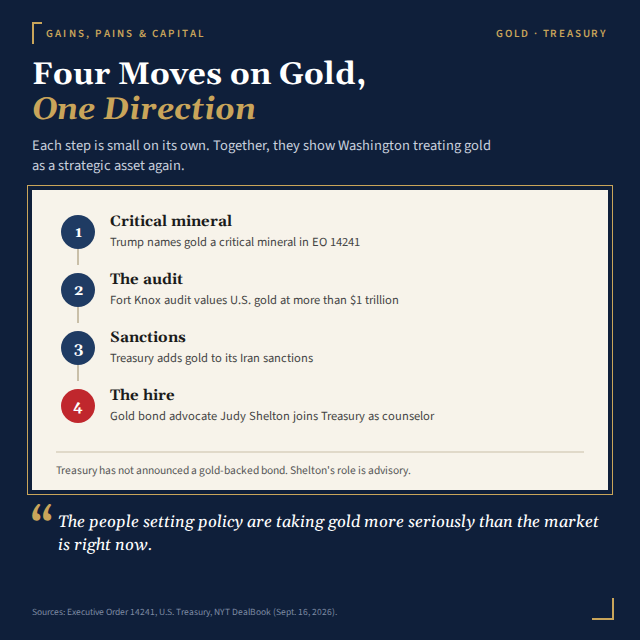
If you were preparing to use gold as part of the government’s financing toolkit, those are the steps you would take: establish its strategic importance, verify what you own, and bring in someone who knows how to structure it.
I want to be careful here. Treasury has not announced or proposed a gold-backed bond. Shelton’s role is advisory. Bessent himself said this summer that gold doesn’t determine the value of the dollar. It is entirely possible that she is there for other reasons, such as Washington’s push to reform the Fed, which she has criticized for years.
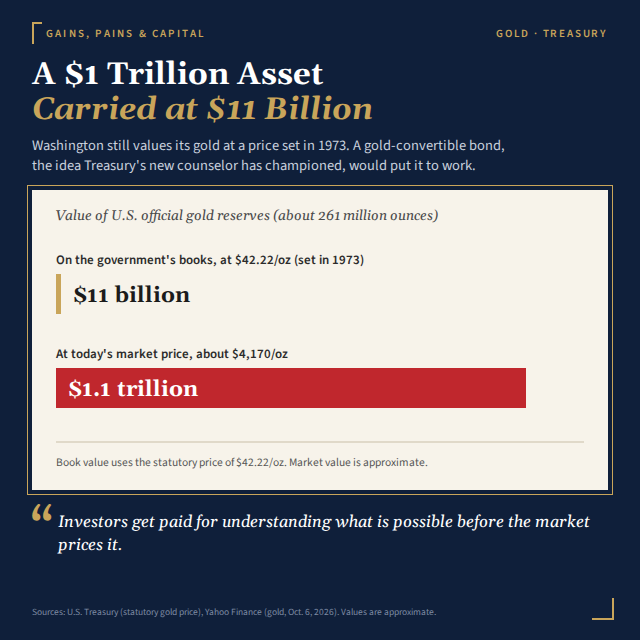
Still, investors get paid for understanding what is possible before the market prices it. So let’s look at the implications.
First, the balance sheet. he U.S. government still carries its gold at $42.22 an ounce, an official price set in 1973. At that price, America’s roughly 261 million ounces are worth about $11 billion on paper. At today’s price of around $4,170, they’re worth about $1.1 trillion. Any program that uses gold as backing for debt puts that gap to work without selling a single ounce.
Second, the incentive. A government that uses gold to support its borrowing has a reason to want a strong gold price, because the more gold is worth, the more it can support. That would be a meaningful shift from the past 50 years, when Washington treated gold as a relic.
Third, China. Beijing is already treating gold as strategic money. China’s central bank added 20.2 tonnes in August, its largest monthly purchase since October 2023. Its gold holdings have risen for 22 consecutive months, and gold is now 9% of China’s foreign exchange reserves. Shelton has written for years about rebuilding the international monetary system with gold playing a role. If Washington wants a response to China’s gold buildup, strengthening the dollar’s link to gold is one option.
And here’s what makes this interesting for investors: the market isn’t paying attention.
Gold is down nearly 8% from a month ago, and its gain over the past year is the smallest since Yahoo Finance began tracking it daily. Back in January, gold was up more than 95% year over year. Investors are treating gold as a trade that has run its course.
TO READ MORE: https://www.zerohedge.com/news/2026-10-06/why-did-treasury-just-hire-architect-gold-backed-bond
The Ultimate Anchor for the Financial System
The Ultimate Anchor for the Financial System
Gold Telegraph: 10-4-2026
For decades, U.S. Treasuries were treated like money.
Now they are starting to trade like debt.
Gold has always just been money.
The Ultimate Anchor for the Financial System
Gold Telegraph: 10-4-2026
For decades, U.S. Treasuries were treated like money.
Now they are starting to trade like debt.
Gold has always just been money.
The founding fathers understand that money is good as gold.
Sound money…
Gold Telegraph: BREAKING NEWS: JUDY SHELTON HAS JOINED THE U.S. TREASURY DEPARTMENT AS COUNSELOR TO THE SECRETARY. Judy has spent decades thinking deeply about monetary policy, sound money, gold, and the architecture of the global financial system. To now see her bringing those ideas and that experience into discussions at the highest levels of the U.S. Treasury is incredibly exciting. My conversation with Judy on The Gold Telegraph will always be one of the highlights of my career. Beyond her extraordinary intellect, she is thoughtful, gracious, and deeply committed to the ideas she believes in. Full documentary: youtu.be/USGjSU5yXh8?si… Congratulations, my friend. Very well deserved. @judyshel

America has $40 trillion in national debt.
The President recently suggested that a certain level of inflation could reduce that burden faster.
Of course it can.
Inflation reduces the real value of debt.
But it also reduces the real value of your money.
This is exactly why gold remains the ultimate anchor of the financial system.
Source(s):
• https://x.com/GoldTelegraph/status/2106106115138478393
• https://x.com/GoldTelegraph/status/2106118311251767572
https://dinarchronicles.com/2026/10/03/gold-telegraph-the-ultimate-anchor-for-the-financial-system/
Gold and the Fed, Judy Shelton Appointment in Treasury, Six Banks
Gold and the Fed, Judy Shelton Appointment in Treasury, Six Banks
And We Know: 10-4-2026
The modern financial landscape is undergoing a massive transformation, driven by technological innovation and shifting economic philosophies. As traditional banking systems evolve, individuals and investors are being forced to reevaluate how money works, how transactions are processed, and what the future holds for personal financial autonomy.
Recent discussions from prominent financial commentators highlight a growing tension between centralized digital currency initiatives and timeless principles of sound money, offering a fascinating glimpse into the crossroads where technology meets liberty.
Gold and the Fed, Judy Shelton Appointment in Treasury, Six Banks
And We Know: 10-4-2026
The modern financial landscape is undergoing a massive transformation, driven by technological innovation and shifting economic philosophies. As traditional banking systems evolve, individuals and investors are being forced to reevaluate how money works, how transactions are processed, and what the future holds for personal financial autonomy.
Recent discussions from prominent financial commentators highlight a growing tension between centralized digital currency initiatives and timeless principles of sound money, offering a fascinating glimpse into the crossroads where technology meets liberty.
At the forefront of these technological changes is the emergence of programmable digital payments, particularly initiatives being explored by Canadian financial institutions. Proponents of these digital systems champion them for their incredible speed, efficiency, and the promise of cost-free transactions that could streamline commerce.
However, this technological leap forward is not without its critics. A closer look at programmable currency reveals significant concerns regarding individual privacy, personal freedom, and institutional control. Because programmable money can be coded with specific restrictions or conditions on how, when, and where it is spent, many analysts worry it paves the way for unprecedented oversight.
This apprehension has even led some commentators to draw symbolic comparisons to historical and biblical warnings regarding absolute control, underscoring the deep-seated mistrust many citizens hold toward top-down monetary policies.
Contrasting sharply with the trend toward centralized digital control are differing visions for broader economic recovery and monetary stabilization. On one side of the debate, figures like Judy Shelton have emerged as voices of hope for those advocating a return to stability.
Shelton has famously championed the idea of a gold-backed bond that could be convertible into either gold or traditional fiat currency, a move designed to instill confidence and anchor the currency in tangible value.
Supporters believe that reintroducing elements of a gold standard could curb reckless spending and protect the purchasing power of everyday citizens against the erosive effects of inflation.
This hopeful outlook on asset-backed currency stands in stark opposition to other economic proposals currently circulating among policymakers and influencers. For instance, strategies suggested by figures like Anthony Scaramucci—which often lean toward higher taxation and fiscal austerity—face heavy criticism from market traditionalists.
Opponents argue that increasing the tax burden and tightening austerity measures can severely stifle economic growth, hurt small businesses, and place an unfair weight on the middle class during already uncertain times. Instead of relying on government-mandated belt-tightening, many financial experts suggest that true economic health comes from fostering production, encouraging investment, and preserving the value of the currency.
As these debates unfold, a common theme continues to resonate among those seeking financial security: the enduring value of precious metals. Gold and silver are increasingly viewed not just as traditional investments, but as essential safeguards against persistent inflation and the potential loss of financial freedom.
In an era where digital currencies can be monitored, restricted, or altered by central authorities, holding physical assets provides a reliable fallback that remains entirely outside the banking system.
This renewed interest highlights a broader excitement within certain financial circles about the potential revival of sound money principles, reminding the market of the fundamental importance of intrinsic value.
America Is Quietly Building a New Gold & Silver System | Jason Cozens
America Is Quietly Building a New Gold & Silver System | Jason Cozens
Miles Franklin Media: 10-1-2026
Andy Schectman, Founder & CEO of Miles Franklin, speaks with Jason Cozens, Founder & CEO of Glint, about the accelerating push to make gold and silver usable as money across the United States.
Cozens says six states have already passed related laws, with another 14 actively working on legislation, as concerns grow around U.S. debt, inflation and the resilience of the financial system.
America Is Quietly Building a New Gold & Silver System | Jason Cozens
Miles Franklin Media: 10-1-2026
Andy Schectman, Founder & CEO of Miles Franklin, speaks with Jason Cozens, Founder & CEO of Glint, about the accelerating push to make gold and silver usable as money across the United States.
Cozens says six states have already passed related laws, with another 14 actively working on legislation, as concerns grow around U.S. debt, inflation and the resilience of the financial system.
They discuss Florida’s emerging gold and silver framework, the expansion of precious-metals vaulting in the U.S., and how digital platforms could make gold easier to transact and redeem for physical metal.
Cozens also explains why he believes cities such as Miami, Austin and Salt Lake City could develop into major gold hubs, potentially strengthening America’s role in the global gold and silver market.
In this episode of Little by Little with Andy Schectman:
Why U.S. states are turning to gold and silver
The $40 trillion U.S. debt problem
20 states advancing gold and silver legislation
Making gold usable as everyday money
Could America become a global gold hub?
00:00 Coming Up
02:12 Introduction
03:33 UK Gilts Breaking News
06:15 Debt Spiral and Bonds
08:49 AI Risk and Disruption
14:23 Why Gold Endures
16:18 Constitutional Path for States
22:32 Florida Rules and Tax Clarity
29:44 Miami Vault and Delivery Options
38:25 Capital Gains and IRS Pressure
42:08 America as Gold Hub Vision
43:56 Wrap Up and Farewell
Judy Shelton Joins The Treasury, Do We Have The Gold? Gold Destroys The Fed,The Golden Age
Judy Shelton Joins The Treasury, Do We Have The Gold? Gold Destroys The Fed,The Golden Age
X22 Report: 10-3-2026
Bessent brings on Judy Shelton to assist in transitioning the country to sound money.
Gold in the end will destroy the Fed.
Judy Shelton has joined the US Treasury Dept. as councilor to the Secretary.
Judy has spent decades thinking deeply about monetary policy, Sound money, gold and the architecture of the global financial system.
Judy Shelton Joins The Treasury, Do We Have The Gold? Gold Destroys The Fed,The Golden Age
X22 Report: 10-3-2026
Bessent brings on Judy Shelton to assist in transitioning the country to sound money.
Gold in the end will destroy the Fed.
Judy Shelton has joined the US Treasury Dept. as councilor to the Secretary.
Judy has spent decades thinking deeply about monetary policy, Sound money, gold and the architecture of the global financial system.
And now she is going to be assisting Treasury Secretary Bessent. Think about that.
Do we have the gold? Gold will destroy the Fed.
Trump is bringing us back to the constitution and sound money. They need to shift off of the old Federal Reserve petrodollar system and onto the new US dollar system based and backed by stablecoins for the transition. I do believe also backed by bitcoin and eventually gold.
When the time is right, the new financial structure is complete , and the transition has begun…I believe he will start the narrative and talk about Ft. Knox and asking “Do we have the gold” He is already setting it up and Judy Shelton will assist.
We are heading to a place where the whole system is about to change. We will be going from a debt system to a income system. An income system needs sound money. That is where it is headed….we will be entering the “Golden Age”
The 10-year Treasury yield hit a 19-year high in September – Why is it so important?
The 10-year Treasury yield hit a 19-year high in September – Why is it so important?
Sep 25, 2026| Seth Carlson J.P. Morgan Wealth Management Investing Essentials
If it feels like the 10-year Treasury yield has become a fixture in financial headlines, there’s a reason for that. As investors navigate lingering inflation concerns, shifting market expectations around Federal Reserve policy and questions about economic growth, moves in the 10-year Treasury yield are closely watched, as it can impact mortgage rates, stock prices and broader financial conditions.
The 10-year Treasury yield hit a 19-year high in September – Why is it so important?
Sep 25, 2026| Seth Carlson J.P. Morgan Wealth Management Investing Essentials
If it feels like the 10-year Treasury yield has become a fixture in financial headlines, there’s a reason for that. As investors navigate lingering inflation concerns, shifting market expectations around Federal Reserve policy and questions about economic growth, moves in the 10-year Treasury yield are closely watched, as it can impact mortgage rates, stock prices and broader financial conditions.
At its core, the 10-year Treasury yield reflects the annualized return an investor earns by holding a 10-year U.S. Treasury note to maturity, based on its current market price. The yield helps shape long-term borrowing costs across the economy, offers insight into how investors view inflation and growth, and even serves as a reference point for market risk.
The 10-year Treasury yield can act as a window into a broader economic outlook. Here’s what you need to know about the yield, what it signals about the economy, how it affects financial markets and why it can be a useful tool for investors trying to make sense of an uncertain economic environment.
What is the 10-year Treasury yield?
Very simply, the 10-year Treasury yield is the annualized return an investor earns by holding a 10-year U.S. Treasury note to maturity, based on its current market price. These notes, which are issued by the U.S. Department of the Treasury, are widely viewed as one of the safest instruments in which to invest money because they are backed by the “full faith and credit of the U.S. government." Footnote 1 Opens overlay
Also important for investors to understand is how the 10-year Treasury yield typically behaves. Treasury prices and yields move in opposite directions. When investors rush to purchase Treasuries, prices rise and yields fall. When investors move money elsewhere, Treasury prices drop and yields rise.
The 10-year yield reflects how investors feel about inflation, economic growth and where interest rates may be headed over the long term. That’s why it’s often treated as a barometer for broader economic expectations, not just a return on government debt.
The influence of the 10-year Treasury yield shows up in very real ways. For example, long-term borrowing costs across the economy – especially mortgage rates – tend to follow the 10-year yield. When the yield rises, 30-year fixed mortgage rates also typically climb, making the cost to borrow money to buy a home more expensive. When the yield falls, borrowing may become more affordable, which can help boost the housing market and consumer spending.
That’s why the yield on the 10-year Treasury note can be important to people who may never buy a bond – they may still feel the impact when they take out a loan or refinance their mortgage. Footnote 2
10-year Treasury yield, January 1, 2000-September 23, 2026
CHART: LINK
When you look at the period of January 2000 to September 23, 2026, it’s easy to see how the 10-year yield reacted to major economic disruptions. After the dot-com bubble burst in the early 2000s and during the 2008 financial crisis, one reason yields fell could be that investors sought out safer assets over those that are seen as riskier, such as equities.
The same pattern reappeared in 2020. As the COVID-19 pandemic disrupted the global economy, investors sought safety, pushing the 10-year Treasury yield to historic lows.
In contrast, persistent inflation and correspondingly aggressive rate hikes by the Federal Reserve in 2022 and 2023 caused existing bonds to lose market value as investors tried to sell their old bonds with lower yields for newer bonds paying higher yields. And then in 2025, when the Fed began cutting rates, 10-year Treasury yields increased – and that was unusual since history suggests that the yield typically falls after a Fed rate cut.
In 2026, after the Fed hiked rates in September to combat stubborn inflation, the 10-year Treasury yield continued to climb, hitting a high of 5.116% on September 23, a rate not seen since 2007. Footnote 3 Opens overlay
What does the 10-year Treasury yield tell investors about the economy?
TO READ MORE: https://www.chase.com/personal/investments/learning-and-insights/article/10-year-treasury-yield-why-is-it-so-important
Is It A Golden Era For Gold?
Is It A Golden Era For Gold?
JP MORGAN
Gold stands at the crossroads of global uncertainty and enduring resilience. Here, we explore the factors driving the price of gold and consider the important role it plays in portfolio diversification. Gold prices have more than doubled since late 2023, repeatedly hitting all-time highs in a sustained rally. The precious metal outperformed major equity benchmarks in 2025 with an eye-popping 65% return,1 its strongest single year since 1979, then built on those gains in early 2026.
Is It A Golden Era For Gold?
JP MORGAN
Gold stands at the crossroads of global uncertainty and enduring resilience. Here, we explore the factors driving the price of gold and consider the important role it plays in portfolio diversification. Gold prices have more than doubled since late 2023, repeatedly hitting all-time highs in a sustained rally. The precious metal outperformed major equity benchmarks in 2025 with an eye-popping 65% return,1 its strongest single year since 1979, then built on those gains in early 2026.
A sought-after commodity for centuries, gold has been a popular component in investment portfolios in modern times, and has delivered attractive annual returns of approximately 12% over the 20 years ending in 2025.
That said, its price can be volatile: Gold sank 9.8% on January 30, surrendering about half its prior 2026 gain in the biggest one-day loss since 2013. Weakness in gold prices can be prolonged, as gold tumbled approximately 40% from September 2011 to December 2015, and did not fully recover until August 2020.
This combination of a historic rally and historic volatility would seem to challenge the case for investing in gold today. However, we remain firmly bullish on gold in 2026, and recently raised our outlook to a range of $6,000 to $6,300 per ounce.
The recent sell-off may present a potential entry point for long-term investors, and see potential for further upside as investors look to diversify dollar exposure, hedge geopolitical risk and guard against inflation surprises.
To explain why, we’ll dig into the complex interplay of macro factors and supply/demand dynamics that influence gold prices.
Understanding gold’s unique characteristics and benefits is crucial for investors who are looking to establish portfolios that endure through cycles. We will show how the key drivers of gold prices have evolved in recent years, and how an appropriately sized allocation to gold can add value to a portfolio.
What drives gold prices?
The level of the U.S. dollar
As gold is denominated in U.S. dollars, gold prices have often exhibited a negative correlation with the value of the dollar. When the dollar weakens, gold becomes more relatively attractive for holders of other currencies, increasing demand. Conversely, gold prices tend to weaken as the dollar strengthens.2
However, there are instances when this relationship does not hold. For example, in 2012–13, gold lost 18% of its value even though the dollar remained relatively stable, rising less than 1%. We think a relatively weak dollar will present a stable and benign backdrop for gold prices over the next six to 12 months.
Following a year of significant weakness, the dollar is entering a bumpy process of bottoming, as shown in the chart below. In our base case, we anticipate that the U.S. economy could gradually recover over the second half of the year, potentially coinciding with improvements in other major economies such as Europe and Japan. Lingering concerns over Federal Reserve (Fed) independence and U.S. fiscal sustainability may also limit the dollar’s strength.
The U.S. dollar environment is largely benign; we expect the dollar to stabilize, tracking the moves in interest rate differential
DXY model based on 5Y swap rate differentials
CHART: LINK https://privatebank.jpmorgan.com/nam/en/insights/markets-and-investing/is-it-a-golden-era-for-gold
Change in real yields
Historically, gold prices have generally had an inverse relationship with real yields (inflation-adjusted interest rates). As gold does not generate interest income, real yields can be seen as the opportunity cost of holding it. When real yields go down, gold becomes more attractive relative to interest-bearing assets such as cash and fixed income securities.
This relationship explains a large part of the price increase in gold since the 1990s, a period of structural decline in real yields. Large gold rallies such as those in 2008–2012 and 2019–2021 can also be attributed to real yields turning negative due to global quantitative easing and zero interest rate policies.
TO READ MORE: https://privatebank.jpmorgan.com/nam/en/insights/markets-and-investing/is-it-a-golden-era-for-gold
Who Decides What Gold Is Worth? How Gold Prices Are Determined
Who Decides What Gold Is Worth? How Gold Prices Are Determined
Catherine Brock Yahoo Personal Finance
The price of gold can be quoted in multiple forms because the precious metal is traded in different ways. The two main gold prices that investors should know about are spot prices and gold futures prices.
Who Decides What Gold Is Worth? How Gold Prices Are Determined
Catherine Brock Yahoo Personal Finance
The price of gold can be quoted in multiple forms because the precious metal is traded in different ways. The two main gold prices that investors should know about are spot prices and gold futures prices.
The Spot Price
The spot price of gold is the current market price per ounce for physical gold as a raw material, sometimes called spot gold. Gold ETFs that are backed by physical gold assets generally track the gold spot price.
The spot price is lower than what you'd pay to buy gold coins, bullion, or jewelry, since your total price will include a markup called the gold premium that covers refining, marketing, dealer overhead, and profits. The spot price is more like a wholesale price, and the spot price plus the gold premium is the retail price.
Gold Futures
Gold futures are contracts that mandate a gold transaction at a specific price on a future date. These contracts are exchange-traded and more liquid than physical gold. They settle on the contract expiration date or earlier, either financially or via delivery. A cash settlement involves paying the contract's profit or loss in cash. Delivery means the seller sends physical gold to the buyer for the contracted price.
Learn more: Gold alternatives? How to invest in silver, platinum, and palladium.
Factors That Affect Gold Prices
Supply and demand determine gold spot prices and gold futures prices. Factors that influence gold supply and demand include:
Geopolitical events: Gold is considered a safe-haven asset, meaning it can hold its value — and sometimes appreciate — when stocks and other assets are volatile or in decline. Geopolitical events, such as military conflicts and trade disputes, can prompt stock price volatility and, in turn, stoke higher demand for gold.
Central bank buying trends: Central banks own gold to hedge against inflation and support economic stability. Unlike traditional currency, the price of gold is not tied to a banking system that is subject to manipulation or collapse. Central banks influence the global gold supply because they buy and sell in large quantities.
Inflation: Many investors consider gold an effective hedge against inflation. Rising prices, therefore, can stimulate gold demand and push gold prices higher.
Interest rates: When interest rates rise, gold prices can decline. When interest rates fall, gold prices can rise. This happens in part because gold does not pay interest. Cash and fixed-income assets are preferred in higher-rate environments because they can produce higher yields.
Mining production: Mining activity affects the global gold supply, while production costs influence gold prices.
Historic Price Of Gold
Historically, the gold futures price has been volatile, particularly when adjusted for inflation. Significant trends include:
April 1934 to July 1970: Gold declined more than 65% in an extended downturn.
July 1970 to January 1980: Gold rose nearly 850% in a sharp spike upward.
January 1980 to February 2001: Gold fell 82%.
February 2001 to September 2025: Gold gained by 591%.
Owning gold potentially exposes you to similar extended trends, which is why it's important to set your allocation carefully.
In the lackluster years, your gold position will negatively impact your overall investment returns. If that feels problematic, a lower allocation percentage is more appropriate. On the other hand, you may be willing to accept gold's underperforming years so you can benefit more in the good years. In this case, you would target a higher percentage.
If you are interested in learning more about gold's historical value, Yahoo Finance has been tracking the historical price of gold since 2000.
Current Gold Dynamic
In 2025, the gold futures price rose more than 65%. It was the precious metal's strongest calendar year performance since 1979.
Thomas Winmill, portfolio manager at Midas Funds, said the historic run-up into 2026 has been driven by investors seeking a hedge against a "potential negative reaction in the general stock and bond markets to the current news cycle." Headlines about evolving U.S. tariff policies and U.S. military involvement in Venezuela, Iran, Greenland, and domestic cities can be unnerving for investors.
Additionally, rising national debt erodes confidence in the U.S. dollar. A continuation of that trend would negatively affect financial assets such as stocks and bonds and benefit gold.
While the specific factors driving gold's strength today may be historically distinct, gold's recent performance is not out of character. "Gold's behavior, like that of any hard asset, can be extremely volatile," Winmill said. As an example, gold rose more than 100% in 1979 and nearly 30% in 1980 before falling about 33% in 1981.