
Thank you to all the subscribers to our Early Access program…we thank you for your continued support.
We are excited to offer this new service to keep you informed and up-to-date on the latest Dinar and currency news.
“Tidbits From TNT” Friday Morning 9-19-2025
TNT:
Tishwash: Iraq remains America's darling...the Supreme Court dismisses a lawsuit against Baghdad for hundreds of millions.
The Supreme Court in Washington ruled on Wednesday (September 17, 2025) to prevent an American military affairs company from fining the Iraqi government $121 million in a lawsuit related to breach of contract to rehabilitate Iraqi army weapons.
According to a Bloomberg report translated by Baghdad Today, Wy Oak Technology, a military-related company, filed a lawsuit against the Iraqi government, seeking $121 million in damages for the contract's suspension.
TNT:
Tishwash: Iraq remains America's darling...the Supreme Court dismisses a lawsuit against Baghdad for hundreds of millions.
The Supreme Court in Washington ruled on Wednesday (September 17, 2025) to prevent an American military affairs company from fining the Iraqi government $121 million in a lawsuit related to breach of contract to rehabilitate Iraqi army weapons.
According to a Bloomberg report translated by Baghdad Today, Wy Oak Technology, a military-related company, filed a lawsuit against the Iraqi government, seeking $121 million in damages for the contract's suspension.
The Supreme Court affirmed that "Iraq is protected under the U.S. Foreign Immunity Act," noting that this law protects foreign governments from prosecution in such cases, even in the presence of formally signed contracts.
The report added that the court's decision means Iraq retains "immunity," which prevents companies and commercial entities from being sued within the United States, whether for breaches of contract or damages resulting from operating in Iraq.
The roots of this immunity date back to the aftermath of the 2003 invasion of Iraq, when the US Congress passed a special law signed by former President George W. Bush, known as the "Iraq Freedom from Judicial Attachment Act," which granted Iraq exceptional protection from lawsuits and seizures. Experts interpreted this move as maintaining Iraq's status as a "spoiled child" in US politics, amid subsequent presidential successions that ensured this privilege would continue for two full decades. link
**************
Tishwash: The Oil Minister affirms the government's support for the Iraq Investment Forum to attract foreign capital.
Deputy Prime Minister and Minister of Oil, Hayan Abdul-Ghani, reviewed today, Thursday, the preparations for the Iraq Investment Forum, stressing the government's support for the Iraq Investment Forum to attract foreign capital.
A statement by the Ministry of Oil stated: "Abdul Ghani met with a delegation from the Preparatory Committee for the Iraq Investment Forum, headed by Ibrahim Al-Masoudi Al-Baghdadi, Chairman of the Iraqi Economic Council and member of the Preparatory Committee."
The statement added that "the Chairman of the Council provided a detailed explanation of the dialogue session for the Ministry of Oil, which is scheduled to be chaired by the Minister of Oil on September 27. During the meeting, investment opportunities presented by the Ministry of Oil were discussed, which aim to attract investments in the oil and gas sector and petroleum industries.
" It continued, "The meeting discussed logistical preparations and preparations related to sending invitations to the relevant ministers, including the Turkish and Lebanese Ministers of Oil."
The Minister stressed "his keenness to support the forum, which reflects the government's direction towards revitalizing the national economy and attracting foreign capital."
The statement indicated that "the meeting was attended by the Executive Director of the Economic Council, Thabet Kazim Al-Safi, and the Assistant Director General of the Economic Department at the National Investment Commission, Hussein Ali Kanbar, in addition to Hazem Al-Shammari from the Media and Relations Department." link
****************
Tishwash: Abu Raghif inaugurates the e-signature conference in Baghdad to promote digital payments and secure transformation.
The "Activating Electronic Signatures to Support E-Payment" conference kicked off in Baghdad today, Thursday, under the title "Towards a Trusted Digital Environment." The conference, held under the patronage of the Prime Minister and under the supervision of the Central Bank and the Communications and Media Commission, brought together ministries, government institutions, and local and international technology companies.
In his speech during the opening session, which was followed by {Euphrates News}, the Chairman of the Communications and Media Commission, Nofal Abu Ragheef, said: “The conference represents a fundamental step in building a secure digital environment that supports the national economy, under the sponsorship and essential partnership of the Communications and Media Commission as the regulatory body for this vast sector, confirming its tireless pursuit of real partnerships with financial technology (FinTech) companies to develop innovative financial services that respond to the needs of citizens in the digital age.”
Abu Raghif added, "The success of this project requires responsible institutional strengthening of information security, which is the cornerstone of data protection and ensuring digital trust, as well as developing the infrastructure and encouraging informed investment in this field." He emphasized the authority's commitment to implementing applicable legislation, most notably the Electronic Signature and Electronic Transactions Law, in line with international standards and regulations of the International Telecommunication Union.
The Commission Chairman concluded his speech by emphasizing that "digital transformation is no longer just a regulatory option, but rather a national economic necessity," calling for "integrating the efforts of the state, the private sector, and international partners to build a sustainable digital economy that meets the demands of the times and serves the Iraqi citizen." link
***************
Mot: Uh Oh !!!!!

Mot: As You Can See!! -- I Am Now Committed !!!

FRANK26…9-18-25……NO TOILET PAPER
KTFA
Thursday Night Video
FRANK26…9-18-25……NO TOILET PAPER
This video is in Frank’s and his team’s opinion only
Frank’s team is Walkingstick, Eddie in Iraq and guests
Playback Number: 605-313-5163 PIN: 156996#
KTFA
Thursday Night Video
FRANK26…9-18-25……NO TOILET PAPER
This video is in Frank’s and his team’s opinion only
Frank’s team is Walkingstick, Eddie in Iraq and guests
Playback Number: 605-313-5163 PIN: 156996#
Iraq Economic News and Points To Ponder Thursday Evening 9-18-25
Central Bank: 6.8 Trillion Dinars In Electronic Collections In 2025
Banks Economy News – Baghdad The Central Bank of Iraq revealed that the total government electronic collections through points of sale (POS) during the first eight months of 2025 exceeded six trillion dinars, while the number of employee payroll cards exceeded five million
Central Bank: 6.8 Trillion Dinars In Electronic Collections In 2025
Banks Economy News – Baghdad The Central Bank of Iraq revealed that the total government electronic collections through points of sale (POS) during the first eight months of 2025 exceeded six trillion dinars, while the number of employee payroll cards exceeded five million.
The Director General of the Information Technology and Payments Department at the Central Bank of Iraq, Adnan Asaad, said in an interview with Al-Sabah, followed by Al-Eqtisad News:
“The volume of government electronic collections through points of sale so far has reached more than 6.8 trillion dinars in the first eight months of this year,” expecting that “it will exceed 10 trillion dinars by the end of this year, while last year it amounted to about 9 trillion dinars, while collections from gas stations exceeded 750 billion dinars, after it was 465 billion dinars last year.”
He added, "Total government e-collection through various payment instruments has reached approximately 2.1 trillion dinars, while last year it reached approximately 322 billion dinars," noting that "49 ministries and agencies have approved the deployment of e-payment instruments in more than 6,600 formations."
Asaad continued, "The number of domiciled employee cards has reached approximately 5.6 million, while the value of the use of electronic payment systems for real-time settlement has exceeded 200 trillion dinars. Automated clearing has exceeded 35 trillion dinars, and the national switchboard has recorded approximately 20 trillion dinars."
The bank's Director General of Information Technology and Payments explained that "these figures for 2025 reflect the continued expansion in the adoption of electronic payment channels and the development of its infrastructure, in line with the Central Bank's strategic directions and the government's national plans to enhance financial inclusion and digital transformation in Iraq." 09/17/2025 https://economy-news.net/content.php?id=60147
Trade Bank Of Iraq Launches Direct Delivery Service For Electronic Cards
Banks Economy News – Baghdad The Trade Bank of Iraq announced today, Thursday, the launch of a direct delivery service for electronic cards.
A statement from the bank, received by Al-Eqtisad News, stated that "to facilitate customers, it has been decided to activate the direct delivery service for electronic cards."
The bank added, "We announce the activation of the electronic card delivery service in Baghdad and all governorates to ensure their safe and timely arrival." https://economy-news.net/content.php?id=60184
Electronic Payment In Iraq: Major Strides, Challenges Ahead
Banks Iraq is witnessing rapid transformations in the structure of its financial systems, with increasing reliance on electronic payment methods instead of direct cash transactions. This transition is not merely a technical update; it represents a fundamental step toward building a more transparent economy capable of keeping pace with changes in regional and global markets.
From Cash To Card
The Central Bank of Iraq's recent announcement that the number of domiciled employee cards has reached 5.6 million clearly indicates the depth of the ongoing transformation. After years of near-total reliance on cash, large segments of Iraqis—employees and retirees alike—now rely on electronic cards as their primary means of receiving their salaries and conducting transactions.
This step represents a qualitative shift in a country that has long been a prisoner of cash liquidity, with large salaries paid in cash, straining the banking system and increasing security and economic risks.
Leadership And The Role Of Local Companies
Among the companies that pioneered this transformation, Qi Card emerged as the first electronic payments company in Iraq, laying the foundation for a national experience in financial technology. The company launched with a basic service, payroll localization, but has gradually transformed into a major player providing multiple payment and financing services.
Despite the challenges it faced operating in a challenging environment, K-Card's presence helped boost users' confidence in digital services and provided access to groups in villages and rural areas, making electronic payments a part of daily life for a growing segment of Iraqis.
Expansion Of Services
The development did not stop at issuing cards, but included the introduction of services such as:
Biometric update to ensure accuracy of user data.
Electronic advance systems that provide urgent liquidity.
Installment services in universities, hospitals and retail stores.
Point of sale (POS) devices are widespread in markets and shops.
These services have enhanced the added value of the electronic payment sector and connected consumers more deeply to the formal financial system.
User Experience...The Most Important Indicator
The decisive factor in the success of electronic payments was not the number of cards but rather user satisfaction. Employees or retirees who once had to wait hours in bank lines are now able to receive their salary via card quickly and securely.
This user experience has directly impacted the service's popularity. The smoother the process, the higher the uptake. However, challenges still exist in some areas due to poor communications infrastructure or a lack of financial awareness.
Private Sector And Government Orientation
The widespread adoption of electronic payment is not limited to government employees. The government has adopted a clear policy to deploy point-of-sale (POS) devices in various markets, including the private sector, to expand the user base and reduce cash transactions.
Payment companies have responded to this policy by offering cards and services that operate both inside and outside Iraq, giving consumers greater flexibility and putting Iraq on the path to integration into the global financial system.
Figures And Facts
The number of electronic payment cards in Iraq has exceeded 12 million cards.
Thousands of POS devices are now widespread in the market.
A large segment of universities and institutions now rely on digital installment systems.
These figures reflect the magnitude of the change, but they also indicate the extent of the work required to secure infrastructure and update legislation.
New Technology And Applications
With the growing demand for digital solutions, applications like SuperKey have emerged, combining payments, transfers, and government services into a single platform.
These applications not only facilitate financial transactions, but also offer a practical model for integration between the public and private sectors, through services such as paying water and electricity bills or paying government fees electronically.
Challenges That Cannot Be Ignored
Despite these successes, the sector faces a number of challenges, most notably:
Lack of financial awareness among some users, which hinders full access to services.
Internet services are intermittent in some areas, limiting operational stability.
The need for more flexible legislation to keep pace with the development of financial technology.
Competing with traditional banks that still maintain a portion of their cash share.
Towards An Integrated Digital Economy
The success of electronic payment goes beyond facilitating transactions; it also serves as a tool for combating corruption, reducing tax evasion, and promoting financial inclusion. The data generated from millions of transactions represents a wealth of information that can help decision-makers formulate more accurate economic policies.
Iraq's e-payment experience is a growing success story, but it still requires strengthening its infrastructure, developing legislative frameworks, and intensifying financial literacy programs. Between the regulatory role of the Central Bank, investments by local companies like Qi Card, and government efforts to expand the sector, a clear path is taking shape toward a digital economy that could be one of the most prominent features of Iraq's economic development over the next decade. https://economy-news.net/content.php?id=60186
New Drop In Gold Prices In Baghdad
Stock Exchange Economy News – Baghdad Iraqi and foreign gold prices fell slightly on Thursday in local markets in the capital, Baghdad.
Gold prices in the wholesale markets on Al-Nahr Street in the capital, Baghdad, this morning recorded a selling price of one mithqal of 21 karat Gulf, Turkish and European gold at 736 thousand dinars, and a purchase price of 732 thousand dinars, while yesterday, Wednesday, it recorded 738 thousand dinars.
The selling price of one mithqal of 21-karat Iraqi gold reached 706,000 dinars, and the buying price was 702,000 dinars.
As for gold prices in jewelers' shops, the selling price of a mithqal of 21-karat Gulf gold ranges between 740,000 and 750,000 dinars, while the selling price of a mithqal of Iraqi gold ranges between 710,000 and 720,000 dinars. https://economy-news.net/content.php?id=60185
For current and reliable Iraqi news please visit: https://www.bondladyscorner.com
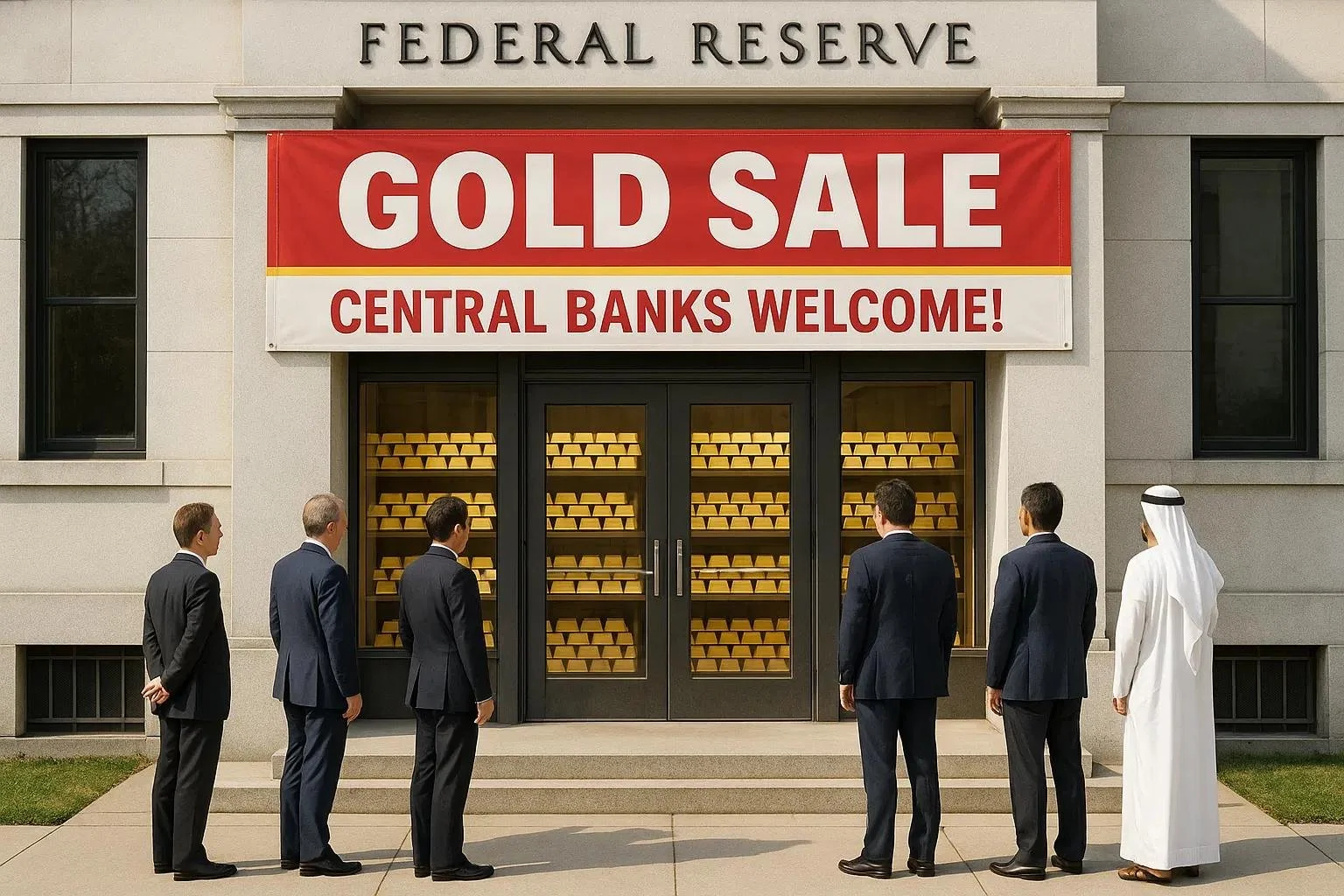
The Fed Just Became the World’s #1 Gold Salesman..
The Fed Just Became the World’s #1 Gold Salesman...
Notes From the Field By James Hickman (Simon Black) September 18, 2025
To the surprise of absolutely no one, the Federal Reserve announced its decision yesterday to cut interest rates… and kept the door open to further rate cuts in the future.
The funny thing is that we’ll never truly know why.
Sure, it’s possible that Fed officials honestly felt that the economy needs lower rates (despite obviously persistent inflation risks).
The Fed Just Became the World’s #1 Gold Salesman...
Notes From the Field By James Hickman (Simon Black) September 18, 2025
To the surprise of absolutely no one, the Federal Reserve announced its decision yesterday to cut interest rates… and kept the door open to further rate cuts in the future.
The funny thing is that we’ll never truly know why.
Sure, it’s possible that Fed officials honestly felt that the economy needs lower rates (despite obviously persistent inflation risks).
Of course, it’s also possible that Fed Chairman Jerome Powell finally caved to all the insults and pressure from the President.
Or that the rest of the FOMC members looked at what’s happening with Lisa Cook and submitted to inevitability, fearing that they too would be investigated for mortgage fraud (or some other criminal matter) if they didn’t cut rates.
Again, we may never know their real motivations. But it’s clear that the White House has gotten its way.
The President and Treasury Secretary believe that lower rates will stimulate the economy, raise wages, raise asset prices, improve housing affordability, and broadly create conditions for economic prosperity… and they’ve been pushing hard for rate cuts.
Lower rates will also help bail out the US government— whose national debt is so gargantuan that the Treasury is set to spend $1.2 trillion this Fiscal Year (which ends on September 30) just to pay interest.
The Trump administration sees lower rates as the key to slashing that annual interest bill.
Of course, a better solution would be to cut spending, bring the budget closer into balance, and reduce America’s debt-to-GDP ratio.
Putting America’s fiscal house in order would also attract investment in US government bonds the old-fashioned way— by restoring confidence that the US Treasury can pay back its debts through growth, strength, and prestige.
But making such cuts is politically difficult. Even the party that claims to be fiscally conservative isn’t really that interested in meaningful spending cuts.
So, they’re going with Plan B-- push the Fed to lower interest rates.
But as we’ve argued before, they’re setting themselves up for disappointment.
Remember what happened last year— between September and December 2024, the Fed cut rates three times for a total of 1%. Yet over that same period, US government bond yields actually INCREASED by 1%.
This proves that the Fed can’t just snap its fingers and force interest rates lower simply by having a committee meeting.
Interest rates are ultimately determined by supply and demand for money. So if they Fed really wants to see lower rates, they’re going to have to intervene directly in the bond market.
They’ve done this many times before-- this is when the Fed ‘prints’ money, i.e. what they call “quantitative easing”. And the most recent example was during the pandemic when the Fed created about $5 trillion of new money.
They used that money to buy government bonds-- essentially creating artificial demand for Treasurys that pushed yields down to record lows.
And life felt pretty good for a while-- people were able to buy homes and finance mortgages at rates lower than 3%. The government was able to sell 10-year debt for less than 0.5%.
But all those trillions of dollars of new money from the Fed came at a consequence: inflation soared to 9%— the highest in decades.
This is the major tradeoff that the Fed is facing right now: the White House wants lower interest rates. And the Fed seems to be capitulating to the pressure.
But for interest rates to get really low (and remain there), the Fed will almost certainly have to engage in more Quantitative Easing… and that means more inflation.
That alone is going to push a lot more capital into the gold market.
For the past few years, foreign governments and central banks have been selling off their US dollar reserves and funneling that money into gold; this has been the primary reason why gold has soared to all-time highs.
And with the Fed’s capitulation on rates, this trend will continue.
It’s also very likely that pension funds, insurance funds, and other long-term institutional investors will seek refuge in gold as well, driving the price even higher.
To be clear, this isn’t a prediction that gold is going to go up every day, or every month, or even every year.
But if you take a longer-term view—say, 8 to 10 years when the US national debt hits $60 trillion and Social Security runs out of funds— the case for owning gold becomes even more compelling.
I don’t hold this view because I’m a “gold bug”. I’m not fanatical about a hunk of metal. But I do understand these long-term trends, and in my view, we’re still in the early innings.
Another option is to buy gold-related companies, which can offer powerful leverage to the metal itself.
Central banks buy physical gold. They do not buy shares of gold companies. That’s why, even as gold surged, many of the companies we researched traded at dirt-cheap valuations—as low as 2-3x earnings in some cases.
But investors are starting to catch on and pay attention to these deeply undervalued businesses; in fact, we’ve seen several companies in our portfolio gain up to 4x, some even just over the last few months.
Given that Q3 earnings are coming up just around the corner, we believe that some of these gold (and related silver and platinum) companies are about to post record earnings and could see their share prices soar even more.
If you’re interested, we publish all of this investment research, including detailed analysis of deeply undervalued gold companies, in our premium service.
To your freedom, James Hickman Co-Founder, Schiff Sovereign LLC
30-50% Market Crash Incoming, Trillions will be Erased
30-50% Market Crash Incoming, Trillions will be Erased
Commodity Culture: 9-17-2025
Are you feeling the squeeze? The rising cost of living, the persistent worry about the future – you’re not alone. And according to one financial expert, things could be set for a much bigger shift than many realize.
In a recent, highly illuminating discussion on Commodity Culture, financial analyst Michael Pento joined host Jesse Day to deliver a sobering message.
30-50% Market Crash Incoming, Trillions will be Erased
Commodity Culture: 9-17-2025
Are you feeling the squeeze? The rising cost of living, the persistent worry about the future – you’re not alone. And according to one financial expert, things could be set for a much bigger shift than many realize.
In a recent, highly illuminating discussion on Commodity Culture, financial analyst Michael Pento joined host Jesse Day to deliver a sobering message.
Pento isn’t just seeing a few frayed threads in the economic fabric; he’s sounding the alarm on a “multitude of epic bubbles” that he believes are poised for a catastrophic burst.
Perhaps the most chilling aspect of Pento’s warning concerns the backbone of our society: the middle class. Already grappling with persistent inflation eroding purchasing power and wage growth that stubbornly refuses to keep pace, the middle class, Pento argues, is being “completely crushed into poverty.”
This economic pressure cooker has a direct and dangerous link to the credit markets. As everyday families struggle to make ends meet, their ability to service debt diminishes, creating a critical vulnerability in the entire system.
According to Pento, the real danger isn’t merely a slow leak; it’s a catastrophic rupture, beginning with a collapse in the credit markets. This isn’t just about banks; it’s about the lifeblood of commerce and personal finance.
Once credit seizes up, the dominoes fall swiftly, leading to an estimated 30 to 50% crash in the stock market.
And here’s where Pento’s forecast becomes truly grim: he estimates that this kind of market correction could take decades to fully recover. This isn’t a quick dip and rebound; it’s a long, arduous journey back to financial stability, profoundly impacting retirement plans, investments, and overall economic well-being for generations.
Pento’s insights on Commodity Culture paint a picture of significant economic upheaval. While such predictions can be unsettling, understanding the potential landscape is the first step toward navigating it. In times of economic uncertainty, knowledge truly is power.
For a deeper dive into Michael Pento’s detailed analysis, the driving forces behind these bubbles, and what it all means for your financial future, we highly recommend watching the full discussion from Commodity Culture.
Arm yourself with information, understand the risks, and prepare for what could be a very different economic horizon.
Silver Shorts: Blood In The Water | Bill Holter
Silver Shorts: Blood In The Water | Bill Holter
Liberty and Finance: 9-17-2025
Bill Holter explains why recent gold and silver price action points to a looming short squeeze and possible failure to deliver in the metals markets.
He argues that central banks worldwide are shifting from U.S. treasuries to gold and silver as the dollar weakens and global financial war intensifies between East and West.
Silver Shorts: Blood In The Water | Bill Holter
Liberty and Finance: 9-17-2025
Bill Holter explains why recent gold and silver price action points to a looming short squeeze and possible failure to deliver in the metals markets.
He argues that central banks worldwide are shifting from U.S. treasuries to gold and silver as the dollar weakens and global financial war intensifies between East and West.
Domestically, Holter warns that Americans are living "behind enemy lines" in a divided, manipulated system where self-sufficiency is essential. He stresses preparedness—physically, mentally, spiritually, and through community networks—while noting that urban dependence is a major vulnerability.
Ultimately, he believes that gold will re-emerge as the core collateral for settlement worldwide as the U.S. financial system deteriorates.
INTERVIEW TIMELINE:
0:00 Intro
1:30 Silver short squeeze
6:00 Financial war
12:21 US debt and stablecoins
14:00 Stock market euphoria
20:00 Relocation
24:51 Family breakdown
Iraq Economic News and Points To Ponder Thursday Afternoon 9-18-25
Prime Minister: The Government Attaches Great Importance To The Work Of Major Oil Companies In Iraq, Especially American Ones
Thursday, September 18, 2025, | Politics Number of readings: 154 Baghdad / NINA / Prime Minister Mohammed Shia al-Sudani stressed: "The government attaches great importance to the work of major oil companies, especially American ones, in Iraq.
A statement by his media office said: "Al-Sudani received, today, Wednesday, the Chairman of the Board of Directors and CEO of the American company Halliburton, specialized in the oil sector and energy technology, Jeff Miller, and his accompanying delegation."
Prime Minister: The Government Attaches Great Importance To The Work Of Major Oil Companies In Iraq, Especially American Ones
Thursday, September 18, 2025, | Politics Number of readings: 154 Baghdad / NINA / Prime Minister Mohammed Shia al-Sudani stressed: "The government attaches great importance to the work of major oil companies, especially American ones, in Iraq.
A statement by his media office said: "Al-Sudani received, today, Wednesday, the Chairman of the Board of Directors and CEO of the American company Halliburton, specialized in the oil sector and energy technology, Jeff Miller, and his accompanying delegation."
Al-Sudani stressed during the meeting: "The government attaches great importance to the work of major oil companies, especially American ones, in Iraq, to develop the energy sector, raise the efficiency of production operations, and achieve the desired aspirations."
He urged Halliburton to expand service centers in Iraq for various engineering specialties, and establish research centers to support technological development for drilling and reclamation operations, as well as open training centers to develop human capabilities and localize some industries, including the production of chemicals for drilling and production and the manufacture of oil equipment for drilling purposes and submersible pumps.
For his part, Jeff Miller expressed his thanks to the Prime Minister for the continuous support to complete the work, and expressed the company's readiness and desire to reach an agreement with the Ministry of Oil to sign a development contract Bin Omar and Sinbad fields in Basra Governorate, with the aim of producing gas, employing Iraqi cadres, and localizing the oil industry. /End https://ninanews.com/Website/News/Details?key=1252603
The Minister Of Oil Affirms The Government's Support For The Iraq Investment Forum
Buratha News Agency1832025-09-18 Deputy Prime Minister and Minister of Oil, Hayan Abdul-Ghani, reviewed preparations for the Iraq Investment Forum on Thursday, stressing the government's support for the forum to attract foreign capital.
A ministry statement said, "Deputy Prime Minister and Minister of Oil, Hayan Abdul-Ghani, met with a delegation from the preparatory committee for the Iraq Investment Forum, headed by Ibrahim Al-Masoudi Al-Baghdadi, Chairman of the Iraqi Economic Council and member of the preparatory committee."
The statement added, "The Council Chairman provided a detailed explanation of the dialogue session on the Ministry of Oil, which is scheduled to be chaired by the Minister of Oil on September 27. During the meeting, investment opportunities presented by the Ministry of Oil were discussed, aiming to attract investment in the oil and gas sector and petroleum industries."
The statement continued, "During the meeting, logistical preparations and preparations related to sending invitations to the relevant ministers, including the Turkish and Lebanese oil ministers, were discussed."
The Minister also affirmed his "keenness to support the forum, which reflects the government's drive to stimulate the national economy and attract foreign capital."
The statement also noted that "the meeting was attended by the Executive Director of the Economic Council, Thabet Kazim Al-Safi, the Assistant Director General of the Economic Department at the National Investment Commission, Hussein Ali Kanbar, and Hazem Al-Shammari from the Media and Public Relations Department." https://burathanews.com/arabic/economic/465323
Government Advisor: The Iraqi Economy Urgently Needs To Diversify And Move Away From Its Oil Dominance.
Time: 2025/09/18 19:22:03 Reading: 210 times {Economic: Al Furat News} The Prime Minister's economic advisor, Mazhar Mohammed Salih, confirmed that the Iraqi economy faces fundamental challenges due to its overreliance on crude oil exports.
Saleh told Al Furat News Agency, "The Iraqi economy is one of the most rentier economies in the world, with oil revenues accounting for more than 90% of public revenues and nearly 60% of the gross domestic product."
He explained that "this fragile structure makes the economy highly vulnerable to fluctuations in global oil prices, which hinders the achievement of comprehensive and sustainable development."
Saleh called for "the necessity of adopting serious and effective policies to diversify sources of revenue and reduce dependence on oil," noting that "diversification opportunities require continuous, long-term planning."
The economic advisor highlighted promising sectors as drivers of non-oil growth, foremost among them the agricultural sector, where Iraq boasts fertile lands and water resources. He noted that "this sector can play a pivotal role in achieving food security and reducing imports, particularly so-called virtual water, which is the import of food from countries that source our country's water resources."
Saleh emphasized the importance of manufacturing industries, particularly food, textiles, petrochemicals, and pharmaceuticals, which have the potential for rapid growth, in addition to infrastructure-related industries.
He pointed out that there are "significant opportunities to revive stalled industrial cities, and that effective implementation of the Development Road Project strategy will represent a strategic focus for comprehensive development, including the revival of major industrial cities."
He pointed out that "Iraq's geographical location gives it a pivotal regional role in global trade connectivity," stressing that "the Grand Faw Port project represents the beginning of a major strategic opportunity to diversify the national economy."
Saleh concluded his remarks by noting that Iraq is "an undisputed destination for religious and cultural tourism," emphasizing the importance of the country entering the digital age and capitalizing on the tremendous opportunities available in digital technology, such as electronic payments and e-commerce. LINK
For current and reliable Iraqi news please visit: https://www.bondladyscorner.com
Seeds of Wisdom RV and Economics Updates Thursday Afternoon 9-18-25
Good Afternoon Dinar Recaps,
BRICS Expansion in 2025 Shapes Future of World Order, US on Edge
The rapid growth of BRICS membership signals a seismic realignment in global governance and finance, challenging U.S. dominance.
Membership Numbers Reach Historic Levels
The BRICS expansion map has now engineered inclusion of eleven full members after Saudi Arabia completed its membership in July 2025, integrating Egypt, Ethiopia, Iran, UAE, and Indonesia across several key strategic partnerships.
Good Afternoon Dinar Recaps,
BRICS Expansion in 2025 Shapes Future of World Order, US on Edge
The rapid growth of BRICS membership signals a seismic realignment in global governance and finance, challenging U.S. dominance.
Membership Numbers Reach Historic Levels
The BRICS expansion map has now engineered inclusion of eleven full members after Saudi Arabia completed its membership in July 2025, integrating Egypt, Ethiopia, Iran, UAE, and Indonesia across several key strategic partnerships.
Over 23 nations have formally applied for membership while another 28 have expressed interest, spanning every continent through major diplomatic initiatives.
The alliance has also established nine partner countries including Belarus, Malaysia, Nigeria, and Thailand. Vietnam joined as a strategic partner while Colombia announced accession intentions, demonstrating continued momentum in BRICS expansion.
Trump Threatens Future Relations
President Trump has escalated tensions by threatening 100% tariffs on BRICS members over what he calls “anti-American policies.” The administration also added 10% tariff threats in July 2025, creating diplomatic friction across multiple channels.
Brazilian President Lula da Silva responded firmly during the 2025 BRICS Summit in Rio de Janeiro:
“We are witnessing an unprecedented collapse of multilateralism.”
He also warned that the world “does not want an emperor,” criticizing increased military spending and decreased development assistance.
Global Reach Expands Rapidly
The BRICS expansion map has reshaped geographical diversity. European applicants include Turkey, Serbia, and Belarus, despite Western pressure. Asian and African hopefuls include Azerbaijan, Bangladesh, Cambodia, Morocco, Pakistan, and Zimbabwe.
Looking ahead, BRICS expansion 2026 is expected to include clearer membership criteria and optimized partner-state frameworks, creating a pathway for gradual integration.
India’s Strategic Position Strengthens
India is leveraging its unique position between Western democracies and emerging economies. The country has secured access to major energy suppliers and new trade partnerships with Egypt and Ethiopia, boosting energy security and export markets.
According to the U.S. Institute of Peace, India views BRICS as a platform to promote global leadership, strategic autonomy, and a multipolar world order.
Financial Cooperation Advances
At the July 2025 Rio Summit, BRICS nations issued three finance-related declarations:
Support for IMF quota reforms
Backing of the UN Framework Convention on International Tax Cooperation
Launch of a new multilateral guarantee mechanism via the New Development Bank (NDB)
The NDB continues financing infrastructure projects across BRICS nations, while pilot programs for the new mechanism are expected in 2026.
Global Impact Reshapes Order
BRICS expansion has catalyzed a turning point in international relations. Member countries are demanding greater IMF quotas, representation for emerging economies, and reform of Western-dominated institutions.
The bloc has positioned itself as the voice of developing nations, accelerating a multipolar global system.
Implications for Global Finance
BRICS expansion accelerates the move away from Western-centric financial systems. With new members including major energy exporters and large consumer markets, the bloc is building the foundation for settlement systems that bypass the U.S. dollar.
Tokenization, de-dollarization, and the New Development Bank’s new multilateral guarantee mechanism together set the stage for alternative financing models that challenge the IMF and World Bank.
Impact on the U.S. Dollar System
Trump’s tariff threats underscore Washington’s fear that BRICS could undermine the dollar’s dominance. As more nations apply for membership, the bloc’s combined economic power grows, making dollar alternatives — including gold-backed trade settlements and regional currency swaps — more viable.
If BRICS expands its financial frameworks effectively, U.S. sanctions and tariffs may lose potency in global trade enforcement.
Strategic Outlook
Short Term (2025–2026): Membership grows, partner-state models expand, and BRICS finance declarations begin implementation.
Medium Term (2027–2029): BRICS-led institutions rival IMF/World Bank in development lending, with tokenized settlement systems gaining traction.
Long Term (2030 and beyond): The bloc’s structural reforms could mark the end of unilateral Western dominance in global governance.
Why This Matters
BRICS expansion in 2025 is not only a diplomatic milestone but a financial restructuring event that challenges the U.S.-led order. The implications span global trade, capital markets, and monetary systems.
This is not just politics — it’s global finance restructuring before our eyes.
@ Newshounds News™
Source: Watcher.Guru
~~~~~~~~~
Seeds of Wisdom Team RV Currency Facts Youtube and Rumble
Newshound's News Telegram Room Link
Follow the Gold/Silver Rate COMEX
Follow Fast Facts
Seeds of Wisdom Team™ Website
Thank you Dinar Recaps
News, Rumors and Opinions Thursday 9-18-2025
KTFA:
Clare: The Iraqi judiciary has recovered two billion dinars from two violating companies for financial fraud involving the exchange rate.
9/18/2025
The Iraqi judiciary announced on Thursday that it had recovered two billion dinars for financial fraud involving exchange rates.
The Judicial Media Department said in a statement that the Second Karkh Investigation Court recovered two billion Iraqi dinars on September 17, 2025, for a financial fraud crime.
KTFA:
Clare: The Iraqi judiciary has recovered two billion dinars from two violating companies for financial fraud involving the exchange rate.
9/18/2025
The Iraqi judiciary announced on Thursday that it had recovered two billion dinars for financial fraud involving exchange rates.
The Judicial Media Department said in a statement that the Second Karkh Investigation Court recovered two billion Iraqi dinars on September 17, 2025, for a financial fraud crime.
He pointed out that the amount was recovered from two companies that violated the law by fraudulently obtaining the dollar exchange rate difference through money transfers outside the country.
The statement indicated that the "Second Karkh Investigation Court," through extensive efforts and under the supervision of the court's first judge, recovered this amount. These efforts are ongoing to take legal action against the remaining companies that employ illegal methods to obtain large profits, thereby harming public funds. LINK
************
Clare: Iraq signs an agreement and seven trade memoranda of understanding with Lebanon.
9/18/2025
The Iraqi Ministry of Trade and the Lebanese Ministry of Economy and Trade signed an agreement and seven memoranda of understanding today, Thursday, to enhance trade and investment between the two countries.
This came during the second session of the Iraqi-Lebanese Joint Committee held in the capital, Baghdad, headed by Minister of Trade Athir Dawood Al-Ghariri on the Iraqi side, and Minister of Economy and Trade Amer Al-Bassat on the Lebanese side, in the presence of heads and representatives of the Iraqi private sector and their counterparts from the Lebanese side.
The committee's work witnessed the signing of an agreement and seven memoranda of understanding between the two sides, covering areas such as developing trade exchanges and export promotion, cooperation in organizing international and specialized exhibitions, land transport of passengers and goods, investment, and mutual recognition of maritime qualification certificates for seafarers working at sea. This will contribute to supporting economic integration, facilitating the flow of trade, and exchanging technical and scientific expertise.
In this regard, the Iraqi Minister of Trade, in a speech delivered on the sidelines of the session, affirmed Iraq's keenness to enhance cooperation with Lebanon and expand the horizons of partnership in various economic, trade, and investment sectors, noting that this session represents an important shift in the path of bilateral relations.
He explained that the signing of the minutes and memoranda during the conference reflects the seriousness of both sides in moving directly to the implementation phase, stressing the Iraqi government's full support for all initiatives that would strengthen the partnership with Lebanon and develop relations in a manner that serves common interests.
Al-Ghariri added that "seven memoranda of understanding were signed, in addition to a cooperation agreement between the Iraqi and Lebanese Ministries of Justice, to enhance legal and institutional cooperation between our two countries." He added, "The government will be a true supporter of the private sector, and we are working to launch an investment forum soon that will open broader horizons for trade and investment cooperation."
He pointed out that "these agreements represent a new beginning for the resumption of private sector activity and business owners, in line with the deep economic and trade relations between Iraq and Lebanon."
He continued, "The memoranda of understanding cover various sectors, such as trade, investment, transportation, and exhibitions, and represent an important step to expand trade exchange and enhance joint economic activity." LINK
************
Courtesy of Dinar Guru: https://www.dinarguru.com/
Mnt Goat I want to first cover something today that is VERY important to everyone and the timing of the RV we all have been looking for.... this reinstatement and revaluation of the Iraqi dinar was part of a much larger plan. The pieces to the plan are all but in place now. This is not decades from now. It is happening now. It is part of a financial “reset” of the US financial system and it will also eventually move downstream to other countries by the nature of it. But remember its “America First”. The US Treasury is not going to let this opportunity pass by with Iraq...no one knows the entirety of the plan, as they are not sharing it... [Post 1 of 2....stay tuned]
Mnt Goat This much we do know and we know something is moving fast to shift the Iraqi dinar into the global arena for a purpose and to reinstate its currency back to the currency trading. The dinar will be repegged to a basket along with other currencies, each supporting the other. We can already see the new Trump foreign policy with Iraq and to bring huge investment opportunities to Iraq. Remember, however, there must be money enough for both nations or the US will not get involved ...Just know there is a plan and it is in motion... [Post 2 of 2]
Mnt Goat Just remember that the dinar now already trades on the ISX which is the Iraqi Securities Exchange. A link was placed even on FOREX back to the ISX years ago. This made it easier for future investors in the dinar to follow IQD trends. However, it is not on the global exchanges and certainly not at the rate we are waiting to see. The official CBI rate of 1320 is simply not going to help in the Trump reset of the national US debt, get it?
************
This Crisis won’t be like 2008, it will be a US Sovereign Debt Crisis
Kitco News: 9-16-2025
The financial world is abuzz with talk of a looming crisis, and prominent economist and investor Peter Schiff is at the forefront of these warnings.
In a recent, exclusive interview with Kitco News Anchor Jeremy Szafron, Schiff laid out a grim picture of a “great repricing” underway, driven by a U.S. sovereign debt crisis and what he calls the Federal Reserve’s “biggest error yet.”
If Schiff’s predictions hold true, the implications for the U.S. dollar, the price of gold, and your personal savings could be profound and far-reaching. This isn’t a rerun of 2008; Schiff argues we’re heading into uncharted and considerably more perilous territory.
Thursday Coffee with MarkZ 09/18/2025
Thursday Coffee with MarkZ 09/18/2025
Some highlights by PDK-Not verbatim
MarkZ Disclaimer: Please consider everything on this call as my opinion. People who take notes do not catch everything and its best to watch the video so that you get everything in context. Be sure to consult a professional for any financial decisions
Member: Good Morning and Happy Thursday
MZ: Interesting developments over the weekend. Is the stage being set?
Thursday Coffee with MarkZ 09/18/2025
Some highlights by PDK-Not verbatim
MarkZ Disclaimer: Please consider everything on this call as my opinion. People who take notes do not catch everything and its best to watch the video so that you get everything in context. Be sure to consult a professional for any financial decisions
Member: Good Morning and Happy Thursday
MZ: Interesting developments over the weekend. Is the stage being set?
Member: I am hearing a lot of chatter about this weekend
MZ: Hearing that same chatter….just afraid its one weekend to early. I don’t know exactly when we go but the majority of sources believe we go at the very end of September and the first days of October.
Member: October first is when the new fiscal year for the government starts
MZ: There are a number of rumors in groups and the Indian Nations that this could be our weekend. But my middle eastern contacts thin it’s the following weekend. There are tons of rumors out there.
Member: just for kicks and giggles i just now popped into my local Wells Fargo branch and asked about currency exchange and he said yes. I said what about Iraqi Dinar, he smiled and said not yet!
MZ: More and more folks in banking are hearing about it and training for it.
Member: Heard somewhere that president of Iraq and Trump are going to be in NY on 22nd for a UN or NATO thing. How often are these guys together. What a good time to announce and reap the political rewards
MZ: It would be a great time.
Member: I think everything is pointing to first of October. New fiscal year starts. Sudani is getting very close to elections, hcl about to be done
Member: Still hoping the Vietnam dong is in the first basket.
Member: The Vietnamese dong is definitely a currency you will want $$$
Member: Central Bank of Vietnam web site had been down 36 hours…may be back up now
Member: Iraq Finance Minister was in London yesterday discussing building an international financial center
Member: do you think Sudani is holding the RV for an October surprise....to guarantee reelection? if rv doesn't happen he would most likely be politically destroyed and ran out of town
Member: (From Dinar Guru) Mnt Goat : Just remember that the dinar now already trades on the ISX which is the Iraqi Securities Exchange. A link was placed even on FOREX back to the ISX years ago. This made it easier for future investors in the dinar to follow IQD trends. However, it is not on the global exchanges and certainly not at the rate we are waiting to see. The official CBI rate of 1320 is simply not going to help in the Trump reset of the national US debt, get it?
MZ: I get it
Member: Sure hope that MarkZ knows that when people act salty its not about him but about the people in power going so slow…lets get things moving.
MZ: I get it and it is very frustrating for us all.
Member: Thanks Mark for all you do we appreciate you so much! Your positive attitude carries many of us through this!!
Member: Imagine the Christmas we are about to have. I’ve never liked Christmas, as an adult.. this year I will.
Mod: BREAKING NEWS: MarkZ's EVERYDAY email address: Don't Write Me@NeverOnEVERYDAY.Com..... SERIOUSLY, MARK NEEDS A LITTLE TIME FOR HIMSELF FOR REST AND REC. THANK YOU!
Jonathon Otto From MyRedLight joins the stream today. Please listen to replay for his information
THE CONTENT IN THIS PODCAST IS FOR GENERAL & EDUCATIONAL PURPOSES ONLY&NOT INTENDED TO PROVIDE ANY PROFESSIONAL, FINANCIAL OR LEGAL ADVICE. PLEASE CONSIDER EVERYTHING DISCUSSED IN MARKZ’S OPINION ONLY
FOLLOW MARKZ : TWITTER . https://twitter.com/originalmarkz?s=21. TRUTH SOCIAL . https://truthsocial.com/@theoriginalm...
Mod: MarkZ "Back To Basics" Pre-Recorded Call" for Newbies 10-19-2022 ) https://www.youtube.com/watch?v=37oILmAlptM
MARKZ DAILY LINKS: https://theoriginalmarkz.com/home/
Note from PDK: Please listen to the replay for all the details and entire stream….I do not transcribe political opinions, medical opinions or many guests on this stream……just RV/currency related topics.
ZESTER'S LINK TREE: https://linktr.ee/CrazyCryptonaut
THANKS FOR JOINING. HAVE A BLESSED DAY! SEE YOU ALL TUESDAY THROUGH THURSDAY EVENINGS FOR NEWS @ 7:00 PM EST ~ UNLESS BREAKING NEWS HAPPENS! FROM NOW ON NO MORE NIGHTLY PODCASTS ON MONDAYS AND FRIDAYS
“Tidbits From TNT” Thursday 9-18-2025
TNT:
Tishwash: Trade Bank of Iraq launches direct delivery service for electronic cards.
The Trade Bank of Iraq announced today, Thursday, the launch of a direct delivery service for electronic cards.
A statement from the bank, received by Al-Eqtisad News, stated that "to facilitate customers, it has been decided to activate the direct delivery service for electronic cards."
The bank added, "We announce the activation of the electronic card delivery service in Baghdad and all governorates to ensure their safe and timely arrival."
TNT:
Tishwash: Trade Bank of Iraq launches direct delivery service for electronic cards.
The Trade Bank of Iraq announced today, Thursday, the launch of a direct delivery service for electronic cards.
A statement from the bank, received by Al-Eqtisad News, stated that "to facilitate customers, it has been decided to activate the direct delivery service for electronic cards."
The bank added, "We announce the activation of the electronic card delivery service in Baghdad and all governorates to ensure their safe and timely arrival." link
************
Tishwash: Indonesian Ambassador: Invites Karbala merchants to participate in a trade fair in his country
The Indonesian Ambassador to Iraq, Didik Eko Pujianto, invited merchants from the holy Karbala Governorate to participate in a trade fair to be held in his country next month, stressing his country’s desire to invest in Iraq and Karbala in the fields of medicine, leather industries, electricity, and other projects.
The Indonesian ambassador told Al-Mustaqilla on the sidelines of his visit to the Karbala Chamber of Commerce and his meeting with the chamber’s president, Zaman Sahib Abdul Awad, “We discussed strengthening and deepening bilateral relations between the two countries, opening new horizons for joint cooperation to stimulate trade exchange, and we are working to facilitate procedures for obtaining entry visas.”
For his part, the head of the Karbala Chamber of Commerce said in a statement to Al-Mustaqilla after his meeting with the Indonesian ambassador, “We invited Indonesian traders, companies and businessmen to see and learn about the most important investment opportunities in the province.”
In addition, the Chamber's Vice President, Saeed Shukr, emphasized to the Indonesian Ambassador the importance of reviewing the Iraqi investment law to benefit from it, and to encourage Indonesian companies to establish projects, especially medical projects, to be of a standard befitting the quality of the holy Karbala Governorate, and the necessity of these companies obtaining approvals from the Iraqi Ministry of Health.
Chamber Board Member Mohammed Al-Hussaini concluded by stressing the need for Indonesian companies to visit Karbala Governorate and see for themselves the investment opportunities.
The delegation called for "facilitating the issuance of entry visas to Karbala merchants, as this would have a positive impact on strengthening and deepening economic relations." link
************
Tishwash: Parliament on the brink of closure: MPs' salaries exceed 400 billion dinars
The Council has been inactive for 14 months... and Al-Mashhadani was looking for a "religious fatwa"!
MPs are estimated to have received more than 122 billion dinars in wages, salaries, and services during this current session, "without work" due to the suspension of sessions.
Parliament failed to hold more than 100 sessions during its fifth session, including only 12 sessions during the past 11 months.
Based on this poor performance, it is likely that September will be the last day of the parliament's term, which is supposed to extend its term until early 2026.
Last Tuesday, parliament failed to hold its session for the second time in the same week due to a lack of quorum.
Yasser al-Husseini, an independent MP, told Al-Mada, "Political disagreements over important laws led to the suspension," including a law related to Saudi investments in Iraq.
Al-Husseini asserted that "most MPs are busy preparing for the elections," scheduled for November 11. statement issued after a presidential meeting in parliament last Tuesday described MPs' attendance at sessions as "a national duty that cannot be postponed," following the failure of the last two sessions.
The statement, following a meeting between Parliament Speaker Mahmoud al-Mashhadani and his deputies, Mohsen al-Mandalawi and Shakhwan Abdullah, emphasized "the importance of the presence of parliamentary bloc heads and MPs at the upcoming sessions and their active participation in voting on vital laws."
Parliament published the agenda for the sessions of Monday and Tuesday earlier this week, which included a number of laws described as important.
In a video address, Deputy Speaker Shakhwan Abdullah expressed his regret over the lack of a quorum for the parliamentary session last Tuesday, despite the presence of important laws and legislation on the agenda.
He added that no more than 50 MPs were present, despite the 130 MPs who signed the attendance list. He explained that this was unacceptable, given that many MPs travel from outside Baghdad to attend the sessions.
Full salaries, no cuts!
Last August, Parliament imposed fines on MPs who miss sessions, deducting one million dinars from the salary of each MP absent from a single session. The number of absentees ranged between 100 and 150 MPs per session.
However, it appears that MPs have found a way around this punishment, sitting in the parliament cafeteria without attending sessions, thus avoiding salary cuts.
Mohammed al-Ziyadi, a representative of the Muntasiroun bloc, affiliated with Kata'ib Sayyid al-Shuhada leader Abu Alaa al-Wala'i, told Al-Mada: "We are not school students... MPs can express their opinion by boycotting and not attending sessions, but what matters is that they attend parliament."
In the past, al-Mashhadani, the last parliament speaker, hesitated to cut the salaries of absent MPs, although he said in March 2025 that he was seeking a "fatwa from the Najaf Martyrdom" regarding MPs' attendance at sessions, describing the current session as "the worst."
MPs like Yasser al-Husseini believe that "dismissing the absent MP," rather than simply cutting their salaries, will prevent others from being absent, explaining that "constitutionally, parliament's term is supposed to end on January 8, 2026."
The parliamentary term consists of four legislative years, each of which is divided into two terms, each extending for eight months, with a four-month recess.
This parliament was suspended for three months after the elections, and has two presidents since the removal of former President Mohammed al-Halbousi at the end of 2023.
So far, since its first session on January 9, 2022, the current parliament has only been able to hold 149 sessions out of approximately 265.
This means that parliament has not functioned for 14 months, but during that period, it has received full salaries and expenses amounting to more than "122 billion and 500 million dinars."
According to some reports, each member of parliament receives a monthly salary of 8 million dinars, in addition to 16 million dinars in protection allowances and 3 million dinars in rent allowances for members of parliament not residing in Baghdad, bringing the total monthly salary of each member of parliament to 27 million dinars.
The total annual cost of salaries and allowances for all 329 members of parliament amounts to more than 426 billion dinars.
"Hibernation Time"
Ghaleb Al-Dami, a political affairs researcher, says that "Parliament has now entered the winter hibernation phase.
" Al-Dami added to Al-Mada: "Most of the members of parliament are candidates and are busy campaigning in the governorates," predicting that this September will be "the last day of parliament."
The worst performance of the sessions this term occurred during the tenure of its current speaker, al-Mashhadani, who was only able to hold 12 sessions in 11 months, at a rate of one session per month instead of the usual eight.
For his part, Ziad al-Arar, an academic and researcher, said that "political disagreements between bloc leaders from all parties have brought parliamentary work to a near-standstill."
He added to Al-Mada: "There are clear disagreements between Speaker al-Mashhadani and his deputy, al-Mandalawi, and the Sunni forces, as well as a lack of trust among the leaders of the political scene."
Al-Arar pointed out that, due to these disagreements, the heads of the parliamentary blocs are "upset with each other and are not attending the sessions."
The researcher believes that the origin of the disagreement was on the day al-Mashhadani was elected (late October 2024), due to objections to his assumption of the position.
His election was a "gracious response" to the parliament speaker's previous positions with some political parties. link
************
Dang!!! -- These Young ""Felines"" are Tough!!!
Mot: . Yes - This actually happened and caused 16 accidents !!! moose drivers
This actually happened: they dressed up the truck with a guy tied down on the roof, while the driver and passengers wore moose heads.
They drove down Interstate I-35 and caused 16 accidents.
Yes, they went to jail, yes, they were so drunk, and yes, men cannot be left alone.

Seeds of Wisdom RV and Economics Updates Thursday Morning 9-18-25
Good Morning Dinar Recaps,
Fed Cuts Interest Rates by a Quarter Point, Tees Up Two More Cuts in 2025
The Federal Reserve shifts to rate cuts, signaling concern for jobs over inflation — and the global implications are bigger than just politics.
A Policy Shift at the Fed
In a widely expected decision, the Federal Reserve lowered interest rates by a quarter point. Chair Jerome Powell emphasized that weakening labor markets now outweigh inflation risks, signaling a turn in strategy. This sets up two additional cuts later in 2025, putting the U.S. on a clear easing path.
Good Morning Dinar Recaps,
Fed Cuts Interest Rates by a Quarter Point, Tees Up Two More Cuts in 2025
The Federal Reserve shifts to rate cuts, signaling concern for jobs over inflation — and the global implications are bigger than just politics.
A Policy Shift at the Fed
In a widely expected decision, the Federal Reserve lowered interest rates by a quarter point. Chair Jerome Powell emphasized that weakening labor markets now outweigh inflation risks, signaling a turn in strategy. This sets up two additional cuts later in 2025, putting the U.S. on a clear easing path.
While the move was modest, it represents a broader pivot. The Fed is openly prioritizing employment stability even as the economy grows modestly and trade uncertainties mount under Trump’s tariff push. Markets responded positively, with the Dow surging 400 points.
Trump’s Influence and Fed Independence
President Trump has been vocal in demanding more aggressive cuts and has already positioned his allies within the Fed. His efforts to reshape the institution raise questions about central bank independence. With further cuts on the table, Trump’s hand in monetary policy is increasingly evident.
Economic Outlook
The Fed projects GDP growth at 1.6% for 2025, rising slightly through 2027. Unemployment is forecast to edge up to 4.5% before stabilizing, while inflation is expected to gradually ease toward the 2% target. Consumers may see relief in borrowing costs, but savers will feel the squeeze as returns on deposits and money markets decline.
Why It’s More Than Politics
The Fed’s pivot is not just about domestic economic management — it shows how U.S. monetary policy is now entangled with Trump’s broader trade and tariff agenda. Cutting rates while tariffs disrupt global supply chains reflects a deeper struggle: keeping the U.S. dollar strong and competitive in a shifting international order.
Proof of Global Finance Restructuring
Central bank rate cuts signal to the world that the U.S. is willing to stimulate growth at the expense of traditional inflation discipline. This reshaping of priorities ties into the global reset narrative — where economic stability is increasingly pursued through coordinated monetary adjustments rather than old inflation-first doctrines. The Fed’s move could accelerate demand for alternative systems, including digital assets and gold-backed reserves.
Implications for De-Dollarization & Global Reset
Lower U.S. rates make dollar assets less attractive globally, pushing investors toward gold, commodities, and even BRICS-led settlement currencies.
Trump’s pressure on the Fed underscores political risk in U.S. monetary policy — a concern for countries already seeking alternatives to dollar hegemony.
The easing cycle may align with broader international moves toward asset-backed financial systems, giving momentum to calls for a reset in global reserve structures.
Why This Matters
The Fed’s cuts are a domestic economic response — but they ripple outward. Every shift in U.S. monetary policy recalibrates global capital flows, currency strength, and the ongoing search for alternatives to the dollar. What looks like a small cut is part of a much larger transition.
This is not just politics — it’s global finance restructuring before our eyes.
@ Newshounds News™ Exclusive
Source: U.S. News & World Report
~~~~~~~~~
SEC Opens Floodgates for Crypto ETFs With Grayscale Approval
The SEC’s approval of Grayscale’s multi-crypto fund and new listing standards clears the way for a wave of digital asset ETFs on Wall Street.
Grayscale’s First-of-Its-Kind Fund
The U.S. Securities and Exchange Commission (SEC) has approved Grayscale’s Digital Large Cap Fund (GDLC) to trade as the first multi-crypto exchange-traded product (ETP). The fund offers exposure to five major cryptocurrencies: Bitcoin, Ether, XRP, Solana, and Cardano.
Grayscale CEO Peter Mintzberg hailed the approval as a landmark, thanking the SEC’s Crypto Task Force for “bringing the regulatory clarity our industry deserves.” The fund, valued at $57.7 per share with over $915 million under management, had previously traded over-the-counter before its conversion to an ETP on NYSE Arca.
Generic Standards: A Fast Track for Crypto ETFs
Alongside Grayscale’s win, the SEC approved generic listing standards for crypto ETFs — a move expected to accelerate dozens of applications. Under the new rules, exchanges such as Nasdaq, NYSE Arca, and Cboe BZX can list certain crypto ETFs without lengthy, case-by-case reviews.
SEC Chair Paul Atkins framed the decision as market modernization:
“By approving these generic listing standards, we are ensuring that our capital markets remain the best place in the world to engage in the cutting-edge innovation of digital assets.”
The streamlined process could unleash a wave of new crypto funds, with Bloomberg ETF analysts predicting more than 100 launches within the next year. Eligible assets include XRP, Solana, Dogecoin, Litecoin, and others with sufficient market and surveillance structures.
Balancing Opportunity and Risk
Not all commissioners were fully supportive. SEC Commissioner Caroline Crenshaw warned that looser standards could flood markets with products lacking rigorous vetting:
“The Commission is passing the buck on reviewing these proposals … in favor of fast tracking these new and arguably unproven products to market.”
Still, the broader response has been bullish, with analysts and fund managers viewing the shift as a watershed moment for institutional adoption of crypto assets.
Why It’s More Than Politics
This decision reflects more than regulatory housekeeping. By fast-tracking crypto ETFs, the SEC is legitimizing digital assets inside U.S. capital markets, linking America’s financial future to blockchain adoption. Politics may shape the rhetoric, but the real story is regulatory alignment with innovation to keep Wall Street globally competitive.
Proof of Global Finance Restructuring
The SEC’s shift shows how digital assets are becoming integrated into mainstream financial products. Crypto ETFs, once delayed and contested, are now moving into mass-market availability. This marks a restructuring of global finance: investment flows that once went into stocks and bonds are now being systematically rerouted into tokenized assets.
Implications for De-Dollarization & Global Reset
The institutionalization of crypto ETFs may accelerate global diversification away from dollar-only reserves.
With XRP, Solana, and other altcoins in approved funds, the U.S. is acknowledging assets that BRICS nations already see as alternatives to the dollar.
Generic standards could be the infrastructure blueprint for tokenized commodities and CBDCs — tools that could reshape reserve systems in a global financial reset.
Why This Matters
The SEC’s dual approval of Grayscale’s multi-crypto fund and new listing standards may prove a watershed in U.S. financial history. The regulator is signaling openness to a crypto-integrated market structure — one that could both strengthen Wall Street’s dominance and simultaneously speed up global shifts away from a purely dollar-centered system.
This is not just politics — it’s global finance restructuring before our eyes.
@ Newshounds News™ Exclusive
Sources: The Block, Cointelegraph
~~~~~~~~~
Ripple at the Core: DBS and Franklin Templeton Launch Tokenized Lending on XRP Ledger
The partnership places Ripple’s XRP Ledger at the center of a new tokenized ecosystem for global institutions.
Partnership for Tokenized Finance
DBS, Franklin Templeton, and Ripple have signed a memorandum of understanding (MOU) to roll out tokenized trading and lending services for institutional investors. The system, built on the XRP Ledger, is designed to help investors navigate volatile markets by enabling seamless movement between stablecoins and yield-bearing funds.
DBS Digital Exchange (DDEx) will list sgBENJI, a tokenized version of Franklin Templeton’s U.S. Dollar Short-Term Money Market Fund, alongside Ripple USD (RLUSD), a stablecoin issued on the XRP Ledger. Together, the assets will allow institutions to trade and rebalance portfolios 24/7 while capturing yield opportunities.
From Trading to Tokenized Lending
In its next phase, DBS will allow clients to use sgBENJI as collateral to unlock credit, either through repo agreements with the bank or through third-party lending platforms — with DBS acting as collateral agent. Franklin Templeton will issue sgBENJI directly on the XRP Ledger, citing its speed and low fees as key advantages.
Ripple executive Nigel Khakoo called the partnership a breakthrough:
“Investors can move between a stablecoin and a tokenized fund within a single, trusted ecosystem, unlocking real-world capital efficiency, utility and liquidity that institutions demand.”
Institutional Adoption on the Rise
Demand for such products is growing quickly. A recent survey by Coinbase and EY-Parthenon showed 87% of institutional investors expect to allocate to digital assets by 2025. Tokenization, in particular, is gaining traction as banks and asset managers look for blockchain-native solutions that maintain regulatory clarity.
Cross-Border Ambitions
The collaboration also dovetails with broader global experiments in tokenized banking. SBI Shinsei Bank, Singapore’s Partior, and Japan’s DeCurret DCP recently announced work on multicurrency tokenized deposits for real-time, cross-border settlement. DBS’s move positions it as a bridge between regional experiments and institutional adoption.
Why It’s More Than Politics
Ripple’s XRP Ledger is now being embedded in institutional financial architecture — not as a fringe experiment, but as the infrastructure for tokenized money markets and collateral lending. This is a transformation of core capital flows, where blockchain becomes the operational standard.
Proof of Global Finance Restructuring
Money market funds — the backbone of short-term U.S. dollar liquidity — are now tokenized on the XRP Ledger.
DBS’s willingness to accept tokenized funds as collateral moves blockchain finance into traditional credit markets.
Ripple’s RLUSD stablecoin and sgBENJI together create a seamless pathway between stable value and yield-bearing assets — a model designed for institutional scale.
Implications for De-Dollarization & Global Reset
Tokenized lending on XRP Ledger offers a global alternative to dollar-clearing through traditional correspondent banks.
By placing real-world funds onchain, institutions may bypass parts of the dollar-dominated settlement system.
Ripple’s role in powering tokenized lending infrastructure could accelerate a broader reset toward blockchain-based reserves and settlement networks.
Why This Matters
Ripple is no longer just an industry advocate or payments provider — it is now underpinning tokenized collateral and lending for some of the world’s biggest financial institutions. As DBS, Franklin Templeton, and Ripple push this forward, the transition to blockchain-based financial infrastructure is not a future possibility, but a present reality.
This is not just politics — it’s global finance restructuring before our eyes.
@ Newshounds News™ Exclusive
Source: Cointelegraph
~~~~~~~~~
Seeds of Wisdom Team RV Currency Facts Youtube and Rumble
Newshound's News Telegram Room Link
Follow the Gold/Silver Rate COMEX
Follow Fast Facts
Seeds of Wisdom Team™ Website
Thank you Dinar Recaps
4 Ways To Avoid Bank Fees and Keep More of Your Money
4 Ways To Avoid Bank Fees and Keep More of Your Money
Laura Bogart Wed, September 17, 2025 GOBankingRates
You work hard for your money — to quote the great Donna Summer, “so hard, honey, honey.” Your emergency and retirement funds can vouch for your saving and budgeting skills. Your financial advisor is on speed dial, and no coupon is left unused. So why does your bank statement feel like it’s working against you?
Before you spiral into spreadsheet mode to dissect every expense, Andrea Woroch — a nationally recognized consumer finance expert, writer, and regular on-air contributor — wants you to zoom in on something else: bank fees.
4 Ways To Avoid Bank Fees and Keep More of Your Money
Laura Bogart Wed, September 17, 2025 GOBankingRates
You work hard for your money — to quote the great Donna Summer, “so hard, honey, honey.” Your emergency and retirement funds can vouch for your saving and budgeting skills. Your financial advisor is on speed dial, and no coupon is left unused. So why does your bank statement feel like it’s working against you?
Before you spiral into spreadsheet mode to dissect every expense, Andrea Woroch — a nationally recognized consumer finance expert, writer, and regular on-air contributor — wants you to zoom in on something else: bank fees.
Woroch spoke with GOBankingRates as part of our Top 100 Money Experts series to about how surprise bank fees can chip away at the money you specifically put in the bank to keep it safe. Here are Woroch’s top strategies to sidestep those fees and keep more of your hard-earned cash. https://www.youtube.com/watch?v=WpEqyNeIjEw
1. Know the Most Common Fees
Whether you’re navigating a budgeting app or simply trying to stop the drip of small charges, rule number one is: Know thy enemy.
“Where you choose to bank can impact your finances as some charge high fees which can add up quickly if you aren’t paying attention,” said Woroch. “Some of the most common bank fees include checking account maintenance fees, overdraft fees and out-of-network ATM fees.”
First, Woroch advises that you find out what the minimum balance is, to avoid monthly maintenance fees. Set up an alert that will warn you when your balance drops to near that amount, then move money to the account to bring your balance back up again.
You could also shop around for a bank that offers free checking, removing the problem altogether.
Woroch also cited those irritating ATM fees.
ATM fees are easier to avoid as you can use digital wallets to make purchases these days,” she said. “If you need cash and can’t find an in-network ATM, head to a grocery or drugstore that offers cash back for no charge. You can then make a small purchase using your debit card and request money back from the cashier without paying high fees to access your cash.”
2. Say Sayonara to Overdraft Fees With Proper Planning
TO READ MORE: https://www.yahoo.com/finance/news/4-ways-avoid-bank-fees-163350701.html