
Thank you to all the subscribers to our Early Access program…we thank you for your continued support.
We are excited to offer this new service to keep you informed and up-to-date on the latest Dinar and currency news.
When Leaving Your Home State Becomes a Duty
When Leaving Your Home State Becomes a Duty
Notes From the Field By James Hickman (Simon Black / Sovereign Man) June 9, 2026
In the year 1863, at the height of the Civil War in the United States that must have seemed at the time like an irrecoverable national death, a former bookkeeper turned entrepreneur built an oil refinery in Cleveland’s up-and-coming industrial area in order to capitalize on the market for kerosene.
His name was John Rockefeller. And within twenty years he would control close to 90% of the oil in America. And his Standard Oil would become the largest and most powerful company ever seen.
When Leaving Your Home State Becomes a Duty
Notes From the Field By James Hickman (Simon Black / Sovereign Man) June 9, 2026
In the year 1863, at the height of the Civil War in the United States that must have seemed at the time like an irrecoverable national death, a former bookkeeper turned entrepreneur built an oil refinery in Cleveland’s up-and-coming industrial area in order to capitalize on the market for kerosene.
His name was John Rockefeller. And within twenty years he would control close to 90% of the oil in America. And his Standard Oil would become the largest and most powerful company ever seen.
The trouble was holding it together. Standard Oil was comprised of a complex network of subsidiaries, and you practically had to be an engineer just to understand the structure.
The problem was that, in most states, a corporation wasn't even allowed to own another corporation.
That restriction sounds strange today, but back then the corporation was still a young, distrusted creature of the state, chartered to do one thing— for example, run a railroad or a bank— with privileges no ordinary person enjoyed.
Industrialization was minting a handful of staggeringly rich men— the titans a later generation would call “robber barons”— and the public watched them swallow up entire industries. People feared that letting one corporation own another corporation would stack company on company until the combination was beyond the reach of any single state.
So Rockefeller ran his empire through a workaround.
On January 2, 1882, he and eight fellow “trustees” signed the agreement creating the Standard Oil Trust, a small group of men who held the stock of some forty companies— refiners, pipelines, and distributors— and ran the whole thing as a single entity.
Great idea, but it was fragile. The trust had no real legal home, and the states Standard Oil operated in were beginning to notice.
In 1892, Ohio's attorney general hauled the company before the state Supreme Court and successfully argued his case; the court agreed, and ruled that Standard Oil had no right to hand itself over to out-of-state trustees. Consequently, Rockefeller had to cut all ties with the trust. And it appeared on paper that the whole arrangement was broken up.
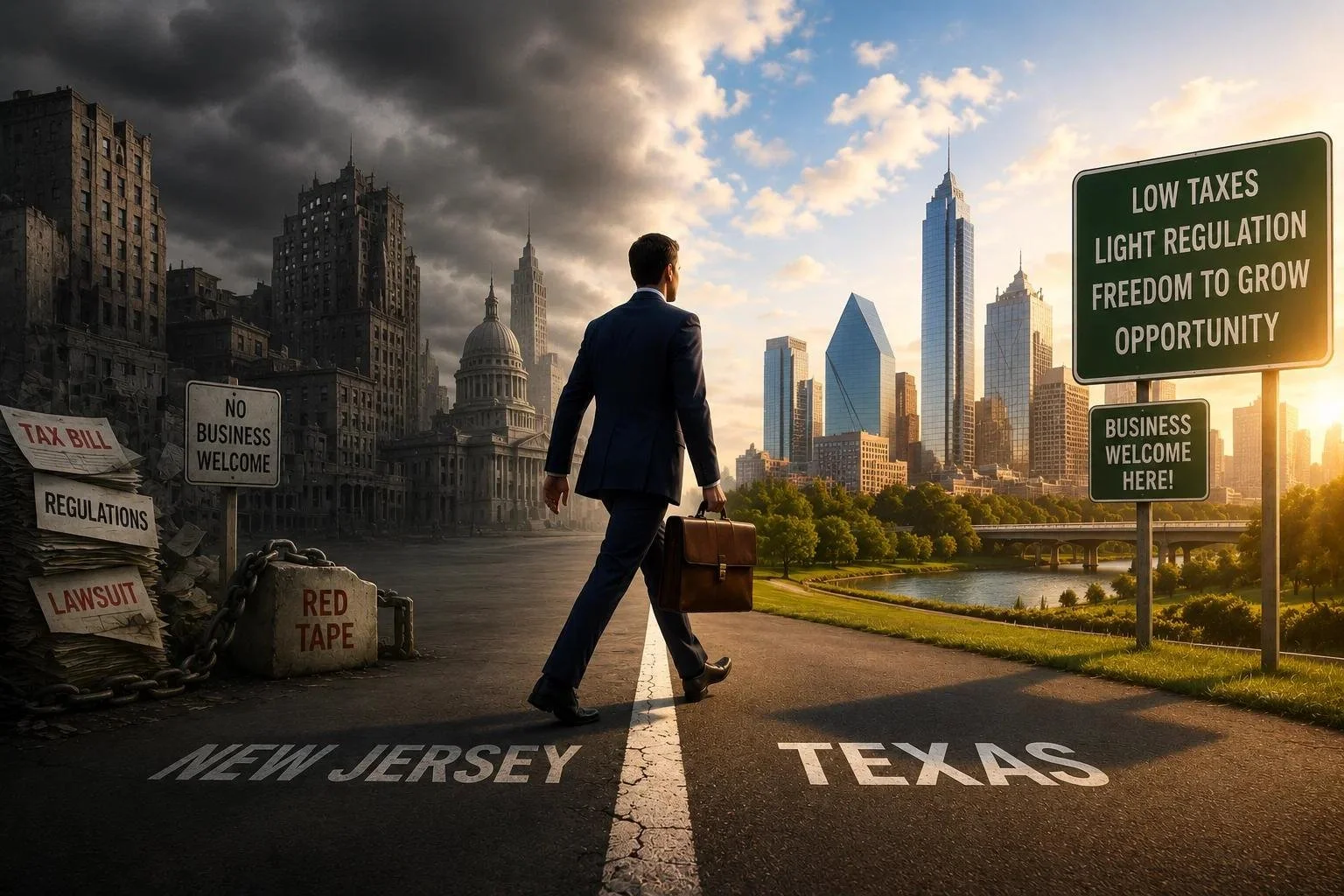
Rockefeller went shopping to find a friendly state government that would let him keep control. And back in the late 1800s, there was exactly one place to do that.
New Jersey, hungry for revenue, rewrote its corporation law in 1888 and 1889 to let state-chartered companies own as many subsidiary companies as they wanted.
Under this new New Jersey law, for the first time a giant could put its whole empire under one legal roof— for a modest fee to the state.
It was purpose-built for the kind of company Rockefeller had. So in 1899, he reincorporated the entire empire as the Standard Oil Company of New Jersey: a single holding company that owned everything.
Initially, other states felt betrayed.
In 1905 the muckraker Lincoln Steffens branded New Jersey a "Traitor State" for getting rich by selling friendly charters to the monopolies while other states were trying to rein in those same monopolies.
New Jersey had made itself the best place in America to be a big, successful company, and it was eating everyone else's lunch. That is, until New Jersey's own governor, Woodrow Wilson, ruined it. In 1913, in his final weeks as governor before leaving for the White House, he pushed through seven antitrust laws aimed at the very corporations the state had courted for a generation.
(Of course Wilson was just warming up. That same year he'd help ruin the whole country with the Federal Reserve and the federal income tax.)
Companies shopping for a friendly charter then shifted to Delaware, which had quietly copied New Jersey's law in 1899. New Jersey repealed Wilson’s anti-trust laws within a few years, but by then it was too late; Delaware had become the gold standard.
(Now Delaware has screwed it up and companies are redomiciling in Texas and Wyoming.)
Over the next century New Jersey became one of the most heavily taxed and regulated states in the country, and today it carries the highest corporate tax rate in the nation.
Yet Rockefeller's old empire kept its New Jersey home through it all.
When the Supreme Court broke Standard Oil into 34 companies in 1911, the largest piece was Standard Oil of New Jersey— which became Exxon, then ExxonMobil. And they remaind incorporated in New Jersey for 127 years.
Until now.
Just a few weeks ago, ExxonMobil shareholders voted 71% to move the company's legal home from New Jersey to Texas.
Perhaps the final straw came in 2022, when New Jersey's attorney general sued the company, along with the other oil majors, for allegedly “deceiving” the public about climate change.
Apparently it’s a private company’s responsibility to preach the Green Gospel to the world. Courts disagreed, and a judge threw out the lawsuit in 2025.
But the message was unmistakable: the companies that produce the energy powering modern life were no longer welcome in New Jersey.
New Jersey was joining a pile-on that had been building for years. In 2021, a tiny activist fund called Engine No. 1, holding a tiny amount of Exxon's stock, won three seats on its board. That hedge fund’s big idea was that the largest oil company on earth should pump less oil.
But Exxon refused to be run by people who wanted it to shrink. It beat the activists back— and its shareholders finished the job, voting the company out of New Jersey for good.
Granted, the move was almost ceremonial.
A company's legal home and its actual headquarters aren't the same thing: Exxon has been headquartered in Texas since 1989, while only its legal state of incorporation remained in New Jersey.
The vote didn't move a single desk. It just made the paperwork match a reality that had been true for decades— and fully aligned the company with a state that treats a profitable energy producer as a value creator, not a defendant.
And that is actually the point.
Exxon didn't bolt in a panic. It had watched New Jersey turn hostile for years. Slowly, over time, it weighed its options and prepared. The move wasn't impulsive— it was calculated long in advance.
This is not disloyalty, any more than New Jersey was a "traitor" for once being the friendliest place in America to do business.
Both were rational moves dressed up as betrayal (just as ExxonMobil is now being blasted for leaving New Jersey). You cannot expect to keep a company, or a person, or their capital, in a place that punishes them for succeeding.
In fact, for Exxon it was more than rational; it was a fiduciary duty. A board is legally bound to do what's best for its shareholders.
And as a father, I’d say a man owes his family the same kind of obligation to prepare— to study the world honestly and rationally, to line up options early, and to keep them ready, so that if the day ever comes, the groundwork is already done.
That is what having a Plan B actually means.
To your freedom, James Hickman Co-Founder, Schiff Sovereign LLC
It Was a Win/Win Deal So of Course They Rejected It
It Was a Win/Win Deal So of Course They Rejected It
Notes From the Field By James Hickman (Simon Black / Sovereign Man) June 8, 2026
On November 6, 1906, an American entrepreneur named Augustus E. Staley incorporated his cornstarch manufacturing business in Decatur, Illinois— the first city that Abraham Lincoln came to when he first moved to Illinois at the young age of 21. Staley’s A.E. Staley Manufacturing Company made cornstarch... which is hardly sexy by modern business standards. But over time his company was a huge success and grew it into a major Midwest food processor.
It Was a Win/Win Deal So of Course They Rejected It
Notes From the Field By James Hickman (Simon Black / Sovereign Man) June 8, 2026
On November 6, 1906, an American entrepreneur named Augustus E. Staley incorporated his cornstarch manufacturing business in Decatur, Illinois— the first city that Abraham Lincoln came to when he first moved to Illinois at the young age of 21. Staley’s A.E. Staley Manufacturing Company made cornstarch... which is hardly sexy by modern business standards. But over time his company was a huge success and grew it into a major Midwest food processor.
Like a lot of companies back in that day, Staley ran a "Fellowship Club" for his workers. And in the year 1919, some of the members of that club formed an intramural sports team to play what was then a strange and relatively new game called gridiron football.
The game was starting to become a lot more popular. And both the sport, and the team, took off.
By 1920 the Decatur Staleys had already won a state championship and had become a charter member of the brand new league that would become the National Football League. Shortly after the team, now professional, moved to the city of Chicago and renamed itself to da Bears.
What started off as a little intramural team survived everything the twentieth century threw at it: the Great Depression, World War II, brutal riots, political violence, domestic terrorism, and the gangland chaos of Al Capone's Chicago.
For more than a century, though, the Bears stayed true to the city of Chicago. But everyone has a breaking point, even the Chicago Bears.
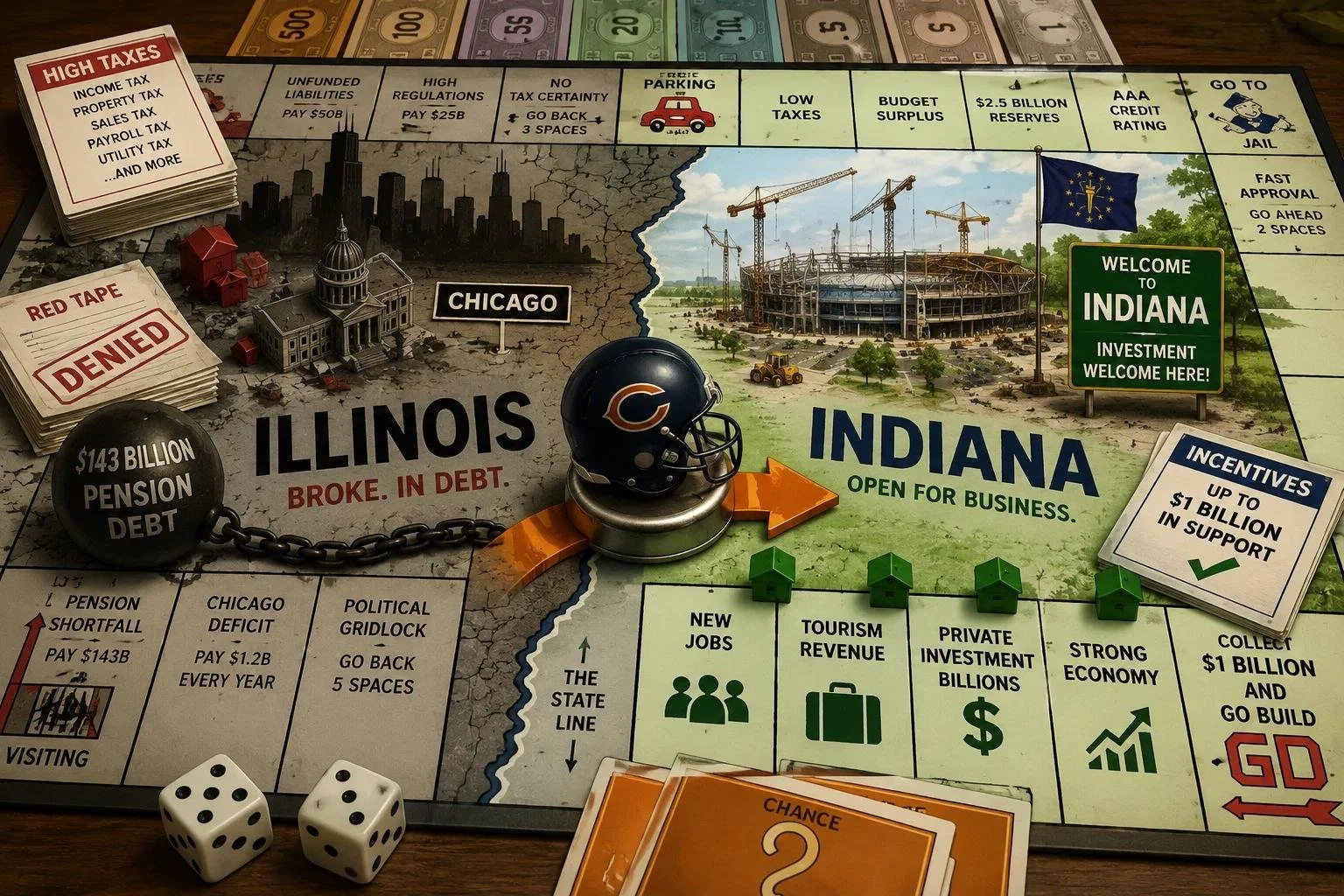
Late last week, the Bears' board of directors voted to advance a stadium development project across the border in Hammond, Indiana... signaling what could very well be their permanent departure from Chicago.
For more than fifty years, the Bears have leased Soldier Field from the city of Chicago. Five years ago, they decided to build their own stadium, paying $197 million for a nearby 326-acre parcel.
Da Bears further earmarked $2 billion of private capital to build a stadium on that site.
But the organization is not stupid. They know Illinois is broke. The state's pension system is $143 billion in the hole (the worst in America), and Chicago faces a $1.2 billion annual shortfall.
So before sinking billions into the ground, the team wanted assurances that politicians wouldn't tax the new stadium to death.
They asked for reasonable concessions— the sort of deal that any large business negotiates with cities and states before making major investments.
This is totally normal. Cities routinely grant some property-tax certainty or minor tax breaks, and in exchange they get billions in private investment, jobs, tourism, and a new tax base. Everyone comes out ahead.
This, after all, is the entire basis of capitalism: You win AND I win.
The medieval world was a zero-sum game, where one side got richer only by taking from another; capitalism's radical idea is that the pie itself can grow, so everyone can win if they work together towards a common goal.
Sadly, that remains a foreign concept on the political left.
The tax negotiation required Illinois lawmakers’ approval, and the legislature had five years to get it done. Yet they never did. After this spring’s legislative session ended last week without the Bear’s tax deal getting done, the team finally made the decision to move on.
It’s just a short drive across the border to Indiana. But the business environment is completely different. Indiana runs a budget surplus, sits on $2.5 billion in reserves, and carries a coveted AAA rating.
And it only took Indiana’s legislature a couple of months to pass a variety of incentives— worth up to $1 billion. Illinois is squeezing the team. Indiana is rolling out the red carpet.
It’s not hard to understand why: billions in private construction, thousands of jobs, and lots of new tourism dollars.
Illinois could have had that. But the Left simply does not want to do win/win deals.
Governor JB Pritzker, himself a billionaire heir to the Hyatt Hotel fortune, said he "wasn't willing to give up billions of dollars of taxpayer money in order to give it to a billionaire-owned family, or team."
Think about that. They’d rather lose the team— lose the tax base, lose prosperity, make the city worse off— than make a single concession to the Bears, simply because the owner is a billionaire.
This is what I call Billionaire Derangement Syndrome.
It was the same thing in 2019 when New York progressives (led by Alexandria Ocasio-Cortez) chased Jeff Bezos out of town. Amazon was considering New York City for its “HQ2” location, bringing billions in investment and tens of thousands of highly paid jobs.
But AOC wasn’t having any of that; Bezos, one of the world’s richest men, would have benefited from the deal, so AOC killed it... then took a victory lap to celebrate hollowing out the city’s tax base.
In the end, Bezos and Amazon did just fine. New York City has suffered. The Bears will be just fine. Chicago will suffer.
The Left only knows chaos and destruction. And their endless affliction with Billionaire Derangement Syndrome is one of the great risks to American prosperity.
There was once a time in America when successful people were admired as proof that anyone willing to build something could rise.
Now, across much of the Left, “the rich” are enemies of the state to be taxed into the ground, driven out town, or, as the activists chant, imprisoned or even ‘eaten’.
This derangement drives away the very people and capital that create prosperity and pay for everything that politicians claim to care about.
When the place you live starts treating productive people and their money as enemies to punish, rather than partners to welcome, the rational move is to think about your own Plan B.
To your freedom, James Hickman Co-Founder, Schiff Sovereign
P.S. Our flagship research service, Schiff Sovereign Plan B Confidential, is built for the practical, legal steps to diversify across borders before you ever need them. Inside, we cover second residencies and citizenships, international banking, legal tax reduction, and real-asset strategies — all drawn from boots-on-the-ground intelligence in more than 120 countries. Because the time to give yourself options is while you still have them.
Europe Just Bragged About Losing to Gold
Europe Just Bragged About Losing to Gold
Notes From the Field By James Hickman (Simon Black / Sovereign Man) June 4, 2026
When the euro launched on January 1, 1999, it was sold as the future. It would be a single currency to knit Europe together — to wipe out the exchange-rate friction between member states, complete the continent's single market, and bind a dozen squabbling nations into one economic bloc with one money.
And in the grander ambitions of its architects, it was meant to do something more: to grow up into a true global currency, the first serious rival the US dollar had faced since World War II.
Europe Just Bragged About Losing to Gold
Notes From the Field By James Hickman (Simon Black / Sovereign Man) June 4, 2026
When the euro launched on January 1, 1999, it was sold as the future. It would be a single currency to knit Europe together — to wipe out the exchange-rate friction between member states, complete the continent's single market, and bind a dozen squabbling nations into one economic bloc with one money.
And in the grander ambitions of its architects, it was meant to do something more: to grow up into a true global currency, the first serious rival the US dollar had faced since World War II.
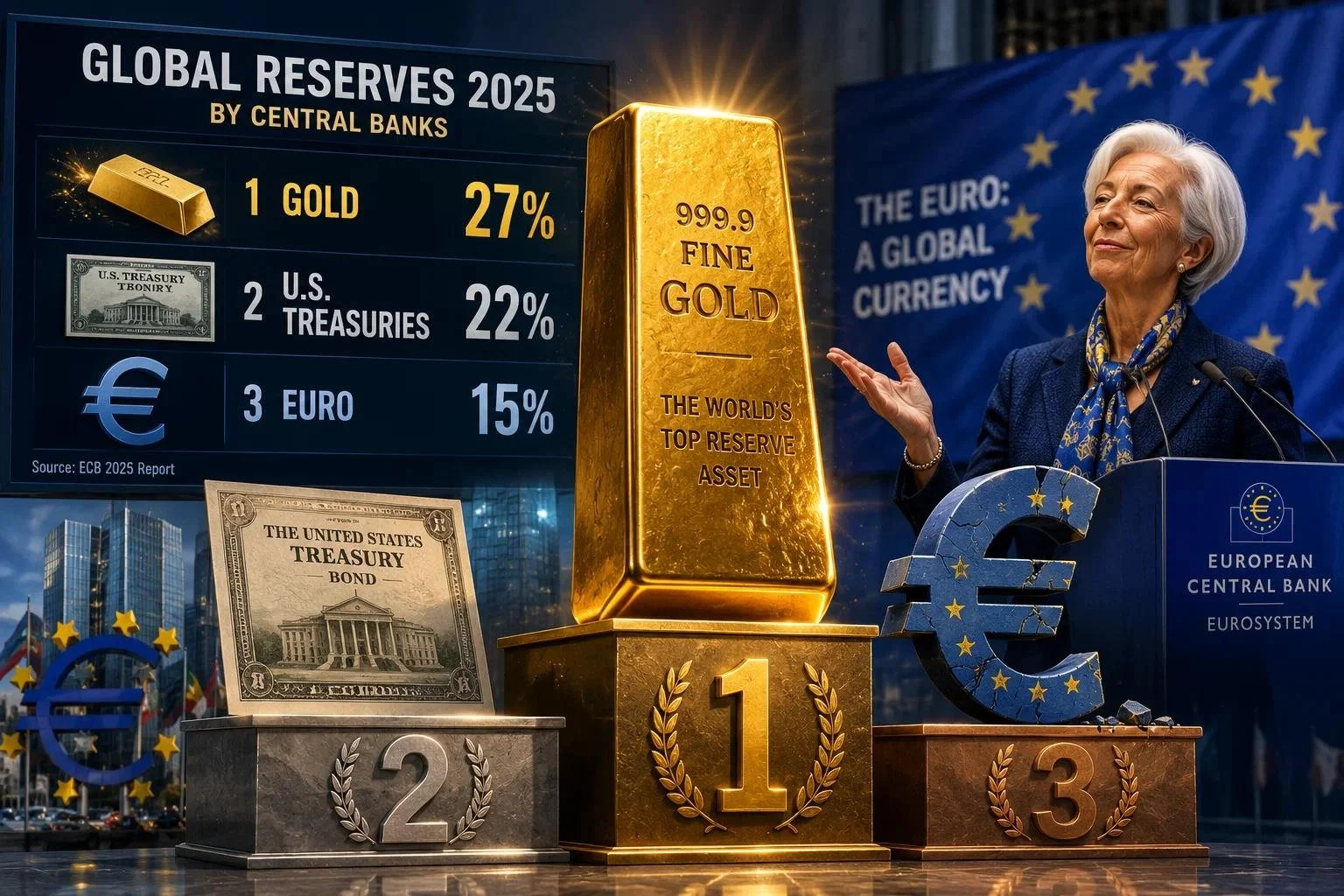
Last week, the European Central Bank published its 2025 report card, with ECB President Christine Lagarde celebrating “an opening for the euro to enhance its global appeal.”
The report bragged that the euro remains the second most used currency in the world, as well as the second most held in reserve, behind only the dollar.
The key word is “currency.”
Because in reality, 2025 was the year that gold took the top spot, making up 27% of global reserves held by governments and central banks. That pushed US Treasuries into second place with 22%, and the euro into third, making up 15% of global reserves.
A metal that pays no interest and earns no yield is now the biggest slice of global reserves, up from just 20% a year earlier.
The world is, in fact, trying to diversify away from the dollar. Central banks have spent years quietly trimming their dollar exposure, looking for somewhere safer to park their national savings.
But they are not choosing euros.
Then why, the ECB may counter, was 2025 a record year for international borrowing in euros?
Because there is more debt in everything than ever — global debt keeps smashing new highs, so a record pile of euro IOUs is less an achievement than a symptom of the times.
But to give credit where it's due, the euro is genuinely in first place in one market, according to Lagarde: "The euro became the leading currency in the green and sustainable international bond market."
That's the debt Europe sells to bankroll the very net-zero crusade that gutted its own economy. So the euro's crowning achievement of 2025 was becoming the world champion at borrowing money to make itself poorer.
If you ever needed one sentence to explain why nobody wants this currency, there it is.
Because leading the world in the things that make you poorer is the entire European model. Across the continent, governments spent two decades waging war on their own cheap energy in the name of net zero — turning their backs on nuclear power that supplied a third of Europe's electricity in 1990 and barely 15% today.
They saddled themselves with some of the highest power prices in the developed world and watched their industry pack up and leave. They threw open their borders, then aimed their police and courts at the citizens who objected.
The result is a continent so hollowed out that Mississippi, the poorest state in America, now produces more wealth per person than France or Italy.
But sure, this is the euro’s moment...
Meanwhile, central banks added roughly 850 tonnes of physical gold in 2025, a slight step down from the record-shattering pace of the prior two years, but bought at the highest prices in human history.
Poland led the gold-buying pack last year, followed by China, Turkey, and India.
But for a stretch of 2025, the single biggest gold buyer on the planet wasn't a country at all — it was Tether, the company behind the world's biggest dollar-backed stablecoin.
In the third quarter alone it bought more gold than any central bank on earth, and by the end of January it was sitting on roughly 148 tonnes — nearly 4.8 million ounces, worth about $22 billion — enough to rank among the top 30 gold holders in the world, ahead of the likes of Australia and South Korea.
This is exactly why the gold story is far from over.
The extra gold central banks have bought since 2022 laid the foundation for a price that has nearly tripled since — yet even that represents only a modest reallocation out of US dollars.
So what happens when they move even another 5% of their $10 trillion in reserves into gold?
With no single currency able to replace the dollar, and the reasons to diversify only growing, gold looks set to keep climbing as the world's largest reserve asset.
To your freedom, James Hickman Co-Founder, Schiff Sovereign LLC
P.S. Everyone from central banks to a stablecoin giant is racing into gold — which is why it's trading near record highs. We think owning the companies that produce it beats buying bullion at the top.
That's the whole idea behind Strategic Assets, Schiff Sovereign's monthly investment research. We hunt for profitable real-asset businesses with clean balance sheets, real catalysts, and a low multiple of free cash flow.
And it's working. We've seen it multiply the value of several precious metals companies, with others still in the buy range today. The same setup is now lining up well beyond the metals — in energy and other real assets — as nations around the world scramble to secure the critical resources a fragmenting world runs on.
The Funky Math Behind How The US Economy Could Double In Size. Overnight
The Funky Math Behind How The US Economy Could Double In Size. Overnight
Notes From the Field B James Hickman (Simon Black / Sovereign Man) June 2, 2026
It was September 2006— roughly two years before the 2008 financial crisis annihilated much of the global economy. But Greece was already in deep trouble. Unemployment was hovering around 9%. Youth unemployment was a staggering 25%. And government finances were in the toilet, with official debt-to-GDP at 100% and annual budget deficits at nearly 8% of GDP.
The deficit issue was especially troubling; as part of the Eurozone, Greece was legally obliged to keep its annual budget deficit below 3% of GDP. But the government was simply incapable of doing so.
The Funky Math Behind How The US Economy Could Double In Size. Overnight
Notes From the Field B James Hickman (Simon Black / Sovereign Man) June 2, 2026
It was September 2006— roughly two years before the 2008 financial crisis annihilated much of the global economy. But Greece was already in deep trouble. Unemployment was hovering around 9%. Youth unemployment was a staggering 25%. And government finances were in the toilet, with official debt-to-GDP at 100% and annual budget deficits at nearly 8% of GDP.
The deficit issue was especially troubling; as part of the Eurozone, Greece was legally obliged to keep its annual budget deficit below 3% of GDP. But the government was simply incapable of doing so.
Yet if they didn’t significantly reduce their deficit-to-GDP ratio, Greek politicians faced the prospect of EU bureaucrats from Brussels taking charge of the government and imposing austerity.
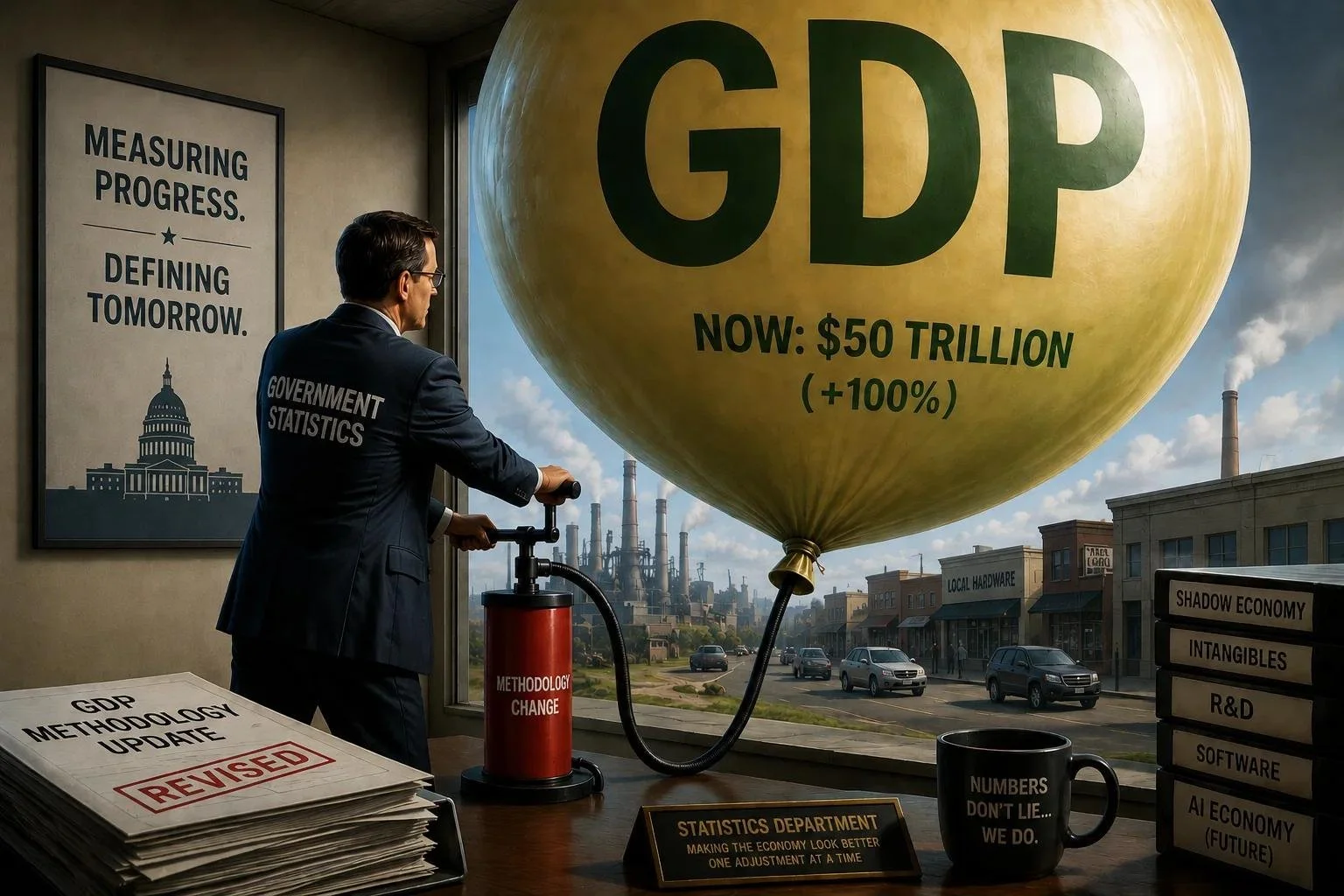
So, rather than cut spending and reduce the deficit, the Greeks cooked up a creative way to magically increase their GDP—overnight.
And on September 26, 2006, the Greek National Statistical Service announced they were changing the way they were calculating GDP; among other things, the Greek government would include “illegal activities like drug trafficking and prostitution” in their GDP estimates.
Laughter and facepalming ensued immediately around the world as global economists collectively groaned at the Greek government’s desperation.
And yet, they still went through with it: poof. Overnight, Greece’s GDP magically grew by 25% because of the change in their calculation.
Frankly this idea is not uncommon in economics; plenty of countries have seen overnight surges in their GDP simply by changing the way they count economic activity.
Italy famously increased its GDP by nearly 20% overnight back in 1987 when they started including estimates of their shadow economy in the GDP numbers.
Nigeria ‘rebased’ its economy in 2014, nearly DOUBLING its GDP. One day it was a $270 billion economy, and literally the next day it was a $510 billion economy.
Ghana did the same in 2010, increasing its GDP by 60%.
But the world record goes to west Africa’s Guinea-Bissau, which, in 2005, increased GDP by a whopping 142%. Overnight.
Now, sometimes these updates aren’t completely ludicrous. Econometrics is an imprecise field that often relies on outdated modes of information gathering.
More importantly, statistical agencies over-concentrate their efforts collecting data on has-been industries while ignoring ‘new economy’ sectors. And this can seriously distort the picture.
That’s why, even in the United States, government agencies occasionally make changes to their econometric methods. Measuring an economy as dynamic as America’s absolutely has to change from time to time. And they have.
In 1999, for example, the Bureau of Economic Analysis began classifying software as a long-term asset (rather than an expense), immediately adding about 0.4% to the prior year’s GDP growth.
In 2013 the same agency went even further and began counting R&D expenses, artistic content, and more in GDP calculations. This change added $560 billion to the US economy.
To be fair, these were not political mandates or desperation moves. Instead, they were necessary adjustments to reflect changes that had taken place in the US economy; it makes sense to include R&D in GDP calculations when so much of the economy is R&D.
Typically, these adjustments to US methodologies take place every few years. And, as of yet, the US government has NOT yet updated its measurements to include AI.
And this is what may ultimately lead to a Greek, Ghana, or even Guinea-Bissau boost to GDP.
Economic activity from AI is extremely difficult to measure. Sure, there are sales of Nvidia GPUs and data center spending.
But think about all of the things that people are doing with AI—things which have economic value, but the government has no credible way to count.
Here’s an easy example: every time I’m at the grocery store, I browse the meager selection of children’s books for my kids. I almost never buy anything, though, because most of them are garbage… so the resulting economic activity is very low.
Lately I’ve been using AI to create my own books for the kids—which they seem to be enjoying very much. But since no dollars actually changed hands (i.e. I make the books myself), there is no economic activity recorded in this case either.
This is a critical point to understand, so I’ll say it again: in both situations, i.e. me NOT buying a book at the store, versus me creating one with AI, no recorded economic activity took place.
And yet, when I make my own books, something of economic value IS being created. I value them. My kids value them. The books have some value, hence value is being created.
I’m just one guy. Hundreds of millions of people are doing the same thing. And none of that value is being recorded, i.e. none of it is showing up in the GDP numbers.
It turns out the US government’s Bureau of Economic Analysis is already considering ways to incorporate AI into the GDP numbers.
And frankly that impact could be dramatic… for a couple of reasons.
First, because the impact of AI really IS dramatic. And growing. But second—because the US government REALLY needs to cut its deficit-to-GDP and debt-to-GDP ratios.
And since, like Greece, they seem to have no interest in actually cutting spending and reducing the debt, they’ll use AI as a way to suddenly boost GDP.
So don’t be surprised if we wake up one day and are told that the US economy is now $50 trillion because of AI… and hence America’s debt-to-GDP level immediately falls to 80%.
I suppose counting the economic value of cat memes and unicorn stories is better than drug traffickers and prostitutes. And it would be an interesting way for the US government to dramatically improve its fiscal condition overnight.
To your freedom, James Hickman Co-Founder, Schiff Sovereign LLC
Green Policy is Deadlier Than Guns
Green Policy is Deadlier Than Guns
Notes From the Field By James Hickman (Simon Black / Sovereign Man May 29, 2026
Every year around this time, a silent killer sneaks its way onto European shores and slaughters people by the tens of thousands. Last year, it killed more people in just three months than the number of civilians killed in the war in Ukraine all year. It killed three times as many people as traffic accidents do. And it killed FOUR times more Europeans than gun violence killed in America. I'm not talking about COVID. Or even the legions of migrants invading the continent.
Green Policy is Deadlier Than Guns
Notes From the Field By James Hickman (Simon Black / Sovereign Man May 29, 2026
Every year around this time, a silent killer sneaks its way onto European shores and slaughters people by the tens of thousands. Last year, it killed more people in just three months than the number of civilians killed in the war in Ukraine all year. It killed three times as many people as traffic accidents do. And it killed FOUR times more Europeans than gun violence killed in America. I'm not talking about COVID. Or even the legions of migrants invading the continent.
This deadly scourge that kills tens of thousands of Europeans each year is the lack of air conditioning.
Heat killed 62,775 people across the continent in the summer of 2024, according to a study in Nature Medicine.
The World Health Organization calls it the leading "climate-related" cause of death in the region.
But in reality, these deaths are directly related to the fanatical green environmental policies of European governments, which have made the electricity to run air conditioning prohibitively expensive.
Roughly 19% of European homes have A/C, versus 90% in the US.
The simple reason is the bill: electricity in Germany costs about 2.5 times what it does in the US. Starting in 2011, Germany shut down every one of its nuclear reactors and bet its grid on wind and solar — in a country where the sun barely shines.
European media and politicians have also spent a generation making anyone who even thinks about buying A/C feel like a moral failure.
The result is a continent that has made cooling both unaffordable and shameful; then they act surprised when 60,000 people die in a heat wave.
The dead are not the only price paid. For decades, German manufacturing thrived because one machine could produce more than a thousand workers in the developing world.
But Germany's high-tech manufacturing model only worked because the electricity to run those machines was reliable and affordable. But the German government has spent twenty years making energy either too expensive or, on certain days, simply unavailable.
Germany used to have inexpensive electricity thanks to its nuclear reactors. But the green fanatics have succeeded in shutting those reactors down, resulting in higher electric prices.
The bill for that policy lands on the factory floor. The German Association of the Automotive Industry reported on May 13, 2026 that German automakers have already shed 100,000 jobs since 2019, with another 125,000 projected to disappear by 2035.
German Chancellor Friedrich Merz has called the nuclear phase-out "a mistake," and said "I regret this." Yet in the same breath he explained that "it is the way it is, and we are now concentrating on the energy policy we have."
In other words, they acknowledge that they made a huge mistake. But they also admit that they aren't going to fix it.
Perversely, the simple act of admitting a mistake (even without fixing it) is actually progress for a politician.
Just look at their immigration policy— they won’t even admit the mistake of importing legions of gang-raping foreigners who do not respect laws and have no problem committing violence.
The bill for that policy has come due in the same way the energy bill came due: in bodies.
In August 2024, Solingen's Festival of Diversity got a firsthand demonstration of what they were celebrating when a Syrian asylum seeker stabbed three people to death.
Four months later, a Saudi national drove a rented SUV through Magdeburg's Christmas market, killing six and injuring 200.
In January 2025, an Afghan asylum seeker— already under an active deportation order German authorities had failed to enforce— stabbed a two-year-old boy and a 41-year-old man to death in a public park in Aschaffenburg.
By November 2025, German cities had begun canceling their Christmas markets outright. One reopened after spending more than €250,000 on concrete barriers to keep trucks from being driven into shoppers a second time.
The state's response to imported violence is not to stop importing it. It is to cancel Christmas.
The pattern is always the same: even when governments make an enormous mistake, they lean into it. They rarely fix anything, they just continue with a destructive policy.
And anyone who actually does try to fix it gets ridiculed, canceled, or shot.
One current example from the US is the LA mayoral election.
The incumbent mayor, Karen Bass, has presided over the worst destruction the city has seen in decades. She does nothing about the homeless problem— in fact recently stated that taxpayers should pay for new teeth for homeless meth addicts so that they can have dignity.
Her only positive contribution, in her own words, is that she was “out of the country” when the Palisades wild fires started in January 2025 and that she did “not start the fires” herself. That’s a pretty low bar for success.
Her opponent, Spencer Pratt, just wants to fix the city. He presents real solutions to real problems, yet he is the one that the media paints as a fringe lunatic— not the lady who wants to give taxpayer-funded teeth to meth addicts.
Politicians do not just refuse to fix their mistakes; they save their loudest contempt for whoever is rude enough to mention them, or daring enough to fix them.
There may still be a way forward here. Maybe more responsible, more sensible people start running... and maybe voters will be responsible and sensible enough to elect them. Maybe this happens before it’s too late, and America can finally turn things around.
But there’s also a rational possibility that doesn’t happen... and that’s why it’s worth having a Plan B.
To your freedom, James Hickman Co-Founder, Schiff Sovereign
PS— Having a Plan B is not hysteria. It’s not unpatriotic. It’s a rational common-sense move to mitigate obvious risks.
The fact is that we have much more control over our circumstances than the ‘experts’ would have us believe. It is possible to get inflation’s impact on your life under control. To reduce your current and future tax bill. To reduce the risk of future social chaos. To set your family up for long-term success.
These are all sensible precautions and part of a smart Plan B strategy; we have been providing these solutions for years, and invite you to learn more about our research.
US Treasury Pays 3.7%, Violates Every AML Regulation On The Books
US Treasury Pays 3.7%, Violates Every AML Regulation On The Books
Notes From the Field By James Hickman (Simon Black / Sovereign Man) May 28, 2026
Opening a bank account in the Land of the Free today feels like applying for a top secret security clearance. Banks often require multiple forms of ID, proof of address, proof of employment, plus detailed explanations of where your money came from, what you plan to do with it, and who you plan to send it to.
And that's just to get the account open. Once you've actually been deemed worthy of handing over your money to them, the surveillance really kicks in.
US Treasury Pays 3.7%, Violates Every AML Regulation On The Books
Notes From the Field By James Hickman (Simon Black / Sovereign Man) May 28, 2026
Opening a bank account in the Land of the Free today feels like applying for a top secret security clearance. Banks often require multiple forms of ID, proof of address, proof of employment, plus detailed explanations of where your money came from, what you plan to do with it, and who you plan to send it to.
And that's just to get the account open. Once you've actually been deemed worthy of handing over your money to them, the surveillance really kicks in.
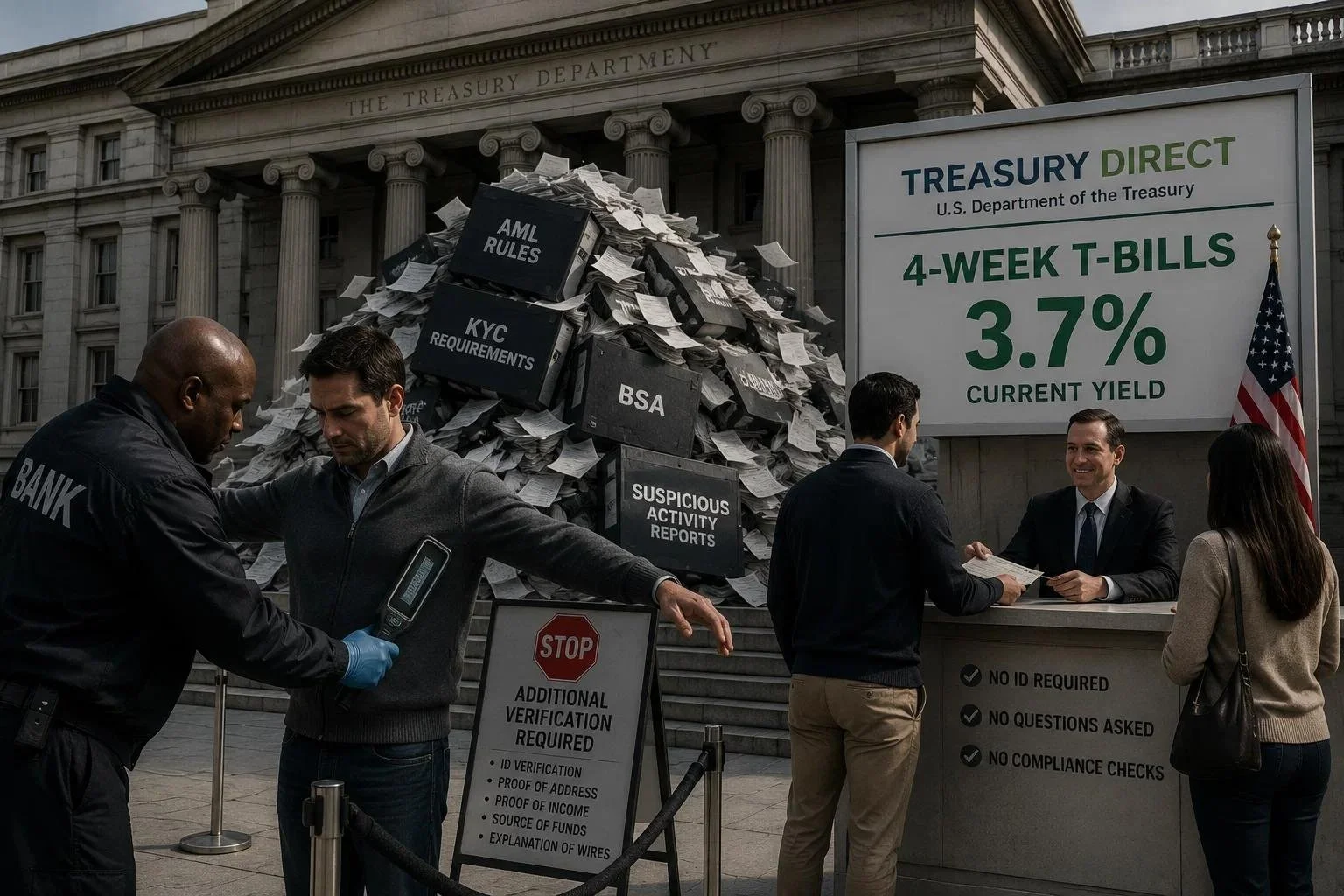
If you wire money to someone new, prepare for a phone call from the fraud department. Send a wire to a foreign bank and prepare for your account to be flagged by compliance.
The Cato Institute recently published a study showing that banks file 28 million reports to the federal government, flagging customer transactions as “suspicious”.
Yet the government’s own data show that 99.98% of these reports were filed on innocent people for completely frivolous reasons, i.e. people like my own mother who simply like to deal in physical cash.
Yet in the mind of a financial bureaucrat, using completely legal tender in the United States of America is suspicious and deserves to be reported.
Banking is a completely soulless industry devoid of any humanity or common sense.
We recently almost had a bank account shut down because one of our customers sent us a routine payment for his Total Access renewal.
Unfortunately our customer happens to have the same name as someone on a US government watch list.
Now, banks obviously shouldn’t be doing business with known criminals... so I have no problem that the transaction was flagged. But our team was quickly and easily able to prove that it wasn’t the same person. Not even close. Just two people who happen to have the same name.
But it didn’t matter. After several days of scrutiny and document gopher hunts, the bank not only rejected the transaction, but they nearly shut down our account.
Multiply that across every account, every business, every wire, every customer. American banking is now mostly a compliance apparatus that happens to do some occasional financial transactions on the side.
Yet for all the bureaucratic gauntlet your bank puts you through, the average savings account in the US pays a measly 0.38% interest right now.
It's one reason why I like crypto.
I'm not someone who thinks Bitcoin is going to magically become larger than the GDP of the known universe. But I do like that it's decentralized— that you can effectively be your own bank, without begging permission from someone whose entire job is to assume you're guilty.
Ironically, it turns out there's another option; there's at least one place in America to put your money that asks no questions.
They open accounts in no time with little more than a Social Security number. They don't demand to know where your funds came from. You don’t have to fill out 10,000 forms or show a single form of ID.
Frankly, these guys are deliberately and willfully violating every single Anti-Money Laundering rule and Treasury regulation on the books.
Fortunately no one is going to haul them off in handcuffs... because I’m talking about the Treasury Department itself!
The US government runs a website called Treasury Direct which allows anyone with a Social Security number to sign up and buy US government bonds.
Of course, as we discussed a few days ago, it would be insane to buy long-term bonds and lock up money for thirty years, ten years, or even five years. The US has nearly $40 trillion in debt, runs $2 trillion deficits every year, and has no plan to slow either down.
But the shortest-term security the US government sells is just FOUR WEEKS; it’s known as the 28-day T-bill. It’s essentially the same as a 1-month CD, and right now it pays 3.7%.
28 days is no time at all. And while I would in NO WAY be willing to hold a 30 year bond, I’m happy to loan a portion of my funds to the federal government for a couple of weeks.
Naturally the Treasury Direct website sucks. The User Interface is clunky and looks like a 15-year old designed it in 1997.
But none of that matters; they make it REALLY easy to sign up and buy bonds. You link your bank account select which bond you want to buy, and you can set yourself up for automatic reinvestments or payouts.
Crazy enough, the Treasury Department even allows you to transfer certain T-bills to third parties... which is effectively the same as making a cash or wire transfer.
There’s no hoops to jump through, no one flagging your transaction, no demands to prove that you’re not a member of Hezbollah or the Russian government.
The federal government ignores every single one of its own anti-money laundering rules. And I’d wager that criminals and terrorists are using Treasury Direct to launder and transfer money... because the Treasury Department literally performs zero compliance checks.
It’s pretty sad, and deeply ironic. But it’s also the easiest and safest way to earn a reasonable rate of return on a measly 4-week commitment.
To your freedom, James Hickman Co-Founder, Schiff Sovereign LLC
Treasury Yields Are At 20-Year Highs And Almost Nobody Wants Them
Treasury Yields Are At 20-Year Highs And Almost Nobody Wants Them
Notes From the Field By James Hickman (Simon Black / Sovereign Man) May 26, 2026
There are pools of capital in the world so large that they cannot be parked just anywhere. Pension funds, foreign governments and central banks, giant commercial banks— they are collectively sitting on tens of trillions of dollars worth of capital that they have to invest in a safe, stable asset.
The stock market doesn’t really work— it’s far too volatile. Real estate doesn’t really work either— it’s not liquid.
Treasury Yields Are At 20-Year Highs And Almost Nobody Wants Them
Notes From the Field By James Hickman (Simon Black / Sovereign Man) May 26, 2026
There are pools of capital in the world so large that they cannot be parked just anywhere. Pension funds, foreign governments and central banks, giant commercial banks— they are collectively sitting on tens of trillions of dollars worth of capital that they have to invest in a safe, stable asset.
The stock market doesn’t really work— it’s far too volatile. Real estate doesn’t really work either— it’s not liquid.
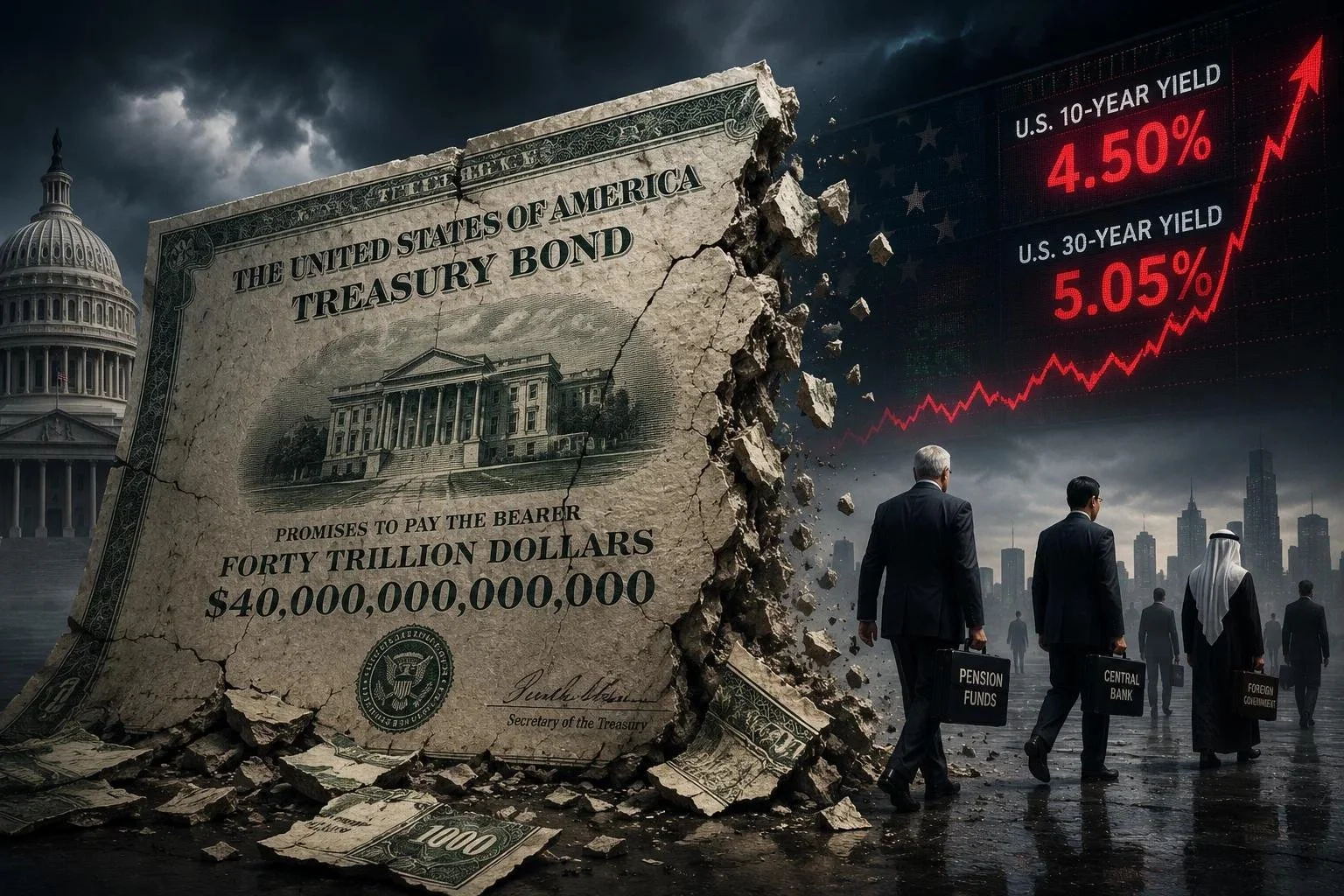
That is where the bond market comes in: it’s both massive (far larger than the stock market), so it can absorb enormous flows of capital. And it’s highly liquid. This allows large investors to quickly move huge sums of money in/out of the bond market.
That’s why, for the better part of a century, the single deepest and most trusted piece of that market has been US government bonds. With the US national debt of nearly $40 trillion, this makes America’s bond market REALLY big. And Congress keeps adding to it.
The federal government runs roughly $2 trillion annual deficits— which you could think of as the new ‘supply’ of Treasury securities added to the bond market each year.
In other words, when the government spends more, they have to borrow more money by issuing more Treasury bonds. So the supply of US Treasury securities in the bond market increases.
‘Demand’ for US government bonds, on the other hand, comes from everyone on the planet who buys them. Pension funds, foreign governments and central banks, big corporations, banks, money market funds, etc.
And as any high school economics student can tell you, the ‘price’ is where supply meets demand. In the bond market, we usually think of price as the bond yield, e.g. right now the US 10-year yield is 4.5%, and the 30-year Treasury is over 5%.
To put those yields in a historical context, they haven’t been this high in decades— and it’s a direct result of rising supply and waning demand.
On the supply side, the US government keeps borrowing money at an insane pace, i.e. the Treasury Department keeps flooding the market with more and more bonds, notes, and yields.
But on the demand side, investors are backing off— especially foreigners. Foreign ownership of US government bonds (as a percentage of total public debt) has fallen by roughly HALF since the early 2010s... with a significant drop recorded just over the past twelve months according to the Treasury Department’s own data.
Few people in Congress seem to mind; there is no serious discussion in Washington about slowing the growth of the deficit, i.e. the bond supply, let alone actually shrinking supply by paying off debt.
Ultimately this supply and demand imbalance means that bond yields will continue to rise— which affects just about everything else from auto loans to the 30-year mortgage rate.
And just take a look around the rest of the developed world:
Bond yields in Germany are far lower (by about 1.5%) than US yields. So are yields in Japan, France, Italy, Canada, Singapore, New Zealand, South Korea, and China.
Even GREECE, with its 3.6% 10-year government bond yield, has lower yields than the United States.
You’d think that such attractive yields in the United States compared to the rest of the world would entice a lot more capital into the US bond market. After all, investors generally chase the highest returns.
But buyers are signaling that they don’t think the return is worth the risk— that even a 4.5% yield on a 10-year Treasury note is not worth the risk of holding a US government IOU for an entire decade.
Think about how much has changed over the past decade... and how much more can change over the next decade. Inflation, government shutdowns, debt ceiling showdowns, political theater, war, Social Security’s looming insolvency, etc.
Foreign governments and central banks aren’t willing to lock themselves in for ten years, let alone thirty years, with so much chaos on the horizon.
And with less demand from foreigners in the bond market, it’s likely that bond yields will continue to rise, until the Treasury Department is paying 5, 6, and 7% to borrow money.
With a ~$40 trillion national debt, that’s almost $3 trillion per year just to pay interest— roughly 60% of last year’s tax revenue.
This is why it makes so much sense to have a Plan B... because the most likely ‘solution’ to this problem will be for the Federal Reserve to ‘print’ trillions of dollars of capital.
This approach may succeed in lowering yields. But it will lead to substantially higher inflation, for a lot longer.
To your freedom, James Hickman Co-Founder, Schiff Sovereign LLC
P.S. If the Fed ultimately prints trillions to keep yields down, inflation is the bill— and the best protection is owning the companies that produce the real assets central banks are already loading up on.
Gold is the obvious example, but the same logic applies to every essential input the real economy runs on: energy, fertilizer, industrial metals, uranium, agriculture, shipping.
People still need to eat, drive, heat their homes, build, and farm.
That's why we built Schiff Sovereign's Strategic Assets, our monthly investment research service focused on profitable, well-managed real asset companies.
The BBC wants to Make the Taliban Great Again
The BBC wants to Make the Taliban Great Again
Notes From the Field By James Hickman (Simon Black / Sovereign Man) May 22, 2026
This week the British Broadcasting Corporation flew halfway around the world to find a sad story that it could blame on (1) America and (2) climate change. Their drama opens in Afghanistan’s Ghor province, where fathers line up before dawn at a dusty square hoping to find a day’s work. One man weeps that he is preparing to sell his seven-year-old daughter to feed the rest of his children.
The BBC wants to Make the Taliban Great Again
Notes From the Field By James Hickman (Simon Black / Sovereign Man) May 22, 2026
This week the British Broadcasting Corporation flew halfway around the world to find a sad story that it could blame on (1) America and (2) climate change. Their drama opens in Afghanistan’s Ghor province, where fathers line up before dawn at a dusty square hoping to find a day’s work. One man weeps that he is preparing to sell his seven-year-old daughter to feed the rest of his children.

The reporter then explains how nearly five million Afghans are food deprived; she goes on to describe graveyards of dead infants, and then tells the story of another man who already sold his five-year-old daughter for about $3,200.
It is all genuinely terrible. But when the BBC starts explaining WHY any of this is happening— is where the journalism ends and the propaganda begins.
Famine, in almost every modern case, is not a weather event. It is a political outcome.
Afghanistan has fertile river valleys and enough arable land to feed several times its current population. Whenever a country is starving, it is due to bad policy— not bad soil.
It was the same issue when Venezuela ran out of food a few years ago. People were starving. Supermarkets were stripped bare. Zoo animals turned up on dinner plates.
Yet Venezuela has a tropical climate, a year-round growing season, abundant water, and some of the most productive farmland on the planet.
It really takes a special kind of incompetence to starve citizens in a place like that. And the same kind of incompetence is at work in Kabul at the hands of the Taliban overlords.
The BBC mentions none of this. Instead it points the finger at the legacy media's two favorite villains: Donald Trump and climate change.
To make the case, the reporter sits down with a senior Taliban official, who insists that their regime "inherited poverty, hardship, unemployment and other problems".
These “problems” were entirely due to the US presence, he explains, which had built "an artificial economy due to the influx of US dollars."
In other words, the men who reconquered the country, kicked girls out of school, and locked half the workforce in their homes, are blaming their economic problems on the US investing too much money in Afghanistan.
Yet the BBC nods along enthusiastically.
Ironically, despite blaming America’s substantial investments in Afghanistan for the country’s problems, the Taliban’s solution is for America to give them more money.
"Humanitarian assistance should not be politicized," said the Taliban spokesman, parroting the exact talking that point Western NGOs use to demand more no-strings cash for regimes that whip women in public.
The BBC nods along enthusiastically again.
They follow this up with more emotional propaganda, telling stories of dead babies and infant graveyards, all to tug at the heartstrings of their readers.
Then comes their coup-de-grace: blasting the Trump administration for cutting nearly all US aid to Afghanistan last year. The unspoken conclusion is that America is responsible for a graveyard of dead Afghan babies.
The naïveté is breathtaking. Is anyone stupid enough to believe that a single dollar in aid to the Taliban will end up in the hands of the old man sobbing at the labor square, and not in the hands of the warlords?
We do not have to guess.
A US Inspector General report found that at least $293 million in foreign aid earmarked for Afghan NGOs had already been stolen by the Taliban after they took the country in 2021. A large part of this was through fake NGOs that the regime invented to defraud donor nations.
The only thing that "humanitarian assistance" in Afghanistan actually buys is a better-funded Taliban.
What is most extraordinary is that this came from the British Broadcasting Corporation.
They didn’t need to fly halfway across the world to find children going hungry, being abused, or being sold. Britain has each of those stories on its own soil.
For nearly two decades, organized grooming gangs of overwhelmingly Pakistani Muslim men raped thousands of underage British girls, some as young as ten.
Yet police, social workers, and hospital staffs dismissed the obvious signs. And the BBC had remarkably little to say about any of it.
This raises the BBC’s other unspoken conclusion: “we” need to help these people by bringing more of them into the West.
Think about it: if men from this culture are willing to buy and sell their own children, imagine what they’re willing to do to yours.
Yet these are the values that Western politicians want to import into Europe and North America as a glorious example of multiculturalism. And anyone who has a problem with this is a racist Islamophobe.
Inspired Idiots like the BBC are the very reason it makes sense to have a Plan B.
To your freedom, James Hickman Co-Founder, Schiff Sovereign LLC
How To Lose Billions Of Dollars: Trust The US Government
How To Lose Billions Of Dollars: Trust The US Government
Notes From the Field By James Hickman (Simon Black / Sovereign Man) May 19, 2026
America was at the top of the world in 1955. World War II had been over for ten years. Soldiers had come home to GI Bill mortgages in brand-new suburbs. Detroit was building cars faster than anywhere else on the planet.
And the economy was booming— in fact that year a milkshake-machine salesman named Ray Kroc had just franchised his first McDonald's on a roadside in Illinois.
How To Lose Billions Of Dollars: Trust The US Government
Notes From the Field By James Hickman (Simon Black / Sovereign Man) May 19, 2026
America was at the top of the world in 1955. World War II had been over for ten years. Soldiers had come home to GI Bill mortgages in brand-new suburbs. Detroit was building cars faster than anywhere else on the planet.
And the economy was booming— in fact that year a milkshake-machine salesman named Ray Kroc had just franchised his first McDonald's on a roadside in Illinois.
Half a world away, in a country still rebuilding from the rubble of that war, a scrappy little Japanese company called Honda was selling cheap motorcycles to people who couldn't afford cars.
That year, 1955, was the last year that Honda lost money. Starting in 1956, and for seven decades after that, the company became one of the most consistently profitable carmakers on the planet.
Until now.
A few days ago, Honda announced billions in losses for the first time since Eisenhower was President. And the reason isn't because of a major scandal, financial crisis, or moonshot bet on flying cars.
Honda's executives had simply made a sensible business decision to believe the US government.
When Joe Biden promised that America was going all-electric, Honda took him at his word. That promise has now cost the company roughly $10 billion in write downs and impairments and pushed Honda into its first annual loss in decades.
Biden's plan was carrot-and-stick. The carrot was part of the poorly named Inflation Reduction Act in the form of a $7,500 federal tax credit on every new EV sold.
The stick came from sweeping new regulations requiring roughly two-thirds of new vehicles sold in the US to be electric by 2032. Either automakers built EVs, or they got regulated out of the American market.
In the background, Biden squeezed the oil supply to make driving a gasoline car more expensive.
He canceled the Keystone XL pipeline on his first day in office, paused new federal oil and gas leases a week later, and in his final days withdrew more than 625 million acres of US offshore waters from any future drilling.
To automakers, this EV push looked like a once-in-a-generation opportunity; Washington was writing checks, mandating the switch, and selling the whole thing as permanent. So, Honda, along with Ford, GM, and Stellantis, built the EV factories.
Consumers didn't cooperate. Less than 10% of new cars sold in America were electric.
Then the rules changed.
When Trump took office, his administration’s EPA sensibly rolled back the emissions rule. Congress (rightly) killed the $7,500 tax credit. And automakers’ EV math collapsed overnight.
Ford swallowed a $17.4 billion hit on its EV business. Over at Stellantis, the parent of Jeep, Ram, and Chrysler, a $29.7 billion writedown produced the first annual loss in the company's history.
GM has chalked up another $7 billion of EV-related losses. Add it up and you get roughly $64 billion of real capital that was incinerated in less than a year.
Automakers weren't designing cars for customers; they were designing cars for subsidies and regulations. When the subsidies and regulations went away, the profits went with them.
And it isn't Honda's fault either. They made the call on the best information available, which was supposedly a "permanent" change in how the US government rewarded and punished automakers.
It's sad, really. Biden cooked up a stupid policy, Trump reversed it, and the companies lost billions.
What it teaches every CEO in Tokyo, Seoul, Munich, and Detroit is to think twice before trusting Washington again. That's the exact wrong message for a country that desperately needs continued capital investment from abroad.
Reagan saw all of this coming forty years ago. "Government's view of the economy," he said in 1986, "could be summed up in a few short phrases: if it moves, tax it. If it keeps moving, regulate it. And if it stops moving, subsidize it."
Four decades later, that's still the entire playbook.
There's only one path out of America's debt trap, and it's less government. Cut the rules, cut the spending, and let markets— not Senate committee chairs and EPA administrators— decide where capital flows.
GDP has to grow faster than the borrowing, and that won't happen if Washington keeps torching $60 billion of industrial capital every time it changes its mind about which industry to bless.
They never learn. Which is exactly why it makes so much sense to have a Plan B.
To your freedom, James Hickman Co-Founder, Schiff Sovereign LLC
How to lose billions of dollars: trust the US government | Schiff Sovereign
The Decade That Made Secession Seem Normal
The Decade That Made Secession Seem Normal
Notes From the Field By James Hickman (Simon Black / Sovereign Man) May 18, 2026
Almost ten years ago to the day, I woke up in my hotel room in Bangkok and flipped on the TV; it was late, late in the evening in the UK, and the BBC News was broadcasting live coverage of the Brexit vote.
As the results slowly trickled in and it became clear that Brexit would prevail, the news anchors could not hide their shock and horror; the idea that British voters would actually choose to leave the European Union was, to them, incomprehensible.
The Decade That Made Secession Seem Normal
Notes From the Field By James Hickman (Simon Black / Sovereign Man) May 18, 2026
Almost ten years ago to the day, I woke up in my hotel room in Bangkok and flipped on the TV; it was late, late in the evening in the UK, and the BBC News was broadcasting live coverage of the Brexit vote.
As the results slowly trickled in and it became clear that Brexit would prevail, the news anchors could not hide their shock and horror; the idea that British voters would actually choose to leave the European Union was, to them, incomprehensible.
A decade later, things like that which once seemed incomprehensible are now becoming mainstream. Britain is just the tip of the iceberg— it’s happening all across the west.
Earlier this month in Wales, voters elected the ‘Plaid Cymru’ party to its first majority ever; this is the party that has campaigned for decades to secede from the United Kingdom and make Wales independent.
The same dynamic is now playing out in Canada.
A decade under Justin Trudeau-Castro’s policies, which sacrificed the Canadian economy on the twin altars of climate religion and identity politics, has produced a country measurably poorer than the United States across the border.
In 2014 the per-capita GDP gap between Canada and the US was around 24%. Today it has grown to 43%.
And the OECD now projects Canada will rank dead last among developed economies for real GDP per capita growth through 2060.
So, on May 2, organizers in the province of Alberta handed-in over 300,000 signatures, more than 10% of Alberta’s registered voters, demanding a referendum on independence.
People have a breaking point. And when they reach it, they vote with with their ballots... with their wallets... and with their feet.
Take corporate America. For as long as anyone can remember, the standard practice for any serious American company was to incorporate in Delaware. And for more than two centuries, any serious financial firm was based almost entirely on Wall Street.
But in January 2024, the Delaware Court of Chancery rescinded Elon Musk's $56 billion Tesla compensation package— a single ruling that told every public company in America that corporate law could be relitigated on a whim.
Tesla and SpaceX reincorporated in Texas. Coinbase followed them. Dropbox decamped to Nevada. Dell is redomiciling to Texas. One company after another is leaving Delaware for good.
It’s the same with Wall Street.
Jamie Dimon, CEO of JPMorgan Chase, was blunt about the changing dynamic in his April shareholder letter: "Individuals vote with their feet. You can already see a fairly large exodus of people and jobs out of some states with high taxes and high expenses."
In his own estimate, JPMorgan now employs 32,000 people in Texas, up from 26,000 a decade ago. Its New York headcount over the same period fell from 30,000 to 24,000.
The IRS migration data tells the same story one household at a time. Between 2019 and 2023, California's cumulative net outflow amounted to $91.4 billion in Adjustable Gross Income; that’s a huge loss of their tax base.
Meanwhile, Florida's cumulative net inflow came to $137 billion.
Hollywood is also instrumental.
One, the audience has voted with its wallets, hence the string of box office bombs. People don't go to the movies to be lectured on social justice. They want to be entertained.
But for the past decade, Hollywood decided audiences needed to hear about racial injustice, gender identity, and climate change instead. Studios have racked up enormous losses as a result.
Second, no one wants to make films in Hollywood anymore because of the insane costs and regulations of doing business in California.
Instead, Atlanta wins because Georgia offers an uncapped 30% tax credit. Plenty of foreign countries offer far more. Plus production companies filming outside of California don’t have to deal with unions, taxes, or political hostility.
Consumers have been delivering the same lesson for years.
Bud Light decided in 2023 that its core demographic was, apparently, trans activists. American beer drinkers knocked the brand from #1 to #3 in the country and stripped more than $1 billion in lost sales out of its parent company.
Gillette tried it during #metoo, with a 2019 ad lecturing its male customers about how to be "the best men they can be." P&G took an $8 billion write-down on the brand the same year.
Personally I have never bought a Gillette product since.
But think about the trend: a decade ago, almost none of this was thinkable.
Brexit was treated as a national psychotic break. A large voting bloc interested in their province seceding from Canada was ludicrous. And why on earth would a serious company leave Delaware, any serious banker leave Wall Street, or any red-blooded American stop buying Bud Light?
And yet it’s all happened.
Frankly it’s a cause for optimism. The people running these institutions are finding out the hard way that everyone has a vote— at the ballot box, with their feet, and with their wallets.
Just imagine what another 10 years of this trend will look like.
To your freedom, James Hickman Co-Founder, Schiff Sovereign LLC
The decade that made secession seem normal | Schiff Sovereign
How The World Is Starting To Look Like 1492 All Over Again
How The World Is Starting To Look Like 1492 All Over Again
Notes From the Field By James Hickman (Simon Black / Sovereign Man) May 14, 2026
In the year 1484, a thirty-something year old sailor from Genoa was working in Lisbon when he stumbled upon a bold idea. For the previous decade, he had served as a crewman on several Portuguese commercial expeditions to haul physical resources like gold, ivory, and fish from Asia back to European ports.
These voyages were treacherous; they all crossed into maritime territory controlled by the Venetians, Ottomans, or Egyptian Malmuk. So there was a high likelihood of a vessel being confiscated and its crew being captured or killed.
How The World Is Starting To Look Like 1492 All Over Again
Notes From the Field By James Hickman (Simon Black / Sovereign Man) May 14, 2026
In the year 1484, a thirty-something year old sailor from Genoa was working in Lisbon when he stumbled upon a bold idea. For the previous decade, he had served as a crewman on several Portuguese commercial expeditions to haul physical resources like gold, ivory, and fish from Asia back to European ports.
These voyages were treacherous; they all crossed into maritime territory controlled by the Venetians, Ottomans, or Egyptian Malmuk. So there was a high likelihood of a vessel being confiscated and its crew being captured or killed.
But through his marriage into a Portuguese navigator's family, this sailor had inherited a small library of nautical charts. And he spent years studying them and corresponding with scientists who studied cosmology.
Over time, he became convinced that a small fleet could reach Asia by sailing WEST, not east, and arrive to the spice markets of the Indies without passing through enemy territory.
The sailor’s name was Christopher Columbus. And he took his idea to the King of Portugal, John II.
The King was interested enough to convene a royal panel, but the ‘experts’ decided that Columbus had badly underestimated the size of the Earth and recommended against funding the voyage.
Columbus spent the next several years pitching his idea to anyone who would listen.
He sent his brother to make the case to Henry VII in England. He approached the French court. He crossed the border into Spain, secured an audience with Ferdinand and Isabella at Córdoba, and watched a second royal commission argue for nearly four years... before rejecting him for the same reasons the Portuguese had.
He gave up on Spain and was riding north to try the French court again when a royal courier caught up with him. Ferdinand and Isabella had just taken Granada on January 2, 1492 — a conquest that ended a decade-long war and brought the southern Mediterranean coast and its ports under their control.
With the war finally over and the southern frontier secured, the monarchs had excess cash to fund the next strategic venture.
So in April of that year, at the siege camp of Santa Fe outside Granada, Isabella signed the contract. A few months later, three small ships set sail— with the crew probably all assuming that they would not survive the voyage.
The Spanish crown’s investment paid off... and they spent the next century pulling staggering amounts of silver and gold out of the new continent Columbus had stumbled upon; Spain became the wealthiest power in Europe as a result.
This is how governments used to invest. They were like venture capital funds of their day, financing long-term bets on ports, territory, trade routes, and resources, all in an effort to secure strategic assets that compound over generations.
But for the last eighty years or so, the world has run a different experiment.
After 1945, the United States built a system in which the rest of the world manufactured goods, sold them to American consumers, and recycled their trade surpluses back into US Treasury bonds.
This system worked for decades; in fact the most rational thing a foreign government could do with its national savings was invest in US dollars and US government bonds. Any foreign country with a stockpile of Treasurys was considered stable and creditworthy.
But this system is now cracking. Rapidly.
After the Biden administration froze Russia's dollar reserves in 2022, foreign central banks understood that US government bonds were ‘safe’ only as long as their country stayed on America's good side.
Consequently, most foreign governments have been diversifying out of dollars ever since.
This year's Iran war drove the lesson home: the Strait of Hormuz, the narrow waterway through which roughly a quarter of the world's seaborne oil passes, has been closed since late February.
And every foreign country holding hundreds of billions of US government bonds has been reminded that, no matter how big their Treasury stockpile, they cannot feed their population with it. They cannot fill their people’s gas tanks with it. They cannot power homes with it.
So governments are reconsidering their US dollar positions more than ever.
Just like Ferdinand and Isabella, governments around the world started by acquiring gold; central banks have been buying it at the fastest pace in modern history since 2022.
But gold is only the leading indicator.
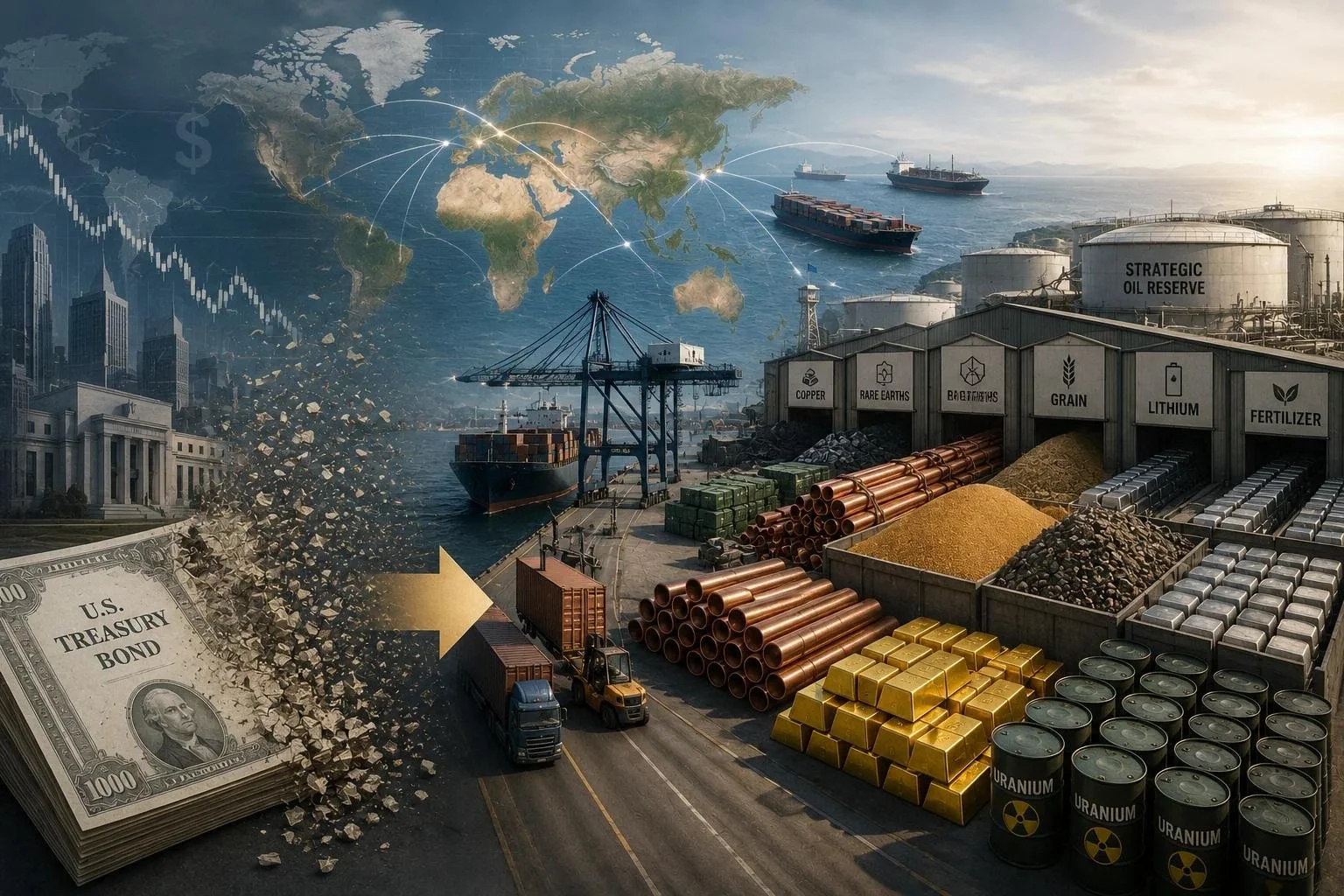
The next phase is foreign governments and central banks stockpiling other critical resources and materials— energy, fertilizer, copper, uranium, rare earths, food production, and even fresh water.
These are all strategic assets that no government can conjure out of thin air. And no amount of paper bonds can magically summon.
China has been running this playbook for fifteen years: they’ve purchased farmland in Africa, copper concessions in the Congo, rare-earth processing across central Asia, and the Belt and Road infrastructure that physically connects the resource to the buyer.
A large part of China’s investment capital has come from their steady liquidation of US Treasury holdings.
This is the Columbus-era calculus all over again. Whereas governments around the world used to stockpile US government bonds, they are now stockpiling strategic resources.
One obvious consequence is lower demand for US government bonds— which drives up interest rates, mortgage rates, and more. It probably also leads to a lot more inflation, i.e. the 1970s all over again.
But it also means that these critical resources— and the companies which produce them— should have a very, very bright future as foreign governments throw potentially trillions of dollars at the commodities sector.
This is the primary thesis behind Schiff Sovereign's monthly investment research service, Strategic Assets.
We look for profitable, well-managed real-asset businesses with pristine balance sheets that are trading at a low multiple of free cash flow— with clear catalysts for growth.
And those catalysts include our fragmenting world and the scramble to secure physical, critical assets.
To your freedom,
James Hickman Co-Founder, Schiff Sovereign LLC
$100,000 Income is Now "Lower-Middle Class"
$100,000 Income is Now "Lower-Middle Class"
Notes From the Field By James Hickman (Simon Black/Sovereign Man) May 12, 2026
Henry VIII probably thought he was being extremely clever when he started debasing his currency in 1544... and assumed that, if he reduced the silver content slowly and gradually enough, perhaps no one would notice.
But the King was hilariously wrong.
$100,000 Income is Now "Lower-Middle Class"
Notes From the Field By James Hickman (Simon Black/Sovereign Man) May 12, 2026
Henry VIII probably thought he was being extremely clever when he started debasing his currency in 1544... and assumed that, if he reduced the silver content slowly and gradually enough, perhaps no one would notice.
But the King was hilariously wrong.
Despite centuries of warfare, invasions, and plagues, English rulers prior to Henry had been remarkably disciplined in maintaining 92.5% silver in their coins.
In fact, England’s kings were so serious about their coinage that, at one point in the 1100s, one of Henry VIII’s forebears rounded up every private minter who skimped on the silver content in their coins— and had the man’s testicles removed.
But Henry VIII did not share his ancestors resolve. So, drowning in debt, divorce, and too much war, he started to reduce the silver content and replace it with copper.
His new coins still looked vaguely similar to the original ones because they were given a cheap, silver wash. But the wash wore off quickly— especially on the side where Henry’s profile was carved.
Londoners soon began to notice that the king’s nose would turn orange once the silver sheen wore off, giving rise to the nickname “Old Coppernose”.
And yet the debasement continued— and this was Henry’s ‘clever’ idea.
There wasn’t a single shock or dramatic crash. Henry’s ‘Great Debasement’ was a years-long operation of slowly robbing prosperity from his subjects. Each year their coins would buy less. Prices would rise. Their cost of living increased. And overall they were worse off.
This is the same story of our own time.
Gallup reported last week that 55% of Americans believe their personal finances are getting worse; that’s the absolute rock bottom reading in 25 years of the survey.
It is worse than 2008, when the financial system was actually breaking. It is worse than the pandemic, when the economy was shut off.
And that 55% statistic is in a year when headline employment numbers and stock indices are supposed to be telling everyone they're doing fine.
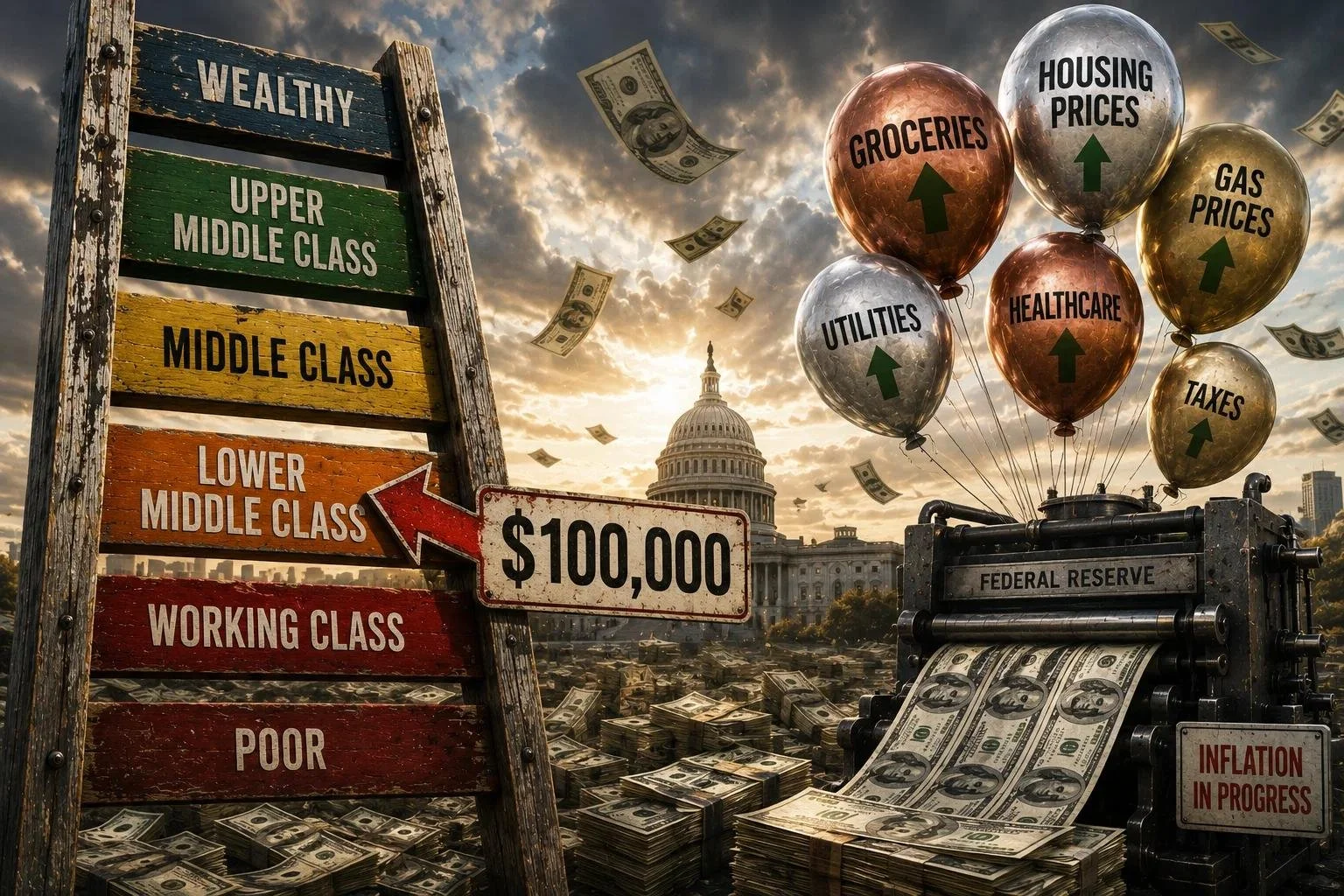
Perhaps even more alarming is a recent analysis by a group called MoneyLion, which looked at Census data and found that, in 12 states in the US, a $100,000 income is now considered LOWER middle class.
For those who remember what life was like 25 years ago, making six figures was solid “made it” territory.
Not anymore. In Massachusetts, the lower-middle ceiling has crept up to $116,476. In New Jersey, $115,882. In California, $111,277.
Of course, it isn't hard to see what those states have in common. They tax heavily, regulate aggressively, and treat business and wealth as plump dairy cows to milk.
This isn’t magically going away if the Strait of Hormuz opens, or Congress passes a ban on corporations buying homes to rent.
The federal government runs trillion-dollar deficits every year, the Treasury borrows the difference, and the Federal Reserve accommodates the whole arrangement by expanding the money supply by trillions.
Long term inflation doesn't slow down until Washington decides to be fiscally responsible— and there is little evidence that's about to happen.
If you bought a house in 2010, or even 2021, the same forces hollowing out the dollar have been inflating the value of your assets; your house cannot be printed by the Federal Reserve, so as the money supply increases, your house costs more in nominal dollars.
That's why the people who feel worst about this economy are young people.
A recent Generation Lab survey found that more than 8 in 10 Americans aged 18-29 — the cohort least likely to own a home or hold meaningful investments — now describe the economy as bad or terrible. Only 2 percent of them call it "excellent."
This is why real assets matter. The Fed can manufacture as many dollars as it wants, but it cannot manufacture the things that actually have value: precious metals, energy, critical resources like uranium or copper, a profitable business producing something the world cannot function without.
Because every single time governments are given the choice between inflation and discipline, they pick inflation.
And just like Henry VIII, they think no one is going to notice.
To your freedom, James Hickman Co-Founder, Schiff Sovereign LLC
PS — Schiff Sovereign's investment research newsletter, Strategic Assets, exists for exactly this reason: to identify real assets and real businesses that not only protect wealth from debasement, but actually give you tremendous upside as Americans prioritize essential spending over luxuries.
We’ve seen some major winner in precious metals, fertilizer, industrial metals, shipping— and there is reason to believe we are still early.
Mark Zuckerberg Makes a Strong Case for Real Assets
Mark Zuckerberg Makes a Strong Case for Real Assets
Notes From the Field By James Hickman (Simon Black / Sovereign Man) May 7, 2026
Mark Zuckerberg had his hands full last week trying to calm the storm at his company.
In an employee conference call, he had to quell a great deal of panic over the company's performance.
Growth at Facebook/Meta is slowing, the stock price is down, and the company is dealing with significant regulatory and economic headwinds. And workers are unsettled.
Mark Zuckerberg Makes a Strong Case for Real Assets
Notes From the Field By James Hickman (Simon Black / Sovereign Man) May 7, 2026
Mark Zuckerberg had his hands full last week trying to calm the storm at his company.
In an employee conference call, he had to quell a great deal of panic over the company's performance.
Growth at Facebook/Meta is slowing, the stock price is down, and the company is dealing with significant regulatory and economic headwinds. And workers are unsettled.
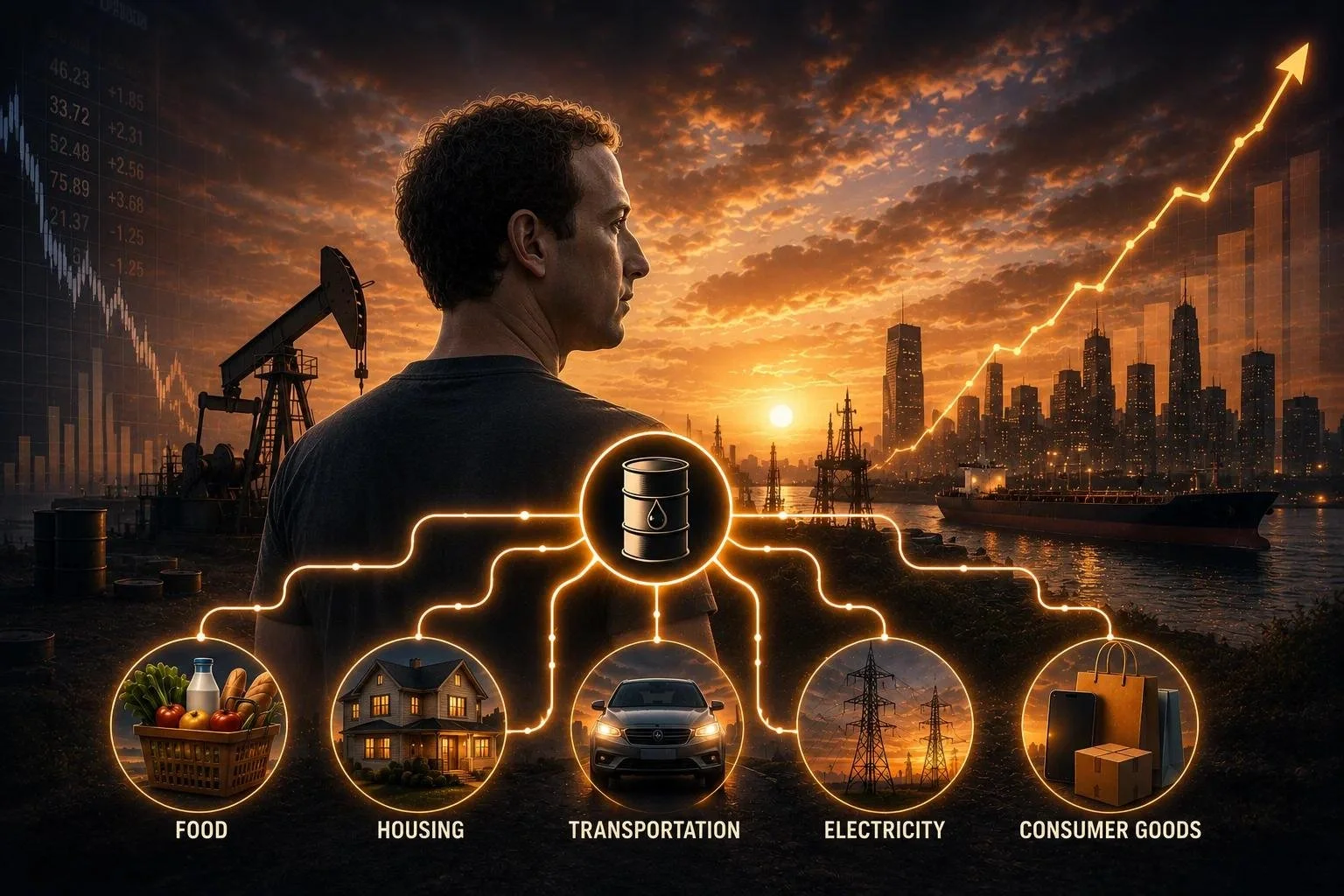
So Zuckerberg took the mic and tried to assuage those concerns by explaining to everybody why ad revenue growth is slowing.
He said plainly, "If oil prices go up, then consumers spend more of their money on oil, on gas, and less on things that they would just buy that are kind of discretionary things that the advertising might serve."
Without really meaning to, Mark Zuckerberg made a really strong case for real assets.
It ultimately starts with energy costs. Energy costs are higher. And everyone wants to blame Iran and the Strait of Hormuz, but this trend has been building for a long time.
For years, oil was the second most hated asset on the planet, only edged out by coal.
Think about it— liberal elites hold conferences where they fly to dictator states in their private jets, only to parade oil and gas CEOs on stage and publicly shame them.
Then you have the legions of inspired idiots who glitter-bomb art and glue themselves to pavement to stop traffic (ironically increasing emissions), all in the name of "just stop oil."
They deface buildings and commit crimes, but they've been so successful that many oil companies themselves have turned their back on oil.
National governments, especially the previous Biden administration, have gone out of their way to tax, fleece, subvert, frustrate, and publicly ridicule oil companies.
Furthermore, the industry itself has been starved of capital because investors jumped on the bandwagon. Financial institutions stopped making loans, in some cases even debanking oil companies as a ridiculous form of virtue signaling.
Pension funds stopped investing in oil companies. Hedge funds tried to take over oil companies solely to turn them into fantasy green projects.
The dearth of capital— in a capital intensive industry— made it very difficult for exploration companies to finance new discoveries.
Even in the labor market, young people around the world have been so brainwashed that no one wants to go into the oil and gas sector— even though it pays quite well— for fear of public humiliation and "being on the wrong side of history."
To be frank, it's actually kind of extraordinary that an industry deprived of capital and labor, suffering an endless onslaught of media hysteria and political assault, has managed to continue delivering, day after day, the energy that our civilization requires to function.
Blaming today's higher oil prices exclusively on Iran totally misses this history; the problems have been building for years.
Solving this energy challenge will take a long time— to finance new projects, find new discoveries, build the right kinds of infrastructure, and commercialize those discoveries in a way that keeps up with the rising energy demands of a growing world.
In the meantime, higher energy prices increase the production cost of just about everything else— food, housing, automobiles, consumer goods, even your monthly electricity bill. So, in the end, most things become more expensive.
This is ultimately what Mark Zuckerberg was saying— without fully saying it. For years there was an abundance of energy and global cooperation. Combined with low interest rates, the result was negligible price inflation and a feeling of widespread prosperity.
That feeling of prosperity meant consumers had plenty of disposable income for the sorts of things advertisers would sell on platforms like Facebook and Instagram.
As Zuckerberg explained, those same retail-focused companies are now selling to consumers and individuals who have less disposable income— precisely because they have to spend more money on essentials like energy and food.
We've been predicting this for the last several years, and we think this trend will continue for some time.
This is why a very sensible place to consider investing, even if just as a hedge against rising prices, is in the companies that produce these critical resources.
This is the core of our investment ethos, and to be frank, it has been very successful.
We've seen our mining stocks multiply by as much as ten times, with several others doubling, tripling, and quadrupling.
But it goes beyond mining; one agricultural company has doubled, and a fertilizer producer is up double digits in just a few months. We've been collecting dividends from industrial producers while their stocks tick higher.
Only a few companies we have researched are down, and we think they still have plenty of upside.
And we are still finding some really great real-asset businesses that are surprisingly, deeply undervalued. That includes energy companies.
There are a lot of reasons for high quality businesses being undervalued; but I think it's because people believe this is some sort of aberration— that tomorrow the spigots turn on and oil drops back to $40 a barrel.
The reality is all these challenges can be solved, but it's going to take a while. And in the meantime, we think these real-asset companies are going to be cash machines.
Keep an eye on your inbox tomorrow afternoon for the new issue of Strategic Assets about an interesting company that has the potential to capture this mismatch in expectations versus reality.
To your freedom, James Hickman Co-Founder, Schiff Sovereign LLC