
Thank you to all the subscribers to our Early Access program…we thank you for your continued support.
We are excited to offer this new service to keep you informed and up-to-date on the latest Dinar and currency news.
The Dollar's Gold Problem Just Got Bigger
The Dollar's Gold Problem Just Got Bigger
Taylor Kenny: 6-4-2026
The safest asset in the world may no longer be the asset central banks trust most.
In this video, Taylor breaks down the dollar’s growing gold problem — and why this may be one of the clearest warnings yet that the monetary system is changing.
The Dollar's Gold Problem Just Got Bigger
Taylor Kenny: 6-4-2026
The safest asset in the world may no longer be the asset central banks trust most.
In this video, Taylor breaks down the dollar’s growing gold problem — and why this may be one of the clearest warnings yet that the monetary system is changing.
CHAPTERS:
0:00 The “Safest Asset” Narrative Just Cracked
0:57 Gold Overtakes U.S. Treasuries
1:27 Why Treasuries Dominated for 80 Years
2:20 The Stealth Default Hiding in Plain Sight
3:15 Central Banks Started Buying Gold at Record Levels
4:12 Russia’s Frozen Reserves Changed Everything
6:07 Why Gold Has No Counterparty Risk
9:29 Gold, Silver, and the New Monetary System
Europe Just Bragged About Losing to Gold
Europe Just Bragged About Losing to Gold
Notes From the Field By James Hickman (Simon Black / Sovereign Man) June 4, 2026
When the euro launched on January 1, 1999, it was sold as the future. It would be a single currency to knit Europe together — to wipe out the exchange-rate friction between member states, complete the continent's single market, and bind a dozen squabbling nations into one economic bloc with one money.
And in the grander ambitions of its architects, it was meant to do something more: to grow up into a true global currency, the first serious rival the US dollar had faced since World War II.
Europe Just Bragged About Losing to Gold
Notes From the Field By James Hickman (Simon Black / Sovereign Man) June 4, 2026
When the euro launched on January 1, 1999, it was sold as the future. It would be a single currency to knit Europe together — to wipe out the exchange-rate friction between member states, complete the continent's single market, and bind a dozen squabbling nations into one economic bloc with one money.
And in the grander ambitions of its architects, it was meant to do something more: to grow up into a true global currency, the first serious rival the US dollar had faced since World War II.
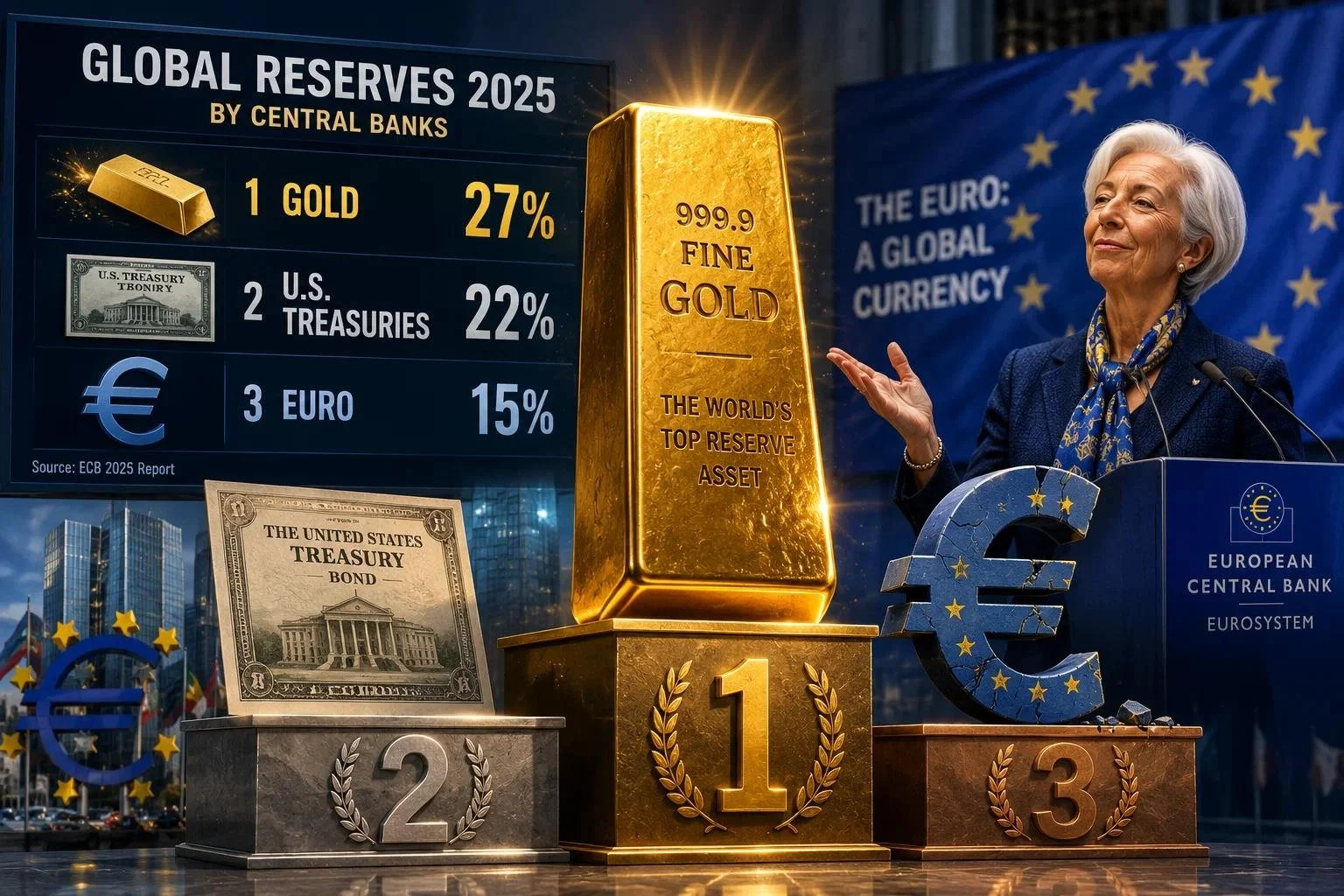
Last week, the European Central Bank published its 2025 report card, with ECB President Christine Lagarde celebrating “an opening for the euro to enhance its global appeal.”
The report bragged that the euro remains the second most used currency in the world, as well as the second most held in reserve, behind only the dollar.
The key word is “currency.”
Because in reality, 2025 was the year that gold took the top spot, making up 27% of global reserves held by governments and central banks. That pushed US Treasuries into second place with 22%, and the euro into third, making up 15% of global reserves.
A metal that pays no interest and earns no yield is now the biggest slice of global reserves, up from just 20% a year earlier.
The world is, in fact, trying to diversify away from the dollar. Central banks have spent years quietly trimming their dollar exposure, looking for somewhere safer to park their national savings.
But they are not choosing euros.
Then why, the ECB may counter, was 2025 a record year for international borrowing in euros?
Because there is more debt in everything than ever — global debt keeps smashing new highs, so a record pile of euro IOUs is less an achievement than a symptom of the times.
But to give credit where it's due, the euro is genuinely in first place in one market, according to Lagarde: "The euro became the leading currency in the green and sustainable international bond market."
That's the debt Europe sells to bankroll the very net-zero crusade that gutted its own economy. So the euro's crowning achievement of 2025 was becoming the world champion at borrowing money to make itself poorer.
If you ever needed one sentence to explain why nobody wants this currency, there it is.
Because leading the world in the things that make you poorer is the entire European model. Across the continent, governments spent two decades waging war on their own cheap energy in the name of net zero — turning their backs on nuclear power that supplied a third of Europe's electricity in 1990 and barely 15% today.
They saddled themselves with some of the highest power prices in the developed world and watched their industry pack up and leave. They threw open their borders, then aimed their police and courts at the citizens who objected.
The result is a continent so hollowed out that Mississippi, the poorest state in America, now produces more wealth per person than France or Italy.
But sure, this is the euro’s moment...
Meanwhile, central banks added roughly 850 tonnes of physical gold in 2025, a slight step down from the record-shattering pace of the prior two years, but bought at the highest prices in human history.
Poland led the gold-buying pack last year, followed by China, Turkey, and India.
But for a stretch of 2025, the single biggest gold buyer on the planet wasn't a country at all — it was Tether, the company behind the world's biggest dollar-backed stablecoin.
In the third quarter alone it bought more gold than any central bank on earth, and by the end of January it was sitting on roughly 148 tonnes — nearly 4.8 million ounces, worth about $22 billion — enough to rank among the top 30 gold holders in the world, ahead of the likes of Australia and South Korea.
This is exactly why the gold story is far from over.
The extra gold central banks have bought since 2022 laid the foundation for a price that has nearly tripled since — yet even that represents only a modest reallocation out of US dollars.
So what happens when they move even another 5% of their $10 trillion in reserves into gold?
With no single currency able to replace the dollar, and the reasons to diversify only growing, gold looks set to keep climbing as the world's largest reserve asset.
To your freedom, James Hickman Co-Founder, Schiff Sovereign LLC
P.S. Everyone from central banks to a stablecoin giant is racing into gold — which is why it's trading near record highs. We think owning the companies that produce it beats buying bullion at the top.
That's the whole idea behind Strategic Assets, Schiff Sovereign's monthly investment research. We hunt for profitable real-asset businesses with clean balance sheets, real catalysts, and a low multiple of free cash flow.
And it's working. We've seen it multiply the value of several precious metals companies, with others still in the buy range today. The same setup is now lining up well beyond the metals — in energy and other real assets — as nations around the world scramble to secure the critical resources a fragmenting world runs on.
Would $300 Silver Crush The Retail Industry? | Andy Schectman
Would $300 Silver Crush The Retail Industry? | Andy Schectman
Liberty and Finance: 6-3-2026
Andy Schectman explains that the recent silver selloff was driven by a combination of sharply higher margin requirements, ETF rebalancing, and forced selling tied to primary distributor allocations, creating a cascading liquidity event rather than a true breakdown in fundamentals.
He argues that this overlap of structural pressures led to more selling than buying in the short term, which overwhelmed bids and pushed prices lower.
Would $300 Silver Crush The Retail Industry? | Andy Schectman
Liberty and Finance: 6-3-2026
Andy Schectman explains that the recent silver selloff was driven by a combination of sharply higher margin requirements, ETF rebalancing, and forced selling tied to primary distributor allocations, creating a cascading liquidity event rather than a true breakdown in fundamentals.
He argues that this overlap of structural pressures led to more selling than buying in the short term, which overwhelmed bids and pushed prices lower.
In contrast, he notes that prior strong upside moves saw the opposite dynamic, with intense buying pressure causing premiums to surge and physical supply to tighten dramatically.
Looking forward, he says that a potential move toward $300 to $500 silver would likely bring far greater public participation and stronger hands into the market, reducing the kind of fragile selling pressure seen in earlier cycles.
In his view, that kind of environment would still strain the system but would be more fluid and balanced demand driven, rather than collapsing under forced unbalanced liquidation.
INTERVIEW TIMELINE:
0:00 Intro
2:20 Digitization of all assets
11:20 Unrealized capital gains tax
14:50 Precious metal industry
America’s Gold Problem Just Got Harder to Ignore
America’s Gold Problem Just Got Harder to Ignore
Taylor Kenny: 6-2-2026
The Fort Knox audit may be the spark—but not the real fire. America’s gold problem just got harder to ignore because the real issue may not be buried inside Fort Knox.
It may be hiding in plain sight on the U.S. Treasury balance sheet.
Why does the U.S. government still value its gold at $42.22 per ounce when the market price is thousands of dollars higher?
America’s Gold Problem Just Got Harder to Ignore
Taylor Kenny: 6-2-2026
The Fort Knox audit may be the spark—but not the real fire. America’s gold problem just got harder to ignore because the real issue may not be buried inside Fort Knox.
It may be hiding in plain sight on the U.S. Treasury balance sheet.
Why does the U.S. government still value its gold at $42.22 per ounce when the market price is thousands of dollars higher?
CHAPTERS:
00:00 Trump, Fort Knox, and the Gold Audit
00:57 The Real Question No One Is Asking
01:25 The $42.22 Gold Accounting Illusion
02:22 Why Gold Threatens the Dollar System
03:18 Central Banks Are Buying Gold for a Reason
04:44 The 1934 Gold Revaluation Warning
06:32 Nixon, Broken Promises, and Fiat Currency
07:27 Physical Gold vs. Paper Gold
08:53 Are We Near a Gold Revaluation?
News, Rumors and Opinions Tuesday 6-2-2026
KTFA:
Tishwash: Al-Zarkoushi: An extraordinary parliamentary session may be held within ten days to complete the cabinet formation.
6/1/2026 Information/Baghdad..
Member of the Coordination Framework, Abdul Samad Al-Zarkoushi, confirmed on Monday that setting a date for an extraordinary session of the House of Representatives to complete the remaining ministerial portfolios in Ali Al-Zidi's government may be decided within the next ten days.
KTFA:
Tishwash: Al-Zarkoushi: An extraordinary parliamentary session may be held within ten days to complete the cabinet formation.
6/1/2026 Information/Baghdad..
Member of the Coordination Framework, Abdul Samad Al-Zarkoushi, confirmed on Monday that setting a date for an extraordinary session of the House of Representatives to complete the remaining ministerial portfolios in Ali Al-Zidi's government may be decided within the next ten days.
Al-Zarkoushi told Al-Maalouma that “the forces of the Coordination Framework, with all their titles, realize the importance of completing the cabinet, and there is an agreement in this direction so that the government can take its course on important issues.”
He added that “a series of meetings will be held in the coming days, both within the coordination framework and with other political forces, which may lead to an extraordinary session of the House of Representatives within ten days to vote on the remaining ministerial portfolios.”
He indicated that “putting forward more than one candidate for each portfolio is possible, but the upcoming political understandings will determine the outcome,” explaining that “the question of whether or not the same names presented in the previous session will be resubmitted for the undecided portfolios will become clear in the next few days.” LINK
************
Clare: Between hopes and stability... the 2026 budget opens a new window for contractors in Iraq
6/1/2026 Baghdad
Economic experts believe that the anticipated measures in the 2026 budget to address the situation of contractors and daily wage workers represent an important step towards enhancing job stability, but they alone do not amount to a comprehensive reform of the labor market unless they are accompanied by long-term strategic plans.
Here, economist Ahmed Al-Tamimi confirms that the regularization of a segment of contractors and daily wage workers reflects a governmental response to continuous demands related to job security and achieving greater fairness in job opportunities, indicating that this step represents a gradual treatment of a file that has accumulated over years of reliance on temporary contracts, rather than a radical shift in the philosophy of government employment.
Al-Tamimi explained in a statement to Baghdad Today on Sunday (May 31, 2026) that the government's ability to implement large-scale stabilization operations remains directly linked to oil revenues, given the continued reliance of the general budget on oil revenues as its primary source of income. He warned that any decline or sharp fluctuations in global oil prices could place additional pressure on operational spending, particularly salaries and allowances, necessitating the diversification of income sources and the strengthening of non-oil revenues to ensure the sustainability of future financial obligations.
He pointed out that regularizing the status of contractors would positively impact the performance of government institutions by enhancing administrative stability and reducing job uncertainty, which would contribute to raising productivity levels and institutional belonging, as well as preserving accumulated expertise and competencies within state departments.
He added that these measures may also contribute to reducing the phenomenon of job attrition, especially among talents who move towards the private sector or job opportunities abroad in search of stability, stressing that the success of this policy requires, in parallel, the development of the work environment, incentive systems, promotions and training.
Al-Tamimi emphasized that transforming the regularization process from a temporary solution to a sustainable policy necessitates linking employment to the actual needs of government institutions and achieving a balance between social considerations and the requirements of financial efficiency. This will preserve the state's ability to finance investment and development projects without burdening the budget with operational expenses.
The issue of contract and daily wage workers is one of the most prominent social and administrative issues in Iraq, as tens of thousands of them have been demanding permanent employment for years to guarantee their job security and living standards.
With the 2026 budget nearing completion, expectations are rising regarding the size of the financial allocations and the government measures designated to address this issue, amidst economic challenges related to fluctuating oil prices and rising state operating expenses. LINK
************
Courtesy of Dinar Guru: https://www.dinarguru.com/
Frank26 Everybody wants this to happen now. Are you kidding me? In less than 2 months look what Trump has done. He's brought security and stability into your country [Iraq] so that you can raise the value of your currency and give your citizens purchasing power and enter the international world and pay us back. And guess what? It's happening...!
Jeff Tackling corruption is the number one thing they need to go international, revalue and so forth. It's the number one requirement by the Central Bank of Iraq. It's also the number one reason why the CBI hasn't revalued for the past 23 years.
Reset Intelligence There is one market price for gold...set by the market not by any governments wishes. The one place that price is not honored is on America's own books, where the Treasury still records the nation's gold at a number fixed back in 1970s, a small fraction of what the metal actually fetches today. That gap between the pretend price on the ledger and the real price in the market was left there on purpose. The president reached for it, asking that the gold in the vaults finally be counted. Because before a government can put a new price on something it first has to prove how much of it there is. When that number is corrected... more than a trillion dollars appears on the national balance sheet overnight ...This is what a revaluation is. [Post 1 of 2...stay tuned]
Reset Intelligence The same logic runs through Baghdad...except there, the problem was never an honest price hidden on a ledger, but a currency deliberately held below its worth, kept down for years by a political class Washington did not trust to lift it. This week the president tried again to place his own envoy over Iraq. The cabinet that will finally raise the dinar began to take shape which is why the gold and the dinar belong together. One government correcting the price of its metal while the other corrects the price of its money. A single hand guiding both inside one week. [Post 2 of 2]
************
SILVER ALERT! Silver Traders Leaving COMEX Exchange! Silver Supply & Demand Data Lies!
(Bix Weir) 6-2-2026
We are seeing the Death of a means of Transacting in and Controlling the Price of Silver. More and more traders are leaving the COMEX Silver Exchange knowing that the GAME IS RIGGED!
The Bullion Banks have overplayed their Silver Rigging Cards and are now STUCK without the normal flock of Suckers to unload short positions to!
This is the Death of a Century Long Silver Rig Job!
Bendleruschka: Preparing for the QFS, US Gold Reserve Audit and Revaluation
Bendleruschka: Preparing for the QFS, US Gold Reserve Audit and Revaluation
5-31-2026
PREPARING FOR THE QFS «FLIP OF THE SWITCH»: US GOLD RESERVE AUDIT & REVALUATION
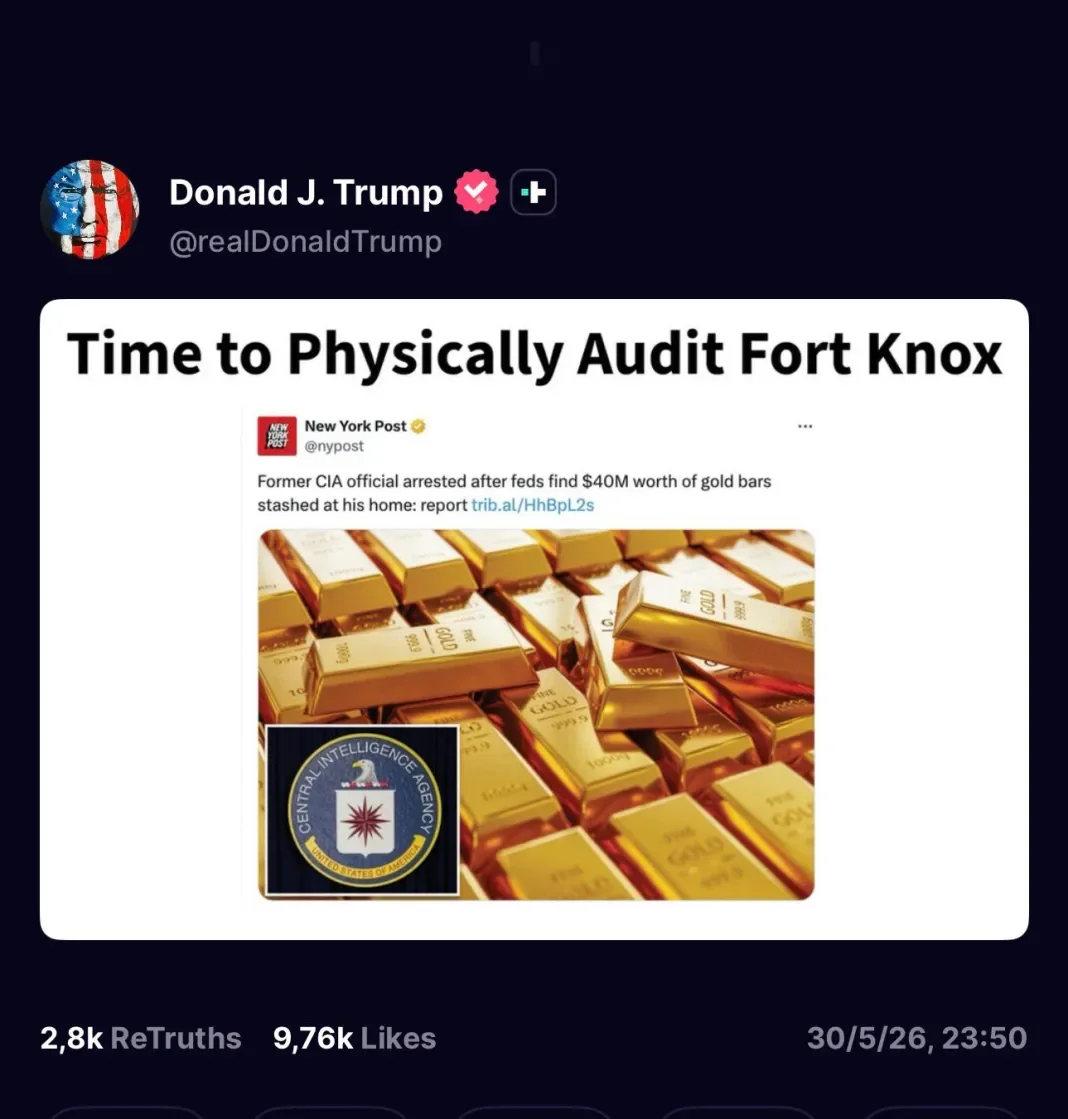
DJT on Truth May 30: «Time to Physically Audit Fort Knox»
Are we finally getting to know the status at Fort Knox?
The gold must be revalued before the new financial system based on the «gold standard» enters into force («flipping the switch»)
Bendleruschka: Preparing for the QFS, US Gold Reserve Audit and Revaluation
5-31-2026
PREPARING FOR THE QFS «FLIP OF THE SWITCH»: US GOLD RESERVE AUDIT & REVALUATION
DJT on Truth May 30: «Time to Physically Audit Fort Knox»
Are we finally getting to know the status at Fort Knox?
The gold must be revalued before the new financial system based on the «gold standard» enters into force («flipping the switch»)
This is also necessary for the global RV (currency revaluation) and for the real XRP price («XRP to the moon»)
The US Treasury values its gold reserves at a statutory rate of $42.22 per troy ounce, established in 1973, rather than the current market price.
As of today May 31, 2026, the gold spot price is approximately $4,530 – 4,570 USD per troy ounce.
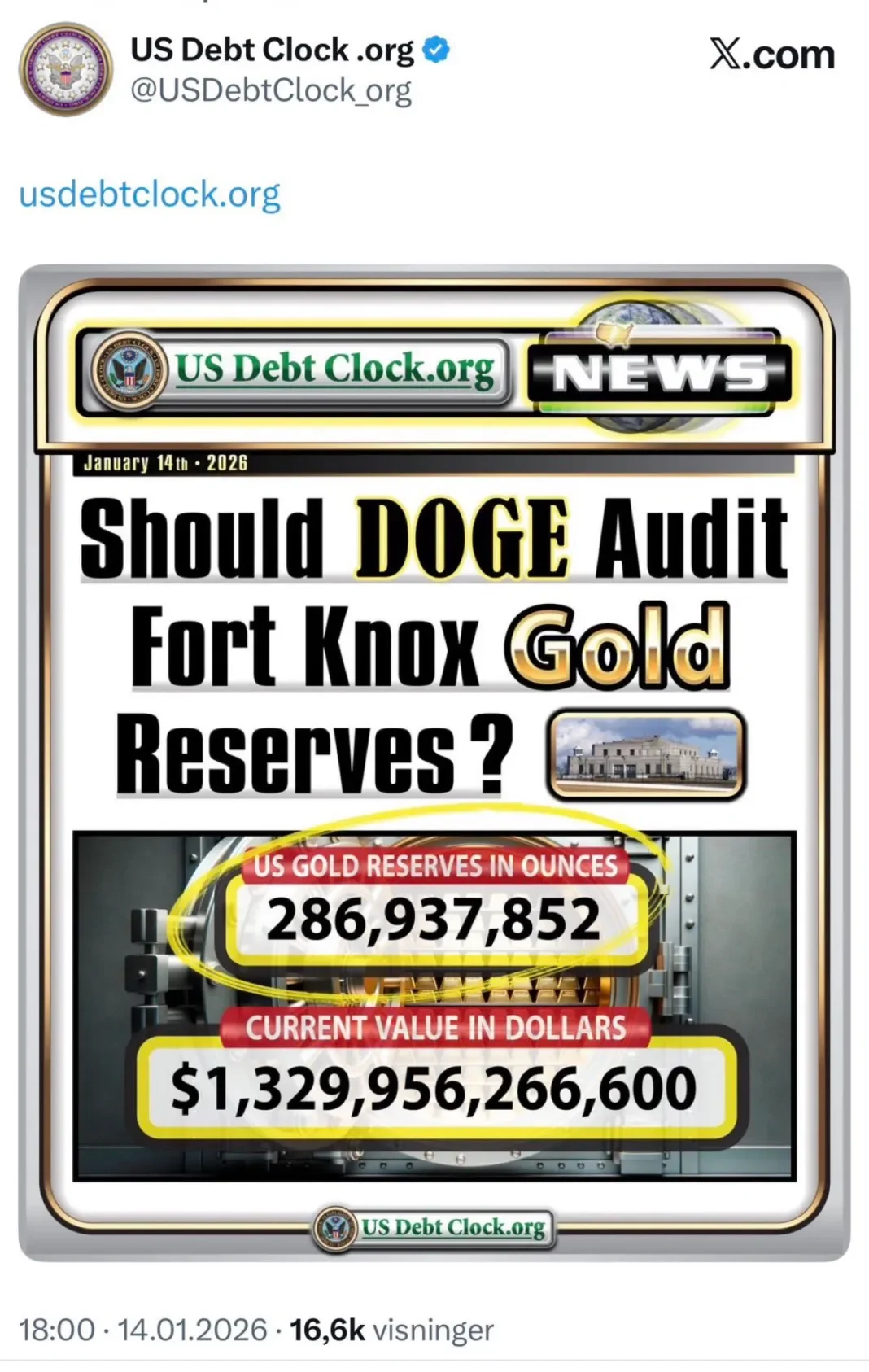
The US is said to hold about 261.5 million troy ounces of gold (equivalent to 8,133 tonnes), so at market value, the reserves are worth roughly $1.18 – 1.20 trillion, while the statutory value is around $11 billion.
US Debt Clock.org: On X
Gold vs Silver: Knowing The Difference Could Matter in a Crisis
Gold vs Silver: Knowing The Difference Could Matter in a Crisis
Lynette Zang: 5-31-2026
Gold and silver may both be precious metals, but they serve very different purposes during a crisis.
In this video, Lynette Zang breaks down how gold and silver respond to financial stress, inflation, and currency devaluation—and why understanding the difference could help protect your wealth.
Gold vs Silver: Knowing The Difference Could Matter in a Crisis
Lynette Zang: 5-31-2026
Gold and silver may both be precious metals, but they serve very different purposes during a crisis.
In this video, Lynette Zang breaks down how gold and silver respond to financial stress, inflation, and currency devaluation—and why understanding the difference could help protect your wealth.
Chapters:
00:00 Introduction
00:30 Gold vs. Silver: Warning Signal vs. Protection
00:56 Why Fiat Money Loses Purchasing Power
01:29 The Hyperinflation Pattern Repeats
02:09 Deflation, Inflation, and Economic Cycles
02:43 Gold’s Long-Term Role vs. Silver’s Volatility
03:46 Silver Signals Change, Gold Preserves Wealth
04:18 Lessons from Weimar: Gold vs. Silver in Crisis
06:05 Why Gold Remains the Global Anchor
07:20 Inflation as a Global Warning Sign
08:31 The Different Roles of Gold and Silver
09:43 Building a Sound Money Strategy Before It’s Too Late
10:50 Community, Redeemable Gold, and Taking Back Financial Power
11:54 The 3% Solution and Final Call to Action
Basel III Endgame: Why Banks Are Quietly Moving Into Gold
Basel III Endgame: Why Banks Are Quietly Moving Into Gold
Lynette Zang: 5-29-2026
Basel III quietly changed the rules for physical gold, and major banks may already be repositioning behind the scenes.
In this video, Kenneth Mraz breaks down why banks can now swap cash for gold without alarming regulators or the public, what this could mean for fiat currency, and why the financial system may be far more fragile than most people realize.
Basel III Endgame: Why Banks Are Quietly Moving Into Gold
Lynette Zang: 5-29-2026
Basel III quietly changed the rules for physical gold, and major banks may already be repositioning behind the scenes.
In this video, Kenneth Mraz breaks down why banks can now swap cash for gold without alarming regulators or the public, what this could mean for fiat currency, and why the financial system may be far more fragile than most people realize.
Chapters:
0:00 Basel III End Game Explained
0:16 Why Big Banks Are Quietly Preparing
0:44 The “Quiet” Basel III Shift in 2025
1:08 Physical Gold Becomes a Tier One Asset
1:37 Why Banks Can Secretly Swap Cash for Gold
2:15 Are Banks Executing a Stealth Exit From Fiat?
2:45 “Melting Ice”: Why Cash May No Longer Be Safe
3:15 Banks Building Lifeboats While the Public Watches the Ship
3:47 The Derivatives Exposure Threat Nobody Talks About
4:22 Why Bullion Could Protect Banks During a Reset
4:50 How Deposits Could Become Collateral Damage
5:23 Building a Financial Fortress Before the Storm
Dollar Demand CRUSHED As Gold Secretly Disappears From LBMA | Andy Schectman
Dollar Demand CRUSHED As Gold Secretly Disappears From LBMA | Andy Schectman
5-27-2026
Kaiser Johnson speaks with Miles Franklin CEO Andy Schectman about the growing mystery surrounding unreported gold movements out of the LBMA system and where that physical metal is ultimately going.
Schectman argues that official narratives do not fully account for discrepancies between reported inventories and trade flows, suggesting significant volumes of gold are being redirected into non Western vaulting and exchange systems.
Dollar Demand CRUSHED As Gold Secretly Disappears From LBMA | Andy Schectman
5-27-2026
Kaiser Johnson speaks with Miles Franklin CEO Andy Schectman about the growing mystery surrounding unreported gold movements out of the LBMA system and where that physical metal is ultimately going.
Schectman argues that official narratives do not fully account for discrepancies between reported inventories and trade flows, suggesting significant volumes of gold are being redirected into non Western vaulting and exchange systems.
He points to expanding gold hubs in regions such as the Middle East and Asia, where new exchanges and settlement mechanisms are increasingly built around physical delivery rather than paper claims.
The discussion also examines how central bank accumulation and sovereign demand are reshaping global liquidity in gold markets, reducing visible Western inventory availability.
Schectman concludes that these shifts may reflect a broader structural transition in global monetary architecture, with physical gold moving into strategic reserves outside traditional Western oversight.
INTERVIEW TIMELINE:
0:00 Intro
2:30 Gold update
17:00 Dollar dominance
32:00 Ignoring the noise
Why Silver Will Explode – Mike Maloney Warns of Oil Crisis & Market Crash
Why Silver Will Explode – Mike Maloney Warns of Oil Crisis & Market Crash
5-15-2026
In this powerful new presentation, Mike Maloney joins Robert Helms of The Real Estate Guys live from Puerto Rico to break down the perfect storm hitting the global economy right now.
The escalating conflict in Iran has devastated critical oil and natural gas infrastructure in the Strait of Hormuz — where roughly one-third of the world’s oil and fertilizer supply flows. Traffic has collapsed for over a month, driving oil prices sharply higher, fertilizer prices nearly doubling, and threatening food shortages and crop failures worldwide.
Why Silver Will Explode – Mike Maloney Warns of Oil Crisis & Market Crash
5-15-2026
In this powerful new presentation, Mike Maloney joins Robert Helms of The Real Estate Guys live from Puerto Rico to break down the perfect storm hitting the global economy right now.
The escalating conflict in Iran has devastated critical oil and natural gas infrastructure in the Strait of Hormuz — where roughly one-third of the world’s oil and fertilizer supply flows. Traffic has collapsed for over a month, driving oil prices sharply higher, fertilizer prices nearly doubling, and threatening food shortages and crop failures worldwide.
Mike reveals eye-opening charts showing:
• The Buffett Indicator at a record 232% — far beyond the 1929, 2000, and 2007 peaks
• Sky-high PE ratios and hours-of-work needed to buy stocks
• Energy price spikes that have preceded every major recession
• Banks upside-down on bonds and commercial real estate delinquencies worse than 2008
He explains why fiat currency can’t store value, why real assets are essential, and why gold and silver have been the top-performing assets of the 21st century.
Mike also shares his personal move to build 900-acre Freedom Farms in Puerto Rico as a model for true resilience and self-sufficiency.
Whether you’re a real estate investor, precious metals owner, or simply want to protect your family, this is a must-watch roadmap for what’s coming.
What Do Central Banks Know That You Don’t?
What Do Central Banks Know That You Don’t?
GoldSilver: 5-14-2026
Central banks just bought another 244 tons of gold in Q1 2026 — even with gold sitting at all-time highs.
In this video, GoldSilver breaks down the latest World Gold Council data, including who is buying, who is selling, why unreported buying still matters, and what this says about the growing loss of confidence in fiat currencies.
If central banks keep accumulating gold regardless of price, investors should be paying attention.
What Do Central Banks Know That You Don’t?
GoldSilver: 5-14-2026
Central banks just bought another 244 tons of gold in Q1 2026 — even with gold sitting at all-time highs.
In this video, GoldSilver breaks down the latest World Gold Council data, including who is buying, who is selling, why unreported buying still matters, and what this says about the growing loss of confidence in fiat currencies.
If central banks keep accumulating gold regardless of price, investors should be paying attention.
You’ll learn:
What the latest 244-ton Q1 2026 central bank gold buying figure really means
Why net central bank buying remains strong even at record gold prices
Who the biggest buyers and sellers were this quarter
Why central bank demand has been a major tailwind for gold for years
What central bank gold buying signals about faith in fiat currencies
Why bars and coins continue gaining ground as more people move to protect themselves
Central banks are not buying gold for decoration. They are buying it because they see risks building in the financial system — and that has major implications for anyone still holding large amounts of fiat.
Trump Reopens Fort Knox as GOLD Revaluation Questions Mount
Trump Reopens Fort Knox as GOLD Revaluation Questions Mount
Taylor Kenny: 5-12-2026
The gold revaluation question is back in the headlines after President Trump again raised the idea of going to Fort Knox to see whether America’s gold is still there.
Trump said he wanted to “see if the gold is there” and questioned whether it had been left untouched, reviving a debate that has haunted U.S. monetary policy for decades.
Trump Reopens Fort Knox as GOLD Revaluation Questions Mount
Taylor Kenny: 5-12-2026
The gold revaluation question is back in the headlines after President Trump again raised the idea of going to Fort Knox to see whether America’s gold is still there.
Trump said he wanted to “see if the gold is there” and questioned whether it had been left untouched, reviving a debate that has haunted U.S. monetary policy for decades.
CHAPTERS:
00:00 Is the U.S. Preparing for a Gold Revaluation?
00:53 Why the Fort Knox Audit Still Matters
02:14 U.S. Debt Crisis and the Gold Revaluation Question
02:42 Why U.S. Gold Is Still Valued at $42.22
04:08 How Gold Revaluation Impacts Everyday Americans
04:37 What Happened During Past Gold Revaluations
06:00 Why an Audit May Come Before Revaluation
06:56 Why You Won’t Get Advance Warning
Back to the Founders: Dr. Shelton on the Constitution, Gold, and the Future of the US Dollar
Back to the Founders: Dr. Shelton on the Constitution, Gold, and the Future of the US Dollar
In Gold We Trust: 5-10-2026
Gold near record highs. A weakening US dollar. An Iran crisis reshaping the global monetary conversation.
Against that backdrop, Dr. Judy Shelton shares her reflections on what a return to sound money could look like, and lays out a concrete path: a 50-year gold-backed bond, a US gold revaluation, and a quiet return to a gold-anchored system without a formal Bretton Woods II.
Back to the Founders: Dr. Shelton on the Constitution, Gold, and the Future of the US Dollar
In Gold We Trust: 5-10-2026
Gold near record highs. A weakening US dollar. An Iran crisis reshaping the global monetary conversation.
Against that backdrop, Dr. Judy Shelton shares her reflections on what a return to sound money could look like, and lays out a concrete path: a 50-year gold-backed bond, a US gold revaluation, and a quiet return to a gold-anchored system without a formal Bretton Woods II.
Watch this fascinating conversation between Dr. Shelton and Ronnie Stöferle, Managing Partner at Incrementum AG and co-author of the In Gold We Trust report, recorded on March 19, 2026.
Undoubtedly, as Dr. Shelton makes clear throughout the conversation, gold is not merely a commodity but a constitutional ideal, embedded in the original American vision of a dependable unit of account.
Drawing on Jefferson, Madison, Hamilton, and her own meetings with Secretary Bessent, she lays out a path toward what she calls a classical gold standard, take two.