
Thank you to all the subscribers to our Early Access program…we thank you for your continued support.
We are excited to offer this new service to keep you informed and up-to-date on the latest Dinar and currency news.
Ariel: We Must have a Level Playing Field Right?
Ariel: We Must have a Level Playing Field Right?
6-5-2026
Are You Listening?
Are You Paying Attention?
Are You Moving Yourself Into Position?
Ariel: We Must have a Level Playing Field Right?
6-5-2026
Are You Listening?
Are You Paying Attention?
Are You Moving Yourself Into Position?
What has Donald Trump repeatedly said since winning office in 2016?
We Must Have A Level Playing Field Right?
Meaning currencies from around the world must be of equal value.
Now does the statement from @MazinAlEshaiker a week or so ago about pegging the IQD to USD at 1:1 make more sense to you now?
Senator Cynthia Lummis: (on X) The Clarity Act doesn't pick winners. It creates a level field where the best ideas win. That's how America is supposed to work.
I swear you all wake up 1st thing in the morning looking for something to disappoint you.
Iraqi OFFICIALS have said on multiple occasions that the 3 Zero Project is for their country internally. The revaluation is for the external international markets.
That is why the 1:1 is financially considered a revaluation. Let Iraq help their people 1st by a in-country redenomination. Then they will help the world by revaluation.
They can not do this without balancing their books 1st.
Source(s):
• https://x.com/Prolotario1/status/2062597686235115821
https://dinarchronicles.com/2026/06/05/prolotario-we-must-have-a-level-playing-field-right/
Seeds of Wisdom RV and Economics Updates Friday Afternoon 6-5-26
Good Afternoon Dinar Recaps,
Hezbollah Rejects Ceasefire as Middle East Peace Efforts Face New Setback
The collapse of a U.S.-brokered Lebanon ceasefire highlights the growing link between regional conflicts, Iran negotiations, and global economic stability.
Good Afternoon Dinar Recaps,
Hezbollah Rejects Ceasefire as Middle East Peace Efforts Face New Setback
The collapse of a U.S.-brokered Lebanon ceasefire highlights the growing link between regional conflicts, Iran negotiations, and global economic stability.
Overview
Efforts to reduce tensions in the Middle East suffered a setback after Hezbollah rejected a U.S.-brokered ceasefire agreement negotiated between Israel and the Lebanese government. The development raises new questions about whether broader diplomatic efforts involving Iran can succeed and underscores how interconnected the conflicts in Lebanon, Gaza, and Iran have become.
The rejection comes as Washington seeks to transform recent military de-escalation into a wider diplomatic framework with Tehran. However, Hezbollah's refusal to support the agreement demonstrates the challenges of achieving regional stability without the participation of key non-state actors.
Key Developments
1. Hezbollah Rejects U.S.-Brokered Ceasefire
The ceasefire proposal was negotiated between Israel and the Lebanese government, but Hezbollah was not directly involved in the talks. As the dominant military force in southern Lebanon, Hezbollah's rejection significantly reduces the likelihood that any ceasefire can be successfully implemented.
The decision highlights the limits of diplomatic agreements that do not include all major stakeholders on the ground.
2. Iran Peace Prospects Face New Obstacles
The development complicates ongoing efforts to improve relations between Washington and Tehran. Iranian officials have repeatedly linked progress on sanctions relief and nuclear negotiations to the treatment of Iran's regional allies, including Hezbollah.
As a result, continued fighting in Lebanon could directly impact broader U.S.-Iran diplomatic discussions.
3. Regional Conflicts Continue to Merge
What once appeared to be separate conflicts are increasingly becoming part of a larger regional crisis. Events in Lebanon now influence negotiations involving Iran, Israel, Gaza, and Gulf security.
This growing interconnectedness makes diplomatic solutions more difficult and increases the risk of wider escalation.
4. Energy Markets Remain Sensitive to Instability
Although global markets have recently shown optimism regarding potential de-escalation, the latest setback raises concerns about future volatility. Investors remain focused on risks surrounding the Strait of Hormuz, regional shipping routes, and energy infrastructure.
Any expansion of hostilities could quickly affect oil prices and global supply chains.
5. Long-Term Stability Remains Elusive
Analysts increasingly believe that temporary ceasefires alone may not be enough to achieve lasting peace. Without addressing the broader strategic competition between Iran, Israel, and the United States, future agreements may remain vulnerable to collapse.
The situation highlights the complexity of achieving sustainable stability across the region.
Why It Matters
The rejection of the ceasefire demonstrates that military realities on the ground continue to shape diplomatic outcomes. As regional actors pursue competing strategic objectives, efforts to reduce tensions face significant obstacles.
The outcome will influence not only regional security but also global energy markets, trade routes, and investor confidence.
Why It Matters to Foreign Currency Holders
• Geopolitical instability can increase volatility across global financial markets.
• Energy disruptions often influence inflation and currency valuations.
• Safe-haven assets may attract increased demand during periods of uncertainty.
• Prolonged instability can affect trade flows and economic growth worldwide.
Implications for the Global Reset
Pillar 1: Geopolitical Stability and Financial Markets
The Middle East remains one of the world's most strategically important regions for energy production and trade. Continued instability can directly affect inflation, investment flows, and economic growth.
Pillar 2: Regional Conflicts Shape Global Economic Conditions
As geopolitical conflicts become increasingly interconnected, their economic consequences extend far beyond national borders. Energy security, supply chains, and international finance are all impacted by developments in the region.
Closing Insight
Hezbollah's rejection of the ceasefire serves as a reminder that lasting peace requires more than diplomatic agreements between governments. The broader struggle involving Iran, Israel, and regional allies continues to influence both security and economic conditions throughout the world.
This is not simply a ceasefire dispute—it is another example of how regional power struggles can shape global financial stability, energy markets, and the future direction of international diplomacy.
Seeds of Wisdom Team
Newshounds News™ Exclusive
Sources
Modern Diplomacy — "Hezbollah Rejects Lebanon Ceasefire, Casting Doubt on Iran Peace Prospects"
Reuters — "Middle East Diplomacy Faces Challenges as Regional Tensions Persist"
~~~~~~~~~~
Seeds of Wisdom Team RV Currency Facts Youtube and Rumble
Newshound's News Telegram Room Link
RV Facts with Proof Links Link
RV Updates Proof links - Facts Link
Follow the Gold/Silver Rate COMEX
Follow Fast Facts
Seeds of Wisdom Team™ Website
Thank you Dinar Recaps
The Fed Just Made it’s Biggest Move Since 2008
The Fed Just Made it’s Biggest Move Since 2008
Mark Moss: 6-5-2026
The financial world is abuzz with the talk of a significant transformation brewing at the heart of U.S. monetary policy.
A recent video outlines a compelling narrative regarding the new Federal Reserve Chair, Kevin Warsh, and the most substantial monetary regime change witnessed since 2008.
This isn’t just a tweak; it’s presented as a foundational overhaul, moving away from decades-old practices and setting a new course for the economy.
The Fed Just Made it’s Biggest Move Since 2008
Mark Moss: 6-5-2026
The financial world is abuzz with the talk of a significant transformation brewing at the heart of U.S. monetary policy.
A recent video outlines a compelling narrative regarding the new Federal Reserve Chair, Kevin Warsh, and the most substantial monetary regime change witnessed since 2008.
This isn’t just a tweak; it’s presented as a foundational overhaul, moving away from decades-old practices and setting a new course for the economy.
Unlike his predecessors, who largely operated within established frameworks, Kevin Warsh is described as an architect of structural reform. His appointment is particularly noteworthy, having been handpicked by Treasury Secretary Scott Bessent.
Both Warsh and Bessent share a common background as former partners of the renowned investor Stanley Druckenmiller, bringing a potent blend of deep macroeconomic understanding and real-world investing acumen to the highest levels of economic stewardship.
Their mission? To dismantle a legacy framework that, since 1971, has arguably linked government deficits to persistent inflationary pressures and cheap debt. Warsh’s strategy is multi-faceted, focusing on three key structural reforms designed to reshape how the Federal Reserve operates.
The proposed changes are profound and aim to fundamentally rewrite the monetary playbook:
Rethinking Inflation Measurement: At the core of this shift is a change in how inflation is measured. The legacy framework relied on the core Personal Consumption Expenditures (PCE) inflation gauge. The new regime, however, proposes adopting a “trimmed mean PCE” metric. This alternative largely excludes volatile, one-off price shocks, which has a significant implication: inflation figures could appear closer to the Fed’s target without requiring drastic price declines. This strategic adjustment could enable the Fed to potentially adjust interest rates while maintaining the narrative of controlled inflation.
Eliminating Forward Guidance: The era of explicit forward guidance, often characterized by the Fed’s “dot plot,” appears to be drawing to a close. Warsh’s approach seeks to dismantle this system, moving towards a monetary policy focused more on direct rate-setting rather than liquidity interventions. This doctrinal break represents a significant departure from the practices of the last four Fed chairs, who largely operated within a similar inflation-targeting paradigm tied to a fiscal-monetary symbiosis. The goal is a more autonomous and market-driven approach to monetary policy.
Shrinking the Balance Sheet: To reduce reliance on quantitative easing (QE), a hallmark of post-2008 monetary policy, the new regime aims to shrink the Fed’s balance sheet. This move signals a desire to return to more conventional tools for managing economic stability, lessening the dependence on large-scale asset purchases that have characterized recent decades.
These monetary reforms are not isolated; they are presented as integral to a broader national economic strategy.
The video highlights a focus on financing critical initiatives such as re-industrialization, the development of critical mineral mining and refining capabilities, advancements in energy infrastructure, and leadership in the burgeoning AI technology race.
This strategic alignment echoes historic debt management strategies, particularly the post-World War II period where robust economic growth helped erode the burden of national debt rather than relying solely on outright repayment.
The outlook suggests a dynamic where inflation is expected to run “hot but controlled,” asset prices could outpace inflation, and real interest rates might remain low, all designed to fuel this ambitious growth agenda.
Within this evolving landscape, certain assets are highlighted as playing unique roles. Bitcoin and gold are positioned as key “liquidity sponges” or productive stores of value.
The idea is that these assets could absorb monetary expansion without experiencing significant devaluation, offering a stable haven amidst economic shifts. Intriguingly, the video suggests an institutional endorsement of Bitcoin, recognizing its potential as “digital gold” for younger generations within this new monetary framework.
Ultimately, the video conveys a powerful message: the monetary “train” of deficit spending and easy money is unlikely to be halted.
For individuals and investors, the imperative becomes deciding whether to position themselves to potentially benefit from this new regime or risk being left behind as the anticipated economic boom unfolds.
For a deeper dive into these insights and further information, be sure to watch the full video from Mark Moss.
https://www.youtube.com/watch?v=HVDZx8lmvB0
https://dinarchronicles.com/2026/06/05/mark-moss-the-fed-just-made-its-biggest-move-since-2008/
News, Rumors and Opinions Friday 6-5-2026
Note: All intel should be considered as "Rumors" until we receive official announcements ...and “Rates and Dates” could change anytime until we get to the banks/redemption centers.
RV Excerpts from the Restored Republic via a GCR Update as of Fri. 5 June 2026
Compiled Fri. 5 June 2026 12:01 am EST by Judy Byington
Thurs. 4 June 2026 Bank Shutdowns mask the Final Transfer …Tier4b ISO20022 on Telegram
High Security operations were moving at full speed. Unmarked convoys were (allegedly) leaving federal complexes at night carrying sealed containers and classified files to underground military facilities.
Note: All intel should be considered as "Rumors" until we receive official announcements ...and “Rates and Dates” could change anytime until we get to the banks/redemption centers.
RV Excerpts from the Restored Republic via a GCR Update as of Fri. 5 June 2026
Compiled Fri. 5 June 2026 12:01 am EST by Judy Byington
Thurs. 4 June 2026 Bank Shutdowns mask the Final Transfer …Tier4b ISO20022 on Telegram
High Security operations were moving at full speed. Unmarked convoys were (allegedly) leaving federal complexes at night carrying sealed containers and classified files to underground military facilities.
Treasury Insiders report massive data migrations from legacy bank servers into QFS nodes. Accounts being reconciled and hidden assets tagged for public release under Nesara/ Gesara.
IRS Central databases offline. Teams inside buildings (allegedly) cataloguing evidence of tax fraud, black budgets and secret slush funds. Every dollar will be tracked and exposed.
QFS test payments already(allegedly) hitting foreign partner banks under “shutdown” cover.
The shutdown has begun, but was only the curtain. Behind it, the old system is being gutted and the new one is already humming. What the world will see next will break the illusion forever.
~~~~~~~~~~~~
Global Currency Reset:
Nesara Gesara Definition and History: NESARA/GESARA | United States of America
Thurs. 4 June 2026: Gold Dethrones The King: ECB Confirms Barbarous Relic Has Overtaken Treasuries As Top Global Reserve Asset | ZeroHedge
~~~~~~~~~~~
Thurs. 4 June 2026 Bruce, The Big Call The Big Call Universe (ibize.com) 667-770-1866, pin123456#, 667-770-1865:
• On Fri. 5 June 2026 The Clarity Act for XRP Crypto-currencies tied to the Quantum Financial System could be announced as passed.
• President Trump’s face will be on a new $250 US Note.
• All currency to be revalued will (allegedly) show up on the forex Sun evening 7 June 2026. That will be considered the Global Currency Reset.
• A source said that “everything pops on Mon. 8 June 2026.”That could refer to Tier4b (us, the Internet Group) notification to set appointments and disbursement of tariff dividends ($2,000 to $4,000).
Read full post here: https://dinarchronicles.com/2026/06/05/restored-republic-via-a-gcr-update-as-of-june-5-2026/
************
Courtesy of Dinar Guru: https://www.dinarguru.com/
Frank26 There is less and less resistance to the new exchange rate of Iraq's currency and the report is being brought to Washington D.C. The size of this meeting is impressive.
Walkingstick [Iraqi banker friend Aki update] All of Iraqi banking...AMF, IMF, EMF, US Treasury, WB, BIS, WTO, this is a big pow-wow at Trump's house. Aki's boss definitely knows they're going to meet with Trump, Bessant, Rubio and Vance. He was excited when he called. He said, 'I'm headed to D.C. I have to be there at this meeting because all of Iraq is giving their reports to D.C.' Aki himself is a big deal in the monetary reform. That's why he has to be in DC. But his boss is a much bigger deal. We are grateful to have his friendship. His boss owns dozens of private banks and Aki is his partner...There is something big going on for sure.
Reset Intelligence The bribe was never the story. What al-Zaidi did with it was. He turned down $200m to look the other way, put the bribe on live television, arrested the man who carried it, and built a council that refers the file straight to a judge. Who clears the ground like that, unless you are setting a precedence for the future.
*************
Gold Surpasses U.S. Treasuries as Central Banks Abandon Dollar Assets
Lena Petrova: 6-5-2026
Gold has officially surpassed U.S. Treasuries as the world's top central bank reserve asset.
According to new ECB data, central banks are buying gold at the fastest pace in decades as concerns over debt, sanctions, inflation, and geopolitical instability reshape the global financial system.
Is this the beginning of de-dollarization—or simply a strategic diversification away from dollar dependence?
In this video, we break down why countries like China, India, Poland, and Turkey are stockpiling gold, what it means for the U.S. dollar, and whether a new monetary order is emerging.
Iraq Economic News and Points To Ponder Friday Morning 6-5-26
The 2026 World Cup Will Be The Most Expensive In History
Money and Business Economy News - Follow-up Bloomberg News reported that the costs of the 2026 FIFA World Cup will be the highest in history for fans attending the tournament in the United States, Canada, and Mexico.
The agency explained that ticket prices for the tournament matches have witnessed an unprecedented rise, with some categories reaching hundreds of thousands of dollars, coinciding with a significant increase in transportation, parking and match-related service costs.
The 2026 World Cup Will Be The Most Expensive In History
Money and Business Economy News - Follow-up Bloomberg News reported that the costs of the 2026 FIFA World Cup will be the highest in history for fans attending the tournament in the United States, Canada, and Mexico.
The agency explained that ticket prices for the tournament matches have witnessed an unprecedented rise, with some categories reaching hundreds of thousands of dollars, coinciding with a significant increase in transportation, parking and match-related service costs.
She noted that this prompted a number of fans to announce their boycott of attending the tournament and to be content with following it remotely.
With the 2026 World Cup kicking off next week in Canada, Mexico and the United States, the controversy surrounding the tournament, already ranked as the most expensive in football history, is growing.
As fans prepare to follow the world's biggest event, ticket prices and tournament-related expenses have become a major topic of discussion, with some fearing the impact of strict US immigration policies on the event's atmosphere.
Conversely, host cities face increasing financial pressure to avoid incurring significant losses, as they seek to offset the expenses associated with hosting the matches by passing some of the costs on to consumers and taxpayers.
In New York State, which is hosting the final at MetLife Stadium, the New Jersey Transit Authority has introduced special tickets to get to the stadium for $98 per trip, compared to about $13 under normal circumstances.
This is just one example of the price increases associated with the tournament, which is expected to generate up to $13 billion in revenue for FIFA.
The 2026 edition saw the implementation of the "dynamic pricing" system for the first time in the history of the World Cup, a system that links ticket prices to market demand levels.
FIFA said that demand for tickets reached record levels during this edition, with more than half a billion purchase requests submitted during the first phase of sales.
With increased demand, prices automatically rise according to the new pricing mechanism, making the 2026 World Cup tickets the most expensive in the tournament's history.
Since the announcement that the tournament would be hosted, security and transportation costs have emerged as one of the biggest challenges facing the host cities.
The US government had approved grants of $625 million for the eleven US cities hosting the games, but these funds were not disbursed until last March, and many officials believe that they may not be enough to cover the actual expenses.
The problem is further complicated by the fact that the cities do not receive any share of the match revenues, as the proceeds go directly to FIFA, which in turn asserts that it reinvests these funds in the development of football around the world.
Therefore, host cities rely primarily on tourist spending and indirect economic returns to offset their investments, a bet that often does not pay off, according to mathematical economists.
Bloomberg News quoted Andrew Zimbalist, an economics professor at Smith College and author of several studies on the economics of sports, as saying that government grants are an important support but are not enough to meet potential security challenges.
He added: "This is a good amount, but it doesn't even come close to covering potential security problems. When costs are high on one hand, while direct revenues for cities are almost non-existent on the other, the result is a net loss of this magnitude."
He explained that part of these expenses may be covered through local sponsorship contracts or private donations, but the remaining part will likely be borne by taxpayers in the end.
As the world prepares to watch the largest edition in World Cup history in terms of the number of teams and matches, increasing questions arise about whether the expected economic gains will actually justify the exorbitant costs borne by fans and host cities, or whether the tournament could turn into an economic "backfire" off the pitch.
https://www.economy-news.net/content.php?id=69872
Gold Is Declining And Heading For A Weekly Loss
Money and Business Economy News - Follow-up Gold prices edged lower on Friday and are on track for a weekly loss after Middle East tensions dampened hopes for a peace deal between the United States and Iran, amid rising inflation and concerns about higher interest rates.
Gold fell 0.3 percent to $4,462.22 an ounce in spot trading by 0049 GMT. It is down about 1.6 percent so far this week.
U.S. gold futures for August delivery fell 0.4 percent to $4,489, according to Reuters.
https://www.economy-news.net/content.php?id=69863
Trade: New Measures To Combat Monopolies And Ensure Competitive Pricing Of Goods
Localities Economy News – Baghdad The Ministry of Commerce announced on Friday new measures to combat monopolies and provide goods at competitive prices.
The Ministry of Trade spokesman, Mohammed Hanoun, said that "the ministry is witnessing remarkable progress compared to previous years, through the adoption of reform and administrative programs aimed at enhancing performance efficiency and improving the level of services provided to citizens," noting that "the ministry is currently working on developing mechanisms for market control and monitoring price movements in coordination with the relevant regulatory bodies, which contributes to reducing cases of monopoly and price manipulation and protecting the consumer."
He added that "the ministry is also focusing on updating the work procedures of its various departments and expanding the use of electronic systems, with the aim of simplifying transactions and reducing administrative red tape, as well as enhancing food security procedures through managing the strategic stock of basic materials and ensuring the stability of the supply of ration card items."
Hannon pointed out that “the ministry, in the context of serving the citizen and achieving social justice, has moved towards adopting the experience of government hypermarkets as a modern model that provides food and consumer goods of appropriate quality and competitive prices, while providing wider options for citizens in various governorates,” explaining that “this experience aims to enhance balance in the local market, support the purchasing power of Iraqi families, and provide an organized shopping environment that contributes to achieving price stability and serving various segments of society.”
https://www.economy-news.net/content.php?id=69881
The Integrity Commission Deploys Its Field Staff To Monitor Fuel Distribution And Supervise Filling Stations
Energy Economy News – Baghdad The Federal Integrity Commission announced on Friday that it has formed field teams to monitor the fuel supply process at filling stations and supervise distribution mechanisms in order to prevent smuggling and ensure that petroleum products reach citizens, as part of the measures taken to address the gasoline crisis and monitor the smooth flow of supply.
A statement issued by the commission and received by “Al-Eqtisad News” stated that “teams composed of staff from the Prevention and Investigations Departments began, on Friday afternoon, to carry out surprise field visits to a number of fuel filling stations on both sides of Baghdad, Karkh and Rusafa.”
He added that "the visits are to review the procedures for preparing the gasoline product, and to match the quantities of fuel supplied from the warehouses of the Oil Products Distribution Company with the quantities dispensed to citizens, as well as to follow up on the storage and distribution mechanisms and to verify that no cases of smuggling or manipulation have occurred."
He pointed out that “the field teams observed that the preparation operations, especially after the issuance of the Prime Minister’s directives, are continuing at the stations that were visited, especially the Al-Saydiya station, where there was a greater demand for improved gasoline compared to regular gasoline, with the stations continuing to be supplied with the product via tankers and at regular rates, while a relative congestion was observed at the outlets for supplying improved gasoline, with the smooth flow of work and supplying citizens with fuel.” https://www.economy-news.net/content.php?id=69880
Iraqi Oil Exports Via The Kurdistan Region Pipeline Are Expected To Stabilize In May.
Energy Economy News – Baghdad Economic expert Nabil Al-Marsoumi predicted on Friday that Iraq’s total oil exports during May would remain at the same levels as April, at around 329,000 barrels per day as an additional export rate through the northern outlets and some alternative distribution channels, amid continued unrest in the region and disruption of supply chains through the Strait of Hormuz.
Al-Marsoumi explained in a post that the average export through the Kurdistan Region pipeline to the Turkish port of Ceyhan reached 233,000 barrels per day in May, of which about 20,000 barrels came from the region’s fields, and the rest from Kirkuk oil and the northern and central fields.
These estimates come in conjunction with official warnings issued by Oil Minister Bassem Mohammed Khudair, in which he revealed the extent of the damage inflicted on the country’s export capacity as a result of the current tensions in the region, noting that total exports have declined from their normal rate of 93 million barrels per month before the crisis, to be limited to very low levels of only about 10 million barrels in April due to the disruption of maritime navigation.
Seeds of Wisdom RV and Economics Updates Friday Morning 6-5-26
Good Morning Dinar Recaps
Digital Finance Accelerates as Governments and Markets Prepare for a New Monetary Era
Growing adoption of tokenized assets, stablecoins, and digital financial infrastructure is reshaping the future of global commerce and capital flows.
Good Morning Dinar Recaps
Digital Finance Accelerates as Governments and Markets Prepare for a New Monetary Era
Growing adoption of tokenized assets, stablecoins, and digital financial infrastructure is reshaping the future of global commerce and capital flows.
Overview
A series of developments today highlight the accelerating transformation of the global financial system. Policymakers, financial institutions, and technology firms are increasingly embracing digital assets, tokenized finance, and blockchain-based payment systems as part of a broader modernization effort.
At the same time, governments are working to establish regulatory frameworks that balance innovation with financial stability. These trends suggest that the evolution of money, payments, and capital markets is moving from experimentation toward implementation.
Key Developments
1. Digital Asset Integration Expands Across Traditional Finance
Financial institutions continue integrating digital assets into mainstream products and services. Recent initiatives involving tokenized collateral, digital asset-backed lending, and regulated stablecoins demonstrate growing confidence that blockchain technology can coexist with traditional financial systems.
The trend reflects a shift from speculative use cases toward practical financial applications.
2. Stablecoins Gain Strategic Importance
Governments and regulators are increasingly recognizing stablecoins as a significant component of future payment systems. Discussions surrounding stablecoin regulation have intensified as policymakers seek to preserve monetary oversight while encouraging innovation.
The rapid growth of stablecoin markets has elevated the issue from a niche technology topic to a strategic financial priority.
3. Tokenization of Real-World Assets Continues Advancing
Tokenization initiatives involving real estate, securities, commodities, and other assets are gaining momentum globally. Supporters argue that tokenized markets can improve efficiency, increase liquidity, and reduce transaction costs across the financial sector.
Many analysts view tokenization as one of the most transformative developments in modern finance.
4. Central Banks Continue Exploring Digital Currency Frameworks
Major economies remain engaged in research and development surrounding central bank digital currencies (CBDCs). While implementation timelines vary, policymakers continue evaluating how digital currencies could improve payment systems while maintaining financial stability.
The ongoing work reflects growing recognition that payment infrastructure is undergoing significant change.
5. Global Competition for Financial Innovation Intensifies
Nations around the world are competing to attract investment, talent, and innovation within the digital asset sector. Regulatory clarity is increasingly viewed as a competitive advantage as countries seek leadership positions within the emerging digital economy.
This competition is accelerating efforts to modernize financial regulations and infrastructure.
Why It Matters
The transition toward digital finance represents more than a technological upgrade. It reflects a broader shift in how value is stored, transferred, and managed across the global economy.
As digital assets become increasingly integrated into traditional finance, the distinction between conventional and blockchain-based systems continues to narrow.
Why It Matters to Foreign Currency Holders
• Digital payment systems may influence future cross-border transactions.
• Stablecoins could play a larger role in international commerce.
• Tokenized assets may create new opportunities for investment and liquidity.
• Regulatory developments could impact the future role of major reserve currencies.
Implications for the Global Reset
Pillar 1: Evolution of Money and Payments
Digital assets, stablecoins, and tokenized financial products are transforming how transactions occur within the global economy. These developments may influence the future architecture of international payments and settlements.
Pillar 2: Modernization of Financial Infrastructure
The expansion of blockchain-based systems demonstrates a growing effort to modernize financial infrastructure for a more digital and interconnected world.
Closing Insight
Today's developments reinforce the idea that the future of finance is increasingly digital. While challenges remain regarding regulation, security, and adoption, momentum continues building toward a financial system that combines traditional institutions with emerging technologies.
This is not simply financial innovation—it is part of a broader transformation in how money, assets, and economic value move throughout the global economy.
Seeds of Wisdom Team
Newshounds News™ Exclusive
Sources
Cointelegraph — "Coinbase to Launch Token-Backed Mortgage Down Payments This Summer"
Reuters — "Central Banks and Regulators Continue Expanding Digital Finance Frameworks"
~~~~~~~~~~
🌱 A Message to Our Currency Holders🌱
If you’ve been holding foreign currency for many years, you were not foolish.
You were not wrong to believe the global financial system would change.
What failed was not your patience — it was the information you were given.
For years, dates, rumors, and personalities replaced facts, structure, and proof. “This week” predictions created cycles of hope and disappointment that were never based on how currencies actually change.
That is not your failure.
Our mission here is different: • No dates • No rates • No hype • No gurus
Instead, we focus on:
• Verifiable developments • Institutional evidence
• Global financial structure • Where countries actually sit in the process
Currency value changes only come after sovereignty, trade, banking, settlement systems, and fiscal coordination are in place. History and institutions confirm this sequence.
You will see silence. You will see denials. That is not delay — that is discipline.
Protect your identity. Organize your documents. Verify everything.
Never hand your discernment to anyone who cannot show proof.
You deserve truth — not timelines.
Seeds of Wisdom Team
Newshounds News™
~~~~~~~~~~
Seeds of Wisdom Team RV Currency Facts Youtube and Rumble
Newshound's News Telegram Room Link
RV Facts with Proof Links Link
RV Updates Proof links - Facts Link
Follow the Gold/Silver Rate COMEX
Follow Fast Facts
Seeds of Wisdom Team™ Website
Thank you Dinar Recaps
Friday “Iraq News” Posted by Tishwash at TNT 6-5-2026
TNT:
Tishwash: MP: The coordination framework supports holding an extraordinary session to complete the vote on the government.
On Thursday, June 4, 2026, MP Ibtisam Al-Hilali, from the State of Law Coalition, revealed a political movement led by the Coordination Framework forces to hold an extraordinary session of the House of Representatives to complete the vote on the vacant ministries within the cabinet of Prime Minister Ali Al-Zidi’s government.
Al-Hilali told the official agency, as reported by Baghdad Today, that: “There is a political movement, confirmation, and insistence by the forces of the Coordination Framework to hold an extraordinary session to complete the vote on the ministerial cabinet of Prime Minister Ali al-Zidi’s government.”
TNT:
Tishwash: MP: The coordination framework supports holding an extraordinary session to complete the vote on the government.
On Thursday, June 4, 2026, MP Ibtisam Al-Hilali, from the State of Law Coalition, revealed a political movement led by the Coordination Framework forces to hold an extraordinary session of the House of Representatives to complete the vote on the vacant ministries within the cabinet of Prime Minister Ali Al-Zidi’s government.
Al-Hilali told the official agency, as reported by Baghdad Today, that: “There is a political movement, confirmation, and insistence by the forces of the Coordination Framework to hold an extraordinary session to complete the vote on the ministerial cabinet of Prime Minister Ali al-Zidi’s government.”
She added that "the last meeting of the coordination framework, which was held in the presence of Prime Minister Ali al-Zidi, witnessed the attendees confirming the completion of the vote on the vacant ministries during the coming period."
Al-Hilali pointed to "political movements and calls to hold an extraordinary session of the House of Representatives during the coming week, with the aim of completing the vote on Al-Zidi's government." link
************
Tishwash: The Association of Iraqi Private Banks participates in the Arab-European Summit in Paris
The Association of Iraqi Private Banks participated today, Thursday, in the Arab-European Banking and Economic Summit 2026, hosted by the French capital, Paris, with a delegation headed by the Association’s President, Wadih Al-Hanzal.
The association stated in a statement received by Kalima News that its participation came within the framework of the summit organized by the Union of Arab Banks and sponsored by French President Emmanuel Macron, with the aim of discussing the most prominent global financial challenges and strengthening economic partnerships.
The statement added that the Iraqi delegation reviewed before the participants the role played by the Iraqi government in managing economic challenges and moving towards achieving sustainable development, in addition to the efforts made to reform the banking sector.
During his participation, Al-Hanzal stressed that the formation of the new Iraqi government headed by Ali Al-Zidi represents an important step in a stage that requires an advanced economic vision, noting that the emergence of its leadership from the private and banking sector environment enhances the chances of adopting modern management methods based on efficiency and speed of decision-making.
He explained that the Central Bank of Iraq is leading a program of structural reforms in the banking sector, which included raising the capital of banks, re-evaluating the branches of foreign banks, and issuing instructions specific to digital banks.
He pointed out that the efforts of digital transformation and financial inclusion resulted in achieving positive indicators, including exceeding the number of bank accounts to 15 million, issuing more than 20 million bank cards, as well as deploying about 179,000 electronic payment devices, while electronic government levies exceeded 15 trillion dinars. link
************
Tishwash: The Ministry of Finance includes "daily wages and contracts" in the 2026 budget (document)
An official document revealed on Wednesday that Finance Minister Faleh al-Sari approved the inclusion and regularization of daily wage and contract employees within the 2026 budget, and referred the file to the Budget Department to take the necessary measures.
According to an official letter issued by the Chairman of the Finance Committee, MP Aziz Sharif Al-Mayahi, and addressed to the Minister of Finance, he requests that daily wage employees in ministries and service departments in the governorates, who have served for more than four years, be included in the 2026 budget and placed on permanent staff.
The document included a note from the Minister of Finance addressed to the Budget Department stipulating that contract and daily wage employees be included in the upcoming budget, in accordance with the approved procedures. link
************
Tishwash: Financial expert identifies tools to "save Baghdad" from the liquidity crisis - Urgent
Iraq's public finances are under increasing pressure due to declining oil revenues and the continued near-total reliance on crude oil as the primary source of budget funding. This has impacted liquidity levels and the government's ability to meet its growing obligations.
Amid these challenges, economic calls are mounting for a review of the public revenue structure, expanding the tax base from non-oil sectors, reforming financial collection systems, combating corruption, and reducing waste in government spending.
These measures aim to enhance financial stability and mitigate the severity of recurring crises. Financial expert Saleh Rashid outlined several tools Baghdad could adopt to successfully manage the liquidity crisis, given the alarming decline in the country's treasury revenues for the third consecutive month.
Rashid told Baghdad Today that “Baghdad is facing a major, sensitive and complex financial crisis, especially after losing an important part of its crude oil export revenues as a result of the disturbances in the Strait of Hormuz, which has made Iraq one of the most affected countries in the region, as it depends on oil for more than 90% of its resources.”
He explained that "the government has limited options for addressing the financial gap, foremost among them developing non-oil revenues, which has multiple dimensions, most notably the issue of collecting money from services provided to citizens, as this issue is witnessing high levels of corruption that require a comprehensive review."
He added that "the introduction of modern technologies in collecting money, especially in the electricity and water sectors, has become an urgent necessity, provided that the collection is fair and equitable, takes into account the conditions of the poor and the simple, and contributes to reducing losses, as well as developing the collection of the rest of the other services."
Rashid pointed out that “warnings against relying on oil as a primary resource for Iraq’s treasury were issued more than 30 years ago, while many oil-producing countries, especially in the Arabian Gulf, realized the danger of this approach and began to change it, but successive governments in Baghdad did not give this issue sufficient attention.”
He added that "the picture today is clearer than ever before, which necessitates changing the economic view of oil and moving to a diversified economy in which oil is a part but not the whole," stressing "the importance of controlling the pace of spending in state institutions and strengthening efforts to combat corruption."
He concluded by saying: "A large part of Iraq's wealth is being drained due to corruption, and addressing this issue is a fundamental step for any real financial or economic reform."
The Iraqi economy is heavily dependent on crude oil export revenues, which constitute more than 90% of the country's resources, making it highly vulnerable to fluctuations in oil prices and geopolitical conditions in the region.
In recent years, warnings about the dangers of this unilateral reliance have increased, especially with the recurrence of financial crises and delays in paying salaries and government obligations at certain times. link
Iraq Economic News and Points To Ponder Thursday Afternoon 6-4-26
Financial expert identifies tools to "save Baghdad" from the liquidity crisis - Urgent
Baghdad Today - Special Report Iraq's public finances are under increasing pressure due to declining oil revenues and the continued near-total reliance on crude oil as the primary source of budget funding. This has impacted liquidity levels and the government's ability to meet its growing obligations. Amid these challenges, economic calls are mounting for a review of the public revenue structure, expanding the tax base from non-oil sectors, reforming financial collection systems, combating corruption, and reducing waste in government spending.
Financial expert identifies tools to "save Baghdad" from the liquidity crisis - Urgent
Baghdad Today - Special Report Iraq's public finances are under increasing pressure due to declining oil revenues and the continued near-total reliance on crude oil as the primary source of budget funding. This has impacted liquidity levels and the government's ability to meet its growing obligations. Amid these challenges, economic calls are mounting for a review of the public revenue structure, expanding the tax base from non-oil sectors, reforming financial collection systems, combating corruption, and reducing waste in government spending.
These measures aim to enhance financial stability and mitigate the severity of recurring crises. Financial expert Saleh Rashid outlined several tools Baghdad could adopt to successfully manage the liquidity crisis, given the alarming decline in the country's treasury revenues for the third consecutive month.
Rashid told Baghdad Today that “Baghdad is facing a major, sensitive and complex financial crisis, especially after losing an important part of its crude oil export revenues as a result of the disturbances in the Strait of Hormuz, which has made Iraq one of the most affected countries in the region, as it depends on oil for more than 90% of its resources.”
He explained that "the government has limited options for addressing the financial gap, foremost among them developing non-oil revenues, which has multiple dimensions, most notably the issue of collecting money from services provided to citizens, as this issue is witnessing high levels of corruption that require a comprehensive review."
He added that "the introduction of modern technologies in collecting money, especially in the electricity and water sectors, has become an urgent necessity, provided that the collection is fair and equitable, takes into account the conditions of the poor and the simple, and contributes to reducing losses, as well as developing the collection of the rest of the other services."
Rashid pointed out that “warnings against relying on oil as a primary resource for Iraq’s treasury were issued more than 30 years ago, while many oil-producing countries, especially in the Arabian Gulf, realized the danger of this approach and began to change it, but successive governments in Baghdad did not give this issue sufficient attention.”
He added that "the picture today is clearer than ever before, which necessitates changing the economic view of oil and moving to a diversified economy in which oil is a part but not the whole," stressing "the importance of controlling the pace of spending in state institutions and strengthening efforts to combat corruption."
He concluded by saying: "A large part of Iraq's wealth is being drained due to corruption, and addressing this issue is a fundamental step for any real financial or economic reform."
The Iraqi economy is heavily dependent on crude oil export revenues, which constitute more than 90% of the country's resources, making it highly vulnerable to fluctuations in oil prices and geopolitical conditions in the region.
In recent years, warnings about the dangers of this unilateral reliance have increased, especially with the recurrence of financial crises and delays in paying salaries and government obligations at certain times.
https://baghdadtoday.news/300574-.html
An Economist Says Increased Money Printing "Threatens Financial Stability."
Information / Special: Economic expert Dirgham Muhammad Ali confirmed on Monday that the reopening of the Strait of Hormuz does not mean Iraq's immediate return to previous export levels, noting that increasing the printing of currency to cover the financial deficit threatens the economy.
Ali told Al-Maalomah that "crude oil production has declined as a result of the decrease in reservoir pressure in some fields and the shutdown of a number of wells, which requires technical procedures and sufficient time to rehabilitate them and resume work at full capacity," indicating that "restoring previous export rates will not be achieved directly just by opening the strait."
On the financial front, Ali warned against “rushing to adopt the option of printing money to address economic pressures,” stressing that “this step needs careful study to assess its potential effects on the national economy.”
He explained that “increasing the money supply without a real economic backing or parallel growth in foreign reserves could put pressure on the value of the Iraqi dinar and exacerbate financial imbalances,” noting that “this option entails significant economic risks.”
Ali pointed out that "resorting to external borrowing is not an easy solution, due to the legal restrictions that regulate borrowing operations and impose specific ceilings on it, as well as the limited availability of financing alternatives at the present time."
He added that "non-oil revenues are still of limited impact," explaining that "customs revenues have been affected by the decrease in the volume of imports during the recent period as a result of the implementation of the ASYCUDA system, which has been reflected in the volume of resources collected from customs and Levies."
He explained that "the continued repercussions of the Strait of Hormuz closure are placing additional pressure on the country's financial situation, given its heavy reliance on oil revenues and the absence of alternative export outlets capable of compensating for the losses, thus making the available economic options for addressing the crisis more complex." (End
Parliamentary Request To Hold An Emergency Session To Complete The Government Cabinet And Approve The Budget
6/3/2026 TRANSLATION: Republic of Iraq, Iraqi Parliament, Office of Attorney Ammer Nasrallah, Number: 315, Date: 3/6/2026, In the Name of God, the Most Gracious, the Most Merciful.
Republic of Iraq, Iraqi Parliament, Office of Attorney Ammer Rahim Nasrallah, Parliamentary Services Bloc. To the
Honorable Speaker of the Parliament: Convening an Emergency Session.
Greetings. Pursuant to Article (61) and Article 73 - Fourth) of the Constitution and the Parliament Law No.(13 of 2018 ), in response to the public interest and the requirements of the current stage, and given the importance of completing the requirements of the current stage and its direct repercussions on providing services to citizens and enhancing government performance, we kindly request that you take the necessary steps to convene an emergency session of the esteemed Parliament to complete the vote on the cabinet and finalize the vacant ministerial positions, thereby contributing to strengthening institutional stability and enabling the government to perform its duties optimally.
We also emphasize the importance of expediting the submission and discussion of the schedules for the 2026 Federal General Budget, given its significant impact on the implementation of service and development projects and meeting the needs of the people.
The provinces, as well as ensuring the continuation of reconstruction plans and improving the level of services
provided to citizens. These files represent a national priority that requires concerted efforts and expedited procedures to serve our beloved country and fulfill the aspirations of our noble people.
With our deepest gratitude and appreciation. A copy of this document is sent to: - The Office of the Speaker of the House of Representatives / For your kind review. - The Office of the First Deputy Speaker of the House of Representatives / For your kind review. - The Office of the Deputy Speaker of the House of Representatives /
For your kind review. Address: Najaf - Emad Sukkar Complex.
Representative Amer Rahim Nasrallah, Member of the Iraqi Parliament, 2/2026/6.
Al-Azirjawi Warns Of The Dangers Of Borrowing To Secure Salaries: It Exacerbates Iraq's Debt.
The Information Agency / Baghdad - MP Ali Al-Azirjawi warned on Tuesday against the government's continued reliance on borrowing to secure salaries and operational expenses, stressing that this approach exacerbates the debt burden and directly impacts the national economy.
Al-Azirjawi told the Information Agency that “Iraq is suffering from increasing debt that is casting a shadow over the overall economic situation,” explaining that “the continued reliance on loans reflects the absence of clear financial plans for managing resources.”
He added that "the continuation of the borrowing policy without real solutions will lead to a further deterioration in the national economy and increase the financial burdens on the state," emphasizing "the necessity of developing a reform vision to manage the financial file more efficiently and sustainably."
He affirmed that "addressing the financial crisis requires radical solutions, far removed from temporary solutions that rely on borrowing to cover operational expenses." End/25
The Dollar's Gold Problem Just Got Bigger
The Dollar's Gold Problem Just Got Bigger
Taylor Kenny: 6-4-2026
The safest asset in the world may no longer be the asset central banks trust most.
In this video, Taylor breaks down the dollar’s growing gold problem — and why this may be one of the clearest warnings yet that the monetary system is changing.
The Dollar's Gold Problem Just Got Bigger
Taylor Kenny: 6-4-2026
The safest asset in the world may no longer be the asset central banks trust most.
In this video, Taylor breaks down the dollar’s growing gold problem — and why this may be one of the clearest warnings yet that the monetary system is changing.
CHAPTERS:
0:00 The “Safest Asset” Narrative Just Cracked
0:57 Gold Overtakes U.S. Treasuries
1:27 Why Treasuries Dominated for 80 Years
2:20 The Stealth Default Hiding in Plain Sight
3:15 Central Banks Started Buying Gold at Record Levels
4:12 Russia’s Frozen Reserves Changed Everything
6:07 Why Gold Has No Counterparty Risk
9:29 Gold, Silver, and the New Monetary System
Seeds of Wisdom RV and Economics Updates Thursday Afternoon 6-4-26
Good Afternoon Dinar Recaps,
Crypto Enters Mainstream Housing Market as Coinbase Launches Token-Backed Mortgages
The integration of cryptocurrency into mortgage lending marks a significant step toward the convergence of digital assets and traditional finance.
Good Afternoon Dinar Recaps,
Crypto Enters Mainstream Housing Market as Coinbase Launches Token-Backed Mortgages
The integration of cryptocurrency into mortgage lending marks a significant step toward the convergence of digital assets and traditional finance.
Overview
Coinbase and Better Home & Finance have announced plans to launch a new mortgage program this summer that will allow qualified borrowers to use Bitcoin and USDC as collateral for home loan down payments. The initiative, backed through Fannie Mae-approved mortgage structures, represents one of the most significant integrations of digital assets into the U.S. housing finance system to date.
The move reflects a broader trend of digital assets becoming increasingly intertwined with traditional financial services. Supporters view the program as an innovative way to unlock wealth held in cryptocurrency, while critics warn about the risks associated with asset volatility and financial stability.
Key Developments
1. Coinbase Launches Token-Backed Mortgage Program
Qualified borrowers will soon be able to use Bitcoin (BTC) and USD Coin (USDC) as collateral to help fund mortgage down payments. The program is being developed through a partnership between Coinbase and Better Home & Finance and is expected to launch during the summer of 2026.
The initiative aims to help homebuyers access homeownership without first liquidating their digital asset holdings.
2. Fannie Mae Framework Opens the Door
The new mortgage structure follows policy changes made by the Federal Housing Finance Agency (FHFA), which directed Fannie Mae and Freddie Mac to consider cryptocurrency assets during mortgage risk assessments without requiring conversion into traditional currency.
This policy shift has created new opportunities for digital assets to be recognized alongside conventional financial resources.
3. Traditional Finance and Digital Assets Continue to Merge
The mortgage initiative highlights the accelerating convergence between blockchain-based assets and traditional banking systems. Digital assets are increasingly being viewed not only as investments but also as usable financial collateral within mainstream lending markets.
This evolution could pave the way for additional tokenized financial products in the future.
4. Regulatory and Market Risks Remain
Despite the enthusiasm surrounding the program, concerns remain regarding the volatility of cryptocurrency prices. Significant fluctuations in Bitcoin values could create challenges for both borrowers and lenders if collateral values decline sharply.
Several lawmakers have also expressed concerns regarding the potential impact on housing market stability.
5. Digital Asset Adoption Expands Beyond Investing
The use of cryptocurrency for mortgage qualification reflects a broader trend toward integrating digital assets into everyday financial activities. Industry leaders believe that tokenized assets may eventually become a standard component of wealth management, lending, and real estate transactions.
Why It Matters
This initiative represents a major milestone in the ongoing evolution of financial markets. By allowing cryptocurrency holdings to support home purchases, traditional financial institutions are beginning to recognize digital assets as part of mainstream personal finance.
The development also demonstrates growing confidence among regulators and lenders that blockchain-based assets can play a larger role within the broader economy.
Why It Matters to Foreign Currency Holders
Digital assets are increasingly being treated as legitimate financial collateral.
Tokenized wealth may become more integrated into traditional lending systems.
Expanded digital asset adoption could influence future payment and settlement networks.
Alternative forms of collateral may reshape how wealth is evaluated globally.
Implications for the Global Reset
Pillar 1: Tokenization of Financial Assets
The acceptance of cryptocurrency-backed mortgages reflects the broader movement toward tokenized finance. Assets that once existed only within digital ecosystems are increasingly being integrated into traditional financial structures.
Pillar 2: Transformation of Lending and Credit Markets
As digital assets become recognized within lending frameworks, the criteria used to assess wealth and creditworthiness may evolve significantly. This could contribute to the modernization of financial infrastructure worldwide.
Closing Insight
The launch of token-backed mortgages demonstrates how rapidly the boundaries between traditional finance and digital assets are disappearing. While risks remain, the willingness of major institutions to incorporate cryptocurrency into housing finance signals a growing acceptance of blockchain-based wealth within the broader financial system.
This is not just a mortgage innovation—it is another step toward a financial system where digital assets function alongside traditional money and credit.
Seeds of Wisdom Team
Newshounds News™ Exclusive
Sources
~~~~~~~~~~
Seeds of Wisdom Team RV Currency Facts Youtube and Rumble
Newshound's News Telegram Room Link
RV Facts with Proof Links Link
RV Updates Proof links - Facts Link
Follow the Gold/Silver Rate COMEX
Follow Fast Facts
Seeds of Wisdom Team™ Website
Thank you Dinar Recaps
Europe Just Bragged About Losing to Gold
Europe Just Bragged About Losing to Gold
Notes From the Field By James Hickman (Simon Black / Sovereign Man) June 4, 2026
When the euro launched on January 1, 1999, it was sold as the future. It would be a single currency to knit Europe together — to wipe out the exchange-rate friction between member states, complete the continent's single market, and bind a dozen squabbling nations into one economic bloc with one money.
And in the grander ambitions of its architects, it was meant to do something more: to grow up into a true global currency, the first serious rival the US dollar had faced since World War II.
Europe Just Bragged About Losing to Gold
Notes From the Field By James Hickman (Simon Black / Sovereign Man) June 4, 2026
When the euro launched on January 1, 1999, it was sold as the future. It would be a single currency to knit Europe together — to wipe out the exchange-rate friction between member states, complete the continent's single market, and bind a dozen squabbling nations into one economic bloc with one money.
And in the grander ambitions of its architects, it was meant to do something more: to grow up into a true global currency, the first serious rival the US dollar had faced since World War II.
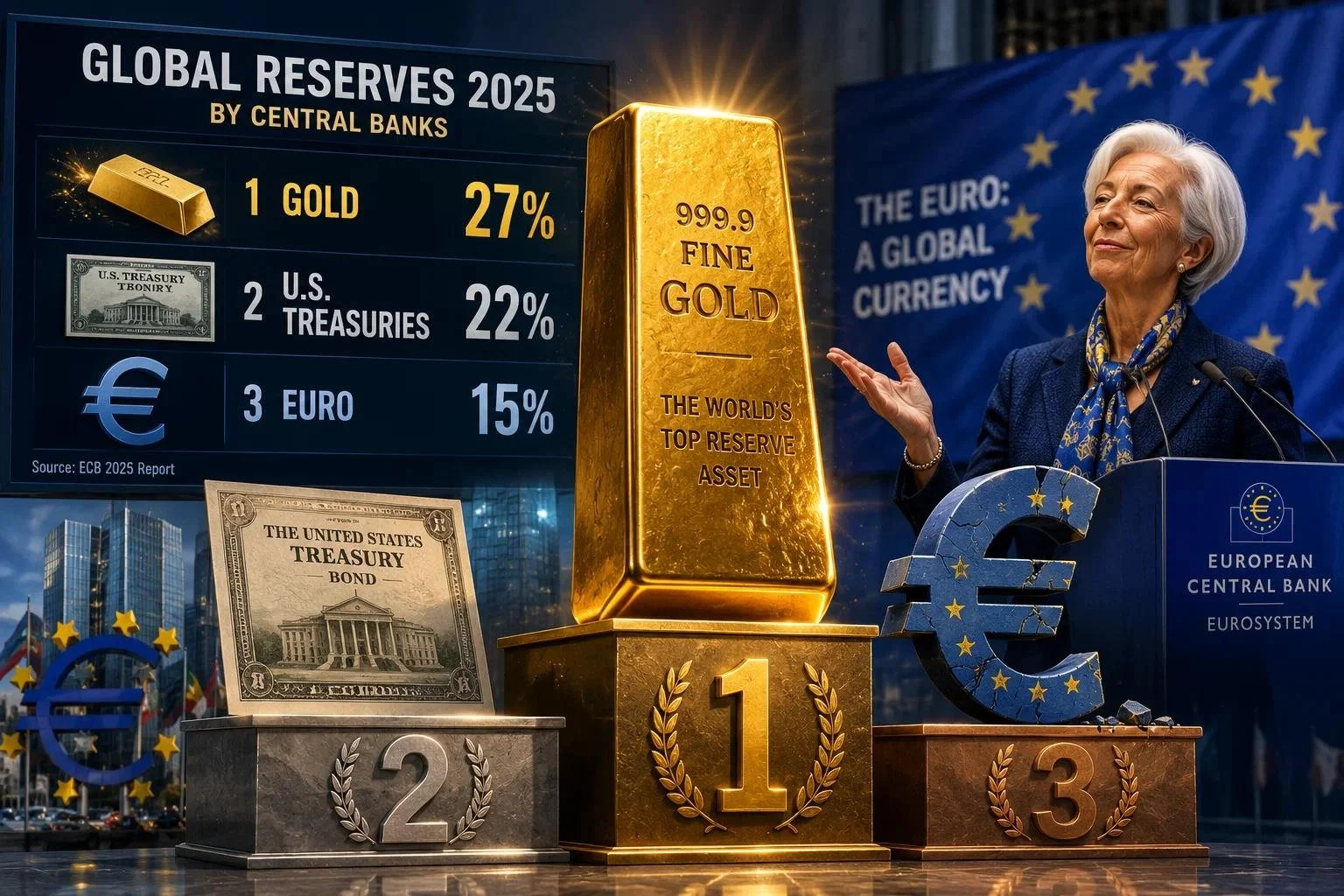
Last week, the European Central Bank published its 2025 report card, with ECB President Christine Lagarde celebrating “an opening for the euro to enhance its global appeal.”
The report bragged that the euro remains the second most used currency in the world, as well as the second most held in reserve, behind only the dollar.
The key word is “currency.”
Because in reality, 2025 was the year that gold took the top spot, making up 27% of global reserves held by governments and central banks. That pushed US Treasuries into second place with 22%, and the euro into third, making up 15% of global reserves.
A metal that pays no interest and earns no yield is now the biggest slice of global reserves, up from just 20% a year earlier.
The world is, in fact, trying to diversify away from the dollar. Central banks have spent years quietly trimming their dollar exposure, looking for somewhere safer to park their national savings.
But they are not choosing euros.
Then why, the ECB may counter, was 2025 a record year for international borrowing in euros?
Because there is more debt in everything than ever — global debt keeps smashing new highs, so a record pile of euro IOUs is less an achievement than a symptom of the times.
But to give credit where it's due, the euro is genuinely in first place in one market, according to Lagarde: "The euro became the leading currency in the green and sustainable international bond market."
That's the debt Europe sells to bankroll the very net-zero crusade that gutted its own economy. So the euro's crowning achievement of 2025 was becoming the world champion at borrowing money to make itself poorer.
If you ever needed one sentence to explain why nobody wants this currency, there it is.
Because leading the world in the things that make you poorer is the entire European model. Across the continent, governments spent two decades waging war on their own cheap energy in the name of net zero — turning their backs on nuclear power that supplied a third of Europe's electricity in 1990 and barely 15% today.
They saddled themselves with some of the highest power prices in the developed world and watched their industry pack up and leave. They threw open their borders, then aimed their police and courts at the citizens who objected.
The result is a continent so hollowed out that Mississippi, the poorest state in America, now produces more wealth per person than France or Italy.
But sure, this is the euro’s moment...
Meanwhile, central banks added roughly 850 tonnes of physical gold in 2025, a slight step down from the record-shattering pace of the prior two years, but bought at the highest prices in human history.
Poland led the gold-buying pack last year, followed by China, Turkey, and India.
But for a stretch of 2025, the single biggest gold buyer on the planet wasn't a country at all — it was Tether, the company behind the world's biggest dollar-backed stablecoin.
In the third quarter alone it bought more gold than any central bank on earth, and by the end of January it was sitting on roughly 148 tonnes — nearly 4.8 million ounces, worth about $22 billion — enough to rank among the top 30 gold holders in the world, ahead of the likes of Australia and South Korea.
This is exactly why the gold story is far from over.
The extra gold central banks have bought since 2022 laid the foundation for a price that has nearly tripled since — yet even that represents only a modest reallocation out of US dollars.
So what happens when they move even another 5% of their $10 trillion in reserves into gold?
With no single currency able to replace the dollar, and the reasons to diversify only growing, gold looks set to keep climbing as the world's largest reserve asset.
To your freedom, James Hickman Co-Founder, Schiff Sovereign LLC
P.S. Everyone from central banks to a stablecoin giant is racing into gold — which is why it's trading near record highs. We think owning the companies that produce it beats buying bullion at the top.
That's the whole idea behind Strategic Assets, Schiff Sovereign's monthly investment research. We hunt for profitable real-asset businesses with clean balance sheets, real catalysts, and a low multiple of free cash flow.
And it's working. We've seen it multiply the value of several precious metals companies, with others still in the buy range today. The same setup is now lining up well beyond the metals — in energy and other real assets — as nations around the world scramble to secure the critical resources a fragmenting world runs on.
Reset Intelligence: The Treasury Becomes the Teller
Reset Intelligence: The Treasury Becomes the Teller
6-4-2026
Reset Intelligence: The Treasury Becomes the Teller
By David E. Atterton | Reset Intelligence | @EXIT_FIAT
The dollar is being rebuilt from a promise you trust into a toll you pay through.
Iraq is the first place you can watch the whole motion at once.
And the dinar sits at the end of that line, the last to move and the one everyone is waiting on.
Reset Intelligence: The Treasury Becomes the Teller
6-4-2026
Reset Intelligence: The Treasury Becomes the Teller
By David E. Atterton | Reset Intelligence | @EXIT_FIAT
The dollar is being rebuilt from a promise you trust into a toll you pay through.
Iraq is the first place you can watch the whole motion at once.
And the dinar sits at the end of that line, the last to move and the one everyone is waiting on.
Marco Rubio said it on camera this week and almost everyone scrolled past it. Cuba, he said, is not run by its government. It is run by a military holding company called GAESA that owns nearly everything while not a dollar of it reaches the public treasury. He was describing Cuba. He was also describing the same layer the United States is now prying open in Iran, Iraq and Venezuela at once.
This week Treasury sanctioned Iran’s four largest crypto exchanges, and Scott Bessent said the regime’s economy is in free fall.
In Baghdad a corruption court seized forty properties, ten million dollars and a cache of weapons from one former oil official, the oil money and the militia guns turned out onto the same table. The cabinet then approved tripling its pipeline exports north and west, off the Strait of Hormuz that Iran can choke.
The other half of the story runs through Washington. Venezuela’s oil money now has to clear a US Treasury account before a cent reaches Caracas.
The GENIUS Act has turned every dollar stablecoin into a forced buyer of US Treasuries, making a single crypto company a bigger holder of American debt than South Korea. The Treasury Secretary called it a moment for dollar supremacy himself.
The dollar is being rebuilt from a promise you trust into a toll you pay through. Iraq is the first place you can watch the whole motion at once, and the dinar sits at the end of that line as the settlement variable, the last to move and the one everyone is waiting on.
That is the read in short. The full extended briefing, every source named and verified, is yours and your readers’ on a five day free trial: read the full briefing free for 5 days.
The full documented case behind all of it is the book, Head of the Snake, 25% off through Sunday with code 25XOFF: resetintelligence.com/head-of-the-snake.
This is the signal.
News, Rumors and Opinions Thursday 6-4-2026
Note: All intel should be considered as "Rumors" until we receive official announcements ...and “Rates and Dates” could change anytime until we get to the banks/redemption centers.
RV Excerpts from the Restored Republic via a GCR Update as of Thurs. 4 June 2026
Compiled Thurs. 4 June 2026 12:01 am EST by Judy Byington
The Green Light Has Been Given
The Banks Are Done, Their Control Ended
Old Liquidity Withdrawn, New Rails Activated
Protocols Moving From Standby To Live
Note: All intel should be considered as "Rumors" until we receive official announcements ...and “Rates and Dates” could change anytime until we get to the banks/redemption centers.
RV Excerpts from the Restored Republic via a GCR Update as of Thurs. 4 June 2026
Compiled Thurs. 4 June 2026 12:01 am EST by Judy Byington
The Green Light Has Been Given
The Banks Are Done, Their Control Ended
Old Liquidity Withdrawn, New Rails Activated
Protocols Moving From Standby To Live
ISO 20022 is the language
Tier 4B is the doorway
Timing is Everything & The Timing is NOW
Tier4b ISO20022 on Telegram
~~~~~~~~~~~~~~
Global Currency Reset:
Tues. 2 June 2026 Bruce, The Big Call The Big Call Universe (ibize.com) 667-770-1866, pin123456#, 667-770-1865:
We were told notification to set exchange appointments for Tier4b (us, the Internet Group) would come by Thurs. 4 June.
Med Bed treatments would be (allegedly) available for those in Tier4b who were in dire need by Sat-Mon 6-8 June 2026.
Tariff Dividend payments for natural US citizens would (allegedly) be $2,000 to $3,000 per US citizen, could be monthly for a year and start within the next couple of days.
The Emergency Broadcast System should (allegedly) activate in the 10 days of exposure between Wed. 24 June and Sat. 4 July 2026.
The EBS could also happen this coming weekend Fri. 5 June to Mon.8 June 2026.
Debt forgiveness could start around Sun 5 July 2026.
Judy Note: No one knows the exact date for notification of appointments for Tier4b (us, the Internet Group) to exchange foreign currencies, but deadlines shown in the above Timing indicate it to be by the end of this week. We have been told that Wells Fargo, which is controlled by the Chinese Elders – (the ones who own the gold behind the Global Currency Reset) – will send out emails to currency and bond holders worldwide telling them how to set redemption & exchange appointments. It is advised to exchange/redeem your foreign currency at an official Redemption Center (RC) rather than a bank. You can only (allegedly) redeem Zim at a RC, the Dinar Contract Rate can only be given at a RC and banks will (allegedly) offer you lower exchange rates than what you can obtain at a RC. You can only (allegedly) set up your new wallet (bank account) at a RC. It was my understanding that most banks were under control of the Cabal and would soon play a different role in the Global Financial System.
Read full post here: https://dinarchronicles.com/2026/06/04/restored-republic-via-a-gcr-update-as-of-june-4-2026/
************
Courtesy of Dinar Guru: https://www.dinarguru.com/
Thom Iraq has already moved the rate once. February 2023. 1,460 → 1,310. No announcement. No countdown. No community consensus. The Central Bank of Iraq made a policy decision and it moved. Immediately...The mechanism isn't theoretical. It's already been used. The question was never can it move. The questions are when and how much? So, let me ask you something. If the CBI moved the rate tomorrow with zero community warning , would you actually be ready?
Militia Man The security cleanup we see is gaining momentum...More major factions are publicly committing to lay down arms and integrate into state institutions. We see an abundance of that today...This trend is accelerating.
Jeff Parliament is supposed to have two sessions of parliament per week. This is a normal week. They have not had one session of parliament so far this week. What does that show you? They're done with everything. They're literally waiting for the cabinet to get approved and change the freaking rate when the government's done being approved. Form the cabinet, complete the government, change the freaking rate. That's the reason why parliament has not had one session this week ...So far nothing announced.
************
America's Debt Bomb Explodes: $1.25 Trillion in Credit Card Debt Signals Economic Crisis
Lena Petrova: 6-4-2026
While headlines celebrate a “strong” economy, millions of Americans are falling deeper into debt. Credit card balances have surged to a record $1.25 trillion, delinquencies are at their highest level since the 2008 financial crisis, and more families are using Buy Now, Pay Later loans just to buy groceries.
Is consumer spending masking a growing financial emergency?
In this video, we examine the alarming data behind rising debt, falling purchasing power, and what it could mean for the future of the U.S. economy.