
Thank you to all the subscribers to our Early Access program…we thank you for your continued support.
We are excited to offer this new service to keep you informed and up-to-date on the latest Dinar and currency news.
Seeds of Wisdom RV and Economics Updates Thursday Afternoon 10-2-25
Good Morning Dinar Recaps,
Token2049 Trends: Quantum, Stablecoins, DeAI & RWA
At Token2049, the industry mapped the trajectory from innovation to infrastructure — and those pathways intersect straight with global financial restructuring.
Good Morning Dinar Recaps,
Token2049 Trends: Quantum, Stablecoins, DeAI & RWA
At Token2049, the industry mapped the trajectory from innovation to infrastructure — and those pathways intersect straight with global financial restructuring.
What Emerged from Token2049 2025
● The conference spotlighted quantum resistance, with panels exploring how quantum computing could disrupt crypto security and what post-quantum ledger designs must look like.
● Stablecoins remain a core theme — predictions of $1 trillion+ market caps were echoed, and supply, regulation, and cross-border use were debated.
● DeAI / decentralized AI gained traction as a concept: AI agents embedded in blockchains, DAO governance powered by machine learning, and data markets were among the hot topics.
● Real-world assets (RWA) tokenization got serious attention: tokenization of real estate, bonds, private credit, art — bringing TradFi onto chain.
Key Forces Driving These Trends
Quantum Threat & Opportunity
Blockchain protocols are increasingly expected to resist quantum attacks. New cryptographic standards (e.g. lattice, zk-SNARKs with post-quantum tweaks) were discussed.
Stablecoins as Payment Rails
Stablecoins were framed not just as collateral tools but as foundational rails for payments, remittances, and programmatic finance. The push is for institutional adoption.
DeAI / On-chain Intelligence
By blending AI with decentralized infrastructure, architects propose systems that optimize logic, compliance, and resource allocation autonomously — cutting latency, trust frictions, and central points of failure.
RWA Tokenization & Liquidity
Turning physical or traditional assets into tokens promises fractional ownership, access, and tradability. But liquidity, regulation, and standardization are recognized obstacles. Recent academic work notes many RWA tokens have low secondary market volume and structural barriers in custody, valuation, and regulatory gating.
How These Trends Fit Into Global Restructuring
🔹 Reinventing Money & Settlement
Stablecoins + RWA = programmable money backed by real assets. As this model scales, dollar-based systems may lose primacy as settlement hubs.
🔹 Sovereignty in Tech Infrastructure
Every protocol that embeds AI, quantum resistance, or tokenized assets becomes a domain of control. Nations or blocs that can host or mandate these rails gain strategic influence.
🔹 Fragmentation vs Convergence
The future likely holds multiple token systems — regional or national rails coexisting with open protocols. That splinters power and reduces dominance of any single global financial center.
🔹 The Legitimacy & Trust Pivot
Trust is moving from political institutions to cryptographic institutions. Systems that remain stable, auditable, and resilient will attract capital, influence, and legitimacy.
Why This Matters / Key Takeaway
Token2049 wasn’t a festival — it was a marker of how the next phase of money, value, and governance is being built. These architectures aren’t speculative: they are foundational layers of future finance. As stablecoins, quantum resistance, AI, and real-world asset integration converge, the battleground shifts to who writes the rules, who operates the rails, and who captures the trust.
This is not just politics — it’s global finance restructuring before our eyes.
@ Newshounds News™ Exclusive
Sources:
Newsweek — Ziplines, DJs and Trump: Singapore’s crypto conference has attendees roaring Reuters
Token2049 official reports / event pages TOKEN2049 Dubai+1
RWA definition & market context (Wikipedia) Wikipedia
TOKEN2049 Dubai insights, key takeaways Bitget
Academic: Tokenize Everything, But Can You Sell It? RWA Liquidity Challenges arXiv
Academic: Hybrid Monetary Ecosystems: Integrating Stablecoins & Fiat arXi
~~~~~~~~~
At Historic Conference, Serbia Weighs BRICS as Alternative to EU Path
Belgrade’s flirtation with BRICS reveals cracks in the European model—and signals realignment pressures in global politics and finance.
Serbia Opens Debate: East or West?
● Serbia held its first parliamentary conference evaluating BRICS membership as a possible alternative to full EU integration.
● Organizers included the Parliamentary Group for Cooperation with BRICS and the Socialist Movement led by former intelligence chief Aleksandar Vulin. Vulin criticized EU demands such as recognizing Kosovo’s independence, abandoning traditional ties with Russia/China, and giving up support for Republika Srpska.
● The Russian ambassador to Serbia affirmed support for Belgrade’s BRICS ambitions, stating the bloc represents “multipolarity” and cooperation without undue dominance.
Backing Data & Shifting Public Sentiment
● Public support for EU membership in Serbia has dropped sharply—only ~33 % now endorse joining, the lowest in the Western Balkans.
● Yet, around 60 % reportedly support the idea of Serbia entering BRICS, reflecting growing openness to non-Western alternatives.
● Serbia has formally been an EU candidate since 2012, but progress is slow: of 35 negotiation chapters, only 22 opened and just 2 provisionally closed as of 2025.
● Deputy PM Vulin has repeatedly stated BRICS is a viable alternative to EU accession, because it carries fewer political conditions (no requirement to recognize Kosovo’s independence, no forced alignment with sanction regimes).
Strategic Drivers Behind the Shift
🔹 Sovereignty & Conditionality
Serbian leaders argue BRICS demands less political adherence than the EU—it doesn’t force changes in foreign policy or judicial structure to the same degree. This gives Belgrade more maneuvering room.
🔹 Multipolar Appeal & Identity
By associating with BRICS, Serbia taps into a narrative of resisting Western dominance—projecting alignment with Beijing, Moscow, and Global South states. It positions itself as a player in multipolar diplomacy.
🔹 Financial & Trade Leverage
Joining BRICS could open access to alternative finance, trade in national currencies, and reduced dependence on EU structural funds and conditional lending. Serbia seeks avenues beyond EU grants and subsidies.
🔹 Institutional & Structural Shift
If a country like Serbia abandons or slows EU integration in favor of BRICS, it signals weakening of the EU’s pull—and encourages others in its orbit to reconsider their alignment.
Why This Matters / Key Takeaway
Serbia’s public and institutional debate over BRICS membership is more than a regional curiosity—it epitomizes how countries are rethinking the old paradigms. In choosing between conditional European integration and a looser multipolar alliance, Serbia is testing the strength of global structures. Its pivot could ripple across the Balkans and beyond, reshaping trade, diplomacy, and financial order.
This is not just politics — it’s global finance restructuring before our eyes.
@ Newshounds News™ Exclusive
Sources:
Watcher.Guru – At Historic Conference, Serbia Weighs BRICS as Alternative to EU Path
Gazeta Express – Serbia wants to join BRICS, not the EU: First International Conference
Intellinews – Serbia records lowest support for EU in Western Balkans
International Affairs / Australian Outlook – Serbia between Brussels, Beijing, and Moscow
Novinite – Serbia Eyes BRICS as Alternative to EU, Citing Political Sovereignty
TASS – Serbia views BRICS membership as alternative to EU — Deputy PM
TASS – BRICS gives Serbia real alternative to EU without blackmail or humiliation
~~~~~~~~~
Seeds of Wisdom Team RV Currency Facts Youtube and Rumble
Newshound's News Telegram Room Link
Follow the Gold/Silver Rate COMEX
Follow Fast Facts
Seeds of Wisdom Team™ Website
Thank you Dinar Recaps
Gold-Backed Currency, How China’s Yuan Could End Cheap Manufacturing
Gold-Backed Currency, How China’s Yuan Could End Cheap Manufacturing
As Good As Gold: 10-1-2025
Imagine a world where the global economic rules are being rewritten, not with abstract financial policies, but with something as tangible and ancient as gold.
This is the intriguing scenario explored in a recent video from As Good As Gold, which delves into the potential implications if China decides to back its currency, the yuan, with gold or adopt a gold standard.
Gold-Backed Currency, How China’s Yuan Could End Cheap Manufacturing
As Good As Gold: 10-1-2025
Imagine a world where the global economic rules are being rewritten, not with abstract financial policies, but with something as tangible and ancient as gold.
This is the intriguing scenario explored in a recent video from As Good As Gold, which delves into the potential implications if China decides to back its currency, the yuan, with gold or adopt a gold standard.
The immediate question that springs to mind for anyone tracking global trade is: Wouldn’t a gold-backed yuan make Chinese manufacturing significantly more expensive, thus hurting its export competitiveness?
It’s a valid concern. Currently, the yuan operates under a fiat system, often kept relatively cheap to support exports.
The expert in the As Good As Gold video confirms that, indeed, if the yuan were backed by gold, its value would strengthen. A gold-backed currency is inherently more stable and robust compared to fiat currencies, which can be prone to inflation and devaluation. This appreciation would, by definition, raise the cost of Chinese manufactured goods in international markets.
However, the expert argues that this cost increase will not be the fatal blow to China’s manufacturing might that many might assume. Here’s why China appears to have a strategic advantage already in play:
Unlike historical examples such as Japan, which faced significant challenges and diversified production abroad when a stronger yen made its exports less competitive, China has been playing a different long game.
Through initiatives like the Shanghai Cooperation Organization (SCO) and BRICS, China has meticulously cultivated a massive, captive market encompassing an astonishing 70-80% of the global population.
This strategic market dominance means that even if the yuan appreciates due to gold backing, China can sustain its exports within this vast bloc. Many countries within the SCO and BRICS are increasingly open to trading in yuan or gold-backed currencies, effectively bypassing the Western fiat currency system and its potential vulnerabilities.
Beyond strategic alliances, China also boasts inherent strengths that provide a buffer against currency appreciation. Its advanced technology, particularly in consumer electronics, gives it a competitive edge that reduces sensitivity to currency fluctuations.
Furthermore, even with an appreciating yuan, China’s baseline manufacturing costs are still substantially lower than those in the West.
This significant margin provides considerable room to absorb the impact of a stronger yuan without completely pricing itself out of the market. Essentially, they have a larger cost cushion than many competitors.
A crucial element of China’s long-term strategy, as highlighted by the expert, is anticipating the potential instability of Western fiat currencies. Should these currencies face significant devaluation or collapse, the demand for Chinese exports paid in those currencies would naturally diminish.
In such a scenario, China’s gold-backed yuan and its large, strategically cultivated internal market through alliances like BRICS would act as a powerful economic shield, protecting its interests and ensuring continued trade on its own terms.
The discussion also touches upon the implications for other major players, such as Australia, the world’s third-largest gold producer.
If a new global trading system emerges based on gold or gold-backed yuan, Australia might find it increasingly difficult to sell its gold externally within the traditional Western financial framework. This could have significant economic impacts for Australia, forcing it to reassess its trade relationships.
In essence, the expert from As Good As Gold believes that China’s potential move towards a gold-backed currency isn’t a hasty reaction, but rather the culmination of years of meticulous long-term planning.
This strategy has already accounted for the evolving global trade dynamics, potential shifts in manufacturing costs, and the vulnerabilities of the current fiat system.
China’s strategic market alliances, technological superiority, and cost advantages are not merely mitigating factors; they are foundational pillars designed to ensure its economic resilience and continued global influence, even as it potentially ushers in a new era of gold-backed trade. This isn’t just about currency; it’s about a potential tectonic shift in global economic power structures.
For a deeper dive into these fascinating insights and to understand the full scope of this potential economic revolution, be sure to watch the full video from As Good As Gold.
The Government Shutdown, What’s the Big Deal?
The Government Shutdown, What’s the Big Deal?
Heresy Financial: 10-2-2025
The phrase “government shutdown” is back in the news, often accompanied by panic and dire predictions. It’s easy to feel overwhelmed by the political noise, but the truth is, not all shutdowns are created equal.
In fact, distinguishing the current turmoil from potentially catastrophic economic events is crucial for anyone trying to understand the actual risk level.
The Government Shutdown, What’s the Big Deal?
Heresy Financial: 10-2-2025
The phrase “government shutdown” is back in the news, often accompanied by panic and dire predictions. It’s easy to feel overwhelmed by the political noise, but the truth is, not all shutdowns are created equal.
In fact, distinguishing the current turmoil from potentially catastrophic economic events is crucial for anyone trying to understand the actual risk level.
Drawing insights from detailed financial analysis, we can cut through the complexity. A government shutdown is essentially the cessation of some or all non-essential government services because Congress has failed to authorize funds to pay employees.
But to truly grasp the stakes, we must recognize that there are three fundamentally different types of shutdowns—each carrying a vastly different economic consequence.
This is the type of shutdown the U.S. currently faces most frequently. It stems from Congress’s failure to pass the necessary appropriations bills to fund the government’s operations for the upcoming fiscal year.
A budget shutdown is essentially a disagreement over how to allocate the remaining, smaller pot of discretionary funds. When this spending authority lapses, non-essential services tied to those funds cease.
As seen in the 2018-2019 shutdown, while frustrating and disruptive, these shutdowns are generally minimal in long-term economic impact. They cause temporary disruptions, short-term market volatility, and delays in government services (like processing permits or reporting economic data), but they do not lead to a default.
While often confused with budget fights, a debt ceiling crisis is fundamentally different and potentially far more dangerous.
The debt ceiling is the statutory limit on how much money the U.S. Treasury can borrow to fulfill existing legal obligations—bills that Congress has already authorized. Think of the debt ceiling as the limit on your credit card, whereas the budget is the argument over how much you spend this month.
When the government hits the debt ceiling, it can no longer borrow money to pay its bills (including payments to bondholders). While Congress almost always raises or suspends this limit to avoid catastrophe, the risks associated with a true debt ceiling shutdown (a technical default) are immense.
In short, a budget shutdown is a skirmish over future spending; a debt ceiling shutdown is a massive crisis concerning the government’s ability to pay past debts.
The third type of shutdown is thankfully rare, historical, and catastrophic: the currency failure shutdown.
This occurs when a government becomes unable to pay its bills because its currency is no longer accepted. This goes far beyond budget gridlock; it signifies a fundamental loss of confidence in the nation’s monetary system, often triggered by hyperinflation or severe political instability.
This scenario typically leads to regime change, a complete monetary reset, or the adoption of a different currency structure.
While fascinating to consider in a historical context, it bears no resemblance to the current political disagreements.
It is undeniably frustrating to watch Congress repeatedly stumble toward these fiscal deadlines. However, the video analysis offers a crucial philosophical takeaway: the gridlock is intentional.
The U.S. system of checks and balances was specifically designed to make decision-making difficult. By dividing power and requiring broad consensus, the founders sought to prevent the concentration of authority and safeguard against tyranny or rapid, unwise government action.
While this structure often results in inefficiencies and frustrating delays, it is a feature designed to prevent catastrophic outcomes. We may lament the temporary closure of national parks, but the difficulty in passing legislation acts as a permanent brake on runaway power.
When you hear warnings about an impending government shutdown, remember to ask which type is being discussed.
Currently, we endure budget shutdowns—a painful but temporary disruption resulting from necessary political negotiations over discretionary funds. The high-stakes drama involves temporary salary freezes and service halts, but it is a relatively stable part of the American political process.
The true fiscal calamity remains the debt ceiling shutdown, an event that carries the potential for global economic devastation, but which has historically been averted at the last minute.
For further detailed analysis on government shutdowns and financial markets, we recommend checking out the insights provided by Heresy Financial.
https://dinarchronicles.com/2025/10/02/heresy-financial-the-government-shutdown-whats-the-big-deal/
Seeds of Wisdom RV and Economics Updates Thursday Morning 10-2-25
Good Morning Dinar Recaps,
US Shutdown Day 2: What’s Happening, Who’s Affected & Why It Matters
Services falter, economic losses mount, and continuity of governance looms as a central test of American institutional strength.
Good Morning Dinar Recaps,
US Shutdown Day 2: What’s Happening, Who’s Affected & Why It Matters
Services falter, economic losses mount, and continuity of governance looms as a central test of American institutional strength.
What Operations Continue — and What Doesn’t
• Essential services such as Social Security payments, Medicare, Medicaid, and the U.S. Postal Service (which is funded outside annual appropriations) remain operational.
• The federal courts announced they can sustain operations through October 17, 2025 under existing resources.
• Public health & research agencies face deep cuts: ~41% of Health & Human Services staff will be furloughed, and institutions like NIH and CDC are heavily affected.
• Cybersecurity functions are compromised — CISA has furloughed most of its workforce, weakening defense of critical infrastructure.
• Hospitals, particularly in rural or underserved areas, risk losing federal funding via Medicaid and other support programs.
• Air traffic and aviation impacts include the halting of new air traffic controller training, potential delays in safety inspections, and strain on travel infrastructure.
Economic Fallout & Ripple Effects
• A White House memo projects up to $15 billion in GDP lost per week during the shutdown, with potential unemployment rises.
• The CBO previously estimated that extended shutdowns suppress private-sector demand, as furloughed workers lose income and cut spending.
• Historic precedent: The 2018–19 shutdown cost the economy ~$11 billion and shaved growth.
Could Continuity of Government Be Tested?
Government continuity mechanisms are designed to maintain essential functions despite funding gaps. But the 2025 shutdown is testing those lines:
• Federal law (the Government Employee Fair Treatment Act of 2019) ensures retroactive pay for furloughed employees once funding is restored.
• But many federal contractors do not get back pay and may suffer permanent layoffs.
• The ability of agencies to suspend non-essential operations, redirect funds, or invoke emergency powers will strain interagency cooperation—and may empower the executive branch.
Tie-In With Deeper Structural Shifts
• The shutdown undermines the United States’ reputation for institutional stability. As the world watches, it bolsters arguments for alternative power centers—nations and blocs that claim they can deliver governance without such breakdowns.
• In times of uncertainty, capital and trust migrate. Investors may question dollar-based assets and U.S. debt, accelerating interest in non-USD reserves, alternative financial systems, or gold-anchored institutions.
• As agencies pause, new opportunities emerge for states, private actors, and foreign powers to fill gaps—shaping parallel systems of influence, trade, and financial alignment.
Why This Matters / Key Takeaway
On Day 2, the U.S. shutdown is no longer just a political showdown. It is a stress test of governance, credibility, and global authority. The resulting economic scars, institutional paralysis, and capital uncertainty create openings for shifts in financial order—just the kind of restructuring many talk about, but few expect to see so clearly.
This is not just politics — it’s global finance restructuring before our eyes.
@ Newshounds News™ Exclusive
Sources:
The Guardian – What does the US government shutdown mean for everyday people The Guardian
Modern Diplomacy (via your link)
Reuters – Courts can sustain operations through October 17 Reuters
Reuters – Health agency furloughs Reuters
Washington Post – CISA and cybersecurity furloughs The Washington Post
Axios – Hospital funding in jeopardy Axios
Reuters – Air traffic controller training halted Reuters
Politico – White House memo on GDP loss Politico
CBO – Potential effects of a federal government shutdown Congressional Budget Office
The Guardian / historic shutdown cost The Guardian+1
Wikipedia – 2025 U.S. federal government shutdown Wikipedia
Wikipedia – Government Employee Fair Treatment Act Wikipedia
House.gov / impact summary tonko.house.gov
~~~~~~~~~
US Upgrades Air Power on Korean Peninsula
Strategic modernization in East Asia exposes deeper shifts in power, alliances, and global defense finances.
Modernization Amid Rising Tensions
• The U.S. is retiring aging A-10 aircraft in South Korea and upgrading F-16 jets with new avionics to improve survivability and mission precision.
• Drone operations are expanding: a drone squadron in South Korea has been established, and U.S. Air Force, Navy, and Marine drones are now deployed in Japan for intelligence and deterrence roles.
• The move occurs in tandem with rebalancing in Japan, where F-35A and F-15EX jets are being phased into Japan’s combat fleet.
Why It Matters
• The U.S. is signaling its continuing commitment to deterrence in Northeast Asia, reinforcing alliances as North Korea advances missile and nuclear capabilities.
• Upgrading capabilities in an allied theater extends U.S. logistical, strategic, and financial burden—yet it also projects influence and anchors security partnerships in a contested region.
• The modernization supports U.S. goals of maintaining forward-deployed dominance, which has downstream effects on trade routes, supply chains, and regional stability.
Global & Financial Implications in a Restructuring Era
🔹 Military Spending & Fiscal Strain
• Funding modernization is expensive. As defense budgets swell, opportunity cost appears in social programs, infrastructure, and domestic priorities.
• In the context of government shutdowns, volatile debt, and financial stress, the willingness to sustain heavy defense outlays may be tested.
🔹 Realignment of Defense Influence
• Nations in Southeast and Northeast Asia witness these upgrades as both reassurance and pressure. Some may shift procurement or alignments (Russia, China, India) in response.
• Competitors may respond: China could accelerate naval or air development in disputed areas (South China Sea, Taiwan Strait) to counterbalance U.S. presence.
🔹 Infrastructure, Bases & Local Economies
• Bases in South Korea, Japan, and allied outposts see upgrades, spurring contracts, defense manufacturing, and local economic activity tied to U.S. defense industrial complex.
• Those infrastructure investments carry long-term financial commitments and create dependencies.
Key Takeaway
U.S. upgrades in air power aren’t just about military deterrence. They are nodes in a larger architecture of global influence, financial marking, and infrastructure dependence. As the world edges toward a multipolar order, control of the skies becomes central to who controls the future.
This is not just politics — global finance restructuring before our eyes.
@ Newshounds News™ Exclusive
Source: Newsweek – US Upgrades Air Power on Korean Peninsula Newsweek
~~~~~~~~~
China Uses UN to Advance Biggest Territorial Claim
China leverages the United Nations to bolster its sovereignty narrative over Taiwan — a move with deep geopolitical and financial implications.
China’s Legal Play at the U.N.
● The Chinese government issued a white paper at the U.N. General Assembly, asserting that UN Resolution 2758 “once and for all” settled China’s representation, and implicitly extended its sovereignty claim over Taiwan.
● Beijing claims that the resolution, passed in 1971, supports the idea that Taiwan is a province of China, and that “two Chinas” or “one China, one Taiwan” are illegitimate.
● Taiwan’s government and its de facto diplomatic representatives (AIT) reject that interpretation, emphasizing that 2758 did not expressly address Taiwan’s political status.
Responses & Regional Ripple Effects
● Taiwan condemned the white paper, accusing China of deliberate distortion of treaties and documents to justify coercive claims.
● Recent reporting indicates Taiwan views China’s reinterpretation of 2758 as an attempt to manufacture a legal basis for future aggression.
● Observers note that the U.N. General Assembly’s decision did not adjudicate the status of Taiwan as a state; it resolved which government represents “China” at the U.N.
● In parallel, China continues to apply pressure via grey-zone tools — military drills, diplomatic isolation, media influence, and legal arguments — to shift the status quo.
Larger Stakes: Power, Influence & Financial Leverage
🔹 Weaponizing International Institutions
China’s use of the UN as a venue for sovereignty claims illustrates how great powers can co-opt multilateral institutions to validate expansionist agendas. This undermines the credibility of neutrality in global systems.
🔹 Erosion of Norms & Precedents
If states succeed in stretching legal interpretations to justify territorial claims, international law becomes malleable. That could embolden other powers to challenge borders under nominal legal cover.
🔹 Financial & Strategic Impacts
Countries aligned with China may begin to mirror its use of legal and institutional pressure. Capital flows, trade agreements, and investment patterns may increasingly favor states that accept such interpretations or stay silent.
🔹 Questioning U.S. Authority & Rule Enforcement
As China asserts dominance in key institutions, American leverage through institutions like the U.N. wanes. Its ability to uphold rules, impose sanctions, or shape UN bodies may diminish over time.
Why This Matters / Key Takeaway
China’s push to reframe Taiwan’s status at the U.N. is more than a legal argument — it is a structural move in the reshaping of global power. By bending institutions to its will, Beijing challenges the mechanisms through which rules, norms, and legitimacy are maintained. In doing so, it accelerates shifts in financial, diplomatic, and institutional architecture — exactly the kind of transformation that signals we are witnessing global finance restructuring.
This is not just politics — it’s global finance restructuring before our eyes.
@ Newshounds News™ Exclusive
Sources & Further Reading:
Newsweek – China Uses UN to Advance Biggest Territorial Claim Newsweek
Reuters – Taiwan says China trying to create legal basis for attack via misinterpretation of UN Resolution 2758 Reuters
U.S.–Asia Law Institute – Analysis: UN General Assembly Resolution 2758 Does Not Establish Beijing’s “One China” as Fact U.S.-Asia Law Institute
Taiwan Ministry of Foreign Affairs – Rebuttal to PRC claims on Taiwan Taiwan MOFA
RUSI / policy papers – Taiwan’s response to China’s grey zone tactics RUSI
Academia (arXiv) – Cross-strait information influence networks arXiv
~~~~~~~~~
Seeds of Wisdom Team RV Currency Facts Youtube and Rumble
Newshound's News Telegram Room Link
Follow the Gold/Silver Rate COMEX
Follow Fast Facts
Seeds of Wisdom Team™ Website
Thank you Dinar Recaps
Who Do We Hold Accountable?
Who Do We Hold Accountable?
The loss and squandering of non-oil revenues in numbers: Billions And Abundant Resources Are Being Swallowed Up By Corruption Networks.
Baghdad Today – Baghdad The issue of non-oil revenues in Iraq is one of the most important issues, revealing the depth of the structural dependence on oil.
The state treasury remains almost entirely tied to oil revenues, while other resources are supposed to be the primary tributary to ensuring financial stability.
Who Do We Hold Accountable?
The loss and squandering of non-oil revenues in numbers: Billions And Abundant Resources Are Being Swallowed Up By Corruption Networks.
Baghdad Today – Baghdad The issue of non-oil revenues in Iraq is one of the most important issues, revealing the depth of the structural dependence on oil.
The state treasury remains almost entirely tied to oil revenues, while other resources are supposed to be the primary tributary to ensuring financial stability.
Constitutional deliberations indicate that excessive reliance on a single resource weakens the principle of economic justice and disrupts the mechanisms for equitable wealth distribution.
According to Ministry of Finance data, the percentage of non-oil revenues rose from 7 percent in 2023 to 9 percent in 2024, and then to 10 percent by July 2025.
These are official figures, which economist Nabil al-Marsoumi asserts on his Facebook page, monitored by Baghdad Today, are the most accurate and reliable. However, they remain modest when compared to the potential in sectors such as tourism, ports, and border crossings.
Monitoring data indicates that this gap does not reflect a shortage of resources, but rather a crisis in collection mechanisms.
In the religious tourism sector, one of the most prominent potential sources of income, millions of visitors enter Iraq annually, with the Arbaeen pilgrimage exceeding four million foreign visitors. According to preliminary research data, average spending ranges between one and two billion dollars annually, while reports indicate direct and indirect revenues exceeding nine billion dollars in 2023.
However, the treasury's share of these funds is extremely limited due to the vast informal economy and weak tax collection. Constitutional law experts argue that the absence of strict tax legislation on tourism services deprives the state of legitimate entitlements and leaves it hostage to the informal market.
This limits direct revenues to a few tens of millions of dollars, while possible collection through smart mechanisms could reach hundreds of millions.
Field studies indicate that this shortcoming is not related to weak demand, but rather to the absence of institutional tools capable of fair collection.
Border crossings and customs represent a stark example of the discrepancy between reality and potential.
According to various legal estimates, border crossings should constitute the state's second-largest source of revenue after oil, but corruption and fraud consume a significant portion of the revenue.
Official customs revenues in 2025 amounted to approximately 2.7 trillion dinars, with expectations of reaching 3 trillion by the end of the year, equivalent to approximately $2.3 billion.
However, international oversight reports indicate that customs losses could reach as much as 30 percent of revenues. If this loss were eliminated through comprehensive automation and the integration of collection with electronic payment, the proceeds could easily rise to $2.9 billion annually.
Comparative analyses indicate that Iraq is the only regional exception, losing a third of its customs revenues despite its extensive network of border crossings.
Iraqi ports, in turn, present a similar picture. According to critical readings of constitutional jurisprudence, port revenues fall within sovereign resources that are supposed to be centrally managed in accordance with the principle of transparency.
In the first quarter of 2025, ports generated revenues exceeding 314 billion dinars, equivalent to approximately $240 million over three months, meaning annual revenues approach $1 billion.
However, this figure remains below actual potential, as improving handling management, increasing operational efficiency, and linking electronic invoicing with customs could increase revenues to $1.15 billion annually.
Institutional estimates indicate that Iraq is losing a portion of its resources due to the lack of a unified port collection system, which further widens the gap between reality and potential.
When compared to the Gulf states, the magnitude of the difference becomes clear. Research studies indicate that Saudi Arabia, through Vision 2030, has succeeded in increasing the contribution of non-oil revenues to more than 40 percent of the budget by developing tourism, imposing a value-added tax, and developing non-oil industries.
The UAE has transformed its economy into a global hub for aviation, tourism, real estate, and financial services, until the oil contribution declined to less than 30 percent of GDP.
Qatar, on the other hand, has harnessed liquefied natural gas revenues while simultaneously building service and investment sectors that have boosted sustainable revenues.
According to contemporary intellectual approaches, these experiences would not have been possible without stable institutions and accumulated experience in managing public resources.
Iraq, by contrast, has remained stagnant despite possessing similar, and perhaps even broader, assets, such as massive religious tourism, extensive border crossings, and strategic seaports. In-depth legal analyses confirm that structural obstacles have prevented the exploitation of these resources, most notably administrative and financial corruption, which causes significant revenue leakage; the absence of a long-term strategic vision, which renders short-term policies hostage to political consensus; weak infrastructure, a widespread informal economy; and political and security instability, which undermines investor confidence and prevents stable economic policies.
Comparative experience demonstrates that these obstacles are not inevitable, as other countries in the region have overcome them through gradual and cumulative reforms.
********************************
In conclusion, Iraq does not lack resources, but rather the institutional will to transform them into actual revenues for the state treasury. While the official share of non-oil revenues has risen to 10 percent, it remains modest compared to the 40 percent achieved by Saudi Arabia or the 30 percent achieved by the UAE.
If Iraq succeeds in overcoming the obstacles of corruption and red tape and adopts a genuine strategic plan, it could double its non-oil resources to nearly $5 billion annually in the short term, and raise their share to more than 20 percent of total revenues within a few years.
According to intersecting political-economic estimates, this path is contingent on radical reforms that redefine the relationship between the state and the economy and free public finances from the grip of oil rents.
Source: Baghdad Today Monitoring and Follow-up Department https://baghdadtoday.news/284288-.html
For current and reliable Iraqi news please visit: https://www.bondladyscorner.com
“Tidbits From TNT” Thursday Morning 10-2-2025
TNT:
Tishwash: $6.1B boost: Iraq signs 64 partnership contracts for industry
Iraq’s Industrial Week kicked off Wednesday at Baghdad International Fair, bringing together local and foreign companies from both the public and private sectors.
At the opening ceremony, Industry and Minerals Minister Khaled Battal highlighted that the government has completed more than 86% of its industrial program, and laid the groundwork for 27 new factories.
TNT:
Tishwash: $6.1B boost: Iraq signs 64 partnership contracts for industry
Iraq’s Industrial Week kicked off Wednesday at Baghdad International Fair, bringing together local and foreign companies from both the public and private sectors.
At the opening ceremony, Industry and Minerals Minister Khaled Battal highlighted that the government has completed more than 86% of its industrial program, and laid the groundwork for 27 new factories.
He also pointed out that the ministry signed 64 partnership contracts worth 9 trillion dinars ($6.1 billion) with local and foreign investors in strategic industries, including fertilizers, phosphates, iron, and steel. Talks are ongoing for an additional 33 contracts.
Noting that the week-long fair will continue through October 7, Battal described it as an economic and social platform that connects industrialists with policymakers, ''helping obstacles removal to industrial projects.”
“Key challenges facing national industry include shortages of electricity and gas, border crossing issues, and aging factories,” the minister underlined, adding that Iraq has achieved self-sufficiency in cement, producing over 37 million tons in 2024.
Production has also increased for chlorine used in water treatment, electrical transformers, and other industrial goods.
Meanwhile, the General Company for Iron and Steel displayed its products at the fair. Marketing Director Mohammad Subih emphasized that Iraqi rebar production matches European standards, highlighting that the ISO-certified plant produces up to 600,000 tons annually, with plans to export to neighboring countries. link
************
Tishwash: Iraqi banks between the "dollar transfers complex" and the "dream of a regional financial center": A new vision for the changing Middle East economy
In a region experiencing major transformations, from economic corridor projects to reconstruction plans, from geopolitical shifts to the so-called "New Middle East" plans, Iraq finds itself facing both a historic opportunity and fateful challenges.
A bold banking and economic vision is needed here, seeking to transform Iraqi banks from marginal players to key players in economic decision-making and building an attractive investment environment.
A rapidly changing Middle East
Economic expert Saif al-Halfi told Iraq Observer that the Middle East is currently undergoing profound transformations, including mega-projects and new economic corridors. Baghdad stands at a historic gateway that requires a fundamental shift in the way the financial sector is managed. What is required is not just an injection of capital or the introduction of modern payment systems, but rather the establishment of an integrated legal and institutional vision that protects financing and opens the way for development initiatives.
Only then can Iraq capitalize on its strategic geographic location, the Faw Port, the Development Road project, and its oil, gas, and human resources to become a financial and commercial hub at the heart of the region.
The first challenge: Capital and institutional reform.
The first step Al-Halfi refers to is raising the capital of Iraqi banks and strengthening their resilience to risks. This is a plan the government has implemented in cooperation with the Central Bank and with the assistance of the global consulting firm Oliver Wyman. The decision was made to raise the capital of banks to 400 billion dinars. Although this decision appears to be an accounting measure, it lays a new foundation for building a stronger banking sector that is more integrated with the regional and international economies.
He adds that institutional reform, the dismantling of large shareholdings, and the introduction of automation and modern systems are not sufficient on their own, but they are an indispensable condition for transitioning from the stage of survival to the stage of competition and expansion.
The Second Challenge: From Dollar Captivity to Diversified Financing
Al-Halfi acknowledges that banking activity in Iraq still relies almost entirely on foreign remittances in dollars. This reality makes banks more like large exchange houses than true financial institutions. International experience confirms that banks only flourish when they transform into "real financiers" of the national economy through lending and adopting diverse strategies.
The economic expert suggests that expansion should be based on five main paths: "The first is personal and housing loans to meet citizens' needs. The second is financing small and medium-sized enterprises, as they are the largest engine of employment and growth.
This is in addition to loans to large companies, especially those listed on the Iraq Stock Exchange or seeking to be listed. Syndicated loans to finance oil, electricity, refinery, and residential projects, provided the Central Bank is flexible in granting licenses.
Fifth, financing international trade, including letters of credit and participation in foreign projects such as oil refining in more active markets." These mechanisms, if implemented boldly, will open the door to a qualitative transformation in the Iraqi economy, away from the "dollar complex."
Challenge 3: The Electronic Payment Revolution
In parallel with financing and lending, electronic payment is emerging as a fundamental pillar of the new financial world. Al-Halfi believes that Iraqi banks must accelerate the provision of modern and diverse banking products, such as credit cards, debit cards, prepaid cards, charge cards, and even secured credit cards. Diversifying these products will not only contribute to enhancing financial inclusion and reducing reliance on cash, but will also enhance the financial system's ability to combat money laundering and boost investor and customer confidence alike.
What is required of the Iraqi government
however, is that banks alone cannot fight this battle. What is required, according to the economic expert, is to expedite the enactment of modern laws to protect loans and electronic transactions, in addition to establishing specialized banking courts to quickly resolve disputes, and establishing an expedited judiciary to ensure the stability of transactions.
He stresses the importance of establishing a credit guarantee scheme for small and medium-sized loans, in which the state participates in guaranteeing loans to reduce financing risks, thus encouraging banks to lend instead of relying on external transfers.
The historic opportunity
presents a mix of challenges and opportunities. On the one hand, Iraqi banks face the accumulation of overreliance on the dollar, weak capital, and delayed legislation. On the other hand, Iraq possesses a unique geographical location and massive strategic projects, as well as natural and human resources that could transform it into a regional financial center if exploited wisely.
Al-Halfi poses a pivotal question: Will Iraqi banks remain captive to remittances, or will they transform into genuine financial institutions that contribute to building a diversified and robust economy?
The answer, it seems, cannot be delayed. Today's Middle East does not wait for the hesitant, and if Iraq does not race against time to reform its banking sector, it may find itself excluded from the map of the new Middle East. link
************
Tishwash: Jordan-Iraq Bank branch opened in Erbil
Jordan-Iraq Bank is expanding its branch network with the opening of a new branch in Erbil.
In a strategic move that reflects Jordan Bank Group's vision to strengthen its regional presence and consolidate its position as a leading financial institution, the bank announced the opening of its new branch in Erbil, the capital of the Iraqi Kurdistan Region.
Saleh Hamad said the opening is part of a well-designed expansion plan aimed at establishing the bank's presence in the Iraqi market and expanding its banking services to meet customer needs according to the highest international standards.
The Erbil branch provides a qualitative addition to the Bank of Jordan's regional corridor as it provides a comprehensive financial system that supports economic activity and opens up new opportunities for sustainable growth.
The Group is also committed to contributing to the development of the banking environment in Iraq and financial development through advanced digital solutions that improve the quality of service and support the development of the business environment in Iraq.
Erbil is gaining strategic importance as an active economic center and a major gateway for trade and investment, making it a key stage in the bank's plans to expand its presence in Iraq.
This expansion will allow for wider coverage of key markets and provide comprehensive banking services, strengthening Jordan Bank's position as a leading banking institution in the region that can empower various economic sectors to access advanced financial solutions, increase investment opportunities and revitalize the business environment.
Jordan Bank's expansion plans are based on a rich banking heritage and strong experience spanning more than 65 years, which has contributed to and will continue to build a comprehensive financial group with an extensive network of branches in Jordan, Palestine, Syria, Bahrain and Iraq.
The Bank continues to invest in the development of advanced digital systems, positioning itself as a leading regional financial institution capable of managing banking transformation, strengthening economic integration and establishing itself as a driver of development and stimulation of growth locally and regionally link
*************
Mot: I Used to Worry bout it!!! --- Now ~~~

Mot: Yeppers - My Peoples!!!!

Gold Back in the Game: Why More Than 30 States Are Moving Now | JP Cortez
Gold Back in the Game: Why More Than 30 States Are Moving Now | JP Cortez
Miles Franklin Media: 10-12025
Andy Schectman, CEO of Miles Franklin Precious Metals, speaks with Jp Cortez, Executive Director of the Sound Money Defense League, about the growing state-level revolt against the U.S. dollar and the push to restore gold and silver as real money.
Jp explains why nearly 70% of U.S. states are advancing pro-gold and silver legislation, and how Wyoming and Utah are building state gold reserves.
Gold Back in the Game: Why More Than 30 States Are Moving Now | JP Cortez
Miles Franklin Media: 10-12025
Andy Schectman, CEO of Miles Franklin Precious Metals, speaks with Jp Cortez, Executive Director of the Sound Money Defense League, about the growing state-level revolt against the U.S. dollar and the push to restore gold and silver as real money.
Jp explains why nearly 70% of U.S. states are advancing pro-gold and silver legislation, and how Wyoming and Utah are building state gold reserves.
He also breaks down federal efforts to audit America’s gold reserves, the new Silver Act, and the risks of financial surveillance in so-called “sound money” bills. This conversation dives into the future of money, the role of sound money in protecting wealth, and whether states are quietly leading a monetary rebellion against fiat money.
In this episode of Little by Little:
70% of U.S. states now considering pro-gold and silver legislation
Wyoming passes $10M gold reserve; Utah invests $180M
Why some states are reimposing taxes on precious metals
The push to audit America’s gold and refine coin-melt bars
The Silver Act and why silver shortages matter now
Florida’s “sound money” law
Risk of surveillance
Are states leading a quiet rebellion against the dollar?
00:00 Coming Up
01:19 Introduction Jp Cortez and the Sound Money Defense League
04:20 The Historical Context of America's Monetary System
05:13 State Legislation & the Push for Sound Money
08:35 Challenges & Controversies in Sound Money Legislation
18:17 The Role of Gold in the US Government's Balance Sheet
21:01 Florida's Controversial Sound Money Bill
24:35 Tax Implications on Precious Metals
24:43 Legislative Bills & Digital Systems
24:58 Privacy Concerns with Digital Transactions
25:49 Government Involvement in Monetary Systems
29:55 Generational Divide: Gold vs. Crypto
34:04 Federal Legislation & the Silver Act
38:30 Best Case Scenario for Gold & Silver
44:10 Legal Tender & the Future of Fiat Currencies
47:32 Gold Reserve Transparency Act
49:31 Conclusion & Final Thoughts
Countries are Canceling Treasuries for Gold as US Revaluation Panic Grows
Countries are Canceling Treasuries for Gold as US Revaluation Panic Grows
Sean Foo: 9-20-2025
For decades, the US dollar has stood as the undisputed monarch of global finance, its status as the world’s primary reserve currency underpinning stability and shaping international trade. But what if this reign is quietly approaching its twilight?
A compelling video from Sean Foo offers a deep dive into the accelerating “de-dollarization” trend, painting a picture of a world on the cusp of a profound economic shift.
Countries are Canceling Treasuries for Gold as US Revaluation Panic Grows
Sean Foo: 9-20-2025
For decades, the US dollar has stood as the undisputed monarch of global finance, its status as the world’s primary reserve currency underpinning stability and shaping international trade. But what if this reign is quietly approaching its twilight?
A compelling video from Sean Foo offers a deep dive into the accelerating “de-dollarization” trend, painting a picture of a world on the cusp of a profound economic shift.
Sean Foo highlights that the erosion of the dollar’s dominance isn’t a sudden event, but rather the cumulative effect of several powerful forces. Geopolitical tensions, particularly the rising friction between major powers, have incentivized nations to seek alternatives to the dollar-centric system.
Add to this the disruptive force of trade wars – vividly exemplified by the Trump Administration’s tariffs – which have fractured established supply chains and cooled international demand for the dollar.
Simultaneously, persistent fiscal mismanagement within the US, leading to ballooning deficits, has further undermined confidence. When a nation’s financial house isn’t in order, the stability of its currency comes under scrutiny on the global stage.
This isn’t just theoretical; it’s playing out in real-time. China, for instance, is actively spearheading the shift by increasingly conducting its trade and financial transactions in its own currency, the renminbi (RMB), rather than the US dollar.
This move, accelerated by the very trade wars intended to pressure China, demonstrates a strategic pivot away from dollar dependency.
The impact is palpable. The US economy itself is showing signs of instability – think payroll declines, delayed economic data, and increasingly erratic government behavior – all of which erode investor confidence.
The numbers don’t lie: the dollar index plummeted nearly 11% in the first half of 2025, marking its worst performance since the historic collapse of the Bretton Woods system in 1973. This is not merely a dip; it’s a tremor.
Amidst this weakening dollar and a landscape of rising tariffs and projected $2 trillion fiscal deficits in 2025, central banks worldwide are doing something significant. They are actively reducing their holdings of US Treasuries – long considered the world’s safest asset – and conspicuously increasing their gold reserves.
Gold, the ancient store of value, is re-emerging as the preferred safe haven, signaling a historic shift in global financial strategy.
Interestingly, Sean Foo also explores a drastic measure the US government could take: a gold revaluation. Given the vast disparity between the book value and market value of US gold reserves, such a move could unlock nearly $1 trillion in liquidity. This “easy money” could provide short-term relief for US fiscal and monetary policy, fueling inflation-driven GDP growth.
However, this path is fraught with peril. A gold revaluation would be an implicit admission of the dollar’s fragile condition, potentially accelerating its decline.
Furthermore, it could unintentionally strengthen China’s financial position, as China is rumored to hold vast, potentially underreported, gold reserves. The US faces a challenging dilemma: embrace this short-term liquidity and risk undermining the dollar’s long-term status, or avoid it and battle escalating fiscal crises head-on.
The implications of these shifts are profound. We are witnessing a historic recalibration of global reserves, a re-evaluation of dollar holdings, and a resurgence of gold’s role in the new economic landscape. For investors, policymakers, and anyone concerned about the future of money, understanding these dynamics is crucial.
The world is moving on from a singular reliance on the US dollar. The question is no longer if things are changing, but how fast, and what the ultimate destination will be.
Shutdown Or Not, Government Dysfunction = Higher Gold Prices
Shutdown Or Not, Government Dysfunction = Higher Gold Prices
Notes From the Field By James Hickman (Simon Black) September 30, 2025
All eyes are on Washington to see if the government shuts down when the clock strikes midnight tonight.
Funny thing is, most people aren’t really going to care—because all of the “essential” services will keep running. (Which makes you wonder: why do non-essential government services exist on the taxpayer’s dime in the first place?)
But today is also the end of the fiscal year. And based on the data, we can see that the US will end the fiscal year with around $37.5 trillion in debt. That means, for Fiscal Year 2025, the debt will have increased by another $1.8 trillion.
Shutdown Or Not, Government Dysfunction = Higher Gold Prices
Notes From the Field By James Hickman (Simon Black) September 30, 2025
All eyes are on Washington to see if the government shuts down when the clock strikes midnight tonight.
Funny thing is, most people aren’t really going to care—because all of the “essential” services will keep running. (Which makes you wonder: why do non-essential government services exist on the taxpayer’s dime in the first place?)
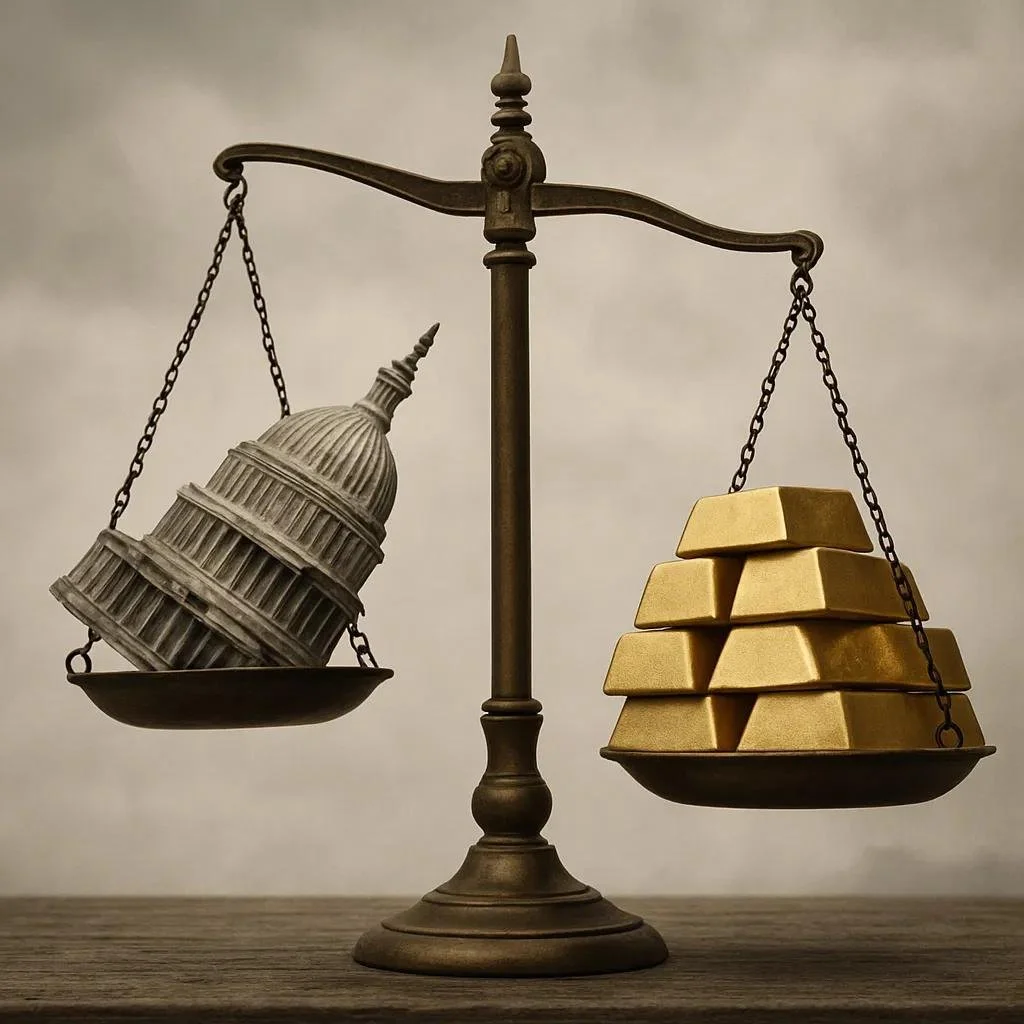
But today is also the end of the fiscal year. And based on the data, we can see that the US will end the fiscal year with around $37.5 trillion in debt. That means, for Fiscal Year 2025, the debt will have increased by another $1.8 trillion.
Taken as a whole, this is an obvious testament to why foreign governments and central banks are rapidly losing confidence in the US government.
It doesn’t even matter whether the government shuts down tonight— it is the fact that it always comes so close. That Congress can’t even manage to pass a basic budget.
And the “solution” on the table is just another short-term patch— a continuing resolution that keeps the government funded for less than two months, until November 21st.
America looks like exactly what it is: a dysfunctional government that can’t even pass a budget.
Frankly, it’s embarrassing.
On top of that, you’ve got this $37.5 trillion debt growing by leaps and bounds—faster than the US economy and faster than tax revenue.
At a certain point, these foreign governments and central banks, who collectively own trillions upon trillions of dollars worth of US government bonds, start wondering: why should I continue to own these securities? Why continue to lend money to the US government?
They can’t even pass a routine budget, let alone the kind of budget that would actually reassure foreign governments and central banks—a truly controversial one that makes deep, necessary cuts to runaway spending.
Then there’s another problem—one that isn’t new. It started under the Bush administration, Obama elevated it, and Biden perfected it: the weaponization of the US dollar, the financial system, and US Treasury bonds.
This gives foreign governments and central banks obvious concern: if they do something the US doesn’t like, they’re going to be frozen out of the dollar system—out of their Treasury holdings, and out of dollar-denominated assets altogether.
And these are all reasons why we believe, over the long run, gold will continue to march higher: central banks will continue to buy gold as an alternative to US dollars.
Why gold?
It’s an independent asset. It’s not controlled by any government. No country is worried that America will freeze its gold holdings. Millions of troy ounces of bars and bullion stored around the world can’t be frozen with the click of a button.
Gold is universally accepted by every other country and central bank. There’s a global market for it. And it’s an asset class large enough to absorb billions of dollars— or even tens, or hundreds of billions—over time.
You can’t say that about most other asset classes.
Gold has already had an astonishing run—especially this year. But we think that, over the long run, as more foreign central banks allocate an increasing percentage of their strategic reserves into gold instead of dollars, that excess demand will continue to push the gold price much higher.
Gold is like anything else—subject to the laws of supply and demand. Demand for physical gold by governments and central banks around the world has been very strong.
And based on the data we’re seeing, that continues to be the case.
The Chinese central bank has bought another 21 tons of gold this year, marking ten consecutive months of purchases.
And it’s not just China. It’s all over the world— Poland, Turkey, Czech Republic, Kazakhstan and many other countries are buying literal tons of gold.
In fact, 95% of central bank reserve managers said they expect global official gold holdings to increase over the next 12 months, according to the 2025 World Gold Council Central Bank Gold Reserves Survey.
There are, however, short-term price risks. For example, the gold price is also impacted by demand for jewelry, as well as industrial use.
Given current record-high prices, jewelry demand is much weaker.
And that can have an adverse impact on gold prices.
Another factor to consider is supply. At a certain point, mining companies are going to take advantage of these high prices and ratchet up production, eventually resulting in oversupply in the market. That, too, could weigh on gold prices.
But we think these are shorter-term factors that don’t change anything about the long-term driver of gold prices—and that is central bank demand.
What we are seeing literally today— government shutdowns and $1.8 trillion deficits—just underscores how widespread that central bank demand is—and why it simply isn’t going away.
To your freedom, James Hickman Co-Founder, Schiff Sovereign LLC
PS: While gold has hit all time highs, the share prices of many top quality gold producers has lagged far behind. That is starting to change, but there is still opportunity before the gap closes.
Seeds of Wisdom RV and Economics Updates Wednesday Afternoon 10-1-25
Good Afternoon Dinar Recaps,
BRICS Dollar Devaluation Path Strengthens With New Payment Systems
As BRICS builds alternative payment rails and leans on gold reserves, the move toward a multipolar financial order accelerates — with profound geopolitical and economic consequences.
Good Afternoon Dinar Recaps,
BRICS Dollar Devaluation Path Strengthens With New Payment Systems
As BRICS builds alternative payment rails and leans on gold reserves, the move toward a multipolar financial order accelerates — with profound geopolitical and economic consequences.
Payment Infrastructure Advances: Beyond Talk to Action
BRICS is pushing forward with BRICS Pay, a decentralized cross-border payment messaging system designed to bypass Western-controlled networks like SWIFT, allowing member nations to transact in local currencies.
During the Rio de Janeiro deliberations, the bloc proposed a guarantee fund to support local payments and integrate them into BRICS Pay.
These systems aren’t theoretical — they are intended to make dollar-free trade routable, reliable, and scalable across BRICS and select partner states.
De-Dollarization Backed by Gold & Local Currency Trade
🔹 Gold as a Pillar
BRICS nations now hold over 6,000 tons of gold — nearly 20–21% of global central bank reserves. Russia and China lead, owning ~74% of the bloc’s gold reserves.
The gold buffer acts as a shield against sanctions, dollar volatility, and external pressure while anchoring confidence in new payment systems.
🔹 Local Currency Settlement
Trade between BRICS nations increasingly uses national currencies instead of the U.S. dollar, reducing the need for dollar liquidity or FX hedging.
The New Development Bank (NDB) now plans to issue its first Indian rupee-denominated bond, aiming to raise ~$400–$500 million in India, as part of a strategy to internationalize BRICS member currencies.
Challenges & Friction in the Shift
🔹 Institutional & Network Effects
The U.S. dollar remains deeply entrenched in global trade: used in nearly 90% of FX trades and ~48% of SWIFT payments.
De-dollarization faces headwinds: liquidity fragmentation, exchange risk, and the higher cost of managing multiple currency rails.
🔹 Uneven Commitment Among Members
India has publicly stated de-dollarization is “not part of India’s financial agenda”, emphasizing bilateral local-currency trade instead.
Some BRICS members remain wary of overextending—too rapid a shift could destabilize economies, especially those with debt pegged to USD or who still rely heavily on U.S. trade and investment.
How This Fits Into Broader Global Restructuring
🔹 Redistribution of Financial Power
By operating an independent payment network and backing it with gold, BRICS is carving out financial sovereignty zones less subject to U.S. pressure or SWIFT control.
🔹 Erosion of Dollar Leverage
As BRICS transactions move off dollar rails, demand for USD as a settlement, reserve, and liquidity asset may decline — weakening the mechanisms by which the U.S. exerts financial influence.
🔹 Multipolar Payment Networks
Instead of one monolithic financial system, we may see overlapping networks (BRICS Pay, CIPS, mBridge, regional CBDC links), each with their own control nodes, rules, and dominant currencies. The world becomes less unified and more plural in financial architecture.
🔹 Gold & Currency Strategy as Influence Tools
Holding gold gives BRICS credibility; issuing debt in local currencies gives them leverage. These instruments become tools of diplomacy and alignment, not just balance sheet items.
Key Takeaway
BRICS is not just talking about breaking dollar dominance — it is constructing the alternatives. Payment systems, gold reserves, and currency internationalization converge in a push to remake global finance. What once seemed speculative is now engineering realignment of power.
This is not just politics — global finance restructuring before our eyes.
@ Newshounds News™ Exclusive
Sources:
Watcher.Guru – BRICS Dollar Devaluation Path Strengthens With New Payment Systems Watcher Guru
InvestingNews – How Would a New BRICS Currency Affect the US Dollar? Investing News Network (INN)
Nestmann – The BRICS De-Dollarization & What It Means for Gold The Nestmann Group
Brasil de Fato – BRICS leaders propose alternative payment system to SWIFT Brasil de Fato
Reuters / News – BRICS-backed NDB plans first rupee-denominated bond Reuters
Wikipedia – BRICS Pay Wikipedia
Carnegie / Policy analyses – Challenges to de-dollarization and structural headwinds CIRSD
Additional academic insight – Geopolitical Tensions & Financial Networks: Strategic Shifts Toward Alternatives arXiv
~~~~~~~~~
Seeds of Wisdom Team RV Currency Facts Youtube and Rumble
Newshound's News Telegram Room Link
Follow the Gold/Silver Rate COMEX
Follow Fast Facts
Seeds of Wisdom Team™ Website
Thank you Dinar Recaps
Urgent Breaking News Currency Exchange, IQD Value Increase to 1303
Urgent Breaking News Currency Exchange, IQD Value Increase to 1303
Edu Matrix: 9-30-2025
For years, analysts and investors eyeing exotic currencies have focused on regions struggling with geopolitical instability, searching for the elusive “buy low, sell high” opportunity.
While much of this conversation centers on nations like Iraq, a recent compelling analysis from the Edu Matrix channel shifts the spotlight dramatically to South America, suggesting that Venezuela’s currency could be positioned for a stunning revival.
In a thought-provoking video, Edu Matrix host Sandy Ingram draws a powerful historical parallel, comparing Venezuela’s current state of economic turmoil not to the instability of Iraq, but to the remarkable financial revitalization of Panama in the late 1980s and early 1990s.
Urgent Breaking News Currency Exchange, IQD Value Increase to 1303
Edu Matrix: 9-30-2025
For years, analysts and investors eyeing exotic currencies have focused on regions struggling with geopolitical instability, searching for the elusive “buy low, sell high” opportunity.
While much of this conversation centers on nations like Iraq, a recent compelling analysis from the Edu Matrix channel shifts the spotlight dramatically to South America, suggesting that Venezuela’s currency could be positioned for a stunning revival.
In a thought-provoking video, Edu Matrix host Sandy Ingram draws a powerful historical parallel, comparing Venezuela’s current state of economic turmoil not to the instability of Iraq, but to the remarkable financial revitalization of Panama in the late 1980s and early 1990s.
This isn’t just speculation; it’s an analysis based on economic mechanisms and the critical role of trust in driving currency valuation.
Venezuela’s economy has been ravaged by years of hyperinflation, sanctions, and political paralysis. Yet, Sandy Ingram argues that this exact environment—extreme devaluation coupled with massive underlying assets—is what creates the most asymmetric financial opportunity.
In 1989, following the U.S. arrest of Panamanian leader Manuel Noriega, the country experienced a profound regime change. This political shift had an immediate and immense financial consequence: trust was restored.
Prior to the arrest, citizens and investors had withdrawn significant funds due to instability. Once the political climate stabilized, confidence surged. Sandy Ingram highlights that Panamanians instantly began depositing billions of U.S. dollars back into the country’s banks.
This sudden influx of capital was transformative. It empowered Panama’s central bank, stabilized the financial system, and ignited a rapid economic revival. Crucially, those who had held faith in the nation’s currency during the depths of the crisis were the primary beneficiaries of the subsequent rebound.
Sandy Ingram contrasts this Panamanian success story with the challenges faced by nations like Iraq. While Iraq has experienced periods of stabilization, widespread distrust in its banking system and government has prevented similar massive capital inflows, thus hindering quick, sustained currency stabilization.
Like Panama prior to 1989, Venezuela is currently suffering from a deep crisis of confidence. But the moment a definitive shift in governance or stabilization occurs, the mechanism is expected to mirror the Panamanian experience. Citizens and international investors holding U.S. dollars would likely repatriate capital into the country, depositing funds into the now-trusted banking system.
This sudden, massive capital—measured in billions—would give the central bank the necessary leverage to stabilize the local currency and rapidly spur economic activity.
The foundation of any successful long-term currency rebound is underlying national wealth. In this regard, Venezuela stands apart. Sandy Ingram points out that Venezuela possesses enormous proven oil reserves—reported to be even larger than those in Iraq.
This vast resource base acts as a powerful financial ballast. While political turmoil can suppress the value of the currency, these assets remain fundamental to the country’s long-term viability. As soon as the investment climate improves, these reserves will attract significant foreign direct investment, fueling the currency’s rise.
The Edu Matrix video emphasizes that for investors interested in exotic currencies, the time to conduct research is now, while the Venezuelan currency remains severely undervalued and the economic situation appears darkest.
The investment thesis is clear: Positioning now means buying the currency when the risk is known and priced in, anticipating the potential for a massive, asymmetric payoff once political and banking trust is restored.
This is not a prediction of when a regime shift or stabilization will occur, but an analysis of what will happen financially once it does. If Venezuela follows the Panama blueprint—restored trust leading to massive capital inflow—its currently struggling currency could be one of the most promising exotic currency opportunities available today.
Seeds of Wisdom RV and Economics Updates Wednesday Morning 10-1-25
Good Morning Dinar Recaps,
Day One of a U.S. Government Shutdown — What It Signals for Global Power and Finance
As federal operations grind to a halt, the shockwaves go beyond Washington — this moment may accelerate how capitals, markets, and alliances recalibrate.
Good Morning Dinar Recaps,
Day One of a U.S. Government Shutdown — What It Signals for Global Power and Finance
As federal operations grind to a halt, the shockwaves go beyond Washington — this moment may accelerate how capitals, markets, and alliances recalibrate.
What We Know: Shutdown Begins Amid Deep Political Divide
On October 1, 2025, the U.S. government entered a shutdown after Republicans and Democrats failed to reach agreement on a $1.7 trillion funding package, with healthcare subsidies among the core conflicts.
The shutdown is the 15th since 1981, but this one carries added weight: President Trump is pushing aggressive restructuring of the federal workforce and government programs.
Immediate effects include:
▪️ Federal employees furloughed without pay, while some on administrative leave had already been paid through the end of September.
▪️ Military personnel, research programs, air travel, and social services disrupted or delayed.
▪️ Analysts estimate a $400 million per day cost, spotlighting the economic stakes.
Political Context & Risks
The impasse reflects intense polarization: Republicans frame the shutdown as leverage to force concessions, especially over government size; Democrats call the tactic reckless.
Public opinion is fractured — the political gamble is that no one wants to “lose” by appearing weak.
Longer shutdowns risk eroding confidence: businesses, foreign governments, and markets may begin to question U.S. reliability as a stable economic anchor.
How This Connects to Global Restructuring
🔹 Institutional Fragility & Credibility
When the U.S.—long seen as a bastion of institutional continuity—allows a shutdown to paralyze parts of government, it weakens perceptions of its capacity to govern. That perception shift can shift financial flows, risk assessments, and alliances.
🔹 Capital Flight & Market Volatility
Uncertainty spurs capital movements. Investors may retreat from U.S. treasuries or dollar exposures, pushing them toward alternative safe havens, gold, or non-dollar debt instruments.
🔹 Power Vacuums & Alternative Financial Systems
A distracted U.S. may signal opportunity to China, BRICS, and others to deepen parallel institutions, trade blocs, and currency alternatives while U.S. domestic focus is on internal strife.
🔹 Debt & Fiscal Stress Amplified
Already burdened by a $37.5 trillion national debt, a shutdown reduces revenue, increases borrowing costs, and tightens the margin for maneuver. Other nations watching may accelerate their own strategic alternatives.
Key Takeaway
Day one of the U.S. shutdown is more than a domestic political crisis — it’s a structural stress test of America’s global role. As institutions slow, markets tremble, and credibility cracks, the architecture of global finance and power tilts ever more toward a multipolar future.
This is not just politics — it’s global finance restructuring before our eyes.
@ Newshounds News™ Exclusive
Sources:
Modern Diplomacy – U.S. Government Shutdown Begins Amid Deep Political Divide Modern Diplomacy
(Contextual references from institutional debt trends, global risk assessment, and comparative reaction patterns)
Russia’s Nuclear Technology Playbook for the Global South
By providing reactors, training, and financing, Russia is positioning itself as an energy patron — a role with geopolitical weight and financial leverage in the multipolar era.
Russia’s Strategy in the Global South
Russia is promoting its nuclear technology as a tool for long-term development and energy security, presented as low-carbon, stable power for growing economies.
At the Global Atomic Forum (part of World Atomic Week), President Putin emphasized shifting public attitudes toward nuclear energy and the expanding view of nuclear power as a developmental necessity rather than a niche or controversial option.
Russia’s pitch is holistic: not just building reactors, but offering complete packages—fuel supply, waste management, staff training, financing, and local industry development.
Russia recently formalized a planning agreement with Ethiopia to build a nuclear plant, including roadmap development and technical capacity building.
Challenges and Resistance
🔹 Technical, safety & regulatory hurdles
New nuclear projects require rigorous oversight, often needing alignment with the International Atomic Energy Agency (IAEA) standards. Some partner countries lack regulatory infrastructure.
Public skepticism and concerns about cost overruns, radioactive waste, and nuclear accidents remain major political obstacles.
🔹 Competition & donor dependence
Several global and regional actors—China, France, the U.S.—compete for influence through conventional energy projects (renewables, gas), which may appear safer or more politically acceptable.
Countries relying on Russian nuclear assistance may become dependent on Russian supply chains, maintenance, and economic terms, giving Moscow leverage in diplomacy, trade, or sanctions evasion.
Restructuring Implications & Strategic Alignments
🔹 New Patronage Network
Russia is re-weaving relationships in the Global South by positioning itself as a strategic energy backer. These infrastructure ties often translate into political loyalty and alignment in voting blocs, trade agreements, and financial pacts.
🔹 Financing & Currency Anchors
Nuclear projects cost tens of billions. The financing machinery—loans, guarantees, supply chains—can be aligned with non-USD systems or tied to regional banking structures (e.g. BRICS or state development banks). This shifts capital flows and undermines dollar dominance.
🔹 Legitimacy Through Development
Russia frames its approach as cooperation, not domination. By helping energy-poor states industrialize, it gains moral and diplomatic soft power, contrasting its Western adversaries’ “conditional aid” narratives.
🔹 Energy Security & Geopolitical Leverage
States with shaky grid systems see nuclear power as strategic infrastructure. Russia supplying that infrastructure gives it leverage over energy dependency, supply interruptions, and bilateral influence in conflicts.
🔹 Multipolar Energy Order
As more nations look beyond Western energy firms for support and finance, the architecture of global energy and its financial backbone becomes more plural. Russia’s nuclear push is one axis of this shift.
Why This Matters
Russia’s nuclear diplomacy isn’t just technical or energy policy — it’s part of a reconfiguration of global power and finance. By embedding itself into the energy systems of developing states, Russia secures influence, builds financial dependencies outside Western structures, and accelerates the move toward a more pluralistic global order.
This is not just politics — global finance restructuring before our eyes.
@ Newshounds News™ Exclusive
Sources:
Modern Diplomacy – Russia’s Nuclear Technology Playbook for the Global South Modern Diplomacy
OrePulse – Russia’s Nuclear Energy Advocacy & Partnerships Ore Pulse
Reuters – Russia, Ethiopia sign document calling for construction of nuclear plant Reuters
Chatham House – Russia using Soviet playbook to de-Westernize global order Chatham House
Forbes – Rosatom’s nuclear deals as geopolitical advantage Forbes
CSIS – Reactions in Global South to Russian nuclear threats CSIS
Financial Times – Russia ambitions to lead global nuclear projects Financial Times
Stablecoins Under Fire: U.S. Tokenization Push vs. EU Multi-Issuance Ban Threat
The tug of war over stablecoins in the U.S. and Europe reflects how the next chapter of money is being written — and who will control the rails, rules, and power behind it.
U.S. Moves: Tokenization & Regulatory Softening
The SEC is exploring allowing blockchain-based versions of stocks (tokenized equities) to trade on crypto exchanges, signaling more openness to merging traditional finance with digital finance.
Nasdaq has formally asked the SEC for a rule change to permit regulated exchanges to trade tokenized stocks under equivalent execution and documentation rules.
Separately, SEC staff signaled they will not recommend enforcement action for advisers using state trust companies to custody crypto when certain safeguards are met.
These developments suggest the U.S. is actively pushing the boundary on tokenization and asset digitization — potentially positioning itself as the regulatory anchor for future digital-asset finance.
Europe’s Pushback: Ban on Multi-Issuance Stablecoins
The European Systemic Risk Board (ESRB) recommended a ban on “multi-issuance” stablecoins (i.e. stablecoins issued jointly across borders or jurisdictions) to prevent financial stability risks.
The ESRB flagged concerns about liquidity mismatches: in a stress event, investors may all redeem stablecoins in jurisdictions with stronger protections, straining those reserves.
The European Central Bank (ECB) and other bodies are pushing for strong equivalence regimes so foreign stablecoin issuers must meet EU regulatory standards — particularly around reserve backing, redemption rights, and cross-border operations.
This is part of a broader concern: the EU wants to guard its financial space from unregulated dollar-pegged tokens like USDC or USDT, whose issuers lie mostly beyond EU control.
How These Developments Fit Into Global Restructuring
🔹 Competing Visions for Money & Authority
The U.S. approach leans toward innovation + regulatory clarity, enabling tokenization of assets and digital finance expansion. Europe's approach leans toward caution + containment, particularly for cross-border or non-EU issuance. These contrasting strategies show a struggle over who defines the rules of digital money.
🔹 De-Dollarization & Currency Alternatives
If Europe restricts dollar-pegged stablecoins, it may accelerate adoption of euro-backed digital currencies or stablecoins issued under EU rules — thereby weakening the dominance of dollar-based tokens in European markets.
🔹 Rail Control & Financial Infrastructure
Stablecoin issuance models define who controls the rails: who mints, redeems, oversees reserves, settles cross-border flows. As the U.S. advances tokenization and Europe clamps down on cross-jurisdiction issuance, the contest is over which financial infrastructures will prevail in the new era.
🔹 Sovereignty, Compliance & Risk
Countries will favor stablecoin networks they can regulate, supervise, and audit. Issuers with multi-jurisdiction models may lose access or be forced to fragment operations. This pressures stablecoin companies to localize — reinforcing multipolar financial architectures.
Key Takeaway
The stablecoin battleground isn’t just technical — it’s a frontline in redefining money, power, and financial sovereignty. U.S. regulatory openings and EU tightening are not just policy moves — they are structural shifts that determine who controls the next generation of money systems.
This is not just politics — global finance restructuring before our eyes.
@ Newshounds News™ Exclusive
Sources:
Cointelegraph – SEC weighs plan to allow blockchain-based stock trading Cointelegraph
Cointelegraph – EU watchdog pushes stablecoin ban: Report Cointelegraph
Reuters / news – European banks form company to launch euro stablecoin Reuters
PYMNTS – ECB Seeks Ban on Multi-Issuance Stablecoins PYMNTS.com
FinanceFeeds – EU Regulator Weighs Ban on Circle, Paxos Stablecoins FinanceFeeds
Other references: Nasdaq’s rule change request Cointelegraph; SEC custody openness Cointelegraph
~~~~~~~~~
Seeds of Wisdom Team RV Currency Facts Youtube and Rumble
Newshound's News Telegram Room Link
Follow the Gold/Silver Rate COMEX
Follow Fast Facts
Seeds of Wisdom Team™ Website
Thank you Dinar Recaps
What Happens When The Government Shuts Down?
What Happens When The Government Shuts Down?
Raquel Coronell Uribe Tue, September 30, 2025 NBC News
The federal government shut down Wednesday after lawmakers left the Capitol without passing a funding bill. Agencies and departments have issued guidance in recent days on what to expect when the money runs out.
Here’s what will happen during the shutdown.
What Happens When The Government Shuts Down?
Raquel Coronell Uribe Tue, September 30, 2025 NBC News
The federal government shut down Wednesday after lawmakers left the Capitol without passing a funding bill. Agencies and departments have issued guidance in recent days on what to expect when the money runs out.
Here’s what will happen during the shutdown.
How does a shutdown affect the military?
The majority of veteran benefits and military operations will continue to be funded regardless of a shutdown. However, pay for military and civilian workers will be delayed until a funding deal is reached, forcing them to continue their duties without pay.
Military personnel on active duty, including active guard reserves, will continue their duty. However, no new orders may be issued except for extenuating circumstances — such as disaster response or national security. Some National Guard members serving through federal funding could have their orders terminated unless performing an essential duty.
The Department of Veterans Affairs said it expects 97% of its employees to work, though regional offices will be closed. Some death benefits, such as the placement of permanent headstones at VA cemeteries, and ground maintenance, will cease. Also affected will be communication lines, including hotlines, emails, social media and responses to press inquiries.
How is air travel affected?
Air traffic control services will continue, allowing for 13,227 air traffic controllers to work through a shutdown — but without pay until the government is funded again. Other essential activities, such as the certification and oversight of commercial airplanes and engines will continue, as will limited air traffic safety oversight.
However, the Department of Transportation will stop air traffic controller hiring, field training of air traffic controllers, facility security inspections and law enforcement assistance support.
In a letter Monday, a coalition of aviation groups urged Congress to avoid a shutdown, saying funding lapses will hurt the Federal Aviation Administration. The letter cited the furloughing of many FAA employees, and said the ceasing of funding could create backlogs that will create delays in critical FAA services “long after funding resumes.”
“While air traffic controllers, technicians and other excepted aviation safety professionals will continue to work without pay, many of the employees who support them are furloughed, and the programs that the FAA uses to review and address safety events are suspended. To remain the world leader in aviation, we must continue to strive to improve efficiency and further mitigate risk,” the aviation groups wrote.
Will Social Security checks still go out?
Social Security benefits, considered mandatory under law, will continue regardless of a shutdown, so recipients can expect to continue receiving their payments. However, the Social Security Administration could face a furloughed workforce. Fewer workers could mean that processing new Social Security applications could be delayed.
How does the shutdown affect the Department of Health and Human Services?
TO READ MORE: LINK