
Thank you to all the subscribers to our Early Access program…we thank you for your continued support.
We are excited to offer this new service to keep you informed and up-to-date on the latest Dinar and currency news.
“Tidbits From TNT” Friday 9-26-2025
TNT:
Tishwash: Breakthrough Oil Export Deal in Iraqi Kurdistan: A New Dawn for Crude Flow
International oil companies in Iraqi Kurdistan have reached an agreement with Iraqi federal and Kurdish governments to resume oil exports. The framework, once signed, will allow for the export of 230,000 barrels per day through the Iraq-Turkey pipeline, suspended since March 2023. DNO and Genel Energy are yet to sign.
In a significant development, international oil companies operating in Iraqi Kurdistan have reached a preliminary deal with both the Iraqi federal and Kurdish regional governments to restart oil exports. This move comes after extensive negotiations, according to an IOC statement seen by Reuters.
TNT:
Tishwash: Breakthrough Oil Export Deal in Iraqi Kurdistan: A New Dawn for Crude Flow
International oil companies in Iraqi Kurdistan have reached an agreement with Iraqi federal and Kurdish governments to resume oil exports. The framework, once signed, will allow for the export of 230,000 barrels per day through the Iraq-Turkey pipeline, suspended since March 2023. DNO and Genel Energy are yet to sign.
In a significant development, international oil companies operating in Iraqi Kurdistan have reached a preliminary deal with both the Iraqi federal and Kurdish regional governments to restart oil exports. This move comes after extensive negotiations, according to an IOC statement seen by Reuters.
The agreed-upon framework will enable exports to resume "in the coming days" following its official signing and implementation. However, oil companies DNO and its partner Genel Energy have yet to formalize their participation, as reported by a reliable source with direct information on the matter.
The agreement, once fully executed, will facilitate the flow of approximately 230,000 barrels of crude daily through the Iraq-Turkey pipeline, a crucial artery that has been non-operational since March 2023. Efforts to reach DNO and Genel Energy for comments were not immediately successful. link
************
Tishwash: Miles Caggins: The Kurdistan Regional Government will export 230,000 barrels of oil per day.
Miles Caggins, spokesman for the Kurdistan Region's Petroleum Industry Association (APICOR), said on Thursday that today is a very important day. An agreement has been signed to resume oil exports, and the process is scheduled to begin in the next few days.
In an interview with Kurdistan 24, he added that exports are expected to begin within two or three days.
He pointed out that, according to the agreement, the Kurdistan Regional Government will export 230,000 barrels of oil per day through SOMO, while 50,000 to 60,000 barrels will be allocated for domestic consumption.
In the same context, the Kurdistan Region's Oil Industry Association (APICOR) said on Thursday that resuming oil exports from the region will contribute to strengthening global energy markets.
On the occasion of the tripartite agreement to resume exports, the association commended, in a statement, Kurdistan Regional Government Prime Minister Masrour Barzani and Federal Prime Minister Mohammed Shia al-Sudani.
APICORP emphasized that the resumption of Kurdistan Region oil exports will benefit all Iraqis and will play a role in supporting the position of global energy markets. It is expected that exports will begin within the next few days.
The Federal Ministry of Oil announced today, Thursday, an agreement stipulating the commencement of pumping and delivering all crude oil produced from the Kurdistan Region's fields, except for the quantities allocated for domestic consumption, to the State Oil Marketing Organization (SOMO), which will export it via the Iraq-Turkey pipeline via the Turkish port of Ceyhan.
The ministry indicated that the agreement was concluded in accordance with the approved legal procedures, the constitution, the provisions of the Federal General Budget Law, and Federal Court decisions.
The Ministry reiterated its unwavering commitment to managing oil resources in accordance with the principles of national sovereignty and the country's supreme interest, ensuring a fair distribution of wealth among all Iraqis, in accordance with the constitution. link
************
Tishwash: Vietnamese, Iraqi Presidents hail development of bilateral ties
President Cường affirmed that Việt Nam always treasures and wishes to strengthen multifaceted cooperation with Iraq, particularly in the areas of economy, trade, culture, tourism, and people-to-people exchanges.
Vietnamese President Lương Cường and his Iraqi counterpart Abdul Latif Rashid praised the progress of their countries’ long-standing friendship during a meeting in New York on the morning of Wednesday (local time).
The event took place on the sidelines of the High-Level General Debate of the 80th Session of the United Nations General Assembly and bilateral activities in the US.
President Cường affirmed that Việt Nam always treasures and wishes to strengthen multifaceted cooperation with Iraq, particularly in the areas of economy, trade, culture, tourism, and people-to-people exchanges.
He proposed increasing delegation exchanges, especially business missions, to explore cooperation opportunities in potential sectors and boost access to the Halal market.
He also expressed his hope that Iraq will create favourable conditions for Vietnamese enterprises to invest in areas aligned with Iraq’s reconstruction needs.
For his part, the Iraqi leader expressed admiration for Việt Nam’s achievements in national development, stressing that Iraq views Việt Nam as an important partner and wishes to advance cooperation in economy, trade, investment, water management, agriculture, and infrastructure development serving its reconstruction.
Both sides agreed to further improve the effectiveness of existing bilateral cooperation mechanisms, and consider the establishment of new ones and the signing of agreements in potential sectors.
On this occasion, the two leaders also consented to step up cooperation and mutual support at multilateral forums.
President Cường extended an invitation to President Abdul Latif Rashid to visit Việt Nam and attend the signing ceremony of the United Nations Convention against Cybercrime in Hà Nội next month. link
************
Mot: Now Ya Knows -- WHY!!!! ~~~~

Mot: . Give it a Try!!! -- It Might Work fer YOU Too!!!!

Seeds of Wisdom RV and Economics Updates Friday Morning 9-26-25
Good morning Dinar Recaps,
Trump Draws Line: No West Bank Annexation for Israel
Trump’s rejection of annexation signals both geopolitical pressure and financial recalibration, tying peace to the foundations of global restructuring.
Trump’s Firm Declaration
U.S. President Donald Trump delivered a clear message on September 25, 2025: he would not permit Israel to annex the West Bank, defying the demands of far-right members of Israeli Prime Minister Benjamin Netanyahu’s coalition.
Good Morning Dinar Recaps,
Trump Draws Line: No West Bank Annexation for Israel
Trump’s rejection of annexation signals both geopolitical pressure and financial recalibration, tying peace to the foundations of global restructuring.
Trump’s Firm Declaration
U.S. President Donald Trump delivered a clear message on September 25, 2025: he would not permit Israel to annex the West Bank, defying the demands of far-right members of Israeli Prime Minister Benjamin Netanyahu’s coalition.
“Not going to happen” — From the Oval Office, Trump stated: “I will not allow Israel to annex the West Bank. Nope, I will not allow it. It’s not going to happen.” [Reuters]
“Time to stop now” — He added: “There’s been enough. It’s time to stop now.”
This puts Trump directly at odds with Netanyahu’s coalition, where annexation has become a rallying cry — especially following recent moves by France and other Western countries to recognize a Palestinian state [NYT].
Context and Regional Pressure
Arab leaders’ influence: Trump’s declaration followed private assurances he made to Arab and Muslim leaders on the sidelines of the United Nations General Assembly. Officials reportedly warned that annexation would jeopardize regional stability and block future integration with Israel [Politico].
International Court of Justice: In July 2024, the ICJ ruled Israeli settlements in the West Bank illegal, increasing global legal and diplomatic pressure on Israel.
U.S. leverage: As Israel’s closest ally, the U.S. remains one of the only nations with real leverage to block annexation. Observers question, however, whether Trump’s stance will remain firm [Al Jazeera].
Strategic Calculations
Netanyahu’s bind: Netanyahu must balance between his far-right coalition partners demanding annexation and the U.S. position that firmly blocks it.
Trump’s peace agenda: This statement aligns with Trump’s push for a 21-point regional peace plan to end the war in Gaza and establish a framework for postwar governance.
Signal to financial reset watchers: Just as Jim Pugh recently noted in reset discussions — peace is the “long pole in the tent” before financial restructuring can move forward — Trump’s rejection of annexation is not just political. It is about creating the geopolitical stability required for economic and monetary realignment.
Why This Matters
Trump’s decision highlights how geopolitics and financial restructuring are inseparably linked:
Peace as a prerequisite: Blocking annexation is part of ensuring the region moves toward peace treaties — which reset analysts say are essential before any global monetary reset can proceed.
Regional integration = trade flows: If Israel can stabilize ties with Arab neighbors, trade, investment, and resource allocation in the Middle East become more predictable — a necessary step for capital flows in a tokenized, asset-backed system.
Dollar leverage at work: The U.S. is using political influence to maintain its strategic foothold in the Middle East, reinforcing the dollar’s role as tokenization and stablecoin regulation advance globally.
“This is not just politics — it’s global finance restructuring before our eyes.”
@ Newshounds News™ Exclusive
Source: Reuters, New York Times, Politico, Al Jazeera
~~~~~~~~~
Trump–Erdogan Talks: Turkey at the Center of Sanctions, Oil, and Global Realignment
The White House meeting underscored how U.S.–Turkey relations intersect energy security, defense sales, and the financial restructuring now reshaping global power.
Sanctions Relief and F-35s Back on the Table
President Donald Trump and Turkish President Recep Tayyip Erdogan met in Washington on September 25, 2025, marking Erdogan’s first White House visit in six years. Trump suggested he may lift U.S. sanctions on Turkey “almost immediately” if Ankara halts Russian oil purchases, paving the way for Turkey’s potential re-entry into the F-35 fighter jet program. Reuters
The move represents a sharp reversal of earlier policy, where Turkey was expelled in 2019 after acquiring Russian S-400 missile systems. Erdogan framed the meeting as “conclusive,” while Trump indicated that Ankara could soon access advanced U.S. defense hardware once again. Politics Today
Russian Oil Purchases at the Core
At the heart of the talks was Turkey’s role as one of the largest buyers of Russian energy. Trump pressed Erdogan to cut these imports, presenting it as a way to undermine Moscow’s war financing while simultaneously strengthening U.S.–Turkey ties.
Although Turkey recently inked a 20-year LNG deal with U.S. supplier Mercuria, it remains heavily reliant on Russian oil and gas. Erdogan’s willingness to diversify reflects the strategic balancing act between East and West. Atlantic Council
Middle East, Syria, and Gaza as Leverage Points
Beyond oil and defense, Trump and Erdogan also discussed conflicts in Syria and Gaza, with Trump signaling that Erdogan could serve as an intermediary in Ukraine peace efforts. Both leaders emphasized their renewed alignment on Syria, reversing tensions from earlier years. Brookings
Why This Matters: Energy and Finance Intertwined
Turkey’s position illustrates how geopolitical bargaining over oil, arms, and sanctions is directly shaping the global financial restructuring. Ankara’s choices ripple through:
Dollar hegemony – Will Turkey pivot toward U.S. LNG and defense deals, reinforcing Washington’s influence?
BRICS alternatives – Or will Turkey hedge by maintaining Russian oil ties, deepening its energy and trade links with Eurasian powers?
This episode highlights the fragility of U.S. dominance and how energy flows, sanctions relief, and military sales are becoming financial levers in the global order.
This is not just politics — it’s global finance restructuring before our eyes.
@ Newshounds News™ Exclusive
Sources: Reuters, Atlantic Council, Brookings, Politics Today, U.S. News
~~~~~~~~~
Trump and Pakistan: A Strategic Reset at the Edge of Energy and Finance
Trump’s outreach to Islamabad signals a deeper recalibration: holding Pakistan in the balance between dollar-based alliances and emerging non-Western financial orders.
Sharif’s White House Visit and U.S.–Pakistan Rapprochement
President Donald Trump hosted Pakistani Prime Minister Shehbaz Sharif at the White House on September 25, 2025, marking a thaw in U.S.–Pakistan relations. The meeting underscored Washington’s renewed interest in Pakistan’s strategic value. AP News, Reuters
Sharif used the visit to pitch American investment in key sectors—energy, agriculture, tech, and mining—inviting U.S. firms to tap Pakistan’s untapped potential. Reuters, The Indian Express
Energy Deals & Export Leverage
A major opportunity lies in energy and resource diplomacy. Islamabad has long relied on oil imports and external financing, making it vulnerable to leverage.
Pakistan struck a landmark trade deal with the U.S. in July 2025 to develop its oil reserves and reduce tariffs, aligning Islamabad more closely with U.S. energy interests. AP News
During his visit, Sharif emphasized both energy and mining as pillars for renewed U.S.-led investment. AP News, Al Jazeera, Indiatimes
Crucially, on September 8, Islamabad signed memoranda of understanding (MoUs) with a U.S.-based firm to develop critical minerals and rare earth elements, framed as strategic assets for both parties. Al Jazeera
These steps suggest Pakistan is repositioning itself from being a resource consumer to a supplier in the U.S.-influenced global resource network—altering the flow of capital, energy, and leverage.
Defense, Security & Regional Mediation
The Trump–Sharif meeting also addressed security cooperation and regional mediation:
They discussed counterterrorism and security alignment, reinforcing Pakistan’s role as a regional partner. AP News
Sharif praised Trump’s mediation during recent India–Pakistan tensions and invited the U.S. to play a bigger diplomatic role in South Asia. AP News, AP News
Importantly, Pakistan may leverage its strategic weight in the Middle East and South Asia, offering Turkey-like potential as a mediator in Gaza, Syria, and the Indo-Pacific.
This engagement signals a shift: diplomatic influence is being balanced with resource and financial alignment, not just military dependence.
Between Dollar and De-Dollarization
Where Pakistan sets itself in this moment may determine its financial trajectory:
If Islamabad doubles down on U.S. energy, defense, and resource deals, it re-enters the dollar-aligned orbit with renewed leverage from Washington.
But the push to develop critical minerals and rare earths hints at an alternate path: integrate into non-dollar, resource-backed networks leveraged by China, Russia, or BRICS actors.
Pakistan’s pivot can influence whether it becomes a node in the new financial infrastructure emerging outside U.S. hegemony.
This choice is not just economic—it is deeply financial.
Why This Matters
The Trump–Pakistan meeting is more than diplomacy. It is a move in an evolving global chessboard where energy, security, and finance intertwine. Islamabad’s alignment might tip the balance between:
Reinforcing U.S.-led global financial structures
Or accelerating a transition toward a multipolar, resource-backed order
This is not just politics — it’s global finance restructuring before our eyes.
@ Newshounds News™ Exclusive
Sources: Reuters, AP News, Al Jazeera, Wikipedia, Indiatimes
~~~~~~~~~
CFTC Moves to Allow Stablecoins as Collateral in U.S. Derivatives Markets
With the CFTC embracing stablecoins and tokenized collateral, U.S. policy is shifting toward integrating crypto into core financial plumbing, reshaping how value is stored, settled, and regulated globally.
The Initiative: What’s Changing
The CFTC has officially launched an initiative to allow tokenized collateral (including stablecoins like USDC and Tether) for derivatives trading. CFTC
Acting Chair Caroline Pham invited public feedback, with comments open until October 20, 2025. CFTC
This builds on prior CFTC efforts—the Crypto CEO Forum, the Global Markets Advisory Committee’s (GMAC) Digital Asset Markets Subcommittee, and the President’s Working Group on Digital Asset Markets recommendations. CFTC, Cointelegraph
Key Elements & Stakeholder Reactions
Under the proposal, stablecoins and tokenized assets could be treated similarly to cash or U.S. Treasuries when used as collateral. Cointelegraph
Industry players — including Circle, Coinbase, Ripple, Crypto.com — praised the move. They argue that stablecoin collateral will lower costs, reduce risk, and unlock liquidity in derivative markets. Cointelegraph
The push complements recently passed legislation (GENIUS Act) which regulates stablecoins and lays groundwork for their broader use in regulated financial systems. Cointelegraph
Implications:How This Fits Into Global Finance Restructuring
Efficiency & Capital Utilization — Allowing stablecoins as collateral means firms and market participants can use digital assets to free up liquidity. This could redefine margin practices, reduce friction, and shift how capital is allocated internationally.
Regulatory Recognition of Crypto’s Role — The CFTC’s move signals that stablecoins are not seen merely as speculative assets but now as infrastructural elements of finance. This adds legitimacy and encourages cross-border usage in trade, clearing, and settlement.
Competition with Alternative Financial Systems — As BRICS and other nations build out non-dollar, commodity-backed, or gold-backed systems, U.S. acceptance of tokenized collateral strengthens the dollar/crypto hybrid model. It’s part of the tug-of-war over who sets standards for global finance.
Risk & Oversight Challenges — With greater integration comes greater risk exposure: valuation, reserve backing, custody, settlement, governance of these stablecoins must be regulated tightly. Otherwise, financial stability could be compromised.
Why This Matters
This initiative by the CFTC isn’t just technical policy—it reflects a turning point. The financial order is evolving: derivatives markets may soon operate on rails that accept digital collateral; stablecoins may serve core functions in financial infrastructure; regulation is catching up to innovation.
This is not just politics — it’s global finance restructuring before our eyes.
@ Newshounds News™ Exclusive
Sources: CFTC, CoinDesk, Cointelegraph, pymnts.com
~~~~~~~~~
Seeds of Wisdom Team RV Currency Facts Youtube and Rumble
Newshound's News Telegram Room Link
Follow the Gold/Silver Rate COMEX
Follow Fast Facts
Seeds of Wisdom Team™ Website
Thank you Dinar Recaps
It’s Like Buying Gold For $1,000 An Ounce
It’s Like Buying Gold For $1,000 An Ounce
Notes From the Field By James Hickman (Simon Black) September 25, 2025
Gold just hit another all-time high this week, briefly touching $3,800 per ounce... which means it has more than doubled in the last two years.
When any asset continues hitting all-time highs, most people who haven’t bought it yet naturally believe that they missed out... or that they should wait for a pullback.
Of course, many people believed that when gold hit $2,400 in spring of 2024... and then $2,800 early this year... and $3,400 in April.
It’s Like Buying Gold For $1,000 An Ounce
Notes From the Field By James Hickman (Simon Black) September 25, 2025
Gold just hit another all-time high this week, briefly touching $3,800 per ounce... which means it has more than doubled in the last two years.
When any asset continues hitting all-time highs, most people who haven’t bought it yet naturally believe that they missed out... or that they should wait for a pullback.
Of course, many people believed that when gold hit $2,400 in spring of 2024... and then $2,800 early this year... and $3,400 in April.
As gold has continued its rise, however, we continued to suggest that this is still early days... and that the gold price could continue to surge much, much higher.
It’s not hard to understand why.
Foreign governments and central banks around the world are rapidly losing confidence in the US government... and by extension, in the US dollar.
The national debt is $37.5 trillion and rising. Deficits total $2 trillion each year, and there seems to be no appetite to cut spending. Worst of all, Congress can’t even manage to pass a budget... risking yet another government shutdown at the end of this month.
If that weren’t bad enough, the US federal government has also gotten in the habit of freezing assets of any foreign country that it doesn’t like.
At the moment, those same foreign governments (and foreign central banks) hold trillions worth of US dollar assets. So naturally any sensible foreign official is thinking about diversifying away from the US, and from the US dollar.
Unfortunately there simply aren’t too many options. No one trusts the Chinese Communist Party, so the yuan is out. Europe is its own economic basket case, so euro-denominated assets and European government bonds are not much better.
Out of the universe of options available, gold is one of the few assets that can solve this problem for foreign governments and central banks.
Gold isn’t controlled by any single government. No one can freeze them out of their gold or confiscate their holdings. Gold will hold its value against inflation. And the gold market is large enough that sovereign nations can purchase hundreds of billions of dollars worth.
This is why gold is at an all-time high: foreign governments and central banks have been buying it by the metric ton. And that extreme gold demand has pushed prices higher and higher.
We have been talking about this for 2+ years, since gold was below $2,000. And throughout gold’s rise, we kept saying that this trend will continue, i.e. foreign governments and central banks will buy more.
We still believe this is true, especially if you have a longer-term view over the next few years.
But we also presented an alternative to gold.
We wrote that the main demand driver for gold was from central banks. But central banks only buy physical gold. They do not buy gold stocks.
And we pointed out that while gold was at all time highs, the share prices of companies producing the gold were ridiculously low.
In January, for example, one gold company we follow was trading at roughly 1x forward earnings.
And we practically screamed from the rooftops that this opportunity would not last— people would realize how undervalued these businesses were, while their revenue was literally denominated in gold at all time high prices.
Well, the gold companies’ earnings reports starting rolling in this year, and the market saw just how much money these companies were making.
Investors finally woke up. And by April, that same gold company had doubled its January share price— but was still only trading at about 2x earnings.
Gold kept ripping higher, and so did this company’s profits— after all, the cost to mine gold didn’t increase, and this company was still pulling it out of the ground for about $1,000 an ounce.
So its profit margin went from $800 per ounce two years ago, to over $2,500 per ounce today.
Production costs have been flat. But their revenue per ounce has soared, up 50% this year alone.
Now, it’s share price has doubled again— 4x higher than in January.
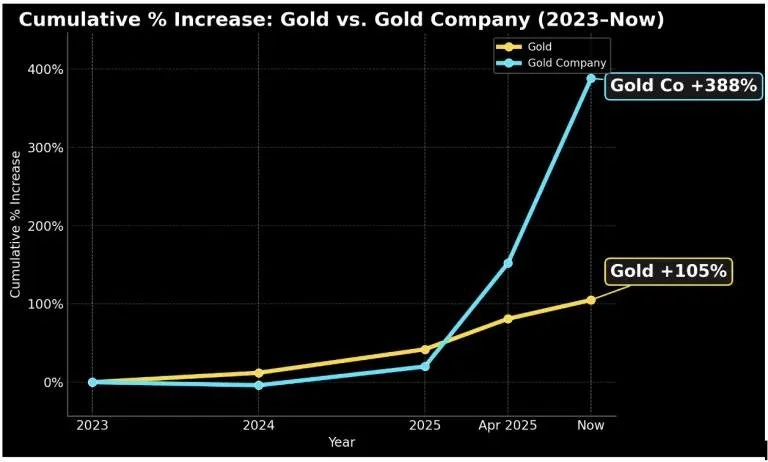
And next month it will release Q3 results, a period it could sell gold as high as $3,700 per ounce. Its profits could be simply ridiculous.
Here’s the crazy part: even though the share price has quadrupled this year, the company is making so much money that it is STILL only trading for 2x earnings.
Which is why we think, despite already multiplying by four this year, the share price is poised for even higher growth once Q3 earnings are released in a few weeks.
In other words, gold companies are STILL cheap compared to gold, and offer leverage beyond physical gold.
If you own shares in a company that can produce gold at $1,000 per ounce, in a way its like buying gold at $1,000 per ounce. And that’s a pretty fantastic deal these days.
Right now it’s still possible to buy into these gold companies at cheap valuations, delivering gains that could far outpace gold.
So we really want to encourage you to check out our premium investment research— it’s called The 4th Pillar, where we feature these undervalued gold companies... along with other real asset businesses ranging from silver to platinum to oil to industrial metals to agriculture.
Many of our picks are up 2-4x just this year alone, and based on our analysis, we think there’s scope for them to go much higher over the next few months based on Q3 earnings (which will be released in a few weeks).
We’re offering a limited time promotional discount to The 4th Pillar, along with our iron-clad money back guarantee. So definitely take a few minutes to learn more about it and consider joining.
To your freedom, James Hickman Co-Founder, Schiff Sovereign LLC
Debt Fiat System Is In Collapse As Gold Races Higher | Francis Hunt
Debt Fiat System Is In Collapse As Gold Races Higher | Francis Hunt
Liberty and Finance: 9-24-2025
Francis Hunt joins Liberty and Finance to share his latest outlook on gold and silver.
He explains that while both metals remain in a powerful long-term bull market, traders should expect a short-term pause after gold hit his key target near $3,769 and silver broke through the crucial $44 level.
Debt Fiat System Is In Collapse As Gold Races Higher | Francis Hunt
Liberty and Finance: 9-24-2025
Francis Hunt joins Liberty and Finance to share his latest outlook on gold and silver.
He explains that while both metals remain in a powerful long-term bull market, traders should expect a short-term pause after gold hit his key target near $3,769 and silver broke through the crucial $44 level.
Hunt highlights a massive cup-and-handle breakout in silver, projecting a long-term target of $330, though near-term pullbacks are possible.
He also warns that the global financial system is collapsing under debt and fiat debasement, with the dollar showing signs of temporary strength.
Ultimately, he stresses stacking physical metals while being prepared for a darker reset involving CBDCs and loss of freedoms.
INTERVIEW TIMELINE:
0:00 Intro
1:18 Gold & DXY
10:00 Silver
15:45 Debt crisis
25:00 Government control over currency
Seeds of Wisdom RV and Economics Updates Thursday Afternoon 9-25-25
Good Afternoon Dinar Recaps,
Pakistan and Vietnam Push Toward Preferential Trade Agreement
Islamabad and Hanoi are strengthening ties with a planned Preferential Trade Agreement (PTA) that could lift bilateral trade from under $1 billion to a $5 billion target.
Deepening Bilateral Relations
Pakistan and Vietnam have shared friendly diplomatic and trade ties since 1972, but relations have accelerated since the 2000s under Pakistan’s Vision East Asia strategy.
Good Afternoon Dinar Recaps,
Pakistan and Vietnam Push Toward Preferential Trade Agreement
Islamabad and Hanoi are strengthening ties with a planned Preferential Trade Agreement (PTA) that could lift bilateral trade from under $1 billion to a $5 billion target.
Deepening Bilateral Relations
Pakistan and Vietnam have shared friendly diplomatic and trade ties since 1972, but relations have accelerated since the 2000s under Pakistan’s Vision East Asia strategy.
Pakistan reopened its embassy in Hanoi in 2000; Vietnam followed with embassies and trade offices in Pakistan by 2005.
Leaders from both nations have exchanged visits, underscoring growing political and economic alignment.
Today, both countries are focused on expanding trade, investment, and security cooperation.
Vietnamese Ambassador Pham Anh Tuan recently emphasized at the Lahore Chamber of Commerce and Industry:
“Vietnam has the strong will to expand bilateral trade and ensure all possible support.”
Trade Potential and Strategic Leverage
Bilateral trade stood at $850 million in 2024 and is expected to cross $1 billion this year. But with the PTA, both sides aim for $5 billion in trade flows — a massive leap.
Pakistan’s exports: textiles, raw cotton, pharmaceuticals, leather, corn, and agricultural goods.
Vietnam’s exports: electronics, man-made filaments, coffee, tea, and spices.
Pakistan’s Special Investment Facilitation Council (SIFC) is pushing to attract foreign investors, while Vietnam is inviting Pakistani capital in manufacturing and technology.
Trump’s tariffs have reshaped global trade, and both Pakistan and Vietnam are leveraging U.S. protectionism to diversify partners and strengthen their resilience.
Mutual Advantages and Shared Growth
The PTA will help both nations address structural economic challenges while building synergies.
Pakistan brings low-cost labor, natural resources, and a growing export base.
Vietnam offers industrial expertise, rapid manufacturing, and global market access.
Cooperation ensures mutual gains while reducing over-reliance on Western markets.
This expansion is framed not as an alliance against others, but as a peaceful strategy to raise living standards, reduce poverty, and stabilize regional economies.
Why This Matters
The Pakistan–Vietnam PTA reflects the larger multipolar trend in global trade, where nations are building parallel economic frameworks outside U.S.-dominated supply chains.
For Pakistan, this is part of its “Vision East Asia” pivot — deepening links with ASEAN economies.
For Vietnam, the PTA represents diversification after U.S. tariffs destabilized export routes.
Together, both countries are embedding themselves into a BRICS–ASEAN economic corridor, connecting South Asia and Southeast Asia in ways that bypass traditional Western-controlled trade hubs.
This is not just politics — it’s global finance restructuring before our eyes.
@ Newshounds News™
Source: Modern Diplomacy
~~~~~~~~~
BRICS Startup Summit Links Russia and China for Global Growth
The Moscow summit from October 1–2 connects BRICS startups with over 600 investors, strengthening cross-border tech and financial networks between Russia and China.
Chinese Market Access for Russian Startups
Russia’s startups are gaining direct entry into China’s vast technology and investment markets, with AI and robotics emerging as key focus areas.
China is offering over $20 billion in subsidies for robotics and AI in 2024.
Russian startups can now tap into these funds and scale across one of the world’s largest consumer markets.
China consistently ranks third globally for venture capital, alongside the U.S. and U.K.
As Sberbank’s Alexander Vedyakhin explained:
“China is undoubtedly a very attractive market for startups, bringing them unique opportunities for scaling and developing tech businesses.”
Venture Capital Recovery Boosts BRICS
The global VC market has stabilized after pandemic shocks, creating a more supportive environment for BRICS startups.
VC funding peaked at $643 billion in 2021, halved in 2023, but recovered to $330 billion in 2024.
Early 2025 showed 25% year-on-year growth, with AI as the dominant investment category.
Nearly one-third of all VC funding in 2024 flowed into AI startups, with sectoral investment up 80%.
This trend reinforces BRICS’ focus on tech multipolarity, where capital flows matter as much as deal volumes.
AI and Innovation Lead the Agenda
The Moscow summit places generative AI at the center, aligning Russian innovation with China’s state-backed industrial strategy.
Over 150 speakers and a dedicated tech exhibition highlight both startup and corporate solutions.
AI-focused startups will receive pilot project proposals and cross-border investment offers.
Sberbank’s Sber500 accelerator program already reflects this pivot: 13% of its startups chose China for overseas expansion.
Vedyakhin summed up the momentum:
“Our agenda includes tangible mechanisms — startups will receive pilot project proposals and investment offers; corporations and investors will connect with promising projects.”
Why This Matters
This summit is about more than startup growth — it is BRICS building an alternative tech-finance axis outside of Western capital markets.
By combining Russia’s innovation base with China’s capital and subsidies, BRICS strengthens its position in both technology and finance.
Venture capital recovery and state-backed AI funding mean BRICS can divert global capital flows into their own innovation ecosystems.
The event highlights the multipolar shift, where startups and financial networks are no longer dependent on Silicon Valley or Western venture firms.
This is not just politics — it’s global finance restructuring before our eyes.
@ Newshounds News™
Source: Watcher.Guru
~~~~~~~~~
Seeds of Wisdom Team RV Currency Facts Youtube and Rumble
Newshound's News Telegram Room Link
Follow the Gold/Silver Rate COMEX
Follow Fast Facts
Seeds of Wisdom Team™ Website
Thank you Dinar Recaps
News, Rumors and Opinions Thursday 9-25-2025
KTFA
Clare: The President of the Republic meets his American counterpart on the sidelines of the United Nations General Assembly.
9/24/2025 Baghdad –
President Abdul Latif Jamal Rashid met with his US counterpart Donald Trump on Wednesday on the sidelines of the UN General Assembly in New York.
The Presidency's media department said in a statement received by the Iraqi News Agency (INA), "President Abdul Latif Jamal Rashid met with US President Donald Trump on the sidelines of the UN General Assembly in New York."
KTFA
Clare: The President of the Republic meets his American counterpart on the sidelines of the United Nations General Assembly.
9/24/2025 Baghdad –
President Abdul Latif Jamal Rashid met with his US counterpart Donald Trump on Wednesday on the sidelines of the UN General Assembly in New York.
The Presidency's media department said in a statement received by the Iraqi News Agency (INA), "President Abdul Latif Jamal Rashid met with US President Donald Trump on the sidelines of the UN General Assembly in New York." LINK
************
Clare: The President of the Republic receives an invitation to visit Vietnam.
9/24/2025 Baghdad –
President Abdul Latif Jamal Rashid received an official invitation from President of the Socialist Republic of Vietnam Luong Quong to visit Vietnam.
The media office of the President of the Republic stated in a statement received by the Iraqi News Agency (INA), that "President of the Republic, Abdul Latif Jamal Rashid, received at his residence in New York, the President of the Socialist Republic of Vietnam, Luong Quong."
According to the statement, the President of the Republic stressed "the importance of strengthening bilateral relations between the two countries, and expanding the scope of cooperation in various fields, especially agriculture, in a way that achieves the mutual interests of the two friendly peoples," pointing to "the historical relations between Iraq and Vietnam and the importance of investing in them to achieve the aspirations of the two countries for development and progress."
The President added, "The world is witnessing complex situations that require coordination and joint action to achieve international peace and security."
For his part, the Vietnamese President extended an invitation to the President of the Republic to visit Vietnam, and the President expressed his appreciation for this generous invitation.
President Leung also expressed his country's aspiration to strengthen joint cooperation with Iraq in various fields, and the need for international action to end wars and conflicts and build cooperative relations that serve the peoples of the world.
The meeting was attended by Deputy Prime Minister of the Kurdistan Region, Qubad Talabani, National Security Advisor, Qasim al-Araji, Chief of Staff of the Presidency, Kamil al-Dulaimi, and from the Vietnamese side, Minister of Industry and Trade, Nguyen Hong Dinh, in addition to a number of Iraqi and Vietnamese officials. LINK
************
Clare: On behalf of the Group of 77 and China, the Iraqi president calls for reforming the global financial system.
9/24/2025
Iraqi President Abdul Latif Jamal Rashid called on Wednesday evening for enhanced cooperation between multilateral institutions and all countries, in a spirit of solidarity and inclusiveness, to implement the 2030 Agenda and build a more just and resilient international financial system.
This came during his participation in the first bilateral summit on a sustainable, inclusive, and resilient global economy: implementing commitments related to financing the Sustainable Development Goals.
Rashid delivered a speech on behalf of the Group of 77 and China, currently chaired by Iraq, as part of his participation in the 80th session of the United Nations General Assembly, held in New York.
The Presidency of the Republic stated in a statement received by Shafaq News Agency that Rashid indicated in his speech that this summit is an important platform for promoting democracy in global economic governance and accelerating the implementation of commitments related to development financing.
Rashid highlighted the G77's assertion that global economic governance remains limited in its influence, with developing countries bearing the brunt of debt pressures, capital outflows, and declining aid flows.
He also stressed the need for this summit to galvanize collective will to ensure the mobilization of resources and their allocation towards achieving sustainable development.
The President concluded his speech by calling on the group to strengthen cooperation between multilateral institutions and all countries, in a spirit of solidarity and inclusiveness, to implement the 2030 Agenda and build a more just and resilient international financial system. LINK
************
Courtesy of Dinar Guru: https://www.dinarguru.com/
Walkingstick Capitalization is what Iraq is seeking. It's going down against the dollar. That is the goal in order to add purchasing power to the Iraqi dinar. Remember when the time comes for a new exchange rate it's a simple flip of the switch because it is now digital.
Frank26 Question "Once the three zeros are dropped will their currency be at $1.14?" It would be at a dollar but there's talk it may come out at the float just a little over a dollar because they're not going to be pegged to the American dollar.
Militia Man Interconnectivity...I believe it's going to be digitally done and I think it's going to be done with new technologies. I also think it's going to be done with a new exchange rate...fundamentally supported by a real effective exchange rate that's based off real fundamentals of the country.
************
The IQD is NOT the First Revalue Currency w Overnight Expectations
Edu Matrix: 9-25-2025
*What History Teaches Us About Currency Revaluation*
Have you ever wondered if the Iraqi dinar (IQD) could one day revalue?
History has shown us that currencies can change overnight — but only under the right conditions.
In this video, we explore the most famous examples of currency revaluations and resets, and what they teach us about the future of the IQD.
*Here’s what we cover:*
The Kuwait dinar revaluation after the Gulf War
Germany’s Deutsche Mark reset after World War II
Zimbabwe’s currency collapse and what went wrong
China’s gradual revaluation of the yuan
What these lessons mean for Iraq and IQD investors today
Seeds of Wisdom RV and Economics Updates Thursday Morning 9-25-25
Good Morning Dinar Recaps,
China’s Expanding Global Role: From Gold Custodian to Diplomatic Arbiter
As the West falters, Beijing seizes opportunities across finance, diplomacy, trade, and military presence—recasting the global balance of power.
China and Palestine: A Diplomatic Counterweight
China has seized on growing discontent with Israel’s war on Gaza to amplify its call for a two-state solution. By supporting recognition of Palestinian statehood, Beijing positions itself as a responsible mediator, contrasting itself with Washington’s veto power at the UN.
Good Morning Dinar Recaps,
China’s Expanding Global Role: From Gold Custodian to Diplomatic Arbiter
As the West falters, Beijing seizes opportunities across finance, diplomacy, trade, and military presence—recasting the global balance of power.
China and Palestine: A Diplomatic Counterweight
China has seized on growing discontent with Israel’s war on Gaza to amplify its call for a two-state solution. By supporting recognition of Palestinian statehood, Beijing positions itself as a responsible mediator, contrasting itself with Washington’s veto power at the UN.
This alignment with global frustration over U.S. inaction underscores China’s ability to leverage soft power when Western credibility erodes.
China’s Gold Ambitions: Custodian of Reserves
The People’s Bank of China is moving to store foreign sovereign gold reserves within its borders, a clear attempt to weaken reliance on Western financial centers. With one of the world’s largest stockpiles already, China’s pitch to “friendlier nations” signals both a hedge against the dollar and a way to anchor trust in the yuan. Gold accumulation becomes not just economic policy, but a geopolitical tool.
Naval Diplomacy in the Pacific
Beijing’s hospital ship, Silk Road Ark, has been deployed across the Pacific islands, offering humanitarian aid while also projecting China’s growing military reach. This mirrors U.S. naval missions, turning small Pacific nations into strategic stages for influence. Where Washington emphasizes deterrence, Beijing presents a softer face—but the outcome is the same: embedded presence in contested waters.
Repairing Trade With Canada
Even as Washington pressures allies to maintain a hard line on China, Canada and Beijing are quietly working to resolve tariff disputes. Constructive talks on agriculture, EVs, and steel show how economic pragmatism can override U.S. strategic demands. If Canada restores canola exports and deepens ties, it could embolden other U.S. allies to carve out independent policies with China.
Why This Matters
These stories form a coherent picture: China is not simply reacting to Western power, but actively building an alternative system across multiple domains—financial (gold), diplomatic (Palestine), military (Pacific), and trade (Canada). Each move chips away at U.S. dominance and invites others to hedge against Western control.
This is not just politics — it’s global finance restructuring before our eyes.
@ Newshounds News™ Exclusive
Source: Modern Diplomacy, Daily Hodl, Newsweek, Modern Diplomacy, Reuters
~~~~~~~~~
India Emerges as Crypto Powerhouse: Scale, Security, and the Future of Finance
India dominates global crypto volumes while tightening cybersecurity rules — positioning itself as both a leader in adoption and a standard-setter for digital finance.
India Leads in Crypto Adoption
According to the 2025 Chainalysis Geography of Cryptocurrency Report, India is now the undisputed leader in global crypto adoption. Ranked number one across multiple indices, India has become the top on-chain transaction market in Asia-Pacific — outpacing not just regional neighbors but also North America in several metrics.
Monthly transaction volumes in APAC surged from $81 billion in mid-2022 to over $244 billion by late 2024, with India capturing the lion’s share. Alongside India, Japan’s rapid growth in stablecoins and XRP trading reflects how Asia is reshaping the center of crypto gravity.
India’s crypto ecosystem is no longer just fast-growing — it’s complex, diverse, and central to global flows.
Cybersecurity Crackdown: Building Trust Through Compliance
But India isn’t only scaling volumes. Facing a wave of cyber frauds, New Delhi has mandated that all digital asset exchanges undergo strict cybersecurity audits conducted by government-approved firms.
Without certification, exchanges cannot register with the Financial Intelligence Unit (FIU) — making the audits a prerequisite for legal operation. International players like Coinbase, Binance, and KuCoin have already complied, with some paying hefty fines to remain in the Indian market.
Though compliance costs will rise, the mandate is expected to enhance institutional confidence, protect retail investors, and bring Indian platforms in line with global best practices. The reforms underscore India’s ambition to match its scale in crypto adoption with credibility and resilience.
Global Implications
India’s dual strategy — mass adoption paired with regulatory hardening — shows how emerging economies can leapfrog into leadership positions in digital finance. By combining scale with structure, India is not just participating in crypto’s rise but shaping the standards by which global digital assets will operate.
This positions India as a potential anchor in the post-dollar financial system, aligning with the broader shift where BRICS nations and other emerging markets are rewriting the rules of trade, payments, and currency flows.
Why This Matters
India’s rise demonstrates how financial power is no longer confined to Wall Street or Western banks. From on-chain transaction dominance to mandatory cybersecurity frameworks, India is asserting itself as both a crypto giant and a regulator of consequence.
This is not just politics — it’s global finance restructuring before our eyes.
@ Newshounds News™ Exclusive
Source: Bitcoin.com, Coingeek
~~~~~~~~~
Australia Moves to Rein in Crypto Exchanges with New Licensing Laws
Canberra’s proposed legislation signals a decisive shift in how digital assets will be regulated, bringing crypto under the same framework as traditional financial services.
New Regulatory Framework
Australia has released draft legislation that would require crypto exchanges and custody providers to hold an Australian Financial Services License (AFSL), aligning them with the broader financial services sector.
Two new categories of financial products would be created: Digital Asset Platforms (DAPs) and Tokenized Custody Platforms (TCPs).
These platforms would fall under the Corporations Act 2001, extending the same obligations that already apply to portfolio operators and other intermediaries.
Oversight would shift to the Australian Securities and Investments Commission (ASIC), centralizing authority over licensing and compliance.
Why Now?
Failures of global and domestic crypto platforms have exposed consumers to major losses, particularly where client assets were pooled without adequate safeguards. Assistant Treasurer Daniel Mulino described the draft as “the cornerstone of our digital asset roadmap,” aimed at both legitimizing responsible operators and shutting out bad actors.
Key Features of the Draft Law
Consumer Protection: Standards for custody, settlement, wrapped tokens, staking, and token infrastructure.
Exemptions: “Low-risk” platforms holding less than AU$5,000 (~$3,300) per customer and facilitating under AU$10 million (~$6.6 million) annually will be exempt.
Penalties: Breaches could trigger fines of up to AU$16.5 million ($10.8 million), or 10% of annual turnover.
Stablecoins: In parallel, ASIC announced exemptions for licensed intermediaries distributing stablecoins, avoiding regulatory bottlenecks in this critical area.
Industry Response
Australia’s largest exchanges, including Swyftx, Kraken, OKX, and Crypto.com, broadly welcomed the proposal. Leaders stressed the importance of high standards and regulatory clarity, while warning against a “one-size-fits-all” approach that could disadvantage smaller innovators.
Jason Titman, CEO of Swyftx, said: “I don’t think our industry should be frightened of high standards… this looks like the government is balancing consumer protections and innovation in a sensible way.”
Geopolitical & Financial Implications
Australia’s move places it among jurisdictions — including Japan, the EU, and Brazil — advancing regulated, asset-backed digital finance. This isn’t just domestic reform: it positions Australia within the emerging global reset toward digital and tokenized financial infrastructure.
By binding crypto platforms to the same standards as banks and financial institutions, Australia reinforces the broader trend of transitioning to regulated, asset-backed systems that could form the backbone of a global currency reset.
Why This Matters
Australia’s digital asset law reflects a larger global alignment: nations are steadily integrating crypto into regulated financial systems as part of preparing for a shift toward tokenized, asset-backed currencies.
This is not just politics — it’s global finance restructuring before our eyes.
@ Newshounds News™ Exclusive
Sources: Cointelegraph, The Block
~~~~~~~~~
Seeds of Wisdom Team RV Currency Facts Youtube and Rumble
Newshound's News Telegram Room Link
Follow the Gold/Silver Rate COMEX
Follow Fast Facts
Seeds of Wisdom Team™ Website
Thank you Dinar Recaps
“Tidbits From TNT” Thursday Morning 9-25-2025
TNT:
Tishwash: SOMO Director: Kurdistan oil export agreement will ensure implementation of budget law and its amendments
The State Oil Marketing Organization (SOMO) confirmed that the mechanisms of the upcoming agreement to export the region's oil will ensure the implementation of the budget law and its amendments.
The Director General of the State Oil Marketing Organization (SOMO), Ali Nizar, said in a statement to the National Iraqi News Agency ( NINA ), that "there are great efforts by the Ministry of Oil to conclude the oil agreement with the Kurdistan region, and this is not a new agreement, but it guarantees the establishment of an effective mechanism for implementing the general budget law and its amendments."
TNT:
Tishwash: SOMO Director: Kurdistan oil export agreement will ensure implementation of budget law and its amendments
The State Oil Marketing Organization (SOMO) confirmed that the mechanisms of the upcoming agreement to export the region's oil will ensure the implementation of the budget law and its amendments.
The Director General of the State Oil Marketing Organization (SOMO), Ali Nizar, said in a statement to the National Iraqi News Agency ( NINA ), that "there are great efforts by the Ministry of Oil to conclude the oil agreement with the Kurdistan region, and this is not a new agreement, but it guarantees the establishment of an effective mechanism for implementing the general budget law and its amendments."
He pointed out that "the Ministry of Oil and Natural Resources in the region is also making efforts to complete this mechanism, and implementation is proceeding quickly."
He explained, "The government will soon announce the launch of the mechanisms after the official signing of this agreement, and everything is ready for us, awaiting the pumping of oil to be exported through the Turkish port of Ceyhan. We are also optimistic that these mechanisms will lead to the pumping of oil from the region under the supervision of SOMO."
He added, "The recent Cabinet decisions outline a clear mechanism to guarantee the rights of producing companies and Iraq's revenues from this export, which is awaiting permission to begin pumping," indicating that "all the procedures by the Ministry of Oil, the Oil Marketing Company, and the Ministry of Natural Resources in the Kurdistan Region, and the strict mechanisms put in place to implement the budget law and its amendments, would have begun the pumping process a long time ago." link
**********
Tishwash: Baghdad awaits the most prominent economic event: the "Iraq Investment Forum", promising opportunities and development goals.
The capital, Baghdad, is preparing to host the most prominent economic event (Iraq Investment Forum) on Saturday and Sunday, under the patronage of Prime Minister Mohammed Shia Al-Sudani, under the slogan (Invest in Mesopotamia), which is organized by the Iraqi Economic Council in partnership with the National Investment Commission, under the direct supervision of the Prime Minister's Office.
The forum, which has been postponed more than once due to the circumstances and events that the region has gone through, will witness the participation of major Arab and foreign companies, with a distinguished presence of relevant institutions and organizations, as it represents an important event to showcase ready investment opportunities for various economic sectors provided by the National Investment Commission, a number of ministries and investment agencies in the governorates and the private sector.
The forum's agenda also includes main axes and direct dialogue sessions to shed light on the measures supporting the investment environment and promising projects, and the role that Iraq plays regionally and globally in the energy, industry, agriculture, trade and transportation files.
The forum will also include a presentation on the Strategic Development Road project and its developmental and economic objectives, and the sustainable investment and development opportunities it includes, as well as the announcement of the second phase of new city projects, which will provide more than (150) thousand housing units in integrated residential cities in several Iraqi governorates.
In addition to presenting more than (160) investment opportunities in various sectors, including "oil and gas, energy, renewable energy, health, pharmaceutical industries, food and manufacturing industries, transportation, heavy and medium industries, tourism, hotels, entertainment, higher education, scientific research, housing and real estate development, the agricultural sector and animal production, the industrial cities sector and free zones." link
************
Tishwash: President Rashid at UNGA 80: Iraq Restores International Standing
President of the Republic of Iraq, Dr. Abdullatif Jamal Rashid, addressed the 80th Session of the United Nations General Assembly in New York, affirming Iraq’s restored role on the international stage and outlining the country’s vision for peace, development, and regional stability.
President Rashid highlighted Iraq’s leadership as current chair of both the Arab Summit and the Group of 77 and China, noting the country’s active participation in organisations such as OPEC, the Non-Aligned Movement, and the Organisation of Islamic Cooperation.
He underlined that Iraq is once again a constructive partner in international and regional affairs.
President Rashid announced that Iraq is preparing for its sixth parliamentary elections, consolidating the process of peaceful power transfer, which he described as a “bright example” in the region. He reaffirmed Iraq’s democratic path, commitment to free and fair elections, and readiness to host international or regional UN offices as part of strengthening cooperation.
On security, President Rashid recalled Iraq’s successful fight against terrorism, stressing that global efforts must hold accountable all parties who finance or support extremist groups. He also urged collective implementation of UN Security Council resolutions on counter-terrorism.
Addressing humanitarian issues, President Rashid said Iraq continues to prioritise the safe return of displaced persons to liberated areas, while requiring international assistance to rebuild devastated cities. He underscored the importance of protecting minorities such as Yazidis and Christians and ensuring their right to live securely in their ancestral lands.
Turning to economic and development matters, Iraqi President said the country is pursuing reforms and diversifying its economy beyond oil, with significant investment opportunities in energy, water, electricity, agriculture, industry, and infrastructure. He called on the international community to support Iraq in recovering smuggled funds and expanding partnerships.
On environmental challenges, President Rashid warned that Iraq is among the countries most severely affected by climate change, citing desertification, water scarcity, and intensifying dust storms. He outlined Iraq’s efforts to develop renewable energy, improve water management, and cut carbon emissions, while urging stronger international cooperation, particularly with upstream countries on fair water-sharing agreements for the Tigris and Euphrates rivers.
President Rashid also used the platform to reaffirm Iraq’s principled foreign policy. He called for an immediate end to the suffering of Palestinians, condemning ongoing aggression in Gaza and other violations of sovereignty in the region. He renewed Iraq’s support for the establishment of an independent Palestinian state as the only path to lasting peace in the Middle East.
On regional stability, he rejected the use of Iraqi airspace for military operations and stressed the need to keep the Middle East free of weapons of mass destruction, while supporting the peaceful use of nuclear energy under international oversight. He also reiterated Iraq’s readiness to foster dialogue among regional powers and promote cooperation instead of conflict.
Concluding his speech, President Rashid declared: “Iraq’s message is clear: We are not asking for sympathy, but for partnership – a partnership to heal our land, secure our rivers, achieve our security, empower our youth, and unite our region rather than divide it.” link
************
Mot: Did you know this is an actual thing they do!

Mot: ... Trust Me! - It's a Guy Thingy!!

Ariel : Starting Wednesday off with a Bang
Ariel : Starting Wednesday off with a Bang
9-24-2025
Are We Starting Wednesday Off With A Bang?
Look, I’ve been following Iraq’s oil drama for a while, and it boils down to this: without a fresh exchange rate for the dinar, restarting those KRG exports just won’t stick. Here’s why, in plain terms it’s all about keeping the money machine running smooth without it breaking down.
Iraq’s got this massive $153 billion budget for 2025, but it’s locked until KRG oil brings in its share about 10-15% of total exports. A new rate makes revenue forecasts reliable, so they can finally release funds without guessing games. What makes sense to you?
Ariel : Starting Wednesday off with a Bang
9-24-2025
Are We Starting Wednesday Off With A Bang?
Look, I’ve been following Iraq’s oil drama for a while, and it boils down to this: without a fresh exchange rate for the dinar, restarting those KRG exports just won’t stick. Here’s why, in plain terms it’s all about keeping the money machine running smooth without it breaking down.
Iraq’s got this massive $153 billion budget for 2025, but it’s locked until KRG oil brings in its share about 10-15% of total exports. A new rate makes revenue forecasts reliable, so they can finally release funds without guessing games. What makes sense to you?
Another thing to consider. Those exports will pour in dollars, but a stronger dinar rate lets the central bank convert and store them properly. Right now, reserves are around $100 billion, but volatility could eat that up fast without a solid rate to back it.
The street rate’s at 1,494 to the dollar while official’s 1,300 that’s a trust k****r. A reval lines them up, so buyers aren’t scared off and exports can actually flow without shady side deals.
These big players won’t sign off on more loans or trade perks without currency tweaks. No rate change means endless red tape, stalling the whole export restart. So why go through the trouble of meeting these requirements if they were going to use the current rate?
Companies like DNO are itching to pump more cash up to $27 billion in deals but they need a stable dinar to feel safe. A new rate screams “we’re serious,” pulling them in. So who are you betting on this this scenario people? Be real with yourselves.
Over 4.7 million folks are waiting on checks, plus back pay. Oil money needs a steady rate to stretch without inflation wiping it out mid-month.
Baghdad and Erbil fight over shares; a fixed rate settles disputes quick, so 230,000 barrels a day don’t get stuck in court forever. How long have we been waiting for them to resolve this specific issue? Now look where we are.
Buyers want a dinar they can swap anywhere on Forex. Reval gets it listed, turning SOMO’s “global exports” promise into reality, not just talk.
With deficits at 5% of GDP, a stronger rate keeps import prices down and oil bucks from leaking away, giving breathing room for growth.
A stable currency ups Iraq’s game in talks like WTO entry, locking in pipeline security and making sure exports aren’t just a short-term win. What else is there to say?
Zoom News: The KRG Ministry of Natural Resources says it has fulfilled all obligations to resume Kurdistan Region oil exports with federal government, noting that all international and domestic companies but one have signed with no impact on the tripartite deal, and is awaiting the Federal Oil Ministry’s signature so SOMO can restart exports “as soon as possible.” – statement LINK
So we wait to see what Baghdad will do from this point. Because with this being done we knowledge for a fact that stability in oil prices will bring that same balance in the exchange rate once they decide to release it.
They will have a solid foundation to work with which will help with equal distribution of the budget. So I am fine with whatever they decide to do from this point going forward.
The rate actually has more life in it now then it ever has since we invested. So who cares if they release it weeks from now? That still going to be money that you didn’t have to work for. And you will be set the rest of your life.
Source(s): https://x.com/Prolotario1/status/1970805600851247505
https://dinarchronicles.com/2025/09/24/ariel-prolotario1-starting-wednesday-off-with-a-bang/
Seeds of Wisdom RV and Economics Updates Wednesday Evening 9-24-25
Good Evening Dinar Recaps,
Geopolitical Stakes: Dollar, Euro, or BRICS?
The GENIUS Act in the U.S. provides the legal foundation for stablecoins, positioning them to export dollar dominance into the digital era.
BRICS is piloting mBridge and digital ruble settlements, creating real-world trade platforms beyond Western control.
Europe’s indecision risks turning the euro into a second-tier player in digital finance, squeezed between U.S. and BRICS leadership.
Good Evening Dinar Recaps,
Geopolitical Stakes: Dollar, Euro, or BRICS?
The GENIUS Act in the U.S. provides the legal foundation for stablecoins, positioning them to export dollar dominance into the digital era.
BRICS is piloting mBridge and digital ruble settlements, creating real-world trade platforms beyond Western control.
Europe’s indecision risks turning the euro into a second-tier player in digital finance, squeezed between U.S. and BRICS leadership.
Why This Matters
The split is stark: the U.S. is embedding digital assets into global finance, while Europe remains stuck in process. The longer the EU waits, the harder it will be to compete against both Washington’s stablecoin-powered dollar strategy and BRICS’ sovereignty-driven payment networks.
By 2029, the global architecture of finance may already be reshaped—leaving Europe to play catch-up.
This is not just politics — it’s global finance restructuring before our eyes.
@ Newshounds News™ Exclusive
Sources: CoinTelegraph, CoinTribune, CryptoNews
~~~~~~~~~
Brazil’s Central Bank Tightens Forex Rules, Crypto Exchanges in the Crosshairs
New oversight of forex platforms could spill over into crypto, reshaping cross-border money flows in Latin America.
Brazil’s Push for Stricter Oversight
The Central Bank of Brazil (BCB) has unveiled proposals to tighten rules on electronic forex (eFX) platforms.
Requirements include:
Licensing for all operators
Detailed client transaction reporting
Strict on/off-ramps through approved financial channels
A $10,000 cap per individual transfer
The framework is designed to bring transparency and limit risks but could have unintended consequences for digital assets.
Crypto Exchanges May Be Pulled In
While not directly mentioned, crypto platforms offering cross-border transfers could be swept into this regulatory net.
Exchanges may face:
Licensing requirements similar to forex platforms
Reporting obligations on all user transactions
Enforcement of the $10,000 transfer cap
As one analyst noted, “Even overseas crypto exchanges may find their Brazilian users restricted by these rules.”
Impact on Brazil’s Crypto Traders
Brazil is among Latin America’s most active crypto markets.
These measures could:
Slow large-scale transactions
Complicate cross-border stablecoin transfers
Shift innovation toward domestically approved platforms
The rules walk a fine line between oversight and innovation, suggesting regulators want control—without stifling adoption entirely.
Latin America’s Digital Asset Momentum
Demand for digital assets is surging across the region, from stablecoins in Venezuela and Argentina to Brazil’s own experiments.
Nubank is piloting a stablecoin-powered payments platform, showing that mainstream finance is already embracing blockchain.
With Brazil as a regional leader, its approach to regulation will likely set the tone for Latin America’s crypto trajectory.
Why This Matters
Brazil’s tightening of forex rules highlights how traditional oversight is converging with digital finance. The move could limit cross-border flexibility but also push domestic players toward greater stability. For Latin America, Brazil’s path may become the blueprint for how governments manage the rise of stablecoins and crypto adoption under inflationary pressure.
This is not just politics — it’s global finance restructuring before our eyes.
@ Newshounds News™ Exclusive
Source: Coinpedia
~~~~~~~~~
BRICS Digital Payments: India’s UPI Meets Russia’s Digital Ruble
India’s push to extend UPI across BRICS intersects with Russia’s digital ruble rollout — together signaling a coordinated shift away from Western-controlled payment systems.
India’s UPI Expansion Plan
Prime Minister Narendra Modi has invited BRICS members to adopt India’s Unified Payments Interface (UPI).
Already active in the UAE, Nepal, Bhutan, Sri Lanka, Singapore, and Maldives, UPI is redefining digital payments, with 40–50% of transactions going online in some markets.
If adopted by BRICS, UPI could streamline trade settlement and reduce reliance on Western banking systems.
Russia’s Digital Ruble Enters the Picture
While India exports UPI, Russia is pushing its digital ruble, now piloted across banks and government channels.
For BRICS trade, this means:
Faster cross-border settlements
Reduced exposure to U.S. sanctions and dollar clearing
An integrated digital currency backbone inside the bloc
Together, UPI and the digital ruble form complementary pillars: one a retail payments interface, the other a sovereign digital currency.
China’s Parallel Strategy
China is developing its own cross-border settlement network linked to the digital yuan.
Like India and Russia, Beijing is positioning this as a shield against Western financial leverage.
If combined, BRICS nations could build a multi-rail digital payment system, making sanctions harder to enforce and trade more independent of SWIFT.
The Bigger Picture: BRICS Reshaping Global Finance
India’s UPI: consumer and trade payment efficiency
Russia’s digital ruble: state-backed currency infrastructure
China’s system: geopolitical alternative to U.S. dominance
This three-pronged push shows BRICS is not just experimenting — it’s constructing a parallel payments ecosystem.
Why This Matters
For decades, the U.S. dollar’s control over settlement systems gave Washington unmatched geopolitical leverage. With UPI, the digital ruble, and China’s parallel system, BRICS is writing the blueprint for financial sovereignty.
If successful, this architecture could mark the beginning of a post-dollar payments era.
This is not just politics — it’s global finance restructuring before our eyes.
@ Newshounds News™ Exclusive
Source: Watcher Guru and other articles published here previously
~~~~~~~~~
Seeds of Wisdom Team RV Currency Facts Youtube and Rumble
Newshound's News Telegram Room Link
Follow the Gold/Silver Rate COMEX
Follow Fast Facts
Seeds of Wisdom Team™ Website
Thank you Dinar Recaps
CBI vs. the Iraqi People, Delay of the IQD Revaluation
CBI vs. the Iraqi People, Delay of the IQD Revaluation
Edu Matrix: 9-24-2025
For years, the Iraqi Dinar (IQD) has captivated a dedicated segment of investors, many of whom hold onto hopes of a significant revaluation.
But what’s the real story today, beyond the rumors and speculation? Sandy Ingram, in a recent insightful video from Edu Matrix, cuts through the noise to provide a crucial, grounded update on the current state of Iraqi Dinar investments.
CBI vs. the Iraqi People, Delay of the IQD Revaluation
Edu Matrix: 9-24-2025
For years, the Iraqi Dinar (IQD) has captivated a dedicated segment of investors, many of whom hold onto hopes of a significant revaluation.
But what’s the real story today, beyond the rumors and speculation? Sandy Ingram, in a recent insightful video from Edu Matrix, cuts through the noise to provide a crucial, grounded update on the current state of Iraqi Dinar investments.
Sandy masterfully sets the stage, reminding us of the historical backdrop. Prior to 2003, Saadam Hussein was no longer actively developing weapons of mass destruction, though he had tragically used such weapons earlier against his own people.
Post-invasion, Iraq underwent a redesign of its currency. These new, aesthetically pleasing banknotes soon found their way to the West, often via returning US military personnel and eager eBay sellers, sparking early investor interest.
Initial optimism soared, fueled by parallels drawn to Kuwait’s dramatic currency restoration after the Iraqi invasion. Many believed the IQD would follow a similar trajectory. However, as Sandy meticulously explains, that particular expectation was halted.
Investors holding onto hopes for an immediate jump to $1, $2, or even $3 per dinar are likely to be disappointed. The realistic projections, according to Sandy, sit firmly in the range of 10 to 50 cents per dinar.
Why the tempered outlook? The core reason is simple yet profound: Iraq has massively overprinted its currency. A sudden, significant revaluation now would quite simply bankrupt the nation due to the sheer volume of dinars currently in circulation.
Despite this, Iraq isn’t standing still. The nation is steadily, albeit slowly, working to meet international financial standards and integrate into global platforms like the IMF and World Bank.
This journey is complex, however, complicated by persistent internal security challenges and external geopolitical tensions, particularly with neighbors like Iran.
Sandy also reminds us of Iraq’s critical importance on the global stage. Without Iraq’s substantial oil production, gasoline prices worldwide would be substantially higher. Beyond oil, Iraq harbors ambitions to reclaim its historical stature and become a significant financial and historical power in its own right.
Perhaps one of the most significant, and often overlooked, hurdles to Iraq’s economic modernization is the profound mistrust many Iraqi citizens harbor towards their banking system. The traumatic experience of the 2003 invasion, which saw many personal savings wiped out, has ingrained a deep reluctance to deposit currency.
As a result, vast sums of dinars remain hidden in homes – often literally protected by firearms. This widespread “cash economy” makes it incredibly difficult for the Central Bank of Iraq (CBI) to pull excess banknotes from circulation and transition towards a modern digital currency system. This stalemate between the physical cash economy and digital banking platforms poses a significant challenge.
So, what does this all mean for investors? Sandy Ingram offers a reassuring, yet realistic, perspective: the Iraqi Dinar investment story is not over. Billions of dinars are held globally, including large amounts in the US and other countries, a testament to the enduring belief in Iraq’s potential. While the timing remains uncertain, Sandy believes these issues will eventually be resolved.
Sandy Ingram’s update provides a much-needed dose of reality, balancing historical context with current challenges and future hopes. For anyone invested in or considering the Iraqi Dinar, her insights are invaluable.
Seeds of Wisdom RV and Economics Updates Wednesday Afternoon 9-24-25
Good Afternoon Dinar Recaps,
The SEC Wants to Accelerate Crypto Innovation with an Unprecedented Exemption
New leadership shifts the SEC from resistance to support, opening the door for U.S. dominance in digital assets.
From Gensler’s Clampdown to Atkins’ Acceleration
Under Gary Gensler, the SEC treated most tokens as securities, applying a rigid Howey Test interpretation that choked innovation and drove startups overseas.
Paul Atkins, SEC Chair since April 2025, breaks decisively with that era: “Very few tokens are securities; it depends on structure and distribution.”
This regulatory reset represents a paradigm shift for the U.S. crypto industry.
Good Afternoon Dinar Recaps,
The SEC Wants to Accelerate Crypto Innovation with an Unprecedented Exemption
New leadership shifts the SEC from resistance to support, opening the door for U.S. dominance in digital assets.
From Gensler’s Clampdown to Atkins’ Acceleration
Under Gary Gensler, the SEC treated most tokens as securities, applying a rigid Howey Test interpretation that choked innovation and drove startups overseas.
Paul Atkins, SEC Chair since April 2025, breaks decisively with that era: “Very few tokens are securities; it depends on structure and distribution.”
This regulatory reset represents a paradigm shift for the U.S. crypto industry.
By ending the presumption of hostility, Atkins signals that crypto is no longer a threat to be contained, but an innovation to be fostered.
The “Innovation Exemption” — A New Regulatory Path
Atkins is preparing an “innovation exemption”—lighter oversight for crypto companies to test products in the U.S. without facing immediate legal burdens.
Recent approval of the first U.S. multi-crypto ETP (covering BTC, ETH, XRP, SOL, ADA) marks a turning point, showing the SEC is now an enabler of tokenization, not a barrier.
Project Crypto, launched July 2025, aims to adapt 1930s securities laws to digital assets, giving regulatory clarity that matches the 21st-century financial system.
This creates the foundation for U.S. leadership in tokenized finance, reversing the outflow of talent and capital.
Coordination With the CFTC and the GENIUS Act
Atkins is also pushing to end the turf war between the SEC and CFTC: “We need to give certainty to the market… the American economy will benefit.”
Harmonization means one regulatory framework instead of conflicting jurisdictions.
The GENIUS Act’s recognition of stablecoins in U.S. law fits neatly into this vision, giving stablecoins—and by extension, tokenized assets—a legal anchor in the dollar system.
Next milestone: Fall 2025 congressional vote on market structure reform, which would codify these changes into lasting law.
This is not just about digital assets—it’s about restructuring the financial markets to keep the dollar central in a tokenized economy.
Key Milestones in the SEC’s New Direction
April 2025: Paul Atkins becomes SEC Chair.
July 2025: Launch of Project Crypto.
September 2025: First U.S. multi-crypto ETP approved.
Fall 2025: Vote on market structure reform expected.
GENIUS Act: Stablecoins formally recognized in U.S. law.
Democratizing Access to Finance
Atkins also wants everyday savers to access investments previously reserved for institutions.
By expanding 401(k) options into crypto and tokenized private markets, crypto regulation becomes a tool for financial mobility, not an elite playground.
Why This Matters
This shift shows that the U.S. has chosen a path of financial modernization. Crypto is no longer fringe—it is being woven into the architecture of U.S. markets. By embracing innovation, America is not just catching up with global tokenization trends, it is positioning the dollar to dominate them.
The SEC’s new strategy under Atkins aligns with the GENIUS Act and broader U.S. goals: to weaponize innovation, regulate stability, and maintain dollar supremacy in an era of financial restructuring.
This is not just politics — it’s global finance restructuring before our eyes.
@ Newshounds News™ Exclusive
Source: CoinTribune
~~~~~~~~~
US CFTC Launches Stablecoin Collateral Plan for Derivatives Markets
Stablecoins move from shadow finance into the heart of U.S. market infrastructure.
CFTC’s Big Move: Stablecoins as Collateral
The CFTC announced a plan to let stablecoins serve as tokenized collateral in derivatives markets, marking a historic turning point in financial market design.
Acting Chair Caroline Pham called this the “killer app” to modernize markets, saying: “The public has spoken: tokenized markets are here, and they are the future.”
This initiative builds on the President’s Working Group recommendations and the agency’s earlier crypto sprint.
By treating stablecoins as legitimate collateral, the CFTC is redefining the plumbing of U.S. financial markets.
Industry Heavyweights Back the Initiative
Circle (USDC), Ripple, and Tether (USDT) praised the move, noting that tokenized collateral would lower costs, reduce risk, and unlock liquidity 24/7.
Circle President Heath Tarbert emphasized that stablecoin collateral “unlocks liquidity across global markets.”
Tether CEO Paolo Ardoino declared stablecoins a “core building block of modern finance”, citing their ability to enable faster settlement, deeper liquidity, and greater resilience.
The Digital Chamber of Commerce reinforced that the U.S. will become “stronger, safer, and competitive” by embracing tokenized market infrastructure.
The private sector’s endorsement confirms this is not just a regulatory shift, but the market’s demand for tokenization made official.
The GENIUS Act’s Strategic Role
The GENIUS Act, which legally recognized stablecoins, has become the defining foundation for stablecoin adoption in U.S. finance.
By embedding stablecoins into regulatory law, the U.S. can integrate tokenized collateral into global derivatives markets without losing dollar primacy.
This positions the dollar-backed stablecoins (USDC, USDT) as the anchors of tokenized liquidity, ensuring that U.S. markets remain the center of global trading.
This is the strategic counter to BRICS de-dollarization: the U.S. does not resist tokenization, it absorbs it into the dollar system.
Why This Matters
The CFTC’s recognition of stablecoins as collateral is a monumental step in global finance restructuring. By bringing nearly $300 billion in stablecoins directly into U.S. market infrastructure, regulators are doing more than modernizing—they are weaponizing tokenization to preserve dollar dominance.
The U.S. is signaling: if the world tokenizes, it will tokenize on the back of the dollar.
This is not just politics — it’s global finance restructuring before our eyes.
@ Newshounds News™ Exclusive
Source: CryptoNews
~~~~~~~~~
Japan, US, and South Korea Unite to Strengthen Cybersecurity and AI
Trilateral cooperation targets North Korea’s cyber thefts, strengthens AI collaboration, and counters Russia–North Korea military ties.
Cybersecurity Becomes a Strategic Frontline
Japan, the US, and South Korea are elevating their cooperation to fight North Korean cybercrime—especially crypto thefts funding Pyongyang’s weapons programs.
The Lazarus Group alone stole billions in 2025, exploiting DeFi vulnerabilities, phishing scams, and supply chain attacks. These funds are redirected into nuclear and missile development, turning digital finance into a national security risk.
This demonstrates how financial systems and national security are inseparably linked. Cryptocurrencies, once viewed as niche, are now weapons of geopolitical conflict.
Economic Security and AI Innovation
The ministers pledged to strengthen supply chain resilience for critical minerals and promote joint AI development.
AI is positioned as both a tool of innovation and a line of defense for digital and physical infrastructure.
Coordinated research and standard-setting among the three nations ensures they maintain a technological edge against adversaries.
This signals a broader shift: the AI race is no longer just commercial—it is geopolitical, reshaping alliances and economic strategy.
Countering Russia–North Korea Military Ties
The trilateral reaffirmed opposition to the Russia–North Korea military partnership, which combines arms deals, cybercrime revenues, and nuclear brinkmanship.
This alignment highlights how currency, technology, and security are converging in new ways—with cyberattacks funding missiles, and AI becoming a frontline defense.
National Cyber Strategies Converge
United States: OFAC sanctions crypto mixers; FBI tracks stolen assets.
South Korea: Stricter AML rules, AI-based transaction monitoring, cybersecurity training expansion.
Japan: Agencies collaborate to regulate exchanges and share threat intelligence; joint exercises with allies expanding.
Together, these approaches build a layered defense network that treats cyber and financial resilience as two sides of the same coin.
Why This Matters
This trilateral meeting illustrates the new reality: global finance, cybersecurity, and national defense are no longer separate domains. North Korea’s ability to turn stolen crypto into missiles forces alliances to respond by merging economic, technological, and military strategies.
It’s not just about protecting banks or stopping hackers—it’s about defending the integrity of global finance itself. As AI and digital currencies rise, who controls these tools will shape security, trade, and power balances in the coming decade.
This is not just politics — it’s global finance restructuring before our eyes.
@ Newshounds News™ Exclusive
Source: BeInCrypto
~~~~~~~~~
U.S. Races Ahead While Europe Stalls on Digital Currency
SEC and CFTC forge ahead with crypto rules as EU delays digital euro until 2029.
America’s Crypto Acceleration
Under new leadership, the SEC is embracing innovation, pushing an “innovation exemption” and approving multi-crypto ETPs.
The CFTC is moving stablecoins into derivatives collateral, cementing them as part of U.S. financial infrastructure.
Together, these moves mark a historic pivot from the Gensler era of suspicion to a regulatory environment that actively supports growth.
The U.S. is building a foundation where crypto innovation and market regulation align, giving it a clear first-mover advantage.
Europe’s Delay: Digital Euro Not Before 2029
By contrast, the ECB admitted this week that the digital euro may not launch until mid-2029.
Legislative bottlenecks in the European Parliament have slowed progress, with debates dragging on into 2026.
Even with ministerial compromises, Europe remains years away from implementation—ceding ground to faster-moving powers.
This hesitation undermines Europe’s push for financial sovereignty, leaving its markets dependent on outside innovation.
Seeds of Wisdom Team RV Currency Facts Youtube and Rumble
Newshound's News Telegram Room Link
Follow the Gold/Silver Rate COMEX
Follow Fast Facts
Seeds of Wisdom Team™ Website
Thank you Dinar Recaps
Schectman: 'Genius... and Diabolical' – The Act That Could Rewrite the Dollar System
Schectman: 'Genius... and Diabolical' – The Act That Could Rewrite the Dollar System
Miles Franklin Metals: 9-23-2025
Michelle Makori, President & Editor-in-Chief of Miles Franklin Media, speaks with Andy Schectman, Founder & CEO of Miles Franklin Precious Metals, about the controversial GENIUS Act and its potential to transform the global financial system.
Schectman and Makori call it “genius… and diabolical” – a Trojan horse that could create synthetic demand for U.S. Treasuries via stablecoins, while quietly laying the groundwork for a new monetary order anchored in gold.
Schectman: 'Genius... and Diabolical' – The Act That Could Rewrite the Dollar System
Miles Franklin Metals: 9-23-2025
Michelle Makori, President & Editor-in-Chief of Miles Franklin Media, speaks with Andy Schectman, Founder & CEO of Miles Franklin Precious Metals, about the controversial GENIUS Act and its potential to transform the global financial system.
Schectman and Makori call it “genius… and diabolical” – a Trojan horse that could create synthetic demand for U.S. Treasuries via stablecoins, while quietly laying the groundwork for a new monetary order anchored in gold.
They also discuss the gold angle, with crypto company Tether, the creator of the world's largest stablecoin, pivoting towards the precious metal.
In addition, Schectman weighs in on Russia calling out what it calls a U.S. plot to erase $37 trillion debt with crypto reset. In this cut:
The GENIUS Act explained: stablecoins backed by Treasuries
Why Schectman says it’s both genius and diabolical
Tether’s surprise gold pivot: mining, refining, and royalties
Russia’s warning: a “crypto scheme” to erase U.S. debt
How gold is becoming the ultimate anchor in the reset
00:00 Introduction to US Treasuries and Stable Coins
00:57 The Role of Gold in the Crypto Ecosystem
04:29 Concerns About the Genius Act and CBDCs
06:25 Global Reactions and Implications
09:21 The Future of Gold and Bitcoin
13:56 Signs of a Monetary Reset