
Thank you to all the subscribers to our Early Access program…we thank you for your continued support.
We are excited to offer this new service to keep you informed and up-to-date on the latest Dinar and currency news.
“Tidbits From TNT” Tuesday 8-12-2025
TNT:
Tishwash: Karmal partners with ZagTrader for Electronic Trading in Iraq
Karmal Brokerage has secured approval from the Iraq Stock Exchange (ISX) to launch a comprehensive digital transformation project in preparation for operations on the "Tabadul" electronic trading platform.
According to a press release, the initiative, the first of its kind in Iraq's financial market, supports the government's vision to enhance transparency and modernise trading infrastructure in line with international best practices.
TNT:
Tishwash: Karmal partners with ZagTrader for Electronic Trading in Iraq
Karmal Brokerage has secured approval from the Iraq Stock Exchange (ISX) to launch a comprehensive digital transformation project in preparation for operations on the "Tabadul" electronic trading platform.
According to a press release, the initiative, the first of its kind in Iraq's financial market, supports the government's vision to enhance transparency and modernise trading infrastructure in line with international best practices.
Karmal will deploy the global ZagTrader platform to manage its front, middle, and back-office operations, integrate AI technologies, and implement anti-money-laundering (AML) and E-KYC procedures. The system will provide a secure, efficient, and fully integrated trading environment.
CEO Waseem Al-Jazrawi said the project will boost investor confidence and strengthen Iraq's financial market both regionally and internationally, praising the support from the Iraq Stock Exchange Board of Governors and the Iraqi Securities Commission (ISC). link
**********
Tishwash: Relations: 10 banks are unable to return customer deposits, and lack of confidence keeps 80% of funds outside banks.
The Governor of the Central Bank, Ali Al-Alaq, confirmed today, Tuesday (August 12, 2025), that about 80% of the Iraqi currency is stored outside banks in homes due to the lack of confidence in the banking system.
Al-Alaq explained in a press statement followed by "Baghdad Today" that "the reform document for the year (2025) aims to modernize banks according to international standards and attract global partnerships," stressing that "the banking reform document represents a strategic step to enhance confidence in the Iraqi banking system and address shortcomings."
He also revealed that only (10%) of the banks expressed reservations about the plan, while there are (10) banks under liquidation due to their inability to return customers’ deposits. link
************
Tishwash: Government advisor: Great stability in the Iraqi market and inflation falling to less than 3%
The Prime Minister's financial advisor, Mazhar Mohammed Salih, confirmed that the significant positive interaction in the Iraqi market has had a significant impact on its stability, noting that this success is evident in the decline in annual inflation rates to below 3%.
Saleh told Al Furat News Agency, "This remarkable decline in annual inflation rates indicates that expectations related to the exchange rate are moving toward calm and stability."
He added, "The parallel currency exchange market has begun to clearly follow the official market, and this trend is expected to continue until the end of this year, based on current economic data."
This development, according to Saleh, reflects "an improvement in overall economic performance and the success of monetary and government policies aimed at regulating markets and achieving the desired economic stability." link
************
Tishwash: The Prime Minister inaugurates the Bismayah Gas Investment Plant.
Prime Minister Mohammed Shia al-Sudani inaugurated this morning, Monday, August 11, 2025, the additional expansion unit of the Bismayah Gas Investment Plant.
The Prime Minister's Media Office noted that the expansion unit will add 300 megawatts to the station's output, bringing its total capacity to 5,000 megawatts.
Bismayah Power Plant is located east of the capital, Baghdad, and operates on a combined cycle system. The plant consists of three stages, each stage consisting of six generating units, four of which are gas-fired and two steam-fired, which brings the total number of production units to 18 units (12 gas-fired units and 6 steam-fired units) with a total capacity of 4,500 megawatts link
************
Mot: . Lets Go ""Camping"" -- It Will Beeeeee Fun They Say!!!!

Mot: . Now Ya Knows 2 !!!!!

37 Trillion Reasons To Have A Plan B
37 Trillion Reasons To Have A Plan B
Notes From the Field By James Hickman (Simon Black) August 11, 2025
On Friday afternoon last week, the US national debt hit another ignominious milestone: $37 trillion. And there’s absolutely no end in sight.
Perhaps the wildest part is how quickly the debt is rising. Just before the One Big Beautiful Bill was passed on July 4th-- barely a month ago-- the national debt was ‘only’ $36.2 trillion. So, the debt increased a whopping $800 billion in a mere 36 days.
37 Trillion Reasons To Have A Plan B
Notes From the Field By James Hickman (Simon Black) August 11, 2025
On Friday afternoon last week, the US national debt hit another ignominious milestone: $37 trillion. And there’s absolutely no end in sight.
Perhaps the wildest part is how quickly the debt is rising. Just before the One Big Beautiful Bill was passed on July 4th-- barely a month ago-- the national debt was ‘only’ $36.2 trillion. So, the debt increased a whopping $800 billion in a mere 36 days.
To be fair, about $300 billion worth of that amount was ‘pent up’ debt that couldn’t be reflected on the national balance sheet until they increased the debt ceiling last month.
But there’s still roughly half a trillion dollars in fresh spending that went out the door over a five-week period. That is an insane pace of outflows.
The other big problem, of course, is that the debt is becoming a lot more expensive-- in other words, the average rate of interest that the US government pays on the national debt is steadily rising.
As of July 31st, 2025, Uncle Sam is paying an average 3.352% on the entire national debt.
That sounds pretty low… until you look back a couple of years and see the average interest rate was just 1.5% in early 2022.
This means that interest rates have doubled in just 2 1/2 years. Combined with the rapid increase in the national debt, America’s annual interest bill is quickly spiraling out of control.
Back in Fiscal Year 2021, the US government spent around 13% of its tax revenue to pay interest on the debt. This Fiscal year 2025, it will take around 22% of tax revenue to pay interest on the national debt.
That’s an extraordinary increase in just four years. And it’s quite likely this trend will continue, i.e. interest will eat up a larger and larger portion of the annual budget.
Why? Because the debt keeps rising… plus interest rates are MUCH higher than they were a few years ago.
Think about it: over the next twelve months alone, nearly $9 trillion of US government debt will mature; that’s nearly 25% of the entire US national debt maturing over the next YEAR.
Obviously, the government doesn’t have $9 trillion lying around to repay this debt. So instead, they’ll simply issue new debt (i.e. government bonds) to repay the old debt.
The key problem is that the new bonds they’ll have to issue will carry a significantly higher interest rate than the old bonds from a few years ago. And this will continue to push up the government’s average interest rate.
Our analysis-- with a lot of help from Grok-- is that it will take more than 40% of tax revenue, just to pay interest, by the year 2033 (which happens to be the same year that Social Security’s major trust funds are set to run out of money).
So, it’s not hard to see why the White House is so adamant about bringing interest rates down… and why the President is pushing the Fed Chairman to cut rates.
The President may very well get his way. Last week, a key Fed official who was a member of their interest rate committee (called the FOMC) suddenly and inexplicably resigned. She literally quit with no explanation and with almost immediate effect.
The White House responded quickly by appointing none other than Stephen Miran to fill the post; Miran, as you are probably aware, is one of the key architects behind Trump’s entire economic agenda-- everything from the tariff bonanza to the so-called “Mar-a-Lago Accords”.
Not to mention, Miran has publicly called for a weak dollar… which is clear conflict given that one of the Federal Reserve’s key mandates is to maintain a stable currency.
I imagine it will be pretty hard for Miran to maintain a stable currency when he’s working so hard (and successfully) to weaken it.
Point is, Miran will almost certainly be a strong advocate on the Fed to dramatically lower interest rates-- and to ‘print’ money-- in order to weaken the dollar and bail out the Treasury Department.
The White House will also appoint a new Fed Chairman next year once Jerome Powell’s term expires in the spring.
It’s not a sure thing, but the Trump administration is clearly doing everything it can to take control of the Fed and steer US monetary policy towards lower rates.
If they’re successful and manage to hijack the Fed, the end result will likely be a new round of Quantitative Easing (i.e. ‘printing money’), leading to a nasty bout of inflation.
But if they’re not successful, the government’s annual interest bill will probably continue to spiral out of control, eventually leading to… a nasty bout of inflation.
This isn’t exactly controversial; in fact, throughout human history, inflation has almost always been the consequence of governments’ financial mismanagement.
The good news is that America has been in this position before. As recently as the 1990s, the US government was spending well more than 20% of tax revenue just to pay interest on the national debt.
Congress and the White House both acknowledged the problem, and they worked together to address it-- primarily by reigning in spending.
Could the same thing happen over the next decade? Of course. But at the moment there seems to be zero appetite for cooperation… or to restrain spending.
So, again, the current trajectory almost certainly leads to inflation.
Now, this doesn’t mean the world is coming to an end. Civilization as we know it is not on the brink of collapse. Future inflation is a very solvable problem. But it requires taking sensible, proactive precautions now… all part of a rational Plan B.
James Hickman Co-Founder, Schiff Sovereign LLC To your freedom,
Seeds of Wisdom RV and Economic Updates Tuesday Morning 8-12-25
Good Morning Dinar Recaps,
SEC to Focus on ‘Clear’ Crypto Regulations After Ripple Case
Five-Year Legal Battle Ends
The United States Securities and Exchange Commission (SEC) is preparing to pivot toward building a clear regulatory framework for cryptocurrency after concluding one of the industry’s most closely watched legal disputes.
Good Morning Dinar Recaps,
SEC to Focus on ‘Clear’ Crypto Regulations After Ripple Case
Five-Year Legal Battle Ends
The United States Securities and Exchange Commission (SEC) is preparing to pivot toward building a clear regulatory framework for cryptocurrency after concluding one of the industry’s most closely watched legal disputes.
Last Thursday, both the SEC and Ripple Labs filed to drop their legal appeals and bear their own costs, officially ending an almost five-year courtroom battle.
Hester Peirce, SEC Commissioner, called the conclusion a “welcome development” that frees up resources for rulemaking.
SEC Chair Paul Atkins echoed the sentiment, stating the focus should now shift “from the courtroom to the policy drafting table” to create rules that foster innovation while protecting investors.
Case History & Ruling
SEC sued Ripple in December 2020, alleging $1.3 billion in unregistered XRP securities sales.
In July 2023, Judge Analisa Torres ruled XRP was not a security for retail sales, but was for institutional sales.
Ripple was fined $125 million in August 2024.
Legislative Push: The CLARITY Act
The case’s conclusion coincides with the advance of the Digital Asset Market Clarity Act (CLARITY Act), which seeks to define the structure of digital asset markets.
Republican lawmakers and the Senate Banking Committee aim to pass the bill by Sept. 30.
Opposition is mounting from key Democratic members, who label the bill “dangerous.”
Political Divide on Crypto Policy
Rep. Maxine Waters (D-CA) criticized Republicans for “fast-tracking” both the CLARITY Act and the Anti-CBDC Surveillance State Act, which would prohibit the launch of a U.S. central bank digital currency.
The clash highlights deepening partisan divides over the future of crypto regulation.
@ Newshounds News™
Source: Cointelegraph
~~~~~~~~~
Payment Giant Stripe Building ‘Tempo’ Blockchain with Crypto VC Paradigm: Report
Strategic Partnership Targets Fortune 500 Integration
Payments giant Stripe is developing Tempo, a high-performance Layer 1 blockchain for payments, in collaboration with crypto venture capital firm Paradigm. This initiative follows Stripe’s recent $1.1 billion acquisition of Bridge (a stablecoin infrastructure provider) and purchase of wallet developer Privy.
The project, described as Ethereum-compatible, reportedly involves a five-person team targeting Fortune 500 companies. Paradigm’s Matt Huang, a member of Stripe’s board, is partnering on the build, aiming to create a full-stack crypto infrastructure spanning wallets, stablecoins, and blockchain processing.
Building a Complete Crypto Payments Stack
Stripe’s blockchain move comes after a methodical acquisition strategy:
Bridge — stablecoin payments platform.
Privy — wallet infrastructure.
Tempo would enable Stripe to control the server layer for processing stablecoin transactions, creating end-to-end crypto payment solutions.
Stripe’s Crypto Evolution
Entered crypto in 2014, becoming the first major processor to support Bitcoin.
Paused Bitcoin support due to inefficiencies.
Rebuilt blockchain team in 2021.
Expanded crypto initiatives throughout 2024.
Launched stablecoin payments in 70 countries (October 2024).
Rolled out Stablecoin Financial Accounts in 101 countries.
Currently supports Circle’s USDC and Bridge’s USDB.
Earlier in 2024, Stripe partnered with Ramp to launch stablecoin-backed corporate cards, initially in Latin America, later expanding to Europe, Africa, and Asia.
Regulatory Boost from the GENIUS Act
CEO Patrick Collison told Congress in March that stablecoins had matured significantly. The GENIUS Act, passed in July, provided the regulatory clarity needed for large-scale corporate adoption.
Corporate Rush Into Stablecoins
Market capitalization: now over $250 billion.
Ripple CEO Brad Garlinghouse projects $1–2 trillion within a few years.
MetaMask planning “MetaMask USD” via Stripe infrastructure.
Western Union, Interactive Brokers, and Remitly all advancing stablecoin pilots.
Major retail players (Amazon, Walmart, JD.com, Alipay) exploring integration.
Dollar Dominance via Stablecoins
Federal Reserve Governor Christopher Waller stated that 99% of stablecoin market cap is USD-linked, arguing that this trend helps keep the U.S. dollar as the world’s reserve currency by boosting global accessibility.
Strategic Impact
Stripe’s Tempo blockchain could:
Capture stablecoin processing in-house.
Enable instant adoption through Stripe’s millions of merchant connections.
Position Stripe at the center of the global stablecoin economy.
@ Newshounds News™
Source: Cryptonews
~~~~~~~~~
Seeds of Wisdom Team RV Currency Facts Youtube and Rumble
Newshound's News Telegram Room Link
Follow the Roadmap
Follow the Timeline
Seeds of Wisdom Team™ Website
Thank you Dinar Recaps
AI: The Invisible Engine of the Financial Reset
AI: The Invisible Engine of the Financial Reset
Miles Harris: 8-11-2025
The global financial system is undergoing a profound transformation. Artificial intelligence is being embedded into the very wiring of a new financial architecture.
It is the invisible engine driving this reset, powering real time operations, predictive surveillance, and automated policy decisions.
AI: The Invisible Engine of the Financial Reset
Miles Harris: 8-11-2025
The global financial system is undergoing a profound transformation. Artificial intelligence is being embedded into the very wiring of a new financial architecture.
It is the invisible engine driving this reset, powering real time operations, predictive surveillance, and automated policy decisions.
The speed and reach of this integration is unprecedented. It is being presented as progress, as the arrival of a more efficient and rational system, but beneath the surface it raises deeper questions about power, control, and the future of human agency.
00:00 Intro
00:42 AI + Finance
02:03 AI + Regulatory Technology
03:35 AI + Digital Identity
04:14 AI + ESG Scoring
05:09 The Infrastructure Layer & its Choke Points
06:00 Data as the Commodity of the Reset
06:43 The Psychological & Behavioural Layer
08:37 Failure Models & Systemic Risks
09:18 AI + Governance Risks
10:46 The Broader Reset
12:10 Conclusion
Foreigners Own Less US Government Debt—Is That a Good Thing? [Podcast]
Foreigners Own Less US Government Debt—Is That a Good Thing? [Podcast]
Notes From the Field By James Hickman (Simon black) July 23, 2025
The US owes a LOT less money to China today than it did a few years ago. As recently as three years ago, for example, China held $1.3 trillion worth of US government bonds. Today they’re down to around $750 billion.
In other words, China’s government has decided to cut back on its US dollar Treasury holdings by more than 40% over the past three years.
Foreigners Own Less US Government Debt—Is That a Good Thing? [Podcast]
Notes From the Field By James Hickman (Simon black) July 23, 2025
The US owes a LOT less money to China today than it did a few years ago. As recently as three years ago, for example, China held $1.3 trillion worth of US government bonds. Today they’re down to around $750 billion.
In other words, China’s government has decided to cut back on its US dollar Treasury holdings by more than 40% over the past three years.
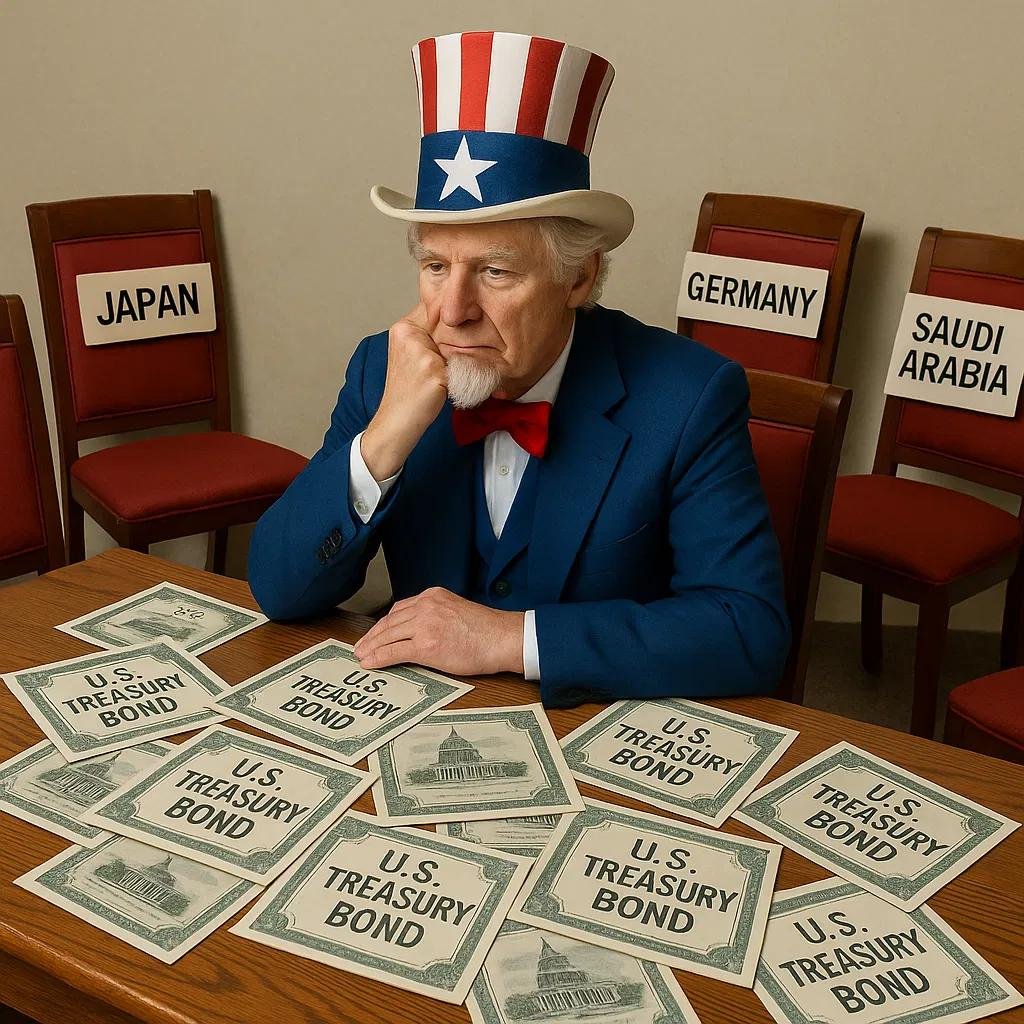
And at first, that might sound like a good thing— HOORAY! More independence from foreign creditors! America is better off without that Chinese money! Right?
But in reality this is a huge problem. Because it’s not just China.
Going back to the years before Covid, roughly a third of US debt was owned by foreigner governments and foreign central banks.
But then federal debt skyrocketed during the pandemic, and US government credibility plummeted. Even the government’s credit rating has been slashed.
As a result, foreigners across the board began stepping back from Treasury securities.
Today foreign ownership of US debt is less than 25%, and falling. This is a significant drop in just a few years.
Why it matters:
The US Treasury relies heavily on foreign capital to fund the federal government’s gargantuan (~$2 trillion) deficits. So if foreigners’ appetite to buy US government debt is waning— at a time when federal deficits are exploding higher— where will the Treasury Department come up with the money?
There are essentially two answers. Either (1) the Federal Reserve will “print” the money, or (2) domestic investors within the US economy will buy government bonds and fund the deficit.
But both of those options come at a significant cost.
Consequences of the Fed funding US government deficits:
In order for the Federal Reserve to buy US government bonds (and essentially fund the government’s annual budget deficit), the Fed must first expand the money supply.
We often refer to this as “printing money” even though it all happens electronically. The Fed calls it “quantitative easing”, or QE, but it’s all the same thing.
The consequence of QE is inflation. Serious, serious inflation.
Think about it— during the pandemic, the Fed’s QE created roughly $5 trillion in new money... resulting in 9% inflation.
Creating enough money to fund federal budget deficits over the next decade could result in the Fed having to print $15+ trillion. So most likely that’s going to be a LOT of inflation.
Consequences of the US economy funding government deficits:
American investors, i.e. banks, funds, corporate treasury departments, etc. could also buy more US government bonds in order to offset waning foreign demand.
But this capital comes at a big opportunity cost
Any private capital that goes in to the Treasury market means less money available to buy stocks, fund venture capital, or finance real estate mortgages
The net result is lower stock prices, higher mortgage rates, and slower innovation.
Why China is first to ditch US government bonds:
After sanctions on Russia, which included freezing their Treasury holdings, other countries got spooked — especially China.
China probably fears becoming the next target of US financial weaponization.
This may also be an indication that they will eventually invade Taiwan
So China is hedging: they’re selling their US government bonds and buying literal metric tons of physical gold— driving gold prices to record highs.
The bottom line:
The shrinking foreign appetite for US debt is a glaring red flag. It signals waning confidence in US fiscal credibility and could lead to a capital squeeze at home — or nasty inflation spiral if the Fed fills the gap.
Many Americans might cheer the idea of being less reliant on Chinese or other foreign money. But in reality, foreign investment in government debt is the closest thing to a ‘free lunch’ in economics.
It means that foreigners are financing federal deficits, meaning less inflation at home, and allowing private capital to invest directly in the US economy.
Losing this benefit is a bad thing for America.
You can listen to my full thoughts on the matter in this brief Podcast.
For the audio-only version, check out our online post here.
Finally, you can find the podcast transcript for your convenience, here.
To your freedom, James Hickman Co-Founder, Schiff Sovereign LLC
Seeds of Wisdom RV and Economic Updates Monday Afternoon 8-11-25
Good Afternoon Dinar Recaps,
China and Russia Hit Trade Milestone, Defying U.S. Tariff Threats
Record High in July
According to the Chinese General Administration of Customs, bilateral trade between China and Russia reached $19.14 billion in July — the highest monthly figure this year — despite U.S. warnings of secondary tariffs on Russian oil sales. China remains one of the largest buyers of Russian crude.
Good Afternoon Dinar Recaps,
China and Russia Hit Trade Milestone, Defying U.S. Tariff Threats
Record High in July
According to the Chinese General Administration of Customs, bilateral trade between China and Russia reached $19.14 billion in July — the highest monthly figure this year — despite U.S. warnings of secondary tariffs on Russian oil sales. China remains one of the largest buyers of Russian crude.
*******************************
Yearly Trends and Oil Dependency
July trade rose 8.7% compared to June.
However, it was 2.8% lower than July 2024.
Russian crude remains a major driver, with 108.5 million metric tonnes shipped to China in 2024, accounting for 19.6% of China’s total crude imports.
From January to June 2025, Russia delivered 49.11 million metric tonnes — down 10.9% from the same period last year.
Geopolitical Context
Despite ongoing sanctions and supply restrictions, trade volumes remain strong, suggesting Beijing is largely unfazed by Washington’s recent threats to impose additional penalties on Russian oil transactions.
Potential U.S.-China Trade Impact
The U.S. government has already applied a 25% tariff on Indian oil purchases.
The current U.S.–China trade moratorium ends August 12, though Treasury Secretary Scott Bessent has signaled a likely extension, saying trade is in “a very good place with China.”
President Trump has claimed a trade deal with China is “sort of” in place, but further tariff measures could disrupt finalization.
Strategic Calculations
China’s continued imports may indicate confidence in an eventual resolution to the Russia-Ukraine conflict, or a calculated bet that the U.S. will not escalate tariff enforcement against Chinese oil imports.
@ Newshounds News™
Source: Bitcoin.com
~~~~~~~~~
BRICS Shakeup: India Chooses U.S. Over Russia in Sudden Shift
Tariff Threat Forces Overnight U-Turn
In a stunning policy reversal, India has abandoned its $50.2 billion annual Russian oil partnership within just 24 hours after facing crippling tariff threats from Washington. President Trump’s 25% tariff on Indian goods — with potential hikes to 100% — targeted New Delhi’s purchases of Russian crude and military equipment, forcing a choice between Russia and India’s most important trade partner: the United States.
Why India Chose Washington
U.S. = India’s largest trade partner, worth $186 billion in 2024–2025.
Accounts for 18% of India’s exports, with a $41 billion trade surplus at stake.
Risk to key service-sector revenues outweighed energy ties with Russia.
**********************************
Impact on Russian Energy Exports
Before the ultimatum, India imported 87.4 million tons of Russian oil annually — about 35% of its total crude imports.
State-owned refiners controlling 60% of India’s 5.2M bpd capacity immediately stopped Russian purchases.
Supplies replaced with Middle Eastern (Abu Dhabi) and West African crude.
Russia, already hit by Europe’s embargo, loses its largest oil customer, forcing steep discounts to move stockpiles.
BRICS Alliance Reality Check
India’s defection delivers a strategic blow to Moscow and exposes limits of BRICS unity.
The move came hours after ex-Russian President Dmitry Medvedev dismissed U.S. tariff threats.
Russia now faces a wartime economy with a budget deficit projected to exceed $100 billion by year’s end.
Geopolitical Significance
This reversal highlights a core weakness in anti-Western alliances: economic leverage from the U.S. and its allies remains powerful enough to override years of alternative trade bloc building. Despite BRICS’ ambitions, Washington’s economic dominance is still decisive in shaping global trade alignments.
@ Newshounds News™
Source: Watcher.Guru
~~~~~~~~~
Seeds of Wisdom Team RV Currency Facts Youtube and Rumble
Newshound's News Telegram Room Link
Follow the Roadmap
Follow the Timeline
Seeds of Wisdom Team™ Website
Thank you Dinar Recaps
“Tidbits From TNT” Monday 8-11-2025
TNT:
Tishwash: Sudanese advisor: White noise supports exchange rate stability in the Iraqi market
The Prime Minister's financial and economic advisor, Mazhar Mohammed Salih, confirmed that the success of the three fiscal, monetary, and trade policies in working together is what has led to the continued convergence of the exchange rates in the parallel and official markets.
Saleh said in a statement to {Euphrates News}: “The continuation of these general policies constitutes positive information for the market, known as ‘white noise’, which is a condition that makes the market maintain stable rates and prevents the parallel market from taking any negative directions.”
TNT:
Tishwash: Sudanese advisor: White noise supports exchange rate stability in the Iraqi market
The Prime Minister's financial and economic advisor, Mazhar Mohammed Salih, confirmed that the success of the three fiscal, monetary, and trade policies in working together is what has led to the continued convergence of the exchange rates in the parallel and official markets.
Saleh said in a statement to {Euphrates News}: “The continuation of these general policies constitutes positive information for the market, known as ‘white noise’, which is a condition that makes the market maintain stable rates and prevents the parallel market from taking any negative directions.”
He added, "The parallel exchange market is now moving toward convergence with the official fixed rate, which is considered one of the strongest stages of stability in the monetary market, as a result of the success of the three pillars of economic policy." link
************
Tishwash: The Central Bank Governor announces funding for housing projects and international praise for dollar transfer operations.
Central Bank Governor Ali Al-Alaq announced today, Sunday (August 10, 2025), that the bank has financed housing projects with an amount of 12 trillion and 300 billion dinars.
In a press statement followed by Baghdad Today, Al-Alaq noted that "international parties have praised the dollar transfer operations conducted by the Central Bank," stressing that "Iraq is unique in being the only country that successfully carries out these operations."
As the Iraqi government strives to strengthen the housing sector and provide the necessary financial support for housing projects, the Central Bank plays a pivotal role in financing these projects with large sums of money, aiming to improve the housing situation for citizens. link
************
Tishwash: Al-Sudani directs a review of the provisions of the banking reform document after receiving comments from the Iraqi Private Banks Association.
Prime Minister Mohammed Shia al-Sudani reviewed the latest developments related to the banking reform paper, particularly the provisions affecting private banks, in light of the comments and responses he received from various stakeholders.
Al-Sudani commended the efforts made by the Central Bank of Iraq in preparing the banking reform document, which aims to enhance financial stability, achieve transparency, and raise the efficiency of the banking sector. He affirmed the government's full support for all reform initiatives aimed at developing the country's financial and monetary infrastructure, in line with international best practices.
In the same context, the Prime Minister paid close attention to the comments of the Iraqi Private Banks Association, contained in its letter dated August 3, 2025, which addressed the objective challenges facing local banks in implementing some reform provisions, particularly those related to capital increase requirements, the adoption of strategic partners, the costs of contracting with foreign companies, and the timelines required for implementing reforms.
Driven by his commitment to achieving a realistic balance between reform requirements and the capabilities of local banks, the Prime Minister directed the adoption of a participatory and consultative approach between the Central Bank and Iraqi banks, through the formation of joint technical committees to review reform requirements and ensure their compatibility with the national financial and economic reality, while protecting the interests of local and international investors and those working in the sector.
In this context, Al-Sudani emphasized that the goal of reform is not exclusion but empowerment, calling for an expanded dialogue to clarify the technical aspects of the document and discuss implementation mechanisms in a gradual and thoughtful manner.
He also stressed the importance of taking into account the specificities of Iraq's reality when applying international standards, while emphasizing the need to formulate procedures in a way that enhances confidence in the banking sector and contributes to its development.
The Prime Minister concluded his remarks by emphasizing that the doors to discussion are open, and that the government continues to support all sincere efforts, both national and international, aimed at reforming the financial and banking system to serve the public good and the national economy. link
************
Tishwash: The toman is worth nine million for every $100.
The price of the toman, today, Sunday (August 10, 2025), recorded nine million for every 100 dollars, affected by news of upcoming negotiations between Iran and the United States of America.
Informed sources confirmed to the Tehran Times, followed by Baghdad Today, that "Tehran and Washington are showing a willingness to resume negotiations, but with a fundamental difference this time, as Iran is demanding that a clause for compensation for damages resulting from military operations be included as a fundamental part of any future agreement."
Sources said that "Norway has emerged as a leading candidate to host a new round of talks between Iran and the United States amid escalating regional and international tensions over the Iranian nuclear issue."
She added, "These negotiations are expected to begin indirectly, through a mediator who will act as a conduit between the two parties, starting this month." link
************
Mot: Did Ya Ever Wonder ????

Mot: It Was a Tough Day But I ~~~~~

News, Rumors and Opinions Monday 8-11-2025
Note: All intel should be considered as "Rumors" until we receive official announcements ...and “Rates and Dates” could change anytime until we get to the banks/redemption centers.
RV Excerpts from the Restored Republic via a GCR: Update as of Mon. 11 August 2025
Compiled Mon. 11 August 2025 12:01 am EST by Judy Byington
Possible Timing: There appears to be no information available on the timing of the Tier4b (Us, the Internet Group) redemption of foreign currency process for the Global Currency Reset, only that everything has been done, currencies were trading on the back screens of the Forex and we were awaiting the Green Light to receive our appointments.
Note: All intel should be considered as "Rumors" until we receive official announcements ...and “Rates and Dates” could change anytime until we get to the banks/redemption centers.
RV Excerpts from the Restored Republic via a GCR: Update as of Mon. 11 August 2025
Compiled Mon. 11 August 2025 12:01 am EST by Judy Byington
Possible Timing: There appears to be no information available on the timing of the Tier4b (Us, the Internet Group) redemption of foreign currency process for the Global Currency Reset, only that everything has been done, currencies were trading on the back screens of the Forex and we were awaiting the Green Light to receive our appointments.
~~~~~~~~~~~~
On Tues. 19 Aug. 2025 NESARA + GESARA Planet Earth is entering The Great Shift of Consciousness — The Great Awakening into Unity Consciousness. Mother Earth is returning as a sacred planet and taking with her all who choose to go. A Golden Age beyond imagination is dawning, bringing global prosperity, peace, and an end to poverty, hunger, and debt. …QFS on Telegram
GESARA (Global Economic Stabilization and Recovery Act), as (allegedly) ratified by all 209 sovereign nations under the 2015 Paris Agreement, is now set to launch alongside NESARA (National Economic Stabilization and Recovery Act) in the restored Republic of the United States. Together, they will (allegedly) reshape economies, laws, and daily life worldwide.
Under NESARA, all credit card, mortgage, and bank debt will be (allegedly) canceled — a true “jubilee” — due to decades of illigal banking and government practices. Federal income tax will be (allegedly) abolished in the U.S., replaced by a 17% flat sales tax on new non-essential goods only, exempting food, medicine, and used items.
The IRS will be (allegedly) dismantled, its employees reassigned to the Treasury’s national sales tax division.
Constitutional Law will be (allegedly) fully restored, all judges and attorneys retrained, and all unconstitutional officials and members of Congress removed from office.
GESARA extends these transformations globally, (allegedly) integrating the new quantum-secure financial system. The IMF will announce a global gold-standard monetary system, converting all remaining fiat currencies into gold-backed digital money.
National debts will be erased, taxes lowered, and paper money gradually phased out. This quantum-hosted system has been online for months, immune to hacking and unauthorized access.
This is the transition from a world of survival to a world of abundance, respect, and unity. As pain and suffering dissolve, a new era begins — one of peace, prosperity, and shared destiny for all
Read full post here: https://dinarchronicles.com/2025/08/11/restored-republic-via-a-gcr-update-as-of-august-11-2025/
**
Courtesy of Dinar Guru: https://www.dinarguru.com/
Frank26 Banks...are being selectively fined and... shutdown. That's the ones that are still doing illegal things. This is a very good step for the monetary reform process. Just like the two commanders [sent to judiciary]...they are being dealt with. This is a requirement of the monetary reform process. You remove all the stinking cockroaches that you can just before you pull the trigger.
Militia Man Article quote: "Those who misuse public funds or abuse power face consequences." I like that part...If you got caught stealing $500 billion and were allowed to go for 8 years and then another decade almost...really? It's incredible...If you claw back $100 billion for instance it goes to support the real effective exchange rate. You do that five time or even more, it [all] goes to the real effective exchange rate...Sudani has been cleaning house. It's house cleaning time. That's where people start going to jail. They're getting tapped on the shoulder for large amounts of money
************
Economic Storm Incoming: Here's PROOF - Rising Prices, Slowing Jobs, Confused Consumers
Lena Petrova: 8-11-2025
A recent analysis by economic commentator Lena Petrova sheds light on a concerning trend: despite a brief reprieve in gas prices, inflation in the United States is once again on an upward trajectory.
This renewed surge is having a profound impact, particularly on the daily lives of Americans, with the food industry bearing a significant brunt of the changes.
As Lena Petrova effectively illustrates, the current economic landscape is an intricate web of interconnected factors. Inflation isn’t just a number; it’s a force reshaping daily routines, impacting businesses, and challenging the very foundation of economic optimism.
Understanding these relationships, particularly through tangible examples like the food industry, is paramount for anticipating future economic developments and the policy responses that will inevitably follow.
Seeds of Wisdom RV and Economic Updates Monday Morning 8-11-25
Good Morning Dinar Recaps,
Elizabeth Warren Demands Crypto Regulation Free from Industry Influence
Senator Elizabeth Warren has renewed her push for tighter cryptocurrency oversight, calling for investor protections and safeguards to prevent financial instability—without influence from the crypto industry itself.
Good Morning Dinar Recaps,
Elizabeth Warren Demands Crypto Regulation Free from Industry Influence
Senator Elizabeth Warren has renewed her push for tighter cryptocurrency oversight, calling for investor protections and safeguards to prevent financial instability—without influence from the crypto industry itself.
Key Proposals
Ban lawmakers from trading cryptocurrencies to avoid conflicts of interest and ensure policy decisions are free from personal financial bias.
Establish stronger “guardrails” to prevent systemic risks from destabilizing the broader economy.
Expand beyond current bills like the GENIUS Act to create a comprehensive market structure framework.
Preventing Economic Fallout
Warren described existing rules as “weak” and insufficient to handle potential large-scale risks. Her skepticism toward crypto reflects concerns that unregulated digital assets could trigger broader economic disruptions if left unchecked.
Not Just Opposition to Bills
Although Warren previously voted against the GENIUS Act, she refrained from criticizing it in her latest remarks. Instead, she called for additional legislative measures to close regulatory gaps and strengthen oversight.
Trump’s Crypto Earnings Under Scrutiny
Financial disclosures show Donald Trump earned over $57 million from World Liberty Financial, issuer of USD1.
Trump denies profiting directly from the token, but critics point to potential conflicts of interest, particularly after his administration approved crypto investments in 401(k) plans—a move analysts warn could expose retirement savings to volatility.
Industry Reaction
Justin Slaughter, VP of Regulatory Affairs at Paradigm, welcomed Warren’s acknowledgment that crypto regulation is necessary. He noted her remarks are shifting from blanket opposition to shaping stronger, more inclusive rules.
Bottom Line:
Warren’s position signals a shift toward structured dialogue on how cryptocurrency fits into the U.S. financial system—emphasizing investor protection, systemic stability, and independence from industry lobbying.
@ Newshounds News™
Source: Coinpedia
~~~~~~~~~
Tether-Backed Rumble Plans $1.17 Billion Northern Data Acquisition Following Bitcoin Mining Division Selloff
Rumble, the video-sharing platform and AI-focused cloud services provider, has announced plans to acquire Northern Data in an all-stock deal valued at approximately $1.17 billion, excluding Northern Data’s bitcoin mining division.
The transaction aims to strengthen Rumble’s position in AI cloud computing and high-performance infrastructure, with major backing from Tether, the world’s largest stablecoin issuer and Northern Data’s majority shareholder.
Deal Structure & Terms
The proposed offer values Northern Data at roughly €1 billion ($1.17 billion).
Shareholders of Northern Data would receive 2.319 newly issued Class A Rumble shares for each Northern Data share.
If all shares are tendered, Northern Data shareholders would own approximately 33.3% of Rumble.
Tether, holding 54% of Northern Data, would become Rumble’s largest Class A shareholder under the same exchange ratio.
Tether has committed to a multi-year GPU purchase agreement upon deal closure.
Tether & Rumble’s Strategic Partnership
Tether previously invested $775 million in Rumble in December 2024 to accelerate the platform’s growth as a YouTube alternative with an emphasis on data privacy and global independence.
The combined company is expected to enhance Rumble’s AI leadership capabilities and scale its cloud computing infrastructure worldwide.
Leadership & Governance
Chris Pavlovski, Rumble’s Chairman and CEO, will retain majority voting control.
Pavlovski has expressed full support for the acquisition and will vote all of his shares in favor.
Northern Data has signaled willingness to enter formal discussions regarding the exchange offer.
Financial Performance
Northern Data reported strong H1 2025 growth:
Revenue: €94.3 million ($109.8 million), up 72% year-over-year.
Mining Revenue: €53.5 million ($62.3 million), up 49% due to capacity expansion and higher bitcoin prices.
Market Reaction
Following the announcement, Rumble’s stock surged 20% in pre-market trading, reaching $9.48, according to TradingView.
@ Newshounds News™
Source: The Block
~~~~~~~~~
Seeds of Wisdom Team RV Currency Facts Youtube and Rumble
Newshound's News Telegram Room Link
Follow the Roadmap
Follow the Timeline
Seeds of Wisdom Team™ Website
Thank you Dinar Recaps
Silver Investment and this Could Change Everything for Iraq
Silver Investment and this Could Change Everything for Iraq
Edu Matrix: 8-9-2025
A recent deep dive from Edu Matrix offers a compelling look into two seemingly disparate yet critically influential global trends shaping 2025: the surging prospects of silver as an investment and the escalating geopolitical landscape in the Middle East.
The video provides a comprehensive overview, highlighting the intertwined nature of economic, political, and technological developments that create a complex backdrop for investors and observers alike.
Silver Investment and this Could Change Everything for Iraq
Edu Matrix: 8-9-2025
A recent deep dive from Edu Matrix offers a compelling look into two seemingly disparate yet critically influential global trends shaping 2025: the surging prospects of silver as an investment and the escalating geopolitical landscape in the Middle East.
The video provides a comprehensive overview, highlighting the intertwined nature of economic, political, and technological developments that create a complex backdrop for investors and observers alike.
The Edu Matrix channel strongly advocates for a “buy and hold” strategy for silver, pointing to its exceptional performance in 2025, where prices have soared to a 13-year high. This remarkable rise is attributed to a confluence of factors: significant supply shortages, burgeoning industrial demand, and its enduring status as a safe haven asset amidst pervasive market volatility.
Edu Matrix further underscores silver’s considerable potential for continued growth, noting its current undervaluation relative to gold. Its expanding critical role in burgeoning green industries like solar energy and electric vehicle manufacturing is also highlighted as a key driver for future demand.
As the global push towards decarbonization accelerates, silver’s industrial applications are set to increase dramatically, cementing its position as a compelling investment in the years to come.
Shifting gears to the geopolitical arena, the Edu Matrix video meticulously dissects the fraught situation in the Middle East, particularly focusing on Israel’s recent contentious decision to annex the Gaza Strip.
The analysis reveals that Israel’s security cabinet has approved taking full control of Gaza City, a move that has ignited massive internal protests within Israel and drawn vehement condemnation from key regional players such as Iran and Iraq.
Iran has vehemently lambasted the annexation as a blatant violation of international law and a looming humanitarian catastrophe. Tehran anticipates this decision will inevitably intensify regional conflicts and empower its allied militias across Lebanon, Yemen, and Iraq, further destabilizing the already volatile region.
Iraq finds itself in a particularly precarious position, navigating the delicate balance between domestic pressure from powerful pro-Iran factions and maintaining its crucial relationship with the United States.
The video warns that such an annexation could catastrophically escalate existing proxy conflicts, deepen regional instability, and severely worsen the already dire humanitarian conditions in Gaza and the broader Middle East. For Iraq, these repercussions could specifically impact its fragile economy and ongoing currency adjustments.
The Edu Matrix discussion also thoughtfully touches upon the deep-seated historical and cultural tensions that have long simmered between Israel, Arab nations, and Persia, provocatively raising the question of how future artificial intelligence might one day unveil hidden truths about these complex, enduring conflicts.
In conclusion, the Edu Matrix video effectively illustrates how these seemingly disparate narratives—the robust economic ascendancy of a precious metal and the profound geopolitical tremor in a vital region—are inextricably linked.
It paints a picture of 2025 as a year where economic, political, and even technological developments are deeply intertwined, creating an exceptionally complex and often unpredictable backdrop for global investors and observers alike.
US Dollar Devaluation, Global Currency Collapse is Coming
US Dollar Devaluation, Global Currency Collapse is Coming
Lena Petrova: 8-9-2025
A financial storm of unparalleled magnitude is brewing, threatening to engulf the world’s largest economies in a crisis unlike any seen before.
Drawing insights from a recent video by financial expert Lena Petrova, a sobering analysis reveals that the very nations considered the pillars of global finance—the G7—are teetering on the edge of a potential currency collapse, driven by crushing debt and rapidly rising interest rates.
US Dollar Devaluation, Global Currency Collapse is Coming
Lena Petrova: 8-9-2025
A financial storm of unparalleled magnitude is brewing, threatening to engulf the world’s largest economies in a crisis unlike any seen before.
Drawing insights from a recent video by financial expert Lena Petrova, a sobering analysis reveals that the very nations considered the pillars of global finance—the G7—are teetering on the edge of a potential currency collapse, driven by crushing debt and rapidly rising interest rates.
Unlike past financial crises, which were often confined to emerging markets or isolated nations, this looming threat originates from the core of the global financial system.
The G7 nations—Canada, France, Italy, Japan, Spain, the United Kingdom, and the United States—collectively referred to as the “D7” due to their daunting debt levels, find their government debts exceeding their entire Gross Domestic Product (GDP).
The financial lifeline extended during the 2008 crisis and the 2020 pandemic, characterized by cheap and abundant borrowing, has now tightened into a financial noose. Interest rates, once near zero, have surged, making it exponentially more difficult for these highly indebted governments to service their colossal debts.
This dynamic has created a “pressure cooker” in global credit markets, as investor confidence wanes regarding the ability of these nations to manage their liabilities without resorting to extreme measures.
Should investor confidence evaporate, it could trigger a rapid sell-off in government bonds and currencies.
Historically, currency devaluations have occurred, but they were largely isolated events. Today, the interconnectedness of the global financial system means a devaluation in one major economy could unleash a catastrophic domino effect.
The G7’s central banks, intricately linked by holding each other’s currencies, amplify this risk; a crisis in one nation would inevitably ripple across all.
One politically tempting, yet economically perilous, “shortcut” to managing debt is through massive money printing to inflate the debt away. However, as Petrova highlights, this path carries severe consequences: rampant inflation, a significant decline in living standards, a collapse of public and investor confidence, and ultimately, a run on the currency.
While central banks might attempt to defend their currencies by selling reserves, the effectiveness of this strategy is limited given that these reserves are often tied to each other’s currencies.
A sharp fall in the U.S. dollar, the world’s primary reserve currency, would be particularly destabilizing. Other countries might feel compelled to devalue their own currencies to maintain export competitiveness, initiating a broad market sell-off and a painful revaluation of institutional portfolios globally. This scenario would severely impact bond markets worldwide.
The Eurozone, with its shared central bank but disparate economic resilience among member states, is uniquely vulnerable to political tensions and financial instability in such a scenario.
The International Monetary Fund (IMF) already projects slower global growth and tighter national budgets, exacerbated by rising trade tensions. While urgent structural reforms are desperately needed, they are politically challenging to implement.
The sheer scale of the debt makes it impossible to simply “grow out of it,” and raising taxes or cutting spending is politically fraught. This leaves financial devaluation—either forced by market panic or a deliberate government action—as the most likely, albeit devastating, path forward.
Lena Petrova’s analysis serves as a stark warning: a simultaneous collapse of the world’s most trusted currencies would be a historic and devastating event
Its far-reaching consequences would reshape wages, decimate savings, erode investments, and cripple global trade.
The lessons from past financial upheavals underscore the urgency of understanding and preparing for this potential financial upheaval.
This sobering assessment of the precarious financial position of the world’s largest economies and the cascading risks of high debt and rising interest rates demands immediate attention and proactive preparation.
The potential fallout from a synchronized currency crisis in developed markets would be truly unprecedented and globally disruptive.
Seeds of Wisdom RV and Economic Updates Sunday Afternoon 8-10-25
Good Afternoon Dinar Recaps,
US Targets India, Brazil & South Africa, Yet BRICS Stands for Unity
BRICS — Brazil, Russia, India, China, and South Africa — has become a focal point of economic and geopolitical tensions with the United States. While U.S. measures target several key BRICS markets, the alliance continues to project resilience.
Right now, U.S.-Brazil tariffs have surged to 50%, and secondary sanctions loom over India’s Russian oil trade. Yet, despite these pressures, BRICS stands for unity — at least for now.
Good Afternoon Dinar Recaps,
US Targets India, Brazil & South Africa, Yet BRICS Stands for Unity
BRICS — Brazil, Russia, India, China, and South Africa — has become a focal point of economic and geopolitical tensions with the United States. While U.S. measures target several key BRICS markets, the alliance continues to project resilience.
Right now, U.S.-Brazil tariffs have surged to 50%, and secondary sanctions loom over India’s Russian oil trade. Yet, despite these pressures, BRICS stands for unity — at least for now.
Origins and Purpose of BRICS
The BRICS concept, coined in 2001 by Goldman Sachs economist Jim O’Neill, was envisioned as a platform for deeper economic cooperation among leading emerging economies. Today, BRICS also aims to create alternatives to Western-led financial systems.
Operationally, the group focuses on:
Resolving regional disputes
Advocating financial reform at global institutions like the World Bank and IMF
Coordinating through the BRICS Interbank Cooperation Mechanism
U.S. Tariff Pressure on BRICS Members
Brazil: Facing 50% U.S. tariffs, justified by Washington over human rights concerns tied to former president Jair Bolsonaro’s case. Brazil has resisted U.S. pressure, with President Lula preparing a formal response.
India: Threatened with secondary sanctions due to Russian crude imports of 1.7 million barrels per day. The U.S. aims to push India toward greater market access concessions or revised energy procurement policies.
Economic Resilience Despite Sanctions
Brazil: The real remains strong, buoyed by attractive near-15% yields drawing international investors.
South Africa: Despite 30% U.S. tariffs, the rand benefits from the central bank’s pursuit of a lower 3% inflation target, attracting capital inflows.
India: The Reserve Bank of India has allowed greater flexibility in the rupee’s exchange rate while benefiting from lower domestic inflation.
Strategic Implications
BRICS’ ability to maintain cohesion under U.S. economic targeting will be tested in the months ahead. The group’s unity is further influenced by the stability of U.S.-China trade relations, with critical diplomatic deadlines — including August 12 — potentially reigniting tensions.
This moment will determine whether BRICS can sustain its founding principle of providing a counterweight to Western financial dominance, or whether national interests will override collective solidarity.
@ Newshounds News™
Source: Watcher.Guru
~~~~~~~~~
Seeds of Wisdom Team RV Currency Facts Youtube and Rumble
Newshound's News Telegram Room Link
Follow the Roadmap
Follow the Timeline
Seeds of Wisdom Team™ Website
Thank you Dinar Recaps
“Tidbits From TNT” Sunday 8-10-2025
TNT:
Tishwash: The Central Bank to Al-Maalouma: Our measures for banks are necessary, but not strict.
A member of the Central Bank's Board of Directors, Ahmed Brihi, confirmed today, Saturday, that the standards set by the bank to reform the banking sector are not strict or prohibitive, but rather aim to protect banks from collapse and ensure the safety of depositors' funds, in addition to preserving Iraq's international financial relations.
Brihi said in a statement to Al-Maalouma Agency, “The banking reform standards approved by the Central Bank related to private banks are not strict measures as promoted, but rather are necessary steps aimed at ensuring financial stability and preventing banks from collapsing.”
TNT:
Tishwash: The Central Bank to Al-Maalouma: Our measures for banks are necessary, but not strict.
A member of the Central Bank's Board of Directors, Ahmed Brihi, confirmed today, Saturday, that the standards set by the bank to reform the banking sector are not strict or prohibitive, but rather aim to protect banks from collapse and ensure the safety of depositors' funds, in addition to preserving Iraq's international financial relations.
Brihi said in a statement to Al-Maalouma Agency, “The banking reform standards approved by the Central Bank related to private banks are not strict measures as promoted, but rather are necessary steps aimed at ensuring financial stability and preventing banks from collapsing.”
He added, "A number of private banks faced circumstances that disrupted their financial operations, which required the Central Bank to establish regulatory standards to protect them and depositors' funds."
He pointed out that "these standards also take into account the importance of maintaining the Central Bank's international financial relations, which represent a decisive factor in Iraq's monetary and financial stability." link
************
Tishwash: The Central Bank of Iraq's fines on banks and financial companies exceed 66 billion.
The Central Bank of Iraq announced on Saturday that fines imposed on banks and non-banking institutions (exchange companies) amounted to more than 66 billion Iraqi dinars during the first half of 2025.
Statistics from the bank showed that “the fines imposed on banks and financial companies during the past six months, starting from January/November until the end of last June, amounted to 66 billion, 210 million, and 955 thousand dinars,” indicating that “the fines also included 77 administrative penalties for these banks and non-banking institutions, distributed between warnings, alerts, and grace periods.”
The bank stated that, "These fines decreased from the same period last year, which amounted to 181 billion, 842 million, and 854 thousand dinars, while the penalties amounted to 151, distributed between warnings, cautions, and grace periods."
The bank did not name the banks subject to the fines or administrative penalties. There are approximately 51 private banks, including 23 private commercial banks and 28 private Islamic banks. link
************
Tishwash: Al-Sudani announces decisive steps to reform Iraqi banks and restore confidence in the financial sector.
Prime Minister Mohammed Shia al-Sudani affirmed on Sunday the continuation of the comprehensive banking reform process through three basic steps, emphasizing the need for implementation to be based on a balanced vision that takes into account the specificities of Iraqi reality and ensures enhanced confidence in the banking sector.
A statement issued by his office, received by Al-Mada, said, "Al-Sudani was briefed on the latest developments related to the banking reform paper, particularly those related to private banks, appreciating the efforts made by the Central Bank of Iraq in preparing the document, which aims to enhance financial stability, achieve transparency, and raise the efficiency of the banking sector."
The statement indicated that "the Prime Minister paid special attention to the observations contained in the letter from the Iraqi Private Banks Association dated August 3, which included challenges facing local banks in implementing some provisions of the document, particularly those related to capital increase requirements, the adoption of a strategic partner, the costs of contracting with foreign companies, as well as the binding timelines. Accordingly, Al-Sudani called for adopting a participatory and consultative approach between the Central Bank and Iraqi banks by forming joint technical committees to review reform requirements and ensure their compatibility with the national financial and economic reality, in a manner that maintains a balance between reform requirements and the capabilities of local banks and protects the interests of investors and workers in this vital sector."
Al-Sudani explained that "the three approved steps begin with opening an expanded dialogue between the Central Bank and the banks to clarify the technical aspects of the document and discuss possible implementation mechanisms and their gradual progression.
This includes taking into account the specificity of the Iraqi reality when applying international standards, while committing to reform in principle and formulating standards in a manner that enhances confidence in the banking sector. This is followed by reassuring the banking community through clear messages that the goal of reform is empowerment, not exclusion, and that the doors of discussion remain open to serve the national economy."
For his part, banking expert Majid Abdul Hamid told Al-Mada that "the document represents a necessary step to raise the efficiency of the banking sector and improve the business environment in Iraq, but its success depends on gradual implementation and linking each stage to a clear support plan." He explained that the immediate implementation of some provisions, such as increasing capital or requiring a strategic partner, could place small banks under significant financial pressure, which requires granting them appropriate periods of time to adapt.
Economist Ayad Al-Rawi explained to Al-Mada that "banking reform is part of a broader economic reform, and that raising technical standards for banks will boost the confidence of depositors and investors. However, he warned that the lack of effective communication with the public could lead to unjustified fears and sudden withdrawals of deposits."
He stressed that "gradualness and transparency in announcing measures will be key to the success of reform, calling for a supportive legislative and financial environment to reduce risks to the local market."
As the government continues its path of banking reform, the stakes remain on the ability of the relevant parties to balance adherence to international standards with their adaptation to Iraqi market conditions, thus preserving the sector's stability and enhancing its role in financing development and supporting the national economy. link
************
Mot: . OK!!! --- Bringing OUT the ""RV Clock""
Mot: .. can ya sing um????