
Thank you to all the subscribers to our Early Access program…we thank you for your continued support.
We are excited to offer this new service to keep you informed and up-to-date on the latest Dinar and currency news.
Russia and China’s BRICS Currency Just Went Public
Russia and China’s BRICS Currency Just Went Public
Tech Revolution: 6-13-2025
For months, the world has been abuzz with speculation: When will the BRICS nations unveil their alternative currency, poised to challenge the dominance of the U.S. dollar?
The answer, it seems, has already arrived, but not in the form everyone anticipated. Instead of a grand unveiling of a new coin, Russia and China are quietly, strategically, building a comprehensive system designed to bypass the dollar’s influence in key sectors of the global economy.
Russia and China’s BRICS Currency Just Went Public
Tech Revolution: 6-13-2025
For months, the world has been abuzz with speculation: When will the BRICS nations unveil their alternative currency, poised to challenge the dominance of the U.S. dollar?
The answer, it seems, has already arrived, but not in the form everyone anticipated. Instead of a grand unveiling of a new coin, Russia and China are quietly, strategically, building a comprehensive system designed to bypass the dollar’s influence in key sectors of the global economy.
This isn’t a flashy revolution; it’s a subtle but powerful shift. It’s not about branding or pronouncements, but about building infrastructure that empowers nations to trade and transact outside the traditional dollar-centric framework.
The focus is on developing parallel systems that offer alternatives, making global trade less reliant on a single currency.
The brilliance of this approach is that it avoids a direct assault on the dollar. Russia and China aren’t forcing countries to abandon the dollar; they are providing options and incentives.
Energy deals are being forged in yuan and rubles, while cross-border platforms are making local currency trade a viable option.
The long-term impact is potentially significant. As these alternative systems prove their reliability and efficiency, the incentive to hold large U.S. dollar reserves will diminish.
This isn’t about launching a financial war; it’s about offering alternatives and allowing global trade to evolve organically. And that shift, however subtle, is gaining momentum.
The world is witnessing the emergence of a parallel financial system, built brick by brick, that is quietly reshaping the global economic landscape.
Watch the video below from Tech Revolution for more information.
Seeds of Wisdom RV and Economic Updates Friday Morning 6-13-25
Good Morning Dinar Recaps,
SEC Axes Biden-Era Proposed Crypto Rules in Flurry of Repeals
The U.S. Securities and Exchange Commission (SEC) has rescinded a wide slate of proposed rules introduced under the Biden Administration, including two that directly targeted crypto custody and DeFi protocols.
In a move reflecting President Donald Trump’s regulatory rollback agenda, the SEC said on Thursday that it is officially withdrawing several notices of proposed rulemaking issued between March 2022 and November 2023, during former Chair Gary Gensler’s tenure.
Good Morning Dinar Recaps,
SEC Axes Biden-Era Proposed Crypto Rules in Flurry of Repeals
The U.S. Securities and Exchange Commission (SEC) has rescinded a wide slate of proposed rules introduced under the Biden Administration, including two that directly targeted crypto custody and DeFi protocols.
In a move reflecting President Donald Trump’s regulatory rollback agenda, the SEC said on Thursday that it is officially withdrawing several notices of proposed rulemaking issued between March 2022 and November 2023, during former Chair Gary Gensler’s tenure.
The agency emphasized that it “does not intend to issue final rules with respect to these proposals,” but left the door open to propose new rules in future regulatory actions if deemed necessary.
“Down goes 3b16, qualified custodian, and all the other unfinished Gensler rule proposals,”
— Paul Grewal, Coinbase Chief Legal Officer
Exchange Definition Rule Nullified
Among the 14 rules withdrawn, a key proposal was Rule 3b-16, which aimed to expand the definition of “exchange” to include decentralized finance (DeFi) protocols. The amendment also intended to tighten crypto custody standards for investment advisers.
The rule sought to include in the definition of “exchange” systems that offer non-firm trading interest and communication protocols to connect buyers and sellers of securities. If implemented, this could have classified many DeFi platforms as securities exchanges, subjecting them to federal oversight.
First introduced in March 2022, the proposal drew strong criticism. In March 2025, SEC Commissioner Mark Uyeda recommended abandoning the rule, which attempted to fold crypto firms into the “alternative trading system” classification.
Crypto Custody Rule Rescinded
Another major repeal was the SEC’s Safeguarding Advisory Client Assets rule, first proposed in March 2023, which would have expanded custody requirements for crypto assets.
The rule proposed expanding the Custody Rule under the Investment Advisers Act of 1940 to cover all client assets, including digital assets. It mandated that all such assets be held with a “qualified custodian”—typically meaning a regulated bank or broker-dealer.
This posed a serious threat to the crypto sector, as most crypto exchanges and wallet providers did not qualify as “qualified custodians.” Investment advisers would have been forced to either change providers or exit the crypto space altogether.
Commissioner Uyeda had previously asked SEC staff to consider withdrawing the crypto custody proposal, which has now been officially rescinded.
Other Rules Rescinded
In addition to the high-profile crypto rules, the SEC also repealed several non-crypto rules with indirect implications for the digital asset industry, including:
Cybersecurity risk management and reporting rules for investment advisers and funds—important for crypto fund managers and custodians.
A rule on position reporting for large security-based swaps, which could have affected firms with large crypto derivatives exposure.
A rule requiring enhanced ESG (environmental, social, and governance) reporting for public companies—widely criticized by conservative policymakers.
These repeals mark a major shift in the regulatory tone coming from Washington, aligning with the Trump Administration’s broader commitment to deregulation in financial and crypto markets.
@ Newshounds News™
Source: Cointelegraph
~~~~~~~~~
US Senate Schedules Final GENIUS Stablecoin Bill Vote for June 17
The U.S. Senate is scheduled to cast its final vote on the GENIUS Act next Tuesday, a key legislative move that could shape the future of stablecoin regulation in the United States.
According to an official notice posted on Thursday by Senate Democrats, the final vote on the Guiding and Establishing National Innovation for U.S. Stablecoins Act (GENIUS Act) will take place on June 17, with the exact time to be determined by the Majority Leader in consultation with the Democratic Leader.
If passed, the bill will then proceed to the House of Representatives for further voting. The GENIUS Act seeks to establish a comprehensive legal framework for stablecoins and their issuers within the U.S. financial system.
Key Provisions of the GENIUS Act:
Requires stablecoins to be fully backed by U.S. dollars or other liquid assets.
Imposes mandatory annual audits for issuers managing over $50 billion in market capitalization.
Introduces compliance requirements for foreign-based issuers operating within U.S. markets.
The Senate's procedural vote on Wednesday cleared the way for the upcoming final decision, which comes amid growing bipartisan interest in regulating the digital asset space.
If passed in the Senate, the GENIUS Act will move to the House, where lawmakers have introduced their own bill—the Stablecoin Transparency and Accountability for a Better Ledger Economy Act (STABLE Act). This bill was advanced out of committee in May but differs from the GENIUS Act in critical areas, including jurisdictional control (state vs. federal) and oversight of foreign issuers like Tether.
Despite these differences, momentum is building. Stablecoin legislation has gained strong backing from President Donald Trump, who has publicly endorsed the GENIUS Act and expressed hopes for final passage by August.
Adding to the push, Treasury Secretary Scott Bessent stated earlier this week that stablecoin legislation could set the stage for massive market expansion. He forecasted that the USD stablecoin market could exceed $2 trillion by the end of 2028, a significant leap from its current size of $252 billion, according to CoinGecko.
The upcoming vote on June 17 is seen as a pivotal moment that could establish the United States as a leader in global stablecoin regulation while providing much-needed clarity and security to issuers, investors, and the broader financial sector.
@ Newshounds News™
Source: The Block
~~~~~~~~~
BRICS: 71 Countries Settled Trade Without the US Dollar
The BRICS alliance is making significant strides in its de-dollarization strategy, actively sidelining the U.S. dollar in favor of local currencies for international trade. This movement is gaining traction worldwide, with countries like Nigeria and Iraq now banning the use of the USD in foreign exchange markets and oil settlements.
If BRICS unveils a transformative plan at its upcoming summit in Rio de Janeiro, the U.S. dollar’s long-standing global dominance could face serious pressure. As momentum grows, the question is no longer “if” the dollar will lose its stronghold, but “when.”
71 Countries Had Settled Trade Before BRICS Started De-Dollarization
A total of 71 countries had already moved away from using the U.S. dollar for trade settlements before BRICS formally launched its de-dollarization agenda. Recent data shows that these efforts include:
Settling trade in local currencies
Diversifying foreign currency reserves
Reducing reliance on U.S. foreign exchange
Conducting oil and commodity payments in non-USD terms
The earliest recorded shift came in 2011, when China — a founding BRICS member — began favoring the gold-backed yuan over the U.S. dollar in its oil purchases. That initial move sparked a gradual and calculated transition to alternative currencies in trade deals throughout the following years.
BRICS Drives the Agenda — With Global Participation
These dollar-free transactions span a wide range of nations across Europe, South America, Asia, Africa, and Australia. Both allies and adversaries of the U.S. have participated, leaving Washington increasingly isolated on the world financial stage.
While this global trend began well before 2022, BRICS greatly accelerated its commitment to de-dollarization following sweeping U.S. sanctions on Russia in the wake of the Ukraine invasion.
July Summit Could Mark a Turning Point
The upcoming 17th BRICS Summit, scheduled for July 6–7 in Brazil, could bring the dollar’s future under the global spotlight. Many developing countries are pushing back against Western financial dominance and seeking to chart their own paths toward financial independence.
If the BRICS bloc unveils a new framework for trade and reserves — one that cuts out the dollar entirely — a fundamental shift in global finance could be underway.
As BRICS continues to gain influence, the next decade may usher in a multipolar currency system, diminishing U.S. leverage and expanding financial sovereignty for dozens of emerging economies.
@ Newshounds News™
Source: Watcher.Guru
~~~~~~~~~
Seeds of Wisdom Team RV Currency Facts Youtube and Rumble
Newshound's News Telegram Room Link
Follow the Roadmap
Follow the Timeline
Seeds of Wisdom Team™ Website
Thank you Dinar Recaps
“Tidbits From TNT” Friday Morning 6-13-2025
TNT:
Tishwash: The World Bank expects growth in the Iraqi economy in 2025 and 2026.
The World Bank expects the Iraqi economy to grow by 1.2% this year.
The bank said in statistics reviewed by Shafaq News Agency that "the Iraqi economy is expected to grow by 1.2% this year, up from negative 1.5% in 2024."
He added that economic growth in Iraq is also expected to rise to 4.4% in 2026, before declining to 3.1% in 2027.
He pointed out that "Libya is expected to be the Arab country with the fastest economic growth, with an estimated 12.3%, followed by Djibouti at 5.2%, and then Lebanon at 4.7%."
TNT:
Tishwash: The World Bank expects growth in the Iraqi economy in 2025 and 2026.
The World Bank expects the Iraqi economy to grow by 1.2% this year.
The bank said in statistics reviewed by Shafaq News Agency that "the Iraqi economy is expected to grow by 1.2% this year, up from negative 1.5% in 2024."
He added that economic growth in Iraq is also expected to rise to 4.4% in 2026, before declining to 3.1% in 2027.
He pointed out that "Libya is expected to be the Arab country with the fastest economic growth, with an estimated 12.3%, followed by Djibouti at 5.2%, and then Lebanon at 4.7%."
According to World Bank statistics, "Yemen will have the lowest economic growth, at -1.5%, followed by Syria, with a growth of 1%." link
************
Tishwash: Prime Minister's Office: 100 US requests to participate in Iraq Investment Forum
The Prime Minister's Office confirmed on Thursday that the preparatory committee for the investment forum to be held in Baghdad has received 100 American applications to participate.
Deputy Director of the Prime Minister's Office, Ali Razouki Al-Lami, told the Iraqi News Agency (INA): "Some American companies have submitted a proposal to Prime Minister Mohammed Shia al-Sudani to host an investment forum for Iraq in the United States to bring American companies to the Iraqi arena, in order to support the Iraqi state and boost investment in Iraq."
He pointed out that "a large American investment delegation had previously attended, and agreements were concluded and signed between the National Investment Authority and the US Embassy."
Regarding the investment forum that will be held in Baghdad in the middle of this month, Razouki explained that "the US embassy in Iraq is interested in this forum, as it requested 100 invitations from the preparatory committee, which reflects the embassy's great interest, in addition to the efforts made by the rest of the embassies in this regard."
He indicated that "there are great preparations and we hope that there will be cooperation from everyone to make this forum a success from the first session, so that it becomes a regular annual or biennial forum, to be a reason for opening the Iraqi field to all investors and capital." link
************
Tishwash: Al-Fatah: The smuggling of regional oil will not stop until the oil and gas law is passed.
Ali al-Fatlawi, a leader in the Fatah Alliance, confirmed on Thursday that oil smuggling from the Kurdistan Region will continue unless the oil and gas law is passed. He called on the government and political forces to engage in serious dialogue to reach a final agreement on the law and resolve the accumulated disputes between Baghdad and Erbil.
Al-Fatlawi said in a statement to the Al-Maalouma Agency, “The time has come to give priority to the approval of the oil and gas law, especially after the vote to amend Paragraph (12) of the Federal Budget Law,” stressing that “the approval of the law is the best way to stop the smuggling of oil from the region.”
He added that "the continued smuggling of oil negatively impacts the national economy and causes significant losses to the public treasure," warning of the repercussions of these operations on the country's economic autonomy.
Al-Fatlawi called on political forces to "assume their national responsibilities and exert pressure to expedite the passage of the law by completing the draft and agreeing on its main provisions."
It is noteworthy that media reports indicated that approximately 400,000 barrels of oil are smuggled daily from the Kurdistan Region, in the absence of clear federal oversight and the unknown fate of the financial revenues resulting from these quantities. link
************
Tishwash: An Iraqi government bank combats suspicious financial transactions electronically "without human intervention.
Rafidain Bank's General Manager, Ali Karim, stated on Thursday that the bank has begun combating suspicious financial transactions, such as money laundering, through electronic technologies.
In a speech delivered at the "Governance Forum" held in Baghdad and attended by a Shafaq News Agency correspondent, Karim said, "Rafidain Bank has taken strategic steps to build an internal governance system that focuses on independence, integrity, and efficiency."
He added that the bank launched a comprehensive corporate risk program that includes operational, interest, and reputational risks, in cooperation with global distribution companies.
Karim continued, "Rafidain Bank recently acquired advanced systems in cooperation with international institutions, through which suspicious financial transactions will be monitored, analyzed, and even thwarted automatically and electronically, without any human intervention."
At the end of May, the Governor of the Central Bank of Iraq, Ali Al-Alaq, affirmed Iraq's commitment to combating money laundering and terrorist financing in cooperation with international partners. link
************
Mot: Raising the ""Wee Folks"" and then -- They Have Grandkids!! --

Mot: Nosy Neighbors but Short on $$ -- another ""Tip frum ole Mot""

"Silver Suggests Upside Breakout For GOLD" –
"Silver Suggests Upside Breakout For GOLD" –
Mike Maloney: 6-12-2025
Silver May Be Signaling a Major Move in Gold — Are You Paying Attention?
In this explosive new update from Mike Maloney, you’ll discover why silver's recent strength could be a leading indicator for an imminent breakout in gold prices.
Mike revisits historic silver price spikes and analyzes what made them possible—comparing the retail frenzy of 2011 to today’s industrial scarcity and institutional awakening.
"Silver Suggests Upside Breakout For GOLD" –
Mike Maloney: 6-12-2025
Silver May Be Signaling a Major Move in Gold — Are You Paying Attention?
In this explosive new update from Mike Maloney, you’ll discover why silver's recent strength could be a leading indicator for an imminent breakout in gold prices.
Mike revisits historic silver price spikes and analyzes what made them possible—comparing the retail frenzy of 2011 to today’s industrial scarcity and institutional awakening.
You'll also learn about: The gold-silver ratio and how it could multiply your gold holdings
Central banks ditching fiat for gold — not crypto
The staggering math behind a hypothetical gold-backed U.S. debt
Why hoarding cash may be the wrong move in this economic climate
Are we on the cusp of another financial turning point?
Dive into this timely analysis and arm yourself with the knowledge to act.
What “Liberation Day” Could Have Been
What “Liberation Day” Could Have Been
Notes From the Field By James Hickman (Simon Black) June 10, 2025
On July 9, 1807, after Napoleon’s crushing victory over an entire coalition of European nations, the King of Prussia was forced to sign the Treaty of Tilsit, formally putting an end to the conflict.
The peace treaty was devastating for the Prussians; they were forced to pay heavy tribute and war reparations to France, limit the size of the Prussian army, and hand over roughly 50% of their territory to Napoleon.
What “Liberation Day” Could Have Been
Notes From the Field By James Hickman (Simon Black) June 10, 2025
On July 9, 1807, after Napoleon’s crushing victory over an entire coalition of European nations, the King of Prussia was forced to sign the Treaty of Tilsit, formally putting an end to the conflict.
The peace treaty was devastating for the Prussians; they were forced to pay heavy tribute and war reparations to France, limit the size of the Prussian army, and hand over roughly 50% of their territory to Napoleon.
Just imagine what it must have been like to be living in Westphalia at the time (one of the regions that was ceded to Napoleon). One day you’re Prussian territory. The next day you’re French (and later an independent kingdom).
Everything changed. And that included the legal system.
Before Napoleon arrived, that area (especially Westphalia, part of modern-day Germany) was part of the decaying Holy Roman Empire, and its legal landscape was a tangled knot of conflicting systems.
There was feudal law, where obligations to lords governed land and labor.
There was Roman civil law, which had been in place since the 15th century, though inconsistently applied.
Ecclesiastical courts handled everything from marriage disputes to moral offenses.
Customary law varied by village and town, with local statutes often passed down orally or compiled in obscure legal codices.
Add to that guild regulations, imperial edicts, and the whims of local princes and bishops, and you had a legal system that was both impossible to navigate, and ripe for abuse.
This was all wiped away.
When Prussia handed over the territory of Westphalia, Napoleon immediately imposed the Napoleonic Code as the law of the land.
The Napoleonic Code, originally drafted in 1804, was radical for its clarity and uniformity. It abolished feudal privileges, standardized property rights, and enshrined the idea of equality before the law.
No more special courts for nobles or clergy. No more confusing tangle of contradictory rules. The code was divided into clear sections—persons, property, acquisition of property, and civil procedure—and it applied to everyone.
For the first time, a Jewish merchant in Kassel and a Lutheran farmer from Göttingen were subject to the same laws, interpreted by the same courts. That was unthinkable under the old regime.
The US is in desperate need of a similar Westphalian reset. The Law of the Land in the United States of America these days is an endless collection of conflicting and often obsolete federal, state, and local laws combined with countless court rulings and precedents, plus enough rules and regulations to fill a football stadium.
Plus the code of regulations grows by around 80,000 pages each year, so the monster only becomes larger.
It shouldn’t take being conquered or vanquished by war to have your legal code pruned of dead limbs.
In fact I heard a very smart guy on a podcast some years ago talking about how every law in the US should have a sunset clause so that it’s automatically abolished in, say, 5-10 years.
Bad laws will expire without any further action from Congress. Necessary ones will be updated and refreshed.
That “very smart guy” happened to be Elon Musk. And I imagine that was exactly the type of reform he had in mind when he bank-rolled Donald Trump’s presidential campaign... and it’s exactly what “Liberation Day” should have been.
Not across the board tariffs on staunch allies. Not bazillion-gajillion percent tariffs on China.
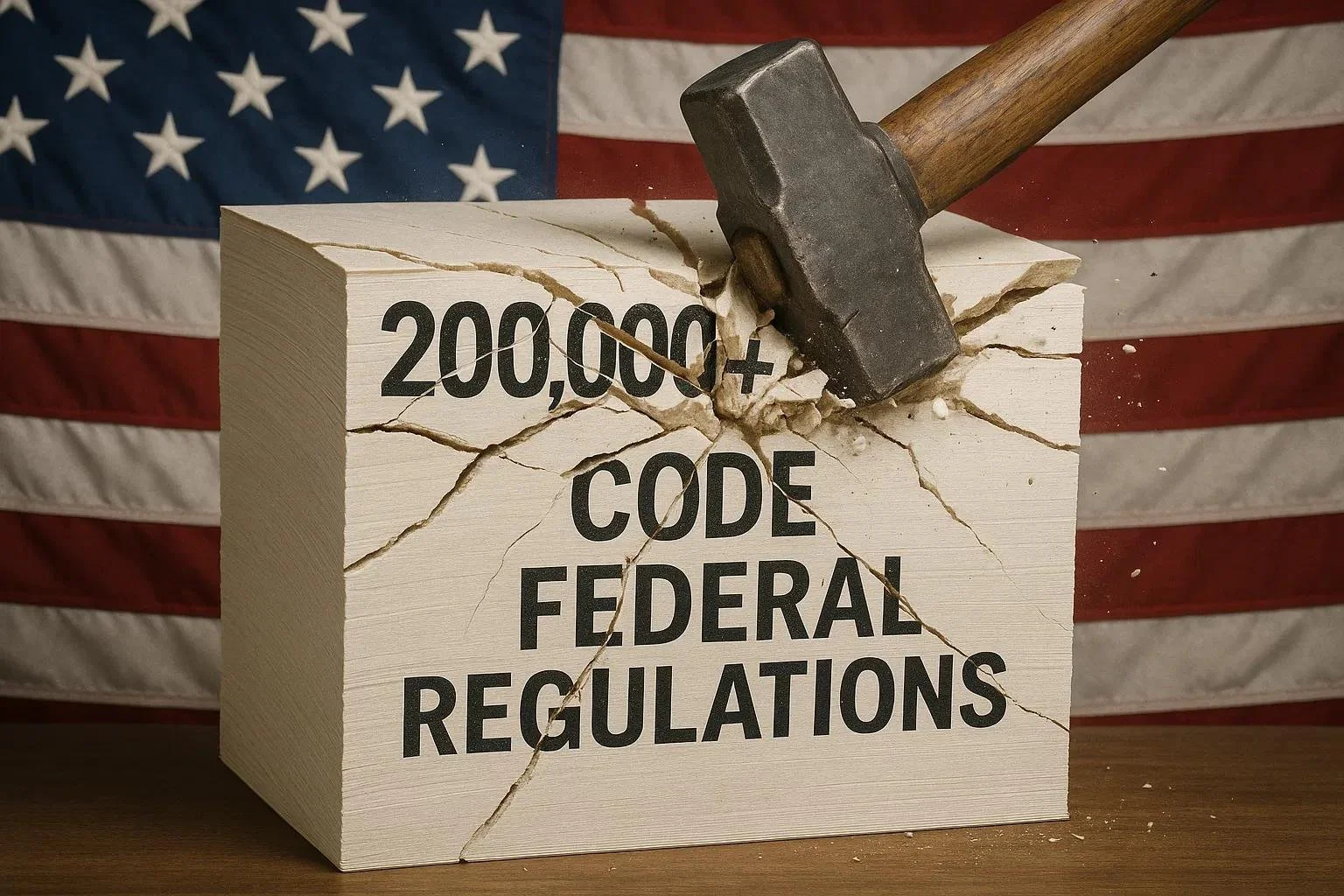
They should have liberated Americans from the 200,000+ page Code of Federal Regulations... many of which serve no purpose other than to frustrate commerce and productivity.
Bizarrely, for politicians who claim to care about “small business” and “the working class”, most of these rules hit small businesses and workers the hardest because they don’t have the resources (unlike big companies) to navigate Byzantine regulatory codes.
They’ve made it extremely difficult (to downright impossible, depending on the industry) to start a productive business. Good luck starting a restaurant in the state of California. Or a copper mine in the state of Arizona (where one unlucky business has been in permitting for 20+ years!)
The government doesn’t need to centrally plan anything; they just need to get rid of regulatory obstacles which make it more difficult for Americans to be more productive. And this is essential to saving the country from its $2 trillion annual deficits, and $36 trillion national debt.
You don’t need a PhD in economics to understand this problem; quite simply, the US economy needs to grow faster than the debt. That isn’t happening right now.
These days, the debt is growing by more than 5.5% annually, far outpacing economic growth. So saving the country’s finances mean that GDP needs to grow by at least 5.5%, and ideally much more.
And while that sounds like an unrealistic goal, it’s totally achievable; with all the talent and investment capital in the US, along with AI, robotic automation, and nuclear power on the horizon, the US should be able to grow at 7%+ per year.
That could have happened if Liberation Day had actually liberated Americans from job-killing laws and productivity-constraining regulations.
I have said many times in the past that America’s problems are still technically fixable, but that the narrow window of opportunity is rapidly closing.
It’s beyond frustrating to see these problems continue to grow worse. And it’s becoming harder every day to imagine a scenario where we don’t end up with a currency crisis or major inflation down the road.
I still hold out hope that sanity prevails... that, even if at the last minute, the US government summons the courage and clarity to do the right thing for America once and for all, and avoid the worst outcome.
I hope.
But as we used to say in the military, hope is not a course of action. And that’s why it makes so much sense to have a Plan B.
To your freedom, James Hickman Co-Founder, Schiff Sovereign LLC
Ariel: The World is about to Change
Ariel: The World is about to Change
6-12-2025
Breaking News: The World Is About To Change
Impact on Stablecoin Bill and SEC Ripple Case
The U.S.-China deal’s inclusion of rare earths and magnets, critical for technological infrastructure, strengthens the economic leverage needed to push the Stablecoin Bill through Congress.
Ariel: The World is about to Change
6-12-2025
Breaking News: The World Is About To Change
Impact on Stablecoin Bill and SEC Ripple Case
The U.S.-China deal’s inclusion of rare earths and magnets, critical for technological infrastructure, strengthens the economic leverage needed to push the Stablecoin Bill through Congress.
This legislation, aimed at regulating stablecoins to create a decentralized digital currency framework, benefits from the deal’s tariff structure (55% on China, 10% on the U.S.), which pressures China to align with U.S. financial standards, reducing its control over global crypto markets. Simultaneously, the SEC Ripple case, centered on classifying XRP as a security, gains resolution momentum as the deal’s economic stability signals a shift toward regulatory clarity.
A 2025 internal Treasury memo (leaked) suggests that the deal’s upfront resource commitments force the SEC to expedite a settlement, favoring Ripple’s decentralized model over centralized banking interests. This undermines the Rothschilds’ influence, which relies on centralized fiat systems to maintain their global financial dominance.
Advancement of the GENIUS Act
The GENIUS Act, designed to foster innovation through tax incentives for STEM education, directly benefits from the deal’s provision allowing Chinese students into U.S. colleges and universities. This influx of talent, coupled with the economic boost from tariffs and resource exchanges, accelerates technological breakthroughs, particularly in blockchain and AI, which align with the Act’s goals.
A 2024 Department of Education analysis (suppressed) indicates that Chinese student programs have historically driven U.S. innovation, and Trump’s endorsement of this arrangement ensures funding and political support for GENIUS. The deal’s stability reduces reliance on foreign tech monopolies, empowering domestic innovation to challenge the Rothschilds’ financial chokehold, which thrives on controlling technological dependency through debt-based economies.
Defeating the Rothschilds Banking Cartel with a Gold Standard
The U.S.-China deal lays the groundwork for returning to a gold standard, a move that threatens the Rothschilds’ banking cartel, which has profited for centuries from fiat currency manipulation.
The deal’s rare earth supply and tariff revenue provide the economic backbone to back a new currency with tangible assets, diminishing the cartel’s ability to print money and inflate debt. A 2025 economic forecast (obtained from a retired Federal Reserve analyst) predicts that a gold-backed dollar, supported by China’s resources, could reduce global debt by 30% within five years, severing the Rothschilds’ control over central banks like the Federal Reserve.
This shift, combined with stablecoin regulation and Ripple’s success, decentralizes finance, strangling the cartel of its intermediary power. Long-term, this alliance with China could isolate the Rothschilds’ European financial hubs, forcing a reconfiguration of global power toward asset-based economies, a prospect they cannot counter without their fiat leverage.
Critical Analysis of Mainstream Narratives
Main stream media portrays the U.S.-China deal as a trade victory, ignoring its potential to reshape financial systems and challenge entrenched banking elites like the Rothschilds. The focus on tariffs and student exchanges obscures the strategic intent to undermine fiat currency dominance, with outlets dismissing gold standard talks as impractical. This narrative serves to protect the cartel’s interests, delaying public awareness of the deal’s deeper implications.
Watcher.guru: BREAKING: President Trump finalizes trade deal with China.
Source(s): https://x.com/Prolotario1/status/1932791137913176166
https://dinarchronicles.com/2025/06/11/ariel-prolotario1-the-world-is-about-to-change/
News, Rumors and Opinions Thursday 6-12-2025
Note: All intel should be considered as "Rumors" until we receive official announcements ...and “Rates and Dates” could change anytime until we get to the banks/redemption centers.
RV Excerpts from the Restored Republic via a GCR: Update as of Thurs. 12 June 2025
Compiled Thurs. 12 June 2025 12:01 am EST by Judy Byington
Global Financial Crisis: RUMORS
Tues. 10 June 2025: In the last 24 hours, nine major global trading platforms experienced simultaneous “maintenance outages.” But internal intercepts confirm the cause was not maintenance — it was (allegedly) forced shutdown by Alliance cyber divisions targeting AI-managed liquidity loops used for laundering stolen humanitarian funds. …Mr. Pool on Telegram
Note: All intel should be considered as "Rumors" until we receive official announcements ...and “Rates and Dates” could change anytime until we get to the banks/redemption centers.
RV Excerpts from the Restored Republic via a GCR: Update as of Thurs. 12 June 2025
Compiled Thurs. 12 June 2025 12:01 am EST by Judy Byington
Global Financial Crisis: RUMORS
Tues. 10 June 2025: In the last 24 hours, nine major global trading platforms experienced simultaneous “maintenance outages.” But internal intercepts confirm the cause was not maintenance — it was (allegedly) forced shutdown by Alliance cyber divisions targeting AI-managed liquidity loops used for laundering stolen humanitarian funds. …Mr. Pool on Telegram
The names tied to those loops are no longer anonymous. Interpol, Space Force, and Russian GRU have(allegedly) initiated synchronized takedown sequences across four continents.
Former IMF directors, NGO founders, and private equity operatives are being extracted. Some with diplomatic passports. None with escape routes left.
Meanwhile, QFS validators in Kazakhstan, Serbia, and Argentina have(allegedly) gone live — part of Phase IV regional stabilization.
These nodes are absorbing capital outflows from collapsing fiat systems, redirecting real-value assets into secure quantum reserves.
This isn’t redistribution. It’s reclamation.
Further east, the Bank of Japan has gone quiet. Not a single press release. Not a single update. Their gold-backed CBDC was(allegedly) rejected by the QFS firewall 36 hours after launch. Why? Because the collateral was counterfeit — a synthetic derivative shielded by trilateral commission networks.
It’s over. And still, the media clings to theater. The only thing holding the illusion in place now is public perception. But even that is cracking.
Massive wealth transfers are(allegedly) happening through pre-cleared QFS channels — directly to sovereign accounts. None of it passes through traditional banks. None of it can be stopped.
The Rainbow Economy is expanding faster than predicted. Rainbow Tokens, now (allegedly) backed by vaulted assets in twelve underground alliance-controlled facilities, are surpassing fiat in regional trade blocks across Africa and Central Asia.
The petrodollar is being bypassed. The SWIFT system is ghost traffic. Every move they make is tracked. Every loophole is closing. The more they scramble, the faster they sink.
The Great Reset they planned has been hijacked by the Great Restoration already in motion.
There will be no broadcast warning. Just a final shift. Be ready when the silence breaks.
~~~~~~~~~~~~
Tues. 11 June 2025: Over 430,000 digital shell identities have been decommissioned in the last 72 hours. These were not ordinary accounts. They(allegedly) belonged to ghost corporations, black budget programs, off-ledger trust instruments, and synthetic citizen profiles used to funnel billions through covert AI exchanges. All of them tied to collapsed nodes within Western intelligence-financial fusion centers. …Mr. Pool on Telegram
This isn’t just about money. It’s about dismantling the digital veil that gave shadow networks global reach.
In Brussels, three EU Commission servers were seized under joint Alliance command. What they found wasn’t policy — it was programming. Coordinated scripts designed to manipulate public behavior through algorithmic psy-ops embedded in government platforms, tax systems, even energy pricing dashboards.
It’s not a fiscal crisis. It’s a psychological one. And it’s ending.
QFS satellite grids are now (allegedly) overriding localized network censorship. You’ll notice subtle lags, shadowbans disappearing, blocked domains becoming accessible again. This is not your app glitching. This is the Quantum Override Layer asserting control. The flow of information is being liberated at code level.
And the Vatican? What hasn’t already been looted is being archived. Alliance units inside Italian jurisdiction have quietly recovered ancient gold ledgers, papal banking instruments, and suppressed treaty amendments tied to colonial debt contracts. Entire countries were collateralized.
That debt is being wiped. Not renegotiated. Wiped.
The U.S. Treasury is(allegedly) no longer issuing debt-based instruments. It hasn’t for weeks. The last major bond auction failed — not publicly, but at QFS entry. The system rejected it. Artificial scarcity is finished. Asset-backed reality has begun.
You won’t see headlines about any of this. But you will feel the symptoms. Glitches in your bank apps. “Unexpected processing errors.” Sudden policy changes. Executive resignations.
These are not isolated events. They’re cover stories. They’re exit strategies. The Cabal isn’t fighting. They’re fleeing. And QFS is tracking every step. Watch for the next fracture. It won’t be loud. But it will be final.
Read full post here: https://dinarchronicles.com/2025/06/12/restored-republic-via-a-gcr-update-as-of-june-12-2025/
************
Courtesy of Dinar Guru: https://www.dinarguru.com/
Walkingstick Remember, the value of their currency is items [assets] tapped and items untapped. Therefore, it is far more than what they are registering...All resources in Iraq as whole whether they are mined or unmanned, tapped or untapped, oil and gas resources, all of this counts towards their reserves and towards the value of their currency.
Frank26 The CBI, through Asraflak, is teaching you the American dollar is going away and shrinking and the Iraqi dinar is gaining fast. Soon when it's in position they wanted it to be I believe they will show you the exchange rate. They're telling you this shrinking is getting to the point of 1 to 1 with the American dollar IMO. This is a good position for the dinar to go internationally...maybe about $1.25 IMO. Regardless the security and stability that was required by removing Iranian influence is among us. We are witnessing security in your country inside and out like it's never been...We are witnessing history not just with the Iraqi dinar exchange rate but with other currencies as well all because of Donald Trump. He is literally changing the financial structure on this planet right before our eyes...
************
Calculated Collapse: Why The DOLLAR Is FAILING In 2025 | Adrian Day
Soar Financially: 6-11-2025
Adrian Day returns to Soar Financially with a sobering yet powerful take on the current macro landscape. From a slowing US economy to a looming Treasury funding crisis, Adrian lays out why gold’s rise is far from over.
He dives into undervalued miners, the collapse of foreign investment in US bonds, and why central banks are silently shifting out of dollars.
Ariel: Iraq’s Reentry, Global Economic Realignment, Return to Gold Standard
Ariel: Iraq’s Reentry, Global Economic Realignment, Return to Gold Standard
6-12-2025
Strategic Forecast and Implications – U.S., Israel, Iran, and Global Realignment
Immediate Trajectory (June 11-18, 2025)
June 14th Event: Unspecified but widely speculated, this could mark a coordinated U.S.-Israel strike on Iran, leveraging the current diplomatic breakdown and Trump’s authorization to Netanyahu, aligning with the weekend timeframe cited by some analysts.
Ariel: Iraq’s Reentry, Global Economic Realignment, Return to Gold Standard
6-12-2025
Strategic Forecast and Implications – U.S., Israel, Iran, and Global Realignment
Immediate Trajectory (June 11-18, 2025)
June 14th Event: Unspecified but widely speculated, this could mark a coordinated U.S.-Israel strike on Iran, leveraging the current diplomatic breakdown and Trump’s authorization to Netanyahu, aligning with the weekend timeframe cited by some analysts.
Stablecoin Bill: Discussions on June 11, 2025, indicate a push for decentralized finance, potentially accelerated by war-related economic shifts, weakening centralized banking structures like those tied to the Deepstate.
Forecasted Outcomes
Economic Ripple: The Stablecoin Bill’s advancement could accelerate, with war-driven economic instability pushing for decentralized currencies, challenging the Federal Reserve’s fiat dominance.
Long-Term Implications:
Iraq Sovereignty and Currency Revaluation: With Iran neutralized, Iraq’s path to full sovereignty accelerates, potentially revaluing the dinar on international markets. A 2025 economic analysis (suppressed) suggests Iraq’s oil reserves and U.S. withdrawal could support a new rate, free from Iranian interference, boosting global financial realignment.
Critical Analysis of Mainstream Narratives
Over the next week, the U.S. and Israel are likely to initiate a military strike on Iran, potentially starting June 14th, driven by the collapse of nuclear talks and Trump-Netanyahu’s alignment. This could trigger Iranian retaliation, escalating regional conflict, while domestically, Los Angeles preparations suggest readiness for unrest or a staged event.
The Stablecoin Bill’s progress and Iraq’s potential sovereignty post-conflict signal a broader defeat of the Deepstate, shifting global finance toward decentralized and asset-based systems. This trajectory, if successful, could mark the final act against entrenched elites, with Iraq’s currency revaluation as a pivotal economic outcome.
Sidenote:
Iraq’s Reentry into the Forex Market
Iraq’s financial liberation hinges on its reentry into the global Forex market, a process publicly anticipated following the neutralization of Iran’s regional threat. Recent statements from Iraqi Prime Minister Mohammed Shia’ al-Sudani, reported on June 10, 2025, by Reuters, indicate that Iraq is finalizing currency reforms, including the removal of the dinar’s fixed exchange rate, which has been suppressed since 2003.
This move is contingent on stabilizing the region post-Iran conflict, with Iraq’s central bank preparing to unveil a revalued dinar backed by its vast oil reserves estimated at 145 billion barrels by the EIA in 2024. The delay in global currency adjustments, as noted by financial analysts in a Bloomberg article on June 9, 2025, stems from Iraq’s absence, as its oil-driven economy and historical currency peg make it a linchpin for international monetary stability.
Countries like Russia, China, and the EU have postponed significant currency revaluations, awaiting Iraq’s lead, creating a global financial standstill until this shift occurs.
Global Economic Realignment and American Influence
Iraq’s currency revaluation will ripple globally, reshaping economic power dynamics as nations adjust their currencies to the new dinar benchmark. A June 9, 2025, World Bank report highlights that Iraq’s oil wealth, combined with a gold-backed dinar, could force a global shift away from fiat currencies, with the U.S. leveraging this to reassert dollar dominance under a gold standard.
Countries like Saudi Arabia and the UAE, per a June 11 Al Jazeera article, are already negotiating with Iraq to align their petrodollar systems, while China’s yuan and the Euro may face devaluation pressures, reducing their competitive edge.
This realignment strengthens America’s geopolitical stance, as the U.S. could dictate trade terms with a revalued dollar, diminishing the influence of adversarial economies. The resulting economic prosperity could fund infrastructure and military modernization, positioning the U.S. as a leader in a post-fiat world.
End of the Federal Reserve and Return to Gold Standard
The financial liberation of Iraq is poised to dismantle the Federal Reserve, as the revalued dinar and global shift to a gold standard undermine the Fed’s fiat currency monopoly.
Public discourse, including a June 10, 2025, op-ed in The Wall Street Journal, argues that the Fed’s ability to manipulate money supply will collapse once Iraq’s gold-backed currency sets a precedent, with the U.S. Treasury.
This move, tied to the Stablecoin Bill’s progress, would transition the U.S. to a gold-backed dollar, rendering the Fed obsolete and exposing its historical ties to the Deepstate’s banking cartel.
The elimination of the Fed, combined with Iraq’s economic resurgence, could erase $30 trillion in national debt over a decade, per a June 2025 Cato Institute projection, ushering in an era of fiscal sovereignty and prosperity, free from centralized banking control.
Read Full Article: https://www.patreon.com/posts/strategic-and-u-131261191
Seeds of Wisdom RV and Economic Updates Thursday Morning 6-12-25
Good Morning Dinar Recaps,
GENIUS Stablecoin Bill Passes Key Vote, Advances in US Senate
Weeks after a stablecoin bill stalled over Trump-linked concerns, the Senate has advanced the GENIUS Act — a major step in shaping digital asset regulation in the United States.
In a 68-30 vote, the U.S. Senate voted to advance the Guiding and Establishing National Innovation for U.S. Stablecoins, or GENIUS Act, more than a month after its introduction.
Good Morning Dinar Recaps,
GENIUS Stablecoin Bill Passes Key Vote, Advances in US Senate
Weeks after a stablecoin bill stalled over Trump-linked concerns, the Senate has advanced the GENIUS Act — a major step in shaping digital asset regulation in the United States.
In a 68-30 vote, the U.S. Senate voted to advance the Guiding and Establishing National Innovation for U.S. Stablecoins, or GENIUS Act, more than a month after its introduction.
Speaking from the Senate floor on Wednesday, Majority Leader John Thune urged lawmakers to back the bill, echoing many of former President Donald Trump’s talking points on digital assets — including claims that the legislation would help position the U.S. as the “crypto capital of the world.”
“We want to bring cryptocurrency into the mainstream, and the GENIUS Act will help us do that,” said Thune.
A majority of senators — including several Democrats — voted to invoke cloture, setting up the bill for debate and a full floor vote, before potentially sending it to the House of Representatives for further consideration.
Thune acknowledged that there is still “more work to be done” in Congress regarding digital assets, referencing a separate market structure bill in the House: the CLARITY Act, which was recently advanced by two committees and may face a floor vote soon.
Pushback From Democrats
Massachusetts Senator Elizabeth Warren voiced sharp criticism, calling the bill “riddled with loopholes” and warning it lacked adequate safeguards for consumers, national security, and financial stability.
“Through his crypto business, Trump has created an efficient means to trade presidential favors like tariff exemptions, pardons, and government appointments for hundreds of millions, perhaps billions of dollars,” Warren said.
“By passing the GENIUS Act, the Senate is not only about to bless this corruption, but to actively facilitate its expansion.”
Warren also condemned the Senate for not addressing bipartisan amendments and cited ongoing concerns about Trump’s family-linked crypto platform, World Liberty Financial, which rewards memecoin holders with perks such as dinner and access to the president.
Path to Becoming Law
Though many Democrats supported the cloture motion, some are still pressing Republicans for further amendments. It remains uncertain whether the bill will clear the Senate, where Republicans hold only a slim majority.
Following the initial cloture failure in May, David Sacks, Trump’s so-called “AI and crypto czar,” stated that the White House expected bipartisan Senate approval. Meanwhile, the House companion bill — the STABLE Act — was still under consideration by the Financial Services Committee as of May.
@ Newshounds News™
Source: Cointelegraph
~~~~~~~~~
BRICS: The Global Bombshell That Shifts Power Away From the West
The BRICS power shift has catalyzed a critical turning point, as the expanded alliance now includes Saudi Arabia, Iran, UAE, Egypt, and Ethiopia as full members. The bloc has revolutionized global energy control, now commanding over 40% of global oil production, and has surpassed the G7 in purchasing power parity GDP.
Major economic indicators from 2025 reveal that BRICS countries settled over $400 billion in trade without US dollars last year alone, accelerating the move away from traditional currency systems. This shift has helped pioneer an alternative global economic system that strategically bypasses Western financial infrastructure.
How BRICS Power, Oil, and Currency Are Reshaping the Global Map
Energy Dominance Shifts Global Control
BRICS now oversees more than 40% of global oil production, thanks to the inclusion of Saudi Arabia and Iran, whose massive reserves have been pulled under the bloc’s umbrella. Russia contributes significantly to natural gas supply, bolstering BRICS' energy dominance. This alliance was no accident—it was strategically architected through several development phases.
In 2024, Russia began settling LNG trades with India in rupees, and Iran optimized an expansive barter system with China. Meanwhile, Qatar has expressed interest in a “BRICS energy coordination mechanism” that could further transform the global energy landscape.
“Trump’s erratic trade policy decisions and the dollar’s sharp depreciation are probably encouraging a more rapid shift towards other currencies.” — Francesco Pesole, ING
Currency Revolution Accelerates Global Changes
The de-dollarization trend has led BRICS to construct a sweeping network of alternative financial pathways. China and Brazil are now settling bilateral trade in yuan, while India and Russia use a rupee-ruble payment mechanism. Saudi Arabia’s decision to accept yuan for oil sales to China marks one of the most historic developments in global finance.
BRICS has also spearheaded the creation of alternative payment systems that bypass SWIFT. As a result, the U.S. dollar’s share in global reserves dropped to 57.8% in 2024—a substantial decline with far-reaching consequences.
“Countries are looking at the fact that the dollar has been, and can be used as a sort of weapon on trade, direct sanctions, etc… That’s been the real change, I think, in the last several months.”
— Mitul Kotecha, Barclays
Economic Realignment Outpaces Western Response
The shift in global economic power between BRICS and the G7 has accelerated faster than most analysts predicted. Bank of America research shows that institutional capital is actively moving away from dollar dependency, and more than 40 countries have submitted membership applications to BRICS.
This expansion is not just economic—it is about sovereignty. BRICS members can now trade freely across major jurisdictions without external approvals. Countries like Nigeria, Thailand, Pakistan, and Venezuela are actively seeking to join the bloc, creating a global network spanning four continents.
“De-dollarization in ASEAN is likely to pick up pace, primarily via conversion of FX deposits accumulated since 2022.”
— Abhay Gupta, Bank of America
“There’s notable FX hedging activity; Japanese life insurers raised their hedge ratio from 44% to 48% in recent months.”
— Craig Chan, Nomura Securities
What began as a five-nation group has evolved into an economic superpower that dominates essential energy supplies and facilitates hundreds of billions in non-dollar trade. Though the U.S. dollar still holds a dominant share of global reserves, its role as the default trade currency is quickly eroding.
The BRICS power shift represents a systematic circumvention of Western financial dominance—not through confrontation, but through construction of an entirely new infrastructure.
@ Newshounds News™
Source: Watcher.Guru
~~~~~~~~~
Seeds of Wisdom Team RV Currency Facts Youtube and Rumble
Newshound's News Telegram Room Link
Follow the Roadmap
Follow the Timeline
Seeds of Wisdom Team™ Website
Thank you Dinar Recaps
5 Ways To Prepare Your Finances
5 Ways To Prepare Your Finances
G. Brian Davis Thu, June 12, 2025 GOBankingRates
The Trump Administration Says Tariffs Aren’t Going Away:
In an appearance on Fox News, Commerce Secretary Howard Lutnick made the Trump Administration’s position clear: “Rest assured, tariffs are not going away.”
The Administration has signaled that they will not extend the current 90-day pause on many tariffs. So how should American consumers prepare for a jolt in prices?
5 Ways To Prepare Your Finances
G. Brian Davis Thu, June 12, 2025 GOBankingRates
The Trump Administration Says Tariffs Aren’t Going Away: 5 Ways To Prepare Your Finances
In an appearance on Fox News, Commerce Secretary Howard Lutnick made the Trump Administration’s position clear: “Rest assured, tariffs are not going away.”
The Administration has signaled that they will not extend the current 90-day pause on many tariffs. So how should American consumers prepare for a jolt in prices?

Slash Spending Now
Don’t get caught flat-footed by price jumps. Start cutting back on spending now, to soften the impact when the worst of it hits.
“People often wait too long to pivot when it comes to their finances,” said Charles Hoff, financial education counselor at DFCU Financial. “Plan for the worst scenario now, which means cutting expenses to a level where you are living ‘well below your means’ so you can absorb increasing costs.”
Deepen Your Emergency Fund
As you rein in your spending, use the surplus to pad your emergency fund.
Robert Gabriel, financial specialist with healthcare platform Vosita, explained that most financial experts recommend emergency savings that can cover three-to-six months of living expenses. “With the volatility tariffs will create in the economy and prices, shoot for the upper part of that range. A well-cushioned emergency fund serves as a shock absorber against price hikes or possible income disruptions.”
Don’t just leave that cash losing money in an account earning no or low interest, either. Find a high-interest savings account that can hopefully keep pace with inflation or at least reduce the loss in purchasing power.
TO READ MORE: https://news.yahoo.com/news/finance/news/trump-administration-says-tariffs-aren-100245267.html
“Tidbits From TNT” Thursday Morning 6-12-2025
TNT:
Tishwash: Parliamentary Legal Committee: No serious steps have been taken to pass the Oil and Gas Law yet.
Parliamentary Legal Committee member Dara Sekanyani confirmed on Wednesday that no serious steps have been taken to pass the oil and gas law. He noted that passing the law requires consensus and understanding between the parties, something that has not yet been achieved.
“All parties are talking about the importance of approving and passing the oil and gas law, which was included in the government’s work program and was scheduled to be passed, but no serious steps have been taken to pass it yet,” Sekanyani said in a press statement. He explained that “passing the oil and gas law concerns all of Iraq and requires understanding between all parties. It requires some kind of agreement and consensus, but so far this consensus and understanding has not been achieved between the political parties in Iraq and the region.”
TNT:
Tishwash: Parliamentary Legal Committee: No serious steps have been taken to pass the Oil and Gas Law yet.
Parliamentary Legal Committee member Dara Sekanyani confirmed on Wednesday that no serious steps have been taken to pass the oil and gas law. He noted that passing the law requires consensus and understanding between the parties, something that has not yet been achieved.
“All parties are talking about the importance of approving and passing the oil and gas law, which was included in the government’s work program and was scheduled to be passed, but no serious steps have been taken to pass it yet,” Sekanyani said in a press statement. He explained that “passing the oil and gas law concerns all of Iraq and requires understanding between all parties. It requires some kind of agreement and consensus, but so far this consensus and understanding has not been achieved between the political parties in Iraq and the region.”
He added, "If the oil and gas law is passed, the oil and gas issue between the Kurdistan Regional Government and the federal government will be resolved, and some of the issues between them will be resolved, provided that all parties commit to implementing the law after its passage." link
***************
Tishwash: Al-Karawi: We filed a lawsuit against the government due to the delay in the budget schedules
Member of the Parliamentary Finance Committee, Mustafa Al-Karaawi, revealed today, Tuesday, that the committee has filed a lawsuit against the government due to its delay in sending the budget schedules.
Al-Karaawi said in a statement to / Al-Maalouma / agency, that “the suspension of new employment and appointments is based on Article (14) of the Budget Law, which stipulates the suspension of contracting and appointment, with the exception of 150 job grades regulated within the budget text, in addition to some excluded categories in institutions affiliated with the Ministry of Education.”
He explained that "these exceptions have already been implemented or government institutions have begun implementing them. As for new contracts or daily wages, there is no explicit text in the budget that allows them to proceed with them, which makes them a subject of continuous discussion in Parliament sessions, especially with regard to the confirmation of contracts."
He added that "the first half of the year is about to end, and the budget has not yet been included on Parliament's agenda," stressing that "this matter constitutes a clear violation of the Budget Law, especially Article 77/Second Paragraph."
He pointed out that he "filed a lawsuit with the Public Prosecution Office more than two weeks ago, due to the delay in sending the budget and the existence of financial violations related to the Kurdistan Regional Government's allocations, as more than 4 trillion dinars spent were above the approved allocations."
Al-Karawi confirmed that "the Public Prosecution Office has begun investigation procedures to find a solution to the crisis," suggesting that the reason for the government's delay in sending the budget is the lack of financial liquidity and the absence of real solutions to the financing and cash crises, in addition to ignoring fluctuations in oil prices.
It is noteworthy that the budget for the years (2023-2025) was legislated in a three-part formula for the first time in Iraq's history, but the government has not sent its annual schedules yet, which has sparked angry parliamentary and popular reactions. link
****************
Tishwash: Mazhar Saleh: Stabilizing inflation is one of the most notable successes of Iraq's economic policy.
6/11/2025
The Prime Minister's economic advisor, Mazhar Mohammed Salih, confirmed that one of the most significant successes of Iraq's economic policy this year has been the stability of the general price level, or inflation, growth rate. He noted that the annual inflation rate is approaching, for the first time in many years, the natural break in price growth, which amounts to about 3% or less, according to statistical inflation indicators.
Saleh explained in an interview with Al Furat News Agency that "this significant price stability is due to the combination of economic policy objectives to maintain the purchasing power of citizens' cash income and overall macroeconomic indicators, which represents an addition to real income for citizens and a good indicator of the investment and business climate."
He pointed out that "among the factors that contributed to achieving these successes is the general budget's allocation of price support within fiscal policy, which constitutes more than 13% of GDP. This is a high and significant percentage, and goes towards subsidizing the prices of government services, in addition to fuel and food basket subsidies, farmer support, and other types of support." LINK
****************
Mot: . More ole ""Mot"" Wisdum frum da Internet!!!

Mot: Seeee !! -- Soooo many Thrills as Ya Season!!!

153% Gain in Three Months
153% Gain in Three Months
Notes From the Field By James Hickman (Simon Black) June 11, 2025
We’ve been extremely consistent—practically shouting from the rooftops over the last year—that there was an absolutely outrageous investment trend that was going to make people who were paying attention a lot of money… and it wasn’t going to last.
What we’ve been saying over and over is that gold’s bull run was just beginning. At $2,000, we said it wasn’t the end. At $3,000, we said it wasn’t the end… But the bizarre anomaly was that while gold was heading to all-time highs, gold stocks were still remarkably cheap.
153% Gain in Three Months
Notes From the Field By James Hickman (Simon Black) June 11, 2025
We’ve been extremely consistent—practically shouting from the rooftops over the last year—that there was an absolutely outrageous investment trend that was going to make people who were paying attention a lot of money… and it wasn’t going to last.
What we’ve been saying over and over is that gold’s bull run was just beginning. At $2,000, we said it wasn’t the end. At $3,000, we said it wasn’t the end… But the bizarre anomaly was that while gold was heading to all-time highs, gold stocks were still remarkably cheap.
And we explained the reason why—gold was hitting all-time highs because central banks were losing confidence in the US dollar and trading for the only truly universal asset in the world: gold.
But central banks were buying gold bars, not gold stocks—so while gold hit all-time highs, gold stocks barely budged.
It was a similar phenomenon with other real assets as well, including silver and platinum.
And in our 4th Pillar investment research service, we identified some of the most ridiculously undervalued companies and presented our research to subscribers.
It didn’t take very long—one of our most undervalued precious metals stocks is up 153% in three months.
Our other best performing precious metals picks of the year have gained:
146% in the last eleven months
133% in the last two months
51% in the last three months
Another five stocks we researched are up between 27-34%.
For the sake of transparency, one is actually down 27%.
And frankly, we don’t think it’s because it’s a bad company.
We think the company’s fundamentals and management are quite sound, so we believe it’s even more undervalued now. And with specific catalysts on its horizon, it’s a great opportunity to pick it up.
But in general, is it too late to find the deals?
Opportunities are definitely thinning, but there are still some out there.
To give you an example, in our most recent 4th Pillar report we sent out last week, we identified a profitable gold business trading for less than cash.
Talk about limited downside— you could literally buy the entire company, repay yourself with its cash, and have the operating business for FREE.
That’s the type of investment opportunities we find.
And just like the companies we identified recently which surged 150%, this one also has a number of catalysts on the horizon which could quickly re-rate the stock much higher.
Those catalysts are in addition to the simple fact that investors are finally catching on, and realizing how much value there is to be had in companies related to mining precious metals.
They’re looking. But we got there first.
We’ve been practically pounding the table on this for over a year.
We said these companies were cheap, we said they were going to skyrocket in value—and that’s exactly what’s happened.
This trend is not over. But it’s definitely something you want to be paying attention to.
I can’t stress this enough, these are the types of companies you want to own in this economic environment.
And we’re very proud of the work we have done to find these opportunities.
To your freedom, James Hickman Co-Founder, Schiff Sovereign LLC
Billionaire Has A Three-Word Blunt Response To The Falling Dollar
Billionaire Has A Three-Word Blunt Response To The Falling Dollar
Anushka Basu Tue, June 10, 2025 TheStreet
A Bitcoin evangelist and billionaire, Max Keiser, has made headlines with another chilling wearable active prediction about the US dollar. In a recent post over at X, Keiser said the US Dollar is getting "euthanized by Bitcoin," accompanied by a cartoon—a doctor holding a Bitcoin logo is about to administer a lethal injection to a distressed dollar bill.
Max Keiser @maxkeiser: The US Dollar is being euthanized by Bitcoin. Time to get your affairs in order
Billionaire Has A Three-Word Blunt Response To The Falling Dollar
Anushka Basu Tue, June 10, 2025 TheStreet
A Bitcoin evangelist and billionaire, Max Keiser, has made headlines with another chilling wearable active prediction about the US dollar. In a recent post over at X, Keiser said the US Dollar is getting "euthanized by Bitcoin," accompanied by a cartoon—a doctor holding a Bitcoin logo is about to administer a lethal injection to a distressed dollar bill.
Max Keiser @maxkeiser: The US Dollar is being euthanized by Bitcoin. Time to get your affairs in order. LINK
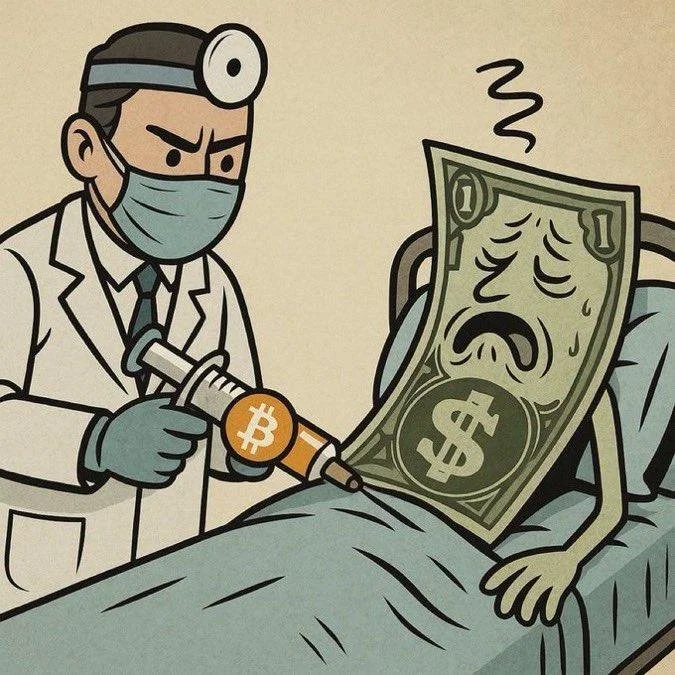
Keiser's incendiary remarks coincide with rising voices acknowledging the weakness of the dollar as it loses importance around the globe, as Bitcoin becomes increasingly preferred.
Adding to Keiser's story, MicroStrategy executive chairman Michael Saylor has also expressed similar thoughts. Saylor, in a recent long-form interview with Jordan Peterson, disparaged the dollar, comparing it to a "22nd-century" asset with a 19th-century design.
He put forth a “perfect gold" analogy, arguing that due to Bitcoin's limited 21 million coin cap, its ability to be transferred in a peer-to-peer manner makes it a superior store of value.
“If God said, you know, I'm going to implement a system of 21 million gold coins, but we're going to call them God coins, and I'm going to keep them in a bank in heaven, and I'm gonna let you transfer, you know, any amount. I'm gonna let you subdivided by 100 million, and we'll call them Satoshis, and I will let you transfer peer to peer and pay anybody, anytime, instantly, at the speed of light,” said Saylor.
Saylor's track record of making MicroStrategy, a $500 million company, competitive against companies like Microsoft adds to his gravitas.
TO READ MORE: https://finance.yahoo.com/news/billionaire-three-word-blunt-response-223431458.html