
Thank you to all the subscribers to our Early Access program…we thank you for your continued support.
We are excited to offer this new service to keep you informed and up-to-date on the latest Dinar and currency news.
Seeds of Wisdom RV and Economic Updates Friday Afternoon 2-28-25
Good Afternoon Dinar Recaps,
SEC COMMISSIONER DISSENTS ON AGENCY’S MEMECOIN STANCE
Commissioner Caroline Crenshaw said that the agency’s working definition of memecoins was vague and could be easily misconstrued.
US Securities and Exchange Commission Commissioner Caroline Crenshaw issued a dissenting opinion on the SEC’s recent stance that memecoins are not securities.
According to the commissioner’s Feb. 27 statement, memecoins could satisfy the Howey test’s condition of profiting from the managerial efforts of others due to the coordination between developer teams and promoters.
The commissioner added that most, if not all, cryptocurrencies could be defined as memecoins under the SEC’s recent guidance, which was released on the same day. In this guidance, the agency stated that memecoins represent online social trends with speculative value and high volatility — and are not securities. Commissioner Crenshaw, however, has a different viewpoint:
“Today’s statement paints meme coins as cultural projects whose purpose is entertainment and social engagement. The reality is that meme coins, like any financial product, are issued to make money.”
Memecoins have come into sharper focus following several high-profile scams, hacks and even presidential memecoin launches that threaten the long-term viability of the sector and invite scrutiny from state officials.
US regulators and lawmakers attempt to reign in memecoins
Following US President Donald Trump’s memecoin launch, several Democrat lawmakers, including Elizabeth Warren, called for an investigation into potential ethics violations of the presidential token.
On Feb. 27, California Member of Congress Sam Liccardo announced that House Democrats are prepping a bill that would ban presidential memecoins.
The proposed bill, titled “The Modern Emoluments and Malfeasance Enforcement (MEME) Act,” would prohibit US lawmakers from sponsoring, issuing or endorsing any digital asset.
Moreover, spouses and dependents of US representatives, the president, vice president and senior executive branch officials are also prohibited from issuing or sponsoring memecoins under the bill.
Attorney Elizabeth Davis, former chief attorney at the Commodity Futures Trading Commission (CFTC), recently argued that memecoins should be regulated by the CFTC.
Davis told Cointelegraph that if the commodities regulator is granted regulatory oversight over crypto, then there is a strong likelihood that memecoins will be included in their purview.
The attorney also expressed confidence that comprehensive memecoin regulations would be established in the United States over the next year — putting an end to the regulatory ambiguity surrounding social tokens.
@ Newshounds News™
Source: CoinTelegraph
~~~~~~~~~
ARIZONA APPROVES BITCOIN RESERVES, BUT WYOMING AND MONTANA ARE SAYING NO – HERE’S WHY
▪Arizona advances crypto legislation - two bills, one establishing a digital asset reserve and another focused on Bitcoin investment
▪While Arizona embraces crypto reserves, other states like Wyoming and Montana reject them due to volatility concerns.
▪Bitcoin's recent price drop fuels skepticism, while predictions suggest federal crypto legislation is forthcoming.
Arizona is pushing ahead with cryptocurrency investment as two Bitcoin reserve bills have passed the Senate, setting the stage for final approval in the state’s House of Representatives.
While states like Wyoming and Montana are rejecting similar measures over concerns about crypto’s volatility, Arizona is doubling down on digital assets.
If these bills pass in the state’s House of Representatives, Arizona could become one of the first states to officially hold Bitcoin in its reserves.
Senate Approves Bitcoin Reserve Bills
On Feb. 27, the Arizona Senate approved the Strategic Digital Assets Reserve bill (SB 1373) in a 17-12 vote, sending it to the House for final approval. Sponsored by Republican Senator Mark Finchem, the bill aims to create a Digital Assets Strategic Reserve Fund, which will be managed by the state treasurer. The fund will include legislative appropriations and crypto assets seized by the state.
To limit risk, the treasurer would be allowed to invest no more than 10% of total fund deposits per fiscal year. However, the state could loan out digital assets to generate returns as long as it doesn’t add financial risk.
Another Bill Aims to Allow Bitcoin Investments
A second Bitcoin-related bill is also moving forward. The Strategic Bitcoin Reserve Act (SB 1025), co-sponsored by Republican Senator Wendy Rogers and Representative Jeff Weninger, passed the Senate with a 17-11 vote.
Unlike Finchem’s bill, which focuses on managing seized crypto assets, SB 1025 allows the state to invest public funds directly into Bitcoin and other cryptocurrencies. This signals Arizona’s growing commitment to incorporating digital assets into its financial strategy.
Crypto Legislation Gaining Momentum Nationwide
Dennis Porter, founder of Satoshi Action Fund, believes federal regulation of cryptocurrencies is inevitable. He predicts lawmakers will first regulate stablecoins, followed by broader market structure rules, and eventually, Bitcoin reserves.
While Arizona and Utah are leading the push for crypto reserves, 18 other states are still waiting for approval. However, not all states are on board—Montana, Wyoming, and others have rejected similar plans, calling Bitcoin too risky.
Trump Weighs Heavy on the Markets
Despite increasing political support for crypto, Bitcoin’s price has taken a hit. The asset dropped below $80K, and analysts fear it could fall further to $70K–$75K. Bitcoin is down 17% this week, with Trump’s tariff policies adding to market uncertainty.
Amid the panic, Michael Saylor jokingly told investors to “sell a kidney if you must, but keep the Bitcoin.” While Saylor continues to advocate for a U.S. Bitcoin reserve, the recent price drop has given skeptics more reason to doubt Bitcoin’s long-term stability.
@ Newshounds News™
Source: Coinpedia
~~~~~~~~~
FEBRUARY IN CHARTS: SEC DROPS 6 CASES, MEMECOIN CRAZE COOLS AND MORE
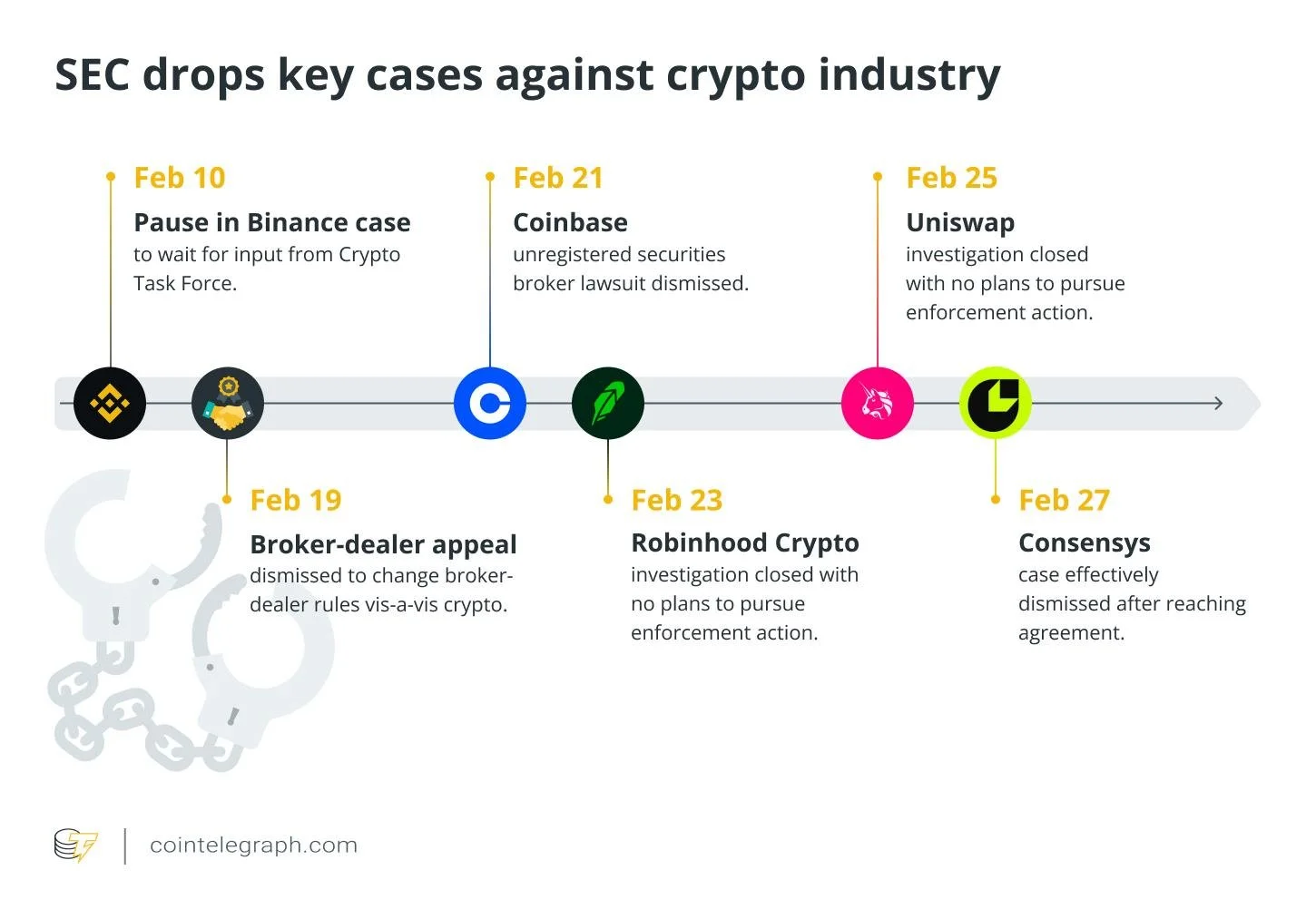
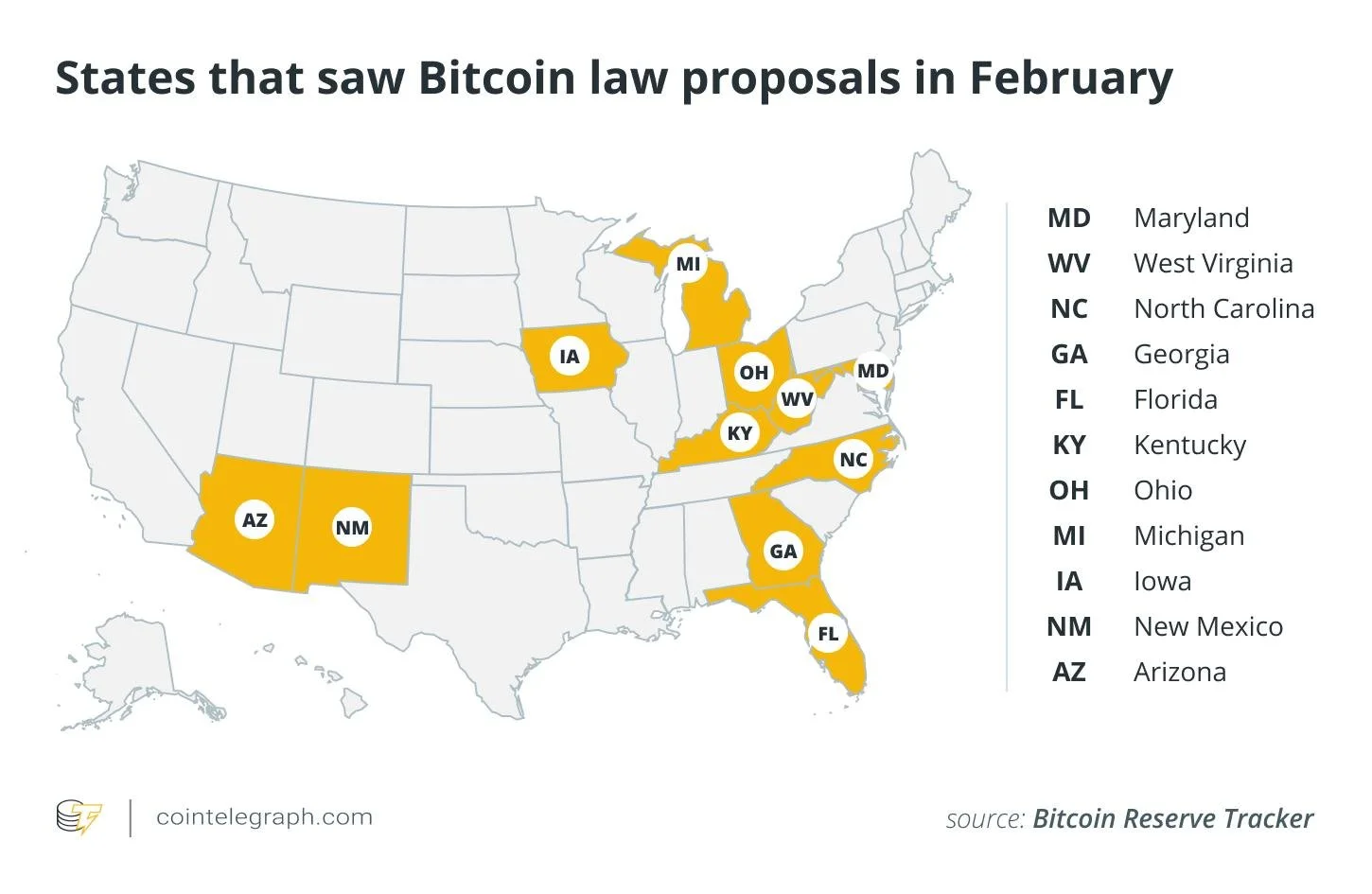
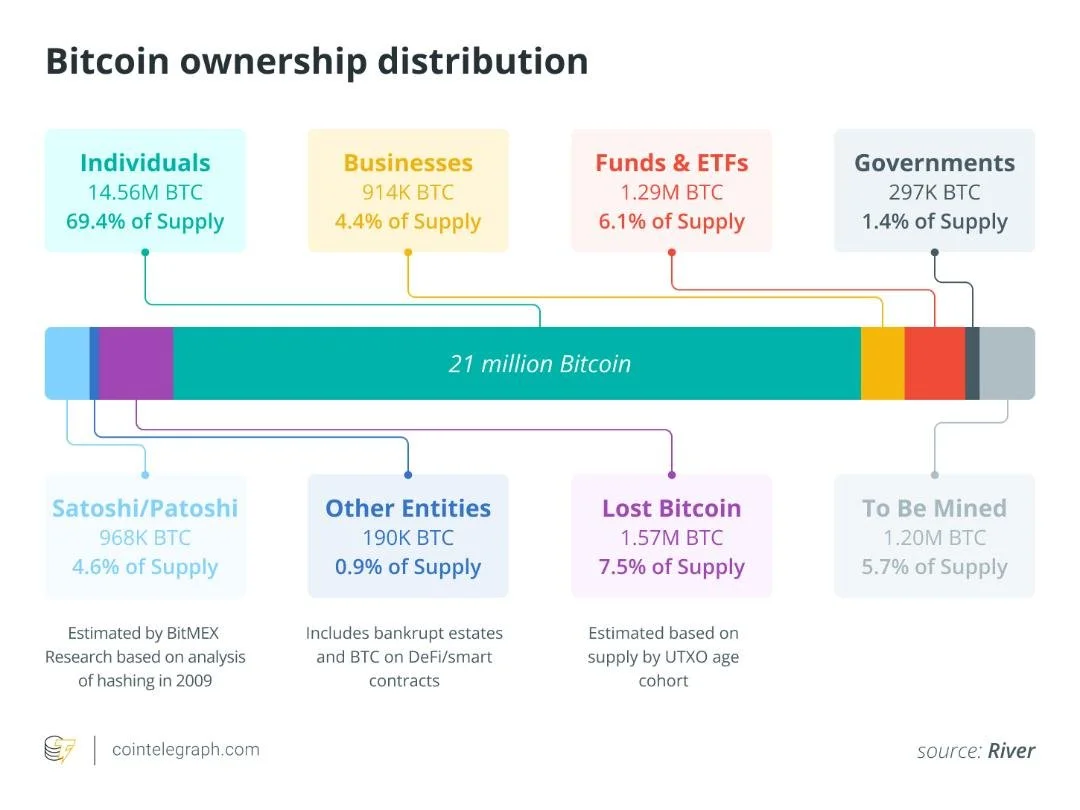
bitcoin pic
@ Newshounds News™
Read the story: CoinTelegraph
~~~~~~~~~
Seeds of Wisdom Team RV Currency Facts Youtube and Rumble
Newshound's Podcast Link
Newshound's News Telegram Room Link
Q & A Classroom Link
Follow the Roadmap
Follow the Timeline
Seeds of Wisdom Team™ Website
Subscribe to Seeds of Wisdom Team™ Newsletter
Thank you Dinar Recaps
More News, Rumors and Opinions Friday PM 2-28-2025
KTFA:
Clare: At an initial rate of 185 thousand barrels.. Oil Minister: Resumption of Kurdistan oil exports will take place within hours - Urgent
- Baghdad
Oil Minister Abdul Ghani Al-Sawad said that Iraq will announce in the coming hours the start of the region's oil export operations.
The Minister of Oil said in a statement received by (Al-Rabia) that "Iraq will announce in the coming hours the commencement of the region's oil export operations through the State Oil Marketing Company (SOMO) via the Turkish port of Ceyhan at an initial rate of 185 thousand barrels, gradually increasing to reach the capacity specified in the general federal budget."
KTFA:
Clare: At an initial rate of 185 thousand barrels.. Oil Minister: Resumption of Kurdistan oil exports will take place within hours - Urgent
- Baghdad
Oil Minister Abdul Ghani Al-Sawad said that Iraq will announce in the coming hours the start of the region's oil export operations.
The Minister of Oil said in a statement received by (Al-Rabia) that "Iraq will announce in the coming hours the commencement of the region's oil export operations through the State Oil Marketing Company (SOMO) via the Turkish port of Ceyhan at an initial rate of 185 thousand barrels, gradually increasing to reach the capacity specified in the general federal budget."LINK
************
Clare: Analysis detailing the reasons for the fluctuations in the exchange rate of the Iraqi dinar against the dollar over 21 years
2/28/2025
The "Iraq Al-Mustaqbal" Foundation for Economic Studies and Consultations attributed, on Friday, the reasons for the fluctuations in the exchange rate of the dinar against the US dollar in the parallel market over more than two decades in the country to internal and external factors.
This came according to an analysis issued by the institution, in which it explained these fluctuations from 2005 until 2024.
The institution stated in its analysis that "the exchange rate of the Iraqi dinar against the US dollar in the parallel market witnessed noticeable fluctuations over the course of 21 years, as it was affected by a group of factors ranging from political, legislative and economic."
The analysis added that "supply and demand were the most influential, as the patterns of exchange rate changes differed according to the months of the year as a result of internal and external factors, such as the timing of the launch of the general budget and official holidays in major countries exporting goods to Iraq, such as China and Iran."
He pointed out that "by analyzing the exchange rate data in the parallel market from 2005 to 2024, there appears to be a recurring pattern that reflects the dinar's value being affected by specific months more than others."
According to the institution, “December was the month with the most frequent increase in the value of the dinar, as it witnessed a decline in 13 years out of 21 years, followed by: August and June with increases in the value of the dinar against the dollar in 11 years, then April 10 times, while October and November witnessed an increase 9 times, and March 8 times.”
May was the month with the least frequent decline in the value of the dinar, as its value rose only 4 times during the period studied, which gives a semi-impression that the prices of the dinar against the dollar rise in the months of February, March and April, then decline again against the dollar in May as a result of the strong return of demand in May.
The institution warned in its analysis that "despite this clear seasonal impact on the exchange rate, there are other factors that cannot be ignored, such as the levels of dollar sales by the Central Bank of Iraq, which directly affect the size of the money supply in the market, as well as political and financial factors such as the timing of the release of general budget funds, in addition to geopolitical situations that may cause sudden disturbances in the demand for foreign currency."
The analysis concluded that “the seasonal effect remains one of the main elements in determining the exchange rate trends in Iraq, as a recurring pattern appears at the end of the year and the beginning of the fiscal year, in addition to being affected by official holiday periods in countries exporting goods to Iraq. However, other factors, such as monetary policies and political and economic developments, remain a direct influence on the parallel market, which makes it necessary to monitor all these variables to understand exchange rate changes more accurately.” LINK
************
Courtesy of Dinar Guru: https://www.dinarguru.com/
Frank26 I get chills every time I hear Saleh say they banking structure in Iraq now has security and stability because those were the same words Dr. Shabibi, the author of the Iraqi monetary reform wanted, demanded, before a new exchange rate was released. These are exciting times.
Militia Man For all you folks that have been in the dinar for a long time, if you remember back 15+ years ago, who was there? CitiBank was. Article quote: "In recognition of its outstanding performance gave the excellence award to the National Bank of Iraq...in managing incoming and outgoing financial transfers stressing that this is an achievement that reflects its commitment to the highest standards of quality and transparency in banking services." ...They're ready to go!
************
Can Trump Expose Fed’s Gold Cover-Up? Feat. Daniel Lacalle - LFTV Ep 212
Kinesis Money: 2-28-2025
In this week’s Live from the Vault, Andrew Maguire sits down with renowned economist Daniel Lacalle to dissect the shifting global financial landscape, from the erosion of trust in political institutions to the rise of gold as a preferred reserve asset.
As resistance grows against mainstream narratives, political and economic turns in Europe, the US, and beyond are driving demand for gold, whilst central banks are reducing reliance on sovereign debt, signalling significant market changes ahead.
00:00 Start
02:22 JD Vance on EU and UK freedom of expression issues
05:10 Could DOGE cuts impact Davos agenda funding?
08:15 UK Labour’s restrictive civil liberty policies
13:45 US wasteful government spending
17:15 Healthy criticism of the EU amid its rapid decline
25:00 Daniel on economic stagnation and persistent inflation
27:50 Aftermath of BIS making gold a first-tier asset
33:00 Why government bonds are no longer a reserve asset
35:20 Trump explores monetising US Treasury gold
37:10 Can Trump audit the Federal Reserve?
42:10 Musk’s DOGE shows how fast frauds can be exposed
46:05 China’s National Regulatory Administration opens gold buying to insurers
52:35 Gold as the ultimate wealth protection
55:40 Daniel on silver’s role in an investment portfolio
Homes aren’t Getting More Expensive and Gold Just Proved it
Homes aren’t Getting More Expensive and Gold Just Proved it
Taylor Kenny: 2-27-2025
We’re all feeling the squeeze. Whether it’s at the grocery store, the gas pump, or even just contemplating the dream of homeownership, the rising cost of everything is a palpable reality.
While inflation is the word on everyone’s lips, understanding the why behind this economic phenomenon is crucial to protecting your financial future. And a key piece of the puzzle lies in the history of the US dollar and its relationship with gold.
Homes aren’t Getting More Expensive and Gold Just Proved it
Taylor Kenny: 2-27-2025
We’re all feeling the squeeze. Whether it’s at the grocery store, the gas pump, or even just contemplating the dream of homeownership, the rising cost of everything is a palpable reality.
While inflation is the word on everyone’s lips, understanding the why behind this economic phenomenon is crucial to protecting your financial future. And a key piece of the puzzle lies in the history of the US dollar and its relationship with gold.
For decades, wages and housing prices largely moved in tandem, reflecting a relatively stable economic environment.
However, a significant shift occurred in 1971 when the U.S. government completely severed the dollar’s link to gold. This pivotal decision unleashed forces that continue to impact our financial lives today.
Prior to 1971, the dollar’s value was directly tied to gold, meaning a certain amount of dollars could be exchanged for a fixed quantity of gold. This provided a natural constraint on the money supply. With the gold standard abandoned, the Federal Reserve gained the ability to print money virtually without limit.
Without the gold standard to tether it, the dollar’s value became increasingly susceptible to inflation. Printing more money effectively dilutes the existing currency, driving up prices for goods and services.
The detachment of the dollar from gold was a watershed moment in modern economic history. While the full ramifications are still unfolding, understanding the link between monetary policy, inflation, and your purchasing power is paramount.
By taking proactive steps to protect your wealth through diversification, strategic investments, and a proactive approach to financial planning, you can navigate the challenges of dollar devaluation and build a more secure financial future. Remember, knowledge is power, and informed decisions are your best defense against the silent thief of inflation.
Watch the video below from ITM Trading with Taylor Kenney for further insights and information.
Seeds of Wisdom RV and Economic Updates Friday Morning 2-28-25
Good Morning Dinar Recaps,
WHEN IS THE BRICS SUMMIT IN 2025?
Brazil will chair the BRICS summit in 2025 under the helm of President Luiz Lula da Silva. The alliance will reinforce its commitment to reshape the global order and usher their economy into a new financial territory. Apart from discussing financial issues, the bloc will also make decisions on climate change and global governance.
The BRICS alliance will collectively collaborate on policymaking at the 2025 summit and represent the population of developing nations. This year’s summit is important as the nine-member bloc will decide on concrete steps to strengthen their economies. The move could reshape the geopolitical landscape and challenge the Western-dominated global financial order.
Good Morning Dinar Recaps,
WHEN IS THE BRICS SUMMIT IN 2025?
Brazil will chair the BRICS summit in 2025 under the helm of President Luiz Lula da Silva. The alliance will reinforce its commitment to reshape the global order and usher their economy into a new financial territory. Apart from discussing financial issues, the bloc will also make decisions on climate change and global governance.
The BRICS alliance will collectively collaborate on policymaking at the 2025 summit and represent the population of developing nations. This year’s summit is important as the nine-member bloc will decide on concrete steps to strengthen their economies. The move could reshape the geopolitical landscape and challenge the Western-dominated global financial order.
When & Where Is The Next BRICS Summit in 2025?
The next BRICS summit in 2025 is scheduled to take place in Brazil’s Rio De Janeiro from July 6th to 7th. The 17th summit will discuss de-dollarization, strengthening of local currencies, new trade deals, and also rewrite policies favoring developing nations. In addition, the alliance might also consensually decide about inducting new countries into the bloc.
Several leaders have hinted that the 17th BRICS summit in 2025 could begin discussions about alternative payment options to the US dollar. Brazil and India have confirmed that they do not support the formation of a BRICS currency. They are looking at various methods to settle cross-border transactions in local currencies.
“This is being discussed in BRICS (2025 summit), at the initiative of (Brazilian President Luiz Lula da Silva). The previous summit stated a decision on the necessity of developing a proposal on alternative payment platforms through finance ministries and central banks.
Such proposals have been made, they suggest, in particular, the creation of a so-called trans-border payment initiative, the creation of a reinsurance company, and the BRICS Clear settlement and depositary infrastructure,” said Russian Foreign Minister Sergey Lavrov.
@ Newshounds News™
Source: Watcher Guru
~~~~~~~~~
XRP NEWS TODAY: CLOSED-DOOR MEETING FUELS SPECULATION OVER RIPPLE LAWSUIT DISMISSAL
▪Ripple vs SEC’s closed-door meeting sparks speculation about lawsuit being dismissed soon.
▪Political pressure increases as Senator Lummis challenges SEC’s crypto regulatory approach.
▪Ripple's XRP dropped by 8% but lawsuit dismissal could push price toward $3.20
The U.S. Securities and Exchange Commission (SEC) held a closed-door meeting on February 27, 2025, sparking speculation about the future of the Ripple lawsuit. With the SEC recently dropping cases against major crypto firms like Coinbase, Uniswap, and Robinhood, many wonder if Ripple could be next.
Could the SEC End the Ripple Case?
The SEC sued Ripple in December 2020, saying the company sold XRP as an unregistered security. However, Judge Analisa Torres ruled in 2023 that XRP itself is not a security, weakening the SEC’s case.
Now, with increasing pressure on the SEC, people believe the agency might be ready to move on.
At the recent SEC meeting, officials discussed legal matters and settlements. While the details are secret, many think the Ripple case may have been included. Former SEC lawyer Marc Fagel does not believe this is a sign of progress, but pro-XRP lawyer Bill Morgan is confident that Ripple has the upper hand.
Political Pressure May Shake the Market
Senator Cynthia Lummis recently criticized the SEC’s approach to crypto regulation, stating that most digital assets are not securities under the Howey Test. Meanwhile, this aligns with Judge Torres’ ruling in the Ripple case, further strengthening Ripple’s position.
No official decision has been announced yet, but the next key date is April 16, when Ripple must submit its reply to the SEC’s appeal. If the SEC withdraws before then, it could mark the end of the long-running case, paving the way for a brighter future for XRP.
What Next For XRP?
As of now, XRP’s price is trading around $2.03 reflecting a drop of 8.19% with a market cap hitting $142 billion. However, many crypto experts believe that if the SEC drops the case, XRP could rise sharply. Some even predict a jump toward $3.20.
Meanwhile, there is also talk if Ripple lawsuits get dismissed, it will open the door for the approval of an XRP exchange-traded fund (ETF), which could push XRP’s price even higher.
@ Newshounds News™
Source: Coinpedia
~~~~~~~~~
Seeds of Wisdom Team RV Currency Facts Youtube and Rumble
Newshound's Podcast Link
Newshound's News Telegram Room Link
Q & A Classroom Link
Follow the Roadmap
Follow the Timeline
Seeds of Wisdom Team™ Website
Subscribe to Seeds of Wisdom Team™ Newsletter
Thank you Dinar Recaps
Get Ready to Pay
Get Ready to Pay for Paris Hilton’s New House [Podcast]
Noteds From the Field by James Hickman (Simon Black) January 14, 2025
In 1913, 24-year-old Charlie Chaplin arrived in Los Angeles, drawn by an offer from Keystone Film Company. Coming from a poverty-stricken childhood in London and a successful vaudeville career, Chaplin found in Los Angeles a place of limitless potential.
The city was largely undeveloped, surrounded by orange groves, open fields and dirt roads where coyotes still roamed. But it offered the perfect backdrop for the burgeoning film industry— mountains, oceans, deserts— and a chance to escape the constraints of traditional theater.
Get Ready to Pay for Paris Hilton’s New House [Podcast]
Notes From the Field by James Hickman (Simon Black) January 14, 2025
In 1913, 24-year-old Charlie Chaplin arrived in Los Angeles, drawn by an offer from Keystone Film Company. Coming from a poverty-stricken childhood in London and a successful vaudeville career, Chaplin found in Los Angeles a place of limitless potential.
The city was largely undeveloped, surrounded by orange groves, open fields and dirt roads where coyotes still roamed. But it offered the perfect backdrop for the burgeoning film industry— mountains, oceans, deserts— and a chance to escape the constraints of traditional theater.
While San Francisco had flourished during the gold rush, Los Angeles was entering its own boom, fueled by filmmaking. Chaplin quickly became the silent era’s most famous actor, transforming the medium while the city grew into the heart of the movie industry.
Like Chaplin, Los Angeles embodied the spirit of creative freedom, shaping modern entertainment for a century.
The city, especially Hollywood, became synonymous with the film industry, and perhaps took that for granted.
Like California in general, LA assumed that however poorly it treated its residents, however burdensome the regulation, however high the taxes, people would still come flocking like there was gold in the hills.
If you ever wanted to be the author of your own decline, follow the example of California, and Los Angeles in particular.
Hollywood has chased away its own industry to burgeoning film locations like Georgia, New Mexico, and Toronto. Georgia especially is raking in the benefits from LA’s decline.
Los Angeles was a one industry town, and they chased it away.
They forced countless lockdowns on the city during COVID, even threatened to cut off water to those who dared to invite guests over. They declared themselves a sanctuary city against federal law, inviting illegals to enjoy a multitude of free benefits— then expected federal dollars to pay for it.
They cut police, and refused to enforce basic laws against things like shoplifting, or keep even serious criminals in prison. They destroyed education, from elementary to university.
And every business and individual is absolutely drowned in useless permitting.
Oh, and with all their idiotic spending priorities, somehow fire fighting, in an area prone to wildfires, seems to be the only thing they were unwilling to properly fund.
Who would want to continue doing business there? Or invest there? Or live there?
And tax revenue and talented workers are part of the exodus.
California ran things into the ground until they no long had money for basic services.
But hey, at least people can still get private insurance when the government fails them!
Oh wait, California has also run them out of town. Because of California’s regulatory burden many insurance companies no longer do business in the state. And that has left a number of people, including those whose homes have burned down, without insurance.
California has long relied on federal bailouts to fund all these idiotic policies. Their COVID lockdowns were paid for with federal tax dollars, and they’ve received bags of cash from the Biden administration to help pay for migrant care.
The damage from these fires could easily exceed $50 billion, and again, since they have chased away insurance companies, I have a funny feeling that California is going to have its hand out to the federal government once again to help people rebuild form a crisis that was not only preventable but a direct result of political incompetence.
Would you be surprised if the federal government came to their rescue, and US taxpayers ended up paying for poor Paris Hilton’s burned out mansion, because no one would give her insurance?
There used to be a saying, "As California goes, so goes the nation."
And to be frank, I think that’s right. The US itself has some deep challenges brought on by the last several years of horrific leadership and terrible priorities.
There is, starting next week, an opportunity to makes things right and get it back on track. And I am certainly rooting for them to pull it off.
If they don’t, we don’t have to wonder what the future of the US looks like— the whole world can see the failures of the left, in Los Angeles today, laid to waste.
And it is a snapshot of what might come if the incoming leadership isn’t able to right the ship.
Tune in to today’s podcast where we talk about this in greater depth, including at the end explaining our whole ethos on building a Plan B.
(For the audio-only version, check out our online post here.)
To your freedom, James Hickman Co-Founder, Schiff Sovereign LLC
https://www.schiffsovereign.com/trends/get-ready-to-pay-for-paris-hiltons-new-house-podcast-151973/
News, Rumors and Opinions Friday AM 2-28-2025
Note: All intel should be considered as “Rumors” until we receive official announcements …and “Rates and Dates” could change anytime until we get to the banks/redemption centers.
RV Excerpts from the Restored Republic via a GCR: Update as of Fri. 28 Feb. 2025
Compiled Fri. 28 Feb. 2025 12:01 am EST by Judy Byington
Thurs. 27 Feb. 2025 Edward Griffin on the Federal Reserve: “When I did my research on this topic I came to the conclusion that the Federal Reserve system does not need to be audited, it needs to be abolished. The reason I say that is because if they audit the Federal Reserve system they would find out that it is doing exactly what it’s supposed to do.. It’s all out in the open…It’s one of the greatest scams of all history. Out on the surface.
Note: All intel should be considered as “Rumors” until we receive official announcements …and “Rates and Dates” could change anytime until we get to the banks/redemption centers.
RV Excerpts from the Restored Republic via a GCR: Update as of Fri. 28 Feb. 2025
Compiled Fri. 28 Feb. 2025 12:01 am EST by Judy Byington
Thurs. 27 Feb. 2025 Edward Griffin on the Federal Reserve: “When I did my research on this topic I came to the conclusion that the Federal Reserve system does not need to be audited, it needs to be abolished. The reason I say that is because if they audit the Federal Reserve system they would find out that it is doing exactly what it’s supposed to do.. It’s all out in the open…It’s one of the greatest scams of all history. Out on the surface.
The demise of the IRS: On 20 Feb. Commerce Secretary Howard Lutnick confirmed on Fox News that Trump was erasing the IRS. Federal income taxes? GONE. Instead? Tariffs on foreign nations. Due to findings of a DOGE audit they were closing 120 IRS offices nationwide while firing thousands of employees. Breaking: Seconds After Getting The Bad News From Trump Every IRS Agent Is Literally Freaking Out | Blogging/Citizen Journalism | Before It’s News
~~~~~~~~~~~~~~~
ABOLISH THE IRS – It’s HAPPENING! …Emergency Streamline System on Telegram
February 25, 2025: The IRS is crumbling! Acting head Doug O’Donnell is out! His sudden “retirement” comes after Trump’s administration slashed IRS jobs and blocked deep state operatives from accessing private taxpayer data. The takedown has begun!
February 20, 2025: Commerce Secretary Howard Lutnick just confirmed on Fox News: Trump is ERASING the IRS! Federal income taxes? GONE. Instead? Tariffs on foreign nations – AMERICA FIRST! The plan: BALANCE THE U.S. BUDGET before Trump’s term ends! Lutnick declared, “I am so pumped up for it!” as he hinted at the creation of an External Revenue Service to oversee alternative funding. The corrupt tax regime is COLLAPSING before our eyes!
Central Banks PANIC – Gold Reserves SHIFT! The globalists are trembling! Major central banks are signaling that inflation is out of control, and they’re scrambling to stop it. The move? A MASSIVE shift into gold! Rising geopolitical tensions and economic sanctions on Russia are forcing nations to abandon fiat money and run to nationless gold!
Egypt Joins BRICS – The Death of the U.S. Dollar Begins! Egypt is making its move: $500 MILLION in yuan-denominated bonds! Russia is expanding Mir payment systems globally—a clear sign that the world is ditching the U.S. dollar. Egypt, Turkey, and Saudi Arabia? On the fast track to BRICS!
~~~~~~~~~~
Thurs. 27 Feb. 2025 Bruce:
Two very strong sources told Bruce this would be the week to receive notification to set appointments and Bruce believes this was still true because (1) he knows of a person who will work at a bank in the morning, and then go to work at a Redemption Center in the afternoon and (2) There was a third email that should be received at Redemption Centers tomorrow that could be the green light.
Today Thurs. 27 Feb. 2025 Trump signed off on both GESARA and NESARA. Trump will likely talk about GESARA and NESARA when he addresses both houses of Congress next Tues. 4 March.
Read full post here: https://dinarchronicles.com/2025/02/28/restored-republic-via-a-gcr-update-as-of-february-28-2025/
************
Courtesy of Dinar Guru: https://www.dinarguru.com/
Frank26 [Iraq boots-on-the-ground report] FIREFLY:
Television says the Oil Minister is now saying the oil export flowing to regions is now happening much earlier than expected. It will start flowing next week. This is excellent news. We don't think the oil is going to flow at 1310. FRANK: I don't either. Everything seems to be coming to a massive collision. It's like an atom smasher. I don't think it's going to be flowing at 1310...I'm very confident the oil is going to start flowing next week. I'm not as confident it's going to be revealed at 1310. I am confident it's going to be done at a new exchange rate but I don't know when it will be revealed at that rate. FIREFLY: Now it's saying that it's going to be at 1310...
Walkingstick [Iraqi Bank friend Aki update] Very early in the morning Aki will be part of a large meeting that will be broadcast to all the CBI banks, even all the private banks, financial institutions that have been working on the monetary reform with the CBI and the US Treasury...with the CBI. It will go for two days, Thursday and Friday. More than likely one day will deal with banks, exchange rate, currency, monetary reform and the other day will deal with the international status of Iraq.
************
Moving to digital Iqd
Nader: 2-27-2025
The World is Quietly Preparing for a MAJOR Financial Reset | Lynette Zang
George Gammon: 2-28-2025
“Tidbits From TNT” Friday Morning 2-28-2025
TNT:
Tishwash: Within hours... the region's oil will be re-exported through SOMO
The Ministry of Oil announced today, Friday, that the coming hours will witness the re-export of Kurdistan Region oil through the State Oil Marketing Company (SOMO).
"Deputy Prime Minister for Energy Affairs and Minister of Oil, Eng. Hayan Abdul-Ghani Al-Sawad, is visiting Khor Al-Zubair port to see the gas pipeline connection operations," she said in a statement.
The minister confirmed, according to the statement, that “Iraq will announce in the coming hours the commencement of the region’s oil export operations through the State Oil Marketing Company (SOMO) via the Turkish port of Ceyhan at an initial rate of 185,000 barrels, gradually increasing to reach the capacity specified in the general federal budget.”
TNT:
Tishwash: Within hours... the region's oil will be re-exported through SOMO
The Ministry of Oil announced today, Friday, that the coming hours will witness the re-export of Kurdistan Region oil through the State Oil Marketing Company (SOMO).
"Deputy Prime Minister for Energy Affairs and Minister of Oil, Eng. Hayan Abdul-Ghani Al-Sawad, is visiting Khor Al-Zubair port to see the gas pipeline connection operations," she said in a statement.
The minister confirmed, according to the statement, that “Iraq will announce in the coming hours the commencement of the region’s oil export operations through the State Oil Marketing Company (SOMO) via the Turkish port of Ceyhan at an initial rate of 185,000 barrels, gradually increasing to reach the capacity specified in the general federal budget.” link
************
Tishwash: From Safe Internet to Smart Systems" Iraq Enters the Digital Revolution Era with Steady Steps
The financial advisor to the Prime Minister, Mazhar Muhammad Salih, confirmed that Iraq is moving steadily towards achieving a major digital renaissance, based on a set of foundations that support this trend.
Saleh explained to {Euphrates News} agency, "The most prominent of these foundations is the progress achieved in two types of infrastructure."
He explained that "the first category is represented by the advanced technological infrastructure, whether through secure and strong internet networks or digital payment systems that work effectively and efficiently in parallel with each other."
Saleh continued, "As for the other category, it is the advanced legal infrastructure that provides protection for the rights of users, operators, and the public right against electronic and financial crimes arising from the digital transformation."
He pointed out "the importance of having the ability to keep pace with the developments of digital technology in the virtual world on an ongoing basis," indicating that "the advisory team in the General Secretariat and all relevant Iraqi state institutions are keen to achieve this to ensure that Iraq enters the new digital age." link
************
Tishwash: Iraq agrees to supply Lebanon with crude oil, with immediate cash payment
Lebanese media sources quoted informed sources as saying that the Lebanese delegation to Iraq (consisting of IDAL Chairman Mazen Sweid and Brigadier General Hassan Shaqir) agreed with Iraqi officials to renew the fuel supply contract to operate the Electricité du Liban plants with some amendments to its implementation mechanism.
The sources indicated that Iraq will supply about 2 million tons of crude oil after it had been supplying fuel oil, in exchange for paying the price of the shipments in cash and immediately, unlike the three previous versions of the contract that included Lebanon paying the price of the shipments through services provided in Lebanon to the Iraqis, provided that the previous arrears amounting to 2 billion dollars would be addressed through the platform between the two countries to provide the agreed-upon services.
By the end of 2024 and until the formation of the new government, a huge amount has accumulated on Lebanon for the price of fuel shipments. Lebanon has only paid $118 million out of $2 billion. This accumulated amount is the result of three copies of renewed contracts between the two parties.
The fourth version of the contract includes the supply of 2 million tons of crude oil and payment for it in cash.
These renovations were carried out with “provisions” and “sympathy” even though Lebanon was not paying the cost of the shipments. Despite Iraqi facilities, Lebanon was unable to pay the bills.
These facilities stipulated that Lebanon would pay the price of fuel in Lebanese pounds, and that the amounts would be deposited in the Iraqi government’s account at the Bank of Lebanon, and would be spent on services for Iraqis (including hospitalization and medical treatment for Iraqis in Lebanon) in Lebanon exclusively. link
************
Tishwash: Central Bank of Iraq signs agreement with Emirates Islamic Bank
The Central Bank of Iraq announced the signing of a banking agreement with Emirates Islamic Bank, which is considered one of the highest-rated Islamic banks, and is rated (A+) according to the international Fitch agency.
Thus, Emirates Islamic Bank is a distinctive addition to the banking relations that the Central Bank of Iraq has established with advanced regional and international banks in recent years.
The agreement includes joint cooperation on several axes, the most important of which are:
Exchange of experiences in the field of developing the Islamic banking sector.
Providing payment services in UAE Dirhams to Iraqi banks and expanding their correspondent accounts network.
Cooperation between Iraqi banks and Emirates Islamic Bank, under the supervision and support of the Central Bank of Iraq, to formulate a mechanism that will allow individual customers of Iraqi banks in the near future to invest (partially) in Islamic bonds issued by Emirates Islamic Bank or other issuers with a similar credit rating in the United Arab Emirates.
It is noteworthy that the Central Bank of Iraq announced in August of last year the start of a new phase of foreign transfer operations in a step aimed at enhancing the diversity of currencies and facilitating international transfer operations. This announcement came after reaching an agreement on the mechanisms for regulating dealings in the euro, the Chinese yuan, the Indian rupee, the UAE dirham, and other global currencies.
Central Bank of Iraq
Media Office
February 27, 2025 link
**************
Mot: ..... Ready I Am

Mot: .. Just Perspective it is

Seeds of Wisdom RV and Economic Updates Thursday Evening 2-27-25
Good Evening Dinar Recaps,
SOCIAL SECURITY UPDATE: LAWMAKERS' NEW PLAN WOULD EXPAND BENEFITS BY $2,400
Some members of Congress are pushing for a new law that would expand Social Security benefits by $2,400 annually.
The bill, the Social Security Expansion Act, would also ensure the program is funded for the next 75 years by applying a payroll tax on higher-income workers.
Good Evening Dinar Recaps,
SOCIAL SECURITY UPDATE: LAWMAKERS' NEW PLAN WOULD EXPAND BENEFITS BY $2,400
Some members of Congress are pushing for a new law that would expand Social Security benefits by $2,400 annually.
The bill, the Social Security Expansion Act, would also ensure the program is funded for the next 75 years by applying a payroll tax on higher-income workers.
Why It Matters
Social Security faces a funding crisis that could see the Social Security Administration run out of money for full payments by the mid-2030s.
Millions of Americans rely on the program to fund the bulk of their retirement, but seniors have complained in recent years that the benefits' cost-of-living adjustment doesn't adequately reflect inflation.
Across the board, seniors are facing higher costs for groceries, housing and health care.
What To Know
Independent Senator Bernie Sanders of Vermont, Senator Elizabeth Warren, Democrat from Massachusetts, and Democratic Representatives Jan Schakowsky of Illinois and Val Hoyle of Oregon introduced the bill on Thursday in an attempt to increase benefits for millions of Americans.
The act calls for Social Security benefits to rise by $2,400 per year and would be fully funded for the next 75 years through application of a payroll tax on all income above $250,000.
That means only 9 percent or less of American households would see taxes increase in order to fund the higher benefit amount and ensure funds for the next 75 years.
At the moment, nine other Democratic senators and 17 House members have cosponsored the bill.
Before Social Security was created by President Franklin D. Roosevelt in the 1930s, around half of all seniors lived in poverty. Today, the senior poverty rate is down to 9.7 percent, thanks in large part to Social Security payments, according to the lawmakers.
The average Social Security payment is $1,838 per month, with nearly 40 percent of seniors relying on it for a majority of their income. One in seven count on it for more than 90 percent of their income.
@ Newshounds News™
Read more: MSM
~~~~~~~~~
TREASURY’S NEW CRYPTO COUNSELOR ADVOCATES FOR SWIFT STABLECOIN LEGISLATION
Tyler Williams, newly appointed crypto counselor to Treasury Secretary Scott Bessent, has announced his focus on helping Congress develop appropriate stablecoin legislation as the US accelerates crypto regulation efforts.
▪Williams emphasizes creating clear legal guidelines for stablecoins to boost industry confidence and ensure consistent regulatory approaches across jurisdictions.
▪The Treasury Department's decision to hire Williams signals willingness to responsibly integrate crypto into the mainstream financial system.
▪Bipartisan support continues building with the FIT21 bill passing the House in May 2024 and Senator Hagerty's GENIUS Act seeking to place dollar-pegged tokens under Federal Reserve oversight.
Tyler Williams recently got appointed as the crypto counselor to Treasury Secretary Scott Bessent. However, he has revealed that his first line of actions in this new role will include helping Congress to get stablecoin legislations exactly where they need to be.
Williams’ comment came during a private digital assets event that was recently held in Washington, D.C. This is, as the US accelerates its efforts to regulate a crypto sector that continues to grow at such a remarkable rate.
Tyler Williams Hammers on Unified Regulatory Framework
According to Williams, there is an urgent need for a concerted effort towards creating clear legal guidelines and regulatory environment for stablecoins. He noted that this would not only boost the industry’s confidence but also ensure that both state and federal regulators operate under a consistent framework.
This way, there is a uniform approach to the issuance and oversight of stablecoins that cut across various jurisdictions.
Williams, who previously served as a regulatory lawyer for Galaxy Digital, has also shared his optimism for the times ahead. He believes that the Treasury Department’s decision to hire him already proves that the US is more than willing to introduce crypto into the mainstream financial system, but in a responsible manner.
Bipartisan Momentum in Congress
Speaking at the same event, Representative Bryan Steil, a Wisconsin Republican and chair of the House Financial Services Committee’s digital assets subcommittee, appeared to share the same optimism as Williams. The lawmaker noted that the legislative push for stablecoin regulation has gained serious momentum and bipartisan support.
Despite the notable bipartisan backing that saw the FIT21 pass the House in May 2024, however, Steil insists that the US still needs to “outcompete the rest of the world” in its support of digital assets. That is, if the nation wants to sustain this legislative momentum and see it grow, Steil added.
Interestingly, efforts are also ongoing in the Senate to establish a comprehensive regulatory framework for stablecoins. In early February, Senator Bill Hagerty introduced the Guiding and Establishing National Innovation for US Stablecoins of 2025 Act (GENIUS Act).
This legislation aims to bring US dollar-pegged crypto tokens under Federal Reserve rules. It also seeks to clearly define the roles of federal and state authorities in overseeing stablecoin issuers.
The bill has been hailed as addressing a key challenge that has previously hindered regulatory clarity, especially for stablecoins.
@ Newshounds News™
Source: CoinSpeaker
~~~~~~~~~
Seeds of Wisdom Team RV Currency Facts Youtube and Rumble
Newshound's Podcast Link
Newshound's News Telegram Room Link
Q & A Classroom Link
Follow the Roadmap
Follow the Timeline
Seeds of Wisdom Team™ Website
Subscribe to Seeds of Wisdom Team™ Newsletter
Thank you Dinar Recaps
The Global Financial System is Broken
The Global Financial System is Broken
WTFinance: 2-26-2025
The WTFinance podcast recently welcomed back Larry Lepard, Managing Partner of Equity Management Associates, a veteran investment manager with over 40 years of experience and a staunch advocate for sound money.
Lepard is also the author of the newly released book, “The Big Print: What Happened To America And How Sound Money Will Fix It,” and the discussion delved deep into the issues facing the American economy and the potential solutions he proposes.
The Global Financial System is Broken
WTFinance: 2-26-2025
The WTFinance podcast recently welcomed back Larry Lepard, Managing Partner of Equity Management Associates, a veteran investment manager with over 40 years of experience and a staunch advocate for sound money.
Lepard is also the author of the newly released book, “The Big Print: What Happened To America And How Sound Money Will Fix It,” and the discussion delved deep into the issues facing the American economy and the potential solutions he proposes.
The conversation spanned a wide range of critical topics, starting with Lepard’s central thesis: What exactly happened to America?
He points to the increasing financialization of the country as a primary driver of the current problems. This means a shift away from productive industries and towards complex financial instruments, leading to instability and ultimately, a detachment from the real economy.
A key question raised was: How long can this system survive? Lepard doesn’t paint a rosy picture, suggesting that the current trajectory is unsustainable. He pinpoints interest as a core issue, arguing that artificially low interest rates have fueled malinvestment and distorted the market signals necessary for a healthy economy.
He also expressed concerns about the potential of losing control of the bond market, which could trigger a significant financial crisis.
Given his advocacy for sound money, the conversation naturally turned to precious metals. Lepard remains bullish on Gold, viewing it as a hedge against inflation and a store of value in uncertain times.
He also discussed his intriguing perspective on Bitcoin, explaining his rationale for its potential as a valuable asset. He even speculated on the possibility of sovereigns buying Bitcoin, a development that could significantly impact the cryptocurrency’s long-term value.
The podcast further explored conventional economic wisdom, questioning the commonly held belief that the constant growth of the money supply is necessary for economic growth. Lepard challenges this notion, arguing that it ultimately leads to inflation and erodes the purchasing power of the currency.
In a more unconventional tangent, the discussion even touched upon the meme cryptocurrency D.O.G.E. (Dogecoin) and the possibility of it somehow playing a role in a potential system reset.
While seemingly a lighthearted moment, it highlighted the growing distrust in traditional financial institutions and the search for alternative solutions, however unconventional they may seem.
Lepard also addressed the growing concentration of wealth in the hands of a few, a consequence of the financialized system he criticizes. This disparity, he argues, further exacerbates the existing problems and contributes to social and economic instability.
Despite the bleak outlook, Lepard offered a glimmer of hope, outlining a potential positive outcome.
He believes that a return to sound money principles, coupled with a focus on productive industries and responsible fiscal policies, can steer America back towards a more stable and prosperous future.
Ultimately, the podcast concluded with a call to action. Lepard’s one message to takeaway is a plea for individuals to educate themselves on the principles of sound money and to demand responsible governance from their elected officials.
He believes that informed citizens are the key to driving the necessary changes and ensuring a more sustainable future for the American economy.
The Shocking History of the Fort Knox Gold Audits
The Shocking History of the Fort Knox Gold Audits
Arcadia Economics: 2-26-2025
The whispers are growing louder: a potential audit of Fort Knox, spearheaded by none other than Donald Trump and Elon Musk. The prospect is undeniably intriguing, a potential deep dive into one of the world’s most heavily guarded vaults, holding what many believe to be the United States’ gold reserves.
The coming months promise to be filled with speculation and anticipation as we await details on the scope, methods, and ultimately, the findings of this proposed audit.
The Shocking History of the Fort Knox Gold Audits
Arcadia Economics: 2-26-2025
The whispers are growing louder: a potential audit of Fort Knox, spearheaded by none other than Donald Trump and Elon Musk. The prospect is undeniably intriguing, a potential deep dive into one of the world’s most heavily guarded vaults, holding what many believe to be the United States’ gold reserves.
The coming months promise to be filled with speculation and anticipation as we await details on the scope, methods, and ultimately, the findings of this proposed audit.
While the narrative often repeated is that Fort Knox hasn’t seen an audit since 1974, that’s a simplification of a more complex reality. The truth is, there have been subsequent inspections and verifications, though whether they qualify as full-fledged “audits” is debatable.
These examinations, often conducted by the Government Accountability Office (GAO) or the Treasury Department’s Inspector General, have involved inventory checks and reconciliation of records.
However, what these past exercises have revealed is where things get truly interesting. Beyond simple verification of weight and quantity, some stunning details have emerged regarding the management and handling of the Fort Knox gold after the widely cited 1974 date.
Gold researcher Jan Nieuwenhuijs, for example, has dedicated considerable time to scrutinizing official records and historical accounts pertaining to Fort Knox. His findings, often documented and presented with compelling evidence, raise serious questions about the transparency and accuracy of the government’s accounting of the gold reserves. His research suggests a more nuanced and potentially troubling picture than the public generally perceives.
These “audits” and investigations raise questions: What exactly has transpired within the walls of Fort Knox in the decades since 1974? Have the gold reserves been consistently accounted for? Have there been any instances of discrepancies or unexplained movements?
The prospect of a comprehensive audit led by figures like Trump and Musk adds a new dimension to this long-standing debate. Their involvement could potentially bring greater scrutiny and transparency to the process, providing a more definitive answer to the questions that have lingered for years.
Whether this new initiative will truly unlock the secrets hidden within Fort Knox remains to be seen. But one thing is certain: the renewed focus on the US gold reserves will undoubtedly spark intense discussion and perhaps, finally, reveal the shocking truth about what has been happening inside Fort Knox all these years.
Watch the video below from Arcadia Economics featuring Jan Nieuwenhuijs for further insights and information.
Seeds of Wisdom RV and Economic Updates Thursday Afternoon 2-27-25
Good Afternoon Dinar Recaps,
SOCIAL SECURITY ANNOUNCES EXPEDITED RETROACTIVE PAYMENTS AND HIGHER MONTHLY BENEFITS FOR MILLIONS – ACTIONS SUPPORT THE SOCIAL SECURITY FAIRNESS ACT
Today, the Social Security Administration announced it is immediately beginning to pay retroactive benefits and will increase monthly benefit payments to people whose benefits have been affected by the Windfall Elimination Provision (WEP) and Government Pension Offset (GPO).
Good Afternoon Dinar Recaps,
SOCIAL SECURITY ANNOUNCES EXPEDITED RETROACTIVE PAYMENTS AND HIGHER MONTHLY BENEFITS FOR MILLIONS – ACTIONS SUPPORT THE SOCIAL SECURITY FAIRNESS ACT
Today, the Social Security Administration announced it is immediately beginning to pay retroactive benefits and will increase monthly benefit payments to people whose benefits have been affected by the Windfall Elimination Provision (WEP) and Government Pension Offset (GPO).
These provisions reduced or eliminated the Social Security benefits for over 3.2 million people who receive a pension based on work that was not covered by Social Security (a “non-covered pension”) because they did not pay Social Security taxes.
The Social Security Fairness Act ends WEP and GPO.
“Social Security’s aggressive schedule to start issuing retroactive payments in February and increase monthly benefit payments beginning in April supports President Trump’s priority to implement the Social Security Fairness Act as quickly as possible,” said Lee Dudek, Acting Commissioner of Social Security. “The agency’s original estimate of taking a year or more now will only apply to complex cases that cannot be processed by automation. The American people deserve to get their due benefits as quickly as possible.”
People who will benefit from the new law include some teachers, firefighters, and police officers in many states; federal employees covered by the Civil Service Retirement System; and people whose work had been covered by a foreign social security system.
Many beneficiaries will be due a retroactive payment because the WEP and GPO offset no longer apply as of January 2024. Most people will receive their one-time retroactive payment by the end of March, which will be deposited into their bank account on record with Social Security.
Many of these people will also receive higher monthly benefits, which will first be reflected in the benefit payment they receive in April. Depending on factors such as the type of Social Security benefit received and the amount of the person’s pension, the change in payment amount will vary from person to person.
Anyone whose monthly benefit is adjusted, or who will get a retroactive payment, will receive a mailed notice from Social Security explaining the benefit change or retroactive payment. Most people will receive their retroactive payment two to three weeks before they receive their notice in the mail, because the President understands how important it is to pay people what they are due right away.
Social Security is expediting payments using automation and will continue to handle many complex cases that must be done manually, on an individual case-by-case basis. Those complex cases will take additional time to update the beneficiary record and pay the correct benefits.
Social Security urges beneficiaries to wait until April to ask about the status of their retroactive payment, since these payments will process incrementally into March.
Since the new monthly payment amount will begin with the April payment, beneficiaries should wait until after receiving their April payment, before contacting Social Security with questions about their monthly benefit amount.
Visit the agency’s Social Security Fairness Act webpage to learn more and stay up to date on its progress. Visitors can subscribe to be alerted when the webpage is updated.
@ Newshounds News™
Source: SSA Blog
Social Security Fairness Act: Link
~~~~~~~~~
DEMOCRAT LAWMAKER INTRODUCES BILL BANNING OFFICIALS FROM LAUNCHING MEME COINS AFTER TRUMP TOKEN
▪️The MEME Act would require Trump to return profits from his meme coin sales and enable investors to sue officials for losses related to endorsed cryptocurrencies.
▪️The bill faces significant challenges in the Republican-controlled Congress but serves as a symbolic stance against what Liccardo perceives as unethical behavior.
▪️Regulatory uncertainty persists as SEC official Hester Peirce claims most meme coins fall outside their jurisdiction, suggesting CFTC or lawmakers should establish clearer oversight frameworks.
Newly elected Democrat Sam Liccardo, representing Silicon Valley, is introducing legislation that would block government officials from launching cryptocurrencies such as meme coins.
He noted that the move was never part of his plan when he ran for office, but after the president launched a meme coin last month, he felt a response was needed.
US President Donald Trump released a meme coin, TRUMP, just days before assuming office. Not long after, his wife Melania launched hers, called MELANIA, on January 19. Both tokens rose quickly but collapsed just as fast. The introduction of these meme coins has led to criticism. Liccardo noted that even Trump’s crypto-supporting enthusiasts found the move unappealing.
Liccardo’s bill, called the Modern Emoluments and Malfeasance Enforcement (MEME) Act, seeks to prohibit the president, members of Congress, and other high-ranking officials—along with their families—from issuing or endorsing cryptocurrencies, stocks, or other financial securities.
According to the draft, the bill also requires Trump to return any money he made from selling his meme coin. Moreover, the bill would allow investors who lost money on a meme coin backed by a public official to sue to recover their losses.
Despite the bill’s strong stance, it faces an uphill battle in the Republican-controlled Congress. However, Liccardo sees it as a symbolic stand against corruption and a potential legislative tool for the future if Democrats regain power.
Regulatory Uncertainty Surrounds Meme Coins
One of the developers behind Trump’s meme coin, Hayden Davis, has a history of controversial crypto projects, including one linked to a corruption probe involving Argentina’s President Javier Milei.
Davis himself has described meme coins as a rigged game, calling the industry an unregulated casino that rewards a small group at the expense of retail investors.
Liccardo argues that existing laws fail to address the ethical and financial risks posed by politicians entering the crypto space. He said,
“That behavior is so self-evidently unethical that it raises the question why isn’t there a clear enough prohibition.”
He added that having a way to enforce the rules is important, and allowing people to sue helps ensure accountability. Aside from Liccardo’s bill, other proposals related to meme coins have also been introduced.
On February 20, US Democratic Senator Catherine Cortez Masto proposed an amendment to resolution S. Con. Res. 7, seeking to prevent federal employees and officials from launching, endorsing, or profiting from digital tokens connected to investments by the Chinese Communist Party.
Hester Peirce, head of the US Securities and Exchange Commission’s digital asset division, said most meme coins are beyond the SEC’s authority, noting that their regulation depends on the specifics of each coin. She suggested that lawmakers or agencies like the Commodity Futures Trading Commission (CFTC) should take responsibility for overseeing them.
@ Newshounds News™
Source: CoinSpeaker
~~~~~~~~~
Seeds of Wisdom Team RV Currency Facts Youtube and Rumble
Newshound's Podcast Link
Newshound's News Telegram Room Link
Q & A Classroom Link
Follow the Roadmap
Follow the Timeline
Seeds of Wisdom Team™ Website
Subscribe to Seeds of Wisdom Team™ Newsletter
Thank you Dinar Recaps
Zimbabwe Gold ZiG Collapse: Lessons on How Not to Launch a Gold-Backed Currency
Zimbabwe Gold ZiG Collapse: Lessons on How Not to Launch a Gold-Backed Currency
Awake-In-3D February 26, 2025
Zimbabwe’s gold-backed currency was supposed to bring stability, but mismanagement led to its rapid decline. A gold-backed currency can work, but only if implemented correctly.
The Zimbabwe Gold ZiG was introduced as a gold-backed solution to the country’s currency instability, promising to restore confidence in Zimbabwe’s monetary system. However, less than a year after its launch, the currency has lost nearly half its value, inflation is rising, and the U.S. dollar remains the preferred medium of exchange.
Zimbabwe Gold ZiG Collapse: Lessons on How Not to Launch a Gold-Backed Currency
Awake-In-3D February 26, 2025
Zimbabwe’s gold-backed currency was supposed to bring stability, but mismanagement led to its rapid decline. A gold-backed currency can work, but only if implemented correctly.
The Zimbabwe Gold ZiG was introduced as a gold-backed solution to the country’s currency instability, promising to restore confidence in Zimbabwe’s monetary system. However, less than a year after its launch, the currency has lost nearly half its value, inflation is rising, and the U.S. dollar remains the preferred medium of exchange.
The problem isn’t with gold backing itself—historically, such systems have provided stability—but rather with poor economic policies that have undermined its success. This article examines the key mistakes made with the Zimbabwe Gold ZiG and the crucial lessons other nations should learn before attempting to implement a similar system.

The Zimbabwe Gold ZiG Struggles to Maintain Value
Zimbabwe introduced the Zimbabwe Gold ZiG on April 8, 2024, with an initial exchange rate of 13.56 ZiG per U.S. dollar. Since its launch, the ZiG has experienced significant depreciation. Below is a summary of its exchange rate progression:
April 8, 2024: 1 USD = 13.56 ZiG
September 2024: The Reserve Bank of Zimbabwe devalued the Zimbabwe Gold ZiG by approximately 42.55%, adjusting the official exchange rate to around 24.4 ZiG per U.S. dollar.
October 12, 2024: Reports indicated that on the parallel market, the U.S. dollar was trading at nearly 28 ZiG.
February 26, 2025: The official exchange rate stood at approximately 26.5012 ZiG per U.S. dollar.
This trajectory highlights the challenges the Zimbabwe Gold ZiG has struggled with in maintaining its value against the U.S. dollar since its inception.
However, less than a year after its launch, the Zimbabwe Gold ZiG lost nearly half its value, inflation soared, and Zimbabweans continued to prefer the U.S. dollar over their own national currency. The problem is not with gold backing itself—historically, gold-backed systems provided monetary stability—but rather with poor government policies and mismanagement that undermined the ZiG’s success.
This article examines what went wrong with the Zimbabwe Gold ZiG and the key lessons other nations should learn before attempting to implement a similar system.
A Gold-Backed Currency Is Only as Strong as Its Convertibility
One of the core principles of a successful gold-backed currency is that it must allow free and transparent conversion into gold. Zimbabwe’s Reserve Bank claimed the Zimbabwe Gold ZiG was backed by gold reserves, yet ordinary citizens and businesses could not directly exchange their ZiG for gold at will.
Lesson Learned: A gold-backed currency must have clear and enforceable redemption policies that allow holders to convert their money into physical gold or other tangible assets on demand. Otherwise, the “gold backing” is just a theoretical concept that fails to build trust.
Partial Backing Defeats the Purpose
A truly stable gold-backed system requires that the total money supply has full gold reserve backing or a basket of tangible assets. However, in Zimbabwe’s case, the actual gold reserves were insufficient to fully support the volume of Zimbabwe Gold ZiG in circulation.
This led to a situation where the central bank continued printing ZiG beyond what gold reserves could support, weakening its purchasing power and causing black market exchange rates to diverge significantly from the official rate.
Lesson Learned: A government cannot simply declare a currency “gold-backed” while still engaging in inflationary monetary policies. Strict money supply discipline is required, ensuring that every unit of currency in circulation is genuinely supported by hard assets.
Government Intervention and Exchange Rate Controls Undermine Trust
Rather than allowing the market to determine the value of the Zimbabwe Gold ZiG, Zimbabwe’s government fixed an official exchange rate that quickly disconnected from reality. As a result, a black market developed where ZiG traded at a much lower value than the government’s official rate.
This eroded trust in the currency even further, as businesses and individuals realized that their ZiG holdings were worth far less in practice than on paper.
Lesson Learned: A gold-backed currency must operate within a free-market system where exchange rates reflect real supply and demand. Government-imposed exchange rates distort the market and drive people toward alternative currencies, such as the U.S. dollar or cryptocurrencies.
Economic Stability Must Come First
A gold-backed currency cannot function properly in an environment of economic mismanagement, inflation, and policy uncertainty. Despite the introduction of the Zimbabwe Gold ZiG, Zimbabwe’s annual inflation rate soared to 14.6% in January 2025, up from 2.5% just a month earlier.
Additionally, high borrowing costs, a weak business environment, and a lack of fiscal discipline continued to undermine confidence in the national economy. A gold-backed currency alone cannot fix a broken financial system.
Lesson Learned: Before implementing a gold-backed currency, a government must establish macroeconomic stability, control inflation, and ensure that businesses and consumers have confidence in the overall financial system. Otherwise, the currency is prone to failure regardless of its backing.
People Must Actually Use the Currency
Perhaps the most fundamental failure of the Zimbabwe Gold ZiG was its lack of adoption. Zimbabweans overwhelmingly preferred using the U.S. dollar—not because they opposed gold backing, but because they didn’t trust the government to manage the currency responsibly.
Many businesses and consumers avoided the Zimbabwe Gold ZiG altogether, choosing instead to trade in U.S. dollars on the informal market. This led to the rise of illigal night markets, where prices were lower and transactions were conducted outside government oversight.
Lesson Learned: A gold-backed currency must be the preferred medium of exchange in daily transactions. This requires trust in the government’s monetary policies, a stable and predictable exchange rate, and a regulatory environment that encourages currency adoption rather than pushing people toward alternatives.
The Bottom Line: A Blueprint for a Proper Gold-Backed System
The failure of the Zimbabwe Gold ZiG is not an indictment of gold-backed currencies themselves—rather, it is a lesson in how not to implement one. A properly managed gold-backed currency provides stability, controls inflation, and builds confidence—but only if the following conditions are met:
Full Convertibility – Citizens and businesses must be able to freely exchange their currency for gold or other hard assets.
Strict Monetary Discipline – The money supply must be strictly controlled to prevent excessive printing beyond gold reserves.
Market-Driven Exchange Rates – The currency must be allowed to float freely, without government-imposed rates that create black markets.
Macroeconomic Stability – Inflation must be controlled, and economic policies must support confidence in the financial system.
Widespread Adoption – People must trust and prefer using the currency over foreign alternatives.
For any country considering a return to a gold-backed system, Zimbabwe’s experience with the Zimbabwe Gold ZiG provides a critical warning: gold backing alone is not enough. Without competent economic management, fiscal responsibility, and public trust, even a gold-backed currency can fail.
A gold standard requires transparency, discipline, and a commitment to free-market principles—things Zimbabwe’s government failed to provide. Other nations considering gold-backed currencies would do well to learn from these mistakes.
=======================================
© GCR Real-Time News
Visit the GCR Real-Time News website and search 100’s of articles here: Ai3D.blog
Join my Telegram Channel to comment and ask questions here: GCR_RealTimeNews
Follow me on Twitter: @Real_AwakeIn3D
News, Rumors and Opinions Thursday 2-27-2025
Note: All intel should be considered as "Rumors" until we receive official announcements ...and “Rates and Dates” could change anytime until we get to the banks/redemption centers.
RV Excerpts from the Restored Republic via a GCR: Update as of Thurs. 27 Feb. 2025
Compiled Thurs. 27 Feb. 2025 12:01 am EST by Judy Byington
What We Think We Know as of Thurs. 27Feb. 2025:
Before Pres. Kennedy was assassinated in 1865 he made an Executive Order to dissolve what was now known as the privately owned Federal Reserve, which was stealing US Taxpayer monies and still was to this day according to the DOGE Audit. The Audit also found that the EO has never been dismissed and was still valid
Note: All intel should be considered as "Rumors" until we receive official announcements ...and “Rates and Dates” could change anytime until we get to the banks/redemption centers.
RV Excerpts from the Restored Republic via a GCR: Update as of Thurs. 27 Feb. 2025
Compiled Thurs. 27 Feb. 2025 12:01 am EST by Judy Byington
What We Think We Know as of Thurs. 27Feb. 2025:
Before Pres. Kennedy was assassinated in 1865 he made an Executive Order to dissolve what was now known as the privately owned Federal Reserve, which was stealing US Taxpayer monies and still was to this day according to the DOGE Audit. The Audit also found that the EO has never been dismissed and was still valid
Wed. 26 Feb. 2025 The IRS will now be closing over 120 offices nationwide, in addition to laying off THOUSANDS of employees, per WaPo. This comes after We The People OVERWHELMINGLY voted for DOGE to audit the IRS, and apparently, they’re moving quickly.
President Kennedy’s Executive Order to take down the Federal Reserve and return Taxpayer Monies back to The People was still valid.
~~~~~~~~~~~~
Wed. 26 Feb. 2025: BOOM! TRUMP’S 2025 REVOLUTION IGNITES: NESARA to GESARA, the FII Priority Summit, and the unveiling of the Rainbow Dollar—the gold-backed currency reset set to transform the world economy forever. …The 47th on Telegram
Mon. 24 Feb. 2025 – QUANTUM FINANCIAL SYSTEM GOES LIVE (allegedly) Cabal Wealth Seized. Global Currency Reset activated. Quantum satellites & military-guarded nodes now anchor the largest financial revolution in history.
The QFS is no longer in beta. It’s live, tracking every elite move in real time. The financial landscape is shifting—forever.
October 2024 Deployment: The Quantum Financial System began “beta” operations across anti-Cabal regions, with secure, instant transactions bypassing traditional banks. Now, over 100 million real-time transactions flow through QFS daily, locked within an un-hackable quantum ledger.
13 Quantum Satellites guard this revolution—military-secured, beyond NASA’s reach—ensuring every transaction is encrypted and invulnerable.
Operation Dark Mirror: QFS maps out global corruption, exposing shadow accounts, offshore havens, and illicit transactions tied to human trafficking and drug smuggling. Major arrests in Europe & Asia trace directly to QFS intel—and this is only the beginning.
Banks in Chaos: Since November 2024, banks worldwide suffer “glitches”—but these are intentional disruptions as QFS uncovers fraud, embezzlement, and artificial inflation. Cabal-controlled banks are scrambling, their secrets exposed.
Countdown to the Global Currency Reset (GCR): Governments are liquidating gold reserves into QFS, prepping for the end of fiat currencies. The largest wealth shift in history is imminent.
Military Oversight: Special ops are locking down QFS nodes. If the system fails, the Cabal regains control—but the military isn’t letting that happen.
Read full post here: https://dinarchronicles.com/2025/02/27/restored-republic-via-a-gcr-update-as-of-february-27-2025/
************
Courtesy of Dinar Guru: https://www.dinarguru.com/
Frank26 There are so many things that are at a standstill right now waiting for the new exchange rate. That is such an obvious indication that there is a new exchange rate. Every time we see a pause, a delay, it's because it's looking for the new exchange rate. Right now the evidence is showing that Sudani is really tightening up the security on the new exchange rate.
Frank26 I consider this [Kurdish oil] to be the final countdown. Many things are waiting for the new exchange rate but IMO the most important thing is this oil.
Henig Article: "Vietnam's Economic Takeoff: Surpassing the Philippines to Join ASEAN’s Top Four" Quote: "Vietnam’s ascent in economic rankings is a testament to its robust growth and strategic policies aimed at fostering sustainable development."
*************
GOLD Paper Scheme UNRAVELED: Why Gold Prices Are About to Explode!
Daniela Cambone: 2-26-2025
"The fiat currency standard is on its last legs," says Mario Innecco, financial markets and macroeconomics analyst.
In an interview with Daniela Cambone, he compares the current situation to past events, like Roosevelt's 1934 gold revaluation, suggesting a similar monetary reset could occur around 2027.
"Gold will play a key role in the new monetary system, uniting countries like China, Russia, and the US." Innecco also likens the gold market to fractional reserve banking, warning that the LBMA and COMEX may be lending more gold than they hold.
He cautions of a "run on the bank" scenario, where gold in Fort Knox could have been lent, sold, or hypothecated multiple times.
Watch the video to learn how to navigate these turbulent times.
Chapters: 00:00
COMEX gold transfers
6:15 Gold delivery
8:32 China gold demand
15:12 Inflation
17:54 Money printing
22:28 Gold price
27:54 National debt
31:55 Auditing Fort Knox gold
35:49 Currency reset