
Wed. Iraq News Posted by Tishwash at TNT 10-14-2026
TNT:
Tishwash: The Association of Private Banks reveals three pillars for banking reform.
The Association of Private Banks revealed on Monday three pillars of banking reform, noting that the banking reform plan is reviewed every six months.
The association’s executive director, Ali Tariq, told the Iraqi News Agency (INA): “The Central Bank has launched a central reform plan for 2025-2027, and this plan concerns private banks, which must implement it on several axes, including governance, the work plan, financial indicators, in addition to compliance and combating money laundering.”
TNT:
Tishwash: The Association of Private Banks reveals three pillars for banking reform.
The Association of Private Banks revealed on Monday three pillars of banking reform, noting that the banking reform plan is reviewed every six months.
The association’s executive director, Ali Tariq, told the Iraqi News Agency (INA): “The Central Bank has launched a central reform plan for 2025-2027, and this plan concerns private banks, which must implement it on several axes, including governance, the work plan, financial indicators, in addition to compliance and combating money laundering.”
He added that "the banks are working on this plan and reviewing it every six months, with the aim of all banks implementing it," indicating that "there are paths to reform, whether reform individually, mergers, or outside the market."
He added that "the banking reform plan is a large plan with many requirements that private banks must fulfill within the set timeframe." link
Tishwash: Al-Fariji: Raising the value of the dollar against the dinar does not represent financial reform.
Crisis expert Ali al-Fariji criticized the government's move to raise the value of the dollar against the dinar, pointing out that this decision does not constitute financial reform in itself.
Al-Fariji told Al-Maalouma, "Raising the exchange rate may provide quick liquidity, but it does not represent financial reform in itself. True reform lies in building a diversified revenue system, recovering funds and assets, reducing waste, and shifting the economy away from dependence on oil and the dollar's revaluation towards a financial management that measures results and creates real and sustainable revenues."
He added, "The 19.2 trillion dinars expected from the dollar's revaluation should be viewed as an approximate total book revenue, not a net gain for the treasury, because part of its impact may rebound on the state itself in the form of increased spending and import costs."
He explained that "maximizing revenues requires recovering Iraqi funds and assets, and establishing a specialized institutional framework to track and recover funds and assets proven to have been illegally transferred after 2003. This also necessitates reassessing files related to the funds and assets of the former Iraqi state. What is needed here is not political rhetoric, but a unified database of assets, verification of their ownership, tracing of their financial flows, and activating legal and international mechanisms to recover or freeze them through laws and agreements. link
*************
Tishwash: The IMF commends the Iraqi government's efforts in adopting a path of economic and financial reforms.
Finance Minister Faleh Sari announced on Wednesday a commitment to financial reforms and strengthening the role of the private sector in Iraq, while the International Monetary Fund praised the Iraqi government's efforts in adopting a path of economic and financial reforms.
A statement from the Ministry, received by the Iraqi News Agency (INA), stated that "the Minister of Finance, Faleh Sari, participated in the annual meetings of the International Monetary Fund and the World Bank Group, currently being held in the Thai capital, Bangkok, as part of strengthening cooperation with international financial institutions and supporting the path of economic and financial reform in Iraq."
He added that "the Minister of Finance held a series of meetings with officials of the International Monetary Fund, beginning with a meeting with the Fund's Executive Director for Iraq and the region, Mohamed Maait, and the incoming Executive Director, Ali Al-Hosni, in the presence of the Governor of the Central Bank of Iraq, Nizar Nasser Hussein, where the economic and financial conditions in Iraq were discussed, and views were exchanged on reform priorities and ways to enhance joint cooperation."
He added that "Finance Minister Faleh Sari met with the Regional Director of the Technical Assistance Department at the International Monetary Fund, Ali Abbas, to discuss areas of technical cooperation and prospects for benefiting from the Fund's expertise in developing financial and economic policies in Iraq."
During his meetings, the minister stressed "the importance of the partnership with the International Monetary Fund in supporting reform efforts and enhancing their chances of success, expressing his confidence in the possibility of completing financial reforms within the next two years."
Speaking about the current economic challenges, he pointed to the "repercussions of the Strait of Hormuz crisis and its impact on the Iraqi economy," explaining that "the government is working on preparing immediate remedies and future solutions to contain its repercussions."
The Minister of Finance revealed "a genuine trend to support the private sector and alleviate the pressures it faces, thereby strengthening its role in the market economy and contributing to expanding investment opportunities."
For their part, IMF officials praised the Iraqi government's efforts in adopting a path of economic and financial reforms, stressing the Fund's commitment to continuing to support Iraq and employing its expertise and capabilities to enhance these efforts and ensure their success. link
***************
Tishwash: Masrour Barzani and the US Consul discuss expanding investments in Kurdistan
On Tuesday, Kurdistan Regional Government Prime Minister Masrour Barzani emphasized strengthening the bonds of friendship and strategic partnership between the region and the United States, enhancing trade exchange, and expanding the prospects for American companies' investments in Kurdistan.
This came according to a statement from the Presidency of the Regional Government, received by Shafaq News Agency, during Barzani’s reception of the US Consul General to the region, Gwendolyn Wendy Green, this afternoon, in a meeting that witnessed discussions on developments in the general situation in the Kurdistan Region, Iraq and the region.
The statement noted that the two sides agreed on the importance of maintaining the security and stability of the Kurdistan Region, and stressed the need to activate the Kurdistan Parliament as a fundamental step to proceed with forming the new cabinet of the regional government.
He explained that the two sides discussed the course of relations between the Kurdistan Region and the federal government, where the importance of resolving contentious issues was emphasized based on the constitution, while stressing the need to respect the constitutional entity of the region, preserve its financial entitlements, and allocate its share of the federal general budget on fair grounds. link
Tishwash: Fuad Hussein in Rome: Official meetings and discussions on relations with the Vatican
Foreign Minister Fuad Hussein began an official visit to Rome in preparation for the opening of the new building of the Iraqi embassy. The visit includes official meetings with Vatican officials to discuss issues of common interest and strengthen relations between the two sides.
The ministry said in a statement that “Foreign Minister Fuad Hussein arrived in the Italian capital, Rome, at the start of an official visit to the Vatican City State, during which he will inaugurate the new building of the Embassy of the Republic of Iraq to the Holy See.”
The statement added, “During the visit, the minister will hold a number of official meetings with officials in the Holy See to discuss issues of common interest and ways to strengthen relations between the Republic of Iraq and the Holy See.” link
************
Tishwash: The Minister of Trade discusses prospects for joint cooperation with Chinese companies.
Minister of Trade Mustafa Nizar Al-Ani met today with a delegation of Chinese companies specializing in investment, banking and trade to discuss prospects for joint cooperation and review the opportunities available to develop economic and investment partnerships between the two sides.
A statement from the ministry, which was reviewed by (Shafaqna Iraq), stated that “the meeting witnessed the Chinese delegation presenting a set of visions, proposals and projects related to investment , developing the work environment and strengthening the partnership, which contributes to opening new horizons for cooperation and exchange of experiences, and benefiting from the capabilities available to both sides in supporting economic and commercial activity.”
The Minister of Trade pointed out that “the meeting emphasized the importance of strengthening communication with international investment companies and institutions, and creating appropriate opportunities to establish effective partnerships that contribute to supporting economic development and developing the commercial and banking sectors, in line with the Iraqi government’s directions to attract investments and enhance economic cooperation with various countries of the world.” link
BOND MARKET CRISIS: Is the U.S. Secretly Preparing for a Gold Reset? | Andy Schectman
BOND MARKET CRISIS: Is the U.S. Secretly Preparing for a Gold Reset? | Andy Schectman
Liberty and Finance: 10-13-2026
America added more than $2.3 trillion in debt in a single fiscal year, while annual interest payments have climbed to $1.1 trillion.
Andy Schectman warns that rising Treasury yields could trigger a chain reaction across stocks, banks, pensions, and real estate.
BOND MARKET CRISIS: Is the U.S. Secretly Preparing for a Gold Reset? | Andy Schectman
Liberty and Finance: 10-13-2026
America added more than $2.3 trillion in debt in a single fiscal year, while annual interest payments have climbed to $1.1 trillion.
Andy Schectman warns that rising Treasury yields could trigger a chain reaction across stocks, banks, pensions, and real estate.
Meanwhile, central banks and major institutions continue accumulating gold as questions mount about the future of the dollar.
Schectman raises the possibility that the Treasury could be accumulating gold and silver indirectly, while Judy Shelton’s appointment adds fresh intrigue to the prospect of monetary reform.
Could the bond market crisis force Washington to consider a radical change to the monetary system?
Schectman suggests that her influence could signal a potential shift toward more traditional monetary principles, possibly involving a return to assets that provide a more stable foundation for the currency.
Given Shelton’s history of advocating for sound money and her interest in the role of gold within the financial system, her presence in high-level discussions may point toward upcoming attempts at stabilizing the dollar amidst ongoing fiscal instability.
This potential for reform highlights the urgency with which policymakers are viewing the current debt crisis.
Ultimately, the insights shared by Andy Schectman emphasize that the current economic climate is one of transition and high stakes. Between the unsustainable path of national debt and the strategic maneuvering of international powers, the importance of hard assets has rarely been more evident.
News, Rumors and Opinions Wednesday 10-14-2026
Ariel: For those Who Want to Know
10-14-2026
Iraq’s 2027 budget is written in IQD because that’s the endgame sovereign currency, gold-backed, revalued, black market eliminated.
But you don’t get there overnight. Right now Iraq still runs a dual-currency economy. USD circulates alongside IQD.
The black market exchange rate exists because there’s a gap between the official rate and the street rate. That gap is the problem.
Ariel: For those Who Want to Know
10-14-2026
Iraq’s 2027 budget is written in IQD because that’s the endgame sovereign currency, gold-backed, revalued, black market eliminated.
But you don’t get there overnight. Right now Iraq still runs a dual-currency economy. USD circulates alongside IQD.
The black market exchange rate exists because there’s a gap between the official rate and the street rate. That gap is the problem.
Iraq can’t revalue IQD while the exchange rate is volatile. The peg to gold requires a stable domestic currency first.
USD provides the anchor during the period where IQD is being positioned for revaluation. It’s scaffolding. You build with it, then you remove it.
The 2027 IQD budget assumes a revalued currency, a closed exchange rate gap, and a gold peg. None of that is live yet. USD keeps the lights on in the interim.
The USD is the tool that gets Iraq to the point where the IQD can stand on its own gold-backed, revalued, black market dead. Once that’s locked in, the USD flows stop because they’re no longer needed.
Americangrit17: Why are we sending United States dollars to iraq? Sorry if you explained it before but if you could explain it again I would be very appreciative
Ariel: Iraq's 2027 budget is written in IQD because that's the endgame sovereign currency, gold-backed, revalued, black market eliminated. But you don't get there overnight. Right now Iraq still runs a dual-currency economy. USD circulates alongside IQD. The black market exchange rate exists because there's a gap between the official rate and the street rate. That gap is the problem. Iraq can't revalue IQD while the exchange rate is volatile. The peg to gold requires a stable domestic currency first. USD provides the anchor during the period where IQD is being positioned for revaluation. It's scaffolding. You build with it, then you remove it.
Source(s):
• https://x.com/Prolotario1/status/2110201380178727232
https://dinarchronicles.com/2026/10/14/prolotario-for-those-who-want-to-know/
***************
Courtesy of Dinar Guru: https://www.dinarguru.com/
Jeff The new prime minister is Trump Jr. He was put in by Trump. He's a businessman. He's a banker. He knows exactly what's going on. There is nothing more than a short-term effort to suck in dinar notes. This [devaluation] doesn't scare me, doesn't concern me. I see this as strategically timed and coordinated. Till they get to around their scheduled rate change period, then they'll do something to overturn this, make everybody happy, put the exchange rate back to where it was, and bam, it's over and done.
Stephen There is a plan in place to issue new denominations with the zeros cut off. Most people are watching a devaluation and thinking the RV isn't happening. This past August...Iraq ordered 7.5 new banknotes. Iraq is regaining control of its currency...It looks like all the dominoes are falling exactly how they were designed to fall...
Ariel Three Things To Note: 1. The budget must contain a usable exchange rate to calculate revenues, expenditures, and allocations. 2. If the budget is being drafted right now and set for submission by mid-October, it must use the exchange rate that will be operative during the 2027 fiscal year. 3. Iraq cannot submit a budget using the [1510] rate if it plans to change that rate before January 1, 2027 doing so would require a complete budget rewrite after the RV, collapsing the entire legislative timeline.
SILVER ALERT! Between Clif High, Judy Shelton and Roota...SILVER'S LOOKING GREAT!
(Bix Weir) 10-13-2026
For almost 20 years the Road to Roota Theory has continually played out in front of OUR very eyes and the latest announcement proves...IT STILL IS!! Got Silver?!
Reset Intelligence: Who Is Joining Iraq's Government?
Reset Intelligence: Who Is Joining Iraq's Government?
By Reset Intelligence | @EXIT_FIAT
On Thursday Iraq's parliament votes on the last empty seats in Prime Minister Ali al-Zaidi's government, and on four new deputy prime ministers.
One of the nominees put forward is Laith al-Khazali, a senior figure in Asaib Ahl al-Haq whom the US Treasury sanctioned in 2019.
Reset Intelligence: Who Is Joining Iraq's Government?
By Reset Intelligence | @EXIT_FIAT
On Thursday Iraq's parliament votes on the last empty seats in Prime Minister Ali al-Zaidi's government, and on four new deputy prime ministers.
One of the nominees put forward is Laith al-Khazali, a senior figure in Asaib Ahl al-Haq whom the US Treasury sanctioned in 2019.
The nominees
Parliament has published no list, so these are the names their own blocs have put forward. None is confirmed until the vote, and the chamber has turned a nominee down before. For Interior, the bloc of former prime minister Nouri al-Maliki has put forward Yasser Sakhil al-Maliki, reported to be his son-in-law. Iraqi reporting says two new ministries are meant for factions that agreed to give up their weapons.
What moved this week
Washington - Iraq's National Security Adviser said on Tuesday that the United States had decided on strikes and a blockade before Baghdad chose economic deals with it.
The banks - the US Treasury fined Bank of America more than $1.21 billion over money-laundering and sanctions failures.
The cut - Iraqi reporting says the governing parties approved the cut to 1,500 in June, months before it was announced.
The street - Tuesday closed at 166,250 IQD for $100 in Baghdad, against the bank's public price of 152,000.
The budget - the 2027 budget has still not reached parliament.
Hormuz - two senior Iranian officials say attacks on shipping have been stepped up to keep oil high through the US elections.
The question
Why would Baghdad bring men Washington sanctioned into its government, and why would Washington let it? And what does that mean for the dinar you hold?
That is the short version. Who is joining, what each side got for it, and what it means for the IQD and the RV - that is the daily read.
Read the full daily briefing free for 5 days. Sign up here: the daily Iraqi dinar briefing
Want it straight from the horse's mouth? The CBI Rate Alert pings you the moment the Central Bank of Iraq moves the official rate. The number itself, not a rumour about it. It comes with our free resource library and the daily breakdown of what is actually moving in Iraq. Sign up free: The CBI Rate Alert
Got a dinar question? Reset Intelligence runs an on-call research assistant: ask it anything they have published. It answers in seconds and will conduct deep research to find you the answer. Try it: the Iraqi dinar research assistant
Common questions, answered straight: When will the Iraqi dinar revalue? and Is the Iraqi dinar revaluation real?
The design behind all of it is mapped in Head of the Snake, and the free guides live in the Iraqi dinar resource library.
Follow the daily intel free: Telegram · Facebook · Spotify · Odysee
Iraq Economic News and Points To Ponder Wednesday Morning 10-14-26
CBI Defends Dinar Devaluation, Cites Strong Reserves
2026-10-13 / 04:06 Shafaq News- Erbil Iraq’s recent dinar devaluation was the best option to protect foreign reserves from an oil revenue shock, although the country still holds enough reserves to cover at least a year of imports, Central Bank of Iraq (CBI) Director General of Statistics and Research Samir Fakhri Nima said on Tuesday.
Speaking at the Middle East Research Institute’s MERI Forum 2026 in Erbil, Nima said disruptions around the Strait of Hormuz had sharply reduced oil revenue, with the effects emerging in May and June because of deferred payments for oil sales. He put oil’s share of government revenue at more than 93%.
CBI Defends Dinar Devaluation, Cites Strong Reserves
2026-10-13 / 04:06 Shafaq News- Erbil Iraq’s recent dinar devaluation was the best option to protect foreign reserves from an oil revenue shock, although the country still holds enough reserves to cover at least a year of imports, Central Bank of Iraq (CBI) Director General of Statistics and Research Samir Fakhri Nima said on Tuesday.
Speaking at the Middle East Research Institute’s MERI Forum 2026 in Erbil, Nima said disruptions around the Strait of Hormuz had sharply reduced oil revenue, with the effects emerging in May and June because of deferred payments for oil sales. He put oil’s share of government revenue at more than 93%.
Nima put monthly government spending at the equivalent of about $6 billion to $6.7 billion at the new Finance Ministry exchange rate, but said average oil exports had recently exceeded 2.5 million barrels per day, easing financing pressure on the government and the CBI. The oil revenue shock made it “necessary” to assess domestic and foreign borrowing options, while Iraq’s external debt declined in recent years.
Government operating spending generates demand for dollars at the CBI, adding pressure to foreign reserves, he said.
On October 7, Iraq raised the public dollar-selling rate from 1,320 to 1,520 dinars, while the rate applied to Finance Ministry transactions rose from 1,300 to 1,500. Iraqi analyst Mohammed Al-Saffar told Reuters the adjustment would give the government more dinars per dollar of oil revenue but raise import costs. CBI data showed foreign reserves had fallen to $80.6 billion by the end of July, from $97.4 billion at the end of 2025.
Read more: Iraqi dinar devaluation sparks backlash from blocs inside the cabinet
Read more: Why Iraq's dinar keeps sliding despite fresh US cash
https://www.shafaq.com/en/Economy/CBI-defends-dinar-devaluation-cites-strong-reserves
Latest Updates From Bahaa Al-Araji: Al-Zaydi Dissolved The "Al-Muhandis" Company, And The World Bank Wants The Dollar At 200,000 Dinars
2026-10-13 | 23:50 Baghdad - 964 Media Member of Parliament and head of the Reconstruction and Development bloc, Bahaa Al-Araji, confirms the existence of a severe financial crisis that threatens salaries by the end of this year, noting that the World Bank is asking Baghdad to price the dollar at 200,000 dinars per 100 US$. (2,000 IQD / $1)
At the same time, he reveals that Washington agreed to amend the Popular Mobilization Forces Law in exchange for abolishing the company of (Abu Mahdi) Al-Muhandis, as he put it in an interview with journalist Samer Jawad, on Iraq 24 channel, which was followed by the 964 network.
Bahaa Al-Araji:
Brother Humam Hamoudi, my teacher, but where is the state for there to be a State Leadership Council? I, Bahaa Al-Araji, cannot be in this council. The state has been exhausted, paralyzed, and weakened, so why these titles? We are the ones who brought the state to this stage, is it right for us to come up with the solutions?
We have a constitution that includes the institutions of the Prime Minister, Parliament, Republic, and Judiciary, and there is no State Leadership Council. This proposal wants to swallow up the state, like the previous regime that reduced it to a temporary constitution and a Revolutionary Command Council.
Regarding the lack of salaries for the deputy prime ministers: At the beginning of the national session, Ahmed Chalabi suggested giving an advance of $50,000 to each deputy, to sort out his situation and fill his eye with something other than theft, because when you don’t give him a salary, how will he live?
We export Iraqi oil through Hormuz, with American approval and via the Omani side, without Iran's approval. The Islamic Republic did not stand with Iraq as we stood with it.
Our imports from Iran are around $15 billion annually, and some say we have become your backyard. So when you prevent me from exporting, where will I be?
We paid a higher price for the war than Iran. If the war stops, Iran will recover in one year, while Iraq will not recover its financial situation in five years.
Iranian influence in Iraq has weakened over the last three years, and Iran has put up many indicators in Iraq, but these are things that are not in our hands, as we cannot do anything to American and Israeli aircraft.
When the previous government wanted to open outlets from Jordan and Syria, some “Shait and Mait” came out to say: I will blow up the pipeline and other things. We should hang these people now in Hormuz.
Some were “shouting” from the factions, which were outside the state institution, so how will they be now that they are inside the state in the ministerial formation, and will become influential in weapons and decision-making, and none of them will hand over their weapons, as long as the war exists in the region.
The state pays salaries with loans from the Central Bank, and salaries are secured until December of this year, after which the situation is difficult.
Raising the exchange rate will not solve the budget crisis, and the Central Bank has advised that the exchange rate should be 220,000 per 100 dollars.
The Popular Mobilization Forces (PMF) law has been transformed from the blacklist to the whitelist, due to some amendments, including the cancellation of the Engineer Company.
The Americans also have reservations about the PMF structure, especially regarding some professional positions, as well as the issue of affiliation.
For example, there is a certain party or faction present in the PMF. These people are affiliated with the party, but today their affiliation is being severed and they may be scattered and not be in one group. https://964media.com/725304/
Seeds of Wisdom RV and Economics Updates Wednesday Morning 10-14-26
Good Morning Dinar Recaps,
GLOBAL PAYMENTS RESET WATCH: IMF AND WORLD BANK LAUNCH NEW FRAMEWORK TO FIGHT DIGITAL FINANCIAL FRAUD
The new Bangkok Blueprint calls for stronger international cooperation to protect digital payments, strengthen financial security, and preserve public confidence as money moves through an increasingly connected global system.
Good Morning Dinar Recaps,
GLOBAL PAYMENTS RESET WATCH: IMF AND WORLD BANK LAUNCH NEW FRAMEWORK TO FIGHT DIGITAL FINANCIAL FRAUD
The new Bangkok Blueprint calls for stronger international cooperation to protect digital payments, strengthen financial security, and preserve public confidence as money moves through an increasingly connected global system.
OVERVIEW
The IMF and World Bank have introduced a new framework to help governments, regulators, banks, and other stakeholders combat cyber-enabled financial fraud.
The scale of the problem is enormous: Thailand’s finance minister estimated that digital fraud and scams cost the world economy approximately $1 trillion annually.
The global reset connection: As digital payments and financial technology expand across borders, protecting transactions and maintaining public trust are becoming essential to the future of the international financial system.
KEY DEVELOPMENTS
1. The Bangkok Blueprint Establishes a Framework for Cooperation
On October 14, 2026, the International Monetary Fund (IMF) and World Bank launched the Bangkok Blueprint for Fraud-Resilient Financial Services at their annual meetings in Bangkok, Thailand.
Developed in partnership with the Bank of Thailand, the framework is intended to help policymakers, financial institutions, regulators, and other stakeholders coordinate their responses to digital fraud.
Its central principle is that financial fraud cannot be addressed by banks alone. Scams may begin on social media, involve telecommunications networks, target bank customers, and move stolen funds across multiple countries. Effective prevention therefore requires cooperation across industries and national borders.
Important distinction: The Bangkok Blueprint is a framework for guiding discussion and action. It is not a binding IMF-World Bank policy directive or a new global financial system.
2. Digital Fraud Threatens the Expansion of Digital Finance
Thai Finance Minister Ekniti Nitithanprapas estimated that digital fraud and scams cost the global economy around $1 trillion each year, equivalent to approximately 3% of global gross domestic product.
Reuters also reported that, according to the United Nations Office on Drugs and Crime, scam gangs defrauded people in the Asia-Pacific region of at least $88 billion in 2025.
These figures illustrate the growing challenge facing financial institutions as digital transactions become more widespread. Criminal networks are adapting their methods, while online platforms and emerging technologies can make fraudulent messages, identities, and investment schemes more convincing.
IMF Managing Director Kristalina Georgieva warned that fraud could undermine the benefits of digital finance, particularly for people who have only recently gained access to formal banking and payment services.
3. Trust Becomes a Critical Part of Financial Infrastructure
The launch comes amid wider concerns about cyberattacks, artificial intelligence, and the security of interconnected financial systems.
Bank of England Governor Andrew Bailey and Georgieva warned that cyber-enabled fraud could erode confidence in technology and financial institutions. If people no longer trust digital transactions, some may withdraw from formal financial services or return to less convenient ways of holding money.
That creates a challenge beyond individual losses. A digital payment system is only useful when people believe their money can be transferred safely and reliably.
The framework points toward a broader approach in which fraud prevention, information sharing, international cooperation, and appropriate technology become central parts of financial-system resilience.
WHY IT MATTERS
The global financial system is undergoing a significant technological transition. Payments are increasingly digital, financial institutions rely on interconnected networks, and new technologies are changing how money is transferred and managed.
The Bangkok Blueprint highlights an important part of that transition: modernizing financial infrastructure also means modernizing the protections that keep it trustworthy.
Its potential importance extends across several areas:
Cross-border payments: Better coordination could help countries identify fraudulent transactions and respond to criminal networks operating across jurisdictions.
Financial inclusion: Stronger protections may help preserve access to digital banking for individuals and businesses that depend on affordable electronic services.
Financial stability: Widespread fraud or major cyber incidents can damage confidence, disrupt operations, and create broader risks for financial institutions.
Technology and regulation: Governments and financial firms face increasing pressure to keep security measures aligned with rapidly evolving digital threats.
The initiative does not establish a new international currency, announce a replacement for the U.S. dollar, or guarantee a coordinated global financial reset. Its significance lies in the practical work of strengthening the infrastructure on which an increasingly digital financial system depends.
WHY IT MATTERS TO FOREIGN CURRENCY HOLDERS
For foreign currency holders following developments in the possible evolution of the global monetary system, this story is relevant because payment security is part of the foundation required for modern financial networks to function reliably.
International currency use depends on more than exchange rates or official reserve holdings. It also relies on payment channels, banking relationships, legal safeguards, regulatory cooperation, and confidence that transactions will be completed securely.
As countries explore faster payments, digital currencies, tokenized assets, and other financial technologies, protection against fraud becomes increasingly important.
However, the Bangkok Blueprint does not confirm a currency revaluation, establish a date for a global reset, or promise that any particular currency will rise in value. Those outcomes cannot be inferred from the launch of an anti-fraud framework.
For currency holders, the useful takeaway is to watch for measurable developments: implementation by national regulators, stronger payment-security standards, cross-border cooperation, and evidence that new systems can operate safely at scale.
IMPLICATIONS FOR THE GLOBAL RESET
Pillar 1: Technology
Digital finance is expanding, but its long-term success depends on secure infrastructure. Artificial intelligence and other emerging technologies may help detect suspicious activity, while criminals can also use technology to make fraud more sophisticated. The challenge is ensuring that protection advances alongside innovation.
Pillar 2: Trade
International commerce depends on businesses being able to send and receive payments across borders. Better cooperation against financial fraud could help protect the payment channels that support trade, remittances, and business activity.
Pillar 3: Assets
As financial assets and transactions become increasingly digital, the systems used to hold, transfer, and safeguard value become more important. Stronger security can support confidence, although it does not by itself change the underlying value of currencies or assets.
Pillar 4: Global Financial Governance
The initiative illustrates how international institutions and national authorities can develop shared approaches to problems that no country can solve alone. Whether the framework produces meaningful results will depend on how governments, regulators, banks, technology platforms, and payment providers put its principles into practice.
THE BOTTOM LINE
The IMF and World Bank’s Bangkok Blueprint is a meaningful development in the effort to protect an increasingly digital global financial system. It recognizes that fraud is not simply a problem for individual consumers or individual banks; it is a cross-border challenge that can weaken financial inclusion, disrupt payments, and undermine confidence in money itself.
The next step is implementation. Watch for practical measures, stronger cooperation, and evidence that countries and financial institutions are turning the framework into effective protections.
For foreign currency holders, this is a development to follow with informed interest—not as proof of an imminent revaluation, but as evidence that the security and coordination of global financial infrastructure are receiving greater attention.
The bigger picture is clear: as the world redesigns how money moves, trust must move with it—or the next generation of global finance cannot reach its full potential.
Seeds of Wisdom Team
Newshounds News
SOURCES
1. Reuters — “IMF, World Bank launch ‘Bangkok Blueprint’ to fight cyber fraud”
2. The Guardian — “Bank of England and IMF bosses issue stark warning on cyber threat to trust”
~~~~~~~~~~
🌱 A Message to Our Currency Holders🌱
If you’ve been holding foreign currency for many years, you were not foolish.
You were not wrong to believe the global financial system would change.
What failed was not your patience — it was the information you were given.
For years, dates, rumors, and personalities replaced facts, structure, and proof. “This week” predictions created cycles of hope and disappointment that were never based on how currencies actually change.
That is not your failure.
Our mission here is different: • No dates • No rates • No hype • No gurus
Instead, we focus on:
• Verifiable developments • Institutional evidence
• Global financial structure • Where countries actually sit in the process
Currency value changes only come after sovereignty, trade, banking, settlement systems, and fiscal coordination are in place. History and institutions confirm this sequence.
You will see silence. You will see denials. That is not delay — that is discipline.
Protect your identity. Organize your documents. Verify everything.
Never hand your discernment to anyone who cannot show proof.
You deserve truth — not timelines.
Seeds of Wisdom Team
Newshounds News
~~~~~~~~~~
Seeds of Wisdom Team RV Currency Facts Youtube and Rumble
Newshound's News Telegram Room Link
RV Facts with Proof Links Link
RV Updates Proof links - Facts Link
Start Here room with Most Asked Questions Link
Follow the Gold/Silver Rate COMEX
Follow Fast Facts
Seeds of Wisdom Team™ Website
Thank you Dinar Recaps
16 Retirement Mistakes You Will Regret Forever
16 Retirement Mistakes You Will Regret Forever
From saving too little to taking withdrawals from your retirement account too early, there are plenty of ways that current and future retirees can sabotage their golden years.
By Bob Niedt Contributions by Kathryn Pomroy, Alexandra Twin Last updated October 7, 2026 In Features
As more and more baby boomers and Gen Xers anticipate a happy retirement, thoughts turn from worry over the workday slog to concerns about how to bankroll their golden years. How prepared are you? How much money do you need to retire? The 2026 Planning & Progress Study by Northwestern Mutual says that number is $1.46 million.
16 Retirement Mistakes You Will Regret Forever
From saving too little to taking withdrawals from your retirement account too early, there are plenty of ways that current and future retirees can sabotage their golden years.
By Bob Niedt Contributions by Kathryn Pomroy, Alexandra Twin Last updated October 7, 2026 In Features
As more and more baby boomers and Gen Xers anticipate a happy retirement, thoughts turn from worry over the workday slog to concerns about how to bankroll their golden years. How prepared are you? How much money do you need to retire? The 2026 Planning & Progress Study by Northwestern Mutual says that number is $1.46 million.
Do you know the ins and outs of your pension (if you're lucky enough to have one)? How about your 401(k), IRA, and other retirement accounts that make up your nest egg? Do you have a good handle on when to claim Social Security benefits? These are just some of the questions to contemplate as retirement approaches.
Long before you punch out for the last time, make sure you're making the right choices now.
To help, we've compiled a list of the 16 biggest retirement planning mistakes you'll regret forever and how to avoid making them. Take a look to see if any sound familiar.
1. Relocating On A Whim
The lure of warmer climates has long been the siren call of many approaching retirement. So, you're cooking up a plan to retire in Florida, or maybe you're considering relocating to one of the many places near the beach.
Our advice: Test the waters and visit your destination before you make a permanent move.
Too many folks have trudged off willy-nilly to what they thought was a dream destination, only to find that it's more akin to a nightmare. The pace of life is too slow, everyone is a stranger, and endless rounds of golf and walks on the beach can quickly grow tiresome.
Well before your retirement date, spend extended vacation time at your chosen destination to get a feel for the people and the lifestyle.
This is especially true if you're thinking about retiring abroad, where new languages, laws and customs can overwhelm even the hardiest retirees.
You can also check out some of our helpful articles to learn more about things you should know before retiring in Florida, retiring in Arizona, or retiring in the Carolinas. And, as these areas are getting more popular, you can also read about some of the challenges (and costs) that might hit your wallet.
Along with that, before you buy a new home, either on the coast or inland, make sure you understand if your new house will flood in a storm. Flood insurance is expensive, if it's offered at all.
Once you do make the plunge, consider renting before buying. A couple I know circled Savannah, Georgia, for their permanent retirement nest. But wisely, as it turned out, they decided to lease an apartment downtown for a year before building or buying a new home in the suburbs. Good thing, too.
It turns out the Deep South didn't suit their Philadelphia get-it-done-now temperament. They instead joined the ranks of "halfback retirees" — people who head to the Deep South, find they don't like it, and move halfway back toward their former home up north.
2. Falling For Too-Good-To-Be-True Offers
Hard work, careful planning and many decades of working and building wealth are the keys to reducing stress for a secure retirement. There are no shortcuts. Yet, Americans lose hundreds of millions of dollars a year to get-rich-quick and other scams, according to the FTC, as elder fraud runs rampant. My parents constantly receive calls from scammers trying to persuade them to hand over their hard-earned retirement savings.
Credit card fraud was the most common type of identity theft in 2025 and is expected to reach $43 billion worldwide this year, according to Merchant Cost Consultant. Add in the 150 million Americans who will be victims of credit card fraud this year and the fact that every 14 seconds a person in the US falls victim to identity theft, it's enough to make your blood curdle.
State Attorney General offices and the FTC offer tips for spotting too-good-to-be-true offers. Telltale signs include guarantees of spectacular profits in a short time frame without risk; requests to wire money or pay a fee before you can receive a prize; or unnecessary demands to provide bank account and credit card numbers, Social Security numbers, or other sensitive financial information. Oh, and those pesky phone calls for donations to the police or fire department could also be a scam.
Be wary of — in fact, run away from — anyone pressuring you to make an immediate decision or discouraging you from getting advice from an impartial third party. If they want your money, they can mail you an envelope.
What do you do if you suspect a scam? The FTC advises searching for the company or product name, along with "review," "complaint," or "scam," on Google or another search engine. You can also check with your local consumer protection office or your state attorney general to see if it has fielded any complaints. If it has, add yours to the list. Be sure to file a complaint with the FTC, too.
3. Planning To Work Indefinitely
The 2026 reports from both Transamerica Life and Money: Retirement Security in the USA (PDF) and Employers, Workers, and the New World of Work confirm that 44% of workers expect to retire after age 65 or not retire at all — with Baby Boomers remaining among the most likely to work longer.
But that plan could backfire.
Consider this: Fidelity’s 2026 State of Retirement Planning survey showed that more than six in ten Americans (61%) plan to continue working in some capacity as they transition into retirement, with many phasing into retirement via part-time work, consulting, gig work or side hustles indefinitely.
Or, you could be forced to stop working and retire early for any number of reasons. Health-related issues — either your own or those of a loved one — are a major factor. Employer-related issues such as downsizing, layoffs, and buyouts are also a factor.
Failing to keep skills up to date is another reason older workers struggle to get hired. The actionable advice regarding this: Assume the worst, and save early and often.
Per the Transamerica survey, almost four in 10 workers expect to retire at age 70-plus, while 23% do not plan to retire at all, citing financial and healthy-aging reasons for doing so.
Although working past retirement age may be necessary, it could be a mistake you regret down the road.
4. Putting Off Saving For Retirement
In Northwestern Mutual’s 2026 Planning & Progress Study, nearly one in four Americans (23%) who have retirement savings say they have one year or less of their current income saved for retirement. For Gen Xers, many of whom are approaching retirement, one-third have 3x or less of their current annual income saved.
What is even more concerning is that while significant differences exist across generations, about 1 in 5 of each believe they will never be financially independent.
The truth is, while many retirees understand they should save for retirement, many have no idea how much money they will need to retire comfortably.
"Many people do not start to aggressively save for retirement until they reach their 40s or 50s," says Ajay Kaisth, a certified financial planner with KAI Advisors in Princeton Junction, N.J. "The good news for these investors is that they may still have enough time to change their savings behavior and achieve their goals, but they will need to take action quickly and be extremely disciplined about their savings."
Here's how much you need to sock away monthly to build a $1 million nest egg by age 65, according to Dutch Point Credit Union. Assuming an annual interest rate of 8%, an annual inflation rate of 2%, and $0 in prior savings, you'd need to save $300 a month if you start at age 25; $700 a month, starting at age 35; $1,700 per month, starting at age 45; and $3,000 each month, starting at age 50.
Uncle Sam offers incentives to procrastinators. Once you turn 50, you can start making catch-up contributions to your retirement accounts. In 2026, older savers can contribute an extra $8,000 to a 401(k) (up from $7,500 last year) on top of the standard $24,500, up from $23,500 in 2025.
In addition, people aged 60 to 63 can make “super” catch-up contributions of up to $11,250 in eligible workplace retirement plans on top of the standard limit and any regular age-50+ catch-up.
For IRAs (Traditional or Roth), the catch-up amount for those age 50 and older is $1,100, on top of the standard contribution limit of $7,500 (for a total of $8,600).
5. Claiming Social Security Too Early
You're entitled to start taking Social Security benefits at 62, but you might want to wait if you can financially. Most financial planners recommend holding off at least until your full retirement age (FRA) — 67 for anyone born after 1959 — before tapping Social Security. Waiting until 70 can be even better.
Let's say your full retirement age, the point at which you would receive 100% of your benefit amount, is 67. If you claim Social Security at 62, your monthly check will be reduced by 30% for the rest of your life.
But if you hold off, you'll get an 8% boost in benefits each year between ages 67 and 70 thanks to delayed retirement credits. There are no additional retirement credits after you turn 70. Claiming strategies can differ for couples, widows and divorced spouses, so weigh your options and consult a professional if you need help.
"If you can live off your portfolio for a few years to delay claiming, do so," says Natalie Colley, a financial analyst at Francis Financial in New York City. "Where else will you get guaranteed returns of 8% from the market?" Alternatively, stay on the job longer, if feasible, or start a side gig to help bridge the financial gap. There are plenty of interesting ways to earn extra cash these days.
6. Borrowing From Your 401(K)
Taking a loan from your 401(k) retirement savings account can be tempting. After all, it's your money. As long as your plan sponsor permits borrowing, you'll usually have five years to pay it back with interest.
But short of an emergency, tapping your 401(k) is a bad idea. It's one of the eight worst 401(k) mistakes you can make that could tank your retirement.
According to Meghan Murphy, VP, Commercial Strategy at Fidelity Investments, you're likely to reduce or suspend new contributions during the period you're repaying the loan.
That means you're short-changing your retirement account for months or even years and sacrificing employer matches — free money. You're also missing out on the investment growth from the missed contributions and the cash that was borrowed.
”As you think about loans from retirement plans, the first thing we say is, is there anywhere else you might be able to borrow from?” says Murphy. “We think through the importance of having an emergency fund.
But, of course, if that’s not available, is there any other place that you’re able to draw from? Something you might want to think about is: if it’s a medical emergency, do you have a health savings account (HSA) that you might be able to take money from?”
What’s becoming more popular, says Murphy, is employees drawing money from stock plan options through their employer. “If you draw money from there, there’s not necessarily a penalty associated with it or the requirement that you have to make payment on the loan directly through your paycheck.”
Another huge downside to borrowing from your retirement plan is the payback. Usually, loans are paid back to the fund over five years. If you were to leave that employer before the loan is paid off, you’re obligated to pay it back in full within 60 to 90 days, says Murphy, or it becomes a taxable distribution. “And if you’re below the age of 59-1/2, there’s now a 10% tax penalty associated with it.”
Keep in mind, too, that you'll be paying the interest on that 401(k) loan with after-tax dollars, then paying taxes on those funds again when retirement rolls around. And if you leave your job, the loan usually must be paid back in as little as 30 days. Otherwise, it's considered a distribution and taxed as income.
Before borrowing from a 401(k), explore other loan options. College tuition, for instance, can be covered with student loans and PLUS loans for parents. Major home repairs can be financed with a home equity line of credit (HELOC), though that comes with considerable risks, too.
TO READ MORE: https://www.kiplinger.com/slideshow/retirement/t047-s001-retirement-mistakes-you-will-regret-forever/index.html
MilitiaMan & Crew: Is Iraq’s Economy Finally Turning? | Daily IQD Analysis
MilitiaMan & Crew: Is Iraq’s Economy Finally Turning? | Daily IQD Analysis
10-13-2026
The Crew: Samson, PompeyPeter, Petra, Daytrader, Sunkissed, GIGI and Militia Man
Straight reporting on Iraq’s economy. CBI policy, the budget, oil, banking reform, and the exchange rate — read clean and interpreted without the noise. This channel started as daily phone calls to Mom with the latest dinar news. After she passed in 2022, I built a team so that same standard could keep going for everyone following the story.
MilitiaMan & Crew: Is Iraq’s Economy Finally Turning? | Daily IQD Analysis
10-13-2026
The Crew: Samson, PompeyPeter, Petra, Daytrader, Sunkissed, GIGI and Militia Man
Straight reporting on Iraq’s economy. CBI policy, the budget, oil, banking reform, and the exchange rate — read clean and interpreted without the noise. This channel started as daily phone calls to Mom with the latest dinar news. After she passed in 2022, I built a team so that same standard could keep going for everyone following the story.
Follow MM on X == https://x.com/Slashn
Be sure to listen to full video for all the news……..
FRANK26….10-13-26…..19th TO THE 24th
KTFA
Tuesday Night Video
FRANK26….10-13-26…..19th TO THE 24th
This video is in Frank’s and his team’s opinion only
Frank’s team is Walkingstick, Eddie and Omar in Iraq and guests
Playback Number: 605-313-5163 PIN: 156996#
KTFA
Tuesday Night Video
FRANK26….10-13-26…..19th TO THE 24th
This video is in Frank’s and his team’s opinion only
Frank’s team is Walkingstick, Eddie and Omar in Iraq and guests
Playback Number: 605-313-5163 PIN: 156996#
What Frank’s suit color’s mean…. FRANKS SUIT COLORS FOR CC'S..... WHITE = NEW INFO…. SILVER = INTEL FROZEN…. RED= HIGH ALERT… PURPLE=GUEST WITH US…. BLUE = AIR FORCE…. BLACK = GROUND/FF’S…. GREEN= MR OR FAB 4 ... GOLD = CHANGE… ORANGE=IMPLEMENTATION
Iraq Economic News and Points To Ponder Tuesday Afternoon 10-13-26
Parliamentary Finance: The Proposal Of The Salary Scale Law Will Be Presented Soon To The House Of Representatives
Money and business Economy News — Baghdad The Parliamentary Finance Committee said on Tuesday that the proposal of the salary scale law will be presented soon to the House of Representatives. The head of the Parliamentary Finance Committee, MP Adi Awad, said in a statement to the official newspaper: "The proposal of the salary ladder law will be presented soon in the sessions of the House of Representatives, after studying with specialists in financial and economic affairs."
Parliamentary Finance: The Proposal Of The Salary Scale Law Will Be Presented Soon To The House Of Representatives
Money and business Economy News — Baghdad The Parliamentary Finance Committee said on Tuesday that the proposal of the salary scale law will be presented soon to the House of Representatives. The head of the Parliamentary Finance Committee, MP Adi Awad, said in a statement to the official newspaper: "The proposal of the salary ladder law will be presented soon in the sessions of the House of Representatives, after studying with specialists in financial and economic affairs."
He added that "the proposal was submitted to the Federal Court to ensure that it is not challenged," expecting that "it will be put to the first reading in the coming sessions."
Awad explained that "the Finance Committee is ready to listen to the observations on the law after reading it, and adopt what it deems fair and compatible with the legal frameworks." He pointed out that "the proposal aims to enhance purchasing power and support the stability of the salaries of state employees, and includes the abolition of instructions that contradict its provisions."
For his part, MP Abdul Hamza Moneim Al-Khafaji said: "The demand to amend the salary scale comes within the supervisory and legislative roles of the House of Representatives," stressing "the importance of the law for the segment of employees with limited income, especially in light of the economic crises and high prices of goods and services."
He added that "employees in several grades, from ten to five, receive limited salaries ranging from 250 to 300 thousand dinars," noting that "the presence of employees with these salaries in more than seven ministries."
He warned that “the continuation of these conditions, in conjunction with the high cost of living, exacerbates the burdens on this segment, as well as the existence of a large disparity between the salaries of employees who occupy similar grades.”
Al-Khafaji called for "promoting the adoption of the law and addressing the legal articles that are said to be contrary to it, instead of taking this conflict as a pretext to disrupt it," stressing "the need to take measures leading to reducing disparities and achieving justice among state employees."
He pointed out that "the Prime Minister was addressed on the possibility of sending the draft law of the civil service and salaries or the proposal of the salary scale, in addition to requesting a statement of the measures taken by the Presidency of the Council of Ministers and the House of Representatives on this file. https://www.economy-news.net/content.php?id=74966
IMF Expects Iraq’s Economy To Contract By 16% In 2026 And Strong Growth In 2027
Money and business Economy News _ Follow-up The International Monetary Fund (IMF) predicted that Iraq’s real GDP will contract by 16% during 2026, before registering a growth of 19% in 2027, according to data from the World Economic Outlook report issued in October 2026, at a time when it is estimated that inflation will rise and the current account deficit will worsen during the current year.
According to the table on the economies of the Middle East and Central Asia in the report, which was seen by "Economy News", the Iraqi economy fell by 0.4% in 2025, while the Fund expected the inflation rate to reach 3.5% in 2026, compared to 0.3% in 2025, to decline to 3% in 2027.
On the current account, the IMF expected Iraq to record a deficit equivalent to 10.8% of GDP in 2026, compared to a deficit of 3.8% in 2025, before turning into a surplus equivalent to 2.2% of GDP in 2027.
These estimates put Iraq among the oil-exporting economies in the region, which the Fund expects to witness a contraction during 2026, as the table indicated that the economies of the oil-exporting countries combined contracted by 3.8%, before achieving a growth of 7.4% in 2027.
In contrast, the report predicted that the real GDP of Saudi Arabia will contract by 3.3%, the UAE by 3.9%, Qatar by 15.6% and Kuwait by 16.7% in 2026, with these economies recording growth in 2027.
Iraq’s figures reflect a sharp discrepancy between the 2026 and 2027 forecasts, with the economy moving from a major downturn to high growth, according to the IMF estimates, without necessarily implying improvement in living standards or household financial conditions at the same pace, as these indicators remain linked to other factors, including employment, income, inflation and fiscal performance. The real GDP of Iraq is the total value of goods and services produced by the Iraqi economy within a year. https://www.economy-news.net/content.php?id=74965
Emir Of Qatar Announces $60 Billion Worth Of Investment Projects And Opportunities
Money and business The Emir of Qatar, Tamim bin Hamad Al-Thani, announced a package of projects and investment opportunities worth about 221 billion Qatari riyals, equivalent to $ 60.71 billion, over the next five years.
In his annual speech to the Shura Council, Tamim said that Qatar has been able to contain the repercussions of the regional crisis and reduce public spending without compromising basic services and development priorities.
He added that the Qatari economy recorded real growth of 2.9% during 2025, with inflation stabilizing at 0.5%, pointing to the continued expansion of the North Gas Field and progress in the Golden Pass project in the United States.
The Emir of Qatar stressed the importance of diversifying the economy, pointing out that the contribution of non-hydrocarbon sectors amounted to about 80% of real GDP, in addition to the development of more than 360 new digital services.
In the food security issue, he pointed out that Qatar has regionally topped the food systems resilience index for 2026, while continuing to support local agricultural production https://www.economy-news.net/content.php?id=74993
Minister Of Transport And Chairman Of The Dhi Qar Provincial Council Discuss The Completion Of Nasiriyah International Airport
Money and business Economy News – Baghdad Minister of Transport Wahab al-Hassani discussed on Tuesday with the President of the Dhi Qar Azza al-Nashi Provincial Council the completion of Nasiriyah International Airport and the paths of development.
A statement by the ministry, received by "Economy News", that "the Minister of Transport, Wahab al-Hassani, received the President of the Council of the province of Dhi Qar Azza al-Nashi and his accompanying delegation, and discussed with them the file of the completion of Nasiriyah International Airport and the paths of development in the province, in the framework of follow-up strategic projects for the transport sector and strengthen coordination with the local government."
He added that "the meeting dealt with the latest developments in the work in the Nasiriyah International Airport project, and the importance of completing its requirements to contribute to the development of air transport services in the province, and provide infrastructure that supports passenger traffic and economic activity, as well as enhancing the ability of Dhi Qar to attract investments."
He added that "the two sides discussed the path of development within the borders of the province, and the importance of coordinating efforts between the Ministry of Transport and the local government on the requirements of the project, in order to enhance the link between the provinces and support the movement of goods and trade exchange, in line with the developmental and economic objectives of the project." https://www.economy-news.net/content.php?id=74983
Chairman Of The Integrity Commission: We Received A Number Of Wanted In Corruption Cases From Egypt
Money and business Economy News – Baghdad The head of the Federal Integrity Commission, Mohammed Ali Al-Lami, on Tuesday, the importance of Arab cooperation within the framework of the Arab Convention to Combat Corruption in the field of preventing and preventing corruption and the recovery of funds and wanted.
During his meeting with the Ambassador of the Arab Republic of Egypt to Iraq, Ahmed Hussein Khafaji, Al-Lami referred to the brotherly relations and ties between the Iraqi and Egyptian peoples, and their role in intensifying cooperation between them, praising the partnerships in various political, economic and cultural fields with the brothers in the Arab Republic of Egypt, which reflect the extent of harmony and cooperation between the two brotherly countries.
He pointed out the importance of coordination between the Arab countries and the concerted efforts in addressing the scourge of corruption, especially in the areas of legal assistance, the recovery of the proceeds of corruption and the extradition of wanted persons, and the exchange of experience and expertise, praising the cooperation of brothers in the Republic of Egypt with the authorities in the Republic of Iraq, which led to the extradition of a number of wanted persons in corruption cases.
He called for academic partnerships in the specializations related to the prevention and combating of corruption, and the exchange of knowledge and twinning between the Iraqi and Egyptian anti-corruption academies within the framework of the memorandum of understanding between the Iraqi Integrity Commission and the Egyptian Administrative Control Authority; in order to increase the knowledge and experience of workers in the regulatory field and refine their skills, and focus the scientific effort to strengthen the practical aspect of the practical, and benefit from modern scientific methods in the face of corruption.
For his part, Mr. Ahmed Hussein Khafaji, the Egyptian ambassador to Iraq, expressed his happiness to strengthen ties with the people and government of the Republic of Iraq, especially with the supervisory bodies, which were embodied in the conclusion of the memorandum of understanding between Iraqi integrity and Egyptian administrative control, stressing support for the efforts of Iraqi integrity in the fight against corruption, and overcome the obstacles to the recovery of wanted persons, noting that the stability and security of Iraq represents the security and stability of Egypt https://www.economy-news.net/content.php?id=74981
Rising Bond Yields Are Creating A Problem For The US Banking System
Rising Bond Yields Are Creating A Problem For The US Banking System
Notes From the Field By James Hickman (Simon Black / Sovereign Man) October 13, 2026
In January 2021, two months before US inflation took off, a reporter asked Federal Reserve Chairman Jerome Powell how much inflation the Fed was willing to tolerate.
Powell acted like he'd never heard of inflation— like it was crazy to even ask. He dismissed the notion of inflation entirely and said it was "far away and unlikely."
Rising Bond Yields Are Creating A Problem For The US Banking System
Notes From the Field By James Hickman (Sinon Black / Sovereign Man) October 13, 2026
In January 2021, two months before US inflation took off, a reporter asked Federal Reserve Chairman Jerome Powell how much inflation the Fed was willing to tolerate.
Powell acted like he'd never heard of inflation— like it was crazy to even ask. He dismissed the notion of inflation entirely and said it was "far away and unlikely."
Then he doubled down. "Frankly," the Fed Chairman bizarrely claimed, "we welcome slightly higher inflation."
Yes, of course, the central economic problem of our time: too LITTLE inflation. What a joke.
A few months later prices started climbing faster than Americans had seen in years, and Powell found his new favorite word: "transitory."
As inflation rose, he kept saying it was "transitory", and it took inflation hitting 5% for Powell to finally admit that it was "probably a good time to retire that word."
Prices finished 2021 up 7%, the most since 1982. The Fed still didn't raise interest rates until March 2022, and by just a quarter of a point. Even with 7% inflation, the Fed wasn't taking it seriously.
But then they suddenly panicked. Their attitude on inflation went from "huh?" to five alarm fire in a matter of months, prompting the Fed to jack interest rates up from near zero to 4.75%. It was the fastest pace of rate hikes since the 1980s.
By early 2023, Jerome Powell had a lot of explaining to do. So when he sat in front of the Senate Banking Committee on March 7 that year, plenty of people were asking if his abrupt, panicked rate hikes were going cause problems in the banking sector.
No, said a clearly unworried Powell. "I think nothing about the data suggests to me that we have [raised rates] too much," he said.
Literally three days later, Silicon Valley Bank, the 16th-largest bank in America, collapsed… specifically because of those rising interest rates.
Remember, when you deposit money at a bank, they don't just keep your cash sitting in a vault. They either loan it out to someone, or invest it in bonds— especially US government bonds.
The thing about bonds is that they lose value when interest rates rise. So when Jerome Powell rapidly hiked interest rates, banks were sitting on big losses in their bond portfolios.
But it's sort of like owning a stock that's down: you haven't actually LOST money unless you sell. In the meantime you're just sitting on a paper loss, or what accountants call an "unrealized loss."
Yet that's what killed Silicon Valley Bank.
By the end of 2022, SVB was sitting on about $15 billion of unrealized losses— which made it technically insolvent.
Customers figured that out and panicked. They pulled more than $40 billion out in a single day (nearly a quarter of its deposits), and regulators shut the bank down the next day.
Two more banks went under shortly after... all because rising interest rates caused banks to suffer huge unrealized bond losses.
But rates are MUCH higher today, so banks' unrealized losses are growing.
According to the FDIC, the federal agency that insures bank deposits, those losses added up to $327 billion as of June 30. The next quarterly report for Q3 (which ended September 30) hasn't come out yet. But it will almost certainly be MUCH worse.
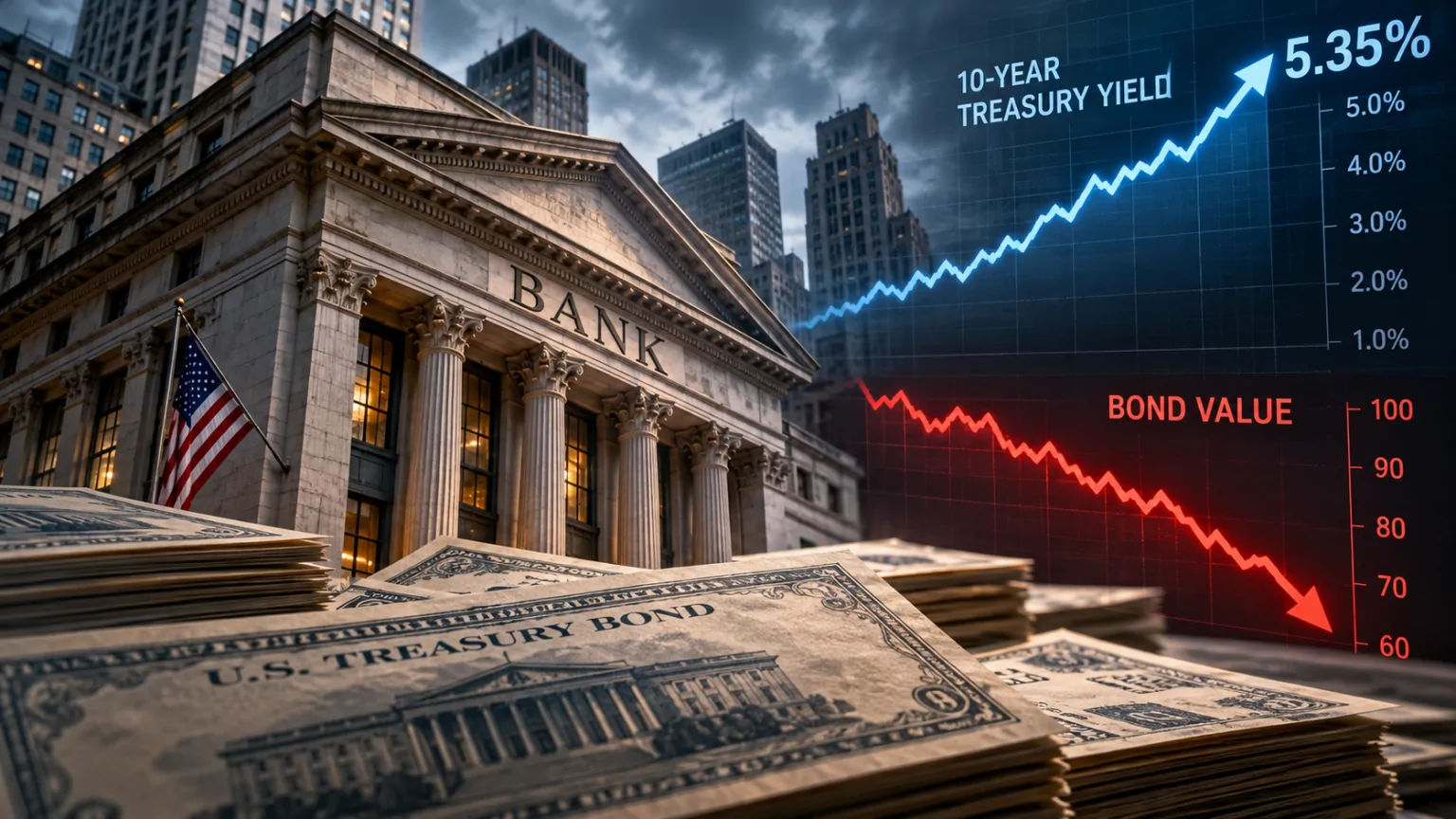
The yield on the 10-year Treasury hit 5.35% recently. That's up from 4.4% back in June, when the last FDIC report came out.
To be clear, I'm not suggesting this is going to bring down the banking system. In fact, at the moment, it will NOT. Banks as a whole have enough equity to absorb those losses.
But a rapid increase in unrealized losses will likely drag down bank stocks and force executives to cut costs, and the interest banks pay you is always one of the first things to go.
Once these unrealized losses hit the banks’ Q3 and Q4 financial statements, I’m betting you’re probably going to see a cut in the interest rate your savings account as banks shore up more capital.
So it's worth considering other options for your cash deposits.
For one, the federal government likely pays more than your bank does: a 90-day T-bill, which is a three-month loan to the US Treasury, pays about 4.1% right now. Even the 28-day T-bill pays almost 4%.
Then there's the option of moving some money overseas.
I don't mean a secret Swiss bank account from a spy movie. Foreign banks report their American customers to the IRS, and having a foreign account is not about hiding money.
The real reason to have a foreign bank account is far more practical: it puts a portion of your savings in another jurisdiction. It’s a useful asset protection measure... with the added benefits of better service and higher interest rates.
We research a number of foreign banks for members of our Plan B Confidential service. One sent its bankers to our Plan B conference in Panama City last month, where they opened accounts for attendees on the spot.
It's a private, safe, well-capitalized bank. That means it has plenty of its own money to absorb losses, which is exactly what Silicon Valley Bank ran out of.
It also pays 4% interest on a savings account.
And you can open the account remotely. That's very rare these days. US reporting rules have made Americans such a compliance headache that many foreign banks won't take them at all, and the ones that do usually want you to show up in person.
You can learn more here about Plan B Confidential, which comes with a Rolodex of vetted service providers, from immigration attorneys to tax advisors to private bankers, including, of course, our contacts at this bank.
To your freedom, James Hickman Co-Founder, Schiff Sovereign LLC