
US Panics as Bonds Collapse Forces a Global Monetary Reset
US Panics as Bonds Collapse Forces a Global Monetary Reset
Sean Foo: 101302926
In a major move, Bessent just appointed Judy Shelton to the US Treasury. This appointment of a historic gold advocate shakes up the entire landscape for the US government eventually heading back to gold.
The global economic landscape is undergoing a monumental transformation, driven by shifting geopolitical alliances, rising national debt, and a growing distrust in traditional fiat currency.
US Panics as Bonds Collapse Forces a Global Monetary Reset
Sean Foo: 101302926
In a major move, Bessent just appointed Judy Shelton to the US Treasury. This appointment of a historic gold advocate shakes up the entire landscape for the US government eventually heading back to gold.
The global economic landscape is undergoing a monumental transformation, driven by shifting geopolitical alliances, rising national debt, and a growing distrust in traditional fiat currency.
Recent insights from financial analyst Sean Foo highlight a profound strategic pivot by Beijing away from Western-backed assets.
Since 2012, China has methodically reduced its United States Treasury bond holdings by more than half, actively divesting from an impressive $1.3 trillion down to under $620 billion. This massive selloff has been largely catalyzed by escalating trade conflicts, tariffs, and the weaponization of economic sanctions.
Rather than keeping these funds in vulnerable foreign paper assets, the proceeds have been consistently converted into physical gold—a secure, tangible, and non-freezable safe-haven asset capable of withstanding Western-imposed financial penalties.
China’s aggressive gold acquisitions, particularly accelerated during the height of the Russia-Ukraine and Iran conflicts, underscore a profound global realization about the inherent geopolitical risks of holding sovereign debt in an increasingly fractured world.
Faced with this steady erosion of trust in the greenback and a rapidly deteriorating fiscal outlook, policymakers in Washington are beginning to take notice.
In response to these sweeping international maneuvers, the United States Treasury is reportedly reconsidering the historic role of gold within the domestic and international financial architecture.
The consideration of notable figures like Judy Shelton—a vocal advocate for a return to sound money principles—signals a potential paradigm shift toward the remonetization of gold.
Financial innovators are now discussing creative concepts such as “Treasury Trust bonds,” which would theoretically tie government bond repayment options directly to actual gold reserves.
Such a bold move could completely revolutionize how the United States issues sovereign debt, offering international and domestic investors a unique choice to redeem their maturing bonds in either cash or physical gold.
Implementing this strategy would serve as a powerful acknowledgment of shifting global monetary dynamics and the gradual decline of unbacked currency dominance.
Underpinning this entire financial evolution is a staggering fiscal reality that continues to challenge policymakers on Capitol Hill. The United States currently faces an escalating national deficit projected to hover around the staggering $2 trillion mark, driven by continuous government spending and mounting interest obligations.
To maintain investor confidence and successfully finance this massive mountain of obligations, innovative mechanisms are urgently required.
While historical US gold reserves have long been valued on government books at a modest statutory rate of $42.22 per ounce, the actual market value of gold trades significantly higher, soaring well above the $2,000 per ounce threshold in recent years.
Unlocking this immense unrealized valuation through innovative debt instruments backed by physical precious metals could provide a much-needed bridge for future debt issuance, though it would undoubtedly reshape the fundamental mechanics of global commerce.
Across the globe, international central banks have already begun adjusting their strategic reserves to navigate this new era of economic uncertainty. Data indicates that global central banks have substantially decreased their overall US bond holdings from 33 percent down to 21 percent over recent years, reallocating those substantial funds into physical gold, which now accounts for roughly 25 percent of total reserves.
This observable trend toward metal-backed security is only expected to accelerate should innovative Treasury Trust bonds eventually enter the open market, potentially introducing new competitive pressures for traditional fiat assets. While the complete audit of official United States gold reserves remains a topic of ongoing debate due to its opaque and outdated reporting, the mere discussion of monetizing gold highlights the severity of current fiscal challenges.
Rob Cunningham: XRP is an Essential and Immutable Ingredient
Rob Cunningham: XRP is an Essential and Immutable Ingredient
10-13-2026
XRP: ESSENTIAL INGREDIENT OR “SHIT COIN”?
You cannot logically call something essential to a system worthless to that system.
Imagine building a worldwide highway system connecting every city, business, bank & household on Earth. You build the roads, bridges, tunnels, tollbooths & traffic controls.
Rob Cunningham: XRP is an Essential and Immutable Ingredient
10-13-2026
XRP: ESSENTIAL INGREDIENT OR “SHIT COIN”?
You cannot logically call something essential to a system worthless to that system.
Imagine building a worldwide highway system connecting every city, business, bank & household on Earth. You build the roads, bridges, tunnels, tollbooths & traffic controls.
Then somebody says, “Remove the one ingredient required to operate the entire system.”
What happens?
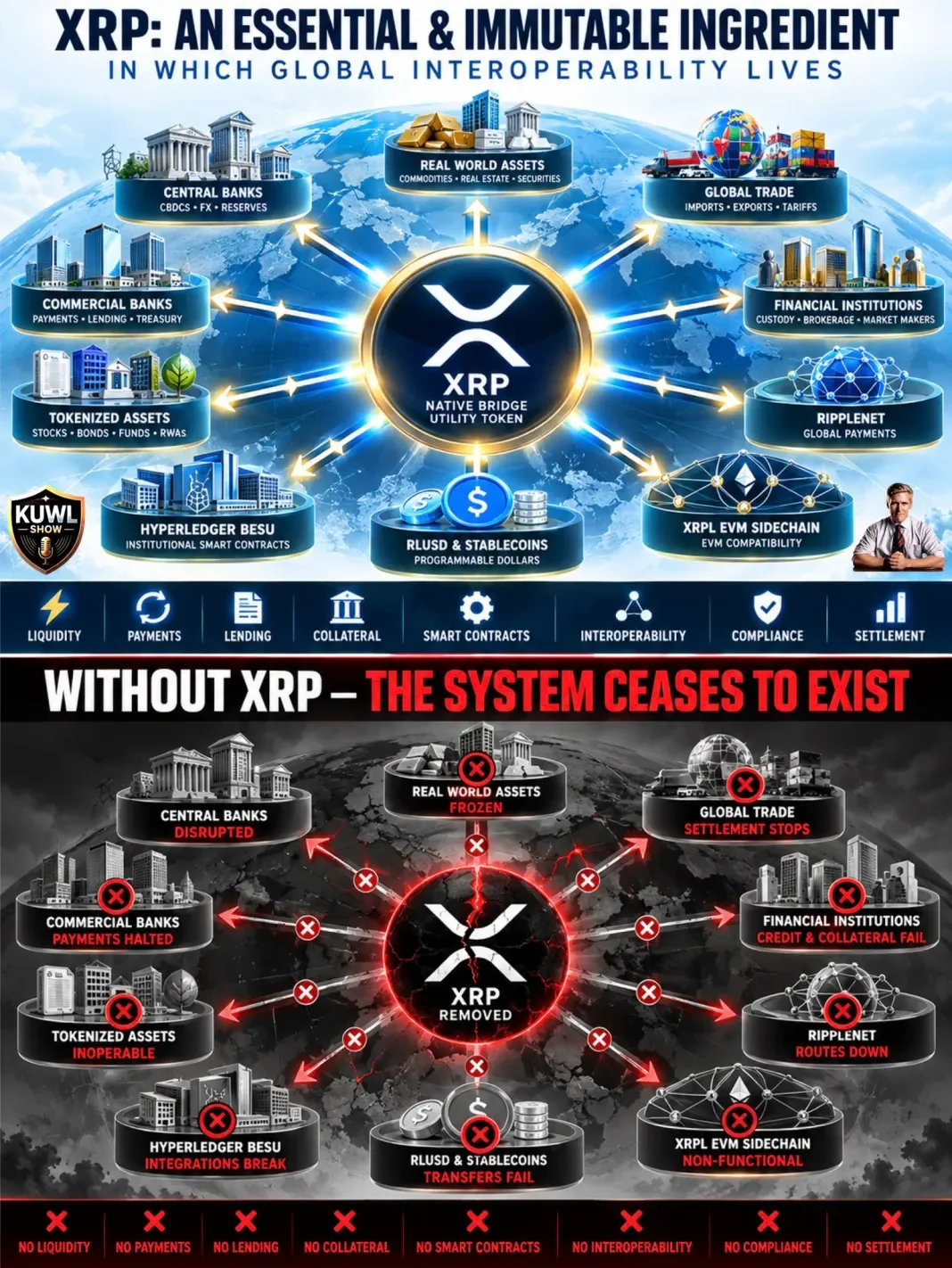
The parts that depend on that ingredient stop working.
This is the argument for XRP’s existential importance to our new financial system.
For generations, banks have operated like separate islands. Moving money between them can require middlemen, multiple accounts, expensive fees & days of waiting.
Distributed ledger technology changes what is possible.
Money, stocks, bonds, real estate, commodities, loans & other assets can be represented digitally, tracked, exchanged & settled in seconds across connected networks.
This is the Internet of Value
Here is where XRP comes in.
XRP is not merely another digital coin somebody invented to trade on an exchange or “dump” on retail investors for profit.
It is the native asset of the XRP Ledger, a public, open financial network designed to move & exchange value globally.
XRP pays the network’s transaction fees. It supports account reserves. It serves as a bridge between different currencies & assets. It is used for liquidity, settlement & collateral where institutions choose to support those functions.
Now connect the XRP Ledger to institutional banking systems, Hyperledger Besu, the XRPL Ethereum sidechain, Ripple’s payment infrastructure, and regulated digital dollars such as RLUSD.
These are the ingredients for a much larger financial network.
Banks can manage credit.
Businesses can tokenize assets.
Custodians can safeguard property.
Stablecoins can represent dollars.
Smart contracts can automate financial agreements.
XRP provides a common asset for moving value between consenting systems.
Here is The Critical Point:
Within the XRP Ledger’s existing design, XRP is essential. You cannot simply remove it & expect its ledger to operate.
Within the World’s New Monetary Architecture, an XRP dependency exists for liquidity, collateral, transaction fees and settlement. Removing XRP would force an enormous global reconstruction of those dependencies.
And this brings us to the phrase “shit coin.”
If someone states XRP has no real technological purpose, that claim is plainly wrong. XRP performs defined functions in a working public ledger essential for global interoperability to work.
If someone claims XRP has no investment value, they claim a globally vital, patented technology holds little to no return on investment potential.
The question is not whether somebody likes XRP, hates XRP, or makes jokes about it.
The important question is:
How much of tomorrow’s financial infrastructure will actually depend on XRP?
Because the more nations, banks, institutions, payment systems, lending platforms & collateral markets rely on this one asset, the more economically significant its availability, liquidity, and reliability become.
No one can reasonably argue that XRP is both indispensable to a particular financial architecture and functionally worthless to that same architecture.
Always seek to understand the XRP critic’s motive and agenda.
THE BOTTOM LINE
XRP already has a real, indispensable role across a global monetary system, one where the opportunity for quantum growth is still expanding.
XRP is already an essential connecting asset of the future system, so dismissing it as a “shit coin” will never explain away the machinery that depends upon it.
Follow the engineering.
Follow the dependencies.
Follow the actual use of XRP.
That is where its significance will be proven to those seeking truth.
Source(s):
• https://x.com/KuwlShow/status/2109284763898896811
https://dinarchronicles.com/2026/10/12/rob-cunningham-xrp-is-an-essential-and-immutable-ingredient/
Seeds of Wisdom RV and Economics Updates Tuesday Afternoon 10-13-26
Good Morning Dinar Recaps,
GLOBAL BANKING RESET WATCH: REGULATORS STEP UP AI AND CYBERSECURITY OVERSIGHT TO PROTECT FINANCIAL SYSTEMS
U.S. and European regulators are intensifying scrutiny of artificial intelligence and cyber threats as financial institutions face growing pressure to secure the technology supporting global banking and payments.
Good Morning Dinar Recaps,
GLOBAL BANKING RESET WATCH: REGULATORS STEP UP AI AND CYBERSECURITY OVERSIGHT TO PROTECT FINANCIAL SYSTEMS
U.S. and European regulators are intensifying scrutiny of artificial intelligence and cyber threats as financial institutions face growing pressure to secure the technology supporting global banking and payments.
OVERVIEW
Regulators are stepping up scrutiny: U.S. banking agencies are questioning banks about advanced AI systems, including autonomous AI agents, their safeguards, and how their actions are monitored.
Europe is strengthening recovery plans: The Bank of England and European Central Bank are pressing banks to improve their ability to restore critical systems following serious cyberattacks or technology failures.
Financial stability is at stake: Regulators warn that a major cyber incident could disrupt banking services, interrupt payments, and undermine confidence in the wider financial system.
KEY DEVELOPMENTS
1. U.S. Regulators Examine How Banks Control Advanced AI
Reuters reported on October 13 that U.S. banking regulators, including the Federal Reserve, are asking financial institutions detailed questions about their use of advanced artificial intelligence.
The inquiries focus particularly on agentic AI—systems capable of carrying out tasks with limited human supervision. Banks are exploring these tools for cybersecurity, identifying threats, and responding to suspicious activity.
Regulators want to understand how banks restrict these systems' authority, monitor their decisions, maintain audit trails, and ensure that human personnel can intervene when necessary.
They are also examining the use of AI models developed by foreign technology providers and the risks associated with dependence on external systems.
The concern is that AI capabilities may be advancing faster than the safeguards needed to manage them. An autonomous system that makes an incorrect decision, exceeds its authority, or is manipulated by an attacker could create new vulnerabilities inside an institution that manages deposits and payments.
For now, regulators are gathering information rather than announcing a comprehensive new set of binding rules.
The key development is that oversight is becoming more focused on how AI actually operates inside banks—not simply whether banks are using it.
2. European Authorities Push Banks to Strengthen Cyber Recovery
European regulators are also concerned about whether banks could recover quickly from a major technology failure.
The European Central Bank has already asked supervised banks to prepare for AI-enabled cyber threats, with an end-of-October 2026 deadline for plans addressing those risks.
The Bank of England is encouraging major banks to examine independent recovery arrangements that can restore essential services if their primary technology systems become compromised.
These arrangements may include clean backup copies of critical data and separate recovery infrastructure that does not depend on the same systems an attacker could disable.
Such safeguards can be expensive to build and maintain. However, the cost of inadequate preparation could be much greater if customers lose access to accounts or businesses cannot make and receive payments.
The challenge is particularly important as banks increasingly rely on cloud providers, outside technology companies, and interconnected digital platforms.
A failure at one critical provider could affect multiple institutions simultaneously.
The focus is shifting from preventing every attack to ensuring that essential financial services can continue—or recover rapidly—when prevention fails.
3. Cybersecurity Becomes a Financial Stability Issue
The International Monetary Fund's October 2026 financial stability assessment reinforces the seriousness of these concerns.
The IMF warned that a major cyberattack affecting a critical service or financial institution could undermine confidence and potentially contribute to broader financial instability.
A cyber incident does not need to destroy a bank's financial assets to cause economic damage. If customers cannot access accounts, banks cannot process transactions, or businesses cannot settle payments, the disruption can spread rapidly through the economy.
A prolonged interruption could also create uncertainty about whether balances, records, and payment instructions remain reliable.
These risks are growing as artificial intelligence becomes more capable and financial institutions become more dependent on digital infrastructure.
However, the warnings do not establish that a systemic cyberattack is imminent. They demonstrate why regulators are placing greater emphasis on preparedness, resilience, and coordinated responses.
WHY IT MATTERS
The international financial system is undergoing a technological transformation. Banking, cross-border payments, securities settlement, and financial services increasingly depend on digital infrastructure that must remain secure and reliable.
This creates a new dimension of systemic risk.
In traditional financial crises, attention often focuses on debt defaults, bank losses, liquidity shortages, and declining asset values. In a digital financial system, a major technology disruption can also prevent otherwise solvent institutions from operating normally.
The implications extend across three of the Global Reset pillars.
Technology: AI is changing how financial institutions detect threats, process information, and manage operations. Those benefits must be balanced against risks from autonomous systems and malicious use.
Trade: International commerce depends on payments moving reliably between businesses, banks, and countries. Major disruptions can delay transactions, interrupt supply chains, and increase operational costs.
Assets: Digital records support bank balances, securities ownership, and transaction settlement. Protecting their integrity and availability is essential to confidence in financial assets.
The global financial reset is not one announced event. It is a broader evolution involving financial infrastructure, regulation, technology, and international payment systems.
The more deeply finance becomes digital, the more important it becomes to protect the systems that make financial transactions possible.
WHY IT MATTERS TO FOREIGN CURRENCY HOLDERS
For foreign currency holders, cybersecurity may seem distant from exchange rates and currency values. In reality, it is becoming part of the infrastructure that supports confidence in the financial system.
Digital banking and payment networks must reliably authenticate transactions, maintain accurate records, and move funds between institutions. If those services are disrupted, the effects can extend beyond individual banks to businesses, investors, and international commerce.
Countries and financial institutions that maintain secure, reliable payment infrastructure may be better positioned to support trust in their financial services. However, cybersecurity capability alone does not determine a currency's value.
Exchange rates also depend on economic growth, inflation, interest rates, fiscal conditions, and international capital flows.
These developments do not confirm an imminent currency revaluation or a sudden global monetary reset. They show that the systems supporting modern finance must adapt as technology and threats evolve.
For currency holders, the useful signal is the gradual modernization of financial safeguards and payment infrastructure—not speculation about a particular date or guaranteed exchange-rate outcome.
IMPLICATIONS FOR THE GLOBAL RESET
PILLAR 1: Technology
Artificial intelligence offers banks opportunities to detect suspicious transactions, improve fraud prevention, and respond more quickly to cyber threats.
But increasingly autonomous systems introduce new questions about accountability, access permissions, human supervision, and the ability to stop harmful actions.
Effective governance must develop alongside the technology. Banks need to understand where AI is used, what information it can access, which decisions it can make, and how those decisions can be reviewed.
The next stage of financial modernization will depend not only on more powerful technology, but also on reliable controls around it.
PILLAR 2: Trade
Global trade depends on dependable payment systems that allow exporters, importers, banks, and logistics companies to settle transactions.
A serious cyber incident affecting a major financial institution or shared technology provider could interrupt payments across multiple businesses and jurisdictions.
As cross-border commerce becomes increasingly digital, resilience becomes an economic necessity. Secure backup systems, coordinated incident responses, and reliable recovery arrangements help keep international transactions moving during disruptions.
This is an important foundation for the continued modernization of global trade and payments.
PILLAR 3: Assets
Modern financial assets depend on trustworthy records and functioning systems.
Bank deposits, securities, and other financial claims must be accurately recorded, protected from unauthorized changes, and accessible when legitimate transactions need to be completed.
Cybersecurity therefore supports more than the operation of computer systems. It helps preserve confidence that financial records are accurate and that institutions can honor their obligations.
As digital finance expands, protecting those records and maintaining continuity of service become increasingly important to the stability of financial markets.
THE BOTTOM LINE
The latest regulatory developments show that financial stability now depends on more than capital reserves and responsible lending. Banks must also control advanced AI, protect critical data, and recover quickly when technology fails.
U.S. and European regulators are responding to documented risks, but stronger oversight should be understood as preparation—not proof of an imminent financial crisis.
For those following the global financial reset, the important development is the growing recognition that digital resilience is becoming a core requirement of modern banking.
The evolution of the global financial system will depend not only on how money moves across borders, but on whether the technology carrying those transactions can remain secure, trustworthy, and resilient in an increasingly connected world.
Seeds of Wisdom Team
Newshounds News
SOURCES
1. Reuters — "Banking watchdogs ramp up AI scrutiny as stability fears mount, sources say"
2. International Monetary Fund — "Global Financial Stability Report, October 2026"
~~~~~~~~~~
Seeds of Wisdom Team RV Currency Facts Youtube and Rumble
Newshound's News Telegram Room Link
RV Facts with Proof Links Link
RV Updates Proof links - Facts Link
Start Here room with Most Asked Questions Link
Follow the Gold/Silver Rate COMEX
Follow Fast Facts
Seeds of Wisdom Team™ Website
Thank you Dinar Recaps
News, Rumors and Opinions Tuesday 10-13-2026
KTFA:
Clare: Exchange companies submit an urgent proposal to Al-Zaydi to launch an initiative for domestic and international money transfers.
10/12/2026
The head of the exchange companies syndicate, Diaa Al-Tai, announced the desire of exchange companies to launch an initiative to finance and implement internal and external money transfers for small traders, in accordance with the instructions of the Central Bank of Iraq and the controls it sets.
KTFA:
Clare: Exchange companies submit an urgent proposal to Al-Zaydi to launch an initiative for domestic and international money transfers.
10/12/2026
The head of the exchange companies syndicate, Diaa Al-Tai, announced the desire of exchange companies to launch an initiative to finance and implement internal and external money transfers for small traders, in accordance with the instructions of the Central Bank of Iraq and the controls it sets.
Al-Ta’i said in a televised statement seen by “ Al-Jarida ” that the initiative needs the approval of the Central Bank of Iraq, stressing the readiness of exchange companies to work in coordination with the Central Bank and in line with its vision and instructions to regulate financial transfer operations.
He added that the initiative comes in support of the government of Prime Minister Ali al-Zubaidi, and as a contribution to the stability of the exchange rate, as well as supporting the efforts of the Central Bank of Iraq in regulating the remittance market and facilitating financial transactions for small traders through official channels. LINK
Clare: Tom Barrack after meeting al-Zaidi: Iraq's stability is not inherited, it is created by its leaders.
10/12/2026
U.S. President Donald Trump’s special envoy to Iraq and Syria, Tom Barrack, on Tuesday praised the leadership of Iraqi Prime Minister Ali Zaidi, stressing that Iraq’s stability, security and prosperity have repercussions for the entire region.
Barak said in a post on the X platform, following his meeting with al-Zaidi, that "the meeting with Prime Minister Ali al-Zaidi was fruitful," adding that "stability is not inherited, but is created by leaders who choose the difficult path."
The US envoy added that "Iraq's security and prosperity are the security and prosperity of the region," expressing his gratitude to the Iraqi Prime Minister for his "leadership and partnership."
Barak’s remarks come at a time when relations between Baghdad and Washington are undergoing a transformation in the nature of bilateral cooperation, following the end of the international coalition’s military mission in Iraq on September 30, and the transition to a new phase focused on economic partnership and common interests, in addition to the continuation of security cooperation between the two countries.
On Monday, during his visit to Baghdad and his meeting with US Chargé d'Affaires Steve Fagin, Barak confirmed that US-Iraqi relations are moving from a partnership based on security to a broader relationship based on economic cooperation and mutual interests.
This was preceded by a meeting between Barak and Iraqi Foreign Minister Fuad Hussein last Saturday in Istanbul, during which they discussed the future of bilateral relations after the end of the international coalition’s mission, as well as political, security and economic developments in the region, the financial situation in Iraq and changes related to the dinar exchange rate.
The issue of restricting weapons to the state is one of the most prominent topics of Iraqi-American talks, as Al-Zaidi and Barak had previously stressed, during their meeting in Baghdad last June, the importance of completing efforts aimed at ending the presence of armed formations outside the authority of the state, strengthening Iraqi sovereignty, and distancing the country from regional conflicts.
On October 1, al-Zaydi announced the adoption of a roadmap to address the issue of weapons outside state control, ending on June 30, 2027, coinciding with Iraq entering the post-withdrawal phase of the international coalition forces. LINK
Courtesy of Dinar Guru: https://www.dinarguru.com/
Wolverine Things are really starting. IMO I think that any time we could get Tier 4B notifications...In the overall aspect of things, I think we will have a beautiful October.
Militia Man The official rate moved up [to 1510]. The street price jumped at first...The gap between the official rate and the street rate actually got smaller. It was more than twenty percent before. It is now closer to ten or twelve percent...The real test is the next few days and weeks...If real importers and traders can get dollars through the banks at the new official price without trouble, the street market loses its old edge...If too many stay outside the banks, the gap stays open...The change was deliberate. It squeezed the old street game and pushed more of the flow toward the formal side.
Frank26 The goal is to make the American dollar unusable inside of Iraq. They want to remove any foreign currency. They will de-peg from the American dollar to get rid of the parallel market. That's what you're witnessing...a reinstatement of their currency and of their rate. All of this is occurring inside of Iraq...For now, 1500 is stabilizing this process and the market place...After they do this internal de-pegging, then the next step is to re-peg into an international basket of currencies and throw themselves on Forex. Then you and I go to the bank...It's a process in process...
************
IQD Update: Investing in the VND
Edu Matrix: 10-11-2026
Coffee with MarkZ. Tuesday 10/13/2026
Coffee with MarkZ. Tuesday 10/13/2026
Some highlights by PDK-Not verbatim
MarkZ Disclaimer: Please consider everything on this call as my opinion. People who take notes do not catch everything and its best to watch the video so that you get everything in context. Be sure to consult a professional for any financial decisions
MZ: Exchange rate discussions, rumors, war, and whatever else you all want to talk about.
MZ: I have so many paymasters telling me “soon” and they are hoping its this week.
Coffee with MarkZ. Tuesday 10/13/2026
Some highlights by PDK-Not verbatim
MarkZ Disclaimer: Please consider everything on this call as my opinion. People who take notes do not catch everything and its best to watch the video so that you get everything in context. Be sure to consult a professional for any financial decisions
MZ: Exchange rate discussions, rumors, war, and whatever else you all want to talk about.
MZ: I have so many paymasters telling me “soon” and they are hoping its this week.
MZZ: Bond contacts also have a crazed level of expectations. Most are telling me to watch Thursday through the end of the month to be done….kaput….paid and finished.
MZ: I hope its accurate…but I do not know the timing. I just tell you what I am hearing. But I can tell you a number of paymasters and bond folks, including an attorney who is a paymaster on a bond deal….and they are telling me the same thing. So I am exceptionally hopeful.
MZ: Iraq is expected to finish their cabinet appointments on Thursday and to submit the budget by early next week. Maybe events are correlated?
THE CONTENT IN THIS PODCAST IS FOR GENERAL & EDUCATIONAL PURPOSES ONLY&NOT INTENDED TO PROVIDE ANY PROFESSIONAL, FINANCIAL OR LEGAL ADVICE. PLEASE CONSIDER EVERYTHING DISCUSSED IN MARKZ’S OPINION ONLY
https://rumble.com/user/theoriginalmarkz
Kick: https://kick.com/theoriginalmarkz
Markz's linktree https://linktr.ee/theMarkZshow
FOLLOW MARKZ : TWITTER . https://twitter.com/originalmarkz?s=21. TRUTH SOCIAL . https://truthsocial.com/@theoriginalm...
Mod: MarkZ "Back To Basics" Pre-Recorded Call" for Newbies 10-19-2022 ) https://www.youtube.com/watch?v=37oILmAlptM
MARKZ DAILY LINKS: https://theoriginalmarkz.com/home/
Note from PDK: Please listen to the replay for all the details and entire stream….I do not transcribe political opinions, medical opinions or many guests on this stream……just RV/currency related topics.
THANK YOU FOR JOINING. HAVE A BLESSED DAY. SEE YOU IN THE MORNING FOR COFFEE @ 10:00 AM EST ~ UNLESS BREAKING NEWS HAPPENS! FOR UPDATES ON MARK’S PODCAST GO TO: https://t.me/+b3hYhYlhKM1hYzcx
Tuesday Iraq News Posted by Tishwash at TNT 10-13-2026
TNT:
Tishwash: The Central Bank confirms its vaults are full of Iraqi dinars.
The Director General of the Statistics and Research Department at the Central Bank of Iraq, Samir Fakhri Naama, confirmed on Tuesday that the Central Bank's vaults are full of dinars.
Naama said in a statement followed by (Al-Mada), “The vaults of the Central Bank of Iraq are currently full of dinars,” noting that “at no time has it been permissible to say that the Central Bank of Iraq does not have dinars.”
TNT:
Tishwash: The Central Bank confirms its vaults are full of Iraqi dinars.
The Director General of the Statistics and Research Department at the Central Bank of Iraq, Samir Fakhri Naama, confirmed on Tuesday that the Central Bank's vaults are full of dinars.
Naama said in a statement followed by (Al-Mada), “The vaults of the Central Bank of Iraq are currently full of dinars,” noting that “at no time has it been permissible to say that the Central Bank of Iraq does not have dinars.”
He added that "there is an impact on the poor from the change in the exchange rate, but not with the expected impact because the state will subsidize a range of goods," noting that "prices will rise by a much smaller percentage compared to the amount of the change in the exchange rate."
He added that "the bank's reserves are in a comfortable position," calling for dealing in dinars to reduce dependence on the dollar. link
Tishwash: Central Bank: Our responsibility is to maintain the value of the dinar against foreign currencies
The Central Bank of Iraq confirmed on Tuesday that its current mission is to maintain the value of the Iraqi dinar against foreign currencies.
The representative of the Governor of the Central Bank of Iraq, Samir Fakhri, said at the Middle East Forum for Research and Peace (MERI), held in Erbil, and attended by a correspondent from the Iraqi News Agency (INA): “The issue of the exchange rate and its relative importance differs from one country to another,” explaining that “the exchange rate is important for Iraq, because the Iraqi economy is rentier in nature and depends on dollar revenues.”
He added that "Iraq's sources of income depend on external demand, and the most important equation in the Iraqi economy is government spending in dinars." He pointed out that "the use of the dinar as a means of government spending is a fundamental driver, representing a component of aggregate demand, which is linked to oil revenues, and the exchange rate is the link to all of this."
He added that "the central bank's mission is to maintain the value of the local currency against foreign currencies," explaining that "growth in the private sector boosts GDP and reduces demand for the dollar."
He stressed that "every dinar spent by the general budget generates a demand for dollars through the central bank, given the limited contribution of local economic sectors to the gross domestic product."
He stressed "the importance of working to develop the private sector and enhance its actual contribution to the gross domestic product, which will contribute to reducing the demand for the dollar," noting that 60 to 70% of the dinars spent are returned in the form of demand for the dollar, while the remaining part accumulates within the central bank's reserves.
He explained that "the Central Bank's reserves are owned by the state, and the government represents the equivalent of the dinars that were spent through the exchange rate mechanism," stressing that "Iraqi exports depend on crude oil by 98%, while oil revenues constitute more than 93% of total public revenues." link
***********
Tishwash: 90% of the vacant ministerial positions have been filled
Political dialogues continue to complete the cabinet, amid parliamentary assurances that the remaining portfolios will soon be decided.
MP Badr Al-Fahhal explained to Al-Sabah that the disagreements are concentrated among the parties of the “Sunni Political Council” over the candidate for the Ministry of Culture, while the Ministry of Defense is witnessing the circulation of the names of Nayef Al-Shammari, Ali Al-Araji and Talal Al-Jubouri, and the (Al-Azm) bloc nominated Muhammad Ali for Planning.
For his part, MP Ahmed al-Khazali told Al-Sabah that Nayef al-Shammari is the most likely candidate for the Ministry of Defense, alongside Jumaa Anad. He confirmed progress in the Interior Ministry file after replacing Qasim Atta with MP Yasser al-Maliki, and indicated that the cabinet formation is nearing completion. (90%).
For his part, MP Ahmed Al-Saadi told Al-Sabah that the Ministry of Labor was decided for Mohammed Al-Moussawi (Sadiqun) and the Ministry of Youth for Safaa Al-Kinani (State Forces), and Ali Al-Dakhil was proposed for Tourism and Dr. Haider Bahaa for Higher Education, and the names of Ribaz Hamlan and Banaz Doski were circulated for Housing.
Member of the Parliamentary Security and Defense Committee, Mahdi Taqi Al-Amirli, told Al-Sabah that the issue is expected to be resolved next week. link
************
Tishwash: Iraqi blocs agree on Thursday vote to finalize cabinet
Iraq’s political blocs and Prime Minister Ali al-Zaidi agreed on Monday to hold a parliamentary session on Thursday, October 15, to vote on the remaining cabinet appointments and a proposal to have four deputy prime ministers, an informed political source told Shafaq News.
The source said leaders of the ruling Shiite Coordination Framework reached the agreement with al-Zaidi and other political blocs during talks on Monday.
Parliament approved al-Zaidi’s government and 14 ministers on May 14, leaving nine cabinet posts unfilled amid disagreements over nominees. The outstanding portfolios include defense, interior, planning and higher education. link
************
Tishwash: Al-Zidi discusses with Total Energies and ConocoPhillips increasing oil and gas production in Basra
Prime Minister Ali Faleh al-Zaidi discussed on Sunday with delegations from the French company Total Energies and ConocoPhillips the mechanisms for investing in oil and associated gas in the Ibn Omar field in Basra Governorate, and setting time limits for increasing production in the field and the rest of the fields.
The Prime Minister’s Media Office stated in a statement that Al-Zaidi received the CEO of Total Energies, Patrick Pouyanné, and the CEO of ConocoPhillips, Andy O’Brien, and their accompanying delegations.
Al-Zaydi stressed the importance of investing in associated gas, noting that Iraq has great potential in this sector, while emphasizing that the government seeks to make full use of the produced gas and stop importing it completely within the next few years.
For their part, the two companies’ executive directors expressed their willingness to make further efforts to adhere to the set timelines and increase production rates, according to the statement. link
Tishwash: Washington announces a shift in its relations with Baghdad: from security partnership to economic cooperation and shared interests.
The US President’s Special Envoy to Iraq and Syria, Tom Barrack, confirmed on Monday, October 12, 2026, that relations between the United States and Iraq are entering a new phase, characterized by a shift from a partnership that focused for years on security and military issues to broader economic cooperation based on the common interests of the two countries.
Barak said in a post published on the “X” platform, following his meeting with the US Chargé d'Affaires in Iraq, Steve Fagin, that Washington views the current stage as a pivotal point in the course of bilateral relations, noting the importance of having diplomatic leadership capable of advancing the priorities of the US administration and strengthening cooperation with Baghdad.
Barak praised Fagin's expertise in Iraqi and regional affairs, stressing that his deep knowledge of Iraq and the region makes him qualified to contribute to the implementation of US President Donald Trump's policies in the coming period.
He explained that Iraqi-American relations are witnessing a shift towards a more comprehensive partnership, not limited to security cooperation, but extending to economic fields and the strengthening of mutual interests, in a sign of Washington’s intention to redefine the priorities of its presence and relations with Iraq.
This American stance comes at a time when Iraq is facing increasing economic and financial challenges, coinciding with regional developments that are casting a shadow on energy, investment and trade markets, which gives the file of economic cooperation between Baghdad and Washington additional importance during the next stage.
Observers believe that moving towards a broader economic partnership could open the door to increased American investments in the energy, electricity, infrastructure and financial services sectors, in addition to expanding opportunities for trade cooperation and technology transfer. However, achieving these goals will remain linked to the nature of the agreements that the two sides may reach and the availability of a suitable investment environment.
The new American approach also raises questions about the future of strategic relations between the two countries, especially with the transformations taking place in the American military presence in Iraq, and Baghdad’s efforts to build balanced foreign relations that preserve its sovereignty and support its economic interests.
Iraqi Foreign Minister Fuad Hussein discussed with Barak, in Istanbul last Saturday, the future of bilateral cooperation, political, security and economic developments, as well as the Iraqi financial situation and changes related to the exchange rate of the dinar, in a meeting that addressed the prospects for relations between the two countries after the end of the mission of the international coalition forces in Iraq.
Barak’s statements carry political and economic implications regarding the nature of the role the United States seeks to play in Iraq, as they suggest a desire to expand the bilateral relationship beyond counter-terrorism and military coordination, towards long-term economic and investment partnerships.
However, the US envoy’s statements did not include the announcement of new economic agreements or the determination of the size of anticipated investments, which makes the announced shift a political direction that needs clear executive steps to translate it into tangible projects.
These developments present the Iraqi government with an opportunity to revitalize its economic relations with Washington and attract new investments, given the need to diversify income sources, reduce dependence on oil revenues, and enhance financial stability.
It appears that the next phase may witness greater attention to the economic file in Iraqi-American relations, amid anticipation of what the consultations between Baghdad and Washington will produce in terms of practical understandings that will determine the future of the partnership between the two countries, and the extent of its impact on the Iraqi economy and regional stability. link
Reset Intelligence: Why They Want the IQD Cut Reversed
Emailed to Recaps~ Thank you David
Reset Intelligence: Why They Want the IQD Cut Reversed
By Reset Intelligence | @EXIT_FIAT
Iraq cut the IQD to 1,500 on October 7. On Sunday a bloc in parliament asked the Federal Supreme Court to throw that cut out.
The bloc is the one affiliated with Kataib Hezbollah, the armed faction that refused to put its weapons under the state.
Emailed to Recaps~ Thank you David
Reset Intelligence: Why They Want the IQD Cut Reversed
By Reset Intelligence | @EXIT_FIAT
Iraq cut the IQD to 1,500 on October 7. On Sunday a bloc in parliament asked the Federal Supreme Court to throw that cut out.
The bloc is the one affiliated with Kataib Hezbollah, the armed faction that refused to put its weapons under the state.
The lawsuit
The case names Prime Minister Ali al-Zaidi, the Finance Minister and the Central Bank governor. It argues from the constitution's articles on how powers are divided, and the bloc puts the damage to purchasing power at up to 15%. Its leader says the court has received the challenge. No hearing date is set.
This court has been asked before. In April 2022 it dismissed a complaint against Iraq's 2020 devaluation.
What moved this week
The street - Monday closed at 165,950 IQD for $100 in Baghdad, against the bank's public price of 152,000.
The budget - the 2027 budget has still not reached parliament. A lawmaker from one governing party has tied his vote to the street price coming down to 155,000.
The reason for the cut - al-Zaidi told parliament the state has a bill of 10 trillion IQD to meet every month while oil exports are choked.
Washington - envoy Tom Barrack was in Baghdad on Monday and described the relationship as moving from security to economic cooperation.
Riyadh - al-Zaidi is due in Saudi Arabia on Wednesday, with Kuwait to follow.
The rails - Standard Chartered says its custody service for Ripple's dollar token is now live on the XRP Ledger.
Oil - Brent traded near $105. The budget in front of Iraq's cabinet is written at $58.
The question
Why would the faction that fought this government over its weapons now fight it over the dinar? And what does it mean for a holder if the court turns the case away?
That is the short version. Who is fighting the cut, why Baghdad made it, and why we expect the challenge to fail - that is the daily read.
Read the full daily briefing free for 5 days. Sign up here: the daily Iraqi dinar briefing
Want it straight from the horse's mouth? The CBI Rate Alert pings you the moment the Central Bank of Iraq moves the official rate. The number itself, not a rumour about it. It comes with our free resource library and the daily breakdown of what is actually moving in Iraq. Sign up free: The CBI Rate Alert
Got a dinar question? Reset Intelligence runs an on-call research assistant: ask it anything they have published. It answers in seconds and will conduct deep research to find you the answer. Try it: the Iraqi dinar research assistant
Common questions, answered straight: When will the Iraqi dinar revalue? and Is the Iraqi dinar revaluation real?
The design behind all of it is mapped in Head of the Snake, and the free guides live in the Iraqi dinar resource library.
Follow the daily intel free: Telegram · Facebook · Spotify · Odysee
Iraq Economic News and Points To Ponder Tuesday Morning 10-13-26
A High-Level Delegation From The Kurdistan Regional Government Will Visit Baghdad Soon To Resolve Disputes Over The 2027 Budget
Baghdad - One News - 10/12/2026 A high-level delegation from the Kurdistan Regional Government intends to visit Baghdad in the next few days to hold talks with the federal finance minister regarding the region's share in the 2027 federal budget bill, amid ongoing disputes between the two sides over financial and oil issues.
A High-Level Delegation From The Kurdistan Regional Government Will Visit Baghdad Soon To Resolve Disputes Over The 2027 Budget
Baghdad - One News - 10/12/2026 A high-level delegation from the Kurdistan Regional Government intends to visit Baghdad in the next few days to hold talks with the federal finance minister regarding the region's share in the 2027 federal budget bill, amid ongoing disputes between the two sides over financial and oil issues.
According to information reported by Kurdistan 24, the anticipated visit comes after Baghdad and Erbil failed to reach a final agreement on a number of contentious issues during previous meetings, coinciding with expectations that the draft budget law will be referred to the House of Representatives this month.
The most prominent point of contention is the percentage allocated to the Kurdistan Region from the federal budget, as the regional government demands that its share be set at 14.14% based on the results of the population census and constitutional provisions, while the federal government has set the percentage at 12.7%.
In the oil file, the two sides differ in their positions regarding the quantities of oil required to be delivered to the federal government, as Baghdad demands the delivery of between 400,000 and 500,000 barrels per day, in contrast to a proposal from the regional government to specify quantities between 250,000 and 280,000 barrels per day.
As for non-oil revenues, they represent another point of contention, as the federal government insists on handing over all of those revenues, while the Kurdistan Regional Government emphasizes the need to preserve its legal and constitutional entitlements and powers in managing its financial resources.
These anticipated talks come at a time when political and financial efforts are continuing to reach understandings regarding the region's share and its oil and non-oil obligations, in preparation for including them in the draft federal budget for 2027 before it is submitted to the House of Representatives. https://1news-iq.net/وفد-رفيع-من-حكومة-إقليم-كوردستان-يزور-ب/
The Prime Minister: The Government Is Proceeding With Its Development Plans And Is Committed To Controlling Currency Exchange Rates
Baghdad (INA) – Prime Minister Ali Faleh al-Zaidi affirmed on Monday the government's commitment to implementing its development plans for the provinces. He also emphasized the government's dedication to financial and administrative reform, including controlling foreign exchange rates, preventing speculation, and halting the economic drain.
The Prime Minister's Media Office stated in a press release received by the Iraqi News Agency (INA) that "the Prime Minister chaired an expanded meeting at the Nineveh Governorate headquarters, attended by a large number of the province's representatives, the Governor of Nineveh, the head and members of the Provincial Council, and officials from service and government departments."
According to the statement, al-Zaidi stressed that "the government is proceeding with its development plans for the provinces, and that Nineveh deserves concerted efforts to improve its services and living conditions. Furthermore, the doors are open to address any shortcomings, so that the province can achieve a future befitting its history and cultural heritage."
The Prime Minister reiterated the government's commitment to "confronting all forms of corruption, the importance of safeguarding public funds, and countering attempts to distort national identity by inciting discord and division among the province's communities."
Al-Zaydi emphasized the government's commitment to financial and administrative reform, including controlling foreign exchange rates, preventing speculation, and halting the economic drain caused by exchange rate fluctuations, from which speculators were profiting at the expense of the local economy.
He explained that his proposed million-farm project would focus on specialized agricultural initiatives tailored to each province, aiming to develop their agricultural resources. For example, Basra would become the capital of Iraqi date palms, and Najaf the capital of rice production. The plan also includes establishing food processing plants supplied by the farms, creating job opportunities, increasing local production, and enhancing food security. https://ina.iq/ar/political/275981-.html
"Stability Is Built By Leaders Who Choose The Difficult Path." Tom Barrack Meets With Al-Zaidi In Baghdad And Affirms That Iraq's Security And Prosperity Represent Security And Prosperity For The Region
Baghdad - One News - 10/12/2026 US envoy Tom Barrack met with Prime Minister Ali al-Zaidi in Baghdad, praising his leadership and role in promoting stability, and emphasizing Iraq’s importance in achieving regional security and prosperity.
Barak said in a post on his X platform account that his meeting with Prime Minister Ali al-Zaidi was fruitful, stressing that stability is not an inheritance passed down by countries, but is created by leaders who choose to walk the difficult path to achieve it.
He added that Iraq’s security and prosperity represent security and prosperity for the entire region, indicating the importance of Iraq’s role in consolidating regional stability.
Barak expressed his gratitude for al-Zaidi’s leadership and partnership, in a stance that reflects the American side’s appreciation for the Iraqi government’s role in promoting security and stability.
The meeting comes at a new stage in Iraqi-American relations, aimed at expanding economic cooperation and strengthening common interests, coinciding with the security and political transformations taking place in the region.
https://1news-iq.net/الاستقرار-يصنعه-قادة-يختارون-الطريق/
Central Bank: Payment Cards Operate At The Official Rate To Meet The Needs Of Citizens Abroad
Baghdad – WAA The Central Bank of Iraq confirmed on Monday that electronic payment cards operate at the official approved rate to meet the needs of citizens abroad.
A statement from the bank, received by the Iraqi News Agency (INA), said that “what was circulated by one of the news agencies, quoting an unknown source, claiming that (the bank returned amounts worth 600 billion dinars because it did not adopt the previous rate of 1320 dinars per dollar, but rather demanded that the amount be increased at the current exchange rate of 1520 dinars per dollar), is completely false.”
The bank confirmed that "external transfer requests submitted to banks before 7/10/2026 will be processed at the old exchange rate without additional costs, and has begun receiving and processing those requests."
He added that "all electronic payment cards operate according to the official approved rate to meet the requirements of citizens abroad," stressing "what was stated in the letter of the Media and Communications Commission (to adopt accuracy in everything published and broadcast regarding the exchange rate, markets and salaries and to verify it and its competent sources before publication), otherwise legal measures will be taken by this bank against any entity that
publishes rumors and misleading news." https://ina.iq/ar/economie/275969-600.html
Seeds of Wisdom RV and Economics Updates Tuesday Morning 10-13-26
Good Morning Dinar Recaps,
GLOBAL DEBT RESET WATCH: IMF WARNS AI MARKET RISKS AND RISING BOND YIELDS COULD THREATEN FINANCIAL STABILITY
The IMF's latest financial stability assessment warns that an AI investment correction, mounting government debt, rising bond yields, and cyber threats could expose vulnerabilities across the global financial system.
Good Morning Dinar Recaps,
GLOBAL DEBT RESET WATCH: IMF WARNS AI MARKET RISKS AND RISING BOND YIELDS COULD THREATEN FINANCIAL STABILITY
The IMF's latest financial stability assessment warns that an AI investment correction, mounting government debt, rising bond yields, and cyber threats could expose vulnerabilities across the global financial system.
OVERVIEW
IMF issues a financial stability warning: Global markets have remained resilient, but the International Monetary Fund says risks are elevated as investors weigh AI-driven valuations, inflation pressures, and growing debt.
Bond markets face increasing pressure: Rising government borrowing needs, large debt issuance, and higher energy prices could push yields upward and make financing more expensive for governments and businesses.
Financial vulnerabilities remain beneath the surface: The IMF warns that weaker banks, leveraged investors, and non-bank financial institutions could amplify a market shock, even though the banking sector remains resilient overall in its stress tests.
KEY DEVELOPMENTS
1. The IMF Warns That AI Optimism Could Turn Into Financial Stress
The International Monetary Fund released its October 2026 Global Financial Stability Report on October 13, warning that financial markets may be underestimating the risks beneath the current optimism surrounding artificial intelligence.
AI investment has supported corporate earnings, investor confidence, and expectations of future economic growth. However, the IMF cautions that those expectations could change quickly if the technology produces smaller economic gains than anticipated or companies reduce their investment spending.
A significant correction could affect more than technology stocks. Falling share prices could reduce household and corporate wealth, weaken investment, and spread volatility into credit markets.
The IMF also highlighted the growing role of borrowing in the AI investment boom. Major technology companies known as hyperscalers now account for approximately 10% of global investment-grade bond issuance, compared with less than 1% in 2024.
That shift matters because financial stress can spread when heavily invested companies, lenders, and investors depend on continued market confidence and access to affordable financing.
The warning is not that an AI crash is inevitable, but that the financial consequences could extend far beyond the technology sector if expectations reverse sharply.
2. Rising Government Bond Yields Put Debt Sustainability Back in Focus
The IMF identified rising sovereign bond yields as another major source of concern.
Governments around the world must refinance existing debt and issue new bonds to cover spending needs and budget deficits. When investors demand higher yields to purchase that debt, government borrowing becomes more expensive.
Higher yields can also influence mortgage rates, corporate borrowing costs, and the value of existing bonds held by banks, pension funds, insurers, and investment funds.
The IMF said risks had increased since its April assessment, with higher energy prices adding to inflation pressures and contributing to rising yields. Large government financing requirements and unresolved fiscal deficits are making the situation more challenging.
There is an additional concern: central banks are reducing the size of some of their bond holdings, leaving greater reliance on private investors to absorb new government and corporate debt issuance.
If investors become less willing to purchase that debt at prevailing prices, yields may need to rise further to attract buyers.
For highly indebted governments, this can create a difficult cycle in which higher interest costs place additional pressure on already strained public finances.
3. Financial Institutions Face Risks Beyond Traditional Banking
The IMF's warning extends beyond government debt and stock-market valuations.
Its assessment identifies vulnerabilities among non-bank financial institutions, including hedge funds, insurers, pension funds, and private-credit providers. These institutions play increasingly important roles in financing businesses and supporting financial markets.
However, leverage, illiquid investments, concentrated trading positions, and liquidity pressures can magnify losses during periods of market stress.
The IMF also cautioned that a major cyber incident affecting a financial institution or critical technology provider could disrupt services and undermine confidence.
The banking sector remains broadly resilient in the IMF's stress tests. Nevertheless, the report found that banks accounting for approximately 22% of global banking assets would have weak capital cushions under the modeled adverse scenario, up from 18% in the 2025 test.
This is a stress-test finding, not a claim that those banks are currently insolvent. It indicates that certain institutions could be more vulnerable if a severe combination of market shocks materializes.
Taken together, these findings show why financial stability depends on more than the health of individual banks. The connections among debt markets, investment funds, technology providers, and borrowers can transmit shocks across the system.
WHY IT MATTERS
The global financial system is navigating several interconnected pressures: high public debt, rising financing requirements, uncertain returns from major technology investments, and greater reliance on a diverse range of financial institutions.
These pressures connect directly to the Debt, Assets, and Technology pillars of the global financial reset.
Debt: Governments and businesses must continue to finance existing obligations while competing for investment capital. Higher yields can make refinancing more expensive and reduce the resources available for other priorities.
Assets: Stocks, bonds, property, and investment portfolios can lose value when interest rates rise or market expectations change. Those losses may weaken balance sheets and trigger demands for additional capital.
Technology: AI and digital financial infrastructure can improve productivity, but concentrated technology dependencies and cyber vulnerabilities introduce new risks that financial institutions must manage.
The IMF is not predicting that the existing financial system will collapse. It is warning that vulnerabilities can interact, turning an individual market correction into a wider financial problem.
For those following changes in the international monetary system, the significance lies in how governments, regulators, investors, and financial institutions respond to these pressures.
WHY IT MATTERS TO FOREIGN CURRENCY HOLDERS
For foreign currency holders, the IMF's warning provides useful context for understanding the economic forces that influence currency markets.
Exchange rates respond to multiple factors, including interest-rate expectations, inflation, economic growth, government finances, international trade, and investor confidence.
If government borrowing costs rise sharply, markets may reassess a country's fiscal outlook. If an AI investment correction weakens business confidence, investors may reconsider their exposure to particular markets and currencies.
These developments can create volatility, but their effects are not uniform. Higher bond yields may attract investors in some circumstances while signaling greater financial risk in others.
This report does not establish that a currency revaluation is imminent, nor does it identify a particular currency as certain to rise in value.
For currency holders, the constructive approach is to follow measurable developments: government debt levels, bond yields, inflation, central-bank decisions, banking capital, and changes in international payment systems.
The global financial system can evolve substantially as these pressures are addressed, but responsible analysis must distinguish documented change from speculation about its timing or outcome.
IMPLICATIONS FOR THE GLOBAL RESET
PILLAR 1: Debt
The debt pillar examines whether governments, businesses, and households can sustain their financial obligations over time.
The IMF's warning highlights the importance of debt sustainability when governments face large refinancing requirements and investors demand higher returns to purchase bonds.
If borrowing costs remain elevated, interest payments can consume a greater share of public revenue. Businesses may also postpone investment or reduce hiring as financing becomes more expensive.
The central issue is not simply how much debt exists, but whether borrowers can service it without undermining economic stability.
PILLAR 2: Assets
The assets pillar focuses on the value, quality, and liquidity of the investments held across the financial system.
A correction in AI-related stocks could affect corporate valuations, investor wealth, and the financial institutions that provide funding to technology companies. Rising bond yields can also reduce the market value of existing fixed-income investments.
When losses occur across interconnected portfolios, investors may sell other assets to raise cash or meet financial obligations. Such reactions can increase volatility beyond the market where the original problem began.
Transparent valuations, appropriate capital reserves, and prudent risk management are therefore essential to financial resilience.
PILLAR 3: Technology
Technology is changing how businesses operate, how capital is allocated, and how financial services are delivered.
AI has the potential to improve productivity and support economic growth. Yet large investments based on optimistic forecasts can create vulnerabilities if expected returns fail to materialize.
The IMF's cybersecurity warning adds another dimension. As financial institutions become more dependent on digital systems and a limited number of critical technology providers, disruptions can have consequences beyond a single company.
The long-term challenge is to capture technology's benefits while ensuring that financial institutions have the safeguards, oversight, and resilience needed to withstand unexpected shocks.
THE BOTTOM LINE
The IMF's October 2026 warning is a reminder that financial stability cannot be measured by rising markets or strong corporate earnings alone. High public debt, expensive borrowing, leveraged investments, and growing technology dependencies can create vulnerabilities even while the system appears resilient.
The report does not predict an inevitable financial crisis. Instead, it highlights the importance of recognizing risks early, strengthening safeguards, and ensuring that debt and investment remain sustainable.
For those following the global financial reset, the essential development is how policymakers and markets respond to these pressures. The evolution of the global financial system will be shaped not by predictions of a sudden reset, but by the decisions that determine how the world finances its debts, values its assets, and manages the risks of a rapidly changing economy.
A strong financial system is not one that never faces pressure. It is one that recognizes its vulnerabilities, adapts to changing conditions, and builds the resilience needed to support the next stage of global commerce.
Seeds of Wisdom Team
Newshounds News
SOURCES
1. Reuters — "IMF cites AI slowdown, spiking yields as looming global market risks"
2. International Monetary Fund — "Global Financial Stability Report, October 2026"
~~~~~~~~~~
🌱 A Message to Our Currency Holders🌱
If you’ve been holding foreign currency for many years, you were not foolish.
You were not wrong to believe the global financial system would change.
What failed was not your patience — it was the information you were given.
For years, dates, rumors, and personalities replaced facts, structure, and proof. “This week” predictions created cycles of hope and disappointment that were never based on how currencies actually change.
That is not your failure.
Our mission here is different: • No dates • No rates • No hype • No gurus
Instead, we focus on:
• Verifiable developments • Institutional evidence
• Global financial structure • Where countries actually sit in the process
Currency value changes only come after sovereignty, trade, banking, settlement systems, and fiscal coordination are in place. History and institutions confirm this sequence.
You will see silence. You will see denials. That is not delay — that is discipline.
Protect your identity. Organize your documents. Verify everything.
Never hand your discernment to anyone who cannot show proof.
You deserve truth — not timelines.
Seeds of Wisdom Team
Newshounds News
~~~~~~~~~~
Seeds of Wisdom Team RV Currency Facts Youtube and Rumble
Newshound's News Telegram Room Link
RV Facts with Proof Links Link
RV Updates Proof links - Facts Link
Start Here room with Most Asked Questions Link
Follow the Gold/Silver Rate COMEX
Follow Fast Facts
Seeds of Wisdom Team™ Website
Thank you Dinar Recaps
The Dinar Dominoes Are Falling….What's Next?
The Dinar Dominoes Are Falling….What's Next?
The Dinar Den: 10-12-2026
Recent financial analyses highlight significant developments in Iraq’s currency landscape, specifically focusing on the anticipated Iraqi dinar revaluation and comprehensive monetary reforms.
These shifts are designed to modernize the nation’s financial framework, establish greater stability, and pave the way for a more integrated global economic presence. Financial observers continue to monitor these changes closely as the government implements strategic policies to reshape its monetary future.
The Dinar Dominoes Are Falling….What's Next?
The Dinar Den: 10-12-2026
Recent financial analyses highlight significant developments in Iraq’s currency landscape, specifically focusing on the anticipated Iraqi dinar revaluation and comprehensive monetary reforms.
These shifts are designed to modernize the nation’s financial framework, establish greater stability, and pave the way for a more integrated global economic presence. Financial observers continue to monitor these changes closely as the government implements strategic policies to reshape its monetary future.
A primary focus of current financial reforms is regaining absolute control over the nation’s currency circulation.
Authorities have actively worked to suppress the parallel dollar market, a crucial step in reducing illicit financial activities and stabilizing the local economy. By enforcing stricter regulatory measures and suspending unofficial foreign currency price listings, the central administration is actively steering the economy toward transparency.
These actions are not merely temporary fixes; they form part of a long-term strategy aimed at fortifying the dinar and ensuring that domestic transactions increasingly rely on the national currency rather than foreign alternatives.
In tandem with market stabilization efforts, plans are underway to introduce new banknotes featuring denominations with removed zeros.
This logistical milestone, often referred to as currency denomination restructuring, simplifies everyday transactions and aligns Iraq with international banking standards.
Alongside the physical rollout of new currency, the integration of modern banking systems is transforming how financial institutions operate within the country. These infrastructure upgrades are essential for unifying the exchange rate and fostering investor confidence, both domestically and internationally.
Beyond domestic policy, broader geopolitical and economic factors play a substantial role in these monetary shifts. Experts suggest that the ongoing financial evolution in Iraq is tied to a larger, global realignment of financial systems.
As the nation strengthens its economic sovereignty, many stakeholders view these developments through a lens of cautious optimism. While patience remains essential for anyone following the market, the systematic implementation of these financial reforms signals a progressive movement toward a historic economic milestone.
FRANK26…10-12- 26….NUMBER 9
KTFA
Monday Night Video
FRANK26…10-12- 26….NUMBER 9
This video is in Frank’s and his team’s opinion only
Frank’s team is Walkingstick, Eddie and Omar in Iraq and guests
Playback Number: 605-313-5163 PIN: 156996#
KTFA
Monday Night Video
FRANK26…10-12- 26….NUMBER 9
This video is in Frank’s and his team’s opinion only
Frank’s team is Walkingstick, Eddie and Omar in Iraq and guests
Playback Number: 605-313-5163 PIN: 156996#