
FRANK26…8-28-26….RAIDED !!!
KTFA
Friday Night video
FRANK26…8-28-26….RAIDED !!!
This video is in Frank’s and his team’s opinion only
Frank’s team is Walkingstick, Eddie and Omar in Iraq and guests
Playback Number: 605-313-5163 PIN: 156996#
KTFA
Friday Night video
FRANK26…8-28-26….RAIDED !!!
This video is in Frank’s and his team’s opinion only
Frank’s team is Walkingstick, Eddie and Omar in Iraq and guests
Playback Number: 605-313-5163 PIN: 156996#
Rob Cunningham: What if we’ve been Right about XRP but Measuring the Wrong Clock?
Rob Cunningham: What if we’ve been Right about XRP but Measuring the Wrong Clock?
8-28-2026
XRP ARMY: WHAT IF WE’VE BEEN RIGHT… BUT MEASURING THE WRONG CLOCK?
We all know the headline: XRP settles in ~3–5 seconds.
But settlement speed ≠ economic reuse speed.
That distinction may completely change the XRP calculus.
Rob Cunningham: What if we’ve been Right about XRP but Measuring the Wrong Clock?
8-28-2026
XRP ARMY: WHAT IF WE’VE BEEN RIGHT… BUT MEASURING THE WRONG CLOCK?
We all know the headline: XRP settles in ~3–5 seconds.
But settlement speed ≠ economic reuse speed.
That distinction may completely change the XRP calculus.
If XRP simply bridges: ASSET A → XRP → ASSET B
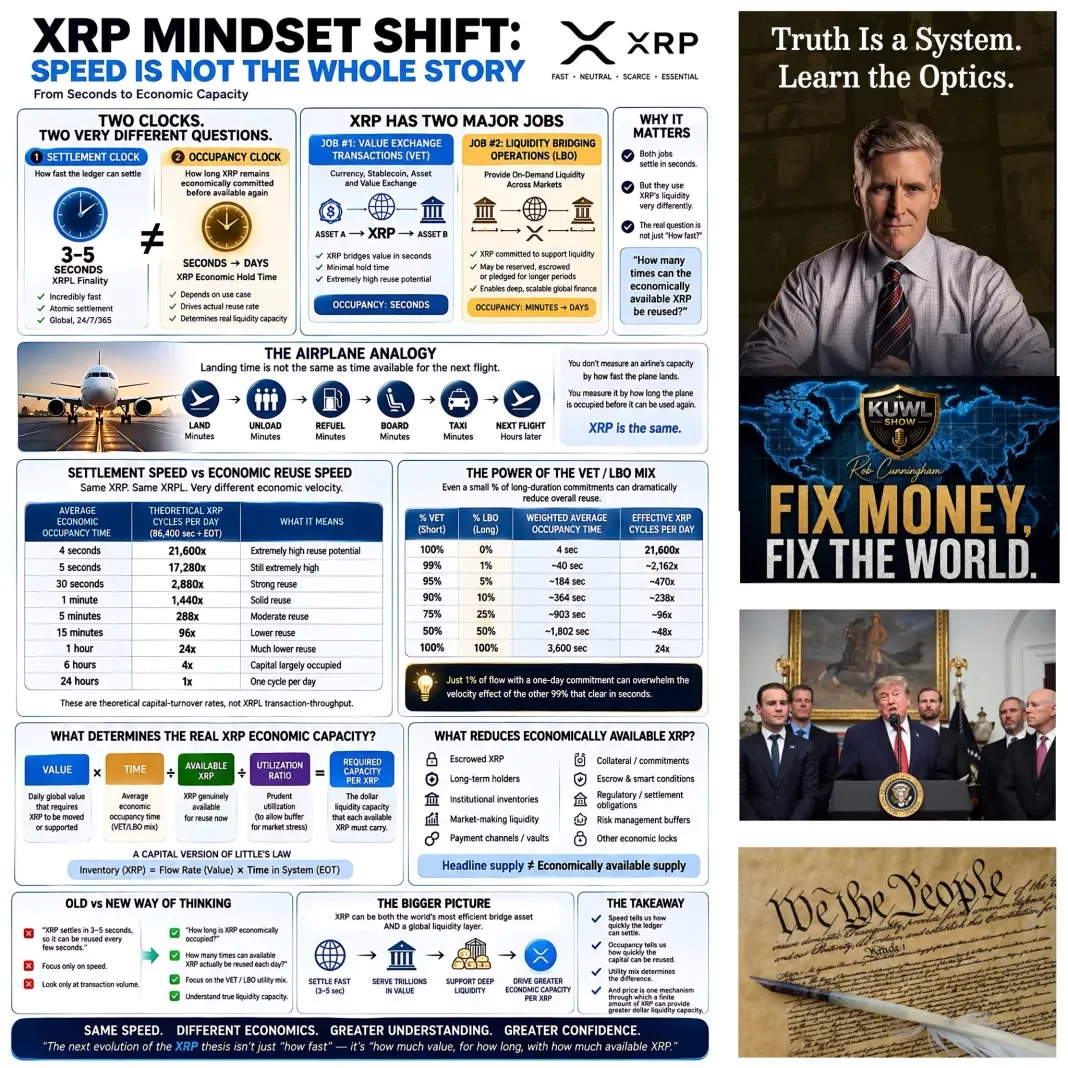
…it may be economically occupied for seconds.
But if XRP is also supporting liquidity across currencies, stablecoins, tokenized securities and other assets, some XRP will remain economically committed for minutes, hours, days or longer.
Same XRP.
Same fast ledger.
Very different capital velocity.
And THAT changes the question.
Stop asking only: “How many times can XRP theoretically settle each day?”
Start asking: “How many times can the economically AVAILABLE XRP actually be reused each day?”
Now XRP utility becomes something closer to:
VALUE × TIME ÷ AVAILABLE XRP
How much value needs XRP? × How long does it need XRP? ÷ How much XRP is actually available for the next job?
That’s the mindset shift.
A 3–5 second settlement network can remain breathtakingly fast while portions of its liquidity become economically occupied for far longer.
And even a relatively small percentage of longer-duration liquidity commitments can dramatically reduce effective XRP reuse.
Which means the future XRP question may not simply be: “How much value can XRP move?”
It may be: “HOW MUCH ECONOMIC CAPACITY MUST EACH AVAILABLE XRP CARRY?”
Don’t accept this because it’s bullish.
Don’t reject it because it’s unfamiliar.
Attack the assumptions. Change the VET/LBO mix. Change occupancy time. Change available supply. Run the math.
Confidence doesn’t come from somebody predicting our favorite XRP price target.
It comes from understanding the machinery deeply enough that you no longer need someone else to tell you what to believe.
Maybe the XRP community hasn’t been wrong.
Maybe we’ve simply been watching one clock… when XRP’s emerging liquidity economy requires us to understand two.
SETTLEMENT measures SPEED.
OCCUPANCY measures SCARCITY.
UTILITY determines the MIX.
PRICE provides CAPACITY.
Same XRP.
Entirely different calculus.
My Full KUWL Analysis: https://robcunningham.substack.com/p/the-next-layer-of-xrp-understanding
Source(s):
• https://x.com/KuwlShow/status/2093102360415387990
Dollar's Final Break? “RUSH TO THE EXITS” Could Trigger Global Financial CHAOS | Robert Kientz
Dollar's Final Break? “RUSH TO THE EXITS” Could Trigger Global Financial CHAOS | Robert Kientz
Liberty and Finance: 8-27-2026
The U.S. dollar and Treasury markets could be approaching a critical breaking point as rising debt, persistent inflation, and declining confidence put increasing pressure on the financial system, according to Rob Kientz of the Freedom Report.
Kientz argues that de-dollarization may unfold slowly at first, but could suddenly accelerate when the next recession forces nations to “rush to the exits” and rotate out of dollars and U.S. bonds.
Dollar's Final Break? “RUSH TO THE EXITS” Could Trigger Global Financial CHAOS | Robert Kientz
Liberty and Finance: 8-27-2026
The U.S. dollar and Treasury markets could be approaching a critical breaking point as rising debt, persistent inflation, and declining confidence put increasing pressure on the financial system, according to Rob Kientz of the Freedom Report.
Kientz argues that de-dollarization may unfold slowly at first, but could suddenly accelerate when the next recession forces nations to “rush to the exits” and rotate out of dollars and U.S. bonds.
He warns that a bond-market crisis could trigger massive losses across banks, pensions, corporations, and financial markets while capital seeks alternative assets such as gold and silver.
Kientz also explains why the Federal Reserve is trapped between fighting inflation with higher rates and protecting an economy burdened by unprecedented debt, while predicting continued strength in precious metals and significant outperformance from mining stocks.
With gold potentially retesting $5,500 and silver potentially surpassing $100 this year, Kientz sees the beginning of a broader commodity supercycle—and warns investors to prepare for a potentially historic shift in global capital flows.
INTERVIEW TIMELINE:
0:00 Intro
1:10 US debt crisis
15:20 Jackson Hole meeting
24:30 Miners & gold
28:20 Gold confiscation
29:45 Last thoughts
Bruce’s Big Call Dinar Intel Thursday Night 8-27-26
Bruce’s Big Call Dinar Intel Thursday Night 8-27-26
Transcribed By WiserNow Emailed To Recaps (INTEL ONLY)
Welcome, everybody, to the big call tonight. It is Thursday, August 27, and you're listening to the big call. Thanks everybody for coming in, tuning in, and we're just blessed to have you here with us tonight. Looking forward to a really good call. This will be our last call of this week, and so we look forward to it as always.
So thank you, Bob. Appreciate that very much. Well, let's see. It's my turn. It's Intel time. This is short and sweet, but I think it's going to take us right to the point that we need. This will help answer the question that Jeannie had in her post tonight, because she always prompts me on where we are and whether whether we're going to be going this month or whatever.
Bruce’s Big Call Dinar Intel Thursday Night 8-27-26
Transcribed By WiserNow Emailed To Recaps (INTEL ONLY)
Welcome, everybody, to the big call tonight. It is Thursday, August 27, and you're listening to the big call. Thanks everybody for coming in, tuning in, and we're just blessed to have you here with us tonight. Looking forward to a really good call. This will be our last call of this week, and so we look forward to it as always.
So thank you, Bob. Appreciate that very much. Well, let's see. It's my turn. It's Intel time. This is short and sweet, but I think it's going to take us right to the point that we need. This will help answer the question that Jeannie had in her post tonight, because she always prompts me on where we are and whether whether we're going to be going this month or whatever.
So I appreciate that too, Jeannie. We heard obviously. I told you guys a lot of times I'll get something after the call, after the call, and that happened last Tuesday night at around 11, after the call.
Remember, I'm on Central Time, and so I get a call, and it ends up this person says. “It looks like a weekend kickoff, and we should be exchanging very early next week.”
I thought, oh great! I wish I'd had that on Tuesday night, but I didn't. But I have it now, Thursday night, the other piece or two other pieces that came in, one was from somebody who works directly with the Redemption Centers all across the country, and she said, she said this weekend should be the kickoff of everything, and we should have a wonderful week next week.
Okay, that's good. That's given us some perspective, and then the last piece of information came in this afternoon, and it said, "You know, guys, we've been talking. You've heard the expression, 'This is all just part of the movie. Remember that? It kind of bugs me to hear that.
This is all just part of the movie. All this stuff, all that noise out there, everything that you're seeing online and all this stuff-it's all just part of the movie. I thought, well, okay, I've had my popcorn out quite a while. Well, this piece of information I thought was really important.
It said, "The movie ends this weekend. The movie ends this weekend. Next week should be a glorious week for all of us.
Now, what that tells me is there's a slight chance to get notified over the weekend, but I, because you know how close we are to September, or Monday is august 31, Tuesday is september 1, and look at that and go, could we get notified literally on the last day of August, having made it through the weekend, and that would be that would be what that would be Monday would be the 31st.
So, do we get notified over the weekend, or do we get notified Monday and begin setting appointments to exchange on Tuesday?
Tuesday the first of September. It's looking good either way. Either the weekend brings it in for us, or the very first day of September for exchanges. august 31, we could get notified on the last day, on Monday, and begin exchanges Tuesday. It looks like that might be the timing.
It looks like it could kick off this weekend. The end of the movie is this weekend, and then everything happens Probably early next week for us, and I'll take it. Believe me, at this point, that sounds great. That sounds really good.
And you know as well as I do, when we get very close to the end of the month, and the first of September is right around the corner, would they start us exchanging before the first of September? I don't know, but that is what we're looking at right now.
Obviously, I'll get more information between now and Tuesday, and hopefully we get our numbers. and and Tuesday would be possibly a celebration call, and it might even be recorded. Not even a live call.
We'll have to see. You got to see a lot can happen in five days, and that's what we've got between now and Tuesday night. So I'm going to say that's not a lot of intel. I'm going to say we. I told you guys Tuesday we had nine currencies on the screen solid with rates, but we haven't been able to track that since Tuesday to know if we have more currencies on the screens.
Do we have solid rates? There's a lot of stuff, but they're just not able to discuss it with us. You know, it's amazing we get what we get, I guess, because you know there's a lot happening behind the scenes. The money is moved into place.
We think everything is ready for us, and I know in Iraq, for example, who do you think's printing the money for the Iraqi dinar? Who do you think printed it? Who do you think's printing the lower denominations for Iraq? That's right, we are.
Our treasury is printing that for them, and we sent two plane loads of of lower denomination Iraqi currency over one was last Monday and one was last Tuesday, so they've got it in the ATMs.
We believe we've got it in the shop owners' stores, groceries, whatever else they have. They're using lower denoms, and I think Iraq is rocking and rolling, ready to go. I don't think there's anything there that's holding us up. Finally, but you know we've held up Iraq, they've held us up.
It's been a cat and mouse game back and forth, really. But let's just believe that we do have a green light coming on From Department of Defense, which is over, our military is over the release of all of this in conjunction with our Treasury, of course, and then it goes from DoD Treasury to Wells Fargo to us in terms of those 800 numbers in the setting of our appointments, so that is where we stand.
That's our brief little timeline, and it sounds like we can all love that idea of getting started at the very end of this month, Monday or Tuesday, the first of September.
Can't believe we're already there, huh? We're already almost to September. Does it feel like fall where you are yet? We only had a high of 93 today. Ooh, it's cooling off a little bit. So let's just believe for some cooler weather and a little bit of rain where it's needed.
We don't have much intel, but we don't need much at this point. I gave you guys all that information about the the med beds, the hospitals, the letters that went out to the hospital administrators, the 11-page letters that went out a week ago Monday.
Was it last Monday? No, it was a week ago tomorrow. It was Friday. They went out to the administrators. So that's really interesting. That was a major, major thing, and we could get some disclosure right away.
We don't know exactly when, and it keeps changing as we get pushed back. It changes also, so beware of that possibility. I don't think you have to worry too much about things, but if you are somewhat of a prepper or you feel like you need to store some food and water and that kind of thing, I don't see us having a problem.
But you know, we will have disclosure with television, internet, and tele or phone service, cell phone service. So beware of that. Don't know how long it's going to go, how many hours a day, how many weeks it'll go, or whatever. But it's going to be pretty interesting, I think.
So we have to pace ourselves through that. Okay., and let's go ahead and be in the best possible health we can be in, awaiting the arrival of the emails with the 800 numbers.
Also, well, let's just take it from there and say we look forward to receiving this information and for the movie being over this weekend, I hope so. So let's just hang in there and be positive about it. Let's thank Sue and Bob for their beautiful involvement as hosts on the bid call.
Thank you for oh gosh, GCK and Doug and Jeanie and Pastor Scott and everybody in Big Call Universe and everybody behind the scenes that's helping to provide important intel and information to us. So thank you guys for that. Let's go ahead and pray the call out, and then we'll say good night
All right, guys, thank you so much for listening, and we'll talk to you Tuesday night, which hopefully will be a celebration call.
Bruce’s Big Call Dinar Intel Thursday Night 8-27-26 REPLAY LINK Intel Begins 1:03:33
https://www.freeconferencecallhd.com/wall/recorded_audio?audioRecordingUrl=https%3A%2F%2Frs0002.freeconferencecall.com%2Fstorage%2FsgetHD%2FHsCgW%2FOGMR
Bruce’s Big Call Dinar Intel Tuesday Night 8-18-26 REPLAY LINK Intel Begins 1:06:20
Bruce’s Big Call Dinar Intel Thursday Night 8-20-26 REPLAY LINK Intel Begins 1:09:20
Bruce’s Big Call Dinar Intel Tuesday Night 8-18-26 REPLAY LINK Intel Begins 1:14:40
https://www.freeconferencecallhd.com/wall/recorded_audio?audioRecordingUrl=https%3A%2F%2Frs0002.freeconferencecall.com%2Fstorage%2FsgetHD%2FHsCgW%2FOGvf
Bruce’s Big Call Dinar Intel Thursday Night 8-13-26 REPLAY LINK Intel Begins 1:04:54
Bruce’s Big Call Dinar Intel Tuesday Night 8-11-26 REPLAY LINK Intel Begins 1:02:00
Bruce’s Big Call Dinar Intel Thursday Night 8-6-26 REPLAY LINK Intel Begins 1:22:22
Bruce’s Big Call Dinar Intel Tuesday Night 8-4-26 REPLAY LINK Intel Begins 1:19:00
https://www.freeconferencecallhd.com/wall/recorded_audio?audioRecordingUrl=https%3A%2F%2Frs0002.freeconferencecall.com%2Fstorage%2FsgetHD%2FHsCgW%2FOG0D
Bruce’s Big Call Dinar Intel Thursday Night 7-23-26 REPLAY LINK Intel Begins 1:08:45
Bruce’s Big Call Dinar Intel Tuesday Night 7-28-26 REPLAY LINK Intel Begins 1:34:24
Bruce’s Big Call Dinar Intel Thursday Night 7-23-26 REPLAY LINK Intel Begins 1:27:10
Bruce’s Big Call Dinar Intel Tuesday Night 7-21-26 REPLAY LINK Intel Begins 1:30:35
Bruce’s Big Call Dinar Intel Thursday Night 7-16-26 REPLAY LINK Intel Begins 1:14:00
Bruce’s Big Call Dinar Intel Tuesday Night 7-7-26 REPLAY LINK Intel Begins 1:03:15
https://www.freeconferencecallhd.com/wall/recorded_audio?audioRecordingUrl=https%3A%2F%2Frs0002.freeconferencecall.com%2Fstorage%2FsgetHD%2FHsCgW%2FO7eM
Seeds of Wisdom RV and Economics Updates Friday Afternoon 8-28-26
Good Afternoon Dinar Recaps,
The Strait of Hormuz Becomes a Financial Negotiation: Oil, Sanctions and the Global Economy
The six-month Iran conflict has reached a potentially important new phase as diplomacy increasingly centers on reopening the Strait of Hormuz — turning a military chokepoint into a negotiating instrument with consequences for oil, inflation, sanctions and the global financial system.
Good Afternoon Dinar Recaps,
The Strait of Hormuz Becomes a Financial Negotiation: Oil, Sanctions and the Global Economy
The six-month Iran conflict has reached a potentially important new phase as diplomacy increasingly centers on reopening the Strait of Hormuz — turning a military chokepoint into a negotiating instrument with consequences for oil, inflation, sanctions and the global financial system.
Overview
The Strait of Hormuz is becoming much more than a military or energy-security issue.
It is now a central bargaining point in the broader U.S.-Iran confrontation, with mediators pressing for the restoration of commercial shipping while Iran prepares conditions for reopening the waterway.
Before the war, roughly 20% of global oil supplies moved through the Strait of Hormuz. Today, shipping remains dramatically below normal levels, even as the United States says it has cleared Iranian mines and oil markets have begun responding to signs that more crude is finding its way through alternative routes and limited traffic.
That makes Hormuz a direct connection between geopolitics and global finance.
Key Developments
1. Diplomacy is increasingly focused on reopening Hormuz
Qatar and Pakistan are helping mediate efforts to restore freedom of navigation through the strait. Iran says it is preparing a list of conditions for reopening the waterway, while Qatar has emphasized the importance of returning to the pre-war system of open commercial shipping.
The United States continues to insist that Hormuz must remain an open international waterway. Iran, however, has linked reopening to broader demands that have included sanctions relief, an end to the U.S. blockade and compensation.
This creates an important shift.
The reopening of a major global energy artery is now part of the diplomatic price being negotiated to end or de-escalate the conflict.
2. Oil markets are already pricing the possibility of greater flows
Oil prices moved lower today as traders assessed signs that more oil may be moving through the Gulf and that producers are adapting to the disruption.
Reuters reports that oil was on track for a weekly decline, despite the diplomatic stalemate, as the market increasingly focused on the possibility of greater supply and a gradual normalization of Gulf energy flows.
That reaction is important because it demonstrates how quickly financial markets can begin pricing a geopolitical change before a formal agreement exists.
A sustained reopening of Hormuz could reduce the geopolitical premium embedded in crude prices.
A renewed closure or military escalation could reverse that trade just as quickly.
3. Washington's sanctions campaign adds another financial layer
At the same time that diplomacy is focusing on Hormuz, Washington is expanding economic pressure against Iran.
New U.S. sanctions are targeting additional Iranian-linked entities, while the administration is pressuring other countries to reduce commercial ties with Tehran or risk secondary sanctions. Iran's annual inflation has reached 66%, according to Reuters.
This creates a fascinating intersection between physical energy flows and financial flows.
The United States is attempting to restrict Iran's access to international finance at the same time that Iran retains leverage over one of the world's most important energy corridors.
Why It Matters
The Strait of Hormuz illustrates how closely energy security and financial security have become connected.
If oil remains expensive because shipping is restricted, inflation can remain elevated.
If inflation remains elevated, central banks may have less room to cut interest rates.
If interest rates remain higher, government borrowing costs remain elevated.
And higher borrowing costs place additional pressure on highly indebted governments around the world.
The chain is straightforward: Hormuz → Oil → Inflation → Interest Rates → Bonds → Currencies → Global Growth
That is why today's diplomatic developments deserve attention far beyond the Middle East.
Why It Matters to Foreign Currency Holders
For foreign-currency holders, the most important issue is how an energy shock affects relative currency strength and purchasing power.
Countries heavily dependent on imported energy can experience significant pressure on their currencies when oil prices rise. Energy exporters can experience the opposite effect as higher commodity revenues strengthen their external balances.
But there is another consideration.
The Iran conflict is demonstrating that access to international finance and access to physical commodities can be used together as instruments of geopolitical power.
Sanctions restrict financial channels.
Control over shipping routes influences physical commodities.
Together, they create a much broader form of economic pressure.
That could encourage more countries to diversify their trade relationships, payment mechanisms and reserve assets over time.
Implications for the Global Financial Reset
The Hormuz crisis is becoming another example of why the global financial system may be moving toward greater diversification rather than a simple replacement of the dollar.
The dollar remains central to international finance.
But countries facing sanctions risk or geopolitical uncertainty have greater incentives to develop:
Local-currency trade
Alternative payment systems
Bilateral settlement arrangements
Larger strategic commodity reserves
Greater gold holdings
Alternative energy transportation routes
The financial reset, therefore, may not happen through one dramatic announcement.
It may emerge through thousands of decisions by governments trying to reduce vulnerability to financial, energy and geopolitical chokepoints.
The Bigger Picture
Today's development is particularly important because the Strait of Hormuz is now sitting at the intersection of three negotiations.
There is a military negotiation over control of the waterway.
There is a diplomatic negotiation over the conditions required to reopen it.
And there is a financial negotiation over the consequences of sanctions, oil prices and access to global markets.
The fact that oil prices are already responding to the possibility of greater flows demonstrates how important the strait has become to global markets.
The ultimate outcome remains uncertain.
If Hormuz gradually reopens, oil could lose some of its geopolitical risk premium, easing inflation pressure and potentially giving central banks greater policy flexibility.
If the reopening fails, the opposite could occur: renewed supply concerns could push energy prices higher, complicating the inflation outlook and keeping pressure on bond markets and currencies.
That makes the next phase of the Iran conflict particularly important.
The Strait of Hormuz is no longer simply a passage for oil. It has become a bargaining chip connecting military power, sanctions, energy security and the global financial system.
The next major financial move may come not from Wall Street, but from whether the world's most important energy chokepoint becomes a pathway to de-escalation — or another source of global economic pressure.
Seeds of Wisdom Team
Newshounds News™ Exclusive
Sources
Reuters — Iran war diplomacy turns toward reopening Strait of Hormuz
Reuters — Oil slides on clues about Fed policy, rumors of Hormuz deal
~~~~~~~~~~
Seeds of Wisdom Team RV Currency Facts Youtube and Rumble
Newshound's News Telegram Room Link
RV Facts with Proof Links Link
RV Updates Proof links - Facts Link
Start Here room with Most Asked Questions Link
Follow the Gold/Silver Rate COMEX
Follow Fast Facts
Seeds of Wisdom Team™Website
Thank you Dinar Recaps
MilitiaMan & Crew: Iraqi Dinar: What You Need to Know About Today's Developments
MilitiaMan & Crew: Iraqi Dinar: What You Need to Know About Today's Developments
8-28-2026
The Crew: Samson, PompeyPeter, Petra, Daytrader, Sunkissed, GIGI and Militia Man
No drama. No intrigue. No songs and dances. Just straight, factual news that I read and interpret to the best of my ability after being an avid Dinar investor and insanely obsessed Dinarian for over 15 years.
Follow MM on X == https://x.com/Slashn
MilitiaMan & Crew: Iraqi Dinar: What You Need to Know About Today's Developments
8-28-2026
The Crew: Samson, PompeyPeter, Petra, Daytrader, Sunkissed, GIGI and Militia Man
No drama. No intrigue. No songs and dances. Just straight, factual news that I read and interpret to the best of my ability after being an avid Dinar investor and insanely obsessed Dinarian for over 15 years.
Follow MM on X == https://x.com/Slashn
Be sure to listen to full video for all the news……..
Holly Celiano: Crypto, the Great Wealth Transfer, Clarity Act, Updates with Rob Cunningham, August 2026
Holly Celiano: Crypto, the Great Wealth Transfer, Clarity Act, Updates with Rob Cunningham, August 2026
8-28-2026
The global financial landscape is undergoing a profound transformation, moving away from outdated, opaque systems toward a future defined by transparency, security, and efficiency.
In an insightful discussion hosted by Holly Celiano, financial analyst Rob Cunningham dives deep into the structural flaws of traditional monetary systems and explores how modern technology is paving the way for a fairer economic paradigm.
Cunningham’s analysis sheds light on why a systemic overhaul is not only necessary but actively underway, driven by advancements in blockchain technology and digital assets.
Holly Celiano: Crypto, the Great Wealth Transfer, Clarity Act, Updates with Rob Cunningham, August 2026
8-28-2026
The global financial landscape is undergoing a profound transformation, moving away from outdated, opaque systems toward a future defined by transparency, security, and efficiency.
In an insightful discussion hosted by Holly Celiano, financial analyst Rob Cunningham dives deep into the structural flaws of traditional monetary systems and explores how modern technology is paving the way for a fairer economic paradigm.
Cunningham’s analysis sheds light on why a systemic overhaul is not only necessary but actively underway, driven by advancements in blockchain technology and digital assets.
To understand the urgency of this financial evolution, Cunningham compares the legacy monetary framework to a broken, contaminated bubble gum machine built on dishonest “weights and measures.”
For generations, centralized financial systems have relied on opacity, allowing intermediaries to control the flow of capital while introducing vulnerabilities such as inflation, counterfeiting, and institutional corruption.
This traditional model often benefits entrenched banking cartels—such as those historically centered in the City of London—at the expense of everyday participants. As trust in these legacy institutions wanes, experts point to the necessity of a system built on verifiable integrity rather than blind faith in intermediaries.
The proposed solution lies in a modernized global monetary architecture powered by transparent stablecoins backed one-to-one by real-world assets, such as gold or secure government securities like US Treasuries.
By anchoring digital tokens to tangible value, this approach bridges the gap between traditional economic stability and the speed of the digital age. Technologies like XRP and the XRP Ledger play a pivotal role in this vision by facilitating trustless, peer-to-peer value transfers. By cutting out unnecessary intermediaries, this immutable and auditable ledger system eliminates points of failure, ensuring that transactions can occur securely 24 hours a day, anywhere in the world.
Transitioning to this new financial frontier requires more than just innovative technology; it demands regulatory clarity and institutional adoption. Cunningham highlights ongoing legislative efforts, such as the Clarity Act, alongside strategic executive orders, as crucial steps toward integrating blockchain technology into the mainstream financial ecosystem.
Despite inevitable resistance from legacy institutions accustomed to controlling monetary policy, the momentum toward digitization is undeniable. Proponents view this monumental shift not merely as a technical upgrade, but as a fundamental movement toward financial sovereignty, where mathematics and immutable principles replace human discretion and deception.
Ultimately, the conversation surrounding the future of money points toward a remarkably optimistic outlook. As the longstanding systemic overhaul approaches implementation, society stands on the brink of a more equitable financial era. By embracing decentralized, transparent, and asset-backed systems, the global economy is moving closer to an era of uncompromised trust and financial inclusion.
Coffee with MarkZ, joined by Mr. Cottrell. 08/28/2026
Coffee with MarkZ, joined by Mr. Cottrell. 08/28/2026
Some highlights by PDK-Not verbatim
MarkZ Disclaimer: Please consider everything on this call as my opinion. People who take notes do not catch everything and its best to watch the video so that you get everything in context. Be sure to consult a professional for any financial decisions
MZ: Could the news get any crazier? Rhetorical, please do not get crazier..... We cover the latest news and speak with Mr. Cottrell. Lucas joins us after the news.
Coffee with MarkZ, joined by Mr. Cottrell. 08/28/2026
Some highlights by PDK-Not verbatim
MarkZ Disclaimer: Please consider everything on this call as my opinion. People who take notes do not catch everything and its best to watch the video so that you get everything in context. Be sure to consult a professional for any financial decisions
MZ: Could the news get any crazier? Rhetorical, please do not get crazier..... We cover the latest news and speak with Mr. Cottrell. Lucas joins us after the news.
MZ: On the bond side-There are great expectations that they get paid throughout the weekend with currencies starting early next week.
MZ: There are a lot of people calling for it this weekend….but stay grounded. There is a lot coming together is a short period of time.
THE CONTENT IN THIS PODCAST IS FOR GENERAL & EDUCATIONAL PURPOSES ONLY&NOT INTENDED TO PROVIDE ANY PROFESSIONAL, FINANCIAL OR LEGAL ADVICE. PLEASE CONSIDER EVERYTHING DISCUSSED IN MARKZ’S OPINION ONLY
https://rumble.com/user/theoriginalmarkz
Kick: https://kick.com/theoriginalmarkz
Markz's linktree https://linktr.ee/theMarkZshow
FOLLOW MARKZ : TWITTER . https://twitter.com/originalmarkz?s=21. TRUTH SOCIAL . https://truthsocial.com/@theoriginalm...
Mod: MarkZ "Back To Basics" Pre-Recorded Call" for Newbies 10-19-2022 )https://www.youtube.com/watch?v=37oILmAlptM
MARKZ DAILY LINKS: https://theoriginalmarkz.com/home/
Note from PDK: Please listen to the replay for all the details and entire stream….I do not transcribe political opinions, medical opinions or many guests on this stream……just RV/currency related topics.
THANK YOU FOR JOINING. HAVE A BLESSED DAY. SEE YOU IN THE MORNING FOR COFFEE @ 10:00 AM EST ~ UNLESS BREAKING NEWS HAPPENS! FOR UPDATES ON MARK’S PODCAST GO TO: https://t.me/+b3hYhYlhKM1hYzcx
News, Rumors and Opinions Friday 8-28-2026
Reset Intelligence: Denial or Blueprint
8-28-2026
Denial or Blueprint
By Reset Intelligence | @EXIT_FIAT
The Central Bank of Iraq published two documents in one day. The public got a denial. Every bank in Iraq got instructions.
One tells you what the state wants believed. The other tells you what the state is doing.
Reset Intelligence: Denial or Blueprint
8-28-2026
Denial or Blueprint
By Reset Intelligence | @EXIT_FIAT
The Central Bank of Iraq published two documents in one day. The public got a denial. Every bank in Iraq got instructions.
One tells you what the state wants believed. The other tells you what the state is doing.
The Statement
On Wednesday the CBI put out its first formal statement under its own name on the zeros. The first half denies that the bank has printed a new currency with the zeros deleted. The second half describes, in the bank’s own words, how a redenomination would run: legal, regulatory and technical stages, an announcement through official channels, and a transitional period for citizens, banks and institutions to exchange the currency with financial rights preserved in full. Institutions with no project do not publish the project’s procedure.
The Circular Nobody Saw
The same day, the bank’s Banking Supervision Department sent a circular to every licensed bank and financial institution in the country. Subject: due diligence on politically exposed persons. It reaches officials, their families to the second degree, and their associates. The red flags are explicit, and one of them is the whole story in a sentence: wealth that does not match the salary of a government employee.
• 111 trillion dinars – total currency issued by end of June, up from just under 100 trillion at end-2025, with about 92% of it outside the banking system
• Cabinet vote – parliament preparing to vote on the vacant ministries within days, three candidates submitted per seat
• 2027 budget – due at parliament by mid-September, the paper that carries the dinar’s number in law
• September 1 – Iraq’s new export routes go live, revenue moving on lanes that never touch the Strait of Hormuz
What the two documents mean together, the Baghdad ground report neither of them mentions, the Kuwait 1991 and Iraq 2003 precedent, and what decides whose cash survives the crossing – that analysis is in today’s full briefing. This is the short version.
A state tells you what it denies. It shows you what it prepares for.
Read the full daily briefing free for 5 days. Sign up here: resetintelligence.com
Want it straight from the horse’s mouth? The CBI Rate Alert pings you the moment the Central Bank of Iraq moves the official rate. The number itself, not a rumour about it. It comes with the free resource library and the daily breakdown of what is actually moving in Iraq. Sign up free: resetintelligence.com/rate-alert
Got a RV question? Reset Intelligence now runs an on-call research assistant: ask it anything they have published. It answers in seconds and will conduct deep research to find you the answer. Try it: resetintelligence.com/research-assistant
The full design behind it all is in the book: Head of the Snake. The free guides and scenario reports live in the Resource Library.
Follow the daily intel free: Telegram · Facebook · Spotify · Odysee
https://dinarchronicles.com/2026/08/27/reset-intelligence-denial-or-blueprint/
*************
Courtesy of Dinar Guru: https://www.dinarguru.com/
Guy They're not going to announce that they're going to make an announcement, they're just going to announce it. Because if they say on Monday that tomorrow we're going to revalue or reinstate our currency, then there's going to be a rush to buy what's available. They would have to shut down all of the exchanges in the world from selling more dinars. That's a gargantuan task. I wouldn't want to try to coordinate that...It's much better just to make the announcement, just to hit everyone by surprise.
Frank26 The CBI, they're not lying. But they're not telling you the full truth...The CBI is saying they don't have to print any lower notes. They're telling you the truth. They don't have to. They already did...They didn't tell you everything...
Reset Intelligence The Central Bank of Iraq published two documents on Wednesday. One went to the public: a formal statement... denying that any new currency has been printed. Its companion went to every licensed bank and financial institution in Iraq...It instructs every counter in the country on how to treat the money of politically exposed persons. That means officials, their families out to the second degree, and the associates whose wealth a government salary cannot explain. One release manages what you believe. The other changes what a bank teller in Baghdad is required to do...Underneath it all sits...102 trillion dinars held beyond the reach of any bank, which all of this is built to bring in.
Europe’s Economic Collapse Is Accelerating — These Are The REAL Numbers
Lena Petrova: 8-28-2026
00:00 Europe’s New Economic Crisis Is Here
00:36 The Economic Chain Reaction: Energy → Inflation → Recession
00:53 Europe’s Energy Crisis Is Driving Inflation Higher
01:38 European Inflation Rises Above the ECB Target
02:14 ECB Trap: Inflation vs. Economic Growth
02:50 Why High Interest Rates Are Hurting Europe
03:43 Germany’s Industrial Crisis Gets Worse
04:10 China’s “New Shock” Hits German Industry
05:22 Chinese Imports Threaten European Manufacturing
06:29 Why Europe Is Turning to Protectionism
07:14 China Could Retaliate Against European Exports
08:09 Europe’s Economic Crisis Explained
08:52 Europe’s Competitiveness Crisis Is Growing
09:10 Can Europe Remain an Industrial Powerhouse?
09:37 The Irony of Europe’s Protectionist Strategy
10:10 Europe’s Impossible Economic Choice
10:50 What Europe Must Do to Avoid Economic Decline
11:26 What Happens Next for Europe’s Economy?
Seeds of Wisdom RV and Economics Updates Friday Morning 8-28-26
Good Morning Dinar Recaps,
When the Fed and Treasury Pull in Different Directions: U.S. Debt, Inflation and the Next Rate Regime
As Federal Reserve Chair Kevin Warsh prepares to speak at Jackson Hole, markets are watching for clues about interest rates, inflation and the future of U.S. monetary policy — while the Treasury pursues its own strategy to manage long-term borrowing costs.
Good Morning Dinar Recaps,
When the Fed and Treasury Pull in Different Directions: U.S. Debt, Inflation and the Next Rate Regime
As Federal Reserve Chair Kevin Warsh prepares to speak at Jackson Hole, markets are watching for clues about interest rates, inflation and the future of U.S. monetary policy — while the Treasury pursues its own strategy to manage long-term borrowing costs.
Overview
The U.S. financial system has reached an important crossroads.
The Federal Reserve is confronting persistent inflation and deciding how restrictive monetary policy needs to remain, while the Treasury is working to manage the government's enormous borrowing needs and long-term financing costs.
Those objectives do not always point in the same direction.
That tension is coming into sharper focus today as Fed Chair Kevin Warsh delivers his first major Jackson Hole speech. Investors are looking for clues about whether the Fed will emphasize inflation control, provide clearer guidance on future rate decisions, or maintain Warsh's relatively limited approach to forward guidance.
At the same time, Treasury Secretary Scott Bessent has been pursuing measures intended to influence the long end of the Treasury market, including expanded Treasury buybacks.
The result is a much larger question than whether the Fed cuts rates in September:
Who ultimately determines the price of money — the Federal Reserve, the Treasury market, or the government's growing financing requirements?
Key Developments
1. Warsh's Jackson Hole speech could redefine the Fed's policy message
Markets have been looking for greater clarity from Warsh since he became Fed chair. His decision to provide relatively little forward guidance has contributed to uncertainty over the path of monetary policy.
Today's speech gives him an opportunity to clarify how the Fed intends to respond if inflation remains above its 2% target.
Several Fed officials have supported the possibility of additional rate increases, while investors have been trying to determine whether the central bank will ultimately prioritize inflation control or respond to signs of economic weakness.
The distinction is critical.
If the Fed keeps policy restrictive, government borrowing costs could remain elevated.
If it moves toward lower rates while inflation remains persistent, markets could question whether inflation is being given sufficient priority.
2. The Treasury has a different problem: the cost of financing $40 trillion of debt
The United States has now crossed the $40 trillion public-debt threshold, dramatically increasing the importance of interest rates to federal finances.
Treasury Secretary Bessent has been pursuing a strategy that includes larger buybacks of longer-dated Treasury securities, designed in part to improve market liquidity and potentially reduce pressure at the long end of the yield curve. Treasury has said its first expanded bond buyback is scheduled for September 10.
That creates an unusual policy dynamic.
The Treasury wants to manage its financing costs and maintain orderly demand for government debt.
The Fed, meanwhile, must remain focused on inflation and monetary conditions.
Those goals can overlap — but they can also conflict.
3. The bond market is becoming the referee
This may ultimately be the most important part of the story.
Even if policymakers want lower borrowing costs, investors still determine the yields at which Treasury securities are ultimately financed.
Reuters has noted that long-term Treasury yields have come under pressure amid uncertainty over Fed policy, while the Treasury's efforts to influence the long end of the curve have added another layer to the market's debate.
That means the bond market is increasingly acting as a constraint on both fiscal and monetary policy.
If investors demand higher yields because of inflation, debt supply or concerns about fiscal sustainability, policymakers cannot simply declare borrowing costs lower.
The market has to agree.
Why It Matters
The U.S. financial system has historically relied on a relatively clear division of responsibilities:
The Fed controls monetary policy. The Treasury manages government financing. The bond market prices the risk.
That division becomes more complicated when the government carries enormous debt and changes in interest rates have increasingly significant consequences for federal finances.
Higher rates help the Fed fight inflation, but they also increase the government's interest expense.
Lower rates can reduce financing costs, but if inflation remains elevated, they can weaken confidence in the Fed's commitment to price stability.
This creates a difficult balancing act.
The larger the debt becomes, the more important the relationship between monetary policy and the Treasury market becomes.
Why This Matters to Foreign Currency Holders
For foreign-currency holders, this is particularly important because U.S. interest rates remain one of the most powerful forces influencing global currencies and capital flows.
Normally, higher U.S. yields can make dollar-denominated assets more attractive and support the dollar.
But that relationship becomes less straightforward if yields rise because investors are demanding compensation for inflation, debt and fiscal risk.
The distinction is crucial.
A higher yield generated by strong economic growth is very different from a higher yield generated by concerns about the government's ability to finance its obligations.
If markets increasingly view Treasury yields through the second lens, the traditional relationship between higher yields and a stronger dollar could become less reliable.
That would be a significant development for the international monetary system.
Implications for the Global Financial Reset
The emerging tension between the Fed, Treasury and bond market is another indication that the next phase of the global financial system may be shaped as much by sovereign debt as by currencies themselves.
The United States does not need to lose its reserve-currency position for the financial system to change.
Instead, the transition could occur gradually as governments and investors respond to:
Record sovereign debt
Higher long-term borrowing costs
Persistent inflation
Central-bank policy uncertainty
Greater use of gold as a reserve asset
Expansion of local-currency trade
Alternative cross-border payment systems
The critical question is whether the dollar's strength continues to rest primarily on the size and liquidity of U.S. financial markets — or whether the growing U.S. debt burden eventually becomes a larger consideration in how global investors allocate reserves.
The Bigger Picture
Today's Jackson Hole speech is important because it comes at the intersection of three powerful forces: inflation, government debt and monetary policy.
The Fed wants to preserve price stability.
The Treasury wants to manage an enormous financing requirement.
And the bond market wants to be compensated for the risks it sees.
Those three forces do not always move together.
The outcome could determine much more than the next interest-rate decision.
It could influence Treasury yields, the dollar, gold, global capital flows and the willingness of foreign investors to continue absorbing U.S. government debt at current prices.
The deeper story is therefore not simply whether the Fed cuts or raises rates.
It is whether the United States can maintain monetary credibility while simultaneously managing an unprecedented debt burden and a bond market that is demanding a larger voice in the price of money.
The next phase of the global financial reset may be shaped by the answer to one question: Can monetary policy, fiscal policy and the bond market remain aligned when the cost of U.S. debt becomes too large to ignore?
This is not simply a Fed story — it is a story about who ultimately sets the price of money in a highly indebted global financial system.
Seeds of Wisdom Team
Newshounds News™ Exclusive
Sources
Reuters — Will Warsh's Jackson Hole speech be a course correction or detour?
Reuters — Treasury to stick to debt auction schedule despite bigger buybacks, Bessent says
~~~~~~~~~~
🌱 A Message to Our Currency Holders🌱
If you’ve been holding foreign currency for many years, you were not foolish.
You were not wrong to believe the global financial system would change.
What failed was not your patience — it was the information you were given.
For years, dates, rumors, and personalities replaced facts, structure, and proof. “This week” predictions created cycles of hope and disappointment that were never based on how currencies actually change.
That is not your failure.
Our mission here is different: • No dates • No rates • No hype • No gurus
Instead, we focus on:
• Verifiable developments • Institutional evidence
• Global financial structure • Where countries actually sit in the process
Currency value changes only come after sovereignty, trade, banking, settlement systems, and fiscal coordination are in place. History and institutions confirm this sequence.
You will see silence. You will see denials. That is not delay — that is discipline.
Protect your identity. Organize your documents. Verify everything.
Never hand your discernment to anyone who cannot show proof.
You deserve truth — not timelines.
Seeds of Wisdom Team
Newshounds News
~~~~~~~~~~
Seeds of Wisdom Team RV Currency Facts Youtube and Rumble
Newshound's News Telegram Room Link
RV Facts with Proof Links Link
RV Updates Proof links - Facts Link
Start Here room with Most Asked Questions Link
Follow the Gold/Silver Rate COMEX
Follow Fast Facts
Seeds of Wisdom Team™Website
Thank you Dinar Recaps
Iraq Economic News and Points To Ponder Friday Morning 8-28-26
CBI Deposits Slide 5.6% In H1 2026
2026-08-27 Shafaq News- BaghdadIraq’s total bank deposits fell by 6.19 trillion Iraqi dinars ($4.03B) in the first half of 2026, extending a decline that has taken deposits to their lowest level in recent years, Central Bank (CBI) data showed on Thursday.
Total deposits stood at 104.875 trillion Iraqi dinars ($68.30B) at the end of June, down 5.6% from 111.065 trillion dinars ($72.33B) at the end of 2025.
CBI Deposits Slide 5.6% In H1 2026
2026-08-27 Shafaq News- Baghdad Iraq’s total bank deposits fell by 6.19 trillion Iraqi dinars ($4.03B) in the first half of 2026, extending a decline that has taken deposits to their lowest level in recent years, Central Bank (CBI) data showed on Thursday.
Total deposits stood at 104.875 trillion Iraqi dinars ($68.30B) at the end of June, down 5.6% from 111.065 trillion dinars ($72.33B) at the end of 2025.
The decline followed a broader downward trend. Total deposits stood at 123.327 trillion dinars ($80.32B) at the end of 2024 and 133.499 trillion dinars ($86.94B) at the end of 2023.
Private-sector deposits made up the largest share at 49.964 trillion dinars ($32.54B) at the end of June 2026. Central government deposits reached 31.426 trillion dinars ($20.47B), while public institutions held 23.485 trillion dinars ($15.29B).
Cash credit contracted by 4.073 trillion dinars ($2.65B), falling 5.4% to 71.511 trillion dinars ($46.57B) at the end of June from 75.584 trillion dinars ($49.22B) at the end of 2025.
Credit extended to the private sector totaled 46.687 trillion dinars ($30.41B), while lending to the central government reached 22.419 trillion dinars ($14.60B). Public institutions received 2.405 trillion dinars ($1.57B) in credit.
Read more: Iraq’s private banks: Capital Growth and the structural credit gap
https://www.shafaq.com/en/Economy/CBI-deposits-slide-5-6-in-H1-2026
Iran Reports Continued Oil Sales Despite US Blockade
2026-08-27 Shafaq News- Tehran/ Doha Iran continues to sell and deliver oil despite the US naval blockade, Oil Minister Mohsen Paknejad told reporters on Thursday, acknowledging that sales had declined while deliveries continue in international waters beyond Iran’s territorial limits.
He declined to disclose operational details, saying the information “could be used by [Iran’s] adversaries.”
Kpler estimates that Iranian crude shipments to China, Tehran’s largest oil buyer, fell to about 534,000 barrels per day in August from 823,000 bpd in July, compared with an average of 1.4 million bpd in 2025.
Earlier today, US Central Command (CENTCOM) said its forces had redirected 75 commercial vessels, disabled three, and boarded two during the current enforcement phase of the naval blockade on Iran. Washington has also expanded sanctions targeting Iranian oil revenues, shipping, financial networks, and companies “helping Tehran maintain external trade.”
Iranian Parliament Speaker Mohammad Bagher Ghalibaf told Qatari Prime Minister and Foreign Minister Sheikh Mohammed bin Abdulrahman Al-Thani that the US economic blockade would fail and called on Washington to fulfill commitments Tehran says were included in the June ceasefire memorandum, including lifting the blockade and oil sanctions, releasing frozen Iranian assets and ending military operations on all fronts.
Talks between the two sides also focused on a proposed temporary Iran-Oman shipping corridor and a joint mine-clearing project in the Strait of Hormuz, where Kpler data showed 10 visible commodity-vessel transits on Wednesday, below the 10-day moving average of 15. https://www.shafaq.com/en/Economy/Iran-reports-continued-oil-sales-despite-US-blockade
Oil Prices Ease After Two Weeks Of Gains
2026-08-28 Shafaq News Oil prices fell on Friday and are on track to snap a two-week winning streak, despite settling higher in the previous session following a report that U.S. President Donald Trump is not interested in returning to previous deal terms with Iran.
Brent crude futures were down 25 cents, or 0.3%, to $89.45 a barrel by 0035 GMT. West Texas Intermediate crude futures fell 22 cents, also 0.3%, to $83.31.
Both benchmarks were poised to end the week lower, with Brent down 5.3% and WTI falling 4.3%.
Citing people familiar with the matter, the Wall Street Journal report said the Trump administration has repeatedly told mediators it has no interest in reviving the June memorandum of understanding, complicating diplomatic efforts to restart talks.
Earlier on Thursday, Washington said it was not in talks with Iran despite diplomatic efforts by other countries to re-engage the two sides.
On Monday, the U.S. announced what it called the "toughest sanctions in history" on Iran. Tehran said the sanctions were an "inhumane and hostile act" that had lost their effectiveness.
Elsewhere, geopolitical tensions escalated after Moscow warned it could strike British military targets inside and outside Ukraine in response to Kyiv's attacks on Russian territory using British-supplied long-range cruise missiles.
Trump, however, said Russian President Vladimir Putin will not attack a North Atlantic Treaty Organization (NATO) country, and he downplayed media reports that CIA Director John Ratcliffe this week had warned Russian officials against such an attack. Britain is one of the founding members of NATO. (REUTERS)
https://www.shafaq.com/en/Economy/Oil-prices-ease-after-two-weeks-of-gains
Gold Slips Ahead Of Fed Chair’s Jackson Hole Speech
2026-08-28 Shafaq News Gold slipped on Friday as market participants awaited closely watched remarks from Federal Reserve Chair Kevin Warsh at the Jackson Hole symposium.
Spot gold fell 0.5% to $4,580.19 per ounce by 0438 GMT. It touched a more than three-month high of $4,696.18 on Tuesday, following the U.S. Treasury's announcement of support measures for long-duration bonds.
U.S. gold futures eased 0.7% to $4,632.40.
The case for Warsh to lean hawkish is greater than the case for him not to, and that could see gold retreat further from its cycle highs in the near term, said Matt Simpson, a senior analyst at StoneX.
"But I suspect any such dip will be viewed favourably by bulls who missed out on the first phase of the rally - and are keen to have another crack at $5,000," he said.
Fed officials shared their concerns about the U.S. inflation landscape on Thursday, as central bankers gathered in Jackson Hole. Their comments came a day after data showed that the Personal Consumption Expenditures price index, the Fed's main inflation gauge, stood at 3.7% in the 12 months through July.
Fed Chair Warsh is scheduled to speak later in the day.
Traders see a 33.7% chance of a U.S. rate hike in September and a 74.2% chance by December, according to the CME FedWatch tool.
Despite its role as an inflation hedge, gold tends to lose appeal in a high interest rate environment as it offers no yield.
Gold remains supported by improving participation in exchange-traded funds and futures, along with concerns over U.S. fiscal credibility and continued official-sector buying, though risks of a consolidation persist, OCBC precious metals strategist Christopher Wong said in a note.
"We remain constructive (on silver), though a cleaner extension higher likely requires renewed weakness in yields, U.S. dollar and a decisive break above the $70.60-$72 resistance area," he said.
Spot silver fell 0.6% to $68.85 per ounce and palladium declined 0.2% to $1,349.44. Platinum was down 0.3% at $1,840.78, on track for a weekly loss. (REUTERS)
https://www.shafaq.com/en/Economy/Gold-slips-ahead-of-Fed-Chair-s-Jackson-Hole-speech