
Iraq Economic News and Points To Ponder Thursday Evening 8-20-26
Al-Hashemi: Iraq Is The Biggest Loser From The Tightening Of The US Blockade On Iran
Money and business Economy News – Baghdad Economist Ziad al-Hashemi warned on Thursday of the repercussions of any US tightening of the economic blockade on Iran, stressing that Iraq may be one of the most affected regionally because of its dependence on Iranian gas and commodities.
"The surrounding countries of Iran, led by Iraq, Turkey, Turkmenistan, Afghanistan, Pakistan and Armenia, will be under direct American pressure to review their trade and financial relations with Tehran and avoid collisions with the United States," he said.
Al-Hashemi: Iraq Is The Biggest Loser From The Tightening Of The US Blockade On Iran
Money and business Economy News – Baghdad Economist Ziad al-Hashemi warned on Thursday of the repercussions of any US tightening of the economic blockade on Iran, stressing that Iraq may be one of the most affected regionally because of its dependence on Iranian gas and commodities.
"The surrounding countries of Iran, led by Iraq, Turkey, Turkmenistan, Afghanistan, Pakistan and Armenia, will be under direct American pressure to review their trade and financial relations with Tehran and avoid collisions with the United States," he said.
He added that "Washington is expected to use a large part of its resources to make its plan to tighten the economic blockade on Iran successful," adding that "the task will not be easy or guaranteed results, with Tehran having long experience in dealing with sanctions and the search for alternative outlets."
"Iran has the ability to maneuver through a parallel economy and cross-border trade and smuggling networks, in addition to continuing to use the paper of the Strait of Hormuz to pressure the global economy," he said.
Al-Hashemi explained that "Iraq may be the most affected regionally in the event of the application of the blockade in a strict manner, because of its great link to Iranian gas and many goods and products," noting that "the cessation of Iranian imports, especially gas, will deprive Iraq of an important source of operation of power plants."
Regarding China, Hashemi said that it “will not easily accept the imposition of a tight economic blockade on Iran, and may resort to maneuvering to maintain its trade relations, especially in the oil sector, but it may have to respond if the US measures are characterized by a high degree of tightness.”
He stressed that "the region is on the verge of a new economic test after the stage of direct military confrontations," pointing out that "any broad siege on Iran may impose a new economic reality reflected on the movement of trade and oil prices and the nature of economic relations between the countries of the region."
https://www.economy-news.net/content.php?id=72830
The Government On Its Plan To Secure Salaries: Internal Borrowing Is A Legal Option When Needed
Money and business Economy News — Baghdad The Prime Minister’s Advisor for Financial and Economic Affairs, Mazhar Mohammed Saleh, explained the features of the government’s plan to manage liquidity and secure salaries and operational expenses.
Saleh revealed in an interview with the official newspaper the nature of the financial strategy adopted to deal with monthly obligations, pointing out that "the public financial management is moving within a solid legal umbrella to ensure the stability of public spending, regardless of the severity of external challenges."
He added that "the disruptions of navigation and trade in the Strait of Hormuz have cast a shadow over the regularity of Iraqi oil exports, which represent the main artery and the adoption of the basis of cash flows feeding the budget."
Despite these pressures, Saleh stressed that “the financial authorities are keen to employ all technical tools to prevent these disturbances from being reflected on social benefits, especially the bill of salaries, wages, retirees and care for vulnerable groups.”
In this context, Saleh said that "the Public Finance Department operates in accordance with the tracks and provisions specified in the Federal Financial Management Law No. 6 of 2019, as this law provides the legal frameworks and approved ceilings to regulate the exchange operations and manage liquidity during the fiscal year, and to protect the stability of state institutions and their service duties."
The financial adviser reviewed the size of the monetary responsibility of the public treasury monthly, noting that "the bill of salaries, wages, pensions and allocations of the social welfare network for the month of August is close to eight trillion dinars per month, while the total liabilities rise to about ten trillion dinars per month when adding the administrative operating expenses necessary for the management of basic facilities and the continued operation of state agencies."
He pointed out that "this high volume of liabilities makes securing liquidity a top priority, especially in light of the high sensitivity of the budget to the fluctuations in global oil prices and the risks of regular cash flows from oil revenues."
To ensure the fulfillment of financial dues, Saleh pointed out that "the federal finance depends on an integrated plan based on several tools, where the available data record a relative improvement in oil revenues compared to the previous two months, which gives the financial management a better margin to control flows and meet basic needs, in parallel with the continuous work to activate non-oil revenues and activate the collection tools to provide the treasury with additional resources."
“The financial authority maintains internal borrowing instruments as a legally available tactical option to be used when needed to fill any temporary liquidity gaps, and to ensure that salary financing or the basic operation of state institutions does not falter,” he said.
The Prime Minister’s Advisor for Financial and Economic Affairs concluded by saying that “the financial stability of the state depends not only on direct oil revenues, but also on a dynamic management of liquidity that anticipates geopolitical shocks and maintains the continuation of the economic and social cycle in the country.
https://www.economy-news.net/content.php?id=72823
Judge Zeidan And Qalibaf Discuss The Implementation Of Agreements And Memorandums Of Understanding Between Iraq And Iran
Money and business Economy News — Baghdad The President of the Supreme Judicial Council, Judge Faik Zeidan, on Thursday, with the President of the Iranian Shura Council, Mohammad Baqer Qalibaf, the implementation of agreements and memorandums of understanding between Iraq and Iran.
A statement by the Supreme Judicial Council received by "Economy News", that "the President of the Supreme Judicial Council received the President of the Iranian Shura Council Mohammad Baqer Qalibaf and his accompanying delegation."
During the meeting, the two sides discussed ways to enhance bilateral cooperation between the two brotherly countries in the judicial and legal fields, and the follow-up and implementation of the agreements and joint memorandums of understanding signed between the two sides. https://www.economy-news.net/content.php?id=72821
Barzani: Expanding Trade And Attracting US Companies Are Two Pillars Of The Growth Of The Kurdistan Economy
Money and business Economy News – Baghdad The President of the Kurdistan Regional Government, Masroor Barzani, said on Thursday that strengthening economic and trade relations is a key factor in consolidating the security and stability of the region, pointing out that his government is working to attract more American companies to invest in the sectors of energy, agriculture, infrastructure and technology.
"The economic strength will contribute to enhancing the security and stability of the region, and expanding trade and economic relations with neighboring countries and international companies will provide more stability and protection," Barzani said.
"The regional government has made efforts to increase the volume of trade with neighboring countries and attract American companies to Kurdistan, not only in the energy sector, but also in agriculture, infrastructure, technology and other sectors," he said.
He expressed the hope that "American companies will view Kurdistan as an attractive investment destination," noting that "strengthening the economic partnership with the United States can go beyond security relations and contribute in turn to support stability."
Barzani pointed out that "expanding trade with the countries surrounding the region would reduce tensions and promote peace and prosperity," pointing out that previous problems with the federal government led to the reduction of trade volume with Turkey.
"We hope to solve these problems and resume trade with Turkey and Syria, in light of great economic potential and opportunities," he said, adding that the development path had been hampered by drone and missile attacks, as well as decisions he said had limited the growth of the region's economy.
He stressed that "the development of the economy of Kurdistan can reflect positively on the economy of Iraq and the entire region," stressing the need to invest resources and opportunities to achieve more economic prosperity.
Regarding US investments, Barzani said that "American companies are always welcome," adding that the regional government has from the beginning encouraged the signing of contracts with it, which prompted Baghdad, he said, to go in the same direction.
“Attracting more U.S. companies is important for both sides, but at the same time it requires protecting investments, infrastructure, employees and economic interests and providing a safe environment for their continued operation.”
https://www.economy-news.net/content.php?id=72837
The Minister Of Finance Stresses The Budget Department To Adhere To The Timings To Complete And Succeed
Money and business Economy News – Baghdad The Minister of Finance, Faleh Sari, on Thursday, a visit to the Budget Department, during which he followed the progress of work in the preparation of the next draft budget in accordance with the methodology of programs and performance.
Sari stressed that the ministry is moving towards a gradual transition from budgeting items to budgeting programs and performance, linking the allocation of resources to goals, programs and results, and enhancing the efficiency of public spending management.
He stressed the need to complete the draft budget within the specified times, and to ensure the completion of its requirements in accordance with a precise methodology and realistic estimates.
He stressed the importance of the success of the program budgeting and performance experience, as an essential step in the development of public resource management and directing spending towards priorities and results
Shattering the Myth That Higher Taxes Can Fix the $40 Trillion National Debt
Shattering the Myth That Higher Taxes Can Fix the $40 Trillion National Debt
Notes From the Field By James Hickman (Simon Black / Sovereign Man) August 20, 2026
In June of 1944, American soldiers were storming the beaches of Normandy, single-handedly leading the fight to defeat the Nazis.
Back home, Americans gave everything they had. Some 85 million bought war bonds. The top income tax rate hit 94%, the highest in US history. Even ordinary people paid more and more income tax to support the war effort.
Shattering the Myth That Higher Taxes Can Fix the $40 Trillion National Debt
Notes From the Field By James Hickman (Simon Black / Sovereign Man) August 20, 2026
In June of 1944, American soldiers were storming the beaches of Normandy, single-handedly leading the fight to defeat the Nazis.
Back home, Americans gave everything they had. Some 85 million bought war bonds. The top income tax rate hit 94%, the highest in US history. Even ordinary people paid more and more income tax to support the war effort.
This was the absolute peak of American patriotism and record high tax rates. And yet overall government tax revenue still only came to just 20.5% of GDP.
This matters. In the eight decades since the end of World War II, tax revenue in the United States has averaged between 17% and 18% of GDP... with very little variation.
The low was 14.2% in 1950, coming out of a recession, and the high was 20.0% in 2000, at the peak of the dot-com boom when capital gains tax rates were through the roof.
Yet throughout those eight decades, the overall average has remained quite steady— 17% to 18%... even though corporate and individual tax rates have been all over the board over the same period.
The reason is simple: as tax rates go up and down, people and businesses adjust their behavior. If marginal tax rates skyrocket, people stuff their earnings into tax shelters. Or they defer revenue. Or they come up with any number of ways to legally reduce what they owe.
It's human nature.
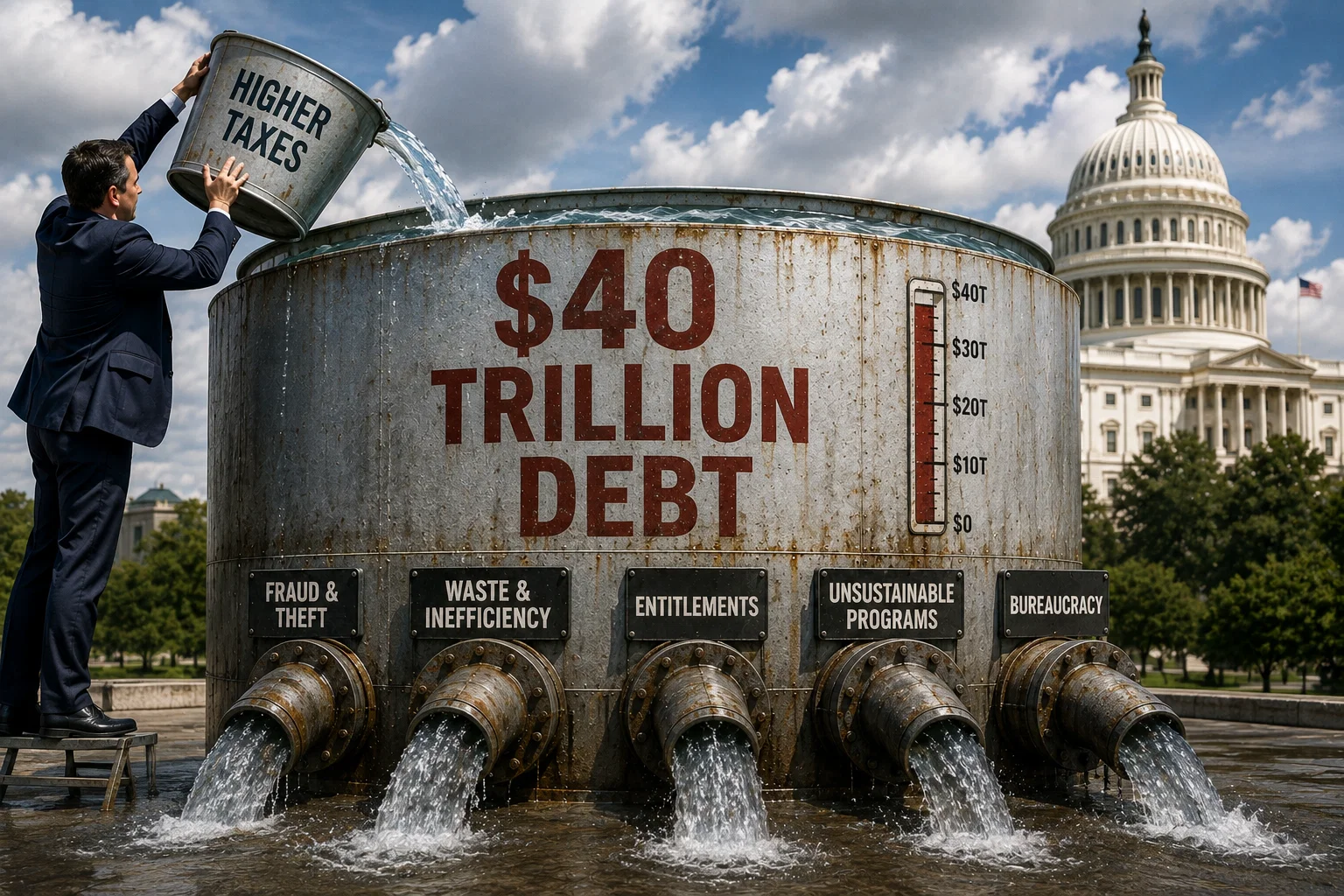
You probably heard that the US national debt just crossed $40 trillion yesterday. And on its current trajectory, there is no end in sight to the growth of that debt.
The federal government now routinely posts ~$2 trillion annual deficits... during periods of relative peace and prosperity.
Plenty of people (especially on the left) believe the answer is to tax the rich: sky-high marginal rates, wealth taxes, etc. But the historical data show that higher tax rates cannot and will not solve the problem.
According to IRS data, imposing a tax rate of 90% on people earning $2MM per year or more would theoretically generate $200 to $300 billion in additional tax revenue.
But remember human nature: people would very quickly change their behavior and restructure their affairs, and so the real additional tax revenue would collapse to less than $50 billion per year.
The same goes for a wealth tax. Charging billionaires and centimillionaires a percentage of their unrealized gains sounds like a nice idea to a socialist. But the consequences would offset most (if not all) of the additional revenue.
If Elon Musk were forced to sell 10% of his stock to pay a wealth tax, the share prices of Tesla and SpaceX would plummet.
Sure, the IRS would collect more money from Musk himself. But, nationwide, overall capital gains tax revenue would fall dramatically. So net tax revenue would barely budge.
The point is there are always consequences to raising taxes: less economic activity, slower growth, and higher unemployment. No country in history has ever taxed its way to prosperity.
What’s crazy is that an economy as large and dynamic as America's doesn't even need to run a balanced budget. Even a $1 trillion annual deficit would be OK— and a huge step in the right direction. The national debt would still grow, but as a percentage of GDP, it would shrink.
And it's not hard to get there. The low-hanging fruit is obvious: the Government Accountability Office, the federal government's own watchdog, estimates that hundreds of billions of dollars are lost to outright fraud and theft every single year.
Yet Congress doesn't seem to want to even try to eliminate obvious fraud.
And that's the easy stuff.
The harder part would be streamlining government operations and cutting waste and inefficiency... which could easily generate hundreds of billions in savings.
Harder still would be reforming entitlements, fixing immigration, and taking a chainsaw to the Code of Federal Regulations... all of which could trim spending and/or grow the economy (and hence increase tax revenue).
Again, the national debt is $40 trillion, yet Congress won't even do the easy stuff to fix it. Even worse, the media and the courts actively block and obstruct the people who do try.
We can hope that common sense will one day prevail, and that AI and nuclear power will supercharge the US economy to the point where America grows its way out of debt.
But in the meantime, there are now 40 trillion reasons to have a Plan B.
To your freedom, James Hickman Co-Founder, Schiff Sovereign LLC
The Treasury Just Admitted It... The Bond Market Is Broken: Peter Schiff
The Treasury Just Admitted It... The Bond Market Is Broken
Peter Schiff: 8-20-2026
Peter Schiff breaks down the Treasury's panic move to rescue the bond market, the $40 trillion debt milestone, and gold's $185 reversal day.
The Treasury just doubled its bond buybacks. Peter Schiff says that's the government admitting the bond market is broken.
On the same day the national debt topped $40 trillion, the Treasury announced it is doubling its long-term bond buybacks from $2 billion to $4 billion... buying the bonds everybody else is selling, and funding it by issuing more short-term debt.
The Treasury Just Admitted It... The Bond Market Is Broken
Peter Schiff: 8-20-2026
Peter Schiff breaks down the Treasury's panic move to rescue the bond market, the $40 trillion debt milestone, and gold's $185 reversal day.
The Treasury just doubled its bond buybacks. Peter Schiff says that's the government admitting the bond market is broken.
On the same day the national debt topped $40 trillion, the Treasury announced it is doubling its long-term bond buybacks from $2 billion to $4 billion... buying the bonds everybody else is selling, and funding it by issuing more short-term debt.
Peter calls it what it is: a panic move, a Hail Mary to suppress rising yields after the 30-year hit 5.3%, its highest in over 19 years. Refinancing debt locked in at a 3.44% average coupon with 4% T-bills makes no financial sense, which is exactly why it's happening... the government is scared, not stupid.
The market rendered its verdict immediately. Gold reversed off a $185 rally to close above $4,500, silver cleared $66, and the miners surged 8-12%, while hawkish FOMC minutes were shrugged off entirely.
Peter explains why this Treasury version of Operation Twist forces the Fed to follow with real QE... a program that will have to dwarf 2008's... why Bitcoin's pop above $70,000 is built on hope, and why the housing data shows the panic is justified.
Chapters:
00:00 Treasury Panic Move
01:05 Bond Yields Hit New Highs
02:58 Debt Explosion Politics
07:00 Treasury Buyback Twist
10:23 QE Next And Fed Cornered
16:04 Hawkish Minutes Gold Surge
24:03 Markets React Unevenly
24:20 Dollar Drops Oil Jumps
25:08 Fed Inflation Bind
26:30 Debt Era Comparison
27:40 Jobs Data Media Spin
29:17 Bitcoin Versus Metals
31:19 Housing Slump Mortgages
33:59 Tariffs Canada Trade
37:50 Buybacks Won't Work
42:26 QE Addiction Ahead
44:34 Boat Update Farewell
Ariel: This Needs to be Said on Record (and more)
Ariel: This Needs to be Said on Record
8-20-2026
When You Run Across Those Who Are Unsure (Show Them This)
You’re holding a piece of paper that was called worthless by the same international banking structure that called the Iraqi Dinar “speculative” and the Vietnamese Dong “non-investment-grade.” The same structure that told everyone their mortgages were secure in 2007. The same structure that said the petrodollar was eternal.
Ariel: This Needs to be Said on Record
8-20-2026
When You Run Across Those Who Are Unsure (Show Them This)
You’re holding a piece of paper that was called worthless by the same international banking structure that called the Iraqi Dinar “speculative” and the Vietnamese Dong “non-investment-grade.” The same structure that told everyone their mortgages were secure in 2007. The same structure that said the petrodollar was eternal.
The ZIM notes represent a sovereign debt instrument from a nation sitting on trillions in untapped mineral wealth that was demonetized at a suppressed conversion rate to keep the population economically immobilized while international extraction interests looted the resources.
The GCR doesn’t just “revalue a currency.” It recalculates the entire relationship between sovereign wealth and currency issuance and when it does, those ZIM notes become what they were always supposed to be: a claim against real, tangible, in-the-ground mineral wealth valued at current market prices instead of 2009’s suppressed figures.
Jlynn: What are your thoughts on the Agro Cheques?! I don’t see as much chatter on those.
I Do Not Know Why People Even Entertained These:
Many people keep asking about these. Personally I do not own none of them. And I will explain briefly below. Because it’s not even neccessary to own these particular notes.
Most Agro Cheque holders are sitting on instruments with questionable inclusion in the GCR settlement window.
The legal framework that preserved the currency notes’ claim on mineral reserves does not automatically extend to bearer checks issued under an agricultural financing rubric.
If the settlement architecture treats them as a separate instrument class which the structural evidence suggests it does they would either redeem at a separate, lower tier or be excluded from the primary window entirely.
So they are really a toss-up. You can bring them if you want. But not sure why people bought them.
Because Agro Cheques circulated at the same denominations as the currency notes billions, trillions and because some dealers sold them interchangeably without explaining the distinction.
Holders bought them assuming parity with the currency notes. That assumption may not survive the redemption window.
Source(s):
• https://x.com/Prolotario1/status/2090198279162134552
• https://x.com/Prolotario1/status/2090262480983306355
https://dinarchronicles.com/2026/08/20/prolotario-this-needs-to-be-said-on-record/
Ariel: The Overall Hoopla and Doopla of the Zim-Zam-Sham
8-20-2026
The Overall Hoopla & Doopla Of The Zim-Zam-Sham (Peer 2 Peer)
[Financial Reset Briefing Room — Classified Channel — August 19, 2026 — 18:52 EST]
You Are Going To Love This Upload
[Contents]:
• The Zimbabwe Sovereign Debt Instrument: A Reclamation Dossier
• Part Two — The Charlatan Parade: A Roll Call
• The Dinar Pump-and-Dumpers
• The YouTube Prophets
• The Dismissal Artists
• Part 3 — The Honest Voices: Who Got It Right
• The Structured Settlement Community
• The Sovereign Wealth Analysts
• Part 4 — The Mineral Math
• Total Conservative Sovereign Mineral Wealth Estimate: $4.5–8 trillion.
• Part 5 — The Petrodollar Context
• Part 6 — What The Gurus Never Told You
The institutions telling you those ZIM notes are worthless are the same ones who rated subprime mortgage-backed securities as AAA investment grade six months before they vaporized the global economy. Moody’s. Standard & Poor’s. Fitch.
These three rating agencies the Holy Trinity of Financial Fraud stamped their seals of approval on trillions of dollars of garbage collateralized debt obligations that were, in reality, packages of defaulted loans wrapped in math so deliberately opaque that the people selling them didn’t understand what was inside.
Now. The currency that was demonetized in 2009 was issued against this wealth. The 2008-2009 Series AA and AB trillion-dollar notes the ones in your possession are denominated instruments tied to a sovereign balance sheet that includes the above mineral inventory.
They were “demonetized” at a conversion rate so suppressed that it essentially transferred the sovereign claim to international interests at pennies on the dollar.
The GCR recalculates this. It revalues the sovereign balance sheet at current market pricing. And when it does, the notes the bonds that were issued against that balance sheet become claims against the *recalculated* wealth, not the 2009 suppressed figure.
This is not magic. This is accounting. B****l, geopolitical, structurally enforced accounting that has been suppressed for two decades by the same system that told you mortgage-backed securities were safe.
Read Full Article:
https://www.patreon.com/Prolotario1/posts/overall-hoopla-2-167148163
https://dinarchronicles.com/2026/08/20/prolotario-the-overall-hoopla-and-doopla-of-the-zim-zam-sham/
Iraq Economic News and Points To Ponder Thursday Afternoon 8-20-26
Oil Prices Hover Near Peak During Hormuz Impasse
2026-08-20 Shafaq News Oil prices steadied in early trade on Thursday as investors assessed the outlook for the U.S.-Iran war and the security of shipping through the Strait of Hormuz.
Brent crude futures for October delivery rose 25 cents, or 0.3%, to $91.87 a barrel by 0037 GMT, while U.S. West Texas Intermediate crude futures for September slipped 2 cents to $85.81 a barrel. The more active October WTI contract gained 14 cents, or 0.2%, to $84.53.
Oil Prices Hover Near Peak During Hormuz Impasse
2026-08-20 Shafaq News Oil prices steadied in early trade on Thursday as investors assessed the outlook for the U.S.-Iran war and the security of shipping through the Strait of Hormuz.
Brent crude futures for October delivery rose 25 cents, or 0.3%, to $91.87 a barrel by 0037 GMT, while U.S. West Texas Intermediate crude futures for September slipped 2 cents to $85.81 a barrel. The more active October WTI contract gained 14 cents, or 0.2%, to $84.53.
Both Brent and WTI benchmarks gained for a fourth straight session on Wednesday, settling at their highest since July 24. The September WTI contract expires later on Thursday.
"Oil prices remained elevated as the market is supported by sporadic attacks in the Middle East but lacks fresh momentum without a major escalation," said Hiroyuki Kikukawa, chief strategist of Nissan Securities Investment, a unit of Nissan Securities.
"The market is likely to maintain a gradual upward trend given uncertainty over peace talks and tensions involving the United Arab Emirates, Oman and Iran," he added.
The UAE's decision to suspend all financial and economic transactions with Iran until further notice has refocused the spotlight on fraught ties between the major Gulf Arab oil producer and Iran.
On Tuesday, U.S. President Donald Trump said no talks were taking place with Iran and that the Strait of Hormuz was open. Iran, however, said the waterway remained shut.
Shipping through the Strait of Hormuz slowed, data showed on Wednesday, as most shipowners avoided the key waterway because of a lack of clear signalling on its reopening from a blockade put in place during the Iran war.
In the U.S., crude and gasoline inventories rose and distillate stockpiles fell last week, the Energy Information Administration said on Wednesday. Crude inventories rose by 4.4 million barrels in the week ended on August 14, compared with estimates for a 600,000-barrel draw.(Reuters)
https://www.shafaq.com/en/Economy/Oil-prices-hover-near-peak-during-Hormuz-impasse
Basrah Crude Grades Gain Over 18%
2026-08-20 Shafaq News- Baghdad Iraq's two Basrah export grades climbed more than $12 on Thursday, outpacing modest gains in global benchmarks.
Basrah Heavy settled at $77.43 a barrel, up $12.39, or 19.05%. Basrah Medium rose to $80.73 a barrel, gaining $12.39, or 18.13%.
The moves ran well ahead of the day's global benchmarks. Brent crude edged up 0.3% to $91.87 a barrel, while West Texas Intermediate (WTI) slipped 2 cents to $85.81.
In Arab markets, Saudi Arab Light was priced at $85.44 a barrel, up 35 cents, or 0.41%. Kuwait Export Blend rose $2.42, or 2.92%, to $85.23 a barrel. In the UAE, Murban crude was priced at $99.40 a barrel, up $1.65, or 1.69%, while Qatar Land crude stood at $94.32 a barrel. https://www.shafaq.com/en/Economy/Basrah-crude-grades-gain-over-18
Dollar Falls Against Dinar In Baghdad And Erbil
2026-08-20 Shafaq News- Baghdad/ Erbil The US dollar fell against the Iraqi dinar on Wednesday, hovering around 154,000 dinars per $100 in Baghdad and Erbil, the capital of the Kurdistan Region.
At the Al-Kifah and Al-Harithiya exchanges in Baghdad, the dollar traded at 154,150 dinars per $100, down from 154,600 dinars on Wednesday, according to a Shafaq News market survey.
In Baghdad's local exchange shops, the selling price reached 154,500 dinars per $100, while the buying price stood at 153,500 dinars.
Rates eased in Erbil as well, where the dollar sold at 154,100 dinars per $100 and was bought at 154,000 dinars.
https://www.shafaq.com/en/Economy/Dollar-falls-against-dinar-in-Baghdad-and-Erbil
Iran's Central Bank Says Iraq Banking Barriers Removed
2026-08-20 Shafaq News- Tehran Obstacles to banking transactions between Iran and Iraq have been removed, and Tehran expects to access funds held in Iraq within weeks, Iran's central bank governor said in remarks carried by Iran's Mehr news agency.
Abdolnaser Hemmati, Governor of the Central Bank of Iran, said the groundwork had been laid for Iran to draw on those resources following recent talks with Iraqi officials.
A central outcome of his recent visit to Baghdad, Hemmati said, was an agreement by Iraqi Prime Minister Ali al-Zaidi to issue guarantees to Iranian contractors backed by Iranian assets held in Iraqi banks, with executive orders issued to that end.
Iran holds an estimated $10-11 billion in funds and energy receivables in Iraq, mainly payments for gas and electricity that Baghdad deposits into restricted accounts because US sanctions limit dollar and euro transfers to Iranian institutions.
Hemmati added that the implementation of the Iran-US asset-release memorandum depends on approval from Iran's leadership, and that the government and the Supreme National Security Council, Iran's top security body, insist economic decisions rest on national interest and require that approval.
Iraq depends on Iranian gas and electricity and pays for them into restricted accounts under US sanctions rules, leaving Tehran unable to move much of the money. A separate memorandum between Iran and the United States on unfreezing Iranian assets has not led to any funds being released.
Hemmati said that asset-release memorandum, though drawn up to serve Iran's interests, remains on hold pending a decision from the country's leadership.
Read more: $24 billion frozen asset dispute blocks final US-Iran agreement
https://www.shafaq.com/en/Economy/Iran-s-Central-Bank-says-Iraq-banking-barriers-removed
Gold Prices Rise In Baghdad And Erbil
2026-08-20 Shafaq News- Baghdad/ Erbil On Thursday, gold prices hovered around 980,000 IQD per mithqal in Baghdad and Erbil markets, according to a Shafaq News market survey.
Gold prices on Baghdad's Al-Nahr Street recorded a selling price of 980,000 IQD per mithqal (equivalent to five grams) for 21-carat gold, including Gulf, Turkish, and European varieties, with a buying price of 976,000 IQD. The same gold sold for 955,000 IQD on Wednesday.
The selling price for 21-carat Iraqi gold stood at 950,000 IQD, while the buying price reached 946,000 IQD.
In jewelry stores, the selling price per mithqal of 21-carat Gulf gold ranged between 980,000 and 990,000 IQD, while Iraqi gold sold for between 930,000 and 940,000 IQD.
In Erbil, 22-carat gold was sold at 1,100,000 IQD per mithqal, 21-carat gold at 940,000 IQD, and 18-carat gold at 827,000 IQD. https://www.shafaq.com/en/Economy/Gold-prices-rise-in-Baghdad-and-Erbil-4-1-6
Nine Oil Tankers Await Loading At Basra Port
2026-08-20 Shafaq News- Basra Nine oil tankers are docked at Iraq's Basra port waiting to load crude, one of the largest concentrations of tankers at the southern oil terminals since February, a source in the ports authority told Shafaq News on Thursday.
Five of the vessels are berthed at the Basra oil terminal for loading, while the remaining four are waiting their turn.
Basra, in southern Iraq, is the country's principal outlet for crude exports, handling most shipments through its terminals on the Gulf.
Iraq, OPEC’s second-largest producer, exports about 95% of its crude through southern terminals.
Read more: No exit but Hormuz: Iraq's economic vulnerability exposed
https://www.shafaq.com/en/Economy/Nine-oil-tankers-await-loading-at-Basra-port
Seeds of Wisdom RV and Economics Updates Thursday Afternoon 8-20-26
Good Afternoon Dinar Recaps,
Treasury Intervention Loses Its Grip as Oil, Debt and Bond Yields Reignite Global Market Pressure
The Treasury's effort to calm the long-term bond market provided only temporary relief. As yields climb again, oil approaches $94 and U.S. debt surpasses $40 trillion, investors are confronting a more difficult question: can policy intervention overcome the underlying forces driving the global repricing of risk?
Good Afternoon Dinar Recaps,
Treasury Intervention Loses Its Grip as Oil, Debt and Bond Yields Reignite Global Market Pressure
The Treasury's effort to calm the long-term bond market provided only temporary relief. As yields climb again, oil approaches $94 and U.S. debt surpasses $40 trillion, investors are confronting a more difficult question: can policy intervention overcome the underlying forces driving the global repricing of risk?
Overview
The Treasury's bond-market intervention has lost some of its initial effect, with the 30-year Treasury yield climbing back toward 5.25% after briefly falling following the announcement.
U.S. national debt has surpassed $40 trillion, adding another dimension to investor concerns about the long-term cost of financing government spending.
Oil has surged toward $94 a barrel amid continuing U.S.-Iran tensions, adding inflation pressure at exactly the time markets are already worried about government debt and Federal Reserve policy.
Key Developments
1. The bond market is pushing back
The Treasury's decision to increase long-term bond buybacks initially brought relief to investors.
That relief has not lasted.
The 30-year Treasury yield climbed back to approximately 5.25%, while the 10-year yield moved back toward 4.71%. The reversal suggests investors remain concerned that Treasury intervention alone cannot solve the forces pushing long-term borrowing costs higher.
The significance goes beyond Treasury bonds.
Long-term government yields are used as a benchmark for mortgages, corporate borrowing, real estate and equity valuations across the financial system.
When those yields rise, financial conditions tighten throughout the economy.
2. The $40 trillion debt milestone changes the backdrop
The United States has now crossed $40 trillion in national debt.
That milestone arrives at an especially sensitive moment.
Investors are already demanding higher yields to hold longer-term government debt, while the government continues to require enormous amounts of financing.
Reuters reports that the current pressure is not limited to the United States. Long-term borrowing costs have been rising across major economies, including Japan and Germany, as governments face increased borrowing needs from defense spending, aging populations and the costs of recent crises.
This makes today's story much larger than a U.S. Treasury problem.
The world's major governments are simultaneously competing for capital.
3. Oil is adding a second inflation shock
Brent crude has climbed to approximately 93–94 per barrel, with continuing disruption and uncertainty surrounding the Strait of Hormuz and the U.S.-Iran conflict adding to supply concerns.
That creates a difficult combination for central banks.
Higher oil → higher inflation pressure
while
Higher bond yields → tighter financial conditions.
Central banks therefore face an increasingly uncomfortable choice between fighting inflation and protecting economic growth.
Why It Matters
The important development this afternoon is that the market is testing the limits of government intervention.
Treasury Secretary Scott Bessent's expanded buyback program demonstrated that Washington has tools available to respond when long-term yields become disruptive.
But the subsequent rebound in yields suggests that investors are still focused on the underlying fundamentals.
The problem isn't simply liquidity.
It is the combination of:
Massive government borrowing + persistent deficits + inflation risk + higher energy prices + elevated global borrowing needs.
A Treasury buyback can improve market functioning.
It cannot by itself eliminate those structural pressures.
The Bigger Global Financial Reset Story
This is where today's afternoon development becomes especially important.
Yesterday, the story was:
The bond market is repricing sovereign debt.
This morning, the story became:
Treasury is attempting to stabilize the long end of the market.
This afternoon, we have the next stage:
The bond market is pushing back.
That progression is significant.
It suggests that the global financial system may be entering a period in which governments and central banks have less ability to control financial conditions simply through policy announcements.
Markets ultimately have to absorb the debt.
And investors ultimately decide what yield they require to hold it.
Why This Matters to Foreign Currency Holders
The interaction between Treasury yields, the dollar and commodities is becoming increasingly important.
Earlier this week, the dollar weakened sharply even as investors were focused on elevated U.S. yields. Today, the dollar has recovered somewhat, but the broader question remains: will higher U.S. yields continue to translate into stronger demand for dollars?
That relationship is no longer as straightforward as it once was.
Foreign-currency holders should therefore watch not only central-bank interest-rate decisions but also:
U.S.Treasury demand
Long-term bond yields
Government debt levels
Oil and commodity prices
Inflation expectations
Foreign demand for U.S. assets
Central-bank reserve diversification
These forces increasingly interact with one another.
Implications for the Global Financial Reset
1. Sovereign debt is becoming the central pressure point.
The $40 trillion U.S. debt milestone arrives as investors are demanding higher returns for long-term government bonds.
That raises the cost of financing future deficits and creates a feedback loop between debt, interest expense and new borrowing.
2. Policy intervention may increasingly be used to manage market stress.
The Treasury's decision to expand buybacks demonstrates that Washington is prepared to become more active when long-term borrowing costs rise sharply.
The larger question is whether these measures can remain effective if investors continue demanding higher compensation for fiscal and inflation risks.
3. Energy is becoming part of the debt-and-currency equation.
Oil approaching $94 adds another layer of complexity.
Higher energy prices can increase inflation, which can keep interest rates higher for longer, which can increase government borrowing costs.
That creates a potentially powerful chain:
Iran conflict → oil → inflation → interest rates → Treasury yields → debt costs → currencies.
That is precisely why the Iran conflict is no longer only a geopolitical story.
It has become a global financial story.
What to Watch Next
The next several developments could be especially important:
Whether the 30-year Treasury yield moves back toward or above the recent 5.34% high.
Whether Brent crude remains above $90 or approaches $100.
Whether the Treasury announces additional measures to influence long-term borrowing conditions.
Whether the dollar resumes its recent decline.
How the Federal Reserve responds if oil-driven inflation begins appearing in economic data.
Whether foreign investors continue accepting current Treasury yields or demand still higher compensation.
Bottom Line
The Treasury stepped in to calm the bond market — and the bond market is now testing that intervention.
At the same time, U.S. debt has crossed $40 trillion and oil is approaching $94, creating a combination of fiscal and inflationary pressure that policymakers cannot easily solve with a single tool.
This is becoming more than a story about Treasury yields.
It is a story about whether the world's largest financial system can maintain stable borrowing costs while debt, energy prices and geopolitical risk are all moving higher at the same time.
Seeds of Wisdom Team
Newshounds News™ Exclusive
Sources
Reuters — US Treasury buyback briefly eases bond rout, but debt worries persist
Associated Press — The bond market swings back to worries and helps knock U.S. stocks lower
~~~~~~~~~~
Seeds of Wisdom Team RV Currency Facts Youtube and Rumble
Newshound's News Telegram Room Link
RV Facts with Proof Links Link
RV Updates Proof links - Facts Link
Start Here room with Most Asked Questions Link
Follow the Gold/Silver Rate COMEX
Follow Fast Facts
Seeds of Wisdom Team™Website
Thank you Dinar Recaps
Coffee with MarkZ, joined by Dr. Scott Young. 08/20/2026
Coffee with MarkZ, joined by Dr. Scott Young. 08/20/2026
MarkZ Disclaimer: Please consider everything on this call as my opinion. Be sure to consult a professional for any financial decisions
MZ: Dr. Scott Young returns to the show today. Progress, Economic D-day, and Debt
MZ: The bond side is still a wall of quiet.
Coffee with MarkZ, joined by Dr. Scott Young. 08/20/2026
MarkZ Disclaimer: Please consider everything on this call as my opinion. Be sure to consult a professional for any financial decisions
MZ: Dr. Scott Young returns to the show today. Progress, Economic D-day, and Debt
MZ: The bond side is still a wall of quiet.
THE CONTENT IN THIS PODCAST IS FOR GENERAL & EDUCATIONAL PURPOSES ONLY&NOT INTENDED TO PROVIDE ANY PROFESSIONAL, FINANCIAL OR LEGAL ADVICE. PLEASE CONSIDER EVERYTHING DISCUSSED IN MARKZ’S OPINION ONLY
https://rumble.com/user/theoriginalmarkz
Kick: https://kick.com/theoriginalmarkz
Markz's linktree https://linktr.ee/theMarkZshow
FOLLOW MARKZ : TWITTER . https://twitter.com/originalmarkz?s=21. TRUTH SOCIAL . https://truthsocial.com/@theoriginalm...
Mod: MarkZ "Back To Basics" Pre-Recorded Call" for Newbies 10-19-2022 )https://www.youtube.com/watch?v=37oILmAlptM
MARKZ DAILY LINKS: https://theoriginalmarkz.com/home/
THANK YOU FOR JOINING. HAVE A BLESSED DAY. SEE YOU IN THE MORNING FOR COFFEE @ 10:00 AM EST ~ UNLESS BREAKING NEWS HAPPENS! FOR UPDATES ON MARK’S PODCAST GO TO: https://t.me/+b3hYhYlhKM1hYzcx
Thursday Iraq News Posted by Tishwash at TNT 8-20-2026
TNT:
Tishwash: Removing zeros: A currency restructuring or a step to boost confidence in the dinar?
The issue of removing zeros from the Iraqi currency has resurfaced, amid economic debate about the feasibility of this step and its implications for the value of the dinar and the purchasing power of the citizen, as well as the readiness of the banking and financial sectors to implement it.
Economic experts believe that removing zeros, if implemented within a comprehensive study and a clear plan, could contribute to restructuring the currency and simplifying financial and banking transactions, while emphasizing that the measure itself does not mean an increase or decrease in the purchasing power of the dinar, as long as prices, salaries and savings are transformed at the same rate.
TNT:
Tishwash: Removing zeros: A currency restructuring or a step to boost confidence in the dinar?
The issue of removing zeros from the Iraqi currency has resurfaced, amid economic debate about the feasibility of this step and its implications for the value of the dinar and the purchasing power of the citizen, as well as the readiness of the banking and financial sectors to implement it.
Economic experts believe that removing zeros, if implemented within a comprehensive study and a clear plan, could contribute to restructuring the currency and simplifying financial and banking transactions, while emphasizing that the measure itself does not mean an increase or decrease in the purchasing power of the dinar, as long as prices, salaries and savings are transformed at the same rate.
Strengthening the value of the dinar
Economic expert Haider Al-Sheikh told Al-Sabah newspaper: “Changing the Iraqi currency and removing zeros will enhance the value of the Iraqi dinar against foreign currencies,” explaining that “changing the currency will contribute to reviving the economy and providing cash liquidity to the government.”
The sheikh explained that the currency change process, according to the study, requires several months to print specific denominations in batches, in preparation for replacing them with the current currency. He pointed out that this process could contribute to strengthening the balances of government and private banks in Iraqi dinars and providing liquidity.
The necessary cash.
He added that another benefit of the process is “knowing the amount of currency held by the government and banks, as well as knowing the volume of currency circulating in the market.”
The sheikh pointed out that Iraq, after 2003, printed more than 100 trillion dinars, indicating that about 70 percent of the printed cash is outside the government's control and stored in homes. And it is traded on the market.
Renaming the monetary unit
For his part, economist Mustafa Faraj said that "removing zeros from the Iraqi currency, if implemented according to a comprehensive study and plan, represents a positive step towards restructuring the currency and simplifying financial and banking transactions," stressing that "the process itself does not necessarily mean an increase or decrease in value."
The purchasing power of the dinar.
Faraj explained that removing three zeros, for example, means changing prices, salaries, and balances by the same percentage, and therefore the citizen's purchasing power does not change as a result of the removal alone.
He added that the main economic benefit is “reducing the volume of circulating figures, facilitating accounting and banking operations, supporting electronic payment systems, and making dealing in dinars more efficient and transparent,” stressing that the success of the step is linked to monetary stability, price control, and broad public awareness.
He explained that removing zeros could be part of a “broader monetary and banking reform package that enhances confidence in the dinar and supports economic stability.”
It is not a single, formal procedure.
Risks of the conversion phase
In contrast, economic researcher Ahmed Eid warned that the most prominent risks that may accompany the removal of zeros are not related to the accounting removal process itself, but rather to the conversion phase and what may accompany it in terms of confusion in the markets and exploitation by some traders, especially in rounding prices upwards.
He explained that goods with small prices may be more likely to increase when converted to the new monetary unit, which, if this is repeated on a large scale, may lead to citizens feeling an actual increase in the cost of living, even though the process of removing zeros is theoretically supposed not to change purchasing power.
Eid pointed to other risks, including the weak financial literacy of some citizens, particularly with regard to converting cash savings, pricing goods and services, contracts and debts, as well as the possibility of speculation and rumors spreading about the value of the dinar.
He stressed that these risks become greater if the operation is carried out during an economic period suffering from financial pressures and problems related to liquidity and confidence.
Dual pricing and oversight
To protect the purchasing power of citizens, Eid called for the adoption of a sufficient transitional period preceding and accompanying the change process, during which dual pricing in the old and new dinars would be adopted, and precise rules would be put in place to prevent arbitrary rounding of prices, in addition to tightening control over markets and implementing a broad awareness campaign.
He stressed the need for the central bank to ensure that all bank accounts, savings, debts, salaries and contracts are converted in the same proportion, with the new currency being made available in an organized manner, and a period of simultaneous circulation of the two currencies being maintained.
He stressed that “the most important thing is that the removal of zeros should be preceded by real financial and monetary stability,” explaining that protecting purchasing power is not achieved by changing the form of the currency, but rather by controlling inflation, stabilizing the exchange rate and addressing financial and economic imbalances. link
************
Tishwash: National Security Advisor to Qalibaf: The government is proceeding with restricting weapons to the state.
Baghdad/Al-Masalla: National Security Advisor Qasim Al-Aboudi confirmed on Thursday to Iranian Parliament Speaker Mohammad Baqer Qalibaf that the Iraqi constitution does not allow the existence of armed groups that threaten the security of other countries, while indicating that the government is proceeding with restricting weapons to the state.
The media office of the National Security Advisor stated in a statement received by Al-Masalla Agency that “National Security Advisor Qasim Al-Aboudi met with the Speaker of the Iranian Shura Council, Mohammad Baqer Qalibaf, who is currently visiting Iraq,” indicating that “the meeting discussed the latest developments in the region and ways to strengthen relations between Iraq and the Islamic Republic of Iran, in a manner that serves the interests of the two countries and the two friendly peoples.”
He added that “the meeting also included discussions on security agreements between Iraq and the Islamic Republic of Iran.”
Al-Aboudi stressed that “Iraq is committed to the joint security agreement between the two countries,” noting that “the relationship between the two friendly countries is a historical and close one, and the two peoples are bound by close ties.”
He added that “Iraq’s stability is in the interest of the region’s stability,” noting that “Prime Minister Ali Faleh al-Zubaidi’s government emphasizes strengthening relations with neighboring countries in particular and countries of the world in general, and this is in the country’s interest.”
He stated that “the Iraqi constitution does not allow the existence of armed groups that threaten the security of other countries,” explaining that “the government is proceeding with restricting weapons to the hands of the state.”
For his part, Qalibaf affirmed that “the Islamic Republic of Iran cherishes its relations with Iraq and supports the government program regarding the establishment of a legal framework that regulates weapons under the command of the Commander-in-Chief of the Armed Forces,” explaining that “his country is committed to the security agreements concluded between the two countries link
Tishwash: The Cabinet approves a new mechanism for pricing crude oil.
In a move aimed at restructuring the economic portfolio and enhancing export and import capacities, the government took a series of sovereign decisions during the fifteenth regular session of the Council of Ministers, which was held on Tuesday evening under the chairmanship of Council Chairman Ali Faleh Al-Zaidi, which included the oil, finance, electricity, infrastructure, and international relations sectors.
As part of the government's procedures to increase export and import capacities, the recommendation regarding the purchase of crude oil was approved, based on the price of the State Oil Marketing Company (SOMO) or the price set in the general budget, whichever is lower, with a discount of (30%), to be determined annually, starting from (September 1, 2026), and paid to the public treasury, provided that its financial effects are reviewed in detail, with the implementation of the aforementioned study being based on lifting subsidies on the prices of petroleum products for all sectors, with the exception of the main products supplied exclusively to citizens (gasoline, gas oil, kerosene, and liquefied gas) from (September 1, 2026), and that any subsidy granted to any sector reduces the share of the public treasury, and the proposed mechanism is presented to the Federal Board of Financial Control for the purpose of adopting the amended accounting policy to avoid future audit observations.
In the oil sector as well, the Council voted to approve the mechanisms for exporting Iraqi oil through specialized international and local companies, and through different outlets, provided that the contracts are for a period of (3) working months starting from the date of (September 1, 2026).
The recommendation regarding exceptional approvals to increase export and import capacities was also approved, authorizing the Minister of Oil to establish additional transport routes for existing and current contracts, and to renew those contracts. The Minister was also authorized to approve the import of petroleum products when needed to ensure a stable supply and prevent crises, provided that the Oil Pipelines Company completes the expansion of loading platforms. Furthermore, approval was granted to commence work prior to contract signing for the rehabilitation of the IT2A station and a supporting unloading station for the IT1 station, with a capacity of 300,000 barrels per day. This will ensure the rapid delivery of imported raw materials without compromising the principles of competition and transparency.
As part of the procedures for regulating oil sales mechanisms, the Council approved the recommendation related to the mechanisms for advance payment of the prices of Iraqi oil sales, and the methods for companies purchasing the value of shipments to deposit, and advance payments into the relevant accounts belonging to the Ministry of Finance and the Central Bank of Iraq.
The council approved the continued payment of dues to Basra Gas Company for the value of its products delivered to South Gas Company, as it is a self-financing company.
The Council approved the Ministry of Oil's donation of (5) billion dinars to the Ministry of Health, allocated for the purchase of medicines, medical supplies, and laboratory equipment. In the electricity sector, the recommendation of the Central Review and Approval Committee for Referrals at the Ministry of Electricity was approved, regarding the adoption of Request for Proposals (RFPs) in the electricity distribution sector.
To enhance the procedures for collecting fees and taxes, the Council approved the adoption of the principle of pre-payment of customs duties and estimated tax deposits for imported goods, starting from (October 1, 2026), and the importer depositing the amounts of foreign transfer for import purposes with the authorized banks, and not transferring the amounts except after the importer pays the amounts of customs duties and estimated tax deposits through the (ASYCUDA) system, and the approved electronic payment mechanisms, and transferring them to the accounts of the public treasury and the competent accounts in the Ministry of Finance, within (15) days, and that the calculation of the amounts of customs duties and estimated tax deposits be based on the initial data provided by the importer, including the commercial invoice and shipping documents, or import, customs classification, type of goods, origin and value according to the approved customs tariff schedules.
As part of the government's efforts toward administrative and financial reform, the Council voted to amend the instructions regulating write-off procedures and accounting treatments. This amendment requires all government entities to submit records of debt and asset write-offs to the Federal Board of Supreme Audit for review before the authorized body makes a write-off decision.
The Ministry of Finance was also tasked with amending Instruction No. 1 of 2022, which regulates write-off procedures and accounting treatments, to ensure compliance with these amendments. Furthermore, the Cabinet approved the Ministry of Transport/Air Navigation Company's allocation of 15 billion dinars to the Ministry of Finance for border crossings, specifically for developing the infrastructure at the Rabia, Al-Walid, and Safwan border crossings.
The Council approved the recommendation to suspend the implementation of Cabinet Resolution (963 of 2025) until the end of (2026), provided that the local market is monitored during the suspension period.
The council also voted to approve the extension of the Independent High Electoral Commission’s occupancy of school buildings until (December 31, 2027), provided that the commission submits a plan that includes time limits for vacating the occupied classrooms and school buildings in stages.
As part of the government’s measures to strengthen international relations, the Minister of Trade, or whomever he authorizes, was given the power to negotiate and sign the draft agreement for economic, trade, scientific, cultural, artistic and sports cooperation between Iraq and the Republics of Nigeria and Zambia. link
************
Tishwash: State economic integration
The government of Prime Minister Ali Faleh al-Zaidi is adopting a program for financial reform and rationalizing spending in parallel with diversifying sources of revenue and reducing dependence on oil. The Ministry of Public Finance is facing pressure in providing the necessary liquidity to cover public expenditures, with a public spending volume of about 7 trillion and 800 billion dinars, which is not an exaggeration in relation to the size of the wealth of the Iraqi economy, and it would not have affected the size of liquidity or the money supply were it not for the systematic and organized corruption that has been dividing the state’s revenues for years into more than half.
The security operations conducted by the government to pursue corrupt individuals have revealed the enormous sums of money seized from those arrested, while investigations into other suspects continue. Beyond the issue of corruption itself, efforts to increase state resources necessitate measures and laws that do not harm citizens by imposing additional financial burdens that could overburden them due to flawed past economic policies.
Among the possible solutions for the state is to start collecting taxes owed by foreign and local companies and to expand electronic automation in government institutions to reduce financial waste, prevent duplication of work, and collect fees in a legal and proper manner, not by sharing them with other investors as happens in the matter of electricity privatization in some residential areas. In addition, there is the need to audit outstanding advances and loans and recover them from companies and individuals, and to work on reviewing collection contracts in state institutions to determine the size of the revenues that these institutions receive compared to the investor's share.
Some contracts have the investor's share reaching 75 percent of the revenues compared to 25 percent for the state, without knowing the details of the level of service provided by the investor and whether it actually warrants this percentage or is just corruption that drains the state's resources.
Another issue is the need to pay attention to the multiplicity of legislation and decisions that conflict with the investment law and confuse the investment environment instead of benefiting from its financial returns. Perhaps the question that arises regarding the reality of the economy in Iraq is, where do the solutions lie? Is it in institutional reform and combating corruption in a real and unambiguous way, or in controlling the state’s revenues in all their forms, whether local or foreign, in a centralized manner that is not subject to any political interference, or both together?
The strength of the economy lies in coordinating the work of the security, economic and political system with an integrated structure in which politics ensures the success of the other systems that run the life of the citizen.
When there are gaps that work to prevent the integration of these systems with each other with the aim of enriching themselves at the expense of public money, it is not possible to talk about any reform or economic development in the country, because public money will remain permissible under the names of projects and illusions of economic returns, and thus remain in the cycle of our only source of income, oil and nothing else. link
News, Rumors and Opinions Thursday 8-20-2026
Note: All intel should be considered as "Rumors" until we receive official announcements ...and “Rates and Dates” could change anytime until we get to the banks/redemption centers.
RV Excerpts from the Restored Republic via a GCR Update as of Thurs. 20 Aug. 2026
Compiled Thurs. 20 Aug. 2026 12:01 am EST by Judy Byington
CONFIRMED INTEL: The Tier 4B protocol is now in use. What was once laughed at as rumor and fantasy is now being carried out in a controlled way. …JFK Jr. Command Center on Telegram Wed. 19 Aug. 2026
Iraq, Vietnam, and Zimbabwe are quietly leading a change in the economy that is happening outside of public markets. This change is happening because of structure, security, and silence. It is no longer just a guess that the IQD, VND, and ZIM will be worth more. It is a fact of life.
Note: All intel should be considered as "Rumors" until we receive official announcements ...and “Rates and Dates” could change anytime until we get to the banks/redemption centers.
RV Excerpts from the Restored Republic via a GCR Update as of Thurs. 20 Aug. 2026
Compiled Thurs. 20 Aug. 2026 12:01 am EST by Judy Byington
CONFIRMED INTEL: The Tier 4B protocol is now in use. What was once laughed at as rumor and fantasy is now being carried out in a controlled way. …JFK Jr. Command Center on Telegram Wed. 19 Aug. 2026
Iraq, Vietnam, and Zimbabwe are quietly leading a change in the economy that is happening outside of public markets. This change is happening because of structure, security, and silence. It is no longer just a guess that the IQD, VND, and ZIM will be worth more. It is a fact of life.
For years, people who owned these currencies were made fun of, but institutions quietly got ready behind closed doors. Now, what started as rumors have (allegedly) become real bank appointments, tiered access structures, and private exchange processes that run through U.S. banking channels. The Global Currency Reset is now in the execution phase, and Tier 4B is where the public finally comes into contact with it.
This is not a public Forex event. It is (allegedly) a controlled, secret restructuring that follows a strict tiered framework. Tier 1 includes central banks and governments that are independent. Tier 2 includes multinational companies and top-tier financial trusts. Tier 3 includes wealthy people and businesses that have already agreed on contracts. Tier 4B is where private citizens who have legally gotten their money are turned on. This is the door for those who waited and stayed quiet, and Tier 4B is now (allegedly) open.
The biggest banks in the U.S. have already moved. In a quiet way. Only by appointment. Private exchange centers are (allegedly) up and running, using better security, identity checks, proof-of-purchase checks, NDAs, and wealth structuring after the exchange. This isn’t a theory, and it’s not for the public. It is controlled execution in the dark.
There is one simple rule for Tier 4B: no walk-ins, no leaks, and no show. People who want to join are checked out. There are limits on devices. There are records of consultations. You must use discretion. This is not a public rollout; it is a monitored operation meant to keep the market from being shocked and the system from being disrupted.
The exchange rates for IQD and VND are already showing up in internal banking systems at levels that the public can’t see. Public forex platforms are behind because they are not on this track. Tier 4B works on its own and is already (allegedly) moving money.
This reset starts with Iraq. The sanctions that kept the dinar down for decades are no longer in place. Digital banking systems that follow international standards are up and running. The UN and US oversight has officially ended, giving back full sovereignty. Internal anti-corruption operations have gotten back stolen property and turned it into revaluation leverage. Iraq is no longer limited. It is turned on.
Vietnam and Zimbabwe are next, with resource-backed frameworks already in place. Gold-backed structures and project-based valuation models are coming together for a phased integration that will last until 2025 and into 2026.
The rollout is planned. The first round of internal testing is over. First, high-volume holders are given priority, then mid-tier participants, and finally, more people will be able to access the service in the coming weeks. Every step needs identification, proof, compliance with the NDA, and complete secrecy.
This isn’t a lot of talk. It is the end of a long-planned restructuring of the money system. The reset didn’t come with a lot of noise. It got there on time.
Tier 4B is up and running. The quietness is on purpose. The system is moving.
~~~~~~~~~~
Global Currency Reset:
Tues. 18 Aug. 2026 Bruce, The Big CallThe Big Call Universe (ibize.com) 667-770-1866: A Redemption Center Leader, plus an Intel provider, both said they were going to try to do Tier4b exchanges by the end of this week. If not, Tier4b notification to set exchange appointments will happen over the weekend.
On Mon. 24 Aug. 2026 the ISO 20022 messaging (that defines how banks transmit payment information), completes its transition across all major banking rails. For the first time in history SWIFT, Federal Reserve, European Central Bank, Bank of England, BRICS, IMF and all high value cross-border payment systems will speak the same transaction language. …Tier4b ISO20022 on Telegram Tues. 18 Aug. 2026
The first week in Sept. 2026 Redemption Centers will (allegedly) start processing live appointments in accordance with full GESARA protocol. The schedule is already being filled with authorized [Tier 4B] participants, according to sources within two U.S. agencies. …Nesara Gesara Connected on Telegram
Read full post here: https://dinarchronicles.com/2026/08/20/restored-republic-via-a-gcr-update-as-of-august-20-2026/
Courtesy of Dinar Guru: https://www.dinarguru.com/
Thom The "dropping the zeros" talk is everywhere right now. Minister Sanad says the decision is made. CBI hasn’t confirmed a timetable. The community is lit up. I’ve seen this movie before. Excitement peaks. People start counting money...Almost nobody is talking about what happens after the exchange...Holding was the hard part for most of us. Stewarding it is the harder part. When the rate changes and the zeros drop, the people who are prepared will build generational wealth. The ones who aren’t will burn through it like a lightning bolt hitting a gas station. Don’t blow the blessing. Be ready.
Ariel The new currency began arriving in Baghdad...at approximately August 6. It was contracted for printing long ago...and is now sitting in a vault waiting for deployment...Physical currency doesn’t get printed, shipped across borders, transported to Baghdad under security, and then sit in a warehouse indefinitely...The longer the new notes sit, the higher the probability of a leak that would allow the corrupt to begin converting hoarded dinars before the switch...They cannot hold this much longer... The switch has to happen within days, not weeks.
Mnt Goat Article: “IRAQ TO DROP ZEROS FROM ITS CURRENCY AS DINAR ‘REDENOMINATION RETURNS?” Note the question mark in the title. In the article it says that “Iraq’s Communications Minister Mustafa Sanad says Iraq has decided to remove zeros from the dinar and reprint the currency, but the Central Bank remains the country’s monetary authority and has not publicly confirmed a timetable.Is Iraq preparing to remove zeros from its currency after years of discussion over a possible dinar redenomination?” The news is just flowing from Iraq like an over poured bier flows from it’s stein...It is so amazing what is going on now as we are about to see the removal of the zeros from the Iraqi dinar...The pressure to conduct the Project to Delete the Zeros is enormous.
************
IQD Update: Deleting the Zeros in Iraq: What Investors Need to Know Now
Edu Matrix: 8-20-2026
UPDATE: Deleting the Zeros in Iraq: What Investors Need to Know Now. Get the latest Iraq currency update regarding the removal of three zeros. Understand what this shift means for current holders and future holdings.
VIDEO CHAPTERS: 00:00:00 - Intro 00:54:13 - Iraqi TV Reporting on Deleting the Zeros 01:48:23 - Iraqi Government Announcement on Deleting the Zeros - No Official Yet 06:03:15 - Questions In Comment Section 07:28:02 - Exchanging IQD at International Airports 09:18:04 - How Many Iraqi Dinars Does the U.S. Government Have?
Seeds of Wisdom RV and Economics Updates Thursday Morning 8-20-26
Good Morning Dinar Recaps,
The Dollar Falls as Treasury Steps In: A New Risk Equation Emerges for Global Finance
The U.S. Treasury is increasing long-term bond buybacks as investors question the sustainability of high borrowing costs — while the dollar weakens and oil prices add another layer of inflation pressure.
Good Morning Dinar Recaps,
The Dollar Falls as Treasury Steps In: A New Risk Equation Emerges for Global Finance
The U.S. Treasury is increasing long-term bond buybacks as investors question the sustainability of high borrowing costs — while the dollar weakens and oil prices add another layer of inflation pressure.
Overview
The U.S. dollar has fallen to a three-month low even as long-term Treasury yields remain above 5%, challenging the traditional relationship between higher U.S. yields and a stronger dollar.
Treasury's expanded bond-buyback program has temporarily eased pressure in the long end of the market, but investors are already questioning whether it can address the underlying concerns over debt, inflation and Treasury supply.
Oil near $93 a barrel is adding inflation risk at the same time that markets are watching the Federal Reserve and reassessing U.S. fiscal risk.
Key Developments
1. The dollar is weakening despite elevated Treasury yields
The U.S. Dollar Index fell to approximately 98.723 on Thursday, its lowest level since May 14. The euro and British pound both moved to three-month highs against the dollar.
That is significant because higher U.S. interest rates have traditionally provided an important incentive for global investors to hold dollar-denominated assets.
But today's market is showing that yield alone may no longer be enough.
Investors are also weighing America's enormous debt load, inflation expectations, geopolitical risk and the long-term supply of Treasury securities.
The result is a more complicated relationship:
Higher Treasury yields do not automatically mean a stronger dollar.
2. Treasury is attempting to calm the long end of the bond market
The Treasury announced that it will double the size of certain longer-term bond buybacks to at least $4 billion per operation, compared with the previously planned $2 billion.
The move followed a sharp rise in long-term yields. The 30-year Treasury yield had reached 5.337% earlier this week — its highest level since 2007 — before falling after the Treasury announcement.
The stated purpose is to improve liquidity and market functioning rather than formally establish a target for long-term interest rates.
However, the timing is important.
Washington is becoming increasingly sensitive to what is happening at the long end of the Treasury curve.
That matters because long-term Treasury yields influence mortgage rates, corporate borrowing costs, asset valuations and the cost of financing the federal government's enormous debt.
3. The bond-market relief is already showing signs of fading
The initial Treasury announcement produced a significant decline in long-term yields.
But by Thursday, the 30-year yield had moved back upward to around 5.22%, after briefly falling to approximately 5.18%. Reuters reported that investors were questioning how effective the Treasury's intervention could be in addressing the underlying pressures.
Liquidity can be improved without eliminating the reason investors are demanding higher yields.
Those underlying pressures include large government deficits, heavy Treasury issuance and concerns about inflation.
In other words, the Treasury can influence market conditions — but it cannot make the underlying debt disappear.
4. Oil is adding another complication
Brent crude has climbed to approximately $93 per barrel, with higher oil prices raising concerns about energy costs and renewed inflation pressure.
This creates a difficult environment for central banks.
Higher oil prices can push inflation upward even as elevated borrowing costs are already slowing portions of the economy.
That produces the uncomfortable combination of:
Higher debt costs + higher energy costs + inflation uncertainty.
Why This Matters
The most important development today isn't simply that the dollar is down or Treasury yields are high.
It is the relationship between the two.
For years, investors generally understood the equation:
Higher U.S. yields → stronger demand for dollars → stronger dollar.
Today's market is showing that the equation is becoming more complicated.
If investors believe higher yields are increasingly compensation for fiscal risk, inflation risk and the enormous amount of debt that must be financed, the dollar may not receive the same benefit from rising yields.
That is a potentially important structural change.
Why This Matters to Foreign Currency Holders
For foreign-currency holders, the dollar's reaction deserves close attention.
A weaker dollar can change the relative value of currencies around the world even when U.S. interest rates remain relatively high.
Today's movement also demonstrates why currency values cannot be judged by interest rates alone.
Investors are increasingly evaluating:
U.S.debt and deficit levels
Inflation expectations
Treasury supply
Federal Reserve policy
Energy prices
Geopolitical risk
Confidence in the long-term purchasing power of currencies
That doesn't mean the dollar is losing its reserve-currency status.
It does mean that the factors determining dollar strength are becoming more complicated.
Implications for the Global Financial Reset
Sovereign debt is becoming a central financial-market variable.
The recent surge in long-term Treasury yields demonstrates that government borrowing costs can become a global market issue.
When the world's largest sovereign-debt market reprices, the effects extend into currencies, equities, mortgages, commodities and international capital flows.
Treasury policy is becoming increasingly important to global markets.
The expanded buyback program shows that Washington is paying close attention to conditions at the long end of the Treasury market.
The question now becomes whether these measures provide lasting stability or merely buy time while fiscal pressures remain unresolved.
The dollar, bonds and commodities are becoming increasingly interconnected.
A weaker dollar, higher oil prices and elevated Treasury yields create a very different environment from the low-rate, low-inflation world that dominated much of the previous decade.
This is where the broader reset story becomes visible.
Debt affects yields.
Yields affect currencies.
Currencies affect commodities.
Commodities affect inflation.
Inflation affects central-bank policy.
The pieces are no longer moving independently.
What to Watch Next
The most important signals over the coming weeks will be:
Whether the 30-year Treasury yield can remain below the 5.30%–5.34% area.
Whether the Dollar Index continues falling despite elevated U.S. yields.
Whether oil remains near or above $90 a barrel.
Whether Treasury expands its intervention beyond the currently announced buybacks.
Whether the Federal Reserve maintains its focus on inflation or begins moving toward lower rates.
Whether foreign investors continue demanding higher compensation for holding long-term U.S. debt.
Bottom Line
The important signal today is not simply that Treasury yields are high. It is that the dollar is weakening while those yields remain elevated.
That suggests global investors are increasingly looking beyond the traditional interest-rate equation and examining the fiscal and structural risks behind the world's largest bond market.
The Treasury's response may help stabilize market liquidity, but it does not resolve the underlying combination of debt, deficits, inflation and rising energy costs.
And that is why today's development matters for the broader global financial-reset story.
The next major shift may not come from a single currency or a single central-bank decision — it may come from the growing interaction between sovereign debt, Treasury yields, the dollar and the commodities that drive global inflation.
Sources
Reuters — Dollar falls to three-month low as Treasury moves to soothe bond jitters
Reuters — Bond relief ebbs as investors question Treasury's rescue efforts
~~~~~~~~~~
🌱 A Message to Our Currency Holders🌱
If you’ve been holding foreign currency for many years, you were not foolish.
You were not wrong to believe the global financial system would change.
What failed was not your patience — it was the information you were given.
For years, dates, rumors, and personalities replaced facts, structure, and proof. “This week” predictions created cycles of hope and disappointment that were never based on how currencies actually change.
That is not your failure.
Our mission here is different: • No dates • No rates • No hype • No gurus
Instead, we focus on:
• Verifiable developments • Institutional evidence
• Global financial structure • Where countries actually sit in the process
Currency value changes only come after sovereignty, trade, banking, settlement systems, and fiscal coordination are in place. History and institutions confirm this sequence.
You will see silence. You will see denials. That is not delay — that is discipline.
Protect your identity. Organize your documents. Verify everything.
Never hand your discernment to anyone who cannot show proof.
You deserve truth — not timelines.
Seeds of Wisdom Team
Newshounds News
~~~~~~~~~~
Seeds of Wisdom Team RV Currency Facts Youtube and Rumble
Newshound's News Telegram Room Link
RV Facts with Proof Links Link
RV Updates Proof links - Facts Link
Start Here room with Most Asked Questions Link
Follow the Gold/Silver Rate COMEX
Follow Fast Facts
Seeds of Wisdom Team™Website
Thank you Dinar Recaps
Iraq Economic News and Points To Ponder Late Wednesday Evening 8-19-26
Al-Mustaqilla reveals: The Central Bank of Iraq is discussing removing zeros from the dinar
Al-Mustaqilla reveals: Removing zeros from the Iraqi dinar is under discussion within the Central Bank
August 19, 2026Last updated: August 19, 2026
The Independent - The eyes of economic and banking circles in Iraq are turning to the Central Bank of Iraq, amid information about internal discussions regarding the project to remove zeros from the Iraqi dinar and modernize the currency and the monetary and banking system, in a step that, if the decision is made to proceed with it, will be one of the biggest monetary transformations in the history of modern Iraq.
Al-Mustaqilla reveals: The Central Bank of Iraq is discussing removing zeros from the dinar
Al-Mustaqilla reveals: Removing zeros from the Iraqi dinar is under discussion within the Central Bank
August 19, 2026Last updated: August 19, 2026
The Independent - The eyes of economic and banking circles in Iraq are turning to the Central Bank of Iraq, amid information about internal discussions regarding the project to remove zeros from the Iraqi dinar and modernize the currency and the monetary and banking system, in a step that, if the decision is made to proceed with it, will be one of the biggest monetary transformations in the history of modern Iraq.
According to an informed source who spoke to Al-Mustaqilla, the issue of removing zeros is still under discussion within the Central Bank, and has not yet turned into a final binding decision, while a number of scenarios are being discussed regarding the future of the Iraqi currency and the mechanism for transitioning to the new monetary system.
The source indicates that the Central Bank is preparing to issue a statement or clarification soon explaining its direction regarding the project, and whether it will proceed with changing the currency, or will be content with updating the banking and monetary system while keeping the current currency.
Between Removing Zeros And Changing The Value Of The Dinar
Economically, there is a fundamental difference between removing zeros and raising the value of the Iraqi dinar.
Removing zeros is essentially a process of renaming a currency, converting large nominal values into smaller monetary units. For example, if three zeros are removed, 1,000 dinars might become one dinar of the new currency, with a similar conversion occurring in prices, wages, deposits, debts, and contracts.
This means that removing zeros does not in itself create new wealth or increase the purchasing power of the citizen.
Raising the value of the dinar against the dollar is a different decision that is linked to monetary policy, the size of foreign reserves, financial balance, trade balance, domestic liquidity, and the central bank’s ability to defend the exchange rate.
Therefore, any serious economic discussion about the project should not confuse the two terms.
Why Is Iraq Considering Removing Zeros?
The Iraqi monetary system suffers from inflation in the nominal value of money as a result of decades of accumulated inflation and exchange rate changes.
The presence of banknotes in high denominations, along with transactions amounting to millions and billions of dinars, raises the cost of counting, storing, transporting, and accounting settlement, and increases the need for more advanced electronic systems to manage payments.
From an accounting and banking perspective, restructuring currency denominations can contribute to:
Simplifying daily transactions.
Facilitating accounting and the preparation of financial statements.
Reducing the size of numbers in banking systems.
Improving the efficiency of payment and settlement processes.
Facilitating the transition to an economy more reliant on electronic payments.
Reducing some of the costs associated with printing, transporting, and managing cash.
But the success of this step does not depend solely on changing banknotes, but rather on a comprehensive reform of the monetary and banking system.
The Central Bank Faces A Sensitive Decision.
Information obtained by “Al-Mustaqila” indicates that the discussion is not only about printing a new currency, but also about the formula through which the transition from the current system to a more efficient monetary system can be made.
Here a number of fundamental economic questions arise:
Will the zeros be removed while keeping the real value of the dinar unchanged?
Will there be a comprehensive repricing of goods and services?
How will bank deposits and loans be processed?
How will the salaries of employees and retirees be transferred?
What will happen to commercial, real estate, and investment contracts?
And how will cash outside the banking system be dealt with?
These details will be more important than the shape of the new currency itself.
Parliament Enters The Equation
If the central bank decides to officially proceed with changing the currency or redefining its monetary units, the project will need a clear legal framework.
According to the source, there is a discussion about preparing a draft law that can be submitted to the House of Representatives if the Central Bank makes an official decision to proceed with the project.
This means that if the file moves from the study phase to implementation, it will not be a technical decision related to the central bank alone, but will become a broad national project that requires coordination between the central bank, the government, parliament, the banking sector and financial institutions.
The Most Dangerous Factor: Currency Circulating Outside Banks
One of the most difficult issues any project to remove zeros will face is the amount of cash outside the banking system.
The success of the currency restructuring process requires accurate knowledge of the volume of cash in circulation, the mechanisms for replacing old banknotes, the dual circulation period between the old and new currency, and the mechanisms for combating money laundering and the introduction of illicit funds into the banking system.
Therefore, if the project is adopted, it will be an opportunity to reorganize the movement of money within the economy, but at the same time it carries great risks if the replacement process is not governed by precise and transparent procedures.
What About The Dollar?
The Iraqi economy is characterized by a high degree of dollarization, as the dollar is used in part of transactions, savings, trade and real estate, in addition to the dinar's exchange rate being linked to the central bank's monetary policy.
Therefore, changing the shape of the dinar without addressing the reasons for the preference for the dollar may not, on its own, lead to increased confidence in the local currency.
Confidence in the dinar is ultimately linked to deeper factors, most notably:
Exchange rate stability, inflation control, strong foreign reserves, fiscal discipline, sound banking system, and economic policy stability.
Possible Economic Scenarios
The future of the project can be read through three main scenarios:
The first scenario involves modernizing the banking system without changing the currency.
This scenario entails focusing on electronic payments, reforming banks, upgrading banking systems, and improving liquidity management, while maintaining the current dinar in circulation.
The second option is to remove zeros while maintaining the real value of the dinar.
In this case, the currency unit, denominations, and nominal numbers are changed, but the process itself is not considered a true revaluation of the dinar's exchange rate.
Third: Removing zeros in conjunction with a broad monetary and banking reform.
This scenario is the most complex, as it requires restructuring exchange rates, liquidity management, banking systems, prices, wages, contracts, and debt, along with a widespread public awareness campaign.
The Real Challenge Is Not The Banknote.
Economically, a new currency can be printed within a limited period, but rebuilding confidence in the currency takes years.
If three zeros are removed, for example, a citizen who had 10 million dinars will have 10,000 units of the new currency according to the same conversion rate; that is, the calculation changes, but the real economic value does not change simply by removing the zeros.
Therefore, talking about removing zeros as a direct means of "raising the value of the dinar" requires economic scrutiny.
A strong currency is not made by small denominations of currency, but by a strong economy, a stable monetary policy, and reliable financial institutions.
What Is The Market Waiting For?
The Iraqi market is awaiting what the Central Bank will issue in the coming period.
Any official announcement must clearly answer several questions: the implementation date, the conversion rate, the new categories, the dual trading period, the currency exchange mechanism, the status of deposits and loans, exchange rates, the fate of contracts and salaries, and legal guarantees for citizens and companies.
A clear official message will also be important to prevent speculation and rumors that could exploit any inaccurate talk about a "new currency" or a "sudden increase in the value of the dinar". https://mustaqila.com/المستقلة-تكشف-المركزي-العراقي-يناقش-ح/