
News, Rumors and Opinions Saturday 8-15-2026
Reset Intelligence: Iraq Published its own Reserve Burn
8-14-2026
The Controlled Bleed
By Reset Intelligence | @EXIT_FIAT
On Tuesday, Iraq’s Finance Committee said there are 109 trillion dinars behind the country’s salaries. On Thursday, an economist read the central bank’s books in public and added the cost: roughly $7.9 billion left the reserves in July alone.
Most governments would deny that number. Baghdad answered it with paperwork.
Reset Intelligence: Iraq Published its own Reserve Burn
8-14-2026
The Controlled Bleed
By Reset Intelligence | @EXIT_FIAT
On Tuesday, Iraq’s Finance Committee said there are 109 trillion dinars behind the country’s salaries. On Thursday, an economist read the central bank’s books in public and added the cost: roughly $7.9 billion left the reserves in July alone.
Most governments would deny that number. Baghdad answered it with paperwork.
The number they did not announce
The figure came from Manar al-Obaidi of the Future Iraq Foundation, reading the Central Bank of Iraq’s own published indicators. Net official reserves have fallen from 130 trillion dinars at the start of the year to 102 trillion, and the bank’s claims on the government have nearly doubled since early 2025. The state is borrowing from its own bank while the reserve drains, and none of it was leaked – it is sitting in public.
What moved in the same 24 hours
• One customs ledger – Baghdad and Erbil agreed to run every border crossing on the ASYCUDA digital system, non-oil revenue split 50/50. A dispute that outlived 4 governments, closed.
• WTO files finished – the Trade Ministry announced 7 major accession files complete, 175 questions answered, the goods schedule rebuilt to the current international standard.
• Weapons into law – al-Zaidi ordered the drafting of a statute placing every weapon in Iraq under exclusive state authority, then met Nouri al-Maliki over the 9 empty cabinet chairs.
• The budget clock – the 2026-2029 government programme reached parliament, carrying the budget that must print an exchange rate, drafted in September per the government’s own adviser.
• The strait written off – Treasury Secretary Bessent promised measures on Iran “never seen in history” and said the Strait of Hormuz is never going back to the way it was.
A state bleeding out hides its numbers. Iraq published its own burn, then spent the same day finishing the books its currency will be repriced on. Germany ran this exact sequence in 1948, and the money that came out of it was the strongest in Europe for 5 decades. What that pattern means for the dinar, and the order the files land in from here, is in today’s full briefing.
The bleeding stops the day the books are real. This week the books got real.
Read the full daily briefing free for 5 days. Sign up here: resetintelligence.com
Want it straight from the horse’s mouth? The CBI Rate Alert pings you the moment the Central Bank of Iraq moves the official rate. The number itself, not a rumour about it. It comes with our free resource library and the daily breakdown of what is actually moving in Iraq. Sign up free: resetintelligence.com/rate-alert
The full 118-year story of the system now being replaced: Head of the Snake. The reference layer for the coming event: the free resource library.
Follow the daily intel free: Telegram · Facebook · Spotify · Odysee
https://dinarchronicles.com/2026/08/14/reset-intelligence-iraq-published-its-own-reserve-burn/
Courtesy of Dinar Guru: https://www.dinarguru.com/
Reset Intelligence A country holding its currency artificially low bought $40 billion in US debt. Why? Back in March 2026 US Treasury data showed Iraq nearly doubled its US bond holdings in a single year. From $23.4 billion to $40.8 billion, a 79% jump in long term bonds. A nation does not park that much in dollar denominated debt at a fixed program rate unless it knows what that rate is becoming. The position was the answer hiding in plain data.
Thom I heard someone say that if the VND goes to 20 cents, it wouldn't be worth it to them after holding it for so long... Today the value of the 1 VND is $0.00003832 USD. What percentage increase is it if it goes to 20 cents USD? Approximately 521,821%!
Stephen How the heck is the Iraqi dinar worth 1310 dinar per US dollar with a super low inflation rate...This is my biggest argument for the Iraqi dinar revaluation. If they wanted to cut the three zeros off and redenominate, they could have done that years ago...They have meticulously controlled their exchange rate...financial structures and mechanisms for a reason. I believe that reason is quickly approaching.
*************
Iraq Dinar Liquidity Crisis! Major Iraq & Global Developments | Jon Dowling Weekly Update
8-14-2026
Saturday Iraq and Iran News Posted by Tishwash at TNT 8-15-2026
TNT:
Tishwash: World Gold Council: Iraq holds 174.6 tons of gold, ranking 28th globally and third in the Arab world.
Data from the World Gold Council for August 2026 showed that Iraq’s gold reserves amounted to 174.6 tons, ranking it 28th globally, while gold constituted about 23.1% of Iraq’s total reserves.
According to the data, Iraq came in third place in the Arab world in terms of gold holdings, after Saudi Arabia and the UAE, while the United States topped the global ranking with reserves of 8,133.5 tons.
TNT:
Tishwash: World Gold Council: Iraq holds 174.6 tons of gold, ranking 28th globally and third in the Arab world.
Data from the World Gold Council for August 2026 showed that Iraq’s gold reserves amounted to 174.6 tons, ranking it 28th globally, while gold constituted about 23.1% of Iraq’s total reserves.
According to the data, Iraq came in third place in the Arab world in terms of gold holdings, after Saudi Arabia and the UAE, while the United States topped the global ranking with reserves of 8,133.5 tons.
The council noted that Iraq’s most recent data dates back to November 2025, meaning that the amount of gold recorded at 174.6 tons has not been updated in the table since that date, while the data for some countries dates back to months closer to the current period.
Official gold reserve data, according to the World Gold Council methodology, is based primarily on IMF statistics, with the dates of the latest available data varying between countries depending on when reserves are reported.
The World Gold Council had previously confirmed in its statements that Iraq’s gold holdings remained stable at 174.6 tons, with no new purchases recorded during 2026, according to the data available at the time link
Tishwash: National Investment: Corruption is the enemy of investment, and Iraq is moving towards exploiting its desert resources.
The head of the National Investment Commission, Adel Al-Yassiri, confirmed that corruption represents one of the most prominent challenges to attracting foreign investments to Iraq, noting that some projects need about 20 signatures to complete their procedures.
Al-Yasiri said in a televised interview followed by “Al-Eqtisad News” that Iraq is moving towards investing in the desert, which represents the true depth of the country, especially in the field of exploiting raw materials and natural resources, indicating that the Prime Minister’s vision focuses on strengthening foreign investment and attracting capital in a way that contributes to stimulating the economy.
He added that the authority is looking for investments capable of creating a real economic impact, stressing that the agricultural and industrial sectors represent the basis of productive and sustainable investment.
Regarding housing projects, Al-Yassiri explained that it is not possible to stop granting investment licenses, despite the existence of a number of licenses that were granted previously and work has not yet started on them.
He pointed out that the governorates have begun implementing the project to distribute one million residential plots, while Baghdad alone has allocated about 250,000 plots within the project. link
************
Tishwash: The Ministry of Finance begins preparing the 2027 budget; the first reading of the grants and borrowing law will take place next week.
The parliamentary finance committee confirmed on Friday that the Ministry of Finance has begun preparing the 2027 budget, while noting that the grants and borrowing law will be presented to parliament next week.
According to the official agency, committee member Ikhlas Al-Dulaimi said, “During the committee’s visit to the Prime Minister, several issues were agreed upon, including the agreement to send the 2027 budget.” She noted that “the Finance Committee has taken upon itself the legislation of the Grants and Borrowing Law, and an agreement was reached with the government to approve it, and the first reading will take place next week.”
She added that "the Ministry of Finance is directly involved in preparing the 2027 budget, and has prepared the budget strategy and involved the Finance Committee, a number of ministries and representatives of the region, in order to send it to the committee."
She continued, "There is an agreement between the Prime Minister and the Finance Committee that there should be a budget and that it should be passed in the House of Representatives as quickly as possible, given that the country's situation requires a budget in order to achieve financial stability, which will determine the exchange rate, the price of a barrel, export mechanisms, and how to operate."
Regarding the confirmation of contracts, Al-Dulaimi explained: "We did not discuss the contracts with the Prime Minister and the Minister of Finance, but the financial situation is difficult due to the lack of oil exports, so we expect that the state will not get involved in the details of the financial aspects."
The member of the Finance Committee explained that "according to what is included in the Financial Management Law, the budget must reach Parliament on 10/15 of this month for its approval for next year," clarifying that "we hope to resolve the crisis of promotions and allowances in the budget." link
Tishwash: Iranian Central Bank Governor: Iran will soon join the BRICS New Development Bank
Abdolnaser Hemmati, the governor of Iran’s central bank, said in a report published by state media on Wednesday, ahead of a meeting of BRICS finance ministers in India, that Iran will soon join the New Development Bank, a development finance institution established by the BRICS group of nations.
Iran remains subject to comprehensive US and international sanctions, and has yet to reach a peace agreement to end the current conflict with the United States and Israel, giving Tehran an additional incentive to seek alternative financial channels outside the dollar system.
Iran joined the BRICS group in 2024 as the group expanded, in a move aimed at deepening economic ties between emerging economies, and has since clearly expressed its desire to become a member and shareholder of the New Development Bank.
Brazil, Russia, India, China, and South Africa established this bank in 2015 to finance infrastructure and sustainable development projects. Since then, the bank has expanded its membership to include the UAE, Egypt, and other emerging economies.
Hemmati added, according to state media: "The most important result of cooperation between the BRICS member states is the establishment of the New Development Bank, and our country will soon become a member of this bank."
Hemmati is attending the first meeting of BRICS finance ministers and central bank governors, hosted by India, which holds the rotating presidency of the BRICS group this year.
The BRICS countries have sought to reduce dependence on the US dollar by encouraging trade and financial transactions in local currencies.
Hemmati said that Iran believes BRICS countries can conduct trade transactions using their local currencies, and seeks to establish bilateral and trilateral monetary cooperation with other member states. link
FRANK26…8-14-26….2026…2027…NOW
KTFA
Friday Night Video
FRANK26…8-14-26….2026…2027…NOW
This video is in Frank’s and his team’s opinion only
Frank’s team is Walkingstick, Eddie and Omar in Iraq and guests
Playback Number: 605-313-5163 PIN: 156996#
KTFA
Friday Night Video
FRANK26…8-14-26….2026…2027…NOW
This video is in Frank’s and his team’s opinion only
Frank’s team is Walkingstick, Eddie and Omar in Iraq and guests
Playback Number: 605-313-5163 PIN: 156996#
Seeds of Wisdom RV and Economics Updates Saturday Morning 8-15-26
Good Morning Dinar Recaps,
The Global Financial Architecture Is Shifting: Debt Costs Rise as BRICS Builds New Payment Rails
August 15, 2026 — Beneath the daily market headlines, two structural developments are becoming increasingly difficult to ignore: the cost of financing major economies is rising, while BRICS members are working to build payment infrastructure that could give trade more alternatives to traditional dollar-centered channels.
Good Morning Dinar Recaps,
The Global Financial Architecture Is Shifting: Debt Costs Rise as BRICS Builds New Payment Rails
August 15, 2026 — Beneath the daily market headlines, two structural developments are becoming increasingly difficult to ignore: the cost of financing major economies is rising, while BRICS members are working to build payment infrastructure that could give trade more alternatives to traditional dollar-centered channels.
Overview
Long-term government borrowing costs remain elevated, with the U.S. 30-year Treasury yield having reached 5.216% in Thursday's auction and longer-term yields continuing to reflect fiscal and inflation concerns.
BRICS is advancing discussions on connecting fast-payment systems and central bank digital currencies, potentially creating a more interconnected system for cross-border payments and local-currency settlement.
The two developments are part of the same larger story: governments are confronting higher debt-financing costs at the same time that major emerging economies are developing alternative channels for trade and settlement.
Key Developments
1. The cost of sovereign debt is becoming a structural issue
The U.S. 30-year Treasury auction cleared at 5.216%, the highest level for that maturity since 2001. The significance goes beyond the individual auction.
Long-term yields reflect investor expectations about future inflation, government borrowing requirements and the amount of debt the market must absorb.
The yield curve is also sending a notable signal: short-term Treasury yields have been falling as markets anticipate that the Federal Reserve may hold rates steady, while longer-term yields have remained comparatively high.
That divergence suggests that the bond market is increasingly focused on long-term fiscal conditions, rather than simply the next Federal Reserve decision.
2. BRICS is working on the infrastructure behind alternative settlement
BRICS members are discussing potential links between their national fast-payment systems and central bank digital currencies.
The objective is to make cross-border transactions faster and potentially cheaper while increasing the ability of member countries to transact using their own currencies.
This is important because changing the global financial system does not necessarily require creating a new BRICS currency.
Instead, countries can gradually change the architecture by building payment connectivity, local-currency settlement and digital financial infrastructure.
3. Iran is adding urgency to the BRICS financial discussion
Iran has become an important voice in the current BRICS financial discussions as it seeks stronger economic and financial ties with the bloc.
The country's interest illustrates why alternative payment and financing mechanisms matter to nations facing restrictions on access to Western financial networks.
For BRICS, however, the broader objective extends beyond any single country: greater financial connectivity among member economies could reduce transaction costs and increase the practical use of national currencies in trade.
4. Debt and payment architecture are becoming connected stories
At first glance, a 5%-plus U.S. Treasury yield and BRICS payment-system discussions appear unrelated.
They are not.
The global financial system is being shaped simultaneously by two pressures:
Debt markets are demanding greater compensation for long-term sovereign risk, while countries are investing in systems that give them more flexibility in how international trade is settled.
That does not mean the dollar is suddenly being replaced.
It means the international system is gradually becoming more diversified in its financial infrastructure.
5. This is evolution—not an overnight monetary reset
There is an important distinction between building alternatives and replacing the existing system.
BRICS has not launched a common currency that has displaced the dollar. The payment-system discussions remain a developing initiative, and interoperability across different national systems involves substantial technical and regulatory challenges.
Likewise, a 5% Treasury yield does not mean the U.S. debt market is failing.
What it does demonstrate is that the cost of long-term government financing has entered a very different environment from the ultra-low-rate era.
Why It Matters
The structural story is increasingly about who finances governments, who provides the payment rails for international trade and which assets central banks choose to hold.
For decades, the dollar-centered system benefited from deep U.S. Treasury markets, established payment networks and the dollar's role in global trade.
Those advantages remain substantial.
But the emergence of alternative payment infrastructure means countries now have more opportunities to build parallel channels alongside the existing system.
At the same time, higher long-term government yields make debt sustainability a more important issue for major economies.
Why It Matters to Foreign Currency Holders
For foreign-currency holders, the most important development is not a sudden currency reset.
It is the gradual change in the environment surrounding currencies.
A currency's international importance depends on much more than its exchange rate. It also depends on payment systems, trade settlement, reserve holdings, financial markets and confidence in the underlying economy.
That is why Treasury yields, central-bank reserve decisions, gold purchases, BRICS payment initiatives and local-currency trade should be watched together.
The evidence today points toward greater diversification of the financial architecture, not an immediate collapse of the dollar system.
Implications for the Global Reset
Pillar 1 — Debt
Higher long-term sovereign yields increase the importance of debt sustainability and the cost of financing government deficits.
Pillar 2 — Central Banks
Monetary authorities must balance inflation, economic growth and financial stability while markets increasingly differentiate between short- and long-term risks.
Pillar 3 — Trade Architecture
BRICS efforts to connect fast-payment systems and CBDCs could gradually make local-currency settlement more practical for international commerce.
Pillar 4 — Global Finance
The emerging system looks increasingly multipolar at the infrastructure level, even while the dollar remains dominant.
What to Watch
• U.S. 30-year Treasury auctions and whether yields remain above 5%.
• Federal Reserve policy expectations and the growing gap between short- and long-term rates.
• BRICS payment-system development, particularly whether discussions progress into actual interoperability.
• Local-currency trade settlement among BRICS members and partners.
• Central-bank reserve behavior, especially the balance between dollars, Treasuries and gold.
Bottom Line
The global financial system is not being replaced overnight. It is being re-engineered incrementally.
The combination of higher sovereign borrowing costs and the development of alternative payment infrastructure is creating a financial environment very different from the one that dominated the previous decade.
The most important question may therefore be less about whether one currency replaces another and more about whether the world is moving toward a financial system in which multiple currencies, payment networks and reserve assets operate alongside one another.
Closing Perspective
The next major shift may not come from a new reserve currency—it may come from the interaction between rising sovereign debt costs and the new payment infrastructure being built to move money across borders.
Seeds of Wisdom Team
Newshounds News™ Exclusive
Sources
~~~~~~~~~~
🌱 A Message to Our Currency Holders🌱
If you’ve been holding foreign currency for many years, you were not foolish.
You were not wrong to believe the global financial system would change.
What failed was not your patience — it was the information you were given.
For years, dates, rumors, and personalities replaced facts, structure, and proof. “This week” predictions created cycles of hope and disappointment that were never based on how currencies actually change.
That is not your failure.
Our mission here is different: • No dates • No rates • No hype • No gurus
Instead, we focus on:
• Verifiable developments • Institutional evidence
• Global financial structure • Where countries actually sit in the process
Currency value changes only come after sovereignty, trade, banking, settlement systems, and fiscal coordination are in place. History and institutions confirm this sequence.
You will see silence. You will see denials. That is not delay — that is discipline.
Protect your identity. Organize your documents. Verify everything.
Never hand your discernment to anyone who cannot show proof.
You deserve truth — not timelines.
Seeds of Wisdom Team
Newshounds News
~~~~~~~~~~
Seeds of Wisdom Team RV Currency Facts Youtube and Rumble
Newshound's News Telegram Room Link
RV Facts with Proof Links Link
RV Updates Proof links - Facts Link
Start Here room with Most Asked Questions Link
Follow the Gold/Silver Rate COMEX
Follow Fast Facts
Seeds of Wisdom Team™Website
Thank you Dinar Recaps
Iraq Economic News and Points To Ponder Late Friday Evening 8-14-26
Iraq Moves To Results-Based Budgeting In 2027
2026-08-14 / 05:03 Shafaq News- Baghdad For two years, Iraq has run without a national budget. Salaries and essential spending have been covered month to month under a stopgap rule that releases one-twelfth of the previous budget at a time, while political deadlock, regional conflict, and swings in oil prices kept a full budget out of reach.
Parliament passed a three-year law covering 2023 to 2025 but never approved the final year's spending, and no budget was passed for 2026 at all.
Iraq Moves To Results-Based Budgeting In 2027
2026-08-14 / 05:03 Shafaq News- Baghdad For two years, Iraq has run without a national budget. Salaries and essential spending have been covered month to month under a stopgap rule that releases one-twelfth of the previous budget at a time, while political deadlock, regional conflict, and swings in oil prices kept a full budget out of reach.
Parliament passed a three-year law covering 2023 to 2025 but never approved the final year's spending, and no budget was passed for 2026 at all.
That is the backdrop to a change the government of Prime Minister Ali Faleh al-Zaidi now says will reshape how the country spends its money. Starting with the 2027 federal budget, Iraq will adopt what is known as program and performance budgeting, a system that ties funding to specific programs and measurable results rather than to the raw size of allocations.
Read more: Delayed 2026 budget pushes Iraq toward 2027 plan
In plain terms, ministries will be funded for what they are meant to achieve, not simply for what they spent last year. The Cabinet approved the framework at its June 2 session, working with the World Bank, and has presented it as a way to curb waste, tighten oversight of public money, and lift more revenue from sources other than oil.
The shift will arrive in stages. MP Hussein Al-Darraji, a member of the parliamentary Finance Committee, told Shafaq News that in 2027 the new system applies to a single ministry, Electricity, and two provinces, Al-Diwaniyah and Saladin. The 2028 budget widens it to five ministries and five more provinces,, before later budgets extend it across the rest of the state.
Read more: 2026 budget: Iraq confronts unprecedented fiscal strain
The 2027 budget is also significant simply for existing. It is the first full spending plan Iraq will have drafted in two years. Mudhir Mohammed Saleh, the financial adviser to the prime minister, told Shafaq News that the Finance Ministry expects to complete the draft law by September, after which it moves through the Ministerial Council for the Economy and the Council of Ministers before reaching parliament, where a budget must ultimately be approved. Saleh said it is still too early to put a figure on the budget's total size, which will not be fixed until the draft is finished.
A 2026 budget, by contrast, is no longer expected. With the year already half gone, the government concluded there was little point in approving one and turned its attention to 2027 instead.
Read more: Iraq’s budget paralysis: How the 1/12 rule reduced state finances to salary ayments
https://www.shafaq.com/en/Economy/Iraq-moves-to-results-based-budgeting-in-2027
Parliamentary Finance Committee: The Ministry Of Finance Has Begun Preparing The 2027 Budget.
Baghdad - WAA - Wissam Al-Mulla The parliamentary finance committee confirmed on Friday that the Ministry of Finance has begun preparing the 2027 budget, while noting that the grants and borrowing law will be presented to parliament next week.
Committee member Ikhlas Al-Dulaimi told the Iraqi News Agency (INA): “During the committee’s visit to the Prime Minister, several issues were agreed upon, including the agreement to send the 2027 budget.
” She noted that “the Finance Committee has taken upon itself the legislation of the Grants and Borrowing Law, and an agreement was reached with the government to approve it, and the first reading will take place next week.”
She added that "the Ministry of Finance is directly involved in preparing the 2027 budget, and has prepared the budget strategy and involved the Finance Committee, a number of ministries and representatives of the region, in order to send it to the committee."
She continued, "There is an agreement between the Prime Minister and the Finance Committee that there should be a budget and that it should be passed in the House of Representatives as quickly as possible, given that the country's situation requires a budget in order to achieve financial stability, which will determine the exchange rate, the price of a barrel, export mechanisms, and how to operate."
Regarding the confirmation of contracts, Al-Dulaimi explained: "We did not discuss the contracts with the Prime Minister and the Minister of Finance, but the financial situation is difficult due to the lack of oil exports, so we expect that the state will not get involved in the details of the financial aspects."
The member of the Finance Committee explained that "according to what is included in the Financial Management Law, the budget must reach Parliament on 10/15 of this month for its approval for next year," clarifying that "we hope to resolve the crisis of promotions and allowances in the budget." https://ina.iq/ar/political/270833-2027.html
The Ministry Of Finance Has Begun Preparing The 2027 Budget; An Agreement Has Been Reached To Pass It In Parliament As Quickly As Possible
Money and Business Economy News - Baghdad The parliamentary finance committee confirmed on Friday that the Ministry of Finance has begun preparing the 2027 budget, while noting that the grants and borrowing law will be presented to parliament next week.
Committee member Ikhlas Al-Dulaimi said, "During the committee's visit to the Prime Minister, several issues were agreed upon, including the agreement to send the 2027 budget." She noted that "the Finance Committee has taken upon itself the legislation of the Grants and Borrowing Law, and an agreement was reached with the government to approve it, and the first reading will take place next week."
She added that "the Ministry of Finance is directly involved in preparing the 2027 budget, and has prepared the budget strategy and involved the Finance Committee, a number of ministries and representatives of the region, in order to send it to the committee."
She continued, "There is an agreement between the Prime Minister and the Finance Committee that there should be a budget and that it should be passed in the House of Representatives as quickly as possible, given that the country's situation requires a budget in order to achieve financial stability, which will determine the exchange rate, the price of a barrel, export mechanisms, and how to operate."
Regarding the confirmation of contracts, Al-Dulaimi explained: "We did not discuss the contracts with the Prime Minister and the Minister of Finance, but the financial situation is difficult due to the lack of oil exports, so we expect that the state will not get involved in the details of the financial aspects."
The member of the Finance Committee explained that "according to what is included in the Financial Management Law, the budget must reach Parliament on 10/15 of this month for its approval for next year," clarifying that "we hope to resolve the crisis of promotions and allowances in the budget."https://www.economy-news.net/content.php?id=72586
From Guardian Of The Dinar To Financier Of The Deficit? Ziad Al-Hashemi Warns Of The Depletion Of The Central Bank's Reserves To Cover Government Spending And A Cost The Economy May Later Pay.
Baghdad - One News Economic expert Ziad al-Hashemi warned of the repercussions of resorting to the reserves of the Central Bank of Iraq to cover the financial requirements of the government, calling on the bank to announce an official and clear position on the increasing proposals regarding the use of its foreign reserves and available liquidity in dinars to finance salaries and public spending.
Al-Hashemi said in a post on the “X” platform that the Central Bank has become the “present absentee” in discussions related to the financial crisis, even though part of the proposed solutions revolves around its dollar reserves and the liquidity it possesses in dinars.
He pointed out that talk of passing a law to borrow, coinciding with the rise in official and parliamentary statements regarding the adequacy of the central bank’s reserves to meet the government’s financial requirements, necessitates a clear position from the bank that specifies the available capabilities and the legal restrictions that govern their use.
Al-Hashemi called on the Central Bank to take the initiative and clarify the limits of its independence and responsibilities, and to respond to what he described as “misconceptions” regarding the possibility of using foreign reserves or available liquidity to finance salaries and government expenditures.
He demanded that the bank answer directly regarding the extent to which foreign reserves and dinar liquidity can be used to finance government spending, the limits of government financing through transfers and bonds, as well as the size of the pressures that the bank’s budget can withstand without affecting its ability to manage monetary stability.
Al-Hashemi considered that the Central Bank’s continued silence regarding these proposals raises questions about its ability to defend its independence, warning that this could lead to the depletion of the monetary institution’s remaining reserves to meet government spending needs.
He stressed that the issue is not only about the central bank's ability to provide dinars to the government at present, but also about the future economic cost, warning against monetary policy becoming a permanent tool for financing public spending instead of fulfilling its primary function of protecting currency and economic stability.
https://1news-iq.net/من-حارس-للدينار-إلى-ممول-للعجز؟-زياد-ا/
From Restricting Weapons To "Operation Dawn"... Al-Zaidi's Government Concludes Its First 100 Days With A Restructuring Of The Security Establishment, Rare Cooperation With The Judiciary, And Foreign Outreach To Washington And The Gulf
latest news Friday, August 14, 2026 Baghdad - One News - With the first hundred days of Prime Minister Ali Faleh al-Zaidi’s government, the most prominent issues during the first phase of its work were limiting weapons to the state, combating corruption, reorganizing military and security institutions, and moving to reformulate Iraq’s foreign relations.
In the security file, the government focused on establishing the principle of restricting weapons to the state and ending the manifestations of weapons outside official institutions, through political and security moves aimed at unifying the military decision under the authority of the Commander-in-Chief of the Armed Forces, in parallel with setting September 30 as the date for resolving this file.
During the same period, the security and military establishment witnessed structural and organizational changes, including the reorganization of the work of the Office of the Commander-in-Chief of the Armed Forces, the merging of a number of offices and leadership departments into a unified structure, as well as changes in a number of field and intelligence positions.
In the fight against corruption, Operation Dawn Strike emerged as one of the most prominent steps taken by the government during its first 100 days, in coordination with the Supreme Judicial Council headed by Judge Faiq Zaidan. On June 28, a broad campaign was launched targeting officials and figures accused of financial and administrative corruption.
The investigations within the campaign have expanded to include dozens of officials and political and administrative figures, while the procedures have extended to more than two hundred former and current officials, in an indication of the wide scope of the files being opened and reviewed.
On the level of foreign relations, al-Zaidi’s visit to the United States in July constituted a major milestone in the government’s move, as the talks focused on the future of the security relationship between Baghdad and Washington, and ending the military mission of the international coalition by September 30.
In parallel with the American approach, the Al-Zaidi government moved to expand its relations with the Arab Gulf states, as part of a trend to rebuild balance in Iraqi foreign policy and expand political, security and economic partnerships with the regional environment.
The results of the first 100 days reflect the government's focus on three main tracks: controlling weapons and security decisions within state institutions, combating corruption in cooperation with the judiciary, and rearranging foreign relations in line with Baghdad's priorities in the next phase.
As the September 30th deadline approaches, the most prominent tests that will determine the course of the next phase of al-Zaidi's government remain the issues of weapons control, the completion of the restructuring of security institutions, the results of the anti-corruption campaign, and the government's ability to translate its foreign policy into stable partnerships.
#OneNews#The_First_News_Platform_in_Iraq https://1news-iq.net/من-حصر-السلاح-إلى-صولة-الفجر-حكومة-ا/
MilitiaMan and Crew: Are You Ready? Latest Iraqi Dinar Economic Developments
MilitiaMan and Crew: Are You Ready? Latest Iraqi Dinar Economic Developments
8-14-2026
The Crew: Samson, PompeyPeter, Petra, Daytrader, Sunkissed, GIGI and Militia Man
No drama. No intrigue. No songs and dances. Just straight, factual news that I read and interpret to the best of my ability after being an avid Dinar investor and insanely obsessed Dinarian for over 15 years.
Follow MM on X == https://x.com/Slashn
MilitiaMan and Crew: Are You Ready? Latest Iraqi Dinar Economic Developments
8-14-2026
The Crew: Samson, PompeyPeter, Petra, Daytrader, Sunkissed, GIGI and Militia Man
No drama. No intrigue. No songs and dances. Just straight, factual news that I read and interpret to the best of my ability after being an avid Dinar investor and insanely obsessed Dinarian for over 15 years.
Follow MM on X == https://x.com/Slashn
Be sure to listen to full video for all the news……..
Japan Could Spark a Global Debt Crisis & Contagion, 2032 Monetary Reset Ahead | Martin Armstrong
Japan Could Spark a Global Debt Crisis & Contagion, 2032 Monetary Reset Ahead | Martin Armstrong
8-14-2026
Michelle Makori, President & Editor-in-Chief of Miles Franklin Media, speaks with Martin Armstrong, Founder of Armstrong Economics and creator of the Economic Confidence Model, about the growing risks in sovereign debt, global capital flows, geopolitical conflict, and what his models signal for the years ahead.
Armstrong explains why trouble in Japan’s debt and currency markets could trigger contagion across the global financial system, why he believes central banks are increasingly constrained in their ability to control inflation, and why governments and institutions are diversifying away from sovereign debt and toward assets such as gold and equities.
Japan Could Spark a Global Debt Crisis & Contagion, 2032 Monetary Reset Ahead | Martin Armstrong
8-14-2026
Michelle Makori, President & Editor-in-Chief of Miles Franklin Media, speaks with Martin Armstrong, Founder of Armstrong Economics and creator of the Economic Confidence Model, about the growing risks in sovereign debt, global capital flows, geopolitical conflict, and what his models signal for the years ahead.
Armstrong explains why trouble in Japan’s debt and currency markets could trigger contagion across the global financial system, why he believes central banks are increasingly constrained in their ability to control inflation, and why governments and institutions are diversifying away from sovereign debt and toward assets such as gold and equities.
Looking ahead, Armstrong forecasts a serious global economic decline into 2028 and a potential monetary reset around 2032. He explains why he expects capital to continue flowing into the United States, sees equities moving higher longer term, and projects gold could reach roughly $11,000 by 2032 as confidence in government debt deteriorates.
In this episode of The Real Story with Michelle Makori:
Japan, the yen carry trade and debt contagion
Why a debt crisis could threaten global markets
Central banks, inflation and rising geopolitical risk
Why institutions are diversifying into gold
Armstrong’s economic outlook through 2028
Why U.S. equities could keep rising
Gold’s potential path to $11,000
A potential monetary reset by 2032
Tangible assets and wealth preservation
00:00 Coming Up
02:59 Introduction
06:55 Japan’s Treasury Risk
09:10 Sovereign Debt
13:10 US Debt 14:00 Trump and Yen
17:42 Treasury Safety
19:16 Euro Flaws
22:01 Lessons From 1931
23:14 Carry Trade Unwind
25:37 Liquidity Crisis
27:15 Support Break
28:29 Fed Tools Fail
32:13 What Works Now
33:48 Gold as Reserve
38:39 Economy and War
41:48 Oil-Rate Spiral
46:10 Hormuz Doubts
49:05 Europe 2027
51:06 EU Power Grab
51:47 Macron’s War Push
53:05 France and NATO
54:59 Trump and NATO
55:49 Migration and War
58:01 Rally-Round Effect
01:00:13 EU-NATO Survival
01:03:23 Protecting Wealth
01:03:51 Flight to America
01:05:54 2032 Reset Thesis
01:07:27 Euro Breakup
01:08:39 Alberta Secession
01:15:01 Why 2032?
01:18:10 Confidence Model
01:20:45 Gold Outlook
01:25:14 Dollar After Reset
01:27:45 AI Forecast Limits
01:33:14 Final Thoughts
Ariel: The Iraqi Dinar Revaluation is a Shifting Tectonic Plate
Ariel: The Iraqi Dinar Revaluation is a Shifting Tectonic Plate
8-14-2026
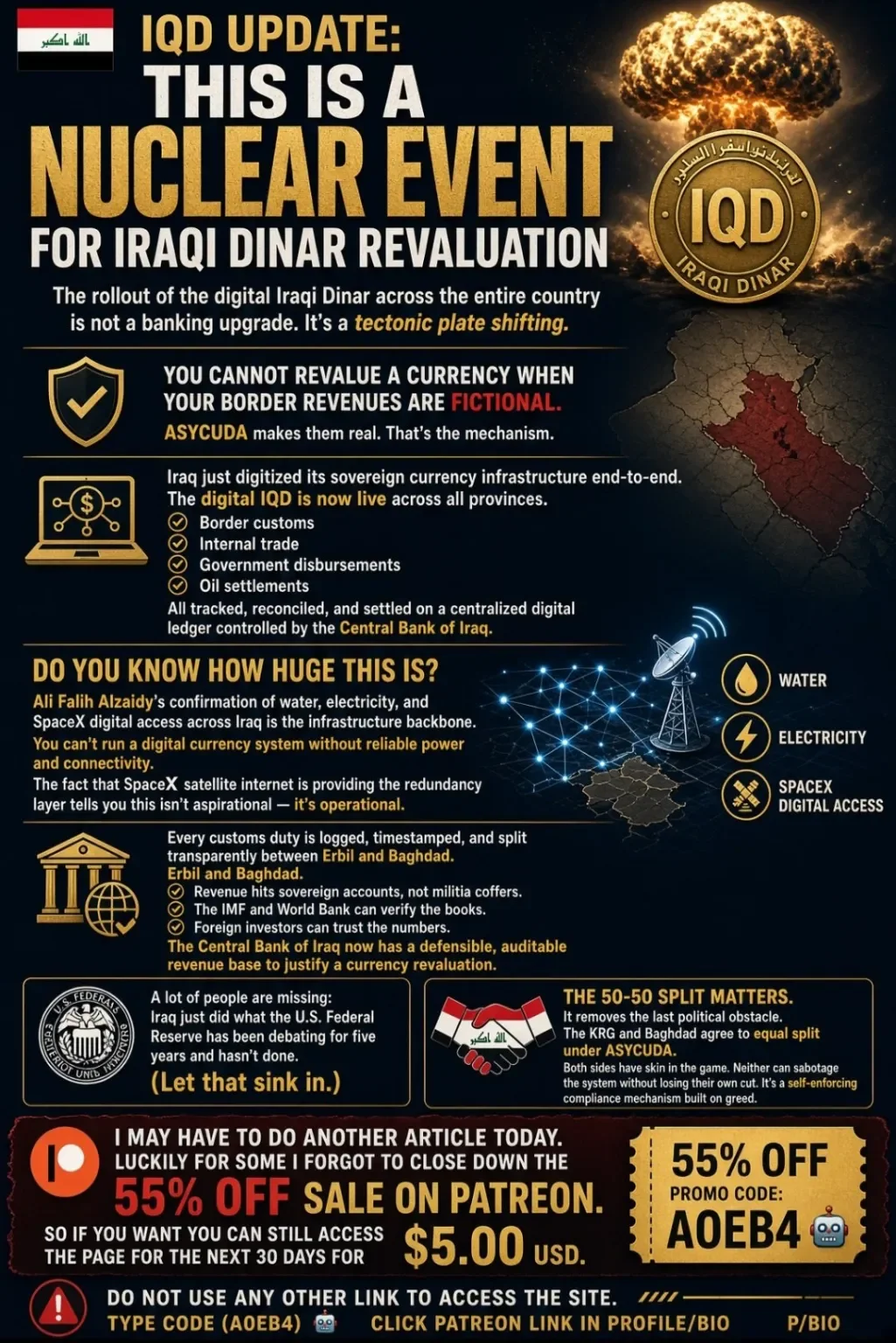
IQD Update: This Is A Nuclear Event For Iraqi Dinar Revaluation
The rollout of the digital Iraqi Dinar across the entire country is not a banking upgrade. It’s a tectonic plate shifting. Please understand this one thing people. You cannot revalue a currency when your border revenues are fictional. ASYCUDA makes them real. That’s the mechanism.
Ariel: The Iraqi Dinar Revaluation is a Shifting Tectonic Plate
8-14-2026
IQD Update: This Is A Nuclear Event For Iraqi Dinar Revaluation
The rollout of the digital Iraqi Dinar across the entire country is not a banking upgrade. It’s a tectonic plate shifting. Please understand this one thing people. You cannot revalue a currency when your border revenues are fictional. ASYCUDA makes them real. That’s the mechanism.
Iraq just digitized its sovereign currency infrastructure end-to-end. The digital IQD is now live across all provinces. That means every transaction border customs, internal trade, government disbursements, oil settlements can now be tracked, reconciled, and settled on a centralized digital ledger controlled by the Central Bank of Iraq.
Do You Know How Huge This Is?
Ali Falih Alzaidy’s confirmation of water, electricity, and SpaceX digital access across Iraq is the infrastructure backbone. You can’t run a digital currency system without reliable power and connectivity. The fact that SpaceX satellite internet is providing the redundancy layer tells you this isn’t aspirational it’s operational. The grid is live. The plumbing works.
Every customs duty is logged, timestamped, and split transparently between Erbil and Baghdad. The revenue hits sovereign accounts, not militia coffers. The IMF and World Bank can verify the books. Foreign investors can trust the numbers. And critically the Central Bank of Iraq now has a defensible, auditable revenue base to justify a currency revaluation.
A lot of people are missing: Iraq just did what the U.S. Federal Reserve has been debating for five years and hasn’t done. They digitized the sovereign currency first. That means Iraq is ahead of the United States digital deployment. (Let that sink in.)
The 50-50 split matters because it removes the last political obstacle. The KRG has been fighting Baghdad over budget disputes and border revenue sharing for over a decade. By agreeing to equal split under ASYCUDA, both sides have skin in the game. Neither can sabotage the system without losing their own cut. It’s a self-enforcing compliance mechanism built on greed.
Seeds of Wisdom RV and Economics Updates Friday Afternoon 8-14-26
Good Afternoon Dinar Recaps,
U.S.–Iran War Enters Economic Phase: Blockade Tightens as Washington Puts Oil Prices at the Center of the Endgame
The U.S. is combining maritime enforcement, unprecedented economic pressure and a renewed focus on energy prices as the conflict with Iran enters a critical phase—with the Strait of Hormuz emerging as the central economic and strategic battleground.
Good Afternoon Dinar Recaps,
U.S.–Iran War Enters Economic Phase: Blockade Tightens as Washington Puts Oil Prices at the Center of the Endgame
The U.S. is combining maritime enforcement, unprecedented economic pressure and a renewed focus on energy prices as the conflict with Iran enters a critical phase—with the Strait of Hormuz emerging as the central economic and strategic battleground.
Overview
CENTCOM says U.S. forces have redirected 62 commercial vessels, disabled three and boarded two while enforcing the maritime blockade against Iran.
Treasury Secretary Scott Bessent is preparing what he calls unprecedented economic-isolation measures, with additional actions expected next week as Washington intensifies pressure on Tehran.
The Trump administration is increasingly emphasizing affordable oil and gasoline for Americans, while keeping Iran from obtaining a nuclear weapon remains another stated objective.
Key Developments
1. The U.S. blockade is becoming an active maritime enforcement operation
U.S. Central Command says its forces have redirected 62 commercial vessels, disabled three and boarded two while enforcing the blockade against Iran.
The operations are taking place in and around the Arabian Sea and approaches to Iranian ports, with U.S. naval forces using helicopters and other assets to intercept vessels attempting to reach Iranian ports.
The significance is that the blockade is no longer simply a policy announcement. It is being actively enforced against commercial shipping.
At the same time, shipping through the Strait of Hormuz remains severely depressed. Reuters reports that only nine commodity vessels transited the waterway Thursday, compared with an August average of roughly 12 per day, with traffic remaining well below normal levels.
2. Washington is preparing a major new financial offensive
Treasury Secretary Scott Bessent says the United States will introduce unprecedented economic measures against Iran, with additional announcements expected next week.
The administration is describing the strategy as a combination of financial isolation and continued physical pressure on Iranian ports.
The financial component could extend beyond Iranian entities themselves by increasing pressure on foreign banks, companies and intermediaries that continue doing business with Iran.
That creates a difficult choice for international institutions: maintain commercial relationships with Iran or risk losing access to the U.S.-dominated financial system.
3. The Strait of Hormuz has become the economic center of the conflict
The conflict is increasingly revolving around one strategic question:
Who controls the flow of energy through the Strait of Hormuz?
The waterway is one of the world's most important energy chokepoints. Disruption there affects not only Iran but also global oil supplies, shipping costs, insurance rates and inflation expectations.
Reuters reports that U.S. officials are threatening to maintain the blockade while Iran continues to assert its own control over the waterway.
The competing claims demonstrate why reopening Hormuz has become central to any eventual settlement.
4. Energy affordability is now an explicit U.S. priority
Vice President JD Vance has said that keeping oil and gasoline prices low for Americans is the administration's top goal in the conflict, with preventing Iran from obtaining a nuclear weapon identified as the second priority.
That represents an important evolution in how Washington is publicly framing the conflict.
The war is no longer being discussed solely through the lens of military security or Iran's nuclear program. Energy prices and the economic impact on American households are now explicitly part of the strategic objective.
5. The administration is trying to apply pressure without relying solely on military escalation
The emerging strategy combines three forms of pressure:
Military: Naval enforcement and control of maritime access.
Financial: Sanctions and pressure on Iran's financial and oil networks.
Economic: Efforts to restore stable energy flows and prevent higher oil prices from damaging the U.S. economy.
This creates a potentially powerful combination—but it also creates risks.
If the blockade significantly restricts Iranian exports without restoring normal commercial shipping through Hormuz, the same policy intended to lower oil prices could contribute to higher energy costs.
Why It Matters
The most important development may be the convergence of military power, financial sanctions and energy policy.
The United States is attempting to pressure Iran economically while simultaneously trying to restore stability to global energy markets.
That creates a delicate balancing act.
Washington needs sufficient pressure to force Tehran toward an agreement, but it also needs to avoid a prolonged disruption that keeps oil prices elevated and increases inflationary pressure on American consumers.
The Strait of Hormuz therefore sits at the intersection of war, energy, trade and global finance.
Why It Matters to Foreign Currency Holders
For foreign-currency holders, this conflict has implications well beyond the Middle East.
Iran is already seeking alternative financial channels, while sanctions pressure countries and companies that continue trading with Tehran to navigate an increasingly fragmented financial system.
If the conflict continues, countries that depend heavily on Middle Eastern energy may have greater incentives to diversify energy suppliers, payment channels and reserve assets.
At the same time, higher oil prices can strengthen the currencies of energy exporters while putting pressure on energy-importing economies.
This does not establish evidence of a currency revaluation or RV event. The more important development is the continuing fragmentation of energy flows, trade relationships and financial networks.
Implications for the Global Reset
Pillar 1 — Energy
Hormuz has become a direct demonstration of how control over energy choke points can influence global prices, trade and financial stability.Pillar 2 — Trade
A sustained maritime blockade can force businesses and nations to reroute trade and reconsider their dependence on vulnerable shipping corridors.5Pillar 3 — Assets
Prolonged geopolitical and financial uncertainty can reinforce demand for reserve assets such as gold while encouraging countries to diversify away from concentrated financial exposure.
What to Watch Next
• The next round of U.S. economic measures expected from the Treasury Department.
• Whether the maritime blockade expands, contracts or remains in place indefinitely.
• Commercial shipping through the Strait of Hormuz, particularly whether traffic begins returning toward normal levels.
• Oil and gasoline prices, which have now become an explicit U.S. policy concern.
• Diplomatic activity, including efforts by European and regional governments to reopen negotiations. AP reports that Washington has expanded diplomatic outreach to Austria and Greece as efforts to resolve the Hormuz dispute continue.
• Iran's response, particularly whether Tehran attempts to challenge the blockade or instead pursues negotiations over sanctions, shipping and the reopening of Hormuz.
Bottom Line
The U.S.–Iran conflict is increasingly becoming an economic war fought through three interconnected fronts: maritime control, financial isolation and energy markets.
The immediate objective appears to be putting enough pressure on Tehran to produce a political settlement while preventing the conflict from creating a sustained oil shock for the United States and the global economy.
The critical question now is whether economic pressure can produce a negotiated reopening of Hormuz—or whether the blockade itself becomes a longer-term source of global economic disruption.
Closing Perspective
The next major move may not come from the battlefield—it may come from the intersection of the Strait of Hormuz, global oil markets and the financial pressure Washington is building around Iran.
Seeds of Wisdom Team
Newshounds News™ Exclusive
Sources
Reuters — Bessent says US to apply measures 'never seen' on Iran
Reuters — Hormuz shipping traffic capped amid competing claims from US and Iran
~~~~~~~~~~
Seeds of Wisdom Team RV Currency Facts Youtube and Rumble
Newshound's News Telegram Room Link
RV Facts with Proof Links Link
RV Updates Proof links - Facts Link
Start Here room with Most Asked Questions Link
Follow the Gold/Silver Rate COMEX
Follow Fast Facts
Seeds of Wisdom Team™Website
Thank you Dinar Recaps
Iraq Economic News and Points To Ponder Friday Afternoon 8-14-26
Sabah Al-Nu'man: The First 100 Days Of Al-Zaidi's Government Shifted Security From Crisis Management To Consolidating The State's Authority
latest news Friday, August 14, 2026 Baghdad - One News The spokesman for the Commander-in-Chief of the Armed Forces, Sabah al-Nu’man, confirmed on Friday that the first 100 days of the government of Prime Minister and Commander-in-Chief of the Armed Forces, Ali Falih al-Zaidi, have laid the foundation for a new phase of security stability, stressing that the monopoly of weapons and the decision of war and peace are the exclusive prerogatives of the official security and military institutions.
Sabah Al-Nu'man: The First 100 Days Of Al-Zaidi's Government Shifted Security From Crisis Management To Consolidating The State's Authority
latest news Friday, August 14, 2026 Baghdad - One News The spokesman for the Commander-in-Chief of the Armed Forces, Sabah al-Nu’man, confirmed on Friday that the first 100 days of the government of Prime Minister and Commander-in-Chief of the Armed Forces, Ali Falih al-Zaidi, have laid the foundation for a new phase of security stability, stressing that the monopoly of weapons and the decision of war and peace are the exclusive prerogatives of the official security and military institutions.
Al-Nu’man told the Iraqi News Agency (INA) that the first 100 days of the government were not just a time limit to evaluate performance, but rather constituted a roadmap for moving the security file from the context of crisis management to rebuilding the prestige of the state, consolidating its sovereignty, and establishing a new phase of stability.
He explained that the vision of the Commander-in-Chief of the Armed Forces stemmed from a firm constitutional principle based on the fact that protecting national security, monopolizing weapons, and making decisions about war and peace are exclusive and direct entitlements of the official security and military institutions, and do not accept, in his words, “division or interpretation.”
Al-Nu’man pointed out that the field procedures during the past period led to a comprehensive review of the leadership structure, which included injecting new blood and replacing a number of field and intelligence joints, which contributed to raising the level of preventive readiness and accelerating the response of the security and military units.
He added that these measures coincided with a strategic move to fully secure Iraq’s borders with neighboring countries, in addition to seeking to acquire the latest radar and air defense systems, and activating intelligence plans aimed at anticipating threats before they occur.
The spokesman for the Commander-in-Chief of the Armed Forces affirmed that the Iraqi security decision has become more robust and independent, noting that the military institutions have reached high levels of discipline and readiness to protect national sovereignty and ensure the stability of the country.
Al-Nu'man stressed that the first hundred days reflect a trend towards re-establishing the responsibility of the state and its official institutions for managing the security file, foremost among which is the monopoly of weapons, the possession of the decision of war and peace, securing the borders, and strengthening air defense and intelligence capabilities.
https://1news-iq.net/صباح-النعمان-أول-100-يوم-من-حكومة-الزيدي/
Hussein Arab: Saudi Arabia Is Ready To Support Baghdad Economically, Politically, And In Terms Of Security, But It Wants A Decision
latest news Friday, August 14, 2026 Baghdad - One News - 8/14/2026 Former MP Hussein Arab affirmed that Saudi Arabia has possessed significant political and economic influence in the region for decades, considering that the Kingdom has entered a new phase under Crown Prince Mohammed bin Salman, which has been reflected in its internal policies and regional relations, especially with Iraq.
Arab said that Saudi Arabia’s economic strength and unified decision-making have given it an influential role in the region for nearly fifty years, noting that the decisions taken during the reign of Crown Prince Mohammed bin Salman have transformed the Kingdom, as he described it, into a “new experiment,” and have pushed towards greater openness towards Iraq.
He added that this openness included a Saudi readiness to implement large investment projects inside Iraq, including a project to establish a large economic city in Al-Muthanna Governorate, as well as proposing a project to build a sports stadium at a cost of up to one billion dollars.
Arab believes that there are parties who do not want Saudi or Gulf investments to enter Iraq, (pro Iran political & IRI groups) noting that implementing projects of this size would expand the Gulf economic presence and strengthen relations between Baghdad and its Arab surroundings.
He stressed that Saudi Arabia, in his estimation, is ready to provide Iraq with the economic, political, security and international support it needs, but in return it wants one essential thing, which is that the Iraqi decision should come from within and be independent of external influences.(Iranian & IRGC incfuences)
Arab explained that Riyadh is not asking Baghdad to side with it, nor does it want to enter into a state of hostility with Iraq, but rather seeks to deal with a country that has its own national decision and determines its foreign relations based on its own interests. (not Iran's)He pointed out that the recent Mecca agreement between Saudi Arabia, Turkey and Pakistan paves the way, in his view, for a new phase in the region and the world, in light of the political, security and economic transformations taking place in the region.
Arab stressed that Iraq has an opportunity to benefit from Saudi and Gulf openness and obtain broad support on multiple issues, provided that it strengthens the independence of Iraqi decision-making and utilizes its regional relations in a way that serves the country's interests. https://1news-iq.net/حسين-عرب-السعودية-مستعدة-لدعم-بغداد-اق/
Al-Zaydi Orders "Unprecedented And Decisive" Measures To Combat Corruption At Border Crossings
latest newsFriday,August 14, 2026Baghdad - One News - Prime Minister and Commander-in-Chief of the Armed Forces Ali Faleh al-Zaidi announced on Friday that he has taken “unprecedented and decisive” measures to combat corruption at border crossings, directing that they be fully automated and linked to a robust electronic system to monitor work and revenues.
This came during a visit by Al-Zaydi to the headquarters of the Border Ports Authority, where he met with the Authority’s officials and greeted, via video conference, the directors of the ports and their employees, appreciating their role in protecting the country’s sovereignty and economy and ensuring the safety of citizens.
The Prime Minister stressed that border crossings represent the face of the state and its economic, security and sovereign gateway, emphasizing the need to expedite the completion of the automation project and put an end to attempts at fraud, corruption and manipulation.
Al-Zaydi directed that all border crossings be linked to a robust electronic system, and that a comprehensive daily report be provided on the movement of work and revenues, in addition to benefiting from leading global experiences in managing border crossings.
He also directed that border crossings be self-financed, through the deduction of tax and customs fees at the outset and before transfers are made, as well as the deduction of service fees and their allocation for the purposes of rehabilitating and developing the crossings.
Regarding the issue of corruption and smuggling, Al-Zaydi stressed that combating corruption at the ports will be a "top priority," and that the next phase will witness unprecedented and decisive measures, emphasizing that there will be no leniency towards drug and medicine smuggling operations, circumventing the competent authorities, and other forms of smuggling.
The Prime Minister described smuggling operations as serious crimes targeting society, stressing that the government will not tolerate those who commit them and will continue to tighten measures to reduce the exploitation of border crossings for illegal activities. https://1news-iq.net/الزيدي-يوجه-بإجراءات-غير-مسبوقة-وحاز/
Completing The Cabinet, Controlling Weapons, And Combating Corruption: Al-Zaydi And Al-Maliki Discuss Political, Security, And Economic Issues
Baghdad - One News - 8/13/2026 Prime Minister Ali Faleh al-Zaidi discussed on Thursday with Nouri Kamel al-Maliki, head of the State of Law Coalition, a number of political and national issues, foremost among them completing the formation of the cabinet and supporting the course of government work.
This came during Al-Zidi’s meeting with Al-Maliki, where the meeting addressed the issue of completing the ministerial formation, in a way that supports the performance of state institutions and enhances the government’s ability to implement its program and tasks during the next stage.
The two sides discussed government measures in the field of combating corruption and promoting integrity, along with economic reform paths and steps aimed at addressing the challenges facing the country.
The issue of restricting weapons to the state was also discussed, with emphasis on the importance of enforcing the rule of law, consolidating security and stability, and protecting state institutions.
The meeting also addressed Iraq’s foreign relations, and the importance of continuing to open up to the regional and international environment, in order to strengthen the country’s presence and relations with various countries.
On the economic side, emphasis was placed on the need to expand economic and investment partnerships, in order to contribute to confronting the current challenges facing the region and reducing their impact on the Iraqi economy.
The meeting comes amid political and governmental moves to complete the cabinet, in parallel with internal issues that top the government's priorities, most notably restricting weapons to the state, combating corruption, economic reform, and strengthening Iraq's regional and international relations. https://1news-iq.net/استكمال-الكابينة-وحصر-السلاح-ومكافحة/
Cabinet Gaps, Disarmament On Table Between PM Al-Zaidi And Nouri Al-Maliki
2026-08-13 / 13:57 Shafaq News- Baghdad Iraqi Prime Minister Ali Faleh Al-Zaidi and State of Law Coalition (SLC) leader Nouri Al-Maliki on Thursday discussed completing the Cabinet and bringing all weapons under state authority, with nine ministries still unfilled and a September 30 weapons-control deadline approaching.
The meeting also covered anti-corruption measures, integrity safeguards, and economic reform, alongside efforts to strengthen state institutions and government performance.
Iraqi Prime Minister Media Office
Prime Minister Ali Faleh Al-Zaidi Receives Head of the State of Law Coalition
•••••
Prime Minister Ali Faleh Al-Zaidi received today, Thursday, the Head of the State of Law Coalition, Nouri Kamel Al-Maliki. The meeting addressed a number of political and national issues, foremost among them completing the formation of the Cabinet, in a manner that supports the performance of state institutions and strengthens the government’s work.
The meeting also addressed support for the government’s measures to combat corruption, promote integrity, advance economic reform, ensure that all arms remain under state authority, and uphold the rule of law, in a manner that contributes to consolidating security and stability and protecting state institutions.
The meeting reviewed matters related to Iraq’s foreign relations and emphasized the importance of continuing Iraq’s engagement with its regional and international partners, as well as strengthening economic and investment partnerships to address the current challenges facing the region and their impact on the Iraqi economy.
•••••
Media Office of the Prime MinisterAugust 13, 2026 On May 14, Parliament approved Al-Zaidi’s government and ministerial program but granted confidence to only 14 of 23 ministers, with unresolved portfolios including Defense, Interior, Planning, Higher Education, Labor, Migration and Displacement, Culture, Reconstruction and Housing, and Youth and Sports. During earlier cabinet negotiations, Al-Maliki’s SLC backed Qasim Atta for the Interior Ministry, while the Defense portfolio remained subject to political bargaining.
Al-Zaidi also told CENTCOM chief Adm. Brad Cooper on August 12 that the US-led Coalition’s military mission and the departure of foreign forces would be completed by September 30, leaving Iraq free of foreign military forces from October 1. He also stressed that weapons must be confined exclusively to state authority under the law.
Read more: Iraqi armed group: No disarmament before US withdrawal, air defense
Coffee with MarkZ, joined by Mr. Cottrell. 08/14/2026
Coffee with MarkZ, joined by Mr. Cottrell. 08/14/2026
MarkZ Disclaimer: Please consider everything on this call as my opinion. Be sure to consult a professional for any financial decisions
MZ: Codeman Friday! We look at the progress in the Middle East, expectations, and quiz the Codeman. Lucas joins after the news segment to unleash some more BOGO madness.
THE CONTENT IN THIS PODCAST IS FOR GENERAL & EDUCATIONAL PURPOSES ONLY&NOT INTENDED TO PROVIDE ANY PROFESSIONAL, FINANCIAL OR LEGAL ADVICE. PLEASE CONSIDER EVERYTHING DISCUSSED IN MARKZ’S OPINION ONLY
Coffee with MarkZ, joined by Mr. Cottrell. 08/14/2026
MarkZ Disclaimer: Please consider everything on this call as my opinion. Be sure to consult a professional for any financial decisions
MZ: Codeman Friday! We look at the progress in the Middle East, expectations, and quiz the Codeman. Lucas joins after the news segment to unleash some more BOGO madness.
THE CONTENT IN THIS PODCAST IS FOR GENERAL & EDUCATIONAL PURPOSES ONLY&NOT INTENDED TO PROVIDE ANY PROFESSIONAL, FINANCIAL OR LEGAL ADVICE. PLEASE CONSIDER EVERYTHING DISCUSSED IN MARKZ’S OPINION ONLY
https://rumble.com/user/theoriginalmarkz
Kick: https://kick.com/theoriginalmarkz
Markz's linktree https://linktr.ee/theMarkZshow
FOLLOW MARKZ : TWITTER . https://twitter.com/originalmarkz?s=21. TRUTH SOCIAL . https://truthsocial.com/@theoriginalm...
Mod: MarkZ "Back To Basics" Pre-Recorded Call" for Newbies 10-19-2022 )https://www.youtube.com/watch?v=37oILmAlptM
MARKZ DAILY LINKS: https://theoriginalmarkz.com/home/
THANK YOU FOR JOINING. HAVE A BLESSED DAY. SEE YOU MONDAY MORNING FOR COFFEE @ 10:00 AM EST ~ UNLESS BREAKING NEWS HAPPENS! FOR UPDATES ON MARK’S PODCAST GO TO: https://t.me/+b3hYhYlhKM1hYzcx